Terms read 19 October 2026 Place T, revision 1
What the terms state, and what it costs that the deciding sentence sits a document away
Twelve leaves sit under this place and every deciding condition on all twelve is written down, correctly, where anybody may go and read it. Nine of those findings add as expected closes and come to £225.49, against £88.60 that the same nine claims are worth with nothing applied. £115.09 of that total is settled three documents out from the claim, and the other three leaves end at figures that will not join an expectation at all.
Stated on the banner £0.00 Of the twelve conditions that decide these leaves, the quantity settled where the claim itself is printed comes to nothing at all. Stated, once you go and look £225.49 Nine findings whose deciding sentence is drafted, filed and reachable, added as expected closes at the return assumed throughout here. Not stated before the money goes in £115.09 The slice of that total resting in a schedule the other documents defer to, which on offers of this shape is frequently published by nobody.
Offers of this kind, with every written condition read
Every destination in this file is bought advertising. The site is paid a fee if a reader goes on to register, and no figure printed below moves because of it.
Bonus Spins UK Slip 01
Betportal
Ceiling as a multiple
The drop
€15.00
€1.00 in the euro
The claim reads €15.00. Once the terms beside it have applied, €0.00 of it can leave. The difference is the drop.
7 of the 15 terms on this slip could not be read before the money went in
Spins priced at this site's own 10p a spin, which the operator does not publish
Stated
€15.00
The claim as it is printed, before a single term has been applied to it.
Headline paid as spins
150 spins at 10c each, which is €15.00 of the figure above.
6 Nowhere
What one spin is worth
No unit is published for a spin, so the count is priced at this site's own 10p a spin. At half that price every figure below halves with it.
Match and other credit not priced
300% of three deposits, to a ceiling of €1,000. A share of a deposit nobody has made yet is not a sum, so no figure stands on this line and none is carried below.
Qualified
-€14.40
Written down somewhere, and taking part of the claim back. Each term carries the place it is written and the sum it takes.
2 Written terms at a distance this record does not establish
Play-through -€14.40
Carrying €14.40 through 35 times stakes €504.00 and costs €20.16 of it at 96 per cent return. That prices above the €14.40 there is to charge it against, so the whole of the credit goes and the line is held at that. The multiple sits on the bonus.
2 Written terms at a distance this record does not establish
Game weighting not priced
Slots only count towards the play-through. No contribution percentage is published, so the line above has been worked at full weight, which is the kindest reading there is.
2 Written terms at a distance this record does not establish
Ceiling on the winnings not priced
5x the bonus.
2 Written terms at a distance this record does not establish
Clock on the credit not priced
14 days.
2 Written terms at a distance this record does not establish
Largest stake while it runs not priced
€5.
3 Public record
Licence, and who holds it not priced
Licensed in Anjouan, Comoros, held by BetPortal Gaming Ltd, with Excite Ultra Media Ltd, reference ALSI-202601040-FI2. A register entry settles who holds a licence and what it permits. It does not settle who is running the site this morning.
4 Cashier
Smallest qualifying deposit your money
€20 a stage. That is €20.00 of your own money, and it is never netted into a drop.
5 On the way out
Checks before a withdrawal not priced
Documents before the first withdrawal.
Unstated
-€0.60
Applying without having been published anywhere, and costing money all the same.
6 Nowhere
What a spin hands back -€0.60
Staking a spin returns 96 per cent of it, so that share of the batch is the house's before a reel turns. This site works at that return and the operator publishes none where the claim is made.
6 Nowhere
Forfeited by rule cost unknown
Nothing is published under this heading, and it applies regardless.
6 Nowhere
Charge on the way out cost unknown
No charge on the way out is published as a figure, so nothing comes off this line. A charge that exists unpublished would come straight off whatever survives.
6 Nowhere
Smallest withdrawal allowed cost unknown
No smallest withdrawal is published as a figure. A floor nobody has published is still a floor, and it decides whether a small balance can move at all.
No Great Britain licence
Terms read 19 October 2026
Bonus Spins UK Slip 02
WinBeast
Ceiling as a sum
The drop
€50.00
€1.00 in the euro
The claim reads €50.00. Once the terms beside it have applied, €0.00 of it can leave. The difference is the drop.
8 of the 15 terms on this slip could not be read before the money went in
Spins priced at this site's own 10p a spin, which the operator does not publish
Stated
€50.00
The claim as it is printed, before a single term has been applied to it.
Headline paid as spins
500 spins at 10c each, which is €50.00 of the figure above.
6 Nowhere
What one spin is worth
No unit is published for a spin, so the count is priced at this site's own 10p a spin. At half that price every figure below halves with it.
Match and other credit not priced
50% to 100% of five deposits, each to a ceiling of €1,000, and a €650 free bet. A share of a deposit nobody has made yet is not a sum, so no figure stands on this line and none is carried below.
Qualified
-€48.00
Written down somewhere, and taking part of the claim back. Each term carries the place it is written and the sum it takes.
2 Written terms at a distance this record does not establish
Play-through -€48.00
Carrying €48.00 through 40 times stakes €1,920.00 and costs €76.80 of it at 96 per cent return. That prices above the €48.00 there is to charge it against, so the whole of the credit goes and the line is held at that. The multiple sits on the bonus and the winnings from the spins.
2 Written terms at a distance this record does not establish
Game weighting not priced
Slots, titles vary by country count towards the play-through. No contribution percentage is published, so the line above has been worked at full weight, which is the kindest reading there is.
2 Written terms at a distance this record does not establish
Ceiling on the winnings not priced
€100 a batch of spins.
2 Written terms at a distance this record does not establish
Clock on the credit not priced
7 days, spins 1 day.
3 Public record
Licence, and who holds it not priced
Licensed in Curaçao, holder not named on the site. A register entry settles who holds a licence and what it permits. It does not settle who is running the site this morning.
4 Cashier
Smallest qualifying deposit your money
€20 a stage. That is €20.00 of your own money, and it is never netted into a drop.
5 On the way out
Checks before a withdrawal not priced
Documents before the first withdrawal.
Unstated
-€2.00
Applying without having been published anywhere, and costing money all the same.
6 Nowhere
What a spin hands back -€2.00
Staking a spin returns 96 per cent of it, so that share of the batch is the house's before a reel turns. This site works at that return and the operator publishes none where the claim is made.
6 Nowhere
Largest stake while it runs cost unknown
Nothing is published under this heading, and it applies regardless.
6 Nowhere
Forfeited by rule cost unknown
Nothing is published under this heading, and it applies regardless.
6 Nowhere
Charge on the way out cost unknown
No charge on the way out is published as a figure, so nothing comes off this line. A charge that exists unpublished would come straight off whatever survives.
6 Nowhere
Smallest withdrawal allowed cost unknown
No smallest withdrawal is published as a figure. A floor nobody has published is still a floor, and it decides whether a small balance can move at all.
No Great Britain licence
Terms read 19 October 2026
Bonus Spins UK Slip 03
EliteSpin
Longest spin window
The drop
£50.00
£1.00 in the pound
The claim reads £50.00. Once the terms beside it have applied, £0.00 of it can leave. The difference is the drop.
8 of the 15 terms on this slip could not be read before the money went in
Spins priced at this site's own 10p a spin, which the operator does not publish
Stated
£50.00
The claim as it is printed, before a single term has been applied to it.
Headline paid as spins
500 spins at 10p each, which is £50.00 of the figure above.
6 Nowhere
What one spin is worth
No unit is published for a spin, so the count is priced at this site's own 10p a spin. At half that price every figure below halves with it.
Match and other credit not priced
50% to 100% of five deposits, each to a ceiling of £1,000. A share of a deposit nobody has made yet is not a sum, so no figure stands on this line and none is carried below.
Qualified
-£48.00
Written down somewhere, and taking part of the claim back. Each term carries the place it is written and the sum it takes.
2 Written terms at a distance this record does not establish
Play-through -£48.00
Carrying £48.00 through 40 times stakes £1,920.00 and costs £76.80 of it at 96 per cent return. That prices above the £48.00 there is to charge it against, so the whole of the credit goes and the line is held at that. The multiple sits on the bonus and the winnings from the spins.
2 Written terms at a distance this record does not establish
Game weighting not priced
Slots count towards the play-through. No contribution percentage is published, so the line above has been worked at full weight, which is the kindest reading there is.
2 Written terms at a distance this record does not establish
Ceiling on the winnings not priced
5x the bonus.
2 Written terms at a distance this record does not establish
Clock on the credit not priced
7 days, spins 3 days.
3 Public record
Licence, and who holds it not priced
Licensed in Costa Rica, held by PrimeTier Limited. A register entry settles who holds a licence and what it permits. It does not settle who is running the site this morning.
4 Cashier
Smallest qualifying deposit your money
£20 a stage. That is £20.00 of your own money, and it is never netted into a drop.
5 On the way out
Checks before a withdrawal not priced
Documents before the first withdrawal.
Unstated
-£2.00
Applying without having been published anywhere, and costing money all the same.
6 Nowhere
What a spin hands back -£2.00
Staking a spin returns 96 per cent of it, so that share of the batch is the house's before a reel turns. This site works at that return and the operator publishes none where the claim is made.
6 Nowhere
Largest stake while it runs cost unknown
Nothing is published under this heading, and it applies regardless.
6 Nowhere
Forfeited by rule cost unknown
Nothing is published under this heading, and it applies regardless.
6 Nowhere
Charge on the way out cost unknown
No charge on the way out is published as a figure, so nothing comes off this line. A charge that exists unpublished would come straight off whatever survives.
6 Nowhere
Smallest withdrawal allowed cost unknown
No smallest withdrawal is published as a figure. A floor nobody has published is still a floor, and it decides whether a small balance can move at all.
No Great Britain licence
Terms read 19 October 2026
Bonus Spins UK Slip 04
Crown Jewelz
Multiple unpublished
The drop
NOT WORKED
The multiple is not published in the operator's own terms. Since the sum cannot be worked around it, none is worked.
9 of the 14 terms on this slip could not be read before the money went in
No drop worked
Stated
£15.00
The claim as it is printed, before a single term has been applied to it.
Headline paid as spins
150 spins at 10p each, which is £15.00 of the figure above.
6 Nowhere
What one spin is worth
No unit is published for a spin, so the count is priced at this site's own 10p a spin. At half that price every figure below halves with it.
Match and other credit not priced
200% of the first deposit, then 150% twice, each to a ceiling of £1,000. A share of a deposit nobody has made yet is not a sum, so no figure stands on this line and none is carried below.
Qualified
NOT WORKED
Written down somewhere, and taking part of the claim back. Each term carries the place it is written and the sum it takes.
2 Written terms at a distance this record does not establish
Play-through not priced
40x the bonus, reported rather than published by the operator.
2 Written terms at a distance this record does not establish
Game weighting not priced
Slots count towards the play-through. No contribution percentage is published, so the line above has been worked at full weight, which is the kindest reading there is.
3 Public record
Licence, and who holds it not priced
Licensed in Curaçao, number not verified, holder not named on the site. A register entry settles who holds a licence and what it permits. It does not settle who is running the site this morning.
4 Cashier
Smallest qualifying deposit your money
£20. That is £20.00 of your own money, and it is never netted into a drop.
5 On the way out
Checks before a withdrawal not priced
Documents before the first withdrawal.
Unstated
NOT WORKED
Applying without having been published anywhere, and costing money all the same.
6 Nowhere
Ceiling on the winnings cost unknown
No ceiling is published. Nothing is assumed in its place.
6 Nowhere
Clock on the credit cost unknown
Nothing is published under this heading, and it applies regardless.
6 Nowhere
Largest stake while it runs cost unknown
Nothing is published under this heading, and it applies regardless.
6 Nowhere
Forfeited by rule cost unknown
Nothing is published under this heading, and it applies regardless.
6 Nowhere
Charge on the way out cost unknown
No charge on the way out is published as a figure, so nothing comes off this line. A charge that exists unpublished would come straight off whatever survives.
6 Nowhere
Smallest withdrawal allowed cost unknown
No smallest withdrawal is published as a figure. A floor nobody has published is still a floor, and it decides whether a small balance can move at all.
No Great Britain licence
Terms read 19 October 2026
Every figure in the second and third columns is this site's own working and nothing an operator has published. A claim is priced as printed, then the share a spin hands back at 96 per cent return comes off it, then what playing the multiple through costs at the same return, and then whatever a published ceiling, a charge on the way out or a floor on the smallest withdrawal takes from what has survived. The drop is the difference between the first figure and the last. The two columns add back up to it exactly, so no money leaves a slip without a term and a place beside it.
Which column a term falls in is settled by one question: has anybody written it down. A charge a reader meets at the payment screen is written down, and it stands in the second column with the cashier against it. A condition that binds without ever having been set down stands in the third, whatever it costs. Inside each column the terms run outwards from the banner, so the order itself says how far a reader would have had to go.
A count of spins has no unit until one is supplied. Where an operator publishes what one of its own spins is worth, that figure is used and the first column says it is theirs. Where none is published, this site's own 10p a spin stands in its place and every figure below moves in proportion with it. Where the multiple itself is unpublished, no drop is worked at all, because that is the one figure the sum cannot be done without.
Three words stand where a figure cannot. Not priced is a term that is written down and carries no number the arithmetic can take. Cost unknown is a term nobody has written down, costing something nobody has put a number on. Your money is money of the reader's own, which is never netted into a drop.
None of the operators in this file holds a Great Britain licence, so none of the duties that licence carries reaches them. Each of those duties is published in its own right, which is what makes its absence here something a reader can check rather than take on trust. Every gambling company licensed in Great Britain belongs to Gamstop Online, so a reader who has shut themselves out through the scheme is not shut out here. Social Responsibility Code 5.1.1 has held a play-through to a maximum of ten times the bonus funds since 19 January 2026, and it binds a licence holder and nobody else. Asked in a post of 21 October 2025 what is lost along with the licence, the Gambling Commission's Director of Enforcement and Intelligence answered: "unfair gaming practices, financial loss, and a lack of recourse if things go wrong". The same post puts blocked payouts, and withdrawal limits pitched high enough to be unreachable, among the behaviour the Commission has recorded. Nobody under 18 may hold an account at any of them.
Terms are reproduced in the wording their operator published, and each slip is dated with the day somebody sat down and read them. 19 October 2026 is the oldest of those dates. Anybody claiming an offer is bound by that operator's full terms, which are elsewhere, and never by a line standing here.
1
Reachable is a property of a document, not of a reader
Six places settle claims on this site and five of them are awkward by nature. A public record has to be searched. A payment screen opens only after registration. An exit condition arrives when the money is already in. An unwritten default has no address at all. This is the sixth place, and it is the comfortable one: the condition exists, it is in sentences, and a link leads to it.
Which makes it the hardest position on the site to price honestly, because the usual complaint does not apply. Nothing here is concealed. Every figure in part two was read off a clause that was sitting in public when the leaf was written. The quantity this place has to measure is therefore not secrecy but separation: how far the deciding sentence stands from the claim it governs, and what that interval is worth once somebody adds it up across a whole class of offer.
The unit is the tap, one deliberate movement away from whatever was being looked at, and it was defined on the anchor leaf of this place rather than here. Nobody official counts in taps and no published rule defines one, so the unit belongs to these pages alone. Scrolling is free. Opening a document costs one. Opening a document that the first one names costs another. What follows applies that count across twelve leaves instead of one, which a leaf cannot do and is the only reason this page exists.
Run the count over the twelve and one column empties. Not a penny of the place is decided . The claim is there, in large type and accurately, and the sentence capable of moving it is at one tap or further on every single leaf. That is a definitional result rather than a discovery, since a leaf whose deciding term stood beside its claim would have been filed under the headline instead. It is still worth printing, because it fixes the starting figure for everything below at nought.
2
Twelve findings, each with the writing that produced it
Each row carries four things: a leaf, what came out of it, the position deciding that outcome, and the money. What gets printed is a result rather than a territory, so these sentences say less about what a leaf covers than its own title already does. Sequence runs by distance, nearest condition first.
- Casino welcome bonus Forty times is levied credit by credit and never once over the pot, which leaves three separately drafted invitations with no sentence anywhere totalling them. In the written terms £32.00
- Fifty spins, the clause deleted Deleting the play-through leaves thirteen lines of the same document upright, and those lines between them still permit the residue to be worked down to nothing. In the written terms £4.80
- 300 percent deposit bonus Each advertised point answers to four pounds of turnover, and solving for the point where nobody is expected to finish puts the threshold at 166.67 per cent. In the written terms £48.00
- 100 percent deposit bonus A single noun decides whether the multiple grips the credited half or the balance entire, which is £400.00 of turnover set against £800.00 of it. In the written terms £16.00
- Seventy spins, the clause denied The condition the headline denies would have taken £10.75, while a release floor nobody thought to deny, filed in another chapter, holds the entire balance where it stands. In the written terms £6.72
- Thirty spins, a promise defined The verb is defined accurately and four conditions survive the promise untouched, one of them a floor that keeps £2.88 permanently stationary. In the written terms £2.88
- A hundred spins, a cap instead A ceiling occupies the slot a struck play-through vacated, idle until a balance reaches 5.21 times the expectation and from there removing every pound above £50.00. In the written terms £70.00
- 400 percent deposit bonus A written cap halts the multiplier dead above a payment of £25.00, so £100.00 paid in collects £100.00 of credit where the advertised ratio computes £400.00. In the written terms £300.00
- 200 percent deposit bonus Nothing refuses a press above the stake ceiling at the button, so £800.00 of turnover supplies 8,000 chances to void a balance and the refusal is delivered at the exit. On the way out £20.00
- Two hundred spins, by instalment The count arrives as a sequence of appointments, so the largest holding at any instant is £2.00 of turnover and three missed days subtract £5.76. Nowhere in writing £5.76
- Bingo sign up bonus Clause 6 asks for 33.33 hours inside a room and a seven day window supplies 21, leaving the condition unmeetable by 12.33 hours that nobody’s document records. Nowhere in writing £16.00
- Slots sign up bonus The rate staking is credited at lives in a different table from the multiple, and moving it to the 30 per cent on record turns £1,000.00 of staking into £3,333.33. Nowhere in writing £93.33
- Nine of these added as expected closes, with the three contingent findings held out of the addition £225.49
£225.49 between nine conditions read and the same nine left in documents nobody opened
Eight of those twelve findings are settled in the written terms, which is what a place with this name should produce and would be unremarkable on its own. The interesting rows are the four that are not. One is settled on the way out, where a stake ceiling drafted in advance is enforced only when a balance tries to leave. Three are settled nowhere in writing, because the schedule the written terms defer to is, on offers of this shape, routinely a document that was never published.
3
Three figures that declined to join a total
Adding twelve numbers is trivial and adding these twelve would be dishonest. Nine of them answer the same question, which is what a claim is expected to be worth before and after its condition is applied. Three answer different questions, and mixing the four kinds would produce a figure with no interpretation whatsoever.
Take them one at a time. A ceiling at £50.00 does nothing until a balance exceeds it, so a leaf pricing one has to posit a balance; £70.00 is what the excess costs on a residue of £120.00, which is 12.5 times what the arithmetic expects. A stake ceiling costs nothing until somebody presses over it; £20.00 is what one such press removes, and whether it happens is a fact about a reader rather than about a document. A cap on credit bites only above a payment of £25.00; £300.00 is what a payment of £100.00 forfeits, four times the size at which the cap starts to matter.
| Kind of finding | Where the kind is settled | Leaves | Money |
|---|---|---|---|
| An expected close, before against after | in the written terms | 6 | £110.40 |
| An expected close whose deciding table may be absent | nowhere in writing | 3 | £115.09 |
| Conditional on an outcome of a stated size arising | in the written terms | 1 | £70.00 |
| Conditional on one act by whoever is pressing | on the way out | 1 | £20.00 |
| Credit withheld above a payment the claim never names | in the written terms | 1 | £300.00 |
The first two rows add, because both are expectations built from the same four assumptions, and £110.40 with £115.09 is the £225.49 in the shelf. The last three do not, and they come to £390.00 of exposure which is real, sourced from the leaves, and not an expectation of anything.
Put every row in one column and the answer would be £615.49. That figure is available to anybody with a calculator and it is the wrong figure, because it reports a certainty and three contingencies as though they were one quantity. Both numbers are printed here so that neither has to be taken on trust, and the £390.00 is kept beside the total rather than inside it.
4
The same sum reached again, clause type by clause type
Route one works down the leaves and uses only the two readings each of them prints. Nine claims read with nothing applied come to £88.60. The identical nine, each with its own written condition applied, come to minus £136.89. Subtracting the second from the first leaves £225.49.
Nine claims of this place, no condition applied £88.60 The identical nine, each written condition applied minus £136.89 What the documents of this place cost unopened £225.49
Route two never touches either of those columns. It sorts the nine by the kind of sentence doing the damage and works each kind from its own mechanism, which means the two routes share no arithmetic step at all.
Four leaves are decided by a plain multiple of forty over a credit and nothing else, and their credits come to £70.00. Forty lots of £70.00 is £2,800.00 of turnover, of which reels returning 96 pence in the pound retain four pence in each, which is £112.00. Three leaves are decided by a sentence that takes the whole of what was standing, so each difference equals its own residue: £4.80, £6.72 and £2.88, which is £14.40. One leaf is decided by a release pattern, where three lapsed instalments of ten remove three tenths of £19.20, or £5.76. One is decided by a contribution rate, where dividing forty by 0.3 raises the effective multiple to 133.33, takes the staking to £3,333.33 and drops the close by £93.33.
£112.00 and £14.40 and £5.76 and £93.33 come to £225.49, and the two routes agree to the penny. The agreement is worth having because it is not forced: route one leans on figures the leaves printed, route two rebuilds each group from the clause and the margin. Route two also answers a question route one cannot. One sentence type, the bare forty times line, accounts for 49.7 per cent of the place across four leaves, and a single unpublished percentage on one leaf accounts for 41.4 per cent more.
5
Putting a price on one step of remove
Now the measurement this place was built to make. Each of the nine deciding sentences sits a countable number of documents from the claim it qualifies, and sorting the money by that count turns an argument about layout into three figures.
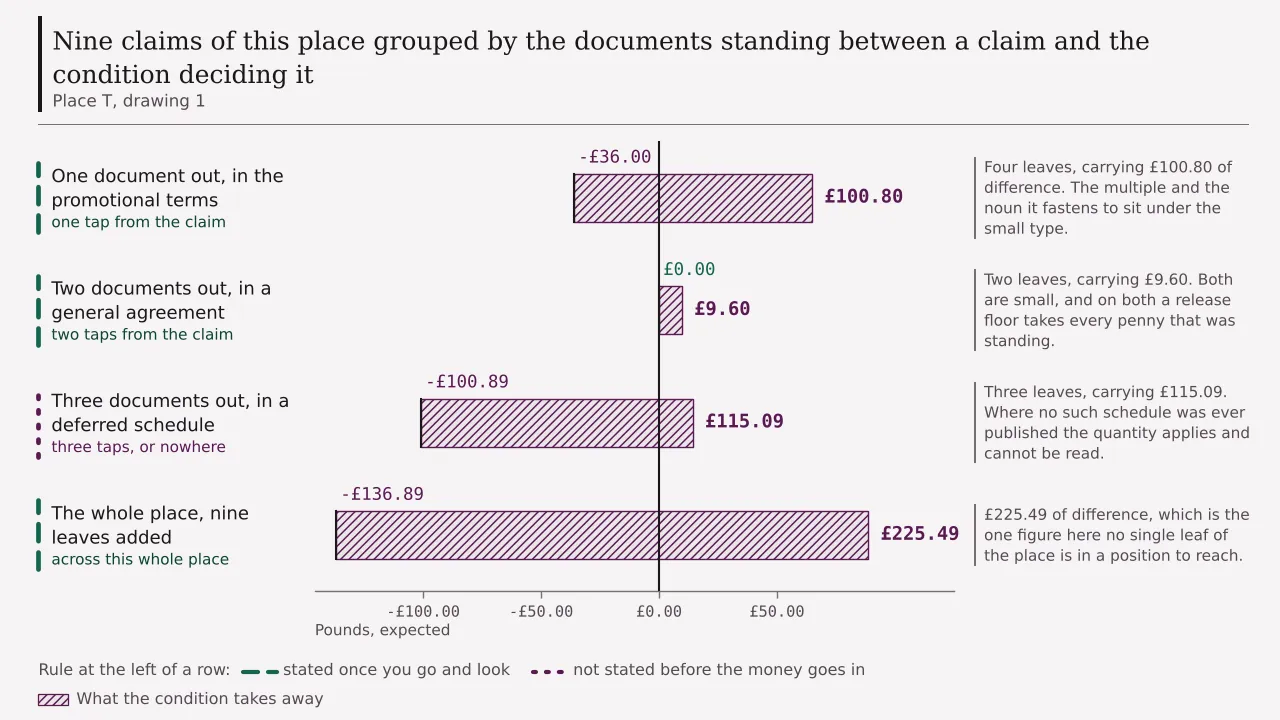
One tap out, in the promotional terms the small type links to, sit four of the nine, holding £100.80. Two taps out, in a second document written before the offer existed, sit two, holding £9.60. Three taps out, in a schedule the other documents defer to, sit three, holding £115.09. The tap counts are this page’s own reading of where each leaf says its clause lives, and no published rule assigns a number to any of them.
| Steps from the claim | The writing that holds it | Leaves | Money | Share of the place | Per leaf |
|---|---|---|---|---|---|
| None at all | The claim as published | 0 | £0.00 | Nothing | Nothing |
| One | Promotional terms, under the small type | 4 | £100.80 | 44.7 per cent | £25.20 |
| Two | An agreement drafted for every customer | 2 | £9.60 | 4.3 per cent | £4.80 |
| Three | A schedule the other documents defer to | 3 | £115.09 | 51.0 per cent | £38.36 |
Read the per-leaf column and the rate of the thing comes out. A sentence one document away costs £25.20 on the leaves it governs. A sentence three documents away costs £38.36, which is 52.2 per cent more per leaf for two further steps. The middle band is low in absolute money and not low in effect, those two leaves being small offers where a floor takes 100 per cent of what was there: £6.72 of £6.72 and £2.88 of £2.88.
£115.09 lodged three documents out against £100.80 at one document and £9.60 at two
One summary figure falls out of the table and it is the sharpest thing this place holds. Weight each step by the leaves standing at it and the average clause is 1.89 documents from its claim. Weight the same steps by the pounds instead and the average pound is 2.06 documents out, 9.2 per cent further than the clauses are. Money, in other words, is not distributed evenly through a filing system. It settles at the back.
6
What a reader who stops early has still not seen
Turn the ladder round and it becomes advice, which the ladder by itself is not. A reader does not decide how far a clause sits from a claim. A reader decides how many documents to open, and the table above says exactly what each decision is worth.
Stop at the claim and the whole £225.49 is unseen. Open the promotional terms and £124.69 remains unseen. Open the account agreement as well and the figure barely moves, to £115.09. Open the schedule behind both and nothing is left outstanding, where the schedule exists.
The shape of that sequence runs against the way reading effort is usually spent. The first document is the one everybody is told to open and it recovers 44.7 per cent. The second is the one that sounds forbidding, runs to many thousands of words, and recovers 4.3 per cent on these leaves. The third is a table with no prose round it, frequently no name of its own and sometimes no link pointing at it, and it recovers 51.0 per cent. Effort and payment are close to inversely sorted.
A caution belongs on that, because three leaves is a thin sample for a general claim. What the band supports is a statement about these twelve and the drafting they share: a quantity handed off to a schedule tends to be the quantity that multiplies everything else. A contribution rate multiplies a multiple. A timetable multiplies a count. A room’s opening hours multiply a window. None of those subtracts a little. Each scales the whole arrangement, and each is the furthest-filed thing in it.
7
Giving these documents the credit they are owed
Nothing above works unless the concession is made first and made properly. Operators behind offers of this shape have done the thing they are asked to do. The multiple is in a document. The ceiling is in a document. The floor, the timetable and the definition of the verb are all in documents, stated correctly, before a penny has moved. Of the £225.49, the portion attributable to anything anybody concealed is £0.00.
So a page calling a reachable clause a trick would be making a false statement about the thing it set out to measure, and it would also be useless, because a reader warned about tricks goes looking for the wrong object. The object is a filing decision. It is lawful, ordinary, and worth £225.49 across these leaves at the stakes and the return assumed here.
Britain’s answer is not a rule about length. It is a duty about siting, and the regulator writes down the consequence alongside the requirement: a significant term belongs within the advertisement, standing near the offer wherever a reader lands and wherever a reader registers, and prominence below that standard makes the whole advertisement a misleading one. Position there is measured down a page rather than across a set of documents, and it bears on the single distance this place has already priced at nought.
Two adjudications a fortnight apart fix the ends of the interval. 17 July 2024: a £10 offer carried a deadline, the advertisement did not carry it, and dropping a term of that weight was taken to be capable of misleading. 31 July 2024: a method of paying that the offer would not take was named down in the conditions, set too small to do its job, and the ruling turned on prominence. One failure put a condition nowhere at all. The other put one a single tap away, and that was not enough either. Nothing calculated on this page has ever been adjudicated by anybody, and the pair of dates still carries the proposition the place rests on, which is that getting at a term and reading it have already been pulled apart by somebody with the authority to pull them apart.
Put these twelve arrangements under a British licence and four sentences come into force, each about where a condition sits or whether it may shift once a reader has looked at it. A significant term would stand within the advertisement, near the offer, on the page somebody lands on and the page somebody registers on, weak prominence being enough to make the advertisement misleading. A material change to the conditions would be put to the customer ahead of the day it bit, and the change itself would have to be fair and transparent. An incentive could not be revalued merely because its qualifying activity got finished early, across some fraction of the period instead of all of it. And no step of the dealing, from first approach to last, could amount to an unfair commercial practice. Every arrangement grouped here holds no Great Britain licence, so all four lapse together, and what lapses with them is the only thing that ever held the distance in part five to a number: where no duty about siting is owed by anybody, 1.89 documents is a custom and not a limit.
8
Where writing runs out and the next place begins
Three rows of the shelf are labelled as settled by no document, which on a page about documents needs explaining rather than glossing. The schedule those three defer to exists on some offers and not on others, and whichever it is, the quantity inside it applies. The anchor leaf of this place works through why that is not a contradiction. What a place can do and a leaf cannot is measure the band.
The band is £115.09, which is 51.0 per cent of everything this place found. Where the table is published, that money is three taps away and recoverable by anybody prepared to walk three taps. Where it is not, the identical money sits nowhere in writing and is recoverable by nobody, because there is no document to open. The clause is the same clause. The arithmetic is the same arithmetic. The only variable is whether somebody published a table, and no rule outside a British licence obliges anyone to.
That is the frontier between this place and the place next door, and it is a frontier rather than a wall. A condition crosses it without being redrafted. It needs only to be deferred to a document that then turns out not to exist, at which point the money stops being merely far away and becomes unfindable. Half the money this place holds is standing on that line.
An honest reader should notice what this implies about the other direction too. A term moved from a schedule into the promotional document does not get smaller. It gets £25.20 a leaf instead of £38.36 a leaf, on these twelve, which is a 34.3 per cent reduction in what it costs and no reduction whatever in what it says. Siting is worth roughly a third of a condition’s price out here, which is all the distance buys and is still the interval between £38.36 and £25.20.
9
Opening a set of conditions in the order the money sits in
Everything above produces one practical instruction, and it is not the instruction usually given. Reading terms from the top is reading them in drafting order, and drafting order has nothing to do with money. Read them in the order part five establishes instead, which takes about the same time and finds the figures sooner.
Begin with the sentence giving the multiple and the noun it attaches to. On these twelve that one sentence type is 49.7 per cent of the place, and the noun beside it settles £400.00 of turnover against £800.00 on a single leaf. Go next to whatever percentage, rate or weighting the terms mention without defining, since a rate that multiplies the multiple is worth more than the multiple: moving one from full to 30 per cent was £93.33 on a credit of £25.00. Then find the floor, which is the cheapest clause to read and twice took every penny of a small balance. Then the ceilings, both kinds, the one capping the credit and the one capping a press.
Two questions settle the rest. Ask what the terms defer to and whether the document they defer to can actually be opened, because an unopenable deferral is the £115.09 row and the frontier in part eight. Ask when each condition is checked, because a stake ceiling written in advance and tested at the exit behaves like a condition on the way out whatever document it was printed in.
Then do the subtraction twice, as part four does, once down the claims and once across the clause types. Two routes that agree mean the working holds. Two routes that disagree mean an assumption was spent somewhere without being named, which on this subject is the only error that matters, since a figure read off a document and a figure a reader supplied look identical once they are both in a column.
Questions
- If the terms are written down and linked, what is the problem?
- Distance, and it is measurable. Every deciding condition under this place is drafted correctly and reachable, and not one of them stands where the claim is made. Nine of the twelve findings add as expected closes to £225.49, of which £100.80 is one document away, £9.60 is two away and £115.09 is three away. Nothing has to be concealed, misstated or unfair for that total to be exactly what it is.
- How far from a bonus claim are the full conditions allowed to sit?
- Britain puts no number on it. What gets regulated is position on a page rather than separation between documents: a significant term has to sit within the advertisement, near the offer, on the page somebody lands on and the page somebody signs up on, and prominence under that mark turns the advertisement into a misleading one. Nothing of the sort reaches the arrangements grouped under this place, which hold no British licence at all, so where a condition is filed comes down to whoever drafted the filing.
- Which single clause is worth the most across offers like these?
- A bare play-through multiple of forty, which decides four of the twelve leaves on its own and carries £112.00 of the £225.49, or 49.7 per cent. Forty lots of £70.00 of credit is £2,800.00 of turnover, and reels returning 96 pence in the pound keep four pence of every one of those pounds. The second most costly is an unpublished contribution rate on one leaf, at £93.33.
- Does reading the small print actually recover the money?
- Partly, and the shares are uneven. Opening the promotional terms recovers 44.7 per cent of what this place found. Adding the account agreement recovers 4.3 per cent more. The remaining 51.0 per cent is in a schedule the other documents defer to, which has no obvious name, frequently no link and on many offers no existence at all. Reading effort and money recovered run close to inversely sorted.
- Why are three of the twelve figures kept out of the total?
- Because they answer different questions. A ceiling costing £70.00 needs a residue of £120.00 to exist first, which is 12.5 times the expectation. A stake ceiling costing £20.00 needs one press above the line, which is an act rather than a clause. A credit cap costing £300.00 needs a payment of £100.00, four times the £25.00 at which it starts to bite. Those three come to £390.00 of contingent exposure, printed beside the total and not inside it.
- What is the £225.49 for this place and how was it worked out?
- Twice, by routes sharing no step. Nine claims read with nothing applied come to £88.60, the same nine with each written condition applied come to minus £136.89, and the subtraction is £225.49. Separately, four leaves on a plain forty times line give £112.00, three leaves where a sentence takes the whole residue give £14.40, one release pattern gives £5.76 and one contribution rate gives £93.33, which is £225.49 again.
- Is a term in a separate schedule still binding on me?
- Yes, and that is the uncomfortable part. A condition is as binding three documents out as it would be beside the claim, and distance changes only the chance that anybody reads it. On these twelve the furthest-filed conditions are also the ones that multiply everything else: a contribution rate multiplies a multiple, a timetable multiplies a count, and a room’s opening hours multiply a window.
- What happens when the schedule the terms point at does not exist?
- The quantity applies anyway and stops being checkable. That is £115.09 of this place, or 51.0 per cent, standing on the line between a condition filed three documents out and a condition settled nowhere in writing. The clause is not redrafted when it crosses: it is simply deferred to a table nobody published, and outside a British licence no rule obliges anybody to publish one.
- Has anyone ever been held to account over a term being too far from the offer?
- Two adjudications a fortnight apart in 2024 come nearest to it. The first, on 17 July, concerned a deadline on a £10 offer that the advertisement never mentioned, and dropping a term of that weight was taken to be capable of misleading. The second, on 31 July, concerned a payment method shut out of an offer that was printed inside the full conditions, in type too small to carry it, and the verdict went against it for failing to stand out. An absence failed and a presence at one remove failed as well, which is precisely the pair this place measures between.
- In what order should I read a set of bonus conditions?
- In money order rather than drafting order. Find the multiple and the noun it attaches to first, since that pair settled £400.00 of turnover against £800.00 on one leaf here. Find any rate or weighting the terms mention without defining second, because moving one from full to 30 per cent was worth £93.33 on a £25.00 credit. Then the withdrawal floor, then the two sorts of ceiling, then ask what the terms defer to and whether it can be opened at all.