Terms read 19 October 2026 Leaf T07, revision 1
Twenty pounds on screen, two tens underneath, and one line deciding which is which
A match paid at par on £10.00 leaves an account reading £20.00, half of it out of a bank and half of it typed in by whoever wrote the offer. Forty times the typed half is £400.00 over the reels. Forty times both halves is £800.00, and a balance of that size is expected to run dry at £500.00. One line in one document picks between those, and the banner has no room for it.
Stated on the banner £20.00 A par match on a £10.00 payment. The screen then shows two sums of equal size and treats them as one total. Stated, once you go and look £800.00 What forty times asks where the wagering clause names the whole balance rather than the credited half alone. Not stated before the money goes in Silence on four points Which half drains first, what a build counts for, the smallest payment a method will take, and the paperwork raised at the exit.
Matched offers, with the written terms read
Every destination in this file is bought advertising. The site is paid a fee if a reader goes on to register, and no figure printed below moves because of it.
Bonus Spins UK Slip 01
Betportal
Ceiling as a multiple
The drop
€15.00
€1.00 in the euro
The claim reads €15.00. Once the terms beside it have applied, €0.00 of it can leave. The difference is the drop.
7 of the 15 terms on this slip could not be read before the money went in
Spins priced at this site's own 10p a spin, which the operator does not publish
Stated
€15.00
The claim as it is printed, before a single term has been applied to it.
Headline paid as spins
150 spins at 10c each, which is €15.00 of the figure above.
6 Nowhere
What one spin is worth
No unit is published for a spin, so the count is priced at this site's own 10p a spin. At half that price every figure below halves with it.
Match and other credit not priced
300% of three deposits, to a ceiling of €1,000. A share of a deposit nobody has made yet is not a sum, so no figure stands on this line and none is carried below.
Qualified
-€14.40
Written down somewhere, and taking part of the claim back. Each term carries the place it is written and the sum it takes.
2 Written terms at a distance this record does not establish
Play-through -€14.40
Carrying €14.40 through 35 times stakes €504.00 and costs €20.16 of it at 96 per cent return. That prices above the €14.40 there is to charge it against, so the whole of the credit goes and the line is held at that. The multiple sits on the bonus.
2 Written terms at a distance this record does not establish
Game weighting not priced
Slots only count towards the play-through. No contribution percentage is published, so the line above has been worked at full weight, which is the kindest reading there is.
2 Written terms at a distance this record does not establish
Ceiling on the winnings not priced
5x the bonus.
2 Written terms at a distance this record does not establish
Clock on the credit not priced
14 days.
2 Written terms at a distance this record does not establish
Largest stake while it runs not priced
€5.
3 Public record
Licence, and who holds it not priced
Licensed in Anjouan, Comoros, held by BetPortal Gaming Ltd, with Excite Ultra Media Ltd, reference ALSI-202601040-FI2. A register entry settles who holds a licence and what it permits. It does not settle who is running the site this morning.
4 Cashier
Smallest qualifying deposit your money
€20 a stage. That is €20.00 of your own money, and it is never netted into a drop.
5 On the way out
Checks before a withdrawal not priced
Documents before the first withdrawal.
Unstated
-€0.60
Applying without having been published anywhere, and costing money all the same.
6 Nowhere
What a spin hands back -€0.60
Staking a spin returns 96 per cent of it, so that share of the batch is the house's before a reel turns. This site works at that return and the operator publishes none where the claim is made.
6 Nowhere
Forfeited by rule cost unknown
Nothing is published under this heading, and it applies regardless.
6 Nowhere
Charge on the way out cost unknown
No charge on the way out is published as a figure, so nothing comes off this line. A charge that exists unpublished would come straight off whatever survives.
6 Nowhere
Smallest withdrawal allowed cost unknown
No smallest withdrawal is published as a figure. A floor nobody has published is still a floor, and it decides whether a small balance can move at all.
No Great Britain licence
Terms read 19 October 2026
Bonus Spins UK Slip 02
WinBeast
Ceiling as a sum
The drop
€50.00
€1.00 in the euro
The claim reads €50.00. Once the terms beside it have applied, €0.00 of it can leave. The difference is the drop.
8 of the 15 terms on this slip could not be read before the money went in
Spins priced at this site's own 10p a spin, which the operator does not publish
Stated
€50.00
The claim as it is printed, before a single term has been applied to it.
Headline paid as spins
500 spins at 10c each, which is €50.00 of the figure above.
6 Nowhere
What one spin is worth
No unit is published for a spin, so the count is priced at this site's own 10p a spin. At half that price every figure below halves with it.
Match and other credit not priced
50% to 100% of five deposits, each to a ceiling of €1,000, and a €650 free bet. A share of a deposit nobody has made yet is not a sum, so no figure stands on this line and none is carried below.
Qualified
-€48.00
Written down somewhere, and taking part of the claim back. Each term carries the place it is written and the sum it takes.
2 Written terms at a distance this record does not establish
Play-through -€48.00
Carrying €48.00 through 40 times stakes €1,920.00 and costs €76.80 of it at 96 per cent return. That prices above the €48.00 there is to charge it against, so the whole of the credit goes and the line is held at that. The multiple sits on the bonus and the winnings from the spins.
2 Written terms at a distance this record does not establish
Game weighting not priced
Slots, titles vary by country count towards the play-through. No contribution percentage is published, so the line above has been worked at full weight, which is the kindest reading there is.
2 Written terms at a distance this record does not establish
Ceiling on the winnings not priced
€100 a batch of spins.
2 Written terms at a distance this record does not establish
Clock on the credit not priced
7 days, spins 1 day.
3 Public record
Licence, and who holds it not priced
Licensed in Curaçao, holder not named on the site. A register entry settles who holds a licence and what it permits. It does not settle who is running the site this morning.
4 Cashier
Smallest qualifying deposit your money
€20 a stage. That is €20.00 of your own money, and it is never netted into a drop.
5 On the way out
Checks before a withdrawal not priced
Documents before the first withdrawal.
Unstated
-€2.00
Applying without having been published anywhere, and costing money all the same.
6 Nowhere
What a spin hands back -€2.00
Staking a spin returns 96 per cent of it, so that share of the batch is the house's before a reel turns. This site works at that return and the operator publishes none where the claim is made.
6 Nowhere
Largest stake while it runs cost unknown
Nothing is published under this heading, and it applies regardless.
6 Nowhere
Forfeited by rule cost unknown
Nothing is published under this heading, and it applies regardless.
6 Nowhere
Charge on the way out cost unknown
No charge on the way out is published as a figure, so nothing comes off this line. A charge that exists unpublished would come straight off whatever survives.
6 Nowhere
Smallest withdrawal allowed cost unknown
No smallest withdrawal is published as a figure. A floor nobody has published is still a floor, and it decides whether a small balance can move at all.
No Great Britain licence
Terms read 19 October 2026
Bonus Spins UK Slip 03
EliteSpin
Longest spin window
The drop
£50.00
£1.00 in the pound
The claim reads £50.00. Once the terms beside it have applied, £0.00 of it can leave. The difference is the drop.
8 of the 15 terms on this slip could not be read before the money went in
Spins priced at this site's own 10p a spin, which the operator does not publish
Stated
£50.00
The claim as it is printed, before a single term has been applied to it.
Headline paid as spins
500 spins at 10p each, which is £50.00 of the figure above.
6 Nowhere
What one spin is worth
No unit is published for a spin, so the count is priced at this site's own 10p a spin. At half that price every figure below halves with it.
Match and other credit not priced
50% to 100% of five deposits, each to a ceiling of £1,000. A share of a deposit nobody has made yet is not a sum, so no figure stands on this line and none is carried below.
Qualified
-£48.00
Written down somewhere, and taking part of the claim back. Each term carries the place it is written and the sum it takes.
2 Written terms at a distance this record does not establish
Play-through -£48.00
Carrying £48.00 through 40 times stakes £1,920.00 and costs £76.80 of it at 96 per cent return. That prices above the £48.00 there is to charge it against, so the whole of the credit goes and the line is held at that. The multiple sits on the bonus and the winnings from the spins.
2 Written terms at a distance this record does not establish
Game weighting not priced
Slots count towards the play-through. No contribution percentage is published, so the line above has been worked at full weight, which is the kindest reading there is.
2 Written terms at a distance this record does not establish
Ceiling on the winnings not priced
5x the bonus.
2 Written terms at a distance this record does not establish
Clock on the credit not priced
7 days, spins 3 days.
3 Public record
Licence, and who holds it not priced
Licensed in Costa Rica, held by PrimeTier Limited. A register entry settles who holds a licence and what it permits. It does not settle who is running the site this morning.
4 Cashier
Smallest qualifying deposit your money
£20 a stage. That is £20.00 of your own money, and it is never netted into a drop.
5 On the way out
Checks before a withdrawal not priced
Documents before the first withdrawal.
Unstated
-£2.00
Applying without having been published anywhere, and costing money all the same.
6 Nowhere
What a spin hands back -£2.00
Staking a spin returns 96 per cent of it, so that share of the batch is the house's before a reel turns. This site works at that return and the operator publishes none where the claim is made.
6 Nowhere
Largest stake while it runs cost unknown
Nothing is published under this heading, and it applies regardless.
6 Nowhere
Forfeited by rule cost unknown
Nothing is published under this heading, and it applies regardless.
6 Nowhere
Charge on the way out cost unknown
No charge on the way out is published as a figure, so nothing comes off this line. A charge that exists unpublished would come straight off whatever survives.
6 Nowhere
Smallest withdrawal allowed cost unknown
No smallest withdrawal is published as a figure. A floor nobody has published is still a floor, and it decides whether a small balance can move at all.
No Great Britain licence
Terms read 19 October 2026
Bonus Spins UK Slip 04
Crown Jewelz
Multiple unpublished
The drop
NOT WORKED
The multiple is not published in the operator's own terms. Since the sum cannot be worked around it, none is worked.
9 of the 14 terms on this slip could not be read before the money went in
No drop worked
Stated
£15.00
The claim as it is printed, before a single term has been applied to it.
Headline paid as spins
150 spins at 10p each, which is £15.00 of the figure above.
6 Nowhere
What one spin is worth
No unit is published for a spin, so the count is priced at this site's own 10p a spin. At half that price every figure below halves with it.
Match and other credit not priced
200% of the first deposit, then 150% twice, each to a ceiling of £1,000. A share of a deposit nobody has made yet is not a sum, so no figure stands on this line and none is carried below.
Qualified
NOT WORKED
Written down somewhere, and taking part of the claim back. Each term carries the place it is written and the sum it takes.
2 Written terms at a distance this record does not establish
Play-through not priced
40x the bonus, reported rather than published by the operator.
2 Written terms at a distance this record does not establish
Game weighting not priced
Slots count towards the play-through. No contribution percentage is published, so the line above has been worked at full weight, which is the kindest reading there is.
3 Public record
Licence, and who holds it not priced
Licensed in Curaçao, number not verified, holder not named on the site. A register entry settles who holds a licence and what it permits. It does not settle who is running the site this morning.
4 Cashier
Smallest qualifying deposit your money
£20. That is £20.00 of your own money, and it is never netted into a drop.
5 On the way out
Checks before a withdrawal not priced
Documents before the first withdrawal.
Unstated
NOT WORKED
Applying without having been published anywhere, and costing money all the same.
6 Nowhere
Ceiling on the winnings cost unknown
No ceiling is published. Nothing is assumed in its place.
6 Nowhere
Clock on the credit cost unknown
Nothing is published under this heading, and it applies regardless.
6 Nowhere
Largest stake while it runs cost unknown
Nothing is published under this heading, and it applies regardless.
6 Nowhere
Forfeited by rule cost unknown
Nothing is published under this heading, and it applies regardless.
6 Nowhere
Charge on the way out cost unknown
No charge on the way out is published as a figure, so nothing comes off this line. A charge that exists unpublished would come straight off whatever survives.
6 Nowhere
Smallest withdrawal allowed cost unknown
No smallest withdrawal is published as a figure. A floor nobody has published is still a floor, and it decides whether a small balance can move at all.
No Great Britain licence
Terms read 19 October 2026
Every figure in the second and third columns is this site's own working and nothing an operator has published. A claim is priced as printed, then the share a spin hands back at 96 per cent return comes off it, then what playing the multiple through costs at the same return, and then whatever a published ceiling, a charge on the way out or a floor on the smallest withdrawal takes from what has survived. The drop is the difference between the first figure and the last. The two columns add back up to it exactly, so no money leaves a slip without a term and a place beside it.
Which column a term falls in is settled by one question: has anybody written it down. A charge a reader meets at the payment screen is written down, and it stands in the second column with the cashier against it. A condition that binds without ever having been set down stands in the third, whatever it costs. Inside each column the terms run outwards from the banner, so the order itself says how far a reader would have had to go.
A count of spins has no unit until one is supplied. Where an operator publishes what one of its own spins is worth, that figure is used and the first column says it is theirs. Where none is published, this site's own 10p a spin stands in its place and every figure below moves in proportion with it. Where the multiple itself is unpublished, no drop is worked at all, because that is the one figure the sum cannot be done without.
Three words stand where a figure cannot. Not priced is a term that is written down and carries no number the arithmetic can take. Cost unknown is a term nobody has written down, costing something nobody has put a number on. Your money is money of the reader's own, which is never netted into a drop.
None of the operators in this file holds a Great Britain licence, so none of the duties that licence carries reaches them. Each of those duties is published in its own right, which is what makes its absence here something a reader can check rather than take on trust. Every gambling company licensed in Great Britain belongs to Gamstop Online, so a reader who has shut themselves out through the scheme is not shut out here. Social Responsibility Code 5.1.1 has held a play-through to a maximum of ten times the bonus funds since 19 January 2026, and it binds a licence holder and nobody else. Asked in a post of 21 October 2025 what is lost along with the licence, the Gambling Commission's Director of Enforcement and Intelligence answered: "unfair gaming practices, financial loss, and a lack of recourse if things go wrong". The same post puts blocked payouts, and withdrawal limits pitched high enough to be unreachable, among the behaviour the Commission has recorded. Nobody under 18 may hold an account at any of them.
Terms are reproduced in the wording their operator published, and each slip is dated with the day somebody sat down and read them. 19 October 2026 is the oldest of those dates. Anybody claiming an offer is bound by that operator's full terms, which are elsewhere, and never by a line standing here.
1
A balance of twenty pounds built from two unlike tens
Pay in ten pounds against a par match and the account reads twenty. Ten of those pounds came out of a bank. The other ten were typed into a ledger by whoever drafted the promotion, and cost that drafter nothing at the moment of typing. On the screen the two are one number in one colour. In the written terms they are separate objects with separate rights fastened to them.
A par match is the only percentage in this family where the halves are exactly equal, and that is why it is the right place to look at the distinction. At 200 per cent the typed half is twice the paid half and nobody mistakes them. At par they are indistinguishable by size, so the only thing capable of telling them apart is a sentence somewhere saying which is which.
Three questions follow from the split, and every one of them is answered in writing rather than on the advertisement. Does the turnover obligation ride on the typed ten, or on both tens together. Which of the two drains first as the reels take money. And what happens to the typed ten if the paid ten is asked for back before the obligation is discharged.
Both the percentage and the £10.00 it asks for sit , and so does the arithmetic that turns them into a total of twenty. Nothing further is. The three answers above are settled in the promotional terms and in the account agreement, which are two separate pieces of writing reached by two separate routes.
One habit of reading makes the whole thing worse, and it is a habit the layout encourages rather than an error anybody should feel foolish about. A single balance figure invites a single judgement about that balance. Twenty pounds looks like twenty pounds of spending power, because that is what twenty pounds in any other account would be. The account display is accurate and the inference is wrong.
So this leaf does one job. It finds the line that separates the two tens, says which document holds it and how far that is from the percentage, and prices the readings the line rules out. Every figure below runs on 10p a press, 96 pence back in the pound, forty times and full contribution, and any departure from those says so where it happens.
2
Where the separating line is actually printed
The line is short. Written out in full it runs to about a dozen words and attaches a multiple to a named quantity: the bonus, or the bonus and deposit, or occasionally the winnings arising from either. Those are three different obligations wearing one phrase, and the phrase sits in a document the percentage never points at.
Its address is consistent enough to be worth stating. The multiple belongs to the promotional terms, reached through the small type under the offer, which is one document along from the claim. The question of which half the operator may sweep, and in what order the two halves are consumed, belongs to the account agreement, which is reached from a site footer rather than from the promotion. A reader chasing the second question has to leave the offer entirely to find it.
That arrangement is not irregular. Guidance written for online advertising puts full conditions ordinarily one click from the advertisement, so a multiple at that remove is exactly what the rule contemplates. What no rule addresses is the second step: a clause in a general customer contract, drafted before this promotion existed, which nonetheless decides what this promotion is worth.
Three wordings recur and they are worth being able to recognise on sight. A clause reading that the bonus must be wagered forty times names the typed half only. A clause reading that the deposit and bonus must be wagered forty times names the total. A clause reading that forty times applies to the bonus amount, with the deposit locked until the requirement is met, names the typed half for turnover and the paid half for detention, which is a third thing again and the hardest to price.
One clause, three obligations: £400.00, £800.00, or £400.00 with £10.00 held still
None of the three is hidden in any underhand sense. Each is written down, in plain sentences, in a document anybody may open. What separates them from the percentage is distance and nothing else, and distance is enough, because a condition does not have to be concealed to go unread. It only has to be somewhere other than where the decision is being taken.
3
Four hundred pounds of turnover against eight hundred
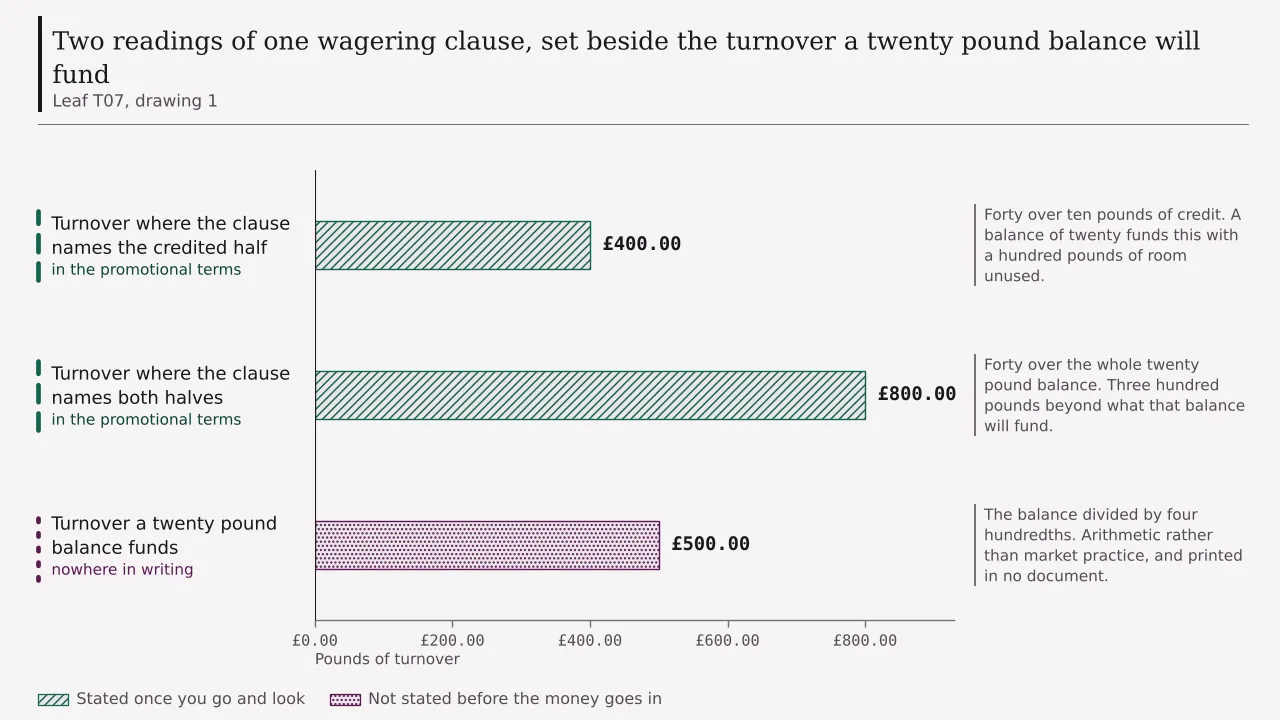
Take the first two wordings and price them, since they are the readings the separating line is there to choose between. A multiple of forty over a typed ten is £400.00 of staking. The same multiple over a balance of twenty is £800.00. The advertisement is word for word identical in both cases and the account looks the same on the day the money lands.
Put the house arithmetic over the first of them. Four pence of every staked pound stays behind where 96 in the hundred comes back, so £400.00 of turnover is expected to cost £16.00. That removes the typed ten and six pounds of the paid ten after it. The formula reaches the same place in one step: a credit multiplied by one less forty times four hundredths, giving minus £6.00 against a claim of £10.00.
Credit as the percentage states it £10.00 Expected close where forty times rides on the typed half minus £6.00 What the kinder of the two readings costs £16.00
Now the second. £800.00 of turnover feeds an expected £32.00 to the margin, against a balance holding £20.00. The obligation is larger than the money available to discharge it, which is a different kind of statement from the first and not merely a bigger version of it. Under the first reading a balance is expected to survive the condition with four pounds standing. Under the second it is expected to be gone before the condition has been met.
Turnover where the clause names the credited half £400.00 Turnover where the clause names both halves £800.00 Carried by one noun in one clause £400.00
Four hundred pounds is the quantity worth carrying away from this page. Nobody is billed for it, no statement will show it, and no sentence anywhere announces that it exists. It separates two obligations which the same advertisement supports with equal comfort, and every penny of it rides on whether one noun in a document a step away reads bonus or reads balance.
4
The distance a twenty pound balance is expected to cover
Any balance has a reach, and the reach is computable to the penny. Money crosses the reels over and over while four pence of each pound stays behind, so a pile of cash carries twenty five times its own size in turnover before exhaustion is the expected outcome. Twenty pounds carries £500.00. That is this page’s working ruler, and the return is the only thing it depends on.
Set the two readings against it. £400.00 fits inside £500.00 with a hundred pounds of reach to spare, so an obligation written over the typed half is one a balance of this size is expected to reach the end of. £800.00 does not fit. It overshoots by three hundred pounds, which means the requirement is expected to outlive the money by a wide margin.
Phrase that as a test and it generalises past this one offer. Divide the balance by four hundredths to get the reach, then compare the reach with the turnover demanded. Where the demand is smaller, finishing is the expected outcome and the question is only what survives. Where the demand is larger, finishing is not the expected outcome at all, and the arithmetic of what survives has nothing left to describe.
| What the clause names | Balance standing | Reach of that balance | Turnover demanded | Whether the end is expected to arrive |
|---|---|---|---|---|
| The credited half alone | £20.00 | £500.00 | £400.00 | Reached, with a hundred pounds of reach unused |
| Both halves together | £20.00 | £500.00 | £800.00 | Not reached, by three hundred pounds |
| The credited half, paid half detained | £20.00 | £500.00 | £400.00 | Reached, but nothing may leave until it is |
The third row repays attention because it looks like the first and behaves like neither. The turnover demanded is the smaller figure, so the end is expected to arrive. What the detention clause changes is not whether the obligation can be discharged but whether the paid half is available in the meantime, and a reader who wanted their own ten pounds back on day two finds it locked by a sentence about the typed ten.
No source publishes any of these three reaches. The twenty five is a property of the return and not of the market: four hundredths divided into one, with no other input. Where a build hands less back the reach shortens, where it hands more back the reach lengthens, and whatever a build counts for against the requirement is nowhere in writing across much of this end of the market.
5
Draining order, and what stopping halfway is worth
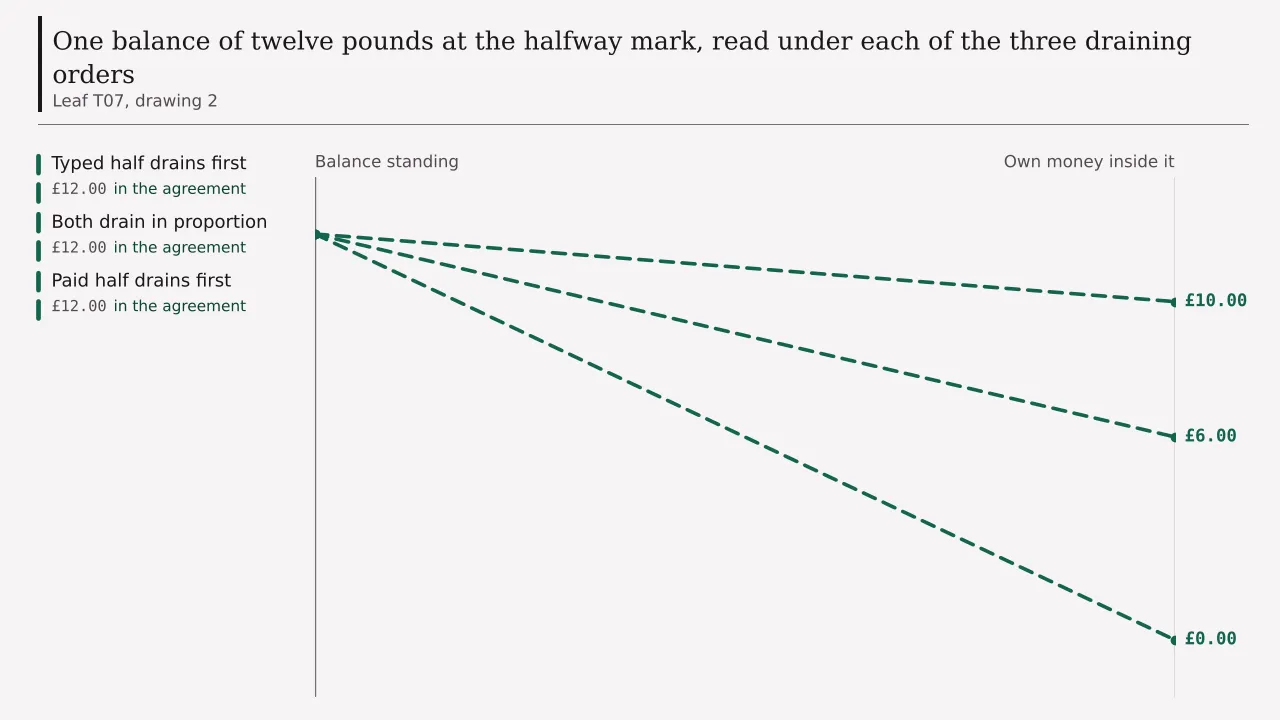
Suppose the obligation rides on the typed half only, which is the kinder reading, and suppose a reader stops after £200.00 of turnover. Half the requirement is discharged. The expected cost so far is £8.00, so the balance is expected to read £12.00. The question nobody asked at the start is what those twelve pounds consist of, and the answer is set by a clause about order.
Three orderings are drafted in this part of the market and they produce three different twelve pounds. Where the paid half is consumed first, the £12.00 is entirely typed money, every penny of it still carrying the unfinished requirement, and stopping yields nothing that can be asked for. Where the typed half is consumed first, the first £10.00 of that balance is the reader’s own and can be requested as soon as the promotion is abandoned.
The third ordering draws proportionally from both, so the £12.00 is split in the ratio the halves started at, which on a par match is even. Six pounds of it is own money and six is typed. A reader stopping under that drafting recovers half of what the typed half-first ordering would have given them and six times what the paid half-first ordering would.
| Order the clause sets | Own money inside the £12.00 | What walking away yields |
|---|---|---|
| Paid half drains first | £0.00 | Nothing. The whole balance is still conditional. |
| Typed half drains first | £10.00 | The original payment, in full, on request |
| Both drain in proportion | £6.00 | Six pounds, with six still carrying the condition |
Ten pounds is therefore the spread between the best ordering and the worst, on a balance the account shows as a single figure either way. The clause that picks between them is settled in the account agreement and is frequently a single subordinate phrase inside a longer paragraph about bonus handling. It is not flagged, not headed, and not reachable from the advertisement at all.
There is a reason the orderings differ in the way they do, and stating it plainly is fairer than implying a conspiracy. A paid half-first ordering keeps a promotion alive longer, because the typed money is still there to be played after the reader’s own has gone. A typed half-first ordering settles the promotion quickly and hands the remainder back. Both are defensible drafting. Only one of them is worth ten pounds to the person reading it.
6
Asking for your own ten back before the turnover is done
A reader who changes their mind on the first evening wants the paid half returned. What that costs depends on a clause with no obvious name, usually a single line attached to the end of the wagering paragraph, saying what becomes of an unfinished promotion when a withdrawal is requested.
Two settings cover nearly all of it. Under the first, requesting the paid half cancels the promotion and removes the typed half along with anything the typed half has won. Under the second, the paid half simply cannot be requested until the requirement is met, which is the detention wording from part two. The first charges £10.00 of credit for the right to leave. The second charges nothing and refuses the right.
Price the first properly, because the figure is not the obvious one. Walking away on day one costs the typed £10.00, which was never worth £10.00: carried to the end of a £400.00 obligation it is expected to be worth minus £6.00. So a reader forfeiting it is giving up a thing with a negative expected value, and the forfeiture is a cost of £10.00 only against the face of the credit, not against what the credit would have become.
Stated that way the clause reads very differently. The sentence that looks like a penalty for leaving early is, on these assumptions, the cheapest exit available from an arrangement whose expected close is negative. A reader who forfeits the typed ten on the first evening walks away with their own ten intact, which is six pounds better than the expected outcome of staying to the end.
That inversion only holds while the obligation is unfinished and the balance has not moved far from its opening figure. A reader forty per cent of the way through, holding a balance that has run ahead of expectation, is forfeiting something with a positive realised value rather than a negative expected one, and the arithmetic turns over. The clause is not uniformly kind or uniformly harsh. Its sign depends entirely on where in the obligation it is invoked.
Forfeiting the typed £10.00 on day one is £6.00 better than finishing the £400.00
7
Every condition on a par match, sorted by the half it grips
Here is the sorting itself, which is this leaf’s contribution and the thing the percentage pages either side of it do not do. Every condition a par match carries, the half of the balance it fastens to, where a reader would settle it, and what it moves in pounds on the worked offer.
| Condition | Half it fastens to | Where it is settled | What it moves |
|---|---|---|---|
| The percentage, and the smallest payment it accepts | Creates the typed half | £10.00 of credit | |
| The multiple, and the quantity it names | One half or both, per the noun | in the promotional terms | £400.00 of turnover |
| Order in which the halves are consumed | Decides which half survives | in the account agreement | £10.00 at the moment of stopping |
| What a withdrawal request does to an open promotion | Removes or detains | in the promotional terms | £10.00 of credit, or the right to leave |
| Ceiling on a single stake while the promotion runs | Gated by the typed half | in the account agreement | The balance, on breach |
| Expiry on the unfinished requirement, assumed at 30 days here | Kills the typed half | in the promotional terms | £13.33 a day of turnover |
| What a given build counts for against the requirement | Scales the turnover | nowhere in writing | Divides into £400.00 |
| Smallest payment a given method will take | Decides the paid half | at the cashier | May put £10.00 out of reach |
| Identity paperwork, and the moment it is demanded | Grips the exit, not the balance | on the way out | Delays, does not reduce |
| Who holds a licence behind the address | Neither half | in the public register | Outside the promotion entirely |
Read the second column downwards and a pattern appears that no single clause states. The conditions fastening to the typed half are about size and time, and they shrink what the promotion is worth. The conditions fastening to the paid half are about availability, and they decide whether the reader’s own money is theirs to move. Those are different kinds of harm and they are drafted in the same paragraph.
The expiry row carries a figure worth unpacking. A thirty day window over £400.00 of turnover is £13.33 a day, which at 10p a press is 134 presses daily and no obstacle at all. Shorten the window to seven days and the same obligation becomes £57.14 a day, or 572 presses. The window changes no figure in the arithmetic and simply decides whether the arithmetic can be reached, and thirty days is this leaf’s own illustrative period rather than anything published.
8
What a document decides by saying nothing at all
Not every question above gets an answer. Plenty of promotional terms name a multiple and stop, leaving the order of draining, the effect of a withdrawal request and the contribution rate entirely unaddressed. A reader then has to decide what an unwritten term says, and the direction that decision runs in is the most reliable finding on this subject.
Silence settles towards whatever nobody will ever be made to apologise for. An operator which never wrote down a draining order has taken on no duty to pick the kinder one, so a calculation resting on the kinder one is showing the promotion at its best possible light. The workable convention is therefore to take the most generous setting available, print the result, and state in terms that what has been printed is a ceiling and not a forecast.
Applied to this offer the convention gives the figures already printed. Forty times over the typed half alone, not over both. Full contribution rather than a fraction. The typed half drained first. Every one of those is the best available answer, and the expected close of minus £6.00 is therefore the kindest number a par match of this shape supports. Each unwritten term can push it down and none can lift it.
There is a second reason to print the generous figure rather than a pessimistic guess. A plausible-looking number invented to fill a gap is indistinguishable on the page from a number with a source behind it, and a site whose whole argument is about where a claim can be checked cannot afford to publish one. Recording the gap is slower and it is the only version that survives somebody checking.
No Great Britain licence stands behind a matched offer built along these lines, and what falls away with it sorts by half, which is the cut this page has worked with from part one. On the paid half: a ceiling over the sum a customer draws back from their own payments is a term no licensee may write, and the worked instance the regulator gives of a barred term is a daily allowance paired with a weekly one. Also over the paid half: a licensee holding customer money must set out in writing whether that money would survive the business failing, against a four-level rating of its own, and must have the customer acknowledge it before the money is gambled. Where the rating puts the funds outside protection, that warning comes round every six months, under a paragraph which began biting on 31 October 2025. Over the typed half: not one of those reaches it, since a ceiling drafted over promotional winnings is a different instrument from a ceiling drafted over a deposit balance, and both may stand in one document without either contradicting the other. Across the pair: contract terms must be transparent, and findable without hunting. Take that set away and the two tens go on being two unlike objects, with the sentence dividing them answerable to nobody.
9
Finding the separating line in under a minute
The search is short because the line is always in the same neighbourhood. Open the promotional terms, find the paragraph carrying the multiple, and read the noun immediately after it. Everything this page is about hangs on that noun. Bonus means £400.00. Bonus and deposit means £800.00. Winnings means a third thing whose size is not known until the reels have decided it.
Then perform one division. Work out the balance the offer would build, divide that by four hundredths, and set the answer beside the turnover the noun has just asked for. A par match on £10.00 builds £20.00, whose reach is £500.00, and the comparison then answers itself. Where the demand sits inside the reach, the money is expected to outlast the condition. Where it sits outside, the money is not.
Two further lines are worth the extra thirty seconds, both of them in the account agreement rather than the promotional terms. One says which half drains first, worth £10.00 at the moment of stopping. The other says what a withdrawal request does to the unfinished promotion, worth the typed half or the right to leave. Neither is signposted and both are ordinary English.
Point the method at the worked offer and six figures come out, with no adjectives attached. £10.00 paid in. £10.00 credited. Turnover of £400.00 or £800.00, hanging on one noun. Reach of £500.00. An expected close of minus £6.00 under the kinder of the two. And £400.00 between the readings. Only the payment itself is settled where the percentage is printed.
The same method survives being pointed at any other rung of the percentage family, and that is the only general claim this leaf makes. A larger match moves the credited half and leaves the paid half exactly where it was, so the separating line matters more as the percentage climbs rather than less. At par the two halves are equal and the line is easiest to see, which is why it is worth learning on this rung before carrying it to a steeper one.
Questions
- On a 100% deposit bonus, is the wagering on the bonus or on the deposit too?
- That is settled by the noun sitting immediately after the multiple in the promotional terms, and the two answers are £400.00 and £800.00 of turnover on a £10.00 payment. Where the clause names the credited half alone, forty times ten pounds is £400.00 and the expected close is minus £6.00. Where it names the deposit as well, forty times twenty pounds is £800.00. Nothing on the banner picks between them, and £400.00 of turnover rides on one word.
- What does a par match on ten pounds actually leave at the end?
- Minus £6.00 against a credit advertised at £10.00, under the kinder of the two readings. Where 96 in the hundred comes back, four pence of each staked pound stays behind, so £400.00 of turnover is expected to cost £16.00 out of a £20.00 balance. That removes the typed ten, then six pounds of the paid one. Treat the result as a ceiling on the outcome rather than a forecast, since each unwritten condition is able to push it lower and not one of them can raise it.
- How do I tell which half of my balance is my own money?
- By reading the clause that sets the draining order, which lives in the account agreement rather than beside the offer. Where the paid half is consumed first, a balance of £12.00 at the halfway point is entirely conditional and stopping yields nothing. Where the typed half goes first, the first £10.00 of that balance is the original payment and can be requested. Where both drain in proportion, a par match splits it evenly at £6.00 each. Ten pounds separates the best setting from the worst.
- How far will a twenty pound balance actually go?
- Five hundred pounds of turnover, got by dividing the balance by four hundredths, that being what a 96 per cent return keeps from each pound. One figure settles whether a requirement can be reached at all. Four hundred pounds of turnover fits inside it and leaves a hundred pounds of reach unused. Eight hundred pounds overshoots by three hundred, so the money is expected to run out long before the condition is satisfied, and there is then nothing left for the arithmetic of survival to describe.
- What happens to the bonus if I take my deposit back early?
- One of two things, depending on a line usually tacked to the end of the wagering paragraph. Either the request cancels the promotion and removes the credited half with anything it has won, or the paid half cannot be requested at all until the requirement is met. On these assumptions the first is the cheaper outcome: giving up a typed ten whose expected close is minus £6.00 leaves the reader six pounds better off than carrying it to the end of a £400.00 obligation.
- Why does a 100 per cent match make the two halves hardest to tell apart?
- Because at par they are the same size. A payment of £10.00 draws a credit of £10.00 and the account reads £20.00, so size cannot distinguish them and only a sentence can. At steeper percentages the credited half is visibly larger than the payment and nobody confuses the two. That is why the separating line is worth learning on this rung: it is the one place where the screen gives a reader no clue at all.
- Where is the clause that separates bonus funds from deposit funds?
- In two places rather than one. The multiple, and the quantity it fastens to, sit in the promotional terms, one document along from the percentage and reached through the small type beneath it. The draining order and the effect of a withdrawal request sit in the account agreement, reached from the foot of a site instead of from the promotion, so a reader has to abandon the offer to find the clauses deciding what their own money is doing.
- Does an expiry window change what the bonus is worth?
- Not by a penny, and that is what makes it quiet. A window changes no figure in the arithmetic. It decides whether the arithmetic can be reached. Thirty days over £400.00 of turnover is £13.33 a day, or 134 presses at 10p, which is no obstacle. Seven days over the same obligation is £57.14 a day, or 572 presses. Thirty days is this leaf’s own illustrative period and no source consulted publishes a standard one.
- What protection goes missing on a matched offer licensed somewhere else?
- A set of duties which happens to sort by half. Over money sent from a bank: no term may cap how much of it comes back out, and a licensee holding it has to say in writing whether it would survive the business failing, measured against a four-level rating, with the warning repeated at six-month intervals where the rating says it would not. Over the credited half: a ceiling on promotional winnings is a different instrument and escapes that rule, so the two can share one document. No Great Britain licence stands behind matched offers of this build, which leaves the whole set binding nobody.
- If the terms say nothing about which half the wagering attaches to, what should I assume?
- Take the reading that favours you, print it, and call it a ceiling. An unwritten term settles towards whatever nobody will ever be made to apologise for, so guessing at a harsher setting means inventing a figure with no source under it. The workable version takes forty times over the credited half, full contribution and the kinder draining order, lands on minus £6.00, and says plainly that each silence is capable of pushing that lower while not one of them can raise it.