Terms read 19 October 2026 Leaf C13, revision 1
Three pounds and ten pounds are both called the minimum, in documents that never open together
A payment screen takes £3.00 and a promotional document will not look at anything under £10.00, both assumptions of this leaf chosen because the pairing is the one the search phrase describes. Six letters are doing two jobs, seven pounds sit between them, and those seven pounds buy £1.12 of further expectation.
Stated on the banner £10.00 Credit at 100 per cent on a qualifying payment. An advertisement built this way publishes nothing further. Stated, once you go and look £4.00 The credited half carries forty times, written into the same document that fixes which payments qualify, so £20.00 of balance closes there. Not stated before the money goes in £7.00 A screen that takes £3.00 and an offer that wants £10.00 are that far apart, and only the payment screen carries the smaller figure.
Offers taking three pounds, with their terms read
Every destination in this file is bought advertising. The site is paid a fee if a reader goes on to register, and no figure printed below moves because of it.
Bonus Spins UK Slip 01
Betportal
Ceiling as a multiple
The drop
€15.00
€1.00 in the euro
The claim reads €15.00. Once the terms beside it have applied, €0.00 of it can leave. The difference is the drop.
7 of the 15 terms on this slip could not be read before the money went in
Spins priced at this site's own 10p a spin, which the operator does not publish
Stated
€15.00
The claim as it is printed, before a single term has been applied to it.
Headline paid as spins
150 spins at 10c each, which is €15.00 of the figure above.
6 Nowhere
What one spin is worth
No unit is published for a spin, so the count is priced at this site's own 10p a spin. At half that price every figure below halves with it.
Match and other credit not priced
300% of three deposits, to a ceiling of €1,000. A share of a deposit nobody has made yet is not a sum, so no figure stands on this line and none is carried below.
Qualified
-€14.40
Written down somewhere, and taking part of the claim back. Each term carries the place it is written and the sum it takes.
2 Written terms at a distance this record does not establish
Play-through -€14.40
Carrying €14.40 through 35 times stakes €504.00 and costs €20.16 of it at 96 per cent return. That prices above the €14.40 there is to charge it against, so the whole of the credit goes and the line is held at that. The multiple sits on the bonus.
2 Written terms at a distance this record does not establish
Game weighting not priced
Slots only count towards the play-through. No contribution percentage is published, so the line above has been worked at full weight, which is the kindest reading there is.
2 Written terms at a distance this record does not establish
Ceiling on the winnings not priced
5x the bonus.
2 Written terms at a distance this record does not establish
Clock on the credit not priced
14 days.
2 Written terms at a distance this record does not establish
Largest stake while it runs not priced
€5.
3 Public record
Licence, and who holds it not priced
Licensed in Anjouan, Comoros, held by BetPortal Gaming Ltd, with Excite Ultra Media Ltd, reference ALSI-202601040-FI2. A register entry settles who holds a licence and what it permits. It does not settle who is running the site this morning.
4 Cashier
Smallest qualifying deposit your money
€20 a stage. That is €20.00 of your own money, and it is never netted into a drop.
5 On the way out
Checks before a withdrawal not priced
Documents before the first withdrawal.
Unstated
-€0.60
Applying without having been published anywhere, and costing money all the same.
6 Nowhere
What a spin hands back -€0.60
Staking a spin returns 96 per cent of it, so that share of the batch is the house's before a reel turns. This site works at that return and the operator publishes none where the claim is made.
6 Nowhere
Forfeited by rule cost unknown
Nothing is published under this heading, and it applies regardless.
6 Nowhere
Charge on the way out cost unknown
No charge on the way out is published as a figure, so nothing comes off this line. A charge that exists unpublished would come straight off whatever survives.
6 Nowhere
Smallest withdrawal allowed cost unknown
No smallest withdrawal is published as a figure. A floor nobody has published is still a floor, and it decides whether a small balance can move at all.
No Great Britain licence
Terms read 19 October 2026
Bonus Spins UK Slip 02
WinBeast
Ceiling as a sum
The drop
€50.00
€1.00 in the euro
The claim reads €50.00. Once the terms beside it have applied, €0.00 of it can leave. The difference is the drop.
8 of the 15 terms on this slip could not be read before the money went in
Spins priced at this site's own 10p a spin, which the operator does not publish
Stated
€50.00
The claim as it is printed, before a single term has been applied to it.
Headline paid as spins
500 spins at 10c each, which is €50.00 of the figure above.
6 Nowhere
What one spin is worth
No unit is published for a spin, so the count is priced at this site's own 10p a spin. At half that price every figure below halves with it.
Match and other credit not priced
50% to 100% of five deposits, each to a ceiling of €1,000, and a €650 free bet. A share of a deposit nobody has made yet is not a sum, so no figure stands on this line and none is carried below.
Qualified
-€48.00
Written down somewhere, and taking part of the claim back. Each term carries the place it is written and the sum it takes.
2 Written terms at a distance this record does not establish
Play-through -€48.00
Carrying €48.00 through 40 times stakes €1,920.00 and costs €76.80 of it at 96 per cent return. That prices above the €48.00 there is to charge it against, so the whole of the credit goes and the line is held at that. The multiple sits on the bonus and the winnings from the spins.
2 Written terms at a distance this record does not establish
Game weighting not priced
Slots, titles vary by country count towards the play-through. No contribution percentage is published, so the line above has been worked at full weight, which is the kindest reading there is.
2 Written terms at a distance this record does not establish
Ceiling on the winnings not priced
€100 a batch of spins.
2 Written terms at a distance this record does not establish
Clock on the credit not priced
7 days, spins 1 day.
3 Public record
Licence, and who holds it not priced
Licensed in Curaçao, holder not named on the site. A register entry settles who holds a licence and what it permits. It does not settle who is running the site this morning.
4 Cashier
Smallest qualifying deposit your money
€20 a stage. That is €20.00 of your own money, and it is never netted into a drop.
5 On the way out
Checks before a withdrawal not priced
Documents before the first withdrawal.
Unstated
-€2.00
Applying without having been published anywhere, and costing money all the same.
6 Nowhere
What a spin hands back -€2.00
Staking a spin returns 96 per cent of it, so that share of the batch is the house's before a reel turns. This site works at that return and the operator publishes none where the claim is made.
6 Nowhere
Largest stake while it runs cost unknown
Nothing is published under this heading, and it applies regardless.
6 Nowhere
Forfeited by rule cost unknown
Nothing is published under this heading, and it applies regardless.
6 Nowhere
Charge on the way out cost unknown
No charge on the way out is published as a figure, so nothing comes off this line. A charge that exists unpublished would come straight off whatever survives.
6 Nowhere
Smallest withdrawal allowed cost unknown
No smallest withdrawal is published as a figure. A floor nobody has published is still a floor, and it decides whether a small balance can move at all.
No Great Britain licence
Terms read 19 October 2026
Bonus Spins UK Slip 03
EliteSpin
Longest spin window
The drop
£50.00
£1.00 in the pound
The claim reads £50.00. Once the terms beside it have applied, £0.00 of it can leave. The difference is the drop.
8 of the 15 terms on this slip could not be read before the money went in
Spins priced at this site's own 10p a spin, which the operator does not publish
Stated
£50.00
The claim as it is printed, before a single term has been applied to it.
Headline paid as spins
500 spins at 10p each, which is £50.00 of the figure above.
6 Nowhere
What one spin is worth
No unit is published for a spin, so the count is priced at this site's own 10p a spin. At half that price every figure below halves with it.
Match and other credit not priced
50% to 100% of five deposits, each to a ceiling of £1,000. A share of a deposit nobody has made yet is not a sum, so no figure stands on this line and none is carried below.
Qualified
-£48.00
Written down somewhere, and taking part of the claim back. Each term carries the place it is written and the sum it takes.
2 Written terms at a distance this record does not establish
Play-through -£48.00
Carrying £48.00 through 40 times stakes £1,920.00 and costs £76.80 of it at 96 per cent return. That prices above the £48.00 there is to charge it against, so the whole of the credit goes and the line is held at that. The multiple sits on the bonus and the winnings from the spins.
2 Written terms at a distance this record does not establish
Game weighting not priced
Slots count towards the play-through. No contribution percentage is published, so the line above has been worked at full weight, which is the kindest reading there is.
2 Written terms at a distance this record does not establish
Ceiling on the winnings not priced
5x the bonus.
2 Written terms at a distance this record does not establish
Clock on the credit not priced
7 days, spins 3 days.
3 Public record
Licence, and who holds it not priced
Licensed in Costa Rica, held by PrimeTier Limited. A register entry settles who holds a licence and what it permits. It does not settle who is running the site this morning.
4 Cashier
Smallest qualifying deposit your money
£20 a stage. That is £20.00 of your own money, and it is never netted into a drop.
5 On the way out
Checks before a withdrawal not priced
Documents before the first withdrawal.
Unstated
-£2.00
Applying without having been published anywhere, and costing money all the same.
6 Nowhere
What a spin hands back -£2.00
Staking a spin returns 96 per cent of it, so that share of the batch is the house's before a reel turns. This site works at that return and the operator publishes none where the claim is made.
6 Nowhere
Largest stake while it runs cost unknown
Nothing is published under this heading, and it applies regardless.
6 Nowhere
Forfeited by rule cost unknown
Nothing is published under this heading, and it applies regardless.
6 Nowhere
Charge on the way out cost unknown
No charge on the way out is published as a figure, so nothing comes off this line. A charge that exists unpublished would come straight off whatever survives.
6 Nowhere
Smallest withdrawal allowed cost unknown
No smallest withdrawal is published as a figure. A floor nobody has published is still a floor, and it decides whether a small balance can move at all.
No Great Britain licence
Terms read 19 October 2026
Bonus Spins UK Slip 04
Crown Jewelz
Multiple unpublished
The drop
NOT WORKED
The multiple is not published in the operator's own terms. Since the sum cannot be worked around it, none is worked.
9 of the 14 terms on this slip could not be read before the money went in
No drop worked
Stated
£15.00
The claim as it is printed, before a single term has been applied to it.
Headline paid as spins
150 spins at 10p each, which is £15.00 of the figure above.
6 Nowhere
What one spin is worth
No unit is published for a spin, so the count is priced at this site's own 10p a spin. At half that price every figure below halves with it.
Match and other credit not priced
200% of the first deposit, then 150% twice, each to a ceiling of £1,000. A share of a deposit nobody has made yet is not a sum, so no figure stands on this line and none is carried below.
Qualified
NOT WORKED
Written down somewhere, and taking part of the claim back. Each term carries the place it is written and the sum it takes.
2 Written terms at a distance this record does not establish
Play-through not priced
40x the bonus, reported rather than published by the operator.
2 Written terms at a distance this record does not establish
Game weighting not priced
Slots count towards the play-through. No contribution percentage is published, so the line above has been worked at full weight, which is the kindest reading there is.
3 Public record
Licence, and who holds it not priced
Licensed in Curaçao, number not verified, holder not named on the site. A register entry settles who holds a licence and what it permits. It does not settle who is running the site this morning.
4 Cashier
Smallest qualifying deposit your money
£20. That is £20.00 of your own money, and it is never netted into a drop.
5 On the way out
Checks before a withdrawal not priced
Documents before the first withdrawal.
Unstated
NOT WORKED
Applying without having been published anywhere, and costing money all the same.
6 Nowhere
Ceiling on the winnings cost unknown
No ceiling is published. Nothing is assumed in its place.
6 Nowhere
Clock on the credit cost unknown
Nothing is published under this heading, and it applies regardless.
6 Nowhere
Largest stake while it runs cost unknown
Nothing is published under this heading, and it applies regardless.
6 Nowhere
Forfeited by rule cost unknown
Nothing is published under this heading, and it applies regardless.
6 Nowhere
Charge on the way out cost unknown
No charge on the way out is published as a figure, so nothing comes off this line. A charge that exists unpublished would come straight off whatever survives.
6 Nowhere
Smallest withdrawal allowed cost unknown
No smallest withdrawal is published as a figure. A floor nobody has published is still a floor, and it decides whether a small balance can move at all.
No Great Britain licence
Terms read 19 October 2026
Every figure in the second and third columns is this site's own working and nothing an operator has published. A claim is priced as printed, then the share a spin hands back at 96 per cent return comes off it, then what playing the multiple through costs at the same return, and then whatever a published ceiling, a charge on the way out or a floor on the smallest withdrawal takes from what has survived. The drop is the difference between the first figure and the last. The two columns add back up to it exactly, so no money leaves a slip without a term and a place beside it.
Which column a term falls in is settled by one question: has anybody written it down. A charge a reader meets at the payment screen is written down, and it stands in the second column with the cashier against it. A condition that binds without ever having been set down stands in the third, whatever it costs. Inside each column the terms run outwards from the banner, so the order itself says how far a reader would have had to go.
A count of spins has no unit until one is supplied. Where an operator publishes what one of its own spins is worth, that figure is used and the first column says it is theirs. Where none is published, this site's own 10p a spin stands in its place and every figure below moves in proportion with it. Where the multiple itself is unpublished, no drop is worked at all, because that is the one figure the sum cannot be done without.
Three words stand where a figure cannot. Not priced is a term that is written down and carries no number the arithmetic can take. Cost unknown is a term nobody has written down, costing something nobody has put a number on. Your money is money of the reader's own, which is never netted into a drop.
None of the operators in this file holds a Great Britain licence, so none of the duties that licence carries reaches them. Each of those duties is published in its own right, which is what makes its absence here something a reader can check rather than take on trust. Every gambling company licensed in Great Britain belongs to Gamstop Online, so a reader who has shut themselves out through the scheme is not shut out here. Social Responsibility Code 5.1.1 has held a play-through to a maximum of ten times the bonus funds since 19 January 2026, and it binds a licence holder and nobody else. Asked in a post of 21 October 2025 what is lost along with the licence, the Gambling Commission's Director of Enforcement and Intelligence answered: "unfair gaming practices, financial loss, and a lack of recourse if things go wrong". The same post puts blocked payouts, and withdrawal limits pitched high enough to be unreachable, among the behaviour the Commission has recorded. Nobody under 18 may hold an account at any of them.
Terms are reproduced in the wording their operator published, and each slip is dated with the day somebody sat down and read them. 19 October 2026 is the oldest of those dates. Anybody claiming an offer is bound by that operator's full terms, which are elsewhere, and never by a line standing here.
1
Six letters carrying two numbers, and the pair that never share a page
Two separate quantities on an offer are routinely given the same name. One is the smallest payment a cashier will process. The other is the smallest payment that makes an offer apply. They are set by different parts of the business, they live in different documents, and both are called the minimum deposit.
This leaf works a pairing of £3.00 and £10.00. Both are its own assumptions, and no rule reachable from this site publishes either of them. They are carried because that pairing is the one the search phrase describes, and because naming a pair makes the arithmetic underneath checkable rather than rhetorical.
The smaller figure is settled at the cashier, on a screen reached after registration. The larger is settled in the promotional terms, one tap from the advertisement. Neither document has any reason to carry the other’s figure. A payment page states what the payment system will accept, which is not a promotional matter. A promotional document states what the promotion requires, which is not a payment matter. Both are complete, both are accurate, and the overlap belongs to nobody.
What the overlap produces is a payment that succeeds and an offer that does not arrive. Three pounds is accepted, the balance appears, and nothing is credited. No error is shown because no error occurred. The transaction did exactly what the payment page said it would do, and the offer did exactly what the promotional document said it would do, and the reader is holding three pounds where they expected six.
Everything below prices that outcome and then prices the obvious response to it, which is to send the missing seven pounds. The second price turns out to be the interesting one, because topping a payment up to the qualifying figure improves the expectation by considerably less than the payment itself.
2
What three pounds buys when it buys no offer at all
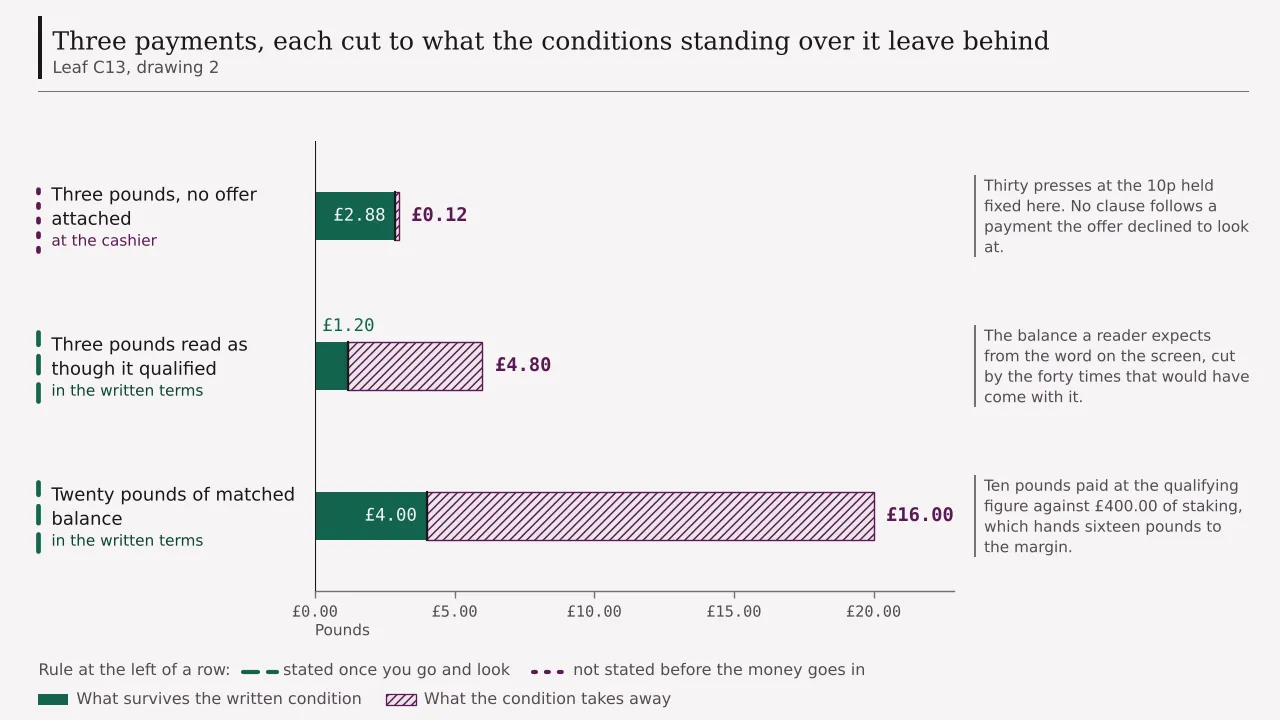
Three pounds at the 10p a press held fixed across this site is thirty presses. Ninety-six pence of each pound comes home at the rate worked here, so those presses give back an expected £2.88 and twelve pence stays with the margin. No condition has been applied, because no condition attached itself to a payment the offer refused to look at.
That refusal is worth stating the right way round. A payment under the qualifying figure is not penalised and nothing is confiscated. It simply sits outside the promotion, and a balance outside a promotion is the plainest object in this whole subject: money that can be staked, money that can be withdrawn subject to whatever the exit asks, and no clause standing over any of it.
Now take the version a reader has in mind while paying. Somebody who read the word minimum on the payment screen, saw an offer promising to match in full, and sent the smallest sum the screen would take, is expecting a balance of £6.00. The three pounds they sent, and three pounds of credit beside it.
Balance a reader expects from the word on the screen and the offer together £6.00 Balance once the qualifying figure in the promotional terms applies £3.00 Credit that was never available at that payment £3.00
Three pounds of absent credit is the direct price of the ambiguity, and there is a second figure underneath it that runs the other way. Had the credit arrived, forty times would have come with it. Forty lots of three pounds is £120.00 of staking, and a four per cent slice of that is £4.80, so a matched three pounds closes at an expected £1.20 against the £2.88 an unmatched three pounds is expected to leave. The offer the reader missed was worth minus £1.68 to them.
Both sentences are true at once and an honest leaf prints both. The word cost a reader three pounds of credit they thought they were getting. The credit, had it arrived, would have cost them £1.68 of expectation. Confusion about a word is a different object from a loss, and keeping the two apart is nearly the whole job here.
3
Seven pounds of difference, and what the seven pounds purchases
The obvious response to a payment that missed the offer is to make up the shortfall. Seven pounds closes the gap between the assumed £3.00 and the assumed £10.00, and what those seven pounds actually buy is the sharpest arithmetic on this leaf.
Take the qualifying payment first on its own terms. Ten pounds matched in full puts £20.00 on the account against £10.00 paid. Forty times over the credited half asks £400.00 of staking. A four per cent slice of that comes to £16.00, and twenty pounds less sixteen leaves £4.00.
Credit read off the offer at the qualifying payment £10.00 What that credit closes at once forty times applies minus £6.00 What the clause beside that figure costs £16.00
Sixteen pounds arrives twice and the two arrivals share nothing but their inputs. Subtract minus six from ten and sixteen is the answer. Or take four hundredths of £400.00 of staking, which is also sixteen. The clause performs one operation only, pushing staked pounds over towards the margin at a rate already known, so the two calculations are obliged to agree, and the fact that they do is the check rather than the finding.
Now compare the two accounts as a reader would experience them. Three pounds unmatched is expected to leave £2.88. Ten pounds matched is expected to leave £4.00. The difference is £1.12, and it cost seven pounds to obtain, which works out at sixteen pence of expectation for every pound of further payment.
That sixteen pence can be reached from a completely different direction, which is how this leaf checks it. The seven extra pounds arrive matched, so they carry an expected close of forty pence each, or £2.80 between them. At the same moment the original three pounds stop being unmatched money keeping 96 pence in the pound and become matched money keeping forty, which costs 56 pence on each of the three, or £1.68. Two pounds eighty less one pound sixty-eight is £1.12 again.
£7.00 of further payment bought for £1.12 of further expectation, at sixteen pence in the pound
So the gap between the two numbers is not merely a gap in wording. Closing it moves the account onto a worse rate, and the rate is worse because the credit carries a condition and the unmatched three pounds carried none. A reader who tops up to qualify has bought an inducement whose price is paid in the quality of every pound already sent.
4
Five jobs the same word is doing at the same time
Two senses have been priced. There are more, and collecting them is useful because the word is doing all of this work simultaneously on one site, with no document anywhere listing the senses together.
| The thing being measured | Where a reader would settle it | Figure worked here |
|---|---|---|
| Smallest stake a reel will accept | nowhere in writing | £0.10 |
| Smallest payment the screen will process | at the cashier | £3.00 |
| Smallest rung a prepaid voucher is sold in | at the cashier | £5.00 |
| Smallest payment that makes the offer apply | in the promotional terms | £10.00 |
| Smallest sum the exit will agree to send | at the cashier | Priced on its own leaf |
Every figure in the right-hand column except the first is this leaf’s own assumption, carried to make the shape visible, and the first is the press value this site holds fixed everywhere. The last row is deliberately unpriced here, because an exit figure set against an entry figure is a subject of its own and gets the full treatment a pound’s worth away from this page.
Read down the middle column and the same pattern this site keeps meeting appears again. Three of the five senses are settled on a payment screen, which is reached after registration. One sits in a promotional document a tap from the advertisement. One is settled nowhere and applies anyway. A reader holding the word on its own holds none of the five, and a reader who has read the promotional terms carefully holds exactly one.
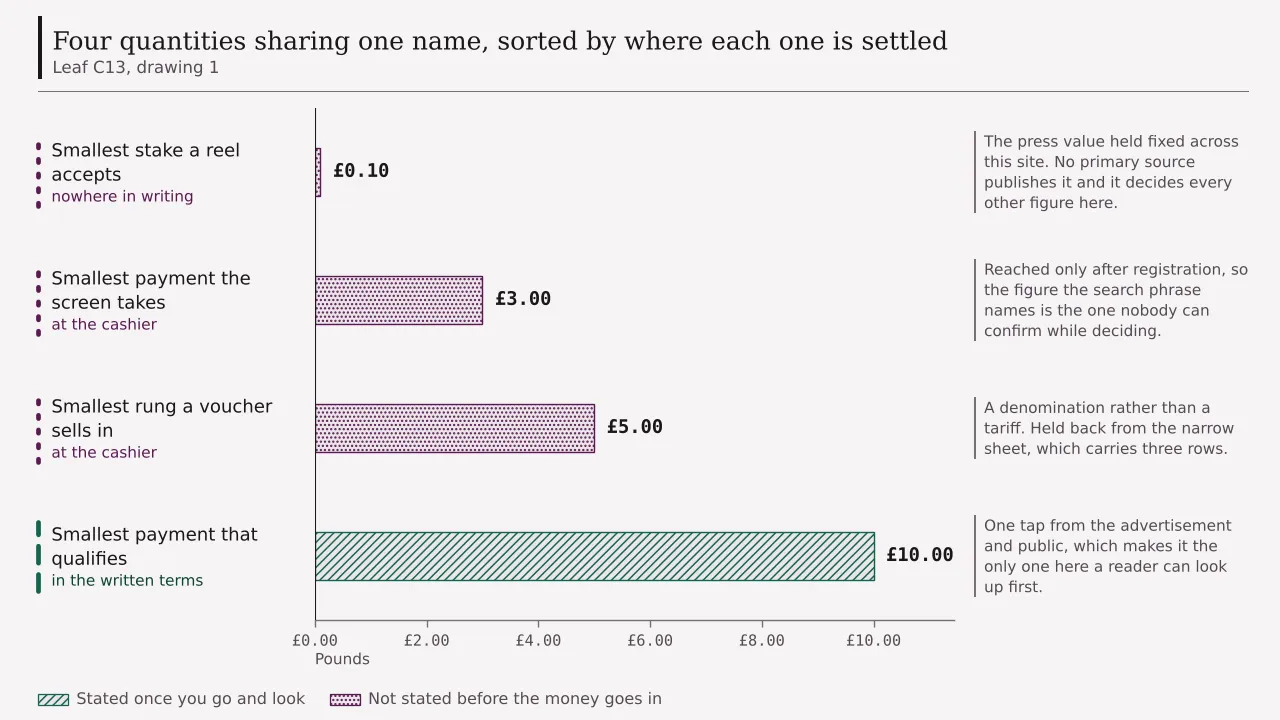
One structural point falls out of the table and deserves its own sentence. The senses are not ranked, ordered or cross-referenced anywhere, so a reader cannot tell from the word alone which of the five a given screen means. Context supplies the answer most of the time and supplies it wrongly exactly where the two payment senses meet, which is the case this leaf exists for.
5
Which of the two payments keeps more of each pound
Set the two accounts side by side and divide each expected close by the money that was sent. Three pounds unmatched returns £2.88, which is 96 pence for every pound paid. Ten pounds matched returns £4.00, which is 40 pence for every pound paid. The payment that failed to qualify keeps more than twice as much of itself.
| What was paid, and whether it qualified | Credit received | Staking the clause asks | Expected close | Kept per pound paid |
|---|---|---|---|---|
| Three pounds, under the qualifying figure | None | None | £2.88 | 96p |
| Three pounds, had it somehow qualified | £3.00 | £120.00 | £1.20 | 40p |
| Ten pounds, exactly at the qualifying figure | £10.00 | £400.00 | £4.00 | 40p |
| Twenty pounds, twice the qualifying figure | £20.00 | £800.00 | £8.00 | 40p |
The final column is flat across every row carrying a credit, and that flatness is the whole lesson of the table. Size changes nothing. A matched pound keeps forty pence at forty times whatever the payment was, because the rate is a property of the multiple and not of the sum, and paying more simply buys more pounds at the same unfavourable rate.
So the word’s two senses do not merely name two payments. They name two different rates of return, 96 pence against 40, and a reader crossing from one to the other is making a change of kind rather than a change of size. Nothing in either document presents it that way, because neither document is written about the other.
6
The figure a reader can check, and the one they cannot
Here the ordering runs backwards from what anybody would expect, and the inversion is this leaf’s own finding rather than a borrowed one. The figure a reader goes looking for is the small one, since that is what the search phrase names. The figure they can actually establish before committing anything is the large one.
Qualifying terms sit a tap from an advertisement. Anybody can open them on a telephone, before registering, before supplying a name, before any payment system has been consulted. The sum an offer demands is therefore reachable at a cost of nothing to somebody who has not decided anything yet.
The accepted payment figure is the opposite. It belongs to a payment page, and a payment page is behind a registration, which means handing over a name, an address, a birth date and in practice a password. The smallest sum a screen will take is consequently at the cashier and unavailable earlier, so the headline figure in the search phrase is the one nobody can confirm in advance.
Put those two facts together and the practical advice inverts as well. Do not go looking for the small number before registering, because it is not there to be found. Go looking for the large one, which is, and which decides whether the small one matters at all. If the qualifying figure is £10.00 then a screen accepting £3.00 is an irrelevance to anybody who wants the offer, and whether it accepts three or two or one changes nothing.
That reordering costs nothing and removes the entire problem this leaf describes. The misunderstanding priced in part two happens only to a reader who learned the small number first and never looked for the large one. Reversing the order of the two enquiries makes the ambiguity impossible to fall into, which is a rare thing to be able to say about anything on this site.
7
Where choosing a route moves the smaller number again
One further variation sits on the payment screen itself, and it means the smaller number is not even a single number. A cashier publishes a figure, and the route chosen to send the money can raise it, because an instrument carries rules of its own that the cashier did not write.
A prepaid voucher is the clearest case. Vouchers are sold in fixed denominations, so a screen accepting £3.00 by card may be reachable only at £5.00 or £10.00 by voucher, and the smallest workable payment by that route is whichever rung sits above the published figure. Two pounds of the purchase is then stranded before anything has been played, which is a cost with no clause behind it anywhere.
A balance charged to a telephone bill carries a rounding step of its own, and a card can come back refused where an issuer thinks the amount too small to bother with. None of those are terms, none appears in any document, and all three are settled on the screen where a route is picked rather than on the screen where a figure is printed.
So the honest version of the smaller number is a range rather than a figure. The cashier’s published sum is its floor, the route decides where the range actually starts, and the reader learns which applies to them only once the route is chosen. A page that reported one number for it would be reporting the most favourable member of a set.
Set that beside the qualifying figure and the asymmetry sharpens again. The large number is a single value written once in a document that anybody can open. The small number is a set of values settled on a screen that nobody can reach without registering. One word covers both, and the word does not say which of those two very different kinds of object it is naming.
8
Duties of telling, and what happens when none of them binds
Screens taking payments this small sit outside the British licence altogether. On a page about an ambiguous word the duties worth collecting are those obliging somebody to say a thing before it bites, and four of them do exactly that. None is a promise about an outcome. Each is owed to a reader rather than imposed on a product.
A reader is owed a description of the rules. The technical standard on game descriptions asks that an explanation of the rules in force sit where a customer reaches it without effort ahead of any commitment, be accurate, and run to enough detail that every rule applying is covered. A word covering two sums, with neither document naming the other, is the exact condition that wording is written against.
A reader is owed a warning about paperwork before paying rather than after. Before funds can be deposited, a licensee has to spell out which papers or further details could be called for, the stage at which that happens, and the manner of sending them. That is a duty to put a future demand in front of somebody at the moment they are deciding, which is precisely the timing this leaf keeps finding absent.
A reader is owed notice of a change of substance. Terms may be altered, but news of anything substantial has to arrive with the customer in advance of the change taking hold, under the licence condition on fair and transparent dealing. Applied to the pair of figures here, a qualifying sum moved from £10.00 to £20.00 overnight would be a change of substance, and the duty decides when a reader hears about it rather than whether it may happen.
And a reader is owed prominence for the conditions that decide participation. The advertising regulator’s advice on casino promotions puts the significant terms as likely to cover any smallest stakes, how a person takes part, and whatever wagering is demanded. Taking part is the limb that bites here, since the qualifying sum is the condition on taking part and nothing else.
Remove the four and every figure above stands exactly where it stood. What goes is the obligation to put any of them where a decision is being taken. The payment screen goes on saying three, the promotional document goes on saying ten, both remain accurate, and nothing compels anybody to notice that one word is carrying both.
One boundary belongs here and concerns anybody registered with the national scheme. That scheme follows the British licence, so an address without one falls beyond its reach by construction and not by anybody’s choice. Somebody who has signed up with Gamstop Online arranged for screens like these to be closed to them, and a figure as small as three pounds does not make an exception. The routes printed below this leaf are where to go instead.
9
The reading on which three pounds is the correct payment
Everything above describes a reader who wanted the offer. There is a reader who does not, and for that reader three pounds is not a mistake but the best payment available on the page.
Run the comparison in part five once more with the preference reversed. Three pounds unmatched keeps 96 pence of every pound sent and carries no clause, no window, no ceiling on a single stake and no condition attached to anything. Ten pounds matched keeps forty pence of every pound and carries every one of them. Measured purely on expectation per pound, the payment that fails to qualify is the better of the two by a wide margin.
That result is not a trick of the arithmetic. It follows from a multiple of forty sitting well past the point at which a credit stops being worth having, twenty-five on the return worked here, that figure being the reciprocal of the four hundredths kept on every pound crossed. Any credit carrying a multiple above twenty-five reduces the expectation of the money standing beside it, so declining the credit is the arithmetically stronger move and the smaller payment declines it automatically.
There is a second sense in which the smaller payment is the sound one. Three pounds is the smallest exposure the screen permits, and sending it caps what can be lost at three pounds by the act of sending. A reader wanting thirty presses and no more has them at a price printed in advance, with nothing owed in either direction afterwards.
So the honest summary of the pair is not that the small figure misleads. It is that the small figure is excellent for one purpose and useless for another, and the single word covering both gives a reader no way of telling which purpose they are being offered. The fault lies in the naming rather than in either number.
10
Opening both documents at once, which takes about a minute
The check is three steps and it runs in the order part six established rather than the order a reader would naturally use. Open the promotional terms first. Find the qualifying sum. Only then open a payment page and find what it will accept.
Step one succeeds before any commitment because promotional terms are public. Search inside them for the word covering a payment and read every instance, since a document of that kind will often carry the word three or four times in different senses, one for the qualifying payment, one for a ceiling on the stake permitted while credit sits on the account, and one for whatever a later stage of the offer demands.
Step two is the comparison and it is a single subtraction. Take the qualifying sum, take whatever the payment page will accept, and write the difference down. On this leaf’s assumed pair that difference is £7.00, and £7.00 is what a reader would have to add to an accepted payment for the advertisement to mean anything at all.
Step three asks what the difference buys, which is the step nobody takes. Work the expectation at each payment and divide by the money sent. Here that produces 96 pence in the pound at the smaller sum and 40 pence at the larger, so the seven pounds buys £1.12 of extra expectation and converts the rate on everything already sent. Set the two figures down together and rule off what separates them, which is what every leaf here does.
Two habits keep the check honest. Record which document each figure came from, because a number remembered without its source is a number that cannot be rechecked when either document changes. And treat any payment figure reached through a particular route as a figure about that route, since part seven showed the same screen offering several different smallest sums depending on what the money travels in.
Questions
- Can I really deposit £3 at a casino?
- At a cashier whose payment screen accepts it, yes, and the payment goes through without any warning. What a sum that size often will not do is set off the offer advertised beside it. This leaf works an assumed pairing of £3.00 accepted against £10.00 required to qualify, with no rule reachable from here publishing either of them. A payment at the smaller sum buys a balance and nothing more, and no error shows because nothing went wrong.
- Why does the same word describe two different amounts?
- Because two parts of a business set them for two different purposes. A payment screen states what the payment system will process, which is not a promotional question. A promotional document states what the promotion requires, which is not a payment question. Each document is complete for its own job and silent about the other’s figure, so the word ends up carrying both and the overlap belongs to nobody.
- What does a £3 deposit leave me with?
- An expected £2.88. Thirty presses at the press value held fixed here, with ninety-six pence of each pound coming home. Nothing is confiscated and no condition attaches, since no clause follows a payment the offer declined to look at. The balance can be staked, and it can be taken out subject to whatever the exit asks, which is a separate figure priced on its own leaf.
- What do the seven pounds between the two figures actually buy?
- £1.12 of further expectation, or sixteen pence for every pound of further payment. Three pounds unmatched is expected to leave £2.88. Ten pounds matched in full is expected to leave £4.00, since a four per cent slice of £400.00 of staking removes £16.00 from a £20.00 balance. The difference between £4.00 and £2.88 is £1.12 and it cost seven pounds to obtain. The same £1.12 can be reached by noting that the seven extra pounds arrive matched and carry £2.80 of expected close, while the original three move from 96 pence in the pound to forty and lose £1.68.
- Is it better to pay the smaller amount or top up to qualify?
- On expectation per pound, the smaller payment wins and it is not close. An unmatched payment keeps 96 pence of every pound sent. A matched payment at forty times keeps forty pence of every pound sent, and that rate is flat whatever the sum, because it is a property of the multiple rather than of the payment. A credit stops being worth having at twenty-five times on the return worked here, that figure being the reciprocal of the four hundredths kept on every pound crossed, so a multiple of forty leaves the credit reducing the expectation of the money standing beside it.
- Which of the two numbers can I check before paying anything?
- The larger one, which is the reverse of what anybody expects. Qualifying terms sit a tap from an advertisement and can be opened on a telephone before registering, before giving a name and before any payment system is consulted. The smallest sum a screen will process belongs to a payment page, and a payment page is behind a registration, so the figure the search phrase names is the figure that cannot be confirmed in advance. Looking up the large number first removes the whole problem.
- Does the payment route change the smaller figure?
- Yes, and that is why the honest version of it is a range rather than a number. A prepaid voucher is sold in fixed rungs, so a screen accepting £3.00 by card may be reachable only at £5.00 or £10.00 by voucher, with the balance above the published figure stranded before anything is played. A charge against a telephone bill carries a rounding step, and a card can be declined where an issuer decides the amount is too small to authorise. None of those is a term, and all of them are settled on the screen where a route is picked.
- How many different things is the word used for?
- At least five on one site. The smallest stake a reel accepts, taken here as the 10p press value and settled nowhere in writing. The smallest payment a screen processes, settled at the cashier. The smallest rung a prepaid voucher sells in, also at the cashier. The smallest payment that makes an offer apply, settled in the promotional terms. And the smallest sum the exit will agree to send, settled at the cashier and priced on its own leaf. Nothing anywhere lists them together or says which one a given screen means.
- What would a British licence oblige anybody to say about this?
- Four things, each a duty to tell somebody before a condition bites. The rules in force have to be explained somewhere a customer reaches without effort ahead of any commitment, accurately, and in enough detail that every rule applying is covered. Before funds can go in, a licensee has to spell out which papers or further details could be called for, the stage at which that happens, and the manner of sending them. News of anything substantial altered in the terms has to arrive in advance of the change taking hold. And the significant terms on a casino promotion are likely to cover any smallest stakes, how a person takes part, and whatever wagering is demanded. Screens taking payments this small sit outside the British licence, so nothing obliges anybody to put a word of it where a decision is being made.
- What is the shortest check I can run before paying?
- Three steps in an order most readers use backwards. Open the promotional terms and find the qualifying sum, reading every instance of the word because a document of that kind often carries it in several senses. Open a payment page and find what it will accept. Subtract, which on this leaf’s assumed pair gives £7.00, then work the expectation at each payment and divide by the money sent. Record which document each figure came from, because a number remembered without its source cannot be rechecked when either document changes.