Terms read 19 October 2026 Leaf C05, revision 1
One icon at the payment screen decides whether the offer exists at all
A £10.00 credit at forty times wants £400.00 pushed across the reels and closes at an expected minus £6.00. Pay in by a route the promotion disqualifies and neither figure belongs to you, because no credit was ever issued. That sentence is settled at the payment screen or it is settled nowhere, and this leaf prices both halves of it.
Stated on the banner £10.00 The credit a matched payment draws, printed next to the percentage where nobody need click anything. Stated, once you go and look An expected minus £6.00 Forty times over that credit, set out in a promotional document, with 96p returning per staked pound as this site assumes. Not stated before the money goes in £16.00 either way Whether the route chosen at the screen is on the disqualifying list, whether the list and the route’s own writing agree, and which of them a reader could have opened first.
Offers taking wallet and bank-initiated payments, with their terms read
Every destination in this file is bought advertising. The site is paid a fee if a reader goes on to register, and no figure printed below moves because of it.
Bonus Spins UK Slip 01
Betportal
Ceiling as a multiple
The drop
€15.00
€1.00 in the euro
The claim reads €15.00. Once the terms beside it have applied, €0.00 of it can leave. The difference is the drop.
7 of the 15 terms on this slip could not be read before the money went in
Spins priced at this site's own 10p a spin, which the operator does not publish
Stated
€15.00
The claim as it is printed, before a single term has been applied to it.
Headline paid as spins
150 spins at 10c each, which is €15.00 of the figure above.
6 Nowhere
What one spin is worth
No unit is published for a spin, so the count is priced at this site's own 10p a spin. At half that price every figure below halves with it.
Match and other credit not priced
300% of three deposits, to a ceiling of €1,000. A share of a deposit nobody has made yet is not a sum, so no figure stands on this line and none is carried below.
Qualified
-€14.40
Written down somewhere, and taking part of the claim back. Each term carries the place it is written and the sum it takes.
2 Written terms at a distance this record does not establish
Play-through -€14.40
Carrying €14.40 through 35 times stakes €504.00 and costs €20.16 of it at 96 per cent return. That prices above the €14.40 there is to charge it against, so the whole of the credit goes and the line is held at that. The multiple sits on the bonus.
2 Written terms at a distance this record does not establish
Game weighting not priced
Slots only count towards the play-through. No contribution percentage is published, so the line above has been worked at full weight, which is the kindest reading there is.
2 Written terms at a distance this record does not establish
Ceiling on the winnings not priced
5x the bonus.
2 Written terms at a distance this record does not establish
Clock on the credit not priced
14 days.
2 Written terms at a distance this record does not establish
Largest stake while it runs not priced
€5.
3 Public record
Licence, and who holds it not priced
Licensed in Anjouan, Comoros, held by BetPortal Gaming Ltd, with Excite Ultra Media Ltd, reference ALSI-202601040-FI2. A register entry settles who holds a licence and what it permits. It does not settle who is running the site this morning.
4 Cashier
Smallest qualifying deposit your money
€20 a stage. That is €20.00 of your own money, and it is never netted into a drop.
5 On the way out
Checks before a withdrawal not priced
Documents before the first withdrawal.
Unstated
-€0.60
Applying without having been published anywhere, and costing money all the same.
6 Nowhere
What a spin hands back -€0.60
Staking a spin returns 96 per cent of it, so that share of the batch is the house's before a reel turns. This site works at that return and the operator publishes none where the claim is made.
6 Nowhere
Forfeited by rule cost unknown
Nothing is published under this heading, and it applies regardless.
6 Nowhere
Charge on the way out cost unknown
No charge on the way out is published as a figure, so nothing comes off this line. A charge that exists unpublished would come straight off whatever survives.
6 Nowhere
Smallest withdrawal allowed cost unknown
No smallest withdrawal is published as a figure. A floor nobody has published is still a floor, and it decides whether a small balance can move at all.
No Great Britain licence
Terms read 19 October 2026
Bonus Spins UK Slip 02
WinBeast
Ceiling as a sum
The drop
€50.00
€1.00 in the euro
The claim reads €50.00. Once the terms beside it have applied, €0.00 of it can leave. The difference is the drop.
8 of the 15 terms on this slip could not be read before the money went in
Spins priced at this site's own 10p a spin, which the operator does not publish
Stated
€50.00
The claim as it is printed, before a single term has been applied to it.
Headline paid as spins
500 spins at 10c each, which is €50.00 of the figure above.
6 Nowhere
What one spin is worth
No unit is published for a spin, so the count is priced at this site's own 10p a spin. At half that price every figure below halves with it.
Match and other credit not priced
50% to 100% of five deposits, each to a ceiling of €1,000, and a €650 free bet. A share of a deposit nobody has made yet is not a sum, so no figure stands on this line and none is carried below.
Qualified
-€48.00
Written down somewhere, and taking part of the claim back. Each term carries the place it is written and the sum it takes.
2 Written terms at a distance this record does not establish
Play-through -€48.00
Carrying €48.00 through 40 times stakes €1,920.00 and costs €76.80 of it at 96 per cent return. That prices above the €48.00 there is to charge it against, so the whole of the credit goes and the line is held at that. The multiple sits on the bonus and the winnings from the spins.
2 Written terms at a distance this record does not establish
Game weighting not priced
Slots, titles vary by country count towards the play-through. No contribution percentage is published, so the line above has been worked at full weight, which is the kindest reading there is.
2 Written terms at a distance this record does not establish
Ceiling on the winnings not priced
€100 a batch of spins.
2 Written terms at a distance this record does not establish
Clock on the credit not priced
7 days, spins 1 day.
3 Public record
Licence, and who holds it not priced
Licensed in Curaçao, holder not named on the site. A register entry settles who holds a licence and what it permits. It does not settle who is running the site this morning.
4 Cashier
Smallest qualifying deposit your money
€20 a stage. That is €20.00 of your own money, and it is never netted into a drop.
5 On the way out
Checks before a withdrawal not priced
Documents before the first withdrawal.
Unstated
-€2.00
Applying without having been published anywhere, and costing money all the same.
6 Nowhere
What a spin hands back -€2.00
Staking a spin returns 96 per cent of it, so that share of the batch is the house's before a reel turns. This site works at that return and the operator publishes none where the claim is made.
6 Nowhere
Largest stake while it runs cost unknown
Nothing is published under this heading, and it applies regardless.
6 Nowhere
Forfeited by rule cost unknown
Nothing is published under this heading, and it applies regardless.
6 Nowhere
Charge on the way out cost unknown
No charge on the way out is published as a figure, so nothing comes off this line. A charge that exists unpublished would come straight off whatever survives.
6 Nowhere
Smallest withdrawal allowed cost unknown
No smallest withdrawal is published as a figure. A floor nobody has published is still a floor, and it decides whether a small balance can move at all.
No Great Britain licence
Terms read 19 October 2026
Bonus Spins UK Slip 03
EliteSpin
Longest spin window
The drop
£50.00
£1.00 in the pound
The claim reads £50.00. Once the terms beside it have applied, £0.00 of it can leave. The difference is the drop.
8 of the 15 terms on this slip could not be read before the money went in
Spins priced at this site's own 10p a spin, which the operator does not publish
Stated
£50.00
The claim as it is printed, before a single term has been applied to it.
Headline paid as spins
500 spins at 10p each, which is £50.00 of the figure above.
6 Nowhere
What one spin is worth
No unit is published for a spin, so the count is priced at this site's own 10p a spin. At half that price every figure below halves with it.
Match and other credit not priced
50% to 100% of five deposits, each to a ceiling of £1,000. A share of a deposit nobody has made yet is not a sum, so no figure stands on this line and none is carried below.
Qualified
-£48.00
Written down somewhere, and taking part of the claim back. Each term carries the place it is written and the sum it takes.
2 Written terms at a distance this record does not establish
Play-through -£48.00
Carrying £48.00 through 40 times stakes £1,920.00 and costs £76.80 of it at 96 per cent return. That prices above the £48.00 there is to charge it against, so the whole of the credit goes and the line is held at that. The multiple sits on the bonus and the winnings from the spins.
2 Written terms at a distance this record does not establish
Game weighting not priced
Slots count towards the play-through. No contribution percentage is published, so the line above has been worked at full weight, which is the kindest reading there is.
2 Written terms at a distance this record does not establish
Ceiling on the winnings not priced
5x the bonus.
2 Written terms at a distance this record does not establish
Clock on the credit not priced
7 days, spins 3 days.
3 Public record
Licence, and who holds it not priced
Licensed in Costa Rica, held by PrimeTier Limited. A register entry settles who holds a licence and what it permits. It does not settle who is running the site this morning.
4 Cashier
Smallest qualifying deposit your money
£20 a stage. That is £20.00 of your own money, and it is never netted into a drop.
5 On the way out
Checks before a withdrawal not priced
Documents before the first withdrawal.
Unstated
-£2.00
Applying without having been published anywhere, and costing money all the same.
6 Nowhere
What a spin hands back -£2.00
Staking a spin returns 96 per cent of it, so that share of the batch is the house's before a reel turns. This site works at that return and the operator publishes none where the claim is made.
6 Nowhere
Largest stake while it runs cost unknown
Nothing is published under this heading, and it applies regardless.
6 Nowhere
Forfeited by rule cost unknown
Nothing is published under this heading, and it applies regardless.
6 Nowhere
Charge on the way out cost unknown
No charge on the way out is published as a figure, so nothing comes off this line. A charge that exists unpublished would come straight off whatever survives.
6 Nowhere
Smallest withdrawal allowed cost unknown
No smallest withdrawal is published as a figure. A floor nobody has published is still a floor, and it decides whether a small balance can move at all.
No Great Britain licence
Terms read 19 October 2026
Bonus Spins UK Slip 04
Crown Jewelz
Multiple unpublished
The drop
NOT WORKED
The multiple is not published in the operator's own terms. Since the sum cannot be worked around it, none is worked.
9 of the 14 terms on this slip could not be read before the money went in
No drop worked
Stated
£15.00
The claim as it is printed, before a single term has been applied to it.
Headline paid as spins
150 spins at 10p each, which is £15.00 of the figure above.
6 Nowhere
What one spin is worth
No unit is published for a spin, so the count is priced at this site's own 10p a spin. At half that price every figure below halves with it.
Match and other credit not priced
200% of the first deposit, then 150% twice, each to a ceiling of £1,000. A share of a deposit nobody has made yet is not a sum, so no figure stands on this line and none is carried below.
Qualified
NOT WORKED
Written down somewhere, and taking part of the claim back. Each term carries the place it is written and the sum it takes.
2 Written terms at a distance this record does not establish
Play-through not priced
40x the bonus, reported rather than published by the operator.
2 Written terms at a distance this record does not establish
Game weighting not priced
Slots count towards the play-through. No contribution percentage is published, so the line above has been worked at full weight, which is the kindest reading there is.
3 Public record
Licence, and who holds it not priced
Licensed in Curaçao, number not verified, holder not named on the site. A register entry settles who holds a licence and what it permits. It does not settle who is running the site this morning.
4 Cashier
Smallest qualifying deposit your money
£20. That is £20.00 of your own money, and it is never netted into a drop.
5 On the way out
Checks before a withdrawal not priced
Documents before the first withdrawal.
Unstated
NOT WORKED
Applying without having been published anywhere, and costing money all the same.
6 Nowhere
Ceiling on the winnings cost unknown
No ceiling is published. Nothing is assumed in its place.
6 Nowhere
Clock on the credit cost unknown
Nothing is published under this heading, and it applies regardless.
6 Nowhere
Largest stake while it runs cost unknown
Nothing is published under this heading, and it applies regardless.
6 Nowhere
Forfeited by rule cost unknown
Nothing is published under this heading, and it applies regardless.
6 Nowhere
Charge on the way out cost unknown
No charge on the way out is published as a figure, so nothing comes off this line. A charge that exists unpublished would come straight off whatever survives.
6 Nowhere
Smallest withdrawal allowed cost unknown
No smallest withdrawal is published as a figure. A floor nobody has published is still a floor, and it decides whether a small balance can move at all.
No Great Britain licence
Terms read 19 October 2026
Every figure in the second and third columns is this site's own working and nothing an operator has published. A claim is priced as printed, then the share a spin hands back at 96 per cent return comes off it, then what playing the multiple through costs at the same return, and then whatever a published ceiling, a charge on the way out or a floor on the smallest withdrawal takes from what has survived. The drop is the difference between the first figure and the last. The two columns add back up to it exactly, so no money leaves a slip without a term and a place beside it.
Which column a term falls in is settled by one question: has anybody written it down. A charge a reader meets at the payment screen is written down, and it stands in the second column with the cashier against it. A condition that binds without ever having been set down stands in the third, whatever it costs. Inside each column the terms run outwards from the banner, so the order itself says how far a reader would have had to go.
A count of spins has no unit until one is supplied. Where an operator publishes what one of its own spins is worth, that figure is used and the first column says it is theirs. Where none is published, this site's own 10p a spin stands in its place and every figure below moves in proportion with it. Where the multiple itself is unpublished, no drop is worked at all, because that is the one figure the sum cannot be done without.
Three words stand where a figure cannot. Not priced is a term that is written down and carries no number the arithmetic can take. Cost unknown is a term nobody has written down, costing something nobody has put a number on. Your money is money of the reader's own, which is never netted into a drop.
None of the operators in this file holds a Great Britain licence, so none of the duties that licence carries reaches them. Each of those duties is published in its own right, which is what makes its absence here something a reader can check rather than take on trust. Every gambling company licensed in Great Britain belongs to Gamstop Online, so a reader who has shut themselves out through the scheme is not shut out here. Social Responsibility Code 5.1.1 has held a play-through to a maximum of ten times the bonus funds since 19 January 2026, and it binds a licence holder and nobody else. Asked in a post of 21 October 2025 what is lost along with the licence, the Gambling Commission's Director of Enforcement and Intelligence answered: "unfair gaming practices, financial loss, and a lack of recourse if things go wrong". The same post puts blocked payouts, and withdrawal limits pitched high enough to be unreachable, among the behaviour the Commission has recorded. Nobody under 18 may hold an account at any of them.
Terms are reproduced in the wording their operator published, and each slip is dated with the day somebody sat down and read them. 19 October 2026 is the oldest of those dates. Anybody claiming an offer is bound by that operator's full terms, which are elsewhere, and never by a line standing here.
1
Ten pounds, four hundred of staking, sixteen between them
Start with the arrangement a qualifying payment buys, because the whole of this leaf is about an arrangement being switched off and the switch is worth nothing until the thing it switches is priced. A payment of £10.00 matched at a hundred per cent sets £10.00 of credit beside the £10.00 that was paid. Forty times over the credit gives £400.00 of turnover owed before anything resting on it becomes cash.
Each staked pound leaves four pence with the margin, so turnover of £400.00 is expected to shed £16.00. Take that off the credit and the close is expected at minus £6.00. The formula lands in the same place: four hundredths taken forty times reaches 1.6, and a credit multiplied by one less that figure sits at minus six tenths of itself, which on ten pounds is six pounds facing the wrong way. Weighting is held at one, so no part of the result hides inside it.
Credit read off the percentage £10.00 Expected close after the multiple bites minus £6.00 Distance between the two readings £16.00
Sixteen pounds is this leaf’s unit of account and it will come back in every part below. Nobody is billed for it, nothing collects it in one go, and no statement will carry it. It measures how far apart two readings of one credit stand: the reading an advertisement supports, and the reading left once a written clause has done its work. It holds whatever the payment route turns out to be.
Two routes to the same £16.00 are worth printing side by side, because they start in different places and the agreement between them is what makes the number safe. The first runs through the credit: £10.00 read alone, minus £6.00 once the multiple applies, so £16.00 separates the readings. The second never mentions the credit: push £400.00 over the reels, let four pence go from each pound, and £16.00 of expected margin falls out. They match because the clause has no mechanism except turnover, and turnover leaks at a rate anybody may look up.
£400.00 of staking demanded of a £10.00 credit, by an arrangement a payment screen may switch off
2
How a payment route deletes an arrangement before it starts
Now switch it off. A promotional document can say that payments made by named routes do not qualify, and where it says so the consequence is total rather than partial. No credit is issued. The £400.00 is never asked for. The minus £6.00 does not exist, because there is nothing for a multiple to be applied to. The reader holds £10.00 they paid in themselves, sitting in an account, plus an advertisement that was accurate for somebody else.
Three things make that clause different from every other condition this site prices. It acts before the arrangement rather than inside it, so none of the usual arithmetic gets a chance to run. It is binary, so a payment of a penny more or a hundred pounds more does nothing to soften it. And the fact that triggers it is a choice the reader makes at a screen, in a second or two, from a row of pictures, with no figure beside any of them.
Set against this leaf’s unit of account, the clause removes £10.00 read off the advertisement and removes minus £6.00 read after the multiple. The distance between those two readings is the same £16.00 as before, which is the first genuinely odd result on this leaf and the one part eight is built on. A clause that deletes an arrangement deletes the arrangement’s whole range, from the flattering end to the honest one.
The ordering is what puts this leaf in a section about payment screens rather than in a section about written terms. A disqualifying route can be written down in a document. Where it is, a reader who opened that document before paying has it. What a payment screen adds is the moment the choice is actually made, and the choice is made from a row of pictures rather than from the document, by somebody who has already decided to pay and is now deciding only how.
So the test this section applies, which is the only test it applies, is whether a reader could have known before the money went in. On a disqualifying route the answer is a conditional rather than a yes or a no. They could have known if the clause existed, if it was written where they looked, if it named the route by the name shown at the screen, and if the list on the screen matched the list in the document. Four conditions, and failing any one of them puts the fact beyond reach.
What the clause removes, read off the advertisement £10.00 What it removes with the multiple in place minus £6.00 Obligation cancelled rather than value taken £16.00
3
Where a disqualifying sentence is permitted to stand
Six places settle everything on this site, and a disqualifying route can honestly be assigned to three of them depending on how a particular arrangement has been drafted. That spread is itself the finding, because a reader cannot tell in advance which of the three they are dealing with.
The percentage and the qualifying payment are settled , always. Forty times is settled in the promotional terms, which is also where a disqualifying list sits wherever one has been written out. The row of pictures a reader actually chooses from is settled at the cashier and cannot be seen earlier. Whether the names in that row and the names in the list refer to the same things is, more often than anybody would like, settled nowhere in writing.
| What decides something here | The place that settles it | Open to anybody before paying? |
|---|---|---|
| The percentage and the qualifying payment | Yes, with nothing opened | |
| Forty times over whatever is credited | in the promotional terms | Yes, one document on |
| The list of routes that do not qualify | in the promotional terms | Only where one is written |
| The route’s own published conditions | in a second writing | Yes, and by a different author |
| Which routes the screen actually presents | at the cashier | Not until an account exists |
| Whether the two name the same things | nowhere in writing | No, and nothing obliges anybody |
Six rows and the money sits on the last two. Rows one to four are all reachable without an account, which makes them the cheap part of the check and the part a careful reader completes in a few minutes. Rows five and six are not reachable at any price before registering, and between them they decide whether the first four rows describe the reader’s own position or somebody else’s.
One honest qualification goes with that table. Where a disqualifying list is written down and a reader reads it, the route question has an address in a document and the whole subject here evaporates for that reader. The leaf is about what happens when any link in the chain breaks, and the chain has more links than a reader usually counts.
4
Two writings, two authors, and the test between them
Here is the instrument the rest of this leaf uses. Call it the agreement test, and run it on any payment route before paying anything in. Two separate writings, produced by two parties who did not consult each other, both have an opinion about whether a given route may be used for a given purpose. The question is not what either one says. The question is whether they agree, and whether a reader can find out before committing.
Writing one belongs to the arrangement being advertised. It is the promotional document, and the sentence that matters in it is the one naming routes that do not qualify. Writing two belongs to the route itself, and the sentence that matters in it is the one describing what the route may be used for. A reader can open writing two today, with no account anywhere, in about the time it takes to open any other published document.
The two writings can stand in four relationships and each one has a different consequence. They can agree that the route is available for the purpose, which is the case nobody writes a leaf about. They can agree that it is not, which is at least honest and costs a reader nothing but the reading. Writing one can permit what writing two restricts, and writing two can restrict what writing one permits. Those last two are the expensive ones, and they are expensive in different directions.
Where the route’s own conditions restrict something the arrangement permits, the failure lands at the moment of payment and tends to be visible: a payment that does not complete announces itself. Where the arrangement disqualifies a route the route itself is perfectly willing to carry, the payment completes, the money arrives, and the only thing missing is the credit. That second case is the whole subject of this leaf, because a successful payment is not evidence of a qualifying payment.
Distinguishing those two is worth a sentence of its own, since readers conflate them constantly. A payment that fails has cost nothing but a minute. A payment that succeeds without qualifying has cost £16.00 of difference against what the advertisement promised, and the reader is now holding a balance in an account they opened for a reason that no longer applies.
| What the arrangement’s terms say | What the route’s own terms say | Where it surfaces, and what it costs |
|---|---|---|
| The route qualifies | The route may carry it | Nothing surfaces, and the credit arrives |
| The route does not qualify | The route may carry it | The payment succeeds and the credit does not come |
| The route qualifies | The route restricts it | The payment stops at the screen, costing a minute |
| The route does not qualify | The route restricts it | The payment stops, and nothing was ever available |
Read the right-hand column and a pattern falls out that has nothing to do with money and everything to do with feedback. Three of those situations tell the reader something at the moment it happens. One of them tells the reader nothing at all, and it is the only one in which a payment has already been made. Silence is the expensive outcome, and silence is what a successful payment on a disqualified route produces.
5
Measured on agreement instead of on speed
Routes of this family get compared on how quickly money lands, which is a comparison where all of them score well and none of them differs enough to matter. The agreement test gives a different ordering, because it asks how many writings have to line up before a reader can predict whether a credit arrives, and which of those writings they can open from a chair at home.
Two of the three in this leaf’s key are stored-value accounts, which means the second writing belongs to an account the reader either holds or is about to open, written by the party running it and published openly. The third initiates a movement out of a bank account the reader opened years ago, which puts the second writing in the hands of a party the reader chose for entirely unrelated reasons and has never read on this question.
| Route | Whose writing is the second one | Readable before an account exists | What only the screen settles | Cost where they disagree |
|---|---|---|---|---|
| Skrill | The party running the stored-value account | Yes, published and open | Whether the row of pictures offers it at all | £10.00 of credit, £16.00 of difference |
| Neteller | The party running the stored-value account | Yes, published and open | Whether the list names it separately or jointly | £10.00 of credit, £16.00 of difference |
| Trustly | A bank the reader chose years earlier | In principle, though never read for this | Which bank the movement is actually drawn from | £10.00 of credit, £16.00 of difference |
The right-hand column is identical down all three rows and that is the point of printing it. A disqualification does not grade routes. It removes the same arrangement whichever picture was pressed, so nothing in the money columns can be used to choose between them. What differs is the middle of the table, which is about documents rather than about pounds.
The third row carries a difficulty the first two do not. Where the second writing belongs to a bank, the reader has agreed to it, has almost certainly not read it against this question, and may not be able to say which of their own accounts a movement would be drawn from until the screen asks. Two unknowns therefore sit behind one picture, and the arrangement being advertised owns just one of them.
None of this is an argument that any route is better or worse. Nothing above measures cost, speed, security or availability, and this leaf has no sourced figures for any of those. What it measures is how far a reader must go to establish whether the credit will arrive, and the answer is a document for the first two rows and a document plus a bank for the third.
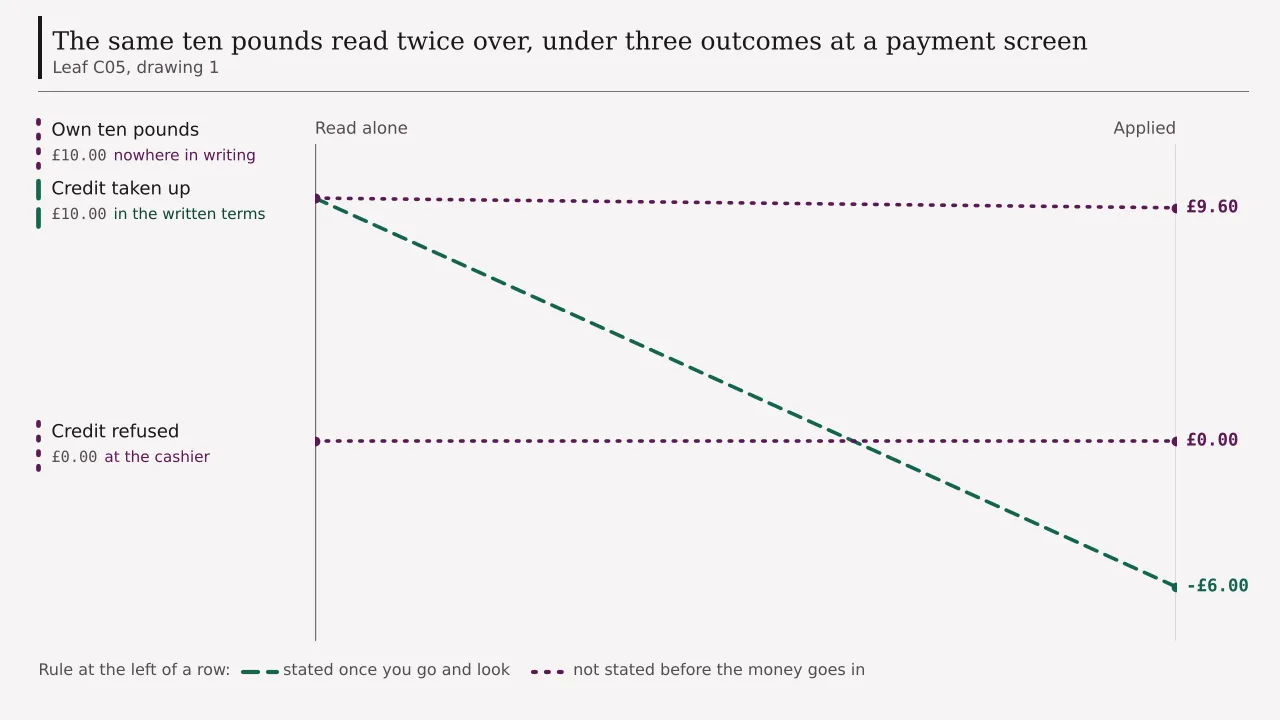
The middle line of that drawing is flat at nothing and it is the line this leaf exists to explain. A refused route produces no credit, so there is nothing for either reading to act on. The bottom line is the reader’s own £10.00 pushed once across the reels with no obligation attached, which is expected to give back £9.60 and is the honest comparison nobody puts on an advertisement.
6
What can be settled before an account exists
This part is the inventory, and it is deliberately dull. Everything a reader can establish at nil commitment goes in the first list. Everything that needs an account goes in the second. The lists are short and the division between them is the whole argument of the section this leaf sits in.
Reachable with nothing opened and nothing paid: the percentage, the qualifying payment, the multiple wherever the promotional document is linked, the window, the ceiling on a single stake where the general conditions carry one, any written list of routes that do not qualify, and the published conditions of the route itself. That is a substantial amount of material and a reader working through it carefully has recovered most of what this site prices elsewhere.
Not reachable at any price until an account exists: which routes the screen presents on the day, whether the names on the screen match the names in the written list, the smallest payment each route will carry, and whether a route offered at the entry is also offered at the exit. Four items, none of them published, and the opening pair settles whether the £10.00 credit appears at all.
Put a number on the imbalance and it reads worse than the lists suggest. Seven items are reachable in advance and they settle the size of the arrangement. Four items are not reachable and they settle whether the arrangement applies to this reader at all. Size is the easy question and applicability is the hard one, and the easy question is the one everything is published about.
There is a cheap partial remedy and it should be stated plainly because this leaf is otherwise unrelieved. The route’s own published conditions are readable now, by anybody, with no account anywhere. Reading them does not settle whether an arrangement disqualifies the route, which is the other writing, but it settles half the agreement test for nothing, and half a test done in advance is better than a whole one done afterwards.
The second cheap remedy is to look for the written list before paying rather than after. Where a disqualifying list exists in the promotional document, the entire subject of this leaf collapses into a thirty-second read. Where no such list exists, that absence is itself information: a promotion with no written route conditions has either no route conditions or unwritten ones, and only one of those is good news.
7
A cliff rather than a charge, at every payment size
Most of what a payment screen adds to an arrangement is proportional. A fee takes a percentage. A floor removes small payments and leaves large ones. A conversion shaves a margin off whatever crosses. A disqualifying route does none of those things, and working the arithmetic at several payment sizes shows exactly how differently it behaves.
| Payment matched in full | Credit issued | Staking at forty times | Presses that takes at 10p | Expected close | Distance between readings | What a disqualified route leaves |
|---|---|---|---|---|---|---|
| £5.00 | £5.00 | £200.00 | 2,000 | minus £3.00 | £8.00 | Nothing, at every size |
| £10.00 | £10.00 | £400.00 | 4,000 | minus £6.00 | £16.00 | Nothing, at every size |
| £60.00 | £60.00 | £2,400.00 | 24,000 | minus £36.00 | £96.00 | Nothing, at every size |
| £75.00 | £75.00 | £3,000.00 | 30,000 | minus £45.00 | £120.00 | Nothing, at every size |
Six columns move and one does not. The credit, the staking, the presses, the expected close and the distance between readings all scale in exact proportion to the payment, which is what a multiple does to anything. The last column is a constant, and a constant in a table where everything else is proportional is a different kind of object altogether.
That constancy has a practical consequence a reader can act on. Nothing is gained by paying in a larger sum to make a disqualification hurt less, and nothing is gained by paying in a smaller one to limit the damage, because the damage is not denominated in the payment. A route either qualifies or it does not, and the only lever a reader holds is which picture they press.
It also means the rule of thumb readers use for fees is exactly wrong here. On a fee, a small payment is the expensive one, since a fixed charge eats more of a small sum. On a disqualification, every payment is equally expensive in the only sense that matters, which is that the arrangement produces nothing at all. The smaller reader is not better protected and the larger one is not worse hit.
£16.00 of difference on £10.00, identical whether the route qualifies or the screen refuses it
8
The reading in which the refused reader comes out ahead
This part argues against the rest of the leaf, and it is the most important paragraph on the page. Forty times over a £10.00 credit, on 96p back in the pound, is expected to close at minus £6.00. Somebody refused that credit has therefore been spared an expected loss of six pounds, and writing anything else would be arithmetic pointed in a convenient direction.
Honestly put, the sign of the answer turns on the multiple alone, and the pivot sits at twenty-five. Under twenty-five a credit is expected to outlive its own clause, so losing it costs real money. Exactly at twenty-five the credit is expected to be handed over whole, so losing it costs nothing. Past twenty-five the credit becomes a reason to go on pressing once the expected balance has gone, and losing it is a reprieve.
| Multiple on a £10.00 credit | Staking demanded | Expected close | Worth of the refusal | Where the figure comes from |
|---|---|---|---|---|
| Ten times | £100.00 | £6.00 | minus £6.00 to the reader | The regulated ceiling, from 19 January 2026 |
| Twenty-five times | £250.00 | £0.00 | £0.00 either way | Arithmetic, one over a four per cent edge |
| Forty times | £400.00 | minus £6.00 | plus £6.00 to the reader | This site’s working assumption throughout |
| Sixty times | £600.00 | minus £14.00 | plus £14.00 to the reader | The height the ceiling was written against |
The bottom row needs its source named, being the one multiple here taken from somebody other than this site. On publishing the ceiling the British regulator put on record that wagering of up to sixty times was in use, which is why a ceiling now stands at ten. The £600.00 and the minus £14.00 beside it are worked here off that figure and are not the regulator’s own arithmetic.
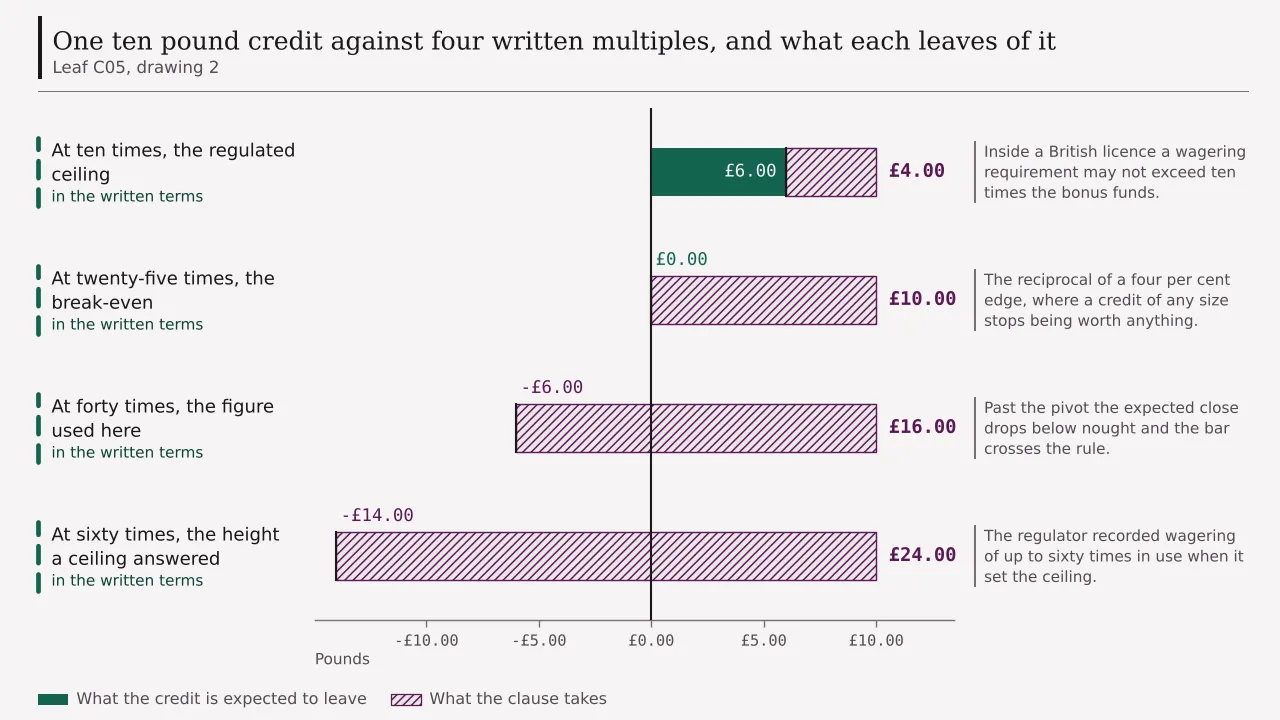
So what exactly has a refused reader lost? Not expected value, at any multiple past twenty-five. What they have lost is the upper tail: the branch where a run goes well and the clause is beaten, which is the only branch anybody is actually buying. An expected close of minus £6.00 is an average across outcomes in which most balances were gone long before the staking was finished, and a reader hoping for the good branch is not hoping for the average.
They have also lost something that is not money and is worth naming. They chose, paid, and were given a different arrangement from the advertised one without being told at the moment of choosing. The complaint there is about information rather than about pounds, and it survives intact even where the arithmetic says the refusal did them a favour.
9
Prominence, position, and a finding dated 31 July 2024
A British duty is written about precisely this clause, and it governs where the clause stands rather than what it says. Promotional material owes each significant condition a clear and prominent place, wherever dropping one would be likely to mislead. The worked list kept by the advertising regulator runs to eligibility restrictions, demands for a payment or for wagering, deadlines fixed on claiming the thing or spending it, and floors on odds or on the bet types allowed.
On 31 July 2024 that duty was applied to an excluded payment route. The route had been written down. It was in the full conditions. The finding was that setting it in small print among those conditions left it insufficiently prominent, which is a judgement about position and nothing else. The British regulator states the consequence in a line of its own: give such a condition too little prominence and what has been published counts as misleading.
Fold that into this leaf’s own units and the duty prices itself. The clause in question decides whether £10.00 of credit exists, which is a £16.00 difference against what the advertisement supports. The duty does not change that £16.00 by a penny. It changes where the sentence producing it has to stand, and therefore how many readers meet it before choosing rather than after paying. A duty about position is a duty about who ends up carrying a figure, which on a number of that size is the entire question.
A second instrument reaches the same ground from the contract side rather than from the advertisement. A licensing duty covering fairness and transparency closes on a fourth limb, which bars commercial practices that are unfair in the statutory sense anywhere in a licensee’s dealings with a consumer, under the consumer statute of 2024. Advertisement and contract between them therefore cover both ends of a disqualifying clause: how it gets presented, and how it gets used.
Arrangements whose qualifying routes get settled at a payment screen hold no Great Britain licence whatever, and the duties that vanish on this subject are those about where a sentence may sit. Nothing then requires a disqualifying route to stand beside the percentage rather than inside a general document. Nothing treats small print around such a condition as a fault in the advertisement. Nothing bars a commercial practice that is unfair in the statutory sense from being applied to the way the condition is used. And the regulator that published the 31 July 2024 finding has no jurisdiction over a promotion it was not written for. The £16.00 does not move. What moves is whether the reader was ever in a position to see the sentence that produces it.
One further loss belongs on a leaf about routes. Being inside the national scheme for self-exclusion follows from the British licence and from nothing an arrangement chooses, and the scheme writes into its own terms of use that it is unable to hold anybody back from services run by bodies taking no part in it. A reader who has used that protection should treat a promotion sitting outside its reach as outside it, and the block further down carries the places worth going to instead.
10
Doing the whole check before anything is paid in
The whole of this leaf reduces to a procedure that takes a few minutes and costs nothing, and it is set out here in the order the steps have to be taken rather than in the order the material was presented.
Step one, open the promotional document and search it for the word excluded and for the names of any routes. What is found there is settled in the promotional terms and is the cheapest fact on this leaf. Step two, open the published conditions of the route itself, which needs no account anywhere, and establish what the route says about the purpose. Those two steps complete the agreement test as far as it can be completed in advance.
Step three is the one that cannot be done in advance and should be acknowledged rather than pretended away. The row of pictures at the payment screen is visible only after registration, and whether the names on it match the names in the document is a question with no published answer. A reader reaching that screen has already created an account and has already passed whatever identity work the arrangement asks for.
Step four brings the arithmetic, which is the subtraction run on every leaf here. Work out the credit as the percentage presents it. Do the sum a second time with the multiple in place. Rule off what separates the two. A £10.00 payment matched in full at forty times gives £10.00, then minus £6.00, then a gap of £16.00, and that gap is what the whole question of the route is contesting.
Two cautions keep the result honest. Never treat a completed payment as evidence that the payment qualified, because the two have different authors and only one of them is involved in moving the money. And never fold the route question into the multiple question: the multiple decides how large an arrangement is, the route decides whether the arrangement exists, and a reader who answers only the first has answered the easier of the two.
The honest summary is four figures and one sentence. Ten pounds of credit, four hundred pounds of staking, an expected close of minus six pounds, and sixteen pounds between the readings. And a sentence deciding whether any of the four applies to this particular reader, which is settled at a payment screen, or in a document nobody linked to, or in nothing anybody wrote.
Questions
- Can a payment route stop me getting a welcome offer?
- Yes, and the effect is total rather than partial. Where a promotional document says payments made by named routes do not qualify, no credit is issued at all: £400.00 of staking is never demanded, and minus £6.00 never becomes anybody’s expected close, because nothing exists for a multiple to act on. What remains is the £10.00 paid in, sitting in an account, plus an advertisement that was accurate for somebody else.
- What is a £10.00 credit at forty times actually worth?
- An expected minus £6.00. Forty times over the credit puts £400.00 across the reels, each staked pound leaves four pence behind, and £400.00 at £0.04 comes to £16.00 of expected cost against £10.00 of credit. The formula reaches it too: four hundredths taken forty times is 1.6, one less that figure is minus six tenths, and six tenths of ten pounds is six pounds facing the wrong way.
- Where would I find out that a route is excluded?
- In the promotional document where one has been written, which is one step from the advertisement and reachable with no account. What cannot be reached in advance is the row of pictures the payment screen presents on the day, and whether the names on that row match the names in the document. The first is settled in the written terms, the second at the cashier, and the third in nothing anybody has published.
- Does a payment going through mean it qualified?
- No, and treating it as evidence is the single most expensive assumption on this subject. Whether a route may carry a payment is decided by the route. Whether that payment earns a credit is decided by the arrangement being advertised. They are separate writings by separate authors, so a payment can complete perfectly while producing nothing, and the only missing thing is silent.
- How do Skrill, Neteller and Trustly compare on this?
- Not on speed, which is where they are usually set against one another and where nothing useful separates them. On the question that decides the credit, the first two put the second writing in the hands of the party running a stored-value account, published and readable before anything is opened. The third draws from a bank the reader chose years earlier for unrelated reasons, so the second writing is one they have agreed to and never read against this question.
- Would paying in more make a disqualification hurt less?
- No. Run it at four sizes and the credit, the staking, the expected close and the distance between readings all scale in exact proportion, while what a disqualified route leaves is nothing at every one of them. A fee punishes the small payment hardest. A disqualification is not denominated in the payment at all, so the only lever a reader holds is which picture they press.
- Am I better or worse off if my payment route is refused?
- The answer turns on the multiple alone, with the pivot sitting at twenty-five. At ten times a £10.00 credit is expected to close at £6.00, so losing it costs six pounds. At twenty-five times it closes at nothing, so losing it costs nothing whatever. At forty times it closes at minus £6.00, which makes refusal worth six pounds in the reader’s favour. What refusal always removes is the branch where a run goes well, and that branch is the thing anybody is actually buying.
- Is there a rule about where an excluded route must be printed?
- Inside the British licence there is, and it governs position rather than content. Promotional material owes a significant condition a clear and prominent place wherever dropping it would be likely to mislead, and the worked list runs to eligibility, demands for a payment or for wagering, deadlines, and floors on odds or bet types. On 31 July 2024 an excluded payment route set in small print among full conditions was judged insufficiently prominent, and the regulator’s own line is that too little prominence makes what was published misleading.
- What changes when the arrangement is run from outside Britain?
- Arrangements whose qualifying routes get settled at a payment screen hold no Great Britain licence whatever, so the duties about position fall away. Nothing then requires the disqualifying route to stand beside the percentage, nothing treats small print around it as a fault, nothing bars a commercial practice unfair in the statutory sense from being applied to how the condition is used, and the body that published the 31 July 2024 finding has no reach over a promotion it was not written for. The £16.00 is unchanged; who meets the sentence producing it is not.
- What can I check before registering anywhere?
- Seven things, and they settle the size of the arrangement: the percentage, the qualifying payment, the multiple, the window, any ceiling on a single stake, any written list of routes that do not qualify, and the route’s own published conditions. Four things cannot be reached until an account exists, and they settle whether the arrangement applies at all: the routes the screen offers, whether its names match the document’s, the smallest payment each route carries, and whether a route offered at the entry is offered at the exit.
- What is the shortest honest summary of this subject?
- Four figures and one sentence. Ten pounds of credit, four hundred pounds of staking, an expected close of minus six pounds, and sixteen pounds between the two readings. Then a sentence deciding whether any of the four applies to this particular reader, settled at a payment screen, or in a document nothing linked to, or in nothing written down at all.