Terms read 19 October 2026 Leaf A04, revision 1
Ten minutes anybody can confirm, and thirty hours nobody can
A payout is several stretches end to end, and on this route exactly one of them leaves a record a stranger could open. Taking the wait at 1,810 minutes on this leaf’s own assumptions, the stretch with a public record runs 10 minutes of it. That is 0.55 per cent of the waiting, and it was never the part holding anything up.
Stated on the banner 10 minutes The stretch an advertisement prints, assumed at ten minutes here, and the only stretch of the five with an open record behind it. Stated, once you go and look £45.60 What an open record can establish about a £48.00 balance once an assumed deduction of five in the hundred has been taken inside the ledger. Not stated before the money goes in 1,800 minutes Everything between a payout being asked for and a transfer being pushed out, which no document carries and no record shows.
Offers paying out across a public network, with their terms read
Every destination in this file is bought advertising. The site is paid a fee if a reader goes on to register, and no figure printed below moves because of it.
Bonus Spins UK Slip 01
Betportal
Ceiling as a multiple
The drop
€15.00
€1.00 in the euro
The claim reads €15.00. Once the terms beside it have applied, €0.00 of it can leave. The difference is the drop.
7 of the 15 terms on this slip could not be read before the money went in
Spins priced at this site's own 10p a spin, which the operator does not publish
Stated
€15.00
The claim as it is printed, before a single term has been applied to it.
Headline paid as spins
150 spins at 10c each, which is €15.00 of the figure above.
6 Nowhere
What one spin is worth
No unit is published for a spin, so the count is priced at this site's own 10p a spin. At half that price every figure below halves with it.
Match and other credit not priced
300% of three deposits, to a ceiling of €1,000. A share of a deposit nobody has made yet is not a sum, so no figure stands on this line and none is carried below.
Qualified
-€14.40
Written down somewhere, and taking part of the claim back. Each term carries the place it is written and the sum it takes.
2 Written terms at a distance this record does not establish
Play-through -€14.40
Carrying €14.40 through 35 times stakes €504.00 and costs €20.16 of it at 96 per cent return. That prices above the €14.40 there is to charge it against, so the whole of the credit goes and the line is held at that. The multiple sits on the bonus.
2 Written terms at a distance this record does not establish
Game weighting not priced
Slots only count towards the play-through. No contribution percentage is published, so the line above has been worked at full weight, which is the kindest reading there is.
2 Written terms at a distance this record does not establish
Ceiling on the winnings not priced
5x the bonus.
2 Written terms at a distance this record does not establish
Clock on the credit not priced
14 days.
2 Written terms at a distance this record does not establish
Largest stake while it runs not priced
€5.
3 Public record
Licence, and who holds it not priced
Licensed in Anjouan, Comoros, held by BetPortal Gaming Ltd, with Excite Ultra Media Ltd, reference ALSI-202601040-FI2. A register entry settles who holds a licence and what it permits. It does not settle who is running the site this morning.
4 Cashier
Smallest qualifying deposit your money
€20 a stage. That is €20.00 of your own money, and it is never netted into a drop.
5 On the way out
Checks before a withdrawal not priced
Documents before the first withdrawal.
Unstated
-€0.60
Applying without having been published anywhere, and costing money all the same.
6 Nowhere
What a spin hands back -€0.60
Staking a spin returns 96 per cent of it, so that share of the batch is the house's before a reel turns. This site works at that return and the operator publishes none where the claim is made.
6 Nowhere
Forfeited by rule cost unknown
Nothing is published under this heading, and it applies regardless.
6 Nowhere
Charge on the way out cost unknown
No charge on the way out is published as a figure, so nothing comes off this line. A charge that exists unpublished would come straight off whatever survives.
6 Nowhere
Smallest withdrawal allowed cost unknown
No smallest withdrawal is published as a figure. A floor nobody has published is still a floor, and it decides whether a small balance can move at all.
No Great Britain licence
Terms read 19 October 2026
Bonus Spins UK Slip 02
WinBeast
Ceiling as a sum
The drop
€50.00
€1.00 in the euro
The claim reads €50.00. Once the terms beside it have applied, €0.00 of it can leave. The difference is the drop.
8 of the 15 terms on this slip could not be read before the money went in
Spins priced at this site's own 10p a spin, which the operator does not publish
Stated
€50.00
The claim as it is printed, before a single term has been applied to it.
Headline paid as spins
500 spins at 10c each, which is €50.00 of the figure above.
6 Nowhere
What one spin is worth
No unit is published for a spin, so the count is priced at this site's own 10p a spin. At half that price every figure below halves with it.
Match and other credit not priced
50% to 100% of five deposits, each to a ceiling of €1,000, and a €650 free bet. A share of a deposit nobody has made yet is not a sum, so no figure stands on this line and none is carried below.
Qualified
-€48.00
Written down somewhere, and taking part of the claim back. Each term carries the place it is written and the sum it takes.
2 Written terms at a distance this record does not establish
Play-through -€48.00
Carrying €48.00 through 40 times stakes €1,920.00 and costs €76.80 of it at 96 per cent return. That prices above the €48.00 there is to charge it against, so the whole of the credit goes and the line is held at that. The multiple sits on the bonus and the winnings from the spins.
2 Written terms at a distance this record does not establish
Game weighting not priced
Slots, titles vary by country count towards the play-through. No contribution percentage is published, so the line above has been worked at full weight, which is the kindest reading there is.
2 Written terms at a distance this record does not establish
Ceiling on the winnings not priced
€100 a batch of spins.
2 Written terms at a distance this record does not establish
Clock on the credit not priced
7 days, spins 1 day.
3 Public record
Licence, and who holds it not priced
Licensed in Curaçao, holder not named on the site. A register entry settles who holds a licence and what it permits. It does not settle who is running the site this morning.
4 Cashier
Smallest qualifying deposit your money
€20 a stage. That is €20.00 of your own money, and it is never netted into a drop.
5 On the way out
Checks before a withdrawal not priced
Documents before the first withdrawal.
Unstated
-€2.00
Applying without having been published anywhere, and costing money all the same.
6 Nowhere
What a spin hands back -€2.00
Staking a spin returns 96 per cent of it, so that share of the batch is the house's before a reel turns. This site works at that return and the operator publishes none where the claim is made.
6 Nowhere
Largest stake while it runs cost unknown
Nothing is published under this heading, and it applies regardless.
6 Nowhere
Forfeited by rule cost unknown
Nothing is published under this heading, and it applies regardless.
6 Nowhere
Charge on the way out cost unknown
No charge on the way out is published as a figure, so nothing comes off this line. A charge that exists unpublished would come straight off whatever survives.
6 Nowhere
Smallest withdrawal allowed cost unknown
No smallest withdrawal is published as a figure. A floor nobody has published is still a floor, and it decides whether a small balance can move at all.
No Great Britain licence
Terms read 19 October 2026
Bonus Spins UK Slip 03
EliteSpin
Longest spin window
The drop
£50.00
£1.00 in the pound
The claim reads £50.00. Once the terms beside it have applied, £0.00 of it can leave. The difference is the drop.
8 of the 15 terms on this slip could not be read before the money went in
Spins priced at this site's own 10p a spin, which the operator does not publish
Stated
£50.00
The claim as it is printed, before a single term has been applied to it.
Headline paid as spins
500 spins at 10p each, which is £50.00 of the figure above.
6 Nowhere
What one spin is worth
No unit is published for a spin, so the count is priced at this site's own 10p a spin. At half that price every figure below halves with it.
Match and other credit not priced
50% to 100% of five deposits, each to a ceiling of £1,000. A share of a deposit nobody has made yet is not a sum, so no figure stands on this line and none is carried below.
Qualified
-£48.00
Written down somewhere, and taking part of the claim back. Each term carries the place it is written and the sum it takes.
2 Written terms at a distance this record does not establish
Play-through -£48.00
Carrying £48.00 through 40 times stakes £1,920.00 and costs £76.80 of it at 96 per cent return. That prices above the £48.00 there is to charge it against, so the whole of the credit goes and the line is held at that. The multiple sits on the bonus and the winnings from the spins.
2 Written terms at a distance this record does not establish
Game weighting not priced
Slots count towards the play-through. No contribution percentage is published, so the line above has been worked at full weight, which is the kindest reading there is.
2 Written terms at a distance this record does not establish
Ceiling on the winnings not priced
5x the bonus.
2 Written terms at a distance this record does not establish
Clock on the credit not priced
7 days, spins 3 days.
3 Public record
Licence, and who holds it not priced
Licensed in Costa Rica, held by PrimeTier Limited. A register entry settles who holds a licence and what it permits. It does not settle who is running the site this morning.
4 Cashier
Smallest qualifying deposit your money
£20 a stage. That is £20.00 of your own money, and it is never netted into a drop.
5 On the way out
Checks before a withdrawal not priced
Documents before the first withdrawal.
Unstated
-£2.00
Applying without having been published anywhere, and costing money all the same.
6 Nowhere
What a spin hands back -£2.00
Staking a spin returns 96 per cent of it, so that share of the batch is the house's before a reel turns. This site works at that return and the operator publishes none where the claim is made.
6 Nowhere
Largest stake while it runs cost unknown
Nothing is published under this heading, and it applies regardless.
6 Nowhere
Forfeited by rule cost unknown
Nothing is published under this heading, and it applies regardless.
6 Nowhere
Charge on the way out cost unknown
No charge on the way out is published as a figure, so nothing comes off this line. A charge that exists unpublished would come straight off whatever survives.
6 Nowhere
Smallest withdrawal allowed cost unknown
No smallest withdrawal is published as a figure. A floor nobody has published is still a floor, and it decides whether a small balance can move at all.
No Great Britain licence
Terms read 19 October 2026
Bonus Spins UK Slip 04
Crown Jewelz
Multiple unpublished
The drop
NOT WORKED
The multiple is not published in the operator's own terms. Since the sum cannot be worked around it, none is worked.
9 of the 14 terms on this slip could not be read before the money went in
No drop worked
Stated
£15.00
The claim as it is printed, before a single term has been applied to it.
Headline paid as spins
150 spins at 10p each, which is £15.00 of the figure above.
6 Nowhere
What one spin is worth
No unit is published for a spin, so the count is priced at this site's own 10p a spin. At half that price every figure below halves with it.
Match and other credit not priced
200% of the first deposit, then 150% twice, each to a ceiling of £1,000. A share of a deposit nobody has made yet is not a sum, so no figure stands on this line and none is carried below.
Qualified
NOT WORKED
Written down somewhere, and taking part of the claim back. Each term carries the place it is written and the sum it takes.
2 Written terms at a distance this record does not establish
Play-through not priced
40x the bonus, reported rather than published by the operator.
2 Written terms at a distance this record does not establish
Game weighting not priced
Slots count towards the play-through. No contribution percentage is published, so the line above has been worked at full weight, which is the kindest reading there is.
3 Public record
Licence, and who holds it not priced
Licensed in Curaçao, number not verified, holder not named on the site. A register entry settles who holds a licence and what it permits. It does not settle who is running the site this morning.
4 Cashier
Smallest qualifying deposit your money
£20. That is £20.00 of your own money, and it is never netted into a drop.
5 On the way out
Checks before a withdrawal not priced
Documents before the first withdrawal.
Unstated
NOT WORKED
Applying without having been published anywhere, and costing money all the same.
6 Nowhere
Ceiling on the winnings cost unknown
No ceiling is published. Nothing is assumed in its place.
6 Nowhere
Clock on the credit cost unknown
Nothing is published under this heading, and it applies regardless.
6 Nowhere
Largest stake while it runs cost unknown
Nothing is published under this heading, and it applies regardless.
6 Nowhere
Forfeited by rule cost unknown
Nothing is published under this heading, and it applies regardless.
6 Nowhere
Charge on the way out cost unknown
No charge on the way out is published as a figure, so nothing comes off this line. A charge that exists unpublished would come straight off whatever survives.
6 Nowhere
Smallest withdrawal allowed cost unknown
No smallest withdrawal is published as a figure. A floor nobody has published is still a floor, and it decides whether a small balance can move at all.
No Great Britain licence
Terms read 19 October 2026
Every figure in the second and third columns is this site's own working and nothing an operator has published. A claim is priced as printed, then the share a spin hands back at 96 per cent return comes off it, then what playing the multiple through costs at the same return, and then whatever a published ceiling, a charge on the way out or a floor on the smallest withdrawal takes from what has survived. The drop is the difference between the first figure and the last. The two columns add back up to it exactly, so no money leaves a slip without a term and a place beside it.
Which column a term falls in is settled by one question: has anybody written it down. A charge a reader meets at the payment screen is written down, and it stands in the second column with the cashier against it. A condition that binds without ever having been set down stands in the third, whatever it costs. Inside each column the terms run outwards from the banner, so the order itself says how far a reader would have had to go.
A count of spins has no unit until one is supplied. Where an operator publishes what one of its own spins is worth, that figure is used and the first column says it is theirs. Where none is published, this site's own 10p a spin stands in its place and every figure below moves in proportion with it. Where the multiple itself is unpublished, no drop is worked at all, because that is the one figure the sum cannot be done without.
Three words stand where a figure cannot. Not priced is a term that is written down and carries no number the arithmetic can take. Cost unknown is a term nobody has written down, costing something nobody has put a number on. Your money is money of the reader's own, which is never netted into a drop.
None of the operators in this file holds a Great Britain licence, so none of the duties that licence carries reaches them. Each of those duties is published in its own right, which is what makes its absence here something a reader can check rather than take on trust. Every gambling company licensed in Great Britain belongs to Gamstop Online, so a reader who has shut themselves out through the scheme is not shut out here. Social Responsibility Code 5.1.1 has held a play-through to a maximum of ten times the bonus funds since 19 January 2026, and it binds a licence holder and nobody else. Asked in a post of 21 October 2025 what is lost along with the licence, the Gambling Commission's Director of Enforcement and Intelligence answered: "unfair gaming practices, financial loss, and a lack of recourse if things go wrong". The same post puts blocked payouts, and withdrawal limits pitched high enough to be unreachable, among the behaviour the Commission has recorded. Nobody under 18 may hold an account at any of them.
Terms are reproduced in the wording their operator published, and each slip is dated with the day somebody sat down and read them. 19 October 2026 is the oldest of those dates. Anybody claiming an offer is bound by that operator's full terms, which are elsewhere, and never by a line standing here.
1
The single stretch of a payout a stranger could confirm
If this page has been reached while looking for a way around a bar somebody put in their own way, the useful number on it is 0808 8020 133, which GamCare staffs around the clock and charges nothing for, with GamCare.org.uk and BeGambleAware.org open at any hour as well. There is nothing here about obtaining, keeping or shifting any unit, nothing here about which sort of cashier asks for less, and nothing here that would serve anybody trying to undo a registration with Gamstop Online. The subject below is arithmetic on a wait.
Start from what checkable means on this site. A claim is checkable where somebody with no account, no relationship and no permission can go to a record, read the claim off it, and get the same answer anybody else would get. A licence entry is checkable in that sense. A published standard is checkable. The contents of a cashier’s own ledger are not, and neither is the reason a payout sat still for a day.
Settlement across a public network passes that test, which is the one genuinely unusual thing about the route. A transfer of a stated size, reaching a stated destination, at a stated moment, is written into a record anybody may open without asking. No other stretch of a payout has that property on any route whatever, and this leaf does not pretend otherwise: the openness is real, it is rare, and saying so plainly comes first because everything below measures it.
What the rest of the page does is measure it. Something being checkable is interesting where the thing checked was the thing in doubt. The arithmetic below puts the open stretch at 10 minutes against a whole wait of 1,810 minutes, both of them this leaf’s own assumptions, which makes the open stretch one part in a hundred and eighty-one of the quantity a reader actually waits through.
Offers paying out this way hold no Great Britain licence. On a subject about what can be seen, the losses that bite are duties putting something in front of a person before they commit, and part seven takes each in turn against whatever it would have made visible. None of them touches the network stretch, which was never the part needing a rule to expose it.
One more thing to fix before the decomposition. The search phrase that reaches this page carries a superlative, and no superlative on this subject belongs to this site. Part six works out why: a ranking by speed would be a ranking on ten minutes in eighteen hundred and ten, and those ten minutes are produced by a shared network that has no idea which cashier asked. Nothing resembling a score, a rating or an order of merit is printed anywhere below, and the reason for that is arithmetical rather than modest.
2
Pulling a payout into the stretches it is actually made of
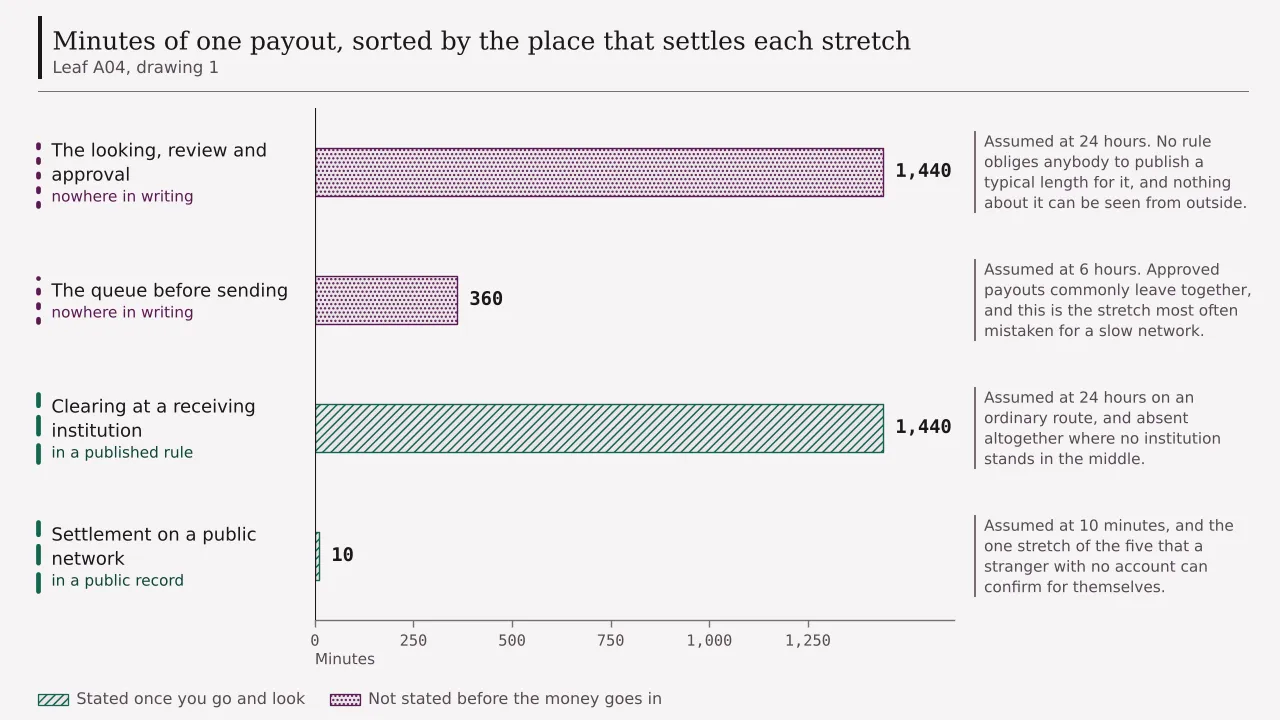
A payout is treated here as four consecutive stretches, with a fifth on ordinary routes. Every length attached to them below is assumed by this leaf and wears that label on every line where it carries a figure, no published source available to this site giving a duration for any of the five.
Stretch one is the asking. A balance holder presses a button and a row appears in a ledger nobody outside the business can read. The length is nought, or near enough, and its interest is that it starts the only clock in the exercise that matters.
Stretch two is the looking. Somebody or something inside the business decides whether the payout goes, which may involve documents, a limit check, a bonus audit or a queue of human beings. Assume 24 hours. Nothing about this stretch is observable from outside, no rule obliges anybody to publish its typical length, and the sibling page on speed claims is where the absence of any published figure for it is taken apart properly.
Stretch three is the waiting to be sent. Approved payouts are commonly gathered and released together rather than one at a time, so a payout approved at four in the morning may leave with the batch after it. Assume 6 hours. This is also invisible, and it is the stretch readers most often mistake for the network being slow.
Stretch four is the moving. On this route it is settlement across a public network, assumed here at 10 minutes, and it is the stretch with an open record. On an ordinary route it is a scheme or bank instruction, which also carries a record, though one only the two institutions may read.
Stretch five exists on ordinary routes and not on this one. It is the arrival: a receiving institution taking the instruction, clearing it and making the money spendable, assumed here at 24 hours. On a public network there is no receiving institution in the middle, so the stretch has no content and takes no time.
| The stretch | Who could settle its length | Ordinary route | This route | Observable from outside |
|---|---|---|---|---|
| The asking | at the cashier | 0 min | 0 min | No |
| The looking | nowhere in writing | 1,440 min | 1,440 min | No |
| The waiting to be sent | nowhere in writing | 360 min | 360 min | No |
| The moving | in a public record | 0 min | 10 min | On this route, yes |
| The arriving | in a published rule | 1,440 min | 0 min | Partly |
| Added together | Not printed anywhere | 3,240 min | 1,810 min | One stretch of five |
The two totals are 54 hours and 30 hours 10 minutes. Nothing in that table is a measurement of anybody’s actual service, and no page on this site measures one. The table is a frame: it fixes what the parts are, so that a claim about speed can be matched against the part it is really a claim about.
3
Which stretches drop out on this route, and what their going is worth
Two things in that table genuinely disappear on this route, and naming them exactly is more useful than saying the route is quick. The arriving stretch disappears, worth an assumed 1,440 minutes. Inside the moving stretch, the cut-offs and non-working days that govern an instruction between institutions disappear as well, which the table does not show because it assumes a payout that never meets a weekend.
Put a figure on the disappearance. Three thousand two hundred and forty minutes less one thousand eight hundred and ten is 1,430 minutes, which is 23 hours and 50 minutes. The same figure comes the other way: the arriving stretch at 1,440 minutes drops out and the moving stretch costs 10 minutes where it previously cost nothing, so 1,440 less 10 is 1,430 again. Two routes to the figure, one by subtracting totals and one by netting the two stretches that changed.
1,430 minutes saved on this leaf’s own assumptions, of which not one belongs to the business being waited on
Now price it, which is where this page parts company with most writing on the subject. Under this site’s arithmetic a balance sitting still earns nothing and costs nothing, so 1,430 minutes of waiting removed is worth £0.00. Converting it into pounds would need a rate of return on a held balance, this leaf has no sourced rate to use, and inventing one to make the saving look like money would be the sort of figure this site exists to object to.
So the honest statement of what the disappearing stretches are worth is this. They are worth 23 hours and 50 minutes, they are worth no pounds, and they are paid for with a third stretch that also disappears and does have a price. The ability to have a wrong payment put back vanishes on this route too, and the arithmetic that prices it at the whole face of the payment is worked on the anchor page of this section rather than here.
One further stretch does not disappear and is worth naming because readers expect it to. The looking and the waiting to be sent, 1,800 minutes between them on these assumptions, are identical on both routes. They belong to the business, they are settled nowhere in writing, and no property of any network reaches them. Changing the rail changes the last two stretches and leaves the first three exactly as they were.
4
Ten against eighteen hundred, written as a proportion
The finding of this leaf is a ratio rather than a length, so here it is in both directions. Ten minutes of open record divided by 1,810 minutes of total wait is 0.0055, which is 0.55 per cent. The other 1,800 minutes, which is 99.45 per cent, leave no record a stranger may open. Divide one by the other and the unobservable part of the wait is 180 times the observable part.
That multiple is the whole argument compressed. A reader who verifies the network leg has verified one minute in every hundred and eighty-one of their own waiting, and has verified precisely the minute that nobody was ever complaining about. The 1,800 minutes that generate every complaint on this subject sit inside a ledger that publishes nothing.
Three cautions keep the ratio honest. The ten minutes is assumed and a busier network makes it longer, which raises the observable share rather than lowering it. The 1,440 minutes of looking is assumed and a quicker business makes it shorter, which also raises the observable share. And a slower business makes the share smaller, so the 0.55 per cent is a figure about a frame rather than about anybody’s practice.
Test the sensitivity and the finding survives all of it. Cut the looking to 2 hours and the queue to 1 hour, which would be a very quick business indeed, and the total falls to 190 minutes with 10 of them observable, giving 5.26 per cent. Stretch the looking to 72 hours and the share drops to 0.22 per cent. Across a band that wide the observable share runs between about one part in twenty and one part in four hundred and fifty, and never approaches a half.
| Assumed looking and queue | Unobservable minutes | Observable minutes | Observable share | Unobservable, as a multiple |
|---|---|---|---|---|
| 3 hours in all, a very quick business | 180 | 10 | 5.26 per cent | 18.0 |
| 30 hours in all, this leaf’s assumption | 1,800 | 10 | 0.55 per cent | 180.0 |
| 72 hours in all | 4,320 | 10 | 0.23 per cent | 432.0 |
| 7 days in all | 10,080 | 10 | 0.10 per cent | 1,008.0 |
Read the right-hand column downwards and a second property shows up. The worse the business behaves, the larger the multiple grows, so the open record is least informative in exactly the circumstances where a reader most wants information. A measurement that gets weaker as the problem gets bigger is not much of a measurement, and that is a statement about the shape of the thing rather than about anybody’s conduct.
5
What an open record fixes about a figure, and what it leaves alone
Length is one half of the question. Size is the other, and the record behaves differently on it. Work a small balance. Five hundred presses of a ten-penny button turn over £50.00, and with ninety-six pence coming back on the pound, a proportion this site never varies, the expectation is £48.00. That £48.00 is the figure on the screen and the figure a reader would act on.
Now assume a deduction of five in the hundred applied inside the ledger before anything is sent. That five is taken here rather than read anywhere, nothing citable on this site setting out a charge of the sort. Five per cent of £48.00 is £2.40, so £45.60 leaves. The open record will show £45.60 arriving, at a given moment, at a given destination, and will show it beyond argument.
Read off the balance before anything is sent £48.00 Fixed beyond argument by the open record £45.60 What the record has nothing to say about £2.40
Two pounds forty can be reached without touching the percentage at all, which is the check that it is a real quantity rather than an artefact of the assumption. Four pence in each pound staked is what the reels keep at a 96 per cent return, so £2.40 is exactly the margin on £60.00 of staking, or 600 presses at 10p. The deduction and six hundred presses are the same sum of money reached from two unconnected directions.
What the record settles, then, is narrow and absolute: that £45.60 moved, when it moved, and where it went. What it does not settle is whether £45.60 was the right figure. A record of a transfer carries no opinion about the balance behind it, no sight of the deduction, no view on whether a bonus clause was applied correctly and no way of telling a deliberate charge from an arithmetical slip. The in a public record label attaches to the movement and stops there.
Which is why the proportion in part four is the right way to read the whole thing. Both measurements come out the same shape. On length, the record covers 10 minutes of 1,810. On size, it covers £45.60 of a £48.00 claim and is silent on the £2.40 that was the only part in dispute. The open stretch is small in time and the open sum is close to complete in money, and in both cases the part left over is the part somebody would argue about.
A fair qualification belongs here. Where a figure can be read off a record, a reader holds something firm, and firmness is not nothing: a disagreement about whether money was sent at all cannot even begin on this route, and disagreements of that shape are ordinary elsewhere. The record removes one whole category of argument. It removes the category that was already the easiest to settle.
6
Why a superlative about speed says nothing about an operator
The phrase that brings most readers to a page of this kind puts a superlative in front of a payment route. Take it apart arithmetically rather than dismissing it. A superlative is a claim that one thing beats others on some measured quantity, so the first question is which quantity, and the second is who owns it.
On the figures above the quantity is a wait of 1,810 minutes, and the ownership splits in a way that settles the matter. The looking and the queue, 1,800 minutes, belong wholly to the business. The moving, 10 minutes, belongs to a shared public network. An ordering by speed that actually discriminated between businesses would have to be an ordering on the 1,800, which is the part that publishes nothing, so no such ordering can be built from anything a reader may read.
Then the harder point, which is about what the ten minutes even is. A public network confirms transfers in the order and at the pace its own rules produce, and it has no knowledge of which cashier instructed any particular one. Two payouts sent at the same moment from two unrelated businesses are treated identically by it, because the information that would let it do otherwise is not in the instruction. Speed on that stretch is therefore a property of the network, shared by everyone using it at that moment, and attributing it to any business is attributing a shared thing to one of its users.
Which produces a clean test anybody can run. A claim about a payment route is a claim about a business only where the business could have made it come out differently. The looking passes that test and is unpublished. The queue passes it and is unpublished. The moving fails it, being the same for all comers, and is the one with a record. Every stretch is either attributable or checkable on this route, and no stretch is both.
10 minutes attributable to nobody in particular against 1,800 minutes attributable to somebody and published by no one
So no order of merit is printed here and none is implied. A number of this site’s own invention, standing beside offers whose figures nobody can confirm, would be the worst thing able to sit on a site whose whole subject is confirmability. What is printed instead is the decomposition, the proportion and the two sums in part five, all of which a reader can recompute with their own assumed lengths in about a minute.
The superlative is not dishonest, which is worth conceding. Payouts across a public network really do skip the arriving stretch, and 23 hours and 50 minutes is a real saving on these assumptions. The objection is narrower and arithmetical: the saving is a fact about a rail rather than about whoever is standing on it, so it cannot order anybody, and the stretch that could order them is the one with no figures.
7
What a British licence puts in front of somebody before they commit
A licence does a good deal that this page cannot measure. What it does that bears directly on visibility is a short, specific list, and each item is a thing a reader would be shown without asking. Three of them produce information and the fourth is a published limit on how far the first three reach.
The first concerns the game rather than the payment, and folding it into this leaf’s own figures beats restating it. Standard 3C obliges a licensed build to put something about a customer’s prospects within easy reach ahead of any commitment, and it will take any one of four alternatives for that something, with a percentage of return only the third on its list. So the 96 pence in the pound sitting behind the £48.00 of part five is not a reading even where a licence is held: the duty is discharged by setting out the mechanics, or the margin, or how likely a winning event is, without any percentage appearing.
The second concerns the reader’s own history, and it is the sharpest item here. Since 17 January 2025 a British licence has obliged the operator to put a customer’s net spending and their elapsed playing time on screen as those two quantities move, with the same release shutting off operator-built ways of running several products together. So the machinery for making a ledger visible as it changes exists, works, and is compulsory. What it is aimed at is how much the reader has spent, never how the business is handling a payout.
The third is the register. The regulator publishes searchable registers of licensed businesses, personal licences, regulatory actions and premises, each downloadable in full, and a player is told to open the entry itself and satisfy themselves that the permitted activities, and the web addresses recorded against them, agree with what the site shows. No account and no payment are needed for that, and of everything in this part it is the one item drafted by somebody other than the business it describes.
The fourth is a limit rather than a duty, and printing it is part of being accurate about the other three. The regulator disclaims the ombudsman’s job outright: no power to settle a gambling dispute, no power to get anybody’s money back, no remit over a complaint about a transaction such as a withdrawal going wrong, and no sight of a customer account with which to work out what took place. Even under a licence, then, the visible record stops short of the 1,800 minutes measured here.
Offers that pay out across a public network hold no Great Britain licence. Read that loss by asking what each item would have placed in front of a reader and then striking it out. Standard 3C would have brought one alternative of the four within reach ahead of any commitment, and without it the return figure sitting behind the £48.00 in part five is assumed instead of read. The real-time spend display would have made a reader’s own total visible as it moved; without it the only ledger in the arrangement is the one nobody may open. The register would have settled who is answerable for the 1,800 minutes; without an entry, the question of who is waiting on whom has no public answer. The regulator’s own limit survives the loss unchanged, which is the honest part: it could not have reached inside the hold either way. Three things deleted, one unchanged, and the stretch with the open record untouched by any of them.
8
Why the proportion is met leaving and not arriving
Everything in parts two to six could in principle have been worked out before a single penny moved. The decomposition needs no account. The proportion needs no account. The fact that a public network knows nothing about who instructed it is documented in public. So this section’s standing question applies here as much as anywhere: what makes it a thing discovered while leaving.
Because the proportion is invisible until there is a wait to measure. On the way in, the route presents itself as one quantity, the advertised ten minutes, and nothing a reader meets at that moment breaks it into five stretches. The decomposition is not hidden. It simply has no occasion to exist until somebody is standing in it.
The occasion arrives at exactly one point. A payout is asked for and does not appear. At that moment a reader reaches for the open record, finds the stretch it covers, discovers that the stretch has not started yet, and learns that the thing holding matters up is the stretch with no record at all. The arithmetic was available from the beginning. The need for it was not.
Put a figure on how far down the road that moment sits. The house assumptions make a £50.00 credit at forty times want twenty thousand presses of a ten-penny button, and close it at an expected minus £30.00, six tenths of the credit having gone to the margin on the way. Anybody reaching a payout request has worked that button twenty thousand times already, and the condition waiting there was settled before the first of them.
Which separates this page from the ones about payment screens. A floor at a cashier is met at the moment of paying and changes the decision being taken right then. The proportion here changes no decision at the time it becomes visible, because by then the only remaining decision is how long to wait. That is the signature of this whole section: a term that was true throughout and became relevant once.
There is a reading of all this that is favourable to the route and it deserves its sentence. A reader on an ordinary rail who waits five days for a payout can confirm nothing whatever, because not one of their five stretches leaves an open record. A reader on this route at least learns which side of the ten-minute stretch the delay sits on, which converts an unanswerable question into a narrower unanswerable question. That is a real improvement and it is 0.55 per cent of one.
9
What is worth settling before a payout is ever asked for
The reusable part of this leaf is a short sequence, and it works on any payment route rather than on this one alone. Four steps, each producing a number rather than an impression.
Step one, write the advertised figure down exactly and name which stretch it belongs to. An advertisement giving minutes is almost always giving the moving stretch, which on these figures is the fourth of five and the shortest of them. A reader who reads it as the whole wait has silently set the other stretches to nought.
Step two, put your own assumed length against the stretches the advertisement did not mention, and label every one of them as an assumption in the same breath. The exercise is not an attempt to guess anybody’s practice. It is an attempt to see how little of the total the advertised figure can possibly be, which holds across every assumption worth making.
Step three, divide. The observable share is the advertised stretch over the total, and on the band worked in part four it runs between about 5 per cent at the quickest and a tenth of one per cent at a week. Any figure in that band supports the same sentence: what can be confirmed is a small part of what is being waited through.
Step four, run the same split on the money rather than the time. Take the balance on the screen, take whatever arrives, and the difference is the part no open record addresses. On the worked figures that is £48.00, £45.60 and £2.40, with the £2.40 reachable again as the house margin on £60.00 of staking. Print both readings and rule off the gap, as every page here does.
Two habits make the method hold up. Keep the word assumed fastened to every length that came out of your own head, on every occasion it is used, since a figure that wanders into a later line without its label has turned into a fact nobody tested. And hold the attributable stretches and the checkable stretches in separate columns for good, because the whole content here is that on this route nothing occupies both columns at once.
The shortest honest summary of the route is three figures and a concession. Ten minutes can be confirmed by anybody. One thousand eight hundred minutes can be confirmed by nobody. One thousand four hundred and thirty minutes genuinely drop out compared with an ordinary rail, which is a real saving, worth no pounds under this site’s arithmetic and paid for with the ability to have a wrong payment put back.
Questions
- Which part of a payout can actually be checked on this route?
- Exactly one stretch of five: the moving. A transfer of a stated size reaching a stated destination at a stated moment is written into a record anybody may open without an account or a relationship. The asking, the looking and the queue before sending are all inside a ledger nobody outside the business may read, and the arriving stretch does not exist on this route at all.
- How much of the wait does that open record actually cover?
- Taking the assumed lengths used throughout here, 10 minutes out of 1,810, which is 0.55 per cent. The other 1,800 minutes leave no record a stranger may open, so the unobservable part is 180 times the observable part. Shift the assumptions and the band runs from about 5.26 per cent at a three-hour hold to 0.10 per cent at a week, and never comes near a half.
- What are the five stretches of a payout?
- The asking, which takes no measurable time and starts the only clock that matters. The looking, meaning review and approval, assumed here at 24 hours. The waiting to be sent, meaning a queue or a batch, assumed at 6 hours. The moving, which on this route is settlement across a public network, assumed at 10 minutes. And the arriving, meaning a receiving institution clearing the instruction, assumed at 24 hours on an ordinary rail and absent here. Not one of those five lengths is read from anything; each is assumed on this page.
- Which stretches drop out on this route, and what is that worth?
- The arriving stretch goes, worth an assumed 1,440 minutes, and the cut-offs and non-working days inside an instruction between institutions go with it. Netting the two stretches that changed gives 1,440 less 10, or 1,430 minutes, which is 23 hours and 50 minutes and matches 3,240 less 1,810 exactly. In money it is worth £0.00, because a balance sitting still neither earns nor costs anything under this site’s arithmetic, and no rate of return is invented here to dress it up.
- Does the open record prove the payout figure was right?
- No. It fixes that a sum moved, when it moved and where it went, and carries no opinion at all about the balance behind it. Five hundred presses of a ten-penny button turn over £50.00, and at 96 pence in the pound the expectation coming back is £48.00. Assume a deduction of five in the hundred inside the ledger, taken here rather than read anywhere, and £45.60 leaves. The record settles that £45.60 beyond argument and says nothing whatever about the £2.40.
- Where does that £2.40 come from a second time?
- From the house arithmetic rather than from the percentage. At a 96 per cent return the reels keep four pence in each pound staked, so £2.40 is the margin on £60.00 of staking, which is 600 presses at 10p. The deduction and six hundred presses are the same sum of money arrived at from two unconnected directions, which is the check that the gap is a real quantity rather than an artefact of the assumed percentage.
- Why is no order of merit printed on this page?
- Because an ordering by speed would be an ordering on 10 minutes in 1,810, and those 10 minutes are produced by a shared public network that has no knowledge of which business instructed any particular transfer. Two payouts sent at the same moment by unrelated businesses are treated identically, because the information that would let the network do otherwise is not in the instruction. The 1,800 minutes that could discriminate between businesses publish nothing, so no ordering can be built from anything a reader may read.
- Is the speed claim therefore untrue?
- Not untrue, and the page concedes it. Payouts across a public network really do skip the arriving stretch, and 23 hours and 50 minutes is a genuine saving on these assumptions. The objection is narrower and arithmetical: the saving belongs to the rail rather than to whoever stands on it, so it cannot order anybody, and the stretch that could order them is the one carrying no figures.
- What does a British licence put in front of a reader before they commit?
- Three things, plus one published limit. Standard 3C puts something about a customer’s prospects within easy reach ahead of any commitment, and will take any one of four alternatives for it, a percentage of return being only the third, so no licensed build is obliged to print one. Since 17 January 2025 a British licence has obliged the operator to put a customer’s net spending and elapsed playing time on screen as those quantities move. Searchable registers of businesses, personal licences, regulatory actions and premises are published, and a player is told to open the entry and satisfy themselves that the permitted activities and the recorded web addresses agree with the site. The limit is the regulator’s own disclaimer of the ombudsman’s job.
- What is lost where an offer pays out this way?
- Offers paying out across a public network hold no Great Britain licence, and each item on that list is therefore struck out in turn. Without standard 3C the return figure behind a £48.00 expectation is an assumption rather than a reading. Without the real-time display the only running ledger in the arrangement is the one nobody may open. Without a register entry the question of who is answerable for 1,800 minutes has no public answer. The regulator’s own limit survives unchanged, because it could never have reached inside the hold.
- Why does this count as something met on the way out?
- Because the proportion has nothing to measure until there is a wait to measure it against. On the way in the route presents itself as a single advertised quantity and nothing a reader meets breaks it into stretches. The occasion arrives at one point: a payout is asked for, does not appear, the reader reaches for the open record, and finds that the stretch it covers has not begun. The arithmetic was available from the start. The need for it was not.
- How do I run this split on any route myself?
- Write the advertised figure down and name which stretch it belongs to, since minutes almost always mean the moving stretch. Put your own assumed lengths against the stretches the advertisement left out and label each as an assumption wherever it is used. Divide the advertised stretch by the total to get the observable share. Then run the same split on money: the balance, the sum that arrives, and the difference nothing open addresses. Keep attributable stretches and checkable stretches in separate columns, because on this route no stretch sits in both.