Terms read 19 October 2026 Leaf H09, revision 1
Free 10 no deposit: solving for the face that actually reaches an exit
Ten pounds at a multiple of forty wants £400.00 of staking and is expected to close at minus £6.00. Set a minimum payment of £10.00 against it and the question stops being what the offer is worth and becomes which face, at which multiple, could reach an exit at all. That has an exact answer and this leaf works it out.
Stated on the banner £10.00 One of the three terms in the inequality, and the only one printed where anybody can read it. Stated, once you go and look £16.67 Hold the multiple at the ceiling a British licence sets and this is the smallest face clearing a ten pound exit, which is two thirds more than the banner carries. Not stated before the money goes in The third term Whatever the payment screen insists on as a smallest transfer, which is one of the two numbers the inequality turns on and is reachable only with an account open.
Ten pound faces of this build, with their terms read
Every destination in this file is bought advertising. The site is paid a fee if a reader goes on to register, and no figure printed below moves because of it.
Bonus Spins UK Slip 01
Betportal
Ceiling as a multiple
The drop
€15.00
€1.00 in the euro
The claim reads €15.00. Once the terms beside it have applied, €0.00 of it can leave. The difference is the drop.
7 of the 15 terms on this slip could not be read before the money went in
Spins priced at this site's own 10p a spin, which the operator does not publish
Stated
€15.00
The claim as it is printed, before a single term has been applied to it.
Headline paid as spins
150 spins at 10c each, which is €15.00 of the figure above.
6 Nowhere
What one spin is worth
No unit is published for a spin, so the count is priced at this site's own 10p a spin. At half that price every figure below halves with it.
Match and other credit not priced
300% of three deposits, to a ceiling of €1,000. A share of a deposit nobody has made yet is not a sum, so no figure stands on this line and none is carried below.
Qualified
-€14.40
Written down somewhere, and taking part of the claim back. Each term carries the place it is written and the sum it takes.
2 Written terms at a distance this record does not establish
Play-through -€14.40
Carrying €14.40 through 35 times stakes €504.00 and costs €20.16 of it at 96 per cent return. That prices above the €14.40 there is to charge it against, so the whole of the credit goes and the line is held at that. The multiple sits on the bonus.
2 Written terms at a distance this record does not establish
Game weighting not priced
Slots only count towards the play-through. No contribution percentage is published, so the line above has been worked at full weight, which is the kindest reading there is.
2 Written terms at a distance this record does not establish
Ceiling on the winnings not priced
5x the bonus.
2 Written terms at a distance this record does not establish
Clock on the credit not priced
14 days.
2 Written terms at a distance this record does not establish
Largest stake while it runs not priced
€5.
3 Public record
Licence, and who holds it not priced
Licensed in Anjouan, Comoros, held by BetPortal Gaming Ltd, with Excite Ultra Media Ltd, reference ALSI-202601040-FI2. A register entry settles who holds a licence and what it permits. It does not settle who is running the site this morning.
4 Cashier
Smallest qualifying deposit your money
€20 a stage. That is €20.00 of your own money, and it is never netted into a drop.
5 On the way out
Checks before a withdrawal not priced
Documents before the first withdrawal.
Unstated
-€0.60
Applying without having been published anywhere, and costing money all the same.
6 Nowhere
What a spin hands back -€0.60
Staking a spin returns 96 per cent of it, so that share of the batch is the house's before a reel turns. This site works at that return and the operator publishes none where the claim is made.
6 Nowhere
Forfeited by rule cost unknown
Nothing is published under this heading, and it applies regardless.
6 Nowhere
Charge on the way out cost unknown
No charge on the way out is published as a figure, so nothing comes off this line. A charge that exists unpublished would come straight off whatever survives.
6 Nowhere
Smallest withdrawal allowed cost unknown
No smallest withdrawal is published as a figure. A floor nobody has published is still a floor, and it decides whether a small balance can move at all.
No Great Britain licence
Terms read 19 October 2026
Bonus Spins UK Slip 02
WinBeast
Ceiling as a sum
The drop
€50.00
€1.00 in the euro
The claim reads €50.00. Once the terms beside it have applied, €0.00 of it can leave. The difference is the drop.
8 of the 15 terms on this slip could not be read before the money went in
Spins priced at this site's own 10p a spin, which the operator does not publish
Stated
€50.00
The claim as it is printed, before a single term has been applied to it.
Headline paid as spins
500 spins at 10c each, which is €50.00 of the figure above.
6 Nowhere
What one spin is worth
No unit is published for a spin, so the count is priced at this site's own 10p a spin. At half that price every figure below halves with it.
Match and other credit not priced
50% to 100% of five deposits, each to a ceiling of €1,000, and a €650 free bet. A share of a deposit nobody has made yet is not a sum, so no figure stands on this line and none is carried below.
Qualified
-€48.00
Written down somewhere, and taking part of the claim back. Each term carries the place it is written and the sum it takes.
2 Written terms at a distance this record does not establish
Play-through -€48.00
Carrying €48.00 through 40 times stakes €1,920.00 and costs €76.80 of it at 96 per cent return. That prices above the €48.00 there is to charge it against, so the whole of the credit goes and the line is held at that. The multiple sits on the bonus and the winnings from the spins.
2 Written terms at a distance this record does not establish
Game weighting not priced
Slots, titles vary by country count towards the play-through. No contribution percentage is published, so the line above has been worked at full weight, which is the kindest reading there is.
2 Written terms at a distance this record does not establish
Ceiling on the winnings not priced
€100 a batch of spins.
2 Written terms at a distance this record does not establish
Clock on the credit not priced
7 days, spins 1 day.
3 Public record
Licence, and who holds it not priced
Licensed in Curaçao, holder not named on the site. A register entry settles who holds a licence and what it permits. It does not settle who is running the site this morning.
4 Cashier
Smallest qualifying deposit your money
€20 a stage. That is €20.00 of your own money, and it is never netted into a drop.
5 On the way out
Checks before a withdrawal not priced
Documents before the first withdrawal.
Unstated
-€2.00
Applying without having been published anywhere, and costing money all the same.
6 Nowhere
What a spin hands back -€2.00
Staking a spin returns 96 per cent of it, so that share of the batch is the house's before a reel turns. This site works at that return and the operator publishes none where the claim is made.
6 Nowhere
Largest stake while it runs cost unknown
Nothing is published under this heading, and it applies regardless.
6 Nowhere
Forfeited by rule cost unknown
Nothing is published under this heading, and it applies regardless.
6 Nowhere
Charge on the way out cost unknown
No charge on the way out is published as a figure, so nothing comes off this line. A charge that exists unpublished would come straight off whatever survives.
6 Nowhere
Smallest withdrawal allowed cost unknown
No smallest withdrawal is published as a figure. A floor nobody has published is still a floor, and it decides whether a small balance can move at all.
No Great Britain licence
Terms read 19 October 2026
Bonus Spins UK Slip 03
EliteSpin
Longest spin window
The drop
£50.00
£1.00 in the pound
The claim reads £50.00. Once the terms beside it have applied, £0.00 of it can leave. The difference is the drop.
8 of the 15 terms on this slip could not be read before the money went in
Spins priced at this site's own 10p a spin, which the operator does not publish
Stated
£50.00
The claim as it is printed, before a single term has been applied to it.
Headline paid as spins
500 spins at 10p each, which is £50.00 of the figure above.
6 Nowhere
What one spin is worth
No unit is published for a spin, so the count is priced at this site's own 10p a spin. At half that price every figure below halves with it.
Match and other credit not priced
50% to 100% of five deposits, each to a ceiling of £1,000. A share of a deposit nobody has made yet is not a sum, so no figure stands on this line and none is carried below.
Qualified
-£48.00
Written down somewhere, and taking part of the claim back. Each term carries the place it is written and the sum it takes.
2 Written terms at a distance this record does not establish
Play-through -£48.00
Carrying £48.00 through 40 times stakes £1,920.00 and costs £76.80 of it at 96 per cent return. That prices above the £48.00 there is to charge it against, so the whole of the credit goes and the line is held at that. The multiple sits on the bonus and the winnings from the spins.
2 Written terms at a distance this record does not establish
Game weighting not priced
Slots count towards the play-through. No contribution percentage is published, so the line above has been worked at full weight, which is the kindest reading there is.
2 Written terms at a distance this record does not establish
Ceiling on the winnings not priced
5x the bonus.
2 Written terms at a distance this record does not establish
Clock on the credit not priced
7 days, spins 3 days.
3 Public record
Licence, and who holds it not priced
Licensed in Costa Rica, held by PrimeTier Limited. A register entry settles who holds a licence and what it permits. It does not settle who is running the site this morning.
4 Cashier
Smallest qualifying deposit your money
£20 a stage. That is £20.00 of your own money, and it is never netted into a drop.
5 On the way out
Checks before a withdrawal not priced
Documents before the first withdrawal.
Unstated
-£2.00
Applying without having been published anywhere, and costing money all the same.
6 Nowhere
What a spin hands back -£2.00
Staking a spin returns 96 per cent of it, so that share of the batch is the house's before a reel turns. This site works at that return and the operator publishes none where the claim is made.
6 Nowhere
Largest stake while it runs cost unknown
Nothing is published under this heading, and it applies regardless.
6 Nowhere
Forfeited by rule cost unknown
Nothing is published under this heading, and it applies regardless.
6 Nowhere
Charge on the way out cost unknown
No charge on the way out is published as a figure, so nothing comes off this line. A charge that exists unpublished would come straight off whatever survives.
6 Nowhere
Smallest withdrawal allowed cost unknown
No smallest withdrawal is published as a figure. A floor nobody has published is still a floor, and it decides whether a small balance can move at all.
No Great Britain licence
Terms read 19 October 2026
Bonus Spins UK Slip 04
Crown Jewelz
Multiple unpublished
The drop
NOT WORKED
The multiple is not published in the operator's own terms. Since the sum cannot be worked around it, none is worked.
9 of the 14 terms on this slip could not be read before the money went in
No drop worked
Stated
£15.00
The claim as it is printed, before a single term has been applied to it.
Headline paid as spins
150 spins at 10p each, which is £15.00 of the figure above.
6 Nowhere
What one spin is worth
No unit is published for a spin, so the count is priced at this site's own 10p a spin. At half that price every figure below halves with it.
Match and other credit not priced
200% of the first deposit, then 150% twice, each to a ceiling of £1,000. A share of a deposit nobody has made yet is not a sum, so no figure stands on this line and none is carried below.
Qualified
NOT WORKED
Written down somewhere, and taking part of the claim back. Each term carries the place it is written and the sum it takes.
2 Written terms at a distance this record does not establish
Play-through not priced
40x the bonus, reported rather than published by the operator.
2 Written terms at a distance this record does not establish
Game weighting not priced
Slots count towards the play-through. No contribution percentage is published, so the line above has been worked at full weight, which is the kindest reading there is.
3 Public record
Licence, and who holds it not priced
Licensed in Curaçao, number not verified, holder not named on the site. A register entry settles who holds a licence and what it permits. It does not settle who is running the site this morning.
4 Cashier
Smallest qualifying deposit your money
£20. That is £20.00 of your own money, and it is never netted into a drop.
5 On the way out
Checks before a withdrawal not priced
Documents before the first withdrawal.
Unstated
NOT WORKED
Applying without having been published anywhere, and costing money all the same.
6 Nowhere
Ceiling on the winnings cost unknown
No ceiling is published. Nothing is assumed in its place.
6 Nowhere
Clock on the credit cost unknown
Nothing is published under this heading, and it applies regardless.
6 Nowhere
Largest stake while it runs cost unknown
Nothing is published under this heading, and it applies regardless.
6 Nowhere
Forfeited by rule cost unknown
Nothing is published under this heading, and it applies regardless.
6 Nowhere
Charge on the way out cost unknown
No charge on the way out is published as a figure, so nothing comes off this line. A charge that exists unpublished would come straight off whatever survives.
6 Nowhere
Smallest withdrawal allowed cost unknown
No smallest withdrawal is published as a figure. A floor nobody has published is still a floor, and it decides whether a small balance can move at all.
No Great Britain licence
Terms read 19 October 2026
Every figure in the second and third columns is this site's own working and nothing an operator has published. A claim is priced as printed, then the share a spin hands back at 96 per cent return comes off it, then what playing the multiple through costs at the same return, and then whatever a published ceiling, a charge on the way out or a floor on the smallest withdrawal takes from what has survived. The drop is the difference between the first figure and the last. The two columns add back up to it exactly, so no money leaves a slip without a term and a place beside it.
Which column a term falls in is settled by one question: has anybody written it down. A charge a reader meets at the payment screen is written down, and it stands in the second column with the cashier against it. A condition that binds without ever having been set down stands in the third, whatever it costs. Inside each column the terms run outwards from the banner, so the order itself says how far a reader would have had to go.
A count of spins has no unit until one is supplied. Where an operator publishes what one of its own spins is worth, that figure is used and the first column says it is theirs. Where none is published, this site's own 10p a spin stands in its place and every figure below moves in proportion with it. Where the multiple itself is unpublished, no drop is worked at all, because that is the one figure the sum cannot be done without.
Three words stand where a figure cannot. Not priced is a term that is written down and carries no number the arithmetic can take. Cost unknown is a term nobody has written down, costing something nobody has put a number on. Your money is money of the reader's own, which is never netted into a drop.
None of the operators in this file holds a Great Britain licence, so none of the duties that licence carries reaches them. Each of those duties is published in its own right, which is what makes its absence here something a reader can check rather than take on trust. Every gambling company licensed in Great Britain belongs to Gamstop Online, so a reader who has shut themselves out through the scheme is not shut out here. Social Responsibility Code 5.1.1 has held a play-through to a maximum of ten times the bonus funds since 19 January 2026, and it binds a licence holder and nobody else. Asked in a post of 21 October 2025 what is lost along with the licence, the Gambling Commission's Director of Enforcement and Intelligence answered: "unfair gaming practices, financial loss, and a lack of recourse if things go wrong". The same post puts blocked payouts, and withdrawal limits pitched high enough to be unreachable, among the behaviour the Commission has recorded. Nobody under 18 may hold an account at any of them.
Terms are reproduced in the wording their operator published, and each slip is dated with the day somebody sat down and read them. 19 October 2026 is the oldest of those dates. Anybody claiming an offer is bound by that operator's full terms, which are elsewhere, and never by a line standing here.
1
Ten pounds, and the two numbers it must be measured against
A sum in sterling appears and the usual work of converting a count into money is already done. Ten pounds of credit is a figure that goes straight into an arithmetic without anything being fetched first, and on this leaf that convenience is a starting point rather than the subject.
The subject is whether anything can ever come out at the other end. Three numbers decide it. There is the face, which is ten pounds and which is published. There is the multiple the credit has to be turned over at, which is written down in the bonus terms and reachable with one click. And there is the smallest transfer the payment screen will perform, which is shown at the cashier and nowhere earlier.
Take a smallest transfer of £10.00 for the working. That figure is supposed by this leaf and nothing on the sheet of regulatory fact behind this site publishes such a number, so every line below that leans on it says so. The choice is deliberate: at exactly ten pounds the posited minimum and the advertised face are the same size, which puts this particular headline on the boundary of being collectable and makes the algebra worth doing.
Why this face and not a smaller one is the reason the leaf exists. Apply nothing at all to ten pounds and ten pounds is what stands, which is level with the minimum and therefore collectable. Apply nothing at all to a five pound face and five pounds stands, which is under the minimum and therefore not collectable at any multiple whatever, including a multiple of nought. Ten is the first face in this family where the set of workable multiples is not empty.
That set, it turns out, contains exactly one member, and the member is nought. Any condition at all moves the expected balance downwards, and the face had no room above the minimum to begin with. So the honest statement about this headline is not that it fails to pay, but that it pays only in the single case where nothing is asked of it, which is not a case this part of the market writes.
Everything after this part is that observation made general. Instead of asking what one face does against one minimum, the question becomes which faces clear which minimums at which multiples, and the answer is a single line of algebra that any reader can carry about with them and use on a headline of any size.
2
The condition a balance has to satisfy to leave
Start from the house arithmetic. Once a turnover requirement has been worked off, what a credit is expected to leave standing is that credit against a bracket, the bracket being unity less whatever the multiple and the margin come to between them, divided again by the crediting rate of the game chosen. Fix that rate at a pound for each pound, and fix the margin at four in every hundred.
So the expected survivor on a ten pound face at forty times is ten against a bracket of unity less 1.6, which is ten against minus 0.6, or minus £6.00. Getting there asks £400.00 over the reels, with four pence of every pound there, £16.00 all told, going to the margin, so sixteen taken off ten is six in the unhelpful direction.
The face as published £10.00 After forty times has been worked off minus £6.00 What the unopened document costs £16.00
Now add the exit. Collecting requires the expected survivor to be at least as large as the smallest transfer the payment screen performs, so the whole question compresses into one line: the face, multiplied by one less the multiple times four hundredths, has to come to the minimum or better. Three quantities, one comparison, and nothing else in the offer enters it.
What makes that line interesting is where its terms live. The face is on the banner. The multiple is a click away in a written document. The minimum stands at a payment screen nobody sees until an account has been opened. One inequality, three terms, three different places, and only one of the three settled before anybody commits anything.
It is worth noting which of the three the advertisement chose to publish. The face is the term the reader has least use for, since it merely scales the left-hand side. The multiple decides the sign of the whole expression. The minimum decides whether a positive left-hand side is large enough to matter. Of the three the published one is the least load-bearing, and it is also the only one with a currency symbol in front of it.
Three terms in one comparison, kept in three separate places, and one of them published
3
Solving it for the face, multiple by multiple
Rearranged for the face, the line reads: the face must be at least the minimum divided by one less the multiple times four hundredths. That is the smallest advertised sum which, after the written condition has taken its share, is still expected to reach the payment screen’s threshold. It is a division and nothing more, and it can be done on a telephone in a few seconds.
Work it at the posited minimum of £10.00. With no turnover asked at all the divisor is one and the required face is £10.00, exactly the face advertised. At a multiple of five the divisor is 0.8 and the required face is £12.50. At ten times, the figure no licensed multiple may exceed in Britain, the divisor is 0.6 and the required face is £16.67.
Keep going and the figures stop behaving politely. At fifteen times the divisor is 0.4 and the required face is £25.00. At twenty times the divisor is 0.2 and the required face is £50.00. At twenty-four times the divisor is 0.04 and the required face is £250.00, which is twenty-five times the headline this leaf started from.
| Multiple written over the credit | The bracket it produces | Face needed for a £10.00 exit | Face needed for a £5.00 exit | How the advertised ten pounds stands |
|---|---|---|---|---|
| Nothing asked | 1.00 | £10.00 | £5.00 | Level with the first, clear of the second |
| Five times | 0.80 | £12.50 | £6.25 | Short of the first, clear of the second |
| Ten times, the licensed ceiling | 0.60 | £16.67 | £8.33 | Short of the first, clear of the second |
| Fifteen times | 0.40 | £25.00 | £12.50 | Short of both |
| Twenty times | 0.20 | £50.00 | £25.00 | Short of both by a wide margin |
| Twenty-four times | 0.04 | £250.00 | £125.00 | Short of both by a factor of tens |
Two columns of required faces are printed rather than one because the minimum is the term a reader is least likely to know, and seeing the answer move with it is more useful than seeing a single number. Halving the posited minimum halves every required face exactly, since the minimum sits on top of the division and nothing else in the line touches it.
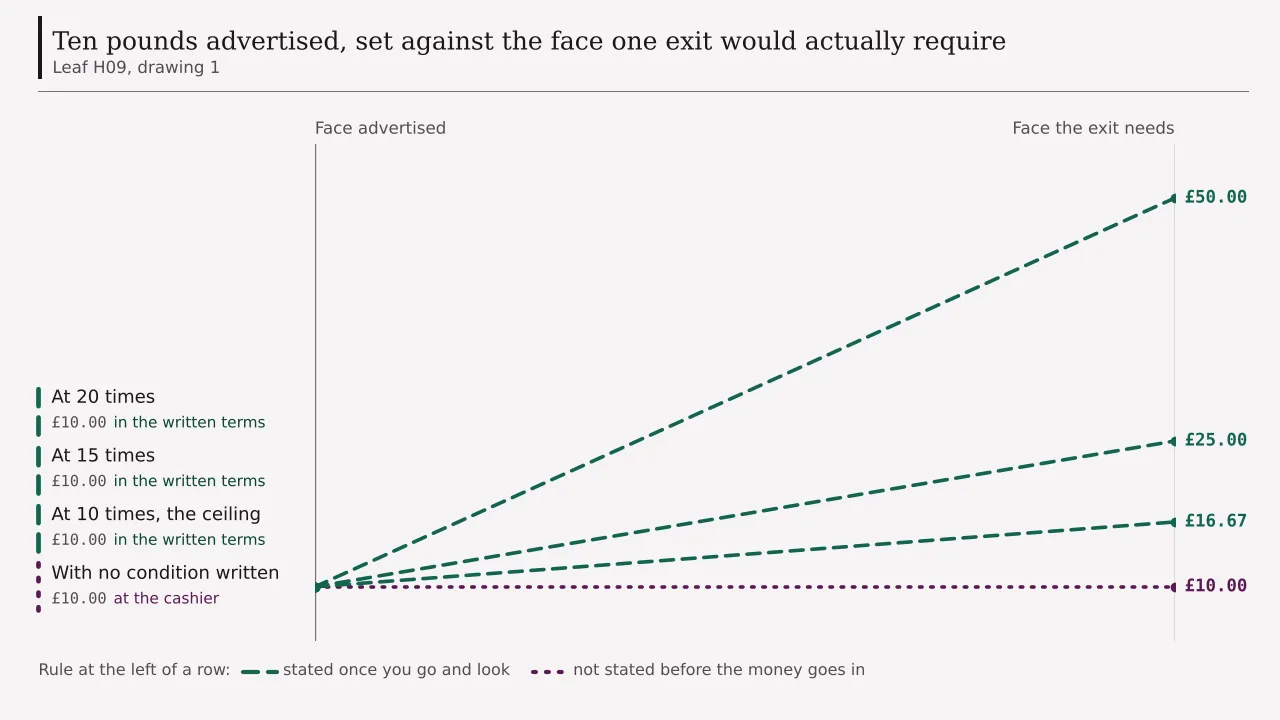
Read the drawing and the shape of the problem is visible without any arithmetic at all. The advertised figure is a horizontal line. The requirement is a line that climbs, slowly at first and then without restraint. A headline cannot grow to meet a requirement that behaves like that, which is why the gap between the two is the subject rather than the size of either.
4
Where the required face stops having an answer
At a multiple of twenty-five the divisor is nought and the division cannot be performed. That is not a flaw in the method, it is the method reporting something true: at twenty-five the expected survivor is nought for every face, large or small, so no face at all satisfies the comparison against any positive minimum.
Twenty-five is the reciprocal of four hundredths and belongs to the margin, not to anybody’s commercial judgement. Every leaf on this site meets the same figure, because every leaf works to the same return. What makes it worth dwelling on here is that the threshold behaves like a wall rather than like a slope: the required face does not grow large near it and then larger still, it grows without any bound.
Past twenty-five the divisor turns negative and the arithmetic stops producing a sensible face altogether. The expected survivor is below nought for every face, and a negative expectation cannot reach a positive minimum by being made bigger. At forty times, which is the band this part of the market asks for, the comparison has no solution in faces at all. There is no advertised sum of any size that fixes it.
That is a sharper statement than it first appears and it is worth laying out plainly. Doubling a headline from ten to twenty does not help. Multiplying it by ten does not help. A hundred pound face at forty times is expected to close at minus sixty, and a thousand pound face at minus six hundred, and each of those is further from an exit than the ten pound face was. Size scales the loss and never touches the sign.
Which locates the real variable. In the three-term comparison, two of the terms can be traded against each other within limits and one of them cannot be traded at all past a certain point. Below twenty-five, a larger face buys a reader out of a larger minimum. At or above twenty-five, no face buys anything, because the left-hand side of the comparison has stopped being positive.
None of this requires anybody to be acting badly. A multiple of forty is a number somebody typed into a document, a minimum of ten pounds is a payment processor’s cost structure showing through, and a face of ten pounds is a marketing decision. The three were set by different people for different reasons, and nothing anywhere obliges them to be consistent with each other.
5
Running the same line the other way round
The same comparison rearranges for the multiple, and this is the more useful of the two forms for a reader standing in front of a real advertisement, because the face is the term they already have. The multiple must be no greater than twenty-five multiplied by the quantity one less the minimum divided by the face.
On the ten pound face and the posited ten pound minimum, the bracket is one less one, which is nought, so the permitted multiple is nought. On the same face against a five pound minimum the bracket is a half and the permitted multiple is twelve and a half. Against a two pound minimum the bracket is four fifths and the permitted multiple is twenty. Against no minimum at all it is the familiar twenty-five.
| Smallest transfer assumed at the exit | Largest multiple that still clears | What that permits in practice |
|---|---|---|
| Nothing at all | 25 times | The break-even figure, and the ceiling of the whole family |
| £2.00 | 20 times | Comfortably inside what a licensed offer could ask |
| £5.00 | 12.5 times | Still above the ceiling a British licence sets |
| £10.00 | None above nought | Collectable only where no turnover is asked |
| £20.00 | No answer exists | The face is under the minimum before anything applies |
The last row is the one that generalises furthest and it is worth separating from the rest. Where the minimum exceeds the face, the bracket turns negative and the permitted multiple would have to be negative too, which is not a thing a document can ask for. The comparison has no solution, not a demanding one, and the offer cannot reach the exit by any route the terms could describe.
Reading the table from the top gives a rule of thumb worth carrying. Every pound of minimum costs the offer two and a half units of permitted multiple on a ten pound face, which is twenty-five divided by ten. On a twenty pound face it would cost one and a quarter units per pound. The exchange rate between a minimum and a multiple is twenty-five divided by the face, which is a tidy thing to know and is never printed anywhere.
One use of this form is as a test of internal consistency. Where a conditions document names a multiple and a banking page names a minimum, the two can be checked against each other before anybody registers. Where the stated multiple exceeds the largest one the face survives, the offer is arithmetically unable to pay, and that conclusion is available from two published numbers and no guesswork.
6
What the solution says about the sizes that get advertised
The faces that get advertised in this corner of the market cluster at five, ten, twenty and thirty pounds. Put each through the solved line at ten times, the figure no licensed multiple in Britain may exceed, against the posited ten pound minimum, and the required face comes to £16.67. Five and ten fall short of that. Twenty and thirty clear it. So at the regulated ceiling the family splits in half, and the line it splits along is not a round number and is published nowhere.
Now run the same four faces at forty times, which is the figure an offshore conditions document tends to carry, and the split disappears. Each of those faces closes below nought: minus three, minus six, minus twelve and minus eighteen respectively. At that multiple the required face does not exist, so the sizes advertised are not merely too small. They are irrelevant to the question.
That finding is what this leaf was written for. The sizes on offer are chosen to attract attention, and attention is a function of how large a number looks against the numbers beside it. Nothing in the process that picks a face consults the multiple or the minimum, and there is no reason it would, since the three are settled by different parts of a business for different purposes.
It follows that reading one face as better than another is a mistake of category rather than of degree. Thirty pounds at forty times is further below an exit than ten pounds at forty times, because the margin takes more from it in absolute terms. A reader comparing banners on size is comparing the one term of three that the arithmetic treats as a scale factor.
There is a positive version of that statement and it deserves printing beside the rest. Where a reader can establish the multiple and the minimum, the face becomes genuinely informative, because the comparison then has only one unknown and the bigger number does win. The published figure is useful exactly in proportion to how much of the rest has been found, and useless on its own.
One further consequence concerns how such an offer should be described. An offer at forty times with a minimum at or above its face is not a poor offer, in the way one multiple is poorer than another. It is some play handed over at no charge, with an exit the arithmetic says stays shut, and describing it in those terms is both more accurate and easier to check than any comparison of sizes.
7
Thresholds the British regime publishes, with their dates
A threshold computed from an offer’s own figures is one thing, and a threshold written into a rulebook with a commencement date is quite another. Britain publishes several of the second kind, and because this leaf is about solving for a number it is worth setting out which numbers the licensed side actually fixes, along with where each one is written.
The first group belongs to limits a customer sets over themselves. The standard on financial limits makes the limit-setting apparatus reachable from the moment an account comes into being, and insists that somebody be asked to pick a figure while registering, or failing that when they first send money in. Whatever figure they choose has to start working as quickly as the business can manage, and they have to be told the moment it starts.
Three durations are compulsory rather than optional, and the standard requires a month, seven days and a single day of twenty-four hours. An account is the coarsest level at which a limit may bite. The figure goes into a box the customer types in, rather than a list they choose from. And a limit on gross deposits, meaning a cap on what goes in across a stretch of time, has to be put forward as prominently as every other variety.
The regulator’s own worked instance of two overlapping limits is the most usable arithmetic anywhere in the standard. Somebody setting ten pounds a day alongside a hundred a week is governed at every moment by whichever of the two binds harder, so the system has to permit ten pounds daily and seventy weekly rather than a hundred. Payments in then stop, either until a fresh period opens or until the customer acts to raise what they set, a cooling-off period being attached to that.
The two directions are handled differently, and that asymmetry is the whole point of the mechanism. Lifting a figure happens on request, no sooner than a day later, and only once the person has done something positive at the far end of that wait to confirm they still mean it. Pulling a figure down bites straight away, barring a technical failure. Setting a limit is the default position besides: declining takes an act, and a confirmation gets collected before anybody proceeds to deposit.
A second threshold is set by the regulator rather than by the customer, and it arrives with two dates attached. Light-touch checks on financial vulnerability bite above a monthly figure for net deposits, and that monthly figure, £500 when it began on 30 August 2024, was cut to £150 with effect from 28 February 2025. The heavier assessments alongside them stay a pilot, are not live for consumers, and the regulator records that neither exercise touches anybody’s credit rating.
8
Which of those survives where no licence is held
Which of those published thresholds reaches an offer of this build? Not one of them. Offers advertising a small cash face with no payment asked are run from outside the British system and hold no Great Britain licence, and every threshold in part seven is a licence condition or a technical standard attached to one. The question answers itself, and the useful work is in saying what each absence does to the arithmetic above.
Does anything then require the limit-setting apparatus to exist at all? No. Keeping it within easy reach, asking for a figure while somebody registers or sends money in, and making a refusal into an act rather than a default, all belong to the licensed side. A reader meeting an offer outside it may find such tools present, because an operator may choose to supply them, and may equally find none.
Are the durations fixed anywhere? No. One month, seven days and a day are the licensed minimum, and past the licence the list is whatever a business decides to build. Is the asymmetry preserved, so that pulling a figure down bites at once while lifting it has to wait? Nothing requires it, which matters more than it sounds, since the waiting is the part of the mechanism doing the work.
Does a monthly figure set off a check on affordability? Not by any rule reaching this far. Five hundred pounds, and the hundred and fifty that replaced it, are British figures fastened to British licences, and an offer outside that system has no equivalent published anywhere this leaf can cite. A reader cannot look up the figure because no figure exists to look up.
What else falls away alongside those is worth naming once, through this leaf’s own subject. Any threshold is worth no more than the record of who applies it, and a licensed business is entered on a public record naming the holder and listing the activities allowed. The national self-exclusion scheme is drawn along the same boundary, reaching operators licensed in Britain and stopping where that licence stops.
So anybody who has registered with Gamstop Online should read an offer outside its reach as outside it, full stop, rather than as a threshold question of their own. Where the scheme’s writ runs is set down in its own conditions of use, and the help routes closing this leaf will do more good than a registration page.
9
Working the same test on any face you meet
The whole of this leaf reduces to one line that can be memorised. A face is expected to reach an exit where the face, multiplied by one less the multiple times four hundredths, comes to the exit’s minimum or more. Three numbers, one multiplication, one comparison, and no further apparatus of any kind.
Collecting the three numbers is the work, and the order matters. Take the face off the banner, which costs nothing. Take the multiple out of the conditions, which costs one click. Take the minimum from a banking or help page where one publishes it, and where none does, note that the figure is at a payment screen and will not be available until an account exists. A missing third term is itself a result.
Where the minimum cannot be found at all, the test still does useful work in a reduced form. Compute the expected survivor and look at its sign. A survivor below nought is beaten by a minimum of whatever size, so the unknown third term never has to be established at all. On a face at forty times that is always the position, and the reading takes about ten seconds.
Where the survivor is positive, the two rearrangements in parts three and five give whichever answer is wanted. Divide the minimum by the bracket for the smallest face that works. Multiply twenty-five by one less the minimum over the face for the largest multiple that works. Both are a single division, and both answer a question the advertisement was not built to answer.
Two habits keep the test honest over time. Write the minimum down with the words assumed or found beside it, every time, because a supposed figure carried quietly into a later line turns into a fact nobody checked. And recompute rather than remember when a face changes, since the relationship between face and required multiple is a division and the intuition that it scales smoothly is wrong near twenty-five.
Applied to the headline this leaf opened with, the test gives its answer in two steps and no more. Ten pounds at forty times leaves an expected minus six. Anything below nought is beaten by a minimum of whatever size, so the ten pounds posited at the exit never has to enter the comparison. The offer amounts to ten pounds of play handed over at no charge, and what shuts the exit is the arithmetic rather than a decision anybody took.
Questions
- A free £10 no deposit bonus: what is left once the wagering is done?
- An expected minus £6.00 at the multiple used here. Turning ten pounds over forty times asks £400.00 over the reels, with four pence of every pound there, £16.00 all told, going to the margin, so sixteen taken off ten leaves six in the unhelpful direction. Ten pounds remains an upper bound on the whole offer, because the bracket standing against the face can never pass unity.
- Why is £10 described as the smallest face that can reach an exit?
- Because it is the first face in this family where the set of workable multiples is not empty. Against a posited minimum payment of £10.00, a ten pound face with nothing applied stands level with the minimum and is collectable. A five pound face with nothing applied stands under it and is collectable at no multiple at all, not even a multiple of nought. The set for ten pounds contains exactly one member, and that member is nought.
- What is the actual condition for a balance to be collectable?
- The face, multiplied by one less the multiple times four hundredths, has to come to the exit’s minimum or better. Three quantities enter it and nothing else does. The face is on the banner, the multiple is one click away in the written conditions, and the minimum stands at a payment screen nobody sees until an account has been opened, so one comparison draws its terms from three separate places.
- How large would the face have to be to clear a £10 minimum?
- That turns wholly on the multiple, and the answer is the minimum over a bracket of unity less the multiple times four hundredths. With nothing asked the required face is £10.00. At five times it is £12.50. At ten times, the ceiling a British licence sets, it is £16.67. At fifteen times it is £25.00, at twenty times £50.00, and at twenty-four times £250.00. Each of those assumes a £10.00 minimum, which is supposed by this leaf and published nowhere.
- What happens to the required face at twenty-five times?
- It stops existing. At twenty-five the bracket is nought, so the expected survivor is nought for a face of any size, and nothing satisfies the comparison against a positive minimum. Past twenty-five the bracket is negative and no advertised sum fixes it: a hundred pound face at forty times closes at minus sixty and a thousand pound face at minus six hundred. Size scales the loss and never alters the sign.
- Can the same line be solved for the multiple instead?
- Yes, and that form is more useful in front of a real advertisement, because the face is already in hand. The largest multiple a face survives is twenty-five multiplied by one less the minimum divided by the face. On ten pounds against a £5.00 minimum that gives twelve and a half times. Against £2.00 it gives twenty times. Against £10.00 it gives nothing above nought, and against £20.00 there is no answer, because the face is under the minimum before anything applies.
- What does the solution say about the sizes that get advertised?
- With the multiple pinned at the ten times no British licence permits it to pass, and a £10.00 minimum posited, the required face is £16.67, so faces of five and ten pounds fall short while twenty and thirty clear it. At forty times the split vanishes, since the required face does not exist and every size in that cluster closes below nought. The face is chosen to attract attention and nothing in that process consults either the multiple or the minimum.
- Does a larger headline help?
- Below twenty-five times, yes, in proportion. Above it, no, in any proportion. A larger face buys a reader out of a larger minimum only while the bracket is still positive, and once the multiple reaches twenty-five the left-hand side of the comparison is nought or worse for every face. That is why doubling a headline changes the loss and leaves the conclusion exactly where it was.
- Which thresholds does a British licence actually publish?
- Several, with dates attached. The apparatus for setting a financial limit has to be reachable from the moment an account comes into being, somebody has to be asked to pick a figure while registering or else when they first send money in, and the durations put forward have to cover a month, seven days and one day of twenty-four hours. Lifting a figure takes a request, a wait of a day at least, and a positive step at the far end of that wait, while pulling one down bites straight away. Separately, light-touch checks on financial vulnerability opened at a monthly net-deposit figure of £500 on 30 August 2024 and were reduced to £150 from 28 February 2025.
- Do any of those thresholds apply to an offer like this?
- None of them. Offers advertising a small cash face with no payment asked are run from outside the British system and hold no Great Britain licence, and every threshold above is a licence condition or a standard attached to one. Nothing then requires the limit-setting apparatus to exist, nothing fixes which durations are offered, nothing preserves the asymmetry whereby pulling a figure down bites at once while lifting it waits, and no published monthly figure sets off a check on affordability.
- What is the quickest way to run this test myself?
- Compute the expected survivor first and look at its sign. A survivor below nought is beaten by a minimum of whatever size, so the one term nobody can find before registering never has to be entered. Where the survivor is positive, divide the minimum by the bracket for the smallest face that works, or multiply twenty-five by one less the minimum over the face for the largest multiple that works. Each is a single division.