Terms read 19 October 2026 Leaf N05, revision 1
A hundred and fifty presses on one named reel, and the rate nobody prints
A hundred and fifty presses at 10p send £15.00 across the reels and give back an expected £14.40 at the 96 in the hundred this site works to. Shift that rate to 94 and the figure is £14.10; shift it to 97 and it is £14.55. Forty-five pence separates the ends of that band before a condition is read, and £16.83 separates them afterwards. The rate doing all of that is the one quantity no place a reader can reach publishes for the build the headline names.
Stated on the banner £15.00 A count of a hundred and fifty, a price of nought, and the name of one build, with the press value imported from this leaf’s own assumption. Stated, once you go and look minus £8.64 Forty times laid over the winnings in a bonus document, worked at the centre of the modelled band rather than at either of its ends. Not stated before the money goes in A spread of £16.83 Seven places were opened looking for the rate behind the named build. Six of them settle something else, and the seventh is reached only after the decision it was wanted for.
Count headlines tied to one build, with their terms read
Every destination in this file is bought advertising. The site is paid a fee if a reader goes on to register, and no figure printed below moves because of it.
Bonus Spins UK Slip 01
Betportal
Ceiling as a multiple
The drop
€15.00
€1.00 in the euro
The claim reads €15.00. Once the terms beside it have applied, €0.00 of it can leave. The difference is the drop.
7 of the 15 terms on this slip could not be read before the money went in
Spins priced at this site's own 10p a spin, which the operator does not publish
Stated
€15.00
The claim as it is printed, before a single term has been applied to it.
Headline paid as spins
150 spins at 10c each, which is €15.00 of the figure above.
6 Nowhere
What one spin is worth
No unit is published for a spin, so the count is priced at this site's own 10p a spin. At half that price every figure below halves with it.
Match and other credit not priced
300% of three deposits, to a ceiling of €1,000. A share of a deposit nobody has made yet is not a sum, so no figure stands on this line and none is carried below.
Qualified
-€14.40
Written down somewhere, and taking part of the claim back. Each term carries the place it is written and the sum it takes.
2 Written terms at a distance this record does not establish
Play-through -€14.40
Carrying €14.40 through 35 times stakes €504.00 and costs €20.16 of it at 96 per cent return. That prices above the €14.40 there is to charge it against, so the whole of the credit goes and the line is held at that. The multiple sits on the bonus.
2 Written terms at a distance this record does not establish
Game weighting not priced
Slots only count towards the play-through. No contribution percentage is published, so the line above has been worked at full weight, which is the kindest reading there is.
2 Written terms at a distance this record does not establish
Ceiling on the winnings not priced
5x the bonus.
2 Written terms at a distance this record does not establish
Clock on the credit not priced
14 days.
2 Written terms at a distance this record does not establish
Largest stake while it runs not priced
€5.
3 Public record
Licence, and who holds it not priced
Licensed in Anjouan, Comoros, held by BetPortal Gaming Ltd, with Excite Ultra Media Ltd, reference ALSI-202601040-FI2. A register entry settles who holds a licence and what it permits. It does not settle who is running the site this morning.
4 Cashier
Smallest qualifying deposit your money
€20 a stage. That is €20.00 of your own money, and it is never netted into a drop.
5 On the way out
Checks before a withdrawal not priced
Documents before the first withdrawal.
Unstated
-€0.60
Applying without having been published anywhere, and costing money all the same.
6 Nowhere
What a spin hands back -€0.60
Staking a spin returns 96 per cent of it, so that share of the batch is the house's before a reel turns. This site works at that return and the operator publishes none where the claim is made.
6 Nowhere
Forfeited by rule cost unknown
Nothing is published under this heading, and it applies regardless.
6 Nowhere
Charge on the way out cost unknown
No charge on the way out is published as a figure, so nothing comes off this line. A charge that exists unpublished would come straight off whatever survives.
6 Nowhere
Smallest withdrawal allowed cost unknown
No smallest withdrawal is published as a figure. A floor nobody has published is still a floor, and it decides whether a small balance can move at all.
No Great Britain licence
Terms read 19 October 2026
Bonus Spins UK Slip 02
WinBeast
Ceiling as a sum
The drop
€50.00
€1.00 in the euro
The claim reads €50.00. Once the terms beside it have applied, €0.00 of it can leave. The difference is the drop.
8 of the 15 terms on this slip could not be read before the money went in
Spins priced at this site's own 10p a spin, which the operator does not publish
Stated
€50.00
The claim as it is printed, before a single term has been applied to it.
Headline paid as spins
500 spins at 10c each, which is €50.00 of the figure above.
6 Nowhere
What one spin is worth
No unit is published for a spin, so the count is priced at this site's own 10p a spin. At half that price every figure below halves with it.
Match and other credit not priced
50% to 100% of five deposits, each to a ceiling of €1,000, and a €650 free bet. A share of a deposit nobody has made yet is not a sum, so no figure stands on this line and none is carried below.
Qualified
-€48.00
Written down somewhere, and taking part of the claim back. Each term carries the place it is written and the sum it takes.
2 Written terms at a distance this record does not establish
Play-through -€48.00
Carrying €48.00 through 40 times stakes €1,920.00 and costs €76.80 of it at 96 per cent return. That prices above the €48.00 there is to charge it against, so the whole of the credit goes and the line is held at that. The multiple sits on the bonus and the winnings from the spins.
2 Written terms at a distance this record does not establish
Game weighting not priced
Slots, titles vary by country count towards the play-through. No contribution percentage is published, so the line above has been worked at full weight, which is the kindest reading there is.
2 Written terms at a distance this record does not establish
Ceiling on the winnings not priced
€100 a batch of spins.
2 Written terms at a distance this record does not establish
Clock on the credit not priced
7 days, spins 1 day.
3 Public record
Licence, and who holds it not priced
Licensed in Curaçao, holder not named on the site. A register entry settles who holds a licence and what it permits. It does not settle who is running the site this morning.
4 Cashier
Smallest qualifying deposit your money
€20 a stage. That is €20.00 of your own money, and it is never netted into a drop.
5 On the way out
Checks before a withdrawal not priced
Documents before the first withdrawal.
Unstated
-€2.00
Applying without having been published anywhere, and costing money all the same.
6 Nowhere
What a spin hands back -€2.00
Staking a spin returns 96 per cent of it, so that share of the batch is the house's before a reel turns. This site works at that return and the operator publishes none where the claim is made.
6 Nowhere
Largest stake while it runs cost unknown
Nothing is published under this heading, and it applies regardless.
6 Nowhere
Forfeited by rule cost unknown
Nothing is published under this heading, and it applies regardless.
6 Nowhere
Charge on the way out cost unknown
No charge on the way out is published as a figure, so nothing comes off this line. A charge that exists unpublished would come straight off whatever survives.
6 Nowhere
Smallest withdrawal allowed cost unknown
No smallest withdrawal is published as a figure. A floor nobody has published is still a floor, and it decides whether a small balance can move at all.
No Great Britain licence
Terms read 19 October 2026
Bonus Spins UK Slip 03
EliteSpin
Longest spin window
The drop
£50.00
£1.00 in the pound
The claim reads £50.00. Once the terms beside it have applied, £0.00 of it can leave. The difference is the drop.
8 of the 15 terms on this slip could not be read before the money went in
Spins priced at this site's own 10p a spin, which the operator does not publish
Stated
£50.00
The claim as it is printed, before a single term has been applied to it.
Headline paid as spins
500 spins at 10p each, which is £50.00 of the figure above.
6 Nowhere
What one spin is worth
No unit is published for a spin, so the count is priced at this site's own 10p a spin. At half that price every figure below halves with it.
Match and other credit not priced
50% to 100% of five deposits, each to a ceiling of £1,000. A share of a deposit nobody has made yet is not a sum, so no figure stands on this line and none is carried below.
Qualified
-£48.00
Written down somewhere, and taking part of the claim back. Each term carries the place it is written and the sum it takes.
2 Written terms at a distance this record does not establish
Play-through -£48.00
Carrying £48.00 through 40 times stakes £1,920.00 and costs £76.80 of it at 96 per cent return. That prices above the £48.00 there is to charge it against, so the whole of the credit goes and the line is held at that. The multiple sits on the bonus and the winnings from the spins.
2 Written terms at a distance this record does not establish
Game weighting not priced
Slots count towards the play-through. No contribution percentage is published, so the line above has been worked at full weight, which is the kindest reading there is.
2 Written terms at a distance this record does not establish
Ceiling on the winnings not priced
5x the bonus.
2 Written terms at a distance this record does not establish
Clock on the credit not priced
7 days, spins 3 days.
3 Public record
Licence, and who holds it not priced
Licensed in Costa Rica, held by PrimeTier Limited. A register entry settles who holds a licence and what it permits. It does not settle who is running the site this morning.
4 Cashier
Smallest qualifying deposit your money
£20 a stage. That is £20.00 of your own money, and it is never netted into a drop.
5 On the way out
Checks before a withdrawal not priced
Documents before the first withdrawal.
Unstated
-£2.00
Applying without having been published anywhere, and costing money all the same.
6 Nowhere
What a spin hands back -£2.00
Staking a spin returns 96 per cent of it, so that share of the batch is the house's before a reel turns. This site works at that return and the operator publishes none where the claim is made.
6 Nowhere
Largest stake while it runs cost unknown
Nothing is published under this heading, and it applies regardless.
6 Nowhere
Forfeited by rule cost unknown
Nothing is published under this heading, and it applies regardless.
6 Nowhere
Charge on the way out cost unknown
No charge on the way out is published as a figure, so nothing comes off this line. A charge that exists unpublished would come straight off whatever survives.
6 Nowhere
Smallest withdrawal allowed cost unknown
No smallest withdrawal is published as a figure. A floor nobody has published is still a floor, and it decides whether a small balance can move at all.
No Great Britain licence
Terms read 19 October 2026
Bonus Spins UK Slip 04
Crown Jewelz
Multiple unpublished
The drop
NOT WORKED
The multiple is not published in the operator's own terms. Since the sum cannot be worked around it, none is worked.
9 of the 14 terms on this slip could not be read before the money went in
No drop worked
Stated
£15.00
The claim as it is printed, before a single term has been applied to it.
Headline paid as spins
150 spins at 10p each, which is £15.00 of the figure above.
6 Nowhere
What one spin is worth
No unit is published for a spin, so the count is priced at this site's own 10p a spin. At half that price every figure below halves with it.
Match and other credit not priced
200% of the first deposit, then 150% twice, each to a ceiling of £1,000. A share of a deposit nobody has made yet is not a sum, so no figure stands on this line and none is carried below.
Qualified
NOT WORKED
Written down somewhere, and taking part of the claim back. Each term carries the place it is written and the sum it takes.
2 Written terms at a distance this record does not establish
Play-through not priced
40x the bonus, reported rather than published by the operator.
2 Written terms at a distance this record does not establish
Game weighting not priced
Slots count towards the play-through. No contribution percentage is published, so the line above has been worked at full weight, which is the kindest reading there is.
3 Public record
Licence, and who holds it not priced
Licensed in Curaçao, number not verified, holder not named on the site. A register entry settles who holds a licence and what it permits. It does not settle who is running the site this morning.
4 Cashier
Smallest qualifying deposit your money
£20. That is £20.00 of your own money, and it is never netted into a drop.
5 On the way out
Checks before a withdrawal not priced
Documents before the first withdrawal.
Unstated
NOT WORKED
Applying without having been published anywhere, and costing money all the same.
6 Nowhere
Ceiling on the winnings cost unknown
No ceiling is published. Nothing is assumed in its place.
6 Nowhere
Clock on the credit cost unknown
Nothing is published under this heading, and it applies regardless.
6 Nowhere
Largest stake while it runs cost unknown
Nothing is published under this heading, and it applies regardless.
6 Nowhere
Forfeited by rule cost unknown
Nothing is published under this heading, and it applies regardless.
6 Nowhere
Charge on the way out cost unknown
No charge on the way out is published as a figure, so nothing comes off this line. A charge that exists unpublished would come straight off whatever survives.
6 Nowhere
Smallest withdrawal allowed cost unknown
No smallest withdrawal is published as a figure. A floor nobody has published is still a floor, and it decides whether a small balance can move at all.
No Great Britain licence
Terms read 19 October 2026
Every figure in the second and third columns is this site's own working and nothing an operator has published. A claim is priced as printed, then the share a spin hands back at 96 per cent return comes off it, then what playing the multiple through costs at the same return, and then whatever a published ceiling, a charge on the way out or a floor on the smallest withdrawal takes from what has survived. The drop is the difference between the first figure and the last. The two columns add back up to it exactly, so no money leaves a slip without a term and a place beside it.
Which column a term falls in is settled by one question: has anybody written it down. A charge a reader meets at the payment screen is written down, and it stands in the second column with the cashier against it. A condition that binds without ever having been set down stands in the third, whatever it costs. Inside each column the terms run outwards from the banner, so the order itself says how far a reader would have had to go.
A count of spins has no unit until one is supplied. Where an operator publishes what one of its own spins is worth, that figure is used and the first column says it is theirs. Where none is published, this site's own 10p a spin stands in its place and every figure below moves in proportion with it. Where the multiple itself is unpublished, no drop is worked at all, because that is the one figure the sum cannot be done without.
Three words stand where a figure cannot. Not priced is a term that is written down and carries no number the arithmetic can take. Cost unknown is a term nobody has written down, costing something nobody has put a number on. Your money is money of the reader's own, which is never netted into a drop.
None of the operators in this file holds a Great Britain licence, so none of the duties that licence carries reaches them. Each of those duties is published in its own right, which is what makes its absence here something a reader can check rather than take on trust. Every gambling company licensed in Great Britain belongs to Gamstop Online, so a reader who has shut themselves out through the scheme is not shut out here. Social Responsibility Code 5.1.1 has held a play-through to a maximum of ten times the bonus funds since 19 January 2026, and it binds a licence holder and nobody else. Asked in a post of 21 October 2025 what is lost along with the licence, the Gambling Commission's Director of Enforcement and Intelligence answered: "unfair gaming practices, financial loss, and a lack of recourse if things go wrong". The same post puts blocked payouts, and withdrawal limits pitched high enough to be unreachable, among the behaviour the Commission has recorded. Nobody under 18 may hold an account at any of them.
Terms are reproduced in the wording their operator published, and each slip is dated with the day somebody sat down and read them. 19 October 2026 is the oldest of those dates. Anybody claiming an offer is bound by that operator's full terms, which are elsewhere, and never by a line standing here.
1
Three tokens published, and the one that converts into nothing
A headline of this shape publishes three things and stops. A quantity, a hundred and fifty. A price, which is nought. And a proper name, which fastens the quantity to one build rather than leaving it loose across a lobby. The first two behave the way they behave on any count headline. The third is the interesting one, because it reads as the most specific token of the three and is the only one that cannot be turned into money by anybody at all.
Watch the conversion fail. The quantity becomes a sum the moment a press value is supplied: at 10p, which this leaf assumes throughout and which no advertisement of this kind prints, a hundred and fifty presses push £15.00 across the reels. The price of nought needs no conversion. The name needs a rate of return before it means a penny, and the rate attached to that name is not printed on the banner, not printed in the bonus document, and not printed anywhere a reader can open before deciding.
So the headline hands over one quantity a reader can use, one quantity requiring an imported assumption, and one token that looks like precision and functions as reassurance. Recognising a name is a feeling of knowing something. Part three takes that feeling apart by asking, of each place a figure could live, what that place actually publishes.
Nothing here accuses the headline of inaccuracy, and the concession matters. The count is honoured. The price really is nought. The presses really do run on the build named, and a reader who wanted a hundred and fifty turns of that particular reel for no payment gets exactly that. Every criticism on this leaf is about a fourth quantity the headline never claimed to supply and which decides what the other three are worth.
One more property of the name is worth putting down before the arithmetic starts. A name is the only token on the banner that a reader can carry in from outside. Nobody arrives at a count of a hundred and fifty with prior views about it. A great many people arrive at a familiar build with a figure already in their head, picked up from a forum, a video, a tracker or a half-remembered screen, and that figure is then spent on a decision as though it had been read off the page. The absence this leaf prices is therefore an absence that gets quietly filled rather than noticed.
2
What recognising a build does settle, item by item
Being fair to the name means listing what it genuinely fixes, because it fixes several things and a leaf that pretended otherwise would be arguing with a straw man. A proper name identifies the ruleset. It identifies the artwork and the symbols. It identifies how many reels turn and how many rows show. It identifies the shape of whatever feature the build carries, if a reader has seen the build before. Every item just listed shows up on a screen, and not one of them is in dispute here.
What none of the four does is produce a rate. Reels and rows are a layout; a layout is consistent with a wide band of rates. A feature is a mechanism; a mechanism says nothing about how much of the total return is routed through it. Artwork is artwork. A reader who has turned the reels before holds an impression of how the build behaves, and an impression formed over a few hundred presses is a sample so short that part four’s arithmetic treats it as noise rather than as evidence.
There is also a harder point underneath, and it is the reason this leaf will not write a figure for the build the key names. One name can sit over more than one build. A supplier may ship a build at several configured rates, and which configuration an address has deployed is a fact about that address rather than about the title. So even a reader holding a correct figure for one configuration holds a figure that may not describe the reel in front of them, and nothing on the screen distinguishes the two.
| The property | Where a reader would settle it | Does it produce a rate |
|---|---|---|
| Which build the presses run on | No | |
| The ruleset, the symbols and the layout | No | |
| The count of presses handed over | No | |
| What one press costs in cash | nowhere in writing | It fixes the stake, not the rate |
| The rate of return on that build | nowhere in writing | It is the rate |
| Which configuration the address deployed | nowhere in writing | It chooses between rates |
| The multiple laid over the winnings | in the bonus terms | No, and it multiplies whatever the rate gives |
Seven rows, three of them unreachable, and the two unreachable rows in the middle are the ones the whole arithmetic stands on. A reader holding the top three rows is holding the furniture of the offer and none of its engine. That is not a drafting failure by anyone. It is what a proper name is for: a name identifies a thing so that two people can talk about the same thing, and identification was never a claim about performance.
3
Seven places opened, and what each of them answers instead
An absence has to be established before it can be costed, and the way to establish one is to name every place the thing could have been, say what that place does hold, and show that the thing is not among it. Seven places were opened for this leaf. Each of them publishes something genuine. Not one of them publishes a rate of return for a build identified by name, in a form a reader can read before committing.
Begin with the two documents the offer itself owns. The advertisement carries the count, the price and the name, and nothing numerical beyond them. The bonus document carries the multiple, the window, any ceiling on what may be withdrawn, and the list of builds the presses are confined to. Terms documents are written about obligations rather than about performance, so a rate has no reason to appear in one and does not.
Move to the public record. A licence register fastens a company to a set of permitted activities and lists whichever domains have been recorded against it. That is a record about permission, and the regulator publishes no guidance at all on reading a domain entry, which is itself a published limit on how far a register row can be pushed. No field in any row carries a figure about a build, because the register was never built to describe products.
Then the standards. Under a British permission a licensee owes a customer information bearing on their chances of winning, easily available before the moment of commitment. Four routes through that requirement are set out and they are separated by or rather than by and. An account of the mechanics with the method of settling winners is one. The margin, or the edge, stated as such, is another. A percentage return is the third. The chance of the winning events arriving is the fourth. Take the first route and the duty has been discharged entirely, percentage or no percentage, so even inside the strictest regime this site cites nothing compels a figure to exist for a given build.
Then the statistics. The regulator publishes annual industry figures, and for the financial year running April 2025 to March 2026 those figures put online casino games at £5.7 billion of yield with reel-based games accounting for £4.8 billion of that, on a release dated 17 September 2026. Dividing one by the other gives the share of a sector and not the behaviour of a build. Official statistics aggregate by sector and by financial year, which is the right thing for them to do and the wrong shape for the question being asked here.
Then the offshore rulebook, because the offers this key attracts sit outside the British licence. The responsible gaming policy published for operators licensed in Curaçao lists what is mandatory: age verification, access to information, self-assessment, behaviour tracking, cooling-off and exclusion, deposit limits, training and marketing principles. Disclosure of a build’s rate is not on that list, and neither is any disclosure about how a game performs. The absence there is not a gap in this leaf’s reading. It is the rulebook’s own scope.
The seventh place is the build itself. Where a figure exists it is normally inside the game’s own information screen, which is reached by opening the game, which is reached by having an account. That places the figure at the far side of the decision it was wanted for. Inside a British licence the duty puts the information before the moment of gambling; outside one, nothing puts it anywhere, and a screen that shows a figure is showing it voluntarily.
This site reads, computes and cites, and it holds one sheet of regulatory fact that every page is built from. That sheet carries no claim about the return, the behaviour or the feature of any particular title, from any supplier. Where a figure for a named build is wanted on this leaf, none is given, and a modelled rate is used instead with the modelling said out loud in the sentence that spends it. An invented figure and a sourced one look identical once they have been set in type, which is exactly why the hole here gets costed instead of plugged.
That is the evidence. Two documents that are about obligations, one register that is about permission, one standard that offers four alternatives and compels none of them to be a percentage, one set of statistics that aggregates by sector, one offshore rulebook whose mandatory list does not reach the subject, and one screen that arrives too late. The rate is in the sixth of this site’s six places, which is to say it applies automatically and is written down for the reader nowhere at all.
4
Modelling a reel at a rate this leaf picks and labels
With nothing publishable to read, the honest move is to model rather than to assert. From here to the end this leaf works a generic reel-based build at a stated rate, and says which rate it is working at in every sentence carrying a figure. The band used is 94 to 97 pence back in each pound staked. That band is this leaf’s own choice, made to show how much the answer moves rather than to report what any build does, and no source consulted for this site fixes a rate for any title whatever.
At the middle of the band the arithmetic is quick. A hundred and fifty presses at 10p turn over £15.00. At 96 pence in the pound those presses give back an expected £14.40, the missing 60p being the margin on £15.00 of staking. At 94 the same presses give back £14.10, and at 97 they give back £14.55. The whole band is 45p wide on £15.00 of turnover, which is three pence in the pound by construction.
Forty-five pence is a small number and a reader looking at it would be entitled to conclude that the missing rate hardly matters. On the raw expectation that conclusion is correct. It is also the trap, because a headline of this shape is never read on the raw expectation: a count of presses handed over for nothing carries a condition on whatever those presses win, and the condition multiplies the margin rather than the winnings. Part six does that multiplication and the 45p turns into £16.83.
Before it does, one thing is worth saying plainly about what a rate of return even is. It is an average over a length of play nobody sits through, computed by whoever built the reel from the paytable and the symbol frequencies. It is not a promise about a hundred and fifty presses and it was never offered as one. A reader working with 96 pence in the pound across a hundred and fifty presses is using a long-run constant on a short-run quantity, which this leaf does openly because the alternative is to compute nothing at all.
45p of spread across the modelled band, on £15.00 of turnover, before any written condition is applied
5
Forty times over the winnings, costed from both ends
The multiple worked from here on is forty, which is what an offshore bonus document asks whenever it troubles to print a number at all. No payment has been made, so no credit sits in the account for a multiple to fasten on, and it fastens on the winnings instead. Winnings of £14.40 at the middle of the modelled band become £576.00 that has to cross the reels before any of it turns into money. Priced in presses at 10p, that is 5,760 further pulls stacked on the count the advertisement handed over.
Now the subtraction, by two routes that have to agree. Route one goes through the formula: forty lots of a four-pence margin consume 1.6 of the winnings, overshooting them by 0.6, so £14.40 closes at minus £8.64. Route two leaves the formula alone and prices the staking instead: £576.00 crossing a reel that keeps four pence out of every pound costs an expected £23.04, and £14.40 of winnings against £23.04 of expected cost is minus £8.64 once more. Nothing but the rate is common to the two, and running both is how an error in either would make itself visible.
A hundred and fifty presses, read with no condition on them £14.40 The same presses once forty times stands over the winnings minus £8.64 What the unread clause is worth at the middle of the band £23.04
Twenty-three pounds and four pence is the gap at one reading of the missing rate. Shift the rate and both ends of the price block shift with it, and they shift by wildly different amounts, and that disproportion is what this leaf was written to show. Pence separate the upper figures. Pounds separate the lower ones. A quantity nobody publishes is therefore cheap to be wrong about before the condition is applied and expensive afterwards, and the condition is applied by default rather than by the reader’s choice.
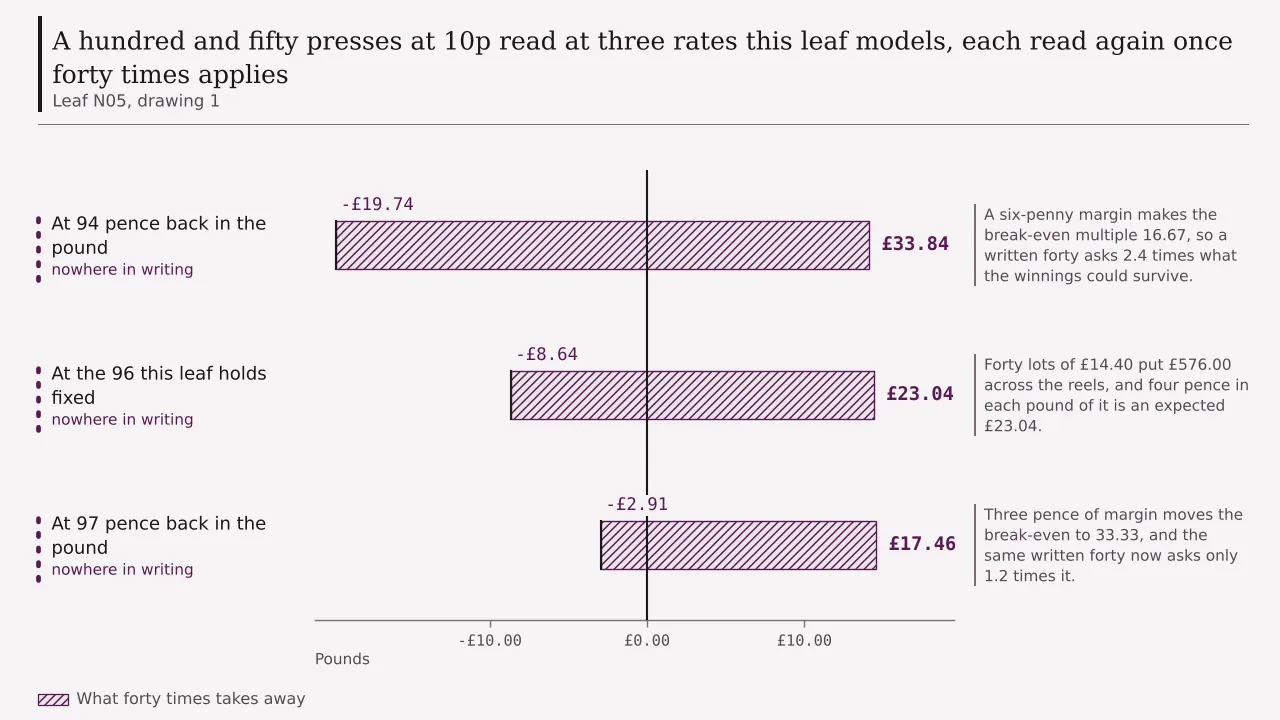
The bars in that drawing start within 45p of one another and finish nearly seventeen pounds apart. Nothing in the advertisement changed between them, nothing in the bonus document changed between them, and the presses are identical. The only quantity moving is the one sitting nowhere in writing, and the clause is what turns a small ignorance into a large one.
6
Forty-five pence before the clause, sixteen pounds after it
Here is the amplification in one column. At 94 pence in the pound the expected winnings are £14.10, the staking asked is £564.00, and the expected close is £14.10 multiplied by one less 2.4, which is minus £19.74. At 97 the expected winnings are £14.55, the staking asked is £582.00, and the close is £14.55 multiplied by one less 1.2, which is minus £2.91. From minus £19.74 to minus £2.91 is £16.83 of spread, against 45p of spread on the same presses before the condition was read.
Divide the second spread by the first and the factor is 37.4. The unpublished rate is therefore worth roughly thirty-seven times more to a reader after a forty times clause applies than it is worth before. That multiplication is not a coincidence and it has a cause: the margin is what the clause spends, the margin is one less the rate, and a three-point move in the rate is a seventy-five per cent move in the margin at this part of the band.
| Rate this leaf models | Expected winnings | Staking the clause asks | Presses that takes at 10p | Expected close | Gap against the first column |
|---|---|---|---|---|---|
| 94 pence in the pound | £14.10 | £564.00 | 5,640 | minus £19.74 | £33.84 |
| 96 pence in the pound | £14.40 | £576.00 | 5,760 | minus £8.64 | £23.04 |
| 97 pence in the pound | £14.55 | £582.00 | 5,820 | minus £2.91 | £17.46 |
Read the fourth column and something quietly absurd appears. Across the whole band the work asked of a reader barely moves: 5,640 presses at the bottom, 5,820 at the top, a difference of 180 presses or about three per cent. Across the same band the result moves by £16.83. So the missing rate hardly changes how long anybody sits there and almost entirely changes what the sitting is worth, which is the least intuitive property of a play-through clause and the one worth carrying away.
Every figure in the final column can be checked the second way as well. At 94 the staking is £564.00 and the margin is six pence in the pound, so the expected cost is £33.84, and £14.10 less £33.84 is minus £19.74. At 97 the staking is £582.00 and the margin is three pence, so the cost is £17.46, and £14.55 less £17.46 is minus £2.91. Both rows close precisely, and they have to, since a clause of this sort performs one operation only: handing staked money across to the margin at whatever rate a build happens to run.
7
Where the sign turns over, and how far that moves
Every clause carries one multiple where a balance finishes level in expectation, holding nothing and owing nothing, and the multiple concerned is one divided by the margin. With 96 pence coming back in each pound the margin stands at four hundredths, putting the turning point at 25. Six hundredths of margin at 94 puts it at 16.67. Three hundredths at 97 puts it at 33.33. One unpublished quantity therefore moves the break-even multiple across a range of more than sixteen, and the written multiple sits at forty in every case.
A break-even multiple of 16.67, 25.00 or 33.33, decided by a rate the reader cannot look up
Put the written forty against each turning point and the picture sharpens. At 94 the clause asks for 2.4 times the multiple a balance could survive. At 96 it asks for 1.6 times. At 97 it asks for 1.2 times. The same four words in the same bonus document are therefore a modest overreach or a brutal one depending on a figure that document does not mention and could not be expected to mention, since the multiple was drafted for a lobby rather than for a reel.
This is also where a reader gains something usable. The turning point is arithmetic rather than market practice, so it can be computed from a rate without consulting anybody. A reader who holds a rate from any source at all can divide one by the margin and compare the answer with the multiple in front of them. Where the multiple is the larger of the two, the expected close is below nought and the remaining question is only how far below. Where it is the smaller, something is expected to survive, and the exit floor and the paperwork then decide whether the survivor can be collected.
What a reader cannot do is run that comparison for the build this key names, because the first input is missing. That is the finding, stated as flatly as it can be: the one figure the whole offer turns on is the figure nobody publishes in a place a reader can reach, and the clause written over it makes the ignorance cost between £17.46 and £33.84 on a count of a hundred and fifty presses.
8
Duties about reach, and what their absence leaves standing
Headlines that tie a count of presses to one named build and ask for no payment are published by operators holding no Great Britain licence. Three duties are the ones worth setting out where the whole complaint is a missing figure, and each governs what somebody may read ahead of deciding, which makes them duties about reach rather than about generosity. None of the three promises an outcome. Each of them puts a document within arm’s length of the moment somebody commits.
Number one puts an account of the rules then in force inside a player’s reach ahead of any commitment, demands that it be accurate, and demands that it be full enough to leave no applicable rule out. Number two is the four-route requirement from part three: material bearing on the chance of winning, reachable by that same instant, satisfied by a description, by a margin, by a percentage or by a set of probabilities. Number three puts the prizes themselves, and the calculation producing them, inside the same reach. Three duties, one deadline, and the deadline is the instant the money is at stake.
Withdraw those three and not one sum above moves by a penny. Fifteen pounds stays fifteen pounds. The 5,760 presses stay 5,760 presses. What changes is the status of the silence. Inside the licence a build showing nothing about its rules or its chances is a build in breach, and the silence is a fault with somewhere to be reported. Outside it, the same silence is a commercial choice nobody can be asked to justify, and a reader meeting it has no standard to measure it against and nobody to raise it with.
A second consequence follows for the modelling itself. Inside the licence a reader who finds a percentage can at least be confident it is the average theoretical figure the guidance describes, because the duty says which figure is meant. Outside it, a number on a screen is a number on a screen, with no stated basis, no stated version and nothing obliging it to describe the configuration actually running. Part two’s third unreachable row is where that bites, and it is the reason this leaf models a band rather than trusting a figure found loose.
The honest half of this part is that the duties were never going to hand a reader the thing this leaf has been hunting. Four alternatives joined by or is not a percentage requirement, and no page here will say it is. What the duties do is fix a position in time: before, rather than after. On a subject where the entire complaint is that the figure arrives after the decision, a duty about position is worth more than it sounds.
9
Reading any headline that fastens itself to one build
The procedure below runs on any count fastened to a proper name, and none of the particular sums above are needed to work it. It takes about two minutes and produces a band rather than an answer, which is the correct output when the input is missing.
Step one, separate the three tokens: the quantity, the price and the name. Write each on its own line. Step two, convert the quantity using a press value you have stated out loud, and mark the conversion as yours rather than the advertisement’s. Step three, ask where the rate behind the name would be settled, and when the answer is nowhere reachable, write the word down instead of guessing a number. Step four, pick a band around three points wide and work the expectation at both ends. Step five, apply the written multiple to both ends and look at the two closes.
The output of step five is the whole of what can honestly be said. On this leaf it reads: between minus £19.74 and minus £2.91, on a hundred and fifty presses at 10p, with a forty times clause and a modelled band of 94 to 97. That is an unsatisfying sentence and it is a true one, and it beats a single confident figure resting on an input nobody published.
Two habits keep the method from drifting. Never let a modelled rate lose its label: the moment 96 stops being described as a working assumption it becomes a fact about a build, and a fact about a build is precisely what this leaf has spent nine parts showing cannot be had. And never let a remembered figure in through the back door, because the one quantity a reader brings from outside is the one quantity nobody can check, and it is always the quantity the offer is built around.
Somebody who wanted the reel they like turned a hundred and fifty times for nothing, means to walk away once the count runs out, and will go nowhere near the clause, has received precisely the article advertised and can leave every sum above alone. For everybody else the sequence is short: establish the absence, price the band, and treat the single remembered number with the suspicion it has earned.
Questions
- What are 150 free spins actually worth before any condition applies?
- Press value is taken as 10p here, which is this leaf’s working assumption, so a hundred and fifty of them carry £15.00 onto the reels. At 96 pence coming back in each pound the expected return is £14.40, at 94 pence it is £14.10, and at 97 pence it is £14.55. The band is 45p wide on £15.00 of turnover, which is three pence in the pound by construction. Both the press value and the rate are modelled here rather than read off anything, and the rate for the build a headline of this shape names is not published anywhere a reader can reach.
- Where would I find the return figure for one named slot before I sign up?
- Seven places were opened for this leaf and not one of them yields a figure. An advertisement carries a count, a price and a name. A bonus document carries obligations rather than performance. A licence register fastens a company to permitted activities and records domains, with no field describing a build at all. The British disclosure standard sets out four routes to satisfying itself, separated by the word or, so a percentage need never come into existence. Official statistics aggregate by sector and by financial year. The mandatory list in the Curaçao responsible gaming rulebook does not reach the subject. A build’s own information screen may well carry a figure, and that screen is opened once the account exists.
- Must a licensed build print its return to player figure?
- No, and the drafting is what decides it. What a licensee owes is material bearing on a customer’s chances, within easy reach ahead of the moment of commitment, and the standard lays out four routes to that and separates them with or. Mechanics plus the settling of winners is one route. Margin or edge is a second. A percentage return is a third. The chance of winning events arriving is the fourth. Take any single route and the duty has been met. What is fixed is the moment by which the material must be reachable, not which of the routes it travels.
- Why does a missing return figure matter more after the wagering clause than before it?
- Because the clause spends the margin rather than the winnings, and the margin is one less the rate. Across a modelled band of 94 to 97 the expected winnings on a hundred and fifty presses move by 45p. Apply forty times to those winnings and the expected close moves from minus £19.74 to minus £2.91, which is £16.83 of spread. Dividing the second spread by the first gives a factor of 37.4, so the unpublished quantity is worth about thirty-seven times more once a condition stands over it.
- What does forty times cost on a hundred and fifty free spins?
- £23.04 at the centre of the modelled band, and the sum arrives twice over. A multiple of forty against £14.40 of winnings asks £576.00 to cross the reels, which is 5,760 further presses at 10p, and four pence kept out of each pound of that staking is an expected £23.04. By the other route, a four-pence margin applied forty times consumes 1.6 of the winnings and overshoots them by 0.6, so £14.40 closes at minus £8.64. Between £14.40 and minus £8.64 sits £23.04, reached without sharing a step except the rate.
- What multiple would a free spin balance actually survive?
- One divided by the margin, and it travels with the rate nobody can look up. Four hundredths of margin at 96 pence in the pound puts the turning point at 25. At 94 it stands at 16.67, and at 97 it stands at 33.33. Against a written multiple of forty that is an overreach of 2.4 times, 1.6 times or 1.2 times depending on a figure the bonus document never mentions. The comparison is arithmetic rather than market practice, so anybody holding a rate can run it in one division.
- Does recognising the game name tell me anything useful?
- It settles the ruleset, the artwork, the layout and the shape of any feature, and it settles none of the quantities that decide money. A layout is consistent with a wide band of rates. A mechanism says nothing about how much of the total return runs through it. There is a further difficulty underneath: one name can sit over more than one configured build, and which configuration an address has deployed is a fact about the address rather than about the title, with nothing on screen to distinguish them.
- Can I trust a return figure I find on a forum or a tracker?
- This site cannot check one, and the sheet of regulatory fact every page here is built from carries no claim about the return, the behaviour or the feature of any particular title. A remembered figure is the one input in the whole calculation that nobody can verify, and it is also the input the offer is built around, which is why it is treated here as the quantity most likely to be wrong rather than the one most likely to be right. Where a figure is needed on this leaf a band is modelled instead, and the modelling is named in the sentence that spends it.
- What protection is missing on an offer of this shape?
- Three duties about reach, every one of them attached to a Great Britain licence that headlines of this shape do not hold. An account of the rules then in force has to sit inside a player’s reach ahead of any commitment, accurate and full enough to leave no applicable rule out. Whatever bears on a chance of winning has to be reachable by that same instant, travelling whichever of the four permitted routes a licensee picks. The prizes, and the calculation producing them, have to be reachable by it as well. Strip the three out and the sums are untouched, while a silent build stops being in breach and turns into a commercial choice nobody can be asked about.
- What is the shortest honest answer about this kind of offer?
- That the expected close sits between minus £19.74 and minus £2.91 on a hundred and fifty presses at 10p with forty times written over the winnings, and that the band cannot be narrowed from anything a reader can open. The count is honoured, the price really is nought, and the presses really do run on the build named. The one figure converting all of that into money is the figure nobody publishes where a decision is taken.