Terms read 19 October 2026 Leaf N04, revision 1
Twenty turns on one side of the counter, and an account on the other
Twenty turns, priced at the 10p this site holds steady, stake £2.00 and return an expected £1.92, which is the smaller half of what changes hands at a sign-up form. The other half is a standing relationship, a permission, a record and a screenful of settings nobody chose. This leaf puts a price on each of them against that £1.92.
Stated on the banner 20 turns The whole of what the advertisement describes, and the only item on it that arrives with a figure attached. Stated, once you go and look £76.80 asked Staking demanded of an expected £1.92 by a forty times condition, written in a document the banner does not open. Not stated before the money goes in Everything but the turns A relationship with no end date, a marketing permission, a record, and a set of defaults drawn up by somebody else.
Sign-up offers paying turns for a form, with the written terms read
Every destination in this file is bought advertising. The site is paid a fee if a reader goes on to register, and no figure printed below moves because of it.
Bonus Spins UK Slip 01
Betportal
Ceiling as a multiple
The drop
€15.00
€1.00 in the euro
The claim reads €15.00. Once the terms beside it have applied, €0.00 of it can leave. The difference is the drop.
7 of the 15 terms on this slip could not be read before the money went in
Spins priced at this site's own 10p a spin, which the operator does not publish
Stated
€15.00
The claim as it is printed, before a single term has been applied to it.
Headline paid as spins
150 spins at 10c each, which is €15.00 of the figure above.
6 Nowhere
What one spin is worth
No unit is published for a spin, so the count is priced at this site's own 10p a spin. At half that price every figure below halves with it.
Match and other credit not priced
300% of three deposits, to a ceiling of €1,000. A share of a deposit nobody has made yet is not a sum, so no figure stands on this line and none is carried below.
Qualified
-€14.40
Written down somewhere, and taking part of the claim back. Each term carries the place it is written and the sum it takes.
2 Written terms at a distance this record does not establish
Play-through -€14.40
Carrying €14.40 through 35 times stakes €504.00 and costs €20.16 of it at 96 per cent return. That prices above the €14.40 there is to charge it against, so the whole of the credit goes and the line is held at that. The multiple sits on the bonus.
2 Written terms at a distance this record does not establish
Game weighting not priced
Slots only count towards the play-through. No contribution percentage is published, so the line above has been worked at full weight, which is the kindest reading there is.
2 Written terms at a distance this record does not establish
Ceiling on the winnings not priced
5x the bonus.
2 Written terms at a distance this record does not establish
Clock on the credit not priced
14 days.
2 Written terms at a distance this record does not establish
Largest stake while it runs not priced
€5.
3 Public record
Licence, and who holds it not priced
Licensed in Anjouan, Comoros, held by BetPortal Gaming Ltd, with Excite Ultra Media Ltd, reference ALSI-202601040-FI2. A register entry settles who holds a licence and what it permits. It does not settle who is running the site this morning.
4 Cashier
Smallest qualifying deposit your money
€20 a stage. That is €20.00 of your own money, and it is never netted into a drop.
5 On the way out
Checks before a withdrawal not priced
Documents before the first withdrawal.
Unstated
-€0.60
Applying without having been published anywhere, and costing money all the same.
6 Nowhere
What a spin hands back -€0.60
Staking a spin returns 96 per cent of it, so that share of the batch is the house's before a reel turns. This site works at that return and the operator publishes none where the claim is made.
6 Nowhere
Forfeited by rule cost unknown
Nothing is published under this heading, and it applies regardless.
6 Nowhere
Charge on the way out cost unknown
No charge on the way out is published as a figure, so nothing comes off this line. A charge that exists unpublished would come straight off whatever survives.
6 Nowhere
Smallest withdrawal allowed cost unknown
No smallest withdrawal is published as a figure. A floor nobody has published is still a floor, and it decides whether a small balance can move at all.
No Great Britain licence
Terms read 19 October 2026
Bonus Spins UK Slip 02
WinBeast
Ceiling as a sum
The drop
€50.00
€1.00 in the euro
The claim reads €50.00. Once the terms beside it have applied, €0.00 of it can leave. The difference is the drop.
8 of the 15 terms on this slip could not be read before the money went in
Spins priced at this site's own 10p a spin, which the operator does not publish
Stated
€50.00
The claim as it is printed, before a single term has been applied to it.
Headline paid as spins
500 spins at 10c each, which is €50.00 of the figure above.
6 Nowhere
What one spin is worth
No unit is published for a spin, so the count is priced at this site's own 10p a spin. At half that price every figure below halves with it.
Match and other credit not priced
50% to 100% of five deposits, each to a ceiling of €1,000, and a €650 free bet. A share of a deposit nobody has made yet is not a sum, so no figure stands on this line and none is carried below.
Qualified
-€48.00
Written down somewhere, and taking part of the claim back. Each term carries the place it is written and the sum it takes.
2 Written terms at a distance this record does not establish
Play-through -€48.00
Carrying €48.00 through 40 times stakes €1,920.00 and costs €76.80 of it at 96 per cent return. That prices above the €48.00 there is to charge it against, so the whole of the credit goes and the line is held at that. The multiple sits on the bonus and the winnings from the spins.
2 Written terms at a distance this record does not establish
Game weighting not priced
Slots, titles vary by country count towards the play-through. No contribution percentage is published, so the line above has been worked at full weight, which is the kindest reading there is.
2 Written terms at a distance this record does not establish
Ceiling on the winnings not priced
€100 a batch of spins.
2 Written terms at a distance this record does not establish
Clock on the credit not priced
7 days, spins 1 day.
3 Public record
Licence, and who holds it not priced
Licensed in Curaçao, holder not named on the site. A register entry settles who holds a licence and what it permits. It does not settle who is running the site this morning.
4 Cashier
Smallest qualifying deposit your money
€20 a stage. That is €20.00 of your own money, and it is never netted into a drop.
5 On the way out
Checks before a withdrawal not priced
Documents before the first withdrawal.
Unstated
-€2.00
Applying without having been published anywhere, and costing money all the same.
6 Nowhere
What a spin hands back -€2.00
Staking a spin returns 96 per cent of it, so that share of the batch is the house's before a reel turns. This site works at that return and the operator publishes none where the claim is made.
6 Nowhere
Largest stake while it runs cost unknown
Nothing is published under this heading, and it applies regardless.
6 Nowhere
Forfeited by rule cost unknown
Nothing is published under this heading, and it applies regardless.
6 Nowhere
Charge on the way out cost unknown
No charge on the way out is published as a figure, so nothing comes off this line. A charge that exists unpublished would come straight off whatever survives.
6 Nowhere
Smallest withdrawal allowed cost unknown
No smallest withdrawal is published as a figure. A floor nobody has published is still a floor, and it decides whether a small balance can move at all.
No Great Britain licence
Terms read 19 October 2026
Bonus Spins UK Slip 03
EliteSpin
Longest spin window
The drop
£50.00
£1.00 in the pound
The claim reads £50.00. Once the terms beside it have applied, £0.00 of it can leave. The difference is the drop.
8 of the 15 terms on this slip could not be read before the money went in
Spins priced at this site's own 10p a spin, which the operator does not publish
Stated
£50.00
The claim as it is printed, before a single term has been applied to it.
Headline paid as spins
500 spins at 10p each, which is £50.00 of the figure above.
6 Nowhere
What one spin is worth
No unit is published for a spin, so the count is priced at this site's own 10p a spin. At half that price every figure below halves with it.
Match and other credit not priced
50% to 100% of five deposits, each to a ceiling of £1,000. A share of a deposit nobody has made yet is not a sum, so no figure stands on this line and none is carried below.
Qualified
-£48.00
Written down somewhere, and taking part of the claim back. Each term carries the place it is written and the sum it takes.
2 Written terms at a distance this record does not establish
Play-through -£48.00
Carrying £48.00 through 40 times stakes £1,920.00 and costs £76.80 of it at 96 per cent return. That prices above the £48.00 there is to charge it against, so the whole of the credit goes and the line is held at that. The multiple sits on the bonus and the winnings from the spins.
2 Written terms at a distance this record does not establish
Game weighting not priced
Slots count towards the play-through. No contribution percentage is published, so the line above has been worked at full weight, which is the kindest reading there is.
2 Written terms at a distance this record does not establish
Ceiling on the winnings not priced
5x the bonus.
2 Written terms at a distance this record does not establish
Clock on the credit not priced
7 days, spins 3 days.
3 Public record
Licence, and who holds it not priced
Licensed in Costa Rica, held by PrimeTier Limited. A register entry settles who holds a licence and what it permits. It does not settle who is running the site this morning.
4 Cashier
Smallest qualifying deposit your money
£20 a stage. That is £20.00 of your own money, and it is never netted into a drop.
5 On the way out
Checks before a withdrawal not priced
Documents before the first withdrawal.
Unstated
-£2.00
Applying without having been published anywhere, and costing money all the same.
6 Nowhere
What a spin hands back -£2.00
Staking a spin returns 96 per cent of it, so that share of the batch is the house's before a reel turns. This site works at that return and the operator publishes none where the claim is made.
6 Nowhere
Largest stake while it runs cost unknown
Nothing is published under this heading, and it applies regardless.
6 Nowhere
Forfeited by rule cost unknown
Nothing is published under this heading, and it applies regardless.
6 Nowhere
Charge on the way out cost unknown
No charge on the way out is published as a figure, so nothing comes off this line. A charge that exists unpublished would come straight off whatever survives.
6 Nowhere
Smallest withdrawal allowed cost unknown
No smallest withdrawal is published as a figure. A floor nobody has published is still a floor, and it decides whether a small balance can move at all.
No Great Britain licence
Terms read 19 October 2026
Bonus Spins UK Slip 04
Crown Jewelz
Multiple unpublished
The drop
NOT WORKED
The multiple is not published in the operator's own terms. Since the sum cannot be worked around it, none is worked.
9 of the 14 terms on this slip could not be read before the money went in
No drop worked
Stated
£15.00
The claim as it is printed, before a single term has been applied to it.
Headline paid as spins
150 spins at 10p each, which is £15.00 of the figure above.
6 Nowhere
What one spin is worth
No unit is published for a spin, so the count is priced at this site's own 10p a spin. At half that price every figure below halves with it.
Match and other credit not priced
200% of the first deposit, then 150% twice, each to a ceiling of £1,000. A share of a deposit nobody has made yet is not a sum, so no figure stands on this line and none is carried below.
Qualified
NOT WORKED
Written down somewhere, and taking part of the claim back. Each term carries the place it is written and the sum it takes.
2 Written terms at a distance this record does not establish
Play-through not priced
40x the bonus, reported rather than published by the operator.
2 Written terms at a distance this record does not establish
Game weighting not priced
Slots count towards the play-through. No contribution percentage is published, so the line above has been worked at full weight, which is the kindest reading there is.
3 Public record
Licence, and who holds it not priced
Licensed in Curaçao, number not verified, holder not named on the site. A register entry settles who holds a licence and what it permits. It does not settle who is running the site this morning.
4 Cashier
Smallest qualifying deposit your money
£20. That is £20.00 of your own money, and it is never netted into a drop.
5 On the way out
Checks before a withdrawal not priced
Documents before the first withdrawal.
Unstated
NOT WORKED
Applying without having been published anywhere, and costing money all the same.
6 Nowhere
Ceiling on the winnings cost unknown
No ceiling is published. Nothing is assumed in its place.
6 Nowhere
Clock on the credit cost unknown
Nothing is published under this heading, and it applies regardless.
6 Nowhere
Largest stake while it runs cost unknown
Nothing is published under this heading, and it applies regardless.
6 Nowhere
Forfeited by rule cost unknown
Nothing is published under this heading, and it applies regardless.
6 Nowhere
Charge on the way out cost unknown
No charge on the way out is published as a figure, so nothing comes off this line. A charge that exists unpublished would come straight off whatever survives.
6 Nowhere
Smallest withdrawal allowed cost unknown
No smallest withdrawal is published as a figure. A floor nobody has published is still a floor, and it decides whether a small balance can move at all.
No Great Britain licence
Terms read 19 October 2026
Every figure in the second and third columns is this site's own working and nothing an operator has published. A claim is priced as printed, then the share a spin hands back at 96 per cent return comes off it, then what playing the multiple through costs at the same return, and then whatever a published ceiling, a charge on the way out or a floor on the smallest withdrawal takes from what has survived. The drop is the difference between the first figure and the last. The two columns add back up to it exactly, so no money leaves a slip without a term and a place beside it.
Which column a term falls in is settled by one question: has anybody written it down. A charge a reader meets at the payment screen is written down, and it stands in the second column with the cashier against it. A condition that binds without ever having been set down stands in the third, whatever it costs. Inside each column the terms run outwards from the banner, so the order itself says how far a reader would have had to go.
A count of spins has no unit until one is supplied. Where an operator publishes what one of its own spins is worth, that figure is used and the first column says it is theirs. Where none is published, this site's own 10p a spin stands in its place and every figure below moves in proportion with it. Where the multiple itself is unpublished, no drop is worked at all, because that is the one figure the sum cannot be done without.
Three words stand where a figure cannot. Not priced is a term that is written down and carries no number the arithmetic can take. Cost unknown is a term nobody has written down, costing something nobody has put a number on. Your money is money of the reader's own, which is never netted into a drop.
None of the operators in this file holds a Great Britain licence, so none of the duties that licence carries reaches them. Each of those duties is published in its own right, which is what makes its absence here something a reader can check rather than take on trust. Every gambling company licensed in Great Britain belongs to Gamstop Online, so a reader who has shut themselves out through the scheme is not shut out here. Social Responsibility Code 5.1.1 has held a play-through to a maximum of ten times the bonus funds since 19 January 2026, and it binds a licence holder and nobody else. Asked in a post of 21 October 2025 what is lost along with the licence, the Gambling Commission's Director of Enforcement and Intelligence answered: "unfair gaming practices, financial loss, and a lack of recourse if things go wrong". The same post puts blocked payouts, and withdrawal limits pitched high enough to be unreachable, among the behaviour the Commission has recorded. Nobody under 18 may hold an account at any of them.
Terms are reproduced in the wording their operator published, and each slip is dated with the day somebody sat down and read them. 19 October 2026 is the oldest of those dates. Anybody claiming an offer is bound by that operator's full terms, which are elsewhere, and never by a line standing here.
1
Two pounds of turns against everything else that moves
Twenty turns at 10p apiece send £2.00 over the glass, the 10p being an assumption this site carries throughout rather than a figure anybody publishes. Counting 96 back on each pound staked, the batch returns an expected £1.92, and £1.92 is the entire sum on the reader’s side of an exchange that has two sides.
What stands on the other side never appears on a banner, is rarely priced anywhere, and is considerably larger. Filling in the form creates an account, and an account is not a receipt for twenty turns. It is a relationship with no stated end, a permission to be contacted, a record held by somebody, and a set of operating settings a reader did not choose and in most cases was never shown.
Not one of them is hidden in the sense of being concealed. Three are visible consequences of filling in a form, obvious the moment anybody stops to think, and the fourth is written into a document somewhere. The point is not concealment. It is that the advertisement prices one side of the exchange, in a count, and says nothing whatever about the other side, which has no count and no figure.
This leaf does not re-argue what a turn is worth. A neighbouring page here owns that question, and the band it opens runs wide. Here the £1.92 is simply taken as given at the house rate, so that it can be used as a measuring stick against everything else the form produces.
One sentence frames the rest. A reader deciding whether to register is being invited to compare twenty turns with nothing, because the other side of the comparison has not been written down. Parts two to seven write it down and attach figures where figures can honestly be attached, and say plainly where they cannot.
2
What a sign-up form creates that the turns do not
Begin with the inventory itself, before any pricing. Four things come into existence when a registration form is submitted, and each has a different owner, a different lifespan and a different place where its terms are settled.
| What is created | How long it lasts | Who decides its terms | Where a reader could settle those terms |
|---|---|---|---|
| Twenty turns of a reel | Until they are used | Whoever wrote the promotion | |
| A standing relationship | Until somebody closes it | The account agreement | in the general terms |
| A permission to be contacted | Until it is withdrawn | Whatever box was ticked | nowhere in writing |
| A record of a named person | Not stated | Whoever holds it | nowhere in writing |
| A set of operating defaults | Until somebody changes them | Whoever drew the screen | nowhere in writing |
Read the second column downwards and the asymmetry is immediate. One entry ends when the turns run out, which is a matter of minutes. Another carries no stated end whatever. The remaining three stop only when somebody performs an act that nothing anywhere prompts them to perform.
Read the fourth column and the pattern this site keeps printing turns up again. The entry carrying a published figure is also the shortest-lived of them. Three entries are settled in nothing a reader may open ahead of committing, every one of those three outlasts the turns, and on two of the three it is a default doing the settling rather than a sentence.
A distinction worth making before part three, because readers conflate them. A relationship and a permission are separate objects. Closing an account ends the first and does not necessarily end the second, since a marketing permission attaches to a person rather than to a balance. That is the commonest surprise in this whole inventory and it is also the cheapest to avoid.
3
A permission that outlives the thing it was given for
The permission is the item most worth pricing, because it is the one with a plausible market value and the one a registration form is most obviously collecting. Twenty turns cost the party handing them over an expected £1.92. A permission to send messages to a named adult who has demonstrated an interest in the subject is worth whatever repeated contact is worth, and repeated contact has no expiry.
Price it by dividing, which is the only honest arithmetic available here. Assume four messages a week for a year, a frequency this page adopts to carry the arithmetic and nobody publishes: that is 208 separate contacts. Divide the £1.92 by 208 and each contact has been bought for 0.92 pence. Halve the assumed frequency and the figure doubles to 1.85 pence a contact, which is still under two pence.
208 messages across a year bought for £1.92, at 0.92 pence apiece
Those are small numbers and that is the finding rather than a complaint. A permission is cheap per contact because it is bought once and spent many times, whereas the turns are bought once and spent once. Any item with a long life bought with a one-off payment will show this shape, and naming the shape is more useful than being indignant about it.
What makes the permission unstated rather than merely unpriced is the structure of the consent itself. A single submission can cover every product, every channel and every future campaign, and the breadth of it is a property of how the form was drawn rather than of anything a reader was told. Nothing on the banner says how often, nothing says by which routes, and nothing says for how long.
Inside the Great Britain licence that breadth is cut down deliberately, and the rule is worth stating precisely because the date moved once. Marketing by electronic means requires agreement that is informed and specific, and from 1 May 2025 it has to be taken one product type at a time and one channel at a time rather than once for the lot. A reader inside the licence therefore gives several narrow permissions or none. A reader outside it gives one broad one.
Set the two against the £1.92 and the difference is not in the price but in what was bought. Under the narrow regime the turns purchase a specific, revocable, itemised permission. Under the broad one they purchase an unlimited one at the same price, which means the per-contact figure of 0.92 pence is a ceiling under the licence and an estimate without it, with the true figure falling as the contact count rises.
4
A record with no end date, and whoever is holding the balance
A registration creates a record of a named adult: who they are, where they live, when they were born, and from that moment onwards what they did and when. The record is not a by-product of the turns. It is the thing the form exists to produce, and the turns are what is paid for it.
Putting a money figure on a personal record would be inventing one, and this leaf will not. What can be priced is the arrangement sitting on top of it, which is the balance the record carries and the question of what happens to that balance if the business behind it stops trading. On twenty turns the balance in question is £1.92, which sounds too small to matter and makes the structure easier to see rather than harder.
Inside the licence, a business holding customer money has to set out in its terms what becomes of that money on an insolvency, how far it is protected and by what means. A rating specified by the regulator carries the answer, it reaches the customer on paper, and the funds stay unstaked until that customer acknowledges having had it. Four such ratings exist and their four names are fixed.
| Rating | What it says about a balance | Where a reader meets it |
|---|---|---|
| Not protected, no segregation | The name says the money is neither protected nor kept apart | in the general terms |
| Not protected, segregation of customer funds | The name says it is kept apart and still not protected | in the general terms |
| Medium protection | A middle rating, with the explanation left to the operator | in the general terms |
| High protection | The strongest of the four names the system carries | in the general terms |
An operator writes its own explanation against whichever rating applies, the regulator having stopped short of settling the exact words for that part. What the rating settles is the category, and a category is enough for anybody to act on.
One further paragraph bites on the two ratings whose wording opens with the words not protected. Twice a year the holder has to repeat that an insolvency leaves the money with no protection over it, name the figure standing in that customer’s account, and take the acknowledgement again before a penny of it is staked. That paragraph came into force on 31 October 2025, a date it shares with a revised wording on financial limits, both having come out of the same consultation response.
Outside the licence a reader is told none of it. Which of the four descriptions fits the business holding their £1.92 is settled nowhere in writing, no acknowledgement is sought, and no reminder arrives at any interval. The balance is still real and the record is still held. What is missing is any statement about what either is standing on.
Scale that thought upwards, because £1.92 is not where it bites. The same silence covers a balance of £19.20 or £192.00, and the rating is a property of the business rather than of the sum. A reader who registers for twenty turns and later pays money in has carried the unstated rating forward with them, and nothing in between will have raised the subject.
5
Settings chosen by whoever drew the screen
The last item on the inventory is the one nobody thinks of as an item at all. Every account opens with settings already in position: whether a spending limit exists, whether a reminder arrives, how quickly a change in either direction takes effect, and how many taps it takes to reach any of it. A reader who was never shown a screen has still chosen every one of those, by default.
Inside the Great Britain licence those defaults are legislated in some detail, and the detail runs in a direction worth noticing. From the moment an account exists a facility for capping spending has to be available, and somebody has to be asked to use it either while registering or when money first arrives. A figure gets typed in rather than picked off a list of suggestions, it binds across the account as a whole at the very least, and the periods on offer run to a day, to a week and to a month.
Two further requirements decide the default itself. A cap is the position the screen starts from, so anybody wanting none has to say so and then confirm having said it before going on to pay anything in or play anything at all. The routes in have to be short as well: a link straight off the front page, something visible wherever money is taken, and a system built so that reaching the facility costs as few taps as can be managed.
How changes take effect is the sharpest part of the set, because the two directions are not treated alike. Ask for a smaller figure and it applies at once, barring some technical failure. Ask for a larger one and a day has to pass before anything happens, after which the request has to be made good a second time. Speed sits on the direction that protects a reader and friction sits on the direction that would cost them.
Take the set away and every one of those settings has an opposite. No prompt arrives, so no limit exists. Nothing is presented as a default, so declining takes no action because no offer was made. A change in either direction happens at whatever speed the screen allows, which means the twenty-four hour pause protecting a reader from their own decision is simply absent.
Pricing this honestly means refusing to invent a loss. A limit prompt does not hand anybody money, and its absence takes none. What a prompt does is place a ceiling where a reader chooses to place one, and a ceiling that was never offered is a ceiling that does not exist. Assume a reader who would have set a limit of £10.00 a month, a number this page picks to show the shape: inside the licence that reader’s year is bounded at £120.00, and outside it their year is bounded by nothing at all. The duty bounds. Its absence does not spend.
6
The condition that returns the whole cost of acquiring you
Forty is the multiple used from here on, that being where conditions in this bracket tend to land, and with no credit issued it bites on winnings instead. Forty applied to an expected £1.92 asks for £76.80 to cross the glass, which at 10p is 768 presses behind the twenty already handed over.
The close follows from the margin. Forty, set against four pence kept in each pound, produces 1.6. Subtracting it from one leaves a negative six tenths, and six tenths of £1.92 turned against the reader is minus £1.152, printing as minus £1.15. A weighting of one is held right through, that being the house setting rather than a figure lifted from anywhere.
What twenty turns return, read alone £1.92 What is left once forty times is applied minus £1.15 What the condition costs £3.07
Two sums with nothing in common arrive at that difference, which is the check this site runs on its own figures. One: four hundredths of £76.80 is £3.072. Two: £1.92 less an expected close of minus £1.152 is £3.072 again. Both print as £3.07 to the penny, and the third decimal is kept here only because the next paragraph leans on it.
Now turn the whole thing round and read it from the till. Handing over twenty turns costs an expected £1.92, since that is what the reels are expected to pay into the balance. Attaching a forty times condition to that balance is expected to bring £3.072 back across the same reels. The acquisition is therefore expected to return 1.6 times what it cost, and 1.6 is simply forty multiplied by four hundredths.
Handed across to open an account £1.92 Expected back from the condition attached to it £3.07 The exchange, before the account counts for anything £1.15
That £1.15 is the same figure as the reader’s expected close, with its sign reversed, and the symmetry is not a coincidence. One party’s expected loss on a closed arrangement is the other party’s expected gain, which is why both blocks above produce it. What the symmetry shows is that the four items on the inventory are not what pays for the turns. The condition attached to the turns already does that, with an expected £1.15 left over.
A licensed build will not start a fresh game cycle within two and a half seconds of the one before, so 768 presses occupy at least 1,920 seconds, which is thirty-two minutes. That floor is a property of the licence rather than of the offer. Where no licence applies the same obligation can be discharged faster, and thirty-two minutes becomes the slowest a licensed build would have allowed rather than any sort of promise.
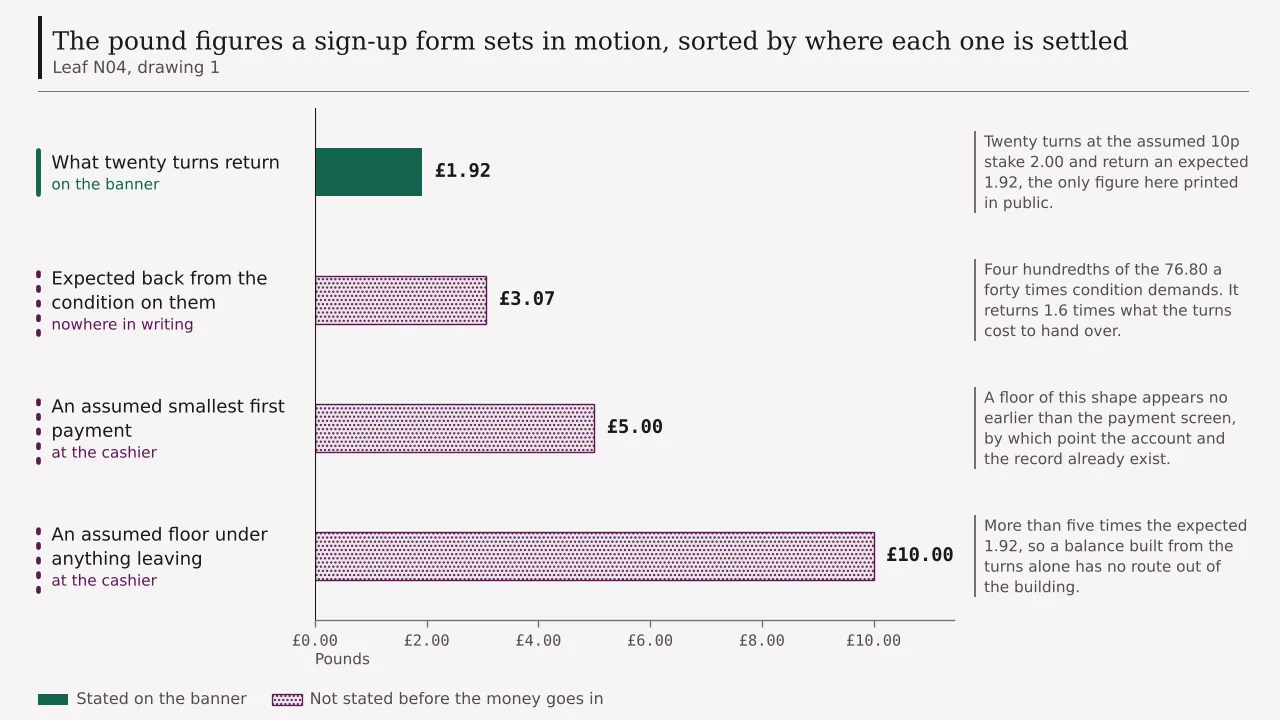
Two of the four bars in that drawing are sums a reader might reasonably expect to find written somewhere, and both of them wait at a payment screen. The bar nobody could find anywhere is the second, which is the figure that decides whether the whole arrangement makes sense for the party offering it, and no advertisement has ever carried it.
7
Every item on the inventory, set against one pound ninety-two
Collect the pricing into one place. Each row below takes an item from part two, names what it is worth measured against the £1.92 the turns return, and says how that figure was reached, because a figure reached by assumption and a figure reached by division should never read the same on a page.
| Item | Worth against £1.92 | How the figure was reached | Where it is settled |
|---|---|---|---|
| Twenty turns of a reel | £1.92 | Count times assumed price times the return | |
| The condition fastened to them | minus £3.07 | Four hundredths of £76.80 of demanded staking | in the bonus terms |
| A permission to send messages | 0.92p a contact | £1.92 divided by an assumed 208 contacts | nowhere in writing |
| A standing relationship | No figure available | No end date is stated, so nothing can be divided | in the general terms |
| A record of a named adult | No figure available | Pricing it would mean inventing a market | nowhere in writing |
| The rating on whoever holds the balance | The whole balance | An unprotected balance is worth nothing on insolvency | nowhere in writing |
| A spending limit nobody offered | A ceiling, not a sum | An unoffered ceiling does not exist to be priced | nowhere in writing |
Three of the seven rows carry a figure and four do not, and the four that do not are the ones that last longest. That is an uncomfortable result for a site built on arithmetic, and printing it is more honest than filling the gaps with plausible numbers, because a plausible number reads on the page exactly like a sourced one.
The row worth staring at is the rating. Its entry says the whole balance, which is not rhetoric: a balance held by a business that fails, with no segregation behind it, is an unsecured claim and the arithmetic on it is total. On £1.92 that is trivial. On whatever a reader pays in later it is not, and the same silence covers both.
Two further pound figures belong to the same registration and neither appears until an account exists. Suppose the till takes nothing under £5.00 as a first payment and the exit shifts nothing under £10.00, both of those numbers set down here to carry the arithmetic and published by nobody. Each is settled at the cashier, which is to say after the form has been submitted, and the second of them is more than five times the expected £1.92 that the turns return. A balance of that size has no route out of the building whatever the condition on it says.
Set the three priced rows side by side and the arrangement resolves. The reader gains £1.92 and loses £3.07 to the condition, closing at minus £1.15. The other party pays £1.92, recovers £3.07, and keeps the permission, the record, the relationship and the settings for nothing, because the condition on the turns has already covered what acquiring the lot of them cost.
That is what the subtraction on this page was run to produce. On the figures above the four unpriced items are free to whoever receives them, not because they are worthless but because the thing that was supposed to pay for them has already paid for itself. A reader comparing twenty turns against nothing has the comparison backwards: the turns are not the price of the account, they are the advertisement for it.
8
What a licence makes a registration screen actually do
Sign-up offers built like this one are run from outside the Great Britain licence, and on a page about what a form creates the duties that matter are the ones written about the form itself. Three of them have been used above already, and collecting them in one place shows what the registration screen would have looked like.
First, consent. Reaching somebody by electronic means to market at them needs agreement that is both informed and specific, and since 1 May 2025 the agreement has to be taken one product type at a time and one channel at a time. A single tick covering everything is exactly what the rule was changed to stop.
Second, caps. A facility for capping spending has to stand ready from the moment an account exists, somebody has to be asked to use it while registering or when money first arrives, the cap has to be where the screen starts from, and declining has to take a deliberate act and then a second one confirming it. A smaller figure applies at once; a larger one sits for a day before anybody may ask for it a second time.
Third, the money. Whoever holds the balance has to set out in the terms what an insolvency would do to it, under which of four fixed ratings and by what means, with an acknowledgement taken before anything is staked, and with the telling repeated twice a year wherever the wording opens with the words not protected.
Strip that set out and the arithmetic in part six does not move by a penny. The £1.92, the £76.80 and the minus £1.15 are properties of a count, a price and a multiple, and no duty about a registration screen touches any of the three. What the set decides is the other column entirely: whether the permission handed over is narrow or unlimited, whether a ceiling exists anywhere, and whether a reader knows what the business behind their balance would do to it if the business stopped. Beyond the licence all three are settled by whoever drew the screen, and the drawing is not published.
One loss stands outside that set and has to be stated on a page about registration above all others. A sign-up form is the exact moment at which the national self-exclusion scheme is supposed to work, and the scheme reaches operators holding the British licence. Registration with Gamstop Online closes accounts across those operators and goes no further, which the scheme writes into its own rules. Anybody who has taken that step and meets a form outside the scheme should treat it as outside, and the block underneath is the better place to go.
9
Reading a sign-up form as a price list
A registration screen can be read as a price list rather than as an obstacle, and doing so takes about a minute. Every field is something being bought, every tick box is a permission being priced, and the figure on the banner is what is being paid for all of it together.
Four questions produce the whole reading. What is the advertised thing worth in money rather than in units. What does the form create that will outlast it. Which of those things has an end date written anywhere. And what condition is attached to the advertised thing, because that condition is usually what funds the exchange.
Run them on twenty turns and five figures come out. Two pounds of staking. An expected £1.92 returned. Seventy-six pounds eighty of staking demanded by the condition. An expected close of minus £1.15. And £3.07 as what the condition is expected to return to the other side, which is 1.6 times what the turns cost to hand over.
Three habits make the reading hold. Count the tick boxes before the fields, since a field describes a person and a tick box creates an entitlement. Look for an end date against each thing the form creates, and write nothing where none is stated rather than assuming the thing is short-lived. And price the advertised figure against the condition attached to it before comparing it with anything, because an advertised figure with a condition on it is not the same object as the figure alone.
The honest summary of a twenty turn registration claim is short. It is true, it is worth an expected £1.92 at the assumed price of a turn, and it is the smaller half of an exchange whose larger half is unpriced, unbounded in time and settled by nobody a reader can consult. Reading the form as a price list does not change any of that. It does make the comparison the reader is actually being asked to make visible, and making it visible is the job this page was set.
Questions
- How much is a 20 free spins no deposit sign-up worth?
- An expected £1.92. Twenty turns at the 10p this site holds steady send £2.00 over the glass, and counting 96 back on each pound staked the batch returns £1.92. That figure rests on the assumed price of a turn, which nobody publishes, so it is the house rate rather than a reading taken off a document. It is also the smaller half of what changes hands at the form.
- What does registering create besides the spins?
- Four things, none of them on the banner. A standing relationship that lasts until somebody closes it. A permission to be contacted that lasts until it is withdrawn. A record of a named adult with no stated end at all. And a set of operating defaults chosen by whoever drew the screen. The turns end when they are used, which is a matter of minutes, and they are the only item of the five that arrives with a figure attached.
- How much is the marketing permission worth against the spins?
- Under a penny per contact on the assumptions used here. Take four messages a week for a year, a frequency this page adopts to carry the arithmetic and nobody publishes, and that is 208 separate contacts. Divide £1.92 by 208 and each one has been bought for 0.92 pence. Halve the assumed frequency and the figure doubles to 1.85 pence, which is still under two pence. A permission is cheap per contact because it is bought once and spent many times.
- Does closing the account end the marketing permission?
- Not necessarily, and it is the commonest surprise in the whole inventory. A relationship and a permission are separate objects: the first attaches to a balance and the second attaches to a person. Closing one ends the first. Inside the Great Britain licence the permission must be both informed and specific, taken one product type at a time and one channel at a time since 1 May 2025, which makes it narrow enough to see and to withdraw. Outside, a single submission can cover everything indefinitely.
- What happens to my balance if the business behind it fails?
- Nothing published says, and that is the point of the row. Inside the licence a business holding the balance must set out in its terms what an insolvency would do to it, under which of four fixed ratings and by what means, with an acknowledgement taken before anything is staked. A pair of those names open with the words not protected, one of the pair adding that nothing is kept apart and the other that customer funds are. The remaining pair are called medium protection and high protection. Wherever the wording opens with the words not protected, the telling repeats twice a year, a requirement in force from 31 October 2025.
- Why does a spending limit matter on an offer that asks for no payment?
- Because the account outlasts the turns. Inside the licence a facility for capping spending has to stand ready from the moment an account exists, somebody has to be asked to use it while registering or when money first arrives, the cap has to be where the screen starts from, and declining has to take a deliberate act and a second one confirming it. A smaller figure applies at once while a larger one sits for a day before anybody may ask for it a second time, so the friction sits on the direction that would cost a reader money. Outside, no prompt arrives, so no limit exists and nothing was declined because nothing was offered.
- What does forty times take off twenty turns of a reel?
- £3.07, and two sums with nothing in common reach it. Forty applied to an expected £1.92 demands £76.80 of staking, four hundredths of which is £3.072. Separately, £1.92 less an expected close of minus £1.152 is £3.072 again. At 10p that staking is 768 presses, and a licensed build will not start a fresh game cycle within two and a half seconds of the one before, so it occupies thirty-two minutes at least.
- Who is actually paying for the account in this exchange?
- The condition on the turns is. Handing twenty turns over costs an expected £1.92, and the forty times condition fastened to that balance is expected to bring £3.072 back across the same reels, so the acquisition returns 1.6 times what it cost, 1.6 being forty multiplied by four hundredths. The £1.15 left over is the reader’s expected close with its sign reversed. On those figures the permission, the record, the relationship and the settings cost whoever receives them nothing.
- Which items on the list cannot be given a figure?
- Four of the seven, and they are the ones that last longest. A standing relationship has no stated end date, so there is nothing to divide by. A record of a named adult cannot be priced without inventing a market for it. An unoffered spending ceiling does not exist to be priced. And the rating on whoever holds the balance is worth the whole balance rather than a fraction of it, because a balance held by a business that fails with no segregation behind it is an unsecured claim. Filling those gaps with plausible numbers would read on the page exactly like sourcing them.
- What should I actually look at on a registration screen?
- Four questions and a habit. What is the advertised thing worth in money rather than in units. What does the form create that will outlast it. Which of those has an end date written anywhere. What condition is attached to the advertised thing. The habit is to count the tick boxes before the fields, because a field describes a person while a tick box creates an entitlement, and the entitlement is the half of the exchange nobody prices.