Terms read 19 October 2026 Leaf H07, revision 1
40 free spins with no deposit: a round count, and the unround sum behind it
Forty spins at ten pence put £4.00 through the game and are expected to give back £3.84. Nothing in that arithmetic wanted the number forty. Advertising rounds and arithmetic does not, and once a spin value is attached a single printed forty covers everything from £2.00 to £8.00.
Stated on the banner 40 A rung on a ladder of counts the market advertises, chosen for how it sets rather than for anything in the sums. Stated, once you go and look £3.84 What the rung is expected to give back at ten pence a spin, which is not a round figure and was never going to be one. Not stated before the money goes in £6.00 of width The span one printed forty covers once the price of a spin and the rate a game credits at are both allowed to move.
Offers advertising a round count, with their terms read
Every destination in this file is bought advertising. The site is paid a fee if a reader goes on to register, and no figure printed below moves because of it.
Bonus Spins UK Slip 01
Betportal
Ceiling as a multiple
The drop
€15.00
€1.00 in the euro
The claim reads €15.00. Once the terms beside it have applied, €0.00 of it can leave. The difference is the drop.
7 of the 15 terms on this slip could not be read before the money went in
Spins priced at this site's own 10p a spin, which the operator does not publish
Stated
€15.00
The claim as it is printed, before a single term has been applied to it.
Headline paid as spins
150 spins at 10c each, which is €15.00 of the figure above.
6 Nowhere
What one spin is worth
No unit is published for a spin, so the count is priced at this site's own 10p a spin. At half that price every figure below halves with it.
Match and other credit not priced
300% of three deposits, to a ceiling of €1,000. A share of a deposit nobody has made yet is not a sum, so no figure stands on this line and none is carried below.
Qualified
-€14.40
Written down somewhere, and taking part of the claim back. Each term carries the place it is written and the sum it takes.
2 Written terms at a distance this record does not establish
Play-through -€14.40
Carrying €14.40 through 35 times stakes €504.00 and costs €20.16 of it at 96 per cent return. That prices above the €14.40 there is to charge it against, so the whole of the credit goes and the line is held at that. The multiple sits on the bonus.
2 Written terms at a distance this record does not establish
Game weighting not priced
Slots only count towards the play-through. No contribution percentage is published, so the line above has been worked at full weight, which is the kindest reading there is.
2 Written terms at a distance this record does not establish
Ceiling on the winnings not priced
5x the bonus.
2 Written terms at a distance this record does not establish
Clock on the credit not priced
14 days.
2 Written terms at a distance this record does not establish
Largest stake while it runs not priced
€5.
3 Public record
Licence, and who holds it not priced
Licensed in Anjouan, Comoros, held by BetPortal Gaming Ltd, with Excite Ultra Media Ltd, reference ALSI-202601040-FI2. A register entry settles who holds a licence and what it permits. It does not settle who is running the site this morning.
4 Cashier
Smallest qualifying deposit your money
€20 a stage. That is €20.00 of your own money, and it is never netted into a drop.
5 On the way out
Checks before a withdrawal not priced
Documents before the first withdrawal.
Unstated
-€0.60
Applying without having been published anywhere, and costing money all the same.
6 Nowhere
What a spin hands back -€0.60
Staking a spin returns 96 per cent of it, so that share of the batch is the house's before a reel turns. This site works at that return and the operator publishes none where the claim is made.
6 Nowhere
Forfeited by rule cost unknown
Nothing is published under this heading, and it applies regardless.
6 Nowhere
Charge on the way out cost unknown
No charge on the way out is published as a figure, so nothing comes off this line. A charge that exists unpublished would come straight off whatever survives.
6 Nowhere
Smallest withdrawal allowed cost unknown
No smallest withdrawal is published as a figure. A floor nobody has published is still a floor, and it decides whether a small balance can move at all.
No Great Britain licence
Terms read 19 October 2026
Bonus Spins UK Slip 02
WinBeast
Ceiling as a sum
The drop
€50.00
€1.00 in the euro
The claim reads €50.00. Once the terms beside it have applied, €0.00 of it can leave. The difference is the drop.
8 of the 15 terms on this slip could not be read before the money went in
Spins priced at this site's own 10p a spin, which the operator does not publish
Stated
€50.00
The claim as it is printed, before a single term has been applied to it.
Headline paid as spins
500 spins at 10c each, which is €50.00 of the figure above.
6 Nowhere
What one spin is worth
No unit is published for a spin, so the count is priced at this site's own 10p a spin. At half that price every figure below halves with it.
Match and other credit not priced
50% to 100% of five deposits, each to a ceiling of €1,000, and a €650 free bet. A share of a deposit nobody has made yet is not a sum, so no figure stands on this line and none is carried below.
Qualified
-€48.00
Written down somewhere, and taking part of the claim back. Each term carries the place it is written and the sum it takes.
2 Written terms at a distance this record does not establish
Play-through -€48.00
Carrying €48.00 through 40 times stakes €1,920.00 and costs €76.80 of it at 96 per cent return. That prices above the €48.00 there is to charge it against, so the whole of the credit goes and the line is held at that. The multiple sits on the bonus and the winnings from the spins.
2 Written terms at a distance this record does not establish
Game weighting not priced
Slots, titles vary by country count towards the play-through. No contribution percentage is published, so the line above has been worked at full weight, which is the kindest reading there is.
2 Written terms at a distance this record does not establish
Ceiling on the winnings not priced
€100 a batch of spins.
2 Written terms at a distance this record does not establish
Clock on the credit not priced
7 days, spins 1 day.
3 Public record
Licence, and who holds it not priced
Licensed in Curaçao, holder not named on the site. A register entry settles who holds a licence and what it permits. It does not settle who is running the site this morning.
4 Cashier
Smallest qualifying deposit your money
€20 a stage. That is €20.00 of your own money, and it is never netted into a drop.
5 On the way out
Checks before a withdrawal not priced
Documents before the first withdrawal.
Unstated
-€2.00
Applying without having been published anywhere, and costing money all the same.
6 Nowhere
What a spin hands back -€2.00
Staking a spin returns 96 per cent of it, so that share of the batch is the house's before a reel turns. This site works at that return and the operator publishes none where the claim is made.
6 Nowhere
Largest stake while it runs cost unknown
Nothing is published under this heading, and it applies regardless.
6 Nowhere
Forfeited by rule cost unknown
Nothing is published under this heading, and it applies regardless.
6 Nowhere
Charge on the way out cost unknown
No charge on the way out is published as a figure, so nothing comes off this line. A charge that exists unpublished would come straight off whatever survives.
6 Nowhere
Smallest withdrawal allowed cost unknown
No smallest withdrawal is published as a figure. A floor nobody has published is still a floor, and it decides whether a small balance can move at all.
No Great Britain licence
Terms read 19 October 2026
Bonus Spins UK Slip 03
EliteSpin
Longest spin window
The drop
£50.00
£1.00 in the pound
The claim reads £50.00. Once the terms beside it have applied, £0.00 of it can leave. The difference is the drop.
8 of the 15 terms on this slip could not be read before the money went in
Spins priced at this site's own 10p a spin, which the operator does not publish
Stated
£50.00
The claim as it is printed, before a single term has been applied to it.
Headline paid as spins
500 spins at 10p each, which is £50.00 of the figure above.
6 Nowhere
What one spin is worth
No unit is published for a spin, so the count is priced at this site's own 10p a spin. At half that price every figure below halves with it.
Match and other credit not priced
50% to 100% of five deposits, each to a ceiling of £1,000. A share of a deposit nobody has made yet is not a sum, so no figure stands on this line and none is carried below.
Qualified
-£48.00
Written down somewhere, and taking part of the claim back. Each term carries the place it is written and the sum it takes.
2 Written terms at a distance this record does not establish
Play-through -£48.00
Carrying £48.00 through 40 times stakes £1,920.00 and costs £76.80 of it at 96 per cent return. That prices above the £48.00 there is to charge it against, so the whole of the credit goes and the line is held at that. The multiple sits on the bonus and the winnings from the spins.
2 Written terms at a distance this record does not establish
Game weighting not priced
Slots count towards the play-through. No contribution percentage is published, so the line above has been worked at full weight, which is the kindest reading there is.
2 Written terms at a distance this record does not establish
Ceiling on the winnings not priced
5x the bonus.
2 Written terms at a distance this record does not establish
Clock on the credit not priced
7 days, spins 3 days.
3 Public record
Licence, and who holds it not priced
Licensed in Costa Rica, held by PrimeTier Limited. A register entry settles who holds a licence and what it permits. It does not settle who is running the site this morning.
4 Cashier
Smallest qualifying deposit your money
£20 a stage. That is £20.00 of your own money, and it is never netted into a drop.
5 On the way out
Checks before a withdrawal not priced
Documents before the first withdrawal.
Unstated
-£2.00
Applying without having been published anywhere, and costing money all the same.
6 Nowhere
What a spin hands back -£2.00
Staking a spin returns 96 per cent of it, so that share of the batch is the house's before a reel turns. This site works at that return and the operator publishes none where the claim is made.
6 Nowhere
Largest stake while it runs cost unknown
Nothing is published under this heading, and it applies regardless.
6 Nowhere
Forfeited by rule cost unknown
Nothing is published under this heading, and it applies regardless.
6 Nowhere
Charge on the way out cost unknown
No charge on the way out is published as a figure, so nothing comes off this line. A charge that exists unpublished would come straight off whatever survives.
6 Nowhere
Smallest withdrawal allowed cost unknown
No smallest withdrawal is published as a figure. A floor nobody has published is still a floor, and it decides whether a small balance can move at all.
No Great Britain licence
Terms read 19 October 2026
Bonus Spins UK Slip 04
Crown Jewelz
Multiple unpublished
The drop
NOT WORKED
The multiple is not published in the operator's own terms. Since the sum cannot be worked around it, none is worked.
9 of the 14 terms on this slip could not be read before the money went in
No drop worked
Stated
£15.00
The claim as it is printed, before a single term has been applied to it.
Headline paid as spins
150 spins at 10p each, which is £15.00 of the figure above.
6 Nowhere
What one spin is worth
No unit is published for a spin, so the count is priced at this site's own 10p a spin. At half that price every figure below halves with it.
Match and other credit not priced
200% of the first deposit, then 150% twice, each to a ceiling of £1,000. A share of a deposit nobody has made yet is not a sum, so no figure stands on this line and none is carried below.
Qualified
NOT WORKED
Written down somewhere, and taking part of the claim back. Each term carries the place it is written and the sum it takes.
2 Written terms at a distance this record does not establish
Play-through not priced
40x the bonus, reported rather than published by the operator.
2 Written terms at a distance this record does not establish
Game weighting not priced
Slots count towards the play-through. No contribution percentage is published, so the line above has been worked at full weight, which is the kindest reading there is.
3 Public record
Licence, and who holds it not priced
Licensed in Curaçao, number not verified, holder not named on the site. A register entry settles who holds a licence and what it permits. It does not settle who is running the site this morning.
4 Cashier
Smallest qualifying deposit your money
£20. That is £20.00 of your own money, and it is never netted into a drop.
5 On the way out
Checks before a withdrawal not priced
Documents before the first withdrawal.
Unstated
NOT WORKED
Applying without having been published anywhere, and costing money all the same.
6 Nowhere
Ceiling on the winnings cost unknown
No ceiling is published. Nothing is assumed in its place.
6 Nowhere
Clock on the credit cost unknown
Nothing is published under this heading, and it applies regardless.
6 Nowhere
Largest stake while it runs cost unknown
Nothing is published under this heading, and it applies regardless.
6 Nowhere
Forfeited by rule cost unknown
Nothing is published under this heading, and it applies regardless.
6 Nowhere
Charge on the way out cost unknown
No charge on the way out is published as a figure, so nothing comes off this line. A charge that exists unpublished would come straight off whatever survives.
6 Nowhere
Smallest withdrawal allowed cost unknown
No smallest withdrawal is published as a figure. A floor nobody has published is still a floor, and it decides whether a small balance can move at all.
No Great Britain licence
Terms read 19 October 2026
Every figure in the second and third columns is this site's own working and nothing an operator has published. A claim is priced as printed, then the share a spin hands back at 96 per cent return comes off it, then what playing the multiple through costs at the same return, and then whatever a published ceiling, a charge on the way out or a floor on the smallest withdrawal takes from what has survived. The drop is the difference between the first figure and the last. The two columns add back up to it exactly, so no money leaves a slip without a term and a place beside it.
Which column a term falls in is settled by one question: has anybody written it down. A charge a reader meets at the payment screen is written down, and it stands in the second column with the cashier against it. A condition that binds without ever having been set down stands in the third, whatever it costs. Inside each column the terms run outwards from the banner, so the order itself says how far a reader would have had to go.
A count of spins has no unit until one is supplied. Where an operator publishes what one of its own spins is worth, that figure is used and the first column says it is theirs. Where none is published, this site's own 10p a spin stands in its place and every figure below moves in proportion with it. Where the multiple itself is unpublished, no drop is worked at all, because that is the one figure the sum cannot be done without.
Three words stand where a figure cannot. Not priced is a term that is written down and carries no number the arithmetic can take. Cost unknown is a term nobody has written down, costing something nobody has put a number on. Your money is money of the reader's own, which is never netted into a drop.
None of the operators in this file holds a Great Britain licence, so none of the duties that licence carries reaches them. Each of those duties is published in its own right, which is what makes its absence here something a reader can check rather than take on trust. Every gambling company licensed in Great Britain belongs to Gamstop Online, so a reader who has shut themselves out through the scheme is not shut out here. Social Responsibility Code 5.1.1 has held a play-through to a maximum of ten times the bonus funds since 19 January 2026, and it binds a licence holder and nobody else. Asked in a post of 21 October 2025 what is lost along with the licence, the Gambling Commission's Director of Enforcement and Intelligence answered: "unfair gaming practices, financial loss, and a lack of recourse if things go wrong". The same post puts blocked payouts, and withdrawal limits pitched high enough to be unreachable, among the behaviour the Commission has recorded. Nobody under 18 may hold an account at any of them.
Terms are reproduced in the wording their operator published, and each slip is dated with the day somebody sat down and read them. 19 October 2026 is the oldest of those dates. Anybody claiming an offer is bound by that operator's full terms, which are elsewhere, and never by a line standing here.
1
Why forty, rather than thirty-seven
Counts on promotional banners bunch. Twenty, twenty-five, thirty, forty, fifty, a hundred: the market advertises on about nine rungs and almost never between them. Nothing in the arithmetic of a bonus produces that bunching. It is a property of advertising, where a figure has to be read at a glance and remembered afterwards, and round figures do both.
So the first thing to notice about a forty is that it was chosen by a designer rather than derived by an accountant. Had the budget behind it come to thirty-seven spins, the banner would have said thirty-five or forty. Had it come to forty-three, the banner would still have said forty. A rounded count is a figure that has already been moved, and the direction it moved in is not recorded anywhere.
This leaf takes no view on whether the rounding is innocent, because the question does not turn on that. A rounded count is less informative than an exact one even where every party acted in good faith, since rounding is lossy by construction. What the page does is measure the loss in pounds, which is the only measurement of it anybody can act on.
The measurement runs on two levels and they compound. Rounding the count blurs the count. The absence of a price for one spin blurs everything built on it. Together they turn a figure that reads as exact into a range several pounds wide, and the range is what the rest of this leaf sets out.
A last framing point before the sums. Precision and accuracy are different virtues, and a banner count has one of them. Forty is accurate: forty spins will arrive and the publisher can be held to it. Forty is not precise about anything a reader wants to know, because the quantity a reader wants is money and the conversion into money is kept off the face. An accurate label on an imprecise quantity reads as a precise one, and that is the whole difficulty.
2
What the rung comes to once a price is attached
Attach the ten pence this site works to and the count converts immediately. Forty spins put £4.00 through the game, and the expectation, with the return pegged at 96 per cent, is £3.84. The ten pence is an assumption of this site’s and sits nowhere in writing unless a bonus document happens to carry it.
Look at the pair of figures that produces. The stake is round because the count is round and the assumed price is round, which is a coincidence of three roundings rather than a fact about the offer. The expectation is not round at all, and £3.84 is the first honest number on the page. Multiply a round count by a round price by an unround return and the roundness is gone at the third step.
That is worth more than it looks. Any figure in this family that comes out round has had a rounding imposed on it somewhere upstream, because the return is 96 in the hundred and 96 divides nothing cleanly. A promotion advertising a round pound figure for its spins is therefore advertising the stake, not the expectation, and the two differ by the margin.
Now the written condition. A play-through of forty is the multiple used throughout this leaf, that being the figure most commonly printed where no ceiling applies, and it is an assumption rather than an observation. Forty lots of £3.84 come to £153.60 of staking before the balance can move, and at ten pence a go that is 1,536 presses of a button.
Four hundredths of £153.60 is £6.144, which is £6.14 rounded to the penny, and that is what satisfying the clause is expected to cost. Take that away from the £3.84 and what remains is an expected minus £2.30. The sign changes at twenty-five, which is what a four per cent margin inverts to, so a clause set at forty sits a long way past the point where the winnings have all gone to the house.
Expected from the count, at ten pence a spin £3.84 Expected once the written multiple is applied minus £2.30 What the clause is expected to take £6.14
3
The ladder the market prints, and the gaps in it
Set the advertised counts out in order and the ladder has uneven rungs. Between ten and twenty the step doubles the figure. Between twenty and twenty-five it adds a quarter. Between forty and fifty it adds a quarter again, and between fifty and a hundred it doubles. A reader moving up the ladder is not moving in equal strides, and nothing on any banner says so.
| What the banner prints | Step up from the rung beneath | Put through at ten pence |
|---|---|---|
| Ten | The bottom of the ladder | £1.00 |
| Twenty | Twice the rung beneath | £2.00 |
| Twenty-five | A quarter more | £2.50 |
| Thirty | A fifth more | £3.00 |
| Forty | A third more | £4.00 |
| Fifty | A quarter more | £5.00 |
| A hundred | Twice the rung beneath | £10.00 |
| A hundred and fifty | Half as much again | £15.00 |
| Two hundred | A third more | £20.00 |
The ladder in that table is a description of advertising practice and not a sourced list, which has to be said plainly. No primary source publishes a distribution of advertised counts, so the rungs are set down here as the shape anyone reading banners will recognise, and nothing later in this leaf depends on the list being complete.
What matters is the spacing rather than the membership. The visible ladder has steps of twenty per cent to a hundred per cent between neighbouring rungs. The invisible ladder, the one running through the price of a spin, has steps of the same order or larger, because a spin priced at five pence and a spin priced at twenty differ by three hundred per cent. A reader can see the smaller variation and cannot see the larger.
That inversion is the point of this leaf and it deserves stating as a sentence a reader can carry away. The quantity printed in large type varies less between promotions than the quantity printed nowhere. Choosing between two banners on the strength of their counts is choosing on the smaller of the two variables, in ignorance of the larger.
4
How wide a single printed count really is
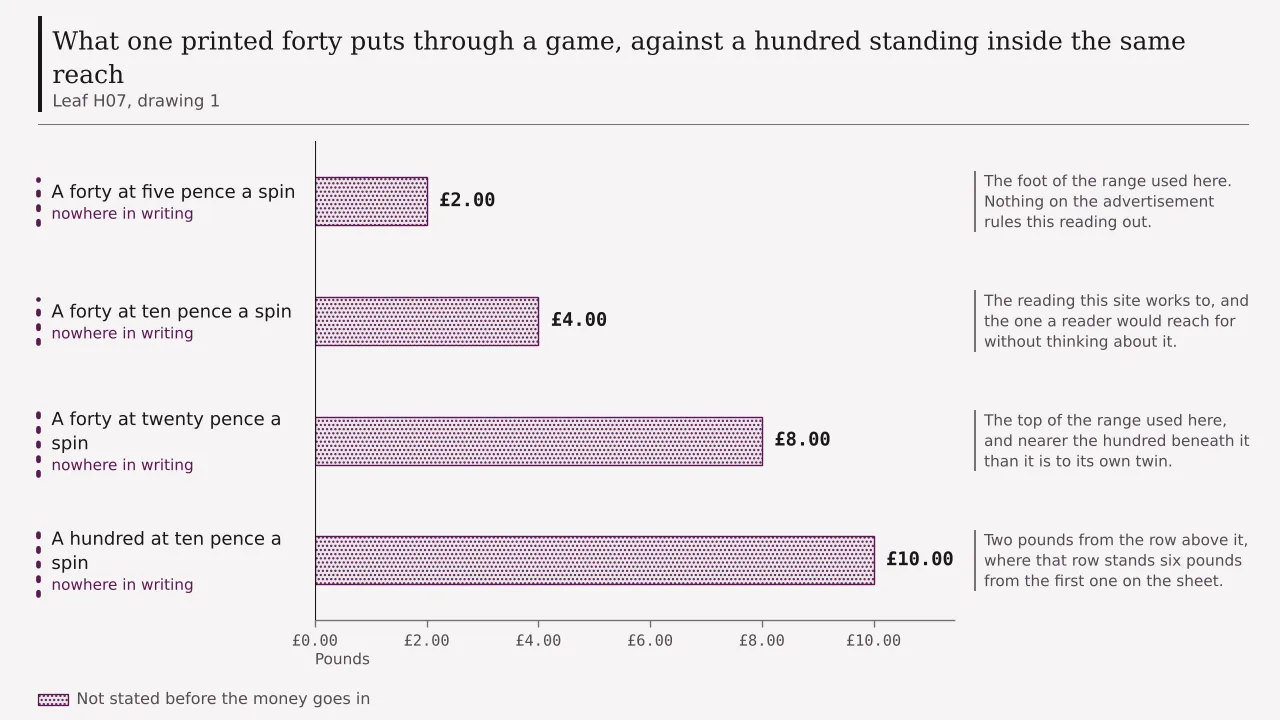
Hold the forty and let the price of a spin move across the range such promotions use. At five pence the forty puts £2.00 through the game; at twenty pence it puts £8.00 through. That span runs to £6.00 in stake and £5.76 in expectation, and every point along it is consistent with one unchanged advertisement.
| Price taken for one spin | How that price got into the sum | Put through the game | Where the price would be settled | Expected back |
|---|---|---|---|---|
| Five pence | The low end of the range used here | £2.00 | nowhere in writing | £1.92 |
| Ten pence | The value this site holds to | £4.00 | nowhere in writing | £3.84 |
| Fifteen pence | A figure a bonus document might name | £6.00 | in the bonus terms | £5.76 |
| Twenty pence | The high end of the range used here | £8.00 | nowhere in writing | £7.68 |
Both ends of that range are this leaf’s own assumptions, carried to show the shape of the uncertainty rather than to report where promotions actually sit. No published source gives a distribution of spin prices out at this end, and a page inventing one would be doing the very thing this site objects to.
Width is the quantity worth keeping. A banner reading forty is not a claim with an error bar of a few pence on it. It is a claim whose pound value runs across a fourfold range, and the top of the range is four times the bottom in a way no amount of attention to the advertisement will narrow. The advertisement is accurate at every point inside the range.
£6.00 of stake between the two readings a single printed forty allows
5
A forty standing closer to a hundred than to a forty
Put the band beside the rung above it and the comparison a reader thinks they are making falls apart. A forty priced at twenty pence puts £8.00 through the game. A hundred priced at ten pence puts £10.00 through. Two pounds separate them. That same forty at five pence puts £2.00 through, which is six pounds from its own twin and three times further than the gap to the larger count.
So two promotions carrying the identical printed figure can stand further apart than a promotion carrying one figure stands from a promotion carrying a figure two and a half times larger. The label is not what separates them. The unprinted price is what separates them, and it separates them by more.
The same arithmetic runs in the other direction and produces a cleaner result still. A twenty priced at twenty pence and a forty priced at ten pence are the same offer to the penny: £4.00 through the game, £3.84 expected back, an identical obligation under an identical clause. One banner prints half of what the other prints and the two are indistinguishable once the sums are done.
Which means a count supports no ordering. Ordering requires a quantity that increases with the thing being ordered, and a count does not, because any count can be matched by a different count at a different price. The ordering a reader performs when they prefer a bigger number is an ordering of advertisements.
None of that makes a larger count worthless. At a fixed price, more spins are more money, and where a bonus document names a price for both promotions the comparison becomes real and takes ten seconds. The condition is the named price, and it is the condition that fails most of the time.
There is one honest consolation and it belongs here rather than anywhere else. A small count fails safe. Forty spins at the worst price in the range still cost the reader nothing to accept, and the downside of misjudging the band is an expectation two pounds lower than hoped rather than a loss. The band matters for deciding where to spend an hour, not for deciding what to risk.
6
The multiplier that widens every band again
One further quantity sits behind every figure above and is published by nobody. Where a pound staked counts for less than a pound towards the clause, the turnover needed to finish it rises by the reciprocal of the rate. The clause reads the same either way, and the work it demands changes by a multiple.
A consultation page the regulator publishes carries a respondent’s description of thirty pence credited for every pound staked, and the working built on that figure is this leaf’s own and not the regulator’s. Taking the rate as given, the £153.60 the clause demands takes £512.00 through the game to produce, which at ten pence a go is 5,120 presses instead of 1,536.
Stack that on the price band and the two compound. A forty at the foot of the band owes £76.80 of turnover where a pound counts for a pound, and £256.00 where it counts for thirty pence. The same forty at the top of the band owes £307.20 and £1,024.00. One printed figure, four readings, and the largest is more than thirteen times the smallest.
A third unwritten quantity decides whether the question arises at all. The shape of the distribution a game pays from determines how often a small balance survives long enough for the clause to be attempted, and no published source sets out that shape for a build nobody has named. This leaf invents none, and the expectations above are averages taken over long runs of attempts in which most got nowhere.
One pattern runs through the three of them, and it is why this site files a term by its address before doing anything else with it. Every quantity that would narrow the band is settled somewhere a reader cannot reach before committing, and every quantity a reader can reach before committing leaves the band exactly as wide as it was. A rounded count is the most visible figure in the whole arrangement and the least load-bearing.
7
A round figure that does carry a definition
British regulation is full of round numbers too, and the difference between those and an advertised forty is instructive. A regulated round number comes with a written definition, a scope and a date, and the definition sometimes contradicts the obvious reading of the figure. The clearest published instance of that sits inside the standard on financial limits.
The standard, which sits in a public record, requires a licensed build to offer limits over periods that must take in a calendar month, a run of seven days and a single twenty-four hours, and it settles what happens where two of them overlap: the tightest one governs. The worked example beside the rule is the useful part. Take somebody who puts ten pounds against the day and a hundred against the week. The daily one binds, so across seven days the system may accept seventy at most, and the weekly hundred is unreachable by construction.
Read that slowly. A round hundred, entered by the customer, written into the account, means seventy. Nothing has gone wrong and nobody has been misled, because the arithmetic is published beside the rule and the tighter limit is the one the customer chose first. The round number is a label and the binding quantity is somewhere else, which is the identical structure this leaf has been describing all the way through.
The standard goes further than the figures in two ways worth naming. Limit-setting has to be put forward as the default choice, declining it has to take a positive act, and a confirmation has to be taken at the cashier before any money moves. The two directions also run at different speeds. A reduction takes effect at once; a rise is held for no less than twenty-four hours and only then, on a second deliberate act by the customer, goes through.
A promotion with a round count on the front of it comes from a business with no Great Britain licence behind it, so none of that reaches it. What is lost here is not a ceiling on the offer but an instrument the reader would have been handed for setting their own. The deposit limit is the one figure in this whole subject a reader gets to choose, and a build outside the licence is under no obligation to offer it, to default to it, to implement a reduction at once, or to wait before raising it.
There is a second loss folded into the same standard and it is quieter. The rule on prompts has the customer asked during registration, or else when the first payment is made, while the regulator’s summary page prefers the looser formula that a prompt should come as early as possible. Either wording fixes a moment. Outside the licence no moment is fixed, so the prompt arrives when somebody decides it should, which in practice means after the account exists.
8
Round thresholds that come with dates on them
The other place a round number earns its keep is a threshold, and a threshold is only as good as the date it started on. Two figures published by the regulator make the point, and both of them are round in exactly the way an advertised count is round while behaving nothing like it.
Light-touch financial checks on online customers run off a monthly net deposit figure. The announcement sets the trigger at £500 in a month to start with, dated 30 August 2024, and lowers it to £150 once 28 February 2025 came round. The enhanced assessments described in the same release are a pilot still, kept clear of live operation, and the regulator says in terms that nobody’s credit standing moves on account of either.
Those two figures are round, and that is where the resemblance to a banner count stops. Each carries a scope, a start date, a published statement of what it does not do, and a document a reader can open to check all three. A banner count carries the figure and nothing else, and what stands in for the missing scope and the missing commencement is the arithmetic parts four and five had to do.
Set the two kinds of round figure side by side and the difference is not accuracy. Forty spins is as true as £150 a month. The difference is that one of them is attached to a definition, a commencement and a publisher who can be held to it, and the other is attached to a conversion rate that is settled nowhere in writing. Truth is not the scarce property in an advertisement. Definition is.
A reader who wants to see the contrast in one line can compare where each figure goes when it is questioned. Ask what £150 a month covers and there is a page to consult, with a date on it and a scope attached. Ask what forty spins covers and the honest answer is a range from £2.00 to £8.00, and the only document that could narrow it is the one the advertisement did not link to.
Which is the practical shape of the loss on an offer carrying no British licensing. Not that the count is false, and not that nobody can complain, but that every figure in the arrangement except the count itself is undefined, undated and unattached to anybody who has to answer for it. The count stays exactly as true as it was and stops being worth very much.
9
Reading a rounded count without pretending it is exact
Four habits make a rounded count safe to handle, and none of them takes more than a minute. Treat the figure as a label. Look for a price in the bonus document. Where no price is there, carry a range rather than a number. And compare ranges rather than labels when deciding between two promotions.
The first habit is the one that does the work. Writing the word label beside the count stops it being carried forward as though it were a sum, which is the mistake the layout of a banner is built to encourage. Forty is what will be handed over. Forty is not what it is worth, and the two are different sentences.
The second habit has a fixed destination. A price for a promotional spin, where it is published at all, goes down beside the conditions and not beside the advertisement, which makes the bonus document the place to go and the general terms a waste of a click. Opening it also settles the multiple, which is the other figure the advertisement left out.
The third habit is where most readers stop too early. A range is an answer. Writing down that a forty stands between £2.00 and £8.00 of stake, and between £1.92 and £7.68 of expectation, is more useful than inventing a single figure, because a range can be compared with another range and an invented figure cannot be compared with anything.
The fourth habit is the one that changes decisions. Two promotions whose ranges overlap are not distinguishable on their banners, whatever their counts say, and the honest conclusion is that the choice has to be made on something else or not made at all. Two promotions whose ranges do not overlap can be ordered, and that ordering holds whichever point inside each range turns out to be true.
Run those habits across the rest of this section and they survive the change of figures. A larger count widens the range in pounds and leaves it exactly as wide in proportion. A headline printed in money has no range at the first step and acquires one at the second. A count with no words about payment beside it adds a range at the front instead of in the middle. In every case what comes out is a pair of bounds, and a reader holding bounds is ahead of a reader holding a label.
Questions
- What is 40 free spins with no deposit worth?
- Somewhere between £2.00 and £8.00 of stake, and the banner does not narrow it. At the ten pence a spin this site assumes, forty spins put £4.00 through the game and are expected to return £3.84 on a 96 per cent rate. At five pence the identical count puts through £2.00 and at twenty pence it puts through £8.00. Nothing on the advertisement chooses, because the price of one spin is not an advertised figure.
- Why do free spin offers always come in round numbers?
- Because advertising rounds and arithmetic does not. A figure has to be read at a glance and remembered afterwards, which favours twenty, twenty-five, thirty, forty, fifty and a hundred, and the market advertises on about nine rungs with very little in between. A budget that worked out at thirty-seven spins would be published as thirty-five or forty, and the direction it was moved in is recorded nowhere.
- Can two offers both saying 40 free spins be different?
- By a factor of four, on the range used here. A forty priced at twenty pence puts £8.00 through the game and a forty priced at five pence puts through £2.00, which is six pounds apart. A hundred priced at ten pence puts through £10.00, only two pounds from the first of those. A printed count can therefore stand closer to a different count than to the same count elsewhere, because the figure that separates them is the one nobody prints.
- Is 40 free spins better than 20?
- Only at a fixed price for a spin, and the price is the thing not fixed. A twenty priced at twenty pence and a forty priced at ten pence are the same offer to the penny: £4.00 through the game, £3.84 expected back, the same obligation under the same clause. Any count can be matched by a smaller count at a higher price, so a count on its own supports no ordering of one promotion against another.
- How much staking does a 40 times requirement ask for on 40 spins?
- £153.60, which at ten pence a go is 1,536 presses. Forty lots of the £3.84 expected from the spins gives the turnover, of which the margin keeps four hundredths, £6.14 once £6.144 is rounded. Subtracting leaves an expected close of minus £2.30. The multiple where the sign changes is twenty-five, the reciprocal of a four per cent margin.
- Does the game weighting change the figure?
- It changes the work rather than the rate. Where a game credits under a pound for every pound staked at it, the staking needed is divided by that rate, which multiplies the work without touching the margin. At the thirty pence per pound a respondent described on the regulator’s consultation page, this leaf’s own working makes £153.60 of required contribution take £512.00 through the game, which is 5,120 presses rather than 1,536. The clause reads identically on the page in both cases.
- Do any round numbers in gambling rules mean what they say?
- They mean what their definitions say, and the definitions are sometimes a surprise. The standard on financial limits wants twenty-four hours, seven days and a calendar month among the periods it offers, and resolves an overlap by applying whichever of them is tightest. Its worked example has somebody entering ten pounds daily beside a hundred weekly; the daily figure binds, seven days of it come to seventy, and the weekly hundred can never be reached.
- What is given up on an offer shaped like this?
- The instrument a reader would otherwise use to set their own ceiling. A promotion of this kind comes from a business with no Great Britain licence behind it, so nothing obliges it to offer limits over the required periods, to present setting one as the default, to put a reduction through at once, or to hold a rise for no less than twenty-four hours before a second confirmation releases it. The deposit limit is the one figure in this subject the reader chooses, and outside the licence nobody has to offer the choice.
- What does a monthly deposit threshold have to do with a spin count?
- It shows what a round figure looks like when it is defined. Light-touch financial checks are triggered by net deposits over a month: the trigger stood at £500 from 30 August 2024, and at £150 once 28 February 2025 came round. The enhanced assessments alongside them are a pilot still, held back from live operation, and no credit standing moves because of them. Each of those figures carries a scope, a start date and a document to check. A banner count carries the figure alone.
- How should I read a rounded spin count?
- Treat the figure as a label rather than a sum, go to the bonus document in search of a price, and where none is printed carry a range rather than inventing a number. Writing down that a forty stands between £2.00 and £8.00 of stake and between £1.92 and £7.68 of expectation is a result. Two promotions whose ranges overlap cannot be told apart on their banners, whatever the counts say.