Terms read 19 October 2026 Leaf C10, revision 1
What the money is really moving on, and where a payout is addressed to
A matched £25.00 carries £1,000.00 of staking at forty times and an expected close of minus £15.00. Those figures hold whichever picture was pressed. What does not hold is where the money goes afterwards, because a payment token is a stand-in and the conditions deciding a payout were written about the thing it stands in for.
Stated on the banner £25.00 The sum a matched payment of that size credits, with no mention anywhere near it of what the payment is drawn from. Stated, once you go and look £15.00 pointing backwards Where forty times leaves that credit, written a document off, on a return of 96p in each pound as fixed sitewide. Not stated before the money goes in £25.00 with no address Which instrument the token resolves to, whether the conditions name the token or that instrument, and whether the instrument is still anything the reader uses.
Offers taking tokenised payments, with the written terms read
Every destination in this file is bought advertising. The site is paid a fee if a reader goes on to register, and no figure printed below moves because of it.
Bonus Spins UK Slip 01
Betportal
Ceiling as a multiple
The drop
€15.00
€1.00 in the euro
The claim reads €15.00. Once the terms beside it have applied, €0.00 of it can leave. The difference is the drop.
7 of the 15 terms on this slip could not be read before the money went in
Spins priced at this site's own 10p a spin, which the operator does not publish
Stated
€15.00
The claim as it is printed, before a single term has been applied to it.
Headline paid as spins
150 spins at 10c each, which is €15.00 of the figure above.
6 Nowhere
What one spin is worth
No unit is published for a spin, so the count is priced at this site's own 10p a spin. At half that price every figure below halves with it.
Match and other credit not priced
300% of three deposits, to a ceiling of €1,000. A share of a deposit nobody has made yet is not a sum, so no figure stands on this line and none is carried below.
Qualified
-€14.40
Written down somewhere, and taking part of the claim back. Each term carries the place it is written and the sum it takes.
2 Written terms at a distance this record does not establish
Play-through -€14.40
Carrying €14.40 through 35 times stakes €504.00 and costs €20.16 of it at 96 per cent return. That prices above the €14.40 there is to charge it against, so the whole of the credit goes and the line is held at that. The multiple sits on the bonus.
2 Written terms at a distance this record does not establish
Game weighting not priced
Slots only count towards the play-through. No contribution percentage is published, so the line above has been worked at full weight, which is the kindest reading there is.
2 Written terms at a distance this record does not establish
Ceiling on the winnings not priced
5x the bonus.
2 Written terms at a distance this record does not establish
Clock on the credit not priced
14 days.
2 Written terms at a distance this record does not establish
Largest stake while it runs not priced
€5.
3 Public record
Licence, and who holds it not priced
Licensed in Anjouan, Comoros, held by BetPortal Gaming Ltd, with Excite Ultra Media Ltd, reference ALSI-202601040-FI2. A register entry settles who holds a licence and what it permits. It does not settle who is running the site this morning.
4 Cashier
Smallest qualifying deposit your money
€20 a stage. That is €20.00 of your own money, and it is never netted into a drop.
5 On the way out
Checks before a withdrawal not priced
Documents before the first withdrawal.
Unstated
-€0.60
Applying without having been published anywhere, and costing money all the same.
6 Nowhere
What a spin hands back -€0.60
Staking a spin returns 96 per cent of it, so that share of the batch is the house's before a reel turns. This site works at that return and the operator publishes none where the claim is made.
6 Nowhere
Forfeited by rule cost unknown
Nothing is published under this heading, and it applies regardless.
6 Nowhere
Charge on the way out cost unknown
No charge on the way out is published as a figure, so nothing comes off this line. A charge that exists unpublished would come straight off whatever survives.
6 Nowhere
Smallest withdrawal allowed cost unknown
No smallest withdrawal is published as a figure. A floor nobody has published is still a floor, and it decides whether a small balance can move at all.
No Great Britain licence
Terms read 19 October 2026
Bonus Spins UK Slip 02
WinBeast
Ceiling as a sum
The drop
€50.00
€1.00 in the euro
The claim reads €50.00. Once the terms beside it have applied, €0.00 of it can leave. The difference is the drop.
8 of the 15 terms on this slip could not be read before the money went in
Spins priced at this site's own 10p a spin, which the operator does not publish
Stated
€50.00
The claim as it is printed, before a single term has been applied to it.
Headline paid as spins
500 spins at 10c each, which is €50.00 of the figure above.
6 Nowhere
What one spin is worth
No unit is published for a spin, so the count is priced at this site's own 10p a spin. At half that price every figure below halves with it.
Match and other credit not priced
50% to 100% of five deposits, each to a ceiling of €1,000, and a €650 free bet. A share of a deposit nobody has made yet is not a sum, so no figure stands on this line and none is carried below.
Qualified
-€48.00
Written down somewhere, and taking part of the claim back. Each term carries the place it is written and the sum it takes.
2 Written terms at a distance this record does not establish
Play-through -€48.00
Carrying €48.00 through 40 times stakes €1,920.00 and costs €76.80 of it at 96 per cent return. That prices above the €48.00 there is to charge it against, so the whole of the credit goes and the line is held at that. The multiple sits on the bonus and the winnings from the spins.
2 Written terms at a distance this record does not establish
Game weighting not priced
Slots, titles vary by country count towards the play-through. No contribution percentage is published, so the line above has been worked at full weight, which is the kindest reading there is.
2 Written terms at a distance this record does not establish
Ceiling on the winnings not priced
€100 a batch of spins.
2 Written terms at a distance this record does not establish
Clock on the credit not priced
7 days, spins 1 day.
3 Public record
Licence, and who holds it not priced
Licensed in Curaçao, holder not named on the site. A register entry settles who holds a licence and what it permits. It does not settle who is running the site this morning.
4 Cashier
Smallest qualifying deposit your money
€20 a stage. That is €20.00 of your own money, and it is never netted into a drop.
5 On the way out
Checks before a withdrawal not priced
Documents before the first withdrawal.
Unstated
-€2.00
Applying without having been published anywhere, and costing money all the same.
6 Nowhere
What a spin hands back -€2.00
Staking a spin returns 96 per cent of it, so that share of the batch is the house's before a reel turns. This site works at that return and the operator publishes none where the claim is made.
6 Nowhere
Largest stake while it runs cost unknown
Nothing is published under this heading, and it applies regardless.
6 Nowhere
Forfeited by rule cost unknown
Nothing is published under this heading, and it applies regardless.
6 Nowhere
Charge on the way out cost unknown
No charge on the way out is published as a figure, so nothing comes off this line. A charge that exists unpublished would come straight off whatever survives.
6 Nowhere
Smallest withdrawal allowed cost unknown
No smallest withdrawal is published as a figure. A floor nobody has published is still a floor, and it decides whether a small balance can move at all.
No Great Britain licence
Terms read 19 October 2026
Bonus Spins UK Slip 03
EliteSpin
Longest spin window
The drop
£50.00
£1.00 in the pound
The claim reads £50.00. Once the terms beside it have applied, £0.00 of it can leave. The difference is the drop.
8 of the 15 terms on this slip could not be read before the money went in
Spins priced at this site's own 10p a spin, which the operator does not publish
Stated
£50.00
The claim as it is printed, before a single term has been applied to it.
Headline paid as spins
500 spins at 10p each, which is £50.00 of the figure above.
6 Nowhere
What one spin is worth
No unit is published for a spin, so the count is priced at this site's own 10p a spin. At half that price every figure below halves with it.
Match and other credit not priced
50% to 100% of five deposits, each to a ceiling of £1,000. A share of a deposit nobody has made yet is not a sum, so no figure stands on this line and none is carried below.
Qualified
-£48.00
Written down somewhere, and taking part of the claim back. Each term carries the place it is written and the sum it takes.
2 Written terms at a distance this record does not establish
Play-through -£48.00
Carrying £48.00 through 40 times stakes £1,920.00 and costs £76.80 of it at 96 per cent return. That prices above the £48.00 there is to charge it against, so the whole of the credit goes and the line is held at that. The multiple sits on the bonus and the winnings from the spins.
2 Written terms at a distance this record does not establish
Game weighting not priced
Slots count towards the play-through. No contribution percentage is published, so the line above has been worked at full weight, which is the kindest reading there is.
2 Written terms at a distance this record does not establish
Ceiling on the winnings not priced
5x the bonus.
2 Written terms at a distance this record does not establish
Clock on the credit not priced
7 days, spins 3 days.
3 Public record
Licence, and who holds it not priced
Licensed in Costa Rica, held by PrimeTier Limited. A register entry settles who holds a licence and what it permits. It does not settle who is running the site this morning.
4 Cashier
Smallest qualifying deposit your money
£20 a stage. That is £20.00 of your own money, and it is never netted into a drop.
5 On the way out
Checks before a withdrawal not priced
Documents before the first withdrawal.
Unstated
-£2.00
Applying without having been published anywhere, and costing money all the same.
6 Nowhere
What a spin hands back -£2.00
Staking a spin returns 96 per cent of it, so that share of the batch is the house's before a reel turns. This site works at that return and the operator publishes none where the claim is made.
6 Nowhere
Largest stake while it runs cost unknown
Nothing is published under this heading, and it applies regardless.
6 Nowhere
Forfeited by rule cost unknown
Nothing is published under this heading, and it applies regardless.
6 Nowhere
Charge on the way out cost unknown
No charge on the way out is published as a figure, so nothing comes off this line. A charge that exists unpublished would come straight off whatever survives.
6 Nowhere
Smallest withdrawal allowed cost unknown
No smallest withdrawal is published as a figure. A floor nobody has published is still a floor, and it decides whether a small balance can move at all.
No Great Britain licence
Terms read 19 October 2026
Bonus Spins UK Slip 04
Crown Jewelz
Multiple unpublished
The drop
NOT WORKED
The multiple is not published in the operator's own terms. Since the sum cannot be worked around it, none is worked.
9 of the 14 terms on this slip could not be read before the money went in
No drop worked
Stated
£15.00
The claim as it is printed, before a single term has been applied to it.
Headline paid as spins
150 spins at 10p each, which is £15.00 of the figure above.
6 Nowhere
What one spin is worth
No unit is published for a spin, so the count is priced at this site's own 10p a spin. At half that price every figure below halves with it.
Match and other credit not priced
200% of the first deposit, then 150% twice, each to a ceiling of £1,000. A share of a deposit nobody has made yet is not a sum, so no figure stands on this line and none is carried below.
Qualified
NOT WORKED
Written down somewhere, and taking part of the claim back. Each term carries the place it is written and the sum it takes.
2 Written terms at a distance this record does not establish
Play-through not priced
40x the bonus, reported rather than published by the operator.
2 Written terms at a distance this record does not establish
Game weighting not priced
Slots count towards the play-through. No contribution percentage is published, so the line above has been worked at full weight, which is the kindest reading there is.
3 Public record
Licence, and who holds it not priced
Licensed in Curaçao, number not verified, holder not named on the site. A register entry settles who holds a licence and what it permits. It does not settle who is running the site this morning.
4 Cashier
Smallest qualifying deposit your money
£20. That is £20.00 of your own money, and it is never netted into a drop.
5 On the way out
Checks before a withdrawal not priced
Documents before the first withdrawal.
Unstated
NOT WORKED
Applying without having been published anywhere, and costing money all the same.
6 Nowhere
Ceiling on the winnings cost unknown
No ceiling is published. Nothing is assumed in its place.
6 Nowhere
Clock on the credit cost unknown
Nothing is published under this heading, and it applies regardless.
6 Nowhere
Largest stake while it runs cost unknown
Nothing is published under this heading, and it applies regardless.
6 Nowhere
Forfeited by rule cost unknown
Nothing is published under this heading, and it applies regardless.
6 Nowhere
Charge on the way out cost unknown
No charge on the way out is published as a figure, so nothing comes off this line. A charge that exists unpublished would come straight off whatever survives.
6 Nowhere
Smallest withdrawal allowed cost unknown
No smallest withdrawal is published as a figure. A floor nobody has published is still a floor, and it decides whether a small balance can move at all.
No Great Britain licence
Terms read 19 October 2026
Every figure in the second and third columns is this site's own working and nothing an operator has published. A claim is priced as printed, then the share a spin hands back at 96 per cent return comes off it, then what playing the multiple through costs at the same return, and then whatever a published ceiling, a charge on the way out or a floor on the smallest withdrawal takes from what has survived. The drop is the difference between the first figure and the last. The two columns add back up to it exactly, so no money leaves a slip without a term and a place beside it.
Which column a term falls in is settled by one question: has anybody written it down. A charge a reader meets at the payment screen is written down, and it stands in the second column with the cashier against it. A condition that binds without ever having been set down stands in the third, whatever it costs. Inside each column the terms run outwards from the banner, so the order itself says how far a reader would have had to go.
A count of spins has no unit until one is supplied. Where an operator publishes what one of its own spins is worth, that figure is used and the first column says it is theirs. Where none is published, this site's own 10p a spin stands in its place and every figure below moves in proportion with it. Where the multiple itself is unpublished, no drop is worked at all, because that is the one figure the sum cannot be done without.
Three words stand where a figure cannot. Not priced is a term that is written down and carries no number the arithmetic can take. Cost unknown is a term nobody has written down, costing something nobody has put a number on. Your money is money of the reader's own, which is never netted into a drop.
None of the operators in this file holds a Great Britain licence, so none of the duties that licence carries reaches them. Each of those duties is published in its own right, which is what makes its absence here something a reader can check rather than take on trust. Every gambling company licensed in Great Britain belongs to Gamstop Online, so a reader who has shut themselves out through the scheme is not shut out here. Social Responsibility Code 5.1.1 has held a play-through to a maximum of ten times the bonus funds since 19 January 2026, and it binds a licence holder and nobody else. Asked in a post of 21 October 2025 what is lost along with the licence, the Gambling Commission's Director of Enforcement and Intelligence answered: "unfair gaming practices, financial loss, and a lack of recourse if things go wrong". The same post puts blocked payouts, and withdrawal limits pitched high enough to be unreachable, among the behaviour the Commission has recorded. Nobody under 18 may hold an account at any of them.
Terms are reproduced in the wording their operator published, and each slip is dated with the day somebody sat down and read them. 19 October 2026 is the oldest of those dates. Anybody claiming an offer is bound by that operator's full terms, which are elsewhere, and never by a line standing here.
1
A stand-in, and conditions written about what it stands for
Pressing a tokenised payment choice does not move money from the token. The token is a stand-in that resolves, at the moment of payment, to an instrument sitting behind it, and the money moves from that instrument. Everything on this leaf follows from that one sentence, and nothing on it depends on any particular arrangement or any particular reader.
The consequence is a mismatch of vocabulary. A reader describes what they did in terms of the token, because that is what they pressed. A set of conditions describes what may happen next in terms of instruments, because that is what money travels on. Those two descriptions are not interchangeable, and where they come apart is at the far end of the trip rather than at the near one.
On the way in the mismatch costs nothing. A payment either completes or it does not, and if it completes the account is credited and the arrangement begins. Whatever sat underneath the token has done its work and the reader never had to name it. That is the whole appeal of a stand-in and it is a genuine convenience, not a trick.
On the way out the mismatch is the entire subject. A payout has to be addressed to something, and the something is chosen by whatever the conditions say rather than by what the reader pressed. Where the conditions are written about the instrument that funded the account, the address is an instrument the reader may not have thought about since the day they added it to a handset.
So the question this leaf answers is narrow and practical: what does somebody need to establish, before paying anything, in order to predict where their own money will be sent later. The answer turns out to be three things, none of which appears on a payment screen, and part two sets them out.
£25.00 addressed to something a reader has not looked at since the day it was added
2
The resolution step, and the three questions it puts
Call the moment a token turns into an instrument the resolution step. It happens in fractions of a second, it is invisible, and it is where every unknown on this leaf is generated. Three questions have to be answered before a reader can predict their own position, and they are independent of each other.
Question one is which instrument the token resolves to at the moment of payment. A handset may hold several and may have a default that was set once and never revisited, so the answer is a fact about the reader’s own device rather than about any arrangement. Alone among the three, it can also be settled without a reader leaving their chair.
Question two is whether the conditions governing a payout name the token or name the instrument. Those are different objects and a sentence can be written about either. Where the conditions speak of the method used to fund the account, the resolution step has already converted that method into an instrument, and the instrument is what gets recorded.
Question three is whether the instrument so recorded is still something the reader actually uses. A card can be re-issued with new digits, an account can be closed, a prepaid balance can lapse. None of those events announces itself to a gambling account, and none of them has any reason to.
Only the first of the three is answerable in advance at no cost. The second needs a document that may or may not exist and may or may not use the vocabulary the question is framed in. The third is answerable in principle and almost never asked, because nothing in the sequence prompts anybody to ask it.
| What has to be established | Who holds the answer | Cost of settling it in advance |
|---|---|---|
| Which instrument the stand-in resolves to | The reader’s own handset | A minute, and no account anywhere |
| Whether conditions name the stand-in or the instrument | Whoever drafted the conditions | A document, where one exists |
| Whether that instrument is still live | Whoever issued the instrument | Nothing, and almost nobody asks |
| All three, answered together | Nobody at all | No party publishes the combination |
The bottom row carries the point. Each question has an owner. The combination has none, because predicting where a payout lands is a job that sits between three parties and belongs to none of them. A reader wanting the answer has to assemble it, and the assembling is work nobody is prompted to do before paying.
3
Where each of those answers is settled
Sorting the three questions into the six places this site uses produces an unusual spread, because each answer sits somewhere different and one of them sits in two places at once depending on how an arrangement has been drafted.
The credit a payment draws is settled . The multiple applied to it is settled in the promotional terms. Which pictures a payment screen offers, and therefore whether a stand-in is available at all, is settled at the cashier. Which instrument the stand-in resolved to on the day is settled at the payment screen as well, since that is the moment the resolution happens. Whether the instrument still works is discovered on the way out, and whether the conditions were written about tokens or about instruments is, on a great many arrangements, nowhere in writing.
Five of the six places are therefore in play on one payment, which is more than any other subject in this section manages. It happens because a stand-in inserts a translation step between two documents that were written independently, and a translation step has no author.
Set the spread beside the reader’s own sequence and the ordering is unkind. The two cheap answers come first and decide the smallest things. The two expensive answers come last and decide where the money goes. Nothing about that is anybody’s fault in particular, and it is still the shape a reader has to work against.
One point of fairness. A stand-in genuinely removes work at the entrance, and the work it removes is real: no long number to copy, no card to find, nothing written down where it should not be. The argument here is not that the convenience is false. It is that the convenience sits at the entrance and the unanswered questions sit at the exit, so the two are not being traded against each other at all.
4
What each possible thing underneath does to the position
Here is the branch table, which is this leaf’s central piece of work. Each row is a possible answer to question one, and each row carries what that answer does to a payment going in, to a payout coming back, and to the reader’s own timetable. The deferral figures are assumed here and are not published anywhere this site may cite.
| What sits underneath | Effect on the payment in | Effect on the payout | Where the answer is settled | Assumed deferral |
|---|---|---|---|---|
| A debit instrument still in daily use | Completes, and the credit arrives | Addressed somewhere that works | at the payment screen | None |
| The same thing, re-issued with new digits | Completes, the stand-in having refreshed itself | Addressed to whatever was recorded earlier | on the way out | 10 banking days |
| Something on an account since closed | Does not complete at all | Addressed to a destination that is gone | on the way out | 10 banking days |
| A prepaid balance of some kind | Completes while the balance lasts | Decided by that balance’s own conditions | in a second writing | Not establishable |
| A credit instrument | Barred outright inside the British licence | The question never arises | in a licence condition | Not applicable |
Read the middle column and the asymmetry is immediate. Three of the five answers behave identically on the way in, which is to say the payment completes and the reader learns nothing. The same three behave quite differently on the way out. A step that cannot be distinguished at the entrance and matters a great deal at the exit is the definition of a condition this section exists to price.
Row three deserves a note because it is the one case where the reader does get told something. A payment drawn from something that no longer exists simply fails, and a failure at the entrance is cheap information: nothing has been committed and the reader can choose again. The expensive version of row three is the one where the payment succeeded months ago and the instrument closed afterwards, which puts the same fact at the exit instead.
Row four is the one with no figure against it, and the blank is deliberate. Whether a prepaid balance can receive a payment at all is decided by conditions written by whoever runs it, which is a second writing by a second author, and nothing citable here lays down a general rule about it. The honest entry is that the answer exists and is not establishable from anything the gambling arrangement publishes.
Row five is handled in full in part eight, because it is the one row where a published British rule decides the answer rather than a private document.
5
Twenty-five credited, a thousand staked, forty between
Price the thing being exited from before pricing the exit, since the two figures get confused constantly and only one of them shifts when a stand-in resolves differently. Pay £25.00 against a full match and £25.00 of credit lands beside it. The multiple then asks for £1,000.00 to be turned over, ten thousand presses at the 10p fixed sitewide.
Of each pound turned over, four pence stays with the house, so a thousand pounds of it is expected to shed £40.00 and the credit closes at an expected minus £15.00. Checked from the other side: an edge of four per cent repeated forty times reaches 1.6, subtracting that from one leaves minus 0.6, and 0.6 of twenty-five pounds is fifteen pounds in the unhelpful direction. The weighting is one everywhere on this leaf.
Credit read off the match £25.00 Expected close at forty times minus £15.00 Distance between the readings £40.00
Not a penny of that £40.00 shifts when the stand-in resolves to one instrument rather than another. A multiple acting on a credit manufactures the difference, and nothing in it refers to how the money arrived. That is worth stating early, because it fixes the relative weight of the two subjects: the clause is worth £40.00 and the resolution step is worth a question about where £25.00 ends up.
It also fixes which of the two a reader should settle first. The clause is published, one document away, and settles a £40.00 question for the price of reading it. The resolution step is unpublished, takes three separate enquiries, and settles a timetable rather than a sum. Both are worth doing. They are not worth doing in that order.
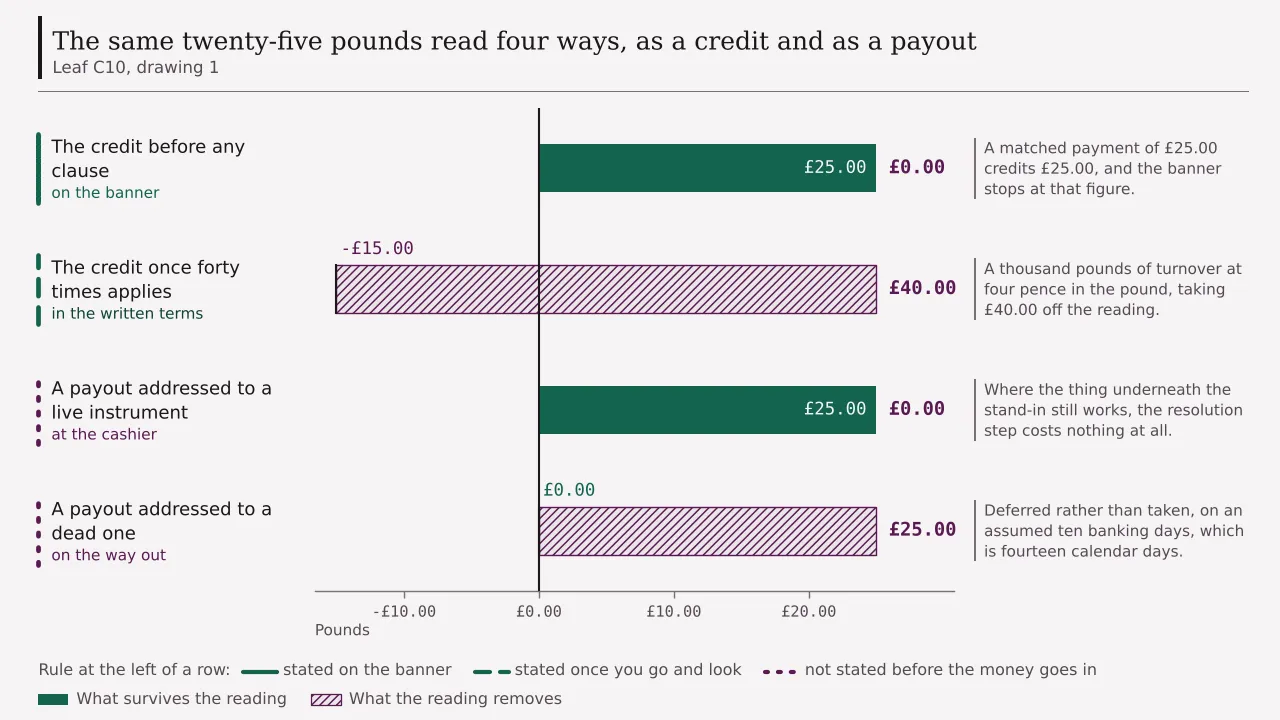
Two of those bars lose nothing and two lose a great deal, and the two that lose do it for unrelated reasons. One is arithmetic performed by a clause anybody can read. The other is an address recorded at a moment nobody watched. Printing them on the same ledger is the only way to see that they are different kinds of object with similar sized consequences.
6
A rule about an instrument, applied to a stand-in
Many arrangements carry a rule that a payout returns to whatever funded the account. That rule is derived and priced on its own leaf of this site, and nothing here repeats the derivation. What this part adds is what happens when the rule is applied to a stand-in rather than to an instrument, because the rule was drafted before stand-ins were common and its wording has not always caught up.
Apply the rule literally and it returns money to the thing that funded the account. The resolution step has already decided that the thing was an instrument rather than a token, so the rule addresses an instrument. A reader who believes the rule returns money to the picture they pressed has made a reasonable mistake about which noun the sentence is using.
Where the instrument is live the mistake costs nothing at all and nobody ever discovers they made it. Where the instrument is not live, the rule performs precisely the job it was drafted for, and that job is sending money to a place the reader has stopped using. No clause has been broken and nothing improper has happened.
That is why the three questions in part two matter more than any particular arrangement. A reader who can name the instrument underneath can predict the address. A reader who cannot is relying on the resolution step having picked something they would have picked themselves, which it may well have done, and which they have no way of confirming after the fact.
One structural observation finishes the part. A rule tying a payout to the funding instrument is a rule about identity rather than about convenience: its purpose is to make the two ends of a payment match. A stand-in sits in the middle of that and makes the two ends match in a vocabulary the reader is not using, which is a problem of translation rather than of policy.
7
Putting a figure on a recovery without advising one
Suppose a payout has been addressed to something that no longer works. The money is not gone. A payment that cannot be delivered does not evaporate, and the sum involved remains the sum involved. What has changed is the timetable, and a timetable is the thing this part prices.
Assume a resolution takes ten banking days and an exchange of documents, both assumed here and neither published. Ten banking days is fourteen calendar days once two weekends are counted, so the reader’s position is £25.00 that exists, is theirs, and is not reachable for a fortnight. Written as a subtraction that is £25.00 read off the exit screen against £0.00 reachable at the moment of asking.
Read off the exit screen £25.00 Reachable at the moment of asking £0.00 Deferred rather than taken £25.00
The word deferred is doing careful work in that block and it should not be softened. Nobody has lost twenty-five pounds. The difference between a sum that is owed and a sum that has arrived is a difference of fourteen assumed days, and anybody describing that as a loss would be overstating a figure they cannot source. What the subtraction prices is the gap between two readings of one balance, which is what this site prices everywhere.
The spread is the useful output rather than any single figure. A reader who cannot answer the three questions in part two is holding a payout whose arrival date lies somewhere between today and an assumed fourteen days from now, and whose reachable value at the moment of asking lies somewhere between £25.00 and nothing. Both ends of both ranges are consistent with everything a payment screen showed them.
No part of this leaf says what anybody should do about that, and the omission is deliberate rather than coy. Every route out of the situation runs through parties whose procedures are their own, with not one of them on a page citable here, and inventing a route would mean inventing precisely the sort of unsourced figure everything above has been declining to print.
14 assumed calendar days between a payout leaving and a payout reaching anywhere usable
8
The one British rule that reads through a wrapper
Row five of the branch table was left for this part because it is the single published instance of a British rule deciding what sits underneath a payment rather than what the payment is called.
Payment for gambling on a credit card is shut out of a British licence altogether, and the condition goes on to catch the same card where it reaches the licensee through a business in the money service trade. The second half of that is the interesting half. It exists because a payment can be built out of two legs, and a bar written about the visible leg alone would be satisfied by anything with a wrapper around it.
The rule took effect on 14 April 2020. Its reach is drawn licence by licence rather than in general terms: every remote one, the ancillary remote varieties included, together with the off-line betting licences of the general, pool and intermediary kinds, while the categories covering machine technology, software and hosting are left outside. Put into this leaf’s terms, it performs the resolution step itself and then applies the answer it gets.
Arrangements paid for by pressing a stand-in hold no Great Britain licence, so what goes missing on a leaf about what sits underneath is any rule that bothers to look at all. Nothing out here bars a payment assembled from a credit leg and a second leg with a different name on it. Nothing extends a bar on the visible leg to the leg behind it. Nothing dates the position, so there is no equivalent of 14 April 2020 to measure anything against, and no list of which licences a rule covers because there are no licences. The British regulator does record one thing still reaching an unlicensed business from outside, which is that the organisations running the large payment systems may pull its facilities. That is a decision other parties take about their own networks, and it is a protection rather than an obstacle.
The structural point survives the loss of the rule, and it is the reason this leaf is organised around the resolution step. Where a rule is written about an instrument, a stand-in does not evade it, because the rule simply looks through. Where no rule is written at all, the stand-in is not evading anything either. In both cases the instrument underneath is the thing that decides, and the reader’s own knowledge of it is the only variable they control.
One further asymmetry belongs here. A rule looking through a wrapper is doing so on behalf of the person paying, since the thing it is preventing is a payment made with borrowed money. A payout rule looking through a wrapper is doing so on behalf of the arrangement, since the thing it is ensuring is that money returns whence it came. The same mechanism serves different parties at the two ends of a trip, and only one end has a published British rule behind it.
9
The whole sum, for anything that pays by token
The procedure is three questions and one subtraction, and it works on any payment choice that stands in for something else. Question one: on your own handset, which instrument is set to be used. Question two: in whatever conditions exist, is a payout described by reference to the method or to the instrument. Question three: is that instrument still one you use.
Answer all three and the address of a future payout is predictable. Answer only the first and the address is narrowed but not fixed. Answer none and the address is whatever a document and a resolution step between them decide, which is a perfectly ordinary outcome and simply not a predictable one.
Then do the subtraction, which is separate and must not be mixed in. Take the credit as the match presents it. Take it again once the multiple is applied. Rule off the gap. On £25.00 at forty times that is £25.00, then minus £15.00, then £40.00, and the resolution step does not alter any of the three.
Three cautions keep the two sums apart. Never read a completed payment as evidence that a payout will travel back the same way, because the entrance and the exit are decided by different sentences. Never treat an undelivered payout as a lost one, since the honest figure is an assumed fourteen days rather than a sum of money. And never put a number against a recovery procedure, because no party in the chain publishes one and a plausible-looking figure cannot be told apart, once printed, from one with a source behind it.
The single action this leaf points at costs a minute and happens before anything else. Look at which instrument the stand-in is set to use, and ask whether it is one you still use. That answers question one and most of question three, which between them remove the larger part of the uncertainty priced above, and neither of them requires an account, a payment or a document from anybody.
Questions
- Does money actually move from the payment token?
- No. The token is a stand-in that resolves at the moment of payment to an instrument sitting behind it, and the money travels from that instrument. A reader describes what happened using the name of the token, because that is what they pressed, while a set of conditions describes what happens next using the name of the instrument, because that is what money travels on. The two descriptions come apart at the far end of the trip rather than at the near one.
- What do I need to know to predict where a payout goes?
- Three things, and they are independent. Which instrument the stand-in resolves to at the moment of payment, which is a fact about your own handset. Whether the conditions describe a payout by reference to the method or to the instrument, which needs a document that may not exist. And whether that instrument is still one you use, which is answerable in principle and almost never asked because nothing in the sequence prompts it.
- Which of those can I settle before paying anything?
- Only the first, at no cost and in about a minute, since it lives on your own device. The second needs a document that may or may not use the vocabulary the question is framed in. The third is free to establish and nobody is ever prompted to do it. No party publishes the three together, because predicting the address of a payout sits between three parties and belongs to none of them.
- What happens if the instrument underneath was replaced?
- The payment in may well complete, the stand-in having refreshed itself, while the payout is addressed to whatever was recorded earlier. That is the expensive branch, because it produces no signal at the entrance at all. The cheap branch is something on an account since closed, where the payment simply fails and nothing has been committed, so the reader learns the fact while choosing is still free.
- Is the money lost if it is sent somewhere I no longer use?
- No, and overstating that would be printing a figure this leaf cannot source. A payment that cannot be delivered does not evaporate and the sum remains the sum. What changes is the timetable: on an assumed ten banking days, which is fourteen calendar days once two weekends are counted, the position is £25.00 that exists and is not reachable for a fortnight. Read as a subtraction that is £25.00 off the exit screen against nothing reachable at the moment of asking.
- Where does forty times leave a credit of twenty-five pounds?
- At an expected minus £15.00. The multiple asks for £1,000.00 to be turned over, ten thousand presses at the 10p fixed sitewide, and of each pound turned over four pence stays with the house, so £40.00 is expected to go. Checked from the other side, an edge of four per cent repeated forty times reaches 1.6, subtracting that from one leaves minus 0.6, and 0.6 of twenty-five pounds is fifteen pounds in the unhelpful direction.
- Does the payment route change that arithmetic?
- Not by a penny. A multiple acting on a credit manufactures the £40.00 of difference, and nothing in it refers to how the money arrived. That fixes the relative weight of the two subjects on this page: the clause is published, one document away, and settles a £40.00 question for the price of reading it, while the resolution step is unpublished, takes three separate enquiries, and settles a timetable rather than a sum.
- Why would a payout go back to the funding instrument at all?
- Because many arrangements carry a rule saying so, and its purpose is to make the two ends of a payment match. That rule is derived and priced on another leaf of this site and is not re-derived here. What this page adds is what the rule does when it meets a stand-in: the resolution step has already turned the stand-in into an instrument, so the rule addresses an instrument, and a reader expecting it to address the picture they pressed has made a reasonable mistake about which noun the sentence uses.
- Is there any British rule that looks at what is underneath?
- One, and it is the clearest published example. Payment for gambling on a credit card is shut out of a British licence altogether, and the condition goes on to catch the same card where it reaches the licensee through a business in the money service trade. That second half exists because a payment can be built out of two legs and a bar written about the visible leg alone would be satisfied by anything with a wrapper around it. The rule carries the date 14 April 2020 and covers every remote licence.
- What goes missing when the arrangement sits outside Britain?
- Any rule that bothers to look underneath. Arrangements paid for by pressing a stand-in hold no Great Britain licence, so nothing bars a payment built from a credit leg and a second leg with a different name on it, nothing extends a bar on the visible leg to the leg behind it, and no commencement date and no list of covered licences exist because no licences exist. The British regulator does record that the organisations running the large payment systems may pull an unlicensed business’s facilities, which is a decision other parties take about their own networks.
- What is the shortest version of this check?
- Look at which instrument the stand-in is set to use, and ask whether it is still one you use. That settles the first question and most of the third, removes the larger part of the uncertainty, and requires no account, no payment and no document from anybody. Then do the separate subtraction on the credit, which on £25.00 at forty times gives £25.00, minus £15.00 and a gap of £40.00.