Terms read 19 October 2026 Leaf R05, revision 1
New casino sites: one published date is a fact, and the nine things read off it are not
A welcome figure of £35.00 hauls £1,400.00 over the reels at the multiple drafted out here and settles at an expected minus £21.00. The date on which a permission began moves none of those three figures by a penny. What it does bound is how much can possibly be known about the address yet, and the floor under that is 56 days.
Stated on the banner £35.00 A credit figure and the word new, which asserts an age and asserts nothing about a condition. Stated, once you go and look minus £21.00 Forty times standing against that credit in a second document, computed on a return of ninety-six in the hundred, which this site holds steady. Not stated before the money goes in 56 days The stretch of an address’s early life over which an empty complaint history is handed over by the clock rather than earned, with nothing outside the business having yet looked at the drafting.
Recently opened offers, with their written terms read
Every destination in this file is bought advertising. The site is paid a fee if a reader goes on to register, and no figure printed below moves because of it.
Bonus Spins UK Slip 01
Betportal
Ceiling as a multiple
The drop
€15.00
€1.00 in the euro
The claim reads €15.00. Once the terms beside it have applied, €0.00 of it can leave. The difference is the drop.
7 of the 15 terms on this slip could not be read before the money went in
Spins priced at this site's own 10p a spin, which the operator does not publish
Stated
€15.00
The claim as it is printed, before a single term has been applied to it.
Headline paid as spins
150 spins at 10c each, which is €15.00 of the figure above.
6 Nowhere
What one spin is worth
No unit is published for a spin, so the count is priced at this site's own 10p a spin. At half that price every figure below halves with it.
Match and other credit not priced
300% of three deposits, to a ceiling of €1,000. A share of a deposit nobody has made yet is not a sum, so no figure stands on this line and none is carried below.
Qualified
-€14.40
Written down somewhere, and taking part of the claim back. Each term carries the place it is written and the sum it takes.
2 Written terms at a distance this record does not establish
Play-through -€14.40
Carrying €14.40 through 35 times stakes €504.00 and costs €20.16 of it at 96 per cent return. That prices above the €14.40 there is to charge it against, so the whole of the credit goes and the line is held at that. The multiple sits on the bonus.
2 Written terms at a distance this record does not establish
Game weighting not priced
Slots only count towards the play-through. No contribution percentage is published, so the line above has been worked at full weight, which is the kindest reading there is.
2 Written terms at a distance this record does not establish
Ceiling on the winnings not priced
5x the bonus.
2 Written terms at a distance this record does not establish
Clock on the credit not priced
14 days.
2 Written terms at a distance this record does not establish
Largest stake while it runs not priced
€5.
3 Public record
Licence, and who holds it not priced
Licensed in Anjouan, Comoros, held by BetPortal Gaming Ltd, with Excite Ultra Media Ltd, reference ALSI-202601040-FI2. A register entry settles who holds a licence and what it permits. It does not settle who is running the site this morning.
4 Cashier
Smallest qualifying deposit your money
€20 a stage. That is €20.00 of your own money, and it is never netted into a drop.
5 On the way out
Checks before a withdrawal not priced
Documents before the first withdrawal.
Unstated
-€0.60
Applying without having been published anywhere, and costing money all the same.
6 Nowhere
What a spin hands back -€0.60
Staking a spin returns 96 per cent of it, so that share of the batch is the house's before a reel turns. This site works at that return and the operator publishes none where the claim is made.
6 Nowhere
Forfeited by rule cost unknown
Nothing is published under this heading, and it applies regardless.
6 Nowhere
Charge on the way out cost unknown
No charge on the way out is published as a figure, so nothing comes off this line. A charge that exists unpublished would come straight off whatever survives.
6 Nowhere
Smallest withdrawal allowed cost unknown
No smallest withdrawal is published as a figure. A floor nobody has published is still a floor, and it decides whether a small balance can move at all.
No Great Britain licence
Terms read 19 October 2026
Bonus Spins UK Slip 02
WinBeast
Ceiling as a sum
The drop
€50.00
€1.00 in the euro
The claim reads €50.00. Once the terms beside it have applied, €0.00 of it can leave. The difference is the drop.
8 of the 15 terms on this slip could not be read before the money went in
Spins priced at this site's own 10p a spin, which the operator does not publish
Stated
€50.00
The claim as it is printed, before a single term has been applied to it.
Headline paid as spins
500 spins at 10c each, which is €50.00 of the figure above.
6 Nowhere
What one spin is worth
No unit is published for a spin, so the count is priced at this site's own 10p a spin. At half that price every figure below halves with it.
Match and other credit not priced
50% to 100% of five deposits, each to a ceiling of €1,000, and a €650 free bet. A share of a deposit nobody has made yet is not a sum, so no figure stands on this line and none is carried below.
Qualified
-€48.00
Written down somewhere, and taking part of the claim back. Each term carries the place it is written and the sum it takes.
2 Written terms at a distance this record does not establish
Play-through -€48.00
Carrying €48.00 through 40 times stakes €1,920.00 and costs €76.80 of it at 96 per cent return. That prices above the €48.00 there is to charge it against, so the whole of the credit goes and the line is held at that. The multiple sits on the bonus and the winnings from the spins.
2 Written terms at a distance this record does not establish
Game weighting not priced
Slots, titles vary by country count towards the play-through. No contribution percentage is published, so the line above has been worked at full weight, which is the kindest reading there is.
2 Written terms at a distance this record does not establish
Ceiling on the winnings not priced
€100 a batch of spins.
2 Written terms at a distance this record does not establish
Clock on the credit not priced
7 days, spins 1 day.
3 Public record
Licence, and who holds it not priced
Licensed in Curaçao, holder not named on the site. A register entry settles who holds a licence and what it permits. It does not settle who is running the site this morning.
4 Cashier
Smallest qualifying deposit your money
€20 a stage. That is €20.00 of your own money, and it is never netted into a drop.
5 On the way out
Checks before a withdrawal not priced
Documents before the first withdrawal.
Unstated
-€2.00
Applying without having been published anywhere, and costing money all the same.
6 Nowhere
What a spin hands back -€2.00
Staking a spin returns 96 per cent of it, so that share of the batch is the house's before a reel turns. This site works at that return and the operator publishes none where the claim is made.
6 Nowhere
Largest stake while it runs cost unknown
Nothing is published under this heading, and it applies regardless.
6 Nowhere
Forfeited by rule cost unknown
Nothing is published under this heading, and it applies regardless.
6 Nowhere
Charge on the way out cost unknown
No charge on the way out is published as a figure, so nothing comes off this line. A charge that exists unpublished would come straight off whatever survives.
6 Nowhere
Smallest withdrawal allowed cost unknown
No smallest withdrawal is published as a figure. A floor nobody has published is still a floor, and it decides whether a small balance can move at all.
No Great Britain licence
Terms read 19 October 2026
Bonus Spins UK Slip 03
EliteSpin
Longest spin window
The drop
£50.00
£1.00 in the pound
The claim reads £50.00. Once the terms beside it have applied, £0.00 of it can leave. The difference is the drop.
8 of the 15 terms on this slip could not be read before the money went in
Spins priced at this site's own 10p a spin, which the operator does not publish
Stated
£50.00
The claim as it is printed, before a single term has been applied to it.
Headline paid as spins
500 spins at 10p each, which is £50.00 of the figure above.
6 Nowhere
What one spin is worth
No unit is published for a spin, so the count is priced at this site's own 10p a spin. At half that price every figure below halves with it.
Match and other credit not priced
50% to 100% of five deposits, each to a ceiling of £1,000. A share of a deposit nobody has made yet is not a sum, so no figure stands on this line and none is carried below.
Qualified
-£48.00
Written down somewhere, and taking part of the claim back. Each term carries the place it is written and the sum it takes.
2 Written terms at a distance this record does not establish
Play-through -£48.00
Carrying £48.00 through 40 times stakes £1,920.00 and costs £76.80 of it at 96 per cent return. That prices above the £48.00 there is to charge it against, so the whole of the credit goes and the line is held at that. The multiple sits on the bonus and the winnings from the spins.
2 Written terms at a distance this record does not establish
Game weighting not priced
Slots count towards the play-through. No contribution percentage is published, so the line above has been worked at full weight, which is the kindest reading there is.
2 Written terms at a distance this record does not establish
Ceiling on the winnings not priced
5x the bonus.
2 Written terms at a distance this record does not establish
Clock on the credit not priced
7 days, spins 3 days.
3 Public record
Licence, and who holds it not priced
Licensed in Costa Rica, held by PrimeTier Limited. A register entry settles who holds a licence and what it permits. It does not settle who is running the site this morning.
4 Cashier
Smallest qualifying deposit your money
£20 a stage. That is £20.00 of your own money, and it is never netted into a drop.
5 On the way out
Checks before a withdrawal not priced
Documents before the first withdrawal.
Unstated
-£2.00
Applying without having been published anywhere, and costing money all the same.
6 Nowhere
What a spin hands back -£2.00
Staking a spin returns 96 per cent of it, so that share of the batch is the house's before a reel turns. This site works at that return and the operator publishes none where the claim is made.
6 Nowhere
Largest stake while it runs cost unknown
Nothing is published under this heading, and it applies regardless.
6 Nowhere
Forfeited by rule cost unknown
Nothing is published under this heading, and it applies regardless.
6 Nowhere
Charge on the way out cost unknown
No charge on the way out is published as a figure, so nothing comes off this line. A charge that exists unpublished would come straight off whatever survives.
6 Nowhere
Smallest withdrawal allowed cost unknown
No smallest withdrawal is published as a figure. A floor nobody has published is still a floor, and it decides whether a small balance can move at all.
No Great Britain licence
Terms read 19 October 2026
Bonus Spins UK Slip 04
Crown Jewelz
Multiple unpublished
The drop
NOT WORKED
The multiple is not published in the operator's own terms. Since the sum cannot be worked around it, none is worked.
9 of the 14 terms on this slip could not be read before the money went in
No drop worked
Stated
£15.00
The claim as it is printed, before a single term has been applied to it.
Headline paid as spins
150 spins at 10p each, which is £15.00 of the figure above.
6 Nowhere
What one spin is worth
No unit is published for a spin, so the count is priced at this site's own 10p a spin. At half that price every figure below halves with it.
Match and other credit not priced
200% of the first deposit, then 150% twice, each to a ceiling of £1,000. A share of a deposit nobody has made yet is not a sum, so no figure stands on this line and none is carried below.
Qualified
NOT WORKED
Written down somewhere, and taking part of the claim back. Each term carries the place it is written and the sum it takes.
2 Written terms at a distance this record does not establish
Play-through not priced
40x the bonus, reported rather than published by the operator.
2 Written terms at a distance this record does not establish
Game weighting not priced
Slots count towards the play-through. No contribution percentage is published, so the line above has been worked at full weight, which is the kindest reading there is.
3 Public record
Licence, and who holds it not priced
Licensed in Curaçao, number not verified, holder not named on the site. A register entry settles who holds a licence and what it permits. It does not settle who is running the site this morning.
4 Cashier
Smallest qualifying deposit your money
£20. That is £20.00 of your own money, and it is never netted into a drop.
5 On the way out
Checks before a withdrawal not priced
Documents before the first withdrawal.
Unstated
NOT WORKED
Applying without having been published anywhere, and costing money all the same.
6 Nowhere
Ceiling on the winnings cost unknown
No ceiling is published. Nothing is assumed in its place.
6 Nowhere
Clock on the credit cost unknown
Nothing is published under this heading, and it applies regardless.
6 Nowhere
Largest stake while it runs cost unknown
Nothing is published under this heading, and it applies regardless.
6 Nowhere
Forfeited by rule cost unknown
Nothing is published under this heading, and it applies regardless.
6 Nowhere
Charge on the way out cost unknown
No charge on the way out is published as a figure, so nothing comes off this line. A charge that exists unpublished would come straight off whatever survives.
6 Nowhere
Smallest withdrawal allowed cost unknown
No smallest withdrawal is published as a figure. A floor nobody has published is still a floor, and it decides whether a small balance can move at all.
No Great Britain licence
Terms read 19 October 2026
Every figure in the second and third columns is this site's own working and nothing an operator has published. A claim is priced as printed, then the share a spin hands back at 96 per cent return comes off it, then what playing the multiple through costs at the same return, and then whatever a published ceiling, a charge on the way out or a floor on the smallest withdrawal takes from what has survived. The drop is the difference between the first figure and the last. The two columns add back up to it exactly, so no money leaves a slip without a term and a place beside it.
Which column a term falls in is settled by one question: has anybody written it down. A charge a reader meets at the payment screen is written down, and it stands in the second column with the cashier against it. A condition that binds without ever having been set down stands in the third, whatever it costs. Inside each column the terms run outwards from the banner, so the order itself says how far a reader would have had to go.
A count of spins has no unit until one is supplied. Where an operator publishes what one of its own spins is worth, that figure is used and the first column says it is theirs. Where none is published, this site's own 10p a spin stands in its place and every figure below moves in proportion with it. Where the multiple itself is unpublished, no drop is worked at all, because that is the one figure the sum cannot be done without.
Three words stand where a figure cannot. Not priced is a term that is written down and carries no number the arithmetic can take. Cost unknown is a term nobody has written down, costing something nobody has put a number on. Your money is money of the reader's own, which is never netted into a drop.
None of the operators in this file holds a Great Britain licence, so none of the duties that licence carries reaches them. Each of those duties is published in its own right, which is what makes its absence here something a reader can check rather than take on trust. Every gambling company licensed in Great Britain belongs to Gamstop Online, so a reader who has shut themselves out through the scheme is not shut out here. Social Responsibility Code 5.1.1 has held a play-through to a maximum of ten times the bonus funds since 19 January 2026, and it binds a licence holder and nobody else. Asked in a post of 21 October 2025 what is lost along with the licence, the Gambling Commission's Director of Enforcement and Intelligence answered: "unfair gaming practices, financial loss, and a lack of recourse if things go wrong". The same post puts blocked payouts, and withdrawal limits pitched high enough to be unreachable, among the behaviour the Commission has recorded. Nobody under 18 may hold an account at any of them.
Terms are reproduced in the wording their operator published, and each slip is dated with the day somebody sat down and read them. 19 October 2026 is the oldest of those dates. Anybody claiming an offer is bound by that operator's full terms, which are elsewhere, and never by a line standing here.
1
One date is a fact, and nine things hung on it are not
A public licensing record is unusual among the places this site sends readers, in that it is the only one capable of settling when something began. A banner has no past tense. A terms document carries a version line at best and often not even that. A payment screen describes the present. A record of permissions, where it carries a date at all, is saying something nothing else on the route is able to say, and that is what this leaf was given to take apart.
So begin by separating the fact from the freight. The fact is narrow: a permission is recorded as having begun. Nine further propositions ride along with it in ordinary reading, and not one of them follows. That the arrangement is young. That the people behind it are new to the trade. That the software is new. That the terms are new. That a short history means a clean one. That a long history would have meant a good one. That payouts will be slow, or fast. That the offer is a launch promotion rather than a standing one. That somebody is trying harder because they have something to prove.
Each of those nine is an inference about people, intentions or quality, and the field underneath them is an administrative entry about permissions. Nothing in the entry distinguishes a business built from nothing last quarter from a long-running operation that applied for an additional permission last quarter, and the record is not written to distinguish them. A reader who wants the first and is handed the second has not been misled by anybody. They have over-read a field.
What the date does do is set a ceiling on evidence, and a ceiling on evidence is worth printing because it can be computed. Published findings take time to exist. Complaints take time to run. Terms take time to be read by anybody with a reason to argue with them. Each of those processes has a published clock attached, so the question how much can possibly be known about this address yet has a numerical answer rather than an atmosphere, and part five does that sum.
The other half of the leaf is the drafting. A recently opened address carries, by definition, the newest terms document anybody has written in this trade, and newness cuts precisely one way. It cannot have been argued over. It cannot have been the subject of a finding. It cannot have had its awkward clause quietly dropped after somebody objected, because nobody has yet had the time to object. A figure for what that is worth gets built in the two parts after the middle.
Everything here is worked on a single arrangement so that the figures can be followed: a welcome credit of £35.00, a multiple of forty where nothing caps it, ten pence a press, a return of ninety-six in the hundred, and a weighting pinned at one from start to finish. Each of those last four is a house assumption of this site’s rather than a published market figure, and every sentence spending one says so again.
2
What a four-week-old address can have behind it
Take an address whose permission is recorded as having begun 28 days ago and ask what could exist about it. The answer divides cleanly into things that could exist, things that could not yet exist, and things that will never exist regardless of how long anybody waits. Sorting them is more useful than any adjective about novelty.
Things that could exist at 28 days: a terms document, a cashier with floors in it, a lobby, a payment arrangement, customers, balances, and complaints that customers have made and the business has answered. None of those takes long. A business can be answering complaints on day two.
Things that could not yet exist at 28 days: anything an outside body has concluded about the terms. That is not a guess about how busy anybody is. It falls out of the clocks in part five, and the floor is twice the age of the address in this example.
Things that will never exist: a statement, from the record or from anywhere, naming which party is operating the address this morning. This is the paragraph every leaf grouped under this section heading is required to carry, and age sharpens it rather than softening it. A row names the party holding a permission and spells out the reach of it. The question of who is running a given website today is a different question, the row does not answer it, and the less time an arrangement has existed the less anybody outside it has had any occasion to find out.
| The thing a reader wants | Where it would be settled | Available at 28 days |
|---|---|---|
| The date a permission began | in the public register | Yes, and it is the one date on offer |
| The multiple written against the credit | in the bonus terms | Yes, from day one, and it decides everything |
| The smallest sum the exit will release | at the cashier | Yes, though not before an account exists |
| The paperwork demanded before payment | on the way out | Yes, and met by nobody yet |
| A finding by an outside body about the terms | in the public register | No, and the floor under it is 56 days |
| A pattern across many withdrawals | nowhere in writing | No, and counting is not published anywhere |
| Which company answers for the address now | nowhere in writing | No, at 28 days or at 28 years |
Seven rows, and the interesting column is the third. Four of the seven are available at once, which is a better position than most readers assume, and each of them is available on day one of an address’s life exactly as on day one thousand. The age of the arrangement changes nothing about them. It changes only the three rows below.
That is what this leaf contributes to the section standing around it. Newness does not degrade the checkable things. It removes the historical ones, and a reader who wanted a checkable thing has lost nothing, while a reader who wanted reassurance has lost everything they were going to get.
3
A date in a record is a field, and two records printed two of them
Before any date can be leaned on, one property of dates in official records has to be faced, and there is a published instance of it sharp enough to settle the point without argument. A penalty of £650,000 appears on the regulator’s own enforcement listing against 20 November 2025. The same penalty appears on the licensee’s own entry in the record of regulatory actions against 30 October 2025. Both were read on 15 October 2026, and neither is wrong.
Twenty-one days separate those two figures for one event. The explanation is mundane and that is exactly why it matters: the two pages are printing different fields. A decision has a date. A listing has a date. A publication has a date. Nobody has misreported anything, and a reader who took either page as giving the date of the event has taken a field for a fact about the world.
Carry that straight across to an address’s beginning. A record showing when a permission began is showing a field, and the field is about the permission. It is not a statement about when a website opened, when a company started trading, when a lobby went live, or when the terms document a reader is about to accept was written. Those four things have four separate dates, three of them published nowhere at all, and the record holds just the remaining one.
Working practice follows from that in one line, and it costs nothing. Record which field the date came from alongside the date itself, every time. A note reading permission recorded as beginning on such a date, read on such a date survives somebody checking it. A note reading opened in March does not survive the first person who asks opened in what sense.
There is a second lesson in the 21 days and it is about expectations of speed. The larger of the two dates sits later, which is to say the public listing of an event arrives after the event has been decided. Whatever the gap is in general, and no published figure states one, it is not zero. So a record consulted today reflects decisions taken before today by some interval nobody has quantified, which is another reason an absence of entries against a new address proves less than it appears to.
21 days between two published dates carried by one £650,000 penalty, on two pages of the same regulator
4
The one date the record declines to give, which is its own
Here is the asymmetry that governs everything after it. The record publishes dates about its subjects and publishes no date about itself. Its own page carries neither a publication stamp nor a revision stamp, noted on this site’s fact sheet when that page was opened on 15 October 2026, and the same page offers nobody an instruction on how a field of it should be read.
So a reader holding a row knows when a permission is recorded as having begun and does not know when that row was last touched. On an address of any age that is awkward. On an address whose whole claim is that it began recently it is sharper still, because the single field the reader came for sits in a document with no freshness statement attached to it anywhere.
From that, two working rules. Put the day of looking into whatever note gets taken, which is why every figure here resting on the record is stamped 15 October 2026. And never dress an absence up as a finding. Nothing recorded against an address means nothing is recorded, which is a statement about a document and not about conduct.
That second point has a published floor underneath it worth stating plainly. The regulator’s enforcement page itself carries no revision date, and the newest entry it carried when this site’s fact sheet took it down was dated 7 October 2026. A reader consulting it a week later and finding nothing new has learned that nothing new is on the page, which is compatible with nothing having happened and equally compatible with something having happened and not yet been posted.
None of this makes the record unusable. It makes it a source with a known shape. Dated about its subjects, undated about itself, silent on interpretation, strong on absence within the thing it covers and silent beyond it. A reader holding that whole set of properties in mind gets more out of two minutes with it than one expecting a dossier and leaving disappointed.
5
Fifty-six days of silence, worked out of the complaints clock
This is the sum the leaf exists to perform, and every quantity in it is published. Four periods govern a complaint inside the British licence. Acknowledgement is owed inside three working days, and inside one single day at an operation whose tables never shut. The internal stage, any escalation inside the business included, is bounded at eight weeks measured from the day it arrives. A week of quiet from the customer on a reasonable request lets that count be halted and later resumed from where it stood. And the letter closing the internal stage carries the onward route to an adjudicating body outside the business.
Turn that bound into days and the arithmetic drops out. Eight weeks counts up to 56 days. A dispute opened on an address’s very first day of trading may therefore remain inside the business, lawfully and with nobody behaving badly, as far as day 57 before anything outer is obliged to be reading it. Allow one halt of the kind just described and it runs later. Allow the adjudicating body its own working time, for which no published figure could be found, and it runs later again.
So the empty history on a 28-day-old address is no achievement. Half of that assured quiet has not yet gone by. At 28 days the address is at the midpoint of a period during which the rulebook itself hands it a clean record, and reading that record as evidence of conduct is reading a clock as though it were a verdict.
| Age of the address | Could a dispute have reached an outside body | Days of the 56 still to run | What an empty record supports |
|---|---|---|---|
| 7 days | No, on any reading | 49 | Nothing whatever about the terms |
| 28 days | No, on any reading | 28 | Nothing whatever about the terms |
| 56 days | Only if the internal stage ran short | 0 | Almost nothing, and only for day-one disputes |
| 182 days | Yes, for anything raised early | 0 | A little, and the window to complain is still open |
The final row carries a figure doing unobtrusive work. A window of at least six months, counted from the incident, stays open for bringing a complaint, and this leaf converts that window into 182 days by its own reckoning. So at six months the address is only then reaching the point at which the earliest possible disputes have both been raised and run their course, while fresh ones about month one may still be opened. The record catches up with an address slowly, and the gap is measured in months rather than days.
One honest qualification belongs with the whole of this part. Eight weeks is a ceiling on the internal stage, not a floor, so a business that answers a complaint in four days has not broken anything, and a dispute could reach an outside body long before day 57. What the 56 establishes is that nobody can be compelled to be quicker, which is the only thing an outsider can rely on. A floor built from what anybody is obliged to do is worth more than an estimate of what most people probably do.
6
The freshest document on the site, and nobody who has read it
A terms document on a recently opened address has a property no other document in this whole subject has. It is the most recently drafted thing in its category, which means the pool of people who have read it adversarially is the smallest pool available anywhere. Nobody has argued a clause of it at an adjudication. No finding bears on it. Nothing in it has been rewritten because somebody objected to it.
One published demonstration exists of what adversarial reading of a bonus document looks like, and its shape teaches more here than its detail does. £170,000 was the bill and 3 July 2025 the date. What drew it was a single sentence standing in the bonus rules one operator had drawn up for promotions aimed at new casino customers, a sentence holding back a discretion to shut accounts down or claw winnings away. Fairness and openness names the condition the finding was recorded under, and an audit by an outside party came with it. That outcome bound one operator and struck no drafting down anywhere else.
Set that single instance against the clock in part five and the position on a new address is exact. One published outcome exists about a clause of that family. It took a regulator, a process and a date to produce. An address 28 days old has had none of those applied to it, so the correct statement about its terms is not that they are good or bad but that they are unexamined, and unexamined is a different word from clean.
Price that in the only currency this site uses. Examination does not change what a clause says, so it cannot move the expected close by a penny on the day a reader meets it. What examination changes is the probability that an unreasonable clause is still standing when the reader arrives, and that probability is unpublished, so no figure is offered for it here. Pretending otherwise would be putting a number on a hunch, which is the one thing this site has refused to do throughout.
What can be priced is the obligation itself, and part seven does that. The useful conclusion from this part is a reading habit rather than a sum: on a recently opened address, read the bonus document as though nobody has ever read it, because on the arithmetic above that is close to literally true, and the clause most likely to be unusual is the one most likely to have survived.
7
What the welcome figure is worth on the morning it is drafted
Here is the arrangement worked end to end. A credit of £35.00 is advertised , a multiple of forty stands against it in a second document, the weighting is pinned at one, and the return is ninety-six in the hundred. Every setting there after the credit itself is a house assumption of this site’s, and not a figure anybody publishes about any particular address.
Forty applied to £35.00 asks £1,400.00 to cross before the balance converts into money. Four hundredths of that total stays with the house, which comes to £56.00. Deduct £56.00 from the £35.00 and the expected close reads minus £21.00.
Reach the same number along a path that never mentions £1,400.00, two routes landing together being the only check this arithmetic can be given. Take the product of the multiple and the margin, forty by four hundredths, which is 1.6. A condition of that size expects to eat more than it was written against, by six tenths of one credit, and six tenths of thirty-five pounds comes to £21.00 that has to be found from somewhere else entirely. The two paths finish together.
Credit as the welcome figure gives it £35.00 Expected close once forty times is carried out minus £21.00 Removed by a clause nobody has yet contested £56.00
Fifty-six pounds is the number this leaf produces, and it should look familiar from part five, where 56 was a count of days. The coincidence is arithmetical accident and not a pattern, and it is flagged here so that nobody reading quickly joins two unrelated figures into an argument neither supports. One is a sum of money on a £35.00 credit. The other is eight weeks expressed in days.
Now bring the date back in and watch it do nothing. Whether the permission behind the address began last month or in a previous decade, the credit is £35.00, the staking asked is £1,400.00, the expected cost is £56.00 and the close is minus £21.00. Not one of those four figures carries a term for age. The one published fact about a new address, read into this subtraction, prices at precisely nought.
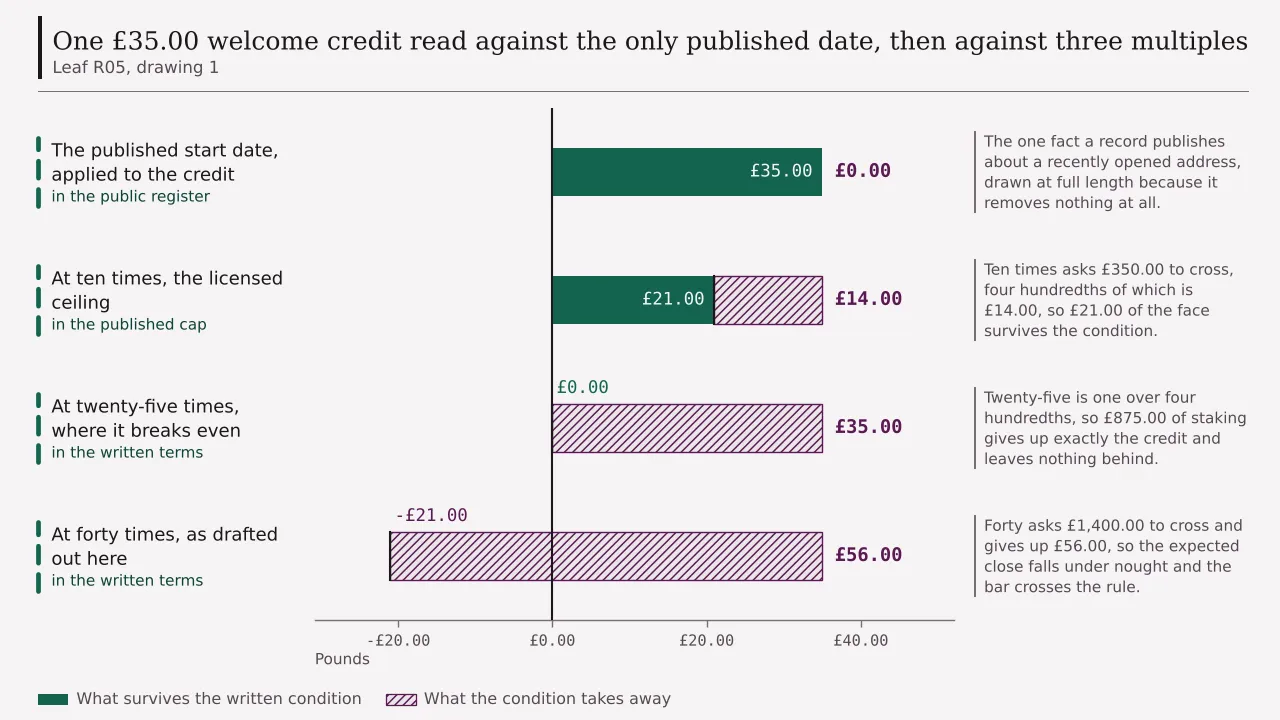
The top row of that drawing is the argument of the whole leaf in one bar. It is drawn at full length because the condition applied to it removes nothing, a start date having no arithmetical effect on a credit. Every bar beneath it is cut, and the cuts come from a document that was drafted at the same time as the address was opened and has nothing to do with when that was.
8
Two readings off one row, one worth £42.00 and one worth nothing
A reader who has opened the record is already there, and two separate things can be read without a second visit. One is the date. The other is whether a permission covering remote casino is held at all, which decides whether the ceiling on a play-through reaches this credit. Those two readings cost the same and are worth wildly different amounts.
That ceiling pins a multiple at ten times the bonus money, binding from 19 January 2026 onwards. Ten applied to £35.00 asks £350.00 across the reels, the margin takes £14.00 of it, and the expected close is £21.00. Outside the ceiling the same credit closes at minus £21.00 on the working in part seven.
So the spread between the two readings is £42.00, on a credit whose face is £35.00. Check it along a second path: the readings differ by thirty multiples, thirty multiples on £35.00 drags a further £1,050.00 over the reels, and four hundredths of that is £42.00. The subtraction and the multiplication arrive together, which is the only verification available on a figure nobody else is computing.
Expected close where the published ceiling reaches it £21.00 Expected close where no ceiling reaches it minus £21.00 Decided by the second reading, taken on the same visit £42.00
Two readings, one record, one visit. The reading everybody takes from a page about recently opened addresses is the date, and it prices at nought in the subtraction. The reading nobody takes is the permission list, and it prices at £42.00 on a £35.00 face. That inversion is the most useful single sentence this leaf has to offer, and it survives whatever the date turns out to be.
Say what the date is good for, so the inversion does not read as dismissal. It bounds evidence, which part five computed at a floor of 56 days. It supplies the field that makes a note checkable later. And it is the one quantity on the whole route that no other place could have supplied, which is why this leaf is the one in its section that owns it. A fact worth nought in a subtraction can still be the only fact of its kind available.
9
The machinery a registration outside the licence never switches on
Addresses advertising a welcome figure of this shape are run by companies holding no Great Britain licence. A leaf about beginnings should name the duties that fire at a beginning, because registration is the one moment a newly opened address has in abundance and the one moment this apparatus is built around. Whatever bites later on in the relationship is real enough and gets its price under a different heading in this section.
Start with the ceiling on money going in, because that is the one a licensed system has to raise before the first pound does. Facilities for fixing a personal cap sit within reach from the moment an account exists, and a prompt to fix one arrives either while the account is being opened or when the first payment is attempted. The figure is typed into an open field rather than picked off a menu, it binds at account level as a floor, and what the customer sets is implemented as soon as it practically can be with the start time told to them.
Three periods are compulsory behind that cap, running one day, seven days and one month, and a cap written over money going in carries the words deposit limit while other shapes of cap may not borrow them. Those three periods are what makes the regulator’s own worked example possible, and the example is where this part turns into arithmetic rather than description.
Take the pairing the regulator itself works through: £10 written over a day and £100 written over a week, with the stricter of the two governing. Seven days at £10 reaches £70, so the weekly figure never bites and £70 in a week is the most the system may let through. Run that out to four weeks, which is this leaf’s own extension of the example, and £280.00 is everything a customer can place through the account over the same 28 days part five was counting. The £1,400.00 of staking a forty times condition asks on a £35.00 credit is five times that whole-month ceiling, and the condition takes no notice of the ceiling at all.
Now price the asymmetry between the two directions, which is the most carefully drafted piece of the arrangement and the piece that converts cleanly into pounds. Moving a cap down takes effect straight away barring a technical failure. Moving it up waits a full day and then wants the customer back again to confirm deliberately. So somebody who doubles a £10 daily cap on the morning of day one still has £10 going through that day and £20 on each of the 27 after it, which is £550.00 across the 28 days against the £560.00 a form with no cooling period would have taken. A tenner, and a tenner bought entirely by making a change of mind wait.
Two further pieces finish it. The cap is the pre-selected answer, so declining one is an act the customer has to perform and the system has to receive that refusal before anything is paid in or played. And reaching the controls is itself regulated: a direct route from the front page, visibility on the payment screens, and the count of taps and pages held down.
Outside all that sits a threshold with two dates on it. Light-touch financial checking begins above a figure for net deposits in a month, and the figure started at £500 from 30 August 2024 before falling to £150 from 28 February 2025. Set it beside the £280.00 a month the worked pairing above permits and the arithmetic is uncomfortable: a customer running at the full pairing is at nearly twice the later threshold, which is to say the threshold is pitched below what a cautious set of caps already allows.
What a registration beyond the British licence therefore fails to switch on is not a single protection but a run of them firing inside the first five minutes: the prompt, the open field, the account-level floor, the three compulsory periods, the instant reduction against the day-long wait on an increase, the pre-selected answer that has to be refused, the route from the front page, and the monthly figure above which checking starts. Strip the run out and those first five minutes consist of a payment form, while the £1,400.00 from part seven stands exactly where it stood, with no cap over the money going in and none over the multiple either.
10
A drill for an address nobody has written a word about
Here is the procedure, assembled so that it can be run against an address with no coverage anywhere, which is the situation this leaf’s subject produces. It takes about as long as reading this paragraph twice and needs no account.
First, read the record for the permission list rather than for the date, because part eight priced that reading at £42.00 against nought. Second, read the date, and write down which field it came from and the day you looked, because part three showed two official pages carrying two dates for one event. Third, open the bonus document and find the multiple, which is the figure that moves £56.00 on a £35.00 credit. Fourth, assume nobody has argued with a word of that document, which part five showed is certain for the first 56 days and probable for a good while after.
Then perform the subtraction, which never varies anywhere on this site. Work out what the claim is worth with nothing else in the frame. Work it out a second time with every condition a reader can actually reach applied to it. Set the two side by side and rule the distance off underneath. On the worked arrangement that gives £35.00, then minus £21.00, then £56.00, and only the middle entry of those three was ever a figure anyone could act on.
Two cautions keep the drill from producing false comfort. An empty record is not a finding, and part four gave the reason: the source carries no freshness statement of its own and its most recent posted entry was dated 7 October 2026 when it was read. And a start date is not an age for the business, the brand, the software or the terms, since those are four separate dates and three of them are published nowhere.
Run across addresses rather than at one, the drill fills the identical column with different entries. A bigger welcome figure scales the staking and leaves the sign of the close untouched. A ceiling reaching the credit lifts it from minus £21.00 to £21.00 without altering the face at all. A longer history alters none of the arithmetic and moves only the third column of the table in part two. The output is always two figures with a measured gap ruled beneath them.
One reader deserves a flat admission that nothing above applies to them. Somebody who has decided to try a recently opened address precisely because it is new, has written the sum off in advance, and means to stop once the credit is spent, leans on not one of the inferences this leaf takes apart. For them the 56 days, the £42.00 and the £56.00 are all beside the point, because none of it engages until a withdrawal is attempted. Every figure above is written for the reader who is quietly expecting the date to mean something.
Questions
- What does a licence start date on a new casino site actually tell me?
- That a permission is recorded as having begun on that day, and nothing else. It is not a statement about the age of the business, the people, the software or the terms, which are four separate dates with three of them published nowhere. Nothing in the field distinguishes a business built from nothing last quarter from a long-running operation that added a permission last quarter. What the date does supply is a ceiling on how much evidence about the address could possibly exist yet, and that ceiling can be computed.
- Why can a date in an official record not be read as the date of the event?
- Because pages print fields rather than events, and there is a published instance that settles it. One penalty of £650,000 appears on the regulator’s enforcement listing against 20 November 2025 and on the licensee’s own regulatory-actions entry against 30 October 2025, both both read on 15 October 2026, and neither of them is wrong. Twenty-one days lie between two correct figures for a single event. The working habit that follows is to record which field a date came from alongside the date itself.
- How long is a new site’s empty complaint record certain to stay empty?
- Fifty-six days at a minimum, and that floor is built from published periods rather than from a guess. Acknowledgement is owed inside three working days, and inside one day where the tables never shut. The internal stage, escalation within the business included, is bounded at eight weeks measured from the day a complaint arrives, and a week of customer silence on a reasonable request lets that count be halted. Eight weeks counts up to 56 days, so a dispute opened on an address’s first day of trading may lawfully remain inside the business as far as day 57 before anything outer has to read it. The adjudicating body’s own working time comes on top, and no published figure for it could be found.
- Does an empty regulatory record mean a new site has done nothing wrong?
- No. It means nothing has been recorded, which is a statement about a document. The record’s own page carries no publication or last-updated stamp, recorded against it on 15 October 2026, and the enforcement page likewise carries no last-updated date, its most recent entry being 7 October 2026 when it was read. So an absence is compatible with nothing having happened and equally compatible with something having happened and not yet appearing. On top of that sits the 56-day floor, which hands a brand-new address a clean sheet by arithmetic.
- Why are a new site’s terms the least tested document on it?
- Because adversarial reading takes time and clocks, and neither has run. No finding bears on them, nobody has argued a clause of them at an adjudication, and nothing in them has been quietly rewritten after an objection. One published outcome exists about a bonus clause of that family: £170,000 was the bill, 3 July 2025 the date, and the trigger a single sentence in the bonus rules one operator had drawn up for promotions aimed at new casino customers, holding back a discretion to shut accounts down or claw winnings away. Fairness and openness names the condition the finding was recorded under, and an audit by an outside party came with it. One operator was bound and no drafting anywhere else was struck down. The honest word for a 28-day-old document is unexamined, which is not the same word as clean.
- What is a thirty-five pound welcome credit worth once the multiple applies?
- An expected minus £21.00, for a difference of £56.00. Forty applied to £35.00 asks £1,400.00 to cross before the balance converts, four hundredths of that total stays with the house at £56.00, and deducting it from the credit leaves minus £21.00. The same answer arrives without the staking total ever being named: the product of multiple and margin is 1.6, so a condition of that size expects to eat more than it was written against by six tenths of one credit, and six tenths of thirty-five pounds comes to £21.00 that has to be found from somewhere else. Ten pence a press, a return of ninety-six in the hundred, a weighting pinned at one and a multiple of forty are house assumptions here rather than figures published about any address.
- Does the start date change any of the money?
- Not by a penny. Whether a permission began last month or a decade ago, the credit is £35.00, the staking asked is £1,400.00, the expected cost is £56.00 and the close is minus £21.00. None of those four figures carries a term for age. Read into the subtraction this site performs on every page, the one published fact about a recently opened address prices at exactly nought, which is why this leaf spends its time on what the date bounds rather than on what it is worth.
- What is worth reading on the same visit, if the date is worth nothing?
- The permission list, which prices at £42.00 on a £35.00 face. Since 19 January 2026 a ceiling has pinned the multiple at ten times whatever the bonus money is, and where that reaches this credit, ten applied to £35.00 asks £350.00 to cross, £14.00 of that is taken and the close comes out at £21.00. Where it does not reach, the close is minus £21.00. Taken the other way, thirty multiples of difference drag £1,050.00 further over the reels and four hundredths of that figure is £42.00. Both paths agree, and the reading nobody takes is worth more than the reading everybody takes.
- What does registering at a new site outside the British licence not switch on?
- A run of things that all fire inside the first five minutes. A personal cap on money going in, reachable from the moment an account exists, prompted either while the account is opened or when the first payment is attempted, implemented as soon as it practically can be and with its start time told to the customer. The figure typed into an open field rather than picked off a menu, binding at account level as a floor, and three compulsory periods of one day, seven days and one month. A reduction taking effect straight away against an increase that waits a full day and then wants deliberate confirmation. The cap pre-selected, so refusing it is an act the system has to receive first. A direct route from the front page with taps and pages held down. And light-touch financial checking once net deposits in a month pass a stated figure, which was £500 from 30 August 2024 and became £150 from 28 February 2025.
- How do those deposit limits compare with what the bonus condition asks?
- Badly, and the comparison is worth making once. The regulator’s own worked example writes £10 over a day and £100 over a week, letting the stricter govern, so seven days at a tenner reaches £70 and the weekly figure never bites. Run out to four weeks, which is this leaf’s own extension of the example, that pairing permits £280.00 through the account. The £1,400.00 of staking a forty times condition asks on a £35.00 credit is five times the whole-month ceiling, and the condition takes no notice of it whatever.
- Is there anybody for whom none of this matters?
- Yes. Somebody who has decided to try a recently opened address precisely because it is new, has written the sum off in advance, and intends to stop when the credit is spent, is relying on no inference this leaf takes apart. The 56 days, the £42.00 and the £56.00 are all beside the point for them, because none of it engages until a withdrawal is attempted. Everything computed above is written for the reader who is quietly expecting the date to mean something.