Terms read 19 October 2026 Leaf T01, revision 1
A welcome package is four documents, and the banner is the shortest of them
A staged offer paying 100 per cent, then 50, then 50 on payments of £10.00 credits £20.00 against £30.00 that came out of a bank account. Forty times on each credit asks for £800.00 to cross the reels and closes at an expected minus £12.00. Not one of those figures is settled where the percentages are printed. This leaf names the document each condition sits in, counts the taps to it, and subtracts.
Stated on the banner £20.00 Three percentages and a £10.00 qualifying payment. The addition is left to whoever reads it. Stated, once you go and look minus £12.00 Forty times, applied to each credit separately, in clause 4 of a second document, which the percentages never name. Not stated before the money goes in 5 unwritten terms A payment floor met at the till, identity paperwork met on the way out, a contribution table nobody links to, the build the credit is spent on, and the length of the hold before a payment leaves.
Welcome packages, with the written terms read
Every destination in this file is bought advertising. The site is paid a fee if a reader goes on to register, and no figure printed below moves because of it.
Bonus Spins UK Slip 01
Betportal
Ceiling as a multiple
The drop
€15.00
€1.00 in the euro
The claim reads €15.00. Once the terms beside it have applied, €0.00 of it can leave. The difference is the drop.
7 of the 15 terms on this slip could not be read before the money went in
Spins priced at this site's own 10p a spin, which the operator does not publish
Stated
€15.00
The claim as it is printed, before a single term has been applied to it.
Headline paid as spins
150 spins at 10c each, which is €15.00 of the figure above.
6 Nowhere
What one spin is worth
No unit is published for a spin, so the count is priced at this site's own 10p a spin. At half that price every figure below halves with it.
Match and other credit not priced
300% of three deposits, to a ceiling of €1,000. A share of a deposit nobody has made yet is not a sum, so no figure stands on this line and none is carried below.
Qualified
-€14.40
Written down somewhere, and taking part of the claim back. Each term carries the place it is written and the sum it takes.
2 Written terms at a distance this record does not establish
Play-through -€14.40
Carrying €14.40 through 35 times stakes €504.00 and costs €20.16 of it at 96 per cent return. That prices above the €14.40 there is to charge it against, so the whole of the credit goes and the line is held at that. The multiple sits on the bonus.
2 Written terms at a distance this record does not establish
Game weighting not priced
Slots only count towards the play-through. No contribution percentage is published, so the line above has been worked at full weight, which is the kindest reading there is.
2 Written terms at a distance this record does not establish
Ceiling on the winnings not priced
5x the bonus.
2 Written terms at a distance this record does not establish
Clock on the credit not priced
14 days.
2 Written terms at a distance this record does not establish
Largest stake while it runs not priced
€5.
3 Public record
Licence, and who holds it not priced
Licensed in Anjouan, Comoros, held by BetPortal Gaming Ltd, with Excite Ultra Media Ltd, reference ALSI-202601040-FI2. A register entry settles who holds a licence and what it permits. It does not settle who is running the site this morning.
4 Cashier
Smallest qualifying deposit your money
€20 a stage. That is €20.00 of your own money, and it is never netted into a drop.
5 On the way out
Checks before a withdrawal not priced
Documents before the first withdrawal.
Unstated
-€0.60
Applying without having been published anywhere, and costing money all the same.
6 Nowhere
What a spin hands back -€0.60
Staking a spin returns 96 per cent of it, so that share of the batch is the house's before a reel turns. This site works at that return and the operator publishes none where the claim is made.
6 Nowhere
Forfeited by rule cost unknown
Nothing is published under this heading, and it applies regardless.
6 Nowhere
Charge on the way out cost unknown
No charge on the way out is published as a figure, so nothing comes off this line. A charge that exists unpublished would come straight off whatever survives.
6 Nowhere
Smallest withdrawal allowed cost unknown
No smallest withdrawal is published as a figure. A floor nobody has published is still a floor, and it decides whether a small balance can move at all.
No Great Britain licence
Terms read 19 October 2026
Bonus Spins UK Slip 02
WinBeast
Ceiling as a sum
The drop
€50.00
€1.00 in the euro
The claim reads €50.00. Once the terms beside it have applied, €0.00 of it can leave. The difference is the drop.
8 of the 15 terms on this slip could not be read before the money went in
Spins priced at this site's own 10p a spin, which the operator does not publish
Stated
€50.00
The claim as it is printed, before a single term has been applied to it.
Headline paid as spins
500 spins at 10c each, which is €50.00 of the figure above.
6 Nowhere
What one spin is worth
No unit is published for a spin, so the count is priced at this site's own 10p a spin. At half that price every figure below halves with it.
Match and other credit not priced
50% to 100% of five deposits, each to a ceiling of €1,000, and a €650 free bet. A share of a deposit nobody has made yet is not a sum, so no figure stands on this line and none is carried below.
Qualified
-€48.00
Written down somewhere, and taking part of the claim back. Each term carries the place it is written and the sum it takes.
2 Written terms at a distance this record does not establish
Play-through -€48.00
Carrying €48.00 through 40 times stakes €1,920.00 and costs €76.80 of it at 96 per cent return. That prices above the €48.00 there is to charge it against, so the whole of the credit goes and the line is held at that. The multiple sits on the bonus and the winnings from the spins.
2 Written terms at a distance this record does not establish
Game weighting not priced
Slots, titles vary by country count towards the play-through. No contribution percentage is published, so the line above has been worked at full weight, which is the kindest reading there is.
2 Written terms at a distance this record does not establish
Ceiling on the winnings not priced
€100 a batch of spins.
2 Written terms at a distance this record does not establish
Clock on the credit not priced
7 days, spins 1 day.
3 Public record
Licence, and who holds it not priced
Licensed in Curaçao, holder not named on the site. A register entry settles who holds a licence and what it permits. It does not settle who is running the site this morning.
4 Cashier
Smallest qualifying deposit your money
€20 a stage. That is €20.00 of your own money, and it is never netted into a drop.
5 On the way out
Checks before a withdrawal not priced
Documents before the first withdrawal.
Unstated
-€2.00
Applying without having been published anywhere, and costing money all the same.
6 Nowhere
What a spin hands back -€2.00
Staking a spin returns 96 per cent of it, so that share of the batch is the house's before a reel turns. This site works at that return and the operator publishes none where the claim is made.
6 Nowhere
Largest stake while it runs cost unknown
Nothing is published under this heading, and it applies regardless.
6 Nowhere
Forfeited by rule cost unknown
Nothing is published under this heading, and it applies regardless.
6 Nowhere
Charge on the way out cost unknown
No charge on the way out is published as a figure, so nothing comes off this line. A charge that exists unpublished would come straight off whatever survives.
6 Nowhere
Smallest withdrawal allowed cost unknown
No smallest withdrawal is published as a figure. A floor nobody has published is still a floor, and it decides whether a small balance can move at all.
No Great Britain licence
Terms read 19 October 2026
Bonus Spins UK Slip 03
EliteSpin
Longest spin window
The drop
£50.00
£1.00 in the pound
The claim reads £50.00. Once the terms beside it have applied, £0.00 of it can leave. The difference is the drop.
8 of the 15 terms on this slip could not be read before the money went in
Spins priced at this site's own 10p a spin, which the operator does not publish
Stated
£50.00
The claim as it is printed, before a single term has been applied to it.
Headline paid as spins
500 spins at 10p each, which is £50.00 of the figure above.
6 Nowhere
What one spin is worth
No unit is published for a spin, so the count is priced at this site's own 10p a spin. At half that price every figure below halves with it.
Match and other credit not priced
50% to 100% of five deposits, each to a ceiling of £1,000. A share of a deposit nobody has made yet is not a sum, so no figure stands on this line and none is carried below.
Qualified
-£48.00
Written down somewhere, and taking part of the claim back. Each term carries the place it is written and the sum it takes.
2 Written terms at a distance this record does not establish
Play-through -£48.00
Carrying £48.00 through 40 times stakes £1,920.00 and costs £76.80 of it at 96 per cent return. That prices above the £48.00 there is to charge it against, so the whole of the credit goes and the line is held at that. The multiple sits on the bonus and the winnings from the spins.
2 Written terms at a distance this record does not establish
Game weighting not priced
Slots count towards the play-through. No contribution percentage is published, so the line above has been worked at full weight, which is the kindest reading there is.
2 Written terms at a distance this record does not establish
Ceiling on the winnings not priced
5x the bonus.
2 Written terms at a distance this record does not establish
Clock on the credit not priced
7 days, spins 3 days.
3 Public record
Licence, and who holds it not priced
Licensed in Costa Rica, held by PrimeTier Limited. A register entry settles who holds a licence and what it permits. It does not settle who is running the site this morning.
4 Cashier
Smallest qualifying deposit your money
£20 a stage. That is £20.00 of your own money, and it is never netted into a drop.
5 On the way out
Checks before a withdrawal not priced
Documents before the first withdrawal.
Unstated
-£2.00
Applying without having been published anywhere, and costing money all the same.
6 Nowhere
What a spin hands back -£2.00
Staking a spin returns 96 per cent of it, so that share of the batch is the house's before a reel turns. This site works at that return and the operator publishes none where the claim is made.
6 Nowhere
Largest stake while it runs cost unknown
Nothing is published under this heading, and it applies regardless.
6 Nowhere
Forfeited by rule cost unknown
Nothing is published under this heading, and it applies regardless.
6 Nowhere
Charge on the way out cost unknown
No charge on the way out is published as a figure, so nothing comes off this line. A charge that exists unpublished would come straight off whatever survives.
6 Nowhere
Smallest withdrawal allowed cost unknown
No smallest withdrawal is published as a figure. A floor nobody has published is still a floor, and it decides whether a small balance can move at all.
No Great Britain licence
Terms read 19 October 2026
Bonus Spins UK Slip 04
Crown Jewelz
Multiple unpublished
The drop
NOT WORKED
The multiple is not published in the operator's own terms. Since the sum cannot be worked around it, none is worked.
9 of the 14 terms on this slip could not be read before the money went in
No drop worked
Stated
£15.00
The claim as it is printed, before a single term has been applied to it.
Headline paid as spins
150 spins at 10p each, which is £15.00 of the figure above.
6 Nowhere
What one spin is worth
No unit is published for a spin, so the count is priced at this site's own 10p a spin. At half that price every figure below halves with it.
Match and other credit not priced
200% of the first deposit, then 150% twice, each to a ceiling of £1,000. A share of a deposit nobody has made yet is not a sum, so no figure stands on this line and none is carried below.
Qualified
NOT WORKED
Written down somewhere, and taking part of the claim back. Each term carries the place it is written and the sum it takes.
2 Written terms at a distance this record does not establish
Play-through not priced
40x the bonus, reported rather than published by the operator.
2 Written terms at a distance this record does not establish
Game weighting not priced
Slots count towards the play-through. No contribution percentage is published, so the line above has been worked at full weight, which is the kindest reading there is.
3 Public record
Licence, and who holds it not priced
Licensed in Curaçao, number not verified, holder not named on the site. A register entry settles who holds a licence and what it permits. It does not settle who is running the site this morning.
4 Cashier
Smallest qualifying deposit your money
£20. That is £20.00 of your own money, and it is never netted into a drop.
5 On the way out
Checks before a withdrawal not priced
Documents before the first withdrawal.
Unstated
NOT WORKED
Applying without having been published anywhere, and costing money all the same.
6 Nowhere
Ceiling on the winnings cost unknown
No ceiling is published. Nothing is assumed in its place.
6 Nowhere
Clock on the credit cost unknown
Nothing is published under this heading, and it applies regardless.
6 Nowhere
Largest stake while it runs cost unknown
Nothing is published under this heading, and it applies regardless.
6 Nowhere
Forfeited by rule cost unknown
Nothing is published under this heading, and it applies regardless.
6 Nowhere
Charge on the way out cost unknown
No charge on the way out is published as a figure, so nothing comes off this line. A charge that exists unpublished would come straight off whatever survives.
6 Nowhere
Smallest withdrawal allowed cost unknown
No smallest withdrawal is published as a figure. A floor nobody has published is still a floor, and it decides whether a small balance can move at all.
No Great Britain licence
Terms read 19 October 2026
Every figure in the second and third columns is this site's own working and nothing an operator has published. A claim is priced as printed, then the share a spin hands back at 96 per cent return comes off it, then what playing the multiple through costs at the same return, and then whatever a published ceiling, a charge on the way out or a floor on the smallest withdrawal takes from what has survived. The drop is the difference between the first figure and the last. The two columns add back up to it exactly, so no money leaves a slip without a term and a place beside it.
Which column a term falls in is settled by one question: has anybody written it down. A charge a reader meets at the payment screen is written down, and it stands in the second column with the cashier against it. A condition that binds without ever having been set down stands in the third, whatever it costs. Inside each column the terms run outwards from the banner, so the order itself says how far a reader would have had to go.
A count of spins has no unit until one is supplied. Where an operator publishes what one of its own spins is worth, that figure is used and the first column says it is theirs. Where none is published, this site's own 10p a spin stands in its place and every figure below moves in proportion with it. Where the multiple itself is unpublished, no drop is worked at all, because that is the one figure the sum cannot be done without.
Three words stand where a figure cannot. Not priced is a term that is written down and carries no number the arithmetic can take. Cost unknown is a term nobody has written down, costing something nobody has put a number on. Your money is money of the reader's own, which is never netted into a drop.
None of the operators in this file holds a Great Britain licence, so none of the duties that licence carries reaches them. Each of those duties is published in its own right, which is what makes its absence here something a reader can check rather than take on trust. Every gambling company licensed in Great Britain belongs to Gamstop Online, so a reader who has shut themselves out through the scheme is not shut out here. Social Responsibility Code 5.1.1 has held a play-through to a maximum of ten times the bonus funds since 19 January 2026, and it binds a licence holder and nobody else. Asked in a post of 21 October 2025 what is lost along with the licence, the Gambling Commission's Director of Enforcement and Intelligence answered: "unfair gaming practices, financial loss, and a lack of recourse if things go wrong". The same post puts blocked payouts, and withdrawal limits pitched high enough to be unreachable, among the behaviour the Commission has recorded. Nobody under 18 may hold an account at any of them.
Terms are reproduced in the wording their operator published, and each slip is dated with the day somebody sat down and read them. 19 October 2026 is the oldest of those dates. Anybody claiming an offer is bound by that operator's full terms, which are elsewhere, and never by a line standing here.
1
Where the conditions on a welcome offer are actually written
Nothing about a staged sign-up offer is hidden. Every condition on it is written down somewhere, in sentences a reader could in principle find, and that is the whole of the problem. Writing a condition down and putting it where the claim is made are separate acts, and only the first one is required of anybody.
Pull a package apart and it resolves into four pieces of writing rather than one. The percentages sit on the first. A multiple, an expiry and a per-part rule sit on the second. A forfeiture power, a stake ceiling while credit is live and a currency rule sit on the third. A contribution table and the tier ladder behind the phrase beginning up to sit on the fourth. Four writings, one offer, and a reader who stops at the first has read roughly thirty words of several thousand.
Call them in order. Document one is the advertisement itself, whether that is a banner, an email or the strip across the top of a lobby. Document two is the promotional terms, which exist precisely because document one has no room for them. Document three is the account agreement, which was written for every customer rather than for this offer, and which therefore carries the clauses that bite hardest. Document four is whatever schedule, table or help article the other three defer to, and it is the one with no obvious name, no obvious address and frequently no link pointing at it.
The £10.00 qualifying payment is settled , because a figure that small is an inducement rather than a condition and gets printed. The multiple is settled in clause 4 of the promotional terms. Whether the operator may take the balance back at its discretion is settled in the account agreement, two documents further along. Who holds the licence is settled in the public register or not at all. The smallest sum the till will accept by a given method is settled at the cashier. What identity paperwork is wanted, and when, is settled on the way out. The weighting applied to whatever the credit is spent on is often nowhere in writing.
Those seven labels are the instrument this whole site uses, and this leaf is where they get attached to one offer in a single pass. Later pages in this part of the site take one term apiece and work it to the floor. The job here is coarser and comes first: establish which writing holds which condition, count how far that writing is from the claim, and attach a figure in pounds to the gap.
One sentence is worth stating before any arithmetic starts, because it governs everything after it. A condition a reader has not found still applies. Distance does not weaken a clause. It only changes the odds that the clause is read, and the money moves in the direction of whoever drafted the layout.
2
Measuring the distance between a claim and its condition
Distance needs a unit before it can be priced, and the unit used throughout this leaf is the tap: one deliberate movement a reader makes away from the thing they were looking at. Scrolling is not a tap. Opening a document is. Opening a second document that the first one names is another. The count is the site’s own measure rather than anything a regulator defines, and it is declared here once so that every figure below can lean on it without re-explaining itself.
At zero taps sits the advertisement. At one tap sits the promotional terms, reached through the line of small type under the percentages. At two taps sits the account agreement, usually reached from a footer rather than from the offer at all, so the reader has to leave the promotion to find the clauses that can void it. At three taps sits the schedule the other documents defer to, and three is where the count usually stops being honest, because a reader who has gone that far has normally stopped reading.
The useful property of counting taps is that it ranks conditions by how likely they are to be read rather than by how important the drafter thought they were. Those two orders are close to opposite. The multiple, which decides whether the credit has any value at all, is one tap away. The qualifying payment, which decides almost nothing, is at zero taps and in bold. The forfeiture power, which can remove the entire balance, is two taps away inside a document written before this offer existed.
A worked instance makes the ordering concrete. Take the staged arrangement this leaf returns to throughout: 100 per cent on a first payment, 50 on a second, 50 on a third, with £10.00 the smallest payment each part accepts. Everything in that sentence is at zero taps. Everything that decides what it is worth is at one tap or further.
| Condition | Taps from the claim | What it moves |
|---|---|---|
| Smallest qualifying payment | 0 | £10.00 |
| Percentage on each of the three parts | 0 | £20.00 |
| Forty times, applied part by part | 1 | £32.00 |
| Discretionary forfeiture power | 2 | £20.00 and the winnings |
| Contribution rate on the games played | 3 | Multiplies £800.00 |
Read the middle column downwards and the shape of the offer is visible without a word of prose. The money is at the bottom and the reading is at the top. A reader who spends thirty seconds on the arrangement has absorbed the two rows that move £10.00 and £20.00, and none of the three rows that move everything else.
3
Three payments, three credits, and the addition nobody performs
Start with what document one actually commits anybody to. A first payment of £10.00 is matched in full, so £10.00 of credit arrives. A second payment of £10.00 draws 50 per cent, which is £5.00. A third does the same. Total credit £20.00. Total paid in from a bank account £30.00.
That ratio deserves a moment, because it runs opposite to the impression the first percentage leaves. The largest number on the advertisement is 100, and a reader seeing it expects the account to be doubled. Across the whole arrangement the account is multiplied by 1.667, not by 2, and the two smaller parts are what drag it down. The arithmetic is £50.00 of balance against £30.00 paid, so two thirds of what ends up on screen is the reader’s own money.
Nothing so far has needed a condition. The three percentages and the £10.00 floor are all at zero taps , and the only work done has been addition. Addition is also the operation an advertisement never prints, because three separate inducements read better than one modest total. Ten, five and five are three pieces of good news. Twenty against thirty is one piece of arithmetic.
Now go one tap further. The promotional terms attach the multiple to each credit on its own footing rather than to the pooled balance, which is the drafting that recurs out here and is the single most consequential sentence in document two. The £10.00 credit carries £400.00 of staking. Each £5.00 credit carries £200.00. Added, the three obligations come to £800.00, and they do not run together: the second cannot begin counting while the first is still live, because the two pots are tracked separately.
At 10p a press that is 8,000 individual presses. The slots pace floor means a single press cannot be repeated faster than every two and a half seconds, so clearing £800.00 of staking inside one calendar day would need 2.25 seconds a press, which is under the floor and therefore not available on a licensed build. The figure matters here only because document two usually carries an expiry alongside the multiple, and the two clauses have to be read against each other rather than one at a time.
| Which part | Percentage | Paid in | Credited | Staking asked | Expected close on the credit |
|---|---|---|---|---|---|
| First | 100 per cent | £10.00 | £10.00 | £400.00 | minus £6.00 |
| Second | 50 per cent | £10.00 | £5.00 | £200.00 | minus £3.00 |
| Third | 50 per cent | £10.00 | £5.00 | £200.00 | minus £3.00 |
| Added together | Not printed anywhere | £30.00 | £20.00 | £800.00 | minus £12.00 |
The bottom row is the one with no home. Each of the first three rows can be sourced to a sentence somewhere in documents one and two. The totals are settled nowhere in writing, not because anybody suppressed them but because no clause has any reason to perform an addition across three arrangements that were drafted as three arrangements.
4
What forty times does to twenty pounds of credit
The house arithmetic used across this site takes 10p a press, 96 pence back on each pound staked, a multiple of forty and a weighting of one, and the expected close on a credit follows from the four assumptions alone. Each pound staked leaves four pence behind. Forty applications of that leakage come to 1.6 of the credit, so a credit of B closes at B multiplied by one less 1.6, which is minus 0.6 of B.
On £20.00 that is minus £12.00. Twenty-five is where a credit stops being worth anything at this return, 25 being one divided by four per cent, so forty sits sixty per cent beyond the point of no value. Past 25 a multiple does more than shrink a credit. It turns the credit into a standing reason to keep pressing after the expected balance has already gone.
Credit read off the percentages £20.00 Expected close once clause 4 applies minus £12.00 The price of one tap not taken £32.00
Thirty-two pounds is the number this leaf exists to print. It is not a loss anybody is billed for and it will not appear on a statement. It is the gap between what a reader would act on from document one and what document two makes the same credit worth, and the entire gap is created by the distance between the two writings rather than by anything either of them says on its own.
Split the thirty-two and it sorts cleanly. Twenty pounds of it is the credit itself evaporating, which is what a multiple past the point of no value does by construction. The other twelve is the further expected cost of carrying £800.00 across the reels, paid out of money that was never part of the credit. Reading £20.00 as spending power when it is £800.00 of obligation gets the sign of the arrangement wrong, not merely its size.
£800.00 of staking asked against £20.00 of credit, from a clause one tap away
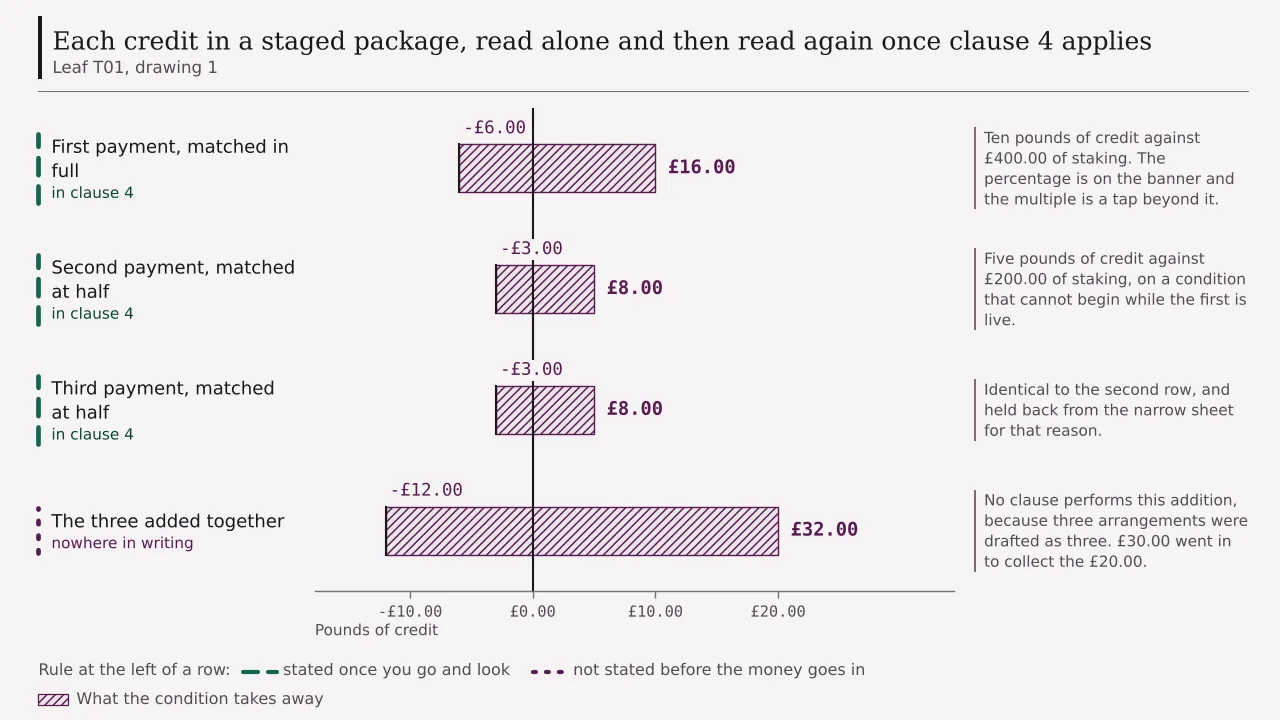
The bottom row of that drawing is the part document one cannot show, because document one describes three separate invitations and the total only exists once somebody adds them. Each of the upper rows is a payment accepted and a condition begun. The lowest is the arrangement as a whole, and it is the only row with a figure a reader would recognise as the answer to what the offer costs.
5
The whole map, term by term, document by document
Here is the map itself, which is this leaf’s reason for existing. Every term a staged offer of this shape carries, the writing that holds it, the number of taps between the claim and that writing, and what the term is worth in pounds on the worked package. Where a figure is the site’s own assumption rather than something any source publishes, the row says so in terms.
| Term | Which writing holds it | Taps | Settled by | Worth on this package |
|---|---|---|---|---|
| Three percentages, 100 then 50 then 50 | The advertisement | 0 | £20.00 of credit | |
| Smallest payment that qualifies | The advertisement | 0 | £10.00 a part | |
| Forty times, per credit rather than pooled | Promotional terms, clause 4 | 1 | in clause 4 | £800.00 of staking |
| Expiry of 30 days on each part, assumed here | Promotional terms, clause 9 | 1 | in clause 9 | Caps the time, not the sum |
| Stake ceiling while credit is live, assumed at £5.00 | Account agreement | 2 | in the account agreement | Breach forfeits £20.00 |
| Discretionary power to close or forfeit | Account agreement | 2 | in the account agreement | The balance, in full |
| Ceiling behind the words up to £100 | Tier schedule | 3 | in the tier schedule | £150.00 paid in, or £500.00 |
| Contribution rate by game type | Separate table, where one exists | 3 | nowhere in writing | Multiplies £800.00 |
| Who holds the licence behind the address | A public licence record | Off the site entirely | in the public register | Not settled by the offer |
| Smallest payment a given method accepts | The payment screen | After registration | at the cashier | Unknown until then |
| Identity paperwork, and when it is demanded | Raised at the withdrawal screen | After the money is in | on the way out | Delays the exit, not the entry |
Eleven rows, four writings, three places that are not writings at all. Count the rows that can be settled without leaving the advertisement and the answer is two, and between them they decide £10.00 and the arithmetic of £20.00. Count the rows capable of removing the entire balance and the answer is two again, both of them two taps away in a document the promotion never mentions.
The expiry and the stake ceiling in that table are this leaf’s own illustrative figures, chosen because they are the shapes that recur, and no source consulted for this site publishes a standard period or a standard ceiling. They are marked as assumptions in the rows that carry them and they are not used in any subtraction below.
One row repays a second look. The contribution rate is given as three taps and also as settled nowhere, which looks like a contradiction and is not. Where a table of rates exists it sits three taps out. Where it does not, the rate still applies, because the system applies it whether or not anyone published it, and a reader doing arithmetic has no option but to assume full contribution, which is the most generous reading available and the only one the house is never obliged to correct.
6
Up to a hundred pounds, and the schedule that defines it
The two words doing most of the work on an advertisement of this kind are up to, and they are the furthest travelled of all. A phrase reading up to £100.00 states a ceiling without stating which thing the ceiling is on, and the difference between the two available readings is £350.00 of a reader’s own money.
Under the first reading the ceiling belongs to the package. A hundred pounds is the most the three parts can credit between them, so under the 100, 50 and 50 shape it takes £50.00, £50.00 and £50.00 to reach, which is £150.00 paid in for £100.00 of credit. Forty times £100.00 is £4,000.00 of staking, and the expected close is 100 multiplied by minus 0.6, which is minus £60.00.
Under the second reading the ceiling belongs to each part separately. The first part then credits £100.00 on a £100.00 payment, the second credits £100.00 on £200.00, the third does the same, and the package tops out at £300.00 of credit for £500.00 paid in. Forty times £300.00 is £12,000.00 of staking, closing at an expected minus £180.00.
Both readings are consistent with the identical five characters on the advertisement. The sentence that chooses between them is in the tier schedule, three taps out, and it is ordinarily one line in a table with no prose around it. A reader who has not opened that table cannot say within a factor of three what the largest version of the offer is, and cannot say within £350.00 what reaching it would cost.
Ceiling read off the advertisement £100.00 Expected close once forty times is applied to it minus £60.00 The price of the phrase beginning up to £160.00
Set that beside the £32.00 from part four and the structure of the whole offer appears. The headline figure is five times the credit anybody actually collects on three payments of £10.00, and it carries five times the difference. Scaling up the advertisement scales up the gap in exact proportion, because the gap is a fixed fraction of the credit at a fixed multiple. The advertisement grows. The arithmetic underneath it does not improve at any point.
A second property of the ceiling is worth stating, because it works against the reading most people bring to it. A ceiling is a promise about the largest possible version of the offer, and the largest version is the worst one on these numbers: £150.00 paid in against an expected close of minus £60.00 is a wider gap than £30.00 paid in against minus £12.00. The phrase beginning up to advertises the end of the range where the subtraction is harshest.
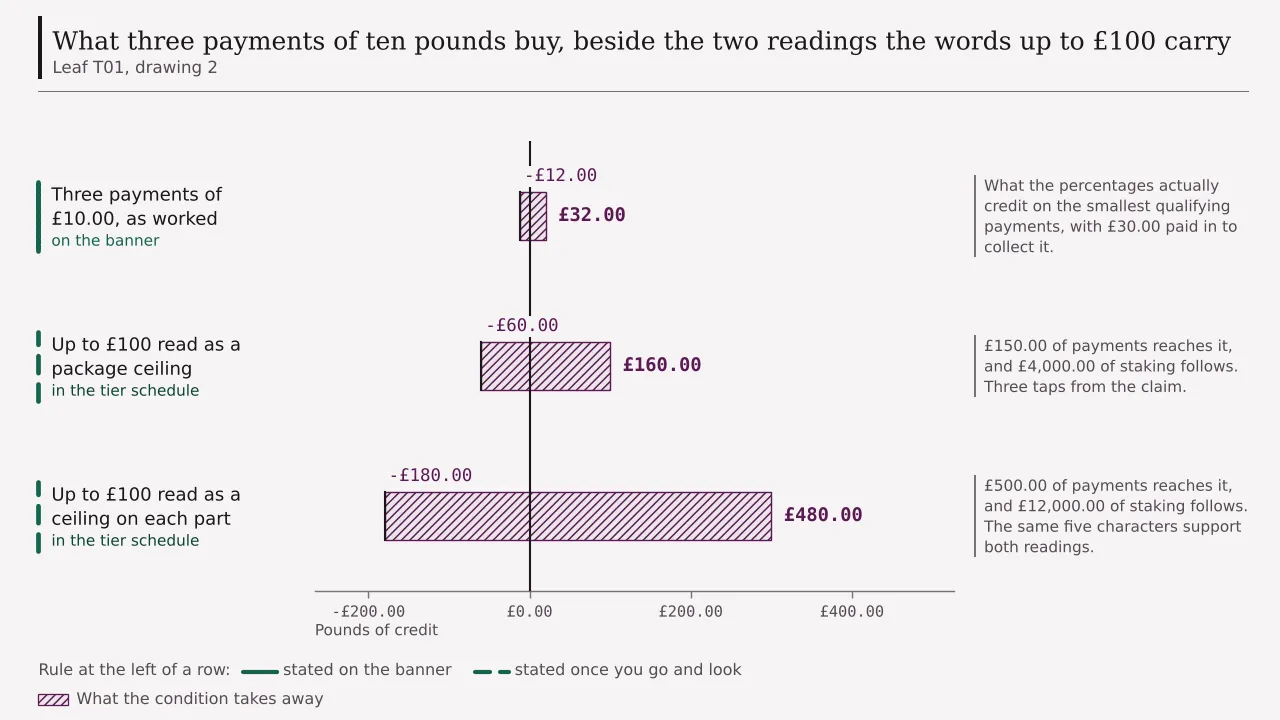
7
Pricing the distance itself, in pounds a tap
Everything so far has priced conditions. This part prices the layout, which is a different quantity and the one this part of the site was built to measure. Take the £32.00 difference on the worked package and ask where each pound of it is settled.
None of it is settled at zero taps. The advertisement contains no sentence capable of reducing £20.00 of credit by a penny. All £32.00 is settled at one tap, in a single clause giving a single multiple. Divide the difference by the distance and the arrangement costs £32.00 a tap, which is a strange-looking figure until it is compared with the other direction: the reader gains £10.00 of information at zero taps and loses £32.00 of value at one.
On the ceiling reading the same sum gives £160.00 settled across three taps, or £53.33 a tap, and the rate rises with the distance rather than falling. That is the finding this leaf hands to the eleven leaves leaning on it. The further a condition sits from the claim it qualifies, the more money it tends to move, and the relationship is not an accident of drafting. A condition worth little can be printed beside the claim without harming the claim. A condition that reverses the claim cannot.
| Distance from the claim | What is settled there | Pounds moved | Share of the difference |
|---|---|---|---|
| Zero taps | Percentages and the qualifying payment | £0.00 reduced | None of it |
| One tap | The multiple, and how it attaches | £32.00 | All of it, on the worked package |
| Two taps | Forfeiture power and the stake ceiling | £50.00 of balance at risk | Conditional, not expected |
| Three taps | Which ceiling the words up to attach to | £350.00 of payments | Decides the size of everything |
The two-tap row carries £50.00 because that is the whole balance on the worked package, £30.00 of it a reader’s own money and £20.00 of it credit. A forfeiture clause does not reduce an expected close. It removes the account. That is why it belongs in a column headed conditional rather than in the subtraction, and why a leaf that folded it into the expected close would be overstating a figure it cannot source.
Money has been put on a clause of that shape exactly once, which is unusual on a subject where most of the evidence is missing. Bonus rules covering new casino promotions, at one operator, held a sentence keeping back the power to shut an account down or to claw winnings away. The bill came to £170,000 and carries the date 3 July 2025. The breach recorded ran against the condition on fairness and openness. What drew the objection was the opacity of a discretion drafted in those terms and the unfair landings it permits, and an audit by an outside party formed part of what followed. One operator, one sum, one condition, and the sharpest published fact anywhere about what sits two taps from a welcome claim.
8
What the rulebooks say about where a condition may sit
A reader might reasonably expect a rule requiring the conditions to stand beside the claim. One exists, and it is weaker than the expectation. Guidance for advertisers online puts the full conditions ordinarily a single click away, and bars the link to them from hiding in a footer or in small type. That is a rule about one tap and not about zero, and it therefore licenses the precise arrangement that parts three to seven have been pricing.
Prominence carries the other half of the duty. A condition dropped from an advertisement, where dropping it misleads, has to stand in that advertisement, clearly and prominently. Four kinds of condition are named in the worked list: eligibility, the payment demanded, the wagering demanded, and any deadline on claiming or spending what is offered. Forty times is a wagering demand, so the list reaches it. Conspicuousness is what the rule governs, and position is not.
Two licensing duties stand behind the advertising ones. One of them, the condition covering fair and transparent terms and practices, wants a licensee’s contract terms transparent in the consumer-law sense and sited where a customer can get at them without a struggle. The other lives in the code provision on incentives: it wants the conditions attached to an inducement clear, transparent, fair, and reachable by the person being offered it. Reach is what both are about. Neither names a maximum distance, and neither counts in taps.
Five figures describe the machinery standing behind those duties, and figures are the right way to put it, because length is what matters to whoever meets a clause only once it has landed on them. 24 hours is the acknowledgement at a round-the-clock operation, 3 working days elsewhere. The complaint itself, internal escalations included, may occupy eight weeks from the day it arrives and no longer. A customer keeps six months from the incident, within which one may still be opened. Where that customer goes quiet for a week on a reasonable request, those eight weeks may be halted where they stand. The closing letter has to name an adjudicator the regulator approves of.
Packages assembled from documents in this fashion hold no Great Britain licence. What falls away with it is a set of duties about writing, none of them a promise about how anything turns out, and each of them priced somewhere on this leaf. Conditions on an inducement, clear and transparent and fair and reachable by the person it is offered to. Contract terms, transparent and sited where a customer can get at them. Eight weeks as the outer limit on an argument about which document said what. An approved adjudicator behind the answer to it. Strip that set out and part five’s map goes on describing the offer correctly: it merely stops being a map anybody can be compelled to keep honest, and the £32.00 that the distance costs turns into a figure with nowhere to be raised.
9
The terms that no document holds at all
Three conditions on the worked package belong to no writing a reader can open before committing, and they are not the same kind of absence as each other. Separating them is most of the honesty on this subject.
The first is deferred rather than missing. The smallest payment a particular method accepts appears at the cashier, which is after registration and therefore after the identity work has begun. If that floor sits above £10.00 for the method a reader intends to use, the qualifying payment on the advertisement is unreachable by that route, and the offer quietly becomes a different offer. The figure exists. It is simply not published at a point where it could change a decision.
The second is deferred to the exit. What identity documents are wanted, and when, is settled on the way out. A British licence turns that order around. Three items get checked off before anything is played: a name, somewhere to post a letter, and a birth date. Credit and free-to-play lobbies fall under the same rule. The exit may not be made the trigger either, since paperwork that could sensibly have been sought at the start makes the way out the wrong moment to start seeking it. The point of the constraint is to keep the demand away from the instant money is trying to leave.
The third is genuinely absent. The rate at which a given build contributes towards the £800.00 is nowhere in writing on a great many offers, and no source consulted for this site publishes a standard table or any rule compelling one. An arithmetic that cannot see the rate has to assume full contribution, and a reader assuming full contribution is making the offer look as good as it can possibly look. That is the direction every unstated term runs in, which is a pattern rather than a coincidence.
What follows for the subtraction is a caution rather than a figure. The minus £12.00 in part four is the kindest expected close available on this package. Every unstated term above can only push it further down, and none of them can lift it. A leaf that printed minus £12.00 without that sentence would be printing a ceiling and calling it an estimate.
10
Running the same method over any staged offer
The method below is the reusable part, and it is set out in order so that the eleven leaves grouped beside this one can lean on it rather than restate it. Five steps, each producing something written down.
Step one, copy out the claim exactly as it stands, including the words beginning up to and every percentage. Step two, find the document that holds the multiple and record how many taps it took, because that count is the measurement. Step three, apply the multiple to each credit separately until the terms say otherwise, since separate application is the drafting that recurs. Step four, work the expected close with the house arithmetic: four pence in the pound, multiplied by the multiple, subtracted from one, applied to the credit. Step five, print the claim’s figure, print the figure after the condition, and rule off the difference.
Two cautions belong with the method. The first is that the addition across parts must be done before the multiple is applied to anything, because an advertisement describing three arrangements invites a reader to evaluate three small propositions rather than one medium one. The second is that any term found with no document behind it gets assumed at its most generous setting and flagged, never guessed at a plausible-looking number, because a plausible-looking number is indistinguishable on the page from a sourced one.
Applied to the worked package the method produces four figures and nothing else: £30.00 paid in, £20.00 credited, £800.00 of staking asked, and an expected close of minus £12.00 against a £20.00 claim, for a difference of £32.00. Applied to the advertised ceiling it produces £150.00 paid in, £100.00 credited, £4,000.00 of staking and minus £60.00, for a difference of £160.00. Those six figures are the whole of what this offer is, and five of the six are at least one tap from where it is advertised.
The honest summary is narrow. A staged welcome arrangement is not a trick and it is not hidden. It is an offer whose good news is printed at zero taps and whose arithmetic is printed at one, two and three, and the interval between those positions is worth £32.00 on £30.00 of payments. Anybody who reads document two before paying anything in has recovered the entire difference, which is the only sentence on this leaf that points anywhere useful.
Questions
- How much does a 100, 50 and 50 package actually credit on three payments of ten pounds?
- Twenty pounds. The first payment of £10.00 draws a full match of £10.00, and the second and third draw £5.00 apiece, so £30.00 leaves a bank account and £20.00 of credit arrives. The account then shows £50.00, two thirds of which is the reader’s own money. All three percentages and the £10.00 floor are settled on the banner at zero taps, and the addition that turns them into £20.00 against £30.00 is settled nowhere, because no clause has a reason to perform it.
- Where is the wagering multiple written down on an offer like this?
- In the promotional terms, ordinarily at clause 4, which is one tap from the advertisement through the line of small type beneath the percentages. That one clause decides the entire value of the credit: at forty times it asks for £800.00 to cross the reels on a £20.00 credit and takes the expected close to minus £12.00. The measurement worth recording is the distance, since the clause is as binding at one tap as it would be at zero and merely less likely to be read.
- Why is forty times worse than it sounds at a 96 per cent return?
- Because 25 is the multiple at which a credit stops being worth anything on a 96 per cent return, 25 being one divided by four per cent. Every pound staked leaves four pence behind, forty applications of that leakage reach 1.6 of the credit, and £20.00 therefore closes at £20.00 multiplied by minus 0.6, or minus £12.00. Past 25 a multiple does more than shrink a credit: it turns the credit into a standing reason to keep pressing once the expected balance has gone.
- What does the phrase beginning up to a hundred pounds commit anybody to?
- Nothing, until a schedule three taps away says whether the ceiling belongs to the package or to each part. If it is a package ceiling, £150.00 of payments buys £100.00 of credit, £4,000.00 of staking and an expected close of minus £60.00. If it belongs to each part separately, £500.00 of payments buys £300.00 of credit, £12,000.00 of staking and minus £180.00. The same five characters support both readings, and £350.00 of a reader’s own money sits between them.
- Which document carries the clause that can remove the whole balance?
- The account agreement, two taps out, which was drafted for every customer rather than for this offer and is usually reached from a footer rather than from the promotion. A discretionary power to close an account or forfeit winnings sits there, and so does any ceiling on the stake permitted while credit is live. On the worked package that is £50.00 at risk, £30.00 of it paid in and £20.00 of it credit, which is why it is recorded as conditional rather than folded into the expected close.
- Has a regulator ever acted over a clause of that shape?
- Once, and the figures are worth carrying. At one operator, the rules written over its new casino promotions held a sentence keeping back the power to shut an account down or to claw winnings away; the bill came to £170,000 and carries the date 3 July 2025; the breach recorded ran against the condition on fairness and openness; what drew the objection was the opacity of a discretion drafted in those terms and the unfair landings it permits; and an audit by an outside party formed part of what followed. That is an enforcement outcome against one operator, not a ruling striking the drafting down everywhere.
- How far from the advertisement are full terms allowed to sit?
- Ordinarily a single click, under guidance written for advertisers online, which also bars the link to them from hiding in a footer or in small type. The layout this leaf prices is therefore the layout the rule contemplates. Separately, a condition dropped from an advertisement, where dropping it misleads, has to stand in that advertisement, clearly and prominently, and the worked list of such conditions covers eligibility, the payment demanded, the wagering demanded, and deadlines on claiming or spending what is offered. Conspicuousness is what the rule governs, and distance is not.
- What is the eight-week figure that keeps coming up in complaints?
- It is the outer limit on the whole process, counted from the day a complaint arrives and taking in any escalation inside the business. Four other figures travel with it: 24 hours to acknowledge where the doors never shut and 3 working days elsewhere, 6 months from the incident within which a complaint may still be opened, and a week of quiet from that customer on a reasonable request, after which the eight weeks may be halted where they stand. The closing letter has to name an adjudicator the regulator approves of.
- What is lost by taking a package of this shape from outside Great Britain?
- A set of duties about writing, none of them a promise about how anything turns out. Conditions on an inducement, clear and transparent and fair and reachable by the person it is offered to. Contract terms, transparent and sited where a customer can get at them. Eight weeks as the outer limit on an argument about which document said what. An approved adjudicator behind the answer to it. Packages assembled from documents in this fashion hold no Great Britain licence, so the set does not bind anybody, and part five’s map goes on describing the offer while nobody can be compelled to keep it honest.
- Is the contribution rate on the games a published figure?
- Usually not, and no source consulted for this site publishes a standard table or any rule compelling one. Where a table exists it sits about three taps out, in a document the promotional terms defer to. Where it does not, the rate applies anyway, because the system applies it whether or not it was written down. Arithmetic that cannot see the rate has to assume full contribution, which is the most generous setting available and the one nobody is ever obliged to correct.
- Why count taps rather than just listing the conditions?
- Because listing conditions produces a page any site could write, while counting the distance to each one produces an ordering. On this package the ordering runs opposite to importance: £10.00 of qualifying payment is in bold at zero taps, £32.00 of difference is at one, £50.00 of balance at risk is at two, and the question of whether the offer is worth £100.00 or £300.00 is at three. The tap is this site’s own measure and no regulator defines it.
- What is the shortest honest summary of the worked package?
- Six figures. £30.00 paid in, £20.00 credited, £800.00 of staking asked, an expected close of minus £12.00, a £20.00 claim, and £32.00 of difference between the last two. Five of those six are settled at least one tap from the place the offer is advertised. A reader who opens the promotional terms before paying anything in recovers the whole £32.00, which is the only action this leaf recommends.