Terms read 19 October 2026 Leaf N02, revision 1
One pound a day for thirty days, and the word that settles none of it
Ten turns a day at the 10p this site holds fixed is £1.00 of staking each day, £30.00 across a thirty day month, and an expected £28.80 handed back. Read the same claim three other ways and the month closes at £24.00, at £14.40 or at £0.96. The word doing every bit of that work is the one nothing defines.
Stated on the banner A count and a word How many turns, and an adverb standing in for a schedule nobody has written out anywhere. Stated, once you go and look £46.08 of clause What a forty times condition takes off a month of winnings worth £28.80, worked at four pence in the pound. Not stated before the money goes in Thirty claims, or ten turns Four separate questions the word leaves open, which between them move a month from £28.80 down to £0.96.
Recurring spin offers, with the written terms read
Every destination in this file is bought advertising. The site is paid a fee if a reader goes on to register, and no figure printed below moves because of it.
Bonus Spins UK Slip 01
Betportal
Ceiling as a multiple
The drop
€15.00
€1.00 in the euro
The claim reads €15.00. Once the terms beside it have applied, €0.00 of it can leave. The difference is the drop.
7 of the 15 terms on this slip could not be read before the money went in
Spins priced at this site's own 10p a spin, which the operator does not publish
Stated
€15.00
The claim as it is printed, before a single term has been applied to it.
Headline paid as spins
150 spins at 10c each, which is €15.00 of the figure above.
6 Nowhere
What one spin is worth
No unit is published for a spin, so the count is priced at this site's own 10p a spin. At half that price every figure below halves with it.
Match and other credit not priced
300% of three deposits, to a ceiling of €1,000. A share of a deposit nobody has made yet is not a sum, so no figure stands on this line and none is carried below.
Qualified
-€14.40
Written down somewhere, and taking part of the claim back. Each term carries the place it is written and the sum it takes.
2 Written terms at a distance this record does not establish
Play-through -€14.40
Carrying €14.40 through 35 times stakes €504.00 and costs €20.16 of it at 96 per cent return. That prices above the €14.40 there is to charge it against, so the whole of the credit goes and the line is held at that. The multiple sits on the bonus.
2 Written terms at a distance this record does not establish
Game weighting not priced
Slots only count towards the play-through. No contribution percentage is published, so the line above has been worked at full weight, which is the kindest reading there is.
2 Written terms at a distance this record does not establish
Ceiling on the winnings not priced
5x the bonus.
2 Written terms at a distance this record does not establish
Clock on the credit not priced
14 days.
2 Written terms at a distance this record does not establish
Largest stake while it runs not priced
€5.
3 Public record
Licence, and who holds it not priced
Licensed in Anjouan, Comoros, held by BetPortal Gaming Ltd, with Excite Ultra Media Ltd, reference ALSI-202601040-FI2. A register entry settles who holds a licence and what it permits. It does not settle who is running the site this morning.
4 Cashier
Smallest qualifying deposit your money
€20 a stage. That is €20.00 of your own money, and it is never netted into a drop.
5 On the way out
Checks before a withdrawal not priced
Documents before the first withdrawal.
Unstated
-€0.60
Applying without having been published anywhere, and costing money all the same.
6 Nowhere
What a spin hands back -€0.60
Staking a spin returns 96 per cent of it, so that share of the batch is the house's before a reel turns. This site works at that return and the operator publishes none where the claim is made.
6 Nowhere
Forfeited by rule cost unknown
Nothing is published under this heading, and it applies regardless.
6 Nowhere
Charge on the way out cost unknown
No charge on the way out is published as a figure, so nothing comes off this line. A charge that exists unpublished would come straight off whatever survives.
6 Nowhere
Smallest withdrawal allowed cost unknown
No smallest withdrawal is published as a figure. A floor nobody has published is still a floor, and it decides whether a small balance can move at all.
No Great Britain licence
Terms read 19 October 2026
Bonus Spins UK Slip 02
WinBeast
Ceiling as a sum
The drop
€50.00
€1.00 in the euro
The claim reads €50.00. Once the terms beside it have applied, €0.00 of it can leave. The difference is the drop.
8 of the 15 terms on this slip could not be read before the money went in
Spins priced at this site's own 10p a spin, which the operator does not publish
Stated
€50.00
The claim as it is printed, before a single term has been applied to it.
Headline paid as spins
500 spins at 10c each, which is €50.00 of the figure above.
6 Nowhere
What one spin is worth
No unit is published for a spin, so the count is priced at this site's own 10p a spin. At half that price every figure below halves with it.
Match and other credit not priced
50% to 100% of five deposits, each to a ceiling of €1,000, and a €650 free bet. A share of a deposit nobody has made yet is not a sum, so no figure stands on this line and none is carried below.
Qualified
-€48.00
Written down somewhere, and taking part of the claim back. Each term carries the place it is written and the sum it takes.
2 Written terms at a distance this record does not establish
Play-through -€48.00
Carrying €48.00 through 40 times stakes €1,920.00 and costs €76.80 of it at 96 per cent return. That prices above the €48.00 there is to charge it against, so the whole of the credit goes and the line is held at that. The multiple sits on the bonus and the winnings from the spins.
2 Written terms at a distance this record does not establish
Game weighting not priced
Slots, titles vary by country count towards the play-through. No contribution percentage is published, so the line above has been worked at full weight, which is the kindest reading there is.
2 Written terms at a distance this record does not establish
Ceiling on the winnings not priced
€100 a batch of spins.
2 Written terms at a distance this record does not establish
Clock on the credit not priced
7 days, spins 1 day.
3 Public record
Licence, and who holds it not priced
Licensed in Curaçao, holder not named on the site. A register entry settles who holds a licence and what it permits. It does not settle who is running the site this morning.
4 Cashier
Smallest qualifying deposit your money
€20 a stage. That is €20.00 of your own money, and it is never netted into a drop.
5 On the way out
Checks before a withdrawal not priced
Documents before the first withdrawal.
Unstated
-€2.00
Applying without having been published anywhere, and costing money all the same.
6 Nowhere
What a spin hands back -€2.00
Staking a spin returns 96 per cent of it, so that share of the batch is the house's before a reel turns. This site works at that return and the operator publishes none where the claim is made.
6 Nowhere
Largest stake while it runs cost unknown
Nothing is published under this heading, and it applies regardless.
6 Nowhere
Forfeited by rule cost unknown
Nothing is published under this heading, and it applies regardless.
6 Nowhere
Charge on the way out cost unknown
No charge on the way out is published as a figure, so nothing comes off this line. A charge that exists unpublished would come straight off whatever survives.
6 Nowhere
Smallest withdrawal allowed cost unknown
No smallest withdrawal is published as a figure. A floor nobody has published is still a floor, and it decides whether a small balance can move at all.
No Great Britain licence
Terms read 19 October 2026
Bonus Spins UK Slip 03
EliteSpin
Longest spin window
The drop
£50.00
£1.00 in the pound
The claim reads £50.00. Once the terms beside it have applied, £0.00 of it can leave. The difference is the drop.
8 of the 15 terms on this slip could not be read before the money went in
Spins priced at this site's own 10p a spin, which the operator does not publish
Stated
£50.00
The claim as it is printed, before a single term has been applied to it.
Headline paid as spins
500 spins at 10p each, which is £50.00 of the figure above.
6 Nowhere
What one spin is worth
No unit is published for a spin, so the count is priced at this site's own 10p a spin. At half that price every figure below halves with it.
Match and other credit not priced
50% to 100% of five deposits, each to a ceiling of £1,000. A share of a deposit nobody has made yet is not a sum, so no figure stands on this line and none is carried below.
Qualified
-£48.00
Written down somewhere, and taking part of the claim back. Each term carries the place it is written and the sum it takes.
2 Written terms at a distance this record does not establish
Play-through -£48.00
Carrying £48.00 through 40 times stakes £1,920.00 and costs £76.80 of it at 96 per cent return. That prices above the £48.00 there is to charge it against, so the whole of the credit goes and the line is held at that. The multiple sits on the bonus and the winnings from the spins.
2 Written terms at a distance this record does not establish
Game weighting not priced
Slots count towards the play-through. No contribution percentage is published, so the line above has been worked at full weight, which is the kindest reading there is.
2 Written terms at a distance this record does not establish
Ceiling on the winnings not priced
5x the bonus.
2 Written terms at a distance this record does not establish
Clock on the credit not priced
7 days, spins 3 days.
3 Public record
Licence, and who holds it not priced
Licensed in Costa Rica, held by PrimeTier Limited. A register entry settles who holds a licence and what it permits. It does not settle who is running the site this morning.
4 Cashier
Smallest qualifying deposit your money
£20 a stage. That is £20.00 of your own money, and it is never netted into a drop.
5 On the way out
Checks before a withdrawal not priced
Documents before the first withdrawal.
Unstated
-£2.00
Applying without having been published anywhere, and costing money all the same.
6 Nowhere
What a spin hands back -£2.00
Staking a spin returns 96 per cent of it, so that share of the batch is the house's before a reel turns. This site works at that return and the operator publishes none where the claim is made.
6 Nowhere
Largest stake while it runs cost unknown
Nothing is published under this heading, and it applies regardless.
6 Nowhere
Forfeited by rule cost unknown
Nothing is published under this heading, and it applies regardless.
6 Nowhere
Charge on the way out cost unknown
No charge on the way out is published as a figure, so nothing comes off this line. A charge that exists unpublished would come straight off whatever survives.
6 Nowhere
Smallest withdrawal allowed cost unknown
No smallest withdrawal is published as a figure. A floor nobody has published is still a floor, and it decides whether a small balance can move at all.
No Great Britain licence
Terms read 19 October 2026
Bonus Spins UK Slip 04
Crown Jewelz
Multiple unpublished
The drop
NOT WORKED
The multiple is not published in the operator's own terms. Since the sum cannot be worked around it, none is worked.
9 of the 14 terms on this slip could not be read before the money went in
No drop worked
Stated
£15.00
The claim as it is printed, before a single term has been applied to it.
Headline paid as spins
150 spins at 10p each, which is £15.00 of the figure above.
6 Nowhere
What one spin is worth
No unit is published for a spin, so the count is priced at this site's own 10p a spin. At half that price every figure below halves with it.
Match and other credit not priced
200% of the first deposit, then 150% twice, each to a ceiling of £1,000. A share of a deposit nobody has made yet is not a sum, so no figure stands on this line and none is carried below.
Qualified
NOT WORKED
Written down somewhere, and taking part of the claim back. Each term carries the place it is written and the sum it takes.
2 Written terms at a distance this record does not establish
Play-through not priced
40x the bonus, reported rather than published by the operator.
2 Written terms at a distance this record does not establish
Game weighting not priced
Slots count towards the play-through. No contribution percentage is published, so the line above has been worked at full weight, which is the kindest reading there is.
3 Public record
Licence, and who holds it not priced
Licensed in Curaçao, number not verified, holder not named on the site. A register entry settles who holds a licence and what it permits. It does not settle who is running the site this morning.
4 Cashier
Smallest qualifying deposit your money
£20. That is £20.00 of your own money, and it is never netted into a drop.
5 On the way out
Checks before a withdrawal not priced
Documents before the first withdrawal.
Unstated
NOT WORKED
Applying without having been published anywhere, and costing money all the same.
6 Nowhere
Ceiling on the winnings cost unknown
No ceiling is published. Nothing is assumed in its place.
6 Nowhere
Clock on the credit cost unknown
Nothing is published under this heading, and it applies regardless.
6 Nowhere
Largest stake while it runs cost unknown
Nothing is published under this heading, and it applies regardless.
6 Nowhere
Forfeited by rule cost unknown
Nothing is published under this heading, and it applies regardless.
6 Nowhere
Charge on the way out cost unknown
No charge on the way out is published as a figure, so nothing comes off this line. A charge that exists unpublished would come straight off whatever survives.
6 Nowhere
Smallest withdrawal allowed cost unknown
No smallest withdrawal is published as a figure. A floor nobody has published is still a floor, and it decides whether a small balance can move at all.
No Great Britain licence
Terms read 19 October 2026
Every figure in the second and third columns is this site's own working and nothing an operator has published. A claim is priced as printed, then the share a spin hands back at 96 per cent return comes off it, then what playing the multiple through costs at the same return, and then whatever a published ceiling, a charge on the way out or a floor on the smallest withdrawal takes from what has survived. The drop is the difference between the first figure and the last. The two columns add back up to it exactly, so no money leaves a slip without a term and a place beside it.
Which column a term falls in is settled by one question: has anybody written it down. A charge a reader meets at the payment screen is written down, and it stands in the second column with the cashier against it. A condition that binds without ever having been set down stands in the third, whatever it costs. Inside each column the terms run outwards from the banner, so the order itself says how far a reader would have had to go.
A count of spins has no unit until one is supplied. Where an operator publishes what one of its own spins is worth, that figure is used and the first column says it is theirs. Where none is published, this site's own 10p a spin stands in its place and every figure below moves in proportion with it. Where the multiple itself is unpublished, no drop is worked at all, because that is the one figure the sum cannot be done without.
Three words stand where a figure cannot. Not priced is a term that is written down and carries no number the arithmetic can take. Cost unknown is a term nobody has written down, costing something nobody has put a number on. Your money is money of the reader's own, which is never netted into a drop.
None of the operators in this file holds a Great Britain licence, so none of the duties that licence carries reaches them. Each of those duties is published in its own right, which is what makes its absence here something a reader can check rather than take on trust. Every gambling company licensed in Great Britain belongs to Gamstop Online, so a reader who has shut themselves out through the scheme is not shut out here. Social Responsibility Code 5.1.1 has held a play-through to a maximum of ten times the bonus funds since 19 January 2026, and it binds a licence holder and nobody else. Asked in a post of 21 October 2025 what is lost along with the licence, the Gambling Commission's Director of Enforcement and Intelligence answered: "unfair gaming practices, financial loss, and a lack of recourse if things go wrong". The same post puts blocked payouts, and withdrawal limits pitched high enough to be unreachable, among the behaviour the Commission has recorded. Nobody under 18 may hold an account at any of them.
Terms are reproduced in the wording their operator published, and each slip is dated with the day somebody sat down and read them. 19 October 2026 is the oldest of those dates. Anybody claiming an offer is bound by that operator's full terms, which are elsewhere, and never by a line standing here.
1
A pound a day, and an adverb carrying the whole offer
Ten turns at 10p is a pound of staking, and the 10p comes from this site’s house arithmetic and is assumed rather than read anywhere. With four pence in every pound staying behind, a day of that sort returns an expected £0.96. Lay thirty days of that shape end to end and £30.00 runs across the glass for an expected £28.80, with the thirty day month itself being a convention adopted here so that the sums can be compared.
That is the arithmetic a reader will do, and all of it rests on a single word. The count stands where anybody may read it. The price of a turn is not, which is a separate problem taken apart elsewhere in this part of the site. The thing this leaf is about is the word joining the count to the calendar, because the count tells you how many and the word is supposed to tell you how often, and it does not.
Four separate questions hang on that word and none of them has a published answer. Whether a day missed is a day gone or a day banked. Whether a day turns over at midnight or twenty-four hours after whatever you last did. Whether the count belongs to each day or to the whole arrangement. And how many days the arrangement runs for at all. Change the answer to any one of them and the month moves by pounds.
Settle every one of them generously and a month is worth an expected £28.80. Settle them the other way and the identical claim is worth £0.96, which is thirty times smaller and describes an advertisement nobody could call inaccurate. Between those two ends sit the readings most people will actually get, and parts three to seven work each of them to the penny.
Something about recurring claims makes this worse than it would be on a one-off, and it is worth naming at the front rather than discovering in part eight. A claim paid once is worth whatever the terms make it worth. A claim paid over and over is worth whatever the terms make it worth multiplied by how often somebody turns up, and the second factor belongs to the reader rather than to the offer. No other family on this site has that property.
So this page does two things. It models each reading of the word, declares every model as an assumption of its own, and prints how far apart a month lands under them. Then it prices the part that depends on attendance, carefully and without suggesting that anybody who misses a Tuesday has done something wrong.
2
Four questions a recurring claim never answers
Set the four questions out as a table before any of them is worked, because the striking thing is how little of it sits anywhere a reader could reach. One row of the four is sometimes written down. The other three apply by default, and a default is what this whole section of the site exists to price.
| The question left open | The generous reading | The other reading | Where a reader could settle it | What the pair are apart by |
|---|---|---|---|---|
| What the count attaches to | Ten turns on each of the days | Ten turns for the arrangement in all | nowhere in writing | £27.84 |
| How long the arrangement runs | A month of days, thirty of them | A week, and then it stops | in the bonus terms | £22.08 |
| What happens to a day gone by | It waits, and can be taken later | It is gone at the turn of the day | nowhere in writing | £4.80 |
| When one day becomes the next | At midnight, on a calendar | Twenty-four hours after the last claim | nowhere in writing | £1.92 |
Each of those closing figures is worked in a later part of this leaf and every one of them rests on assumptions declared where it is worked. Added together without double counting, the four come to the £27.84 between the best reading of a month and the worst, which is the first row on its own, since the count question swamps the other three by construction.
The ordering is what repays attention. The question with the largest figure against it is the one with no address at all, and the question most likely to be written down is the one in second place. That is the pattern this site keeps finding, and a recurring claim shows it more plainly than most, because a reader meeting the word on a banner has no reason to suspect the first row exists as a question.
One row deserves a note before part five takes it apart. A day that waits and a day that disappears are different arrangements, not different wordings of one arrangement, and the word on the banner is equally consistent with both. An arrangement that banks a missed day is insensitive to a reader’s diary. One that forfeits it is a schedule a person has to keep, and the keeping is the condition.
Nothing here suggests any of the four is deliberately withheld. A banner is a short thing and a schedule is a long one, and a sentence covering all four questions would run longer than the claim it qualifies. That is an explanation rather than a defence: the arithmetic below moves by pounds whichever way the silence came about.
3
A month read at its most generous, and the staking under it
Take the four questions at their kindest and the arrangement becomes definite. Ten turns arrive on each of thirty consecutive days, the day turns at midnight, a missed day is banked rather than lost, and the run covers the whole month. Call that model one. A banner invites that reading, and this leaf carries it as the top line of every comparison.
Model one stakes £1.00 a day and £30.00 over the month, which at 10p a press is 300 presses in all. An expected £28.80 comes back, so the month gives up £1.20 to the margin, being four pence on each pound that crosses the glass. Those are the only two figures in the entire arrangement that a reader can get at without opening anything.
Both of them are smaller than they look when set against the effort. Three hundred presses is not a trivial undertaking spread across a month, and the sum that comes back from it would not cover a round of drinks. A reader doing the multiplication before registering gets a true answer and frequently a surprising one, because the word in the key suggests continuity and continuity reads as abundance.
Underneath model one sits a second quantity nobody prints, which is what the arrangement is expected to cost the party running it. Thirty pounds of turnover at a four per cent margin leaves £1.20 with the house before any condition is applied. A month of daily turns is therefore a £1.20 line of expenditure in expectation, which is why a count of ten is advertised rather than a sum of thirty pounds: the count is the larger-sounding of the two true descriptions.
300 presses over a month, expected to leave £1.20 behind and return £28.80
Model one also fixes the units every later model is measured in. One claim taken is worth an expected 96 pence. One claim missed costs the same. Every figure in parts four to eight is some number of claims multiplied by 96 pence, which keeps the arithmetic honest and makes the comparisons between models exact rather than impressionistic.
4
Midnight, or a day measured from whenever you last looked
Two clocks can sit behind the same word and they behave quite differently. Under the first, a day is a calendar day: the entitlement renews at midnight whatever time it was taken, so a claim at nine in the morning and a claim at eleven at night both refresh at the same instant. Under the second, a day is twenty-four hours measured from the last claim, so the next one opens a full day after whenever the previous one happened.
The second clock has a property the first does not, and it is the whole of the difference. It ratchets. Taking a claim later than yesterday pushes tomorrow’s window later by the same amount, and nothing ever pushes it back, because an early claim is simply not available. Over a month the lateness accumulates into whole days that cannot be recovered.
Put a number on it, declaring the number as this leaf’s own. Say a reader is on average ninety minutes later each day than the day before, which is what happens when somebody takes the offer whenever they next remember rather than at a fixed hour. Each cycle then occupies 25.5 hours instead of 24. A month of 720 hours divides by 25.5 into 28.2 cycles, so twenty-eight claims land in the month rather than thirty.
Two claims at 96 pence apiece is £1.92 of expected return, lost to a clock nobody described. In staking it is £2.00 that never crosses the glass, and in presses it is twenty that never happen. The reader did nothing wrong and missed no day in their own reckoning: they claimed on every one of the thirty days and still received twenty-eight lots.
Drift is the right way to think about it because the figure scales with the drift rather than with the reader’s diligence. At an hour a day the cycle runs 25 hours and a month yields 28.8 claims, so one claim goes. At three hours a day the cycle runs 27 and the month yields 26.7, so three go, which is £2.88 of expected return. A reader who treats the offer as a morning habit loses nothing at all, and a reader who treats it as an evening one loses whenever the evening gets later.
Which of the two clocks applies is settled nowhere in writing on most arrangements of this kind, and a reader can establish it in two days without reading anything. Claim once, note the hour, then watch when the next entitlement appears. A renewal at midnight settles it one way. A renewal at the same hour the next day settles it the other. That is a cheap test and nothing but patience is spent on it.
A third arrangement exists and is worth naming so that a reader is not startled by it. Some schedules open a window rather than a point, so the entitlement is claimable between fixed hours and lapses outside them. That behaves like the calendar clock for anybody inside the window and like a total forfeiture for anybody outside it, which makes it the harshest of the three and the hardest to detect in advance.
5
A day that gets missed, and whether anything waits
Nobody claims on thirty days out of thirty. Illness, travel, work, a weekend away and simple forgetfulness all remove days, and the arrangement is silent about what removing one does. Two answers are available and the banner is consistent with both.
Under the first, the entitlement banks. A day not taken waits, and the arrangement hands over thirty lots whenever a reader gets round to them. Attendance then decides nothing at all: the month is worth an expected £28.80 to somebody who claims every morning and to somebody who claims nothing for three weeks and then clears the backlog in an afternoon.
Under the second, the entitlement lapses. A day not taken is a day gone, and the month is worth 96 pence multiplied by however many days were actually taken. Assume five missed days across the thirty, a proportion assumed on this page and measured by nobody: twenty-five claims give £25.00 of staking and an expected £24.00, so the five days cost £4.80.
Four pounds eighty is the price of one unwritten sentence, and it arrives twice from two directions with nothing in common. By claims: twenty-five set against thirty leaves five lots at 96 pence, so £4.80. By staking: £25.00 set against £30.00 leaves £5.00 of turnover that never took place, and 96 per cent of it would have returned, so £4.80 once more. Agreement between the two is the check, and a disagreement would mean an arithmetic fault rather than a subtlety.
A month where a missed day waits £28.80 The same month where it lapses, five days gone £24.00 The price of one unwritten sentence £4.80
Scale the missed days and the figure scales exactly with them, which makes the rule easy to carry. Ten missed days costs £9.60. Fifteen costs £14.40. Half a month gone is half the value gone, and the relationship is linear because each day is an independent lot of the same size. There is no penalty for a run of absences beyond the absences themselves, and that is the single piece of good news this part carries.
Banking changes the character of the arrangement and not merely its size. An entitlement that waits is a stock of turns with a deadline somewhere. An entitlement that lapses is a standing appointment, and the appointment is the condition even though no document calls it one. A reader deciding whether the offer suits them is really deciding whether they are the sort of person who keeps a daily appointment for a month, which is a question about themselves rather than about the terms.
Where a document does settle this, it usually settles it in the second direction, and a reader who finds that sentence has recovered the whole £4.80 by reading one line. Where no document settles it, the safe working assumption is the harsher one, since an arrangement that banks has every reason to say so and an arrangement that lapses has none.
6
Ten each morning against ten altogether, a factor of thirty
The largest of the four blanks is also the least suspected. A count printed beside the word in the key can attach to the day or to the arrangement, and the two readings differ by whatever number of days the run contains. On a thirty day run that is a factor of thirty, which is larger than any other quantity this leaf prices.
Read the count as attaching to each day and the month is 300 turns, £30.00 of staking and an expected £28.80 back. Read it as attaching to the arrangement and the month is 10 turns, £1.00 of staking and an expected £0.96 back, handed over one turn at a time across ten days. Both readings describe something that happens daily. Only one of them is worth more than a pound.
Grammar will not decide between them and a reader should not expect it to. An arrangement releasing one turn on each of ten consecutive days is accurately described as paying turns daily, and so is an arrangement releasing ten turns on each of thirty. The adverb modifies the releasing rather than the count, which is precisely why it cannot settle what the count attaches to.
The count read as belonging to each day £28.80 The same count read as the whole of it £0.96 What one preposition is worth over a month £27.84
Twenty-seven pounds eighty-four is the difference and it is worth saying what that figure is not. It is not a loss anybody suffers, because a reader who gets the smaller arrangement has lost nothing they ever held. It is the width of the reader’s own ignorance at the moment of registering, measured in pounds, and that is the quantity this whole site was built to print.
Three tells separate the readings before anything is claimed. A total written in the conditions, such as a figure for the arrangement as a whole, divides by the run length and settles it outright. A phrase tying the count to a period, rather than to the arrangement, settles it the other way. And a release schedule naming how many arrive and on which days settles it completely, which is why the schedule is the document worth hunting for before any of the rest.
Absent all three, a reader should carry both readings and act on neither. The honest position before registering is that the arrangement is worth somewhere between 96 pence and £28.80 of expected return, which is a wide enough band to make the registration decision for most people without any further arithmetic at all.
7
How long a run lasts, which decides every total above
Every figure printed so far has assumed thirty days, and that assumption has been carrying more weight than the sentences around it admit. A month is a convention adopted here for comparison. Nothing about the word in the key implies a month, and the duration is the blank documents tend to fill in.
Cut the run to seven days and model one collapses to 70 turns, £7.00 of staking and an expected £6.72 back. Against the thirty day figure that is £22.08 of difference, which is the second largest number on this leaf and comes from a term that is usually written down somewhere. Cut it to ten days and the month becomes £10.00 of staking and £9.60 expected.
| How long the run lasts | Turns across the run | Staked | Expected back | Demanded by forty times | Where the length is settled |
|---|---|---|---|---|---|
| Seven days | 70 | £7.00 | £6.72 | £268.80 | in the bonus terms |
| Ten days | 100 | £10.00 | £9.60 | £384.00 | in the bonus terms |
| Thirty days | 300 | £30.00 | £28.80 | £1,152.00 | in the bonus terms |
| Open ended, no end named | Undetermined | £1.00 a day | £0.96 a day | £38.40 a day | nowhere in writing |
Interest attaches to the bottom row, which is commoner than the three above it. An arrangement with no stated end is not an arrangement of unlimited value, because whoever runs it can stop it, and nothing obliges anybody to say in advance when. What a reader holds in that case is a daily entitlement of 96 pence in expectation, terminable without notice, which is a perfectly real thing and not a thirty day total.
Pricing an open ended run honestly means refusing to multiply. A rate is a rate and a total needs a length, so the right output is £0.96 a day for as long as it lasts, with the length being the thing no document supplies. A page that multiplied a daily figure by a month it had invented would be doing exactly what this site exists to catch.
The duration also interacts with the clause in a way parts three to six have not touched. Where each day’s winnings carry their own multiple and their own window, a long run is a long series of small separate obligations. Where the obligations pool, a long run is one large obligation that grows daily. Which of those applies is a fifth blank, and part nine takes it apart.
8
The half of the term that is a fact about the reader
Everything priced above is a property of the arrangement. This part prices the other input, which is how often somebody turns up, and no other quantity priced here belongs to the person reading rather than to the party doing the writing. A recurring claim is the one family where that is true, and it changes what honest pricing means.
Start with the arithmetic and leave the judgement out of it. Where a missed day lapses, the month is worth 96 pence for each day actually claimed, so attendance scales the whole thing linearly. Thirty days out of thirty gives £28.80. Twenty-five gives £24.00. Twenty gives £19.20. Fifteen gives £14.40. Twelve gives £11.52. Nothing in that ladder is a penalty and none of the gaps is a forfeiture: it is simple multiplication.
| Days actually claimed | Turns taken | Staked | Expected back | Short of the top reading |
|---|---|---|---|---|
| Thirty out of thirty | 300 | £30.00 | £28.80 | Nothing |
| Twenty-five | 250 | £25.00 | £24.00 | £4.80 |
| Twenty | 200 | £20.00 | £19.20 | £9.60 |
| Fifteen | 150 | £15.00 | £14.40 | £14.40 |
| Twelve | 120 | £12.00 | £11.52 | £17.28 |
Now the part that has to be said carefully. Nobody who claims on twelve days out of thirty has failed at anything. A person with a job, a family and a life does not keep a daily appointment with an advertisement for a month, and the absence of that appointment is not a character defect. The ladder above describes ordinary behaviour.
What follows from that is a statement about the arrangement rather than about the reader. An offer paid daily, with lapsing days, is constructed so that its advertised shape and its expected cost come apart, and the gap between them is produced entirely by ordinary diaries. At an assumed sixty per cent attendance, a proportion assumed on this page and measured by nobody, eighteen days get claimed, the expected return is £17.28, and the arrangement a reader read as £28.80 has cost £11.52 less than it appeared to promise.
That is the honest version of the finding and it carries no accusation. Nobody has been misled by a false statement. The claim said daily and the turns did arrive daily. What happened is that a quantity belonging to the reader was left out of the advertisement, as it has to be, since an advertisement cannot know anybody’s diary, and the shape of the offer makes the omission work in one direction only.
A reader can turn the whole thing round by doing the one piece of arithmetic in advance. Estimate honestly how many days out of thirty you will actually claim on, multiply by 96 pence, and that is your expected return rather than the one the banner implies. Somebody who answers twelve is looking at £11.52 and can decide on that figure. The estimate will be wrong by a day or two in either direction and it will still be nearer the truth than £28.80 is.
One further asymmetry belongs here. Attendance is the only input on this leaf a reader can change, and changing it upwards means building a daily habit around an advertisement, which is a strange thing to recommend and this page does not recommend it. The sensible direction is the other one: take the attendance you honestly expect, price the offer at that, and treat the difference as information rather than as a target.
9
A multiple applied thirty times over instead of once
Forty times is the multiple carried through this leaf, picked up because offshore conditions of this sort cluster around it, and on turns costing nothing the multiple bites on winnings since no credit was ever issued. Applied to a single day it asks forty times 96 pence, which is £38.40 of staking for an expected 96 pence of winnings. At 10p a press that is 384 presses in a day.
Multiply out across model one and the month asks £1,152.00 to cross the glass, which is 11,520 presses. Licensed builds hold a game cycle shut for two and a half seconds before the next may begin, so those presses occupy 28,800 seconds, which is eight hours over the month or sixteen minutes a day. Outside the British licence nothing fixes that interval, so the eight hours marks the slowest a licensed build would run rather than anything promised out here.
A month of winnings read on its own £28.80 The same month once forty times applies minus £17.28 What the clause costs across a month £46.08
That difference can be reached down a second path sharing nothing with the first, which is how a sum gets checked here. Path one: four hundredths of the £1,152.00 the condition demands. Path two: an expected £28.80 of winnings, less an expected close of minus £17.28. Each path ends at £46.08, as both must, a condition of that sort being nothing more than a mechanism for handing staked pounds to the margin at a settled rate.
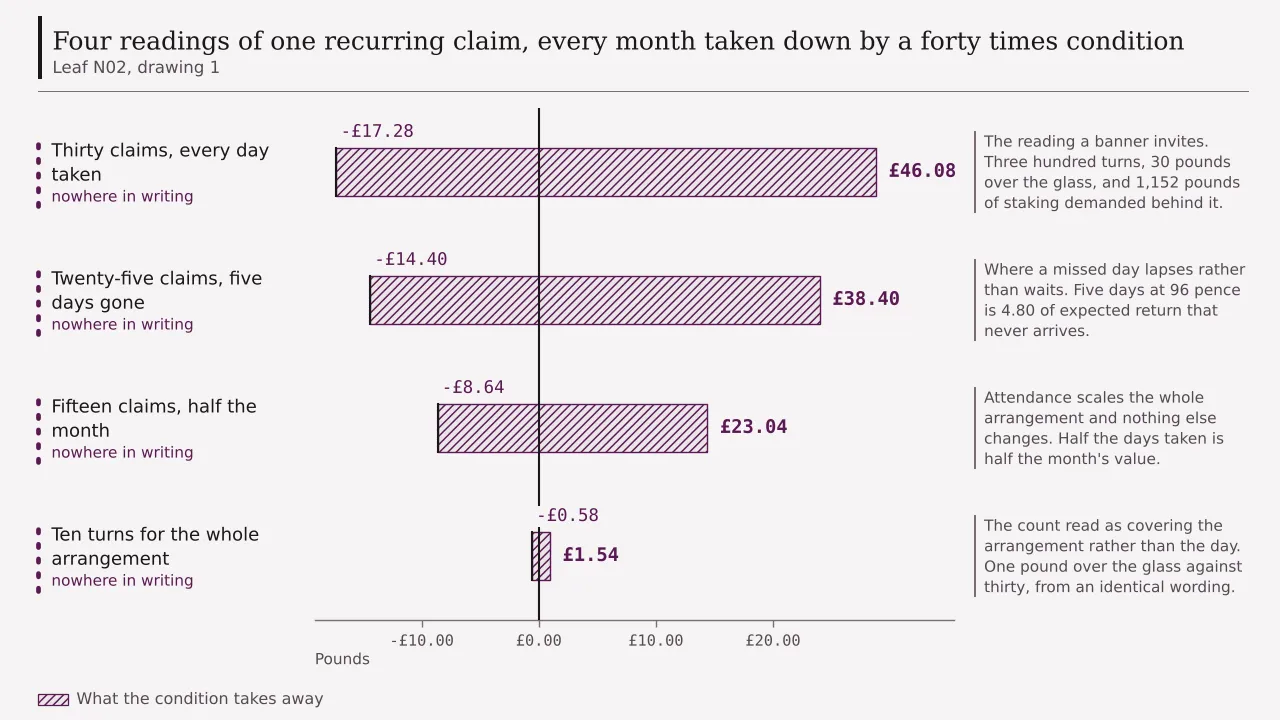
Now the fifth blank, which part seven promised. Where each day’s winnings carry a multiple of their own with a window of their own, a reader faces thirty separate obligations of £38.40, each needing sixteen minutes and each expiring on its own schedule. Where the obligations pool instead, there is one obligation that grows by £38.40 a day and a single deadline somewhere. Nothing on a banner distinguishes the two, and they are not equally difficult.
Separate obligations are harder than they look because they cannot be run together. A day’s 384 presses have to be found on that day or the day’s winnings are stranded, so the sixteen minutes is a daily commitment rather than an eight hour block that can be put somewhere convenient. Pooled obligations are easier to discharge and worse to carry, since the figure grows while a reader is not looking at it.
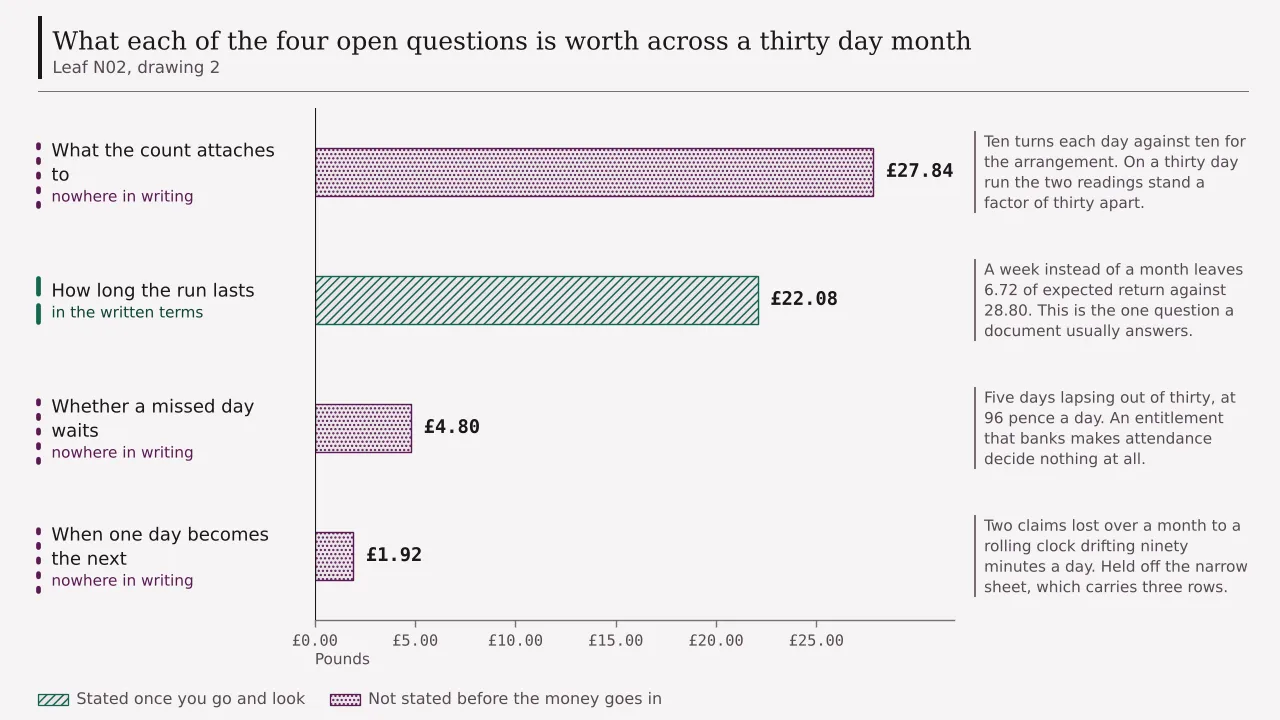
Set the two drawings beside each other and the shape of a recurring claim comes out. The clause costs more than anything else, at £46.08 across a month, and the clause is written down. The four open questions cost less individually and sit in no document, and between them they decide which row of the first drawing a reader is standing on before the clause has been applied to anything.
10
Reading a recurring claim before the first day of it
Where a claim repeats in this fashion, no Great Britain licence covers it, and the duties worth naming are the ones written about repetition itself rather than about disclosure or payment. Four of them bear directly on an arrangement that asks somebody to come back tomorrow, and each is about the shape of the invitation rather than the size of the figure.
Take them one at a time. The design standard bars a product from pushing anybody towards winning back what they have lost, towards a bigger stake, or towards carrying on once they have signalled that they would rather stop, and its guidance puts a free game on the list of things that may not be dangled in front of a departing customer. Advertising guidance covering this sector rules out a promotion that pushes people into taking part often or repeatedly. Guidance written for casino promotions wants a reward in proportion to whatever a player has already laid out in time and in money, and warns against pushing anybody into a regular habit at a set interval. Fourth, the incentives provision forbids shifting what an incentive is worth where its qualifying activity gets finished inside part of the period rather than the whole.
Frequency is the subject of three of those duties, which is what makes the set the right one here. None of them forbids a daily arrangement, and this leaf does not suggest any of them would. Their work is to cap how hard a frequency may be pushed: on whether a lapsed day may be used to pull somebody back, on whether the invitation may be built to reward turning up rather than to reward anything else, and on whether the value may be altered part way through a period.
Take that set away and the models in parts three to eight stand exactly as worked. Not a line of it would move £28.80, £24.00 or £0.96 by a penny, because none of these duties is about the size of a figure. What they govern is whether an arrangement may be designed around the reader’s diary, and that is the one thing a recurring claim is always designed around. Beyond the licence none of them binds anybody, so a daily invitation is free to be as frequent, as perishable and as insistent as whoever drafted it chose, and the £11.52 between the advertised shape and the expected cost has nowhere at all to be raised.
A second loss stands apart from the rest and is worth stating plainly. The national self-exclusion scheme covers operators holding the British licence, which means a registration shutting accounts across those operators leaves anything outside the licence untouched, and Gamstop Online sets that limit down in its own rules, so nobody need discover it the hard way. A recurring daily invitation is the worst possible thing to meet on the way back from that decision, and the block underneath is the better destination.
All of which compresses into a procedure. Write the claim down. Ask what the count attaches to, how long the run goes on, what a missed day does, when the day turns, and whether the obligations pool. Fill in every answer you can source and mark the rest as assumptions. Estimate your own attendance honestly. Multiply the days you will really claim on by 96 pence, and print that figure beside the one the banner implies.
Run that on the arrangement worked here and six figures come out. Thirty pounds of staking and £28.80 expected at the top reading. Ninety-six pence expected at the bottom. Eleven pounds fifty-two expected at an honest sixty per cent attendance. £1,152.00 of staking demanded by the clause. And £46.08 as the clause’s expected cost across a month. A single member of that six stands on the banner, and it is the one that is not a sum of money.
Questions
- What are free daily spins actually worth over a month?
- Between 96 pence and £28.80 of expected return, settled by four questions the word leaves open. Ten turns a day, priced at the 10p this site holds steady, is £1.00 of staking a day and £30.00 across a thirty day month, giving an expected £28.80 back on a 96 per cent return. Read the count as covering the whole arrangement instead and the month is £1.00 of staking and 96 pence expected. Both readings describe something that happens daily.
- Does a missed day get carried over or lost?
- Nothing published settles it, and the two arrangements are different things rather than different wordings. Where the entitlement banks, attendance decides nothing and a month is worth an expected £28.80 whenever the backlog gets cleared. Where it lapses, a month is worth 96 pence for each day actually claimed. On an assumed five missed days out of thirty, twenty-five claims give £25.00 of staking and an expected £24.00, so the five days cost £4.80. Where no document settles it, the harsher reading is the safe working assumption.
- Is the clock a calendar day or twenty-four hours from the last claim?
- Either, and the second ratchets. A calendar clock renews at midnight whatever hour the claim was taken. A rolling clock opens the next window a full day after the last claim, so claiming later than yesterday pushes tomorrow later and nothing ever pushes it back. Assume ninety minutes of drift a day, a proportion assumed on this page and measured by nobody: each cycle runs 25.5 hours, a month of 720 hours divides into 28.2 cycles, and twenty-eight claims land instead of thirty. Two claims at 96 pence is £1.92 lost to a clock nobody described.
- How would I tell which clock an offer is using?
- Claim once, note the hour, and watch when the next entitlement appears. A renewal at midnight settles it as a calendar day. A renewal at the same hour the following day settles it as twenty-four hours from the last claim. Two days settle it and nothing but patience is spent. A third arrangement exists where the entitlement is claimable only between fixed hours and lapses outside them, which behaves like a calendar day for anybody inside the window and like a forfeiture for anybody outside it.
- Does a count of ten mean ten a day or ten in total?
- The word will not decide it, and on a thirty day run the two readings differ by a factor of thirty. An arrangement releasing one turn on each of ten consecutive days is accurately described as paying turns daily, and so is an arrangement releasing ten turns on each of thirty. Ten a day is £30.00 of staking and an expected £28.80. Ten in all is £1.00 of staking and an expected 96 pence. One preposition is therefore worth £27.84 across a month, and the preposition is not printed.
- What does a forty times clause cost across a month of daily turns?
- £46.08 at the top reading, and the sum can be reached down two paths sharing nothing with each other. Path one: forty lots of a month’s expected winnings make £1,152.00 of staking, and four hundredths of that is £46.08. Path two: an expected £28.80 of winnings, less an expected close of minus £17.28. At 10p that staking is 11,520 presses, and where a licensed build holds a cycle shut for two and a half seconds before the next may begin, it occupies eight hours across the month, or sixteen minutes a day.
- Why does my own attendance belong in the pricing at all?
- Because a recurring claim is the only family whose value is a joint product of the terms and the reader’s diary. A claim paid once is worth whatever the terms make it worth. A claim paid over and over is worth that multiplied by how often somebody turns up, and where a missed day lapses the multiplication is linear: thirty days give £28.80, twenty give £19.20, twelve give £11.52. None of that is a penalty and none of it is a forfeiture. It is a quantity belonging to the reader that an advertisement cannot know and does not carry.
- Is somebody who claims on twelve days out of thirty doing it wrong?
- No, and the arithmetic should not be read as suggesting it. A person with a job, a family and a life does not keep a daily appointment with an advertisement for a month, and that is ordinary rather than careless. What follows is a statement about the arrangement instead: an offer paid daily with lapsing days is built so that its advertised shape and its expected cost come apart, and at an assumed sixty per cent attendance the expected return is £17.28 against a reading of £28.80.
- How long does a daily offer run for?
- Duration is the blank documents usually fill in, and every total on this page assumes thirty days as a convention adopted for comparison. Seven days gives 70 turns, £7.00 of staking and an expected £6.72. Ten days gives 100 turns, £10.00 and £9.60. Where no end is named at all, the honest output is a rate rather than a total: 96 pence of expected return a day for as long as it lasts, terminable without notice, and multiplying that by a month nobody promised would be inventing the figure.
- Do the daily wagering obligations pool or stand separately?
- A fifth blank, and the two behave differently. Where each day’s winnings carry a multiple and a window of their own, a reader faces thirty separate obligations of £38.40, each needing about sixteen minutes and each expiring on its own schedule, so the time cannot be moved to a convenient afternoon. Where the obligations pool, there is one obligation growing by £38.40 a day with a single deadline, which is easier to discharge and worse to carry because it grows while nobody is looking at it.
- What does a British licence say about offers that repeat?
- Four duties bear on repetition rather than on disclosure. The design standard bars a product from pushing anybody towards winning back what they have lost, towards a bigger stake, or towards carrying on once they have signalled they would rather stop, and its guidance puts a free game on the list of things that may not be dangled in front of a departing customer. Advertising guidance rules out a promotion that pushes people into taking part often or repeatedly. Guidance on casino promotions wants a reward in proportion to whatever a player has already laid out in time and in money, and warns against pushing anybody into a regular habit at a set interval. The incentives provision forbids shifting what an incentive is worth where its qualifying activity gets finished inside part of the period rather than the whole. Where a claim repeats in this fashion, no Great Britain licence covers it, so not one of these duties binds anybody.
- What is the shortest honest reading of a daily spins claim?
- A rate with four unknowns attached. The rate is 96 pence of expected return for each day actually claimed, at the assumed 10p a turn. The unknowns are what the count attaches to, how long the run goes on, what a missed day does, and when one day becomes the next. Settle them generously and a month is £28.80. Settle them the other way and it is 96 pence. Estimate your own attendance, multiply by 96 pence, and print that beside whatever the banner implies.