Terms read 19 October 2026 Leaf C14, revision 1
A wallet whose own rulebook answers this search before any payment screen does
Forty-five pounds moved by a regulated wallet and £45.00 moved by whatever stands in for one are the same sum going in and two unequal sums coming back. This leaf says at the top that the pairing the search phrase asks for is one the wallet’s published acceptable-use rules largely rule out, puts a value of nothing on the minutes spent hunting for it, and prices what gets accepted in its place: £3.00 of handling on the way out and twelve extra days of waiting.
Stated on the banner £45.00 The payment a reader means to make, identical in size whichever route is used to carry it inward. Stated, once you go and look £72.00 removed What a forty times condition costs against £45.00 of credit where every staked pound returns 96p. Not stated before the money goes in Blanks, four of them Which routes a payment screen will offer, what the outward step charges, how many days it takes, and who answers when it stalls.
Offers of this kind, with their payment terms read
Every destination in this file is bought advertising. The site is paid a fee if a reader goes on to register, and no figure printed below moves because of it.
Bonus Spins UK Slip 01
Betportal
Ceiling as a multiple
The drop
€15.00
€1.00 in the euro
The claim reads €15.00. Once the terms beside it have applied, €0.00 of it can leave. The difference is the drop.
7 of the 15 terms on this slip could not be read before the money went in
Spins priced at this site's own 10p a spin, which the operator does not publish
Stated
€15.00
The claim as it is printed, before a single term has been applied to it.
Headline paid as spins
150 spins at 10c each, which is €15.00 of the figure above.
6 Nowhere
What one spin is worth
No unit is published for a spin, so the count is priced at this site's own 10p a spin. At half that price every figure below halves with it.
Match and other credit not priced
300% of three deposits, to a ceiling of €1,000. A share of a deposit nobody has made yet is not a sum, so no figure stands on this line and none is carried below.
Qualified
-€14.40
Written down somewhere, and taking part of the claim back. Each term carries the place it is written and the sum it takes.
2 Written terms at a distance this record does not establish
Play-through -€14.40
Carrying €14.40 through 35 times stakes €504.00 and costs €20.16 of it at 96 per cent return. That prices above the €14.40 there is to charge it against, so the whole of the credit goes and the line is held at that. The multiple sits on the bonus.
2 Written terms at a distance this record does not establish
Game weighting not priced
Slots only count towards the play-through. No contribution percentage is published, so the line above has been worked at full weight, which is the kindest reading there is.
2 Written terms at a distance this record does not establish
Ceiling on the winnings not priced
5x the bonus.
2 Written terms at a distance this record does not establish
Clock on the credit not priced
14 days.
2 Written terms at a distance this record does not establish
Largest stake while it runs not priced
€5.
3 Public record
Licence, and who holds it not priced
Licensed in Anjouan, Comoros, held by BetPortal Gaming Ltd, with Excite Ultra Media Ltd, reference ALSI-202601040-FI2. A register entry settles who holds a licence and what it permits. It does not settle who is running the site this morning.
4 Cashier
Smallest qualifying deposit your money
€20 a stage. That is €20.00 of your own money, and it is never netted into a drop.
5 On the way out
Checks before a withdrawal not priced
Documents before the first withdrawal.
Unstated
-€0.60
Applying without having been published anywhere, and costing money all the same.
6 Nowhere
What a spin hands back -€0.60
Staking a spin returns 96 per cent of it, so that share of the batch is the house's before a reel turns. This site works at that return and the operator publishes none where the claim is made.
6 Nowhere
Forfeited by rule cost unknown
Nothing is published under this heading, and it applies regardless.
6 Nowhere
Charge on the way out cost unknown
No charge on the way out is published as a figure, so nothing comes off this line. A charge that exists unpublished would come straight off whatever survives.
6 Nowhere
Smallest withdrawal allowed cost unknown
No smallest withdrawal is published as a figure. A floor nobody has published is still a floor, and it decides whether a small balance can move at all.
No Great Britain licence
Terms read 19 October 2026
Bonus Spins UK Slip 02
WinBeast
Ceiling as a sum
The drop
€50.00
€1.00 in the euro
The claim reads €50.00. Once the terms beside it have applied, €0.00 of it can leave. The difference is the drop.
8 of the 15 terms on this slip could not be read before the money went in
Spins priced at this site's own 10p a spin, which the operator does not publish
Stated
€50.00
The claim as it is printed, before a single term has been applied to it.
Headline paid as spins
500 spins at 10c each, which is €50.00 of the figure above.
6 Nowhere
What one spin is worth
No unit is published for a spin, so the count is priced at this site's own 10p a spin. At half that price every figure below halves with it.
Match and other credit not priced
50% to 100% of five deposits, each to a ceiling of €1,000, and a €650 free bet. A share of a deposit nobody has made yet is not a sum, so no figure stands on this line and none is carried below.
Qualified
-€48.00
Written down somewhere, and taking part of the claim back. Each term carries the place it is written and the sum it takes.
2 Written terms at a distance this record does not establish
Play-through -€48.00
Carrying €48.00 through 40 times stakes €1,920.00 and costs €76.80 of it at 96 per cent return. That prices above the €48.00 there is to charge it against, so the whole of the credit goes and the line is held at that. The multiple sits on the bonus and the winnings from the spins.
2 Written terms at a distance this record does not establish
Game weighting not priced
Slots, titles vary by country count towards the play-through. No contribution percentage is published, so the line above has been worked at full weight, which is the kindest reading there is.
2 Written terms at a distance this record does not establish
Ceiling on the winnings not priced
€100 a batch of spins.
2 Written terms at a distance this record does not establish
Clock on the credit not priced
7 days, spins 1 day.
3 Public record
Licence, and who holds it not priced
Licensed in Curaçao, holder not named on the site. A register entry settles who holds a licence and what it permits. It does not settle who is running the site this morning.
4 Cashier
Smallest qualifying deposit your money
€20 a stage. That is €20.00 of your own money, and it is never netted into a drop.
5 On the way out
Checks before a withdrawal not priced
Documents before the first withdrawal.
Unstated
-€2.00
Applying without having been published anywhere, and costing money all the same.
6 Nowhere
What a spin hands back -€2.00
Staking a spin returns 96 per cent of it, so that share of the batch is the house's before a reel turns. This site works at that return and the operator publishes none where the claim is made.
6 Nowhere
Largest stake while it runs cost unknown
Nothing is published under this heading, and it applies regardless.
6 Nowhere
Forfeited by rule cost unknown
Nothing is published under this heading, and it applies regardless.
6 Nowhere
Charge on the way out cost unknown
No charge on the way out is published as a figure, so nothing comes off this line. A charge that exists unpublished would come straight off whatever survives.
6 Nowhere
Smallest withdrawal allowed cost unknown
No smallest withdrawal is published as a figure. A floor nobody has published is still a floor, and it decides whether a small balance can move at all.
No Great Britain licence
Terms read 19 October 2026
Bonus Spins UK Slip 03
EliteSpin
Longest spin window
The drop
£50.00
£1.00 in the pound
The claim reads £50.00. Once the terms beside it have applied, £0.00 of it can leave. The difference is the drop.
8 of the 15 terms on this slip could not be read before the money went in
Spins priced at this site's own 10p a spin, which the operator does not publish
Stated
£50.00
The claim as it is printed, before a single term has been applied to it.
Headline paid as spins
500 spins at 10p each, which is £50.00 of the figure above.
6 Nowhere
What one spin is worth
No unit is published for a spin, so the count is priced at this site's own 10p a spin. At half that price every figure below halves with it.
Match and other credit not priced
50% to 100% of five deposits, each to a ceiling of £1,000. A share of a deposit nobody has made yet is not a sum, so no figure stands on this line and none is carried below.
Qualified
-£48.00
Written down somewhere, and taking part of the claim back. Each term carries the place it is written and the sum it takes.
2 Written terms at a distance this record does not establish
Play-through -£48.00
Carrying £48.00 through 40 times stakes £1,920.00 and costs £76.80 of it at 96 per cent return. That prices above the £48.00 there is to charge it against, so the whole of the credit goes and the line is held at that. The multiple sits on the bonus and the winnings from the spins.
2 Written terms at a distance this record does not establish
Game weighting not priced
Slots count towards the play-through. No contribution percentage is published, so the line above has been worked at full weight, which is the kindest reading there is.
2 Written terms at a distance this record does not establish
Ceiling on the winnings not priced
5x the bonus.
2 Written terms at a distance this record does not establish
Clock on the credit not priced
7 days, spins 3 days.
3 Public record
Licence, and who holds it not priced
Licensed in Costa Rica, held by PrimeTier Limited. A register entry settles who holds a licence and what it permits. It does not settle who is running the site this morning.
4 Cashier
Smallest qualifying deposit your money
£20 a stage. That is £20.00 of your own money, and it is never netted into a drop.
5 On the way out
Checks before a withdrawal not priced
Documents before the first withdrawal.
Unstated
-£2.00
Applying without having been published anywhere, and costing money all the same.
6 Nowhere
What a spin hands back -£2.00
Staking a spin returns 96 per cent of it, so that share of the batch is the house's before a reel turns. This site works at that return and the operator publishes none where the claim is made.
6 Nowhere
Largest stake while it runs cost unknown
Nothing is published under this heading, and it applies regardless.
6 Nowhere
Forfeited by rule cost unknown
Nothing is published under this heading, and it applies regardless.
6 Nowhere
Charge on the way out cost unknown
No charge on the way out is published as a figure, so nothing comes off this line. A charge that exists unpublished would come straight off whatever survives.
6 Nowhere
Smallest withdrawal allowed cost unknown
No smallest withdrawal is published as a figure. A floor nobody has published is still a floor, and it decides whether a small balance can move at all.
No Great Britain licence
Terms read 19 October 2026
Bonus Spins UK Slip 04
Crown Jewelz
Multiple unpublished
The drop
NOT WORKED
The multiple is not published in the operator's own terms. Since the sum cannot be worked around it, none is worked.
9 of the 14 terms on this slip could not be read before the money went in
No drop worked
Stated
£15.00
The claim as it is printed, before a single term has been applied to it.
Headline paid as spins
150 spins at 10p each, which is £15.00 of the figure above.
6 Nowhere
What one spin is worth
No unit is published for a spin, so the count is priced at this site's own 10p a spin. At half that price every figure below halves with it.
Match and other credit not priced
200% of the first deposit, then 150% twice, each to a ceiling of £1,000. A share of a deposit nobody has made yet is not a sum, so no figure stands on this line and none is carried below.
Qualified
NOT WORKED
Written down somewhere, and taking part of the claim back. Each term carries the place it is written and the sum it takes.
2 Written terms at a distance this record does not establish
Play-through not priced
40x the bonus, reported rather than published by the operator.
2 Written terms at a distance this record does not establish
Game weighting not priced
Slots count towards the play-through. No contribution percentage is published, so the line above has been worked at full weight, which is the kindest reading there is.
3 Public record
Licence, and who holds it not priced
Licensed in Curaçao, number not verified, holder not named on the site. A register entry settles who holds a licence and what it permits. It does not settle who is running the site this morning.
4 Cashier
Smallest qualifying deposit your money
£20. That is £20.00 of your own money, and it is never netted into a drop.
5 On the way out
Checks before a withdrawal not priced
Documents before the first withdrawal.
Unstated
NOT WORKED
Applying without having been published anywhere, and costing money all the same.
6 Nowhere
Ceiling on the winnings cost unknown
No ceiling is published. Nothing is assumed in its place.
6 Nowhere
Clock on the credit cost unknown
Nothing is published under this heading, and it applies regardless.
6 Nowhere
Largest stake while it runs cost unknown
Nothing is published under this heading, and it applies regardless.
6 Nowhere
Forfeited by rule cost unknown
Nothing is published under this heading, and it applies regardless.
6 Nowhere
Charge on the way out cost unknown
No charge on the way out is published as a figure, so nothing comes off this line. A charge that exists unpublished would come straight off whatever survives.
6 Nowhere
Smallest withdrawal allowed cost unknown
No smallest withdrawal is published as a figure. A floor nobody has published is still a floor, and it decides whether a small balance can move at all.
No Great Britain licence
Terms read 19 October 2026
Every figure in the second and third columns is this site's own working and nothing an operator has published. A claim is priced as printed, then the share a spin hands back at 96 per cent return comes off it, then what playing the multiple through costs at the same return, and then whatever a published ceiling, a charge on the way out or a floor on the smallest withdrawal takes from what has survived. The drop is the difference between the first figure and the last. The two columns add back up to it exactly, so no money leaves a slip without a term and a place beside it.
Which column a term falls in is settled by one question: has anybody written it down. A charge a reader meets at the payment screen is written down, and it stands in the second column with the cashier against it. A condition that binds without ever having been set down stands in the third, whatever it costs. Inside each column the terms run outwards from the banner, so the order itself says how far a reader would have had to go.
A count of spins has no unit until one is supplied. Where an operator publishes what one of its own spins is worth, that figure is used and the first column says it is theirs. Where none is published, this site's own 10p a spin stands in its place and every figure below moves in proportion with it. Where the multiple itself is unpublished, no drop is worked at all, because that is the one figure the sum cannot be done without.
Three words stand where a figure cannot. Not priced is a term that is written down and carries no number the arithmetic can take. Cost unknown is a term nobody has written down, costing something nobody has put a number on. Your money is money of the reader's own, which is never netted into a drop.
None of the operators in this file holds a Great Britain licence, so none of the duties that licence carries reaches them. Each of those duties is published in its own right, which is what makes its absence here something a reader can check rather than take on trust. Every gambling company licensed in Great Britain belongs to Gamstop Online, so a reader who has shut themselves out through the scheme is not shut out here. Social Responsibility Code 5.1.1 has held a play-through to a maximum of ten times the bonus funds since 19 January 2026, and it binds a licence holder and nobody else. Asked in a post of 21 October 2025 what is lost along with the licence, the Gambling Commission's Director of Enforcement and Intelligence answered: "unfair gaming practices, financial loss, and a lack of recourse if things go wrong". The same post puts blocked payouts, and withdrawal limits pitched high enough to be unreachable, among the behaviour the Commission has recorded. Nobody under 18 may hold an account at any of them.
Terms are reproduced in the wording their operator published, and each slip is dated with the day somebody sat down and read them. 19 October 2026 is the oldest of those dates. Anybody claiming an offer is bound by that operator's full terms, which are elsewhere, and never by a line standing here.
1
Why a rulebook, rather than a payment screen, settles this question
Start with the finding rather than burying it nine parts down. Somebody typing the words non-Gamstop and the name of a large wallet into a search box wants two things to coincide, and one of the two carries an acceptable-use policy of its own that largely stops them coinciding. Instruments of that size publish the categories they decline, they publish them where anybody may read them without opening an account, and gambling arranged outside a licensing regime the instrument recognises appears in that wording in one form or another. The question in the search phrase is therefore settled in a published rulebook owned by neither party the reader had in mind.
An answer living there changes what the rest of this leaf can usefully do. Reaching it needs no payment screen, no registration and no money. The condition is not a gambling condition at all. It is a property of the instrument, drafted for every merchant category the instrument serves, and what a gambling operator would prefer does not enter into it. So the opening sentence has to be that the combination described by those words is one the instrument’s own terms work against, and that a page pretending otherwise would be selling a search result instead of answering a question.
The second thing belongs here too, ahead of any arithmetic, because it matters more than the arithmetic does. Anyone who arrives on this wording while registered with Gamstop Online is looking at an arrangement that registration was taken out to close. Help costs nothing and is confidential: GamCare.org.uk and BeGambleAware.org both answer, and GamCare staffs the National Gambling Helpline without a closing time on 0808 8020 133. GamCare also publishes a no-charge route to blocking software through that helpline under the name TalkBanStop; the article carrying it bears the date 12 April 2021 and attaches no period to what is given away, so the accurate form of the sentence is that the route exists where GamCare publishes it and that its present terms belong to GamCare and not to this page. No part of this leaf describes how to reach an operator anybody has shut themselves out of, and nothing below should be read as though it quietly did.
One further point sits in part one rather than part nine. When a bank, a card scheme, an instrument or a mobile network declines to carry a gambling payment, that refusal protects in the way a self-exclusion protects, even though it arrives as an error message instead of as a decision somebody took. Where this leaf prices a refusal it prices what meeting one costs the person who meets it. That is a different exercise from working round one, and the second exercise is not performed anywhere on this page.
The arithmetic rests on a single worked payment of £45.00, a credit of matching size, a play-through of forty times, 96p returned per pound staked and a weighting of one. Every one of those but the payment is fixed across this whole site, and each gets named again wherever a sentence spends it. Outward charges and waiting periods are figures this leaf sets for itself, and every sentence carrying one says so where it carries it.
2
Thirty-five minutes that return nothing anybody can verify
Give the hunt a length before pricing it. Thirty-five minutes will do, a span this leaf picks for itself and does not claim to have observed in anybody: time enough to open a dozen results, read their payment sections, and arrive at a cashier or two. Then ask what those minutes yield that could afterwards be checked by somebody else, and the count comes out at nought. Treat that as the result of the exercise rather than as a grievance about it.
The yield is nought for a structural reason. What wants confirming is that a named instrument will fund a named account, and exactly one surface ever confirms that: a payment screen, reached after registration, listing today’s routes for today’s address. Everything printed earlier describes an intention. A badge in a footer is a claim with no settlement behind it; a help article reports a past arrangement; and as regards the question actually asked, both sit nowhere in writing, since neither commits anybody to processing anything tomorrow.
Thirty-five minutes of looking therefore buy no information. What they buy is a decision, and the decision is nearly always the same: somebody who set out to pay through a particular instrument opens an account and pays by whatever the screen does offer. That substitution is the event worth pricing, and parts five and six price it. Read that way, the search costs £3.00 of handling plus twelve days of extra waiting, both worked below, and the thirty-five minutes merely record how long it took to reach them.
A second reading of the same minutes is fairer to the reader and deserves printing. Somebody may be checking whether a protection still holds rather than hunting for a way past it, and for that purpose the time is well spent: the rulebook holds, it is published, and it does not hang on anything a gambling site says about it. Anybody who finishes the search knowing that has extracted a real result, and it is the only result the search reliably hands over.
35 minutes of looking, nought verifiable facts produced, one substitution made at the finish
3
Three jobs a regulated instrument was quietly performing
An instrument is easy to mistake for a convenience, and convenience is the least of what it supplies. Take the branding off and three separate functions are left underneath, each needing a replacement once the instrument is gone, and none of them supplied by a gambling account on its own.
The first is a homeward path that exists by default. Money arriving by an instrument has a way back to it without anybody choosing anything, which is why nobody thinks about where a payout goes while the instrument is in use. The second is a published rulebook, held by somebody who gains nothing whichever way one argument is settled, stating what gets carried and what gets declined. The third is a counterparty with an address: a named company, incorporated somewhere, carrying a complaints route of its own that is not the gambling account’s.
Put those three beside what a payment screen outside a Great Britain licence can supply instead, and the asymmetry is plain once written down. A homeward path turns into a route the other side selects at the moment of payout. A published rulebook turns into terms drafted by whoever is holding the balance. A counterparty with an address turns into that same party once more, which puts the complaint, the evidence and the decision on one desk.
| The function | Where it gets settled instead | Worth on £45.00 |
|---|---|---|
| A homeward path to whatever paid in | at the cashier | £45.00, once selected |
| A rulebook drafted by a disinterested party | nowhere in writing | Not settled |
| A counterparty apart from the account holder | nowhere in writing | Not settled |
| A charge for moving the balance outward | at the cashier | £3.00, assumed here |
Two of those rows carry no figure, and the blank is deliberate rather than lazy. A quantity nobody publishes cannot be priced without being invented, and inventing one on a site whose subject is what can be checked would be the worst error available. What can be said is where the blank sits, which is why the middle column of that table does more work than the right-hand one.
4
Sorting what remains by how long the way back runs
Once an instrument is unavailable, the interesting question is not what replaces it. It is how long the replacement’s homeward journey takes, because that length is the whole cost of the substitution, and it falls due at the finish rather than at the start. A payment inward completes in seconds whatever carries it. A payment outward does not, and the spread between the briskest and the slowest ways back is exactly where a reader’s money sits while nothing whatever happens to it.
Three categories cover the ground without naming a single thing. Some instruments carry value both ways and settle the homeward leg by themselves. Some carry value inward and have no outward mechanism at all, so a second instrument must be produced before a balance can move anywhere. And some arrangements make the outward step a manual decision by whoever holds the money, with the period for taking that decision fixed by nobody. A large wallet belongs to the first category, and its absence pushes a reader into the second or the third.
| Kind of homeward journey | Where its length first appears | Days assumed | Charge assumed on £45.00 | Who decides it happens |
|---|---|---|---|---|
| Automatic return to whatever paid in | Payment screen | 2 | £0.00 | Nobody; it is the default |
| Return needing a second instrument | Payment screen | 7 | £1.20 | Whoever reviews the new instrument |
| Manual decision with no stated period | Payment screen | 14 | £3.00 | The party holding the balance |
Each day and each charge in that table is a figure this leaf sets rather than reports, put there to carry a shape instead of to describe a market, and nothing citable on this site publishes a spread of either. What the table exists for is its right-hand column, the one needing no figure at all: travel down the rows and the question of whether money moves stops being a mechanical consequence and becomes somebody else’s decision.
Hold those rows against the licensed position and one line of a published standard does a surprising amount of work. Requirement 14B of the remote technical standards bars a licensed system from putting a cancel button on a withdrawal request, and the guidance printed beside it asks for the route out to be kept as free of obstruction as the operator can manage. Read as arithmetic rather than as regulation, that is the rule converting a fourteen-day row into a two-day one by deleting the step at which somebody is invited to reconsider, and it is the clearest instance on this page of a rule governing duration instead of price.
5
Forty times forty-five pounds, the subtraction everybody expects
Take the familiar subtraction first, since it is the larger of the two and the only one settled without reaching a payment screen. A credit of £45.00, a play-through of forty times, 96p back per pound staked and a weighting of one: the last three stand across this site and every one of them is spent right here. Forty lots of £45.00 means £1,800.00 must be pushed across the reels.
Each staked pound leaves 4 pence behind, so £1,800.00 of staking is expected to hand £72.00 to the margin. Against a credit of £45.00 the expected close is minus £27.00, which is £45.00 multiplied by one less 1.6. A credit at this return runs out of value at a multiple of 25, that being one over 0.04, so forty overshoots the crossing by sixty per cent and the close was below nought before anybody asked about instruments.
Credit as the offer states it £45.00 Expected close at forty times minus £27.00 Price of a clause nobody opened £72.00
Seventy-two pounds is the first of two subtractions performed here, and announcing that in advance matters, because anybody who stops at this point is holding the wrong total. The condition producing it is written down, sits one document away from wherever the offer was advertised, and would be found by somebody who went looking. Expensive and discoverable at once is an odd combination, and it explains why most of the attention paid to offers shaped like this lands on the multiple.
£1,800.00 of staking asked against £45.00 of credit, before any question about routes arises
An honest qualification travels with that figure. Somebody treating £45.00 of credit as forty-five pounds of entertainment, spending it, and never trying to take anything out has suffered none of the above, because the whole apparatus of exits and charges is triggered only by an attempt to leave. Part six is written for everybody else, and part six is where this leaf’s own contribution sits.
6
A charge and a delay, the subtraction nobody budgets for
The second subtraction is smaller in pounds, arrives later, and is the one the search phrase itself brings into being. Suppose the condition is cleared and £45.00 stands in an account that the terms agree belongs to the reader. Put the outward charge at 4 per cent plus a flat £1.20, a pair of figures chosen on this leaf and published as a tariff by nothing citable here. On £45.00 that is £1.80 and £1.20, or £3.00 together, leaving £42.00.
Balance the terms agree is the reader’s £45.00 After the assumed outward charge £42.00 Price of the missing homeward path £3.00
Three pounds is a sixteenth of the balance and two thirds of one per cent short of seven per cent, which is a sharper bite than it looks beside a figure of seventy-two, because it comes out of money that survived everything. The £72.00 in part five is expected value vanishing into a margin. The £3.00 here is cash leaving a sum that already exists on a screen. Budget for one and ignore the other and the loud condition has been priced while the quiet one has not, and the quiet one is the only figure on this page fixed at the cashier and nowhere before it.
Now the duration, which will not convert into pounds and should not be made to. Take the two-day row and the fourteen-day row from part four, both of them figures set here rather than observed, and twelve days separate them. Twelve days is 1,036,800 seconds. Set that beside the act that would empty the account: £45.00 spent in ten-penny presses is 450 presses, and a licensed reel-based build leaves 2.5 seconds between cycles, so 450 of them occupy 1,125 seconds, or eighteen minutes and forty-five seconds. The wait therefore runs about 922 times the length of the quickest way to make it unnecessary, and the account sells that way continuously while the wait runs.
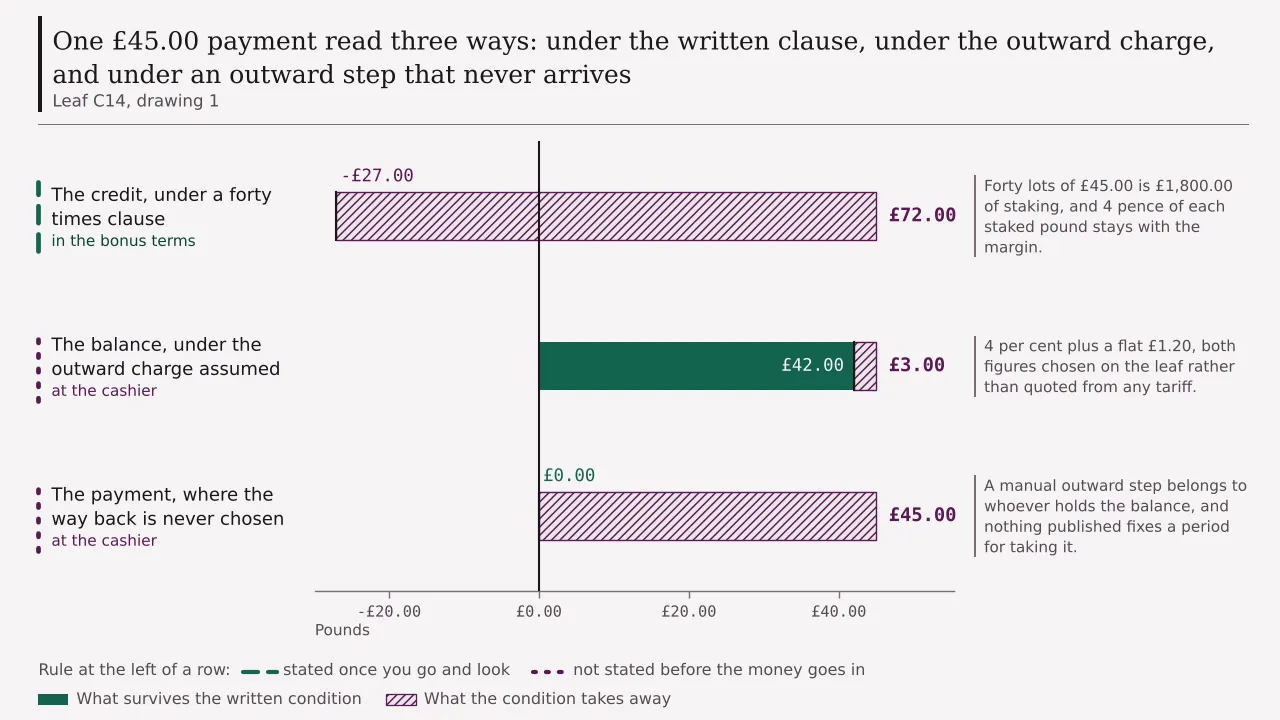
Those three rows share one ledger because they are met in that order and budgeted in reverse. The condition gets read last, the charge is met after that, and the bottom row, where the outward step simply never comes, is the one nobody allows for while deciding. Nothing in the sequence has been concealed by anybody. It is arranged so that the cheapest thing to discover is the first thing offered.
7
Nine quantities, and which of the six places settles each
This site sorts every claim by where somebody would go to settle it, and a leaf about an instrument that is mostly absent throws up an unusual distribution. Most of what decides the outcome is fixed at a payment screen, the fourth of the six places and the one nobody arrives at without creating an account first. That ordering is the entire subject.
| The quantity | Where it would be settled | Figure used here | Reachable before paying |
|---|---|---|---|
| Size of the intended payment | £45.00 | Yes | |
| What the instrument’s own policy permits | in a published rulebook | Not a sum | Yes, with no account |
| Multiple the winnings turn over at | in the bonus terms | £72.00 gone | Yes, one document out |
| Routes the screen is offering today | at the cashier | Not a sum | No |
| Charge for the outward step | at the cashier | £3.00 assumed | No |
| Smallest sum the exit will carry | at the cashier | Unpublished | No |
| Paperwork demanded before money leaves | on the way out | Not a sum | No |
| Whether a licence stands behind the address | in the public register | Binary | Yes, with no account |
| Days the outward step occupies | nowhere in writing | 12 assumed | No |
Three rows there can be reached without an account. Five rows decide whether money ever comes back, and not one of the five is among the three. A reader standing in front of a search engine therefore has access to everything except the part that decides anything, and the part that decides is withheld by sequence rather than by concealment.
Two of the three reachable rows deserve more credit than they usually get. A public register search costs nothing, needs no registration and is answered by a regulator instead of by a merchant, and the instrument’s acceptable-use policy is published on the same terms. Between them they settle the pair of questions this leaf opened with: whether a licence stands behind the arrangement, and whether the instrument would carry the payment. Both answers are available inside the first five of the thirty-five minutes.
8
Four duties that were doing an instrument’s work
Whoever stands behind an arrangement reached this way is holding no Great Britain licence, so the useful way to state what that costs, on a leaf about instruments, is to name the duties performing the same jobs the instrument performs and then remove them one at a time. There are four, and each one is a rule about money sitting still rather than about anything a reel does.
First, the duty that shapes an exit. Requirement 14B stops a licensed system putting a cancel button on a withdrawal request at all, and asks for the way out to be kept clear of obstruction. Folded into the table in part four, that is the rule keeping a two-day row from turning into a fourteen-day one, and nothing outside the licence reproduces it.
Second, the duty that fixes the size of an exit. A licensee may not put a ceiling over the deposit balance a customer is drawing down, and the regulator has printed the shape of the barred wording, which rations withdrawals by the day and again by the week. Worked against £45.00, a clause drafted that way would not shrink the balance by a penny and would stretch the journey instead, which is why it belongs beside the twelve days rather than beside the three pounds.
Third, the duty covering where money rests while it waits. Licence condition 4.2.1 makes a licensee holding customer money declare, in its terms, whether the money survives an insolvency, at what level, and by what method, following a rating system the regulator specifies, whose four named levels run from no segregation whatever up to high protection. The customer must acknowledge the declaration before gambling with the money.
Fourth, the reminder keeping the third fresh. Paragraph 3 of that condition obliges a licensee sitting on either unprotected rating to repeat the warning every six months, to state the sum it is holding for that customer, and to take a new acknowledgement. Implementation advice from the regulator brings that paragraph into force on 31 October 2025, and the response behind it picked the option with no threshold, so the duty covers somebody holding £45.00 on exactly the terms it covers somebody holding a great deal more.
Subtract that set and the twelve days in part six stop being a delay and become an open period in which nobody has said where the £45.00 is held, nobody owes a repeat statement in six months, no ceiling over the outward step is forbidden, and nothing requires the route out to be kept clear. What that produces at the far end is recorded in the regulator’s enforcement post of 21 October 2025, which names sites stopping payouts outright or pitching withdrawal thresholds beyond reach. On a payments leaf that is the shape of the loss: four duties about stationary money, and nothing at all to do with how a reel behaves.
The self-exclusion point hangs off the same hinge. Belonging to the national scheme travels with a Great Britain licence rather than with any operator’s choice, so the scheme covers the licensed population and stops where that population stops, and the terms of use it publishes, carrying 20 May 2026 as their latest revision, state outright that it has no way of keeping a registered person out of whatever a non-participating business provides. A sentence of that kind marks the edge of a protection, and the right response to reading it is the helpline named in part one rather than a payment screen.
9
What can be established first, and who tends to type this phrase
Everything priced above reduces to a short sequence costing nothing and needing no registration. Read the instrument’s published acceptable-use policy, which disposes of the search phrase outright. Search the public register for whoever is said to stand behind the address, which disposes of whether any duty in part eight applies at all. Then, and only then, work the two subtractions, which on these figures come to £72.00 and £3.00 against a payment of £45.00.
Two of those steps produce a definite answer and the third produces a pair of figures, and none of the three needs money to have moved anywhere. That is a better position than the thirty-five minutes in part two normally leave anybody in, and the whole difference between the two is a matter of which question gets asked first.
The honest summary is short. The instrument’s rules largely prevent the pairing, a payment screen is the only surface that would ever confirm it, the substitution made instead costs £3.00 and twelve days on these assumptions, and the conditions attached to the credit cost £72.00 before any of that is reached. Not one step in that sentence requires anybody to have behaved badly.
The last paragraph belongs to the reason people type this phrase at all. A large share of the traffic reaching wording of this sort comes from people whose registration with Gamstop Online is still running, and the regulator, writing to licensees on 20 January 2025, put customers who have excluded themselves among the people unlicensed sites go after. If that describes the reader, the next step is not a cashier. It is GamCare.org.uk, BeGambleAware.org, or a call to 0808 8020 133, and a registration that is still running is a protection doing its job rather than an obstacle in the way.
Questions
- Can a large wallet be used where the operator is outside Gamstop?
- Largely not, and the answer comes from the instrument rather than from the gambling account. Wallets of that size publish an acceptable-use policy naming the categories they decline; gambling arranged outside a licensing regime the instrument recognises falls inside that wording; and the policy can be read without opening anything. So the question is settled in a published rulebook belonging to neither party in the search phrase, which is an unusual address for an answer and the reason this leaf prints it in part one instead of at the end.
- Why will a website not simply say which payment routes it takes?
- Because a route is confirmed on one surface only: a payment screen, reached after registration, listing today’s options for today’s address. A badge in a footer or a help article describes an intention and commits nobody to processing anything tomorrow. That is why thirty-five minutes of hunting, a span this leaf sets for itself, returns nought verifiable facts about the pairing, while five minutes spent on the instrument’s policy and on the public register disposes of two separate questions outright.
- What does a regulated instrument supply that a payment screen does not?
- Three functions. A homeward path that works by default, so money has a way back to whatever it came from without anybody choosing. A rulebook written by a party with no stake in how one argument comes out. And a counterparty addressable separately from the gambling account. Strip the instrument away and all three collapse onto whoever holds the balance, so the complaint, the evidence and the decision end up on a single desk.
- What does the missing homeward path cost on a forty-five pound balance?
- £3.00 on the figures this leaf sets, which are an outward charge of 4 per cent plus a flat £1.20 and are not a tariff anything citable here publishes. That leaves £42.00 out of £45.00, or a sixteenth of the balance, taken from money that had already survived every written condition. It is the only figure on this page fixed at a payment screen and nowhere before it, and it is the second of the two subtractions performed.
- Why is the waiting period not turned into pounds?
- Because turning it into money would mean inventing a probability nobody publishes. What can be stated is a comparison. Twelve extra days, the gap between this leaf’s assumed two-day and fourteen-day journeys, is 1,036,800 seconds. A £45.00 balance spent in ten-penny presses is 450 presses, and a licensed reel-based build leaves 2.5 seconds between cycles, so those presses occupy 1,125 seconds. The wait runs about 922 times the length of the quickest way to make it unnecessary.
- How much does a forty times condition remove from forty-five pounds of credit?
- £72.00. Staking of £1,800.00 is asked, being forty lots of the credit, and every staked pound leaves 4 pence behind, so £72.00 goes to the margin. The expected close is minus £27.00, which is £45.00 multiplied by one less 1.6. A credit at this return runs out of value at a multiple of 25, one over 0.04, so forty overshoots the crossing by sixty per cent.
- Which British duties were performing the instrument’s work?
- Four, all of them about money sitting still rather than about play. Requirement 14B of the remote technical standards bars a cancel button on a withdrawal request and asks for the way out to be kept clear of obstruction. A separate rule forbids any ceiling over the deposit balance a customer is drawing down, the regulator having printed the shape of the barred wording. Licence condition 4.2.1 makes a licensee declare whether customer money survives an insolvency, on a four-level rating system the regulator specifies. And paragraph 3 of that condition, in force from 31 October 2025 and decided without any threshold under it, makes an operator on either unprotected rating repeat the warning twice a year.
- Does a British self-exclusion reach a cashier based offshore?
- It does not, and the scheme publishes that limit itself. Membership travels with the Great Britain licence rather than with any operator’s choice, so the scheme covers the licensed population and stops where it stops. The terms of use it publishes, carrying 20 May 2026 as their latest revision, say outright that it has no way of keeping a registered person out of whatever a non-participating business provides. That marks the edge of a protection rather than a gap to be worked around, and a warning the regulator addressed to the industry on 20 January 2025 counts people who have shut themselves out among the targets of unlicensed sites.
- Is a declined gambling payment something to be worked around?
- No. When a bank, a card scheme, an instrument or a mobile network declines to carry a gambling payment, that refusal protects in the way a self-exclusion protects, even though it arrives as an error message instead of as a decision somebody took. This leaf prices what meeting such a refusal costs the person who meets it and describes no means of avoiding one anywhere. Help costs nothing and is confidential at GamCare.org.uk and BeGambleAware.org, and GamCare staffs the National Gambling Helpline without a closing time on 0808 8020 133.
- What is the shortest honest statement of this whole leaf?
- Five figures on one payment. £45.00 intended, staking of £1,800.00 demanded, an expected close at minus £27.00, a £72.00 gap opened by a condition written down somewhere, and a £3.00 charge plus twelve assumed days opened by a payment screen. Two of the five can be settled before any money moves and three cannot, and the search phrase itself is disposed of without reaching any of them, by reading a policy the instrument publishes for everybody.