Terms read 19 October 2026 Leaf W07, revision 1
A return figure describes twenty-five million presses, and an evening holds three hundred
Three hundred presses at 10p push £30.00 over the reels for an expected £28.80 back. The published percentage behind those two figures is a statement about a span roughly eighty thousand times longer than that, and the gap between the span and the evening is where every misreading on this subject starts. This leaf measures the gap, prices it, and then prices the two points of return nobody has to print.
Stated on the banner 96 per cent One percentage, carrying no sample size, no spread and no statement about how long it takes to show itself. Stated, once you go and look £312.00 What a year of 78,000 presses is expected to cost once that percentage is read as a rate on turnover rather than as a promise about a session. Not stated before the money goes in 25,000,000 presses The sample that would settle the rate to a tenth of a point, a quantity no document carries and no reader approaches.
Offers built on reel play, with their terms read
Every destination in this file is bought advertising. The site is paid a fee if a reader goes on to register, and no figure printed below moves because of it.
Bonus Spins UK Slip 01
Betportal
Ceiling as a multiple
The drop
€15.00
€1.00 in the euro
The claim reads €15.00. Once the terms beside it have applied, €0.00 of it can leave. The difference is the drop.
7 of the 15 terms on this slip could not be read before the money went in
Spins priced at this site's own 10p a spin, which the operator does not publish
Stated
€15.00
The claim as it is printed, before a single term has been applied to it.
Headline paid as spins
150 spins at 10c each, which is €15.00 of the figure above.
6 Nowhere
What one spin is worth
No unit is published for a spin, so the count is priced at this site's own 10p a spin. At half that price every figure below halves with it.
Match and other credit not priced
300% of three deposits, to a ceiling of €1,000. A share of a deposit nobody has made yet is not a sum, so no figure stands on this line and none is carried below.
Qualified
-€14.40
Written down somewhere, and taking part of the claim back. Each term carries the place it is written and the sum it takes.
2 Written terms at a distance this record does not establish
Play-through -€14.40
Carrying €14.40 through 35 times stakes €504.00 and costs €20.16 of it at 96 per cent return. That prices above the €14.40 there is to charge it against, so the whole of the credit goes and the line is held at that. The multiple sits on the bonus.
2 Written terms at a distance this record does not establish
Game weighting not priced
Slots only count towards the play-through. No contribution percentage is published, so the line above has been worked at full weight, which is the kindest reading there is.
2 Written terms at a distance this record does not establish
Ceiling on the winnings not priced
5x the bonus.
2 Written terms at a distance this record does not establish
Clock on the credit not priced
14 days.
2 Written terms at a distance this record does not establish
Largest stake while it runs not priced
€5.
3 Public record
Licence, and who holds it not priced
Licensed in Anjouan, Comoros, held by BetPortal Gaming Ltd, with Excite Ultra Media Ltd, reference ALSI-202601040-FI2. A register entry settles who holds a licence and what it permits. It does not settle who is running the site this morning.
4 Cashier
Smallest qualifying deposit your money
€20 a stage. That is €20.00 of your own money, and it is never netted into a drop.
5 On the way out
Checks before a withdrawal not priced
Documents before the first withdrawal.
Unstated
-€0.60
Applying without having been published anywhere, and costing money all the same.
6 Nowhere
What a spin hands back -€0.60
Staking a spin returns 96 per cent of it, so that share of the batch is the house's before a reel turns. This site works at that return and the operator publishes none where the claim is made.
6 Nowhere
Forfeited by rule cost unknown
Nothing is published under this heading, and it applies regardless.
6 Nowhere
Charge on the way out cost unknown
No charge on the way out is published as a figure, so nothing comes off this line. A charge that exists unpublished would come straight off whatever survives.
6 Nowhere
Smallest withdrawal allowed cost unknown
No smallest withdrawal is published as a figure. A floor nobody has published is still a floor, and it decides whether a small balance can move at all.
No Great Britain licence
Terms read 19 October 2026
Bonus Spins UK Slip 02
WinBeast
Ceiling as a sum
The drop
€50.00
€1.00 in the euro
The claim reads €50.00. Once the terms beside it have applied, €0.00 of it can leave. The difference is the drop.
8 of the 15 terms on this slip could not be read before the money went in
Spins priced at this site's own 10p a spin, which the operator does not publish
Stated
€50.00
The claim as it is printed, before a single term has been applied to it.
Headline paid as spins
500 spins at 10c each, which is €50.00 of the figure above.
6 Nowhere
What one spin is worth
No unit is published for a spin, so the count is priced at this site's own 10p a spin. At half that price every figure below halves with it.
Match and other credit not priced
50% to 100% of five deposits, each to a ceiling of €1,000, and a €650 free bet. A share of a deposit nobody has made yet is not a sum, so no figure stands on this line and none is carried below.
Qualified
-€48.00
Written down somewhere, and taking part of the claim back. Each term carries the place it is written and the sum it takes.
2 Written terms at a distance this record does not establish
Play-through -€48.00
Carrying €48.00 through 40 times stakes €1,920.00 and costs €76.80 of it at 96 per cent return. That prices above the €48.00 there is to charge it against, so the whole of the credit goes and the line is held at that. The multiple sits on the bonus and the winnings from the spins.
2 Written terms at a distance this record does not establish
Game weighting not priced
Slots, titles vary by country count towards the play-through. No contribution percentage is published, so the line above has been worked at full weight, which is the kindest reading there is.
2 Written terms at a distance this record does not establish
Ceiling on the winnings not priced
€100 a batch of spins.
2 Written terms at a distance this record does not establish
Clock on the credit not priced
7 days, spins 1 day.
3 Public record
Licence, and who holds it not priced
Licensed in Curaçao, holder not named on the site. A register entry settles who holds a licence and what it permits. It does not settle who is running the site this morning.
4 Cashier
Smallest qualifying deposit your money
€20 a stage. That is €20.00 of your own money, and it is never netted into a drop.
5 On the way out
Checks before a withdrawal not priced
Documents before the first withdrawal.
Unstated
-€2.00
Applying without having been published anywhere, and costing money all the same.
6 Nowhere
What a spin hands back -€2.00
Staking a spin returns 96 per cent of it, so that share of the batch is the house's before a reel turns. This site works at that return and the operator publishes none where the claim is made.
6 Nowhere
Largest stake while it runs cost unknown
Nothing is published under this heading, and it applies regardless.
6 Nowhere
Forfeited by rule cost unknown
Nothing is published under this heading, and it applies regardless.
6 Nowhere
Charge on the way out cost unknown
No charge on the way out is published as a figure, so nothing comes off this line. A charge that exists unpublished would come straight off whatever survives.
6 Nowhere
Smallest withdrawal allowed cost unknown
No smallest withdrawal is published as a figure. A floor nobody has published is still a floor, and it decides whether a small balance can move at all.
No Great Britain licence
Terms read 19 October 2026
Bonus Spins UK Slip 03
EliteSpin
Longest spin window
The drop
£50.00
£1.00 in the pound
The claim reads £50.00. Once the terms beside it have applied, £0.00 of it can leave. The difference is the drop.
8 of the 15 terms on this slip could not be read before the money went in
Spins priced at this site's own 10p a spin, which the operator does not publish
Stated
£50.00
The claim as it is printed, before a single term has been applied to it.
Headline paid as spins
500 spins at 10p each, which is £50.00 of the figure above.
6 Nowhere
What one spin is worth
No unit is published for a spin, so the count is priced at this site's own 10p a spin. At half that price every figure below halves with it.
Match and other credit not priced
50% to 100% of five deposits, each to a ceiling of £1,000. A share of a deposit nobody has made yet is not a sum, so no figure stands on this line and none is carried below.
Qualified
-£48.00
Written down somewhere, and taking part of the claim back. Each term carries the place it is written and the sum it takes.
2 Written terms at a distance this record does not establish
Play-through -£48.00
Carrying £48.00 through 40 times stakes £1,920.00 and costs £76.80 of it at 96 per cent return. That prices above the £48.00 there is to charge it against, so the whole of the credit goes and the line is held at that. The multiple sits on the bonus and the winnings from the spins.
2 Written terms at a distance this record does not establish
Game weighting not priced
Slots count towards the play-through. No contribution percentage is published, so the line above has been worked at full weight, which is the kindest reading there is.
2 Written terms at a distance this record does not establish
Ceiling on the winnings not priced
5x the bonus.
2 Written terms at a distance this record does not establish
Clock on the credit not priced
7 days, spins 3 days.
3 Public record
Licence, and who holds it not priced
Licensed in Costa Rica, held by PrimeTier Limited. A register entry settles who holds a licence and what it permits. It does not settle who is running the site this morning.
4 Cashier
Smallest qualifying deposit your money
£20 a stage. That is £20.00 of your own money, and it is never netted into a drop.
5 On the way out
Checks before a withdrawal not priced
Documents before the first withdrawal.
Unstated
-£2.00
Applying without having been published anywhere, and costing money all the same.
6 Nowhere
What a spin hands back -£2.00
Staking a spin returns 96 per cent of it, so that share of the batch is the house's before a reel turns. This site works at that return and the operator publishes none where the claim is made.
6 Nowhere
Largest stake while it runs cost unknown
Nothing is published under this heading, and it applies regardless.
6 Nowhere
Forfeited by rule cost unknown
Nothing is published under this heading, and it applies regardless.
6 Nowhere
Charge on the way out cost unknown
No charge on the way out is published as a figure, so nothing comes off this line. A charge that exists unpublished would come straight off whatever survives.
6 Nowhere
Smallest withdrawal allowed cost unknown
No smallest withdrawal is published as a figure. A floor nobody has published is still a floor, and it decides whether a small balance can move at all.
No Great Britain licence
Terms read 19 October 2026
Bonus Spins UK Slip 04
Crown Jewelz
Multiple unpublished
The drop
NOT WORKED
The multiple is not published in the operator's own terms. Since the sum cannot be worked around it, none is worked.
9 of the 14 terms on this slip could not be read before the money went in
No drop worked
Stated
£15.00
The claim as it is printed, before a single term has been applied to it.
Headline paid as spins
150 spins at 10p each, which is £15.00 of the figure above.
6 Nowhere
What one spin is worth
No unit is published for a spin, so the count is priced at this site's own 10p a spin. At half that price every figure below halves with it.
Match and other credit not priced
200% of the first deposit, then 150% twice, each to a ceiling of £1,000. A share of a deposit nobody has made yet is not a sum, so no figure stands on this line and none is carried below.
Qualified
NOT WORKED
Written down somewhere, and taking part of the claim back. Each term carries the place it is written and the sum it takes.
2 Written terms at a distance this record does not establish
Play-through not priced
40x the bonus, reported rather than published by the operator.
2 Written terms at a distance this record does not establish
Game weighting not priced
Slots count towards the play-through. No contribution percentage is published, so the line above has been worked at full weight, which is the kindest reading there is.
3 Public record
Licence, and who holds it not priced
Licensed in Curaçao, number not verified, holder not named on the site. A register entry settles who holds a licence and what it permits. It does not settle who is running the site this morning.
4 Cashier
Smallest qualifying deposit your money
£20. That is £20.00 of your own money, and it is never netted into a drop.
5 On the way out
Checks before a withdrawal not priced
Documents before the first withdrawal.
Unstated
NOT WORKED
Applying without having been published anywhere, and costing money all the same.
6 Nowhere
Ceiling on the winnings cost unknown
No ceiling is published. Nothing is assumed in its place.
6 Nowhere
Clock on the credit cost unknown
Nothing is published under this heading, and it applies regardless.
6 Nowhere
Largest stake while it runs cost unknown
Nothing is published under this heading, and it applies regardless.
6 Nowhere
Forfeited by rule cost unknown
Nothing is published under this heading, and it applies regardless.
6 Nowhere
Charge on the way out cost unknown
No charge on the way out is published as a figure, so nothing comes off this line. A charge that exists unpublished would come straight off whatever survives.
6 Nowhere
Smallest withdrawal allowed cost unknown
No smallest withdrawal is published as a figure. A floor nobody has published is still a floor, and it decides whether a small balance can move at all.
No Great Britain licence
Terms read 19 October 2026
Every figure in the second and third columns is this site's own working and nothing an operator has published. A claim is priced as printed, then the share a spin hands back at 96 per cent return comes off it, then what playing the multiple through costs at the same return, and then whatever a published ceiling, a charge on the way out or a floor on the smallest withdrawal takes from what has survived. The drop is the difference between the first figure and the last. The two columns add back up to it exactly, so no money leaves a slip without a term and a place beside it.
Which column a term falls in is settled by one question: has anybody written it down. A charge a reader meets at the payment screen is written down, and it stands in the second column with the cashier against it. A condition that binds without ever having been set down stands in the third, whatever it costs. Inside each column the terms run outwards from the banner, so the order itself says how far a reader would have had to go.
A count of spins has no unit until one is supplied. Where an operator publishes what one of its own spins is worth, that figure is used and the first column says it is theirs. Where none is published, this site's own 10p a spin stands in its place and every figure below moves in proportion with it. Where the multiple itself is unpublished, no drop is worked at all, because that is the one figure the sum cannot be done without.
Three words stand where a figure cannot. Not priced is a term that is written down and carries no number the arithmetic can take. Cost unknown is a term nobody has written down, costing something nobody has put a number on. Your money is money of the reader's own, which is never netted into a drop.
None of the operators in this file holds a Great Britain licence, so none of the duties that licence carries reaches them. Each of those duties is published in its own right, which is what makes its absence here something a reader can check rather than take on trust. Every gambling company licensed in Great Britain belongs to Gamstop Online, so a reader who has shut themselves out through the scheme is not shut out here. Social Responsibility Code 5.1.1 has held a play-through to a maximum of ten times the bonus funds since 19 January 2026, and it binds a licence holder and nobody else. Asked in a post of 21 October 2025 what is lost along with the licence, the Gambling Commission's Director of Enforcement and Intelligence answered: "unfair gaming practices, financial loss, and a lack of recourse if things go wrong". The same post puts blocked payouts, and withdrawal limits pitched high enough to be unreachable, among the behaviour the Commission has recorded. Nobody under 18 may hold an account at any of them.
Terms are reproduced in the wording their operator published, and each slip is dated with the day somebody sat down and read them. 19 October 2026 is the oldest of those dates. Anybody claiming an offer is bound by that operator's full terms, which are elsewhere, and never by a line standing here.
1
What a return percentage is a statement about, exactly
Start where the figure is settled rather than where it is quoted. A percentage of this sort belongs to a build’s own rules screen, which is a document a reader opens before committing, so it sits in the written terms and one movement away from the lobby tile that advertised the build. Nothing about it is hidden. Almost everything about how to read it is unwritten.
The percentage reports the average theoretical proportion of staked money a build is designed to give back, taken over the full set of outcomes the mathematics contains. Three words in that sentence do the damage. Average means no individual press and no individual run is promised anything. Theoretical means the figure comes out of the specification rather than out of a log of what happened. And full set means the quantity being averaged over is the whole distribution, including the outcomes that occur once in tens of thousands of presses and carry a large share of the total.
Put money against it immediately, because the site’s arithmetic is a subtraction and subtraction needs figures. Throughout this leaf a press is worth 10p and ninety-six pence comes back in the pound, two settings this site assumes everywhere and neither of them read off any particular build. Four pence a pound therefore stays with the margin, which makes three hundred presses £30.00 of turnover against an expected £28.80 returned, at a cost of £1.20.
That £1.20 is a perfectly good figure and it is also the most over-read number in the subject. It is the mean of a distribution, and the mean of a heavily skewed distribution is a poor description of a single draw from it. A reader finishing three hundred presses with £22.00 left and a reader finishing with £41.00 left have both met a build working exactly to its specification, and neither evening says a word about whether the specification was 94 per cent or 98.
So the honest way to state what a return figure is a statement about is to state the span. It describes a population of presses large enough that the rare outcomes have appeared at their proper frequency. Part two works out how large that is on an explicit assumption about spread. Parts three to six then show how far a reader stands from it and what the distance is worth in pounds, which is the only question on this leaf that produces a figure anybody can act on.
One concession belongs here rather than at the end. The percentage is not a marketing number and it is not inflated. Where a build is operated under a British licence the specification is the specification, and a run that departs from it is a fault rather than a feature. The criticism on this leaf is not that the figure is wrong. It is that the figure is true about something a reader will never see.
2
Presses needed before an observed rate says anything
Working out how many presses settle a rate needs one quantity the specification sheet never carries: how widely a single press scatters about its own mean. Take that spread at five times the stake, which is this leaf’s own assumption, chosen because it is a modest setting for a reel-based build and labelled here so that nothing below quietly inherits it as a fact. Everything in this part is that assumption worked through, and a different assumption moves every row in proportion to its square.
On that setting the uncertainty around an observed rate shrinks with the square root of the press count, and that single relation carries the rest of this part. Take five, divide it by the square root of however many presses have been made, and out comes the spread on the observed rate. Four hundred presses leave it at a quarter of the stake, which is twenty-five points of return. To squeeze it down to the four points the margin occupies takes fifteen thousand six hundred and twenty-five presses, because five over four hundredths is a hundred and twenty-five, and a hundred and twenty-five squared is that figure.
Run the same line at tighter targets and the counts climb by the square. One point of return needs five hundred squared, which is 250,000 presses. Settling it inside a tenth of a point needs five thousand squared, which is 25,000,000. Those are not rhetorical numbers. They are the direct consequence of one square root and one assumed spread, and they are the reason a published rate is a statement about a span rather than about an afternoon.
| How tight the reading has to be | Presses it takes | Sent across the reels | Expected cost of pressing | What that length of pressing looks like |
|---|---|---|---|---|
| Within twenty-five points | 400 | £40.00 | £1.60 | An evening, and a reading six times wider than the margin |
| Within twelve points | 1,736 | £173.60 | £6.94 | A fortnight of evenings, still three times the margin |
| Within four points, the margin itself | 15,625 | £1,562.50 | £62.50 | Ten hours and fifty-one minutes of unbroken pressing |
| Within one point | 250,000 | £25,000.00 | £1,000.00 | Seven days and five hours without a break in them |
| Within a tenth of a point | 25,000,000 | £2,500,000.00 | £100,000.00 | Just under two years of pressing and nothing else |
The times in the right-hand column come from folding a published floor into this leaf’s own count. Pressing under a British licence tops out at 1,440 cycles in the hour, that being what the minimum gap between cycles leaves room for, so 15,625 presses cannot be done inside ten hours and fifty-one minutes and 25,000,000 cannot be done inside 17,361 hours. The gap is a public record and every division here is this leaf’s.
Notice which row the margin sits on. Fifteen thousand six hundred and twenty-five presses is the point at which the uncertainty around the observed rate has only just come down to the size of the thing being measured. At that count a reader can distinguish a build designed to keep four pence in the pound from one designed to keep nothing at all, and not much else. Separating 96 from 95 wants sixty-two thousand five hundred presses, and separating 96 from 95.9 wants two and a half million.
3
An evening at the reels, measured against that
Set a plain session beside the ladder. Three hundred presses is a long evening by most standards, and this leaf treats it as one, which is an assumption about habit rather than a measurement of anybody. Three hundred presses at 10p is £30.00 of turnover, an expected £28.80 back, and a spread on the observed rate of five over the square root of three hundred, which is 0.2887 of a stake, or 28.9 points of return.
Twenty-eight point nine against four. The uncertainty the evening carries is a little over seven times the whole quantity the percentage is about. Put the same thing in pounds and it stops being abstract: the expected close on the evening is minus £1.20, while one standard spread on the money is five times the square root of three hundred, at 10p, which is £8.66. The figure a reader is trying to detect is seven times smaller than the noise they are detecting it in.
£8.66 of ordinary swing on an evening whose expected cost is £1.20
Two consequences come out of that and they run in opposite directions, which is why both belong here. No evening convicts a build of anything: a session ending £20.00 down on £30.00 of turnover sits inside the ordinary range of a build working exactly as specified, so calling it tight is a conclusion the data will not bear. And no evening acquits one either, a session ending ahead saying nothing whatever about the specification.
That symmetry is worth dwelling on because the two errors are not equally common. A reader who finishes ahead rarely goes looking for an explanation. A reader who finishes behind often does, and what gets reached for is almost always something about the build rather than something about the sample. Both readings are the same mistake, committed from different directions, and the arithmetic above refuses both of them.
How many evenings would it take. Fifteen thousand six hundred and twenty-five presses at three hundred an evening is fifty-two evenings, which is one a week for a year, and at the end of it a reader holds a reading accurate to the width of the margin. Two hundred and fifty thousand presses is eight hundred and thirty-three evenings, which is sixteen years of one a week. The run the percentage describes is not long in the sense of being tiring. It is long in the sense of being a different kind of object from a life.
4
What taking the sample would cost to take
A quantity that can only be established by a sample has a price, and the price is what the sample costs to collect. This is the one place on the subject where the arithmetic produces a figure nobody expects, because the sampling is not free and is not cheap: it is paid for at four pence in every pound, which is exactly the quantity being measured.
Fifteen thousand six hundred and twenty-five presses send £1,562.50 across the reels and are expected to cost £62.50. Two hundred and fifty thousand presses send £25,000.00 across and are expected to cost £1,000.00. Twenty-five million presses send £2,500,000.00 across and are expected to cost £100,000.00. Those three figures are the price of knowing the rate to four points, to one point and to a tenth of a point respectively, and they are what a reader would have to spend to replace a published number with an observed one.
Reach the same three figures by a second route and they agree, and agreement between two routes is how every subtraction on this site gets checked. Take the turnover and multiply by the four hundredths retained: £1,562.50 gives £62.50. Or leave the turnover out altogether, take 15,625 presses, multiply by the 10p stake and then by the margin, and £62.50 appears again. Two lines sharing no step, one answer.
So the honest position on checking a published rate is this. It is checkable in principle, by anybody, using nothing but a counter and patience. It is not checkable in practice at any price a reader would pay, because the cheapest useful reading costs £62.50 and settles only whether the margin is four points or nothing, while a reading fine enough to tell one advertised build from another costs four figures. The percentage is therefore a published fact that behaves like an unpublished one.
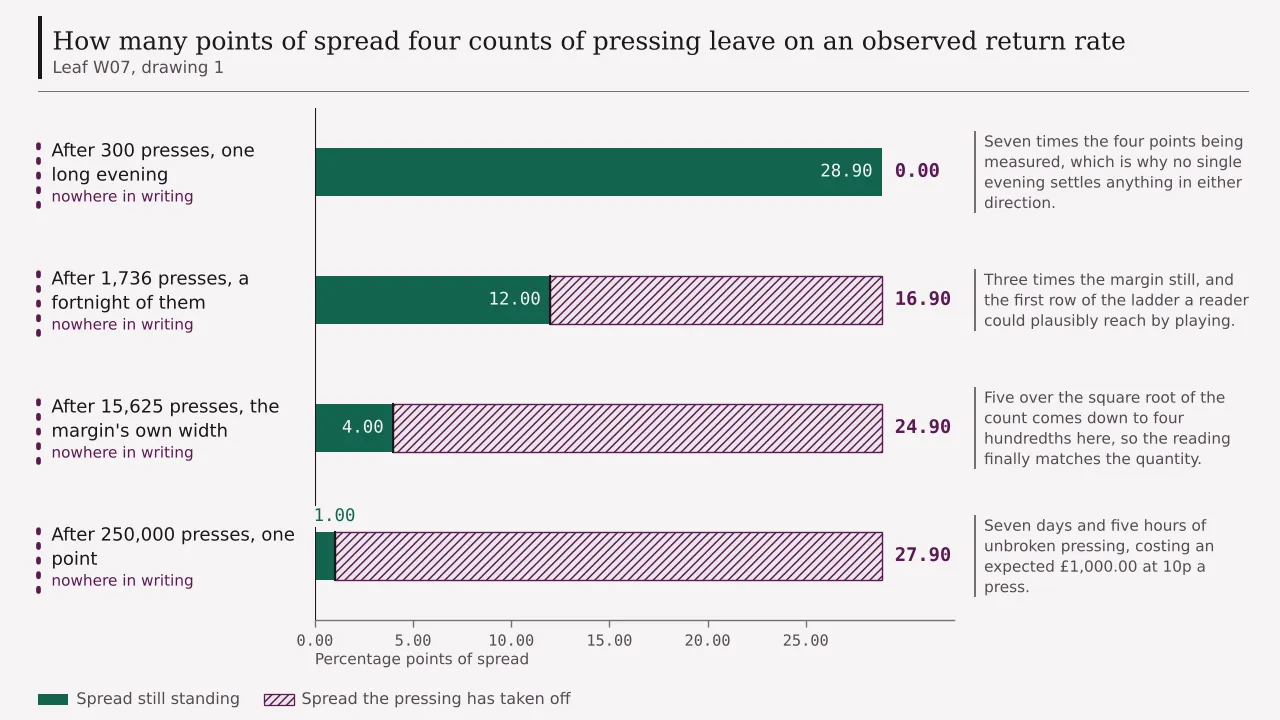
Read the solid lengths on that drawing as the part still unsettled and the hatched lengths as the part the pressing has bought. Nothing on it is a loss in pounds. It is a ledger of ignorance being paid off, at the prices tabled in part two.
5
Two points across a year of pressing, in pounds
Having established that a reader cannot measure the rate, turn the question round and ask what the rate is worth to them. Fix a year of play at 1,500 presses a week, which is this leaf’s own setting and roughly one long evening and one short one. Fifty-two weeks gives 78,000 presses, and at 10p that is £7,800.00 crossing the reels in twelve months.
At the 96 per cent this leaf holds, £7,800.00 of turnover gives back an expected £7,488.00, a cost of £312.00 for the year. Move the rate two points down to 94 and the same turnover gives back £7,332.00, a cost of £468.00. Move it two points up to 98 and the return is £7,644.00, a cost of £156.00. The year’s pressing has not changed by a single press and the cost has moved by half as much again in one direction and a third in the other.
A year read at the published ninety-six £7,488.00 The same year read two points under it £7,332.00 What two unprinted points cost in twelve months £156.00
A hundred and fifty-six pounds arrives twice over on this leaf, from two lines that share no step. Subtract the two expected returns and £7,488.00 less £7,332.00 is £156.00. Multiply the turnover by the two points directly, and two hundredths of £7,800.00 is £156.00 as well. The two agree exactly because the rate enters the arithmetic in one place only, which is also the reason the figure scales with turnover and with nothing else whatever.
Set that beside the sampling. The difference between two builds two points apart is worth £156.00 a year to a reader pressing at this rate. Telling those two builds apart by observation takes 62,500 presses, which is ten months of this reader’s year, and the pressing itself costs £250.00 in expectation at 96 per cent. Measuring the thing is more expensive than the thing is worth, by a factor of about one and a half, and that relation holds at every level of precision because the cost of the sample grows with the square while the value of the knowledge grows linearly.
Which leaves the published figure doing work no reader can do for themselves. Reading it closely is the only route, and that means reading the version as well as the number, since a build may hold more than one specified rate and a lobby rarely says which is loaded.
6
The same two points, set against a hundred pounds
The year in part five holds the pressing fixed and lets the money move. Turn it over and hold the money fixed instead, because that is the form in which the rate compounds and the compounding is the whole reason this one figure outweighs the rest.
Money at the reels is recycled. A press returns something, the something is staked again, and the balance declines in steps of four pence per pound rather than in one subtraction. Carry that through and a balance of B at a margin of m is expected to generate B divided by m of turnover before it is gone, which is the plainest expression of compounding available on this subject. A hundred pounds at four hundredths is £2,500.00 of turnover, which is 25,000 presses at 10p.
Now move the rate. At 98 per cent the margin is two hundredths and the same hundred pounds is expected to produce £5,000.00 of turnover, which is 50,000 presses. At 94 per cent the margin is six hundredths and the hundred pounds produces £1,666.67, which is 16,667 presses. Two points up doubles the pressing a deposit buys. Two points down cuts it by a third. Nothing else a reader can alter has that shape, because every other lever acts once and this one acts on every recycled pound.
| Rate the build is specified at | Turnover before the balance goes | Presses at 10p | How the figure is reached |
|---|---|---|---|
| 98 per cent | £5,000.00 | 50,000 | A hundred pounds divided by two hundredths |
| 97 per cent | £3,333.33 | 33,333 | A hundred pounds divided by three hundredths |
| 96 per cent, held throughout here | £2,500.00 | 25,000 | A hundred pounds divided by four hundredths |
| 95 per cent | £2,000.00 | 20,000 | A hundred pounds divided by five hundredths |
| 94 per cent | £1,666.67 | 16,667 | A hundred pounds divided by six hundredths |
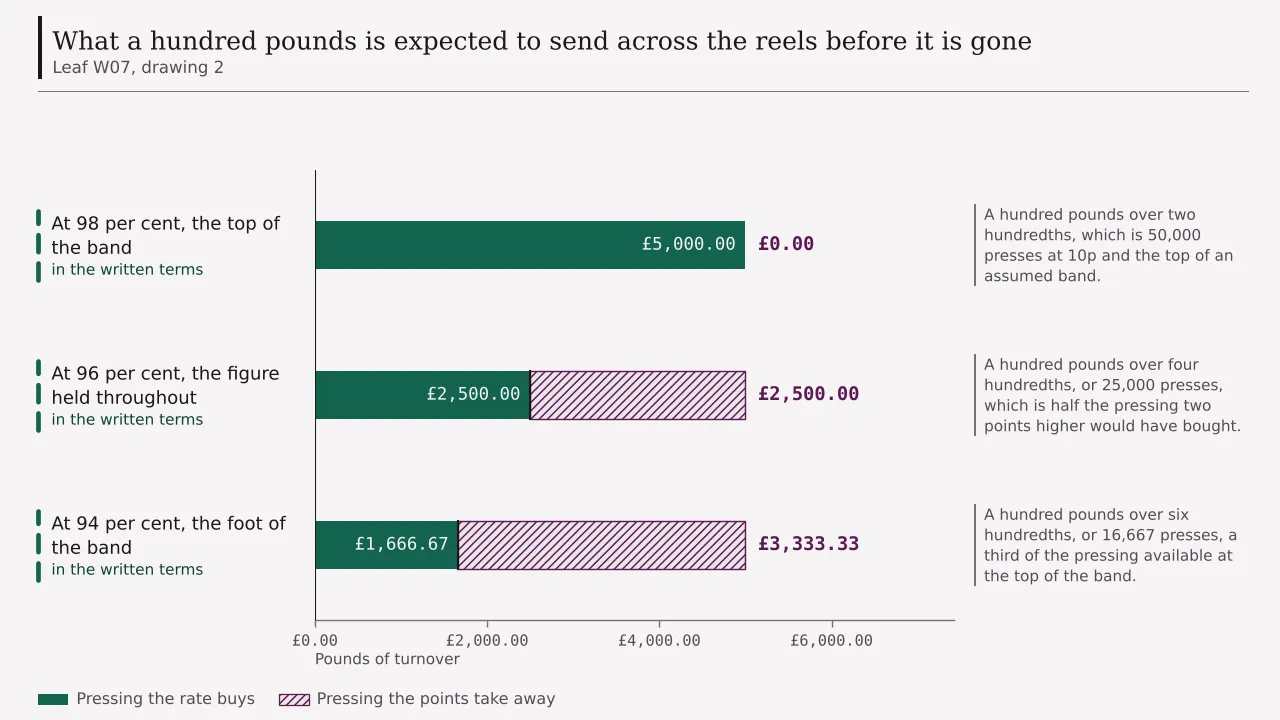
The figures in that drawing are turnover rather than loss, which matters for reading it honestly. A reader who presses until the balance is gone has lost the hundred pounds under every rate in the table. What the rate decides is how much pressing the hundred pounds bought on the way, and a build two points better hands over twice the pressing for the identical sum. Whether that is a benefit depends entirely on what somebody wanted the hundred pounds to do, and this leaf takes no view on that.
7
Levers a reader holds, and the one they do not
Three quantities decide what a year of pressing costs, and the arithmetic treats them identically: turnover is presses multiplied by stake, and cost is turnover multiplied by margin. A reader sets the first two and sets neither the third nor, in any useful sense, the choice among builds that would move it.
Halve the stake from 10p to 5p and the year’s turnover falls from £7,800.00 to £3,900.00, so the expected cost falls from £312.00 to £156.00. Halve the pressing from 1,500 a week to 750 and the identical thing happens. Both levers are real, both are entirely in a reader’s hands, and both work by buying less play. Moving the rate two points saves the same £156.00 and buys exactly as much play as before, which is the distinction worth holding on to: one lever changes the price of the thing, the other two change how much of the thing is bought.
Set out as a table the three levers look interchangeable, and they are not. The stake and the pressing are settled by whoever is playing and are settled nowhere in writing, since nothing anywhere records how often a given person presses. For the rate, the build’s own written terms settle it, in the written terms being an address a reader reaches before a penny moves. That is an odd reversal of the usual pattern on this site, where the reader’s own choices are the known quantities and the operator’s are not.
The reversal has a practical consequence. Of the three quantities, the one a reader cannot control is the one they can actually look up, and the two they control are the two they are least likely to have measured. Somebody who has never counted a week’s presses cannot name their own turnover, so the year’s expected cost is hidden from them by their own records rather than by anybody else’s drafting.
Two further levers are often reached for and neither does what it appears to do. Swapping builds between presses alters the rate from that press onward and alters nothing already spent, no build carrying any memory of the last. Stopping after a good run keeps the run and leaves the rate exactly where it was, the rate attaching to the next press and never to the balance. Both of those sit with the randomness requirement rather than with this leaf’s arithmetic.
The compounding in part six is what makes the rate the lever worth hunting for. A reader who cuts their pressing in half gets half the play. A reader who finds two points gets the same play at two thirds the cost and, on a fixed deposit, twice the pressing. Over a year on these settings the two are worth the same £156.00, and over a deposit they are not close.
8
Who is obliged to publish any of these quantities
Everything above leans on a published rate, so it is worth asking plainly who has to publish one and what the duty actually covers. In Great Britain the answer is a technical standard rather than a promise, and the standard is narrower than the argument this leaf has built on it.
A licensed build owes an account of its own rules, reachable ahead of any commitment, accurate, wide enough to cover every rule in force, and written with sensible effort put into being understood. A second strand owes the same early reach to the prizes and to the method by which the sums are arrived at. Those two obligations are why a rules screen exists, and they put the percentage in a published standard as a matter of duty while the number itself lives inside the build.
A third strand quietly carries this leaf’s long-run argument. Neither the rules, nor what pays, nor the odds on anything paying may be shifted about while a build is live, and a shift that does occur has to be set before the customer, the regulator’s guidance picking out as unacceptable a clause keeping an open-ended right to revise. Take that away and part one’s average is an average over a specification free to move under a reader mid-run, which makes 25,000,000 presses a sample of nothing.
A fourth strand is easy to pass over. What the build did, and what the customer’s own gamble did, has to reach the screen plainly and correctly and stay there long enough for somebody to take in. An outcome that cannot be read is more than an irritation. It is a press that occurred with no way for a reader to write it down, and nobody assembles part two’s sample out of presses they could not record.
Nobody advertising incentives wrapped round reel play like this is holding a Great Britain licence, and the loss that bites on a subject as narrow as a long-run figure is the loss of the four strands worked through just now, rather than the ones usually listed. Take away the account of the rules owed ahead of a commitment, and the percentage this leaf imports has no compelled source. Take away the early reach to the prizes and to how the sums are arrived at, and the spread the percentage averages over stops being describable. Take away the bar on shifting rules, payouts and odds while a build is live, and the figure stops describing one specification. Take away results that stay on the screen long enough to take in, and part two’s sample cannot be gathered by hand. Not one strand promises anybody a good run. Together they settle whether the number at the head of this leaf refers to anything.
Two honest qualifications attach. The first is that the disclosure strand hands a licensee four ways to discharge it and leaves the choice with the licensee: set out the mechanics and how a winner is arrived at; print the margin; print the return; or print the odds on whichever events pay. Any single one closes the obligation, so a licensed build need not carry the number this leaf works with, and where something else is carried the arithmetic above gets rebuilt from whatever was given. The second is that an offshore rulebook consulted for this site does want the conditions on a bonus stated openly and does forbid promotion pushed aggressively, so the ground outside a British licence is not bare. On randomness, on disclosure and on changes made mid-play it holds nothing whatever.
9
Three quantities the percentage quietly rests on
Three numbers have been carried through this leaf without a source, and each is marked where it is spent. Collecting them in one place is the honest close to the argument, because an assumption used ten times and admitted once is not admitted at all.
The first is the spread of a single press, taken at five times the stake in part two. Nothing obliges anybody to publish it, no primary source this site can cite states a typical value, and it is the quantity the entire sample-size ladder turns on. Raise it to eight stakes and the count needed for a four-point reading rises from 15,625 to 40,000. Lower it to three and the count falls to 5,625. The shape of the argument survives every setting, since the square-root law does not care about the constant, but the specific counts move by the square and the table says so.
The second is the press value. This site assumes ten pence everywhere and no rule fixes it, so the turnover figures and every cost drawn out of them scale straight with it. A reader pressing at 20p takes a year’s turnover to £15,600.00 and the cost of two points to £312.00, while not one row of part two moves, a count of presses being a count of presses whatever each costs. The asymmetry is worth noticing: raising the stake makes the rate matter more and makes it no easier to establish.
The third is the pace at which a reader presses. Part two converted counts into hours using the published floor for a licensed build, and that floor is a public record. Away from a British licence nothing fixes it, so the same 15,625 presses might occupy ten hours and fifty-one minutes or a fraction of that, and the hours column becomes a statement about a rule rather than about a reader. Nothing in the money arithmetic changes when the pace does. What changes is how quickly the turnover is reached, which moves the cost of a year without moving the cost of a press.
A fourth absence is not a number and deserves naming anyway. A build may be specified at more than one rate, with the loaded version a matter between the operator and the supplier, and a lobby is not obliged to say which one a reader has in front of them. Where that is so, the figure on the rules screen is accurate about the version it describes and silent about whether that is the version running, which puts the whole question back at nowhere in writing for a reader who cannot check the two against each other.
Taken together the four silences do not undermine the published figure. They fix what it can be used for. It supports the arithmetic in parts five and six, which is about turnover and compounding and needs only the rate. It does not support any statement about an evening, a week or a deposit’s actual fate, and the counts in part two are the measure of how far it falls short of that.
10
Reading a published rate without over-reading it
The procedure below is short and needs none of this leaf’s own settings, only its shape. Find the figure, convert it into a margin, multiply the margin by whatever turnover is actually in prospect, and stop there. Every error on this subject comes from carrying the figure past the point where it is a statement about turnover.
Step one, locate the number and the version it belongs to. The rules screen is the place, it is one movement from the lobby, and a build carrying a range rather than a single figure is telling a reader that more than one specification exists. Where only a house edge or a set of event probabilities is given, convert: an edge of four per cent is a return of ninety-six, and the arithmetic that follows is identical.
Step two, turn the percentage into pence. Ninety-six per cent is four pence a pound, and four pence a pound is the only form in which the figure multiplies cleanly. A reader who holds the figure as a percentage keeps reaching for the wrong operation, because ninety-six per cent sounds like a proportion of a deposit and is a proportion of turnover, and those two are a factor of twenty-five apart on a balance played through.
Step three, estimate turnover honestly rather than optimistically. Presses a week times fifty-two times the stake. On this leaf’s settings that is 78,000 presses and £7,800.00, against a deposit a reader might think of as the sum at stake. Turnover is the quantity the margin acts on and it is routinely twenty or thirty times whatever a reader would name as what they are spending.
Step four, do the two subtractions and print both. What the year costs at the published rate, what it costs two points away, and the difference. On these settings £312.00, £468.00 and £156.00. That last figure is what the published number is worth to a reader, and it is worth exactly that whether or not the reader ever manages to confirm the rate by playing, which they will not.
Two habits keep the method from drifting. Write the assumed spread down whenever a sample size is quoted, since a count of presses with no spread behind it is a number with no derivation. And keep turnover and deposit in separate columns permanently, because the single most expensive confusion on this subject is multiplying a margin by a deposit, which understates the cost by whatever factor the balance was recycled through.
What a reader is left with is narrow and genuinely useful. A published rate will not tell them how an evening goes, cannot be checked by playing at any sane price, and does predict the cost of a year’s turnover to the penny. The honest use of it is the third of those, and the honest description of the first two is that the figure was never about them.
Questions
- What does a 96 per cent return figure actually promise?
- Nothing about any session. It reports the average theoretical proportion of staked money a build is designed to return across its whole set of outcomes, including the rare ones that carry a large share of the total. In money, with the 10p press this site assumes, the margin keeps four pence in each staked pound, so £30.00 of turnover gives back an expected £28.80. The figure sits in the build’s own rules screen, one movement from the lobby, and it is true about a span no reader reaches.
- How many spins would it take to check a return rate by playing?
- On this leaf’s own assumption that a single press scatters about five times the stake, the spread on an observed rate is five over the square root of however many presses have been made. Getting that down to the four points the margin occupies takes 15,625 presses. One point takes 250,000. To settle it inside a tenth of a point takes 25,000,000. The counts climb by the square because the uncertainty falls by the square root, and a different assumption about spread moves every one of them in proportion to its square.
- What would taking that sample cost?
- £62.50 for a reading accurate to four points, £1,000.00 for one point and £100,000.00 for a tenth of a point, all in expectation at 96 per cent and 10p a press. Those come from 15,625, 250,000 and 25,000,000 presses sending £1,562.50, £25,000.00 and £2,500,000.00 across the reels. Leave the turnover out, multiply the press count by the stake and then by the margin, and the same three figures appear, which is how a subtraction here gets checked.
- Can one evening at the reels tell me anything about the build?
- No, in both directions. Three hundred presses carry a spread on the observed rate of 28.9 points, which is a little over seven times the four points being measured, and one standard swing on the money is £8.66 against an expected cost of £1.20. A session ending £20.00 down is inside the ordinary range of a build working exactly to specification, and a session ending ahead says just as little. The two errors are the same mistake committed from opposite directions.
- How much is two percentage points of return worth over a year?
- £156.00 on this leaf’s settings of 1,500 presses a week at 10p, which is 78,000 presses and £7,800.00 of turnover in twelve months. At 96 per cent that year is expected to cost £312.00 and at 94 per cent £468.00. The £156.00 arrives twice from lines sharing no step: subtract the two expected returns of £7,488.00 and £7,332.00, or take two hundredths of the turnover directly. Both give the same answer because the rate enters the arithmetic once.
- Why is the return called the figure that compounds?
- Because money at the reels is recycled rather than spent once. A balance of B at a margin of m is expected to generate B divided by m of turnover before it is gone, so £100.00 produces £2,500.00 of turnover at 96 per cent, £5,000.00 at 98 and £1,666.67 at 94. In presses at 10p that is 25,000, 50,000 and 16,667. Two points up doubles the pressing a deposit buys and two points down cuts it by a third, which no other quantity a reader can alter does.
- Would halving my stake do as much as finding two points?
- Over a year of fixed pressing, yes, and the two still differ. Halving the stake from 10p to 5p takes the year’s turnover from £7,800.00 to £3,900.00 and the cost from £312.00 to £156.00, which is the identical saving. The difference is that halving the stake buys half the play while two points of return buy the same play at two thirds the cost, and on a fixed deposit the two points buy twice the pressing rather than the same amount.
- Is a licensed site obliged to publish a return percentage?
- Not specifically. The disclosure strand hands a licensee four ways to discharge it and leaves the choice with the licensee: set out the mechanics and how a winner is arrived at; print the margin; print the return; or print the odds on whichever events pay. Any single one closes the obligation. Where a margin is given instead, convert it, an edge of four per cent being a return of ninety-six, after which every line of arithmetic on this leaf stands unchanged.
- What rules keep a published rate meaning the same thing while I play?
- Two strands, and the long-run argument on this leaf leans on both. Neither the rules, nor what pays, nor the odds on anything paying may be shifted about while a build is live, a shift that does occur has to be set before the customer, and the guidance picks out as unacceptable a clause keeping an open-ended right to revise. Separately, what the build did and what the customer’s gamble did has to reach the screen plainly and stay there long enough to take in. Lose the first and the average covers a specification free to move; lose the second and the presses part two would count cannot be written down.
- What is given up where reel play like this sits outside the British licence?
- Four strands about writing and display, none of them a promise about outcomes. An account of a build’s rules, accurate and complete and reachable ahead of any commitment. The same early reach to the prizes and to how the sums are arrived at. A bar on shifting the rules, what pays or the odds about while the build is live. And results that reach the screen plainly and stay long enough to take in. Strip the set out and the percentage has no compelled source, the spread it averages over stops being describable, and the sample that would settle it cannot be gathered by hand.
- What should I actually do with a published return figure?
- Convert it to pence in the pound, multiply by the turnover genuinely in prospect, and stop. Ninety-six per cent is four pence a pound. Presses a week times fifty-two times the stake gives turnover, which on this leaf’s settings is £7,800.00 and is routinely twenty or thirty times what a reader would name as the sum they are spending. Print the cost at the published rate, print it two points away, and rule off the difference. The figure predicts that and nothing about an evening.