Terms read 19 October 2026 Leaf W11, revision 1
One penny of return is the whole question, and nobody prints it twice
A credit of £40.00 turned over forty times carries £1,600.00 across the reels and closes at an expected minus £24.00 where 96 pence comes back in the pound. Take one penny off that return and the close becomes minus £40.00. The gap is £16.00, and no source anywhere states the return for a handset build or for a desk build, let alone for both.
Stated on the banner £40.00 A credit figure, carrying no statement at all about which build of which reel it is going to be spent across. Stated, once you go and look minus £24.00 Forty times written into a clause, worked here where the reels give back 96 of every 100 pence. Not stated before the money goes in Four quantities The return, the swing, the frequency of a paying result and the contribution rate, none of them published for either build.
Reel credits claimed on a handset, with the conditions read
Every destination in this file is bought advertising. The site is paid a fee if a reader goes on to register, and no figure printed below moves because of it.
Bonus Spins UK Slip 01
Betportal
Ceiling as a multiple
The drop
€15.00
€1.00 in the euro
The claim reads €15.00. Once the terms beside it have applied, €0.00 of it can leave. The difference is the drop.
7 of the 15 terms on this slip could not be read before the money went in
Spins priced at this site's own 10p a spin, which the operator does not publish
Stated
€15.00
The claim as it is printed, before a single term has been applied to it.
Headline paid as spins
150 spins at 10c each, which is €15.00 of the figure above.
6 Nowhere
What one spin is worth
No unit is published for a spin, so the count is priced at this site's own 10p a spin. At half that price every figure below halves with it.
Match and other credit not priced
300% of three deposits, to a ceiling of €1,000. A share of a deposit nobody has made yet is not a sum, so no figure stands on this line and none is carried below.
Qualified
-€14.40
Written down somewhere, and taking part of the claim back. Each term carries the place it is written and the sum it takes.
2 Written terms at a distance this record does not establish
Play-through -€14.40
Carrying €14.40 through 35 times stakes €504.00 and costs €20.16 of it at 96 per cent return. That prices above the €14.40 there is to charge it against, so the whole of the credit goes and the line is held at that. The multiple sits on the bonus.
2 Written terms at a distance this record does not establish
Game weighting not priced
Slots only count towards the play-through. No contribution percentage is published, so the line above has been worked at full weight, which is the kindest reading there is.
2 Written terms at a distance this record does not establish
Ceiling on the winnings not priced
5x the bonus.
2 Written terms at a distance this record does not establish
Clock on the credit not priced
14 days.
2 Written terms at a distance this record does not establish
Largest stake while it runs not priced
€5.
3 Public record
Licence, and who holds it not priced
Licensed in Anjouan, Comoros, held by BetPortal Gaming Ltd, with Excite Ultra Media Ltd, reference ALSI-202601040-FI2. A register entry settles who holds a licence and what it permits. It does not settle who is running the site this morning.
4 Cashier
Smallest qualifying deposit your money
€20 a stage. That is €20.00 of your own money, and it is never netted into a drop.
5 On the way out
Checks before a withdrawal not priced
Documents before the first withdrawal.
Unstated
-€0.60
Applying without having been published anywhere, and costing money all the same.
6 Nowhere
What a spin hands back -€0.60
Staking a spin returns 96 per cent of it, so that share of the batch is the house's before a reel turns. This site works at that return and the operator publishes none where the claim is made.
6 Nowhere
Forfeited by rule cost unknown
Nothing is published under this heading, and it applies regardless.
6 Nowhere
Charge on the way out cost unknown
No charge on the way out is published as a figure, so nothing comes off this line. A charge that exists unpublished would come straight off whatever survives.
6 Nowhere
Smallest withdrawal allowed cost unknown
No smallest withdrawal is published as a figure. A floor nobody has published is still a floor, and it decides whether a small balance can move at all.
No Great Britain licence
Terms read 19 October 2026
Bonus Spins UK Slip 02
WinBeast
Ceiling as a sum
The drop
€50.00
€1.00 in the euro
The claim reads €50.00. Once the terms beside it have applied, €0.00 of it can leave. The difference is the drop.
8 of the 15 terms on this slip could not be read before the money went in
Spins priced at this site's own 10p a spin, which the operator does not publish
Stated
€50.00
The claim as it is printed, before a single term has been applied to it.
Headline paid as spins
500 spins at 10c each, which is €50.00 of the figure above.
6 Nowhere
What one spin is worth
No unit is published for a spin, so the count is priced at this site's own 10p a spin. At half that price every figure below halves with it.
Match and other credit not priced
50% to 100% of five deposits, each to a ceiling of €1,000, and a €650 free bet. A share of a deposit nobody has made yet is not a sum, so no figure stands on this line and none is carried below.
Qualified
-€48.00
Written down somewhere, and taking part of the claim back. Each term carries the place it is written and the sum it takes.
2 Written terms at a distance this record does not establish
Play-through -€48.00
Carrying €48.00 through 40 times stakes €1,920.00 and costs €76.80 of it at 96 per cent return. That prices above the €48.00 there is to charge it against, so the whole of the credit goes and the line is held at that. The multiple sits on the bonus and the winnings from the spins.
2 Written terms at a distance this record does not establish
Game weighting not priced
Slots, titles vary by country count towards the play-through. No contribution percentage is published, so the line above has been worked at full weight, which is the kindest reading there is.
2 Written terms at a distance this record does not establish
Ceiling on the winnings not priced
€100 a batch of spins.
2 Written terms at a distance this record does not establish
Clock on the credit not priced
7 days, spins 1 day.
3 Public record
Licence, and who holds it not priced
Licensed in Curaçao, holder not named on the site. A register entry settles who holds a licence and what it permits. It does not settle who is running the site this morning.
4 Cashier
Smallest qualifying deposit your money
€20 a stage. That is €20.00 of your own money, and it is never netted into a drop.
5 On the way out
Checks before a withdrawal not priced
Documents before the first withdrawal.
Unstated
-€2.00
Applying without having been published anywhere, and costing money all the same.
6 Nowhere
What a spin hands back -€2.00
Staking a spin returns 96 per cent of it, so that share of the batch is the house's before a reel turns. This site works at that return and the operator publishes none where the claim is made.
6 Nowhere
Largest stake while it runs cost unknown
Nothing is published under this heading, and it applies regardless.
6 Nowhere
Forfeited by rule cost unknown
Nothing is published under this heading, and it applies regardless.
6 Nowhere
Charge on the way out cost unknown
No charge on the way out is published as a figure, so nothing comes off this line. A charge that exists unpublished would come straight off whatever survives.
6 Nowhere
Smallest withdrawal allowed cost unknown
No smallest withdrawal is published as a figure. A floor nobody has published is still a floor, and it decides whether a small balance can move at all.
No Great Britain licence
Terms read 19 October 2026
Bonus Spins UK Slip 03
EliteSpin
Longest spin window
The drop
£50.00
£1.00 in the pound
The claim reads £50.00. Once the terms beside it have applied, £0.00 of it can leave. The difference is the drop.
8 of the 15 terms on this slip could not be read before the money went in
Spins priced at this site's own 10p a spin, which the operator does not publish
Stated
£50.00
The claim as it is printed, before a single term has been applied to it.
Headline paid as spins
500 spins at 10p each, which is £50.00 of the figure above.
6 Nowhere
What one spin is worth
No unit is published for a spin, so the count is priced at this site's own 10p a spin. At half that price every figure below halves with it.
Match and other credit not priced
50% to 100% of five deposits, each to a ceiling of £1,000. A share of a deposit nobody has made yet is not a sum, so no figure stands on this line and none is carried below.
Qualified
-£48.00
Written down somewhere, and taking part of the claim back. Each term carries the place it is written and the sum it takes.
2 Written terms at a distance this record does not establish
Play-through -£48.00
Carrying £48.00 through 40 times stakes £1,920.00 and costs £76.80 of it at 96 per cent return. That prices above the £48.00 there is to charge it against, so the whole of the credit goes and the line is held at that. The multiple sits on the bonus and the winnings from the spins.
2 Written terms at a distance this record does not establish
Game weighting not priced
Slots count towards the play-through. No contribution percentage is published, so the line above has been worked at full weight, which is the kindest reading there is.
2 Written terms at a distance this record does not establish
Ceiling on the winnings not priced
5x the bonus.
2 Written terms at a distance this record does not establish
Clock on the credit not priced
7 days, spins 3 days.
3 Public record
Licence, and who holds it not priced
Licensed in Costa Rica, held by PrimeTier Limited. A register entry settles who holds a licence and what it permits. It does not settle who is running the site this morning.
4 Cashier
Smallest qualifying deposit your money
£20 a stage. That is £20.00 of your own money, and it is never netted into a drop.
5 On the way out
Checks before a withdrawal not priced
Documents before the first withdrawal.
Unstated
-£2.00
Applying without having been published anywhere, and costing money all the same.
6 Nowhere
What a spin hands back -£2.00
Staking a spin returns 96 per cent of it, so that share of the batch is the house's before a reel turns. This site works at that return and the operator publishes none where the claim is made.
6 Nowhere
Largest stake while it runs cost unknown
Nothing is published under this heading, and it applies regardless.
6 Nowhere
Forfeited by rule cost unknown
Nothing is published under this heading, and it applies regardless.
6 Nowhere
Charge on the way out cost unknown
No charge on the way out is published as a figure, so nothing comes off this line. A charge that exists unpublished would come straight off whatever survives.
6 Nowhere
Smallest withdrawal allowed cost unknown
No smallest withdrawal is published as a figure. A floor nobody has published is still a floor, and it decides whether a small balance can move at all.
No Great Britain licence
Terms read 19 October 2026
Bonus Spins UK Slip 04
Crown Jewelz
Multiple unpublished
The drop
NOT WORKED
The multiple is not published in the operator's own terms. Since the sum cannot be worked around it, none is worked.
9 of the 14 terms on this slip could not be read before the money went in
No drop worked
Stated
£15.00
The claim as it is printed, before a single term has been applied to it.
Headline paid as spins
150 spins at 10p each, which is £15.00 of the figure above.
6 Nowhere
What one spin is worth
No unit is published for a spin, so the count is priced at this site's own 10p a spin. At half that price every figure below halves with it.
Match and other credit not priced
200% of the first deposit, then 150% twice, each to a ceiling of £1,000. A share of a deposit nobody has made yet is not a sum, so no figure stands on this line and none is carried below.
Qualified
NOT WORKED
Written down somewhere, and taking part of the claim back. Each term carries the place it is written and the sum it takes.
2 Written terms at a distance this record does not establish
Play-through not priced
40x the bonus, reported rather than published by the operator.
2 Written terms at a distance this record does not establish
Game weighting not priced
Slots count towards the play-through. No contribution percentage is published, so the line above has been worked at full weight, which is the kindest reading there is.
3 Public record
Licence, and who holds it not priced
Licensed in Curaçao, number not verified, holder not named on the site. A register entry settles who holds a licence and what it permits. It does not settle who is running the site this morning.
4 Cashier
Smallest qualifying deposit your money
£20. That is £20.00 of your own money, and it is never netted into a drop.
5 On the way out
Checks before a withdrawal not priced
Documents before the first withdrawal.
Unstated
NOT WORKED
Applying without having been published anywhere, and costing money all the same.
6 Nowhere
Ceiling on the winnings cost unknown
No ceiling is published. Nothing is assumed in its place.
6 Nowhere
Clock on the credit cost unknown
Nothing is published under this heading, and it applies regardless.
6 Nowhere
Largest stake while it runs cost unknown
Nothing is published under this heading, and it applies regardless.
6 Nowhere
Forfeited by rule cost unknown
Nothing is published under this heading, and it applies regardless.
6 Nowhere
Charge on the way out cost unknown
No charge on the way out is published as a figure, so nothing comes off this line. A charge that exists unpublished would come straight off whatever survives.
6 Nowhere
Smallest withdrawal allowed cost unknown
No smallest withdrawal is published as a figure. A floor nobody has published is still a floor, and it decides whether a small balance can move at all.
No Great Britain licence
Terms read 19 October 2026
Every figure in the second and third columns is this site's own working and nothing an operator has published. A claim is priced as printed, then the share a spin hands back at 96 per cent return comes off it, then what playing the multiple through costs at the same return, and then whatever a published ceiling, a charge on the way out or a floor on the smallest withdrawal takes from what has survived. The drop is the difference between the first figure and the last. The two columns add back up to it exactly, so no money leaves a slip without a term and a place beside it.
Which column a term falls in is settled by one question: has anybody written it down. A charge a reader meets at the payment screen is written down, and it stands in the second column with the cashier against it. A condition that binds without ever having been set down stands in the third, whatever it costs. Inside each column the terms run outwards from the banner, so the order itself says how far a reader would have had to go.
A count of spins has no unit until one is supplied. Where an operator publishes what one of its own spins is worth, that figure is used and the first column says it is theirs. Where none is published, this site's own 10p a spin stands in its place and every figure below moves in proportion with it. Where the multiple itself is unpublished, no drop is worked at all, because that is the one figure the sum cannot be done without.
Three words stand where a figure cannot. Not priced is a term that is written down and carries no number the arithmetic can take. Cost unknown is a term nobody has written down, costing something nobody has put a number on. Your money is money of the reader's own, which is never netted into a drop.
None of the operators in this file holds a Great Britain licence, so none of the duties that licence carries reaches them. Each of those duties is published in its own right, which is what makes its absence here something a reader can check rather than take on trust. Every gambling company licensed in Great Britain belongs to Gamstop Online, so a reader who has shut themselves out through the scheme is not shut out here. Social Responsibility Code 5.1.1 has held a play-through to a maximum of ten times the bonus funds since 19 January 2026, and it binds a licence holder and nobody else. Asked in a post of 21 October 2025 what is lost along with the licence, the Gambling Commission's Director of Enforcement and Intelligence answered: "unfair gaming practices, financial loss, and a lack of recourse if things go wrong". The same post puts blocked payouts, and withdrawal limits pitched high enough to be unreachable, among the behaviour the Commission has recorded. Nobody under 18 may hold an account at any of them.
Terms are reproduced in the wording their operator published, and each slip is dated with the day somebody sat down and read them. 19 October 2026 is the oldest of those dates. Anybody claiming an offer is bound by that operator's full terms, which are elsewhere, and never by a line standing here.
1
The only question a handset genuinely raises about a reel
A sibling page in this part of the site settles what a smaller screen does to a cashier and to a conditions document, and the answer there is that it moves two quantities and leaves a long list alone. This page asks something narrower and harder, about the build rather than about the till: could the reel itself be a different machine, and would anybody be able to tell.
Set the arithmetic down first so the question has something to be worth. A credit of £40.00 under a forty times clause asks £1,600.00 to cross the reels. Where 96 pence comes back in each pound, the margin keeps £64.00, which puts the expected close at minus £24.00. Every figure in that sentence rests on the return, and the return is the quantity under examination.
Now suppose the handset build of the same reel returned 95 pence rather than 96. The staking is unchanged at £1,600.00, because a clause counts pounds and not builds. The margin now keeps £80.00. The close is minus £40.00. One penny of return, laid over the obligation a written clause already created, has moved the answer by £16.00.
That £16.00 is the whole stake of the argument and it is worth seeing how small the input was. Nothing about the clause changed. Nothing about the credit changed. Nothing about the count of presses changed. A single hundredth, in a quantity nobody is obliged to print, carried four tenths of the credit with it.
So the page has three jobs and they come in order. Work out which of the figures behind a press could in principle differ between a build drawn for a desk and a build drawn for a hand. Work out which of those anybody publishes, and whether any of them is published twice over, once for each. Then price the gap the second answer leaves.
The conclusion is given here rather than withheld, because a reader deciding whether to read on deserves it. Almost nothing is published per device. Of the quantities that could differ, the expensive ones are published nowhere for any build and the cheap ones are published inside whichever build is being held. The question therefore sits nowhere in writing, which is the sixth place and the only one with no address.
2
Eight quantities behind one press, and which could differ by build
Take a press apart into the quantities that decide what it does. Each one gets three questions: could two builds of one reel honestly carry different values for it, does anybody publish it at all, and is it ever published once for a desk and once for a hand. The third column is the one that empties out.
| Quantity behind a press | Could two builds differ | Where it is settled | Published once per device |
|---|---|---|---|
| Proportion of staking handed back over the long run | In principle, yes | nowhere in writing | No |
| Violence of the swing around that proportion | In principle, yes | nowhere in writing | No |
| How often a press returns anything at all | In principle, yes | nowhere in writing | No |
| Share of staking counted towards a wagering clause | In principle, yes | nowhere in writing | No |
| The schedule of prizes against combinations | In principle, yes | in the game’s own rules | Effectively, yes |
| The rungs a stake may be set to | In principle, yes | in the game’s own rules | Effectively, yes |
| Shortest interval before another cycle opens | Not on a licensed build | in a published rule | Not applicable |
| Largest sum one cycle may take | Not on a licensed build | in a published rule | Not applicable |
The table splits three ways rather than two, which is the useful result. Four quantities could differ and are published nowhere whatever the screen. Two could differ and are readable inside whichever build is open, which makes them per-device in the only sense that pays. Two could not differ at all, because a published rule holds them.
Notice where the money is. The first four rows carry the return, the swing, the frequency of a paying result and the contribution rate, which between them decide the whole of what £1,600.00 of staking does. The two readable rows carry a prize schedule and a ladder of stake rungs, which decide how a press is configured rather than what it is worth in expectation.
So the quantities a reader can settle for their own build are precisely the ones that matter least to the subtraction, and the quantities that decide the subtraction are settled for nobody. That is the same ordering this site keeps meeting, arriving here through a question about hardware rather than through a question about documents.
Four quantities capable of differing between two builds, and none of the four stated for either
One row deserves a note before the arithmetic starts. The contribution rate sits in the first group here although other pages on this site put it in a schedule a reader can sometimes open. Both are true: where a table of rates exists it can be read, and it is published for a game rather than for a rendering of a game, so it answers nothing about the question this page is asking.
3
What a single penny of return is worth, computed twice
Price the first row of the table, because it is the expensive one and because it can be priced exactly. Hold the credit at £40.00 and the clause at forty times, so the staking stays at £1,600.00 whatever the return is. Then move the return by one penny in the pound and watch what the obligation does with it.
Route one works through the credit. At 96 pence back, forty lots of four hundredths add to 1.6, a credit holds whatever one less that comes to, and six tenths of £40.00 pointing downwards is minus £24.00. At 95 pence back, forty lots of five hundredths add to 2.0, so the whole £40.00 points downwards. The two closes are minus £24.00 and minus £40.00.
Expected close at the 96 pence per pound assumed here minus £24.00 Expected close one penny of return below that minus £40.00 What a quantity published for no device is worth £16.00
Route two never touches the credit at all. Take the staking on its own: £1,600.00 should come back as £1,536.00 where 96 of every 100 pence returns, and as £1,520.00 where 95 do. The difference between those is £16.00, which is the same figure the credit route produced, reached without the credit appearing anywhere in the working.
Expected return on £1,600.00 of staking at 96 pence £1,536.00 Expected return on the identical staking at 95 pence £1,520.00 The same sixteen pounds, reached without the credit £16.00
Two blocks printing one figure is not decoration. The first route could be wrong if the house formula were misapplied; the second could be wrong if the staking were miscounted; they share no step and they agree, which is as much verification as arithmetic of this kind admits of. Both rest on the 10p press, the 96 pence return and the forty times clause this leaf assumes, and on nothing else.
Reduce the figure to its smallest form and it becomes portable. One penny of return across one pound of staking is a penny. At the 10p press this site assumes, that is one tenth of a penny per press, which is £1.00 for every thousand presses. The device question has exactly that price and no other, however large the credit on the advertisement happens to be.
| Pence back in the pound | Staking the clause asks | Kept by the margin | Expected close on the credit | Distance from the printed claim |
|---|---|---|---|---|
| 97 pence | £1,600.00 | £48.00 of it | minus £8.00 | £48.00 |
| 96 pence | £1,600.00 | £64.00 of it | minus £24.00 | £64.00 |
| 95 pence | £1,600.00 | £80.00 of it | minus £40.00 | £80.00 |
| 94 pence | £1,600.00 | £96.00 of it | minus £56.00 | £96.00 |
Three pence of range across those rows moves the close by £48.00, which is £16.00 a penny all the way down the column and is therefore linear. A reader who cannot establish the return to within a penny cannot establish the close to within £16.00, and a reader who cannot establish it to within three pence cannot establish the close to within £48.00.
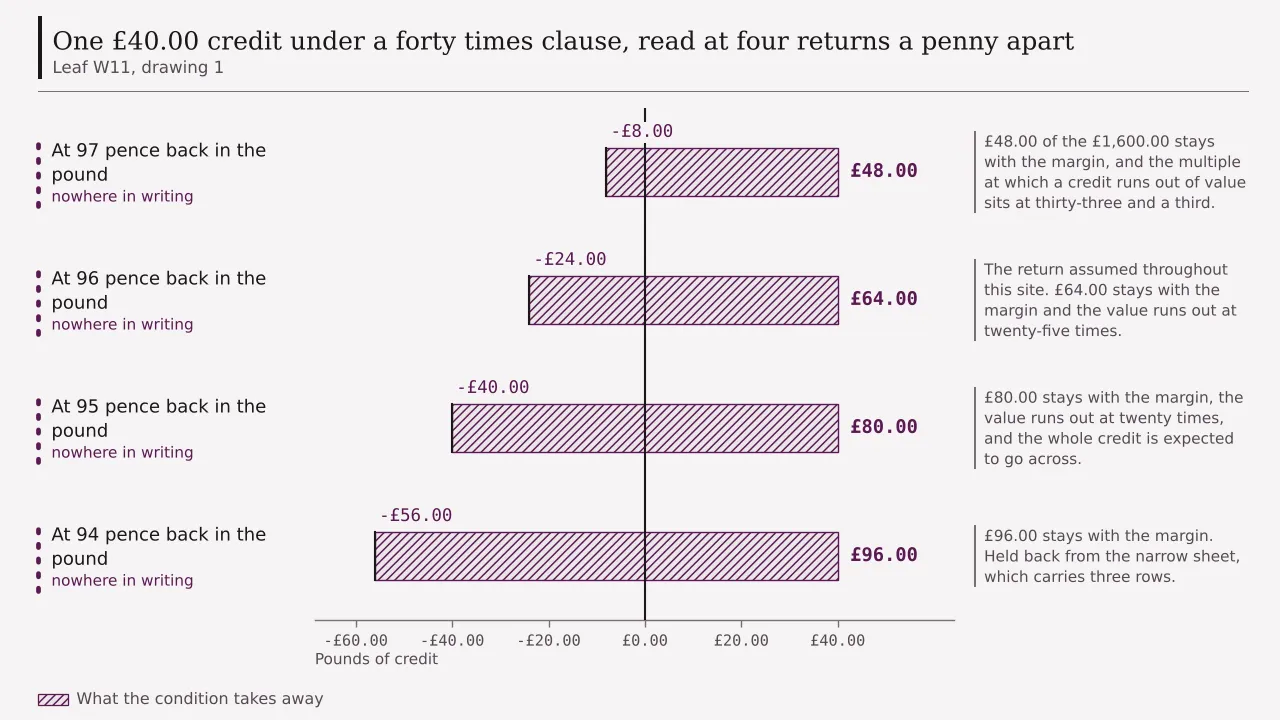
Every bar on that drawing carries the same rule down its left side, because every one of the four readings is settled in the same place, which is nowhere. The drawing therefore prices a spread rather than a condition, and the spread exists because an input is missing rather than because a clause is harsh.
4
The break-even travels with the return, and travels by five
The multiple where a credit’s value runs out is not a market figure. It is however many times the margin goes into a pound, so at 96 pence back it is twenty-five, at 95 pence twenty, at 97 pence thirty-three and a third, and at 94 pence sixteen and two thirds. That single column does more damage to the device question than anything else on this page.
| Pence back in the pound | Multiple at which nothing survives | What a clause of 20 times leaves |
|---|---|---|
| 97 pence | 33.33 times | 40 per cent of the credit |
| 96 pence | 25 times | 20 per cent of the credit |
| 95 pence | 20 times | Nothing at all |
| 94 pence | 16.67 times | Minus 20 per cent of the credit |
Read the last column downwards and a clause of twenty times is generous, thin, exactly worthless and actively costly, in that order, without one word of the clause being altered. The written condition is a constant across all four rows. What moves it from generous to costly is an unpublished property of whichever build the credit is spent across.
Put the same point in the units a reader has. Somebody holding a twenty times clause cannot say whether 40 per cent of their credit survives or whether 20 per cent of it is owed, and the entire difference between those two answers is three pence of return. On a £40.00 credit that spread runs from plus £16.00 to minus £8.00, which is £24.00 of uncertainty attached to a condition that reads as perfectly definite.
This is the sharpest consequence of the absence and it is worth stating in one line. The multiple is published and the figure that makes it meaningful is not, so a published multiple is an incomplete statement rather than a term a reader can price, and it is incomplete by the same amount on either build.
Say the honest qualification alongside it. A difference of three pence between two renderings of one reel is this page’s illustration, chosen to show the mechanics at a size that can be read, and nothing found for this site suggests a spread of that size exists between builds. The arithmetic shows what the question is worth if the answer is not nought. It does not claim that the answer is not nought.
5
Figures a build is not free to vary, and what pins them
Two of the eight quantities cannot differ between renderings on a licensed build, and the reason is worth following because it shows what a published rule is good for. Inside the British licence a reel build keeps 2.5 seconds in hand before another cycle may begin. That interval attaches to a game cycle, and a game cycle is a thing the game does rather than a thing the screen does.
Work it out in this page’s own figures. £1,600.00 of staking at the 10p press assumed here is 16,000 presses, and 16,000 presses at that interval occupy 40,000 seconds at the least, or eleven hours six minutes before anything else is counted. That figure is identical on a desk and in a hand, because neither the press value nor the interval has a screen in it.
16,000 presses and eleven hours six minutes at the shortest, identical on either rendering of one reel
The ceiling over a single cycle behaves the same way, and the drafting makes the reason explicit. What the instrument caps is identified by what the game does, namely turning images until their arrangement settles a prize, and by the fact of its being played online. Hardware is absent from the whole definition, so a build cannot step outside the ceiling by changing shape.
Three further rules in the same family hold a build to one behaviour whatever it is drawn on. Every cycle takes a separate commitment of its own, so nothing rolls forward unasked. No control may be offered that fetches a result up early, which disposes of turbo, quick spin and slam stop together. And where what comes back is no larger than what bought it, the build may not celebrate, so a sub-stake result cannot be dressed as a win on either screen.
Set those five against the four unpublished quantities from part two and the asymmetry is plain. Everything about a build that is fixed by a published rule is fixed identically for both renderings and can be checked by anybody. Everything about a build that decides the expected close is fixed by whoever wrote the maths and is checkable by nobody. The line between the two groups is not a line about devices at all.
That asymmetry is this page’s quietest finding and probably its most useful. A reader worried that a handset reel runs faster, autoplays, lets a result be rushed or dresses up a losing spin has, on a licensed build, four published answers and all of them are no. A reader worried that it returns a penny less has no published answer of any kind.
6
What the build in a hand does publish about itself
Two rows of the table in part two came back as readable, and they are readable in an unusual way: not in a document somewhere else but inside the thing being used. A prize schedule and a ladder of stake rungs both live on an information screen belonging to the build, which means whichever rendering a reader has open is publishing its own figures for itself.
That is the only per-device publication this page found, and it is worth naming precisely because it is easy to overclaim. Nothing is published comparatively. No source sets a handset schedule beside a desk schedule and invites a comparison. What exists is a schedule for the build in hand, which answers what that build pays for a combination and says nothing at all about the other one.
Price what that is worth and the answer is honest rather than flattering. A prize schedule decides how a press is configured. It does not give a return, because converting a schedule into a return needs the probability of each combination and the schedule does not carry it. So a reader holding the one readable document still cannot reach the figure that moves £16.00.
The stake ladder is worth more than it looks, and for a reason this page can compute. A build offering rungs at 10p, 20p and 50p but not at £1 forces a £1,600.00 obligation into at least 3,200 presses rather than 1,600, and at the interval in part five that is 8,000 seconds against 4,000. The ladder therefore sets the clock the same way a per-cycle ceiling does, from inside the build rather than from a clause.
| Readable inside the build | What it fixes | What it leaves open |
|---|---|---|
| Schedule of prizes against combinations | What a given result pays | How often that result arrives |
| Rungs the stake may be set to | The shortest honest route through £1,600.00 | What each press is expected to return |
| Explanation of how the game works | Which combinations count | The proportion handed back over a long run |
Read the third column and the pattern completes itself. Everything a build publishes about itself describes a mechanism. Nothing a build publishes about itself describes a rate. Mechanism is cheap to disclose and tells a reader how to play; rate is expensive to disclose and tells a reader what it costs, and just one of that pair ever reaches the screen.
None of this is about where the information sits or how many presses it takes to reach it, which is a measurement a sibling page makes and this one does not repeat. The point here is simply that the readable material and the expensive material are different material, and that no amount of opening screens converts one into the other.
7
Hunting a per-device figure, and the shape of what is missing
An absence needs evidence before it can be priced, so here is what was looked for and what came back. The question was whether any primary source reachable from this site states a return, a swing, a frequency or a contribution rate separately for a handset rendering and for a desk rendering of one reel. No such source was found, and no rule was found obliging anybody to produce one.
Three negatives make up that answer and they are different sizes. The first is that no source states a return per device. The second is that no source states a return per build at all in a form this site could cite. The third is that no rule anywhere requires either, which means the first two are not oversights waiting to be corrected but the settled position.
The third negative is the one with consequences, so it needs stating carefully. The standard governing what a customer must be able to find out about their chances before committing is satisfied by any one of several different disclosures, only one of which is a return figure. A build can therefore meet it without printing a return at all, and nothing in it is addressed to a screen size.
| The figure wanted | What a source would have to say | What came back | Worth on this page’s credit |
|---|---|---|---|
| Return on a handset rendering | A percentage attached to that rendering | No source found | £16.00 a penny |
| Return on a desk rendering | The same percentage attached separately | No source found | £16.00 a penny |
| A rule obliging either to be stated | A requirement naming the device | No rule found | Decides both rows above |
| Swing or frequency per rendering | Any published measure of either | No source found | Decides whether £1,600.00 is reached |
Four rows of nothing is an answer, not a dead end, and it is what puts this whole subject in the sixth place. A quantity with no address is not a quantity somebody has hidden. It is a quantity nobody has any duty to produce, which is a different complaint and a more durable one.
What follows for a reader is a rule about assumption rather than a figure. Faced with two renderings and no information distinguishing them, the only defensible move is to treat them as identical, and to record that the assumption is unverifiable and is worth £16.00 a penny if it turns out to be wrong. That is how every unstated quantity on this site gets handled, and this one is no exception.
There is an asymmetry inside that assumption worth printing. Assuming the builds identical is the kindest available reading, in the same way that assuming full contribution towards a wagering clause is the kindest available reading. Unstated quantities on this subject run in one direction, and a reader who assumes the generous answer is never the party who has to correct it.
8
What the disclosure standards ask of a game, screen or no screen
Britain does write rules about what a build has to show, and they are the right family of duty to set against part seven. The standard on game information wants enough put within easy reach, before anybody commits, for a customer to judge their chances, and it offers a choice of ways to do it: a statement of the way a game arrives at its winners, or the house margin, or the return, or the odds on the events that pay.
The disjunction is the part that matters here and it is routinely misread. Because any one of those satisfies the standard, a licensed build may publish a description of its mechanism and no rate at all, which is precisely the split part six found on the information screen. The standard is met, the reader is informed about the mechanism, and the £16.00 remains unreachable.
Three companion limbs in the same standard govern the rest of the screen, and each answers a line of part six. One puts a full and correct account of the rules within reach of somebody who has not committed yet, which is what makes a prize schedule evidence at all. One asks a running game to keep enough on view for its own state to be followed. One puts the prizes, or the means of arriving at them, in that same reachable place before anything is committed.
Two limbs of the randomness standard bolt the back door. Once a game has begun, its rules, its payouts and the probabilities underneath them are all pinned where they stood, and the guidance names a term letting rules be rewritten whenever the operator pleases as drafting that fails. A result, when it comes, goes on screen correctly and stays there long enough to be taken in.
Every one of those duties is a duty to put something about the build in front of whoever is using it, and reel credits advertised in this market hold no Great Britain licence, so take them away one at a time and watch which of this page’s figures loses its support. A build then owes no statement at all about what a customer’s chances are, at any point ahead of commitment, so the four unpublished quantities in part two lose even the partial answers a disjunction permits. The rules owe nobody accuracy or completeness, so the prize schedule in part six stops being evidence about anything. A running game owes no display of its own state, so the eleven hours six minutes in part five has no visible progress against it. Rules, payouts and probabilities are free to move mid-game, so the £1,536.00 at the head of part three is computed against a figure nobody has promised to hold still. And no bar stands against a term keeping back the power to rewrite the lot at any moment, which is the clause the rest would otherwise have to be read through.
What none of those duties does is mention a device, and the omission is not an oversight either. They are written about a game and a customer, and a rendering is neither. So the British rulebook does exactly what part seven found the market doing: it governs the build thoroughly and has nothing at all to say about which screen the build is drawn on.
9
Acting on a question that cannot be settled either way
A page that ends in an absence still owes a reader something to do, and there are four things here, in order of what they are worth. The first is to stop treating the device as a variable in the arithmetic, because nothing establishes that it is one and the clause, the credit and the staking are identical regardless.
The second is to open the information screen on the build actually in use and read the prize schedule and the stake rungs off it. Those are the only figures published for a rendering, they take a minute, and the stake ladder in particular decides the clock: 10p rungs against £1 rungs turn a £1,600.00 obligation from 1,600 presses into 16,000, and eleven hours six minutes at the shortest rather than one hour six.
The third is to notice which of the figures in any guide are being presented as properties of a handset when they are properties of a clause. A multiple is a clause. A ceiling in pounds is a clause. A withdrawal floor is a payment screen. None of the three acquires a device-dependent value by being met on one, and a sentence claiming otherwise is a sentence about a column this page could not find.
The fourth is to carry the price of the unknown rather than resolving it. Sixteen pounds a penny, on a £40.00 credit at forty times, is the size of the thing nobody will tell anybody. Written beside the close as an unresolved band rather than folded into it, it keeps the arithmetic honest: minus £24.00 on this page’s assumption, and a band of £16.00 either side of that for every penny of return the question leaves open.
Set that band against the clause for a final sense of proportion. Forty times took a £40.00 credit to minus £24.00, a movement of £64.00, and the whole device question is worth £16.00 a penny on top of it. The written condition is the larger quantity by some distance, and it is also the one printed where somebody can go and read it.
That is the honest conclusion and it is not the exciting one. The reel is almost certainly the same reel, the arithmetic is certainly the same arithmetic, and the only thing this page can prove is that nobody has published enough to say so. Where a question has a price and no answer, printing the price is all anybody can do with it.
Questions
- Do slots pay out differently on a phone than on a computer?
- No source reachable from this site states a return for a handset rendering, a return for a desk rendering, or any rule obliging either to be stated. So the question cannot be settled from published material, and what can be settled is what it would be worth: on a £40.00 credit under a forty times clause, one penny of return moves the expected close by £16.00. The defensible move is to treat the two renderings as identical and to record that the assumption is unverifiable.
- What exactly could differ between two builds of the same reel?
- Six quantities in principle, and they split into two groups. The proportion of staking handed back, the violence of the swing around it, how often a press returns anything and the share of staking counted towards a wagering clause could all differ and are published nowhere for either rendering. The schedule of prizes and the rungs a stake may be set to could also differ, and both are readable inside whichever build is open. Two further quantities, the interval before a cycle may reopen and the ceiling over one cycle, cannot differ on a licensed build at all.
- How much is one point of return actually worth?
- £16.00 on this page’s worked credit, and it arrives by two routes that share no step. Through the credit: at 96 pence back a £40.00 credit closes at minus £24.00, at 95 pence it closes at minus £40.00. Through the staking: £1,600.00 is expected to hand back £1,536.00 at 96 pence and £1,520.00 at 95, a gap of £16.00 with the credit never entering the working. Reduced to its smallest form that is one tenth of a penny per press at 10p, or £1.00 for every thousand presses.
- Does the break-even multiple change with the return?
- It is nothing but the return, restated. The break-even is however many times the margin goes into a pound, so it is twenty-five at 96 pence back, twenty at 95, thirty-three and a third at 97 and sixteen and two thirds at 94. A clause of twenty times therefore leaves 40 per cent of a credit at 97 pence, 20 per cent at 96, nothing at all at 95 and a debt of 20 per cent at 94, with the clause itself unaltered across all four readings.
- Can a handset build run faster, or offer a turbo control?
- Not on a licensed build, and these are the questions with published answers. No fresh cycle may begin inside 2.5 seconds of the last, each cycle takes a separate commitment of its own so nothing rolls forward unasked, no control may fetch a result up early, and where what comes back is no larger than what bought it the build may not celebrate. Worked against this page’s figures, £1,600.00 of staking at a 10p press is 16,000 presses and 40,000 seconds at the least, which is eleven hours six minutes on either rendering.
- Is the per-cycle stake ceiling different on a phone?
- No, and the drafting says why. What the instrument caps is identified by what the game does, turning images until their arrangement settles a prize, and by the fact of its being played online. Hardware appears nowhere in the definition, so a build cannot leave the ceiling behind by changing shape, and the ceiling reads the same in a hand as on a desk.
- What does the information screen inside a game actually tell me?
- A mechanism, not a rate. The schedule of prizes against combinations fixes what a given result pays and leaves open how often that result arrives. The stake rungs fix the shortest honest route through an obligation and leave open what each press returns. The explanation of how the game works fixes which combinations count and leaves open the proportion handed back over a long run. Everything a build publishes about itself describes how to play it, and nothing describes what it costs.
- Why does the stake ladder inside a build matter?
- Because it sets the clock from inside the game rather than from a clause. A build offering rungs at 10p, 20p and 50p but none at £1 forces £1,600.00 of staking into at least 3,200 presses rather than 1,600, which at the shortest interval between cycles is eight thousand seconds against four thousand. The expected close does not move with the rungs, since the margin keeps four pence of every pound at every one of them. Only the length of the sitting moves.
- What does a British licence require a game to disclose?
- Enough for a customer to judge their chances, within easy reach and before anybody commits, satisfied by any one of several routes: a statement of the way a game arrives at its winners, the house margin, the return, or the odds on the events that pay. Because any one will do, a build may publish its mechanism and no rate at all. The rules must be reachable beforehand and must be full and correct, a running game must keep its own state on view, prizes must be reachable too, nothing in the rules or the probabilities may move once a game has begun, and the guidance names a term letting them be rewritten whenever the operator pleases as drafting that fails.
- What is lost on a build held outside the British licence?
- Every duty to put something about the build in front of whoever is using it. Reel credits advertised in this market hold no Great Britain licence. With those gone, a build owes no statement whatever about what a customer’s chances are ahead of any commitment, its rules owe nobody accuracy or completeness, a running game owes no display of its own state, rules and payouts and probabilities are free to move mid-game, and no bar stands against a term keeping back the power to rewrite the lot at any moment. The £1,536.00 in part three is then computed against a figure nobody has promised to hold still.
- So what should I actually do about it?
- Four things, in order of what they are worth. Stop treating the device as a variable in the arithmetic, because the clause, the credit and the staking are identical regardless. Open the information screen on the build in use and read the prize schedule and the stake rungs, which are the only figures published for a rendering. Notice which figures in any guide are being presented as properties of a handset when they are properties of a clause. And carry the price of the unknown rather than resolving it: minus £24.00 on this page’s assumption, with a band of £16.00 either side for every penny of return left open.