Terms read 19 October 2026 Place C, revision 1
What only the cashier shows, and why a condition is worth more parked at a payment screen
Eighteen leaves sit under this place and fifteen of them end at a sum in sterling. Added as the payment pages present them, those fifteen faces come to £936.56. Added again once the condition each leaf found has been applied, they come to £380.32. The £556.24 between the two columns is what the position costs, and £459.14 of it cannot be read until the money has already moved.
Stated on the banner £0.00 Not one of the eighteen findings in this place is settled where an offer is advertised. No banner anywhere prints a floor, a handling charge or a refusal. Stated, once you go and look £97.10 Carried on seven leaves, the portion a reader can still decline by reading a payment page before authorising anything. Not stated before the money goes in £459.14 Carried on eight leaves, where the figure becomes readable only once the payment has gone and a balance exists.
Offers of this kind, with their terms read
Every destination in this file is bought advertising. The site is paid a fee if a reader goes on to register, and no figure printed below moves because of it.
Bonus Spins UK Slip 01
Betportal
Ceiling as a multiple
The drop
€15.00
€1.00 in the euro
The claim reads €15.00. Once the terms beside it have applied, €0.00 of it can leave. The difference is the drop.
7 of the 15 terms on this slip could not be read before the money went in
Spins priced at this site's own 10p a spin, which the operator does not publish
Stated
€15.00
The claim as it is printed, before a single term has been applied to it.
Headline paid as spins
150 spins at 10c each, which is €15.00 of the figure above.
6 Nowhere
What one spin is worth
No unit is published for a spin, so the count is priced at this site's own 10p a spin. At half that price every figure below halves with it.
Match and other credit not priced
300% of three deposits, to a ceiling of €1,000. A share of a deposit nobody has made yet is not a sum, so no figure stands on this line and none is carried below.
Qualified
-€14.40
Written down somewhere, and taking part of the claim back. Each term carries the place it is written and the sum it takes.
2 Written terms at a distance this record does not establish
Play-through -€14.40
Carrying €14.40 through 35 times stakes €504.00 and costs €20.16 of it at 96 per cent return. That prices above the €14.40 there is to charge it against, so the whole of the credit goes and the line is held at that. The multiple sits on the bonus.
2 Written terms at a distance this record does not establish
Game weighting not priced
Slots only count towards the play-through. No contribution percentage is published, so the line above has been worked at full weight, which is the kindest reading there is.
2 Written terms at a distance this record does not establish
Ceiling on the winnings not priced
5x the bonus.
2 Written terms at a distance this record does not establish
Clock on the credit not priced
14 days.
2 Written terms at a distance this record does not establish
Largest stake while it runs not priced
€5.
3 Public record
Licence, and who holds it not priced
Licensed in Anjouan, Comoros, held by BetPortal Gaming Ltd, with Excite Ultra Media Ltd, reference ALSI-202601040-FI2. A register entry settles who holds a licence and what it permits. It does not settle who is running the site this morning.
4 Cashier
Smallest qualifying deposit your money
€20 a stage. That is €20.00 of your own money, and it is never netted into a drop.
5 On the way out
Checks before a withdrawal not priced
Documents before the first withdrawal.
Unstated
-€0.60
Applying without having been published anywhere, and costing money all the same.
6 Nowhere
What a spin hands back -€0.60
Staking a spin returns 96 per cent of it, so that share of the batch is the house's before a reel turns. This site works at that return and the operator publishes none where the claim is made.
6 Nowhere
Forfeited by rule cost unknown
Nothing is published under this heading, and it applies regardless.
6 Nowhere
Charge on the way out cost unknown
No charge on the way out is published as a figure, so nothing comes off this line. A charge that exists unpublished would come straight off whatever survives.
6 Nowhere
Smallest withdrawal allowed cost unknown
No smallest withdrawal is published as a figure. A floor nobody has published is still a floor, and it decides whether a small balance can move at all.
No Great Britain licence
Terms read 19 October 2026
Bonus Spins UK Slip 02
WinBeast
Ceiling as a sum
The drop
€50.00
€1.00 in the euro
The claim reads €50.00. Once the terms beside it have applied, €0.00 of it can leave. The difference is the drop.
8 of the 15 terms on this slip could not be read before the money went in
Spins priced at this site's own 10p a spin, which the operator does not publish
Stated
€50.00
The claim as it is printed, before a single term has been applied to it.
Headline paid as spins
500 spins at 10c each, which is €50.00 of the figure above.
6 Nowhere
What one spin is worth
No unit is published for a spin, so the count is priced at this site's own 10p a spin. At half that price every figure below halves with it.
Match and other credit not priced
50% to 100% of five deposits, each to a ceiling of €1,000, and a €650 free bet. A share of a deposit nobody has made yet is not a sum, so no figure stands on this line and none is carried below.
Qualified
-€48.00
Written down somewhere, and taking part of the claim back. Each term carries the place it is written and the sum it takes.
2 Written terms at a distance this record does not establish
Play-through -€48.00
Carrying €48.00 through 40 times stakes €1,920.00 and costs €76.80 of it at 96 per cent return. That prices above the €48.00 there is to charge it against, so the whole of the credit goes and the line is held at that. The multiple sits on the bonus and the winnings from the spins.
2 Written terms at a distance this record does not establish
Game weighting not priced
Slots, titles vary by country count towards the play-through. No contribution percentage is published, so the line above has been worked at full weight, which is the kindest reading there is.
2 Written terms at a distance this record does not establish
Ceiling on the winnings not priced
€100 a batch of spins.
2 Written terms at a distance this record does not establish
Clock on the credit not priced
7 days, spins 1 day.
3 Public record
Licence, and who holds it not priced
Licensed in Curaçao, holder not named on the site. A register entry settles who holds a licence and what it permits. It does not settle who is running the site this morning.
4 Cashier
Smallest qualifying deposit your money
€20 a stage. That is €20.00 of your own money, and it is never netted into a drop.
5 On the way out
Checks before a withdrawal not priced
Documents before the first withdrawal.
Unstated
-€2.00
Applying without having been published anywhere, and costing money all the same.
6 Nowhere
What a spin hands back -€2.00
Staking a spin returns 96 per cent of it, so that share of the batch is the house's before a reel turns. This site works at that return and the operator publishes none where the claim is made.
6 Nowhere
Largest stake while it runs cost unknown
Nothing is published under this heading, and it applies regardless.
6 Nowhere
Forfeited by rule cost unknown
Nothing is published under this heading, and it applies regardless.
6 Nowhere
Charge on the way out cost unknown
No charge on the way out is published as a figure, so nothing comes off this line. A charge that exists unpublished would come straight off whatever survives.
6 Nowhere
Smallest withdrawal allowed cost unknown
No smallest withdrawal is published as a figure. A floor nobody has published is still a floor, and it decides whether a small balance can move at all.
No Great Britain licence
Terms read 19 October 2026
Bonus Spins UK Slip 03
EliteSpin
Longest spin window
The drop
£50.00
£1.00 in the pound
The claim reads £50.00. Once the terms beside it have applied, £0.00 of it can leave. The difference is the drop.
8 of the 15 terms on this slip could not be read before the money went in
Spins priced at this site's own 10p a spin, which the operator does not publish
Stated
£50.00
The claim as it is printed, before a single term has been applied to it.
Headline paid as spins
500 spins at 10p each, which is £50.00 of the figure above.
6 Nowhere
What one spin is worth
No unit is published for a spin, so the count is priced at this site's own 10p a spin. At half that price every figure below halves with it.
Match and other credit not priced
50% to 100% of five deposits, each to a ceiling of £1,000. A share of a deposit nobody has made yet is not a sum, so no figure stands on this line and none is carried below.
Qualified
-£48.00
Written down somewhere, and taking part of the claim back. Each term carries the place it is written and the sum it takes.
2 Written terms at a distance this record does not establish
Play-through -£48.00
Carrying £48.00 through 40 times stakes £1,920.00 and costs £76.80 of it at 96 per cent return. That prices above the £48.00 there is to charge it against, so the whole of the credit goes and the line is held at that. The multiple sits on the bonus and the winnings from the spins.
2 Written terms at a distance this record does not establish
Game weighting not priced
Slots count towards the play-through. No contribution percentage is published, so the line above has been worked at full weight, which is the kindest reading there is.
2 Written terms at a distance this record does not establish
Ceiling on the winnings not priced
5x the bonus.
2 Written terms at a distance this record does not establish
Clock on the credit not priced
7 days, spins 3 days.
3 Public record
Licence, and who holds it not priced
Licensed in Costa Rica, held by PrimeTier Limited. A register entry settles who holds a licence and what it permits. It does not settle who is running the site this morning.
4 Cashier
Smallest qualifying deposit your money
£20 a stage. That is £20.00 of your own money, and it is never netted into a drop.
5 On the way out
Checks before a withdrawal not priced
Documents before the first withdrawal.
Unstated
-£2.00
Applying without having been published anywhere, and costing money all the same.
6 Nowhere
What a spin hands back -£2.00
Staking a spin returns 96 per cent of it, so that share of the batch is the house's before a reel turns. This site works at that return and the operator publishes none where the claim is made.
6 Nowhere
Largest stake while it runs cost unknown
Nothing is published under this heading, and it applies regardless.
6 Nowhere
Forfeited by rule cost unknown
Nothing is published under this heading, and it applies regardless.
6 Nowhere
Charge on the way out cost unknown
No charge on the way out is published as a figure, so nothing comes off this line. A charge that exists unpublished would come straight off whatever survives.
6 Nowhere
Smallest withdrawal allowed cost unknown
No smallest withdrawal is published as a figure. A floor nobody has published is still a floor, and it decides whether a small balance can move at all.
No Great Britain licence
Terms read 19 October 2026
Bonus Spins UK Slip 04
Crown Jewelz
Multiple unpublished
The drop
NOT WORKED
The multiple is not published in the operator's own terms. Since the sum cannot be worked around it, none is worked.
9 of the 14 terms on this slip could not be read before the money went in
No drop worked
Stated
£15.00
The claim as it is printed, before a single term has been applied to it.
Headline paid as spins
150 spins at 10p each, which is £15.00 of the figure above.
6 Nowhere
What one spin is worth
No unit is published for a spin, so the count is priced at this site's own 10p a spin. At half that price every figure below halves with it.
Match and other credit not priced
200% of the first deposit, then 150% twice, each to a ceiling of £1,000. A share of a deposit nobody has made yet is not a sum, so no figure stands on this line and none is carried below.
Qualified
NOT WORKED
Written down somewhere, and taking part of the claim back. Each term carries the place it is written and the sum it takes.
2 Written terms at a distance this record does not establish
Play-through not priced
40x the bonus, reported rather than published by the operator.
2 Written terms at a distance this record does not establish
Game weighting not priced
Slots count towards the play-through. No contribution percentage is published, so the line above has been worked at full weight, which is the kindest reading there is.
3 Public record
Licence, and who holds it not priced
Licensed in Curaçao, number not verified, holder not named on the site. A register entry settles who holds a licence and what it permits. It does not settle who is running the site this morning.
4 Cashier
Smallest qualifying deposit your money
£20. That is £20.00 of your own money, and it is never netted into a drop.
5 On the way out
Checks before a withdrawal not priced
Documents before the first withdrawal.
Unstated
NOT WORKED
Applying without having been published anywhere, and costing money all the same.
6 Nowhere
Ceiling on the winnings cost unknown
No ceiling is published. Nothing is assumed in its place.
6 Nowhere
Clock on the credit cost unknown
Nothing is published under this heading, and it applies regardless.
6 Nowhere
Largest stake while it runs cost unknown
Nothing is published under this heading, and it applies regardless.
6 Nowhere
Forfeited by rule cost unknown
Nothing is published under this heading, and it applies regardless.
6 Nowhere
Charge on the way out cost unknown
No charge on the way out is published as a figure, so nothing comes off this line. A charge that exists unpublished would come straight off whatever survives.
6 Nowhere
Smallest withdrawal allowed cost unknown
No smallest withdrawal is published as a figure. A floor nobody has published is still a floor, and it decides whether a small balance can move at all.
No Great Britain licence
Terms read 19 October 2026
Every figure in the second and third columns is this site's own working and nothing an operator has published. A claim is priced as printed, then the share a spin hands back at 96 per cent return comes off it, then what playing the multiple through costs at the same return, and then whatever a published ceiling, a charge on the way out or a floor on the smallest withdrawal takes from what has survived. The drop is the difference between the first figure and the last. The two columns add back up to it exactly, so no money leaves a slip without a term and a place beside it.
Which column a term falls in is settled by one question: has anybody written it down. A charge a reader meets at the payment screen is written down, and it stands in the second column with the cashier against it. A condition that binds without ever having been set down stands in the third, whatever it costs. Inside each column the terms run outwards from the banner, so the order itself says how far a reader would have had to go.
A count of spins has no unit until one is supplied. Where an operator publishes what one of its own spins is worth, that figure is used and the first column says it is theirs. Where none is published, this site's own 10p a spin stands in its place and every figure below moves in proportion with it. Where the multiple itself is unpublished, no drop is worked at all, because that is the one figure the sum cannot be done without.
Three words stand where a figure cannot. Not priced is a term that is written down and carries no number the arithmetic can take. Cost unknown is a term nobody has written down, costing something nobody has put a number on. Your money is money of the reader's own, which is never netted into a drop.
None of the operators in this file holds a Great Britain licence, so none of the duties that licence carries reaches them. Each of those duties is published in its own right, which is what makes its absence here something a reader can check rather than take on trust. Every gambling company licensed in Great Britain belongs to Gamstop Online, so a reader who has shut themselves out through the scheme is not shut out here. Social Responsibility Code 5.1.1 has held a play-through to a maximum of ten times the bonus funds since 19 January 2026, and it binds a licence holder and nobody else. Asked in a post of 21 October 2025 what is lost along with the licence, the Gambling Commission's Director of Enforcement and Intelligence answered: "unfair gaming practices, financial loss, and a lack of recourse if things go wrong". The same post puts blocked payouts, and withdrawal limits pitched high enough to be unreachable, among the behaviour the Commission has recorded. Nobody under 18 may hold an account at any of them.
Terms are reproduced in the wording their operator published, and each slip is dated with the day somebody sat down and read them. 19 October 2026 is the oldest of those dates. Anybody claiming an offer is bound by that operator's full terms, which are elsewhere, and never by a line standing here.
1
The one point in the order where the larger half is still in hand
Two things are spent to reach a payment page, in a fixed order, and only the second can be called back. Registration goes first: five fields and a password, an assumed seven minutes at an assumed £12.00 an hour, both of those being this place’s own figures. Call it £1.40, none of which returns. The payment goes second, and until a button is pressed the whole of it is still sitting where it started.
Everything the eighteen leaves collect falls into the gap between those two acts. On the sterling column, £556.24 of condition waits at the second act against £1.40 already spent at the first, a ratio of 397 to one. What has gone is small and irreversible. What remains is large and entirely reversible.
That asymmetry is why conditions of this class earn their keep by waiting. A threshold, a charge, a route restriction or a flat refusal costs nothing to print. Printed beside the offer it meets somebody holding nothing, who shrugs and leaves. Withheld until the payment page, the identical sentence meets somebody who has filled in a form and told a stranger their birthday, and who now carries a reason to finish that the offer never supplied.
Six places settle conditions on this site, and this is the fourth. Something is fixed , or in the written terms, or in the public register, or at the cashier, or on the way out, or nowhere in writing. Any of the first three can be reached with nothing committed. The fourth cannot, which is the whole of its definition: a payment page is not shown to strangers.
So the subject is not payment methods, though the leaves are filed under the names of wallets, vouchers and cards. It is one slot in a sequence and what gets loaded into it, which takes all eighteen at once to price.
2
Eighteen leaves, and the sum each one of them ends at
A row carries four things: where to go, the conclusion reached there, which of the six places decided it, and the money. A conclusion is not a subject reworded, so no sentence here repeats a standfirst. Three rows end outside sterling, and part three says why.
- Pay by phone casino A billing rail has a forward gear only, so an expected balance is held whole rather than trimmed, and prising it loose needs an instrument nobody mentioned until the money had gone. At the cashier £9.60
- PayPal casino A payout gets cut into the shape of the payments that built it, and a floor tests each slice on its own, so the thinnest slice of a £300.00 balance has nowhere it is permitted to go. At the cashier £15.00
- Credit card casino Whether one instrument appears among the payment options decides which of two wagering ceilings a £50.00 credit stands under, and the whole reading takes about as long as it takes to look. In the public register £60.00
- Paysafecard casino Prepaid value is sold in fixed rungs, so a page asking for £12.00 gets answered with £20.00 and the remainder halts at a counter before any account has been opened at all. At the cashier £8.00
- Skrill, Neteller and Trustly casino A disqualifying route does not shrink an arrangement, it deletes one, and the identical £16.00 changes hands whether the route is accepted and the clause then bites or the route is rejected and no credit is ever issued. At the cashier £16.00
- Visa casino A refusal is the single event at a payment page that announces itself, and the one event there worth money to whoever meets it, while which of three parties actually decided is recorded by none of them. Nowhere in writing £0.80
- Mastercard casino Three screens pass in silence and the fourth names a charge honestly, by which stage it takes a quarter of a ten pound payment. At the cashier £2.50
- MuchBetter casino Taking up an instrument nobody already holds is a cost the very first payment has to carry by itself, and the chain of registrations behind it stays invisible until a screen asks for one. At the cashier £6.80
- Apple Pay casino The authorisation everybody advertises occupies three seconds of a round trip nobody times, and the untimed remainder holds the entire wait. On the way out 72 hours
- Google Pay casino A payout is addressed to whatever sits beneath a token rather than to the token itself, so a resolution step the reader never watches can defer £25.00 instead of taking it. At the cashier £25.00
- 1 pound deposit casino One party sets two thresholds on one page and shows them apart, advertising the lower and holding the higher back until a balance exists, at which stage it takes an expected ninety-six pence in full. At the cashier £0.96
- £5 deposit casino A five pound balance has to cross the reels 2.92 times before the transaction stops losing money for whoever accepted it, so a threshold is a statement about handling and not about convenience. At the cashier £2.35
- £3 minimum deposit casino UK One word carries two different numbers in two documents that never open at the same moment, a screen taking £3.00 while a promotional condition declines to look at anything beneath £10.00. At the cashier £3.00
- Non Gamstop PayPal casinos A wallet’s own published acceptable-use rules largely rule the pairing out before a payment page gets a say, and the substitute charges £3.00 on the way back and adds twelve days of waiting. In the written terms £3.00
- Non Gamstop casinos UK 10 deposit A threshold printed as ten carries no symbol in front of it, and two conversion rates that no party to the transaction publishes take fifty-eight pence out of a round trip budgeted at ten pounds. Nowhere in writing £0.58
- Non Gamstop casinos with £5 deposit Moving five pounds in and out again costs about a pound, so a threshold pitched beneath the cost of crossing it is an advertisement for whatever recovers the pound later on. At the cashier £1.00
- Non Gamstop Paysafe casinos A one-way instrument makes leaving a decision rather than a mechanism, and a £75.00 balance nobody else may be given drops to £30.00 at the probability where the voucher merely breaks even. At the cashier £45.00
- Non Gamstop pay by phone casinos A charge falls due 43 days after it is made and is totalled for the first time by the bill itself, so £360.00 of one month’s charging stands in no document anybody can open for 29 days. At the cashier £360.00
- Fifteen leaves in sterling, each taken at the subtraction a payment page performs rather than at the one a play-through clause performs £556.24
£556.24 ruled off across fifteen leaves, and none of it readable at the place where the offer itself is advertised
3
Adding up figures that were never drawn to a single scale
Thirteen of the eighteen leaves rule off more than one difference, and on all thirteen one subtraction belongs to a written play-through clause rather than to a payment page. Play-through is another place’s property and has been priced there, so importing it would charge the same money twice. The rule used throughout is therefore narrow: take whichever subtraction a payment page decides, and leave the rest alone.
Three leaves then decline to join a column of pounds, each for a different reason. The handset leaf ends at 72 hours, a length of waiting no rate available here turns into money. The two leaves working a five pound threshold end at £2.35 and £1.00, both on the receiving side of the counter, measuring what a payment costs the party accepting it. Either in a reader’s column would total two ledgers at once, so the sterling figure covers fifteen leaves and understates by an amount nobody here can supply.
One entry inside the fifteen points the reader’s way. A refusal leaves £20.00 untouched instead of returning an expected £19.20, so the card leaf ends at £0.80 of gain, the single place in all eighteen where the condition and the reader want the same thing. It is added in, because a column that admitted only losses would be an argument rather than a total.
Scale is the harder problem. One leaf contributes £360.00, or 64.7 per cent of everything, since it alone measures a month of charging where the other fourteen measure one transaction apiece. Without it the remainder is £196.24. Mean £37.08 against a median of £8.00 says the same thing in another language: not a set of comparable findings waiting for an average, but fourteen transactions and a billing cycle.
One pair genuinely reached the same conclusion, and concealing that would be the worse failure. Both leaves working a five pound threshold find that such a payment fails to cover its own handling, and that the shortfall comes back through a condition written elsewhere. Only the direction of measurement differs. One gets 2.92 passes of the balance before the transaction stops losing money. The other counts the pound of handling, then names what brings it back: 250 presses of a reel, or a written condition asking for £200.00 across one. Single conclusion, measured twice from opposite ends.
4
Ninety-seven pounds refusable against four hundred and fifty-nine already gone
Here is the subtraction at the scale of all fifteen sterling leaves at once: above, their faces as the payment pages present them, below, the same fifteen with each leaf’s own condition applied.
Fifteen faces, as a payment page presents them £936.56 The same fifteen with each page’s own condition applied £380.32 What it costs that this class is settled here £556.24
The bottom figure arrives twice, by two calculations sharing no step. One adds the fifteen differences the leaves rule off for themselves, straight down the shelf, and reaches £556.24. The other looks at no difference at all: faces totalled at £936.56, applied readings totalled at £380.32, one subtraction at the very end. A column of differences and a difference of columns agree to the penny or a row has been missed from one of them.
Now cut the money by the division the argument turns on, which is whether the payment had already moved when the figure first became readable. Seven leaves can be read with the money in hand: faces of £111.00, applied readings of £13.90, £97.10 between them. Eight become readable only afterwards: faces of £825.56, applied readings of £366.42, £459.14 between them. Both parts and both columns reconcile, which is the third time the same £556.24 turns up.
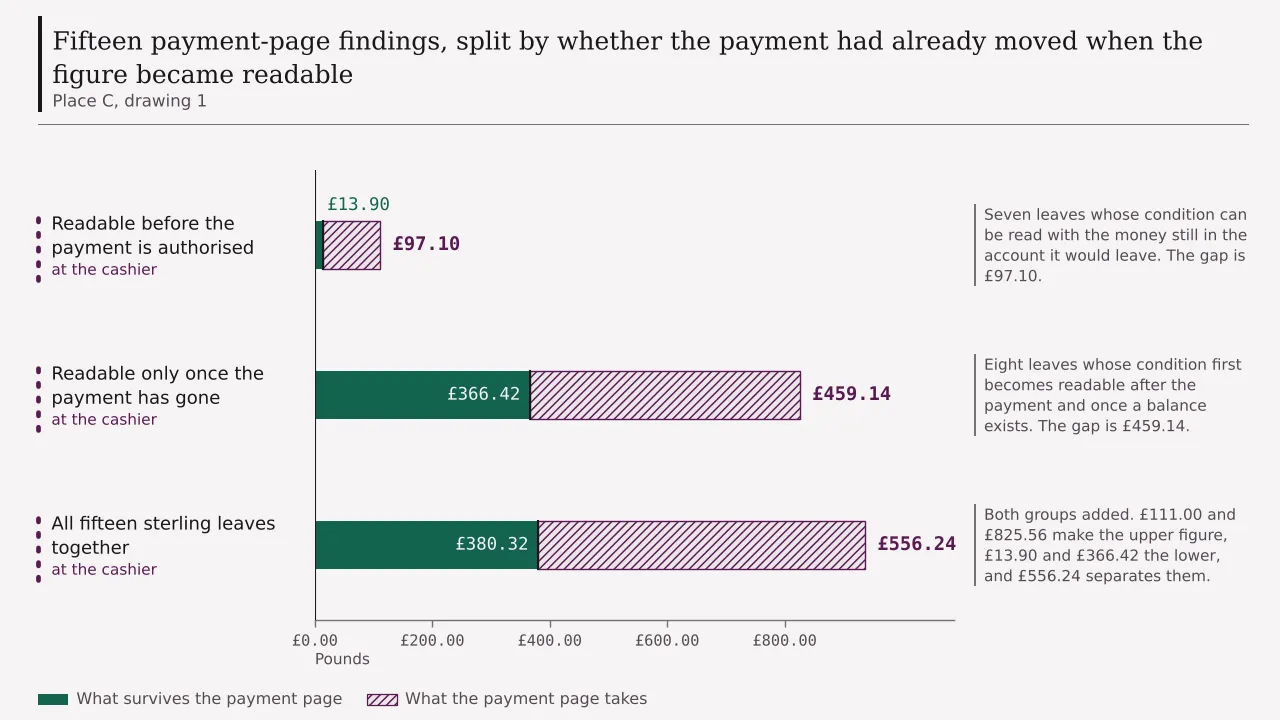
Seven leaves against eight is almost level. £97.10 against £459.14 is nearly one to five. The two orderings disagree, and that disagreement is the whole finding of this place: whatever waits until after the payment is what carries the money. By average, £13.87 a refusable leaf and £57.39 a deferred one.
The qualification is large and gets printed rather than buried. Remove the billing cycle leaf and the other seven deferred findings carry £99.14, averaging £14.16 against £13.87, a difference of 29 pence a leaf. Deferral therefore buys no advantage per condition. What it buys is the chance to accumulate, which one leaf took and the rest did not.
£459.14 of difference first readable after the one step in the sequence that cannot be undone
5
What the same conditions would have cost printed a step sooner
Late is not the same as unknowable, and separating the two is most of what a place can do that its leaves cannot. Take the £459.14 again and ask of each entry whether whoever operates the page could have printed it before the payment instead of after it.
Seven of the eight come back yes. Direction is built into a rail. Which instruments funded an account is recorded on the operator’s side and nowhere on the reader’s. A token resolves the moment it is added. One party fixes both thresholds and prints only the smaller. An outward charge sits in a pricing table, and a substitute payout route for a one-way voucher is a written policy. A month’s running total is known to the penny, daily, by whoever is doing the charging.
One comes back no, and it is worth fifty-eight pence. Two conversion rates on a round trip are set outside the transaction and published by nobody inside it, so neither side held them in advance. That makes £458.56 of the £459.14 a decision about where to print a sentence, and £555.66 of the whole £556.24, leaving fifty-eight pence of genuine ignorance in a place worth five hundred and fifty-six pounds.
What a reader could have done instead is modest. The payment page wants reading as a terms document is read, before the button, with four numbers copied out, which alone recovers the seven findings worth £97.10. The other £458.56 would come back too, but only where a page carries the sentences, and pages of this sort largely do not.
| The class of condition | Where it is settled | Leaves | Sterling carried | Printable before the payment |
|---|---|---|---|---|
| A threshold on the way in | at the cashier | 2 | £11.00 | Yes, and commonly is |
| A threshold on the way out | at the cashier | 1 | £0.96 | Yes, and seldom is |
| A charge taken out of the sum moved | at the cashier | 2 | £5.50 | Yes, it sits in a pricing table |
| A route that cancels the promotion | at the cashier | 1 | £16.00 | Yes, from the promotion itself |
| A rail with no way back, or none to the right address | at the cashier | 3 | £79.60 | Yes, direction is fixed in the rail |
| What taking up an unfamiliar route costs | at the cashier | 1 | £6.80 | Partly, the minutes being the reader’s |
| A payout divided to match what funded it | at the cashier | 1 | £15.00 | Yes, the ledger is already kept |
| A month of charging that no document totals | at the cashier | 1 | £360.00 | Yes, daily, by whoever is charging |
| An instrument a published condition removed | in the public register | 1 | £60.00 | Already is, in a public record |
| Who decided, and at which rate | nowhere in writing | 2 | £1.38 | No, and not by the operator either |
Ten classes, fifteen leaves, £556.24, and the nine other than the billing month make £196.24 between them. The last column is where the table pays: these classes differ completely in what they do to money and hardly at all in whether anybody could have said so sooner.
6
Six obligations a deposit page carries where a licence reaches it
British rules say a surprising amount about this one screen, most of what a regulator writes being aimed at offers, play and complaints rather than at one page in a sequence. Six obligations land on a deposit page itself, and every one of them is about where a thing stands.
Three concern a spending limit and all three aim at the instant part one priced, £1.40 gone and the rest still in hand. The live standard on financial limits wants the prompt for one placed where registration finishes or where a first payment starts, wants the facility kept in sight of the deposit screen inside as few steps as a build can manage, and wants the limit made the default.
A clash between two limits is settled the same way, by letting the tighter govern, and the consequence is arithmetic rather than policy: a ceiling set on the day, multiplied by seven, can only ever cut a weekly ceiling down. Run ten pounds a day across the eighteenth row of the shelf and thirty days allow £300.00, which is £60.00 short of the £360.00 that row records, and the £70 a week the same ten produces lands on the identical answer.
The fourth watches the sum rather than the screen, and is a deposit-page duty anyway, a deposit page being where sums accumulate. Lighter financial checks bite past a net monthly deposit threshold, which opened on 30 August 2024 at £500 and came down on 28 February 2025 to £150. The eighteenth row’s £360.00 clears the lower of the two 2.4 times over inside one cycle.
The fifth reaches forward to the exit. Under the licence condition on identity, nothing may be deposited until the licensee has set out the papers that could later be demanded, the moment of demanding them, and the way they are to be sent: an obligation to describe, on a deposit page, something that will not happen for weeks.
The sixth takes a rail away instead of describing one. A British licensee accepts nothing paid for on credit, and the condition shuts the obvious detour too, naming money service businesses in the same breath. It has held since 14 April 2020, and alone among the six it governs what a page may contain rather than what it has to say, which is where the £60.00 on the third row of the shelf comes from.
Offers of the shape this place examines are run from outside the British licence, which makes the loss unusually literal, since all six obligations describe one screen. No prompt is owed for a spending limit, at registration or at a payment or ever. Nothing puts the facility within reach of the page. No accumulated sum triggers a look at affordability, whatever a month comes to. Nothing need be said about identity papers before money is taken, so the demand surfaces where the balance is. And no instrument comes off the list. None of that makes the £459.14 in part four a rule broken: outside the licence, no rule asked for any of it to stand on the page first.
7
The part of this that genuinely belongs where it stands
Part of what gets collected here stands in the right position, so pricing the whole £556.24 as misplacement would be an argument the arithmetic does not support.
Begin with the £0.80, the figure pointing the reader’s way. Whether one instrument, in one account, at one minute, goes through is settled then and there by one of three parties on information none of them publishes beforehand, so no earlier page could carry an answer that does not yet exist. A refusal is also the cheapest event here: free, leaving £20.00 untouched, and the only condition announcing itself to somebody not looking.
The £2.35 and the £1.00 on the receiving side behave the same way. Nobody is obliged to publish what accepting a payment costs them, and nobody should be. Both were reconstructed from outside by arithmetic, and each means more reached that way than printed.
The strongest case is one the British rules make rather than contradict. A spending limit prompted at a first payment is prompted with the sum in front of whoever sets it, which no earlier moment can match, and a notice setting out the papers that could later be demanded is owed before any deposit, that being the last point at which saying so can still change a decision. Both sit deliberately at the screen this place is named after.
The dividing line is clean enough to carry off. A payment page is the right place for anything about this payment and the wrong place for anything about the offer the payment is made against. A limit, a notice about papers, a scheme decision and a handling cost all pass. A wagering ceiling, a route that cancels a promotion, a pair of thresholds set by one party and a month’s running total all fail, and between them those four misplaced conditions carry £439.96 of the £556.24.
8
Reading a payment page before a single digit goes into it
Recovering the £97.10 takes a couple of minutes and needs none of the figures printed here. Open the payment page, reachable on most builds the moment registration finishes, then copy out four numbers: the smallest payment taken, the smallest that qualifies for whatever was advertised, the routes available, and any charge named at the confirmation step.
Put the same four questions to the exit, which is the half nobody reads. Smallest sum released. Instruments permitted to receive it. Whether a payout is divided to match what funded it. Whether leaving is charged for. Inside a licence those answers are bounded by rules; outside one a page that says nothing has answered.
Two habits make the minutes worth spending. Write the unit beside every number, a threshold printed as ten being fifty-eight pence worse than one printed as ten pounds. And write down who set each figure, since a threshold, a charge, a refusal and a conversion rate have four separate authors and only one of them answers to the reader.
The last step is the subtraction this site performs everywhere. Read the sum about to be paid exactly as the page presents it, read it again with every condition just copied out applied, print both and rule off the gap. Over eighteen leaves that gave £936.56, then £380.32, then £556.24, of which reading recovers £97.10 and placement decides the rest.
Questions
- What can a payment screen spring on somebody that the advertisement never mentioned?
- A threshold on the way in, a different one on the way out, a handling charge, a restriction on which instruments may receive a payout, a route that disqualifies the promotion, and a flat refusal. Those classes carry £556.24 across the eighteen leaves, and none is settled on the banner, a banner printing no floor, no charge and no refusal.
- Why does it matter that a condition appears here rather than in the written terms?
- Because of where it falls in the order. Registration is already spent when a payment page is reached, which this place puts at seven minutes and an assumed £12.00 an hour, so £1.40 has gone and will not come back. The payment has not gone and can still be declined. A condition parked at that moment meets somebody with a reason to finish that has nothing to do with the offer.
- How was the £556.24 for this whole place worked out?
- One figure a leaf, taken from whichever subtraction a payment page decides rather than from one a written play-through clause decides, play-through being another place’s property and already priced there. Fifteen of the eighteen leaves end in sterling. Their faces total £936.56, their applied readings total £380.32, and the gap is £556.24, which is also what the fifteen separate differences come to added down the shelf.
- Which leaves would not go into that column, and what happened to them?
- Three. The handset leaf ends at 72 hours, a length of waiting that no rate here turns into money. The two leaves working a five pound threshold end at £2.35 and £1.00, both on the receiving side of the counter, measuring what a payment costs the party accepting it. All three keep their figures on the shelf and stay out of the sterling column, which makes £556.24 an understatement by an amount this place cannot supply.
- Did any two of the eighteen reach the same conclusion?
- One pair. Both leaves working a five pound threshold conclude that such a payment fails to cover its own handling and that the shortfall comes back through a condition written elsewhere. Only the direction of measurement differs: one counts turnovers and gets 2.92 passes of the balance before the transaction stops losing money, the other counts the pound of handling and names what brings it back, 250 presses of a reel or a written condition asking for £200.00 across one.
- Is a minimum deposit the same number as a minimum withdrawal?
- No. One party fixes both, on one page, and shows them apart. The smaller gets advertised because it is an inducement and the larger waits until a balance exists for it to refuse. On the leaf working the pair at a single pound, the exit threshold takes an expected ninety-six pence in full, a sum beneath a threshold buying nothing on the way out, near miss or not.
- What does a deposit page have to do where a British licence reaches it?
- Six things. Put the prompt for a spending limit where registration finishes or where a first payment starts. Keep the limit facility in sight of the deposit screen, inside as few steps as a build can manage. Make the limit the default, so going without takes a refusal rather than a silence. Run a lighter financial check past a net monthly deposit threshold, which opened on 30 August 2024 at £500 and was cut on 28 February 2025 to £150. Set out, before anything is deposited, the papers that could later be demanded, the moment of demanding them and the way they are to be sent. And accept nothing paid for on credit, which has held since 14 April 2020.
- What is lost when none of that reaches the payment page?
- Offers of the shape this place examines are run from outside the British licence, so all six go at once, and all six described one screen. No prompt for a spending limit. No obligation to put the facility within reach of the page. No default in favour of setting one. No accumulated sum that triggers a look at affordability. Nothing owed about identity papers before money is accepted. And no instrument off the list. The £459.14 readable only after the payment is not a rule broken, since outside the licence no rule asked for it to stand there first.
- Is a payment screen ever the right place to settle something?
- Yes, for whatever is genuinely about this payment. Whether one instrument goes through at one minute is decided then and there by one of three parties, cannot exist on an earlier page, costs nothing, and leaves £20.00 untouched. What accepting a payment costs somebody is their own arithmetic. A spending limit prompted at a first payment is prompted with the sum in front of whoever sets it, and a notice setting out the papers that could later be demanded is owed before any deposit, both of which the British rules site at this screen on purpose.
- What should be copied down before a card number is typed in?
- Eight figures and four authors. Going in: the smallest payment taken, the smallest that qualifies for the offer, the routes available, and any charge named at the confirmation step. Coming out: the smallest sum released, which instruments may receive it, whether a payout is divided to match what funded it, and any outward charge. Note who set each figure, only one of the four answering to the reader.