Terms read 19 October 2026 Leaf T06, revision 1
A ceiling standing in the place a play-through used to occupy
A hundred presses at ten pence put £10.00 across the reels and are expected to leave £9.60. Strike the play-through out and something else is written in the gap: a ceiling, assumed here at £50.00, which costs nothing at all until an outcome reaches 5.21 times the expectation and then costs everything past it. The two conditions are not the same size and no published figure settles which is worse.
Stated on the banner £9.60 A hundred presses against a qualifying payment of £5.00, and a denial covering the condition that is no longer written. Stated, once you go and look £50.00 A ceiling over whatever the presses return, standing in the place the struck condition stood and reading as a concession. Not stated before the money goes in 1 missing weight How often a hundred presses reach past a ceiling, which is the single quantity deciding whether the substitution helps a reader or the house.
Spin offers capping the payout, with their ceilings read
Every destination in this file is bought advertising. The site is paid a fee if a reader goes on to register, and no figure printed below moves because of it.
Bonus Spins UK Slip 01
Betportal
Ceiling as a multiple
The drop
€15.00
€1.00 in the euro
The claim reads €15.00. Once the terms beside it have applied, €0.00 of it can leave. The difference is the drop.
7 of the 15 terms on this slip could not be read before the money went in
Spins priced at this site's own 10p a spin, which the operator does not publish
Stated
€15.00
The claim as it is printed, before a single term has been applied to it.
Headline paid as spins
150 spins at 10c each, which is €15.00 of the figure above.
6 Nowhere
What one spin is worth
No unit is published for a spin, so the count is priced at this site's own 10p a spin. At half that price every figure below halves with it.
Match and other credit not priced
300% of three deposits, to a ceiling of €1,000. A share of a deposit nobody has made yet is not a sum, so no figure stands on this line and none is carried below.
Qualified
-€14.40
Written down somewhere, and taking part of the claim back. Each term carries the place it is written and the sum it takes.
2 Written terms at a distance this record does not establish
Play-through -€14.40
Carrying €14.40 through 35 times stakes €504.00 and costs €20.16 of it at 96 per cent return. That prices above the €14.40 there is to charge it against, so the whole of the credit goes and the line is held at that. The multiple sits on the bonus.
2 Written terms at a distance this record does not establish
Game weighting not priced
Slots only count towards the play-through. No contribution percentage is published, so the line above has been worked at full weight, which is the kindest reading there is.
2 Written terms at a distance this record does not establish
Ceiling on the winnings not priced
5x the bonus.
2 Written terms at a distance this record does not establish
Clock on the credit not priced
14 days.
2 Written terms at a distance this record does not establish
Largest stake while it runs not priced
€5.
3 Public record
Licence, and who holds it not priced
Licensed in Anjouan, Comoros, held by BetPortal Gaming Ltd, with Excite Ultra Media Ltd, reference ALSI-202601040-FI2. A register entry settles who holds a licence and what it permits. It does not settle who is running the site this morning.
4 Cashier
Smallest qualifying deposit your money
€20 a stage. That is €20.00 of your own money, and it is never netted into a drop.
5 On the way out
Checks before a withdrawal not priced
Documents before the first withdrawal.
Unstated
-€0.60
Applying without having been published anywhere, and costing money all the same.
6 Nowhere
What a spin hands back -€0.60
Staking a spin returns 96 per cent of it, so that share of the batch is the house's before a reel turns. This site works at that return and the operator publishes none where the claim is made.
6 Nowhere
Forfeited by rule cost unknown
Nothing is published under this heading, and it applies regardless.
6 Nowhere
Charge on the way out cost unknown
No charge on the way out is published as a figure, so nothing comes off this line. A charge that exists unpublished would come straight off whatever survives.
6 Nowhere
Smallest withdrawal allowed cost unknown
No smallest withdrawal is published as a figure. A floor nobody has published is still a floor, and it decides whether a small balance can move at all.
No Great Britain licence
Terms read 19 October 2026
Bonus Spins UK Slip 02
WinBeast
Ceiling as a sum
The drop
€50.00
€1.00 in the euro
The claim reads €50.00. Once the terms beside it have applied, €0.00 of it can leave. The difference is the drop.
8 of the 15 terms on this slip could not be read before the money went in
Spins priced at this site's own 10p a spin, which the operator does not publish
Stated
€50.00
The claim as it is printed, before a single term has been applied to it.
Headline paid as spins
500 spins at 10c each, which is €50.00 of the figure above.
6 Nowhere
What one spin is worth
No unit is published for a spin, so the count is priced at this site's own 10p a spin. At half that price every figure below halves with it.
Match and other credit not priced
50% to 100% of five deposits, each to a ceiling of €1,000, and a €650 free bet. A share of a deposit nobody has made yet is not a sum, so no figure stands on this line and none is carried below.
Qualified
-€48.00
Written down somewhere, and taking part of the claim back. Each term carries the place it is written and the sum it takes.
2 Written terms at a distance this record does not establish
Play-through -€48.00
Carrying €48.00 through 40 times stakes €1,920.00 and costs €76.80 of it at 96 per cent return. That prices above the €48.00 there is to charge it against, so the whole of the credit goes and the line is held at that. The multiple sits on the bonus and the winnings from the spins.
2 Written terms at a distance this record does not establish
Game weighting not priced
Slots, titles vary by country count towards the play-through. No contribution percentage is published, so the line above has been worked at full weight, which is the kindest reading there is.
2 Written terms at a distance this record does not establish
Ceiling on the winnings not priced
€100 a batch of spins.
2 Written terms at a distance this record does not establish
Clock on the credit not priced
7 days, spins 1 day.
3 Public record
Licence, and who holds it not priced
Licensed in Curaçao, holder not named on the site. A register entry settles who holds a licence and what it permits. It does not settle who is running the site this morning.
4 Cashier
Smallest qualifying deposit your money
€20 a stage. That is €20.00 of your own money, and it is never netted into a drop.
5 On the way out
Checks before a withdrawal not priced
Documents before the first withdrawal.
Unstated
-€2.00
Applying without having been published anywhere, and costing money all the same.
6 Nowhere
What a spin hands back -€2.00
Staking a spin returns 96 per cent of it, so that share of the batch is the house's before a reel turns. This site works at that return and the operator publishes none where the claim is made.
6 Nowhere
Largest stake while it runs cost unknown
Nothing is published under this heading, and it applies regardless.
6 Nowhere
Forfeited by rule cost unknown
Nothing is published under this heading, and it applies regardless.
6 Nowhere
Charge on the way out cost unknown
No charge on the way out is published as a figure, so nothing comes off this line. A charge that exists unpublished would come straight off whatever survives.
6 Nowhere
Smallest withdrawal allowed cost unknown
No smallest withdrawal is published as a figure. A floor nobody has published is still a floor, and it decides whether a small balance can move at all.
No Great Britain licence
Terms read 19 October 2026
Bonus Spins UK Slip 03
EliteSpin
Longest spin window
The drop
£50.00
£1.00 in the pound
The claim reads £50.00. Once the terms beside it have applied, £0.00 of it can leave. The difference is the drop.
8 of the 15 terms on this slip could not be read before the money went in
Spins priced at this site's own 10p a spin, which the operator does not publish
Stated
£50.00
The claim as it is printed, before a single term has been applied to it.
Headline paid as spins
500 spins at 10p each, which is £50.00 of the figure above.
6 Nowhere
What one spin is worth
No unit is published for a spin, so the count is priced at this site's own 10p a spin. At half that price every figure below halves with it.
Match and other credit not priced
50% to 100% of five deposits, each to a ceiling of £1,000. A share of a deposit nobody has made yet is not a sum, so no figure stands on this line and none is carried below.
Qualified
-£48.00
Written down somewhere, and taking part of the claim back. Each term carries the place it is written and the sum it takes.
2 Written terms at a distance this record does not establish
Play-through -£48.00
Carrying £48.00 through 40 times stakes £1,920.00 and costs £76.80 of it at 96 per cent return. That prices above the £48.00 there is to charge it against, so the whole of the credit goes and the line is held at that. The multiple sits on the bonus and the winnings from the spins.
2 Written terms at a distance this record does not establish
Game weighting not priced
Slots count towards the play-through. No contribution percentage is published, so the line above has been worked at full weight, which is the kindest reading there is.
2 Written terms at a distance this record does not establish
Ceiling on the winnings not priced
5x the bonus.
2 Written terms at a distance this record does not establish
Clock on the credit not priced
7 days, spins 3 days.
3 Public record
Licence, and who holds it not priced
Licensed in Costa Rica, held by PrimeTier Limited. A register entry settles who holds a licence and what it permits. It does not settle who is running the site this morning.
4 Cashier
Smallest qualifying deposit your money
£20 a stage. That is £20.00 of your own money, and it is never netted into a drop.
5 On the way out
Checks before a withdrawal not priced
Documents before the first withdrawal.
Unstated
-£2.00
Applying without having been published anywhere, and costing money all the same.
6 Nowhere
What a spin hands back -£2.00
Staking a spin returns 96 per cent of it, so that share of the batch is the house's before a reel turns. This site works at that return and the operator publishes none where the claim is made.
6 Nowhere
Largest stake while it runs cost unknown
Nothing is published under this heading, and it applies regardless.
6 Nowhere
Forfeited by rule cost unknown
Nothing is published under this heading, and it applies regardless.
6 Nowhere
Charge on the way out cost unknown
No charge on the way out is published as a figure, so nothing comes off this line. A charge that exists unpublished would come straight off whatever survives.
6 Nowhere
Smallest withdrawal allowed cost unknown
No smallest withdrawal is published as a figure. A floor nobody has published is still a floor, and it decides whether a small balance can move at all.
No Great Britain licence
Terms read 19 October 2026
Bonus Spins UK Slip 04
Crown Jewelz
Multiple unpublished
The drop
NOT WORKED
The multiple is not published in the operator's own terms. Since the sum cannot be worked around it, none is worked.
9 of the 14 terms on this slip could not be read before the money went in
No drop worked
Stated
£15.00
The claim as it is printed, before a single term has been applied to it.
Headline paid as spins
150 spins at 10p each, which is £15.00 of the figure above.
6 Nowhere
What one spin is worth
No unit is published for a spin, so the count is priced at this site's own 10p a spin. At half that price every figure below halves with it.
Match and other credit not priced
200% of the first deposit, then 150% twice, each to a ceiling of £1,000. A share of a deposit nobody has made yet is not a sum, so no figure stands on this line and none is carried below.
Qualified
NOT WORKED
Written down somewhere, and taking part of the claim back. Each term carries the place it is written and the sum it takes.
2 Written terms at a distance this record does not establish
Play-through not priced
40x the bonus, reported rather than published by the operator.
2 Written terms at a distance this record does not establish
Game weighting not priced
Slots count towards the play-through. No contribution percentage is published, so the line above has been worked at full weight, which is the kindest reading there is.
3 Public record
Licence, and who holds it not priced
Licensed in Curaçao, number not verified, holder not named on the site. A register entry settles who holds a licence and what it permits. It does not settle who is running the site this morning.
4 Cashier
Smallest qualifying deposit your money
£20. That is £20.00 of your own money, and it is never netted into a drop.
5 On the way out
Checks before a withdrawal not priced
Documents before the first withdrawal.
Unstated
NOT WORKED
Applying without having been published anywhere, and costing money all the same.
6 Nowhere
Ceiling on the winnings cost unknown
No ceiling is published. Nothing is assumed in its place.
6 Nowhere
Clock on the credit cost unknown
Nothing is published under this heading, and it applies regardless.
6 Nowhere
Largest stake while it runs cost unknown
Nothing is published under this heading, and it applies regardless.
6 Nowhere
Forfeited by rule cost unknown
Nothing is published under this heading, and it applies regardless.
6 Nowhere
Charge on the way out cost unknown
No charge on the way out is published as a figure, so nothing comes off this line. A charge that exists unpublished would come straight off whatever survives.
6 Nowhere
Smallest withdrawal allowed cost unknown
No smallest withdrawal is published as a figure. A floor nobody has published is still a floor, and it decides whether a small balance can move at all.
No Great Britain licence
Terms read 19 October 2026
Every figure in the second and third columns is this site's own working and nothing an operator has published. A claim is priced as printed, then the share a spin hands back at 96 per cent return comes off it, then what playing the multiple through costs at the same return, and then whatever a published ceiling, a charge on the way out or a floor on the smallest withdrawal takes from what has survived. The drop is the difference between the first figure and the last. The two columns add back up to it exactly, so no money leaves a slip without a term and a place beside it.
Which column a term falls in is settled by one question: has anybody written it down. A charge a reader meets at the payment screen is written down, and it stands in the second column with the cashier against it. A condition that binds without ever having been set down stands in the third, whatever it costs. Inside each column the terms run outwards from the banner, so the order itself says how far a reader would have had to go.
A count of spins has no unit until one is supplied. Where an operator publishes what one of its own spins is worth, that figure is used and the first column says it is theirs. Where none is published, this site's own 10p a spin stands in its place and every figure below moves in proportion with it. Where the multiple itself is unpublished, no drop is worked at all, because that is the one figure the sum cannot be done without.
Three words stand where a figure cannot. Not priced is a term that is written down and carries no number the arithmetic can take. Cost unknown is a term nobody has written down, costing something nobody has put a number on. Your money is money of the reader's own, which is never netted into a drop.
None of the operators in this file holds a Great Britain licence, so none of the duties that licence carries reaches them. Each of those duties is published in its own right, which is what makes its absence here something a reader can check rather than take on trust. Every gambling company licensed in Great Britain belongs to Gamstop Online, so a reader who has shut themselves out through the scheme is not shut out here. Social Responsibility Code 5.1.1 has held a play-through to a maximum of ten times the bonus funds since 19 January 2026, and it binds a licence holder and nobody else. Asked in a post of 21 October 2025 what is lost along with the licence, the Gambling Commission's Director of Enforcement and Intelligence answered: "unfair gaming practices, financial loss, and a lack of recourse if things go wrong". The same post puts blocked payouts, and withdrawal limits pitched high enough to be unreachable, among the behaviour the Commission has recorded. Nobody under 18 may hold an account at any of them.
Terms are reproduced in the wording their operator published, and each slip is dated with the day somebody sat down and read them. 19 October 2026 is the oldest of those dates. Anybody claiming an offer is bound by that operator's full terms, which are elsewhere, and never by a line standing here.
1
What moves into the place a struck condition leaves
Promotional conditions are written to a pattern, and the pattern has a slot in it for the term governing what happens to whatever the promotion produces. On a conventional offer that slot holds a multiple. Remove the multiple and the slot does not close up. Something else goes into it, and on offers advertising no play-through the something else is almost always a ceiling.
That substitution is the subject of this leaf. It is not a sleight of hand and it is not concealed: the ceiling is written down, in ordinary words, in the same chapter and frequently under the same numbered heading the multiple occupied. It reads like a detail because it is phrased like one, and it decides more than the sentence it replaced on certain outcomes and less on most.
A reader scanning conditions for the word that worries them finds nothing, which is the point of the exercise, and moves on past the sentence sitting where that word used to be. The two sentences are not interchangeable. One reduces every outcome proportionally. The other leaves most outcomes exactly alone and removes the top off the rest. Working out which a given reader should prefer turns on a quantity nobody prints, and parts five to seven are about that.
Sorted into places, the offer looks like this. The count of a hundred and the £5.00 qualifying payment are settled , along with the denial. The ceiling is settled in the promotional conditions, in the slot the multiple vacated. What one press is worth stays nowhere in writing. How often a hundred presses reach past a ceiling is likewise nowhere in writing, and it is the figure the whole comparison turns on.
One point of honesty belongs at the front. A ceiling is a perfectly reasonable thing for somebody handing out free presses to write. Without one the liability on a promotion has no upper bound at all, and an offer with no upper bound would either not be made or would be made to far fewer people. The question this leaf asks is not whether a ceiling is defensible. It is what a ceiling is worth, to whom, and at which outcomes.
2
A hundred presses, five pounds paid, £9.60 expected
Ten pence a press is the figure this site works with, and nothing anybody publishes fixes it. A hundred presses therefore put £10.00 across the reels. A return of 96 per cent leaves £9.60 of that expected to survive, so the promotion is expected to cost whoever hands it out 40p.
Set that beside the qualifying payment and the arrangement reads well. £5.00 goes in, stays the reader’s own money, and buys £10.00 of turnover and an expected £9.60 of residue. Twice the payment in turnover, and the residue very nearly matching it. Nothing about those figures is misleading and they are the reason an offer of this shape is worth considering at all.
| Quantity | Where it is settled | Figure |
|---|---|---|
| Qualifying payment | £5.00 | |
| Presses handed over | 100 | |
| Price put on one press here | nowhere in writing | 10p |
| Turnover a hundred of them make | Multiply the two preceding rows | £10.00 |
| Residue that turnover should leave | Apply 96 per cent to the row before | £9.60 |
| Ceiling over the residue, assumed here | in the promotional conditions | £50.00 |
The last row is this leaf’s own illustrative setting and every figure derived from it carries that caveat. Nothing available to this site sets out a standard ceiling on promotional winnings, a spread of them, or any rule obliging one to exist. £50.00 is taken because it is a round sum of the shape that recurs and because it stands a useful way off the expectation, which is the relationship that decides everything below.
Note that relationship now, since it recurs. £50.00 is 5.21 times the expected residue of £9.60, and it is five times the £10.00 of turnover the presses produce. Those two ratios are what a ceiling actually is. A pound figure on its own says nothing: a ceiling only means something set against the size of the thing it is capping.
3
The whole range in which a ceiling does nothing
Begin with the half of the picture that is good news, because it is the larger half and it is usually skipped. Below the ceiling the offer behaves exactly as advertised. Every penny the presses return is the reader’s, nothing has to be staked again, and the sentence in the conditions has no effect whatever.
That range runs from nothing to £50.00 and it contains the expected outcome with a great deal of room to spare. A residue of £5.00 is paid in full. So is £9.60, so is £25.00, and so is £50.00 itself. On every one of those the struck play-through would have taken something and the ceiling takes nothing, which is a straightforward and material improvement.
It is worth printing the comparison at those outcomes rather than asserting it, because the asymmetry is larger than it sounds.
| Residue the presses leave | Multiple of the expectation | With nothing written | Under a £50.00 ceiling | Under a forty-times condition |
|---|---|---|---|---|
| A poor run | About half | £5.00 | £5.00 | minus £3.00 |
| The expectation itself | One | £9.60 | £9.60 | minus £5.76 |
| A good run | About two and a half | £25.00 | £25.00 | minus £15.00 |
| Exactly at the ceiling | 5.21 | £50.00 | £50.00 | minus £30.00 |
| Well past it | 12.5 | £120.00 | £50.00 | minus £72.00 |
| A very long way past it | About fifty-two | £500.00 | £50.00 | minus £300.00 |
Set the two right-hand columns beside one another and the structure is unmistakable. The ceiling column agrees with the unconditioned column on four rows and departs from it on two. The forty-times column disagrees everywhere and is below nought on every row, because forty sits past twenty-five and twenty-five is where a condition of that kind has taken back everything it was written over.
Expected residue, read off the headline £9.60 That residue with a forty-times condition over it minus £5.76 Worth of the sentence that was struck out £15.36
£15.36 is what the substitution hands a reader at the expected outcome, and the matching figure for the ceiling at that same outcome is nothing at all, because £9.60 is nowhere near £50.00. On the expectation, and on every outcome below five times it, the trade is entirely one way.
4
Where the excess stops existing, and what that costs
Now the other half. Past £50.00 the ceiling stops being inert and becomes total. It does not reduce the excess, tax it or defer it. The excess is simply not paid, and from the account’s point of view it never happened.
Take a residue of £120.00, which this leaf uses as its worked large outcome. Under no condition at all that is £120.00. Under the assumed ceiling it is £50.00. The difference is £70.00, and the £70.00 is not held back pending anything. There is no sequence of further play that recovers it.
A residue of £120.00, as the headline would read it £120.00 The same residue once the ceiling applies £50.00 Excess the conditions do not pay £70.00
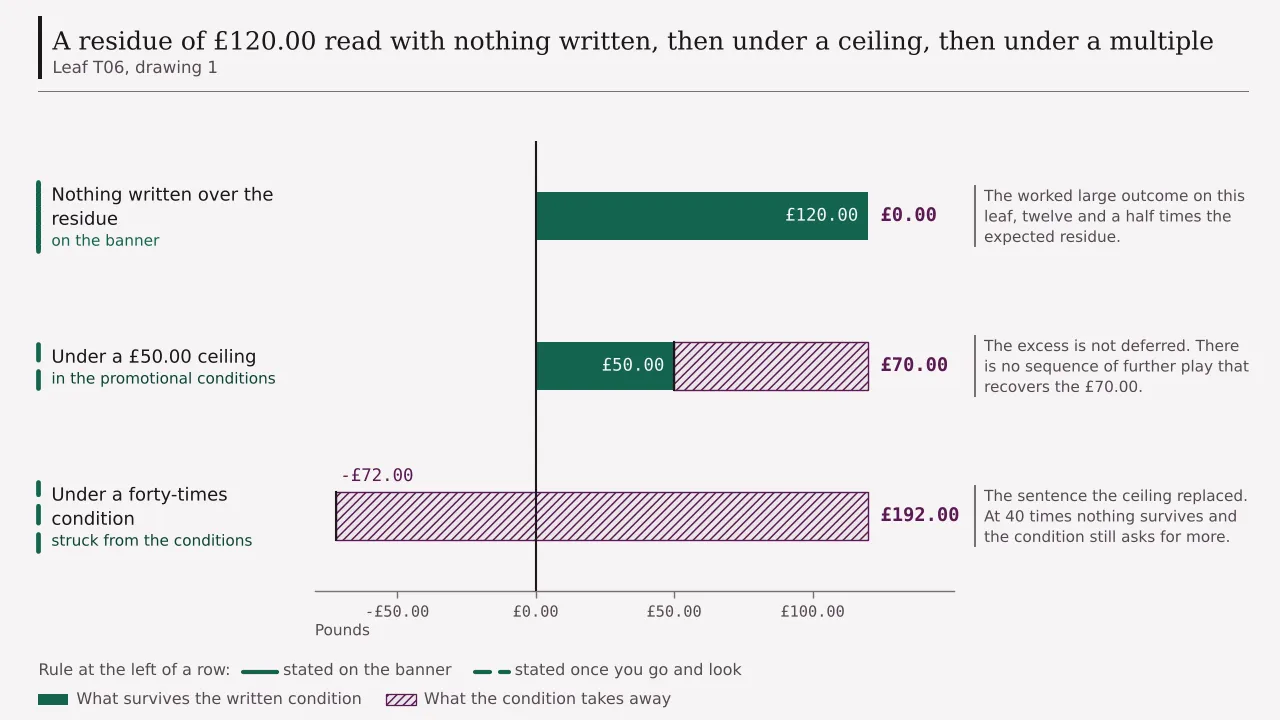
The middle bar in that drawing is the honest picture of a ceiling. Most of its length is solid, because most of the money survives, and the hatched part at the end is a clean cut rather than a gradient. The bottom bar is a different animal: it crosses the rule, and the whole of its length is hatched, because at forty times nothing at all survives and the condition is still asking for more.
£50.00 of ceiling over £10.00 of turnover, which is five times the stake
The ruler gives the cleanest way to hold a ceiling in mind. Divide it by the turnover the presses produce. A £50.00 ceiling over £10.00 of turnover binds on any run returning five times what went across the reels. A £20.00 ceiling over the same turnover would bind at twice the stake, which happens often. A £500.00 ceiling would bind at fifty times, which is rare enough to be decorative. The pound figure alone tells a reader none of this.
5
A proportion and a truncation, set over one balance
The two conditions differ in shape before they differ in size, and the shapes are worth naming because the naming does most of the analytical work. A multiple is a proportion. A ceiling is a truncation.
A proportion acts on every outcome by the same factor. At forty times, with four pence leaking from each pound staked, what survives is the residue multiplied by minus 0.6, whatever the residue is. Small outcomes, the expectation and large outcomes are all treated identically in relative terms. Nothing is special about any part of the range.
A truncation acts on no outcome at all up to a point and on every outcome past it, returning the same number for all of them. Below £50.00 the function is the identity. Above it the function is the constant £50.00. There is a kink and the whole of the condition lives at the kink.
| Property | A multiple written over the residue | A ceiling written over the residue | Which matters more to a reader |
|---|---|---|---|
| Effect on the expected outcome | Reduces it by a fixed proportion | None, where the ceiling is above it | The ceiling, decisively |
| Effect on a large outcome | Reduces it by the same proportion | Removes everything past the kink | The multiple, at this setting |
| Scales with the size of the offer | Yes, in exact proportion | No, it is a fixed sum | Decides small offers |
| Can it be worked off by playing on | Yes, at an expected cost | No, the excess is gone | Depends on the outcome |
| Needs an outcome to be known before it bites | No, it bites from the start | Yes, nothing happens until the kink | Changes how it reads |
The last row explains why a ceiling reads as harmless and a multiple does not. A multiple announces itself immediately, as an obligation standing over money that already exists. A ceiling announces nothing until an outcome happens to be large, and most outcomes are not. A condition that is silent on the ordinary case gets read as a condition about nothing.
There is a further consequence and it cuts against the reader. A hundred presses are not taken for the expected £9.60, which would be a poor use of an afternoon. They are taken for the chance of something larger. A truncation removes precisely that part of the range, and leaves intact the part nobody was playing for.
6
Solving for the balance at which the two agree
Since one condition is a proportion and the other a truncation, there is a residue at which they pay the same, and finding it is a line of algebra worth doing once. A residue B under a multiple W leaves B multiplied by one less four hundredths of W. The same residue under a ceiling C leaves whichever is smaller, B or C.
Set those equal and the crossing residue is C divided by one less four hundredths of W. That expression says something immediately: where W is twenty-five or more the divisor is nothing or negative, so no crossing exists and the ceiling is kinder at every outcome without exception. The forty-times condition this leaf has been pricing is of that kind, which is why its column in part three is worse on every single row.
Below twenty-five the crossing is real and it moves fast.
| Multiple written instead | Share of the residue it leaves | Residue at which the two agree | Which is kinder below that | Which is kinder above it |
|---|---|---|---|---|
| Five times | Eighty per cent | £62.50 | The ceiling | The multiple |
| Ten times | Sixty per cent | £83.33 | The ceiling | The multiple |
| Fifteen times | Forty per cent | £125.00 | The ceiling | The multiple |
| Twenty times | Twenty per cent | £250.00 | The ceiling | The multiple |
| Twenty-four times | Four per cent | £1,250.00 | The ceiling | The multiple |
| Forty times | Nothing, and less | No crossing exists | The ceiling | The ceiling |
Every figure in the third column is £50.00 divided by the share in the second. At a modest multiple the crossing sits at £62.50, which is a residue a hundred presses can plausibly reach. At twenty-four times it sits at £1,250.00, which from £10.00 of turnover is a 125-fold return and is not a case anybody should plan around.
So the answer to the question this leaf’s key asks is a function rather than a verdict. Whether a reader should prefer the ceiling depends on how much of the outcome range sits past the crossing residue, and the crossing residue depends on which multiple the ceiling displaced. Against a severe multiple the ceiling wins outright. Against a mild one it wins on everything ordinary and loses on everything exceptional.
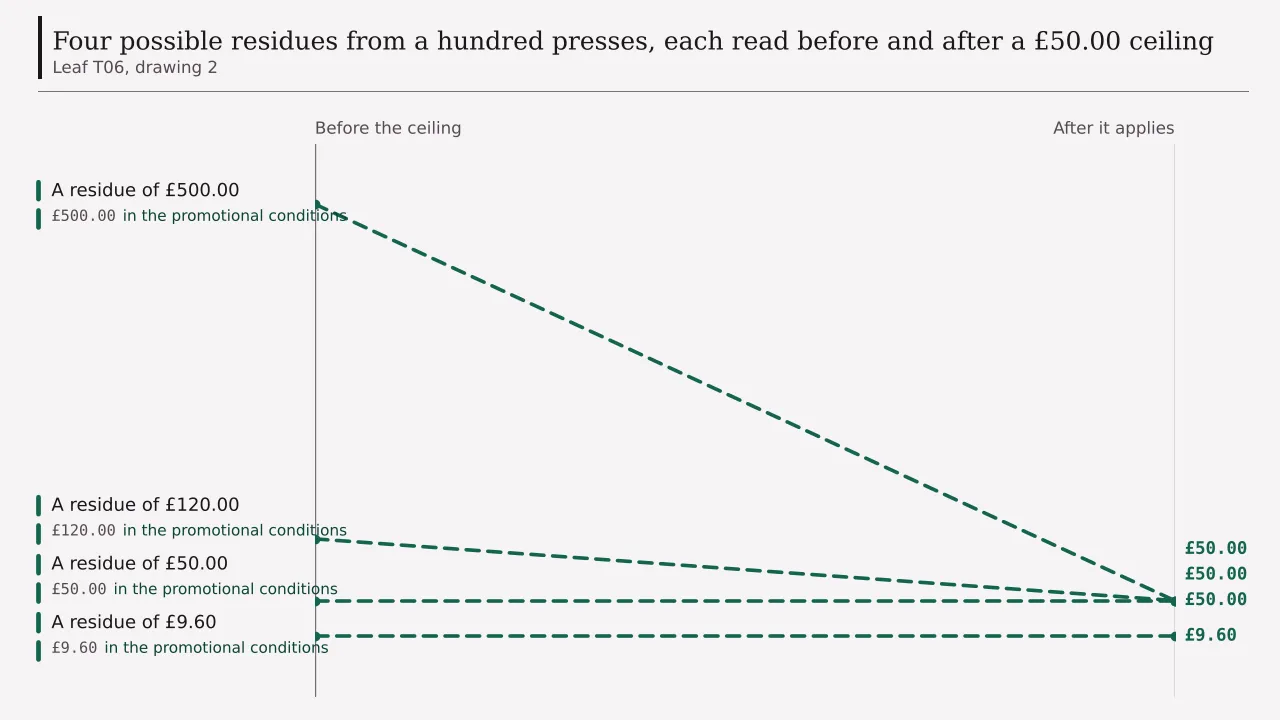
The two flat lines in that drawing carry the argument. A condition that does nothing to most of the range is a condition most readers will never meet, and a reader who never meets it has been handed £15.36 against the sentence it replaced. The two lines that fall are the ones the offer was taken for.
7
The weight nobody publishes, and the preference it would settle
Everything in part six stops one step short of a verdict, and the missing step is a single quantity: how often a hundred presses produce a residue past the crossing. With that figure the comparison is arithmetic. Without it the comparison has two halves and no scales.
That figure is not published and this site will not supply one. No primary source sets out the distribution of outcomes for a hundred presses on any build, and the published return figure does not contain it. A return of 96 per cent is a statement about an average over a length of play no hundred-press session approaches. Two builds returning the same 96 per cent can put wildly different weight past £50.00, and nothing a reader can open distinguishes them.
What can honestly be said about the ceiling’s cost is a bound rather than a figure. It is never negative, since the ceiling never pays more than the uncapped outcome. It is exactly nothing on every outcome at or under £50.00. And it equals the whole of the excess on every outcome past it. Those three statements are complete and they do not add up to an expected cost, because the weights are missing.
There is one thing a reader can do with that, and it is better than guessing. Convert the ceiling into a multiple of turnover, which part four did: £50.00 over £10.00 is five times the stake. Then ask whether a five-fold return on a session is a thing worth protecting. For most people considering a hundred presses the answer is that it is exactly the thing they were there for, which makes the ceiling the part of the arrangement worth reading rather than the part worth skipping.
The symmetrical caution applies to the other side. A reader who treats a capped offer as worthless has also got it wrong, because the ceiling costs nothing on the great majority of sessions and the struck multiple would have cost £15.36 on every one of them. Both errors come from the same habit, which is reading a condition without asking what range of outcomes it operates on.
8
Reading a substitution in the place the old sentence stood
The quantity these leaves set out to measure is the gap between a claim and the sentence qualifying it, and here the gap comes out at almost nothing. The ceiling is not filed somewhere remote. It is in the promotional conditions, in the same chapter and often at the same numbered heading the multiple would have occupied, one movement from the offer.
So the measurement that matters here is not how far a sentence sits from the claim. It is what a reader is scanning for when they arrive. Somebody who opens the conditions to check a play-through is running a search for one word, and a search for one word returns nothing in a document where that word has been removed. The search succeeds, the reader stops, and the sentence occupying the slot is passed over on the way to the result.
| What a reader goes looking for | What is actually in that slot | Worth on this offer |
|---|---|---|
| A play-through on the residue | Nothing, which is the advertised result | £15.36 not taken |
| Nothing in particular | A ceiling in plain words | £70.00 at a £120.00 run |
| Who stands behind the address | Not in the conditions at all | Settled only by a register |
| The smallest payment out | Filed with the payment methods | Met at the till, not here |
The third and fourth rows are in the table because they complete the sorting rather than because this leaf prices them. Who holds a licence behind a given address is settled in the public register and by nothing on the site itself. The smallest sum that will be released appears at the cashier, and what paperwork is wanted before it goes appears on the way out. A ceiling sits closer to the claim than any of those and is still the one most often missed, because proximity does not help a reader who has stopped looking.
The practical form of all this is one instruction. Where a promotion advertises that a play-through is absent, read the sentence that stands where the play-through would have been, whatever it says. The slot is informative even when its contents are not what was being searched for.
9
The ceiling a British licence imposes, and the one it leaves alone
Offers of this shape hold no British licence, and the comparison worth drawing on a leaf about ceilings is which ceilings Britain writes. The answer runs against expectation, so it is set out as a contrast rather than as a list of losses.
What Britain caps is the stake, not the win. An instrument made on the twenty-fifth of February 2025 fixes the most anybody may put behind one cycle of an online slot game: £5.00 ordinarily, or £2.00 for anyone short of twenty-five years. Published guidance starts the first of those on 9 April 2025, the second on 21 May 2025, and confines the pair to online slots, leaving other casino games outside them. Set that against this leaf: at 10p a press a hundred presses are nowhere near a stake ceiling, and the ceiling that decides the arrangement is written over the other end entirely.
What Britain does not cap is a ceiling over promotional winnings. The rule barring a maximum on withdrawals reaches a deposit balance, which is a customer’s own money, and a cap on what a promotion pays is a different object. Both can stand together without contradiction, and a leaf that said a licence forbids a £50.00 ceiling would be wrong. What a licence changes is what surrounds it, not whether it may exist.
What Britain requires instead is that a player can see their own position while it forms. Since 17 January 2025 a licensed remote service has been obliged to set a customer’s net spend and playing time in front of them, as it happens. A ceiling is a running total a player is measured against, and a running total that cannot be seen is a condition operating in the dark.
And the controls have to be reachable. Under the technical standard on financial limits the controls for setting one must carry a direct link from the homepage, stand clearly visible on or beside the screens where a deposit is made, and be arrived at in the fewest steps the system can contrive. That is a rule about where a control sits, which is the nearest thing in the British book to the measurement this part of the site makes.
Take those away and the £50.00 ceiling is unchanged, because nothing in the list forbade it. What goes is the stake limit above it, the running total beside it and the requirement that the controls sit within reach. The condition stays and the apparatus around the condition disappears, which is a more exact description of what an offshore promotion is than any blanket statement about protection.
One further sentence keeps the comparison honest. A capped promotion is not peculiar to offers outside the British licence, and ceilings of this shape appear on licensed ones too. The difference this leaf can state with a source behind it is the surrounding apparatus, which is a narrower thing to assert than what is usually asserted.
10
What to look for wherever a play-through has gone
Four steps, in order, each answerable from the promotional conditions in a minute or two. They work on any offer sold on the absence of a condition, and they produce four figures rather than an opinion.
Find the sentence in the slot. Where the play-through would have been there is now something else, and on offers of this shape it is ordinarily a ceiling. Read it whatever it says, because the search that brought a reader there has already returned its result and the habit is to stop.
Divide the ceiling by the turnover. £50.00 over the £10.00 a hundred presses produce is five times the stake, and five times the stake is a far more useful statement than fifty pounds. A ceiling at twice the stake binds often. A ceiling at fifty times the stake is decoration.
Work out what the struck condition would have cost. At forty times on an expected £9.60 that is £15.36, which is the gap between £9.60 and minus £5.76. That figure is the real value of the denial and it is collected on every ordinary session.
Then ask which range matters. If the session is being taken for the expected outcome, the ceiling is irrelevant and the substitution is worth £15.36. If it is being taken for the chance of something large, the ceiling is the entire arrangement and the £15.36 is the smaller half of the trade. Nobody publishes the weights, so this last step is a question about the reader rather than about the offer.
Run here, the four steps give five figures and nothing else. £5.00 paid in, £10.00 of turnover, £9.60 expected, a ceiling at five times the stake, and £15.36 of condition removed. The sixth figure, the one that would settle whether the substitution was generous, is the weight past £50.00, and it is not available at any price.
The close is therefore narrower than a verdict and more useful than one. A hundred presses bought with £5.00, and nothing standing over whatever they leave, is a good arrangement on every ordinary outcome and a capped one on every extraordinary outcome, and the sentence deciding which is in the conditions, one movement from the offer, standing where the struck sentence stood.
Questions
- What are 100 free spins for a £5 deposit worth?
- A hundred presses, priced at the ten pence used here, put £10.00 over the reels, of which 96 per cent leaves an expected £9.60 standing. The qualifying payment stays the reader’s own money, so £5.00 buys twice its own size in turnover and an expected residue very close to it. The promotion is expected to cost whoever hands it out 40p.
- Why do no wagering offers have a maximum win?
- Because the slot in the promotional conditions that held the play-through does not close up when the play-through is struck out. Something goes into it, and on offers advertising no play-through that something is almost always a ceiling. Without one the liability on a promotion has no upper bound, and an offer with no upper bound would either not be made or would go to far fewer people. The ceiling is written in plain words, in the same chapter and often at the same numbered heading.
- How much does a maximum win cap actually cost?
- Nothing at all below the cap and the whole of the excess above it. This leaf assumes a ceiling of £50.00, an illustrative setting of its own, since nothing available to it sets out a standard figure. A residue of £5.00, £9.60 or £25.00 is paid in full. A residue of £120.00 pays £50.00 and loses £70.00, and a residue of £500.00 loses £450.00. The excess is not deferred or recoverable by playing on.
- Which is worse, a win cap or a wagering requirement?
- Against a severe multiple it is better at every outcome. A multiple of forty applied to a £9.60 residue leaves minus £5.76, while the ceiling leaves the whole £9.60, a difference of £15.36 collected on every ordinary session. Against a mild multiple there is a crossing residue above which the multiple is kinder. With a £50.00 ceiling the crossing sits at £62.50 against a five-times condition, £83.33 against ten times and £250.00 against twenty times.
- At what point does a £50 maximum win start to bite?
- At 5.21 times the expected residue of £9.60, and at five times the £10.00 of turnover a hundred presses produce. Dividing a ceiling by the turnover is the useful operation, because a pound figure on its own says nothing about whether it binds. A ceiling at twice the stake binds often, one at five times binds on a good run, and one at fifty times is decoration.
- Why can the cost of a win cap not be calculated exactly?
- Because the calculation needs the weight sitting past the ceiling, and no primary source publishes the distribution of outcomes for a hundred presses on any build. A published return of 96 per cent is a statement about an average over a length of play no short session approaches, and two builds returning the same figure can put very different weight past £50.00. What can be said is a bound: the cost is never negative, is exactly nothing at or below the ceiling, and equals the whole excess above it.
- How does a cap differ in shape from a wagering requirement?
- One is a proportion and the other a truncation. A multiple acts on every outcome by the same factor, so small runs, the expectation and large runs are all treated alike in relative terms. A ceiling acts on nothing up to a point and returns the same number for everything past it, so the whole condition lives at the kink. That is why a ceiling reads as harmless: it is silent on the ordinary case, and most cases are ordinary.
- Where is the maximum win written on a no wagering offer?
- In the promotional conditions, one movement from the offer, in the chapter and often at the numbered heading the play-through would have occupied. The distance is nearly nothing, which is what makes it easy to miss. Somebody opening the conditions to check a play-through is searching for one word, that search returns nothing, and the sentence occupying the slot is passed over on the way to the result.
- Does a British licence ban a maximum win on free spins?
- No, and a page saying otherwise would be wrong. The rule barring a maximum on withdrawals reaches a deposit balance, which is a customer’s own money, while a cap on what a promotion pays is a different object, and both can stand together without contradiction. What Britain caps on a slot is the stake: £5.00 behind one cycle of the game, or £2.00 where the player has not yet reached twenty-five, under an instrument made on the twenty-fifth of February 2025, the first limit dated from 9 April 2025, the second from 21 May 2025, and the pair confined to online slots.
- What is missing on a capped offer from outside Great Britain?
- The apparatus around the ceiling rather than the ceiling itself. A licensed slot carries the stake limits just described, which at 10p a press a hundred presses come nowhere near. Since 17 January 2025 a licensed remote service has been obliged to set a customer’s net spend and playing time in front of them as it happens, and a ceiling is a running total a player is measured against. The controls for setting a financial limit must carry a direct link from the homepage, stand visible beside the deposit screens, and be arrived at in the fewest steps the system can contrive. Offers of this shape hold no British licence, so the condition stays and the apparatus goes.
- Should a capped free spins offer be taken?
- That depends on which range of outcomes a reader cares about, which is a question about the reader rather than the offer. On the expectation and on every outcome under five times the stake, the substitution hands over £15.36 and the ceiling takes nothing. On an outcome past £50.00 the ceiling is the entire arrangement. Treating a capped offer as worthless is the same error as ignoring the cap, since both come from reading a condition without asking what range it operates on.