Terms read 19 October 2026 Leaf C04, revision 1
A voucher sells in rungs, and the rung above what you need keeps the difference
A payment screen wants £12.00. The amounts a prepaid voucher is sold in do not include twelve pounds, so £20.00 gets bought and £8.00 stops at the counter. Nobody has registered an account, nothing has been credited, and the offer behind the £12.00 has not started. This leaf prices the step before the arithmetic of the offer is allowed anywhere near it.
Stated on the banner £12.00 The payment that qualifies, printed in the promotion and settled before anybody clicks anything. Stated, once you go and look minus £7.20 Forty times applied to the £12.00 credit that payment draws, with 96p coming back on every pound staked, an assumption held sitewide. Not stated before the money goes in £8.00 at the counter The amounts the voucher is actually sold in, the smallest payment the screen will take, and what becomes of whatever is left over.
Offers taking prepaid vouchers, with their terms read
Every destination in this file is bought advertising. The site is paid a fee if a reader goes on to register, and no figure printed below moves because of it.
Bonus Spins UK Slip 01
Betportal
Ceiling as a multiple
The drop
€15.00
€1.00 in the euro
The claim reads €15.00. Once the terms beside it have applied, €0.00 of it can leave. The difference is the drop.
7 of the 15 terms on this slip could not be read before the money went in
Spins priced at this site's own 10p a spin, which the operator does not publish
Stated
€15.00
The claim as it is printed, before a single term has been applied to it.
Headline paid as spins
150 spins at 10c each, which is €15.00 of the figure above.
6 Nowhere
What one spin is worth
No unit is published for a spin, so the count is priced at this site's own 10p a spin. At half that price every figure below halves with it.
Match and other credit not priced
300% of three deposits, to a ceiling of €1,000. A share of a deposit nobody has made yet is not a sum, so no figure stands on this line and none is carried below.
Qualified
-€14.40
Written down somewhere, and taking part of the claim back. Each term carries the place it is written and the sum it takes.
2 Written terms at a distance this record does not establish
Play-through -€14.40
Carrying €14.40 through 35 times stakes €504.00 and costs €20.16 of it at 96 per cent return. That prices above the €14.40 there is to charge it against, so the whole of the credit goes and the line is held at that. The multiple sits on the bonus.
2 Written terms at a distance this record does not establish
Game weighting not priced
Slots only count towards the play-through. No contribution percentage is published, so the line above has been worked at full weight, which is the kindest reading there is.
2 Written terms at a distance this record does not establish
Ceiling on the winnings not priced
5x the bonus.
2 Written terms at a distance this record does not establish
Clock on the credit not priced
14 days.
2 Written terms at a distance this record does not establish
Largest stake while it runs not priced
€5.
3 Public record
Licence, and who holds it not priced
Licensed in Anjouan, Comoros, held by BetPortal Gaming Ltd, with Excite Ultra Media Ltd, reference ALSI-202601040-FI2. A register entry settles who holds a licence and what it permits. It does not settle who is running the site this morning.
4 Cashier
Smallest qualifying deposit your money
€20 a stage. That is €20.00 of your own money, and it is never netted into a drop.
5 On the way out
Checks before a withdrawal not priced
Documents before the first withdrawal.
Unstated
-€0.60
Applying without having been published anywhere, and costing money all the same.
6 Nowhere
What a spin hands back -€0.60
Staking a spin returns 96 per cent of it, so that share of the batch is the house's before a reel turns. This site works at that return and the operator publishes none where the claim is made.
6 Nowhere
Forfeited by rule cost unknown
Nothing is published under this heading, and it applies regardless.
6 Nowhere
Charge on the way out cost unknown
No charge on the way out is published as a figure, so nothing comes off this line. A charge that exists unpublished would come straight off whatever survives.
6 Nowhere
Smallest withdrawal allowed cost unknown
No smallest withdrawal is published as a figure. A floor nobody has published is still a floor, and it decides whether a small balance can move at all.
No Great Britain licence
Terms read 19 October 2026
Bonus Spins UK Slip 02
WinBeast
Ceiling as a sum
The drop
€50.00
€1.00 in the euro
The claim reads €50.00. Once the terms beside it have applied, €0.00 of it can leave. The difference is the drop.
8 of the 15 terms on this slip could not be read before the money went in
Spins priced at this site's own 10p a spin, which the operator does not publish
Stated
€50.00
The claim as it is printed, before a single term has been applied to it.
Headline paid as spins
500 spins at 10c each, which is €50.00 of the figure above.
6 Nowhere
What one spin is worth
No unit is published for a spin, so the count is priced at this site's own 10p a spin. At half that price every figure below halves with it.
Match and other credit not priced
50% to 100% of five deposits, each to a ceiling of €1,000, and a €650 free bet. A share of a deposit nobody has made yet is not a sum, so no figure stands on this line and none is carried below.
Qualified
-€48.00
Written down somewhere, and taking part of the claim back. Each term carries the place it is written and the sum it takes.
2 Written terms at a distance this record does not establish
Play-through -€48.00
Carrying €48.00 through 40 times stakes €1,920.00 and costs €76.80 of it at 96 per cent return. That prices above the €48.00 there is to charge it against, so the whole of the credit goes and the line is held at that. The multiple sits on the bonus and the winnings from the spins.
2 Written terms at a distance this record does not establish
Game weighting not priced
Slots, titles vary by country count towards the play-through. No contribution percentage is published, so the line above has been worked at full weight, which is the kindest reading there is.
2 Written terms at a distance this record does not establish
Ceiling on the winnings not priced
€100 a batch of spins.
2 Written terms at a distance this record does not establish
Clock on the credit not priced
7 days, spins 1 day.
3 Public record
Licence, and who holds it not priced
Licensed in Curaçao, holder not named on the site. A register entry settles who holds a licence and what it permits. It does not settle who is running the site this morning.
4 Cashier
Smallest qualifying deposit your money
€20 a stage. That is €20.00 of your own money, and it is never netted into a drop.
5 On the way out
Checks before a withdrawal not priced
Documents before the first withdrawal.
Unstated
-€2.00
Applying without having been published anywhere, and costing money all the same.
6 Nowhere
What a spin hands back -€2.00
Staking a spin returns 96 per cent of it, so that share of the batch is the house's before a reel turns. This site works at that return and the operator publishes none where the claim is made.
6 Nowhere
Largest stake while it runs cost unknown
Nothing is published under this heading, and it applies regardless.
6 Nowhere
Forfeited by rule cost unknown
Nothing is published under this heading, and it applies regardless.
6 Nowhere
Charge on the way out cost unknown
No charge on the way out is published as a figure, so nothing comes off this line. A charge that exists unpublished would come straight off whatever survives.
6 Nowhere
Smallest withdrawal allowed cost unknown
No smallest withdrawal is published as a figure. A floor nobody has published is still a floor, and it decides whether a small balance can move at all.
No Great Britain licence
Terms read 19 October 2026
Bonus Spins UK Slip 03
EliteSpin
Longest spin window
The drop
£50.00
£1.00 in the pound
The claim reads £50.00. Once the terms beside it have applied, £0.00 of it can leave. The difference is the drop.
8 of the 15 terms on this slip could not be read before the money went in
Spins priced at this site's own 10p a spin, which the operator does not publish
Stated
£50.00
The claim as it is printed, before a single term has been applied to it.
Headline paid as spins
500 spins at 10p each, which is £50.00 of the figure above.
6 Nowhere
What one spin is worth
No unit is published for a spin, so the count is priced at this site's own 10p a spin. At half that price every figure below halves with it.
Match and other credit not priced
50% to 100% of five deposits, each to a ceiling of £1,000. A share of a deposit nobody has made yet is not a sum, so no figure stands on this line and none is carried below.
Qualified
-£48.00
Written down somewhere, and taking part of the claim back. Each term carries the place it is written and the sum it takes.
2 Written terms at a distance this record does not establish
Play-through -£48.00
Carrying £48.00 through 40 times stakes £1,920.00 and costs £76.80 of it at 96 per cent return. That prices above the £48.00 there is to charge it against, so the whole of the credit goes and the line is held at that. The multiple sits on the bonus and the winnings from the spins.
2 Written terms at a distance this record does not establish
Game weighting not priced
Slots count towards the play-through. No contribution percentage is published, so the line above has been worked at full weight, which is the kindest reading there is.
2 Written terms at a distance this record does not establish
Ceiling on the winnings not priced
5x the bonus.
2 Written terms at a distance this record does not establish
Clock on the credit not priced
7 days, spins 3 days.
3 Public record
Licence, and who holds it not priced
Licensed in Costa Rica, held by PrimeTier Limited. A register entry settles who holds a licence and what it permits. It does not settle who is running the site this morning.
4 Cashier
Smallest qualifying deposit your money
£20 a stage. That is £20.00 of your own money, and it is never netted into a drop.
5 On the way out
Checks before a withdrawal not priced
Documents before the first withdrawal.
Unstated
-£2.00
Applying without having been published anywhere, and costing money all the same.
6 Nowhere
What a spin hands back -£2.00
Staking a spin returns 96 per cent of it, so that share of the batch is the house's before a reel turns. This site works at that return and the operator publishes none where the claim is made.
6 Nowhere
Largest stake while it runs cost unknown
Nothing is published under this heading, and it applies regardless.
6 Nowhere
Forfeited by rule cost unknown
Nothing is published under this heading, and it applies regardless.
6 Nowhere
Charge on the way out cost unknown
No charge on the way out is published as a figure, so nothing comes off this line. A charge that exists unpublished would come straight off whatever survives.
6 Nowhere
Smallest withdrawal allowed cost unknown
No smallest withdrawal is published as a figure. A floor nobody has published is still a floor, and it decides whether a small balance can move at all.
No Great Britain licence
Terms read 19 October 2026
Bonus Spins UK Slip 04
Crown Jewelz
Multiple unpublished
The drop
NOT WORKED
The multiple is not published in the operator's own terms. Since the sum cannot be worked around it, none is worked.
9 of the 14 terms on this slip could not be read before the money went in
No drop worked
Stated
£15.00
The claim as it is printed, before a single term has been applied to it.
Headline paid as spins
150 spins at 10p each, which is £15.00 of the figure above.
6 Nowhere
What one spin is worth
No unit is published for a spin, so the count is priced at this site's own 10p a spin. At half that price every figure below halves with it.
Match and other credit not priced
200% of the first deposit, then 150% twice, each to a ceiling of £1,000. A share of a deposit nobody has made yet is not a sum, so no figure stands on this line and none is carried below.
Qualified
NOT WORKED
Written down somewhere, and taking part of the claim back. Each term carries the place it is written and the sum it takes.
2 Written terms at a distance this record does not establish
Play-through not priced
40x the bonus, reported rather than published by the operator.
2 Written terms at a distance this record does not establish
Game weighting not priced
Slots count towards the play-through. No contribution percentage is published, so the line above has been worked at full weight, which is the kindest reading there is.
3 Public record
Licence, and who holds it not priced
Licensed in Curaçao, number not verified, holder not named on the site. A register entry settles who holds a licence and what it permits. It does not settle who is running the site this morning.
4 Cashier
Smallest qualifying deposit your money
£20. That is £20.00 of your own money, and it is never netted into a drop.
5 On the way out
Checks before a withdrawal not priced
Documents before the first withdrawal.
Unstated
NOT WORKED
Applying without having been published anywhere, and costing money all the same.
6 Nowhere
Ceiling on the winnings cost unknown
No ceiling is published. Nothing is assumed in its place.
6 Nowhere
Clock on the credit cost unknown
Nothing is published under this heading, and it applies regardless.
6 Nowhere
Largest stake while it runs cost unknown
Nothing is published under this heading, and it applies regardless.
6 Nowhere
Forfeited by rule cost unknown
Nothing is published under this heading, and it applies regardless.
6 Nowhere
Charge on the way out cost unknown
No charge on the way out is published as a figure, so nothing comes off this line. A charge that exists unpublished would come straight off whatever survives.
6 Nowhere
Smallest withdrawal allowed cost unknown
No smallest withdrawal is published as a figure. A floor nobody has published is still a floor, and it decides whether a small balance can move at all.
No Great Britain licence
Terms read 19 October 2026
Every figure in the second and third columns is this site's own working and nothing an operator has published. A claim is priced as printed, then the share a spin hands back at 96 per cent return comes off it, then what playing the multiple through costs at the same return, and then whatever a published ceiling, a charge on the way out or a floor on the smallest withdrawal takes from what has survived. The drop is the difference between the first figure and the last. The two columns add back up to it exactly, so no money leaves a slip without a term and a place beside it.
Which column a term falls in is settled by one question: has anybody written it down. A charge a reader meets at the payment screen is written down, and it stands in the second column with the cashier against it. A condition that binds without ever having been set down stands in the third, whatever it costs. Inside each column the terms run outwards from the banner, so the order itself says how far a reader would have had to go.
A count of spins has no unit until one is supplied. Where an operator publishes what one of its own spins is worth, that figure is used and the first column says it is theirs. Where none is published, this site's own 10p a spin stands in its place and every figure below moves in proportion with it. Where the multiple itself is unpublished, no drop is worked at all, because that is the one figure the sum cannot be done without.
Three words stand where a figure cannot. Not priced is a term that is written down and carries no number the arithmetic can take. Cost unknown is a term nobody has written down, costing something nobody has put a number on. Your money is money of the reader's own, which is never netted into a drop.
None of the operators in this file holds a Great Britain licence, so none of the duties that licence carries reaches them. Each of those duties is published in its own right, which is what makes its absence here something a reader can check rather than take on trust. Every gambling company licensed in Great Britain belongs to Gamstop Online, so a reader who has shut themselves out through the scheme is not shut out here. Social Responsibility Code 5.1.1 has held a play-through to a maximum of ten times the bonus funds since 19 January 2026, and it binds a licence holder and nobody else. Asked in a post of 21 October 2025 what is lost along with the licence, the Gambling Commission's Director of Enforcement and Intelligence answered: "unfair gaming practices, financial loss, and a lack of recourse if things go wrong". The same post puts blocked payouts, and withdrawal limits pitched high enough to be unreachable, among the behaviour the Commission has recorded. Nobody under 18 may hold an account at any of them.
Terms are reproduced in the wording their operator published, and each slip is dated with the day somebody sat down and read them. 19 October 2026 is the oldest of those dates. Anybody claiming an offer is bound by that operator's full terms, which are elsewhere, and never by a line standing here.
1
Eight pounds, reached by two sums that do not share a step
Take an assumed ladder of £10.00, £20.00, £30.00, £40.00 and £50.00. Those five amounts are assumed here and sourced nowhere, picked because an even step keeps the sums legible, and no rule this site can cite fixes what a prepaid voucher may be sold in. Against a need of £12.00 the ladder offers nothing at £12.00, so the cheapest purchase reaching it is £20.00.
Two sums arrive at the leftover and neither borrows a figure from the other. The first works downwards from the purchase: £20.00 less the £12.00 that was needed leaves £8.00. The second works upwards from the rung underneath: £12.00 stands £2.00 above the £10.00 rung, the step is £10.00 wide, and £10.00 less £2.00 is £8.00. One sum starts at the top of the gap and the other starts at the bottom of it. They have to agree, because an evenly spaced ladder gives a need exactly one gap to land in, and both sums are measuring that gap from opposite ends.
So £8.00 is forty per cent of what was handed over at the counter, and it is forty per cent handed over before an account exists. No registration has happened. No credit has been issued. No multiple is attached to anything, because there is nothing yet for a multiple to attach to. The ordering is the point, and it is why the figure belongs on a leaf about payment screens rather than on a leaf about terms.
Handed over at the counter £20.00 Arriving in the account £12.00 Stopped one step short £8.00
Eight pounds is eighty presses at the 10p this site fixes for a press, and those eighty are expected to give back £7.68. That is not a claim that the £8.00 has been lost. It is a statement of what the £8.00 would have been worth had it reached the reels, and the gap between £8.00 and £7.68 is the only part of it the house would ever have taken.
A reader meeting these numbers for the first time usually objects that nobody needs exactly £12.00. The objection is right and it makes the position worse rather than better. A need is whatever the payment screen asks for, and screens ask for whatever figure a promotion’s qualifying payment happens to be. A ladder fixed in advance and a qualifying payment fixed in advance are two numbers chosen by two parties who never consulted each other, and the chance of them coinciding is the chance of a need landing on a rung.
2
Which of the six places each figure is settled in
This site sorts every figure by where a reader could have gone to settle it, and a voucher payment is unusually clean to sort because its figures come from four separate parties. The promotion fixes one. The gambling account’s payment page fixes two more. The counter the voucher is bought at fixes the fourth, and the fourth is the one nobody consults first.
The qualifying payment of £12.00 is settled , in the sense that a promotion offering a match on a payment has to say what payment it means. The multiple is settled in the bonus terms, one document further on. The smallest payment the screen will accept is settled at the cashier and nowhere earlier. So is the list of amounts the voucher is actually sold in, which appears at the point of purchase and comes last of all to be read.
| The figure | Where a reader would settle it | When it is first visible |
|---|---|---|
| The payment that qualifies, £12.00 | Before any click | |
| The multiple on whatever is credited | in the bonus terms | One document on |
| Smallest payment the screen accepts | at the cashier | After an account exists |
| The amounts the voucher is sold in | at the point of purchase | With money already in hand |
| What a leftover balance may be put towards | nowhere in writing | Never, as a rule anybody publishes |
The last row needs its label defending, because it looks like laziness and is not. A prepaid voucher’s issuer publishes terms, and a reader could read them. What no source this site can cite publishes is a rule obliging anybody to carry a leftover forward, to let two leftovers be joined, or to turn one back into cash. The behaviour exists and varies. The rule does not, which is precisely what puts the row at the sixth address rather than the second.
Set the five rows beside each other and a sequence appears that runs opposite to the order a reader meets them in. The figure that decides least is read first. The figure that decides whether the reader has overpaid by forty per cent is read last, with the money already in their hand and a counter in front of them. Nothing about that ordering is accidental, and nothing about it is dishonest either: every figure is published somewhere, by somebody, with no obligation on any of them to publish it in the order a reader would want.
£8.00 of a £20.00 purchase settled at a counter, after the other three figures have already been read
3
Half a step on average, and the penny that costs most
One worked need is an anecdote. The general result is short. Spread a need evenly across a single step of the ladder and the average leftover is half the step, because the distance from an arbitrary point up to the rung above it averages half the gap that point sits in. On the assumed £10.00 step that makes the average leftover £5.00. At 10p a press that is fifty presses, and fifty presses give back an expected £4.80 once the house return is applied.
Five pounds on average, for every purchase, before anything at all has been credited. That figure does not move when the promotion changes, when the multiple changes or when the return changes, because it is a property of the ladder and of nothing else. It is the only number on this leaf with no gambling arithmetic inside it whatsoever.
The extremes are worth stating because they run against intuition. The best purchase is a need that lands exactly on a rung, which leaves nothing and costs nothing. The worst purchase is not the largest one. It is a need a single penny above a rung: £10.01 calls for a £20.00 voucher and leaves £9.99, which is 99.9 per cent of a whole step gone on account of one penny. A reader who rounds a need up before buying has therefore done the most expensive possible thing for the most reasonable possible motive.
Put the three cases together and the shape of the cost is a sawtooth rather than a slope. It falls to nothing at every rung and jumps back to nearly a full step a penny later. Averaging over the teeth gives the £5.00 above, and that average is what a reader buying repeatedly should expect to carry, rather than the lucky figure from any one purchase.
One honest qualification belongs here. Needs are not evenly spread in practice, because qualifying payments cluster on round figures and round figures cluster near rungs. A promotion asking for £10.00 against a £10.00 rung leaves nothing at all, and a great many promotions ask for £10.00. The £5.00 average is therefore an upper reading of a typical case rather than a measurement of the market, and this leaf has no sourced distribution of qualifying payments to put in its place.
4
Twelve pounds credited, four hundred and eighty staked
Now let the £12.00 reach the account and run the house arithmetic over it. Assume the promotion matches the payment in full, so £12.00 of credit arrives beside the £12.00 that was paid. Take forty times as the multiple, that being the figure offshore promotions tend to print, and the credit carries £480.00 of staking before anything on it turns into money.
The closing line is short. Four pence leaves every staked pound, forty rounds of that leakage build to 1.6 times the credit, so a credit multiplied by one less 1.6 lands at minus six tenths of itself. Six tenths of £12.00 in the unhelpful direction is minus £7.20. Weighting stays at one the whole way, so nothing is hidden inside it, and £12.00 set against minus £7.20 leaves a gap of £19.20.
Credit read off the qualifying payment £12.00 Expected close once forty times applies minus £7.20 The price of the multiple £19.20
A second route reaches the same £19.20 without naming the credit once. Push £480.00 across the reels, let the margin keep four pence in each pound, and £480.00 at £0.04 comes to £19.20. Both routes have to land together, because all the clause ever does is walk staked pounds across to the margin at a rate anybody may look up. The multiple at which a credit of any size runs out is 25, the reciprocal of a four per cent edge, and forty is a long way beyond that.
So a reader who bought a £20.00 voucher to satisfy a £12.00 qualifying payment is carrying two separate figures. One is £8.00 that never entered an account. The other is £19.20 of expected difference on the £12.00 that did. The two have different causes, different addresses and different remedies, and the next part is about why adding them together would be a mistake.
5
Why the remainder stays outside the offer’s sum
It is tempting to write that the offer cost the reader £27.20, being £19.20 of expected difference plus £8.00 left at a counter. That sentence would be wrong, and it would be wrong in a way worth setting out, because the same temptation turns up on every leaf where a payment rail and a promotion are in the same paragraph.
The £8.00 belongs to whoever bought it and still belongs to them. Nothing has been staked with it, no condition has been attached to it, and no operator has received it. It sits on a prepaid balance and it is exactly as large as it was when it was bought. What has happened to it is that its destination has narrowed: on this leaf’s assumption about how a leftover behaves, it can be put towards a later payment at the same sort of counter and it cannot easily go anywhere else.
The £19.20, by contrast, is not money anybody holds. It is the difference between two readings of the same credit, one of them taken from the qualifying payment alone and the other taken once a written clause has been applied. Nobody is billed for it and it appears on no statement. Adding a real pound to a difference of that kind produces a number that describes nothing.
There is a second reason to keep them apart, and it is the more important one. The £19.20 belongs to the offer and moves when the offer’s terms move. Halve the multiple and it halves. The £8.00 belongs to the ladder and does not move at all: it would be £8.00 on a promotion with no multiple, on a promotion with no credit, and on a reader who was not claiming anything and simply wanted £12.00 in an account. A figure that survives the deletion of the entire offer is not a cost of the offer.
What can honestly be said about the two together is a statement about the reader’s cash position rather than about the arithmetic. Twenty pounds left a pocket. Twelve of it reached a balance. Of that twelve, the clause leaves an expected minus £7.20. And eight is sitting somewhere it can only be spent in one direction. Three sentences, three different kinds of object, and no addition between them.
6
The money holds still while the proportion falls away
Run the ladder across a range of needs and a property appears that a single worked case cannot show. The amount left behind depends only on where a need sits inside its step. The share of the purchase that represents depends on which step the need sits in, and those two facts pull in different directions as the figures get larger.
| What the screen asks for | Smallest voucher that covers it | Left at the counter | Share of the purchase | Presses the leftover would buy |
|---|---|---|---|---|
| £10.00, landing on a rung | £10.00 | £0.00 | None | None |
| £10.01, a penny over | £20.00 | £9.99 | 49.95 per cent | 99 |
| £12.00, worked throughout | £20.00 | £8.00 | 40 per cent | 80 |
| £15.00, the middle of a step | £20.00 | £5.00 | 25 per cent | 50 |
| £19.99, a penny under | £20.00 | £0.01 | 0.05 per cent | None |
| £22.00, the same gap one step up | £30.00 | £8.00 | 26.67 per cent | 80 |
The third row and the last row leave the identical £8.00 and report shares of 40 per cent and 26.67 per cent. Nothing has improved between them. The same eight pounds has simply been set against a bigger purchase, which flatters the percentage while leaving the pounds exactly where they were. Anybody comparing rails on a percentage is therefore comparing a figure that falls as the payment grows, for a cost that does not.
| Step a need falls in | Average left at the counter | Average share of that purchase |
|---|---|---|
| Above £10.00, up to £20.00 | £5.00 | 25 per cent |
| Above £20.00, up to £30.00 | £5.00 | 16.67 per cent |
| Above £30.00, up to £40.00 | £5.00 | 12.50 per cent |
| Above £40.00, up to £50.00 | £5.00 | 10 per cent |
Four rows, one figure repeated down the middle column and a percentage sliding down the right. The middle column is what a reader actually pays. The right column is what the same payment looks like when it is reported as a proportion, and the two columns disagree about whether larger payments are better. On this ladder they are not better. They are identical in pounds and merely easier to describe kindly.
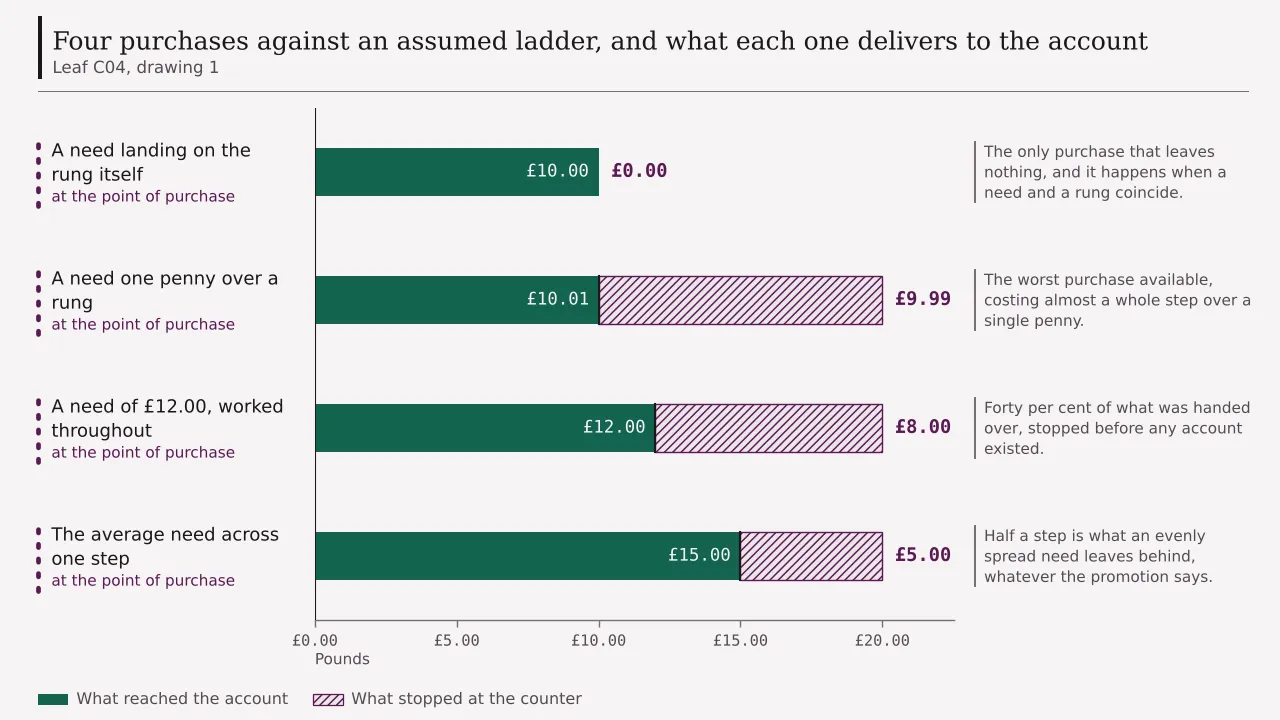
The bar that matters most in that ledger is the second one, where a penny of need turns into £9.99 of leftover. It is the only row where a reader could have changed the outcome by changing a figure they controlled, and it is the row a reader is least likely to notice, because rounding a need upwards feels like the cautious thing to do.
7
What a second purchase does to the first leftover
A leftover is not destroyed, so the natural question is whether the next payment absorbs it. Work that through and the answer is a qualified yes, with the qualification doing most of the work. Assume the payment screen will not move anything smaller than £10.00, which is this leaf’s own assumed floor and not a published figure. An £8.00 leftover is below that floor and cannot be paid in by itself.
Buy a second £20.00 voucher against a second £12.00 need and the position becomes £40.00 spent, £24.00 paid in and £16.00 held across two leftovers. Sixteen pounds clears the assumed £10.00 floor, so it can go in, and if it does the reader has paid £40.00 for a balance of £40.00 with nothing wasted. That is the optimistic reading and it is genuinely available.
Look at what it cost to reach, though. The reader wanted £24.00 in an account across two payments. To avoid stranding anything they have now deposited £40.00, which is 66.7 per cent more than they intended, into an account where a multiple is waiting. The leftover has not been recovered as money. It has been converted into a further deposit, and a further deposit is the one thing a reader avoiding over-commitment was trying not to make.
So the honest statement is narrow and it is the concession this leaf owes. Nothing has been confiscated. A leftover retains its face value and can be spent, and a reader with repeat purchases will eventually spend all of it. What a leftover loses is optionality: £8.00 that could have gone anywhere before it was bought can now go in one direction, and the direction happens to be the one that benefits from it most.
A second reading exists in which nothing resolves whatsoever. A reader who makes exactly one payment, claims one offer and does not return has £8.00 that is never put towards anything. On that path the £8.00 is a straightforward 40 per cent loading on a £12.00 payment, and it is invisible in every figure the promotion prints, because the promotion’s figures begin at the moment the account is credited.
8
A deposit page is a regulated object, or it is not
Most readers think of regulation as something that happens to games and to bonus terms. On this subject the sharper British rules are written about the payment page itself, and naming them is the only way to price what a page without them is missing.
Three duties attach to the screen rather than to the offer standing behind it. A limit-setting facility has to be plainly reachable from a deposit page, or through a link sitting on one, with the standard asking that clicks and pages be minimised on the way to it. The word limit is itself pinned down: a cap on gross deposits across a stated duration is the only thing entitled to that name, and whatever is set has to bite at the level of the account at least. And the two directions travel at different speeds, a reduction going through at once while a rise sits unactioned for a day at the shortest and releases only once the customer has acted a second time to confirm it.
Where a prepaid ladder leads is a promotion with no Great Britain licence beneath it. Duties that go missing on a subject like this one are the short set written about screens rather than about games. Nothing obliges the page showing the rungs to carry a limit facility, or to keep the route to one short. Nothing fixes what the word limit may be attached to, so a cap on single payments and a cap on a month’s payments may both be called the same thing. Nothing holds a rise back for a day while letting a reduction through at once, so the protection that is slow to remove and quick to apply becomes a setting like any other. Take those three away and the £8.00 in part one is unchanged, which is the point: the ladder was never the regulated object. The screen was, and outside the licence it is not.
Fold the limit duty into this leaf’s own figures and a small awkwardness falls out. A gross deposit limit of £10.00 for the day is a perfectly sensible setting, and against the assumed ladder it is a figure the voucher can express exactly once, at the bottom rung. The reader who needs £12.00 has a limit of £10.00 and a ladder whose next available amount is £20.00, and the two disagree about what a reasonable payment looks like by £2.00 in one direction and £8.00 in the other.
Inside the licence that disagreement resolves in the reader’s favour, because the limit is enforced by the account and the ladder is only a tariff at a counter. A payment above the limit does not go through, whatever was bought. Outside the licence the limit is whatever the operator chooses to offer, and the only figure with anything behind it is the one printed on the voucher.
None of that makes the voucher the problem. A ladder is a property of selling prepaid value at a counter and it would exist under any regulator. What the licence changes is whether the screen at the other end has duties written about it, and on these figures the screen is where every unstated number on this leaf lives.
9
Doing this sum on anything sold in fixed amounts
The method takes under a minute and it needs none of this leaf’s figures. Write down what the payment screen is asking for. Write down the amounts the thing is actually sold in. Take the smallest of those amounts that reaches the need. Subtract. Then check the subtraction from the other end, by taking the step and removing the overshoot, and if the two disagree the ladder is not evenly spaced and the first sum is the one to trust.
Two habits keep the result honest. Keep the leftover in its own column, never netted against anything the offer does, because the offer’s figures move when its terms move and the leftover does not. And write the word assumption beside every rung, every floor and every tariff taken from memory rather than from a page, because a ladder read off a counter last month is a ladder that may have been re-cut since.
Applied to the worked case the method prints four figures and stops: £20.00 spent, £12.00 arriving, £8.00 stopped and £19.20 of expected difference on what arrived. Everything but the last of those is settled at a counter or at a screen and could not have been read before the money was in hand. The remaining one sat in a document a step from the promotion.
The one action this leaf points at is the cheap one. Reading the smallest payment the screen will take, and the amounts the voucher is sold in, before buying anything costs nothing and is the only moment at which the £8.00 is still avoidable. After the purchase it is a question about what a leftover can be put towards. Before it, it is a question about which rung to buy, and those are not the same question at all.
£5.00 left behind on an average purchase, a figure that holds whatever the promotion behind the payment says
Questions
- Why does a prepaid voucher leave money behind at all?
- Because it is sold in fixed amounts while a payment screen asks for whatever figure a promotion has chosen. Against an assumed ladder of £10.00, £20.00, £30.00, £40.00 and £50.00, assumed here and sourced nowhere, a need of £12.00 has no matching amount. The cheapest voucher reaching it is £20.00, so £8.00 halts at the counter before any account exists.
- How much is left behind on a typical purchase?
- Half the step, on an even spread of needs. On the £10.00 step assumed here that comes to £5.00, buying fifty presses at the 10p this site fixes for a press and giving back an expected £4.80 once the house return is applied. The figure belongs to the ladder alone, so it holds still when the multiple, the return or the promotion moves.
- What is the worst purchase a reader can make?
- A need one penny above a rung. A need of £10.01 calls for a £20.00 voucher and leaves £9.99, which is 99.9 per cent of a whole step gone over a single penny. The best purchase is a need landing exactly on a rung, which leaves nothing. Rounding a need upwards before buying is therefore the most expensive thing available, for the most reasonable motive.
- Where is the list of amounts published before I buy?
- At the point of purchase, and this leaf treats it as settled there rather than earlier. The qualifying payment is on the banner, the multiple is in the bonus terms one document on, and the smallest payment the screen accepts appears only once an account exists. The amounts the voucher is sold in come last of all, and they are the only figure a reader meets with money already in hand.
- Should the stranded money be added to what the bonus costs?
- No, and the reason matters. The leftover is the reader’s own money, unstaked, with no condition attached, and it would be exactly the same size on a promotion with no credit and no multiple at all. A figure that survives the deletion of the whole offer is not a cost of the offer. The expected difference on the credit is a separate object that nobody is billed for and that appears on no statement.
- What does £12.00 of credit come to at forty times?
- An expected minus £7.20. Forty times £12.00 asks £480.00 across the reels, and the four pence the margin keeps in each pound of that comes to £19.20 of expected cost against a £12.00 credit. Reaching the same £19.20 directly takes £480.00 at £0.04 and no mention of the credit. A credit of any size runs out at a multiple of 25 on these assumptions, so forty is a long way beyond.
- Can a leftover be used on the next payment?
- On the assumption used here about how a leftover behaves it can be put towards a later payment at the same sort of counter. Take a screen that moves nothing under £10.00, assumed rather than sourced, and one £8.00 leftover sits below the floor and cannot go in alone. Two of them make £16.00 and can. Reaching that position costs having deposited £40.00 when £24.00 was wanted.
- What does a British licence change about the payment page?
- It makes the page itself a regulated object. A limit-setting facility has to be plainly reachable from a deposit page or a link sitting on one, with clicks and pages minimised on the way; a cap on gross deposits across a stated duration is the only thing entitled to be called a deposit limit; and a reduction goes through at once while a rise is held a day and then needs a second confirmation. Where a prepaid ladder leads is a promotion with no Great Britain licence beneath it, so not one of those is owed, while the ladder itself stands unaffected either way.
- What should I work out before buying anything?
- Four figures, in this order. The smallest payment the screen will take, the amounts the voucher is sold in, the payment the promotion asks for, and the subtraction between the last two. Check the subtraction from both ends: the rung above the need less the need, and the step less the overshoot. On the worked case both give £8.00, and after the purchase the question changes from which rung to buy into what a leftover can be put towards.