Terms read 19 October 2026 Leaf N10, revision 1
A lobby that charges nothing is still selling something
Forty minutes of practice covers at most 960 cycles on a licensed paid build, which at 10p a press is £96.00 of turnover and £3.84 of expected retention. The practice costs nought. The thing being practised costs £3.84 a session, and no page is obliged to say whether the two builds behave alike.
Stated on the banner £0.00 The price asked, which is the entire published claim and is perfectly true. Stated, once you go and look minus £4.32 The close on the reading that does carry a prize, seventy-five presses under a forty times condition at a 96 per cent return. Not stated before the money goes in £23.04 The gap between a session read off a demonstration and the same session priced on the paid build, on the figures modelled in part seven.
Offers reached from a free lobby, terms read
Every destination in this file is bought advertising. The site is paid a fee if a reader goes on to register, and no figure printed below moves because of it.
Bonus Spins UK Slip 01
Betportal
Ceiling as a multiple
The drop
€15.00
€1.00 in the euro
The claim reads €15.00. Once the terms beside it have applied, €0.00 of it can leave. The difference is the drop.
7 of the 15 terms on this slip could not be read before the money went in
Spins priced at this site's own 10p a spin, which the operator does not publish
Stated
€15.00
The claim as it is printed, before a single term has been applied to it.
Headline paid as spins
150 spins at 10c each, which is €15.00 of the figure above.
6 Nowhere
What one spin is worth
No unit is published for a spin, so the count is priced at this site's own 10p a spin. At half that price every figure below halves with it.
Match and other credit not priced
300% of three deposits, to a ceiling of €1,000. A share of a deposit nobody has made yet is not a sum, so no figure stands on this line and none is carried below.
Qualified
-€14.40
Written down somewhere, and taking part of the claim back. Each term carries the place it is written and the sum it takes.
2 Written terms at a distance this record does not establish
Play-through -€14.40
Carrying €14.40 through 35 times stakes €504.00 and costs €20.16 of it at 96 per cent return. That prices above the €14.40 there is to charge it against, so the whole of the credit goes and the line is held at that. The multiple sits on the bonus.
2 Written terms at a distance this record does not establish
Game weighting not priced
Slots only count towards the play-through. No contribution percentage is published, so the line above has been worked at full weight, which is the kindest reading there is.
2 Written terms at a distance this record does not establish
Ceiling on the winnings not priced
5x the bonus.
2 Written terms at a distance this record does not establish
Clock on the credit not priced
14 days.
2 Written terms at a distance this record does not establish
Largest stake while it runs not priced
€5.
3 Public record
Licence, and who holds it not priced
Licensed in Anjouan, Comoros, held by BetPortal Gaming Ltd, with Excite Ultra Media Ltd, reference ALSI-202601040-FI2. A register entry settles who holds a licence and what it permits. It does not settle who is running the site this morning.
4 Cashier
Smallest qualifying deposit your money
€20 a stage. That is €20.00 of your own money, and it is never netted into a drop.
5 On the way out
Checks before a withdrawal not priced
Documents before the first withdrawal.
Unstated
-€0.60
Applying without having been published anywhere, and costing money all the same.
6 Nowhere
What a spin hands back -€0.60
Staking a spin returns 96 per cent of it, so that share of the batch is the house's before a reel turns. This site works at that return and the operator publishes none where the claim is made.
6 Nowhere
Forfeited by rule cost unknown
Nothing is published under this heading, and it applies regardless.
6 Nowhere
Charge on the way out cost unknown
No charge on the way out is published as a figure, so nothing comes off this line. A charge that exists unpublished would come straight off whatever survives.
6 Nowhere
Smallest withdrawal allowed cost unknown
No smallest withdrawal is published as a figure. A floor nobody has published is still a floor, and it decides whether a small balance can move at all.
No Great Britain licence
Terms read 19 October 2026
Bonus Spins UK Slip 02
WinBeast
Ceiling as a sum
The drop
€50.00
€1.00 in the euro
The claim reads €50.00. Once the terms beside it have applied, €0.00 of it can leave. The difference is the drop.
8 of the 15 terms on this slip could not be read before the money went in
Spins priced at this site's own 10p a spin, which the operator does not publish
Stated
€50.00
The claim as it is printed, before a single term has been applied to it.
Headline paid as spins
500 spins at 10c each, which is €50.00 of the figure above.
6 Nowhere
What one spin is worth
No unit is published for a spin, so the count is priced at this site's own 10p a spin. At half that price every figure below halves with it.
Match and other credit not priced
50% to 100% of five deposits, each to a ceiling of €1,000, and a €650 free bet. A share of a deposit nobody has made yet is not a sum, so no figure stands on this line and none is carried below.
Qualified
-€48.00
Written down somewhere, and taking part of the claim back. Each term carries the place it is written and the sum it takes.
2 Written terms at a distance this record does not establish
Play-through -€48.00
Carrying €48.00 through 40 times stakes €1,920.00 and costs €76.80 of it at 96 per cent return. That prices above the €48.00 there is to charge it against, so the whole of the credit goes and the line is held at that. The multiple sits on the bonus and the winnings from the spins.
2 Written terms at a distance this record does not establish
Game weighting not priced
Slots, titles vary by country count towards the play-through. No contribution percentage is published, so the line above has been worked at full weight, which is the kindest reading there is.
2 Written terms at a distance this record does not establish
Ceiling on the winnings not priced
€100 a batch of spins.
2 Written terms at a distance this record does not establish
Clock on the credit not priced
7 days, spins 1 day.
3 Public record
Licence, and who holds it not priced
Licensed in Curaçao, holder not named on the site. A register entry settles who holds a licence and what it permits. It does not settle who is running the site this morning.
4 Cashier
Smallest qualifying deposit your money
€20 a stage. That is €20.00 of your own money, and it is never netted into a drop.
5 On the way out
Checks before a withdrawal not priced
Documents before the first withdrawal.
Unstated
-€2.00
Applying without having been published anywhere, and costing money all the same.
6 Nowhere
What a spin hands back -€2.00
Staking a spin returns 96 per cent of it, so that share of the batch is the house's before a reel turns. This site works at that return and the operator publishes none where the claim is made.
6 Nowhere
Largest stake while it runs cost unknown
Nothing is published under this heading, and it applies regardless.
6 Nowhere
Forfeited by rule cost unknown
Nothing is published under this heading, and it applies regardless.
6 Nowhere
Charge on the way out cost unknown
No charge on the way out is published as a figure, so nothing comes off this line. A charge that exists unpublished would come straight off whatever survives.
6 Nowhere
Smallest withdrawal allowed cost unknown
No smallest withdrawal is published as a figure. A floor nobody has published is still a floor, and it decides whether a small balance can move at all.
No Great Britain licence
Terms read 19 October 2026
Bonus Spins UK Slip 03
EliteSpin
Longest spin window
The drop
£50.00
£1.00 in the pound
The claim reads £50.00. Once the terms beside it have applied, £0.00 of it can leave. The difference is the drop.
8 of the 15 terms on this slip could not be read before the money went in
Spins priced at this site's own 10p a spin, which the operator does not publish
Stated
£50.00
The claim as it is printed, before a single term has been applied to it.
Headline paid as spins
500 spins at 10p each, which is £50.00 of the figure above.
6 Nowhere
What one spin is worth
No unit is published for a spin, so the count is priced at this site's own 10p a spin. At half that price every figure below halves with it.
Match and other credit not priced
50% to 100% of five deposits, each to a ceiling of £1,000. A share of a deposit nobody has made yet is not a sum, so no figure stands on this line and none is carried below.
Qualified
-£48.00
Written down somewhere, and taking part of the claim back. Each term carries the place it is written and the sum it takes.
2 Written terms at a distance this record does not establish
Play-through -£48.00
Carrying £48.00 through 40 times stakes £1,920.00 and costs £76.80 of it at 96 per cent return. That prices above the £48.00 there is to charge it against, so the whole of the credit goes and the line is held at that. The multiple sits on the bonus and the winnings from the spins.
2 Written terms at a distance this record does not establish
Game weighting not priced
Slots count towards the play-through. No contribution percentage is published, so the line above has been worked at full weight, which is the kindest reading there is.
2 Written terms at a distance this record does not establish
Ceiling on the winnings not priced
5x the bonus.
2 Written terms at a distance this record does not establish
Clock on the credit not priced
7 days, spins 3 days.
3 Public record
Licence, and who holds it not priced
Licensed in Costa Rica, held by PrimeTier Limited. A register entry settles who holds a licence and what it permits. It does not settle who is running the site this morning.
4 Cashier
Smallest qualifying deposit your money
£20 a stage. That is £20.00 of your own money, and it is never netted into a drop.
5 On the way out
Checks before a withdrawal not priced
Documents before the first withdrawal.
Unstated
-£2.00
Applying without having been published anywhere, and costing money all the same.
6 Nowhere
What a spin hands back -£2.00
Staking a spin returns 96 per cent of it, so that share of the batch is the house's before a reel turns. This site works at that return and the operator publishes none where the claim is made.
6 Nowhere
Largest stake while it runs cost unknown
Nothing is published under this heading, and it applies regardless.
6 Nowhere
Forfeited by rule cost unknown
Nothing is published under this heading, and it applies regardless.
6 Nowhere
Charge on the way out cost unknown
No charge on the way out is published as a figure, so nothing comes off this line. A charge that exists unpublished would come straight off whatever survives.
6 Nowhere
Smallest withdrawal allowed cost unknown
No smallest withdrawal is published as a figure. A floor nobody has published is still a floor, and it decides whether a small balance can move at all.
No Great Britain licence
Terms read 19 October 2026
Bonus Spins UK Slip 04
Crown Jewelz
Multiple unpublished
The drop
NOT WORKED
The multiple is not published in the operator's own terms. Since the sum cannot be worked around it, none is worked.
9 of the 14 terms on this slip could not be read before the money went in
No drop worked
Stated
£15.00
The claim as it is printed, before a single term has been applied to it.
Headline paid as spins
150 spins at 10p each, which is £15.00 of the figure above.
6 Nowhere
What one spin is worth
No unit is published for a spin, so the count is priced at this site's own 10p a spin. At half that price every figure below halves with it.
Match and other credit not priced
200% of the first deposit, then 150% twice, each to a ceiling of £1,000. A share of a deposit nobody has made yet is not a sum, so no figure stands on this line and none is carried below.
Qualified
NOT WORKED
Written down somewhere, and taking part of the claim back. Each term carries the place it is written and the sum it takes.
2 Written terms at a distance this record does not establish
Play-through not priced
40x the bonus, reported rather than published by the operator.
2 Written terms at a distance this record does not establish
Game weighting not priced
Slots count towards the play-through. No contribution percentage is published, so the line above has been worked at full weight, which is the kindest reading there is.
3 Public record
Licence, and who holds it not priced
Licensed in Curaçao, number not verified, holder not named on the site. A register entry settles who holds a licence and what it permits. It does not settle who is running the site this morning.
4 Cashier
Smallest qualifying deposit your money
£20. That is £20.00 of your own money, and it is never netted into a drop.
5 On the way out
Checks before a withdrawal not priced
Documents before the first withdrawal.
Unstated
NOT WORKED
Applying without having been published anywhere, and costing money all the same.
6 Nowhere
Ceiling on the winnings cost unknown
No ceiling is published. Nothing is assumed in its place.
6 Nowhere
Clock on the credit cost unknown
Nothing is published under this heading, and it applies regardless.
6 Nowhere
Largest stake while it runs cost unknown
Nothing is published under this heading, and it applies regardless.
6 Nowhere
Forfeited by rule cost unknown
Nothing is published under this heading, and it applies regardless.
6 Nowhere
Charge on the way out cost unknown
No charge on the way out is published as a figure, so nothing comes off this line. A charge that exists unpublished would come straight off whatever survives.
6 Nowhere
Smallest withdrawal allowed cost unknown
No smallest withdrawal is published as a figure. A floor nobody has published is still a floor, and it decides whether a small balance can move at all.
No Great Britain licence
Terms read 19 October 2026
Every figure in the second and third columns is this site's own working and nothing an operator has published. A claim is priced as printed, then the share a spin hands back at 96 per cent return comes off it, then what playing the multiple through costs at the same return, and then whatever a published ceiling, a charge on the way out or a floor on the smallest withdrawal takes from what has survived. The drop is the difference between the first figure and the last. The two columns add back up to it exactly, so no money leaves a slip without a term and a place beside it.
Which column a term falls in is settled by one question: has anybody written it down. A charge a reader meets at the payment screen is written down, and it stands in the second column with the cashier against it. A condition that binds without ever having been set down stands in the third, whatever it costs. Inside each column the terms run outwards from the banner, so the order itself says how far a reader would have had to go.
A count of spins has no unit until one is supplied. Where an operator publishes what one of its own spins is worth, that figure is used and the first column says it is theirs. Where none is published, this site's own 10p a spin stands in its place and every figure below moves in proportion with it. Where the multiple itself is unpublished, no drop is worked at all, because that is the one figure the sum cannot be done without.
Three words stand where a figure cannot. Not priced is a term that is written down and carries no number the arithmetic can take. Cost unknown is a term nobody has written down, costing something nobody has put a number on. Your money is money of the reader's own, which is never netted into a drop.
None of the operators in this file holds a Great Britain licence, so none of the duties that licence carries reaches them. Each of those duties is published in its own right, which is what makes its absence here something a reader can check rather than take on trust. Every gambling company licensed in Great Britain belongs to Gamstop Online, so a reader who has shut themselves out through the scheme is not shut out here. Social Responsibility Code 5.1.1 has held a play-through to a maximum of ten times the bonus funds since 19 January 2026, and it binds a licence holder and nobody else. Asked in a post of 21 October 2025 what is lost along with the licence, the Gambling Commission's Director of Enforcement and Intelligence answered: "unfair gaming practices, financial loss, and a lack of recourse if things go wrong". The same post puts blocked payouts, and withdrawal limits pitched high enough to be unreachable, among the behaviour the Commission has recorded. Nobody under 18 may hold an account at any of them.
Terms are reproduced in the wording their operator published, and each slip is dated with the day somebody sat down and read them. 19 October 2026 is the oldest of those dates. Anybody claiming an offer is bound by that operator's full terms, which are elsewhere, and never by a line standing here.
1
One phrase over two products, with a prize in only one
Four words cover two products that have almost nothing in common, and the thing separating them is whether anything can be won. On one side sits a demonstration build that takes no money and pays none out. On the other sits an offer of presses funded by somebody else, where the presses are real, the balance is real, and conditions are attached. Both are free at the point of use and only one of them has an exit.
Price the second one first, because it is the one this site has a method for. Take seventy-five presses at the 10p assumed throughout here. Those amount to £7.50 crossing the reels, against which 96 pence in the pound leaves an expected £7.20. A forty times condition over those winnings wants £288.00 staked, retention at four hundredths of that is £11.52, and the close is minus £4.32.
Expected on seventy-five presses £7.20 After a forty times condition is met minus £4.32 Carried by a clause behind one link £11.52
Now the demonstration build, where this site’s usual arithmetic produces an answer so clean it looks like a joke. Nothing is staked, so nothing is expected back, so the expected close is exactly £0.00 whatever happens on screen. A product whose expected value is nought in both directions cannot be priced by the method this site uses everywhere else, and that is the first sign that the method has to be pointed somewhere other than at the balance.
| What is being described | Is there a prize in it | Expected close on a session |
|---|---|---|
| A demonstration build taking nothing | None, so nothing leaves either | £0.00 exactly |
| Seventy-five funded presses, no condition | Yes, and collectable in principle | £7.20 |
| The same presses at forty times | Yes, behind £288.00 of staking | minus £4.32 |
Three rows, two products, and a reader searching the phrase cannot tell from the phrase which one they are about to meet. The middle row is a figure nobody will ever reach, since a funded offer without a condition is a rarity at this end of the market, and it is printed because the distance between it and the bottom row is the whole of what a condition does.
Everything after this part takes the top row, which is the harder of the two and the one no page on this site has priced yet. Something is plainly being exchanged in a demonstration lobby, because nobody builds, hosts and licenses a thing for no reason. Working out what, from what it costs to run and what it is worth to the party running it, is the job.
2
What a prize decides about which rulebook attaches
The British regulator has set out its own view of what a demonstration build is, and the sentence is short enough to work from. a game of that kind falls outside gambling in the technical sense, since no prize is in it, adding that no legitimate reason exists, on its view, for a child to be getting at one. Both halves of that matter here and they point in opposite directions.
The first half is a classification. A rulebook written about gambling fastens to gambling, and a thing the regulator describes as not technically gambling has less of that rulebook fastened to it. The second half is the exception: where the regulator wanted a duty extended to demonstration builds, it said so expressly, which it did for age checking and did not do for anything about how a build behaves.
That pairing is the cleanest evidence this leaf has, and it is evidence of a particular shape. An absence is hard to establish anywhere. It is easier where the same source has extended one duty by name and left the others where they were, because the extension shows the question was in front of somebody and shows which way it was answered. One duty crossed the line. The rest did not.
So the position a reader is in can be stated exactly rather than guessed at. Nothing found for this site requires a demonstration build to publish a return figure. Nothing requires it to match the paid build it is a demonstration of. Nothing requires anybody to say whether the two were built from one set of files or two, and no rule compels a sentence either way.
A reader who assumes the two agree has supplied the missing term themselves, at its most generous setting, which is the direction every unstated term on this site runs in. That is a regularity and not an accident: a term nobody has to state gets filled in by whoever is reading, and whoever is reading fills it in optimistically, with the party who left it out never obliged to put the reading right.
None of this says a demonstration build misleads anybody. Two builds of one title may well run from identical files, and the straightforward commercial reason for building them that way is that maintaining two sets of files costs twice as much. The claim here is narrower and is about who carries the uncertainty, which is the reader, at no charge to anybody else.
3
What a lobby charging nothing costs the people running it
Working out what a free lobby is for starts with what it costs, and two of the three costs cannot be priced from anything this site can cite. Hosting is unpriceable here. Whatever a title costs to license for demonstration is unpriceable here, and this leaf will not invent a figure for either. The third cost can be computed exactly, and it is the interesting one.
That third cost is margin not taken. Set a session at forty minutes, a length supplied here and nowhere else. Forty minutes is 2,400 seconds; the minimum interval beneath a cycle on a licensed reel build is 2.5 seconds; and 2,400 divided by that gives 960 presses as the ceiling on what forty paid minutes can deliver.
Price those 960 presses at the 10p this site assumes and the session turns over £96.00. Four pence in each pound is retained where 96 of them come back, so a full paid session of that length is expected to leave £3.84 behind. That figure is the unit this whole leaf is denominated in, and it is the price of forty minutes of somebody’s attention at the rate the paid product charges for it.
£3.84 of expected retention in forty minutes, which is 9.6 pence a minute
So a demonstration session has a cost to the house only if it displaces a paid one, and for most of the people in a free lobby it plainly does not. What it buys instead is a probability. If one free session in ten eventually produces a paid session of the same length, a figure supplied here rather than any measured conversion rate, then a free session is worth 38.4 pence to the house in expectation, and the lobby pays for itself at anything under that a head.
Run the assumption the other way and the arithmetic still works. At one in a hundred the same session is worth 3.84 pence. At one in four it is worth 96 pence. The useful property of the calculation is not the answer, which depends on a figure nobody publishes, but the shape: the value of a free lobby to the house is the paid session’s margin multiplied by the chance of arriving at one, and every term in that product is either assumed here or withheld by somebody.
Which is the honest answer to what a free lobby is for. It is a purchase of probability, priced in a currency the buyer does not know they are spending, and its own arithmetic is held entirely by the party running it. The reader cannot compute it because two of the three terms are not theirs to see.
4
Three things changing hands where no money does
Something passes in both directions or the lobby would not exist, so the next question is what the reader is handing over. Three things, and they are of quite different kinds: a quantity of attention, a record, and a habit. The first can be priced, the second cannot be priced here, and the third is where the money actually is.
| What the reader parts with | Where it is settled | How it is measured | What it comes to here |
|---|---|---|---|
| Forty minutes of attention | At the paid build’s own rate | £3.84 a session | |
| A name, an address, a birth date | behind a registration | Not priceable from any source here | Unpriced |
| A practised rate of play | nowhere in writing | Sessions, multiplied by the margin | £53.76 a fortnight |
| Whether the builds agree | nowhere in writing | Two readings of one session | £23.04 apart |
Attention is the easy row and the smallest. Forty minutes is worth £3.84 at the paid build’s rate, which is 9.6 pence a minute, and a reader giving a lobby an hour has given it something worth 5.76 pence more than that. Nobody is any worse off at the end of the session, because no stake was placed, and that is exactly why the row reads as free rather than as a purchase.
The record is the row this leaf declines to price, and declining is the accurate thing to do. No source consulted for this site puts a figure on what a verified name, an address and a birth date are worth to anybody, and a plausible-looking number would read exactly like a sourced one once it had been set in type. What can be said about that row is in part five and is a statement about when it is taken rather than what it fetches.
The habit is where the arithmetic goes. Fourteen sessions is a fortnight of one a day, a pattern this leaf supplies rather than an observation of anybody. Fourteen lots of £3.84 is £53.76 of expected retention once the sessions are paid for, and the point of the free lobby is that the fourteen sessions are rehearsed before the first pound is asked for.
Put the three together and the exchange reads clearly enough. The house gives away a product whose margin it can compute to the penny. The reader gives away a quantity of attention they would not have priced at all, a record nobody here can price, and a rate of play that becomes worth £3.84 an occasion the moment it is priced. Only one party to the exchange has run the sum.
5
A document check that reaches a game with no prize in it
The middle row of that table carries one sourced point, and the point is sharper than the row looks. Identity work in Britain reaches demonstration builds expressly. Identity is established and checked before anybody gambles, the condition naming three items it must cover at the minimum, which are a name, an address and the date somebody was born; the age-checking duty covers play paid for with an incentive as readily as play paid for out of a bank account; and it then goes further still, since a licensee may not let anybody into the versions of its games that carry no prize without an age check first.
Two things follow and they pull against each other. The first is protective and is plainly the purpose: a demonstration build with no door on it is reachable by a child, and the regulator says in terms that it sees no legitimate reason for that. The second is structural: inside Britain, a lobby charging nothing is a lobby with a registration form in front of it, by rule rather than by commercial choice.
Something about that is worth dwelling on, because it inverts how the free lobby reads. The three items are collected before the first free press rather than at the exit, so the record is not the price of winning anything. It is the price of looking. A reader who intended to spend forty minutes finding out whether a game is any good has handed over a verified identity to do it, and has done so before any sum was in question.
Timing used to be looser and the change is dated. The earlier regime allowed an age check to be finished within seventy-two hours of somebody registering, and the article announcing the change carries 7 February 2019, with the rules taking effect that May. No part of that grace survives, and the check now stands at the front of the sequence rather than three days into it.
Outside the British licence none of this binds anybody, and the consequence is not that the record goes uncollected. A registration form is a commercial instrument as well as a regulatory one, so it is likely to be there either way. The difference is why it is there, which decides what is done with what it collects, and that is a difference a reader cannot see from the form itself.
6
A rate rehearsed at nought, and the rate it rehearses for
A free lobby is better at one thing than any other instrument in this market, and the thing is establishing a rate of play before a price is attached to it. Somebody who has spent fourteen sessions in a demonstration build has a settled idea of how fast the game moves, how long a session lasts and how often a feature arrives, and every one of those was learned at a price of nought.
The trouble is that the rehearsed rate need not be the rate on sale. A licensed paid build cannot go beneath 2.5 seconds a cycle, which caps forty minutes at 960 presses. Nothing published holds a demonstration build to anything whatever. Set one running at 1.5 seconds a press, a setting chosen here to show the shape, and the same forty minutes delivers 1,600 presses.
Sixteen hundred against nine hundred and sixty is 67 per cent more play in the identical span, and the overstatement runs the wrong way for whoever is learning from it. The session that felt like forty minutes of a brisk game is forty minutes of a game running faster than the paid version may legally run. The habit being rehearsed is a habit the paid product cannot serve.
Price the mismatch in the only honest currency available, which is time rather than money. Reaching 1,600 cycles on a licensed paid build takes 4,000 seconds, which is one hour, six minutes and forty seconds. A reader budgeting forty minutes for what they practised is budgeting 40 per cent of the time the paid version will take, which is a planning error made entirely out of an unpublished number.
The same mismatch has a second edge, and it is the one that costs money. Where the demonstration runs quicker, the reader’s sense of what a session costs is formed where nothing costs anything, and the paid build’s own retention clock is running the whole time. On these figures the margin accrues at 9.6 pence a minute, so a session that overruns by twenty minutes has handed over a further £1.92 without a single decision being taken about it.
So the free lobby is not simply advertising. Advertising describes a product. This establishes a pattern of behaviour that the product is then sold into, at a price the pattern itself determines, and the figure that converts the pattern into money is the £3.84 computed in part three. A reader can compute that too, which is the one encouraging sentence on this leaf.
7
Two builds of one game, and nobody obliged to compare them
Here is the sharpest unstated term on the page, and it is a question rather than a number: does the free build behave like the paid one. Nothing this site can cite requires an answer, requires a figure from either build, or requires anybody to say whether a figure quoted for one was taken from the other.
Model it and the stakes become visible. Take the 960-press session from part three and read it twice. Read first off a demonstration modelled at 120 per cent, a setting picked here to show a shape rather than to describe any build: £96.00 of turnover hands back £115.20, and the session closes at plus £19.20. Read at the paid build’s 96 per cent, the same session closes at minus £3.84.
A session as a generous demonstration shows it £19.20 The same session at the paid rate minus £3.84 Price of assuming two builds agree £23.04
Those two ends sit £23.04 apart, and the figure arrives twice over, which is how this site checks itself. Subtracting one end of the block from the other gives it directly. Alternatively take the two return rates, 120 against 96, note the 24 percentage points between them, and apply that to the £96.00 of turnover: 24 per cent of £96.00 is £23.04. The agreement is exact because the only thing changed between the two readings is the rate at which turnover comes back.
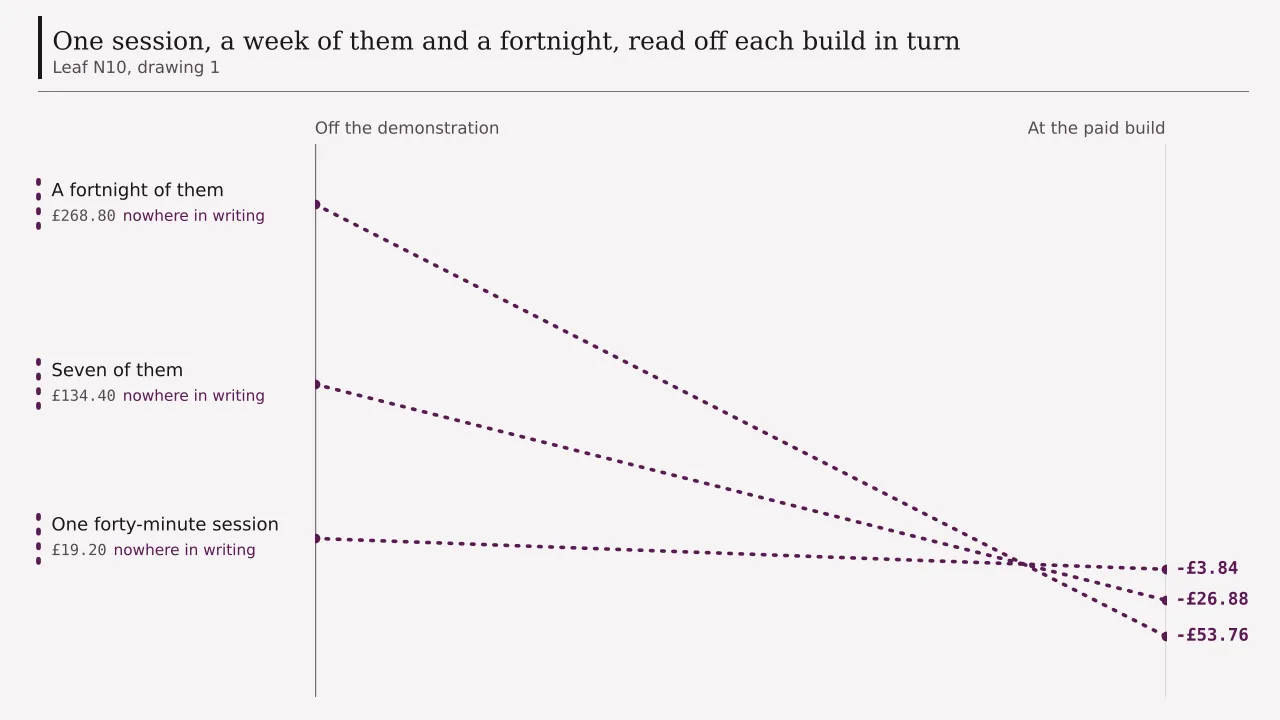
The fortnight row is the one to carry away. Fourteen sessions read off a generous demonstration total plus £268.80 and the same fourteen at the paid rate total minus £53.76, which is £322.56 of difference accumulated by nothing more than a question nobody answered. Both figures are modelled here and neither describes any particular build, and that is precisely the complaint: a reader has no published figure to put in place of either.
Three readings of the evidence are available and this leaf declines to choose between them, because choosing would mean asserting something unsourced. The builds may be identical files. They may differ in ways nobody intended. They may be tuned deliberately. What can be said is that the question decides £23.04 a session on these figures, that it is answered nowhere a reader can reach, and that every one of the three possibilities is consistent with everything published.
£322.56 of difference across a fortnight, resting on one unanswered question
8
Rules that reach a build, and the three this one does without
Lobbies of this kind, and the paid builds standing behind them, hold no Great Britain licence. The protections worth itemising on a leaf about how a build behaves are the three that bear on behaviour itself rather than on money, documents or complaints, and each of them is a rule about what a game may show a player.
The first decides what a losing event may be dressed as, and it is the most pointed design rule this site carries. Two practices get named out of it: dropping a near miss into the place an ordinary loss belonged, and imitating a physical device while declining to imitate its odds. Both sit under a general bar on any design apt to leave somebody mistaken about how probable an outcome is, which the guidance reduces to a single prohibition, that one loss may not be replaced by another.
Read that against part seven and the pairing is awkward. A demonstration build is a simulation of something, and the one rule in the standards that governs simulations governs them as a species of gambling, which the regulator has said demonstration builds are not. Whether the bar reaches a lobby with no prize in it cannot be settled here, and admitting as much is more accurate than pretending otherwise.
The second fixes what may move while somebody is mid-session. A game’s rules, its payouts and the probabilities producing them are held still once play has begun; where something does move, the customer gets told; and one clause is refused by name in the guidance, the clause reserving a power to rewrite rules at any moment. Against the question in part seven, that is a duty of stability rather than of disclosure, and it is the nearest published thing to an assurance that what was practised is what is sold.
The third is the door on the demonstration lobby itself, from part five, and it is the one duty extended to this product by name. Age gets checked before a version carrying no prize is reachable at all, and the seventy-two hours that once ran behind that check went when the current regime arrived.
Take the three together and what goes missing is not money. Every figure computed above stays exactly where it is, because none of these rules changes a return, a stake or a multiple. What goes is the assurance that the thing on the screen is a fair representation of the thing being sold, which on a leaf about demonstration builds is the only assurance that was ever the point.
9
What can be settled about a lobby with no price on it
Five things can be settled before any registration, and running through them takes about a minute on a telephone. What follows is a much shorter list of what cannot be settled, and the second list is the one worth printing.
First, whether a prize exists. That single question separates the two products in part one and decides whether the arithmetic on this site applies at all, since a build paying nothing has an expected close of £0.00 by construction and a funded offer does not. Nothing else about the lobby needs looking at until that is answered.
Second, what the session costs at the paid rate. Multiply the minutes by the presses a licensed build can serve inside them, multiply again by the stake, and take four hundredths of the product where 96 in the hundred come back. Forty minutes gives £3.84 here, or 9.6 pence a minute, and both of those are worked out on this page rather than published by anybody.
Third, what the record is for. The three items collected at the door are collected before the first free press inside the British licence, by a rule that names free-to-play builds expressly, and are collected for commercial reasons wherever that rule does not reach. A reader cannot tell which of the two is happening from the form, and knowing that they cannot tell is itself a result.
Fourth, the licence position, which is settled in the public register by anybody before an account exists, and which decides whether part eight’s three rules apply to the build at all. Fifth, the condition on any funded presses the lobby leads to, which sits in the bonus terms and cost £11.52 on the figures in part one.
What cannot be established is a single thing and it is the one the whole leaf turns on: whether the build being demonstrated is the build being sold. No figure is published for either, no rule requires one, and no document anywhere undertakes that the two agree. On the modelling in part seven that question is worth £23.04 a session and £322.56 across a fortnight, and it is answered nowhere in writing.
The honest conclusion is narrow and is not an accusation. A lobby that charges nothing is telling the truth about its price. What it withholds is not the price but the relationship between what it shows and what it sells, and a reader who treats forty free minutes as forty minutes of the paid product has supplied that relationship themselves, for nothing, in the direction that suits whoever left it out.
Questions
- Does a free slots lobby mean a demonstration or a funded offer?
- The phrase covers both and does not distinguish them, which is why the first question to ask is whether a prize exists. A demonstration build takes nothing and pays nothing, so its expected close is exactly £0.00 in both directions. A funded offer of seventy-five presses at 10p sends £7.50 across the reels and leaves an expected £7.20, which a forty times condition then takes to minus £4.32. Both are free at the point of use and only one of them has an exit.
- If nothing is charged, what is actually being sold?
- A probability, bought with somebody’s attention. Forty minutes of paid play at 10p a press covers at most 960 cycles, turns over £96.00 and leaves £3.84 of expected retention with the house. A free session costs the house nothing unless it displaces a paid one, so what it buys is the chance of producing a paid session later. At one conversion in ten, a figure supplied here, a free session is worth 38.4 pence in expectation, and at one in a hundred it is worth 3.84 pence.
- Where does the 960 presses in forty minutes come from?
- From dividing the session by the minimum interval a licensed build must leave. Forty minutes is 2,400 seconds; the interval beneath a cycle on a licensed reel build is 2.5 seconds at its shortest; and 2,400 divided by that is 960. The forty-minute session is a length supplied here and nowhere else. The division is arithmetic, and the resulting figure is a ceiling on what a paid session of that length can deliver rather than a description of anybody’s play.
- What does a reader hand over in a lobby that takes no money?
- Three things of different kinds. Attention, which is worth £3.84 a session at the paid build’s own rate, or 9.6 pence a minute. A record, meaning a verified name, an address and the date somebody was born, which no source consulted for this site puts a figure on and which this leaf therefore declines to price. And a practised rate of play, which is where the money is: fourteen sessions is £53.76 of expected retention once the sessions are paid for.
- Why is an identity check needed for a game with no prize in it?
- Because the duty was extended to those games by name. Inside the British licence identity is established and checked before anybody gambles, the condition naming three items it must cover at the minimum, which are a name, an address and the date somebody was born; the age-checking rule covers play paid for with an incentive as readily as play paid for out of a bank account; and a licensee may not let anybody into the versions of its games that carry no prize without an age check first. The regulator’s own reasoning is that a game of that kind falls outside gambling in the technical sense, since no prize is in it, and that no legitimate reason exists, on its view, for a child to be getting at one.
- Does that mean the record is the price of looking rather than of winning?
- Inside the British licence, yes, and the sequence is what shows it. The three items are collected before the first free press rather than at the exit, so somebody who meant to spend forty minutes finding out whether a game is any good has handed over a verified identity to do it, before any sum was in question. The earlier regime allowed an age check to be finished within seventy-two hours of somebody registering, and no part of that grace survives.
- Can a free build run faster than the paid one?
- Nothing published stops it. A licensed paid build cannot go beneath 2.5 seconds a cycle, which caps forty minutes at 960 presses, while no rule found for this site holds a demonstration build to any interval whatever. At 1.5 seconds a press, a setting chosen here to show the shape, the same forty minutes delivers 1,600 presses, or 67 per cent more play in the identical span, and 1,600 cycles on the paid build would take one hour, six minutes and forty seconds.
- Does a free version have to behave like the paid version?
- No rule this site can cite requires it, requires a figure from either build, or requires anybody to say whether a figure quoted for one came from the other. The question is the sharpest unstated term on the page. Three readings are consistent with everything published: identical files, an unintended difference, or deliberate tuning. This leaf declines to choose between them, because choosing would mean asserting something no source supports.
- What is that unanswered question worth in money?
- £23.04 on one session, and the figure arrives twice. A 960-press session read off a demonstration modelled at 120 per cent, a setting picked here to show the shape, hands back £115.20 on £96.00 of turnover and closes at plus £19.20, while the same session at the paid build’s 96 per cent closes at minus £3.84, and the two ends are £23.04 apart. Separately, the 24 percentage points between the two rates applied to £96.00 of turnover is also £23.04. Across fourteen sessions the gap compounds to £322.56.
- Which protections are missing where a build holds no British licence?
- Three, all of them about what a game may show rather than about money or documents. A general bar on any design apt to leave somebody mistaken about how probable an outcome is, which names dropping a near miss into the place an ordinary loss belonged and imitating a physical device while declining to imitate its odds. A rule holding game rules, payouts and the probabilities producing them still once play has begun, which refuses by name the clause reserving a power to rewrite rules at any moment. And an age check before a version carrying no prize is reachable at all. None of the three changes a return or a stake, so every figure on this page survives their absence intact.
- What should somebody establish before registering with a free lobby?
- Five things, and all five are reachable. Whether a prize exists at all. What the equivalent paid session costs, which is £3.84 for forty minutes here. What the record at the door is being collected for, noting that a reader cannot tell from the form. The licence position, which the public register settles before an account exists. And the condition attached to any funded presses the lobby leads on to, which cost £11.52 on the seventy-five presses worked in part one.
- Is a free lobby just advertising, then?
- It does something advertising does not. Advertising describes a product, while a demonstration build establishes a pattern of behaviour that the product is afterwards sold into, at a price the pattern itself sets. On this leaf’s figures the margin accrues at 9.6 pence a minute, so a session that overruns by twenty minutes has handed over a further £1.92 with no decision taken about it, and the rate that produced the overrun was learned where nothing cost anything.