Terms read 19 October 2026 Leaf R02, revision 1
Non UK casinos: what the British record covers, and where its authority ends
A balance of £50.00, half paid in and half credited, carries £250.00 of turnover under the ceiling the British record imposes and £2,000.00 under a two-part requirement nothing out here forbids. The first closes at an expected £40.00 and the second at minus £30.00. Which arithmetic a reader is standing in is decided by one boundary, and this leaf measures exactly where that boundary runs.
Stated on the banner £25.00 A credit of twenty-five pounds, with neither a multiple beside it nor a licence number anywhere near. Stated, once you go and look minus £30.00 Forty times over the credit and the payment together, with four pence of each pound crossing the reels kept by the margin. Not stated before the money goes in No ceiling at all Nothing caps the multiple, no entry names a present operator, a self-exclusion registration halts where the grant halts, and whether a payment counts towards a requirement has no published answer.
Addresses outside the record, with their terms read
Every destination in this file is bought advertising. The site is paid a fee if a reader goes on to register, and no figure printed below moves because of it.
Bonus Spins UK Slip 01
Betportal
Ceiling as a multiple
The drop
€15.00
€1.00 in the euro
The claim reads €15.00. Once the terms beside it have applied, €0.00 of it can leave. The difference is the drop.
7 of the 15 terms on this slip could not be read before the money went in
Spins priced at this site's own 10p a spin, which the operator does not publish
Stated
€15.00
The claim as it is printed, before a single term has been applied to it.
Headline paid as spins
150 spins at 10c each, which is €15.00 of the figure above.
6 Nowhere
What one spin is worth
No unit is published for a spin, so the count is priced at this site's own 10p a spin. At half that price every figure below halves with it.
Match and other credit not priced
300% of three deposits, to a ceiling of €1,000. A share of a deposit nobody has made yet is not a sum, so no figure stands on this line and none is carried below.
Qualified
-€14.40
Written down somewhere, and taking part of the claim back. Each term carries the place it is written and the sum it takes.
2 Written terms at a distance this record does not establish
Play-through -€14.40
Carrying €14.40 through 35 times stakes €504.00 and costs €20.16 of it at 96 per cent return. That prices above the €14.40 there is to charge it against, so the whole of the credit goes and the line is held at that. The multiple sits on the bonus.
2 Written terms at a distance this record does not establish
Game weighting not priced
Slots only count towards the play-through. No contribution percentage is published, so the line above has been worked at full weight, which is the kindest reading there is.
2 Written terms at a distance this record does not establish
Ceiling on the winnings not priced
5x the bonus.
2 Written terms at a distance this record does not establish
Clock on the credit not priced
14 days.
2 Written terms at a distance this record does not establish
Largest stake while it runs not priced
€5.
3 Public record
Licence, and who holds it not priced
Licensed in Anjouan, Comoros, held by BetPortal Gaming Ltd, with Excite Ultra Media Ltd, reference ALSI-202601040-FI2. A register entry settles who holds a licence and what it permits. It does not settle who is running the site this morning.
4 Cashier
Smallest qualifying deposit your money
€20 a stage. That is €20.00 of your own money, and it is never netted into a drop.
5 On the way out
Checks before a withdrawal not priced
Documents before the first withdrawal.
Unstated
-€0.60
Applying without having been published anywhere, and costing money all the same.
6 Nowhere
What a spin hands back -€0.60
Staking a spin returns 96 per cent of it, so that share of the batch is the house's before a reel turns. This site works at that return and the operator publishes none where the claim is made.
6 Nowhere
Forfeited by rule cost unknown
Nothing is published under this heading, and it applies regardless.
6 Nowhere
Charge on the way out cost unknown
No charge on the way out is published as a figure, so nothing comes off this line. A charge that exists unpublished would come straight off whatever survives.
6 Nowhere
Smallest withdrawal allowed cost unknown
No smallest withdrawal is published as a figure. A floor nobody has published is still a floor, and it decides whether a small balance can move at all.
No Great Britain licence
Terms read 19 October 2026
Bonus Spins UK Slip 02
WinBeast
Ceiling as a sum
The drop
€50.00
€1.00 in the euro
The claim reads €50.00. Once the terms beside it have applied, €0.00 of it can leave. The difference is the drop.
8 of the 15 terms on this slip could not be read before the money went in
Spins priced at this site's own 10p a spin, which the operator does not publish
Stated
€50.00
The claim as it is printed, before a single term has been applied to it.
Headline paid as spins
500 spins at 10c each, which is €50.00 of the figure above.
6 Nowhere
What one spin is worth
No unit is published for a spin, so the count is priced at this site's own 10p a spin. At half that price every figure below halves with it.
Match and other credit not priced
50% to 100% of five deposits, each to a ceiling of €1,000, and a €650 free bet. A share of a deposit nobody has made yet is not a sum, so no figure stands on this line and none is carried below.
Qualified
-€48.00
Written down somewhere, and taking part of the claim back. Each term carries the place it is written and the sum it takes.
2 Written terms at a distance this record does not establish
Play-through -€48.00
Carrying €48.00 through 40 times stakes €1,920.00 and costs €76.80 of it at 96 per cent return. That prices above the €48.00 there is to charge it against, so the whole of the credit goes and the line is held at that. The multiple sits on the bonus and the winnings from the spins.
2 Written terms at a distance this record does not establish
Game weighting not priced
Slots, titles vary by country count towards the play-through. No contribution percentage is published, so the line above has been worked at full weight, which is the kindest reading there is.
2 Written terms at a distance this record does not establish
Ceiling on the winnings not priced
€100 a batch of spins.
2 Written terms at a distance this record does not establish
Clock on the credit not priced
7 days, spins 1 day.
3 Public record
Licence, and who holds it not priced
Licensed in Curaçao, holder not named on the site. A register entry settles who holds a licence and what it permits. It does not settle who is running the site this morning.
4 Cashier
Smallest qualifying deposit your money
€20 a stage. That is €20.00 of your own money, and it is never netted into a drop.
5 On the way out
Checks before a withdrawal not priced
Documents before the first withdrawal.
Unstated
-€2.00
Applying without having been published anywhere, and costing money all the same.
6 Nowhere
What a spin hands back -€2.00
Staking a spin returns 96 per cent of it, so that share of the batch is the house's before a reel turns. This site works at that return and the operator publishes none where the claim is made.
6 Nowhere
Largest stake while it runs cost unknown
Nothing is published under this heading, and it applies regardless.
6 Nowhere
Forfeited by rule cost unknown
Nothing is published under this heading, and it applies regardless.
6 Nowhere
Charge on the way out cost unknown
No charge on the way out is published as a figure, so nothing comes off this line. A charge that exists unpublished would come straight off whatever survives.
6 Nowhere
Smallest withdrawal allowed cost unknown
No smallest withdrawal is published as a figure. A floor nobody has published is still a floor, and it decides whether a small balance can move at all.
No Great Britain licence
Terms read 19 October 2026
Bonus Spins UK Slip 03
EliteSpin
Longest spin window
The drop
£50.00
£1.00 in the pound
The claim reads £50.00. Once the terms beside it have applied, £0.00 of it can leave. The difference is the drop.
8 of the 15 terms on this slip could not be read before the money went in
Spins priced at this site's own 10p a spin, which the operator does not publish
Stated
£50.00
The claim as it is printed, before a single term has been applied to it.
Headline paid as spins
500 spins at 10p each, which is £50.00 of the figure above.
6 Nowhere
What one spin is worth
No unit is published for a spin, so the count is priced at this site's own 10p a spin. At half that price every figure below halves with it.
Match and other credit not priced
50% to 100% of five deposits, each to a ceiling of £1,000. A share of a deposit nobody has made yet is not a sum, so no figure stands on this line and none is carried below.
Qualified
-£48.00
Written down somewhere, and taking part of the claim back. Each term carries the place it is written and the sum it takes.
2 Written terms at a distance this record does not establish
Play-through -£48.00
Carrying £48.00 through 40 times stakes £1,920.00 and costs £76.80 of it at 96 per cent return. That prices above the £48.00 there is to charge it against, so the whole of the credit goes and the line is held at that. The multiple sits on the bonus and the winnings from the spins.
2 Written terms at a distance this record does not establish
Game weighting not priced
Slots count towards the play-through. No contribution percentage is published, so the line above has been worked at full weight, which is the kindest reading there is.
2 Written terms at a distance this record does not establish
Ceiling on the winnings not priced
5x the bonus.
2 Written terms at a distance this record does not establish
Clock on the credit not priced
7 days, spins 3 days.
3 Public record
Licence, and who holds it not priced
Licensed in Costa Rica, held by PrimeTier Limited. A register entry settles who holds a licence and what it permits. It does not settle who is running the site this morning.
4 Cashier
Smallest qualifying deposit your money
£20 a stage. That is £20.00 of your own money, and it is never netted into a drop.
5 On the way out
Checks before a withdrawal not priced
Documents before the first withdrawal.
Unstated
-£2.00
Applying without having been published anywhere, and costing money all the same.
6 Nowhere
What a spin hands back -£2.00
Staking a spin returns 96 per cent of it, so that share of the batch is the house's before a reel turns. This site works at that return and the operator publishes none where the claim is made.
6 Nowhere
Largest stake while it runs cost unknown
Nothing is published under this heading, and it applies regardless.
6 Nowhere
Forfeited by rule cost unknown
Nothing is published under this heading, and it applies regardless.
6 Nowhere
Charge on the way out cost unknown
No charge on the way out is published as a figure, so nothing comes off this line. A charge that exists unpublished would come straight off whatever survives.
6 Nowhere
Smallest withdrawal allowed cost unknown
No smallest withdrawal is published as a figure. A floor nobody has published is still a floor, and it decides whether a small balance can move at all.
No Great Britain licence
Terms read 19 October 2026
Bonus Spins UK Slip 04
Crown Jewelz
Multiple unpublished
The drop
NOT WORKED
The multiple is not published in the operator's own terms. Since the sum cannot be worked around it, none is worked.
9 of the 14 terms on this slip could not be read before the money went in
No drop worked
Stated
£15.00
The claim as it is printed, before a single term has been applied to it.
Headline paid as spins
150 spins at 10p each, which is £15.00 of the figure above.
6 Nowhere
What one spin is worth
No unit is published for a spin, so the count is priced at this site's own 10p a spin. At half that price every figure below halves with it.
Match and other credit not priced
200% of the first deposit, then 150% twice, each to a ceiling of £1,000. A share of a deposit nobody has made yet is not a sum, so no figure stands on this line and none is carried below.
Qualified
NOT WORKED
Written down somewhere, and taking part of the claim back. Each term carries the place it is written and the sum it takes.
2 Written terms at a distance this record does not establish
Play-through not priced
40x the bonus, reported rather than published by the operator.
2 Written terms at a distance this record does not establish
Game weighting not priced
Slots count towards the play-through. No contribution percentage is published, so the line above has been worked at full weight, which is the kindest reading there is.
3 Public record
Licence, and who holds it not priced
Licensed in Curaçao, number not verified, holder not named on the site. A register entry settles who holds a licence and what it permits. It does not settle who is running the site this morning.
4 Cashier
Smallest qualifying deposit your money
£20. That is £20.00 of your own money, and it is never netted into a drop.
5 On the way out
Checks before a withdrawal not priced
Documents before the first withdrawal.
Unstated
NOT WORKED
Applying without having been published anywhere, and costing money all the same.
6 Nowhere
Ceiling on the winnings cost unknown
No ceiling is published. Nothing is assumed in its place.
6 Nowhere
Clock on the credit cost unknown
Nothing is published under this heading, and it applies regardless.
6 Nowhere
Largest stake while it runs cost unknown
Nothing is published under this heading, and it applies regardless.
6 Nowhere
Forfeited by rule cost unknown
Nothing is published under this heading, and it applies regardless.
6 Nowhere
Charge on the way out cost unknown
No charge on the way out is published as a figure, so nothing comes off this line. A charge that exists unpublished would come straight off whatever survives.
6 Nowhere
Smallest withdrawal allowed cost unknown
No smallest withdrawal is published as a figure. A floor nobody has published is still a floor, and it decides whether a small balance can move at all.
No Great Britain licence
Terms read 19 October 2026
Every figure in the second and third columns is this site's own working and nothing an operator has published. A claim is priced as printed, then the share a spin hands back at 96 per cent return comes off it, then what playing the multiple through costs at the same return, and then whatever a published ceiling, a charge on the way out or a floor on the smallest withdrawal takes from what has survived. The drop is the difference between the first figure and the last. The two columns add back up to it exactly, so no money leaves a slip without a term and a place beside it.
Which column a term falls in is settled by one question: has anybody written it down. A charge a reader meets at the payment screen is written down, and it stands in the second column with the cashier against it. A condition that binds without ever having been set down stands in the third, whatever it costs. Inside each column the terms run outwards from the banner, so the order itself says how far a reader would have had to go.
A count of spins has no unit until one is supplied. Where an operator publishes what one of its own spins is worth, that figure is used and the first column says it is theirs. Where none is published, this site's own 10p a spin stands in its place and every figure below moves in proportion with it. Where the multiple itself is unpublished, no drop is worked at all, because that is the one figure the sum cannot be done without.
Three words stand where a figure cannot. Not priced is a term that is written down and carries no number the arithmetic can take. Cost unknown is a term nobody has written down, costing something nobody has put a number on. Your money is money of the reader's own, which is never netted into a drop.
None of the operators in this file holds a Great Britain licence, so none of the duties that licence carries reaches them. Each of those duties is published in its own right, which is what makes its absence here something a reader can check rather than take on trust. Every gambling company licensed in Great Britain belongs to Gamstop Online, so a reader who has shut themselves out through the scheme is not shut out here. Social Responsibility Code 5.1.1 has held a play-through to a maximum of ten times the bonus funds since 19 January 2026, and it binds a licence holder and nobody else. Asked in a post of 21 October 2025 what is lost along with the licence, the Gambling Commission's Director of Enforcement and Intelligence answered: "unfair gaming practices, financial loss, and a lack of recourse if things go wrong". The same post puts blocked payouts, and withdrawal limits pitched high enough to be unreachable, among the behaviour the Commission has recorded. Nobody under 18 may hold an account at any of them.
Terms are reproduced in the wording their operator published, and each slip is dated with the day somebody sat down and read them. 19 October 2026 is the oldest of those dates. Anybody claiming an offer is bound by that operator's full terms, which are elsewhere, and never by a line standing here.
1
What a national record is a record of
The British regulator keeps a published account of the people it has given permission to, and the account divides into searchable lists of businesses, of individuals and of premises, each readable on screen or downloadable whole. Beside those lists it posts what it has done to the people on them, together with its public statements and its answers to information requests. Every line of all of it describes a permission that the publisher itself granted.
That sentence is the whole of the boundary and it is worth sitting with before any figure gets computed. A record of permissions granted is complete over the permissions granted and owes nothing whatever to anything else. It is not a directory of gambling websites. It is not an inventory of companies taking money from British addresses. It is a list of grants, and the population it is complete over is the population of grantees.
Two consequences follow at once and they pull opposite ways. Inside the boundary the record is unusually strong evidence, since the party described had no hand in writing the description and the publisher has every reason to keep it straight. Outside it the record produces exactly one output, a blank, and that blank is identical for a company that never applied, a company whose application failed, and a company that has arranged matters so the name a reader typed was never going to be the name on any grant.
No reading instructions are attached to any of it. The register’s own front page offers no note on how a web address entered against a licensee ought to be interpreted, no definition of the status words a row can carry, and no date stamped on the page a reader lands on. So the date of a lookup is not decoration. It is part of the finding, because a row read on one morning is evidence about that morning and about nothing later.
Set all of that against the thing a reader actually wants settled, which is whether the money about to be committed sits inside a rulebook or outside one. The record answers a narrower question than that, exactly and reliably, and the distance between the narrow question answered and the broad one asked is where every error on this subject gets made. The remaining nine parts measure the distance and put pounds against it.
One further property of the line belongs here because it shapes everything after. Boundaries of this kind are drawn by whoever keeps the record, and record keepers do not generally publish a tally of what lies beyond them. Nothing on the publisher’s own pages says how many addresses take British money without a grant, and this leaf invents no figure for it. What can be measured is the shape of the line, which is measurable to the day and to the subsection.
2
Who the statute addresses, and who it leaves out of it
Everything downstream begins at section 33 of the governing Act of 2005, so begin by counting the subjects that section can take. There is one: a person who provides facilities for gambling. Such a person commits an offence unless an exception covers them, and the leading exception is a conjunction rather than a single test. A grant has to authorise the activity, and the activity has to be run in accordance with the conditions attached to that grant. Permission on its own discharges half of it.
Subsection 4 measures the consequence in two currencies, time and money. Imprisonment runs to 51 weeks at the outside, a fine runs to whatever level 5 of the standard scale permits, and nothing stops a court reaching for the pair. North of the border the 51 weeks is read as six months instead. Carrying those units across accurately matters more on this subject than almost any other, because of what the paragraph after this one has to do with them.
No companion provision converts taking part in remote gambling into an offence for the person doing the playing. Search the Act for a customer-side offence of that shape and nothing comes back, so the weeks and the fine level above attach to whoever runs the facilities and to nobody sitting at a keyboard using them. What has just been established is the identity of an addressee. It answers the question who, and no other question at all.
This leaf declines to convert that into comfort, and the refusal is deliberate. A reader stopping at the end of the previous paragraph holds an accurate sentence about criminal liability and will routinely restate it as a sentence about safety, which belongs to an entirely different category of claim. Nothing in the section hands a protection to anybody. It allocates a burden, and allocating a burden to a provider leaves a customer precisely where they stood before the allocation was read. The £70.00 that part five computes comes through this part of the leaf without losing a penny.
Lay the two sides of the boundary beside one another and the asymmetry shows up immediately. For the provider, crossing it swaps a grant and a set of conditions for an offence with weeks and fine levels written into it. For the customer, crossing it swaps nothing for nothing, the section creating no entitlement in their favour on either side. Every difference a reader actually experiences has to come out of part nine, where the conditions live, rather than out of the criminal law in this part.
One provision does reach the page a reader is standing on, and it carries a counting rule worth performing. Advertising unlawful gambling is an offence under section 330, where unlawful means that the gambling as advertised would or might need a licence, a notice, a permit, a registration or an exception that has not been arranged. Now the counting rule: a display is an offence on every day that any part of it occurs. A placement standing through a calendar year is 365 chargeable days rather than one event, and 366 where the year is a leap year. Commencement was 1 September 2007, which puts the provision in its twentieth year at the date of this working.
Three limits are built into the same provision and they pull its edges in. A defence of having reasonably believed the gambling lawful covers certain of the conduct caught. A separate limb bites only on somebody with actual or constructive knowledge that it was not. And a party whose business is carrying communications, with no hand in what they contain, does not commit the offence by carrying them.
3
A reach with a date on it and a test of knowledge inside it
Geography is settled one section further on, at 36, and settled against the intuition most readers arrive with. Whether facilities are provided within the United Kingdom or somewhere beyond it is made immaterial by the opening subsection, so an address abroad does no work at all and neither does distance. Two routes into the offence then open at subsection 3. One runs on machinery, where any of the equipment behind the facilities sits on British ground. The other runs on use, where no part of it does while the facilities get used here anyway.
The second route is the durable one, for a mechanical reason: equipment can be relocated over a weekend and use cannot be relocated at all. A test of knowledge rides on that route at subsection 3A, holding two standards inside a single clause. Knowing is the first. Being in a position where one ought to have known is the second, and the second asks nobody to have been told anything by anyone. What the knowledge attaches to is use in Great Britain, actual or likely.
The pairing carries a date, which makes it one of the few things in this subject that can be measured rather than argued over. Those two subsections replaced a single earlier one under the licensing and advertising Act of 2014, and the substitution took effect on 1 November 2014 for the purposes then specified. Under the earlier text the offence followed equipment and stopped where equipment stopped. Counting from that commencement to the day this arithmetic was worked gives a fortnight short of twelve years, so an address standing outside the record throughout has stood outside it for the whole life of the present reach.
Three conclusions follow and the third is the one that gets dropped. Describing such an address as beyond the reach of British law is wrong as a matter of the text, which deliberately extends to providers abroad whose facilities are used here. The knowledge standard needs no British paperwork to be met, since what a provider ought to know about the origin of its own traffic is not a question about documents. And, cutting against both of those, none of it shifts the reader’s position by a penny, the whole apparatus being addressed to providers and to advertisers.
That last conclusion is the hinge of the leaf. Being right that the law reaches the operator and being unprotected in practice are perfectly compatible, and most of the confusion here comes from treating them as alternatives. Reach is a proposition about jurisdiction. Protection is a proposition about enforceable conditions hanging off a grant, and a grant never made has no conditions hanging off it. The publisher’s own assessment of what enforcement achieves fits that reading: traffic measured across 160 targeted websites fell by 32 per cent, which leaves better than two thirds of what was measured still standing, and the same post says in terms that a complete dismantling is improbable given the revenue at stake.
4
An edge inside the edge, and what the ceiling is drawn round
Most of the money in this subject turns on a single ceiling, and that ceiling has an edge of its own which is easy to walk straight past. A credit may not be made to travel through the reels more than ten times over, under the third prohibition written into the social responsibility code provision covering incentives, biting from 19 January 2026. Its scope sweeps in ancillary remote grants and leaves out only the technical and the software ones, so every remote casino grant in the country carries it.
Read the provision slowly and the phrase doing the work is bonus funds. The ceiling is drawn round the credit, and the requirement it caps is defined as a total value of wagers that has to be reached before money becomes withdrawable. Nothing in the published wording reaches the familiar drafting under which a reader has to turn over their own payment alongside the credit, and no worked example on the publisher’s own pages settles that in either direction.
So this leaf lays out the chain of published words and halts there, which is the honest treatment and incidentally the one producing the better arithmetic. Inside the record the ceiling is ten times something, and what the something covers has an unpublished margin round it. Outside the record nothing caps anything, so the question of what a ceiling covers never arises and the two-part drafting is simply available.
That gives the page its shape. A boundary a reader has to know before trusting an absence from the record turns out to carry a second boundary inside it, drawn round the scope of the strongest single protection on either side. Establishing that an address holds no grant establishes that the outer line has been crossed. Establishing that an address does hold one still leaves the inner line to deal with, and the inner one is not published at all.
| The question | Where it is settled | What turns on it |
|---|---|---|
| Does a grant exist for this activity | in the public register | Whether any ceiling applies |
| What multiple the terms ask for | in the bonus terms | £250.00 against £1,000.00 |
| Whether the payment is turned over too | in the bonus terms | A further £1,000.00 |
| Whether a ceiling reaches a two-part requirement | nowhere in writing | £10.00 of expected margin |
| Who is operating the address this morning | nowhere in writing | Not settled anywhere |
Row four is the inner line and the £10.00 beside it gets worked in the next part. Row five is the outer line read from the far side, and it carries no figure whatever, because no arithmetic can be performed on a question that no document answers.
5
Fifty pounds of balance, read on both sides of one line
Take a payment of £25.00 answered by a credit of £25.00, a pairing stated , which puts £50.00 on the account with exactly half of it belonging to the reader. Forty times is the multiple this leaf works to on the offshore side, that being the band written where no ceiling binds anybody. Return is held at 96 in every hundred staked and weighting at one, both of them standing assumptions of this site rather than anything observed.
Inside the record the working runs to three lines. Ten lots of £25.00 come to £250.00 that has to cross the reels. A margin of four in the hundred takes £10.00 of that in expectation. A £50.00 account therefore closes at an expected £40.00, with the reader’s own payment never touched by the requirement at all.
Outside it, drawn over the credit by itself, forty lots of £25.00 come to £1,000.00, the same margin takes £40.00, and the account closes at an expected £10.00. Drawn over the payment as well, which is the shape available once no scope question can be raised, the requirement becomes forty lots of £50.00. That is £2,000.00 crossing the reels, £80.00 of expected margin, and a close of minus £30.00.
A £50.00 balance at the ceiling a grant carries £40.00 The same balance under a two-part requirement minus £30.00 What the edge of the record is worth here £70.00
Seventy pounds arrives twice from two calculations sharing no step, and the agreement is the check rather than a decoration. Subtract the closes: forty less minus thirty leaves £70.00. Ignore the closes altogether and work from turnover instead: £2,000.00 against £250.00 is £1,750.00 of additional staking, and four in the hundred of £1,750.00 is £70.00 on the nose. One route goes through the account and the other never looks at it, and they meet because a requirement does a single thing, which is to push turnover past a margin that does not vary.
£1,750.00 of extra turnover standing between one side of a boundary and the other
Two smaller figures fall out of the same working and both earn printing. The £10.00 beside row four of the table above is what the unpublished inner line is worth taken alone: a ten times requirement drawn over £50.00 rather than £25.00 puts £500.00 across the reels in place of £250.00, and the extra £250.00 costs £10.00. The other is the point at which a credit of whatever size is expected to be worth nothing, which is twenty-five, one divided by four hundredths. A ten times requirement sits fifteen steps under that point and a forty times one sits fifteen steps over it, so the two readings land on the same figure with the sign reversed.
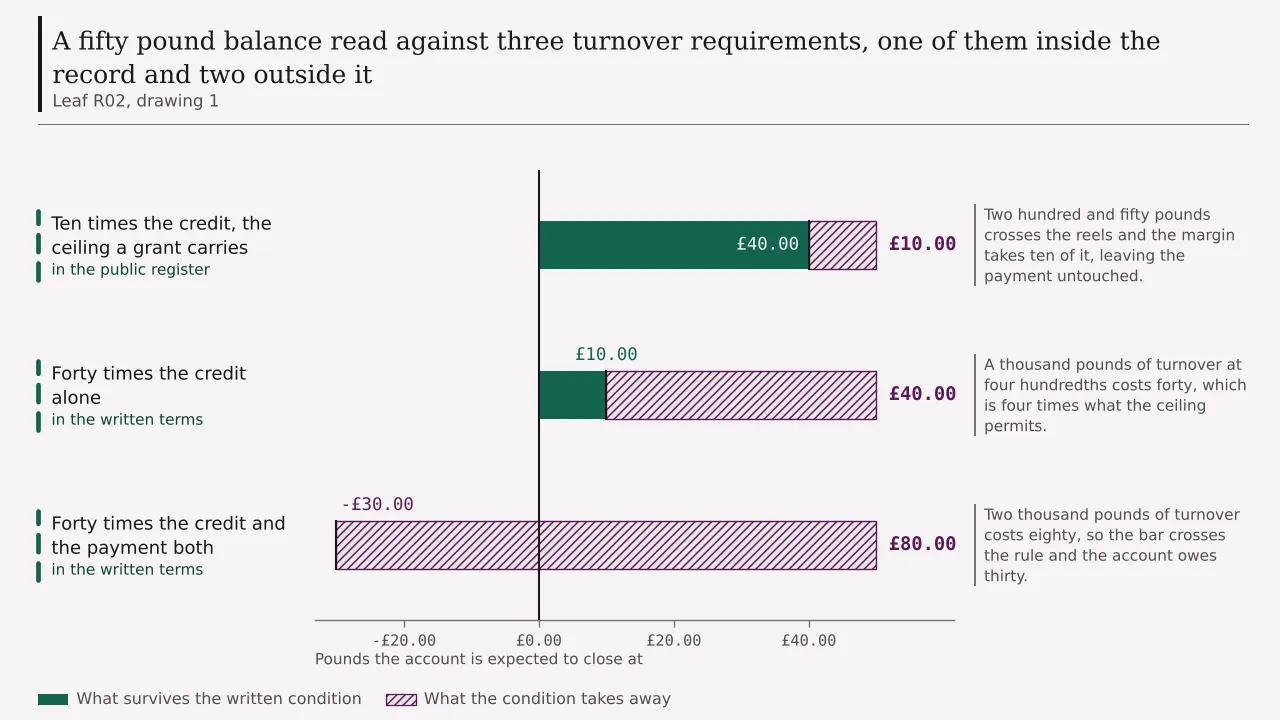
What the drawing makes visible and prose tends to blur is that all three bars start level. Nothing about the account changes when the boundary is crossed. Same money, same reels, same return held at the same assumption from top to bottom. The entire spread from the first bar down to the last is produced by one sentence about how many times a figure has to cross the reels, and by whether anything anywhere caps the number inside that sentence.
6
Three causes of a single blank result
Here is the paragraph this part of the site carries on every leaf, written out for the boundary rather than for the row. An entry fixes two propositions and declines a third. It fixes which company holds a permission, and it fixes the list of activities that permission covers. It declines to say whose hands are on a given website this morning, because ownership moves, a permission holder’s arrangement with a front end is commercial and private, and a web address recorded at some earlier point answers to the arrangement running now rather than to the one that prompted the entry. An entry is evidence about a licence and its holder. It is not evidence about an address.
An absence is weaker again, and the weakness has a precise shape. The search returns a blank, the blank has at least three causes, and the record separates none of them. Cause one is that nobody ever applied. Cause two is that something was applied for and did not survive, whether refused at the outset or surrendered or revoked later. Cause three is that the name or the web address typed into the box was never the string any grant was recorded under, which happens with nobody concealing anything, trading names and corporate names diverging as a matter of routine.
Price the confusion between those three and the result is uncomfortable, because they are worth the same to a reader and nothing like the same to a lawyer. Under all three the conditions in part nine fail to apply, the ceiling in part four fails to apply, and the arithmetic in part five lands on minus £30.00 rather than on £40.00. Guessing wrongly between cause one and cause three means getting a fact about corporate naming wrong and losing nothing by it. Treating any of the three as a sign that an entry will appear shortly is an error worth the full £70.00, because a blank is not a stage in a process.
The opposite misreading costs more and is commoner. Finding an entry and concluding that the website in front of you is what the entry describes adds a proposition the record never made. The publisher’s own advice to players asks for something narrower and more useful: hold the entry’s list of activities and its recorded web addresses against what the site itself puts on screen, then see whether the two agree. That is a comparison rather than an inference. A comparison can fail, and a failure is informative. An inference cannot fail, because nothing was put to a test.
| The reading | What it quietly assumes | Where the truth is settled | What it is worth |
|---|---|---|---|
| No entry, so no British rule reaches it | That the statute follows the grant | in the statute itself | Wrong, and costs nothing |
| No entry, so no conditions reach me | Nothing; this one is accurate | in the public register | £70.00 on a £50.00 balance |
| No entry yet, so an entry is coming | That a blank is a stage | nowhere in writing | The whole £70.00 |
| An entry exists, so this website is covered | That an entry names an operator | nowhere in writing | Every figure on the leaf |
Row two is the only reading in that table which is both correct and useful, and it also reads as the most pessimistic of the four. The ordering is not an accident of this subject. An absence from a record of permissions is informative about permissions and silent about everything else, so an accurate reading of one is always narrower than the reading a reader hoped for, and narrower readings feel like bad news even where they are simply precise.
7
The records that are not this one, and the edges they carry
Grants made elsewhere are real and this leaf will not suggest otherwise. What they are not is interchangeable with the British one, since each answers a narrower question of its own and each stops somewhere. The cheap move is to call the whole area unregulated. The move that survives contact with the documents is to open each rulebook, pull out the quantities it states, and set them beside the British ones in matching units.
Done that way the Caribbean rulebook most often cited yields a mixed result rather than a uniformly poor one, and the mixture is the finding. Its self-exclusion is a genuine obligation and it halts at the operator: a person barring themselves is barred across the domains that operator runs, with the remainder of the market handled by a sentence encouraging them to go and bar themselves there too. Its shortest period runs twelve months where the British scheme’s shortest runs six, putting the floor twice as high, and lifetime exclusion is on its list, which the British scheme has no equivalent of. On raising a deposit limit it waits 168 hours against a British minimum of 24, a wait seven times as long, while cutting one back is immediate in both places.
Against those four points runs a list of silences, and the silences decide the arithmetic on this leaf. That rulebook caps no wagering multiple. It caps no stake. It sets no floor under the interval between game cycles, bars no autoplay, and forbids no celebration of a return no larger than whatever stake produced it. The ceiling worked in part four therefore has no counterpart there, which is precisely why the lowest bar in the drawing above sits where it sits.
Two further issuers can be described only by what will not read off them. The first serves its pages from a domain bought commercially instead of a state one, calls itself an authority regulating gaming on the internet beneath an offshore financial body, and cites no ordinance, no Act and no regulation at any point. It advertises a register, a verification tool, a complaints route and a panel of dispute bodies. The complaints page itself answered with an error at the time the fact sheet behind this page was assembled, so how long a complaint has, what can be obtained through one, and whether an outcome binds a business all go unstated here and will stay unstated.
The Mediterranean authority belongs in a separate category and should not be filed alongside those two. It operates under a gaming Act with directives beneath it, keeps an enforcement record, publishes a licensee list that can be searched, and runs a complaint channel in proper form. What its complaint page omits is the useful part: no time limit, no residency rule, no account of the limits on its own powers, and no indication of whether a decision binds the business complained about.
Two entries on the list come back empty and get reported empty. Nothing that answers to the description of a Costa Rican gambling regulator turned up at all, so where a registration there gets cited this page has no rulebook to open, no record to search and no complaint route to measure, and it declines to say anything whatever about what that law asks for. Gibraltar’s government pages failed three times running, so nothing from that regulator reaches this site. What does reach it is a pair of Gibraltar incorporations sitting on the British publisher’s enforcement listing, which shows in one line that being incorporated somewhere and holding a British grant are separate objects, and that the second is the one carrying enforcement.
8
A second line round the same activity, drawn elsewhere
A second British boundary encloses the same activity, and the body drawing it collects money rather than issuing permissions, which is why it gets missed. Its test is residence. A business anywhere on earth that takes remote gambling, spread betting aside, from a person ordinarily resident in this country comes within one or more of the gambling duties, and the remote gaming one attaches to the provider’s profit on play by a customer of that description. No grant appears anywhere in that test.
Put the two tests side by side. Section 36 turns on where facilities are used and on what the provider knows or ought to know. The duty turns on where the customer ordinarily lives. An address absent from every British register can therefore sit squarely inside the charge, and this leaf can say so precisely because the guidance is written about operators rather than about holders of grants.
The rate supplies a small arithmetic of its own. It has run at 15 per cent, then 21 from 1 April 2019, then 40 on and after 1 April 2026, so the current figure is two and two thirds of the first in the sequence. What it bites on is stakes taken less winnings handed back. Take the £2,000.00 of turnover from part five: at the return this site holds fixed, the margin inside it is £80.00, and a charge at the current rate on a margin that size comes to £32.00. Not one penny of that £32.00 travels in the reader’s direction. A provider outside a group must generally appoint an approved representative in this country unless it sits in an exempt jurisdiction, with EU member states, Norway and Gibraltar given as instances.
The reader’s own position under the same body is a separate question, reached by absence rather than by any charging words. The published manuals treat gambling, taken as gambling, as falling outside trading; a method for selecting bets does not convert it into a trade; neither does living off what it produces; neither does expertise in form. The oldest authority on the point reduces to a remark about habits attracting no tax. All of that is a published position and is reported here as one, not as a declaration that winnings are untaxed, and nothing on this site addresses any individual’s circumstances. The manuals name appearance fees for television as a case whose answer would depend on the facts, which is itself a useful marker of where the published position stops.
So two lines enclose one activity, drawn by different bodies, running on different tests and failing to coincide. One follows a grant the regulator made. The other follows a home address the customer has. Sitting outside the first and inside the second at the same time is an ordinary position rather than an anomaly, and putting it that precisely beats any sweeping sentence about legality pointed either way.
9
What halts at the boundary, named duty by duty
No Great Britain licence stands behind addresses of the sort this leaf has been measuring, and on a page about a boundary the duties worth naming are the four that are themselves instructions about where a thing must sit or when a thing must be said. Deprivations of other sorts are genuine and get their pounds on neighbouring leaves. The quartet below is what a boundary page has to carry.
The first sits inside section 33 and gets read past almost every time. Holding the grant satisfies half the exception; running the activity in accordance with the conditions written into that grant satisfies the other half, which quietly turns every line of the rulebook into part of a statutory test rather than leaving it as a separate code. The second occupies the third limb of the condition on fair and transparent terms: where a change to the terms is material, the customer has to hear about it before it starts operating, so the document read on a Tuesday governs until notice arrives rather than until somebody edits a page. The third counts clicks. A money limit has to be reachable straight off the front page, has to be visible or linked wherever a payment is taken, and the quantity of pages lying between a customer and it is itself driven down by the standard. The fourth decides what happens when nobody acts. A limit is the option put first; turning it down takes a deliberate movement; nothing further proceeds until a refusal has been collected and recorded; and an account already running without one attracts a fresh prompt on a cycle no longer than twelve months.
Set the four against part five and the relationship inverts what a reader expects. Not one member of that quartet shifts the £40.00 or the minus £30.00 at all, since none of them is a term inside any offer. What they settle is whether the terms read on Tuesday still bind on Thursday, and whether the single instrument capable of capping exposure whatever an offer says is one page away or four. The £70.00 comes out of the ceiling in part four. The quartet decides whether a reader sees that ceiling coming and whether anything at all stands between them and the next payment in.
A fifth loss sits outside the group and bears on somebody who has already acted to protect themselves, so it gets stated plainly rather than listed. Taking part in the national self-exclusion scheme is a consequence of the British grant and of nothing else, and the scheme publishes that consequence rather than leaving it to be found by experiment: assistance extends to operators which participate, and does not extend to preventing access to services run by organisations which do not. A registration made in good faith is bounded by exactly the line this leaf has been measuring. Where that describes the person reading, the helpline and the two support bodies set out further down are where this page points.
10
What would have to hold for an absence to settle anything
Negative evidence comes with conditions attached, and writing them out is worth the space because they are the same conditions whatever the record happens to be. Three of them have to hold before a blank result means more than that a search returned nothing.
The first is completeness over a population. A blank informs only about the population the record is complete over, and this record is complete over grants its publisher made. The proposition it supports is that no grant of that kind is recorded under the string searched. The propositions it does not support include anything whatever about the quality, the solvency, the honesty or the past behaviour of whoever stands behind that string.
The second is a stable key. A search is only as good as the string typed into it, and corporate names, trading names and web addresses diverge routinely with nobody concealing anything. One blank is therefore weaker evidence than three blanks taken from three different strings, and the strings worth trying are the ones the site itself puts on screen rather than the ones a reader remembers.
The third is a date. The record carries none on its own page and offers no guidance on interpreting what a row contains, so the reader supplies the date and the finding belongs to that day. A check performed in March is evidence about March. Writing the date beside the result turns an opinion into a dated observation, and it is the cheapest discipline available anywhere in this subject.
Hold all three and a blank settles exactly one sentence, worth printing in full because the narrowness is the whole of the finding. On the day it was looked for, the string searched was not recorded as holding a British operating licence, and therefore none of the conditions attached to such a licence applies to whatever operates behind that string. Everything else a reader wants, including the one thing an entry refuses to settle even when it is present, lies outside the record’s scope and has to come from somewhere else or from nowhere.
Running the search itself, with what each field means and the single conclusion the exercise supports, belongs to this part of the site’s method page rather than to this one, and the four-step check sits there in full. What this leaf adds around it is the boundary: what the record is complete over, what the statute does on the far side, what a second body’s line does to the same activity, and what the difference between the two readings is worth in pounds, which on a balance of £50.00 at the multiples worked above is £70.00.
Questions
- Is it against the law to play at a casino that holds no British licence?
- Count the subjects section 33 of the 2005 Act can take and there is one, a person who provides facilities for gambling. No companion provision turns taking part in remote gambling into an offence for the person doing the playing, so the weeks and the fine level the section carries attach to whoever runs the facilities. That answers the question who and no other question. It hands nobody a protection, removes nobody’s duty, and leaves the arithmetic in part five exactly where it stood.
- Does British law reach an operator based abroad?
- It does, and section 36 settles it against the intuition most readers arrive with. Whether the facilities are provided within this country or somewhere beyond it is made immaterial, so an address abroad does no work. Two routes into the offence then open: machinery, where any of the equipment behind the facilities sits on British ground, and use, where no part of it does while the facilities get used here anyway. The second route carries a knowledge test covering a provider who knows or ought to know.
- When did the point of consumption rule start, and what changed?
- Two subsections replaced a single earlier one under the licensing and advertising Act of 2014, and the substitution took effect on 1 November 2014 for the purposes then specified. Under the earlier text the offence followed equipment and halted where equipment halted, so machinery decided the question; afterwards, use decides it. Counting from that commencement to the day this arithmetic was worked gives a fortnight short of twelve years.
- What does a search returning nothing actually prove?
- One sentence, and its narrowness is the whole of the finding. On the day it was looked for, the string searched was not recorded as holding a British operating licence, so none of the conditions attached to such a licence applies to whatever operates behind that string. A blank has at least three causes, those being that nobody applied, that something was applied for and did not survive, or that the string typed was never the recorded one, and the record separates none of them.
- What does an entry prove about the website I am looking at?
- Two propositions, and it declines a third. It fixes which company holds a permission and the list of activities that permission covers. It declines to say whose hands are on a given website this morning, because ownership moves, a permission holder’s arrangement with a front end is private, and a web address recorded earlier answers to the arrangement running now. The useful move is a comparison: hold the entry’s activities and recorded addresses against what the site puts on screen, then see whether they agree.
- How much is the boundary worth in pounds?
- Seventy pounds, on an account of £50.00 with half paid in and half credited. Ten lots of the £25.00 credit come to £250.00 crossing the reels, a margin of four in the hundred takes £10.00, and the close is an expected £40.00. Forty lots of the whole £50.00 come to £2,000.00, the same margin takes £80.00, and the close is an expected minus £30.00. The figure arrives again from turnover alone: £1,750.00 of extra staking at four in the hundred.
- Does the ten times ceiling cover a requirement to turn over my own payment?
- Nobody has published an answer either way. The provision is drawn round bonus funds, the requirement it caps is defined as a total value of wagers reached before money becomes withdrawable, and no worked example on the publisher’s own pages addresses drafting that pulls in a reader’s own payment alongside the credit. The honest treatment is to lay out the chain of published words and halt. Priced on this leaf’s figures, that unpublished margin is worth £10.00 of expected cost on a £50.00 account.
- Is an offshore operator within British gambling tax?
- The revenue guidance is written about operators rather than about holders of grants, and its test is where the customer ordinarily lives. A business anywhere on earth taking remote gambling, spread betting aside, from somebody whose usual home is in this country comes within one or more of the gambling duties. The rate has run at 15 per cent, then 21 from 1 April 2019, then 40 on and after 1 April 2026, so the current figure is two and two thirds of the first in the sequence.
- Are winnings taxed if the site has no British licence?
- The published manuals treat gambling, taken as gambling, as falling outside trading; a method for selecting bets does not convert it into a trade; neither does living off what it produces; neither does expertise in form. The oldest authority reduces to a remark about habits attracting no tax. That is a published position and is reported here as one, rather than as a declaration that winnings are untaxed, and nothing on this site addresses any individual’s circumstances.
- Will my self-exclusion registration reach a site like this?
- No, and the scheme publishes the limit rather than leaving it to be found by experiment. Its assistance extends to operators which participate, and does not extend to preventing access to services run by organisations which do not. Taking part follows from holding the British grant and from nothing else, so the protection is bounded by exactly the line this leaf measures. Where that describes the person reading, the helpline and the support bodies in the care block are the destination.
- What is lost by crossing the boundary, duty by duty?
- Four duties about placement and notice. Section 33 wants the activity run in accordance with the conditions written into the grant, not merely that a grant exists. A material change to the terms has to reach the customer before it starts operating. A money limit has to be reachable straight off the front page and visible wherever a payment is taken, with the quantity of pages in between driven down by the standard. And a limit is the option put first, turning it down takes a deliberate movement, and nothing proceeds until a refusal has been collected and recorded.
- Do other licence records do the same job?
- Each answers a narrower question of its own and each stops somewhere. The Caribbean rulebook asks for self-exclusion at operator level with a twelve month floor, puts lifetime exclusion on its list, and makes raising a deposit limit wait 168 hours against a British minimum of 24, while capping no multiple, no stake and no interval between game cycles. One issuer serves its pages from a commercial domain and cites no ordinance at any point. Nothing that answers to the description of a Costa Rican gambling regulator turned up, and Gibraltar’s pages failed three times running, so this leaf carries facts from neither.