Terms read 19 October 2026 Leaf H11, revision 1
Free 5 no deposit casino: the smallest face, priced against every exit
Five pounds turned over forty times demands £200.00 of staking and is expected to finish at minus £3.00. Set it against each exit minimum this section has had cause to suppose and the answer comes back the same every time. The conclusion is arithmetic rather than opinion, and an offer can still be advertised after it has been reached.
Stated on the banner £5.00 A small sum in sterling, accurate, and already under most of the exits anybody would meet. Stated, once you go and look £8.00 of cost Forty over five pounds asks £200.00 across the reels and feeds eight pounds to the margin, which is more than the face was worth to begin with. Not stated before the money goes in All of the verdict Whichever smallest payment the exit insists on, which is what makes this face uncollectable and which the advertisement has no duty to mention.
Five pound faces of this build, with their terms read
Every destination in this file is bought advertising. The site is paid a fee if a reader goes on to register, and no figure printed below moves because of it.
Bonus Spins UK Slip 01
Betportal
Ceiling as a multiple
The drop
€15.00
€1.00 in the euro
The claim reads €15.00. Once the terms beside it have applied, €0.00 of it can leave. The difference is the drop.
7 of the 15 terms on this slip could not be read before the money went in
Spins priced at this site's own 10p a spin, which the operator does not publish
Stated
€15.00
The claim as it is printed, before a single term has been applied to it.
Headline paid as spins
150 spins at 10c each, which is €15.00 of the figure above.
6 Nowhere
What one spin is worth
No unit is published for a spin, so the count is priced at this site's own 10p a spin. At half that price every figure below halves with it.
Match and other credit not priced
300% of three deposits, to a ceiling of €1,000. A share of a deposit nobody has made yet is not a sum, so no figure stands on this line and none is carried below.
Qualified
-€14.40
Written down somewhere, and taking part of the claim back. Each term carries the place it is written and the sum it takes.
2 Written terms at a distance this record does not establish
Play-through -€14.40
Carrying €14.40 through 35 times stakes €504.00 and costs €20.16 of it at 96 per cent return. That prices above the €14.40 there is to charge it against, so the whole of the credit goes and the line is held at that. The multiple sits on the bonus.
2 Written terms at a distance this record does not establish
Game weighting not priced
Slots only count towards the play-through. No contribution percentage is published, so the line above has been worked at full weight, which is the kindest reading there is.
2 Written terms at a distance this record does not establish
Ceiling on the winnings not priced
5x the bonus.
2 Written terms at a distance this record does not establish
Clock on the credit not priced
14 days.
2 Written terms at a distance this record does not establish
Largest stake while it runs not priced
€5.
3 Public record
Licence, and who holds it not priced
Licensed in Anjouan, Comoros, held by BetPortal Gaming Ltd, with Excite Ultra Media Ltd, reference ALSI-202601040-FI2. A register entry settles who holds a licence and what it permits. It does not settle who is running the site this morning.
4 Cashier
Smallest qualifying deposit your money
€20 a stage. That is €20.00 of your own money, and it is never netted into a drop.
5 On the way out
Checks before a withdrawal not priced
Documents before the first withdrawal.
Unstated
-€0.60
Applying without having been published anywhere, and costing money all the same.
6 Nowhere
What a spin hands back -€0.60
Staking a spin returns 96 per cent of it, so that share of the batch is the house's before a reel turns. This site works at that return and the operator publishes none where the claim is made.
6 Nowhere
Forfeited by rule cost unknown
Nothing is published under this heading, and it applies regardless.
6 Nowhere
Charge on the way out cost unknown
No charge on the way out is published as a figure, so nothing comes off this line. A charge that exists unpublished would come straight off whatever survives.
6 Nowhere
Smallest withdrawal allowed cost unknown
No smallest withdrawal is published as a figure. A floor nobody has published is still a floor, and it decides whether a small balance can move at all.
No Great Britain licence
Terms read 19 October 2026
Bonus Spins UK Slip 02
WinBeast
Ceiling as a sum
The drop
€50.00
€1.00 in the euro
The claim reads €50.00. Once the terms beside it have applied, €0.00 of it can leave. The difference is the drop.
8 of the 15 terms on this slip could not be read before the money went in
Spins priced at this site's own 10p a spin, which the operator does not publish
Stated
€50.00
The claim as it is printed, before a single term has been applied to it.
Headline paid as spins
500 spins at 10c each, which is €50.00 of the figure above.
6 Nowhere
What one spin is worth
No unit is published for a spin, so the count is priced at this site's own 10p a spin. At half that price every figure below halves with it.
Match and other credit not priced
50% to 100% of five deposits, each to a ceiling of €1,000, and a €650 free bet. A share of a deposit nobody has made yet is not a sum, so no figure stands on this line and none is carried below.
Qualified
-€48.00
Written down somewhere, and taking part of the claim back. Each term carries the place it is written and the sum it takes.
2 Written terms at a distance this record does not establish
Play-through -€48.00
Carrying €48.00 through 40 times stakes €1,920.00 and costs €76.80 of it at 96 per cent return. That prices above the €48.00 there is to charge it against, so the whole of the credit goes and the line is held at that. The multiple sits on the bonus and the winnings from the spins.
2 Written terms at a distance this record does not establish
Game weighting not priced
Slots, titles vary by country count towards the play-through. No contribution percentage is published, so the line above has been worked at full weight, which is the kindest reading there is.
2 Written terms at a distance this record does not establish
Ceiling on the winnings not priced
€100 a batch of spins.
2 Written terms at a distance this record does not establish
Clock on the credit not priced
7 days, spins 1 day.
3 Public record
Licence, and who holds it not priced
Licensed in Curaçao, holder not named on the site. A register entry settles who holds a licence and what it permits. It does not settle who is running the site this morning.
4 Cashier
Smallest qualifying deposit your money
€20 a stage. That is €20.00 of your own money, and it is never netted into a drop.
5 On the way out
Checks before a withdrawal not priced
Documents before the first withdrawal.
Unstated
-€2.00
Applying without having been published anywhere, and costing money all the same.
6 Nowhere
What a spin hands back -€2.00
Staking a spin returns 96 per cent of it, so that share of the batch is the house's before a reel turns. This site works at that return and the operator publishes none where the claim is made.
6 Nowhere
Largest stake while it runs cost unknown
Nothing is published under this heading, and it applies regardless.
6 Nowhere
Forfeited by rule cost unknown
Nothing is published under this heading, and it applies regardless.
6 Nowhere
Charge on the way out cost unknown
No charge on the way out is published as a figure, so nothing comes off this line. A charge that exists unpublished would come straight off whatever survives.
6 Nowhere
Smallest withdrawal allowed cost unknown
No smallest withdrawal is published as a figure. A floor nobody has published is still a floor, and it decides whether a small balance can move at all.
No Great Britain licence
Terms read 19 October 2026
Bonus Spins UK Slip 03
EliteSpin
Longest spin window
The drop
£50.00
£1.00 in the pound
The claim reads £50.00. Once the terms beside it have applied, £0.00 of it can leave. The difference is the drop.
8 of the 15 terms on this slip could not be read before the money went in
Spins priced at this site's own 10p a spin, which the operator does not publish
Stated
£50.00
The claim as it is printed, before a single term has been applied to it.
Headline paid as spins
500 spins at 10p each, which is £50.00 of the figure above.
6 Nowhere
What one spin is worth
No unit is published for a spin, so the count is priced at this site's own 10p a spin. At half that price every figure below halves with it.
Match and other credit not priced
50% to 100% of five deposits, each to a ceiling of £1,000. A share of a deposit nobody has made yet is not a sum, so no figure stands on this line and none is carried below.
Qualified
-£48.00
Written down somewhere, and taking part of the claim back. Each term carries the place it is written and the sum it takes.
2 Written terms at a distance this record does not establish
Play-through -£48.00
Carrying £48.00 through 40 times stakes £1,920.00 and costs £76.80 of it at 96 per cent return. That prices above the £48.00 there is to charge it against, so the whole of the credit goes and the line is held at that. The multiple sits on the bonus and the winnings from the spins.
2 Written terms at a distance this record does not establish
Game weighting not priced
Slots count towards the play-through. No contribution percentage is published, so the line above has been worked at full weight, which is the kindest reading there is.
2 Written terms at a distance this record does not establish
Ceiling on the winnings not priced
5x the bonus.
2 Written terms at a distance this record does not establish
Clock on the credit not priced
7 days, spins 3 days.
3 Public record
Licence, and who holds it not priced
Licensed in Costa Rica, held by PrimeTier Limited. A register entry settles who holds a licence and what it permits. It does not settle who is running the site this morning.
4 Cashier
Smallest qualifying deposit your money
£20 a stage. That is £20.00 of your own money, and it is never netted into a drop.
5 On the way out
Checks before a withdrawal not priced
Documents before the first withdrawal.
Unstated
-£2.00
Applying without having been published anywhere, and costing money all the same.
6 Nowhere
What a spin hands back -£2.00
Staking a spin returns 96 per cent of it, so that share of the batch is the house's before a reel turns. This site works at that return and the operator publishes none where the claim is made.
6 Nowhere
Largest stake while it runs cost unknown
Nothing is published under this heading, and it applies regardless.
6 Nowhere
Forfeited by rule cost unknown
Nothing is published under this heading, and it applies regardless.
6 Nowhere
Charge on the way out cost unknown
No charge on the way out is published as a figure, so nothing comes off this line. A charge that exists unpublished would come straight off whatever survives.
6 Nowhere
Smallest withdrawal allowed cost unknown
No smallest withdrawal is published as a figure. A floor nobody has published is still a floor, and it decides whether a small balance can move at all.
No Great Britain licence
Terms read 19 October 2026
Bonus Spins UK Slip 04
Crown Jewelz
Multiple unpublished
The drop
NOT WORKED
The multiple is not published in the operator's own terms. Since the sum cannot be worked around it, none is worked.
9 of the 14 terms on this slip could not be read before the money went in
No drop worked
Stated
£15.00
The claim as it is printed, before a single term has been applied to it.
Headline paid as spins
150 spins at 10p each, which is £15.00 of the figure above.
6 Nowhere
What one spin is worth
No unit is published for a spin, so the count is priced at this site's own 10p a spin. At half that price every figure below halves with it.
Match and other credit not priced
200% of the first deposit, then 150% twice, each to a ceiling of £1,000. A share of a deposit nobody has made yet is not a sum, so no figure stands on this line and none is carried below.
Qualified
NOT WORKED
Written down somewhere, and taking part of the claim back. Each term carries the place it is written and the sum it takes.
2 Written terms at a distance this record does not establish
Play-through not priced
40x the bonus, reported rather than published by the operator.
2 Written terms at a distance this record does not establish
Game weighting not priced
Slots count towards the play-through. No contribution percentage is published, so the line above has been worked at full weight, which is the kindest reading there is.
3 Public record
Licence, and who holds it not priced
Licensed in Curaçao, number not verified, holder not named on the site. A register entry settles who holds a licence and what it permits. It does not settle who is running the site this morning.
4 Cashier
Smallest qualifying deposit your money
£20. That is £20.00 of your own money, and it is never netted into a drop.
5 On the way out
Checks before a withdrawal not priced
Documents before the first withdrawal.
Unstated
NOT WORKED
Applying without having been published anywhere, and costing money all the same.
6 Nowhere
Ceiling on the winnings cost unknown
No ceiling is published. Nothing is assumed in its place.
6 Nowhere
Clock on the credit cost unknown
Nothing is published under this heading, and it applies regardless.
6 Nowhere
Largest stake while it runs cost unknown
Nothing is published under this heading, and it applies regardless.
6 Nowhere
Forfeited by rule cost unknown
Nothing is published under this heading, and it applies regardless.
6 Nowhere
Charge on the way out cost unknown
No charge on the way out is published as a figure, so nothing comes off this line. A charge that exists unpublished would come straight off whatever survives.
6 Nowhere
Smallest withdrawal allowed cost unknown
No smallest withdrawal is published as a figure. A floor nobody has published is still a floor, and it decides whether a small balance can move at all.
No Great Britain licence
Terms read 19 October 2026
Every figure in the second and third columns is this site's own working and nothing an operator has published. A claim is priced as printed, then the share a spin hands back at 96 per cent return comes off it, then what playing the multiple through costs at the same return, and then whatever a published ceiling, a charge on the way out or a floor on the smallest withdrawal takes from what has survived. The drop is the difference between the first figure and the last. The two columns add back up to it exactly, so no money leaves a slip without a term and a place beside it.
Which column a term falls in is settled by one question: has anybody written it down. A charge a reader meets at the payment screen is written down, and it stands in the second column with the cashier against it. A condition that binds without ever having been set down stands in the third, whatever it costs. Inside each column the terms run outwards from the banner, so the order itself says how far a reader would have had to go.
A count of spins has no unit until one is supplied. Where an operator publishes what one of its own spins is worth, that figure is used and the first column says it is theirs. Where none is published, this site's own 10p a spin stands in its place and every figure below moves in proportion with it. Where the multiple itself is unpublished, no drop is worked at all, because that is the one figure the sum cannot be done without.
Three words stand where a figure cannot. Not priced is a term that is written down and carries no number the arithmetic can take. Cost unknown is a term nobody has written down, costing something nobody has put a number on. Your money is money of the reader's own, which is never netted into a drop.
None of the operators in this file holds a Great Britain licence, so none of the duties that licence carries reaches them. Each of those duties is published in its own right, which is what makes its absence here something a reader can check rather than take on trust. Every gambling company licensed in Great Britain belongs to Gamstop Online, so a reader who has shut themselves out through the scheme is not shut out here. Social Responsibility Code 5.1.1 has held a play-through to a maximum of ten times the bonus funds since 19 January 2026, and it binds a licence holder and nobody else. Asked in a post of 21 October 2025 what is lost along with the licence, the Gambling Commission's Director of Enforcement and Intelligence answered: "unfair gaming practices, financial loss, and a lack of recourse if things go wrong". The same post puts blocked payouts, and withdrawal limits pitched high enough to be unreachable, among the behaviour the Commission has recorded. Nobody under 18 may hold an account at any of them.
Terms are reproduced in the wording their operator published, and each slip is dated with the day somebody sat down and read them. 19 October 2026 is the oldest of those dates. Anybody claiming an offer is bound by that operator's full terms, which are elsewhere, and never by a line standing here.
1
Five pounds, and the single thing it settles
The claim is a currency sign, one digit and a denial that anything has to be paid. Those are settled , they are settled for anybody who looks, and the quantity arrives already denominated in sterling so no conversion is wanted before it can be used. What they establish is an upper bound of five pounds on everything that follows.
An upper bound is a genuine thing to know and it is also the whole of what the advertisement supplies. Nothing on it puts a floor under the figure. The house arithmetic multiplies a face by a bracket that can reach one only where no obligation exists at all, and that bracket has no lower limit, so a five pound banner truthfully says the offer is worth five pounds at the very most and says nothing whatever about the least.
On a face this small the upper bound is doing more work than usual, because five pounds is near enough to nothing that the question stops being how much and becomes whether anything comes out at all. A reader looking at a larger headline can sensibly ask what proportion survives. Here the sensible question is binary, and the rest of this leaf answers it.
Answering it takes two further numbers, neither of them on the banner. There is a turnover multiple, set out in the bonus terms and readable by anybody who clicks. And there is whatever sum the exit refuses to go below, visible at the cashier and nowhere earlier, which is the term carrying the verdict.
Take five pounds read entirely alone first, with no condition of any kind. The face is then worth £5.00, which clears an exit that will send five pounds and clears nothing above that. Every exit minimum larger than five pounds refuses the face in its pristine state, before a single word of the conditions has been applied to it.
That is an unusual position for a headline to be in and it deserves naming precisely. Other faces in this family fail because conditions reduce them. This one is capable of failing before conditions are reached, which means the conditions are not what a reader most needs to read. The exit is, and the exit is the one thing that cannot be read in advance.
2
Two hundred pounds of staking behind a five pound face
Forty is the multiple worked here, that being what a conditions document out this way tends to carry. Forty lots of five pounds come to £200.00 of staking owed before the balance can be asked for. Broken into ten penny presses that is 2,000 of them, each one a separate decision, on a face worth five pounds at its very best.
What the staking costs is settled by the return and by nothing else. At 96 pence back in every pound, four pence stays behind, so £200.00 of turnover hands £8.00 to the margin. Eight pounds of expected cost against five pounds of credit leaves an expected close of minus £3.00, with the crediting rate held at a pound for each pound so nothing is buried inside it.
The face as advertised £5.00 With a forty times clause worked through minus £3.00 What that clause takes from five pounds £8.00
Eight pounds is reachable from both ends and the agreement confirms the working. Two hundred pounds of turnover at four hundredths comes to eight. The first line of the price block less the second comes to eight as well. A turnover requirement has no effect beyond moving staked money into the margin at a proportion fixed from the start, so the two routes cannot disagree.
£8.00 of expected cost attached to a face advertised at £5.00
One feature of those figures is worth stopping on, since it does not occur on the larger faces in this family. The cost of the condition exceeds the thing the condition is attached to. Eight pounds is more than five pounds, so the obligation is larger than the credit that carries it, and the difference has to be funded from money the offer never provided.
The multiple at which that stops being true is twenty-five, which a four per cent margin produces by being divided into one, and that same twenty-five holds for a face of whatever size at this return. Below it the credit is expected to survive in part. Exactly on it the credit is expected to have been consumed to the penny. Above it the obligation outgrows the credit, which on this face happens at every multiple an offshore conditions document is likely to carry.
3
Priced against every exit this section has supposed
No rule anybody could cite here publishes an exit minimum, so every figure below is supposed rather than read, and is carried only to show what the arithmetic does with it. Four are worth running: five pounds, ten pounds, twenty pounds and thirty pounds. The first matches the face exactly and the others sit above it by widening margins.
Against a five pound minimum the face clears in its untouched state and fails under every written condition, since any multiple above nought drops the expected survivor under five. Against a ten pound minimum it fails untouched, by five pounds, and the failure only grows. Against twenty and thirty the shortfall before anything is applied is fifteen pounds and twenty-five pounds respectively.
| Smallest payment the exit performs | Shortfall before any condition | Shortfall at the licensed ceiling | Shortfall at forty times | Largest multiple that could ever clear it |
|---|---|---|---|---|
| £5.00, matching the face | None | £2.00 | £8.00 | Nought, and nothing above it |
| £10.00 | £5.00 | £7.00 | £13.00 | No answer exists at all |
| £20.00 | £15.00 | £17.00 | £23.00 | No answer exists at all |
| £30.00 | £25.00 | £27.00 | £33.00 | No answer exists at all |
The last column is the finding and it is worth reading before the figures beside it. Where the minimum matches the face, one multiple works and that multiple is nought, which no conditions document in this market writes. Where the minimum exceeds the face, the question has no answer in multiples at all, because a smaller multiple cannot lift a balance above a figure the balance never reached.
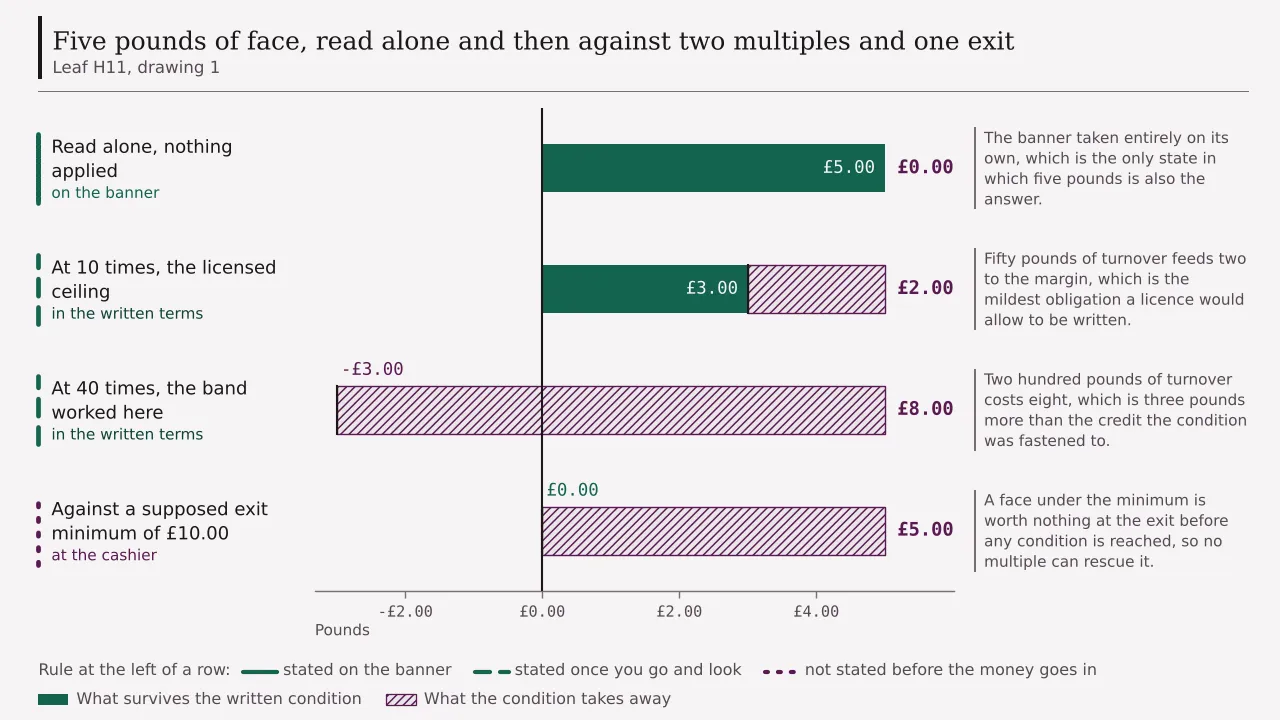
So the honest conclusion, stated once and not softened, is that a five pound face, at the multiples written out this way, does not reach an exit under any of the four minimums supposed just now, and reaches the smallest of them only in a case nobody publishes. No prediction about any named business is being made here. It is what the three numbers do when they are put together, and the three numbers are not in dispute.
4
Under the line before a condition is applied
Most of the arithmetic on this site concerns what conditions take away. This face introduces a different failure and the difference is worth isolating. Where the exit wants more than five pounds, the face is already under the line in its pristine state, so the conditions are not the cause of the failure. They make an uncollectable balance smaller without changing whether it can be collected.
That reverses the usual order of reading. On a larger headline a reader is told, correctly, to find the multiple before deciding anything, because the multiple is what turns a promising figure into a disappointing one. On this one the multiple is close to irrelevant: whether it is ten or forty, the answer against a ten pound minimum is the same answer, and the figure that settles it was never written in any document.
Set out formally, collecting demands that the face, once scaled by a bracket of unity less four hundredths of the multiple, arrive at or above the exit’s minimum. Where the minimum is larger than the face, the bracket would have to exceed one for the comparison to hold, and it cannot: a bracket of exactly one means no obligation at all, and nothing in the arithmetic allows it past that. The inequality has no solution rather than a demanding one.
| The term | Where it is settled | What it decides on this face |
|---|---|---|
| The face, five pounds | The ceiling over everything that follows | |
| The multiple over the credit | in the bonus terms | How far under the line the balance lands |
| The days the turnover sits inside | in the bonus terms | Whether the turnover is attemptable at all |
| The smallest payment at the exit | at the cashier | Whether anything can be collected, full stop |
| Any charge taken off a payment | at the cashier | How much is lost from whatever did clear |
| The rate a chosen game credits at | nowhere in writing | How much turnover the multiple really wants |
Read the third column down and one row carries the verdict while the rest carry detail. That is unusual, and it is a property of the size of the face rather than of anything in the drafting. At fifty pounds the same table would put the verdict in the second row and leave the fourth as a detail, which is where most readers expect to find it.
One honest qualification belongs here. Some operators publish their exit minimum in the general conditions, which moves it out of the payment screen and into a document anybody can open. Where that is done, everything in this part becomes checkable before registering and the complaint falls away, leaving the arithmetic exactly as it stands. A reader cannot tell from the outside which arrangement they are looking at.
5
An offer that cannot pay is still an offer that runs
Having reached that conclusion, a natural question follows: if the arithmetic settles it, why does the advertisement not say so? The answer is structural rather than conspiratorial, and it is the second spine of this leaf. Nothing in the first of the six places is under any obligation to mention the fourth.
The six places are not a scheme anybody designed. They are where documents happen to live, and each has a different author with a different purpose. A banner is written by whoever sells the offer. A conditions document is written by whoever has to enforce it. A payment screen is built by whoever moves the money, usually to constraints imposed by a processor rather than by a marketing department. The three need never be introduced to one another.
So an advertisement can be assembled entirely from true statements, by people who have never seen the figure that makes the offer uncollectable, and published without anybody having told a lie. The conclusion in part three is available to anyone who has all three numbers, and nobody inside the arrangement necessarily does. That is worth saying plainly, because it is more useful than an accusation and harder to dismiss.
What would change it is a duty running from the fourth place back to the first: an obligation to carry, beside the headline, whichever conditions decide whether the headline means anything. Such a duty exists in Britain, is written in two places, and is enforced against advertisements rather than against contracts. The next two parts set out what it says and, just as importantly, what it does not reach.
It is also worth being clear about what cannot be inferred. That an offer is uncollectable on these figures says nothing about whether anybody intended it to be. A face is set to attract a click. A multiple is set to control what an incentive costs. A minimum is set by what a payment costs to make. The three are capable of producing this result without anybody choosing it.
Which leaves the reader in a particular position. The arithmetic is theirs to do, the numbers are not all theirs to see, and the one that decides everything sits behind the act of registering. What follows is about whether anything obliges that number to be moved forward, and the answer turns on a licence this kind of offer does not hold.
6
The rule that would have required the mention
The rule is rule 8.17 of the advertising code, and it is worth stating exactly because its shape is often misremembered. It requires promotional material to communicate all applicable significant conditions clearly and prominently, and it bites where leaving them out is likely to mislead the people reading it. The test is about effect rather than about intention.
Two features of that drafting matter on this face. The first is that the rule attaches to the advertisement, not to the contract, so it reaches the banner itself rather than the document behind it. The second is that the trigger is misleading effect, which means a condition qualifies by what omitting it does to a reader, and not by which category of term it belongs to.
A second instrument says what happens when the duty is not met. The regulator’s own advertising page wants a significant term given prominence within the advertisement itself and set near the headline offer on any page where somebody arrives or signs up. The consequence then arrives in one line: where prominence is lacking, what has been published reads as a misleading advertisement. A base duty is stated there besides, which is that marketing must not mislead the people who see it.
A third sits on the contract side rather than the advertising side and is worth noting for completeness. Whoever hands somebody an incentive owes clear, transparent and fair terms for it, kept easily accessible to everyone it was put in front of, under the social responsibility provision on incentives. Easy access is a statement about where a term is kept, and this leaf’s whole subject is where terms are kept.
A statutory offence sits behind all of that, and it is about lawfulness rather than about prominence. Advertising unlawful gambling is an offence, gambling being unlawful for the purpose where taking place as advertised would or might call for some authorisation, a licence or a notice or a permit or a registration or an exception among them, which has not been arranged. An advertisement left on display, or left reachable, commits the offence afresh on every day any of that display goes on.
Three limits travel with that section and should travel with any mention of it. Charged over certain conduct, a person escapes where their belief that the gambling was lawful was a reasonable one. On another limb, liability needs knowledge, actual or imputed, that it was not. And carrying somebody else’s communications as a business, without any say over what they contain, is not by itself the offence.
7
What the published list of significant conditions names
Rule 8.17 does not define significance in the abstract, and the advertising regulator sets out, by way of worked illustration, what will count inside a gambling promotion. Four kinds of thing are named. Who may take the offer up, which covers being new to the business, how old somebody is and where they are. Anything the offer asks by way of payment in or turnover. Whatever deadline attaches to claiming it or to spending it. And whatever shortest price is insisted on, or whichever bet types are shut out.
Read that against this leaf’s subject and the awkward fact is immediate. A withdrawal minimum is not among them. Turnover is named, so the forty times clause is squarely within the duty. A deadline is named, so a window is. A smallest permitted payment at the exit answers to no entry on the illustration, and nothing in the published advice adds one.
What that does not mean is that the rule has nothing to say. The list is a worked illustration rather than a closed definition, and the operative test is still whether omitting the condition is likely to mislead. On a face of five pounds against a ten pound minimum, omission converts an offer that cannot pay into one that reads as though it might, which is an argument of exactly the kind the test is framed for. Whether it would succeed is not something this leaf can settle, and it does not pretend to.
The nearest published outcome runs along a different term and is the right comparison to draw. On 31 July 2024 a ruling went against an advertisement whose excluded payment route had been set in tiny print somewhere down the conditions, and the advertising regulator judged that significant condition to have been given too little prominence. A payment route belongs to the cashier, as a minimum does, and it counted as significant without appearing on the illustration either.
Two other rulings on the same page show the duty biting on placement rather than on truth. Dated 17 July 2024 is one about an offer of ten pounds that turned on a reply being sent to a text message before a deadline the advertisement had left out. Dated 27 August 2025 is one about a voucher worth five pounds, dead for a single March fixture, with the voucher itself silent on the point. Each of those conditions existed and each was accurately drafted; where it stood was the finding.
So the honest statement of the position is this. Inside a British licence there is a rule whose test a withdrawal minimum could arguably meet, a published list that does not name it, and one ruling on a neighbouring cashier term that was treated as significant. Outside the licence there is no rule, no list and no ruling, because the advertising codes and the licence conditions both run along the same boundary and stop at it.
8
What is left when an offer does not pay
Suppose somebody beats the arithmetic, finishes with a balance and finds the exit refusing it. What happens next is the part of an offer nobody reads in advance, and it is where the absence of a Great Britain licence costs most on this leaf’s own subject. Offers of this size are run from outside that system, so the apparatus below describes what is missing rather than what applies.
Inside the licence the sequence carries clocks. Acknowledgement is owed as promptly as is reasonable, with an outer limit of three working days, which becomes one day where the business runs gambling at every hour. Counting from arrival, the complaint and whatever escalation happens inside the business have to be finished within eight weeks.
Bringing one has a fixed window too: six months at the least, counted from whenever the thing complained of happened, and no term may shut a customer out inside it. Those eight weeks may be halted where seven days pass with a sensible request for information unanswered, then picked up again from the point of halting as soon as a reply arrives.
The final letter has three jobs. It gives reasons for the decision, records that the business has nothing further to add, and names the independent body through which the dispute may go instead. Approval by the regulator is a precondition for that body, the approved names are published, and the sectors each of them covers are printed alongside, which matters because remote casino is not on every one of those entries.
Not an ombudsman is how the regulator describes itself. Settling a gambling complaint, or getting somebody’s money back for them, are among the powers it says it lacks. Transactions are outside what it can decide, the two instances it gives being a withdrawal that will not go through and a fault in a game. Inside anybody’s account it cannot see. Where a player is told to start is with the business itself.
Take all of that away and what remains is whatever the business has written for itself. No acknowledgement owed inside three days. No ceiling of eight weeks with a rule for halting the count. No window of six months protected against a term drafted the other way. No approved body waiting at the end. Offshore regulators do publish complaint frameworks of their own, so this leaf makes no claim that a route is absent, only that nothing on the British list reaches an offer outside the British licence.
One further boundary runs the same way and is worth stating for anybody it concerns. The national self-exclusion scheme covers operators licensed in Britain, which is why an offer outside that licence is outside the scheme. Somebody registered with Gamstop Online should read such an offer as out of reach rather than as a gap, and whichever help route the block closing this leaf names will serve better than a sign-up page.
9
What a five pound face is actually there to do
If a five pound face cannot in practice pay anybody, the sensible question is what it is for, and the answer is visible in what it costs the business rather than in what it pays the reader. Five pounds of credit at forty times is expected to cost the house nothing at all. In expectation it returns a profit of three pounds, since the margin takes eight pounds across two hundred pounds of turnover against five pounds handed over.
That inverts the usual way such an offer is described. It is not a sum the business gives away and hopes to recover. On these figures it is a sum that is expected to come back with three pounds on top, before any further play is considered, which makes it a registration incentive rather than a gift in any ordinary sense.
What it buys the business is an account, a verified set of details and a person who has already pressed a button two thousand times. Each of those carries value on its own account, quite apart from the offer, and not one of them shows up in the arithmetic a reader performs. The transaction is real and it runs in a direction the banner does not describe.
There is also a reading under which the offer is exactly what it says and nobody is worse off. Somebody who wants five pounds of play for nothing, intends to stop when it runs out and never intends to request a payment has received precisely the thing advertised at precisely the stated price. Every finding on this leaf is triggered by an attempt to withdraw, and that reader never makes one.
For everybody else the useful habit is to settle the exit before the terms. Ask what the smallest payment is, in the general conditions or on a banking page, and where neither carries it, note that the figure waits at a payment screen. Then compare it with the face, not with the multiple. On a five pound face that comparison is usually over before the conditions have been opened.
The general lesson carries past this key and is the reason the smallest face is worth a leaf of its own. A headline is a claim about an entry, and every exit in this section is governed by a number kept somewhere else. Where the two are close together the conditions decide the outcome. Where the headline is smaller than the exit, nothing in the conditions can decide anything, and the advertisement has already told a reader everything it is going to.
Questions
- A free £5 no deposit bonus: what survives the wagering?
- An expected minus £3.00 at the multiple used here. Forty lots of five pounds come to £200.00 across the reels, and at four pence retained in every pound the margin takes £8.00, which is three pounds more than the credit was worth. Five pounds stays the ceiling over the whole offer, since the bracket the face is set against reaches one only where no obligation exists.
- Can a £5 no deposit bonus actually be withdrawn?
- Against the exits this section has had cause to suppose, no. A supposed minimum of £5.00 is cleared by the face in its untouched state and by no written multiple above nought. Supposed minimums of £10.00, £20.00 and £30.00 leave the untouched face short by £5.00, £15.00 and £25.00 before a single condition applies. None of those figures is published in any rule cited here, and each is carried to show what the arithmetic does.
- Why does the multiple barely matter on a face this small?
- Because the failure happens before the multiple is reached. Where the exit wants more than five pounds, the face is already under the line in its pristine state, so the conditions make an uncollectable balance smaller without changing whether it can be collected. On a larger headline the multiple is the term that turns a promising figure into a disappointing one. Here it only decides how far under the line the balance lands.
- Is there a multiple at which £5 would clear a £10 exit?
- No, and the reason is arithmetical rather than commercial. Collecting demands that the face, once scaled by a bracket of unity less four hundredths of the multiple, arrive at or above the minimum. For five pounds to reach ten, the bracket would have to exceed one, and a bracket of exactly one already means no obligation at all. The comparison has no solution rather than a demanding one, so no document could be redrafted to fix it.
- How can an offer that cannot pay still be advertised?
- Because nothing in the first of the six places is obliged to mention the fourth. A banner is written by whoever sells the offer, a conditions document by whoever enforces it, and a payment screen is built to constraints a payment processor imposes. The three authors need never meet, so an advertisement can be assembled entirely from true statements by people who have never seen the figure that makes the offer uncollectable.
- Which rule would have required the minimum to be mentioned?
- Rule 8.17 of the advertising code, which wants all the significant conditions that apply set out clearly and prominently in whatever is published, and which bites wherever an omission of that kind is likely to mislead. It fastens to the advertisement rather than to the contract, so the banner itself is within reach, and what triggers it is misleading effect rather than the category a term falls into. The regulator’s own advertising page supplies the consequence: where prominence is lacking, what has been published reads as a misleading advertisement.
- Does the published list of significant conditions include a withdrawal minimum?
- It does not. The worked illustration the advertising regulator publishes covers four kinds of thing: who may take an offer up, meaning newness to the business, age and location; anything asked by way of payment in or turnover; whatever deadline attaches to claiming or to spending it; and whatever shortest price is insisted on or whichever bet types are shut out. A smallest permitted payment at the exit answers to none of them. The list is an illustration rather than a closed definition, and the operative test remains whether the omission is likely to mislead.
- Has a cashier term ever been treated as significant?
- One has, on a neighbouring point. On 31 July 2024 a ruling went against an advertisement whose excluded payment route had been set in tiny print somewhere down the conditions, the advertising regulator judging that significant condition too little prominent. A payment route belongs to the cashier in the same way a minimum does, and it counted as significant without appearing on the illustration either.
- What happens if an offshore site refuses to pay a balance?
- Whatever the business has written for itself, because the British apparatus does not reach it. Inside a British licence, an acknowledgement is owed inside three working days, falling to one where gambling runs at every hour; the complaint and whatever escalation happens within the business finish inside eight weeks of arriving; six months at the least is the window for bringing one, counted from whenever the thing complained of happened; and a dispute body with the regulator’s approval has to be named when the business closes its letter, as the route the matter may take instead. Offshore regulators publish frameworks of their own, so a route may exist, but nothing on the British list applies.
- Will the Gambling Commission get the money back?
- It says itself that it will not, in terms. Not an ombudsman is how it describes itself; settling a gambling complaint, or getting somebody’s money back for them, are among the powers it says it lacks; transactions are outside what it can decide, the two instances it gives being a withdrawal that will not go through and a fault in a game; and inside anybody’s account it cannot see. Where a player is told to start is with the business itself. That is the position inside the licence, and outside it the regulator has no jurisdiction to begin with.
- What is a five pound face actually for?
- It is a registration incentive rather than a gift, and the figures say so. Five pounds of credit at forty times hands £8.00 to the margin across £200.00 of turnover against five pounds given out, so in expectation the business is three pounds ahead before any further play. What it buys is an account, a verified set of details and somebody who has already pressed a button two thousand times, not one of which shows up in the arithmetic a reader performs.