Terms read 19 October 2026 Leaf C02, revision 1
A payout that comes back the way it went in, in as many pieces as it went in by
A balance of £300.00 built on payments of £60.00, £40.00 and £15.00 does not leave as one payment. It leaves as three, each capped at what its own instrument sent, and the smallest of them, £15.00, is under the sum the exit will carry. The date belongs to the slowest leg, which holds 13.3 per cent of the money. This leaf cuts the payout and prices each cut.
Stated on the banner Both ways A wallet is advertised as carrying money in and carrying it out, which is true and is the whole of what gets settled before a click. Stated, once you go and look £115.00 The written rule sends a payout back to whatever funded the account, so three payments in become three payments out, each one capped at what it sent. Not stated before the money goes in £15.00 held The smallest piece falls under the least the exit will send, and nothing anywhere compares those two figures for a reader.
Offers taking a wallet as the qualifying payment
Every destination in this file is bought advertising. The site is paid a fee if a reader goes on to register, and no figure printed below moves because of it.
Bonus Spins UK Slip 01
Betportal
Ceiling as a multiple
The drop
€15.00
€1.00 in the euro
The claim reads €15.00. Once the terms beside it have applied, €0.00 of it can leave. The difference is the drop.
7 of the 15 terms on this slip could not be read before the money went in
Spins priced at this site's own 10p a spin, which the operator does not publish
Stated
€15.00
The claim as it is printed, before a single term has been applied to it.
Headline paid as spins
150 spins at 10c each, which is €15.00 of the figure above.
6 Nowhere
What one spin is worth
No unit is published for a spin, so the count is priced at this site's own 10p a spin. At half that price every figure below halves with it.
Match and other credit not priced
300% of three deposits, to a ceiling of €1,000. A share of a deposit nobody has made yet is not a sum, so no figure stands on this line and none is carried below.
Qualified
-€14.40
Written down somewhere, and taking part of the claim back. Each term carries the place it is written and the sum it takes.
2 Written terms at a distance this record does not establish
Play-through -€14.40
Carrying €14.40 through 35 times stakes €504.00 and costs €20.16 of it at 96 per cent return. That prices above the €14.40 there is to charge it against, so the whole of the credit goes and the line is held at that. The multiple sits on the bonus.
2 Written terms at a distance this record does not establish
Game weighting not priced
Slots only count towards the play-through. No contribution percentage is published, so the line above has been worked at full weight, which is the kindest reading there is.
2 Written terms at a distance this record does not establish
Ceiling on the winnings not priced
5x the bonus.
2 Written terms at a distance this record does not establish
Clock on the credit not priced
14 days.
2 Written terms at a distance this record does not establish
Largest stake while it runs not priced
€5.
3 Public record
Licence, and who holds it not priced
Licensed in Anjouan, Comoros, held by BetPortal Gaming Ltd, with Excite Ultra Media Ltd, reference ALSI-202601040-FI2. A register entry settles who holds a licence and what it permits. It does not settle who is running the site this morning.
4 Cashier
Smallest qualifying deposit your money
€20 a stage. That is €20.00 of your own money, and it is never netted into a drop.
5 On the way out
Checks before a withdrawal not priced
Documents before the first withdrawal.
Unstated
-€0.60
Applying without having been published anywhere, and costing money all the same.
6 Nowhere
What a spin hands back -€0.60
Staking a spin returns 96 per cent of it, so that share of the batch is the house's before a reel turns. This site works at that return and the operator publishes none where the claim is made.
6 Nowhere
Forfeited by rule cost unknown
Nothing is published under this heading, and it applies regardless.
6 Nowhere
Charge on the way out cost unknown
No charge on the way out is published as a figure, so nothing comes off this line. A charge that exists unpublished would come straight off whatever survives.
6 Nowhere
Smallest withdrawal allowed cost unknown
No smallest withdrawal is published as a figure. A floor nobody has published is still a floor, and it decides whether a small balance can move at all.
No Great Britain licence
Terms read 19 October 2026
Bonus Spins UK Slip 02
WinBeast
Ceiling as a sum
The drop
€50.00
€1.00 in the euro
The claim reads €50.00. Once the terms beside it have applied, €0.00 of it can leave. The difference is the drop.
8 of the 15 terms on this slip could not be read before the money went in
Spins priced at this site's own 10p a spin, which the operator does not publish
Stated
€50.00
The claim as it is printed, before a single term has been applied to it.
Headline paid as spins
500 spins at 10c each, which is €50.00 of the figure above.
6 Nowhere
What one spin is worth
No unit is published for a spin, so the count is priced at this site's own 10p a spin. At half that price every figure below halves with it.
Match and other credit not priced
50% to 100% of five deposits, each to a ceiling of €1,000, and a €650 free bet. A share of a deposit nobody has made yet is not a sum, so no figure stands on this line and none is carried below.
Qualified
-€48.00
Written down somewhere, and taking part of the claim back. Each term carries the place it is written and the sum it takes.
2 Written terms at a distance this record does not establish
Play-through -€48.00
Carrying €48.00 through 40 times stakes €1,920.00 and costs €76.80 of it at 96 per cent return. That prices above the €48.00 there is to charge it against, so the whole of the credit goes and the line is held at that. The multiple sits on the bonus and the winnings from the spins.
2 Written terms at a distance this record does not establish
Game weighting not priced
Slots, titles vary by country count towards the play-through. No contribution percentage is published, so the line above has been worked at full weight, which is the kindest reading there is.
2 Written terms at a distance this record does not establish
Ceiling on the winnings not priced
€100 a batch of spins.
2 Written terms at a distance this record does not establish
Clock on the credit not priced
7 days, spins 1 day.
3 Public record
Licence, and who holds it not priced
Licensed in Curaçao, holder not named on the site. A register entry settles who holds a licence and what it permits. It does not settle who is running the site this morning.
4 Cashier
Smallest qualifying deposit your money
€20 a stage. That is €20.00 of your own money, and it is never netted into a drop.
5 On the way out
Checks before a withdrawal not priced
Documents before the first withdrawal.
Unstated
-€2.00
Applying without having been published anywhere, and costing money all the same.
6 Nowhere
What a spin hands back -€2.00
Staking a spin returns 96 per cent of it, so that share of the batch is the house's before a reel turns. This site works at that return and the operator publishes none where the claim is made.
6 Nowhere
Largest stake while it runs cost unknown
Nothing is published under this heading, and it applies regardless.
6 Nowhere
Forfeited by rule cost unknown
Nothing is published under this heading, and it applies regardless.
6 Nowhere
Charge on the way out cost unknown
No charge on the way out is published as a figure, so nothing comes off this line. A charge that exists unpublished would come straight off whatever survives.
6 Nowhere
Smallest withdrawal allowed cost unknown
No smallest withdrawal is published as a figure. A floor nobody has published is still a floor, and it decides whether a small balance can move at all.
No Great Britain licence
Terms read 19 October 2026
Bonus Spins UK Slip 03
EliteSpin
Longest spin window
The drop
£50.00
£1.00 in the pound
The claim reads £50.00. Once the terms beside it have applied, £0.00 of it can leave. The difference is the drop.
8 of the 15 terms on this slip could not be read before the money went in
Spins priced at this site's own 10p a spin, which the operator does not publish
Stated
£50.00
The claim as it is printed, before a single term has been applied to it.
Headline paid as spins
500 spins at 10p each, which is £50.00 of the figure above.
6 Nowhere
What one spin is worth
No unit is published for a spin, so the count is priced at this site's own 10p a spin. At half that price every figure below halves with it.
Match and other credit not priced
50% to 100% of five deposits, each to a ceiling of £1,000. A share of a deposit nobody has made yet is not a sum, so no figure stands on this line and none is carried below.
Qualified
-£48.00
Written down somewhere, and taking part of the claim back. Each term carries the place it is written and the sum it takes.
2 Written terms at a distance this record does not establish
Play-through -£48.00
Carrying £48.00 through 40 times stakes £1,920.00 and costs £76.80 of it at 96 per cent return. That prices above the £48.00 there is to charge it against, so the whole of the credit goes and the line is held at that. The multiple sits on the bonus and the winnings from the spins.
2 Written terms at a distance this record does not establish
Game weighting not priced
Slots count towards the play-through. No contribution percentage is published, so the line above has been worked at full weight, which is the kindest reading there is.
2 Written terms at a distance this record does not establish
Ceiling on the winnings not priced
5x the bonus.
2 Written terms at a distance this record does not establish
Clock on the credit not priced
7 days, spins 3 days.
3 Public record
Licence, and who holds it not priced
Licensed in Costa Rica, held by PrimeTier Limited. A register entry settles who holds a licence and what it permits. It does not settle who is running the site this morning.
4 Cashier
Smallest qualifying deposit your money
£20 a stage. That is £20.00 of your own money, and it is never netted into a drop.
5 On the way out
Checks before a withdrawal not priced
Documents before the first withdrawal.
Unstated
-£2.00
Applying without having been published anywhere, and costing money all the same.
6 Nowhere
What a spin hands back -£2.00
Staking a spin returns 96 per cent of it, so that share of the batch is the house's before a reel turns. This site works at that return and the operator publishes none where the claim is made.
6 Nowhere
Largest stake while it runs cost unknown
Nothing is published under this heading, and it applies regardless.
6 Nowhere
Forfeited by rule cost unknown
Nothing is published under this heading, and it applies regardless.
6 Nowhere
Charge on the way out cost unknown
No charge on the way out is published as a figure, so nothing comes off this line. A charge that exists unpublished would come straight off whatever survives.
6 Nowhere
Smallest withdrawal allowed cost unknown
No smallest withdrawal is published as a figure. A floor nobody has published is still a floor, and it decides whether a small balance can move at all.
No Great Britain licence
Terms read 19 October 2026
Bonus Spins UK Slip 04
Crown Jewelz
Multiple unpublished
The drop
NOT WORKED
The multiple is not published in the operator's own terms. Since the sum cannot be worked around it, none is worked.
9 of the 14 terms on this slip could not be read before the money went in
No drop worked
Stated
£15.00
The claim as it is printed, before a single term has been applied to it.
Headline paid as spins
150 spins at 10p each, which is £15.00 of the figure above.
6 Nowhere
What one spin is worth
No unit is published for a spin, so the count is priced at this site's own 10p a spin. At half that price every figure below halves with it.
Match and other credit not priced
200% of the first deposit, then 150% twice, each to a ceiling of £1,000. A share of a deposit nobody has made yet is not a sum, so no figure stands on this line and none is carried below.
Qualified
NOT WORKED
Written down somewhere, and taking part of the claim back. Each term carries the place it is written and the sum it takes.
2 Written terms at a distance this record does not establish
Play-through not priced
40x the bonus, reported rather than published by the operator.
2 Written terms at a distance this record does not establish
Game weighting not priced
Slots count towards the play-through. No contribution percentage is published, so the line above has been worked at full weight, which is the kindest reading there is.
3 Public record
Licence, and who holds it not priced
Licensed in Curaçao, number not verified, holder not named on the site. A register entry settles who holds a licence and what it permits. It does not settle who is running the site this morning.
4 Cashier
Smallest qualifying deposit your money
£20. That is £20.00 of your own money, and it is never netted into a drop.
5 On the way out
Checks before a withdrawal not priced
Documents before the first withdrawal.
Unstated
NOT WORKED
Applying without having been published anywhere, and costing money all the same.
6 Nowhere
Ceiling on the winnings cost unknown
No ceiling is published. Nothing is assumed in its place.
6 Nowhere
Clock on the credit cost unknown
Nothing is published under this heading, and it applies regardless.
6 Nowhere
Largest stake while it runs cost unknown
Nothing is published under this heading, and it applies regardless.
6 Nowhere
Forfeited by rule cost unknown
Nothing is published under this heading, and it applies regardless.
6 Nowhere
Charge on the way out cost unknown
No charge on the way out is published as a figure, so nothing comes off this line. A charge that exists unpublished would come straight off whatever survives.
6 Nowhere
Smallest withdrawal allowed cost unknown
No smallest withdrawal is published as a figure. A floor nobody has published is still a floor, and it decides whether a small balance can move at all.
No Great Britain licence
Terms read 19 October 2026
Every figure in the second and third columns is this site's own working and nothing an operator has published. A claim is priced as printed, then the share a spin hands back at 96 per cent return comes off it, then what playing the multiple through costs at the same return, and then whatever a published ceiling, a charge on the way out or a floor on the smallest withdrawal takes from what has survived. The drop is the difference between the first figure and the last. The two columns add back up to it exactly, so no money leaves a slip without a term and a place beside it.
Which column a term falls in is settled by one question: has anybody written it down. A charge a reader meets at the payment screen is written down, and it stands in the second column with the cashier against it. A condition that binds without ever having been set down stands in the third, whatever it costs. Inside each column the terms run outwards from the banner, so the order itself says how far a reader would have had to go.
A count of spins has no unit until one is supplied. Where an operator publishes what one of its own spins is worth, that figure is used and the first column says it is theirs. Where none is published, this site's own 10p a spin stands in its place and every figure below moves in proportion with it. Where the multiple itself is unpublished, no drop is worked at all, because that is the one figure the sum cannot be done without.
Three words stand where a figure cannot. Not priced is a term that is written down and carries no number the arithmetic can take. Cost unknown is a term nobody has written down, costing something nobody has put a number on. Your money is money of the reader's own, which is never netted into a drop.
None of the operators in this file holds a Great Britain licence, so none of the duties that licence carries reaches them. Each of those duties is published in its own right, which is what makes its absence here something a reader can check rather than take on trust. Every gambling company licensed in Great Britain belongs to Gamstop Online, so a reader who has shut themselves out through the scheme is not shut out here. Social Responsibility Code 5.1.1 has held a play-through to a maximum of ten times the bonus funds since 19 January 2026, and it binds a licence holder and nobody else. Asked in a post of 21 October 2025 what is lost along with the licence, the Gambling Commission's Director of Enforcement and Intelligence answered: "unfair gaming practices, financial loss, and a lack of recourse if things go wrong". The same post puts blocked payouts, and withdrawal limits pitched high enough to be unreachable, among the behaviour the Commission has recorded. Nobody under 18 may hold an account at any of them.
Terms are reproduced in the wording their operator published, and each slip is dated with the day somebody sat down and read them. 19 October 2026 is the oldest of those dates. Anybody claiming an offer is bound by that operator's full terms, which are elsewhere, and never by a line standing here.
1
One win, three payments, and the date the slowest sets
Take an account funded over a few weeks by three different instruments: £60.00 from a wallet, £40.00 from a card, £15.00 from a bank account. One hundred and fifteen pounds has gone in. Suppose the reels are kind and the balance reaches £300.00. A reader at that point holds one figure and expects one payment.
What arrives is three. A payout rule sending money back to the instruments that funded the account does not pool them, because pooling would defeat the purpose of the rule, and the purpose of the rule is that each route carries home no more than it carried out. The £300.00 is therefore cut before it moves, and the cutting is done by the ledger rather than by anybody’s judgement.
Three pieces means three separate events, each with its own clearing time and its own test against the least the exit will send. A reader watching a bank account sees one credit arrive, then a pause, then another, then a longer pause. Nothing has gone wrong at any point in that sequence, and nobody has done anything the terms did not say they would do.
The number worth holding on to is the one at the far end. A payout completes on the date its slowest piece lands, not on the date its largest piece lands, so a claim about speed made at the front of the process describes the first credit and says nothing about the last. On the assumptions this leaf works to, that gap is five working days wide.
So the subject here is not whether a wallet is quick, which it is, and not whether the rule is honest, which it is. The subject is arithmetic nobody performs: what happens to one sum when it is divided by the history of how an account was filled, and what each piece of the division is worth once the exit tests it separately.
2
Where the rule that splits a payout is written down
An honest page has to concede something immediately. The rule itself is usually written, it sits in the written terms, and a reader who opened the payments page before registering would have met a sentence saying that money goes back the way it came. That sentence is not hidden and this leaf does not pretend otherwise.
What is genuinely absent is everything downstream of the sentence. No document performs the division. No document compares a piece against the least the exit will send. No document says which instrument collects the surplus when the balance has grown beyond the sum that funded it. Those three questions decide the money, and the written rule answers none of them.
They are answered at the cashier, on the screen where a payout is requested, and that screen is reached only by somebody with a balance worth requesting. A reader meets the consequence of the rule at the one moment when every decision that produced the consequence is already weeks behind them.
That is the distinction this part of the site exists to draw. A term read before committing is a term a reader can act on. The same term read at the exit is a description of something already settled, and what separates those two readings has nothing whatever to do with how clearly anybody drafted it.
Work the sequence backwards and the point sharpens. The £15.00 piece in part one became a problem on the day a £15.00 payment was made from a third instrument, which was an ordinary Tuesday on which nothing warned anybody. The exit merely reports a decision taken at a payment screen that said nothing at the time.
3
A ledger the cashier keeps and the reader does not
Behind a rule of this shape sits a record of every payment ever made into the account, with its instrument, its date and its amount. That record is kept whether or not anybody looks at it, and it is the thing the payout is computed from. A reader keeps no such ledger, which is the whole asymmetry in one sentence.
Three columns of it decide everything. Which instrument sent money, how much that instrument sent in total, and whether the instrument is still usable. A card that has expired since the payment was made is a row the ledger still carries and the exit cannot use, which turns a capped piece into a piece that needs a new arrangement entirely.
Put the worked account into that shape and the payout is already determined before anybody asks for it. Sixty pounds, forty pounds and fifteen pounds are the ceilings on three pieces. The £185.00 by which the balance exceeds the funding has no source to go back to, because it never came from anywhere, and some sentence somewhere has to say where it goes.
| The question | Where a reader would settle it | Answer on the worked account |
|---|---|---|
| Money paid in, instrument by instrument | at the cashier | £60.00, £40.00, £15.00 |
| Whether a payout returns to its source | in the written terms | It does |
| Which instrument takes the surplus | nowhere in writing | £185.00 unassigned |
| Least the exit will send in one go | at the cashier | £20.00 assumed |
| How long each leg takes to land | on the way out | Learned by waiting |
Row three carries the figure with no home, and this leaf assumes it follows the instrument that funded the largest share, that being the reading which produces the fewest pieces and so the kindest answer available. Every sum below is computed on that assumption, and a harsher rule, spreading the surplus in proportion, would make the small piece smaller still rather than larger.
Row five is the only row dated after the request, and it is the one carrying the completion date. A cashier that prints clearing times beside each route has moved that row up to the fourth address; one that prints nothing has left it where it is, and neither behaviour is required by anything.
4
Three hundred pounds cut at the exit, piece by piece
Do the division. The wallet sent £60.00 and may receive £60.00 of returned funding, plus the £185.00 of surplus on the assumption in part three, giving £245.00. The card sent £40.00 and receives £40.00. The bank account sent £15.00 and receives £15.00. The three add to £300.00 exactly, as they must.
Now apply the least the exit will send, held at £20.00 right through this leaf and assumed rather than drawn from any rule quotable here. Two pieces clear that comfortably. The third does not clear it at all, and a piece stopped by a floor collects nought however carefully it was computed.
The balance, read as one payment £300.00 Reaching a bank once the cuts and the floor apply £285.00 The price of having funded from a third instrument £15.00
Fifteen pounds turns up twice, down two calculations with no step in common, which is why it can be printed without hedging. From the funding side, a piece is capped at what its instrument sent, so the smallest funding sets the smallest piece, and the smallest funding was £15.00. From the payout side, £300.00 less the £245.00 and the £40.00 that clear leaves £15.00. Same figure, opposite directions.
Five per cent of the payout is held, and 100 per cent of one instrument’s share is held, and those are the same money described two ways. Which description a reader reaches for decides whether this looks like a rounding problem or like an instrument being switched off, and the second description is the accurate one.
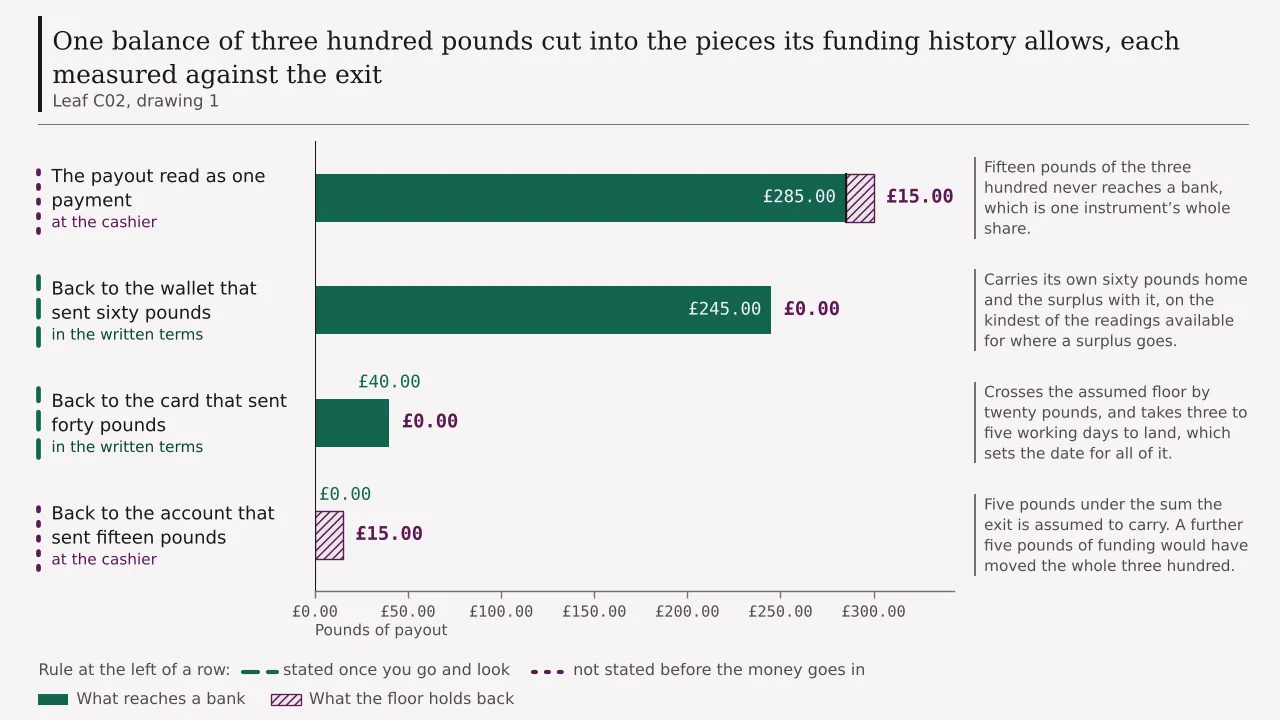
Three of the four bars in that drawing have no gap at all, which is the honest shape of this condition. Return-to-source does not shave a payout. It reorganises one, and the reorganisation is harmless for every piece except the one that falls under a figure set somewhere else entirely.
£15.00 of a £300.00 payout returned to an address that will not carry £15.00
5
A floor that tests each piece instead of the sum
A floor applied to a payout sounds like one test. Under a return-to-source rule it is as many tests as there are instruments, and every additional instrument adds a test that the money has to pass separately. That is the property doing the damage, and it is arithmetical rather than contractual.
Set it out as a condition. A piece survives where the funding behind it is at least the exit floor, or where it happens to be the piece collecting the surplus. On an assumed floor of £20.00 that makes every instrument which ever sent less than £20.00 a liability at the exit, and the liability was created on the day the small payment was made.
How much would have fixed it is a question with an exact answer. Five pounds more from the third instrument, taking its funding from £15.00 to £20.00, would have taken its piece over the floor and moved the whole £300.00. Five pounds of payment therefore decided fifteen pounds of payout, a ratio of three to one, and nothing at the time of the £15.00 payment indicated that any ratio was in play.
| Instrument | Sent in | May receive | Share of the payout | Against a £20.00 floor |
|---|---|---|---|---|
| Wallet, and the surplus with it | £60.00 | £245.00 | 81.7 per cent | Crosses, by £225.00 |
| Card | £40.00 | £40.00 | 13.3 per cent | Crosses, by £20.00 |
| Bank account | £15.00 | £15.00 | 5.0 per cent | Held, by £5.00 |
| The three added together | £115.00 | £300.00 | 100 per cent | £285.00 moves |
The bottom row is the row a reader would have drawn for themselves and no document draws. Each of the three rows above it can be traced to a payment and a sentence. The total cannot be traced anywhere, because no clause has a reason to add up pieces it describes one at a time, and the addition is the only line that answers what the payout is.
What happens to a held piece afterwards is the one thing this leaf cannot price. It may sit until another payment to the same instrument lifts it over the floor. It may be released by somebody answering a message. It may be paid by another route on request. No published rule here settles which, and a page that guessed would be inventing the most important number on it.
6
Why the thinnest leg decides the date for all of it
Three pieces travel by three routes at three speeds. This leaf assumes a wallet credit lands the same day, a bank leg takes one to three working days and a card refund takes three to five, and each of those is an assumption carried for the arithmetic rather than a timetable anybody has published.
On those assumptions the payout is not complete until the card leg lands, which is day five. The card is carrying £40.00, or 13.3 per cent of the money, so eight pounds in every ten arrived days earlier and the date on the whole transaction belongs to the thinnest of the three legs. That is what a maximum does, and a completion date is a maximum rather than an average.
Set that beside a claim of speed and the two are not in conflict, which is the awkward part. A cashier saying a withdrawal is sent within a day may be describing exactly what it does, since it sent all three pieces within a day. What it did not say is that sending is not landing, and that the slowest of the receiving rails owns the last four days of the wait.
| Leg | Carrying | Assumed to land | Sets the completion date |
|---|---|---|---|
| Wallet | £245.00 | The same day | No |
| Bank account | £15.00 | One to three working days | No, and it is held anyway |
| Card | £40.00 | Three to five working days | Yes, at five |
One payment would have had one clock. Funding an account from a single instrument makes the completion date equal to the only leg there is, which on these assumptions is the same day rather than five working days later. Nothing about the balance changes, and the wait shortens by four working days, which is a figure produced entirely by a decision taken at the payment screen weeks before.
There is a second-order effect worth naming and not overstating. A balance waiting for its last piece is a balance still sitting on somebody else’s books, and the longer it sits the more the question in part seven matters. That is a reason to care about the date beyond impatience, and it is the hinge into the duty this leaf turns on.
7
What an exit may not do where a licence reaches it
Two British rules bear on this exit, and each is about the shape a payout takes rather than its size. One bars a ceiling. The other asks for an absence of obstruction. Neither promises anybody a payout at all, which is worth saying before either gets leaned on.
Six days is what the forbidden drafting would do to the worked account. A specimen the regulator prints as out of bounds sets a daily £50.00 against a weekly £500.00, so £300.00 would leave across six days while the weekly figure never once bound. Any term having that object or that effect over money a customer paid in is barred, and winnings sitting in the same balance are inside the same sentence.
Five working days is what the split in part six does to the identical £300.00, with no ceiling anywhere and no term for a rule to reach. Count a weekend into those five and the payout completes seven calendar days out, which is a day longer than the arrangement a licence forbids. One of the two is drafting. The other is the arithmetic of a payments history, and only the first is reachable by any rule.
Number is the second word worth having, and it carries a standard rather than a prohibition: how much leaves, and how many times it leaves, both have to be reasonable. Three payments where one would serve is a statement about how many, made by a payout rule rather than by a withdrawal rule, which is precisely why it is easy to walk past.
Obstruction is the other duty, and it belongs to the standard governing how a withdrawal behaves: getting money out is to be made as free of it as a system can manage. Three floor tests, three clocks and a message about a stranded fifteen pounds are obstruction on any reading, and not one of them was written into a term anybody could point at.
8
Three payments, and the word that would be argued over
A wallet-funded account at an offshore address holds no Great Britain licence whatever, so part seven sets out a regime none of this is inside. Pricing that means naming the sentence a reader would otherwise have pointed at, and naming whoever would have been obliged to answer it.
Two hundred and forty-five pounds, forty pounds and a held fifteen is the arrangement at issue. Under a licence a reader can put that against a standard of reasonableness reaching how many payments there are as well as how large each one is, and somebody is bound to say whether it clears. Beyond the licence the standard is absent, so the question wants an addressee rather than receiving an unwelcome answer.
The instruction about obstruction leaves at the same time. Nothing then requires an exit to be easy, nothing discourages a process that asks for a message about a piece under a floor, and nothing bars three clocks where one would serve. A split stops being a failure against a standard and becomes a design with no standard aimed at it.
Two things the regulator has named in public both land at this end of a payout: money stopped on its way out, and ceilings pitched past the point anybody reaches them. Those are published observations about the offshore side rather than predictions about any particular cashier, and the assumptions worked through this leaf sit comfortably inside both.
What survives is worth printing, the loss being narrower than a sweeping sentence would make it. The payout rule still operates. The pieces still total £300.00. What has gone is any party under a duty to answer whether three pieces and a held fifteen pounds is a reasonable way of handing somebody what they are owed.
9
Funding from a single instrument, priced against the rest
Everything above can be collapsed into one piece of advice that costs nothing and is taken before any money moves. Fund an account from one instrument, and the exit has one piece, one floor test and one clock. No trickery is involved and no cleverness either. It is what follows arithmetically from a rule dividing a payout by the record of how an account filled up.
Price the two accounts side by side. Three instruments: £300.00 of balance, £285.00 reaching a bank, five working days to completion, one piece held. One instrument: £300.00 of balance, £300.00 reaching a bank, same day, nothing held. The difference is £15.00 and four working days, and it was fixed by three payment-screen decisions rather than by anything that happened on the reels.
Two cautions keep that honest. A reader may have good reasons for several instruments, and nothing here says a card or a bank account is a worse way to pay than a wallet. And where a wallet’s own rules decline gambling traffic, that refusal belongs to the wallet, it is a protection, and no route round one appears on this page.
The method generalises past this leaf’s figures. Count the instruments that have ever funded the account. Find the least the exit will send. Any instrument whose total funding is under that figure will produce a piece that cannot move, unless it is the one collecting whatever the balance exceeds the funding by. Then print both readings of the payout and rule off the difference.
Run on the worked account that method gives £300.00, then £285.00, then £15.00, and the £15.00 is the number this leaf exists to produce. No fee was levied, nobody billed anybody, and no statement will carry a line for it. It is the share of a payout posted back to an address too small to take delivery.
Questions
- Why does one payout arrive as several payments?
- Because a rule sending money back to whatever funded the account cannot pool the instruments without defeating itself. Each route carries home no more than it carried out, so an account filled by £60.00 from a wallet, £40.00 from a card and £15.00 from a bank account pays out in three pieces capped at those figures. The division is done from the account’s own record of payments, which the cashier keeps and the reader does not.
- Where does the surplus go when a balance is larger than the funding?
- Nowhere that any document this leaf can point at settles. On the worked account £115.00 went in and the balance reached £300.00, so £185.00 has no source to be returned to. This leaf assumes it follows the instrument that funded the largest share, which produces the fewest pieces and is the kindest reading available. A harsher rule spreading it in proportion would shrink the smallest piece rather than enlarge it.
- Can a piece of a payout be too small to be paid?
- Yes, and that is the whole cost of the arrangement. Take the least the exit will send as £20.00, held as an assumption here rather than drawn from any rule quotable on this site. Two pieces of £245.00 and £40.00 cross it. The £15.00 piece does not, so £285.00 of a £300.00 payout reaches a bank and £15.00 stays where it is, correctly calculated and worth nought at the exit.
- How is the fifteen pounds arrived at twice?
- From the funding side, a piece is capped at whatever its instrument sent, so the smallest funding sets the smallest piece and the smallest funding was £15.00. From the payout side, £300.00 less the £245.00 and the £40.00 that clear the floor leaves £15.00. Those two run in opposite directions with no step in common, which is why the figure needs no hedging.
- How much would have prevented the held piece?
- Five pounds. Taking the third instrument’s funding from £15.00 to £20.00 would have put its piece level with the assumed floor and moved the whole £300.00. So £5.00 of payment decided £15.00 of payout, a ratio of three to one, and nothing at the moment the £15.00 payment was made indicated that any ratio was in play. The condition was created at a payment screen and reported at the exit.
- Which leg sets the date a payout is complete?
- The slowest one, whatever it is carrying. This leaf assumes a wallet credit lands the same day, a bank leg takes one to three working days and a card refund three to five, none of them a timetable anybody publishes. On those figures the payout completes on day five, set by the leg holding £40.00, which is 13.3 per cent of the money. A completion date is a maximum rather than an average.
- Is a claim about withdrawal speed wrong, then?
- Not necessarily, and that is the awkward part. A cashier saying it sends a withdrawal within a day may be describing exactly what it did, because it sent all three pieces within a day. Sending is not landing, and the last four working days of the wait belong to the slowest receiving rail rather than to the operator. The two statements can both be true while describing different events.
- Is a cashier allowed to limit how much comes out at once?
- Not out of a deposit balance, wherever a British licence reaches. Any term having the object or the effect of capping what somebody takes out of money they paid in is barred, and the specimen the regulator prints as out of bounds sets a daily £50.00 against a weekly £500.00. Worked on this leaf’s figures that ceiling moves £300.00 across six days, while the split in part six takes five working days, which is seven calendar days once a weekend falls inside them.
- Does any rule bear on the number of payments rather than the size?
- One standard does, and it is the one this subject turns on: how much leaves, and how many times it leaves, both have to be reasonable. Three payments where one would serve is a statement about how many, made by a payout rule rather than by anything in the withdrawal rules, which is why it is easy to walk past. A second standard asks that getting money out be kept as free of obstruction as a system can manage, and three floor tests with three clocks is obstruction on any reading.
- What is given up where a wallet-funded account sits outside the British licence?
- An addressee, rather than a favourable answer. Under a licence a reader whose £300.00 arrives as £245.00, £40.00 and a held £15.00 has a reasonableness standard to put it against and somebody bound to respond. Beyond the licence that standard is absent, so the question wants somebody to go to, and no instruction obliges the route out to be an easy one. Money stopped on its way out, and ceilings pitched past the point anybody reaches them, are both things the regulator has named in public about this corner of the market.
- What does funding from one instrument actually save?
- On the worked account, £15.00 and four working days. Three instruments give £300.00 of balance, £285.00 reaching a bank, five working days and one piece held. One instrument gives £300.00 of balance, £300.00 reaching a bank, the same day, and nothing held. The saving was fixed by decisions taken at a payment screen weeks earlier rather than by anything that happened on the reels.
- How do I run this check on an account of my own?
- Count the instruments that have ever funded it. Find the least the exit will send in one go. Any instrument whose total funding is under that figure will produce a piece that cannot move, unless it happens to be the one collecting the amount by which the balance exceeds the funding. Then print the payout read as one payment, print it again as the pieces that can actually travel, and rule off the difference.