Terms read 19 October 2026 Leaf C09, revision 1
Seconds at the front of a journey that is measured in days
Authorising a payment on a device is put at 3 seconds here. The journey that payment belongs to is put at 72 hours, and both figures are assumptions of this leaf rather than anything published. Three seconds inside 72 hours is one part in 86,400, so the fast end is to the whole trip what a single second is to a day. This leaf works out what the other 86,399 parts are made of.
Stated on the banner £30.00 What a matched payment of that size credits, printed with nothing beside it about how long anything takes. Stated, once you go and look £18.00 the wrong way Where forty times leaves that credit, set down a document away, at 96p back on each pound of turnover. Not stated before the money goes in 72 assumed hours How long a balance waits before release, how long it then takes to arrive, and at which end of the trip a document check falls. All three are assumed here and none is published.
Offers taking device-authorised payments, with their terms read
Every destination in this file is bought advertising. The site is paid a fee if a reader goes on to register, and no figure printed below moves because of it.
Bonus Spins UK Slip 01
Betportal
Ceiling as a multiple
The drop
€15.00
€1.00 in the euro
The claim reads €15.00. Once the terms beside it have applied, €0.00 of it can leave. The difference is the drop.
7 of the 15 terms on this slip could not be read before the money went in
Spins priced at this site's own 10p a spin, which the operator does not publish
Stated
€15.00
The claim as it is printed, before a single term has been applied to it.
Headline paid as spins
150 spins at 10c each, which is €15.00 of the figure above.
6 Nowhere
What one spin is worth
No unit is published for a spin, so the count is priced at this site's own 10p a spin. At half that price every figure below halves with it.
Match and other credit not priced
300% of three deposits, to a ceiling of €1,000. A share of a deposit nobody has made yet is not a sum, so no figure stands on this line and none is carried below.
Qualified
-€14.40
Written down somewhere, and taking part of the claim back. Each term carries the place it is written and the sum it takes.
2 Written terms at a distance this record does not establish
Play-through -€14.40
Carrying €14.40 through 35 times stakes €504.00 and costs €20.16 of it at 96 per cent return. That prices above the €14.40 there is to charge it against, so the whole of the credit goes and the line is held at that. The multiple sits on the bonus.
2 Written terms at a distance this record does not establish
Game weighting not priced
Slots only count towards the play-through. No contribution percentage is published, so the line above has been worked at full weight, which is the kindest reading there is.
2 Written terms at a distance this record does not establish
Ceiling on the winnings not priced
5x the bonus.
2 Written terms at a distance this record does not establish
Clock on the credit not priced
14 days.
2 Written terms at a distance this record does not establish
Largest stake while it runs not priced
€5.
3 Public record
Licence, and who holds it not priced
Licensed in Anjouan, Comoros, held by BetPortal Gaming Ltd, with Excite Ultra Media Ltd, reference ALSI-202601040-FI2. A register entry settles who holds a licence and what it permits. It does not settle who is running the site this morning.
4 Cashier
Smallest qualifying deposit your money
€20 a stage. That is €20.00 of your own money, and it is never netted into a drop.
5 On the way out
Checks before a withdrawal not priced
Documents before the first withdrawal.
Unstated
-€0.60
Applying without having been published anywhere, and costing money all the same.
6 Nowhere
What a spin hands back -€0.60
Staking a spin returns 96 per cent of it, so that share of the batch is the house's before a reel turns. This site works at that return and the operator publishes none where the claim is made.
6 Nowhere
Forfeited by rule cost unknown
Nothing is published under this heading, and it applies regardless.
6 Nowhere
Charge on the way out cost unknown
No charge on the way out is published as a figure, so nothing comes off this line. A charge that exists unpublished would come straight off whatever survives.
6 Nowhere
Smallest withdrawal allowed cost unknown
No smallest withdrawal is published as a figure. A floor nobody has published is still a floor, and it decides whether a small balance can move at all.
No Great Britain licence
Terms read 19 October 2026
Bonus Spins UK Slip 02
WinBeast
Ceiling as a sum
The drop
€50.00
€1.00 in the euro
The claim reads €50.00. Once the terms beside it have applied, €0.00 of it can leave. The difference is the drop.
8 of the 15 terms on this slip could not be read before the money went in
Spins priced at this site's own 10p a spin, which the operator does not publish
Stated
€50.00
The claim as it is printed, before a single term has been applied to it.
Headline paid as spins
500 spins at 10c each, which is €50.00 of the figure above.
6 Nowhere
What one spin is worth
No unit is published for a spin, so the count is priced at this site's own 10p a spin. At half that price every figure below halves with it.
Match and other credit not priced
50% to 100% of five deposits, each to a ceiling of €1,000, and a €650 free bet. A share of a deposit nobody has made yet is not a sum, so no figure stands on this line and none is carried below.
Qualified
-€48.00
Written down somewhere, and taking part of the claim back. Each term carries the place it is written and the sum it takes.
2 Written terms at a distance this record does not establish
Play-through -€48.00
Carrying €48.00 through 40 times stakes €1,920.00 and costs €76.80 of it at 96 per cent return. That prices above the €48.00 there is to charge it against, so the whole of the credit goes and the line is held at that. The multiple sits on the bonus and the winnings from the spins.
2 Written terms at a distance this record does not establish
Game weighting not priced
Slots, titles vary by country count towards the play-through. No contribution percentage is published, so the line above has been worked at full weight, which is the kindest reading there is.
2 Written terms at a distance this record does not establish
Ceiling on the winnings not priced
€100 a batch of spins.
2 Written terms at a distance this record does not establish
Clock on the credit not priced
7 days, spins 1 day.
3 Public record
Licence, and who holds it not priced
Licensed in Curaçao, holder not named on the site. A register entry settles who holds a licence and what it permits. It does not settle who is running the site this morning.
4 Cashier
Smallest qualifying deposit your money
€20 a stage. That is €20.00 of your own money, and it is never netted into a drop.
5 On the way out
Checks before a withdrawal not priced
Documents before the first withdrawal.
Unstated
-€2.00
Applying without having been published anywhere, and costing money all the same.
6 Nowhere
What a spin hands back -€2.00
Staking a spin returns 96 per cent of it, so that share of the batch is the house's before a reel turns. This site works at that return and the operator publishes none where the claim is made.
6 Nowhere
Largest stake while it runs cost unknown
Nothing is published under this heading, and it applies regardless.
6 Nowhere
Forfeited by rule cost unknown
Nothing is published under this heading, and it applies regardless.
6 Nowhere
Charge on the way out cost unknown
No charge on the way out is published as a figure, so nothing comes off this line. A charge that exists unpublished would come straight off whatever survives.
6 Nowhere
Smallest withdrawal allowed cost unknown
No smallest withdrawal is published as a figure. A floor nobody has published is still a floor, and it decides whether a small balance can move at all.
No Great Britain licence
Terms read 19 October 2026
Bonus Spins UK Slip 03
EliteSpin
Longest spin window
The drop
£50.00
£1.00 in the pound
The claim reads £50.00. Once the terms beside it have applied, £0.00 of it can leave. The difference is the drop.
8 of the 15 terms on this slip could not be read before the money went in
Spins priced at this site's own 10p a spin, which the operator does not publish
Stated
£50.00
The claim as it is printed, before a single term has been applied to it.
Headline paid as spins
500 spins at 10p each, which is £50.00 of the figure above.
6 Nowhere
What one spin is worth
No unit is published for a spin, so the count is priced at this site's own 10p a spin. At half that price every figure below halves with it.
Match and other credit not priced
50% to 100% of five deposits, each to a ceiling of £1,000. A share of a deposit nobody has made yet is not a sum, so no figure stands on this line and none is carried below.
Qualified
-£48.00
Written down somewhere, and taking part of the claim back. Each term carries the place it is written and the sum it takes.
2 Written terms at a distance this record does not establish
Play-through -£48.00
Carrying £48.00 through 40 times stakes £1,920.00 and costs £76.80 of it at 96 per cent return. That prices above the £48.00 there is to charge it against, so the whole of the credit goes and the line is held at that. The multiple sits on the bonus and the winnings from the spins.
2 Written terms at a distance this record does not establish
Game weighting not priced
Slots count towards the play-through. No contribution percentage is published, so the line above has been worked at full weight, which is the kindest reading there is.
2 Written terms at a distance this record does not establish
Ceiling on the winnings not priced
5x the bonus.
2 Written terms at a distance this record does not establish
Clock on the credit not priced
7 days, spins 3 days.
3 Public record
Licence, and who holds it not priced
Licensed in Costa Rica, held by PrimeTier Limited. A register entry settles who holds a licence and what it permits. It does not settle who is running the site this morning.
4 Cashier
Smallest qualifying deposit your money
£20 a stage. That is £20.00 of your own money, and it is never netted into a drop.
5 On the way out
Checks before a withdrawal not priced
Documents before the first withdrawal.
Unstated
-£2.00
Applying without having been published anywhere, and costing money all the same.
6 Nowhere
What a spin hands back -£2.00
Staking a spin returns 96 per cent of it, so that share of the batch is the house's before a reel turns. This site works at that return and the operator publishes none where the claim is made.
6 Nowhere
Largest stake while it runs cost unknown
Nothing is published under this heading, and it applies regardless.
6 Nowhere
Forfeited by rule cost unknown
Nothing is published under this heading, and it applies regardless.
6 Nowhere
Charge on the way out cost unknown
No charge on the way out is published as a figure, so nothing comes off this line. A charge that exists unpublished would come straight off whatever survives.
6 Nowhere
Smallest withdrawal allowed cost unknown
No smallest withdrawal is published as a figure. A floor nobody has published is still a floor, and it decides whether a small balance can move at all.
No Great Britain licence
Terms read 19 October 2026
Bonus Spins UK Slip 04
Crown Jewelz
Multiple unpublished
The drop
NOT WORKED
The multiple is not published in the operator's own terms. Since the sum cannot be worked around it, none is worked.
9 of the 14 terms on this slip could not be read before the money went in
No drop worked
Stated
£15.00
The claim as it is printed, before a single term has been applied to it.
Headline paid as spins
150 spins at 10p each, which is £15.00 of the figure above.
6 Nowhere
What one spin is worth
No unit is published for a spin, so the count is priced at this site's own 10p a spin. At half that price every figure below halves with it.
Match and other credit not priced
200% of the first deposit, then 150% twice, each to a ceiling of £1,000. A share of a deposit nobody has made yet is not a sum, so no figure stands on this line and none is carried below.
Qualified
NOT WORKED
Written down somewhere, and taking part of the claim back. Each term carries the place it is written and the sum it takes.
2 Written terms at a distance this record does not establish
Play-through not priced
40x the bonus, reported rather than published by the operator.
2 Written terms at a distance this record does not establish
Game weighting not priced
Slots count towards the play-through. No contribution percentage is published, so the line above has been worked at full weight, which is the kindest reading there is.
3 Public record
Licence, and who holds it not priced
Licensed in Curaçao, number not verified, holder not named on the site. A register entry settles who holds a licence and what it permits. It does not settle who is running the site this morning.
4 Cashier
Smallest qualifying deposit your money
£20. That is £20.00 of your own money, and it is never netted into a drop.
5 On the way out
Checks before a withdrawal not priced
Documents before the first withdrawal.
Unstated
NOT WORKED
Applying without having been published anywhere, and costing money all the same.
6 Nowhere
Ceiling on the winnings cost unknown
No ceiling is published. Nothing is assumed in its place.
6 Nowhere
Clock on the credit cost unknown
Nothing is published under this heading, and it applies regardless.
6 Nowhere
Largest stake while it runs cost unknown
Nothing is published under this heading, and it applies regardless.
6 Nowhere
Forfeited by rule cost unknown
Nothing is published under this heading, and it applies regardless.
6 Nowhere
Charge on the way out cost unknown
No charge on the way out is published as a figure, so nothing comes off this line. A charge that exists unpublished would come straight off whatever survives.
6 Nowhere
Smallest withdrawal allowed cost unknown
No smallest withdrawal is published as a figure. A floor nobody has published is still a floor, and it decides whether a small balance can move at all.
No Great Britain licence
Terms read 19 October 2026
Every figure in the second and third columns is this site's own working and nothing an operator has published. A claim is priced as printed, then the share a spin hands back at 96 per cent return comes off it, then what playing the multiple through costs at the same return, and then whatever a published ceiling, a charge on the way out or a floor on the smallest withdrawal takes from what has survived. The drop is the difference between the first figure and the last. The two columns add back up to it exactly, so no money leaves a slip without a term and a place beside it.
Which column a term falls in is settled by one question: has anybody written it down. A charge a reader meets at the payment screen is written down, and it stands in the second column with the cashier against it. A condition that binds without ever having been set down stands in the third, whatever it costs. Inside each column the terms run outwards from the banner, so the order itself says how far a reader would have had to go.
A count of spins has no unit until one is supplied. Where an operator publishes what one of its own spins is worth, that figure is used and the first column says it is theirs. Where none is published, this site's own 10p a spin stands in its place and every figure below moves in proportion with it. Where the multiple itself is unpublished, no drop is worked at all, because that is the one figure the sum cannot be done without.
Three words stand where a figure cannot. Not priced is a term that is written down and carries no number the arithmetic can take. Cost unknown is a term nobody has written down, costing something nobody has put a number on. Your money is money of the reader's own, which is never netted into a drop.
None of the operators in this file holds a Great Britain licence, so none of the duties that licence carries reaches them. Each of those duties is published in its own right, which is what makes its absence here something a reader can check rather than take on trust. Every gambling company licensed in Great Britain belongs to Gamstop Online, so a reader who has shut themselves out through the scheme is not shut out here. Social Responsibility Code 5.1.1 has held a play-through to a maximum of ten times the bonus funds since 19 January 2026, and it binds a licence holder and nobody else. Asked in a post of 21 October 2025 what is lost along with the licence, the Gambling Commission's Director of Enforcement and Intelligence answered: "unfair gaming practices, financial loss, and a lack of recourse if things go wrong". The same post puts blocked payouts, and withdrawal limits pitched high enough to be unreachable, among the behaviour the Commission has recorded. Nobody under 18 may hold an account at any of them.
Terms are reproduced in the wording their operator published, and each slip is dated with the day somebody sat down and read them. 19 October 2026 is the oldest of those dates. Anybody claiming an offer is bound by that operator's full terms, which are elsewhere, and never by a line standing here.
1
Three seconds, and the fraction of a trip they are
Put 3 seconds on authorising a payment with a handset, which is an assumption of this leaf and not a measurement anybody made. Put 90 seconds on the alternative, meaning finding a card, typing a long number, and waiting for whatever code arrives. Also assumed, and not published on a page this site may cite. The front end has therefore been shortened by 87 seconds, and 87 seconds is the entire quantity this leaf has to work with.
Now put the money back where it came from. Assume a balance waits 24 hours before it is released and then takes 48 hours to arrive, both assumed rather than read off anything. That is 72 hours on the way out, or 259,200 seconds, against three seconds on the way in.
Divide and the proportion is stark enough to need no adjective. Three seconds into 259,200 is one part in 86,400, and 86,400 seconds is exactly one day, so the relationship can be stated without any division at all: the fast end stands to the slow end as one second stands to a whole day. Expressed as a share of the complete round trip of 259,203 seconds, the authorisation is 0.00116 per cent of it.
The trip read off its first leg 3 seconds The trip with the far end counted in 72 hours and 3 seconds Untouched by anything the handset does 72 hours
None of that is an argument against a fast front end. Three seconds is pleasanter than ninety and nobody should pretend otherwise. The argument is about where a reader’s attention is being pointed, because the one quantity a payment screen shows off is the one quantity that was never the constraint, and the three that are the constraint are settled somewhere a reader cannot see until afterwards.
The question here, then, is not whether the front end is quick. It plainly is. The question is what share of a reader’s own waiting the quickness removes, and on the assumptions above the answer is roughly one thousandth of one per cent.
2
The journey those seconds belong to, leg by leg
A payment into a gambling account and a payment back out of it are usually discussed as one thing, which is how the front end comes to stand in for the whole. Break the trip into legs and the proportions settle themselves without any argument from this leaf.
| Leg of the trip | Assumed length | In seconds | Share of the trip | Who decides the length |
|---|---|---|---|---|
| Authorising the payment on a handset | 3 seconds | 3 | 0.00116 per cent | The handset and whoever it talks to |
| The balance becoming usable for play | Treated as nil | 0 | None | The gambling account |
| Waiting before the payment out is released | 24 hours | 86,400 | 33.33 per cent | The gambling account alone |
| Travelling from release to arrival | 48 hours | 172,800 | 66.67 per cent | Parties the reader never chose |
| The whole trip, added up | 72 hours and 3 seconds | 259,203 | All of it | Nobody, as one figure |
The reader’s own play is deliberately missing from that table. It takes whatever it takes, it belongs to the reader rather than to any party in the chain, and including it would let a long session disguise how the rest of the trip divides. What is left is the part the reader waits through without being able to do anything about it.
Two of the five rows carry the whole of the waiting and neither of them is anywhere near the handset. One belongs entirely to the gambling account, which decides when a request stops being a request. The other belongs to parties further along, whose names the reader never saw and whose timings appear on no screen the reader passed.
The last row is the one with no author, and it is the only row a reader would actually want to know in advance. No party in the chain publishes it, because no party in the chain is responsible for more than their own leg, and a figure covering all of them would be a figure somebody had to stand behind.
259,200 assumed seconds on the way out against 3 on the way in, from the same account
3
Who fixes the length of each leg, and where
Sorting those legs by where a reader could have settled each one is the exercise this site performs on every subject, and on a question of duration it produces an unusually empty answer.
Whether a handset appears as a choice is settled at the cashier, a row of pictures being something that exists only once an account does. How long the authorisation takes is settled by the handset and is the one length a reader has felt for themselves. How long a balance waits before release is settled nowhere in writing. How long the journey afterwards takes is first encountered on the way out, learnt by its effect rather than by reading anything.
| The length in question | Where it is settled | Known before paying in? |
|---|---|---|
| Whether a handset is offered | at the cashier | Only once an account exists |
| How long the authorisation takes | at the payment screen | Felt rather than published |
| The wait before a payment out is released | nowhere in writing | No, and never as a figure |
| The travelling time after release | on the way out | No, and learnt by waiting |
| When paperwork is asked for | on the way out | No, outside the British licence |
Five rows, and the two that carry 99.99 per cent of the waiting are the two with no address a reader can walk to. This part of the site keeps turning up that shape, and it is worth saying plainly rather than implying: the quantity best advertised is the quantity best known, and the two are the same quantity for a reason.
One row deserves a note in its own defence. The authorisation length is marked as felt rather than published because a reader genuinely does know it, having experienced it, which makes it the only length on the table with any evidence behind it at all. Three seconds is the one honest number in the whole trip, and it governs 0.00116 per cent of the trip.
4
What a faster front end buys, in seconds and in pounds
Take the 87 seconds the handset saves and ask what share of the trip it removes. Against a round trip that would otherwise run to 259,290 seconds, 87 seconds is 0.0336 per cent. A reader who shortened the front end by that much has shortened their own waiting by about one part in three thousand.
Put the same quantity against the money and the answer is cleaner still, because it is a round nought. Take a payment of £30.00 matched in full, giving £30.00 of credit. Forty multiples of that credit want £1,200.00 of turnover, which at the 10p a press assumed sitewide is twelve thousand individual presses.
Each staked pound surrenders four pence, so turnover of £1,200.00 is expected to shed £48.00, which leaves the credit at an expected minus £18.00. Arithmetic from the other side agrees. Forty applications of a four per cent edge come to 1.6; taking that away from one gives minus 0.6; and 0.6 of thirty pounds is eighteen pounds facing backwards. The weighting stays at one in every line here.
Credit read off the match £30.00 Expected close at forty times minus £18.00 Distance between the readings £48.00
Of that £48.00, the amount moved by authorising on a handset rather than by typing is £0.00, and not approximately nought. The difference is made of a multiple and a return, neither of which has any term in it for how the money arrived. A payment route can decide whether a credit exists, which is a different leaf’s subject entirely, but once a credit exists the route has no further part in the arithmetic.
That gives the honest ordering for anybody deciding what to look at first. One unread clause is worth £48.00 on this payment. The entire speed advantage of the front end is worth £0.00 on the same payment and 0.0336 per cent of the waiting. A payment screen presents the second of those and is silent about the first.
5
The wait before release, which is the first real lever
Two things in the trip are worth money or time, and this part is the first of them. Before a payment out leaves, there is an interval in which a request exists and the money has not moved. It is put at 24 hours here, assumed rather than published, and it is the single largest thing any one party in the chain controls alone.
Suppose that interval were two hours instead of twenty-four. The trip falls from 72 hours to 50, a saving of 22 hours or 79,200 seconds. Set that against the 87 seconds the handset saves and the ratio is about 910 to one. One decision taken by one party, about one interval, is worth nine hundred times the whole of the front end.
The ratio is worth stating the other way round as well, because it is more striking read backwards. To match a single hour removed from the wait, a front end would have to be shortened by 3,600 seconds, which is forty-one times longer than the entire authorisation it replaced. There is no version of a payment screen capable of that, because the thing it is shortening was never more than a minute and a half.
What makes the interval interesting rather than merely large is that nobody publishes it. A length nobody states is a length nobody can compare, lean on or argue with, and a reader meets it by watching a screen report that a request is being handled. It is the clearest instance on this leaf of a figure that governs everything and is settled nowhere in writing.
One fair qualification. An interval before release is not automatically an obstruction. Reviews exist for reasons, some of them legal, and a chain with none at all would have properties of its own that nobody should want. The complaint here is about the figure being unstated rather than about the figure being positive, and those are different complaints with different remedies.
6
When the paperwork is asked for, which is the second
The other lever is not a length at all. It is a position: whether a demand for documents falls at registration or at the exit. The work is identical in both cases and the cost to the reader is not, because at registration nothing is waiting behind it and at the exit a balance is.
Assume a demand arriving at the exit adds 48 hours to the trip, which is assumed here and published nowhere. That is 172,800 seconds, or about 1,986 times the 87 seconds the handset saved. One decision about where in the order a check sits is therefore worth nearly two thousand times the entire speed advantage of the front end.
| The lever | Assumed change | Seconds it moves | Against the front end | Pounds it moves |
|---|---|---|---|---|
| Tapping rather than typing at the start | 87 seconds off | 87 | One for one | £0.00 |
| The wait before release cut to two hours | 22 hours off | 79,200 | About 910 times | £0.00 |
| Paperwork asked for at registration | 48 hours off | 172,800 | About 1,986 times | £0.00 |
The right-hand column is a constant and it is printed on purpose. Not one of the three levers changes the £48.00 by a penny, because the £48.00 is produced by a multiple working on a credit and none of the three touches either. Time and money are separate accounts on this subject and improvements in one do nothing whatever to the other.
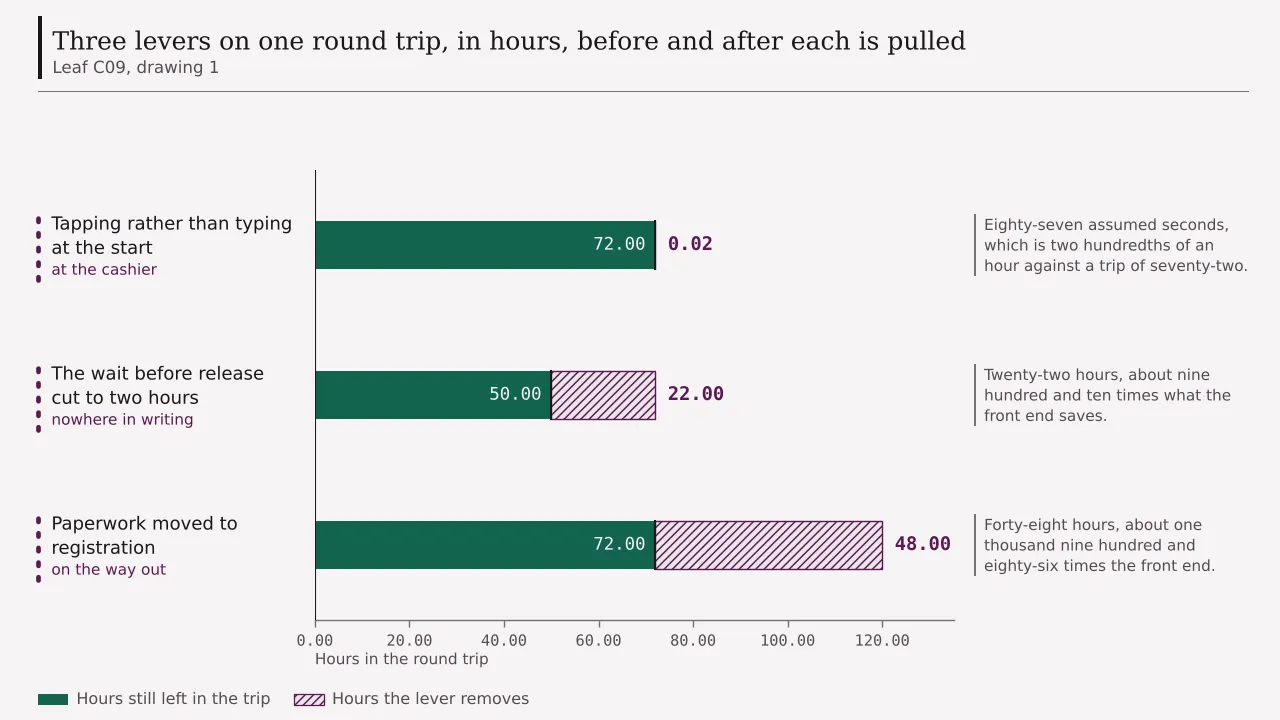
The top bar in that drawing is the one a payment screen advertises and it is drawn at two hundredths of an hour. The two underneath it are drawn at twenty-two hours and forty-eight, and neither is mentioned anywhere a reader passes on the way in. That is the whole of this leaf in a picture, and the numbers are this leaf’s own assumptions rather than anybody’s published tariff.
7
Why the way out is not the way in reversed
Anybody meeting the figures above tends to ask why the exit is not just the entrance played backwards, and the answer is short. Two directions, two sets of parties, two authorisations and two clocks, with the handset taking part in exactly one of them.
On the way in, the thing being proved is possession: that whoever is holding the device is entitled to use what is stored on it. That proof takes three seconds and is complete at the moment the payment is authorised. On the way out, nothing needs proving in that sense, because the money is already inside an account and the question has become where it should be sent and whether it should be sent yet.
Those are different questions with different answerers, which is why no amount of improvement at one end has any effect on the other. A quicker proof of possession does not shorten a review that has not started. It does not shorten a journey between parties who were not involved in the authorisation. It settles nothing about the destination either.
The rule governing which instrument a payment out may be sent to is a separate subject and is worked through on another leaf of this site, where it is derived from first principles and priced. Nothing here repeats that derivation, and nothing here depends on it: the arithmetic above holds whether the destination is fixed, free or decided by a document nobody has read.
What this leaf adds to that subject is a single structural observation. Authentication is asymmetric by construction. It is demanded where money is leaving a reader’s control and is not demanded where money is arriving back in it, so the quick, polished, heavily advertised part of the chain is the part that only ever runs in the direction the house benefits from.
Stating it that way is not an accusation, because the asymmetry has an ordinary explanation. Somebody paying in has to prove they may, and somebody being paid does not have to prove they want it. The consequence is still worth printing: of the two ends of the trip, the one with the engineering on it is the end that takes three seconds, and the one with 72 hours on it has no engineering a reader can see at all.
8
Identity at the front, and the order a licence fixes
Part six handled the position of a check as a lever. Inside the British licence that position is not a lever but a rule, and naming the rule is the only way to put a price on its absence.
Second nought of the trip, ahead of a single press, is where somebody’s identity has to be established and checked, and the condition names three items that must at least be covered: who the person is, the address behind them, and the day they were born. Second one, before any money may be taken at all, is where a warning is owed about which papers could be wanted later, at what point, and in what form. Both duties govern position in a sequence, which is exactly what part six was treating as a lever.
Play nobody paid for sits inside the same rule. The announcement of the current regime puts age checking ahead of gambling funded by a credit or a free bet exactly as it does for gambling funded out of somebody’s own pocket, and ahead of the practice versions kept in a lobby. Before it, the window for finishing an age check ran to seventy-two hours from registration, and none of that window was kept. Dated 7 February 2019, the announcement names the seventh of May as the day the rules start and prints no year against it; the only year its own date leaves available is 2019.
A page written for players puts the same thing in a sentence and gives three grounds for it: how old somebody is, whether they have shut themselves out, and whether they are the person they say. That page is older than the condition, published 23 September 2020 with its last revision on 13 April 2022, and the age of it is worth stating whenever anybody leans on the wording.
Arrangements paid for by tapping a handset hold no Great Britain licence, and the duty that disappears on a leaf about timing is the one fixing where in a sequence a check may stand. Second nought then carries no obligation to settle who somebody is ahead of a press. Second one carries no obligation to warn what papers may be wanted later. The reach into credit-funded play and into practice versions goes with it. And the seventy-two hour window British licensees lost is no ceiling out here, there being no rule for it to be a ceiling against. The 48 hours part six assumed for a late check is accordingly an assumption about conduct, not a departure from any standard.
Fold that into the trip and the ordering duty prices itself in seconds. Where the rule holds, the check costs the reader minutes at registration and nothing at the exit. Where it does not, the identical check may cost an assumed 48 hours at the exit, which is 1,986 times the whole of the front end’s advantage. The work done is the same work. Only its position has moved.
9
The round-trip sum, for anything authorised on a handset
The procedure takes a sheet of paper and about two minutes, and it works on any payment route that advertises its own speed. List the legs of the round trip. Put a length against each one, from your own experience where you have any and marked as a guess where you do not. Add them. Then divide the leg being advertised by the total.
On this leaf’s assumed lengths that gives three seconds over 259,203, which is one part in 86,400 and 0.00116 per cent of the trip. Any figure of that order means the advertised leg is not the constraint, and the constraint is whichever leg carries the largest share. Here the two largest legs carry 33.33 per cent and 66.67 per cent between them, and neither is published by anybody.
Step two is the money, a separate sum that must never be mixed with the first. Work out the credit as the match presents it. Do it again with the clause applied. Print both and rule the gap off beneath. On £30.00 at forty times that produces £30.00, then minus £18.00, then £48.00 of difference, and no leg of the trip changes any of those three figures.
Two habits keep the result from flattering anybody. Never let the advertised leg stand for the trip, which is the error the whole leaf is about. And never convert a saving in seconds into a saving in pounds, because the two accounts have no exchange rate between them: 87 seconds is worth 87 seconds, and £48.00 is worth £48.00, and no amount of the first buys any of the second.
The action this leaf points at is unglamorous and free. Before paying anything in, ask how long a payment out takes and when documents are asked for. Both answers are about the far end of the trip, both decide 99.99 per cent of the waiting, and neither is on the screen showing how quickly a handset can authorise something.
0.00116 per cent of an assumed round trip happening at the end everybody advertises
Questions
- How fast is a deposit authorised on a handset?
- Three seconds on this leaf’s assumption, against ninety for finding a card, typing a long number and waiting for a code. Both figures are assumed here and neither sits on a page this site may cite. The saving is therefore 87 seconds, and 87 seconds is the entire quantity the speed argument has to work with.
- What share of the whole journey does that speed cover?
- About one thousandth of one per cent. Assume a balance waits 24 hours before release and then takes 48 hours to arrive, both assumed here, and the way out runs to 259,200 seconds against three on the way in. That is one part in 86,400, and since 86,400 seconds is exactly a day, the fast end stands to the slow end as one second stands to a whole day.
- Does paying by handset make a withdrawal quicker?
- No, and the reason is built into the chain rather than particular to anybody. Two directions, two sets of parties, two authorisations and two clocks. Proving possession of what is on a device takes three seconds and is finished when the payment is authorised. Nothing about that proof shortens a review which has not begun or a journey between parties who took no part in it.
- What actually shortens the wait, then?
- Two things, and neither is a payment route. Cutting the wait before release from an assumed 24 hours to two saves 22 hours, or about 910 times what the handset saves. Asking for paperwork at registration rather than at the exit saves an assumed 48 hours, or about 1,986 times as much. Both figures are this leaf’s assumptions, and both levers sit at the far end of the trip.
- How does forty times treat a £30.00 credit?
- It leaves an expected minus £18.00. Forty multiples of the credit want £1,200.00 of turnover, which is twelve thousand individual presses at the 10p assumed sitewide, and each staked pound surrenders four pence, so £48.00 is expected to go. From the other side: forty applications of a four per cent edge come to 1.6, taking that away from one gives minus 0.6, and 0.6 of thirty pounds is eighteen pounds facing backwards.
- Does a faster payment route improve those figures?
- It moves them by £0.00, and not approximately nought. The £48.00 of difference is made by a multiple acting on a credit, and neither the multiple nor the return has any term in it for how the money arrived. A route can decide whether a credit exists at all, which is a separate subject, but once the credit exists the route has no further part in the arithmetic.
- Where is the length of the wait before release published?
- Nowhere this site can cite, which is itself the result rather than a gap in the reading. A length nobody states is a length nobody can compare, lean on or argue with, and a reader meets it by watching a screen report that a request is being handled. It is the clearest case on this leaf of a figure that governs everything and has no address at all.
- When does a British licence require identity to be checked?
- Ahead of a single press. Three items must at least be covered, which are who the person is, the address behind them, and the day they were born, and before money may be taken a warning is owed about which papers could be wanted later, at what point and in what form. The rule reaches play funded by a credit or a free bet and the practice versions kept in a lobby. The window for finishing an age check once ran to seventy-two hours from registration. Dated 7 February 2019, the announcement names the seventh of May as the starting day and prints no year against it, with 2019 the sole year the announcement’s own date will support.
- What is lost when the arrangement sits outside Britain?
- The rule fixing where in a sequence a check may stand. Arrangements paid for by tapping a handset hold no Great Britain licence, so nothing obliges anybody to settle who a person is ahead of a press, nothing obliges a warning before money is taken about which papers could be wanted later, and the reach into credit-funded and practice play goes too. The identical work then costs an assumed 48 hours at the exit instead of minutes at the start.
- How do I run this sum on any payment route?
- List the legs of the round trip, put a length against each from your own experience where you have one and marked as a guess where you do not, add them, and divide the advertised leg by the total. On the assumed lengths here that gives three seconds over 259,203, or 0.00116 per cent. Anything of that order means the advertised leg is not the constraint, and the constraint is whichever leg carries the largest share.
- Can a saving in seconds be converted into money?
- Not on this subject, and trying is the commonest error it produces. The two accounts have no exchange rate between them: 87 seconds is worth 87 seconds and £48.00 is worth £48.00, and no amount of the first buys any of the second. Keeping them in separate columns is what stops a payment screen’s one genuine advantage from being read as an answer to a question about pounds.