Terms read 19 October 2026 Place R, revision 1
What the register shows, and where a complete record stops being able to help
Nine leaves sit under this place and their findings add to £845.40. A published record settles £438.40 of that outright, for anybody who looks a name up before creating an account. The remaining £407.00 turns on questions no record anywhere undertakes to hold. This place is about where the line between those two sums runs, and about the single step a reader takes across it unprompted.
Stated on the banner £0.00 Nothing an advertisement prints settles a permission, so not one penny of this place is decided where the claim itself was made. Stated, once you go and look £438.40 The share a published record decides for a reader who types one name into a public search, with no account and no payment first. Not stated before the money goes in 3 of 9 Leaves of this place whose deciding quantity is held in no record, no rulebook and no document of any description.
Offers whose licensing can be looked up, with their terms read
Every destination in this file is bought advertising. The site is paid a fee if a reader goes on to register, and no figure printed below moves because of it.
Bonus Spins UK Slip 01
Betportal
Ceiling as a multiple
The drop
€15.00
€1.00 in the euro
The claim reads €15.00. Once the terms beside it have applied, €0.00 of it can leave. The difference is the drop.
7 of the 15 terms on this slip could not be read before the money went in
Spins priced at this site's own 10p a spin, which the operator does not publish
Stated
€15.00
The claim as it is printed, before a single term has been applied to it.
Headline paid as spins
150 spins at 10c each, which is €15.00 of the figure above.
6 Nowhere
What one spin is worth
No unit is published for a spin, so the count is priced at this site's own 10p a spin. At half that price every figure below halves with it.
Match and other credit not priced
300% of three deposits, to a ceiling of €1,000. A share of a deposit nobody has made yet is not a sum, so no figure stands on this line and none is carried below.
Qualified
-€14.40
Written down somewhere, and taking part of the claim back. Each term carries the place it is written and the sum it takes.
2 Written terms at a distance this record does not establish
Play-through -€14.40
Carrying €14.40 through 35 times stakes €504.00 and costs €20.16 of it at 96 per cent return. That prices above the €14.40 there is to charge it against, so the whole of the credit goes and the line is held at that. The multiple sits on the bonus.
2 Written terms at a distance this record does not establish
Game weighting not priced
Slots only count towards the play-through. No contribution percentage is published, so the line above has been worked at full weight, which is the kindest reading there is.
2 Written terms at a distance this record does not establish
Ceiling on the winnings not priced
5x the bonus.
2 Written terms at a distance this record does not establish
Clock on the credit not priced
14 days.
2 Written terms at a distance this record does not establish
Largest stake while it runs not priced
€5.
3 Public record
Licence, and who holds it not priced
Licensed in Anjouan, Comoros, held by BetPortal Gaming Ltd, with Excite Ultra Media Ltd, reference ALSI-202601040-FI2. A register entry settles who holds a licence and what it permits. It does not settle who is running the site this morning.
4 Cashier
Smallest qualifying deposit your money
€20 a stage. That is €20.00 of your own money, and it is never netted into a drop.
5 On the way out
Checks before a withdrawal not priced
Documents before the first withdrawal.
Unstated
-€0.60
Applying without having been published anywhere, and costing money all the same.
6 Nowhere
What a spin hands back -€0.60
Staking a spin returns 96 per cent of it, so that share of the batch is the house's before a reel turns. This site works at that return and the operator publishes none where the claim is made.
6 Nowhere
Forfeited by rule cost unknown
Nothing is published under this heading, and it applies regardless.
6 Nowhere
Charge on the way out cost unknown
No charge on the way out is published as a figure, so nothing comes off this line. A charge that exists unpublished would come straight off whatever survives.
6 Nowhere
Smallest withdrawal allowed cost unknown
No smallest withdrawal is published as a figure. A floor nobody has published is still a floor, and it decides whether a small balance can move at all.
No Great Britain licence
Terms read 19 October 2026
Bonus Spins UK Slip 02
WinBeast
Ceiling as a sum
The drop
€50.00
€1.00 in the euro
The claim reads €50.00. Once the terms beside it have applied, €0.00 of it can leave. The difference is the drop.
8 of the 15 terms on this slip could not be read before the money went in
Spins priced at this site's own 10p a spin, which the operator does not publish
Stated
€50.00
The claim as it is printed, before a single term has been applied to it.
Headline paid as spins
500 spins at 10c each, which is €50.00 of the figure above.
6 Nowhere
What one spin is worth
No unit is published for a spin, so the count is priced at this site's own 10p a spin. At half that price every figure below halves with it.
Match and other credit not priced
50% to 100% of five deposits, each to a ceiling of €1,000, and a €650 free bet. A share of a deposit nobody has made yet is not a sum, so no figure stands on this line and none is carried below.
Qualified
-€48.00
Written down somewhere, and taking part of the claim back. Each term carries the place it is written and the sum it takes.
2 Written terms at a distance this record does not establish
Play-through -€48.00
Carrying €48.00 through 40 times stakes €1,920.00 and costs €76.80 of it at 96 per cent return. That prices above the €48.00 there is to charge it against, so the whole of the credit goes and the line is held at that. The multiple sits on the bonus and the winnings from the spins.
2 Written terms at a distance this record does not establish
Game weighting not priced
Slots, titles vary by country count towards the play-through. No contribution percentage is published, so the line above has been worked at full weight, which is the kindest reading there is.
2 Written terms at a distance this record does not establish
Ceiling on the winnings not priced
€100 a batch of spins.
2 Written terms at a distance this record does not establish
Clock on the credit not priced
7 days, spins 1 day.
3 Public record
Licence, and who holds it not priced
Licensed in Curaçao, holder not named on the site. A register entry settles who holds a licence and what it permits. It does not settle who is running the site this morning.
4 Cashier
Smallest qualifying deposit your money
€20 a stage. That is €20.00 of your own money, and it is never netted into a drop.
5 On the way out
Checks before a withdrawal not priced
Documents before the first withdrawal.
Unstated
-€2.00
Applying without having been published anywhere, and costing money all the same.
6 Nowhere
What a spin hands back -€2.00
Staking a spin returns 96 per cent of it, so that share of the batch is the house's before a reel turns. This site works at that return and the operator publishes none where the claim is made.
6 Nowhere
Largest stake while it runs cost unknown
Nothing is published under this heading, and it applies regardless.
6 Nowhere
Forfeited by rule cost unknown
Nothing is published under this heading, and it applies regardless.
6 Nowhere
Charge on the way out cost unknown
No charge on the way out is published as a figure, so nothing comes off this line. A charge that exists unpublished would come straight off whatever survives.
6 Nowhere
Smallest withdrawal allowed cost unknown
No smallest withdrawal is published as a figure. A floor nobody has published is still a floor, and it decides whether a small balance can move at all.
No Great Britain licence
Terms read 19 October 2026
Bonus Spins UK Slip 03
EliteSpin
Longest spin window
The drop
£50.00
£1.00 in the pound
The claim reads £50.00. Once the terms beside it have applied, £0.00 of it can leave. The difference is the drop.
8 of the 15 terms on this slip could not be read before the money went in
Spins priced at this site's own 10p a spin, which the operator does not publish
Stated
£50.00
The claim as it is printed, before a single term has been applied to it.
Headline paid as spins
500 spins at 10p each, which is £50.00 of the figure above.
6 Nowhere
What one spin is worth
No unit is published for a spin, so the count is priced at this site's own 10p a spin. At half that price every figure below halves with it.
Match and other credit not priced
50% to 100% of five deposits, each to a ceiling of £1,000. A share of a deposit nobody has made yet is not a sum, so no figure stands on this line and none is carried below.
Qualified
-£48.00
Written down somewhere, and taking part of the claim back. Each term carries the place it is written and the sum it takes.
2 Written terms at a distance this record does not establish
Play-through -£48.00
Carrying £48.00 through 40 times stakes £1,920.00 and costs £76.80 of it at 96 per cent return. That prices above the £48.00 there is to charge it against, so the whole of the credit goes and the line is held at that. The multiple sits on the bonus and the winnings from the spins.
2 Written terms at a distance this record does not establish
Game weighting not priced
Slots count towards the play-through. No contribution percentage is published, so the line above has been worked at full weight, which is the kindest reading there is.
2 Written terms at a distance this record does not establish
Ceiling on the winnings not priced
5x the bonus.
2 Written terms at a distance this record does not establish
Clock on the credit not priced
7 days, spins 3 days.
3 Public record
Licence, and who holds it not priced
Licensed in Costa Rica, held by PrimeTier Limited. A register entry settles who holds a licence and what it permits. It does not settle who is running the site this morning.
4 Cashier
Smallest qualifying deposit your money
£20 a stage. That is £20.00 of your own money, and it is never netted into a drop.
5 On the way out
Checks before a withdrawal not priced
Documents before the first withdrawal.
Unstated
-£2.00
Applying without having been published anywhere, and costing money all the same.
6 Nowhere
What a spin hands back -£2.00
Staking a spin returns 96 per cent of it, so that share of the batch is the house's before a reel turns. This site works at that return and the operator publishes none where the claim is made.
6 Nowhere
Largest stake while it runs cost unknown
Nothing is published under this heading, and it applies regardless.
6 Nowhere
Forfeited by rule cost unknown
Nothing is published under this heading, and it applies regardless.
6 Nowhere
Charge on the way out cost unknown
No charge on the way out is published as a figure, so nothing comes off this line. A charge that exists unpublished would come straight off whatever survives.
6 Nowhere
Smallest withdrawal allowed cost unknown
No smallest withdrawal is published as a figure. A floor nobody has published is still a floor, and it decides whether a small balance can move at all.
No Great Britain licence
Terms read 19 October 2026
Bonus Spins UK Slip 04
Crown Jewelz
Multiple unpublished
The drop
NOT WORKED
The multiple is not published in the operator's own terms. Since the sum cannot be worked around it, none is worked.
9 of the 14 terms on this slip could not be read before the money went in
No drop worked
Stated
£15.00
The claim as it is printed, before a single term has been applied to it.
Headline paid as spins
150 spins at 10p each, which is £15.00 of the figure above.
6 Nowhere
What one spin is worth
No unit is published for a spin, so the count is priced at this site's own 10p a spin. At half that price every figure below halves with it.
Match and other credit not priced
200% of the first deposit, then 150% twice, each to a ceiling of £1,000. A share of a deposit nobody has made yet is not a sum, so no figure stands on this line and none is carried below.
Qualified
NOT WORKED
Written down somewhere, and taking part of the claim back. Each term carries the place it is written and the sum it takes.
2 Written terms at a distance this record does not establish
Play-through not priced
40x the bonus, reported rather than published by the operator.
2 Written terms at a distance this record does not establish
Game weighting not priced
Slots count towards the play-through. No contribution percentage is published, so the line above has been worked at full weight, which is the kindest reading there is.
3 Public record
Licence, and who holds it not priced
Licensed in Curaçao, number not verified, holder not named on the site. A register entry settles who holds a licence and what it permits. It does not settle who is running the site this morning.
4 Cashier
Smallest qualifying deposit your money
£20. That is £20.00 of your own money, and it is never netted into a drop.
5 On the way out
Checks before a withdrawal not priced
Documents before the first withdrawal.
Unstated
NOT WORKED
Applying without having been published anywhere, and costing money all the same.
6 Nowhere
Ceiling on the winnings cost unknown
No ceiling is published. Nothing is assumed in its place.
6 Nowhere
Clock on the credit cost unknown
Nothing is published under this heading, and it applies regardless.
6 Nowhere
Largest stake while it runs cost unknown
Nothing is published under this heading, and it applies regardless.
6 Nowhere
Forfeited by rule cost unknown
Nothing is published under this heading, and it applies regardless.
6 Nowhere
Charge on the way out cost unknown
No charge on the way out is published as a figure, so nothing comes off this line. A charge that exists unpublished would come straight off whatever survives.
6 Nowhere
Smallest withdrawal allowed cost unknown
No smallest withdrawal is published as a figure. A floor nobody has published is still a floor, and it decides whether a small balance can move at all.
No Great Britain licence
Terms read 19 October 2026
Every figure in the second and third columns is this site's own working and nothing an operator has published. A claim is priced as printed, then the share a spin hands back at 96 per cent return comes off it, then what playing the multiple through costs at the same return, and then whatever a published ceiling, a charge on the way out or a floor on the smallest withdrawal takes from what has survived. The drop is the difference between the first figure and the last. The two columns add back up to it exactly, so no money leaves a slip without a term and a place beside it.
Which column a term falls in is settled by one question: has anybody written it down. A charge a reader meets at the payment screen is written down, and it stands in the second column with the cashier against it. A condition that binds without ever having been set down stands in the third, whatever it costs. Inside each column the terms run outwards from the banner, so the order itself says how far a reader would have had to go.
A count of spins has no unit until one is supplied. Where an operator publishes what one of its own spins is worth, that figure is used and the first column says it is theirs. Where none is published, this site's own 10p a spin stands in its place and every figure below moves in proportion with it. Where the multiple itself is unpublished, no drop is worked at all, because that is the one figure the sum cannot be done without.
Three words stand where a figure cannot. Not priced is a term that is written down and carries no number the arithmetic can take. Cost unknown is a term nobody has written down, costing something nobody has put a number on. Your money is money of the reader's own, which is never netted into a drop.
None of the operators in this file holds a Great Britain licence, so none of the duties that licence carries reaches them. Each of those duties is published in its own right, which is what makes its absence here something a reader can check rather than take on trust. Every gambling company licensed in Great Britain belongs to Gamstop Online, so a reader who has shut themselves out through the scheme is not shut out here. Social Responsibility Code 5.1.1 has held a play-through to a maximum of ten times the bonus funds since 19 January 2026, and it binds a licence holder and nobody else. Asked in a post of 21 October 2025 what is lost along with the licence, the Gambling Commission's Director of Enforcement and Intelligence answered: "unfair gaming practices, financial loss, and a lack of recourse if things go wrong". The same post puts blocked payouts, and withdrawal limits pitched high enough to be unreachable, among the behaviour the Commission has recorded. Nobody under 18 may hold an account at any of them.
Terms are reproduced in the wording their operator published, and each slip is dated with the day somebody sat down and read them. 19 October 2026 is the oldest of those dates. Anybody claiming an offer is bound by that operator's full terms, which are elsewhere, and never by a line standing here.
1
Two classes of question, and the money sitting on each side
A public record is an answer to a fixed list of questions and to no others. The list for the British one runs to four items. Who holds a permission. Which activities that permission covers. Which web addresses have been recorded against it. What regulatory action, if any, has been taken. Put any of them to the record in the public register and a definite answer comes back. Put a fifth and nothing comes back, because the fifth was never a field.
That is not a defect and it is not meanness. It is what a record is. A register is complete over the things it records, in the strong sense that a missing row means a missing permission rather than a gap in the filing, and it is silent about everything else in the equally strong sense that no amount of reading will produce an answer the fields do not contain. Both halves of that sentence are load-bearing, and the second half is the one that costs money.
Across the nine leaves gathered here the money divides almost evenly between the two halves. Five findings are decided by something a row holds, and they come to £438.40. Four are decided by something no row holds, and they come to £407.00. So 48.14 per cent of what this place prices sits outside a record that is complete over everything inside it, and a reader holding four crisp answers has no indication whatever that a fifth question went unanswered.
One distinction belongs at the top, because it separates this place from the one two doors along. Nothing here is a failure of timing. The record is open before an account exists, before a payment, before a form, before anything at all, and it stays open afterwards. Every pound it fails to settle is a pound it was never built to hold. The loss on this place is wholly a loss of reach, and that is a different complaint from arriving late with the right answer.
2
Nine leaves, and the question each one put to a record
A line to each leaf, carrying three things: the result that leaf reached rather than the ground it walks over, then whichever of six addresses decided the result, then the money. Leaves a row answers stand first and leaves it does not answer stand after.
- Online casino UK Four fields read in about fifty seconds decide which of two arithmetics a £40.00 credit is standing in, and those two arithmetics finish £48.00 apart. In the public register £48.00
- Non UK casinos The boundary is drawn round an activity rather than round a company, so one £50.00 balance carries £250.00 of turnover on one side of the line and £2,000.00 on the other. In the public register £70.00
- Best non Gamstop casinos A phrase defined by an omission from one record, where the omission removes a daily comparison of a name against a list and the £218.40 of expected loss that comparison was lifting away. In the public register £218.40
- Live casino UK Two permissions stand behind one dealt table and the recognisable one belongs to whoever supplies the game, so a familiar tile decides nothing and a row decides £60.00. In the public register £60.00
- New casino sites The one quantity a record holds that nothing else publishes is a starting date, and the date shifts no figure at all while a second question put during the same visit shifts £42.00. In the public register £42.00
- Online bingo A permission is an inventory of activities rather than a name over a door, and the inventory says which products may run while leaving a £15.00 credit’s multiple to a document no record sees. In the written terms £12.00
- Independent casinos not on Gamstop A word about who owns the shares is answered by a company filing, which produces nought of the labelling that would tell a £300.00 balance what stands behind it if the business fails. Nowhere in writing £300.00
- Non Gamstop Curacao casino sites A second rulebook is real, published and tighter in several rows, and £80.00 comes out of the one row it leaves blank where Britain has now written a ceiling. Nowhere in writing £80.00
- Best gambling sites Five quantities can be put in order off public records and the two a reader wants most are published nowhere, so a single missing input shifts a position by £15.00. Nowhere in writing £15.00
- Nine leaves, the five a row decides and the four it was never drafted to decide £845.40
£845.40 across nine findings, of which a public record answers for £438.40 and declines the rest
Read the labels down the middle and the shape of the place is there without arithmetic. Five findings carry the register label, one carries the written terms, and three carry no address whatever. None carries the banner, which on a place about permissions is the expected result rather than a surprise: an advertisement is drafted by the party being asked about, so nothing it prints could settle the question even in principle.
3
Building a figure no single leaf of this place can reach
Every leaf of this site ends in one operation. A figure gets read with nothing applied to it, gets read again once the condition has been applied, and the two readings are ruled off against one another. The shelf takes that third line, nine times, and adds. No leaf can do this, since no leaf looks at more than one offer, so the sum is the one quantity a place contributes that its contents cannot.
Three of the nine rule off twice rather than once, and a rule was needed. Where a leaf prints two subtractions, the figure carried here is the one a row decides, that being what this place is a place about. The register check on the first of the three is worth £48.00 against £64.00 for its play-through clause; on the second, £42.00 against £56.00; on the third, £60.00 against £80.00. Carrying the other member of each pair instead lifts the place to £895.40 and moves the share falling outside the record from 48.14 per cent to 45.45 per cent. Both totals are printed here rather than one being preferred in silence.
The nine measure unlike things in one currency, which the arithmetic survives and the reading has to be careful about. One figure is expected loss lifted away across six months of protection, computed at 300 presses a day and a ten penny press, which is that leaf’s own assumption and nobody’s measurement. Another is an entire balance that nothing obliges anybody to describe. A third is the width between two readings of the same balance, and a fourth is the distance a composite position travels when one input is missing. They add because each is a difference its own leaf ruled off. They do not become a loss, because nobody holds nine offers at once, and £845.40 states how large the position is rather than what anybody lost. Nothing was rounded on the way, every finding being exact to the penny as its leaf prints it.
Now the subtraction this place exists for, reached twice. Route one takes the shelf total of £845.40 and removes the £438.40 a row settles, leaving £407.00. Route two never opens the register column. It rebuilds the four findings outside the record from their own working: a £15.00 credit at twenty times wants £300.00 over the reels, of which a four pence margin in each pound retains £12.00; a balance of £300.00 with nobody obliged to label it carries £300.00 of unlabelled money; a position read at £120.00 falling to £105.00 on one absent input gives £15.00; and a £50.00 credit at forty times puts £2,000.00 over the reels, which the same margin cuts to £80.00. Added, the four findings come to £407.00. The routes agree to the penny and they share no step beyond the leaves themselves.
4
What completeness in a record means, and what it does not promise
Completeness is always relative to a field, and the field here is generous. Three registers come from the British regulator: one of businesses, one of personal licences, one of premises. Each can be searched and each can be taken away entire. Alongside them the same body publishes what it has done: regulatory actions, public statements, and the answers given to requests for information. Nothing has to be paid, created or requested to read any of it, and the party described writes none of it.
Inside that field a blank carries information. No row for a business means no permission for that business, and that is a finding rather than the absence of one. Outside the field a blank carries nothing, and the difficulty is that the two kinds of blank look identical on a screen. The regulator makes this easier to see than most publishers do, by declining to interpret its own output: the page publishing those registers attaches no date to itself, says nothing of how to read a web address listed beneath a licensee, and leaves every status word undefined. A publisher refusing to tell you what its fields mean is telling you where its fields stop.
| The question put to it | Where it is settled | Leaves | Money |
|---|---|---|---|
| Who holds a permission, and over which activities | in the public register | 5 | £438.40 |
| The multiple written over a credit | in the written terms | 1 | £12.00 |
| What a balance is worth if a business fails | nowhere in writing | 1 | £300.00 |
| The two inputs an ordering would need | nowhere in writing | 1 | £15.00 |
| A ceiling one rulebook leaves blank | nowhere in writing | 1 | £80.00 |
Five rows, four addresses between them, and one address used a single time. The register row is the heaviest in money and the lightest in effort, and the three rows at the bottom share a property worth naming: each is a quantity that decides money, applies whether or not anybody publishes it, and is owed to nobody by anybody. A record cannot be blamed for missing them. It can be measured against them, and that measurement is this place’s whole contribution.
5
One step nobody printed, taken by the reader alone
Here is the step. A reader wants to know whether the party about to take their money is trustworthy, or at least accountable. That wish has no field. So they put the nearest question that does have one, find a definite answer, and carry the definiteness across. Nobody suggested the carry. The record did not claim it, the operator did not claim it, and no sentence anywhere was untrue. The misleading move was made by the reader, out of their own reasonable expectation that four crisp answers imply something about a fifth.
Nine findings, read as though one row settled each £845.40 The same nine, with only what a row actually settles £438.40 The price of reading past the edge of the record £407.00
Four hundred and seven pounds is what the step is worth across this place. Put as a rate it is sharper: for every pound a row settles here, a further 92.84 pence turns on a question no row anywhere holds. A reader treating one search as having answered both halves is working with slightly under half the information and the whole of the confidence.
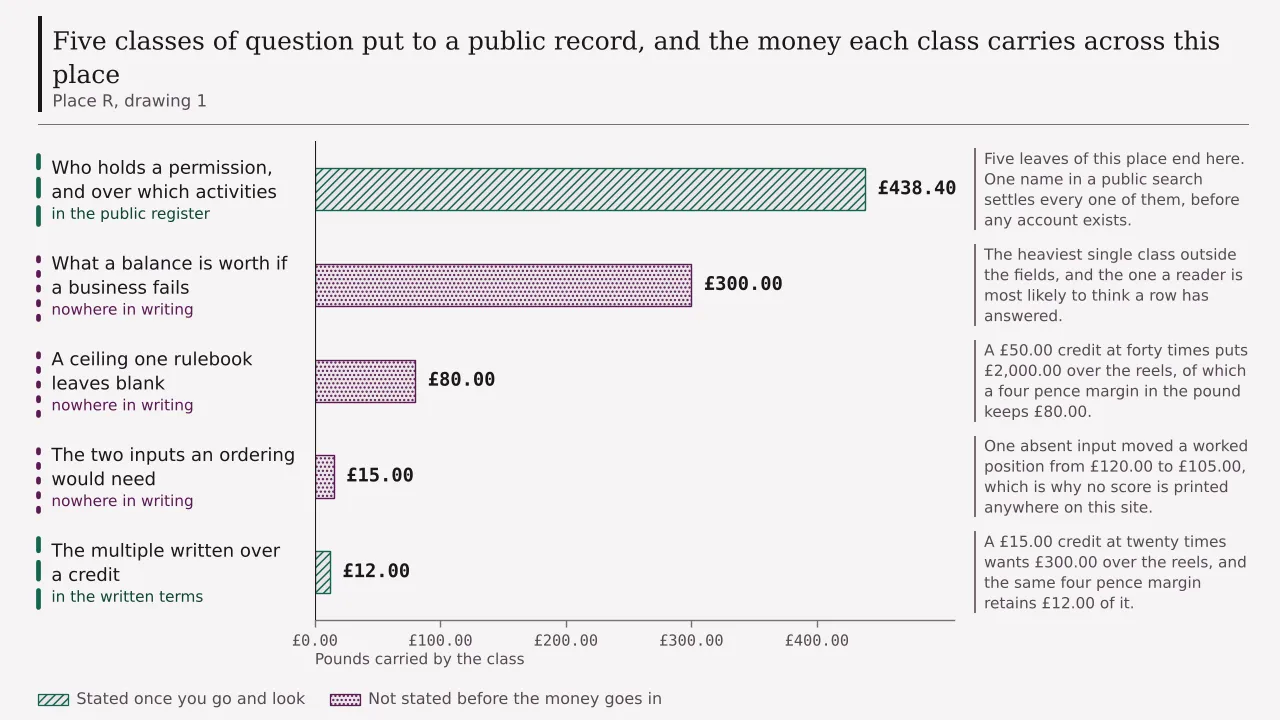
The drawing shows one thing a column of figures hides. The register class is a single tall bar and the silent classes are three separate ones, which is why the step is so easy to take. A reader meets the record once, gets one answer, and has no way of knowing that three further questions were standing behind it unasked, since nothing on the page enumerates them. An index of what a record does not contain is not a document anybody publishes.
6
The sentence this place has now written nine times
Every leaf gathered here states the same limit once, in its own words, and this is the ninth wording of it. An entry is evidence about a grant. A grant is made to a named party, over a listed set of activities, and the entry records those things exactly. Which party is collecting a payment at a given web address today is a separate matter of fact, settled by nobody and recorded nowhere, and it is the matter every reader actually came with.
Three ordinary events open the distance between the two. A company changes hands and the row keeps the old name until somebody files. An arrangement between whoever holds a permission and whoever runs a front end is commercial and private, so no record follows it. A web address entered against a row at some earlier point can be under new management without the row altering, and nothing beside the entry says when it was put there or how it ought to be read. None of the three requires anybody to behave badly.
What the regulator does tell a player is narrower and is worth doing. Its advice before gambling amounts to four comparisons rather than one conclusion. A permission genuinely held. A claim of licensed status on the page itself. The entry reachable from that same page. And the activities and web addresses carried on the entry agreeing with whatever the page displays. Each comparison asks about scope, and scope is precisely what the fields hold. The check is sound, it costs nothing, and it does not answer the question in the paragraph above because no check could.
So the honest formulation is a conditional rather than a conclusion. Where a row is there, agrees on activities and agrees on the web address, obligations attach to somebody, a dispute has a published route, and the national scheme that shuts accounts reaches the address. Where no row is there, every item on that list falls at once. What the row never does is promise that the party in front of you this morning is the party the row describes, and a reader needing that promise is asking a record for something no record of this shape contains.
7
What is recorded beside a permission, and what stops being recorded
Nothing of the shape gathered in this place holds a Great Britain licence. Which duties are worth naming turns on the subject, and the subject here is recording, so the four below are the four that leave a document behind. Losses of a different shape are real as well, and they are costed on other parts of this site.
Four things are published about a British licence holder and about nobody else. The three registers themselves, which anyone may search or download whole. The list of bodies permitted to hear a dispute, which names eight and is drawn up by the regulator rather than chosen by the licensee. A written decision closing an internal complaint, which has to say that the internal stage has finished and has to set out the route onward. And regulatory action against the holder, printed against the entry, suspensions included and dated. Remove the licence and all four stop existing, not because standards fell but because nothing is being written down.
The list of bodies repays a close look, since it is itself a record with a boundary. Eight are named, and counting how many of the eight could hear a remote casino dispute produces a range rather than a number. Five are shown for remote business of every sector. Two more stand against the whole table, though one of that pair gives betting alone in its own row. The eighth carries four categories and not one of them is remote. So the answer is five at worst and seven at best, which a reader establishes in a minute and nobody can establish at all where no list is published.
On its own boundary the regulator is just as exact, and the symmetry is this part’s point. It writes that it is not an ombudsman, and three limits follow in its own account: returning anybody’s money lies outside its powers, a quarrel about a payment or about a game going wrong is not something it decides, and whatever stands in a customer’s account is beyond its sight. A player is pointed at the business before anything else. A body with a stated remit and a published list of who does the rest is being precise in the way a four-field record is being precise.
The honest half of the offshore comparison belongs here too, because a page saying there is no route beyond the licence would be wrong. One rulebook this site has read publishes a complaints policy of its own, free to the player, with the operator carrying the cost of dispute resolution. What that policy then leaves open is the shape of the route: it contemplates the licensee fixing whether a decision binds the player, and whether a claim beneath a certain size may go up at all. A published route whose terms are drafted by one side is a different object from a published list of who may hear it, and a record is the second of those rather than the first. That same body keeps a licence register of its own, and on the date this site last opened its pages the portal carrying the online gaming register was reported there as not running, which is a fact about a record rather than about a rulebook.
8
What the answerable half genuinely buys, stated without flattery
Having spent six parts on the boundary, the half inside it deserves its own accounting. £438.40 of this place gets decided by one public record, and that is 51.86 per cent of the total. The price of deciding it is a name typed into a search box. No account is created, no payment is made, nothing is downloaded and nobody is told. That is the cheapest serious check on this entire site by a wide margin.
£438.40 settled by a search costing nothing, against £407.00 standing outside every record anybody publishes
Two properties make it worth more than its share of the money suggests. The first is authorship. Among the six addresses this site works with, a register row is the only text about an operator that the operator did not draft.
The second is that the answer comes back binary, which is a different sort of object from a clause. None of these leaves changes its arithmetic when a row is found. The credits stay the same size, the multiples stay the same multiples, the expected closes stay where they were. What alters is whether a ceiling binds the multiple, whether an address falls inside the scheme shutting accounts across licensed operators, and whether a dispute has any published route at all. One search therefore decides a block of consequences rather than one condition, and that is why five of these nine findings are register findings at all.
The concession attached to that is real and belongs in the same part. A switch with two positions is a coarse instrument. It will not rank two licensed operators against each other, it will not say which of two permitted sites to use, and it answers nothing about the quality of whatever stands behind a permission. Of the five quantities this place found orderable off public records, the two a reader wants most are published nowhere, which is why no score appears anywhere on this site and why none could honestly be built from the fields that do exist.
9
Asking a record the question it was built to answer
The discipline is short and borrows nothing from the sums above. Write the question down in the words you actually mean. Name the record that would contain the answer and the field in it that would hold the answer. If no field can be named, the answer is not in that record however complete the record is, and the next move is to price the gap rather than to keep searching.
Four questions have fields and are therefore answerable at nought cost. Does this party hold a permission. What is that permission permitted to cover. Is this web address recorded against it. Has anything been done about the holder, and when. Four more have no field anywhere. Who is running the site in front of me this morning. What do the terms of this offer say. Where does my balance stand if the business stops trading. Which of two permitted operators is the better of the two.
Putting outside the record against a line is itself a finding, and that line is the one most worth pricing. On this place the four such lines came to £407.00 between them, against £438.40 for everything the fields did hold, and the only reason anybody can set those two sums side by side is that somebody wrote down the questions the record declined before trying to answer them.
Two habits keep the method straight. Note the date a record was read, since neither the register nor its publisher attaches one, and a row read last spring is not evidence about this morning. And keep the field beside the answer permanently, because an answer carrying its field is a different object from one allowed to float free of whatever produced it.
Questions
- What does a public licence register actually prove?
- That a named party was granted a permission, which activities that permission covers, which web addresses are recorded against it, and what regulatory action has been taken. Four questions, four definite answers, at no cost and without an account. A fifth question, about who is collecting a payment at an address this morning, has no field in the record and therefore no answer in it.
- Can I tell from the register whether a site is safe to use?
- Not in those words, because safety is not a field. What a row settles is whether a body of obligations attaches to somebody, whether a dispute has a published route, and whether an address falls inside the scheme shutting accounts across licensed operators. That answer comes back binary rather than as a measurement, and across this place it decides £438.40 of £845.40.
- Why does an entry not prove who runs the website today?
- Because three ordinary things open a distance between the two. A company changes hands and the row keeps the old name until somebody files. An arrangement between a permission holder and whoever runs a front end is commercial and private, so no record follows it. A web address entered at some earlier point can be under new management without the row altering, and nothing beside the entry says when it was put there.
- How much of this place does the record fail to settle?
- £407.00 of £845.40, which is 48.14 per cent. Four findings sit outside the fields: a multiple written over a credit, worth £12.00; what a balance is worth if a business fails, worth £300.00; the two missing inputs an ordering would need, worth £15.00; and a ceiling one rulebook leaves blank, worth £80.00. Put as a rate, every pound a row settles here comes with a further 92.84 pence turning on something no row holds.
- Is checking the register worth the time it takes?
- On the figures here, yes, and by a wide margin. One name typed into a public search decides £438.40 across nine leaves, with no account created, no payment made and nothing downloaded. It is also the only one of this site’s six addresses whose text about an operator the operator did not draft, since a bonus document, a payment screen and a demand for papers are each written by a party with a stake in how they read.
- What does the regulator say it will not do?
- It writes that it is not an ombudsman, and three limits follow in its own account: returning anybody’s money lies outside its powers, a quarrel about a payment or about a game going wrong is not something it decides, and whatever stands in a customer’s account is beyond its sight. A player is pointed at the business before anything else. A stated remit plus a published list of who does the rest is a boundary drawn the way a four-field record draws one.
- What stops being written down when there is no British licence?
- Four published things. The registers themselves, searchable and downloadable whole. The list of bodies permitted to hear a dispute, which names eight and is drawn up by the regulator rather than chosen by the licensee. A written decision closing an internal complaint, saying that the internal stage has finished and setting out the route onward. And regulatory action against the holder, printed against the entry and dated, suspensions included.
- Does an offshore licence come with no complaints route at all?
- No, and saying so would be wrong. One rulebook read for this site publishes a complaints policy free to the player, with the operator carrying the cost of dispute resolution. What that policy leaves open is the shape of the route, since it contemplates the licensee fixing whether a decision binds the player and whether a claim beneath a certain size may go up at all. A route drafted by one side is a different object from a published list of who may hear it.
- Why is there no rating or score on this site?
- Because the inputs a score would need are not published. Five quantities can be put in order off public records, and the two a reader wants most are in none of them, so a single missing input was enough to shift one worked position by £15.00. A number of our own, on a site about what can be checked, would be the one figure on the page nobody could check.
- How should I put a question to a record myself?
- Write the question in the words you mean, name the record that would contain the answer, then name the field in it that would hold the answer. If no field can be named, stop searching and price the gap, because the answer is not there however complete the record is. Note the date you read it, since the register attaches none, and keep the field beside the answer rather than letting the answer float free of it.