Terms read 19 October 2026 Leaf C06, revision 1
A payment refused on screen, and three parties any one of which may have refused it
Twenty pounds put through and pressed once is expected to leave £19.20. The same twenty pounds refused at the payment screen is still £20.00, which makes a refusal the only event at a cashier worth £0.80 to whoever met it. It is also the only event that announces itself, and the message naming who decided is the one part of it a reader cannot rely on.
Stated on the banner A logo A scheme mark beside a payment field says an instrument is accepted in principle, and settles nothing about one attempt. Stated, once you go and look Three rulebooks A cashier, a card scheme and an issuing bank each publish something about their own decisions, in three documents with nothing in common. Not stated before the money goes in Who decided The screen names one party and carries no field at all for the question of who actually took the decision.
Offers taking a card payment, with the written terms read
Every destination in this file is bought advertising. The site is paid a fee if a reader goes on to register, and no figure printed below moves because of it.
Bonus Spins UK Slip 01
Betportal
Ceiling as a multiple
The drop
€15.00
€1.00 in the euro
The claim reads €15.00. Once the terms beside it have applied, €0.00 of it can leave. The difference is the drop.
7 of the 15 terms on this slip could not be read before the money went in
Spins priced at this site's own 10p a spin, which the operator does not publish
Stated
€15.00
The claim as it is printed, before a single term has been applied to it.
Headline paid as spins
150 spins at 10c each, which is €15.00 of the figure above.
6 Nowhere
What one spin is worth
No unit is published for a spin, so the count is priced at this site's own 10p a spin. At half that price every figure below halves with it.
Match and other credit not priced
300% of three deposits, to a ceiling of €1,000. A share of a deposit nobody has made yet is not a sum, so no figure stands on this line and none is carried below.
Qualified
-€14.40
Written down somewhere, and taking part of the claim back. Each term carries the place it is written and the sum it takes.
2 Written terms at a distance this record does not establish
Play-through -€14.40
Carrying €14.40 through 35 times stakes €504.00 and costs €20.16 of it at 96 per cent return. That prices above the €14.40 there is to charge it against, so the whole of the credit goes and the line is held at that. The multiple sits on the bonus.
2 Written terms at a distance this record does not establish
Game weighting not priced
Slots only count towards the play-through. No contribution percentage is published, so the line above has been worked at full weight, which is the kindest reading there is.
2 Written terms at a distance this record does not establish
Ceiling on the winnings not priced
5x the bonus.
2 Written terms at a distance this record does not establish
Clock on the credit not priced
14 days.
2 Written terms at a distance this record does not establish
Largest stake while it runs not priced
€5.
3 Public record
Licence, and who holds it not priced
Licensed in Anjouan, Comoros, held by BetPortal Gaming Ltd, with Excite Ultra Media Ltd, reference ALSI-202601040-FI2. A register entry settles who holds a licence and what it permits. It does not settle who is running the site this morning.
4 Cashier
Smallest qualifying deposit your money
€20 a stage. That is €20.00 of your own money, and it is never netted into a drop.
5 On the way out
Checks before a withdrawal not priced
Documents before the first withdrawal.
Unstated
-€0.60
Applying without having been published anywhere, and costing money all the same.
6 Nowhere
What a spin hands back -€0.60
Staking a spin returns 96 per cent of it, so that share of the batch is the house's before a reel turns. This site works at that return and the operator publishes none where the claim is made.
6 Nowhere
Forfeited by rule cost unknown
Nothing is published under this heading, and it applies regardless.
6 Nowhere
Charge on the way out cost unknown
No charge on the way out is published as a figure, so nothing comes off this line. A charge that exists unpublished would come straight off whatever survives.
6 Nowhere
Smallest withdrawal allowed cost unknown
No smallest withdrawal is published as a figure. A floor nobody has published is still a floor, and it decides whether a small balance can move at all.
No Great Britain licence
Terms read 19 October 2026
Bonus Spins UK Slip 02
WinBeast
Ceiling as a sum
The drop
€50.00
€1.00 in the euro
The claim reads €50.00. Once the terms beside it have applied, €0.00 of it can leave. The difference is the drop.
8 of the 15 terms on this slip could not be read before the money went in
Spins priced at this site's own 10p a spin, which the operator does not publish
Stated
€50.00
The claim as it is printed, before a single term has been applied to it.
Headline paid as spins
500 spins at 10c each, which is €50.00 of the figure above.
6 Nowhere
What one spin is worth
No unit is published for a spin, so the count is priced at this site's own 10p a spin. At half that price every figure below halves with it.
Match and other credit not priced
50% to 100% of five deposits, each to a ceiling of €1,000, and a €650 free bet. A share of a deposit nobody has made yet is not a sum, so no figure stands on this line and none is carried below.
Qualified
-€48.00
Written down somewhere, and taking part of the claim back. Each term carries the place it is written and the sum it takes.
2 Written terms at a distance this record does not establish
Play-through -€48.00
Carrying €48.00 through 40 times stakes €1,920.00 and costs €76.80 of it at 96 per cent return. That prices above the €48.00 there is to charge it against, so the whole of the credit goes and the line is held at that. The multiple sits on the bonus and the winnings from the spins.
2 Written terms at a distance this record does not establish
Game weighting not priced
Slots, titles vary by country count towards the play-through. No contribution percentage is published, so the line above has been worked at full weight, which is the kindest reading there is.
2 Written terms at a distance this record does not establish
Ceiling on the winnings not priced
€100 a batch of spins.
2 Written terms at a distance this record does not establish
Clock on the credit not priced
7 days, spins 1 day.
3 Public record
Licence, and who holds it not priced
Licensed in Curaçao, holder not named on the site. A register entry settles who holds a licence and what it permits. It does not settle who is running the site this morning.
4 Cashier
Smallest qualifying deposit your money
€20 a stage. That is €20.00 of your own money, and it is never netted into a drop.
5 On the way out
Checks before a withdrawal not priced
Documents before the first withdrawal.
Unstated
-€2.00
Applying without having been published anywhere, and costing money all the same.
6 Nowhere
What a spin hands back -€2.00
Staking a spin returns 96 per cent of it, so that share of the batch is the house's before a reel turns. This site works at that return and the operator publishes none where the claim is made.
6 Nowhere
Largest stake while it runs cost unknown
Nothing is published under this heading, and it applies regardless.
6 Nowhere
Forfeited by rule cost unknown
Nothing is published under this heading, and it applies regardless.
6 Nowhere
Charge on the way out cost unknown
No charge on the way out is published as a figure, so nothing comes off this line. A charge that exists unpublished would come straight off whatever survives.
6 Nowhere
Smallest withdrawal allowed cost unknown
No smallest withdrawal is published as a figure. A floor nobody has published is still a floor, and it decides whether a small balance can move at all.
No Great Britain licence
Terms read 19 October 2026
Bonus Spins UK Slip 03
EliteSpin
Longest spin window
The drop
£50.00
£1.00 in the pound
The claim reads £50.00. Once the terms beside it have applied, £0.00 of it can leave. The difference is the drop.
8 of the 15 terms on this slip could not be read before the money went in
Spins priced at this site's own 10p a spin, which the operator does not publish
Stated
£50.00
The claim as it is printed, before a single term has been applied to it.
Headline paid as spins
500 spins at 10p each, which is £50.00 of the figure above.
6 Nowhere
What one spin is worth
No unit is published for a spin, so the count is priced at this site's own 10p a spin. At half that price every figure below halves with it.
Match and other credit not priced
50% to 100% of five deposits, each to a ceiling of £1,000. A share of a deposit nobody has made yet is not a sum, so no figure stands on this line and none is carried below.
Qualified
-£48.00
Written down somewhere, and taking part of the claim back. Each term carries the place it is written and the sum it takes.
2 Written terms at a distance this record does not establish
Play-through -£48.00
Carrying £48.00 through 40 times stakes £1,920.00 and costs £76.80 of it at 96 per cent return. That prices above the £48.00 there is to charge it against, so the whole of the credit goes and the line is held at that. The multiple sits on the bonus and the winnings from the spins.
2 Written terms at a distance this record does not establish
Game weighting not priced
Slots count towards the play-through. No contribution percentage is published, so the line above has been worked at full weight, which is the kindest reading there is.
2 Written terms at a distance this record does not establish
Ceiling on the winnings not priced
5x the bonus.
2 Written terms at a distance this record does not establish
Clock on the credit not priced
7 days, spins 3 days.
3 Public record
Licence, and who holds it not priced
Licensed in Costa Rica, held by PrimeTier Limited. A register entry settles who holds a licence and what it permits. It does not settle who is running the site this morning.
4 Cashier
Smallest qualifying deposit your money
£20 a stage. That is £20.00 of your own money, and it is never netted into a drop.
5 On the way out
Checks before a withdrawal not priced
Documents before the first withdrawal.
Unstated
-£2.00
Applying without having been published anywhere, and costing money all the same.
6 Nowhere
What a spin hands back -£2.00
Staking a spin returns 96 per cent of it, so that share of the batch is the house's before a reel turns. This site works at that return and the operator publishes none where the claim is made.
6 Nowhere
Largest stake while it runs cost unknown
Nothing is published under this heading, and it applies regardless.
6 Nowhere
Forfeited by rule cost unknown
Nothing is published under this heading, and it applies regardless.
6 Nowhere
Charge on the way out cost unknown
No charge on the way out is published as a figure, so nothing comes off this line. A charge that exists unpublished would come straight off whatever survives.
6 Nowhere
Smallest withdrawal allowed cost unknown
No smallest withdrawal is published as a figure. A floor nobody has published is still a floor, and it decides whether a small balance can move at all.
No Great Britain licence
Terms read 19 October 2026
Bonus Spins UK Slip 04
Crown Jewelz
Multiple unpublished
The drop
NOT WORKED
The multiple is not published in the operator's own terms. Since the sum cannot be worked around it, none is worked.
9 of the 14 terms on this slip could not be read before the money went in
No drop worked
Stated
£15.00
The claim as it is printed, before a single term has been applied to it.
Headline paid as spins
150 spins at 10p each, which is £15.00 of the figure above.
6 Nowhere
What one spin is worth
No unit is published for a spin, so the count is priced at this site's own 10p a spin. At half that price every figure below halves with it.
Match and other credit not priced
200% of the first deposit, then 150% twice, each to a ceiling of £1,000. A share of a deposit nobody has made yet is not a sum, so no figure stands on this line and none is carried below.
Qualified
NOT WORKED
Written down somewhere, and taking part of the claim back. Each term carries the place it is written and the sum it takes.
2 Written terms at a distance this record does not establish
Play-through not priced
40x the bonus, reported rather than published by the operator.
2 Written terms at a distance this record does not establish
Game weighting not priced
Slots count towards the play-through. No contribution percentage is published, so the line above has been worked at full weight, which is the kindest reading there is.
3 Public record
Licence, and who holds it not priced
Licensed in Curaçao, number not verified, holder not named on the site. A register entry settles who holds a licence and what it permits. It does not settle who is running the site this morning.
4 Cashier
Smallest qualifying deposit your money
£20. That is £20.00 of your own money, and it is never netted into a drop.
5 On the way out
Checks before a withdrawal not priced
Documents before the first withdrawal.
Unstated
NOT WORKED
Applying without having been published anywhere, and costing money all the same.
6 Nowhere
Ceiling on the winnings cost unknown
No ceiling is published. Nothing is assumed in its place.
6 Nowhere
Clock on the credit cost unknown
Nothing is published under this heading, and it applies regardless.
6 Nowhere
Largest stake while it runs cost unknown
Nothing is published under this heading, and it applies regardless.
6 Nowhere
Forfeited by rule cost unknown
Nothing is published under this heading, and it applies regardless.
6 Nowhere
Charge on the way out cost unknown
No charge on the way out is published as a figure, so nothing comes off this line. A charge that exists unpublished would come straight off whatever survives.
6 Nowhere
Smallest withdrawal allowed cost unknown
No smallest withdrawal is published as a figure. A floor nobody has published is still a floor, and it decides whether a small balance can move at all.
No Great Britain licence
Terms read 19 October 2026
Every figure in the second and third columns is this site's own working and nothing an operator has published. A claim is priced as printed, then the share a spin hands back at 96 per cent return comes off it, then what playing the multiple through costs at the same return, and then whatever a published ceiling, a charge on the way out or a floor on the smallest withdrawal takes from what has survived. The drop is the difference between the first figure and the last. The two columns add back up to it exactly, so no money leaves a slip without a term and a place beside it.
Which column a term falls in is settled by one question: has anybody written it down. A charge a reader meets at the payment screen is written down, and it stands in the second column with the cashier against it. A condition that binds without ever having been set down stands in the third, whatever it costs. Inside each column the terms run outwards from the banner, so the order itself says how far a reader would have had to go.
A count of spins has no unit until one is supplied. Where an operator publishes what one of its own spins is worth, that figure is used and the first column says it is theirs. Where none is published, this site's own 10p a spin stands in its place and every figure below moves in proportion with it. Where the multiple itself is unpublished, no drop is worked at all, because that is the one figure the sum cannot be done without.
Three words stand where a figure cannot. Not priced is a term that is written down and carries no number the arithmetic can take. Cost unknown is a term nobody has written down, costing something nobody has put a number on. Your money is money of the reader's own, which is never netted into a drop.
None of the operators in this file holds a Great Britain licence, so none of the duties that licence carries reaches them. Each of those duties is published in its own right, which is what makes its absence here something a reader can check rather than take on trust. Every gambling company licensed in Great Britain belongs to Gamstop Online, so a reader who has shut themselves out through the scheme is not shut out here. Social Responsibility Code 5.1.1 has held a play-through to a maximum of ten times the bonus funds since 19 January 2026, and it binds a licence holder and nobody else. Asked in a post of 21 October 2025 what is lost along with the licence, the Gambling Commission's Director of Enforcement and Intelligence answered: "unfair gaming practices, financial loss, and a lack of recourse if things go wrong". The same post puts blocked payouts, and withdrawal limits pitched high enough to be unreachable, among the behaviour the Commission has recorded. Nobody under 18 may hold an account at any of them.
Terms are reproduced in the wording their operator published, and each slip is dated with the day somebody sat down and read them. 19 October 2026 is the oldest of those dates. Anybody claiming an offer is bound by that operator's full terms, which are elsewhere, and never by a line standing here.
1
The one event at a payment screen that announces itself
Every other condition this part of the site prices is silent until it is met. A floor says nothing until a sum falls under it. A charge says nothing until a total is assembled. A route restriction says nothing until a payout is requested. A refusal is the exception: it arrives as a message, in the middle of the screen, at the moment it happens.
That makes it the most informative event available at a cashier and the most misleading, for the same reason. A message is a claim, and a claim about who refused a payment is exactly the kind of thing this site sorts by address. Where would a reader go to settle it? The screen is not an answer, because the screen is one of the parties.
Three can produce the identical outcome: the cashier, the card scheme whose mark sits beside the field, and the bank that issued the instrument. One message comes back, it names whichever party drew it, and it usually names the party the reader is standing in front of.
So the quantity this leaf measures is not whether a payment went through. It is the attribution attached to a refusal, and whether anything at all in the reader’s possession settles it. The answer is settled nowhere in writing on the screen itself, which is why most of this page is about where else to look.
One figure belongs at the front, because it runs against expectation and is the only positive number in this subject. A refused payment leaves the reader with more money than an accepted one, and part four computes how much more. Everything else on this leaf is about what the message does and does not establish.
2
Three parties, one message, and the one that gets named
Follow an attempt from the field to the result. A reader types an instrument number into a cashier’s page. The cashier passes it to whoever processes its card traffic, which passes it along the scheme’s wires, which present it to the bank that issued the instrument. Each stop in that chain can end the attempt, and the ending travels back as one outcome rather than four.
The cashier can decline before anything leaves it: a rule of its own, a country, a limit, an instrument it does not take. The scheme operates rules about what its wires carry and for whom. The issuing bank decides whether to authorise a given attempt on a given account, which is the decision most people mean by the word.
What the reader sees is a sentence composed by whichever system drew the screen, which is the cashier’s. A cashier describing a refusal it did not make is not lying, since it genuinely did refuse to complete the payment, and it may hold nothing more than a code it cannot interpret. A reasonable sentence written by a party with incomplete information is still a sentence a reader cannot act on.
| Party | What it can decide | Where the reader could settle it |
|---|---|---|
| The cashier | Whether to attempt the payment at all | at the cashier |
| The card scheme | What its rules permit to travel | in the scheme’s rules |
| The issuing bank | Whether to authorise this attempt | on asking afterwards |
| The message on the screen | Which of the three it names | nowhere in writing |
The fourth row is the one this leaf exists for. Three parties can decide, three places would settle which, and the message is not one of them. It is a report composed by a participant, and the method everywhere on this site is to settle who wrote a statement before weighing whether it holds.
Two readers can therefore meet identical screens after entirely different events. One has been stopped by a cashier’s own rule about where its customers are. The other has been stopped by a bank applying a setting on that account. Nothing visible separates those two readers, and the actions available to them are not the same at all.
3
What each party publishes about its own decisions
Attribution would be straightforward if the three parties published to one standard. They do not, and the differences are structural rather than accidental, because the three are answering to different people about different things.
A cashier publishes terms written for its own customers. Those terms sit in the written terms, a document away, and they ordinarily reserve a wide power to refuse a payment without reasons. That is a statement about what the cashier may do, not a statement about what happened on one attempt at twenty past nine on a Tuesday.
A card scheme publishes rules for the businesses on its wires rather than guidance for the people holding the instruments, and the audience explains the shape. A reader can reasonably establish that a scheme has rules governing what it carries and unreasonably expect those rules to explain a single refusal, because that is not what they were drafted to do.
An issuing bank is the one party with an account-level record and a duty to the person holding the instrument. It can say whether an attempt reached it, whether it declined one, and frequently why. That makes it the only address in the chain where the question has both an answer and somebody obliged to give it, and it is the address the screen never mentions.
A fourth statement exists and is worth knowing about, because it is published by a party with no commercial interest in this at all. Writing for players about what gambling with an unlicensed business involves, Britain’s regulator notes that a business of that sort may have its payment facilities removed by the large payment systems organisations. That is a sourced statement that decisions get taken at that level, with no particular one named.
4
What a refusal is worth, worked from either end
Attach a figure. Take a payment of £20.00, put it through, and press it once at the house assumptions this site works to: a press at 10p, the reels keeping four pence of every pound, weighting at one. Two hundred presses turn the £20.00 into an expected £19.20, and that is the position of a reader whose payment was accepted.
A reader whose payment was refused is holding £20.00, in a bank account, untouched. The difference between the two positions is eighty pence, which is the house margin on one pass and is the only sum on this entire site that moves towards the person reading it.
Accepted, and pressed once £19.20 Refused, and left where it was £20.00 What the refusal was worth £0.80
Eighty pence arrives from a second direction with no step in common. Multiply the payment by the four hundredths the reels keep: £20.00 at four per cent is £0.80. The first calculation subtracts two balances and the second multiplies one payment by a rate, and both land on the same figure, as they must, because a single pass hands exactly the margin across and nothing else.
| Payment attempted | Presses at 10p | Expected after one pass | Kept by a refusal | What the screen explained |
|---|---|---|---|---|
| £10.00 | 100 | £9.60 | £0.40 | Who decided: not stated |
| £20.00 | 200 | £19.20 | £0.80 | Who decided: not stated |
| £50.00 | 500 | £48.00 | £2.00 | Who decided: not stated |
| £250.00 | 2,500 | £240.00 | £10.00 | Who decided: not stated |
The right-hand column is invariant down the table and that is the finding. What a refusal is worth scales exactly with the payment, since it is a fixed fraction of it. What the screen explains does not scale at all, because the message is the same sentence whether the attempt was for ten pounds or for two hundred and fifty.
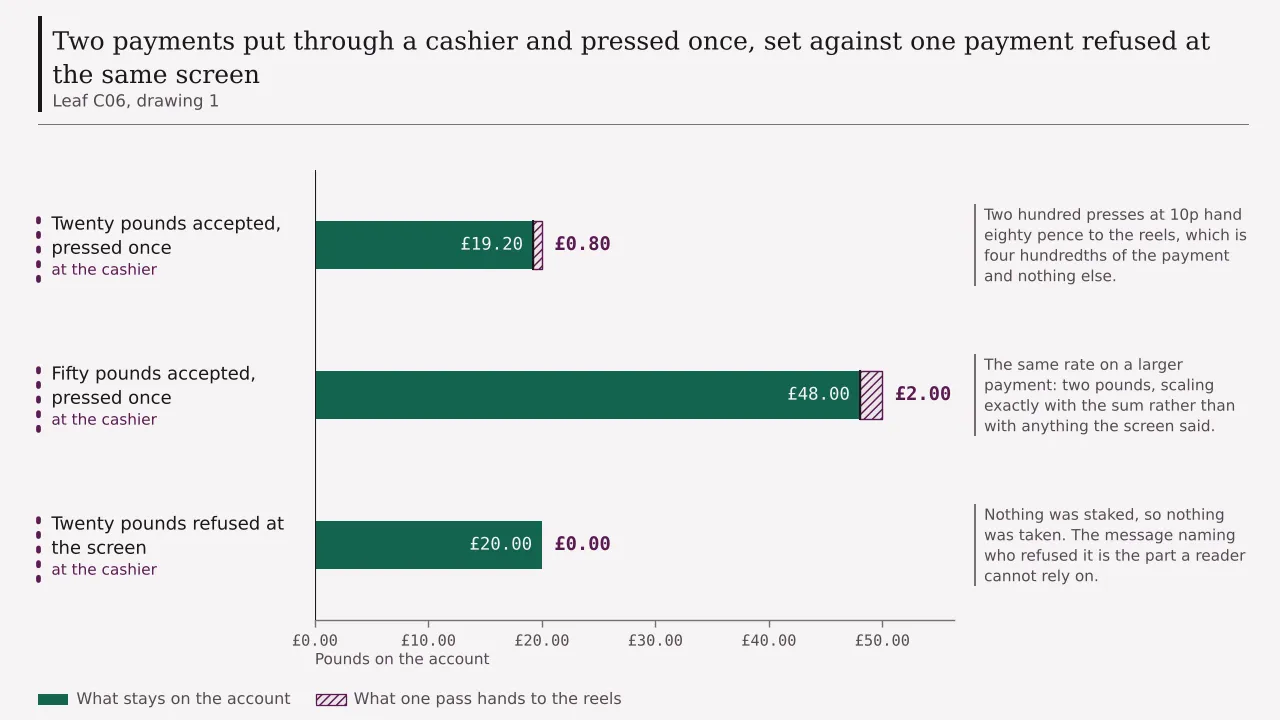
The third bar is the only one on any drawing on this site with nothing taken off it, and the reason is worth stating plainly rather than leaving as a visual joke. Nothing was taken because nothing was staked. A refusal is not a good outcome produced by clever play. It is the absence of a transaction, and its value is exactly the cost that transaction would have carried.
£0.80 kept on a £20.00 attempt, beside a message that names one party out of three
5
What can be established about one afterwards
Attribution is unsettled on the screen and is not unsettled permanently. Three things can be established afterwards, each from a different party, and together they usually answer the question the message left open.
The first is whether an attempt reached the issuing bank at all. A bank holds a record of attempts on an account, including those it turned down, and a reader asking will find either an entry or nothing. An entry puts the decision at the bank or past it. No entry puts the decision at the cashier or at a processor before the wires, and that single fact removes one of the three candidates outright.
The second is whether a hold was placed. An attempt that was authorised and then not completed can leave a sum reserved against the account, which looks like money gone and is not. Nothing on a cashier’s screen mentions it, the bank’s own record does, and the two readings of the same number differ by the whole amount of the attempt.
The third is whatever the cashier will say when asked directly, which is a weaker source and still worth collecting. A cashier that says it did not attempt the payment has placed the decision with itself. A cashier that says the instrument was declined has placed it downstream, and the first of the three checks above will show whether that is consistent.
None of this is fast and none of it is certain. What it is, is a way of turning an unattributed message into an attributed one using records that already exist, kept by parties who have their own reasons for keeping them. The site’s method applies here as anywhere: name the holder of the record before weighing what the record says.
6
What an acceptance tells a reader, which is nothing
Turn the question round, because the comparison is where the sorting pays. A refusal announces itself and settles nothing about who decided. An acceptance announces nothing at all and settles nothing about anything, while costing the reader the whole of the payment.
Enumerate what a successful payment establishes. That an instrument was good for that sum at that moment. That is the complete list. It says nothing about whether the operator holds a licence, nothing about what the exit will carry, nothing about whether a charge appears on a later screen, and nothing about whether a payout may travel home along the same wires.
Set the two events side by side in the units this site uses. The refusal costs nought and delivers one fact about one attempt, imperfectly attributed. The acceptance costs £20.00, of which an expected £0.80 is gone after a single pass, and delivers one fact about one instrument. Neither is an inspection of the cashier, and only one of them leaves the reader poorer.
Here is the sharpest instance of a pattern that runs through every page grouped beside this one. The cheapest events carry the most, and what a reader learns arrives in inverse proportion to what has been committed. A banner costs nothing and states one figure. A payment screen costs an account and states a floor. A payment costs the payment and states almost nothing.
7
A refusal doing its job, and why no way past it appears
Some refusals exist because somebody asked for them, and that case has to be stated before any of the rest. A block set on an account to stop gambling payments is a protection its holder chose. A scheme or a bank declining to carry gambling traffic is a protection of the same kind, made by a party entitled to make it.
No way round any of those is printed here, and the reason is not squeamishness about the subject. It is that a route round a protection is worth negative money to the person who set it, which is a statement this site can make arithmetically rather than morally: the whole value of a block is that it holds when the person who set it would rather it did not.
The attribution question matters here as much as anywhere, and in the opposite direction. A reader who assumes a technical fault where a deliberate block exists will keep trying. A reader who establishes that a block exists has learned something the screen did not tell them, and the right next step is the help block at the foot of this leaf rather than another payment screen.
That is also why the eighty pence in part four is printed as a figure rather than as a piece of encouragement. It describes a single pass and nothing further. A reader repeating an attempt until it succeeds has turned a refusal worth £0.80 into an acceptance costing the margin on every pass that follows it, which is the arithmetic running the other way.
Where a reader has used the national self-exclusion scheme, a payment refused at an offshore cashier is not that scheme working, since the scheme’s reach stops with the operators taking part, and those are the ones holding a British licence. The two protections are separate, they fail separately, and the help routes below are the ones that work regardless of which cashier is on screen.
8
Who answers for a payment, and who says they will not
Behind the attribution question sits a second one that readers reach next: if the answer is unsatisfactory, who hears about it. Great Britain publishes an unusually direct answer, and the directness is the useful part.
Four sentences on a page the regulator writes for players answer it, and each subtracts something. It is not an ombudsman. Settling a dispute or getting somebody’s money returned is outside its powers. A quarrel over a transaction, a withdrawal that has not arrived or a game that behaved oddly, is not work it takes on. And it holds no view of anybody’s account, so it cannot see what occurred. Its own instruction is to take the matter to the business.
Read that against this leaf and it is precise rather than disappointing. The regulator is not the address for a single refused payment anywhere, licensed or not. What a British licence supplies is further down the chain: an operator that must run a complaint to a published timetable and must end by pointing at an adjudicator the regulator has approved.
No Great Britain licence stands behind a card payment to an offshore reel promotion, and what goes missing on this subject is the far end of the chain rather than the near one. The bank still holds its record. The scheme still has its rules. What disappears is the party obliged to answer for the cashier’s half of the decision, and with it the approved adjudicator standing behind that answer.
The regulator has separately described what it sees at this end of the market, and two of its observations bear directly on payments: unlicensed sites often lack secure payment systems, and consumers face a lack of recourse when things go wrong. Recourse is exactly the quantity this part is about, and the published observation is the honest version of what this leaf would otherwise be asserting.
9
Settling attribution without guessing at it
The method is four steps and the first one is restraint. Read the message and write down what it actually says, not what it implies. A sentence reporting that a payment could not be completed is a report of an outcome. A sentence naming a party is a claim about causation, and only the second one is worth testing.
Step two is the bank’s record, because it removes a candidate either way. An attempt that appears there was decided at or past the issuer. An attempt that does not appear was decided before the wires carried it, which puts it with the cashier or its processor. One look settles which half of the chain the decision came from.
Step three is the hold. Check whether a sum is reserved against the account and, where it is, write down the figure and the date rather than treating the balance as spent. On a £20.00 attempt the two readings of the same account differ by the full £20.00, and a reader who reads the lower figure has lost twenty pounds to a presentation.
Step four is the subtraction this site runs on everything. Print what the attempt would have been worth had it gone through, print what it is worth having been refused, and rule off the difference. At the house assumptions and a £20.00 attempt those readings are £19.20 and £20.00, and the difference is £0.80 in the reader’s favour.
Two cautions finish it. Nothing in the method establishes why a decision was taken, only where it was taken, and what separates those two is the distance from an address to a reason. And where the answer turns out to be a block somebody asked for, the method has done its job by stopping there, which is the one result on this leaf that calls for no further action at a cashier at all.
Questions
- Who actually declines a card payment at a gambling cashier?
- Any of three parties, and the screen names one. The cashier can refuse to attempt the payment at all, the card scheme operates rules about what its wires carry and for whom, and the bank that issued the instrument decides whether to authorise a particular attempt. One outcome travels back from a chain with several possible stopping points, and the sentence a reader reads was written by the party drawing the screen.
- Is the cashier lying when it says the payment was declined?
- Not necessarily, and usually not. It did refuse to complete the payment, which is what the sentence says, and it may hold nothing beyond a code it cannot interpret. A reasonable sentence written by a party with incomplete information is still a sentence a reader cannot act on, which is the distinction this page is built on: who wrote a statement is a separate question from whether it is true.
- What is a refused payment worth?
- Eighty pence on a £20.00 attempt, at the house assumptions of a press at 10p with the reels keeping four pence of every pound. Two hundred presses turn £20.00 into an expected £19.20, while a refusal leaves £20.00 sitting in a bank account untouched. The same figure comes out of multiplying the payment by four per cent, which is a calculation sharing no step with the first and lands in the same place.
- Does that mean a refusal is a good outcome?
- It means nothing was staked, so nothing was lost, and the value is exactly the cost the transaction would have carried. It describes a single pass and nothing further. Repeating an attempt until it goes through converts a refusal worth £0.80 into an acceptance that carries the margin on every pass after it, which is the same arithmetic running in the other direction.
- What does a successful payment prove about the cashier?
- That an instrument was good for that sum at that moment. That is the complete list. It establishes nothing about whether the operator holds a licence, nothing about what the exit will carry, nothing about a charge appearing on a later screen, and and nothing about whether a payout may travel home along the same wires. It costs the whole payment and delivers one fact about one instrument.
- How can I find out which party refused my payment?
- Start with the bank’s own record of attempts on the account, because it removes a candidate either way. An attempt that appears there was decided at the issuer or beyond it. An attempt that does not appear was stopped before the wires carried it, which places the decision with the cashier or its processor. Then ask the cashier directly and check whether the two accounts are consistent.
- Why does a balance look lower after a payment that did not go through?
- Because an attempt that was authorised and then not completed can leave a sum reserved against the account. Nothing on a cashier’s screen mentions it, the bank’s own record does, and the two readings of the same number differ by the whole amount of the attempt. On a £20.00 attempt that is twenty pounds of apparent loss created by a presentation rather than by a payment.
- Do card schemes publish anything about refusing gambling payments?
- They publish rules for the businesses on their wires rather than guidance for people holding the instruments, and that audience explains the shape of what a reader will find. Separately, writing for players about what gambling with an unlicensed business involves, Britain’s regulator notes that a business of that sort may have its payment facilities removed by the large payment systems organisations. That is a sourced statement that decisions get taken at that level, without naming any particular scheme.
- What if the refusal is a gambling block I asked for?
- Then it is a protection working, and this page offers no route round it. A block set on an account, or a decision by a bank or a scheme not to carry gambling traffic, is made by a party entitled to make it. Establishing that one exists is itself the useful result: a reader who assumes a technical fault keeps trying, while a reader who knows a block is in place has learned the thing the screen did not say. The help block below is the better next step.
- Will the regulator sort out a payment dispute?
- No, and four sentences on a page it writes for players say so, each subtracting something. It is not an ombudsman. Settling a dispute or getting somebody’s money returned is outside its powers. A quarrel over a transaction, a withdrawal that has not arrived or a game that behaved oddly, is not work it takes on. And it holds no view of anybody’s account, so it cannot see what occurred. Its own instruction is to take the matter to the business.
- What does an offshore cashier change about any of this?
- It removes the far end of the chain rather than the near end. No Great Britain licence stands behind a card payment to an offshore reel promotion, so the bank still keeps its record and the scheme still has its rules, while the party obliged to run a complaint to a published timetable and to finish by naming an approved adjudicator has gone. The regulator has described a lack of recourse and insecure payment systems as things it sees at this end of the market.
- What is the shortest version of the method?
- Write down what the message says rather than what it implies. Check the bank’s record for the attempt, which settles which half of the chain decided. Check for a reserved sum and note the figure. Then print what the attempt would have been worth had it gone through, print what it is worth having been refused, and rule off the difference, which at a £20.00 attempt is £0.80 in the reader’s favour. What the method locates is where a decision was taken, never why it was.