Terms read 19 October 2026 Leaf H10, revision 1
100 free spins no deposit: an inventory of what can be settled first
Twenty items decide what a hundred spins is worth. Thirteen of them can be settled before anything is clicked, and settling the lot takes 14 minutes and 30 seconds of reading. The seven left standing are the finding, and one of them multiplies every pound figure on this page.
Stated on the banner 2 items How many spins arrive and what claiming them costs. Neither takes any time to establish, and neither settles a single pound. Stated, once you go and look 11 items Seven in a public record and four in two documents, every one of them reachable before an account exists. Not stated before the money goes in 7 items Three with no document anywhere, two waiting at a payment screen, one at the exit, and one that is a question about tomorrow.
Hundred-spin offers, with their terms read
Every destination in this file is bought advertising. The site is paid a fee if a reader goes on to register, and no figure printed below moves because of it.
Bonus Spins UK Slip 01
Betportal
Ceiling as a multiple
The drop
€15.00
€1.00 in the euro
The claim reads €15.00. Once the terms beside it have applied, €0.00 of it can leave. The difference is the drop.
7 of the 15 terms on this slip could not be read before the money went in
Spins priced at this site's own 10p a spin, which the operator does not publish
Stated
€15.00
The claim as it is printed, before a single term has been applied to it.
Headline paid as spins
150 spins at 10c each, which is €15.00 of the figure above.
6 Nowhere
What one spin is worth
No unit is published for a spin, so the count is priced at this site's own 10p a spin. At half that price every figure below halves with it.
Match and other credit not priced
300% of three deposits, to a ceiling of €1,000. A share of a deposit nobody has made yet is not a sum, so no figure stands on this line and none is carried below.
Qualified
-€14.40
Written down somewhere, and taking part of the claim back. Each term carries the place it is written and the sum it takes.
2 Written terms at a distance this record does not establish
Play-through -€14.40
Carrying €14.40 through 35 times stakes €504.00 and costs €20.16 of it at 96 per cent return. That prices above the €14.40 there is to charge it against, so the whole of the credit goes and the line is held at that. The multiple sits on the bonus.
2 Written terms at a distance this record does not establish
Game weighting not priced
Slots only count towards the play-through. No contribution percentage is published, so the line above has been worked at full weight, which is the kindest reading there is.
2 Written terms at a distance this record does not establish
Ceiling on the winnings not priced
5x the bonus.
2 Written terms at a distance this record does not establish
Clock on the credit not priced
14 days.
2 Written terms at a distance this record does not establish
Largest stake while it runs not priced
€5.
3 Public record
Licence, and who holds it not priced
Licensed in Anjouan, Comoros, held by BetPortal Gaming Ltd, with Excite Ultra Media Ltd, reference ALSI-202601040-FI2. A register entry settles who holds a licence and what it permits. It does not settle who is running the site this morning.
4 Cashier
Smallest qualifying deposit your money
€20 a stage. That is €20.00 of your own money, and it is never netted into a drop.
5 On the way out
Checks before a withdrawal not priced
Documents before the first withdrawal.
Unstated
-€0.60
Applying without having been published anywhere, and costing money all the same.
6 Nowhere
What a spin hands back -€0.60
Staking a spin returns 96 per cent of it, so that share of the batch is the house's before a reel turns. This site works at that return and the operator publishes none where the claim is made.
6 Nowhere
Forfeited by rule cost unknown
Nothing is published under this heading, and it applies regardless.
6 Nowhere
Charge on the way out cost unknown
No charge on the way out is published as a figure, so nothing comes off this line. A charge that exists unpublished would come straight off whatever survives.
6 Nowhere
Smallest withdrawal allowed cost unknown
No smallest withdrawal is published as a figure. A floor nobody has published is still a floor, and it decides whether a small balance can move at all.
No Great Britain licence
Terms read 19 October 2026
Bonus Spins UK Slip 02
WinBeast
Ceiling as a sum
The drop
€50.00
€1.00 in the euro
The claim reads €50.00. Once the terms beside it have applied, €0.00 of it can leave. The difference is the drop.
8 of the 15 terms on this slip could not be read before the money went in
Spins priced at this site's own 10p a spin, which the operator does not publish
Stated
€50.00
The claim as it is printed, before a single term has been applied to it.
Headline paid as spins
500 spins at 10c each, which is €50.00 of the figure above.
6 Nowhere
What one spin is worth
No unit is published for a spin, so the count is priced at this site's own 10p a spin. At half that price every figure below halves with it.
Match and other credit not priced
50% to 100% of five deposits, each to a ceiling of €1,000, and a €650 free bet. A share of a deposit nobody has made yet is not a sum, so no figure stands on this line and none is carried below.
Qualified
-€48.00
Written down somewhere, and taking part of the claim back. Each term carries the place it is written and the sum it takes.
2 Written terms at a distance this record does not establish
Play-through -€48.00
Carrying €48.00 through 40 times stakes €1,920.00 and costs €76.80 of it at 96 per cent return. That prices above the €48.00 there is to charge it against, so the whole of the credit goes and the line is held at that. The multiple sits on the bonus and the winnings from the spins.
2 Written terms at a distance this record does not establish
Game weighting not priced
Slots, titles vary by country count towards the play-through. No contribution percentage is published, so the line above has been worked at full weight, which is the kindest reading there is.
2 Written terms at a distance this record does not establish
Ceiling on the winnings not priced
€100 a batch of spins.
2 Written terms at a distance this record does not establish
Clock on the credit not priced
7 days, spins 1 day.
3 Public record
Licence, and who holds it not priced
Licensed in Curaçao, holder not named on the site. A register entry settles who holds a licence and what it permits. It does not settle who is running the site this morning.
4 Cashier
Smallest qualifying deposit your money
€20 a stage. That is €20.00 of your own money, and it is never netted into a drop.
5 On the way out
Checks before a withdrawal not priced
Documents before the first withdrawal.
Unstated
-€2.00
Applying without having been published anywhere, and costing money all the same.
6 Nowhere
What a spin hands back -€2.00
Staking a spin returns 96 per cent of it, so that share of the batch is the house's before a reel turns. This site works at that return and the operator publishes none where the claim is made.
6 Nowhere
Largest stake while it runs cost unknown
Nothing is published under this heading, and it applies regardless.
6 Nowhere
Forfeited by rule cost unknown
Nothing is published under this heading, and it applies regardless.
6 Nowhere
Charge on the way out cost unknown
No charge on the way out is published as a figure, so nothing comes off this line. A charge that exists unpublished would come straight off whatever survives.
6 Nowhere
Smallest withdrawal allowed cost unknown
No smallest withdrawal is published as a figure. A floor nobody has published is still a floor, and it decides whether a small balance can move at all.
No Great Britain licence
Terms read 19 October 2026
Bonus Spins UK Slip 03
EliteSpin
Longest spin window
The drop
£50.00
£1.00 in the pound
The claim reads £50.00. Once the terms beside it have applied, £0.00 of it can leave. The difference is the drop.
8 of the 15 terms on this slip could not be read before the money went in
Spins priced at this site's own 10p a spin, which the operator does not publish
Stated
£50.00
The claim as it is printed, before a single term has been applied to it.
Headline paid as spins
500 spins at 10p each, which is £50.00 of the figure above.
6 Nowhere
What one spin is worth
No unit is published for a spin, so the count is priced at this site's own 10p a spin. At half that price every figure below halves with it.
Match and other credit not priced
50% to 100% of five deposits, each to a ceiling of £1,000. A share of a deposit nobody has made yet is not a sum, so no figure stands on this line and none is carried below.
Qualified
-£48.00
Written down somewhere, and taking part of the claim back. Each term carries the place it is written and the sum it takes.
2 Written terms at a distance this record does not establish
Play-through -£48.00
Carrying £48.00 through 40 times stakes £1,920.00 and costs £76.80 of it at 96 per cent return. That prices above the £48.00 there is to charge it against, so the whole of the credit goes and the line is held at that. The multiple sits on the bonus and the winnings from the spins.
2 Written terms at a distance this record does not establish
Game weighting not priced
Slots count towards the play-through. No contribution percentage is published, so the line above has been worked at full weight, which is the kindest reading there is.
2 Written terms at a distance this record does not establish
Ceiling on the winnings not priced
5x the bonus.
2 Written terms at a distance this record does not establish
Clock on the credit not priced
7 days, spins 3 days.
3 Public record
Licence, and who holds it not priced
Licensed in Costa Rica, held by PrimeTier Limited. A register entry settles who holds a licence and what it permits. It does not settle who is running the site this morning.
4 Cashier
Smallest qualifying deposit your money
£20 a stage. That is £20.00 of your own money, and it is never netted into a drop.
5 On the way out
Checks before a withdrawal not priced
Documents before the first withdrawal.
Unstated
-£2.00
Applying without having been published anywhere, and costing money all the same.
6 Nowhere
What a spin hands back -£2.00
Staking a spin returns 96 per cent of it, so that share of the batch is the house's before a reel turns. This site works at that return and the operator publishes none where the claim is made.
6 Nowhere
Largest stake while it runs cost unknown
Nothing is published under this heading, and it applies regardless.
6 Nowhere
Forfeited by rule cost unknown
Nothing is published under this heading, and it applies regardless.
6 Nowhere
Charge on the way out cost unknown
No charge on the way out is published as a figure, so nothing comes off this line. A charge that exists unpublished would come straight off whatever survives.
6 Nowhere
Smallest withdrawal allowed cost unknown
No smallest withdrawal is published as a figure. A floor nobody has published is still a floor, and it decides whether a small balance can move at all.
No Great Britain licence
Terms read 19 October 2026
Bonus Spins UK Slip 04
Crown Jewelz
Multiple unpublished
The drop
NOT WORKED
The multiple is not published in the operator's own terms. Since the sum cannot be worked around it, none is worked.
9 of the 14 terms on this slip could not be read before the money went in
No drop worked
Stated
£15.00
The claim as it is printed, before a single term has been applied to it.
Headline paid as spins
150 spins at 10p each, which is £15.00 of the figure above.
6 Nowhere
What one spin is worth
No unit is published for a spin, so the count is priced at this site's own 10p a spin. At half that price every figure below halves with it.
Match and other credit not priced
200% of the first deposit, then 150% twice, each to a ceiling of £1,000. A share of a deposit nobody has made yet is not a sum, so no figure stands on this line and none is carried below.
Qualified
NOT WORKED
Written down somewhere, and taking part of the claim back. Each term carries the place it is written and the sum it takes.
2 Written terms at a distance this record does not establish
Play-through not priced
40x the bonus, reported rather than published by the operator.
2 Written terms at a distance this record does not establish
Game weighting not priced
Slots count towards the play-through. No contribution percentage is published, so the line above has been worked at full weight, which is the kindest reading there is.
3 Public record
Licence, and who holds it not priced
Licensed in Curaçao, number not verified, holder not named on the site. A register entry settles who holds a licence and what it permits. It does not settle who is running the site this morning.
4 Cashier
Smallest qualifying deposit your money
£20. That is £20.00 of your own money, and it is never netted into a drop.
5 On the way out
Checks before a withdrawal not priced
Documents before the first withdrawal.
Unstated
NOT WORKED
Applying without having been published anywhere, and costing money all the same.
6 Nowhere
Ceiling on the winnings cost unknown
No ceiling is published. Nothing is assumed in its place.
6 Nowhere
Clock on the credit cost unknown
Nothing is published under this heading, and it applies regardless.
6 Nowhere
Largest stake while it runs cost unknown
Nothing is published under this heading, and it applies regardless.
6 Nowhere
Forfeited by rule cost unknown
Nothing is published under this heading, and it applies regardless.
6 Nowhere
Charge on the way out cost unknown
No charge on the way out is published as a figure, so nothing comes off this line. A charge that exists unpublished would come straight off whatever survives.
6 Nowhere
Smallest withdrawal allowed cost unknown
No smallest withdrawal is published as a figure. A floor nobody has published is still a floor, and it decides whether a small balance can move at all.
No Great Britain licence
Terms read 19 October 2026
Every figure in the second and third columns is this site's own working and nothing an operator has published. A claim is priced as printed, then the share a spin hands back at 96 per cent return comes off it, then what playing the multiple through costs at the same return, and then whatever a published ceiling, a charge on the way out or a floor on the smallest withdrawal takes from what has survived. The drop is the difference between the first figure and the last. The two columns add back up to it exactly, so no money leaves a slip without a term and a place beside it.
Which column a term falls in is settled by one question: has anybody written it down. A charge a reader meets at the payment screen is written down, and it stands in the second column with the cashier against it. A condition that binds without ever having been set down stands in the third, whatever it costs. Inside each column the terms run outwards from the banner, so the order itself says how far a reader would have had to go.
A count of spins has no unit until one is supplied. Where an operator publishes what one of its own spins is worth, that figure is used and the first column says it is theirs. Where none is published, this site's own 10p a spin stands in its place and every figure below moves in proportion with it. Where the multiple itself is unpublished, no drop is worked at all, because that is the one figure the sum cannot be done without.
Three words stand where a figure cannot. Not priced is a term that is written down and carries no number the arithmetic can take. Cost unknown is a term nobody has written down, costing something nobody has put a number on. Your money is money of the reader's own, which is never netted into a drop.
None of the operators in this file holds a Great Britain licence, so none of the duties that licence carries reaches them. Each of those duties is published in its own right, which is what makes its absence here something a reader can check rather than take on trust. Every gambling company licensed in Great Britain belongs to Gamstop Online, so a reader who has shut themselves out through the scheme is not shut out here. Social Responsibility Code 5.1.1 has held a play-through to a maximum of ten times the bonus funds since 19 January 2026, and it binds a licence holder and nobody else. Asked in a post of 21 October 2025 what is lost along with the licence, the Gambling Commission's Director of Enforcement and Intelligence answered: "unfair gaming practices, financial loss, and a lack of recourse if things go wrong". The same post puts blocked payouts, and withdrawal limits pitched high enough to be unreachable, among the behaviour the Commission has recorded. Nobody under 18 may hold an account at any of them.
Terms are reproduced in the wording their operator published, and each slip is dated with the day somebody sat down and read them. 19 October 2026 is the oldest of those dates. Anybody claiming an offer is bound by that operator's full terms, which are elsewhere, and never by a line standing here.
1
What an inventory is for, and what running one costs
An inventory is not an argument. It is a list of everything that will decide a question, with a mark beside each entry saying whether it can be answered yet. Run one properly and it produces two outputs: the answers, and the much shorter list of things that have no answer. The second output is the useful one.
A hundred spins at no cost looks like a simple proposition, and twenty separate quantities stand behind it. Some are printed in large type. Some sit in a government register anybody can search. Some are in a document a click away. Some are at a payment screen, some at the exit, and some are written nowhere whatsoever and apply regardless.
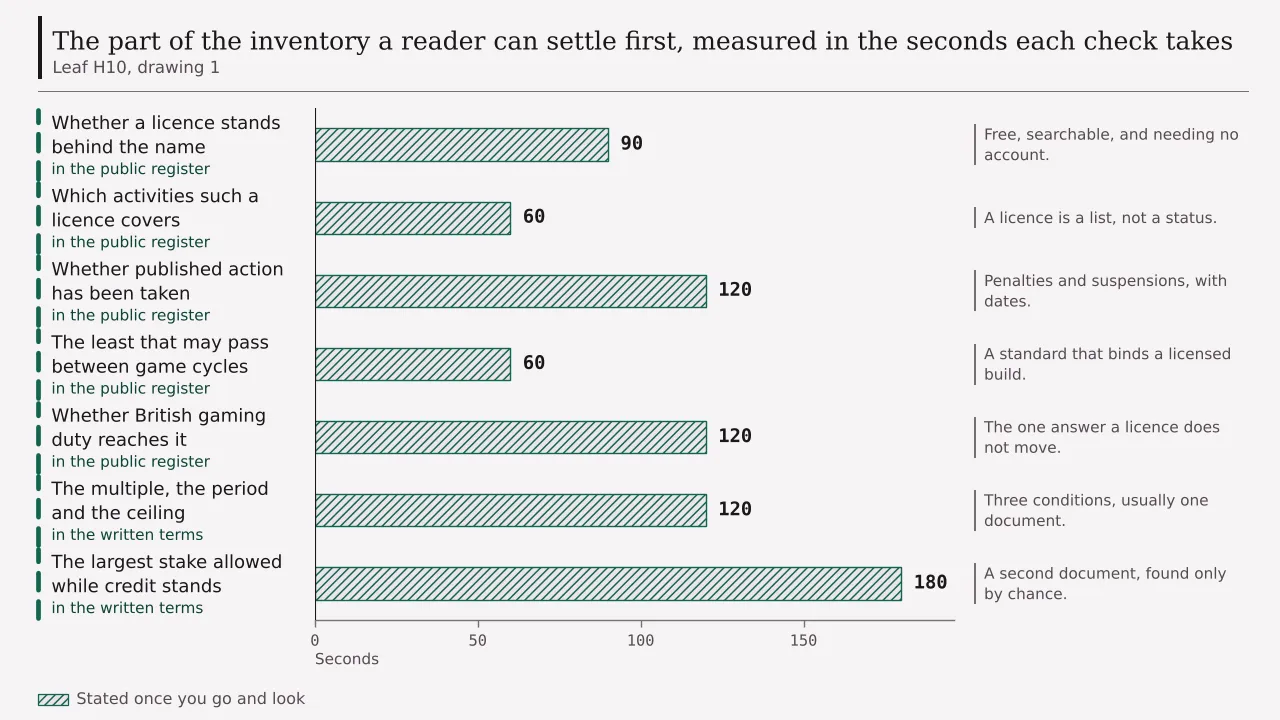
This leaf prices the inventory in a currency the other leaves here do not use, which is time. Each entry a reader can settle gets a number of seconds beside it, being this leaf’s own estimate of how long the check takes somebody who has never done it before. Those estimates are honest guesses rather than measurements, and nothing in the pound arithmetic depends on them.
Totalled, the settleable entries come to 870 seconds, which is 14 minutes and 30 seconds. Set that against the thing being checked. On a licensed build the pause a reel has to leave before the next cycle puts a hundred spins at 250 seconds, that being four minutes and ten seconds of actual play. Running the inventory therefore costs about three and a half times what the promotion costs to consume.
That ratio is the honest opening position of this leaf, and it is not a criticism of anybody. A promotion worth a few pounds is not worth a quarter of an hour of homework to most people, which is exactly why the homework does not get done, and exactly why the quantities that need homework are the ones kept off the face. The inventory is written out here once so that nobody has to assemble it twice.
What the leaf does not do is walk the places in order and price the distance between them. That is a different exercise and it lives elsewhere in this section. Here the list is sorted by a single yes or no question, applied to every entry in turn: can this be settled before any money or any personal detail changes hands.
2
Two items the face of the advertisement settles
Entry one is the count. A hundred spins will be credited, the figure is an integer, and it sits where anybody can read it with no click, no account and no name supplied. Time to settle: none. It is already settled by the act of reading.
Entry two is the price of claiming, which is nought. No payment leaves an account before the spins land. That is also settled on the face, also takes no time, and is also exactly true. Both entries go into the settled side of the list before the inventory properly begins.
Those two are the whole of what the advertisement decides, and it repays being exact about how little that amounts to. The count fixes a number of events. The price fixes what the reader hands over for them. Neither fixes a sum of money, because converting events into money needs a figure the advertisement does not carry, and that figure is entry fourteen.
For the arithmetic to run at all, something has to be imported at this point. This site assumes ten pence a spin throughout, so a hundred spins send £10.00 through the reels and are expected to return £9.60 at ninety-six pence in the pound. Both figures are therefore assumptions wearing the clothes of results, and every later line inherits that.
Keeping the import visible is the point of marking it here rather than burying it. An inventory that quietly fills a gap stops being an inventory and becomes an estimate. The ten pence is written into entry fourteen on the unsettled side of the list, and the £9.60 above is flagged every time it is used.
3
Seven items a public record settles, timed
The next block is the one most readers skip and it is the cheapest block on the list. Seven entries are settled by documents published by somebody other than the business running the promotion, all of them free, all searchable, and none needing an account or a name.
Entries three and four come from the licensing record. The British regulator keeps three registers open to anybody, covering businesses, the people who hold personal licences, and premises, all three searchable and downloadable entire, with its record of regulatory action and its public statements alongside. Finding whether a company holds a licence takes about ninety seconds. Reading which activities that licence covers takes another sixty.
Entry five is the published record of action taken. Penalties appear with their dates and their amounts, and licence suspensions appear too, which makes suspension the sharpest single thing on the whole record: a penalty says something went wrong once, and a suspension says a regulator stopped the business trading. Allow two minutes to read the listing.
Entries six and seven come from the technical standards. On a licensed build the interval before a further cycle may begin is two and a half seconds, no less, and the start control must come up and go down again for each one, so a finger held in place produces nothing. Automatic play is separately unavailable across online gaming, with one exception for blinds posted at a poker table shared between players. Sixty seconds and thirty seconds.
Entry eight is the ceiling on what one game cycle may stake on a licensed slot, which is set by regulation rather than by a licence condition and is published where statute is published. Ninety seconds, because finding the right instrument takes longer than reading it.
Entry nine is the one almost nobody thinks to check and it is genuinely useful. Where a British tax lands turns on the player’s home rather than on who holds a licence. Published guidance sets remote gaming duty at 40 per cent of profits for an accounting period that starts on 1 April 2026 or later. Seven years of a 21 per cent rate came before it, and the charge falls on profits made from remote gambling put in front of a customer resident in the United Kingdom, wherever the business itself sits. Two minutes.
So the charge reaches a business taking a British player’s money with no regard at all to whether a licence stands behind it. The guidance adds a second requirement: an operator standing outside a group ordinarily names somebody here, approved by the revenue, to answer for it, unless its base is one of the exempted places, among them an EU member state, Norway and Gibraltar. All of that is sourced, and it beats a vague assertion about legality by a distance.
4
Four items two documents settle between them
Four entries are written down by the business running the promotion, which makes them a different kind of evidence from the block above, and they are still evidence. They are reachable without an account, they are in ordinary language, and reading them takes five minutes in total.
Entries ten, eleven and twelve share one visit. How many times over the winnings must be staked, the period inside which that has to be finished, and the ceiling on what may ever leave a bonus balance are ordinarily gathered in the bonus terms, within a few paragraphs of each other. Two minutes covers all three if the document is one click from the claim.
Entry thirteen usually is not there. The ceiling on how large a single stake may be while promotional credit is live tends to sit in the general terms, which is a second document, found only because the first one referred to it. Three minutes, most of it spent discovering that the second document exists.
Those four entries do most of the arithmetical damage on the page, and the multiple does nearly all of it. Taking forty times as the figure, forty being the number that turns up where no ceiling exists and an assumption here rather than a reading, forty lots of the expected £9.60 come to £384.00 of turnover before anything may be collected.
Four hundredths of £384.00 stays with the margin, which is £15.36, so the expected close is £9.60 less £15.36. The sign turns at twenty-five, there being twenty-five lots of four hundredths in a whole, and a clause written at forty therefore stands fifteen units beyond the place where the winnings run out.
Everything the first nine entries settle, in money £9.60 With entries ten to thirteen added in minus £5.76 What two minutes with a document buys £15.36
Two minutes is the best return any single line of this inventory offers, and it is the line most often skipped. Nothing else on the settled side moves a figure by fifteen pounds. The licensing entries move no figure at all, which is a point part seven takes up, and the two entries on the face of the advertisement were settled before the clock started.
5
The whole list, with the residue marked
Set out in full, with the mark in the third column, the inventory looks like this. Thirteen entries carry a yes and seven carry a no, and the arrangement of the noes is more interesting than their number.
| What the promotion turns on | Where it is settled | Settleable first | Time it takes | What rests on it |
|---|---|---|---|---|
| How many spins arrive | Yes | None | The number of draws | |
| What claiming them costs | Yes | None | Whether a bank is involved | |
| Whether a licence stands behind the name | in the public register | Yes | Ninety seconds | Whether any duty applies |
| Which activities such a licence covers | in the public register | Yes | A minute | Whether casino play is in it |
| Whether published action has been taken | in the public register | Yes | Two minutes | A record rather than a promise |
| The least that may pass between game cycles | in a published standard | Yes | A minute | How long the spins take |
| Whether play may be automated | in a published standard | Yes | Thirty seconds | Whether each cycle is chosen |
| The ceiling on one game cycle’s stake | in a regulation | Yes | Ninety seconds | How large a single press may be |
| Whether British gaming duty reaches it | in published guidance | Yes | Two minutes | Where the money is taxed |
| The multiple on the winnings | in the bonus terms | Yes | Two minutes, shared | Whether anything survives |
| The period it has to be finished inside | in the bonus terms | Yes | The same two minutes | Whether it is reachable |
| The ceiling on what may leave the balance | in the bonus terms | Yes | The same two minutes | The one good outcome |
| The largest single stake allowed while credit stands | in the general terms | Yes | Three minutes | Whether the work can be hurried |
| What one spin costs in pence | nowhere in writing | No | Not available | Every pound figure here |
| What a pound staked credits towards the clause | nowhere in writing | No | Not available | The size of the work |
| The shape the reel pays from | nowhere in writing | No | Not available | Whether anything is reached |
| Whether a term will read the same next week | nowhere in writing | No | Not available | Whether the reading holds |
| The least a payout will move | at the cashier | No | After an account | Whether money travels |
| Which routes it may travel by | at the cashier | No | After an account | Whether a payment is needed first |
| What papers a payout will call for | on the way out | No | After a balance | Whether it is paid at all |
870 seconds of reading settles thirteen entries and leaves seven standing
Look at the noes rather than counting them. Four have no document at all, which is the category this site calls the sixth place, and of those four the first multiplies every figure on the page. Two wait at a payment screen that only exists once an account does. One waits at the exit. The order is not random: the further down the list an entry sits, the later a reader meets it and the more it has already cost to get there.
6
What the residue is worth in pounds
The settled entries have been priced. The residue has not, and pricing an absence means bounding it rather than resolving it. Each of the seven is taken in turn below, with a figure where a figure can honestly be produced and a plain statement where one cannot.
Entry fourteen, the price of a spin, is the expensive one. At five pence a hundred spins send £5.00 through the reels for an expected £4.80 back; at twenty pence they send £20.00 for an expected £19.20. The settled part of the inventory is identical in both worlds, and the two worlds are £14.40 apart in expectation before any clause has been opened.
Entry fifteen, the rate a pound staked credits at, multiplies the work. Thirty pence credited in the pound is the rate a respondent set out on the regulator’s consultation page, and this leaf’s own working from it makes the £384.00 of required contribution need £1,280.00 of staking. The clause on the page is unchanged.
Entry sixteen, the shape the reel pays from, decides whether any of the arithmetic is ever reached. A reel paying seldom and heavily empties a small balance early most of the time, so the expectations above are averages taken across many attempts that ended long before the clause did. Nothing published gives that shape for a build with no name, and none is invented here.
Entry seventeen is a question about the future rather than the present, which is why it sits in the same place as the other three. A reading of the terms taken today is a reading of today’s terms, and nothing on the settled side establishes that the same words will be there next week. That is a limit on the whole inventory rather than one line of it.
Entries eighteen and nineteen wait at a payment screen. Take a floor of £20.00 on what an exit will move, a figure assumed here and published by nobody, and an expected £9.60 does not reach it. Take instead a rule sending a payout only back down the route a payment arrived by, and a balance built with no payment behind it has no route of that kind at all.
Entry twenty waits at the exit and has no expected cost that can honestly be derived. A document request that is answered costs time. One that cannot be answered costs the lot, a balance that is never paid being worth nought however the sums read. Where the expected close is already under nought, there is in expectation nothing there for it to act upon, and in the one branch anybody hopes for it acts on everything.
7
What a licence moves from one side of the list to the other
A promotion of this shape is run from a site carrying no British licence, and the effect of that on an inventory is unusually easy to state. It does not change a single pound figure. What it does is move entries from the settled side to the unsettled one, which is a different kind of damage and is the damage this leaf is built to show.
Take the entries one at a time. The two seconds and a half between game cycles is a published standard binding a licensed build, so on the settled side it reads as a fact about the promotion; without the licence it is a fact about somebody else’s promotion and tells a reader nothing about this one. The same is true of the automatic play rule and of the ceiling on a single cycle’s stake. Three entries move across.
The licensing entries move differently and more severely. Looking up a company and finding no entry is itself an answer, and a useful one, so entries three and four stay settled. What changes is what their answer implies. With a licence they switch on a long apparatus of duties; without one they switch off the same apparatus, and the remaining eleven entries have to carry the whole weight on their own.
Entry nine survives untouched, which is worth printing because it runs against the expectation. The tax position owes nothing whatever to the licence. A business putting remote gambling in front of a customer resident here falls inside the charge wherever it sits, so the answer to that entry reads the same either way.
The statute is worth stating exactly, because it is frequently stated loosely. Section 33 of the 2005 Act turns the provision of gambling facilities into an offence where no licence authorises the activity, and the penalty available is fifty-one weeks inside, a fine pitched at the standard scale’s fifth level, or the pair of them at once, with Scotland reading the fifty-one weeks as six months. Section 36 then removes geography from the question: it does not matter where the facilities are provided from, and a remote operator whose equipment sits abroad is caught where the facilities are used here and the provider knows or ought to know as much. That reach was substituted into the Act with effect from 1 November 2014.
What the Act does not create is any matching offence for the customer. The section is written about whoever provides the facilities, start to finish, and a reader taking part in remote gambling commits nothing under it. That is the accurate statement and it should not be stretched into a reassurance: what the inventory loses is protection, which is a list of settled entries becoming unsettled, and none of that is a question about liberty.
8
Two items marked settled that answer a neighbouring question
An inventory has one failure mode worth more attention than the obvious ones. An entry can be marked settled, correctly, and still not answer the question a reader thought they were asking, because the thing established sits next door to the thing wanted. Two entries on the settled side are like that, and both are licensing entries.
The first is entry three. A record of licences establishes who holds one and which activities it authorises. It does not establish who is operating a given website this morning. Owners change, the arrangement between a holder and a front end changes, and a domain entered a while back can be answering to somebody else today. No date sits on the register page and no guidance on reading a domain entry sits there either, so anything inferred past what a row literally says belongs to the reader who inferred it.
The practical form of that is simple. Mark entry three as settled about the holder and open about the operator, write the date the check was made beside it, and treat any gap between the two as unsettled rather than as a failure of the record. A register is a precise answer to a question slightly narrower than the one most readers have.
The second is entry five, and the problem there is a date field rather than a subject. A penalty turns up twice: once on the regulator’s published listing of enforcement action with a date attached, and once against the holder on the register itself, sometimes under a different date, the two recording different moments in one process. Neither is wrong. Anybody checking one particular business takes the date off that business’s own row, and reads the wider listing for the shape of the record and nothing narrower.
Both of those are small, and naming them matters anyway, because an inventory whose settled side is slightly overstated is worse than one with a longer residue. The whole value of the exercise is that the two sides can be trusted. An entry that answers the adjacent question belongs with a note beside it rather than a tick.
Stated as a rule the inventory can be run by: a check establishes exactly what its source is about and nothing wider. The record is about holders. The standard is about licensed builds. The guidance is about who pays the tax. Each of those is a precise answer, and a reader who widens one by a single step has moved it quietly across to the residue without noticing.
9
Running the inventory on any headline in a quarter of an hour
The procedure transfers to any promotion in this family and the list barely changes. Write out the quantities that will decide the question. Mark each one with the place that settles it. Put a time beside the ones that can be settled now and a dash beside the ones that cannot. Then read the dashes.
Writing the quantities out is the step people skip, and skipping it is what makes a banner persuasive. An advertisement is built to be remembered rather than enumerated, so the only reliable way to notice that twenty things decide the outcome is to list them. The list above transfers wholesale to any count headline and needs only the count changing.
Marking the place is quick once the six are familiar. A figure is on the face, in a document, in a public record, at a payment screen, at the exit, or in no document anywhere. There is no seventh, and anything that cannot be put in the first five belongs in the sixth by definition, since applying unwritten is what the sixth means.
Timing each check is optional and changes behaviour more than it ought to. A reader who sees that the licensing block costs five and a half minutes, and that the two documents cost five, tends to do them, where a reader facing an unquantified chore tends not to. Nothing here is hard. All of it is tedious, and tedium is what the layout of an advertisement is designed to exploit.
Reading the dashes is the output. On a hundred spin promotion the dashes say that the price of a spin is unknown and swings the expectation by £14.40, that the rate a pound credits at is unknown and can triple the work, that the shape the reel pays from is unknown and decides whether any of it is reached, and that two floors and a document request wait behind an account. A reader holding that is in a far better position than one holding a count.
One conclusion survives the whole exercise and belongs at the end rather than hidden in the middle. Somebody after a hundred turns of a reel at no charge, who has settled beforehand on stopping once they are gone and has no plan to go near the clause, is being offered precisely that at precisely the price stated. Thirteen of the twenty entries become irrelevant for that reader, and the seven in the residue become irrelevant too. The inventory is written for everybody who intends to try to take money out.
Questions
- What can I actually find out about 100 free spins before I click?
- Thirteen of the twenty quantities that decide the outcome. Two are on the face of the advertisement, seven are in records published by somebody other than the business running the promotion, and four are in two of its own documents. Settling the lot takes about 870 seconds of reading, which is fourteen minutes and thirty seconds, and nothing in it needs an account or a name.
- What is 100 free spins no deposit worth?
- £10.00 of staking and an expected £9.60 back, at the ten pence a spin assumed across this site, with the return taken at 96 per cent. Both figures are imports rather than readings, because the price of a spin is the fourteenth entry on the inventory and sits on the unsettled side of it. At five pence the same hundred spins return an expected £4.80, and at twenty pence an expected £19.20.
- Which items cannot be settled before the money goes in?
- Seven things. The price of one spin, the rate a pound staked credits towards the clause and the shape the reel pays from have no document anywhere. Whether the terms will read the same next week has none either. The least a payout will move and the routes it may travel by wait at a payment screen that needs an account first, and the documents wanted before payment wait at the exit.
- How long does a wagering requirement take on 100 spins?
- £384.00 of turnover at the forty times multiple used here, which is forty lots of the expected £9.60. Four hundredths of that stays with the margin as £15.36, so the expected close is £9.60 less £15.36, or minus £5.76. The sign turns at twenty-five, there being twenty-five lots of four hundredths in a whole, so a clause at forty sits fifteen units past it.
- Is checking the licence register worth the time?
- It moves no pound figure and decides what all the others mean. Finding whether a company holds a licence takes about ninety seconds and reading which activities that licence covers takes another sixty. The answer switches a long apparatus of duties on or off. Where it is off, eleven entries on the inventory have to carry the whole weight between them.
- Does a register entry prove who runs the website?
- No, and that is the inventory’s chief failure mode rather than a flaw in the record. An entry establishes who holds a licence and which activities it authorises. Owners change, the arrangement between a holder and a front end changes, and a domain entered a while back can answer to somebody else today. No date sits on the register page and no guidance on reading a domain entry sits there either, so write the date of the check beside the answer and treat the gap as unsettled.
- Does playing at an unlicensed site break the law?
- The Act creates no offence for the customer. Section 33 of the 2005 Act turns the provision of gambling facilities into an offence where no licence authorises the activity, and the penalty available is fifty-one weeks inside, a fine pitched at the standard scale’s fifth level, or the pair of them at once, with Scotland reading the fifty-one weeks as six months. The section is written about whoever provides the facilities throughout. What a reader loses is protection rather than liberty, and that loss is a list of settled entries becoming unsettled.
- Does an offshore operator pay British tax on my play?
- Where the tax lands is decided by the player’s home rather than by the licence. Published guidance sets remote gaming duty at 40 per cent of profits for an accounting period that starts on 1 April 2026 or later. Seven years of a 21 per cent rate came before it, and the charge falls on profits made from remote gambling put in front of a customer resident in the United Kingdom, wherever the business itself sits. An operator standing outside a group ordinarily names somebody here, approved by the revenue, to answer for it, unless its base is one of the exempted places, among them an EU member state, Norway and Gibraltar.
- How fast can 100 free spins actually be played?
- On a licensed build the interval before a further cycle may begin is two and a half seconds, no less, and the start control must come up and go down again for each one, so a finger held in place produces nothing. A hundred spins therefore take at least 250 seconds, which is four minutes and ten seconds, and the inventory in this leaf takes three and a half times as long to run as the promotion takes to play.
- Which single check is worth the most?
- The two minutes spent on the bonus document. The multiple, the window and the ceiling on what may leave a bonus balance are ordinarily within a few paragraphs of each other, and the multiple alone moves the expected position from £9.60 to minus £5.76, a swing of £15.36. Nothing else on the settled side of the inventory moves a figure by anything like that, and it is the line most often skipped.