Terms read 19 October 2026 Leaf R04, revision 1
Online bingo, where a permission is an inventory of activities and not a name
The British record counted 3,097 licensed activities against 2,154 licensed businesses at the end of March 2026, which is 1.4378 activities to an entry. A credit of £15.00 under a twenty times condition closes at an expected £3.00, and whether even that is reachable turns on hours nobody prints. This leaf reads the inventory first and the timetable second.
Stated on the banner £15.00 A credit of fifteen pounds printed beside a room’s name, and the name is not the inventory. Stated, once you go and look £3.00 Twenty times over the credit, carried by the promotional terms, with four pence of each pound handed to the house edge. Not stated before the money goes in Hours, unpriced What one ticket costs, how many of them a game swallows and which hours the room is open: the trio that turns money into time, none of it standing next to the offer.
Room credits, with the written terms read
Every destination in this file is bought advertising. The site is paid a fee if a reader goes on to register, and no figure printed below moves because of it.
Bonus Spins UK Slip 01
Betportal
Ceiling as a multiple
The drop
€15.00
€1.00 in the euro
The claim reads €15.00. Once the terms beside it have applied, €0.00 of it can leave. The difference is the drop.
7 of the 15 terms on this slip could not be read before the money went in
Spins priced at this site's own 10p a spin, which the operator does not publish
Stated
€15.00
The claim as it is printed, before a single term has been applied to it.
Headline paid as spins
150 spins at 10c each, which is €15.00 of the figure above.
6 Nowhere
What one spin is worth
No unit is published for a spin, so the count is priced at this site's own 10p a spin. At half that price every figure below halves with it.
Match and other credit not priced
300% of three deposits, to a ceiling of €1,000. A share of a deposit nobody has made yet is not a sum, so no figure stands on this line and none is carried below.
Qualified
-€14.40
Written down somewhere, and taking part of the claim back. Each term carries the place it is written and the sum it takes.
2 Written terms at a distance this record does not establish
Play-through -€14.40
Carrying €14.40 through 35 times stakes €504.00 and costs €20.16 of it at 96 per cent return. That prices above the €14.40 there is to charge it against, so the whole of the credit goes and the line is held at that. The multiple sits on the bonus.
2 Written terms at a distance this record does not establish
Game weighting not priced
Slots only count towards the play-through. No contribution percentage is published, so the line above has been worked at full weight, which is the kindest reading there is.
2 Written terms at a distance this record does not establish
Ceiling on the winnings not priced
5x the bonus.
2 Written terms at a distance this record does not establish
Clock on the credit not priced
14 days.
2 Written terms at a distance this record does not establish
Largest stake while it runs not priced
€5.
3 Public record
Licence, and who holds it not priced
Licensed in Anjouan, Comoros, held by BetPortal Gaming Ltd, with Excite Ultra Media Ltd, reference ALSI-202601040-FI2. A register entry settles who holds a licence and what it permits. It does not settle who is running the site this morning.
4 Cashier
Smallest qualifying deposit your money
€20 a stage. That is €20.00 of your own money, and it is never netted into a drop.
5 On the way out
Checks before a withdrawal not priced
Documents before the first withdrawal.
Unstated
-€0.60
Applying without having been published anywhere, and costing money all the same.
6 Nowhere
What a spin hands back -€0.60
Staking a spin returns 96 per cent of it, so that share of the batch is the house's before a reel turns. This site works at that return and the operator publishes none where the claim is made.
6 Nowhere
Forfeited by rule cost unknown
Nothing is published under this heading, and it applies regardless.
6 Nowhere
Charge on the way out cost unknown
No charge on the way out is published as a figure, so nothing comes off this line. A charge that exists unpublished would come straight off whatever survives.
6 Nowhere
Smallest withdrawal allowed cost unknown
No smallest withdrawal is published as a figure. A floor nobody has published is still a floor, and it decides whether a small balance can move at all.
No Great Britain licence
Terms read 19 October 2026
Bonus Spins UK Slip 02
WinBeast
Ceiling as a sum
The drop
€50.00
€1.00 in the euro
The claim reads €50.00. Once the terms beside it have applied, €0.00 of it can leave. The difference is the drop.
8 of the 15 terms on this slip could not be read before the money went in
Spins priced at this site's own 10p a spin, which the operator does not publish
Stated
€50.00
The claim as it is printed, before a single term has been applied to it.
Headline paid as spins
500 spins at 10c each, which is €50.00 of the figure above.
6 Nowhere
What one spin is worth
No unit is published for a spin, so the count is priced at this site's own 10p a spin. At half that price every figure below halves with it.
Match and other credit not priced
50% to 100% of five deposits, each to a ceiling of €1,000, and a €650 free bet. A share of a deposit nobody has made yet is not a sum, so no figure stands on this line and none is carried below.
Qualified
-€48.00
Written down somewhere, and taking part of the claim back. Each term carries the place it is written and the sum it takes.
2 Written terms at a distance this record does not establish
Play-through -€48.00
Carrying €48.00 through 40 times stakes €1,920.00 and costs €76.80 of it at 96 per cent return. That prices above the €48.00 there is to charge it against, so the whole of the credit goes and the line is held at that. The multiple sits on the bonus and the winnings from the spins.
2 Written terms at a distance this record does not establish
Game weighting not priced
Slots, titles vary by country count towards the play-through. No contribution percentage is published, so the line above has been worked at full weight, which is the kindest reading there is.
2 Written terms at a distance this record does not establish
Ceiling on the winnings not priced
€100 a batch of spins.
2 Written terms at a distance this record does not establish
Clock on the credit not priced
7 days, spins 1 day.
3 Public record
Licence, and who holds it not priced
Licensed in Curaçao, holder not named on the site. A register entry settles who holds a licence and what it permits. It does not settle who is running the site this morning.
4 Cashier
Smallest qualifying deposit your money
€20 a stage. That is €20.00 of your own money, and it is never netted into a drop.
5 On the way out
Checks before a withdrawal not priced
Documents before the first withdrawal.
Unstated
-€2.00
Applying without having been published anywhere, and costing money all the same.
6 Nowhere
What a spin hands back -€2.00
Staking a spin returns 96 per cent of it, so that share of the batch is the house's before a reel turns. This site works at that return and the operator publishes none where the claim is made.
6 Nowhere
Largest stake while it runs cost unknown
Nothing is published under this heading, and it applies regardless.
6 Nowhere
Forfeited by rule cost unknown
Nothing is published under this heading, and it applies regardless.
6 Nowhere
Charge on the way out cost unknown
No charge on the way out is published as a figure, so nothing comes off this line. A charge that exists unpublished would come straight off whatever survives.
6 Nowhere
Smallest withdrawal allowed cost unknown
No smallest withdrawal is published as a figure. A floor nobody has published is still a floor, and it decides whether a small balance can move at all.
No Great Britain licence
Terms read 19 October 2026
Bonus Spins UK Slip 03
EliteSpin
Longest spin window
The drop
£50.00
£1.00 in the pound
The claim reads £50.00. Once the terms beside it have applied, £0.00 of it can leave. The difference is the drop.
8 of the 15 terms on this slip could not be read before the money went in
Spins priced at this site's own 10p a spin, which the operator does not publish
Stated
£50.00
The claim as it is printed, before a single term has been applied to it.
Headline paid as spins
500 spins at 10p each, which is £50.00 of the figure above.
6 Nowhere
What one spin is worth
No unit is published for a spin, so the count is priced at this site's own 10p a spin. At half that price every figure below halves with it.
Match and other credit not priced
50% to 100% of five deposits, each to a ceiling of £1,000. A share of a deposit nobody has made yet is not a sum, so no figure stands on this line and none is carried below.
Qualified
-£48.00
Written down somewhere, and taking part of the claim back. Each term carries the place it is written and the sum it takes.
2 Written terms at a distance this record does not establish
Play-through -£48.00
Carrying £48.00 through 40 times stakes £1,920.00 and costs £76.80 of it at 96 per cent return. That prices above the £48.00 there is to charge it against, so the whole of the credit goes and the line is held at that. The multiple sits on the bonus and the winnings from the spins.
2 Written terms at a distance this record does not establish
Game weighting not priced
Slots count towards the play-through. No contribution percentage is published, so the line above has been worked at full weight, which is the kindest reading there is.
2 Written terms at a distance this record does not establish
Ceiling on the winnings not priced
5x the bonus.
2 Written terms at a distance this record does not establish
Clock on the credit not priced
7 days, spins 3 days.
3 Public record
Licence, and who holds it not priced
Licensed in Costa Rica, held by PrimeTier Limited. A register entry settles who holds a licence and what it permits. It does not settle who is running the site this morning.
4 Cashier
Smallest qualifying deposit your money
£20 a stage. That is £20.00 of your own money, and it is never netted into a drop.
5 On the way out
Checks before a withdrawal not priced
Documents before the first withdrawal.
Unstated
-£2.00
Applying without having been published anywhere, and costing money all the same.
6 Nowhere
What a spin hands back -£2.00
Staking a spin returns 96 per cent of it, so that share of the batch is the house's before a reel turns. This site works at that return and the operator publishes none where the claim is made.
6 Nowhere
Largest stake while it runs cost unknown
Nothing is published under this heading, and it applies regardless.
6 Nowhere
Forfeited by rule cost unknown
Nothing is published under this heading, and it applies regardless.
6 Nowhere
Charge on the way out cost unknown
No charge on the way out is published as a figure, so nothing comes off this line. A charge that exists unpublished would come straight off whatever survives.
6 Nowhere
Smallest withdrawal allowed cost unknown
No smallest withdrawal is published as a figure. A floor nobody has published is still a floor, and it decides whether a small balance can move at all.
No Great Britain licence
Terms read 19 October 2026
Bonus Spins UK Slip 04
Crown Jewelz
Multiple unpublished
The drop
NOT WORKED
The multiple is not published in the operator's own terms. Since the sum cannot be worked around it, none is worked.
9 of the 14 terms on this slip could not be read before the money went in
No drop worked
Stated
£15.00
The claim as it is printed, before a single term has been applied to it.
Headline paid as spins
150 spins at 10p each, which is £15.00 of the figure above.
6 Nowhere
What one spin is worth
No unit is published for a spin, so the count is priced at this site's own 10p a spin. At half that price every figure below halves with it.
Match and other credit not priced
200% of the first deposit, then 150% twice, each to a ceiling of £1,000. A share of a deposit nobody has made yet is not a sum, so no figure stands on this line and none is carried below.
Qualified
NOT WORKED
Written down somewhere, and taking part of the claim back. Each term carries the place it is written and the sum it takes.
2 Written terms at a distance this record does not establish
Play-through not priced
40x the bonus, reported rather than published by the operator.
2 Written terms at a distance this record does not establish
Game weighting not priced
Slots count towards the play-through. No contribution percentage is published, so the line above has been worked at full weight, which is the kindest reading there is.
3 Public record
Licence, and who holds it not priced
Licensed in Curaçao, number not verified, holder not named on the site. A register entry settles who holds a licence and what it permits. It does not settle who is running the site this morning.
4 Cashier
Smallest qualifying deposit your money
£20. That is £20.00 of your own money, and it is never netted into a drop.
5 On the way out
Checks before a withdrawal not priced
Documents before the first withdrawal.
Unstated
NOT WORKED
Applying without having been published anywhere, and costing money all the same.
6 Nowhere
Ceiling on the winnings cost unknown
No ceiling is published. Nothing is assumed in its place.
6 Nowhere
Clock on the credit cost unknown
Nothing is published under this heading, and it applies regardless.
6 Nowhere
Largest stake while it runs cost unknown
Nothing is published under this heading, and it applies regardless.
6 Nowhere
Forfeited by rule cost unknown
Nothing is published under this heading, and it applies regardless.
6 Nowhere
Charge on the way out cost unknown
No charge on the way out is published as a figure, so nothing comes off this line. A charge that exists unpublished would come straight off whatever survives.
6 Nowhere
Smallest withdrawal allowed cost unknown
No smallest withdrawal is published as a figure. A floor nobody has published is still a floor, and it decides whether a small balance can move at all.
No Great Britain licence
Terms read 19 October 2026
Every figure in the second and third columns is this site's own working and nothing an operator has published. A claim is priced as printed, then the share a spin hands back at 96 per cent return comes off it, then what playing the multiple through costs at the same return, and then whatever a published ceiling, a charge on the way out or a floor on the smallest withdrawal takes from what has survived. The drop is the difference between the first figure and the last. The two columns add back up to it exactly, so no money leaves a slip without a term and a place beside it.
Which column a term falls in is settled by one question: has anybody written it down. A charge a reader meets at the payment screen is written down, and it stands in the second column with the cashier against it. A condition that binds without ever having been set down stands in the third, whatever it costs. Inside each column the terms run outwards from the banner, so the order itself says how far a reader would have had to go.
A count of spins has no unit until one is supplied. Where an operator publishes what one of its own spins is worth, that figure is used and the first column says it is theirs. Where none is published, this site's own 10p a spin stands in its place and every figure below moves in proportion with it. Where the multiple itself is unpublished, no drop is worked at all, because that is the one figure the sum cannot be done without.
Three words stand where a figure cannot. Not priced is a term that is written down and carries no number the arithmetic can take. Cost unknown is a term nobody has written down, costing something nobody has put a number on. Your money is money of the reader's own, which is never netted into a drop.
None of the operators in this file holds a Great Britain licence, so none of the duties that licence carries reaches them. Each of those duties is published in its own right, which is what makes its absence here something a reader can check rather than take on trust. Every gambling company licensed in Great Britain belongs to Gamstop Online, so a reader who has shut themselves out through the scheme is not shut out here. Social Responsibility Code 5.1.1 has held a play-through to a maximum of ten times the bonus funds since 19 January 2026, and it binds a licence holder and nobody else. Asked in a post of 21 October 2025 what is lost along with the licence, the Gambling Commission's Director of Enforcement and Intelligence answered: "unfair gaming practices, financial loss, and a lack of recourse if things go wrong". The same post puts blocked payouts, and withdrawal limits pitched high enough to be unreachable, among the behaviour the Commission has recorded. Nobody under 18 may hold an account at any of them.
Terms are reproduced in the wording their operator published, and each slip is dated with the day somebody sat down and read them. 19 October 2026 is the oldest of those dates. Anybody claiming an offer is bound by that operator's full terms, which are elsewhere, and never by a line standing here.
1
A name over the door against an inventory on the entry
Start with two published totals, because they do more work than any sentence about licensing could. At 31 March 2026 the British record held 2,154 licensed businesses and 3,097 licensed activities. Divide the second by the first and an entry carries 1.4378 activities on average, which is not a fact about averages so much as a warning about reading names.
Push the division harder and it yields something sharper. Subtract the businesses from the activities and 943 activities are left over, those being every activity beyond the first one anybody holds. Even in the most generous arrangement, where no business holds three activities and each surplus belongs to a different holder, at most 943 of the 2,154 can carry a second activity at all. That is 43.78 in every hundred, so a clear majority of entries, at least 56.22 in every hundred, run to a single activity and no more. Allow any holder to carry three or four and the majority grows.
What that does to a reader looking at a room is immediate. A brand showing a bingo lobby, a reel lobby and a sportsbook under one roof is making three claims about permission, and the arithmetic above says the typical entry supports one. The three may genuinely sit under one holder with three activities written against it. They may sit under three separate holders with a commercial arrangement joining them at the front end. Nothing visible on the page distinguishes those, and only one of them is a fact the record can confirm.
A permission is therefore an inventory rather than a label, and reading the label is not reading the inventory. Players are told by the publisher to make precisely this comparison, which is a procedure rather than a feeling about reputation: take the activities written against an entry, take the web addresses written against it, and hold both up against what the site in front of you displays. Two lists, read side by side, producing a result that can come back wrong.
Bingo makes the point better than any other product because it is the one most often sold as a place rather than as a game. A room has a name, a caller, a chat window and an opening time, all of which read as the furniture of a venue. None of that furniture appears on a licence entry. What appears there is a company, a list of permitted activities, a set of recorded web addresses, and the regulator’s own record of anything it has done to the holder.
The rest of this leaf takes the two halves of the question apart and prices them. Parts two to four work on the inventory, which is where permission is settled. Parts five to seven work on a credit and a clock, which is where satisfaction is settled. Part eight puts the two in the same table, and the gap between them is this leaf’s own measurement.
2
Which activities travel together and which are permitted apart
The rulebook’s own taxonomy of products runs to four names, and they appear together in the provision forbidding an incentive from mixing them: betting, casino, bingo and lottery. That list is worth memorising, because every scope question later in this leaf gets answered by pointing at one of its four entries.
Two readings fall straight out of it. Reel-based games are a casino product, so a deposit match paired with free turns of a reel stays inside one of the four names and the mixing rule has nothing to bite on. The same match paired with bingo tickets crosses from one name into a second, and that crossing is the thing the rule was written about. The reading is the list’s own, and this leaf states it as a reading of the published names rather than as anything the publisher has worked through.
The record’s vocabulary for licence types is longer than the product list and runs alongside it. Remote casino and remote bingo are separate entries. Each has an ancillary remote variant, which the conditions name expressly when they carve it out. Software, host and gaming machine technical licences exist and are repeatedly excepted from conditions aimed at operators. Lotteries get their own treatment, with low-frequency and subscription ones separated from the rest. So a reader asking what binds a room is asking which of those names the activity behind the room sits under.
Set the design rulebook against the four product names and the answer comes out mixed rather than uniform, which is the finding this part exists to produce. Some requirements are written for gaming and name bingo inside their own scope. Some are written for reel-based games played online and reach nothing else. Some are written for casino games other than reels. A room sits inside the first group and outside the second and third, so the rulebook covering it is not the rulebook covering a reel lobby on the same screen.
| The requirement | Which products it is drafted for | Reaches a bingo product | Where a reader settles it |
|---|---|---|---|
| A separate act of commitment per game | Gaming, with bingo named inside the scope | Yes | in a published standard |
| Outcomes acceptably random, nothing adaptive | Gaming including bingo, plus lotteries | Yes | in a published standard |
| How prizes get allocated, before committing | Gaming including bingo | Yes | in a published standard |
| Ceilings of £5 and £2 on one game cycle | Reel-based games played online | No | in a statutory instrument |
| A floor under the interval between cycles | Reels at two and a half seconds, other casino at five | No | in a published standard |
| Nothing that brings a result forward | Casino | No | in a published standard |
| Ten times the credit and no further | Every licence bar technical and software | Yes | in a code provision |
| One product name to an incentive | Every licence bar technical and software | Yes | in a code provision |
Count the answers in the third column and a room falls inside five of the eight requirements and outside three. That ratio is not a complaint about anything. It is a description of how the rulebook is built: it addresses products rather than brands, so a protection a reader met on one tab of a website may simply not exist on the next tab, with nobody having removed it.
3
Every rule’s reach is itself a list of licence types
The pattern in part two repeats one level up, and this is the part of the subject that catches people out. A licence condition does not simply apply. It applies to a stated set of licence types and is carved away from others, and the carve-outs are written as names rather than as principles.
Take the condition requiring identity to be established before anybody plays. Its reach covers remote licences broadly, with ancillary remote betting pulled in by name, and its exclusions arrive as a list of names: lotteries confined to draws that are low-frequency or by subscription, the technical licence for gaming machines, software, host, and both ancillary remote variants, bingo being one of the pair. So the sentence a reader wants, which is whether a room has to check who they are before they play, resolves into a question about which name on that list the activity behind the room carries.
The condition on customer money behaves the same way. It reaches operating licences generally and then excepts the same cluster, ancillary remote bingo included. The code provision governing incentives inverts the pattern, pulling ancillary remote grants in and setting aside nothing but software and the machine technical one, which is why a ceiling on a credit reaches a room while a condition about identity may miss the same room under a different licence type.
That is the second edge in the subject and it is quieter than the first. A reader who finds an entry has crossed one boundary. A reader who then assumes every condition in the rulebook attaches to it has crossed a second boundary without noticing, because what attaches is decided by the name of the licence type and not by the fact of a grant existing. Reading an entry therefore means reading the activity names on it twice: once to see whether the product is permitted, and once to see which conditions that permission drags along.
None of this is obscure drafting. It is the ordinary way a rulebook covering betting shops, arcades, lotteries, software suppliers and remote operators has to be built, since a rule about the interval between game cycles has nothing to say to a bingo hall and a rule about premises has nothing to say to a software supplier. The cost of that design falls on whoever is reading, and it falls as an extra step rather than as a trap.
1.4378 activities to an entry, so fewer than 44 in every 100 entries can carry a second one
4
What a row settles about a room, and what it leaves open
Every leaf under this heading carries the same admission, and here it is in the shape a room forces it into. An entry establishes the identity of a permission holder and the inventory of activities that permission runs to. Neither of those is a statement about who is calling numbers in a given room tonight. Permissions change hands, a brand and the company behind a brand are separate objects, and an inventory was accurate when it was written rather than continuously thereafter. The record settles who may lawfully run a bingo product and declines the question of who is running the one on screen, and collapsing the two answers a question nobody asked.
On a product sold as a venue that limitation bites harder than usual. A room’s identity in a player’s mind is its name, its caller and the people in the chat window, and all three of those can be supplied by a party that holds nothing. Software can be licensed from one company, hosting from another and the front end operated by a third, with the activity itself sitting under whichever of them holds the relevant name. The entry tells a reader which company carries which permission. It does not map the arrangement.
There is a second honest thing to say and it runs the other way. Within its own scope the record is exceptionally good evidence, and better evidence than anything else a reader will find on this subject, because the party described wrote none of it and the publisher attaches its own enforcement history to the same route. Treating an entry as weak because it cannot answer every question is the opposite error to treating it as proof of everything.
What follows for the arithmetic below is a conditional rather than a figure. If the activity behind a room sits under a British grant, the ceiling in part two applies and the credit in part five cannot be asked for more than ten times its own value. If it does not, nothing caps the multiple and the twenty times used here is a courtesy rather than a limit. The record decides which sentence the reader is in. It decides nothing else about the room at all.
5
Fifteen pounds of credit against a twenty times condition
Take a credit of £15.00 carrying a condition of twenty times, that being a middling figure for the band written where nothing caps it, with 96 of every 100 staked coming back and weighting left at one. Both of those are standing assumptions of this site, stated here because they are about to be spent.
Twenty lots of £15.00 come to £300.00 that has to pass through the room before anything becomes withdrawable. Four hundredths of £300.00 is £12.00, which is what the condition should be expected to cost in the meeting of it. Deduct that and £3.00 remains in expectation, a fifth of what the banner printed surviving the sentence that qualifies it.
Credit read off the room’s banner £15.00 Expected close once twenty times applies £3.00 What the written condition takes £12.00
Twelve pounds arrives from two directions that share nothing but the starting figure, and their agreement is the check. Route one subtracts the closes: £15.00 less £3.00 is £12.00. Route two never looks at the credit, taking the £300.00 of required turnover and applying four hundredths of it directly, which is £12.00. The routes agree because a condition of this shape performs exactly one operation, which is to drag money past a margin a fixed number of times.
Two reference points make the £3.00 easier to place. A credit stops being expected to survive anything at all once the multiple reaches twenty-five, a figure that comes out of dividing one by an edge of four per cent, so twenty sits five steps beneath it and keeps a fifth. Ten, the ceiling a British grant carries, would leave £9.00 on the same credit, which is three times what twenty leaves. The gap between those two outcomes, £6.00 on a £15.00 credit, is what the ceiling in part two is worth on this leaf’s own figures.
None of that arithmetic has yet asked whether the £300.00 can actually be put through a room. It assumes turnover is available on demand, which is true of a reel and is not true of a product where somebody else decides when the next game starts. Parts six and seven supply the missing half, and the missing half is where this leaf differs from every other page that prices a multiple.
6
The ticket model used here, declared as this page’s own
What a ticket costs, how many a player carries into one game and how often a room starts another are published by nothing this site is permitted to cite. All three are commercial choices, no rule fixes any of them, and the licensing material does not speak to them anywhere. The model below is therefore invented, and every figure pulled out of it on this leaf is an assumption of this page’s rather than a reading.
Three numbers make the model. A ticket costs 25p. A player takes eight of them into a game, so one game costs £2.00. A game starts every five minutes, which puts twelve games in an hour and £24.00 of ticket money through a seat in that hour. Nothing about those three is claimed to be typical. They are stated so that the arithmetic has something to stand on and so that a reader can swap any of them and rerun the working.
Run the £300.00 from part five through the model and it resolves into quantities a player can actually picture. Three hundred pounds divided by 25p is 1,200 tickets. Twelve hundred tickets at eight to a game is 150 games. One hundred and fifty games at five minutes apiece is 750 minutes, which is 12.5 hours of sitting in a room before the condition has been satisfied once.
That conversion is the whole reason a room is different from a reel. On a reel the obligation is bounded below by how fast a person can press, and a person can press fast. In a room the obligation is bounded below by how often somebody else starts a game, and no amount of enthusiasm moves that boundary. The condition is written in money and discharged in hours, and the exchange rate between the two belongs to the operator.
Change one number and watch the hours move, which is the point of declaring the model rather than hiding it. Tickets at 50p halve the count to 600 and the games to 75, giving 6.25 hours. Tickets at 10p triple the count to 3,000 and the games to 375, giving 31.25 hours. A game every three minutes instead of five brings 150 games down to 7.5 hours. Not one of those variants changes the £300.00 or the £12.00 by a penny, and all of them change whether the thing can be done at all.
£300.00 of ticket money on a £15.00 credit, which is 1,200 tickets and 12.5 hours on this page’s own model
7
Hours against a window, and the half nobody publishes
An expiry normally travels alongside the multiple on a credit of this kind, and the pair only means anything once they are put together. Take a window of seven days, which is the shape recurring out here. The question is no longer what the condition costs. It is whether 12.5 hours of room time exist inside seven days for the particular room the credit is tied to.
Now the second document matters. Where a room runs two hours a night, seven days supplies 14 hours, the 12.5 fits with 90 minutes to spare, and the arithmetic in part five stands. Where the same room runs 90 minutes a night, seven days supplies 10.5 hours, the requirement needs 12.5, and the shortfall is two hours that do not exist. Nothing has been breached. The credit simply expires with the condition unmet, and the £3.00 expected close becomes £0.00.
So a two-hour difference in a timetable is worth the entire expected value of the credit, while a two-hour difference anywhere in part five would have been worth nothing at all. That asymmetry is the finding. A multiple is a continuous quantity and moves money smoothly. A window against a timetable is a threshold, and a threshold either lets the whole figure through or stops all of it.
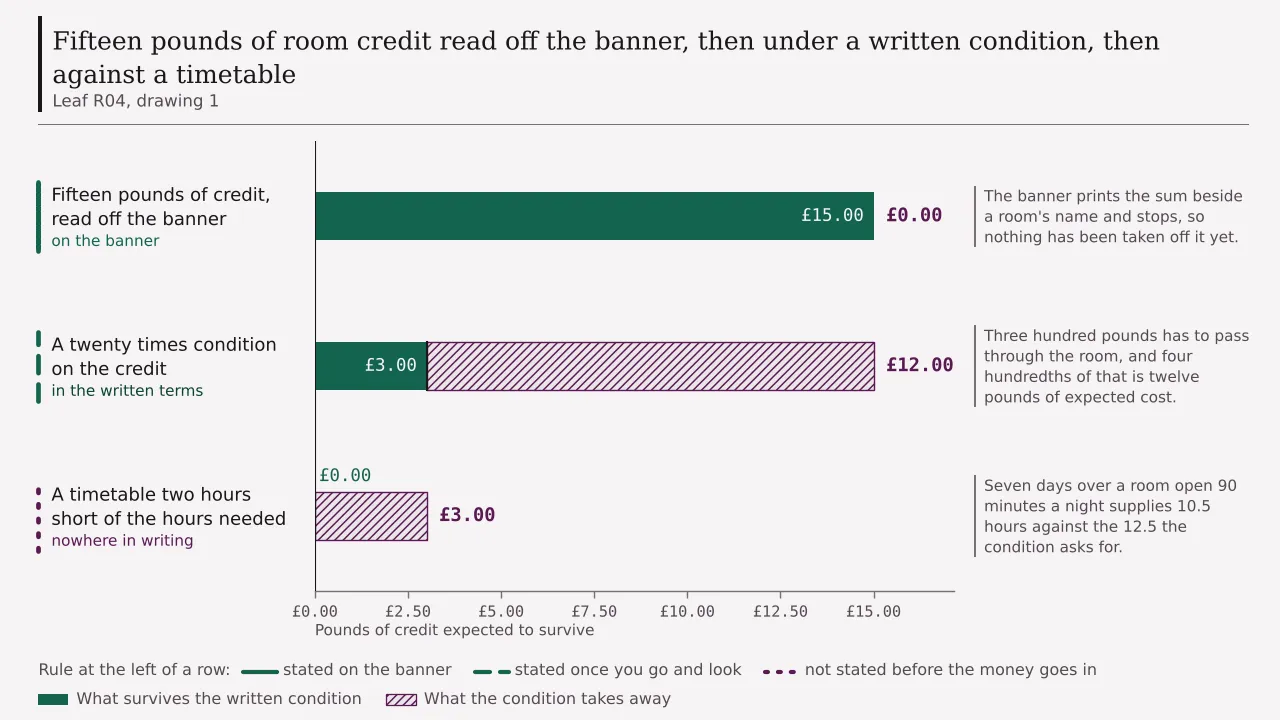
Where those hours get published is the question after that, and the answer sits awkwardly. A schedule exists, because somebody has to decide when a game starts, and it is usually visible inside the lobby once an account exists. Before that it tends to sit behind sign-in, which puts it at the same distance as a payment screen rather than at the distance of a document. Where no schedule is published at all the quantity still applies, since the room opens when it opens, and a reader working out whether a condition can be met has no figure to work with.
That is why this leaf marks the hours in two different places depending on the room. Where a schedule is published the hours are in the written terms and can be counted before anything is committed. Where none is, the same quantity is nowhere in writing and applies anyway, which is the sixth place and the most expensive one on this site’s list. One term, two possible addresses, and the reader does not choose which.
8
Permission in one record, feasibility in another document
Put the two halves in one table and the division of labour is plain. Everything about whether anybody may run the product is settled in a public record that the operator did not write. Everything about whether the offer can be satisfied is settled in documents the operator did write, or in no document at all. The two halves never meet, and no single source answers both.
| The question | What answers it | Where it is settled | What turns on the answer |
|---|---|---|---|
| May a bingo product be run from this address | An activity written against an entry | in the public register | Whether any ceiling exists |
| Which conditions that permission drags along | The licence type named on the entry | in the public register | Five requirements out of eight |
| What multiple the credit carries | The promotional terms | in the bonus terms | £300.00 of ticket money |
| How long the credit lasts | The same promotional terms | in the bonus terms | Seven days of window |
| What one ticket costs | A price list inside the lobby | at the cashier | 1,200 tickets at 25p |
| When the room is open | A schedule, where one is published | in a separate schedule | 10.5 hours against 12.5 |
| How many tickets a game swallows | Nothing a reader can open | nowhere in writing | 150 games against 1,200 |
| Who is running the room tonight | Nothing a reader can open | nowhere in writing | Not settled anywhere |
Work down the last column and the ordering turns out to be the uncomfortable part. The two rows settled in a public record decide whether a ceiling exists and which five of eight requirements attach, which is everything about the shape of the offer. The two rows settled nowhere decide how many games the money buys and who the counterparty is, which is everything about whether the offer can be completed. Between them sit four rows in documents the operator controls.
No reader can finish that table from one place, and nobody is obliged to assemble it on their behalf. The register is complete over permissions and silent about timetables. The terms are complete about multiples and silent about rooms. A lobby price list is complete about tickets and appears after registration. The quantity that decides whether 12.5 hours fit inside seven days is assembled from four sources of which only one is public, and that assembly is the work this leaf has been doing.
9
Duties drafted one product at a time
Credits of this shape are advertised beside rooms running on no British licence, and since this leaf’s whole subject is a rulebook written product by product, the four duties worth naming are the ones drawn around products instead of around outcomes. Other deprivations are real and get their own figures on neighbouring leaves.
The first is consent, and it is granular in two directions at once. Since 1 May 2025 electronic marketing has needed consent gathered separately for each product and each route, so agreeing to hear about a room is not agreeing to hear about a reel, and agreeing by email is not agreeing by text message. The date matters because an earlier one, 17 January 2025, was published and then moved. The second bars an operator from building a way to run two products at the same moment, in force from that same January date, which stops a credit tied to one product being worked off while something else runs alongside it. The third arrived with it: a customer has to be shown net spend and time spent as the session runs, which on a product measured in hours rather than in presses is the only live reading of the 12.5 that exists. The fourth governs the far end of the customer list, where incentives for anybody designated high value have to stay consistent with the licensing objectives and follow the regulator’s published guidance on the point.
Set those four against the arithmetic and none of them touches the £12.00, because none is a term in an offer. What they decide is the surrounding conditions under which the £300.00 gets put through: whether anything is running in a second window while the room plays, whether the hours already spent are visible without counting them by hand, and whether a larger credit arrives because somebody has been losing rather than because an offer was published. Strip the four away and part seven’s 12.5 hours stay 12.5 hours, with nothing on screen saying how many of them have gone.
One advertising rule belongs beside those and is worth stating separately because the product attracts it. A person under 25, or who reads as under 25, may neither be shown gambling nor given a significant part in a gambling advertisement, barring a narrow exception where the placement sits somewhere a bet can be struck directly and the person is the subject of that bet. Everywhere else, social placements included, under 25s stay out altogether. Bright, cartoon-adjacent artwork is a house style in this corner of the market, which is exactly why a rule about who may appear in it is worth naming where it does not apply.
10
What can be established about a room before it opens
Four things about a bingo credit can be settled before anybody registers, and the list is short enough to run from a phone. Everything else on this leaf waits for an account, a lobby or a session, and sorting the first group from the second is most of the value.
First, whether a permission exists for the product. Not for the brand, and not for the company whose name appears in a footer, but for a bingo activity written against an entry. The step is a search and a reading of an activity inventory, and the mechanics of running it properly, field by field, live on the method page under this heading and are not repeated here.
Second, which conditions that permission carries, which is the question part three turned into a list of licence type names. A grant for one activity carries one set of conditions and a grant for another carries a different set, and the difference between them includes whether identity has to be settled before play and whether money held for customers comes with a written statement about what an insolvency would do to it. Both of those are answered by the name of the licence type rather than by anything on the website.
Third, the multiple and the window, which are written down in the promotional terms and reachable without an account where an advertising duty is doing any work. Those two give the £300.00 and the seven days, which between them fix the whole of the arithmetic except the exchange rate into hours.
Fourth, and this is a negative finding rather than a figure, that the exchange rate into hours is not reachable. A reader can establish that a ticket price, a tickets-per-game habit and an opening timetable are all required to answer the question and that none of the three is published beside the offer. Writing that down is a result. It converts an unknown from something a reader forgot to check into something nobody can check, which is the distinction this entire site is built around.
Run the four and a credit of £15.00 resolves into this: £300.00 of turnover asked, £12.00 of expected cost, £3.00 of expected close, and an hours requirement that may or may not fit inside the window depending on a schedule nobody has shown you. Three of those five figures came from documents, one came from a public record deciding whether a ceiling exists at all, and the last came from a model this page invented and labelled. That mixture is the honest description of what is knowable about a room before entering it.
Questions
- Does a licence entry tell me the site can run bingo?
- Only if a bingo activity is written against it, which is a different question from whether the holder appears in the record at all. The published totals make the point: 3,097 licensed activities against 2,154 licensed businesses at 31 March 2026, so an entry carries 1.4378 activities on average and at most 943 of those businesses can hold a second activity. A brand showing a room, a reel lobby and a sportsbook is making three claims about permission, and the typical entry supports one.
- Why does the name on the site not settle it?
- Because a permission is an inventory rather than a label. Software can come from one company, hosting from another and the front end from a third, with the activity sitting under whichever of them holds the relevant name. The comparison worth making is the one the publisher puts to players: take the activities and the web addresses written against an entry and hold both up against what the site displays. Two lists, read side by side, producing a result that can come back wrong.
- Do the same rules cover bingo and slots?
- No, and the difference is drafted into the rules rather than left to chance. A separate act of commitment for each game, the randomness requirements and the duty to explain how prizes are allocated are written for gaming with bingo named inside their scope. The £5 and £2 ceilings on a single cycle are written for reel-based games played online. The floors under the interval between cycles are written for reels and for other casino games. On the eight requirements this leaf tabulates, a room sits inside five and outside three.
- What does a row prove about who is running the room tonight?
- Nothing, and that is the limitation every leaf under this heading carries. An entry establishes who holds a permission and the inventory of activities that permission runs to. Permissions change hands, a brand and the company behind a brand are separate objects, and an inventory was accurate when written rather than continuously. The record settles who may lawfully run a bingo product and declines the question of who is running the one on screen.
- What does a twenty times condition cost on fifteen pounds of credit?
- Twelve pounds. Twenty lots of £15.00 come to £300.00 that has to pass through the room, four hundredths of £300.00 comes to £12.00 of expected cost, leaving an expected close of £3.00, which is a fifth of what the banner printed. The same £12.00 arrives without looking at the credit at all: take the £300.00 of required turnover and apply four hundredths to it directly. At the ten times ceiling a British grant carries, the same credit would leave £9.00.
- How many bingo tickets does a wagering condition actually buy?
- On the model this page declares and nothing else, 1,200. A ticket at 25p, eight tickets to a game and a game every five minutes are invented figures, stated so the arithmetic has something to stand on. They turn £300.00 into 1,200 tickets, 150 games and 750 minutes, which is 12.5 hours of sitting in a room. A ticket price, a tickets-per-game habit and a frequency of games are published by nothing this site is permitted to cite, so all three numbers are assumptions.
- Can a credit expire before the condition can physically be met?
- It can, and nothing has to be breached for it to happen. Seven days over a room running two hours a night supplies 14 hours, so 12.5 fits with 90 minutes spare. Seven days over the same room running 90 minutes a night supplies 10.5 hours against a requirement of 12.5, and the shortfall is two hours that do not exist. The credit expires with the condition unmet and the £3.00 expected close becomes nothing.
- Where are a room’s opening hours published?
- In two different places depending on the room, and the reader does not choose which. Where a schedule is published the hours sit in the written terms and can be counted before anything is committed. Where none is published the same quantity applies anyway, because the room opens when it opens, which puts it nowhere in writing. A schedule visible only after sign-in sits at the distance of a payment screen rather than at the distance of a document.
- Why does an hour matter more here than a multiple does?
- Because a multiple is continuous and a window against a timetable is a threshold. Moving a multiple moves money smoothly, so two hours either way in part five would be worth nothing. Moving a timetable by two hours either lets the whole requirement through or stops all of it, which makes those two hours worth the entire £3.00 expected close. A condition written in money and discharged in hours hands the exchange rate between them to whoever sets the schedule.
- Which conditions does a grant for one activity actually carry?
- A set named by licence type, and the carve-outs are written as names rather than principles. The condition on establishing identity before play reaches remote licences broadly and excepts a cluster that includes both ancillary remote variants, bingo among them. The condition on customer money excepts the same cluster. The code provision on incentives inverts that, pulling ancillary remote grants in and setting aside nothing but software and the machine technical one. So which conditions attach is a question about the name of the licence type.
- What is given up where no British licence stands behind the room?
- Four duties drawn around products rather than outcomes. Electronic marketing consent gathered separately for each product and each route, in force since 1 May 2025 after an earlier date was moved. A bar on an operator building a way to run two products at the same moment, from 17 January 2025. A live reading of net spend and time spent as a session runs, which on a product measured in hours is the only running count of the 12.5 that exists. And a requirement that incentives for anybody designated high value stay consistent with the licensing objectives.
- What can I settle about a room before registering?
- Four things. Whether a bingo activity is written against an entry. Which conditions that licence type carries. The multiple and the window, both in the promotional terms. And, as a negative finding worth writing down, that the exchange rate from money into hours is not reachable at all, because a ticket price, a tickets-per-game habit and an opening timetable are all needed and none of the three stands beside the offer.