Terms read 19 October 2026 Leaf N03, revision 1
Seven pounds of room credit, priced in games instead of presses
A credit of £7.00 buys 8.75 games on the ticket model declared in part three, which is 52 minutes and 30 seconds of sitting. The condition fastened to it asks for 350 games, or 35.00 hours. Nobody publishes the quantity that turns the first figure into the second, because in a room it is not the player’s to set.
Stated on the banner £7.00 A sum of room credit and a price of nought, which is a figure anybody can do arithmetic with straight away. Stated, once you go and look minus £4.20 Forty times over the credit, written at clause 6 of a promotional document, at a 96 per cent return. Not stated before the money goes in 35.00 hours What the clause costs in time once a caller’s rate is supplied, plus the hours a room keeps and how the two collide.
Room credits asking for no payment, terms read
Every destination in this file is bought advertising. The site is paid a fee if a reader goes on to register, and no figure printed below moves because of it.
Bonus Spins UK Slip 01
Betportal
Ceiling as a multiple
The drop
€15.00
€1.00 in the euro
The claim reads €15.00. Once the terms beside it have applied, €0.00 of it can leave. The difference is the drop.
7 of the 15 terms on this slip could not be read before the money went in
Spins priced at this site's own 10p a spin, which the operator does not publish
Stated
€15.00
The claim as it is printed, before a single term has been applied to it.
Headline paid as spins
150 spins at 10c each, which is €15.00 of the figure above.
6 Nowhere
What one spin is worth
No unit is published for a spin, so the count is priced at this site's own 10p a spin. At half that price every figure below halves with it.
Match and other credit not priced
300% of three deposits, to a ceiling of €1,000. A share of a deposit nobody has made yet is not a sum, so no figure stands on this line and none is carried below.
Qualified
-€14.40
Written down somewhere, and taking part of the claim back. Each term carries the place it is written and the sum it takes.
2 Written terms at a distance this record does not establish
Play-through -€14.40
Carrying €14.40 through 35 times stakes €504.00 and costs €20.16 of it at 96 per cent return. That prices above the €14.40 there is to charge it against, so the whole of the credit goes and the line is held at that. The multiple sits on the bonus.
2 Written terms at a distance this record does not establish
Game weighting not priced
Slots only count towards the play-through. No contribution percentage is published, so the line above has been worked at full weight, which is the kindest reading there is.
2 Written terms at a distance this record does not establish
Ceiling on the winnings not priced
5x the bonus.
2 Written terms at a distance this record does not establish
Clock on the credit not priced
14 days.
2 Written terms at a distance this record does not establish
Largest stake while it runs not priced
€5.
3 Public record
Licence, and who holds it not priced
Licensed in Anjouan, Comoros, held by BetPortal Gaming Ltd, with Excite Ultra Media Ltd, reference ALSI-202601040-FI2. A register entry settles who holds a licence and what it permits. It does not settle who is running the site this morning.
4 Cashier
Smallest qualifying deposit your money
€20 a stage. That is €20.00 of your own money, and it is never netted into a drop.
5 On the way out
Checks before a withdrawal not priced
Documents before the first withdrawal.
Unstated
-€0.60
Applying without having been published anywhere, and costing money all the same.
6 Nowhere
What a spin hands back -€0.60
Staking a spin returns 96 per cent of it, so that share of the batch is the house's before a reel turns. This site works at that return and the operator publishes none where the claim is made.
6 Nowhere
Forfeited by rule cost unknown
Nothing is published under this heading, and it applies regardless.
6 Nowhere
Charge on the way out cost unknown
No charge on the way out is published as a figure, so nothing comes off this line. A charge that exists unpublished would come straight off whatever survives.
6 Nowhere
Smallest withdrawal allowed cost unknown
No smallest withdrawal is published as a figure. A floor nobody has published is still a floor, and it decides whether a small balance can move at all.
No Great Britain licence
Terms read 19 October 2026
Bonus Spins UK Slip 02
WinBeast
Ceiling as a sum
The drop
€50.00
€1.00 in the euro
The claim reads €50.00. Once the terms beside it have applied, €0.00 of it can leave. The difference is the drop.
8 of the 15 terms on this slip could not be read before the money went in
Spins priced at this site's own 10p a spin, which the operator does not publish
Stated
€50.00
The claim as it is printed, before a single term has been applied to it.
Headline paid as spins
500 spins at 10c each, which is €50.00 of the figure above.
6 Nowhere
What one spin is worth
No unit is published for a spin, so the count is priced at this site's own 10p a spin. At half that price every figure below halves with it.
Match and other credit not priced
50% to 100% of five deposits, each to a ceiling of €1,000, and a €650 free bet. A share of a deposit nobody has made yet is not a sum, so no figure stands on this line and none is carried below.
Qualified
-€48.00
Written down somewhere, and taking part of the claim back. Each term carries the place it is written and the sum it takes.
2 Written terms at a distance this record does not establish
Play-through -€48.00
Carrying €48.00 through 40 times stakes €1,920.00 and costs €76.80 of it at 96 per cent return. That prices above the €48.00 there is to charge it against, so the whole of the credit goes and the line is held at that. The multiple sits on the bonus and the winnings from the spins.
2 Written terms at a distance this record does not establish
Game weighting not priced
Slots, titles vary by country count towards the play-through. No contribution percentage is published, so the line above has been worked at full weight, which is the kindest reading there is.
2 Written terms at a distance this record does not establish
Ceiling on the winnings not priced
€100 a batch of spins.
2 Written terms at a distance this record does not establish
Clock on the credit not priced
7 days, spins 1 day.
3 Public record
Licence, and who holds it not priced
Licensed in Curaçao, holder not named on the site. A register entry settles who holds a licence and what it permits. It does not settle who is running the site this morning.
4 Cashier
Smallest qualifying deposit your money
€20 a stage. That is €20.00 of your own money, and it is never netted into a drop.
5 On the way out
Checks before a withdrawal not priced
Documents before the first withdrawal.
Unstated
-€2.00
Applying without having been published anywhere, and costing money all the same.
6 Nowhere
What a spin hands back -€2.00
Staking a spin returns 96 per cent of it, so that share of the batch is the house's before a reel turns. This site works at that return and the operator publishes none where the claim is made.
6 Nowhere
Largest stake while it runs cost unknown
Nothing is published under this heading, and it applies regardless.
6 Nowhere
Forfeited by rule cost unknown
Nothing is published under this heading, and it applies regardless.
6 Nowhere
Charge on the way out cost unknown
No charge on the way out is published as a figure, so nothing comes off this line. A charge that exists unpublished would come straight off whatever survives.
6 Nowhere
Smallest withdrawal allowed cost unknown
No smallest withdrawal is published as a figure. A floor nobody has published is still a floor, and it decides whether a small balance can move at all.
No Great Britain licence
Terms read 19 October 2026
Bonus Spins UK Slip 03
EliteSpin
Longest spin window
The drop
£50.00
£1.00 in the pound
The claim reads £50.00. Once the terms beside it have applied, £0.00 of it can leave. The difference is the drop.
8 of the 15 terms on this slip could not be read before the money went in
Spins priced at this site's own 10p a spin, which the operator does not publish
Stated
£50.00
The claim as it is printed, before a single term has been applied to it.
Headline paid as spins
500 spins at 10p each, which is £50.00 of the figure above.
6 Nowhere
What one spin is worth
No unit is published for a spin, so the count is priced at this site's own 10p a spin. At half that price every figure below halves with it.
Match and other credit not priced
50% to 100% of five deposits, each to a ceiling of £1,000. A share of a deposit nobody has made yet is not a sum, so no figure stands on this line and none is carried below.
Qualified
-£48.00
Written down somewhere, and taking part of the claim back. Each term carries the place it is written and the sum it takes.
2 Written terms at a distance this record does not establish
Play-through -£48.00
Carrying £48.00 through 40 times stakes £1,920.00 and costs £76.80 of it at 96 per cent return. That prices above the £48.00 there is to charge it against, so the whole of the credit goes and the line is held at that. The multiple sits on the bonus and the winnings from the spins.
2 Written terms at a distance this record does not establish
Game weighting not priced
Slots count towards the play-through. No contribution percentage is published, so the line above has been worked at full weight, which is the kindest reading there is.
2 Written terms at a distance this record does not establish
Ceiling on the winnings not priced
5x the bonus.
2 Written terms at a distance this record does not establish
Clock on the credit not priced
7 days, spins 3 days.
3 Public record
Licence, and who holds it not priced
Licensed in Costa Rica, held by PrimeTier Limited. A register entry settles who holds a licence and what it permits. It does not settle who is running the site this morning.
4 Cashier
Smallest qualifying deposit your money
£20 a stage. That is £20.00 of your own money, and it is never netted into a drop.
5 On the way out
Checks before a withdrawal not priced
Documents before the first withdrawal.
Unstated
-£2.00
Applying without having been published anywhere, and costing money all the same.
6 Nowhere
What a spin hands back -£2.00
Staking a spin returns 96 per cent of it, so that share of the batch is the house's before a reel turns. This site works at that return and the operator publishes none where the claim is made.
6 Nowhere
Largest stake while it runs cost unknown
Nothing is published under this heading, and it applies regardless.
6 Nowhere
Forfeited by rule cost unknown
Nothing is published under this heading, and it applies regardless.
6 Nowhere
Charge on the way out cost unknown
No charge on the way out is published as a figure, so nothing comes off this line. A charge that exists unpublished would come straight off whatever survives.
6 Nowhere
Smallest withdrawal allowed cost unknown
No smallest withdrawal is published as a figure. A floor nobody has published is still a floor, and it decides whether a small balance can move at all.
No Great Britain licence
Terms read 19 October 2026
Bonus Spins UK Slip 04
Crown Jewelz
Multiple unpublished
The drop
NOT WORKED
The multiple is not published in the operator's own terms. Since the sum cannot be worked around it, none is worked.
9 of the 14 terms on this slip could not be read before the money went in
No drop worked
Stated
£15.00
The claim as it is printed, before a single term has been applied to it.
Headline paid as spins
150 spins at 10p each, which is £15.00 of the figure above.
6 Nowhere
What one spin is worth
No unit is published for a spin, so the count is priced at this site's own 10p a spin. At half that price every figure below halves with it.
Match and other credit not priced
200% of the first deposit, then 150% twice, each to a ceiling of £1,000. A share of a deposit nobody has made yet is not a sum, so no figure stands on this line and none is carried below.
Qualified
NOT WORKED
Written down somewhere, and taking part of the claim back. Each term carries the place it is written and the sum it takes.
2 Written terms at a distance this record does not establish
Play-through not priced
40x the bonus, reported rather than published by the operator.
2 Written terms at a distance this record does not establish
Game weighting not priced
Slots count towards the play-through. No contribution percentage is published, so the line above has been worked at full weight, which is the kindest reading there is.
3 Public record
Licence, and who holds it not priced
Licensed in Curaçao, number not verified, holder not named on the site. A register entry settles who holds a licence and what it permits. It does not settle who is running the site this morning.
4 Cashier
Smallest qualifying deposit your money
£20. That is £20.00 of your own money, and it is never netted into a drop.
5 On the way out
Checks before a withdrawal not priced
Documents before the first withdrawal.
Unstated
NOT WORKED
Applying without having been published anywhere, and costing money all the same.
6 Nowhere
Ceiling on the winnings cost unknown
No ceiling is published. Nothing is assumed in its place.
6 Nowhere
Clock on the credit cost unknown
Nothing is published under this heading, and it applies regardless.
6 Nowhere
Largest stake while it runs cost unknown
Nothing is published under this heading, and it applies regardless.
6 Nowhere
Forfeited by rule cost unknown
Nothing is published under this heading, and it applies regardless.
6 Nowhere
Charge on the way out cost unknown
No charge on the way out is published as a figure, so nothing comes off this line. A charge that exists unpublished would come straight off whatever survives.
6 Nowhere
Smallest withdrawal allowed cost unknown
No smallest withdrawal is published as a figure. A floor nobody has published is still a floor, and it decides whether a small balance can move at all.
No Great Britain licence
Terms read 19 October 2026
Every figure in the second and third columns is this site's own working and nothing an operator has published. A claim is priced as printed, then the share a spin hands back at 96 per cent return comes off it, then what playing the multiple through costs at the same return, and then whatever a published ceiling, a charge on the way out or a floor on the smallest withdrawal takes from what has survived. The drop is the difference between the first figure and the last. The two columns add back up to it exactly, so no money leaves a slip without a term and a place beside it.
Which column a term falls in is settled by one question: has anybody written it down. A charge a reader meets at the payment screen is written down, and it stands in the second column with the cashier against it. A condition that binds without ever having been set down stands in the third, whatever it costs. Inside each column the terms run outwards from the banner, so the order itself says how far a reader would have had to go.
A count of spins has no unit until one is supplied. Where an operator publishes what one of its own spins is worth, that figure is used and the first column says it is theirs. Where none is published, this site's own 10p a spin stands in its place and every figure below moves in proportion with it. Where the multiple itself is unpublished, no drop is worked at all, because that is the one figure the sum cannot be done without.
Three words stand where a figure cannot. Not priced is a term that is written down and carries no number the arithmetic can take. Cost unknown is a term nobody has written down, costing something nobody has put a number on. Your money is money of the reader's own, which is never netted into a drop.
None of the operators in this file holds a Great Britain licence, so none of the duties that licence carries reaches them. Each of those duties is published in its own right, which is what makes its absence here something a reader can check rather than take on trust. Every gambling company licensed in Great Britain belongs to Gamstop Online, so a reader who has shut themselves out through the scheme is not shut out here. Social Responsibility Code 5.1.1 has held a play-through to a maximum of ten times the bonus funds since 19 January 2026, and it binds a licence holder and nobody else. Asked in a post of 21 October 2025 what is lost along with the licence, the Gambling Commission's Director of Enforcement and Intelligence answered: "unfair gaming practices, financial loss, and a lack of recourse if things go wrong". The same post puts blocked payouts, and withdrawal limits pitched high enough to be unreachable, among the behaviour the Commission has recorded. Nobody under 18 may hold an account at any of them.
Terms are reproduced in the wording their operator published, and each slip is dated with the day somebody sat down and read them. 19 October 2026 is the oldest of those dates. Anybody claiming an offer is bound by that operator's full terms, which are elsewhere, and never by a line standing here.
1
A sum rather than a count, and the unknown that replaces the unit
Seven pounds of credit is published, nothing is asked for in return, and both of those are settled . A sum has an advantage a count does not: it converts into money without anybody supplying a price per unit first. Where a reel headline publishes a quantity of turns and withholds what a turn costs, a room headline publishes the money itself.
That advantage closes almost at once. Seven pounds of credit cannot be spent as seven pounds. It is spent on tickets, in games, at whatever interval somebody else starts them, and the question anybody actually wants answered is how long the credit lasts and whether the condition attached to it can be finished before it expires. Answering that needs a rate, and a rate is exactly what nothing in the advertisement, the promotional document or any public record carries.
So the missing quantity has moved rather than disappeared. On a reel offer the reader is short of a price. Here the reader has the price and is short of a speed. The second gap is the worse of the two, because a price is a single number a reader could reasonably guess within a factor of two, while a speed depends on a schedule, a room’s size, a caller’s habit and the format being called, none of which a stranger can estimate at all.
One more property of the sum deserves stating before the arithmetic begins. Seven pounds of credit is below the hourly cost of sitting in the room this page models, which is £8.00 of ticket money an hour at the settings in part three. The entire advertised gift is therefore less than an hour of the activity it is a gift of, and the condition written beside it asks for thirty-five of them.
Nothing in the two preceding sentences contradicts the offer. A reader who claims the credit does receive £7.00 of buying power, and does send nothing from a bank to get it. Every figure below leaves that intact. What the figures take apart is the relationship between the credit and the clause, and that relationship runs entirely through a quantity neither of them mentions.
This page therefore does something the other leaves on this site do not have to do. It supplies the missing quantity itself, says so in every sentence that spends it, and then shows how far the answer moves when the supplied figure is changed. The conclusion that survives all of the changes is the conclusion worth having, and it is not a figure. It is that the figure belongs to somebody else.
2
Who decides how fast money leaves, on a reel and in a room
Two products that look alike on a lobby page differ at the root on one point: whose decision starts the next event. A reel waits. It will sit indefinitely with a balance on it and do nothing until somebody acts, and when that somebody acts twice as often, the money goes twice as fast. The rate is the player’s, bounded below by whatever floor the build runs under.
A room does not wait. Games are started by whoever is running them, to a schedule drawn up before any particular player arrived, and a player who wants to go faster has exactly one lever: buying more tickets into the same game. The interval between games is fixed for everybody in the room at once. Nobody in a seat can shorten it, and nobody in a seat is told what it is before they have a seat.
Put formally, the distinction is between a rate a reader sets and a rate a reader meets. Every other quantity on an offer of this kind is a term: somebody wrote it, it sits in a document, and the document has an address. A rate of play met rather than set is not a term at all. It is a property of an operation, applied to every balance in the room simultaneously, and the party it belongs to has no obligation to describe it and no obvious commercial reason to.
That is why this leaf sits in the section it does. The condition is written down and is perfectly legible. What is unwritten is the exchange rate between the written condition and the only resource a reader actually has, which is an evening. Until that exchange rate is supplied, a clause reading forty times is not a quantity of anything a person can plan around.
There is a second asymmetry worth printing beside the first. A reader who finds a reel too slow or too quick can stop mid-session and resume tomorrow, and nothing about the arithmetic changes. A reader whose room closes at ten o’clock has lost the hours between ten and whenever it opens again, and those hours were part of the window the clause was counting in. Time that a reel merely declines to use is time a room actively spends, and the window is spending it whether anybody is sitting in it or not.
Both halves of this leaf come out of that one structural fact. Part five prices what an unpublished rate does to a condition expressed as a multiple. Part six prices what an unpublished timetable does to a window expressed in days. Neither of the two unknowns is written anywhere a reader could reach before an account exists, and their interaction is written nowhere whatsoever.
3
Three settings supplied here, and the standing of each
Three figures have to be invented before a single line of arithmetic can run, and inventing them openly is better than smuggling in an assumption behind a confident sentence. Each is this leaf’s own choice. Not one of the three is set down by a publisher this leaf may draw on, and each is flagged as an assumption again in every sentence that spends it below.
A ticket is taken at 20p, which is this leaf’s assumption. Four tickets are taken into each game, which is this leaf’s assumption and describes a reader’s habit rather than any rule. Ten games are taken as starting in an hour, one every six minutes, which is this leaf’s assumption about a caller’s pace and the most consequential of the three. Multiply them out and a seat costs 80p a game and £8.00 of ticket money an hour.
Prizes are set at the 96 per cent this whole site computes on. Inside a room that works out as 4p of each pound spent on cards staying behind, with the other 96p redistributed to whoever is holding a winning ticket. A room shares a pot among the people sitting in it instead of paying each of them against a paytable, so the distribution differs from a reel’s while the retention behaves identically, and retention is the only half the arithmetic below has any use for.
| What is being set | Figure used here | Standing of the figure | Where it could be looked up | What it decides |
|---|---|---|---|---|
| Cost of one ticket | 20p | This leaf’s assumption | at the cashier | 1,400 tickets |
| Tickets carried into a game | Four | This leaf’s assumption, about a habit | nowhere in writing | 350 games |
| Games begun in an hour | Ten | This leaf’s assumption, about a caller | nowhere in writing | 35.00 hours |
| Share going back as prizes | 96 per cent | House convention, not a measurement | nowhere in writing | 4p a pound kept |
| Multiple over the credit | Forty times | Written, and the only one that is | in clause 6 | £280.00 asked |
Read the third column downwards and the proportion is the finding. One row of five was written by anybody at all, and it is the row that produces the figure a reader would repeat to a friend. The four rows that decide whether that figure is reachable were supplied here, out of nothing, because there was nothing to take them from.
Anybody holding the true figures for one particular room may run every line below again in about two minutes, and parts five and seven are built so that swapping in a different pace is one multiplication rather than a rewrite. That is the usable half of this leaf. The other half, and the honest one, is that those true figures are not obtainable from outside the room.
4
What £280.00 comes to once it is bought a game at a time
Clause 6 behaves like an ordinary written term and can be read ordinarily. Forty times £7.00 is £280.00 of ticket money, and that sum has to cross the tills of the room before any part of the balance converts into something a bank will accept. That figure is settled in clause 6 and nothing in this part disputes it.
The expected close comes off the house line in three movements. Retention runs at four hundredths of every pound of ticket money. Stretched across the forty the clause asks for, retention reaches 160 per cent of a credit against the 100 per cent the credit actually is, so three fifths of it is owed rather than held. Six tenths of £7.00 pointed the unhelpful way is minus £4.20, and the weighting stays at unity the whole way, with no multiplier tucked inside it.
Credit as the offer states it £7.00 Expected close once clause 6 is served minus £4.20 What one unread sentence moves £11.20
Eleven pounds twenty arrives twice over, from two directions that share no step. Take the two ends of the block and subtract: £7.00 less minus £4.20 is £11.20. Take the clause on its own instead and ask what serving it costs: £280.00 of ticket money leaking four pence in the pound is £11.20 of expected retention. The agreement is not a coincidence, since the only thing the clause does is hand ticket money to the house at a known rate, but printing both routes is how a reader checks that nothing was smuggled into the first one.
Now convert, which is the work this leaf exists to do. At 20p a ticket, this leaf’s assumption, £280.00 is 1,400 tickets. At four tickets a game, this leaf’s assumption, 1,400 tickets are 350 games. At ten games an hour, this leaf’s assumption about a caller, 350 games are 35.00 hours of sitting in front of a card.
Set that beside what the credit itself buys and the shape of the offer appears. Seven pounds at 80p a game is 8.75 games, which at ten an hour is 52 minutes and 30 seconds. The gift is a little under an hour. The condition on the gift is thirty-five hours. Those two numbers stand in the ratio forty to one and always will, whatever the settings are, which is the first useful thing the conversion produces.
350 games asked of a credit that buys 8.75
A comparison with the reel side of the same lobby sharpens it. Spent at 10p a press instead, £280.00 of staking comes to 2,800 presses, and a licensed reel build will not restart inside 2.5 seconds, so those presses cannot be compressed below 7,000 seconds, which is one hour, fifty-six minutes and forty seconds. The identical obligation therefore runs eighteen times longer in the room at the pace assumed here, and the room’s own figure is fenced neither below nor above, nobody having published a limit in either direction.
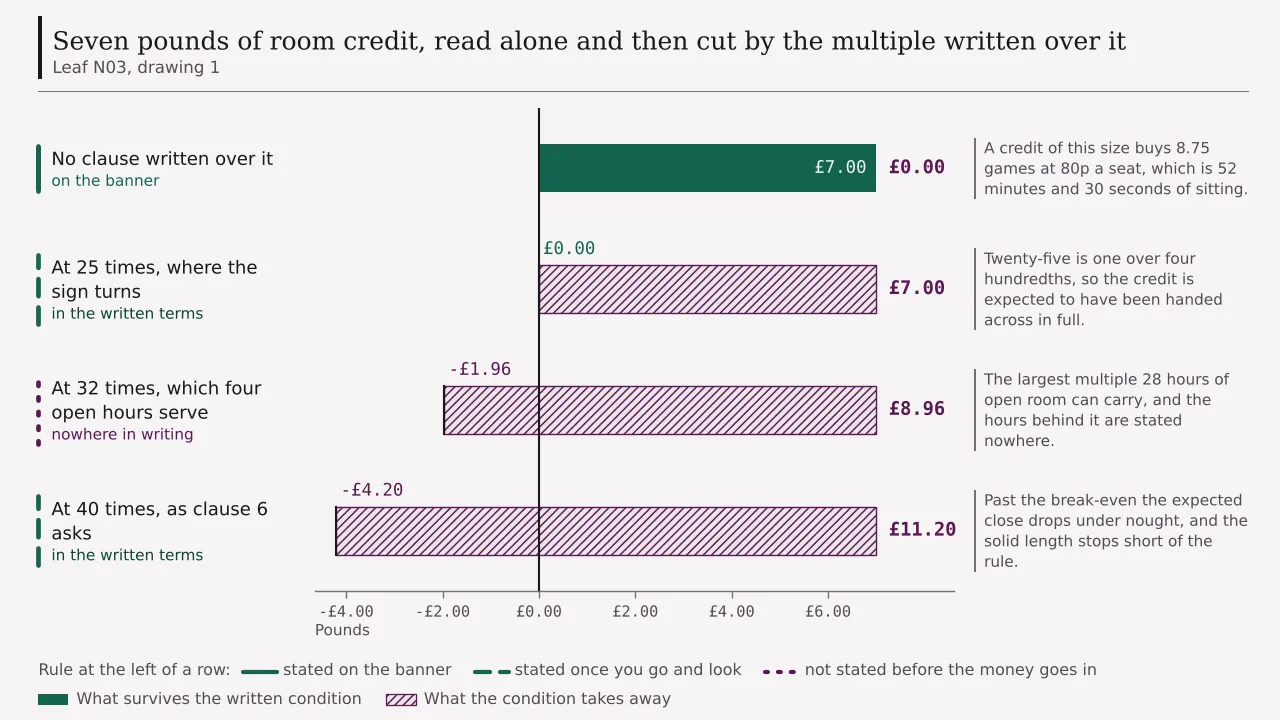
Twenty-five is the hinge, a figure falling out of the arithmetic instead of out of the market, being one over four hundredths. Below the hinge a credit should still show a residue once its clause has been served. At the hinge the residue is nought. Past the hinge the clause wants more retention than £7.00 contains, so the shortfall is funded out of a reader’s own pocket, and forty sits a long way past it.
5
A multiple stops being a multiple and becomes a length
Hold the pace still and something tidy happens to the clause. A credit of £7.00 buys 52.5 minutes at £8.00 of ticket money an hour. A clause asking forty times that credit asks for forty lots of the same 52.5 minutes, which is 35.00 hours. Multiply the credit by anything and the hours multiply by the same thing, exactly, with no remainder and no second step.
So at a fixed rate a wagering multiple is not a financial quantity at all. It is a length of time, measured in units of however long the credit itself lasts. Forty times means forty evenings of the size the credit bought. That reading is available to anybody who knows the rate, and is available to nobody who does not, which is almost everybody reading the advertisement.
Change the pace and watch the clause change size while its wording stays put. The table below moves only the caller’s rate, leaving the credit, the ticket price, the holding and the multiple exactly where clause 6 and part three put them. Every rate in it is this leaf’s own assumption, printed to show a shape rather than to report any room.
| Games begun in an hour | Gap between games | Ticket money an hour | Hours for 350 games | Evenings of four hours |
|---|---|---|---|---|
| Six | Ten minutes | £4.80 | 58.33 | 14.6 |
| Ten | Six minutes | £8.00 | 35.00 | 8.8 |
| Fifteen | Four minutes | £12.00 | 23.33 | 5.8 |
| Twenty | Three minutes | £16.00 | 17.50 | 4.4 |
Top row against bottom row is a factor of 3.33 in time, produced without altering one character of the offer. A reader who assumed the quick end and met the slow end has budgeted a little over four evenings for something wanting nearly fifteen. Nothing in the promotional document would have warned them, because the document does not know either: a clause drafted in multiples is silent about pace by construction.
The same insensitivity runs through the other two settings. Halve the ticket price to 10p and the tickets double to 2,800, the games double to 700 and the hours double to 70.00. Double the holding to eight tickets a game and the games halve to 175 and the hours halve to 17.50. Each of those is one multiplication, and each lands somewhere a reader cannot check before registering.
What the table also shows is the direction the errors run in. A faster caller is better for a reader carrying this clause, because the obligation is a fixed quantity of ticket money and a quicker room serves it in fewer hours. A faster caller is also worse for the same reader in every other respect, because the expected retention arrives sooner and the losing happens at £16.00 an hour instead of £4.80. The pace is not good or bad. It converts one cost into the other at a rate nobody has published.
One sentence can be stated for every row at once. The expected close stays at minus £4.20 all the way down the column, because expectation is a function of ticket money and the multiple alone. Pace decides when the minus £4.20 arrives and how many hours of a life it occupies, and decides nothing about its size.
6
Hours a room keeps, and the document that never mentions them
The second unwritten quantity is coarser than the first and easier to establish. A reel runs continuously, so a window of seven days is a window of 168 hours. A room is open for part of the day. A window of seven days against a room running four hours an evening, which is this leaf’s assumption, is a window of 28 hours, and the advertisement that printed the seven days printed nothing at all about the four.
Three separate documents would have to be read together to notice this, and nothing puts them together. The window lives in clause 6 beside the multiple. The hours, where they are published at all, live in a schedule inside the lobby, which is reached at the cashier in this site’s sense, meaning after an account exists. The arithmetic joining them lives nowhere in writing, because no party has a duty to perform a multiplication across two documents written by different departments.
It is worth being precise about which of the three is genuinely absent. The hours are not secret. A room with a schedule publishes it, and a reader with an account can read it in a few seconds. What is absent is the hours at the moment they would change a decision, which is before registration, and the interaction, which is absent at every moment and from every document.
| Hours the room runs in a day | Hours inside a seven-day window | Games the window can start | Ticket money it can carry | Largest multiple it serves |
|---|---|---|---|---|
| Two | 14 | 140 | £112.00 | 16 times |
| Four | 28 | 280 | £224.00 | 32 times |
| Five | 35 | 350 | £280.00 | 40 times |
| Eight | 56 | 560 | £448.00 | 64 times |
Five hours an evening is the threshold on these settings, and it falls out of the arithmetic rather than being chosen: 35.00 hours of obligation divided across seven days is exactly five hours a day. A room running five hours can serve clause 6 to the minute, provided the reader is present for every one of those hours and starts on day one. A room running four cannot serve it at all, however the reader behaves.
The last column is the one worth carrying away. It converts an opening timetable into a wagering multiple, which is not a conversion anybody normally thinks to make, and it shows that a room’s hours set a ceiling on what any clause can ask. Over any window, the largest multiple a room can serve is the ticket money its open hours can carry divided by the credit, and nothing in the promotional document is bound to respect that ceiling or even to acknowledge that one exists.
Two honest qualifications belong here. A room usually runs several games at once in different formats, so a determined reader may be able to buy into more than one simultaneous game and raise the ticket money an hour considerably. And a window is sometimes counted from the moment credit is granted rather than in calendar days, which moves the partial days at either end. Both of those change the figures in the table. Neither of them is published beside the offer either, so both are further instances of the same complaint rather than answers to it.
7
Twenty-eight hours of room against a condition wanting thirty-five
Put the two halves together at the settings declared in part three and the result is not an expensive clause. It is a clause that cannot be completed. The condition asks for 35.00 hours of sitting. The window offers 168 hours of calendar and 28 hours of room. The shortfall is seven hours, which is 70 games, 280 tickets and £56.00 of ticket money that the window has nowhere to put.
Hours clause 6 asks for 35.00 Hours a four-hour room offers inside the window 28.00 Hours the arrangement is short by 7.00
Express the same shortfall as a multiple and it becomes something a reader can set against the printed clause directly. Twenty-eight hours of room carries £224.00 of ticket money, and £224.00 over a £7.00 credit is thirty-two times. So the largest multiple that room and that window can serve between them is 32, while the document asks 40. The clause overshoots what the operation can deliver by eight times the credit, which is £56.00 of ticket money and the seven hours above.
That sentence is the whole of this leaf compressed. A condition expressed as a multiple looks like a statement about money and is in fact a statement about time, and whether it can be met at all is decided by a rate and a timetable, neither of which the document naming the multiple has any visibility of. Forty times is not forty times. It is thirty-two times plus an impossibility, and which of those two it is cannot be worked out from anything printed before an account exists.
Price the consequence and the arithmetic is blunt rather than subtle. A clause that cannot be finished converts the expected close from minus £4.20 into nought collectable, because a balance that never satisfies its condition never becomes money however well the sitting goes. The reader keeps the entertainment, loses the arithmetic, and ends the window holding a figure on a screen.
Run the same sum at thirty-two times, which is what the room could actually serve, and the expected close is minus £1.96 rather than minus £4.20. The difference between the written multiple and the servable one is therefore £2.24 of expectation, which is the precise cost of the overshoot to anybody who somehow completed it, and the whole of the credit to everybody who did not.
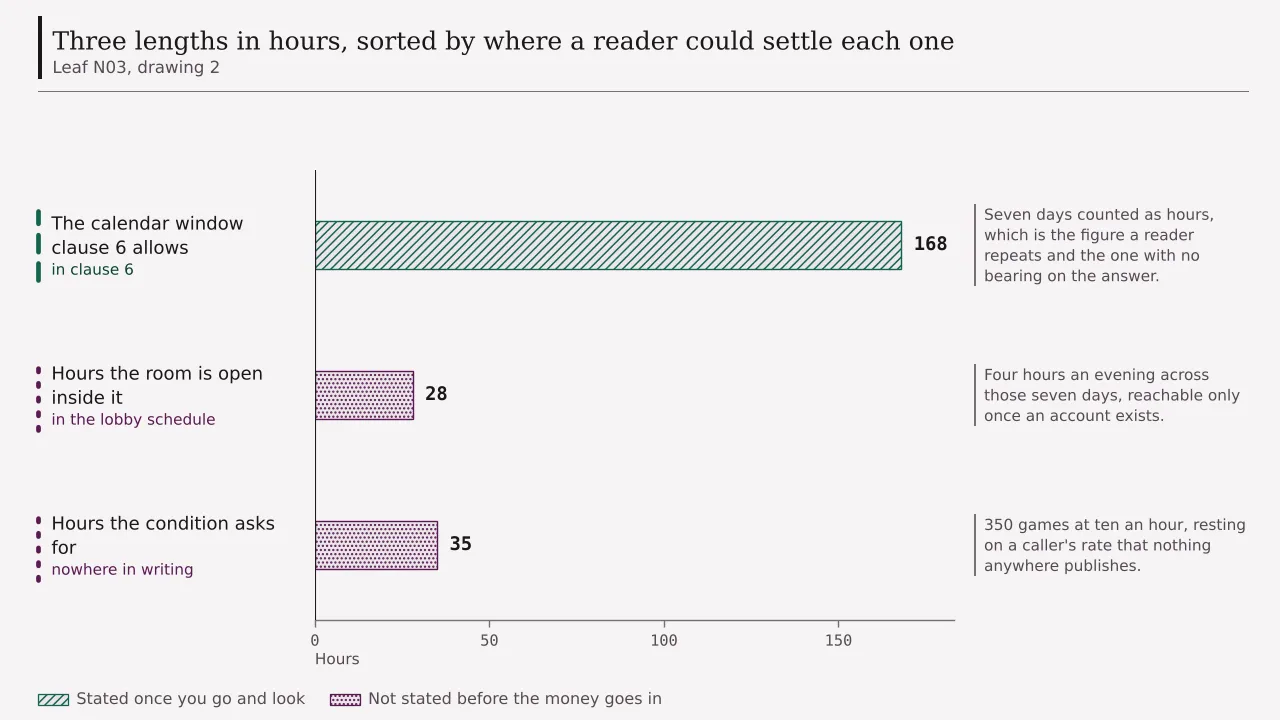
Notice which of the three lengths in that drawing is the one everybody quotes. Seven days is the figure a reader repeats, and of the three lengths it is the one with no bearing on the answer, the calendar not being the constraint. The constraint is the second length, and the demand is the third, and the offer puts the reader in possession of neither.
£56.00 of ticket money the window has no hours to carry
8
Showing that nobody states it, one published rule at a time
A page in this part of the site has a duty the other six sections avoid. Saying that a quantity is unstated is a claim about the whole world, and a claim of that shape cannot be demonstrated by failing to find something. What can be done is narrower and is done here: take every published rule that would have had to carry the quantity if anything did, open each one, and record what it addresses instead.
Start where pace is genuinely regulated. The technical standard governing product design sets a floor between one game cycle and the next, and the floor arrives in two sizes: 2.5 seconds where the game is reel-based, 5 seconds on casino games other than reels, with poker between players lifted out of the second. Each size is drafted about a machine a customer works. Neither is drafted about a caller, and neither says a word about how often a game must or may begin where beginning it is not the customer’s act.
Move to the rule that does reach a room. The standard banning automatic play reaches gaming, and bingo sits inside that, and what it insists on is that every cycle be entered deliberately, one at a time, which settles who decides rather than how quickly. Tickets may not roll forward unattended. The interval between one call and the next goes unmentioned, and so does whether anybody is told what the interval is.
Then the rule about what has to be disclosed before committing. The standard on game descriptions wants the material bearing on a player’s prospects within easy reach beforehand, and it offers four alternatives strung together with the word or. One of them is an account of the way prizes get handed out, which the guidance marks as enough where bingo is the game. An account of prize allocation is not a timetable. No part of the requirement asks for a rate, an interval, a schedule or an hour of opening.
Then the public record. Searching the British regulator’s registers settles one narrow thing: which company has been granted what, and which activities the grant covers. No field in a row carries an opening time, because when a room starts calling is not among the activities anybody licenses, and a row names a licence holder rather than whoever is running a given site this evening, which is the limit this site prints wherever it leans on one.
Then the incentive rules themselves. The code provision governing any reward or arrangement carrying an advantage asks for clear, transparent and fair conditions kept easy to reach by whoever the thing was offered to. Reach is a statement about where a condition sits. It imposes no duty to publish a fact about the operation the condition will have to be served in, and the distinction between those two is the whole reason this leaf exists.
Five published instruments, five subjects that are not the rate of play. The conclusion that follows is modest and exact: the quantity is not required to be published by any rule this site can cite, and it is not present in any of the places a reader could reach before committing. That is a statement about reachability rather than about existence, and it is the strongest honest statement available.
One further piece of evidence is worth recording, because it is the kind that does not depend on reading rules. The fact sheet behind this site carries no primary source for a ticket price, a room’s pace or a schedule, and records in terms that the market figures circulating on these subjects come from trade and affiliate writing that it will not cite. An absence recorded deliberately, with a note saying what was searched for, is better evidence than an absence nobody looked for.
9
Clocks a licence fastens to a session, and what remains without one
No Great Britain licence stands behind credits advertised in this fashion, and on a leaf whose subject is length the protections worth itemising are the ones fastening a clock to something rather than the ones bounding a sum. Four published clocks qualify, each running against a different stretch of a session, and they earn more space here than they would elsewhere, since the quantity this leaf is short of is a duration.
The first is a running display, and it carries a date. From 17 January 2025 a licensed build has had to show, as they accumulate, both the elapsed playing time and the net spend a customer is running up. Set beside the arithmetic above, that is the only published mechanism capable of telling somebody mid-session how far into 35.00 hours they have travelled. Nobody announces thirty-five hours at the outset, and this is the single instrument reporting progress against it.
The second governs what may be done to a session already under way. The product design standard forbids encouraging a customer to chase a loss or to raise what they had decided to spend, forbids topping funds up inside a product without a fresh decision each time, and forbids tempting back somebody who has said they are stopping, free games included. Every one of those is about the shape of an evening rather than the size of a balance.
The third keeps a session to one thing at a time. A licensed build may not offer the functionality for playing several games simultaneously, and separately the operator-led arrangement for running two products at once was stopped on the same date as the display above. Set against part six, that pair matters precisely because buying into several games at once is the one lever a reader has for raising ticket money an hour, and inside the licence the operator may not build the lever for them.
The fourth is the smallest and the most on-subject. The standard on outcomes requires a result to be shown clearly and for a length of time that can reasonably be expected to be enough, which is a duty measured in seconds and attached to the moment a game ends. It is the only published rule on this list that regulates a duration inside a single game rather than across a session.
Strip that set out and what is left is not a worse version of the same arrangement. It is an arrangement in which every clock belongs to one party. The pace is theirs. The timetable is theirs. The window is theirs. Whether a reader is shown how far through the thirty-five hours they are is theirs. The multiple in clause 6 is the only quantity in the entire structure the reader can read in advance, and part seven showed that it is the one quantity that cannot be converted into anything useful on its own.
None of that is an accusation. A room outside the British licence may run a perfectly honest timetable, publish its schedule plainly in the lobby, and call at a civilised pace. The point is narrower and structural: there is no published standard for any of it to fail against, and so a reader comparing two rooms has nothing to compare except the two documents that both say forty times.
10
Working a room credit out before any of it is taken
The method below takes about three minutes and produces four figures. It is written so that a reader meeting a different credit, a different multiple and a different window can run it without any of this leaf’s numbers, and so that the one honest answer it sometimes produces, which is that the question cannot be settled yet, is a result rather than a failure.
First, write the credit and the multiple down and multiply them. That gives the ticket money the clause asks for, and it is the only step on the list where every input is published. On this leaf it gives £280.00 against a £7.00 credit, and from here on every figure needs something nobody printed.
Second, divide the ticket money by the cost of a seat for one game. A seat is the ticket price multiplied by however many tickets a reader intends to hold, and the second of those is a fact about the reader rather than about the room. On the settings in part three that is 80p and the division gives 350 games.
Third, divide the games by however many of them an hour starts, which is the figure nobody publishes and the one worth writing unknown against rather than guessing confidently. Any reader who has sat in the room for an hour has measured it, and any reader who has not should carry the result as a range. Ten an hour gives 35.00 hours, six an hour gives 58.33, and the spread between those is the price of not knowing.
Fourth, measure the window in hours of opening rather than in days. Multiply the days in clause 6 by the hours a day the room actually runs, and compare the product with step three. Where the window is the smaller of the two, as it is at four hours an evening here, the clause is not expensive but unservable, and the expected close stops being minus £4.20 and becomes nought collectable.
Two habits keep the method honest. Say the word supplied aloud in whichever sentence spends a supplied figure, every single time, since a number carried silently through two steps has promoted itself into a fact. And hold the credit’s own duration in view from start to finish: 52 minutes and 30 seconds here, the unit the entire clause is denominated in once a pace is fixed, which is what turns forty times into forty evenings instead of a number.
Applied across this leaf the method gives £280.00 asked, 350 games, 35.00 hours needed and 28.00 hours available, against a stated credit of £7.00 and a stated window of seven days. Two of those six figures were published. One was written in a document a click away. Three were supplied here because nothing publishes them, and they are the three that decide whether the first two mean anything at all.
Questions
- What does a no-deposit bingo credit actually commit anybody to?
- A sum and a multiple, and nothing about time. Seven pounds of credit is settled on the banner and forty times over it is settled in clause 6 of a promotional document, which asks for £280.00 of ticket money. What neither of them settles is how long £280.00 takes to spend, because that depends on a ticket price, on how many tickets a reader carries, and on how often somebody else starts a game.
- How long does seven pounds of room credit take to turn over at forty times?
- 35.00 hours on the settings this leaf declares, and nobody can give the figure for a particular room. At 20p a ticket, four tickets a game and ten games an hour, all three this leaf’s own assumptions, £280.00 of ticket money is 1,400 tickets, 350 games and 35.00 hours of sitting. Move the pace to six games an hour and the same clause takes 58.33 hours without a word of it changing.
- Why can a reader not simply speed up and clear it faster?
- Because the next game is not started by the player. A reel sits still until somebody acts, so the rate belongs to whoever is acting, bounded below by the floor a licensed build runs under. A room runs to a schedule drawn up before any particular player arrived, and the one lever a seat holds is buying into more games at once. The interval itself is fixed for everybody in the room simultaneously.
- Where would a reader go to find out how fast a bingo room calls?
- There is nowhere to go before registering, and this leaf establishes that by opening each published rule that would have had to carry it. The pace floors in the technical standards run to 2.5 seconds on reel-based games and 5 seconds on casino games other than reels, and each is drafted about a machine a customer works. The autoplay rule reaches bingo, but it settles who decides rather than how quickly. The disclosure rule takes an account of prize allocation as enough. A register row carries activities, never hours.
- What is the seven-day window actually worth on a product with opening hours?
- Twenty-eight hours, where the room runs four hours an evening, which is this leaf’s assumption. Seven days is 168 hours of calendar, and a room that is shut for twenty hours a day spends the window whether anybody is sitting in it or not. The window lives in clause 6, the hours live in a lobby schedule reached only after an account exists, and the multiplication joining the two lives in no document at all.
- Can a forty times condition be impossible rather than merely expensive?
- Yes, and on these settings it is. Twenty-eight hours of open room starts 280 games and carries £224.00 of ticket money, which over a £7.00 credit is thirty-two times. The document asks forty. The largest multiple that room and that window can serve between them is therefore 32, the overshoot is £56.00 of ticket money and seven hours, and a condition that is never served converts an expected close of minus £4.20 into nothing collectable.
- What does the forty times clause cost in money rather than in hours?
- £11.20 on this leaf’s figures, and the figure arrives twice from two directions. Seven pounds less an expected close of minus £4.20 is £11.20. Separately, £280.00 of ticket money leaking four pence in each pound is £11.20 of expected retention. The two agree because the clause does nothing except hand ticket money across at a known rate, and twenty-five times is where the sign turns over, being one divided by four hundredths.
- How does the same obligation compare with working it off on reels?
- It runs eighteen times longer in the room at the pace assumed here. Spent at 10p a press, £280.00 of staking is 2,800 presses, and a licensed reel build will not restart inside 2.5 seconds, so they cannot be compressed below 7,000 seconds, which is one hour, fifty-six minutes and forty seconds. The room’s 35.00 hours are fenced neither below nor above, nobody having published a limit in either direction.
- Which figures on this page are assumptions rather than sourced facts?
- Five of them, and each is named in every sentence that spends it. A ticket at 20p, four tickets carried into a game, ten games begun in an hour, four hours of opening a day and a credit of £7.00 are all this leaf’s own, because no publisher this leaf may draw on sets a ticket price, a holding, a pace or a schedule. Forty times and seven days are written terms, and 96 pence back in the pound is the site’s working convention.
- Which protections go missing when a credit like this comes from outside Great Britain?
- Four clocks, all of them about time rather than about sums. From 17 January 2025 a licensed build has had to show, as they accumulate, both the elapsed playing time and the net spend a customer is running up, which is the only published mechanism reporting progress against thirty-five hours. The product design standard bars chasing, bars topping funds up inside a product without a fresh decision, and bars tempting back somebody who has stopped, free games included. Simultaneous play may not be built for a customer. And a result must be shown for long enough to be read. A room credit built like this one has no Great Britain licence behind it, so every clock in the structure belongs to one party.