Terms read 19 October 2026 Leaf N07, revision 1
A maker’s name on a lobby, and the question it is quietly being asked to answer
On 23 July 2026 a games supplier agreed to pay £4.75m after its builds were found running at six addresses that held no British licence, open to players here, with visits arriving in quantity across the better part of a year. Every one of those addresses showed a reader a familiar name. The name was accurate. This leaf works out what a reader who read it as reassurance was actually relying on, and puts £120.00 of balance against the answer.
Stated on the banner A maker’s name Printed in the lobby, in the tiles, in the filter down the side, and settled for anybody without a click or an account. Stated, once you go and look Permitted activities Three fields in a public row: a company, the activities it may carry on, and the domains written down against it. Free, and no account needed. Not stated before the money goes in £120.00 Where a balance of that size would sit if the business holding it stopped trading. Nothing a maker’s name establishes reaches the question, and the condition that would answer it lifts a software permission out by name.
Reel offers at offshore addresses, with their terms read
Every destination in this file is bought advertising. The site is paid a fee if a reader goes on to register, and no figure printed below moves because of it.
Bonus Spins UK Slip 01
Betportal
Ceiling as a multiple
The drop
€15.00
€1.00 in the euro
The claim reads €15.00. Once the terms beside it have applied, €0.00 of it can leave. The difference is the drop.
7 of the 15 terms on this slip could not be read before the money went in
Spins priced at this site's own 10p a spin, which the operator does not publish
Stated
€15.00
The claim as it is printed, before a single term has been applied to it.
Headline paid as spins
150 spins at 10c each, which is €15.00 of the figure above.
6 Nowhere
What one spin is worth
No unit is published for a spin, so the count is priced at this site's own 10p a spin. At half that price every figure below halves with it.
Match and other credit not priced
300% of three deposits, to a ceiling of €1,000. A share of a deposit nobody has made yet is not a sum, so no figure stands on this line and none is carried below.
Qualified
-€14.40
Written down somewhere, and taking part of the claim back. Each term carries the place it is written and the sum it takes.
2 Written terms at a distance this record does not establish
Play-through -€14.40
Carrying €14.40 through 35 times stakes €504.00 and costs €20.16 of it at 96 per cent return. That prices above the €14.40 there is to charge it against, so the whole of the credit goes and the line is held at that. The multiple sits on the bonus.
2 Written terms at a distance this record does not establish
Game weighting not priced
Slots only count towards the play-through. No contribution percentage is published, so the line above has been worked at full weight, which is the kindest reading there is.
2 Written terms at a distance this record does not establish
Ceiling on the winnings not priced
5x the bonus.
2 Written terms at a distance this record does not establish
Clock on the credit not priced
14 days.
2 Written terms at a distance this record does not establish
Largest stake while it runs not priced
€5.
3 Public record
Licence, and who holds it not priced
Licensed in Anjouan, Comoros, held by BetPortal Gaming Ltd, with Excite Ultra Media Ltd, reference ALSI-202601040-FI2. A register entry settles who holds a licence and what it permits. It does not settle who is running the site this morning.
4 Cashier
Smallest qualifying deposit your money
€20 a stage. That is €20.00 of your own money, and it is never netted into a drop.
5 On the way out
Checks before a withdrawal not priced
Documents before the first withdrawal.
Unstated
-€0.60
Applying without having been published anywhere, and costing money all the same.
6 Nowhere
What a spin hands back -€0.60
Staking a spin returns 96 per cent of it, so that share of the batch is the house's before a reel turns. This site works at that return and the operator publishes none where the claim is made.
6 Nowhere
Forfeited by rule cost unknown
Nothing is published under this heading, and it applies regardless.
6 Nowhere
Charge on the way out cost unknown
No charge on the way out is published as a figure, so nothing comes off this line. A charge that exists unpublished would come straight off whatever survives.
6 Nowhere
Smallest withdrawal allowed cost unknown
No smallest withdrawal is published as a figure. A floor nobody has published is still a floor, and it decides whether a small balance can move at all.
No Great Britain licence
Terms read 19 October 2026
Bonus Spins UK Slip 02
WinBeast
Ceiling as a sum
The drop
€50.00
€1.00 in the euro
The claim reads €50.00. Once the terms beside it have applied, €0.00 of it can leave. The difference is the drop.
8 of the 15 terms on this slip could not be read before the money went in
Spins priced at this site's own 10p a spin, which the operator does not publish
Stated
€50.00
The claim as it is printed, before a single term has been applied to it.
Headline paid as spins
500 spins at 10c each, which is €50.00 of the figure above.
6 Nowhere
What one spin is worth
No unit is published for a spin, so the count is priced at this site's own 10p a spin. At half that price every figure below halves with it.
Match and other credit not priced
50% to 100% of five deposits, each to a ceiling of €1,000, and a €650 free bet. A share of a deposit nobody has made yet is not a sum, so no figure stands on this line and none is carried below.
Qualified
-€48.00
Written down somewhere, and taking part of the claim back. Each term carries the place it is written and the sum it takes.
2 Written terms at a distance this record does not establish
Play-through -€48.00
Carrying €48.00 through 40 times stakes €1,920.00 and costs €76.80 of it at 96 per cent return. That prices above the €48.00 there is to charge it against, so the whole of the credit goes and the line is held at that. The multiple sits on the bonus and the winnings from the spins.
2 Written terms at a distance this record does not establish
Game weighting not priced
Slots, titles vary by country count towards the play-through. No contribution percentage is published, so the line above has been worked at full weight, which is the kindest reading there is.
2 Written terms at a distance this record does not establish
Ceiling on the winnings not priced
€100 a batch of spins.
2 Written terms at a distance this record does not establish
Clock on the credit not priced
7 days, spins 1 day.
3 Public record
Licence, and who holds it not priced
Licensed in Curaçao, holder not named on the site. A register entry settles who holds a licence and what it permits. It does not settle who is running the site this morning.
4 Cashier
Smallest qualifying deposit your money
€20 a stage. That is €20.00 of your own money, and it is never netted into a drop.
5 On the way out
Checks before a withdrawal not priced
Documents before the first withdrawal.
Unstated
-€2.00
Applying without having been published anywhere, and costing money all the same.
6 Nowhere
What a spin hands back -€2.00
Staking a spin returns 96 per cent of it, so that share of the batch is the house's before a reel turns. This site works at that return and the operator publishes none where the claim is made.
6 Nowhere
Largest stake while it runs cost unknown
Nothing is published under this heading, and it applies regardless.
6 Nowhere
Forfeited by rule cost unknown
Nothing is published under this heading, and it applies regardless.
6 Nowhere
Charge on the way out cost unknown
No charge on the way out is published as a figure, so nothing comes off this line. A charge that exists unpublished would come straight off whatever survives.
6 Nowhere
Smallest withdrawal allowed cost unknown
No smallest withdrawal is published as a figure. A floor nobody has published is still a floor, and it decides whether a small balance can move at all.
No Great Britain licence
Terms read 19 October 2026
Bonus Spins UK Slip 03
EliteSpin
Longest spin window
The drop
£50.00
£1.00 in the pound
The claim reads £50.00. Once the terms beside it have applied, £0.00 of it can leave. The difference is the drop.
8 of the 15 terms on this slip could not be read before the money went in
Spins priced at this site's own 10p a spin, which the operator does not publish
Stated
£50.00
The claim as it is printed, before a single term has been applied to it.
Headline paid as spins
500 spins at 10p each, which is £50.00 of the figure above.
6 Nowhere
What one spin is worth
No unit is published for a spin, so the count is priced at this site's own 10p a spin. At half that price every figure below halves with it.
Match and other credit not priced
50% to 100% of five deposits, each to a ceiling of £1,000. A share of a deposit nobody has made yet is not a sum, so no figure stands on this line and none is carried below.
Qualified
-£48.00
Written down somewhere, and taking part of the claim back. Each term carries the place it is written and the sum it takes.
2 Written terms at a distance this record does not establish
Play-through -£48.00
Carrying £48.00 through 40 times stakes £1,920.00 and costs £76.80 of it at 96 per cent return. That prices above the £48.00 there is to charge it against, so the whole of the credit goes and the line is held at that. The multiple sits on the bonus and the winnings from the spins.
2 Written terms at a distance this record does not establish
Game weighting not priced
Slots count towards the play-through. No contribution percentage is published, so the line above has been worked at full weight, which is the kindest reading there is.
2 Written terms at a distance this record does not establish
Ceiling on the winnings not priced
5x the bonus.
2 Written terms at a distance this record does not establish
Clock on the credit not priced
7 days, spins 3 days.
3 Public record
Licence, and who holds it not priced
Licensed in Costa Rica, held by PrimeTier Limited. A register entry settles who holds a licence and what it permits. It does not settle who is running the site this morning.
4 Cashier
Smallest qualifying deposit your money
£20 a stage. That is £20.00 of your own money, and it is never netted into a drop.
5 On the way out
Checks before a withdrawal not priced
Documents before the first withdrawal.
Unstated
-£2.00
Applying without having been published anywhere, and costing money all the same.
6 Nowhere
What a spin hands back -£2.00
Staking a spin returns 96 per cent of it, so that share of the batch is the house's before a reel turns. This site works at that return and the operator publishes none where the claim is made.
6 Nowhere
Largest stake while it runs cost unknown
Nothing is published under this heading, and it applies regardless.
6 Nowhere
Forfeited by rule cost unknown
Nothing is published under this heading, and it applies regardless.
6 Nowhere
Charge on the way out cost unknown
No charge on the way out is published as a figure, so nothing comes off this line. A charge that exists unpublished would come straight off whatever survives.
6 Nowhere
Smallest withdrawal allowed cost unknown
No smallest withdrawal is published as a figure. A floor nobody has published is still a floor, and it decides whether a small balance can move at all.
No Great Britain licence
Terms read 19 October 2026
Bonus Spins UK Slip 04
Crown Jewelz
Multiple unpublished
The drop
NOT WORKED
The multiple is not published in the operator's own terms. Since the sum cannot be worked around it, none is worked.
9 of the 14 terms on this slip could not be read before the money went in
No drop worked
Stated
£15.00
The claim as it is printed, before a single term has been applied to it.
Headline paid as spins
150 spins at 10p each, which is £15.00 of the figure above.
6 Nowhere
What one spin is worth
No unit is published for a spin, so the count is priced at this site's own 10p a spin. At half that price every figure below halves with it.
Match and other credit not priced
200% of the first deposit, then 150% twice, each to a ceiling of £1,000. A share of a deposit nobody has made yet is not a sum, so no figure stands on this line and none is carried below.
Qualified
NOT WORKED
Written down somewhere, and taking part of the claim back. Each term carries the place it is written and the sum it takes.
2 Written terms at a distance this record does not establish
Play-through not priced
40x the bonus, reported rather than published by the operator.
2 Written terms at a distance this record does not establish
Game weighting not priced
Slots count towards the play-through. No contribution percentage is published, so the line above has been worked at full weight, which is the kindest reading there is.
3 Public record
Licence, and who holds it not priced
Licensed in Curaçao, number not verified, holder not named on the site. A register entry settles who holds a licence and what it permits. It does not settle who is running the site this morning.
4 Cashier
Smallest qualifying deposit your money
£20. That is £20.00 of your own money, and it is never netted into a drop.
5 On the way out
Checks before a withdrawal not priced
Documents before the first withdrawal.
Unstated
NOT WORKED
Applying without having been published anywhere, and costing money all the same.
6 Nowhere
Ceiling on the winnings cost unknown
No ceiling is published. Nothing is assumed in its place.
6 Nowhere
Clock on the credit cost unknown
Nothing is published under this heading, and it applies regardless.
6 Nowhere
Largest stake while it runs cost unknown
Nothing is published under this heading, and it applies regardless.
6 Nowhere
Forfeited by rule cost unknown
Nothing is published under this heading, and it applies regardless.
6 Nowhere
Charge on the way out cost unknown
No charge on the way out is published as a figure, so nothing comes off this line. A charge that exists unpublished would come straight off whatever survives.
6 Nowhere
Smallest withdrawal allowed cost unknown
No smallest withdrawal is published as a figure. A floor nobody has published is still a floor, and it decides whether a small balance can move at all.
No Great Britain licence
Terms read 19 October 2026
Every figure in the second and third columns is this site's own working and nothing an operator has published. A claim is priced as printed, then the share a spin hands back at 96 per cent return comes off it, then what playing the multiple through costs at the same return, and then whatever a published ceiling, a charge on the way out or a floor on the smallest withdrawal takes from what has survived. The drop is the difference between the first figure and the last. The two columns add back up to it exactly, so no money leaves a slip without a term and a place beside it.
Which column a term falls in is settled by one question: has anybody written it down. A charge a reader meets at the payment screen is written down, and it stands in the second column with the cashier against it. A condition that binds without ever having been set down stands in the third, whatever it costs. Inside each column the terms run outwards from the banner, so the order itself says how far a reader would have had to go.
A count of spins has no unit until one is supplied. Where an operator publishes what one of its own spins is worth, that figure is used and the first column says it is theirs. Where none is published, this site's own 10p a spin stands in its place and every figure below moves in proportion with it. Where the multiple itself is unpublished, no drop is worked at all, because that is the one figure the sum cannot be done without.
Three words stand where a figure cannot. Not priced is a term that is written down and carries no number the arithmetic can take. Cost unknown is a term nobody has written down, costing something nobody has put a number on. Your money is money of the reader's own, which is never netted into a drop.
None of the operators in this file holds a Great Britain licence, so none of the duties that licence carries reaches them. Each of those duties is published in its own right, which is what makes its absence here something a reader can check rather than take on trust. Every gambling company licensed in Great Britain belongs to Gamstop Online, so a reader who has shut themselves out through the scheme is not shut out here. Social Responsibility Code 5.1.1 has held a play-through to a maximum of ten times the bonus funds since 19 January 2026, and it binds a licence holder and nobody else. Asked in a post of 21 October 2025 what is lost along with the licence, the Gambling Commission's Director of Enforcement and Intelligence answered: "unfair gaming practices, financial loss, and a lack of recourse if things go wrong". The same post puts blocked payouts, and withdrawal limits pitched high enough to be unreachable, among the behaviour the Commission has recorded. Nobody under 18 may hold an account at any of them.
Terms are reproduced in the wording their operator published, and each slip is dated with the day somebody sat down and read them. 19 October 2026 is the oldest of those dates. Anybody claiming an offer is bound by that operator's full terms, which are elsewhere, and never by a line standing here.
1
What a maker’s name in a tile is evidence of
Open any reel lobby and the makers are named twice over: once in small type across the corner of every tile, and once again in a filter down the side that sorts the whole catalogue by producer. That filter exists because readers use it, and they use it because a maker’s name is the single most familiar thing on an unfamiliar page. It is the only token in the whole lobby that a reader may have met before.
Take the evidential question seriously rather than dismissively. A maker’s name in a tile is genuine evidence of something. It is evidence that the address has a commercial relationship of some kind with the producer, or that it has obtained the build by some route, and it is strong evidence about what a reader will see when the tile is tapped: the ruleset, the symbols, the layout and the feature are whichever ones belong to that producer. None of that is nothing.
What it is not evidence of is anything about the address. A permission attaches to the party that holds it. A build travels under a contract. Those are two different objects moving along two different routes, and a reader standing in the lobby can see only the second one. The published record on that point is unusually direct for this subject: the British regulator has recorded in terms that it became aware of casino games supplied by licensed operators appearing on websites holding no licence whatever.
Which gives the shape of the whole leaf in one line. The familiar thing in a lobby is accurate and is about the build. The thing a reader wants to know is about the address. Parts two to six show that the first cannot reach the second, and parts seven to nine attach figures to the distance between them.
One concession before any of that. A reader who uses a maker’s filter to find a ruleset they enjoy is using it for precisely what it is good for, and nothing on this leaf argues otherwise. The criticism begins only where the filter is being used as a substitute for a check, which is a different act performed with the same two seconds of attention.
2
The question asked, and the question the name answers
Pin down the question first, because it is rarely said out loud. Somebody who pauses on an unfamiliar address and then relaxes on seeing a name they recognise has asked themselves something like: is this place real, is it supervised, will my money come back. Those are three questions and every one of them is about the party holding the account.
Now pin down what the name answers. A producer’s name answers: who built this. That is a question about a different party, settled by a different record, carrying a different set of obligations. The two questions share no field in any document anywhere. Using the answer to the second as the answer to the first is the substitution this leaf is named for, and it is the commonest unforced error in the whole subject.
Every claim here gets sorted by whichever place would settle it, and the substitution can be described exactly in that vocabulary. Who holds which permission is settled in the public register, place three of the six this site sorts by. Who is running a given address this morning, and what happens to a balance held there, is settled in the third place for the permission and nowhere in writing for the address. A reader taking a fact from the third place and spending it on a question the third place does not reach has not been careless with a document. They have been careless about which document.
There is a reason the error is easy to make and it is worth stating kindly. Both facts feel like the same kind of fact. Both are about licensing. Both involve a regulator and a company and a record. The distinction between a permission to supply software and a permission to run a casino is a distinction in a scope line, and scope lines are the least read sentences in the entire apparatus.
So the leaf proceeds by reading them. Part three takes the record itself and establishes exactly what a row in it settles. Part four takes the single question a reader most wants answered, which is where the money sits, and finds the condition that answers it. Part five reads that condition’s own scope line. The answer there is the sharpest thing on this leaf and it needs no inference at all.
3
How far a public record reaches, and where it stops
Three fields come out of a row and no more. A company name. A list of the activities that company may carry on. A set of domains written down against it. Reading those three costs nothing, asks for no account and takes under a minute, which makes a row the cheapest serious check available anywhere in this subject.
All three fields are settled and none of them is in dispute. The step worth resisting is the fourth, which is reading a row as a description of this morning. No date stands on the page carrying the registers, and no instructions for reading them stand there either. What a recorded domain implies has not been published. What a status field implies has not been published. A fourth field does not exist, and whoever supplies one has supplied it themselves.
Set the three fields beside the catalogue. The row was written by a regulator, costs nothing, asks for no account and declares its own limits. The catalogue was written by whoever runs the address, costs nothing, asks for no account and declares no limits at all, and the reason is simple enough: it is not making a statement. It is listing stock.
Players are pointed at the record rather than at the stock, and the instruction is specific: find the claim to a licensed status, follow the route it offers through to the entry, and see whether the activities and the domain names there agree with what the record holds. Nothing in that instruction asks anybody to look at a tile.
Then the limit, which every leaf grouped under this heading carries in its own words. A row establishes a holder and the permission that holder has. It does not establish who is working an address on any given morning. Businesses change hands, a domain written down a while back may now answer to somebody else, and no field anywhere records that it has. So a row is the best answer obtainable and an incomplete one, while a name in a tile is not an answer.
4
Where the money sits, and whose licence settles that
Of the three questions in part two, the one carrying real money is the third: will the balance come back. Narrow it to its hardest form. Suppose the business holding the money stops trading tomorrow. Was the money kept apart from the company’s own, would it survive an insolvency, and did anybody ever tell the customer which of those was true.
Britain answers with a licence condition rather than leaving it to a contract, and the condition has four moving parts worth separating out. Content first: a business holding customer money writes into its terms whether that money survives an insolvency, how far the protection reaches, and by what mechanism. Then form: the statement follows a rating system and a shape the regulator lays down, so a reader is not at the mercy of whichever words a drafter preferred. Then delivery: it goes to the customer in writing, the customer acknowledges it, and gambling with the money waits on that acknowledgement existing. Then timing: it arrives at the first payment in, and again at the first payment in after the protection arrangements change.
A fifth part took effect on 31 October 2025 and it bites on precisely the case worth worrying about. Where the level applied is either of the pair that begin not protected, a reminder goes out twice a year carrying three items: that the money would not come through an insolvency, what sum is being held for that customer, and an acknowledgement to be made before any of it is gambled with again. No threshold was adopted, so the smallest balance draws the same reminder as the largest.
Now read the condition’s own scope line, which is where this part has been heading. It lifts out by name a permission to supply gambling software, along with gaming machine technical, host and the two ancillary remote permissions. The obligation sits on whoever holds the customer, because a producer of builds holds nobody’s money and has no customer in the sense the condition means.
That is coherent drafting rather than a loophole: obligations about a customer’s money belong to the party with the money in hand. The consequence for a reader is narrower and sharper. A producer in flawless compliance with every duty attaching to it has thereby satisfied nothing whatever about where a balance sits, because the question was never pointed at a producer to begin with.
5
Four labels over one balance, and not a percentage among them
Four levels carry the ratings and their names are fixed. Two open with the words not protected, after which the first says no segregation and the second says segregation of customer funds. Above that pair sits a level called medium protection, and above that a level called high protection. No exact wording for explaining a level has been specified at this stage, so the explanation attached to a rating is drafted by the holder.
Read the lower pair together and the drafting becomes clear. Keeping money apart and keeping it safe are two properties, not one, which is why the second level has to say both things in a single line. Anybody who took segregated to mean safe has read half a label.
| The published level | What it says about the £120.00 | Settled by |
|---|---|---|
| No segregation, not protected | It would not come through an insolvency and was never held apart | in the written terms |
| Segregation, still not protected | It is held apart and would still not come through an insolvency | in the written terms |
| A middle level, named medium protection | Standing above that pair, with its arrangement described by the holder | in the written terms |
| The top level, named high protection | Highest of the published steps, its arrangement described by the holder too | in the written terms |
| No level published at all | It has no stated position, and nobody took an acknowledgement | nowhere in writing |
Two things about that table matter more than its rows. The first is that not a single published level is a percentage. The system sorts a balance into a named position and says nothing about what share of it comes back, so even the strictest regime cited here hands a reader a label rather than a figure, and no page on this site will turn a label into pence.
The second is the bottom row, which is where the offers this key attracts actually sit. A reader at an address beyond the British licence holds no level, no written statement of one, no specified shape for it and no acknowledgement taken before play began. What they hold instead is a catalogue of familiar tiles, and part four has already shown that a catalogue was never pointed at this question.
6
What a recognised name has been worth, from the published record
Everything above argues from drafting. The published enforcement record turns it into an argument from events, and two dated items carry that, both of them countable rather than characterised.
20 January 2025 is the first. A notice reached the industry that day, putting on record that builds from licensed producers had been found at addresses carrying no licence. It goes on to set out what using an address like that can mean: controls over laundering and over social responsibility that may fall short, room for fraud, difficulties about what happens to personal data, and unfair practice. A particular target gets named too, which is anybody who has already shut themselves off through the national scheme.
23 July 2026 is the second and it carries a figure. £4.75m was agreed by a producer of casino games, the regulator having found its builds at six addresses with no British licence on them, open to people here, drawing visits in volume over a span the release dates as running from December 2023 until November 2024. Three findings sit under the sum. The first is about working out and weighing how much exposure to laundering and to the financing of terrorism the producer faced. The second is about controls that ought to have stopped its builds reaching players here by way of operators with nothing. The third is about due diligence towards customers. Weaknesses serious enough that suspension of a licence had been considered is how the enforcement director put it.
Do arithmetic on that pair rather than paraphrase. Six addresses and one settlement of £4.75m works out at a shade under £792,000 an address, which is this leaf’s own division of two published figures and not an apportionment anybody made. Set that beside the £120.00 in part seven and the proportions appear: the settlement is roughly 6,600 times the worked balance, and not one penny of it reaches a reader, because a settlement is paid to a regulator rather than to whoever was standing in the lobby.
Two further published figures belong beside that pair, since they cut against overconfidence in either direction. In a post dated 21 October 2025 the regulator’s own view was that the money moving through the illegal market makes taking it apart altogether unlikely, while traffic across the 160 sites picked out for enforcement is reported in the same post as down by 32 per cent. Worked as a ratio, a third fewer visits is a genuine effect sitting on two thirds that did not move. The post also names the failures seen at the exit: payments blocked outright, and ceilings on withdrawal pitched so high that nobody reaches them.
Take the settlement as a finding about catalogues rather than as a verdict on anybody’s conduct. Builds produced under a British permission were operating at six addresses with none, and they stayed there long enough to draw visits in quantity across the better part of a year. Everyone arriving saw familiar artwork under a familiar name, and that name was correct. The inference drawn from it was not, and the inference is what this leaf prices.
One structural line falls out of all of it. A permission travels with the party holding it; a build travels with whoever contracts for it; the two travel separately. The only place where one can be held up against the other is a record a reader has to leave the lobby to open.
7
Answering one question with another, costed in pounds
Put a figure on the substitution. A reader builds a balance of £120.00 at an address chosen partly because the lobby looked familiar, and the question they settled with the familiar name was where that balance sits. What does the name establish about the £120.00.
Nothing, and the nothing is exact rather than rhetorical. Part four showed the condition settling that question excludes a software permission by name. Part five showed the four ratings and the fifth row, where no rating is published at all. So the quantity a familiar name settles about a balance is £0.00, and the whole £120.00 is riding on an inference the record never supported.
A balance of £120.00, read as the lobby invites £120.00 What a maker’s name establishes about where it sits £0.00 The price of answering one question with the other £120.00
A difference equal to the entire balance looks like an overstatement and is not one. No invoice gets issued for a gap of this kind. What it measures is the quantity a reader believed had been settled, less the quantity actually settled, which is the subtraction every leaf here performs. Where a condition cuts a figure, the difference is part of the figure. Where a check was never performed, the difference is all of it.
The balance is not the only money the name says nothing about, and a second arithmetic makes that concrete. Take seventy-five presses handed over at an address of this kind, at the 10p this site assumes, which is £7.50 of turnover and an expected £7.20 back at 96 pence in the pound. Lay forty times over those winnings, forty being what gets written offshore wherever a multiple is written at all, and £288.00 has to cross the reels, or 2,880 further presses at 10p. Four pence out of each of those pounds leaves an expected £11.52 behind, which puts £7.20 of winnings at an expected close of minus £4.32.
The identical close turns up along the second route, where a margin of four pence taken forty times over swallows 1.6 of the winnings and runs 0.6 past them, leaving £7.20 multiplied by minus 0.6 at minus £4.32. Two routes, one answer, and the maker’s name touches neither of them. The multiple is written by the address. The margin belongs to the build. The familiar name establishes nothing about the first and this leaf asserts nothing about the second.
£120.00 of balance and £11.52 of clause, neither of them reached by anything a lobby displays
8
A ceiling a reader believes in, read against the standard
Money going in carries its own apparatus, and it yields a cleaner subtraction than a balance does, because the published standard on financial ceilings comes with worked arithmetic a reader can lean on. Facilities for setting a ceiling have to be kept easy to get at from registration onwards, and a prompt to set one is owed at registration, or else when a first payment is made.
The detail is where arithmetic becomes possible. A ceiling is typed into an open box rather than picked off a menu. Account level is the coarsest it may be applied at. A day, a week and a month each have to appear somewhere among the durations put in front of a customer. A ceiling over what goes in during a period is shown at least as prominently as the other sorts, and no ceiling built differently may be called a deposit limit. Setting one is the default, which makes declining a positive act followed by a confirmation before anything moves on.
Now fold the regulator’s own worked case into this leaf’s arithmetic. Where two ceilings stand together the tighter governs. Set a daily £10.00 against a weekly £100.00 and seven days of ten pounds comes to seventy, holding the week at £70.00 with the hundred never once touched. A reader who set the larger figure and believed in it has £30.00 a week that cannot be reached while both stand, which comes to £1,560.00 across a year, produced by an interaction nobody announced.
A weekly ceiling of £100.00, read alone £100.00 The same ceiling with a £10.00 daily one beside it £70.00 What the tighter ceiling removes, week by week £30.00
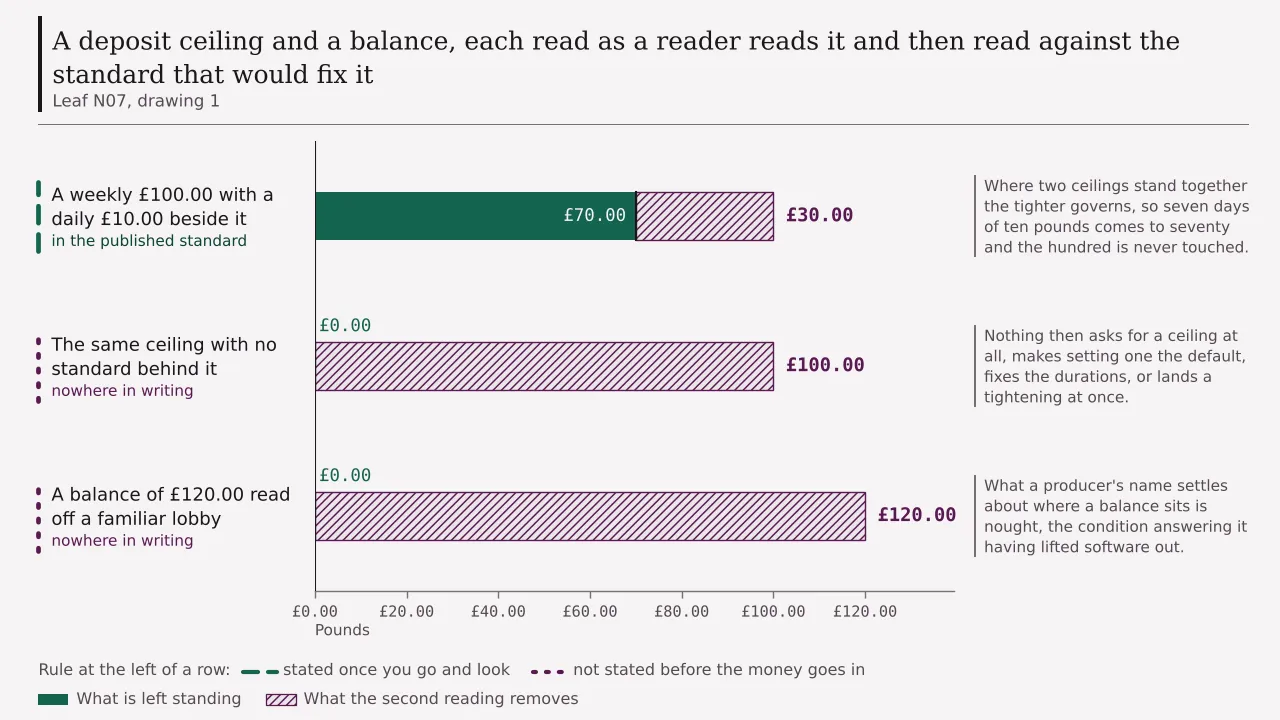
The middle bar of that drawing is the one a familiar name has nothing to say about. Where no standard reaches the address, a ceiling need not be offered, need not be the default, need not come in any particular duration, and a reduction need not land when it is asked for. The ceiling a reader believed in was never promised to them. It is a feature an address may or may not have built.
The two directions of travel are governed unevenly under the standard, and the unevenness is deliberate. Loosening a ceiling waits: the customer asks, at least a day passes, and the customer then acts again to confirm. Tightening one lands straight away, barring a technical fault. So the machinery is built to make a ceiling quick to pull in and slow to let out, which is a design decision no producer’s name bears on.
9
Duties about money arriving and money held, withdrawn
Reel offers found through catalogues of this sort belong to operators that carry no Great Britain licence whatsoever. What is worth itemising on a leaf about a producer’s name is the group of duties that name is most often taken to cover, which are the ones about money arriving and money sitting still. Other sorts of loss are real enough and get their price on neighbouring leaves.
Three travel together. The customer funds duty goes, so there is no published level, no written statement of one, no acknowledgement taken before play, and no twice-yearly reminder where the level opens with the words not protected. The standard on financial ceilings goes, so nothing asks for a ceiling at registration or at a first payment, nothing makes setting one the default, nothing fixes which durations appear, nothing requires the open box, and nothing holds a loosening behind a day’s wait while letting a tightening land at once. And the light-touch financial check goes, the one British rules apply above a monthly net deposit figure, which began as a net £500 inside a month from 30 August 2024, coming down to £150 once 28 February 2025 arrived.
Set that trio against the arithmetic above and the division comes out clean. Nothing in the three moves the £11.52 in part seven, since none of them bears on a multiple or on a margin. What they govern is the position of the money rather than its size: whether a reader knows where it sits, whether a ceiling stands over how much more may follow it in, and whether anybody is looking at the rate of arrival. The £120.00 in part seven is entirely a question of position, which is why this trio is the right one to name here.
The honest half is that none of the three would have made a familiar name informative. Inside the licence a producer’s mark in a tile still says nothing about the address, and a record is still the only place the question gets settled. A British licence does not turn a catalogue into a source. It makes an answer available elsewhere, and it compels the address to publish the level the catalogue was being asked for.
One further loss belongs here and the January notice named it. The national scheme covers an operator because that operator holds a British licence rather than because it volunteered, so a registration closing accounts across the licensed market has an edge at exactly the point the licence has one. Gamstop Online puts that edge in its own terms rather than leaving it to be discovered by running into it. Anybody relying on that protection ought to read an address outside the licensed market as an address outside the protection too, and the routes in the block below are a better destination than a registration form.
10
The check that does reach the question, and what it costs
The substitution in part two is cheap to make and cheap to undo, and the undoing takes about the same two seconds as the mistake. What follows is the replacement, in four steps, none of which needs an account or a payment.
Step one, write down the question being asked, which is almost always about the party holding the money rather than about the party that built the reel. Step two, find the operator’s own claim to a licence on the site and follow it through to the entry it points at. Step three, read the entry for two things: the activities permitted to that company, and whether the domain in your address bar is recorded against it. Step four, read the terms for the funds rating and for whether an acknowledgement was asked of you before you played, which is the question part four showed has an owner.
Where step three fails, the arithmetic on this leaf applies in full and the £120.00 line in part seven is the right way to think about any balance held there. Where step three succeeds, the register is the best available answer and still not a complete one, for the reason printed in part three: a row establishes a permission and not an operator’s identity on a given morning.
What no step does is read the lobby, and that omission is the point of the whole leaf. The catalogue is accurate about every build in it and silent about everything a reader is actually asking. Treating a producer’s filter as a licensing check is using an accurate document to answer a question it does not address, and the published record contains six addresses where exactly that was available to be done.
The shortest summary fits in three figures. £0.00 is what a maker’s name settles about where a balance sits. £120.00 is what was riding on it in the worked case. £11.52 is what the written multiple takes out of a separate £7.20 that the name says nothing about either. A register search costs nothing, takes a moment, and is the only one of those three figures a reader can do anything about before the money moves.
Questions
- Does a well-known slot supplier’s name mean a casino is licensed?
- No, and the published record settles that rather than leaving it to argument. A notice reached the industry on 20 January 2025 putting on record that builds from licensed producers had been found at addresses carrying no licence. A permission travels with the party holding it and a build travels with whoever contracts for it, so the two move along separate routes. Somebody standing in a lobby can see the build. They cannot see the permission behind the address.
- What does a supplier’s licence actually cover?
- The party holding it and the activities written into it, which is what a row in the public record settles and the whole of what it settles. It does not reach the terms a customer agrees to, the money a customer sends, or the balance a customer holds. The sharpest demonstration is a scope line: the licence condition obliging a business that holds customer money to publish a protection level lifts out a permission to supply gambling software by name, because the obligation is placed on whoever holds the customer.
- Has a regulator ever fined a games supplier over unlicensed sites?
- Yes, and the figures are worth carrying off. On 23 July 2026 a producer of casino games agreed £4.75m, the regulator having found its builds at six addresses with no British licence on them, open to people here, drawing visits in volume over a span the release dates as running from December 2023 until November 2024. Three findings sit under the sum: working out and weighing exposure to laundering and to the financing of terrorism, controls that ought to have stopped the builds reaching players here by way of operators with nothing, and due diligence towards customers. Divide the sum by the addresses and each carries a shade under £792,000, which is this leaf’s own division rather than an apportionment anybody made.
- How do I check whether a slot site is actually licensed?
- Four steps, none of which needs an account or a payment. Write down the question, which is about the party holding the money. Find the claim to a licensed status on the site and follow the route it offers through to the entry. Read that entry for the activities permitted to the company and for whether the domain in your address bar appears against it. Then read the terms for a protection level over customer money, and for whether anybody asked you to acknowledge one before you played. Reading the catalogue is not among the four, because a catalogue does not address the question.
- What happens to my balance if an offshore casino stops trading?
- Nothing published says, and that is the difficulty in one line. In Britain a business holding customer money has to write into its terms whether that money survives an insolvency, how far the protection reaches and by what mechanism, following a rating system and a shape the regulator lays down, delivered in writing and acknowledged by the customer before any of it may be gambled with. Beyond that licence there is no level, no specified shape and no acknowledgement. A balance of £120.00 held at such an address has no stated position at all.
- What are the customer funds protection ratings?
- Four levels with fixed names. A pair of them begin not protected, with no segregation following in one case and segregation of customer funds following in the other. Above that pair sits a level called medium protection, and above that a level called high protection. Two points matter more than the names. Keeping money apart and keeping it safe are separate properties, which is why the second level has to say both things in one line. And not a single level is a percentage: the system sorts a balance into a named position without saying what share of it comes back.
- Why does a six-monthly reminder about customer funds exist?
- Because a disclosure made once at a first payment goes stale in a reader’s memory while the exposure does not. A paragraph taking effect on 31 October 2025 requires that, where the level applied is either of the pair that begin not protected, a reminder goes out twice a year carrying three items: that the money would not come through an insolvency, what sum is being held for that customer, and an acknowledgement to be made before any of it is gambled with again. No threshold was adopted, so the smallest balance draws the same reminder as the largest.
- If I set a deposit limit, is that the amount I can actually deposit?
- Not where two ceilings overlap, and the worked case is published. Set a daily £10.00 against a weekly £100.00 and the tighter governs, so seven days of ten pounds comes to seventy, holding the week at £70.00 with the hundred never once touched. The £30.00 between them cannot be reached while both stand, which comes to £1,560.00 across a year from an interaction nobody announced. Beyond the British licence nothing asks for a ceiling to be offered in the first place.
- What is lost by playing recognisable games at an offshore address?
- Three duties about money arriving and money sitting still. The customer funds duty, so no published level, no written statement of one, no acknowledgement before play and no twice-yearly reminder where the level opens with the words not protected. The standard on financial ceilings, so nothing asks for a ceiling at registration or at a first payment, nothing makes setting one the default, nothing fixes which durations appear, and nothing holds a loosening behind a day’s wait while a tightening lands at once. And the light-touch financial check above a monthly net deposit figure, which began as a net £500 inside a month from 30 August 2024, coming down to £150 once 28 February 2025 arrived.
- How much is the mistake worth in money?
- £120.00 in the worked case, which is the whole balance, because what a producer’s name establishes about where a balance sits is £0.00. A separate £11.52 stands beside it: seventy-five presses at 10p turn over £7.50 and return an expected £7.20, a forty times clause asks £288.00 across the reels, and four pence out of each of those pounds puts the £7.20 at an expected close of minus £4.32. The name reaches neither figure. A search of the record costs nothing and reaches the first.