Terms read 19 October 2026 Leaf C16, revision 1
Handling a five pound payment costs about a pound, so something else is paying for it
Taking £5.00 in and sending it out again costs roughly £1.00 on the handling figures this leaf sets for itself, which is a fifth of the payment. A floor pitched beneath the cost of crossing it is not an offer about the payment at all. It is an advertisement for whatever recovers the pound afterwards, and this leaf works out what that has to be: 250 presses of a reel, or a written condition asking for £200.00 to cross one.
Stated on the banner £5.00 The smallest payment the advertisement invites, printed because a small number reads as an easy decision. Stated, once you go and look minus £3.00 Where a matched £5.00 credit closes under a forty times condition, with 96p returning on each staked pound. Not stated before the money goes in £1.00 of handling Acceptance, payout and screening, none of them on any banner and all of them recovered from somewhere.
Offers of this kind, with their smallest payments read
Every destination in this file is bought advertising. The site is paid a fee if a reader goes on to register, and no figure printed below moves because of it.
Bonus Spins UK Slip 01
Betportal
Ceiling as a multiple
The drop
€15.00
€1.00 in the euro
The claim reads €15.00. Once the terms beside it have applied, €0.00 of it can leave. The difference is the drop.
7 of the 15 terms on this slip could not be read before the money went in
Spins priced at this site's own 10p a spin, which the operator does not publish
Stated
€15.00
The claim as it is printed, before a single term has been applied to it.
Headline paid as spins
150 spins at 10c each, which is €15.00 of the figure above.
6 Nowhere
What one spin is worth
No unit is published for a spin, so the count is priced at this site's own 10p a spin. At half that price every figure below halves with it.
Match and other credit not priced
300% of three deposits, to a ceiling of €1,000. A share of a deposit nobody has made yet is not a sum, so no figure stands on this line and none is carried below.
Qualified
-€14.40
Written down somewhere, and taking part of the claim back. Each term carries the place it is written and the sum it takes.
2 Written terms at a distance this record does not establish
Play-through -€14.40
Carrying €14.40 through 35 times stakes €504.00 and costs €20.16 of it at 96 per cent return. That prices above the €14.40 there is to charge it against, so the whole of the credit goes and the line is held at that. The multiple sits on the bonus.
2 Written terms at a distance this record does not establish
Game weighting not priced
Slots only count towards the play-through. No contribution percentage is published, so the line above has been worked at full weight, which is the kindest reading there is.
2 Written terms at a distance this record does not establish
Ceiling on the winnings not priced
5x the bonus.
2 Written terms at a distance this record does not establish
Clock on the credit not priced
14 days.
2 Written terms at a distance this record does not establish
Largest stake while it runs not priced
€5.
3 Public record
Licence, and who holds it not priced
Licensed in Anjouan, Comoros, held by BetPortal Gaming Ltd, with Excite Ultra Media Ltd, reference ALSI-202601040-FI2. A register entry settles who holds a licence and what it permits. It does not settle who is running the site this morning.
4 Cashier
Smallest qualifying deposit your money
€20 a stage. That is €20.00 of your own money, and it is never netted into a drop.
5 On the way out
Checks before a withdrawal not priced
Documents before the first withdrawal.
Unstated
-€0.60
Applying without having been published anywhere, and costing money all the same.
6 Nowhere
What a spin hands back -€0.60
Staking a spin returns 96 per cent of it, so that share of the batch is the house's before a reel turns. This site works at that return and the operator publishes none where the claim is made.
6 Nowhere
Forfeited by rule cost unknown
Nothing is published under this heading, and it applies regardless.
6 Nowhere
Charge on the way out cost unknown
No charge on the way out is published as a figure, so nothing comes off this line. A charge that exists unpublished would come straight off whatever survives.
6 Nowhere
Smallest withdrawal allowed cost unknown
No smallest withdrawal is published as a figure. A floor nobody has published is still a floor, and it decides whether a small balance can move at all.
No Great Britain licence
Terms read 19 October 2026
Bonus Spins UK Slip 02
WinBeast
Ceiling as a sum
The drop
€50.00
€1.00 in the euro
The claim reads €50.00. Once the terms beside it have applied, €0.00 of it can leave. The difference is the drop.
8 of the 15 terms on this slip could not be read before the money went in
Spins priced at this site's own 10p a spin, which the operator does not publish
Stated
€50.00
The claim as it is printed, before a single term has been applied to it.
Headline paid as spins
500 spins at 10c each, which is €50.00 of the figure above.
6 Nowhere
What one spin is worth
No unit is published for a spin, so the count is priced at this site's own 10p a spin. At half that price every figure below halves with it.
Match and other credit not priced
50% to 100% of five deposits, each to a ceiling of €1,000, and a €650 free bet. A share of a deposit nobody has made yet is not a sum, so no figure stands on this line and none is carried below.
Qualified
-€48.00
Written down somewhere, and taking part of the claim back. Each term carries the place it is written and the sum it takes.
2 Written terms at a distance this record does not establish
Play-through -€48.00
Carrying €48.00 through 40 times stakes €1,920.00 and costs €76.80 of it at 96 per cent return. That prices above the €48.00 there is to charge it against, so the whole of the credit goes and the line is held at that. The multiple sits on the bonus and the winnings from the spins.
2 Written terms at a distance this record does not establish
Game weighting not priced
Slots, titles vary by country count towards the play-through. No contribution percentage is published, so the line above has been worked at full weight, which is the kindest reading there is.
2 Written terms at a distance this record does not establish
Ceiling on the winnings not priced
€100 a batch of spins.
2 Written terms at a distance this record does not establish
Clock on the credit not priced
7 days, spins 1 day.
3 Public record
Licence, and who holds it not priced
Licensed in Curaçao, holder not named on the site. A register entry settles who holds a licence and what it permits. It does not settle who is running the site this morning.
4 Cashier
Smallest qualifying deposit your money
€20 a stage. That is €20.00 of your own money, and it is never netted into a drop.
5 On the way out
Checks before a withdrawal not priced
Documents before the first withdrawal.
Unstated
-€2.00
Applying without having been published anywhere, and costing money all the same.
6 Nowhere
What a spin hands back -€2.00
Staking a spin returns 96 per cent of it, so that share of the batch is the house's before a reel turns. This site works at that return and the operator publishes none where the claim is made.
6 Nowhere
Largest stake while it runs cost unknown
Nothing is published under this heading, and it applies regardless.
6 Nowhere
Forfeited by rule cost unknown
Nothing is published under this heading, and it applies regardless.
6 Nowhere
Charge on the way out cost unknown
No charge on the way out is published as a figure, so nothing comes off this line. A charge that exists unpublished would come straight off whatever survives.
6 Nowhere
Smallest withdrawal allowed cost unknown
No smallest withdrawal is published as a figure. A floor nobody has published is still a floor, and it decides whether a small balance can move at all.
No Great Britain licence
Terms read 19 October 2026
Bonus Spins UK Slip 03
EliteSpin
Longest spin window
The drop
£50.00
£1.00 in the pound
The claim reads £50.00. Once the terms beside it have applied, £0.00 of it can leave. The difference is the drop.
8 of the 15 terms on this slip could not be read before the money went in
Spins priced at this site's own 10p a spin, which the operator does not publish
Stated
£50.00
The claim as it is printed, before a single term has been applied to it.
Headline paid as spins
500 spins at 10p each, which is £50.00 of the figure above.
6 Nowhere
What one spin is worth
No unit is published for a spin, so the count is priced at this site's own 10p a spin. At half that price every figure below halves with it.
Match and other credit not priced
50% to 100% of five deposits, each to a ceiling of £1,000. A share of a deposit nobody has made yet is not a sum, so no figure stands on this line and none is carried below.
Qualified
-£48.00
Written down somewhere, and taking part of the claim back. Each term carries the place it is written and the sum it takes.
2 Written terms at a distance this record does not establish
Play-through -£48.00
Carrying £48.00 through 40 times stakes £1,920.00 and costs £76.80 of it at 96 per cent return. That prices above the £48.00 there is to charge it against, so the whole of the credit goes and the line is held at that. The multiple sits on the bonus and the winnings from the spins.
2 Written terms at a distance this record does not establish
Game weighting not priced
Slots count towards the play-through. No contribution percentage is published, so the line above has been worked at full weight, which is the kindest reading there is.
2 Written terms at a distance this record does not establish
Ceiling on the winnings not priced
5x the bonus.
2 Written terms at a distance this record does not establish
Clock on the credit not priced
7 days, spins 3 days.
3 Public record
Licence, and who holds it not priced
Licensed in Costa Rica, held by PrimeTier Limited. A register entry settles who holds a licence and what it permits. It does not settle who is running the site this morning.
4 Cashier
Smallest qualifying deposit your money
£20 a stage. That is £20.00 of your own money, and it is never netted into a drop.
5 On the way out
Checks before a withdrawal not priced
Documents before the first withdrawal.
Unstated
-£2.00
Applying without having been published anywhere, and costing money all the same.
6 Nowhere
What a spin hands back -£2.00
Staking a spin returns 96 per cent of it, so that share of the batch is the house's before a reel turns. This site works at that return and the operator publishes none where the claim is made.
6 Nowhere
Largest stake while it runs cost unknown
Nothing is published under this heading, and it applies regardless.
6 Nowhere
Forfeited by rule cost unknown
Nothing is published under this heading, and it applies regardless.
6 Nowhere
Charge on the way out cost unknown
No charge on the way out is published as a figure, so nothing comes off this line. A charge that exists unpublished would come straight off whatever survives.
6 Nowhere
Smallest withdrawal allowed cost unknown
No smallest withdrawal is published as a figure. A floor nobody has published is still a floor, and it decides whether a small balance can move at all.
No Great Britain licence
Terms read 19 October 2026
Bonus Spins UK Slip 04
Crown Jewelz
Multiple unpublished
The drop
NOT WORKED
The multiple is not published in the operator's own terms. Since the sum cannot be worked around it, none is worked.
9 of the 14 terms on this slip could not be read before the money went in
No drop worked
Stated
£15.00
The claim as it is printed, before a single term has been applied to it.
Headline paid as spins
150 spins at 10p each, which is £15.00 of the figure above.
6 Nowhere
What one spin is worth
No unit is published for a spin, so the count is priced at this site's own 10p a spin. At half that price every figure below halves with it.
Match and other credit not priced
200% of the first deposit, then 150% twice, each to a ceiling of £1,000. A share of a deposit nobody has made yet is not a sum, so no figure stands on this line and none is carried below.
Qualified
NOT WORKED
Written down somewhere, and taking part of the claim back. Each term carries the place it is written and the sum it takes.
2 Written terms at a distance this record does not establish
Play-through not priced
40x the bonus, reported rather than published by the operator.
2 Written terms at a distance this record does not establish
Game weighting not priced
Slots count towards the play-through. No contribution percentage is published, so the line above has been worked at full weight, which is the kindest reading there is.
3 Public record
Licence, and who holds it not priced
Licensed in Curaçao, number not verified, holder not named on the site. A register entry settles who holds a licence and what it permits. It does not settle who is running the site this morning.
4 Cashier
Smallest qualifying deposit your money
£20. That is £20.00 of your own money, and it is never netted into a drop.
5 On the way out
Checks before a withdrawal not priced
Documents before the first withdrawal.
Unstated
NOT WORKED
Applying without having been published anywhere, and costing money all the same.
6 Nowhere
Ceiling on the winnings cost unknown
No ceiling is published. Nothing is assumed in its place.
6 Nowhere
Clock on the credit cost unknown
Nothing is published under this heading, and it applies regardless.
6 Nowhere
Largest stake while it runs cost unknown
Nothing is published under this heading, and it applies regardless.
6 Nowhere
Forfeited by rule cost unknown
Nothing is published under this heading, and it applies regardless.
6 Nowhere
Charge on the way out cost unknown
No charge on the way out is published as a figure, so nothing comes off this line. A charge that exists unpublished would come straight off whatever survives.
6 Nowhere
Smallest withdrawal allowed cost unknown
No smallest withdrawal is published as a figure. A floor nobody has published is still a floor, and it decides whether a small balance can move at all.
No Great Britain licence
Terms read 19 October 2026
Every figure in the second and third columns is this site's own working and nothing an operator has published. A claim is priced as printed, then the share a spin hands back at 96 per cent return comes off it, then what playing the multiple through costs at the same return, and then whatever a published ceiling, a charge on the way out or a floor on the smallest withdrawal takes from what has survived. The drop is the difference between the first figure and the last. The two columns add back up to it exactly, so no money leaves a slip without a term and a place beside it.
Which column a term falls in is settled by one question: has anybody written it down. A charge a reader meets at the payment screen is written down, and it stands in the second column with the cashier against it. A condition that binds without ever having been set down stands in the third, whatever it costs. Inside each column the terms run outwards from the banner, so the order itself says how far a reader would have had to go.
A count of spins has no unit until one is supplied. Where an operator publishes what one of its own spins is worth, that figure is used and the first column says it is theirs. Where none is published, this site's own 10p a spin stands in its place and every figure below moves in proportion with it. Where the multiple itself is unpublished, no drop is worked at all, because that is the one figure the sum cannot be done without.
Three words stand where a figure cannot. Not priced is a term that is written down and carries no number the arithmetic can take. Cost unknown is a term nobody has written down, costing something nobody has put a number on. Your money is money of the reader's own, which is never netted into a drop.
None of the operators in this file holds a Great Britain licence, so none of the duties that licence carries reaches them. Each of those duties is published in its own right, which is what makes its absence here something a reader can check rather than take on trust. Every gambling company licensed in Great Britain belongs to Gamstop Online, so a reader who has shut themselves out through the scheme is not shut out here. Social Responsibility Code 5.1.1 has held a play-through to a maximum of ten times the bonus funds since 19 January 2026, and it binds a licence holder and nobody else. Asked in a post of 21 October 2025 what is lost along with the licence, the Gambling Commission's Director of Enforcement and Intelligence answered: "unfair gaming practices, financial loss, and a lack of recourse if things go wrong". The same post puts blocked payouts, and withdrawal limits pitched high enough to be unreachable, among the behaviour the Commission has recorded. Nobody under 18 may hold an account at any of them.
Terms are reproduced in the wording their operator published, and each slip is dated with the day somebody sat down and read them. 19 October 2026 is the oldest of those dates. Anybody claiming an offer is bound by that operator's full terms, which are elsewhere, and never by a line standing here.
1
A payment that arrives worth less than it costs to take
Begin with the odd thing about the number. Five pounds is small enough that moving it costs a visible share of itself, which is not true of most sums anybody sends anywhere. On the handling figures set out in part two, all of them this leaf’s own, taking £5.00 in and later sending it back out costs about £1.00, so a business accepting that payment and doing nothing else with the account is worse off by a pound than if the payment had never arrived.
A floor is therefore not a neutral administrative setting once it falls far enough. Past a certain point it stops describing the payment and starts describing everything that has to follow the payment, because the arithmetic only balances if something follows. What has to follow, on the figures in part five, is £25.00 of staking, which is five complete passes of the balance and 250 presses at a tenth of a pound each.
This leaf takes no position on what floors are for in general, which is a separate question answered on a separate page about the licensed side of the market. The question here is narrower and belongs to the fourth of this site’s six places: given that a floor first appears at the cashier, what does an unusually low one tell a reader about whoever set it, and what is that information worth in pounds.
The other thing has to be stated before any of that. If a live registration with Gamstop Online is what brought somebody to these words, the account waiting at the end of them is the sort that registration exists to shut. Two places answer free of charge and in confidence: BeGambleAware.org, and GamCare.org.uk, which takes helpline calls on 0808 8020 133 whatever the hour. No sentence here sets out a path to a business a reader has already closed the door on, and none of the arithmetic below is a suggestion that anybody go anywhere.
Worth saying in the same breath: a declined gambling payment is a protection rather than an obstacle. A card scheme, a bank, a wallet or a network may turn such a payment away under a policy each one publishes for itself, and a refusal of that shape pulls in the same direction as a self-exclusion. What gets priced on this page is what such a refusal costs whoever it lands on. Avoiding one is not priced, described or hinted at.
The worked example throughout is a payment of £5.00 with a matched credit beside it, a forty times play-through wherever no other multiple is named, 96p returning per staked pound, and a weighting held at one. Those last three hold site-wide. Handling figures belong to this leaf alone and carry that label in whichever sentence spends one.
2
Pricing the handling, line by line, on figures set here
Three costs attach to a single small payment and two of them do not scale with its size, which is the whole reason the proportion gets ugly at the bottom of the range. Each figure below is chosen on this leaf to produce a worked example. None of them is taken from a published tariff, because no source citable on this site publishes one.
Acceptance on the way in: put it at 2 per cent of the payment plus 20p, which on £5.00 is 10p plus 20p, or £0.30. Paying the money back out again: put that at a flat 25p. Finding out whose account it is, ahead of any play whatever: put that at 45p, charged once as the account opens. Add them and a single small round trip carries £1.00 of handling, which is 20 per cent of the sum that moved.
| Payment | Acceptance at 2 per cent plus 20p | Payout at 25p | Opening check at 45p | Handling as a share |
|---|---|---|---|---|
| £5.00 | £0.30 | £0.25 | £0.45 | 20.0 per cent |
| £10.00 | £0.40 | £0.25 | £0.45 | 11.0 per cent |
| £20.00 | £0.60 | £0.25 | £0.45 | 6.5 per cent |
| £50.00 | £1.20 | £0.25 | £0.45 | 3.8 per cent |
| £100.00 | £2.20 | £0.25 | £0.45 | 2.9 per cent |
Climb the right-hand column from its foot and the curve steepens precisely where the advertisements gather. A hundred pounds carries under 3p of handling in each pound, which nobody need think about. Five pounds carries 20p in each pound, which is five times what a reel is expected to keep from one complete pass of that balance. Part five works that comparison out properly, and it is the hinge the whole leaf turns on.
One line of that table stands apart from the rest, since a duty sits under it instead of a commercial choice. A licensed operator cannot let play start until three particulars are established: which name, which address, which birth date. That requirement takes in bonus-funded play, and the demonstration builds of games along with it, under rules the regulator announced on 7 February 2019 and brought in on 7 May that year, displacing an arrangement under which an age check could trail the registration by 72 hours. Pricing that work at 45p is this leaf’s doing. The duty carries no price of its own, and part eight returns to who bears the cost of it.
3
The first subtraction, done on the paying side of the counter
This site always performs the same subtraction, and on most pages it is performed once. Here it is performed twice, on opposite sides of the counter, and the second is the unusual one. Take the ordinary one first so that the second has something to stand against.
A matched offer on a £5.00 payment credits £5.00. Forty times that credit is £200.00 of staking. Each pound staked keeps 4p back, so £200.00 of staking is expected to leave £8.00 with the margin, and the credit therefore closes at minus £3.00, being £5.00 multiplied by one less 1.6. Nothing in that line is specific to a low floor. It is the same arithmetic any credit meets at this multiple.
Credit as the offer prints it £5.00 Expected close at forty times minus £3.00 Cost of the clause, unopened £8.00
Eight pounds on a five pound payment is a ratio worth holding on to, because it travels through the rest of the leaf. The condition is expected to move more money than the payment contains, which is possible only because the staking is a flow and the payment is a stock. A reader who hands over £5.00 and reads nothing further has made a decision about a stock while the arithmetic that matters is about the flow.
£200.00 across the reels, demanded of an account opened with a single £5.00 payment
4
The second subtraction, done on the receiving side
Now turn the same instrument round and point it at the party taking the payment, which is not something this site usually does and is the only way to read a floor set this low. The claim read alone is that £5.00 has arrived. The claim with everything else applied is that £4.00 of it survives the handling in part two, assuming the account is opened, used once and closed.
Payment read as a sum arriving £5.00 After acceptance, payout and the opening check £4.00 Shortfall carried by the receiving side £1.00
So the subtraction happens twice here, and the two answers face in opposite directions. On the paying side £5.00 drops to minus £3.00, a gap of £8.00. On the receiving side £5.00 drops to £4.00, a gap of £1.00. Neither result is a loss that anybody gets invoiced for. Each is the distance between a sum read by itself and the same sum read with the remainder of the arrangement hung on it, and that distance is the only quantity this site computes.
The pair has to be read together, because separately each is misleading. The first makes the offer look worse than the payment, which it is. The second makes the payment look worse than nothing, which it also is, until the account does something. Put side by side they say that a five pound floor is a proposition about activity rather than about money, and that neither party has an interest in the balance sitting still.
A fair qualification belongs with the second block. The 45p opening check is spent once and the 25p payout is spent only if a payout happens, so a reader who deposits four times in a month pays 30p of acceptance on every one of them and 45p once, which is £1.65 of handling on £20.00 of payments, or 8.3 per cent rather than 20. The proportion improves with frequency, and that is a precise statement of what the receiving side is buying when it sets a floor this low.
5
Where a missing pound comes back, multiple by multiple
A pound has to be found from somewhere and there is only one place it can come from, which is money crossing the reels. At 96p returning on each pound staked, every pound of staking leaves 4p behind, so recovering £1.00 of handling takes £25.00 of staking. On a £5.00 balance that is five complete passes, and at a tenth of a pound a press it is 250 presses.
Two hundred and fifty presses is a quantity rather than a judgement, and it is the smallest honest answer to what a five pound floor needs in order to break even. Nothing about the figure is hidden, nobody is obliged to publish it, and it is reconstructible by anyone willing to assume a handling cost, which is the one input this leaf had to supply itself.
A written condition rearranges all of that, because a condition specifies the flow rather than waiting on it. Put the same £5.00 credit through four multiples and the recovery climbs in strict proportion: multiply the credit by the multiple for the staking, then take 4 per cent of that for the margin.
| Multiple written into the terms | Staking demanded | Expected margin | Expected close on the credit | Times the £1.00 of handling |
|---|---|---|---|---|
| Ten times | £50.00 | £2.00 | £3.00 | 2.0 |
| Twenty-five times | £125.00 | £5.00 | £0.00 | 5.0 |
| Forty times | £200.00 | £8.00 | minus £3.00 | 8.0 |
| Sixty times | £300.00 | £12.00 | minus £7.00 | 12.0 |
At twenty-five times the credit is expected to run out precisely, that multiple being one divided by the four hundredths a reel retains, and the same row covers the handling five times over. Rows beneath it cover it more comfortably still, out of money which never formed part of what was credited. Nor is the sixty times row hypothetical: while explaining why the multiple wanted a ceiling, the British regulator noted that some licensees were then applying up to 60 times, on a page dated 26 March 2025 and revised again on 27 January 2026.
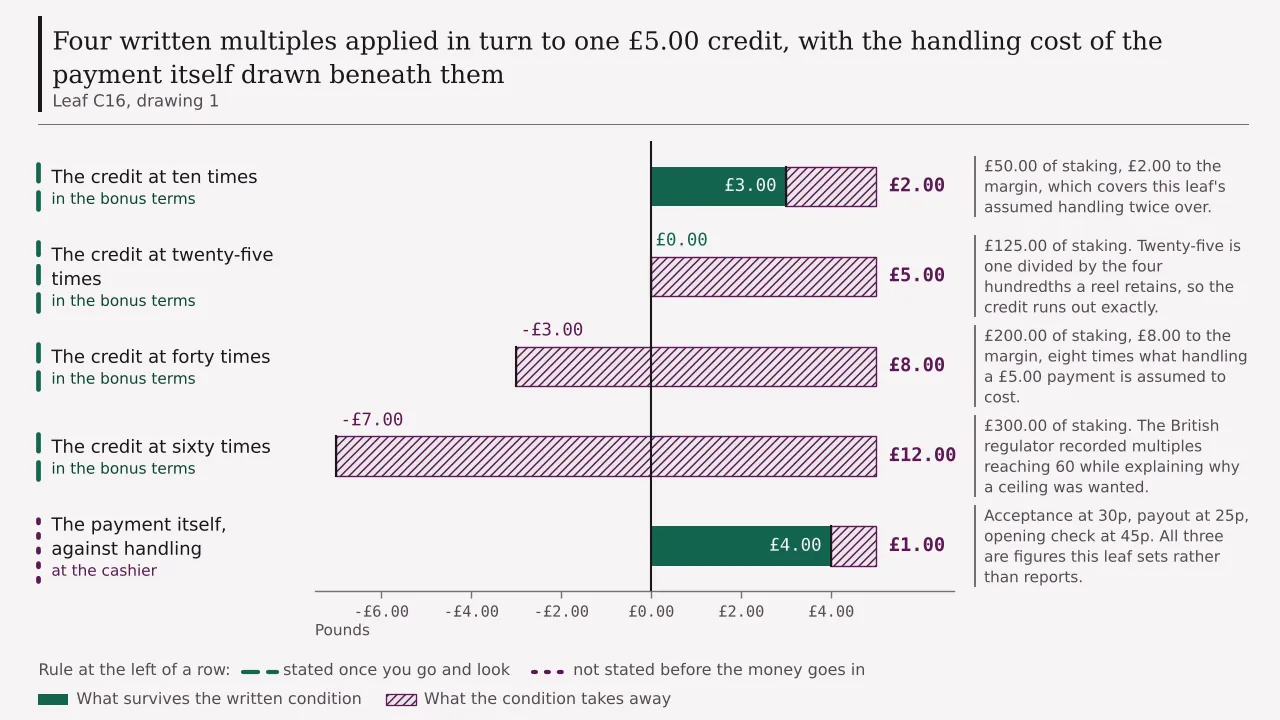
Putting the handling row on the same ledger as the multiples is the point of the drawing. The bottom bar is a pound and the bars above it run to eight and twelve, so the condition is not covering the handling by a margin. It is covering it many times over, and the surplus is what makes a floor beneath the cost of processing a rational thing for somebody to set.
6
Five pounds against a ceiling that does not reach this far
A coincidence of figures makes this leaf’s number unusually easy to think about. Inside the British licence, the most an adult of 25 or over may stake on a single online slot game cycle is £5, fixed by regulations carrying the date 25 February 2025, and £2 is the figure for anybody younger. A five pound payment is therefore one permitted cycle exactly for the older adult, and two cycles with a pound unspent for the younger one.
Those two ceilings start on dates the regulations themselves never print, giving only a formula, so the days come from guidance instead: £5 from 9 April 2025, then £2 from 21 May, six weeks behind it, with the single £5 figure covering all ages throughout the interval. The same guidance confines both ceilings to online slots and to nothing else a casino offers.
Work the comparison as arithmetic rather than as a rule and it becomes sharp. At this site’s assumed tenth of a pound a press, £5.00 is 50 game cycles. At the licensed ceiling for an adult over 25, the same £5.00 is one. The ratio between the slowest and the quickest way to spend the identical floor is therefore 50 to 1, and nothing outside the licence fixes either end of that range.
Bring the interval in and the spread turns into a duration. On a licensed reel-based build one cycle cannot follow another before 2.5 seconds have gone, so fifty presses need 125 seconds, a few seconds past two minutes. A single press at the licensed ceiling takes 2.5 seconds and is over. Beyond the licence neither the ceiling nor the interval binds anybody, so the identical floor may be a session of two minutes or an event lasting two and a half seconds, and the floor itself discloses nothing about which.
That is the sharpest thing a low floor conceals, and it is concealed by nobody. A number describing how much may be put in says nothing at all about how quickly it may be spent, and the two quantities are separate terms settled in separate places: the floor at the cashier, and the rate of spending nowhere in writing once the standard that would have fixed it does not apply.
7
Nine terms, their places, and which party each one costs
Collect the leaf into a single column, sorted the way this site sorts everything, with one extra mark: which side of the counter carries the cost. That mark is what turns a list of terms into an explanation of why a floor sits where it does.
| The term | Where it is settled | Worth on £5.00 | Which side carries it |
|---|---|---|---|
| Smallest payment invited | £5.00 | Neither; it is an invitation | |
| Least the payment screen will accept | at the cashier | £5.00 assumed | Neither; it is a setting |
| Acceptance on the way in | nowhere in writing | £0.30 assumed | The receiving side |
| Cost of sending the money back | nowhere in writing | £0.25 assumed | The receiving side |
| Finding out whose account it is | in a licence condition | £0.45 assumed | The receiving side |
| Play-through written over the credit | in the bonus terms | £8.00 removed | The paying side |
| Ceiling on a single game cycle | in a statutory instrument | £5.00, or nothing | The paying side |
| Interval between one cycle and the next | in a published standard | 125 seconds, or nothing | The paying side |
| Smallest balance the exit will move | at the cashier | Unpublished | The paying side |
Three of the nine rows are settled in a public record rather than in a document either party wrote, and all three of those rows switch off outside the British licence, which is why they carry two figures apiece. Three more are settled nowhere at all and every one of those is a cost on the receiving side, which is the reason this leaf had to supply its own figures for them.
The row worth staring at is the second. A floor is a setting rather than a cost, so it can be moved to any number the receiving side likes without anybody paying for the move directly. Lowering it raises the handling as a share of what arrives, and the increase has to be recovered from the flow. The floor is thus the one row in the table that is free to whoever sets it and expensive to whoever sets it badly.
8
Four costs carried only by a cashier inside the licence
Whatever this phrase turns up holds no Great Britain licence. On a page about what a payment costs to handle, the way to state that consequence is as a schedule of expenses: four obligations load real money onto a licensed operator, and a business without the licence carries not one of them. Treating protections as expenses for a moment makes the economics of a low floor legible from the far side.
First, one whole payment category is closed by rule. Borrowing on a card in order to gamble was barred outright from 14 April 2020, and putting the card through a money service business changes nothing. Measured against this leaf’s figures, closing a category leaves the 30p of acceptance exactly where it was and alters how many £5.00 payments turn up at all, which is an expense nobody can size and the licensed side meets anyway.
Second, the ceiling from part six, which lands on turnover. One permitted cycle at £5 for the over-25s, £2 for anybody younger, slots and nothing else, under regulations dated February 2025 and started on the two days the regulator published. Set that against the £25.00 of staking a pound of handling needs: the ceiling forbids none of the turnover and lengthens the time it takes, and the time is where the expense sits.
Third, a ceiling over the condition itself. The code provision on incentives stops a play-through above ten times the credited bonus, and the consultation response gives 19 January 2026 as the day it starts. Applied to the £5.00 credit on this page, that ceiling drops the expected margin from £8.00 at forty times to £2.00 at ten, three quarters less out of identical money. It is the biggest figure in this part and the one a low floor leans on hardest.
Fourth, an absence rather than a duty, which completes the set. Take the responsible gaming rulebook Curaçao sets over the businesses it licenses, whose version 1.0 carries 21 February 2025, and count its ceilings: none over a play-through multiple, none over a stake, none over the gap between cycles, none over automatic play, and none over celebrating a return no larger than what was staked. Bonuses occupy two sentences of it: communicate them transparently, attach conditions that are clear, and stop short of promotion that pushes anybody into excessive play.
Set the four together and the economics of a five pound floor stop being mysterious. Inside the licence the margin available from a £5.00 credit is capped at £2.00 by the ten times rule, the turnover that produces it is slowed by a ceiling on each cycle, a payment category is closed, and the opening check is compulsory before any play at all. Outside, the same £5.00 credit may be written at forty times for £8.00 of expected margin or at sixty for £12.00, with nothing fixing how fast the balance may be spent. A floor beneath its own handling cost is viable in the second arrangement and difficult in the first, and that difference is the honest answer to why the number is set where it is.
The scheme question hangs off the same licence. Joining the national self-exclusion register is an obligation that comes with a Great Britain licence, so a business holding none owes no duty to consult it before opening an account at £5.00 or at any other number. When the scheme published its figures on 16 July 2026, 614,738 people stood on that register and sign-ups across the year’s opening six months ran 16 per cent higher than before, yet none of that reach carries past the licensed population. Anybody for whom that matters wants the number in part one, not a payment screen.
9
What an unusually low floor is actually advertising
Put the leaf’s figures in one line and the answer falls out without rhetoric. A £5.00 payment carries £1.00 of handling. Recovering that needs £25.00 of staking, or 250 presses. A written condition at forty times demands £200.00 of staking and is expected to produce £8.00, which is eight times what the handling costs. So the floor is not advertising the payment. It is advertising the condition, and the condition is the only part of the arrangement large enough to pay for the rest of it.
That reading explains a thing readers often find puzzling, which is why a small floor and a large multiple travel together so reliably. They are not independent choices. A floor low enough to make the payment unprofitable requires a multiple high enough to recover the shortfall, and the arithmetic in part five shows how high: anything beneath about five times would leave the handling uncovered on a single pass, and the market wording this site works to sits far above that.
It also explains what the floor is not advertising, which matters just as much. It is not a statement that the account is cheap to run, since it is not. It is not a statement about how quickly the money may be spent, which part six showed can vary by a factor of 50 on an identical figure. And it is not a statement about getting anything back, since the smallest balance an exit will move is a separate setting on the same screen and is usually larger than the smallest payment it will take.
The last paragraph belongs to whoever typed the phrase. A fair share of the people searching these words hold a live registration with the national scheme, and for them the arithmetic above is not the part of the page worth having. The part worth having is that BeGambleAware.org charges nothing, that GamCare.org.uk charges nothing either and answers 0808 8020 133 at any hour somebody rings, and that a registration still in force is a protection doing its work rather than a difficulty to be got round.
Questions
- What does it actually cost to process a five pound deposit?
- About £1.00 on the figures this leaf sets for itself, which is a fifth of the payment. Acceptance on the way in at 2 per cent plus 20p is 30p; sending the money back out again is a flat 25p; and establishing who the account holder is costs 45p, charged once when the account opens. None of those is taken from a published tariff, because nothing citable on this site publishes one, and two of the three do not shrink when the payment does.
- If the payment loses money, why is the floor set so low?
- Because the pound is recovered from what happens next rather than from the payment. At 96p returning on each staked pound, every pound of staking leaves 4p behind, so £25.00 of staking covers £1.00 of handling. On a £5.00 balance that is five complete passes, or 250 presses at a tenth of a pound each. A written condition does the same job far faster: forty times a £5.00 credit demands £200.00 of staking and is expected to leave £8.00, which is eight times the handling.
- What does a forty times condition take off a five pound credit?
- £8.00. The terms demand £200.00 of staking, forty lots of what was credited; 4p stays behind out of every staked pound; so the margin collects £8.00 and the credit ends at an expected minus £3.00, which is £5.00 taken six tenths in the unhelpful direction. A credit meets its vanishing point at twenty-five times, that multiple being one divided by the four hundredths a reel retains.
- Why does this page subtract twice?
- Because a floor this low only makes sense when both sides of the counter are worked. The paying side’s subtraction takes £5.00 of credit down to an expected minus £3.00, a gap of £8.00. The receiving side’s takes £5.00 of payment down to £4.00 once the assumed handling is applied, a gap of £1.00. Read separately each is misleading; read together they say that a five pound floor is a proposition about activity rather than about money.
- How far would a five pound deposit go on a licensed site?
- Anywhere between one game cycle and fifty, according to the stake chosen. A single online slot cycle is capped at £5 for an adult of 25 or over, and at £2 for anybody younger, by regulations dated 25 February 2025. Those start dates were published by the regulator and not by the regulations themselves: £5 from 9 April 2025, then £2 from 21 May, six weeks behind it, with the single £5 figure covering all ages throughout the interval. At this site’s assumed tenth of a pound a press, the same £5.00 is 50 cycles, so quickest and slowest stand 50 to 1 apart.
- How long does spending five pounds take?
- Spent in ten-penny presses on a licensed reel-based build, 125 seconds at the very least, since a cycle cannot follow its predecessor inside 2.5 seconds and fifty presses therefore run a few seconds past two minutes. Taken at the licensed ceiling by an adult over 25, the same money is a single cycle lasting 2.5 seconds. Past the licence neither figure binds anybody, so the floor settles nothing whatever about how long the money lasts.
- Which costs does a licensed cashier carry that an offshore one does not?
- Four are worth naming. Borrowing on a card in order to gamble was barred outright from 14 April 2020, and putting that card through a money service business changes nothing either. A single online slot cycle is capped at £5, dropping to £2 below the age of 25. A play-through above ten times the credited bonus is shut off from 19 January 2026, which pulls the expected margin on a £5.00 credit down from £8.00 at forty times to £2.00. And play cannot begin until three particulars are established, which catches bonus-funded play and the demonstration builds along with everything else.
- Has anybody written down that multiples reach sixty times?
- The British regulator has, while explaining why a ceiling was needed. Its response to the consultation puts on record that some licensees were by then applying up to 60 times, on a page dated 26 March 2025 and revised again on 27 January 2026. Run against a £5.00 credit, sixty times calls for £300.00 of staking, is expected to hand £12.00 to the margin, and finishes at minus £7.00, which is twelve times the handling this leaf assumes.
- Does an offshore rulebook cap anything a British one caps?
- The single published rulebook read for this site does not. Count the ceilings in the responsible gaming rulebook Curaçao sets over the businesses it licenses, whose version 1.0 carries 21 February 2025, and the answer is none over a play-through multiple, none over a stake, none over the gap between cycles, none over automatic play, and none over celebrating a return no larger than what was staked. Bonuses take up two sentences of it: communicate them transparently, attach conditions that are clear, and stop short of promotion that pushes anybody into excessive play.
- Does a low floor mean fewer questions are asked?
- That conclusion is neither drawn nor supported here, and no figure on the page points towards it. The arithmetic supports something narrower: a floor pitched beneath its own handling has to be recovered from staking, which makes the condition hung on the account the part worth reading before anything else. Joining the national self-exclusion register is an obligation that comes with a Great Britain licence, so a business holding none consults nothing before opening an account at any number, and anybody for whom that matters wants the helpline instead of a payment screen.