Terms read 19 October 2026 Leaf C17, revision 1
A prepaid voucher travels one way, so the journey back belongs to somebody else
A voucher bought for £30.00 can fund an account and, in the ordinary case, cannot receive anything in return. That turns the exit into a decision rather than a mechanism. This leaf puts a figure on the decision: a balance of £75.00 needs a 40 per cent chance of arriving before the £30.00 is recovered, it cannot be sold to anybody at any price, and the timetables that would ordinarily stand behind the decision are measured here in days rather than described.
Stated on the banner £30.00 The sum a voucher carries inward, which is the only leg of the journey anybody advertises. Stated, once you go and look £48.00 gone The price a forty times condition puts on £30.00 of credit, worked where 96p of every staked pound returns. Not stated before the money goes in Silences, three Which route the money leaves by, how many days that takes, and who is obliged to answer if it never happens.
Offers of this kind, with their exit terms read
Every destination in this file is bought advertising. The site is paid a fee if a reader goes on to register, and no figure printed below moves because of it.
Bonus Spins UK Slip 01
Betportal
Ceiling as a multiple
The drop
€15.00
€1.00 in the euro
The claim reads €15.00. Once the terms beside it have applied, €0.00 of it can leave. The difference is the drop.
7 of the 15 terms on this slip could not be read before the money went in
Spins priced at this site's own 10p a spin, which the operator does not publish
Stated
€15.00
The claim as it is printed, before a single term has been applied to it.
Headline paid as spins
150 spins at 10c each, which is €15.00 of the figure above.
6 Nowhere
What one spin is worth
No unit is published for a spin, so the count is priced at this site's own 10p a spin. At half that price every figure below halves with it.
Match and other credit not priced
300% of three deposits, to a ceiling of €1,000. A share of a deposit nobody has made yet is not a sum, so no figure stands on this line and none is carried below.
Qualified
-€14.40
Written down somewhere, and taking part of the claim back. Each term carries the place it is written and the sum it takes.
2 Written terms at a distance this record does not establish
Play-through -€14.40
Carrying €14.40 through 35 times stakes €504.00 and costs €20.16 of it at 96 per cent return. That prices above the €14.40 there is to charge it against, so the whole of the credit goes and the line is held at that. The multiple sits on the bonus.
2 Written terms at a distance this record does not establish
Game weighting not priced
Slots only count towards the play-through. No contribution percentage is published, so the line above has been worked at full weight, which is the kindest reading there is.
2 Written terms at a distance this record does not establish
Ceiling on the winnings not priced
5x the bonus.
2 Written terms at a distance this record does not establish
Clock on the credit not priced
14 days.
2 Written terms at a distance this record does not establish
Largest stake while it runs not priced
€5.
3 Public record
Licence, and who holds it not priced
Licensed in Anjouan, Comoros, held by BetPortal Gaming Ltd, with Excite Ultra Media Ltd, reference ALSI-202601040-FI2. A register entry settles who holds a licence and what it permits. It does not settle who is running the site this morning.
4 Cashier
Smallest qualifying deposit your money
€20 a stage. That is €20.00 of your own money, and it is never netted into a drop.
5 On the way out
Checks before a withdrawal not priced
Documents before the first withdrawal.
Unstated
-€0.60
Applying without having been published anywhere, and costing money all the same.
6 Nowhere
What a spin hands back -€0.60
Staking a spin returns 96 per cent of it, so that share of the batch is the house's before a reel turns. This site works at that return and the operator publishes none where the claim is made.
6 Nowhere
Forfeited by rule cost unknown
Nothing is published under this heading, and it applies regardless.
6 Nowhere
Charge on the way out cost unknown
No charge on the way out is published as a figure, so nothing comes off this line. A charge that exists unpublished would come straight off whatever survives.
6 Nowhere
Smallest withdrawal allowed cost unknown
No smallest withdrawal is published as a figure. A floor nobody has published is still a floor, and it decides whether a small balance can move at all.
No Great Britain licence
Terms read 19 October 2026
Bonus Spins UK Slip 02
WinBeast
Ceiling as a sum
The drop
€50.00
€1.00 in the euro
The claim reads €50.00. Once the terms beside it have applied, €0.00 of it can leave. The difference is the drop.
8 of the 15 terms on this slip could not be read before the money went in
Spins priced at this site's own 10p a spin, which the operator does not publish
Stated
€50.00
The claim as it is printed, before a single term has been applied to it.
Headline paid as spins
500 spins at 10c each, which is €50.00 of the figure above.
6 Nowhere
What one spin is worth
No unit is published for a spin, so the count is priced at this site's own 10p a spin. At half that price every figure below halves with it.
Match and other credit not priced
50% to 100% of five deposits, each to a ceiling of €1,000, and a €650 free bet. A share of a deposit nobody has made yet is not a sum, so no figure stands on this line and none is carried below.
Qualified
-€48.00
Written down somewhere, and taking part of the claim back. Each term carries the place it is written and the sum it takes.
2 Written terms at a distance this record does not establish
Play-through -€48.00
Carrying €48.00 through 40 times stakes €1,920.00 and costs €76.80 of it at 96 per cent return. That prices above the €48.00 there is to charge it against, so the whole of the credit goes and the line is held at that. The multiple sits on the bonus and the winnings from the spins.
2 Written terms at a distance this record does not establish
Game weighting not priced
Slots, titles vary by country count towards the play-through. No contribution percentage is published, so the line above has been worked at full weight, which is the kindest reading there is.
2 Written terms at a distance this record does not establish
Ceiling on the winnings not priced
€100 a batch of spins.
2 Written terms at a distance this record does not establish
Clock on the credit not priced
7 days, spins 1 day.
3 Public record
Licence, and who holds it not priced
Licensed in Curaçao, holder not named on the site. A register entry settles who holds a licence and what it permits. It does not settle who is running the site this morning.
4 Cashier
Smallest qualifying deposit your money
€20 a stage. That is €20.00 of your own money, and it is never netted into a drop.
5 On the way out
Checks before a withdrawal not priced
Documents before the first withdrawal.
Unstated
-€2.00
Applying without having been published anywhere, and costing money all the same.
6 Nowhere
What a spin hands back -€2.00
Staking a spin returns 96 per cent of it, so that share of the batch is the house's before a reel turns. This site works at that return and the operator publishes none where the claim is made.
6 Nowhere
Largest stake while it runs cost unknown
Nothing is published under this heading, and it applies regardless.
6 Nowhere
Forfeited by rule cost unknown
Nothing is published under this heading, and it applies regardless.
6 Nowhere
Charge on the way out cost unknown
No charge on the way out is published as a figure, so nothing comes off this line. A charge that exists unpublished would come straight off whatever survives.
6 Nowhere
Smallest withdrawal allowed cost unknown
No smallest withdrawal is published as a figure. A floor nobody has published is still a floor, and it decides whether a small balance can move at all.
No Great Britain licence
Terms read 19 October 2026
Bonus Spins UK Slip 03
EliteSpin
Longest spin window
The drop
£50.00
£1.00 in the pound
The claim reads £50.00. Once the terms beside it have applied, £0.00 of it can leave. The difference is the drop.
8 of the 15 terms on this slip could not be read before the money went in
Spins priced at this site's own 10p a spin, which the operator does not publish
Stated
£50.00
The claim as it is printed, before a single term has been applied to it.
Headline paid as spins
500 spins at 10p each, which is £50.00 of the figure above.
6 Nowhere
What one spin is worth
No unit is published for a spin, so the count is priced at this site's own 10p a spin. At half that price every figure below halves with it.
Match and other credit not priced
50% to 100% of five deposits, each to a ceiling of £1,000. A share of a deposit nobody has made yet is not a sum, so no figure stands on this line and none is carried below.
Qualified
-£48.00
Written down somewhere, and taking part of the claim back. Each term carries the place it is written and the sum it takes.
2 Written terms at a distance this record does not establish
Play-through -£48.00
Carrying £48.00 through 40 times stakes £1,920.00 and costs £76.80 of it at 96 per cent return. That prices above the £48.00 there is to charge it against, so the whole of the credit goes and the line is held at that. The multiple sits on the bonus and the winnings from the spins.
2 Written terms at a distance this record does not establish
Game weighting not priced
Slots count towards the play-through. No contribution percentage is published, so the line above has been worked at full weight, which is the kindest reading there is.
2 Written terms at a distance this record does not establish
Ceiling on the winnings not priced
5x the bonus.
2 Written terms at a distance this record does not establish
Clock on the credit not priced
7 days, spins 3 days.
3 Public record
Licence, and who holds it not priced
Licensed in Costa Rica, held by PrimeTier Limited. A register entry settles who holds a licence and what it permits. It does not settle who is running the site this morning.
4 Cashier
Smallest qualifying deposit your money
£20 a stage. That is £20.00 of your own money, and it is never netted into a drop.
5 On the way out
Checks before a withdrawal not priced
Documents before the first withdrawal.
Unstated
-£2.00
Applying without having been published anywhere, and costing money all the same.
6 Nowhere
What a spin hands back -£2.00
Staking a spin returns 96 per cent of it, so that share of the batch is the house's before a reel turns. This site works at that return and the operator publishes none where the claim is made.
6 Nowhere
Largest stake while it runs cost unknown
Nothing is published under this heading, and it applies regardless.
6 Nowhere
Forfeited by rule cost unknown
Nothing is published under this heading, and it applies regardless.
6 Nowhere
Charge on the way out cost unknown
No charge on the way out is published as a figure, so nothing comes off this line. A charge that exists unpublished would come straight off whatever survives.
6 Nowhere
Smallest withdrawal allowed cost unknown
No smallest withdrawal is published as a figure. A floor nobody has published is still a floor, and it decides whether a small balance can move at all.
No Great Britain licence
Terms read 19 October 2026
Bonus Spins UK Slip 04
Crown Jewelz
Multiple unpublished
The drop
NOT WORKED
The multiple is not published in the operator's own terms. Since the sum cannot be worked around it, none is worked.
9 of the 14 terms on this slip could not be read before the money went in
No drop worked
Stated
£15.00
The claim as it is printed, before a single term has been applied to it.
Headline paid as spins
150 spins at 10p each, which is £15.00 of the figure above.
6 Nowhere
What one spin is worth
No unit is published for a spin, so the count is priced at this site's own 10p a spin. At half that price every figure below halves with it.
Match and other credit not priced
200% of the first deposit, then 150% twice, each to a ceiling of £1,000. A share of a deposit nobody has made yet is not a sum, so no figure stands on this line and none is carried below.
Qualified
NOT WORKED
Written down somewhere, and taking part of the claim back. Each term carries the place it is written and the sum it takes.
2 Written terms at a distance this record does not establish
Play-through not priced
40x the bonus, reported rather than published by the operator.
2 Written terms at a distance this record does not establish
Game weighting not priced
Slots count towards the play-through. No contribution percentage is published, so the line above has been worked at full weight, which is the kindest reading there is.
3 Public record
Licence, and who holds it not priced
Licensed in Curaçao, number not verified, holder not named on the site. A register entry settles who holds a licence and what it permits. It does not settle who is running the site this morning.
4 Cashier
Smallest qualifying deposit your money
£20. That is £20.00 of your own money, and it is never netted into a drop.
5 On the way out
Checks before a withdrawal not priced
Documents before the first withdrawal.
Unstated
NOT WORKED
Applying without having been published anywhere, and costing money all the same.
6 Nowhere
Ceiling on the winnings cost unknown
No ceiling is published. Nothing is assumed in its place.
6 Nowhere
Clock on the credit cost unknown
Nothing is published under this heading, and it applies regardless.
6 Nowhere
Largest stake while it runs cost unknown
Nothing is published under this heading, and it applies regardless.
6 Nowhere
Forfeited by rule cost unknown
Nothing is published under this heading, and it applies regardless.
6 Nowhere
Charge on the way out cost unknown
No charge on the way out is published as a figure, so nothing comes off this line. A charge that exists unpublished would come straight off whatever survives.
6 Nowhere
Smallest withdrawal allowed cost unknown
No smallest withdrawal is published as a figure. A floor nobody has published is still a floor, and it decides whether a small balance can move at all.
No Great Britain licence
Terms read 19 October 2026
Every figure in the second and third columns is this site's own working and nothing an operator has published. A claim is priced as printed, then the share a spin hands back at 96 per cent return comes off it, then what playing the multiple through costs at the same return, and then whatever a published ceiling, a charge on the way out or a floor on the smallest withdrawal takes from what has survived. The drop is the difference between the first figure and the last. The two columns add back up to it exactly, so no money leaves a slip without a term and a place beside it.
Which column a term falls in is settled by one question: has anybody written it down. A charge a reader meets at the payment screen is written down, and it stands in the second column with the cashier against it. A condition that binds without ever having been set down stands in the third, whatever it costs. Inside each column the terms run outwards from the banner, so the order itself says how far a reader would have had to go.
A count of spins has no unit until one is supplied. Where an operator publishes what one of its own spins is worth, that figure is used and the first column says it is theirs. Where none is published, this site's own 10p a spin stands in its place and every figure below moves in proportion with it. Where the multiple itself is unpublished, no drop is worked at all, because that is the one figure the sum cannot be done without.
Three words stand where a figure cannot. Not priced is a term that is written down and carries no number the arithmetic can take. Cost unknown is a term nobody has written down, costing something nobody has put a number on. Your money is money of the reader's own, which is never netted into a drop.
None of the operators in this file holds a Great Britain licence, so none of the duties that licence carries reaches them. Each of those duties is published in its own right, which is what makes its absence here something a reader can check rather than take on trust. Every gambling company licensed in Great Britain belongs to Gamstop Online, so a reader who has shut themselves out through the scheme is not shut out here. Social Responsibility Code 5.1.1 has held a play-through to a maximum of ten times the bonus funds since 19 January 2026, and it binds a licence holder and nobody else. Asked in a post of 21 October 2025 what is lost along with the licence, the Gambling Commission's Director of Enforcement and Intelligence answered: "unfair gaming practices, financial loss, and a lack of recourse if things go wrong". The same post puts blocked payouts, and withdrawal limits pitched high enough to be unreachable, among the behaviour the Commission has recorded. Nobody under 18 may hold an account at any of them.
Terms are reproduced in the wording their operator published, and each slip is dated with the day somebody sat down and read them. 19 October 2026 is the oldest of those dates. Anybody claiming an offer is bound by that operator's full terms, which are elsewhere, and never by a line standing here.
1
Money with a forward gear and no reverse
A prepaid voucher is bought for cash or near-cash, carries a value stated of the thing itself, and is spent by handing over a code. Nothing in that description provides for anything coming back, and in the ordinary case nothing does: the instrument moves value in a single direction, so an account funded that way holds a balance with no homeward route attached to the thing that paid for it. Everything on this leaf follows from that single property, which is why it stands in the opening lines instead of surfacing somewhere around part seven.
The consequence is easy to miss because it is a consequence about absence. Where an instrument carries value both ways, nobody has to decide where a payout goes, since the answer is wherever the payment came from. Where it does not, somebody has to decide, and the deciding happens at the cashier at the moment a reader asks to leave. A decision is a different kind of object from a mechanism. It can be made quickly, slowly or not at all.
Before any of the arithmetic, the thing that matters more than the arithmetic. Somebody who has reached these words while a registration with Gamstop Online is running is reading about an account that registration exists to prevent. Two routes answer at no cost and in confidence: GamCare.org.uk, and BeGambleAware.org. GamCare also runs the National Gambling Helpline, which picks up on 0808 8020 133 on any day of the year and at any hour of it. This page contains no route to an operator anybody has excluded themselves from, and the figures below are not an argument for finding one.
The same applies to a payment that will not go through. A network, a bank, a wallet or a card scheme that declines to move money towards a gambling account is protecting from a different direction than a self-exclusion protects from, and deserves reading that way. What this leaf measures is the cost of meeting a refusal. Getting past one is not measured, described or implied at any point.
One boundary is worth marking so that the leaf stays on its own ground. How a voucher is sold, and what buying one in fixed denominations does to a reader wanting an odd sum, is a separate question handled on a separate page about the licensed market. This leaf takes the payment as made and looks only at the far end: the journey back, who owns the decision about it, and what the decision is worth in pounds.
The example worked throughout starts from a voucher of £30.00, adds a matched credit of the same size, applies a play-through of forty times, 96p coming back for every pound staked, and weighting pinned at one. Three of those five are site-wide fixtures. The voucher, the £75.00 balance reached in part four and every period counted in days are chosen on this leaf, and each carries its label again in whichever sentence spends it.
2
When the way out stops being a mechanism and becomes a decision
Sort the ways money can leave a gambling account and there turn out to be three kinds, distinguished by how much of the outcome belongs to a person rather than to a system. A return to the instrument that paid in is automatic and belongs to nobody. A return to a different instrument that the account already recognises is semi-automatic and belongs to whoever checks the new instrument. A return to an instrument produced for the first time at the moment of leaving belongs entirely to whoever is willing to approve it.
A voucher-funded balance begins in the third category by construction, because the only instrument on file is one that cannot receive. So the first thing a reader meets on asking to leave is not a delay. It is a request for something new, and the request arrives at the one moment when the reader has the least leverage they will ever have: after the money is in, after the condition has been worked through, and with a balance sitting on a screen that somebody else controls.
None of that is unusual or improper in itself, and a licensed operator asks much the same question at much the same point. What differs is whether anything behind the question has a deadline on it, which is what parts six and seven measure.
| How the balance leaves | Where that is settled | Who owns the outcome |
|---|---|---|
| Back along the route that paid in | at the cashier | Nobody; it is automatic |
| To an instrument already on the account | at the cashier | Whoever checks that instrument |
| To an instrument produced at the exit | on the way out | Whoever approves it, if anyone |
| Not at all, the balance staying put | nowhere in writing | Decided by silence |
The fourth row is in the table because it is a real outcome and because nothing in the first three excludes it. A balance that stays put is not a refusal and not an approval. It is the absence of either, and the absence of either is only a problem where something obliges somebody to produce one of the two inside a measured period. Parts six and seven are about exactly that obligation, and about how much of it survives outside the British licence.
3
The substitute route, and the days nobody attaches a number to
Producing a second instrument is itself a small chain of events, and the chain has a length even though nobody publishes one. The reader nominates something. Somebody looks at it. The nomination is accepted, queried or ignored. Then the payment is scheduled, and then it travels. Four steps, and a reader can observe only the first and the last.
Assume three working days for the look, two more for the scheduling and two for the travel, which gives seven days in all and is this leaf’s own arithmetic rather than anything observed. Assume a second branch where the nomination is queried once, adding a further round of correspondence at four days, and the total reaches eleven. Neither figure is published by any source citable here, which is the finding: the length of the substitute route is settled nowhere in writing.
That absence is worth separating from a different absence it is often confused with. The documents that may be asked for at the exit are, inside the British licence, a thing a customer has to be told about before any money goes in. Three things have to be covered: which documents could be wanted, at what moment they could be called for, and by what means they are to be sent. That wording belongs to the licence condition on verifying who a customer is, and it is a duty about advance notice rather than about the check itself.
Converted into this leaf’s units, that duty is worth four of the eleven days, since notice given in advance deletes the branch where a nomination gets queried and the correspondence runs round a second time. The check happens either way. What moves is whether the answer was assembled before paying or is being assembled while a balance sits, and the gap between those two states is the queue.
7 days assumed for a clean substitution, 11 where the nomination is queried once
A second published point belongs beside it, bearing on what may be asked for. Which documents get wanted is left open: passports, driving licences and household bills are named as the kinds of thing that come up, no list is prescribed, and a payout held back for want of identity information is recorded as something that may leave an operator in breach. The consumer page carrying all of that gives 23 September 2020 as its publication date and 13 April 2022 as its last revision, making it older than most sources used here, and printing both dates is part of using it properly.
4
Seventy-five pounds that may not be handed to anybody else
Take the worked balance. A reader who paid £30.00 by voucher, worked through a condition and finished with £75.00 on the screen is holding a figure that is real in one sense and useless in another. It is real because the account states it and the terms agree with the account. It is useless until somebody decides to move it, and part two established who that somebody is.
Ordinarily an asset a person cannot presently use still has a value, because it can be sold to somebody who can wait. That escape is shut here, and shut in writing. Curaçao’s complaints policy for licensees records that only the registered player may complain, the governing ordinance having put every claim a player holds against a licence holder beyond pledging, pawning, leasing, renting, gifting or sale. Six verbs, and between them they close every route by which a position could be passed to anybody.
Balance the account states £75.00 Value of the same balance to anybody else £0.00 Price of a claim that may not be assigned £75.00
Seventy-five pounds is an unusual difference to print, because the whole of the figure is the difference. There is no partial market, no discount at which somebody would take the position on, and no third party with standing to pursue it. The claim belongs to one person and expires with that person’s patience, which is a property the balance shares with very few other things a reader is likely to own.
Two further limits travel with the same rulebook and are worth stating because both close doors a reader might assume stayed open. Once a dispute-resolution process has finished it may not be begun again with a different provider, and where a player walks away from a process already running, the policy says they should not be able to raise the dispute again later. So the route out is not only singular: it is attempted once.
5
Printing a threshold instead of inventing a probability
The honest arithmetic on a stranded balance runs into a wall straight away. What the balance is worth is the balance multiplied by the chance that it arrives, and nothing citable on this site publishes that chance for any arrangement anywhere. Inventing one would be the exact failure this site exists to avoid, so this leaf does the other thing: it prints the level at which the sum breaks even and leaves the reader to judge whether reality sits above or below it.
The sum is small. A voucher of £30.00 bought the position. A balance of £75.00 is what the position is now worth if it arrives. Thirty divided by seventy-five is 0.40, so the balance has to arrive four times in ten for a reader to be square on the voucher alone.
Balance read as though it were cash £75.00 Worth at the chance that recovers the voucher £30.00 Held by whoever owns the decision £45.00
So the subtraction arrives twice on this leaf, as it does on every page here, and the two instances are of different kinds. Part eight performs the familiar one on a written condition and produces £48.00. This one is performed on a figure nobody has written down at all, and it produces £45.00 by refusing to guess and printing the threshold instead. Saying which of the two is which is the point of doing both.
Waiting itself is almost free, and printing that keeps the argument honest. Hold £75.00 for eight weeks and the carry at an assumed 4 per cent a year is 46p, which is 0.6 per cent of the balance. That rate is picked here and quoted from nowhere. Forty-six pence is not what anybody is worried about, and the comparison establishes it: the cost of a stranded balance is not the time value of money, it is the 60 per cent of the balance that sits beyond the break-even chance.
6
Five deadlines, converted into days and set against the wait
Britain puts measured periods around an argument about money, all of them settled in published guidance, and the useful way to read them here is to convert every one into days and compare them with the seven to eleven days of part three. Doing so turns a set of rules into a single column of numbers that can be held against a wait.
| What the period covers | Length in days | Who the period binds | What happens at the end |
|---|---|---|---|
| Acknowledging a complaint, doors never shut | 1 | The operator | An acknowledgement is due |
| Acknowledging it elsewhere | 3 working | The operator | An acknowledgement is due |
| The whole process, escalation included | 56 | The operator | A closing letter is due |
| Window for raising it at all | 182 | The customer | The right to raise it lapses |
| A customer going quiet over something reasonable | 7 | The customer | The count may be halted |
Fifty-six days is eight weeks and it is the figure doing the heaviest lifting, because it is an outer limit on the whole business rather than a target. A hundred and eighty-two days is roughly six months and runs the other way, protecting the customer’s right to start. Where a customer stays quiet for seven days over something reasonable the count may be halted on the spot, picking up afterwards from the same place rather than from nought. At the end of it a closing letter must set out the reasoning, record that the operator has gone as far internally as it will go, and point the way towards an independent adjudicator.
Now set those days against the wait in part three and the mismatch appears. Seven to eleven days is how long a substitution takes when it works. Fifty-six days is how long an argument about it may take before somebody must write a letter. The first number is about a process going right and the second is about a process going wrong, and only the second has a rule behind it.
One thing the column does not cover is worth naming, because it is where this leaf’s subject actually sits. None of those periods attaches to the payment decision itself. They attach to a complaint about the payment decision, which is a later object with its own starting gun. A balance that is neither paid nor refused has not yet produced the thing the clocks measure, which is why silence is the most expensive answer available to whoever owns the decision.
7
Four rulebooks, graded by how much of one they publish
Writing that there is nobody at the other end would be inaccurate, and this site does not write inaccurate sentences for effect. What is true is that the answer differs by jurisdiction, that it can be graded, and that two of the gradings are a statement about what could not be read rather than about what was found.
Britain sits at one end. A body adjudicating between a licensee and a customer must be approved by the regulator before a licensee may use it at all. Eight appear on the published list, with coverage running unevenly across them: the regulator’s own table gives one of them a row reading family entertainment centres, public houses and members’ clubs, adult gaming centres, and bingo other than remote. Remote casino appears nowhere in it. Establishing which adjudicator stands behind an account therefore means reading a column instead of a name.
Curaçao publishes a genuine framework, and any page saying otherwise is simply wrong. Six months are allowed, dated from the bet’s settlement or from the incident complained of; receipt must be confirmed in writing within seven days; and a four-week response may be stretched one time by four further weeks, with written notice to the player, landing on the same fifty-six days Britain works to. Authorship is where the two frameworks separate. An operator there may fix the parameters of the adjudication itself: whether a dispute must pass through it ahead of any court, whether the player is bound by what comes out of it, and whether some minimum value has to be reached before escalation is available.
That last parameter is the one with a figure attached on this leaf. A minimum claim value is a floor on the right to argue, and the balance in part four is £75.00. Where such a floor sits beneath £75.00 the balance has a route; where it sits above, the balance has none. The regulator there says it will weigh the circumstances, allowing that a worry about misuse may be reasonable where claims are small, and expecting a case about letting a self-excluded person in to be treated seriously at any value at all. None of the thresholds themselves is published by anything read for this site, so what gets printed here is the condition rather than a number.
| Where the licence is issued | Outer period published | Who sets the adjudication terms | What this site could read |
|---|---|---|---|
| Great Britain | 56 days | The regulator approves the body | A list of eight, with coverage by sector |
| Curaçao | 56 days, four plus four weeks | The operator may set parameters | Two policies, both dated 2025 |
| Malta | None stated | Not stated on the page | A complaints form and four silences |
| Anjouan | Unknown | Unknown | The page would not load |
The Malta row wants its four silences spelled out, because an absence counts as evidence only once it is specified. The authority there runs a player hub holding a formal complaints form, reviews cases submitted in English or in Maltese, and keeps the right to ask who somebody is before taking a case on. Four things its page never says: how long a complaint may take, whether where somebody lives makes any difference, what the authority’s own powers stop short of, and whether an outcome is binding on the business. The form does want a country of residence, and nothing on the page ties eligibility to whatever gets written there.
The Anjouan row is shorter and blunter. Its issuing body advertises both a route for player complaints and a roster of adjudication providers, while the page holding that route returned an error when fetched on 15 October 2026. What may honestly be said is that the route is advertised and that its periods, its remedies and the question of whether anything binds anybody are unknown here. Filling those gaps would mean inventing them. Costa Rica is blanker again: no gambling regulator there has a site this build could locate, so against a registration cited there this site has nothing to open, nothing to search and nothing to hold beside the British arrangements.
8
The other subtraction, which is written down and discoverable
Set beside everything above, the ordinary arithmetic looks almost reassuring, because at least it can be read in advance. A voucher of £30.00 drawing a matched credit of £30.00 at forty times, a multiple written in the bonus terms, asks for £1,200.00 to cross the reels. Each staked pound surrenders 4 pence, so the margin expects £48.00 out of that staking and the credit ends at minus £18.00.
Credit as the offer sets it out £30.00 Expected close under forty times minus £18.00 Cost of a clause left unopened £48.00
Forty-eight pounds against forty-five is near enough a dead heat, which is the comparison this leaf was built to produce. One of the two numbers comes from a sentence sitting a document away from the advertisement, which anybody could have read before paying. The other comes from a decision nobody has written down anywhere, which nobody could have read before paying. They cost about the same, and the attention paid to them does not.
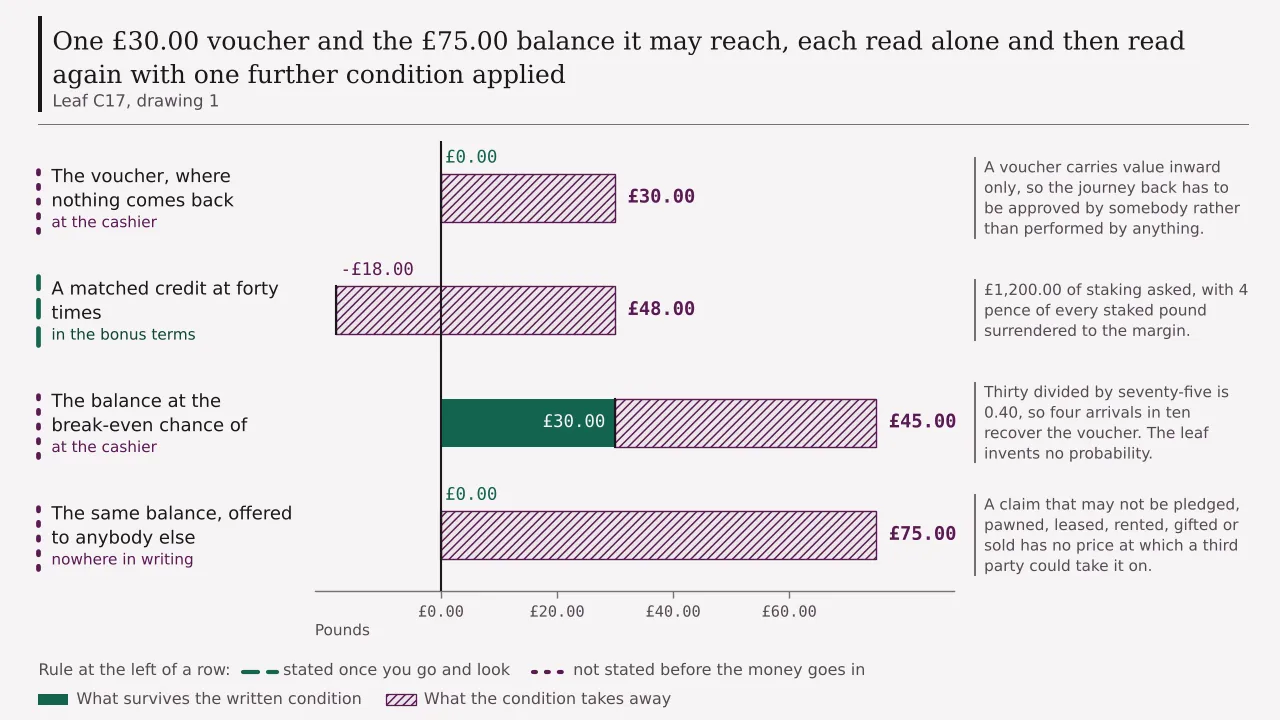
The drawing puts the written condition and the unwritten decision on one ledger so that their bars can be compared directly. Doing so makes a point no prose sentence makes as quickly: the bar produced by a clause anybody could read is no longer than the bar produced by a silence nobody can, and the second bar sits further down the page because it is met later rather than because it is smaller.
9
What a reader can settle first, and who arrives on these words
Three questions can be answered before a voucher is bought, and all three are free. Does the instrument carry value in both directions, which its own published terms answer. Does a public licence register carry the business, which a search answers. And what does the rulebook of whichever authority is named say about periods and adjudication, which parts six and seven answered for four of them, including the two cases where the honest answer is that the material could not be read.
A fourth question cannot be answered in advance by anybody, and naming it is more useful than pretending otherwise. Nothing published anywhere settles how long a substitute payment route takes, or what proportion of stranded balances eventually move. This leaf assumed seven days and eleven days for the first and refused to assume anything for the second, printing the 40 per cent break-even instead.
Collected, the figures run as follows. A voucher of £30.00 travels one way. A matched credit of the same size asks £1,200.00 of staking and is expected to close at minus £18.00, a gap of £48.00. A balance of £75.00 is worth £30.00 at the chance that recovers the voucher, a gap of £45.00, and is worth nought to anybody other than the person holding it. The periods that would surround an argument about it are 1, 3 working, 56, 182 and 7 days inside the British licence, and none of them attaches to the payment decision itself.
The final word belongs to whoever typed the phrase at the top. Many of the people who search this wording are registered with the national scheme and are reading about accounts that the registration was taken out to stop. For them the figures above miss the point and one sentence does not. Free confidential help waits at BeGambleAware.org, and also at GamCare.org.uk, whose helpline number reads 0808 8020 133, and a registration not yet expired is doing precisely the job it was taken out to do.
Questions
- Can a prepaid voucher receive a casino payout?
- In the ordinary case it cannot, because the instrument is built to move value in one direction only. An account funded that way therefore holds a balance with no homeward route attached to the thing that paid for it, and the question of where a payout goes has to be answered by somebody rather than by a mechanism. That answer is given at a payment screen, at the moment a reader asks to leave, which is the point at which the reader has the least leverage of the whole transaction.
- What happens when the only instrument on the account cannot be paid to?
- A second instrument has to be produced, and producing one is a chain of four steps: the reader nominates something, somebody examines it, the nomination is accepted or queried, and then the payment is scheduled and travels. This leaf assumes three working days for the examination, two for scheduling and two for travel, which is seven days in all, rising to eleven where the nomination is queried once. Both totals are this leaf’s own arithmetic, since nothing citable here publishes the length of that route.
- Why is a stranded balance worth nothing to anybody else?
- Because the claim behind it cannot be transferred. Curaçao’s complaints policy for licensees records that only the registered player may complain, the governing ordinance having put every claim a player holds against a licence holder beyond pledging, pawning, leasing, renting, gifting or sale. Six verbs between them shut every route by which a position might be passed to anybody, so no discount exists at which a third party would take it over and nobody outside has standing to pursue it.
- How likely is it that a stranded balance ever arrives?
- Nothing citable on this site publishes that figure for any arrangement anywhere, and inventing one would be the exact failure this site exists to avoid. What can be printed is the break-even level. A voucher of £30.00 bought the position and the balance is £75.00, so thirty divided by seventy-five is 0.40 and the balance must arrive four times in ten before the voucher alone is recovered. Whether the real chance sits above or below four in ten is a judgement this leaf leaves with the reader.
- Does waiting cost much in itself?
- Almost nothing, and printing that keeps the argument honest. Holding £75.00 for eight weeks carries 46p at an assumed 4 per cent a year, which is 0.6 per cent of the balance and is this leaf’s own rate rather than a quotation. The expensive part of a stranded balance is therefore not the time value of the money. It is the 60 per cent of the balance sitting beyond the break-even chance in the previous answer.
- What deadlines surround a complaint inside the British licence?
- Five, and putting them all into days makes them comparable. One day for an acknowledgement where gambling runs round the clock, or three working days otherwise. Fifty-six days as the outer limit on the whole business, escalation included, with a closing letter due at the end of it. A hundred and eighty-two days, roughly six months, inside which a customer may raise the matter at all. And a seven-day silence from the customer over something reasonable, which permits the count to be halted and later resumed from the place it stopped.
- Do those deadlines cover the decision about paying me?
- They do not, and that is where this leaf’s subject sits. Every one of the periods attaches to a complaint about a payment decision, which is a later object with its own starting gun, rather than to the decision itself. A balance that is neither paid nor refused has not yet produced the thing the periods measure. Silence is therefore the most expensive answer available to whoever owns the decision, and it is the one answer no clock reaches.
- Is there really nobody to complain to offshore?
- That would be inaccurate, and a grading states the position better. Curaçao publishes a complaints policy allowing six months from the incident, with receipt confirmed in writing within seven days and a four-week response that may be stretched one time by four further weeks, which lands on the same fifty-six days Britain works to. Malta runs a formal complaints form while never saying how long a complaint may take, whether where somebody lives makes a difference, what its own powers stop short of, or whether an outcome is binding on the business. The Anjouan body advertises a route whose page returned an error when fetched on 15 October 2026. For Costa Rica no regulator’s site for gambling could be located by this build at all.
- Who decides the terms of an offshore dispute process?
- Often the operator, and authorship is where the two frameworks read in full for this leaf come apart. In Great Britain a body must be approved by the regulator before a licensee may use it at all, eight appearing on the published list with coverage running unevenly across them: the regulator’s own table gives one of them a row reading family entertainment centres, public houses and members’ clubs, adult gaming centres, and bingo other than remote, with remote casino appearing nowhere in it. In Curaçao an operator may instead fix the parameters, including whether some minimum value has to be reached before a dispute may be escalated.
- What does a forty times condition cost on a thirty pound voucher?
- £48.00. A matched credit of £30.00 at forty times asks for £1,200.00 to cross the reels, each staked pound surrenders 4 pence, and the credit therefore ends at an expected minus £18.00. Set that beside the £45.00 held by whoever owns the exit decision and the two are near enough a dead heat, which is the comparison this leaf exists to produce: one figure comes from a sentence anybody could have read in advance, the other from a decision written down nowhere.
- Does this page explain how to get round a blocked payment?
- No, and it never will. A network, a bank, a wallet or a card scheme that declines to move money towards a gambling account is protecting from a different direction than a self-exclusion protects from, and is read here as a protection. What gets measured on this page is the cost of meeting such a refusal. Free confidential help waits at BeGambleAware.org, and also at GamCare.org.uk, whose helpline number reads 0808 8020 133 and is picked up on any day of the year at any hour of it.