Terms read 19 October 2026 Leaf H01, revision 1
Free spins no deposit, and the five addresses the rest of the offer is kept at
A hundred presses at 10p push £10.00 across the reels and hand back an expected £9.60. Forty times that return is £384.00 of further staking and an expected close of minus £5.76. One of those figures is printed where anybody can read it without clicking. This leaf walks to each of the places holding the others and prices the walk.
Stated on the banner £9.60 What a hundred presses at 10p are expected to return, and the advertisement carries no second figure at all. Stated, once you go and look minus £5.76 Forty times applied to those winnings, written in a bonus document the advertisement never opens, on the 96 in the hundred this leaf works to. Not stated before the money goes in Five conditions Two of them wait at a payment screen and at an exit, and the remaining three are quantities no document anywhere carries.
Offers built on a spin count, with their terms read
Every destination in this file is bought advertising. The site is paid a fee if a reader goes on to register, and no figure printed below moves because of it.
Bonus Spins UK Slip 01
Betportal
Ceiling as a multiple
The drop
€15.00
€1.00 in the euro
The claim reads €15.00. Once the terms beside it have applied, €0.00 of it can leave. The difference is the drop.
7 of the 15 terms on this slip could not be read before the money went in
Spins priced at this site's own 10p a spin, which the operator does not publish
Stated
€15.00
The claim as it is printed, before a single term has been applied to it.
Headline paid as spins
150 spins at 10c each, which is €15.00 of the figure above.
6 Nowhere
What one spin is worth
No unit is published for a spin, so the count is priced at this site's own 10p a spin. At half that price every figure below halves with it.
Match and other credit not priced
300% of three deposits, to a ceiling of €1,000. A share of a deposit nobody has made yet is not a sum, so no figure stands on this line and none is carried below.
Qualified
-€14.40
Written down somewhere, and taking part of the claim back. Each term carries the place it is written and the sum it takes.
2 Written terms at a distance this record does not establish
Play-through -€14.40
Carrying €14.40 through 35 times stakes €504.00 and costs €20.16 of it at 96 per cent return. That prices above the €14.40 there is to charge it against, so the whole of the credit goes and the line is held at that. The multiple sits on the bonus.
2 Written terms at a distance this record does not establish
Game weighting not priced
Slots only count towards the play-through. No contribution percentage is published, so the line above has been worked at full weight, which is the kindest reading there is.
2 Written terms at a distance this record does not establish
Ceiling on the winnings not priced
5x the bonus.
2 Written terms at a distance this record does not establish
Clock on the credit not priced
14 days.
2 Written terms at a distance this record does not establish
Largest stake while it runs not priced
€5.
3 Public record
Licence, and who holds it not priced
Licensed in Anjouan, Comoros, held by BetPortal Gaming Ltd, with Excite Ultra Media Ltd, reference ALSI-202601040-FI2. A register entry settles who holds a licence and what it permits. It does not settle who is running the site this morning.
4 Cashier
Smallest qualifying deposit your money
€20 a stage. That is €20.00 of your own money, and it is never netted into a drop.
5 On the way out
Checks before a withdrawal not priced
Documents before the first withdrawal.
Unstated
-€0.60
Applying without having been published anywhere, and costing money all the same.
6 Nowhere
What a spin hands back -€0.60
Staking a spin returns 96 per cent of it, so that share of the batch is the house's before a reel turns. This site works at that return and the operator publishes none where the claim is made.
6 Nowhere
Forfeited by rule cost unknown
Nothing is published under this heading, and it applies regardless.
6 Nowhere
Charge on the way out cost unknown
No charge on the way out is published as a figure, so nothing comes off this line. A charge that exists unpublished would come straight off whatever survives.
6 Nowhere
Smallest withdrawal allowed cost unknown
No smallest withdrawal is published as a figure. A floor nobody has published is still a floor, and it decides whether a small balance can move at all.
No Great Britain licence
Terms read 19 October 2026
Bonus Spins UK Slip 02
WinBeast
Ceiling as a sum
The drop
€50.00
€1.00 in the euro
The claim reads €50.00. Once the terms beside it have applied, €0.00 of it can leave. The difference is the drop.
8 of the 15 terms on this slip could not be read before the money went in
Spins priced at this site's own 10p a spin, which the operator does not publish
Stated
€50.00
The claim as it is printed, before a single term has been applied to it.
Headline paid as spins
500 spins at 10c each, which is €50.00 of the figure above.
6 Nowhere
What one spin is worth
No unit is published for a spin, so the count is priced at this site's own 10p a spin. At half that price every figure below halves with it.
Match and other credit not priced
50% to 100% of five deposits, each to a ceiling of €1,000, and a €650 free bet. A share of a deposit nobody has made yet is not a sum, so no figure stands on this line and none is carried below.
Qualified
-€48.00
Written down somewhere, and taking part of the claim back. Each term carries the place it is written and the sum it takes.
2 Written terms at a distance this record does not establish
Play-through -€48.00
Carrying €48.00 through 40 times stakes €1,920.00 and costs €76.80 of it at 96 per cent return. That prices above the €48.00 there is to charge it against, so the whole of the credit goes and the line is held at that. The multiple sits on the bonus and the winnings from the spins.
2 Written terms at a distance this record does not establish
Game weighting not priced
Slots, titles vary by country count towards the play-through. No contribution percentage is published, so the line above has been worked at full weight, which is the kindest reading there is.
2 Written terms at a distance this record does not establish
Ceiling on the winnings not priced
€100 a batch of spins.
2 Written terms at a distance this record does not establish
Clock on the credit not priced
7 days, spins 1 day.
3 Public record
Licence, and who holds it not priced
Licensed in Curaçao, holder not named on the site. A register entry settles who holds a licence and what it permits. It does not settle who is running the site this morning.
4 Cashier
Smallest qualifying deposit your money
€20 a stage. That is €20.00 of your own money, and it is never netted into a drop.
5 On the way out
Checks before a withdrawal not priced
Documents before the first withdrawal.
Unstated
-€2.00
Applying without having been published anywhere, and costing money all the same.
6 Nowhere
What a spin hands back -€2.00
Staking a spin returns 96 per cent of it, so that share of the batch is the house's before a reel turns. This site works at that return and the operator publishes none where the claim is made.
6 Nowhere
Largest stake while it runs cost unknown
Nothing is published under this heading, and it applies regardless.
6 Nowhere
Forfeited by rule cost unknown
Nothing is published under this heading, and it applies regardless.
6 Nowhere
Charge on the way out cost unknown
No charge on the way out is published as a figure, so nothing comes off this line. A charge that exists unpublished would come straight off whatever survives.
6 Nowhere
Smallest withdrawal allowed cost unknown
No smallest withdrawal is published as a figure. A floor nobody has published is still a floor, and it decides whether a small balance can move at all.
No Great Britain licence
Terms read 19 October 2026
Bonus Spins UK Slip 03
EliteSpin
Longest spin window
The drop
£50.00
£1.00 in the pound
The claim reads £50.00. Once the terms beside it have applied, £0.00 of it can leave. The difference is the drop.
8 of the 15 terms on this slip could not be read before the money went in
Spins priced at this site's own 10p a spin, which the operator does not publish
Stated
£50.00
The claim as it is printed, before a single term has been applied to it.
Headline paid as spins
500 spins at 10p each, which is £50.00 of the figure above.
6 Nowhere
What one spin is worth
No unit is published for a spin, so the count is priced at this site's own 10p a spin. At half that price every figure below halves with it.
Match and other credit not priced
50% to 100% of five deposits, each to a ceiling of £1,000. A share of a deposit nobody has made yet is not a sum, so no figure stands on this line and none is carried below.
Qualified
-£48.00
Written down somewhere, and taking part of the claim back. Each term carries the place it is written and the sum it takes.
2 Written terms at a distance this record does not establish
Play-through -£48.00
Carrying £48.00 through 40 times stakes £1,920.00 and costs £76.80 of it at 96 per cent return. That prices above the £48.00 there is to charge it against, so the whole of the credit goes and the line is held at that. The multiple sits on the bonus and the winnings from the spins.
2 Written terms at a distance this record does not establish
Game weighting not priced
Slots count towards the play-through. No contribution percentage is published, so the line above has been worked at full weight, which is the kindest reading there is.
2 Written terms at a distance this record does not establish
Ceiling on the winnings not priced
5x the bonus.
2 Written terms at a distance this record does not establish
Clock on the credit not priced
7 days, spins 3 days.
3 Public record
Licence, and who holds it not priced
Licensed in Costa Rica, held by PrimeTier Limited. A register entry settles who holds a licence and what it permits. It does not settle who is running the site this morning.
4 Cashier
Smallest qualifying deposit your money
£20 a stage. That is £20.00 of your own money, and it is never netted into a drop.
5 On the way out
Checks before a withdrawal not priced
Documents before the first withdrawal.
Unstated
-£2.00
Applying without having been published anywhere, and costing money all the same.
6 Nowhere
What a spin hands back -£2.00
Staking a spin returns 96 per cent of it, so that share of the batch is the house's before a reel turns. This site works at that return and the operator publishes none where the claim is made.
6 Nowhere
Largest stake while it runs cost unknown
Nothing is published under this heading, and it applies regardless.
6 Nowhere
Forfeited by rule cost unknown
Nothing is published under this heading, and it applies regardless.
6 Nowhere
Charge on the way out cost unknown
No charge on the way out is published as a figure, so nothing comes off this line. A charge that exists unpublished would come straight off whatever survives.
6 Nowhere
Smallest withdrawal allowed cost unknown
No smallest withdrawal is published as a figure. A floor nobody has published is still a floor, and it decides whether a small balance can move at all.
No Great Britain licence
Terms read 19 October 2026
Bonus Spins UK Slip 04
Crown Jewelz
Multiple unpublished
The drop
NOT WORKED
The multiple is not published in the operator's own terms. Since the sum cannot be worked around it, none is worked.
9 of the 14 terms on this slip could not be read before the money went in
No drop worked
Stated
£15.00
The claim as it is printed, before a single term has been applied to it.
Headline paid as spins
150 spins at 10p each, which is £15.00 of the figure above.
6 Nowhere
What one spin is worth
No unit is published for a spin, so the count is priced at this site's own 10p a spin. At half that price every figure below halves with it.
Match and other credit not priced
200% of the first deposit, then 150% twice, each to a ceiling of £1,000. A share of a deposit nobody has made yet is not a sum, so no figure stands on this line and none is carried below.
Qualified
NOT WORKED
Written down somewhere, and taking part of the claim back. Each term carries the place it is written and the sum it takes.
2 Written terms at a distance this record does not establish
Play-through not priced
40x the bonus, reported rather than published by the operator.
2 Written terms at a distance this record does not establish
Game weighting not priced
Slots count towards the play-through. No contribution percentage is published, so the line above has been worked at full weight, which is the kindest reading there is.
3 Public record
Licence, and who holds it not priced
Licensed in Curaçao, number not verified, holder not named on the site. A register entry settles who holds a licence and what it permits. It does not settle who is running the site this morning.
4 Cashier
Smallest qualifying deposit your money
£20. That is £20.00 of your own money, and it is never netted into a drop.
5 On the way out
Checks before a withdrawal not priced
Documents before the first withdrawal.
Unstated
NOT WORKED
Applying without having been published anywhere, and costing money all the same.
6 Nowhere
Ceiling on the winnings cost unknown
No ceiling is published. Nothing is assumed in its place.
6 Nowhere
Clock on the credit cost unknown
Nothing is published under this heading, and it applies regardless.
6 Nowhere
Largest stake while it runs cost unknown
Nothing is published under this heading, and it applies regardless.
6 Nowhere
Forfeited by rule cost unknown
Nothing is published under this heading, and it applies regardless.
6 Nowhere
Charge on the way out cost unknown
No charge on the way out is published as a figure, so nothing comes off this line. A charge that exists unpublished would come straight off whatever survives.
6 Nowhere
Smallest withdrawal allowed cost unknown
No smallest withdrawal is published as a figure. A floor nobody has published is still a floor, and it decides whether a small balance can move at all.
No Great Britain licence
Terms read 19 October 2026
Every figure in the second and third columns is this site's own working and nothing an operator has published. A claim is priced as printed, then the share a spin hands back at 96 per cent return comes off it, then what playing the multiple through costs at the same return, and then whatever a published ceiling, a charge on the way out or a floor on the smallest withdrawal takes from what has survived. The drop is the difference between the first figure and the last. The two columns add back up to it exactly, so no money leaves a slip without a term and a place beside it.
Which column a term falls in is settled by one question: has anybody written it down. A charge a reader meets at the payment screen is written down, and it stands in the second column with the cashier against it. A condition that binds without ever having been set down stands in the third, whatever it costs. Inside each column the terms run outwards from the banner, so the order itself says how far a reader would have had to go.
A count of spins has no unit until one is supplied. Where an operator publishes what one of its own spins is worth, that figure is used and the first column says it is theirs. Where none is published, this site's own 10p a spin stands in its place and every figure below moves in proportion with it. Where the multiple itself is unpublished, no drop is worked at all, because that is the one figure the sum cannot be done without.
Three words stand where a figure cannot. Not priced is a term that is written down and carries no number the arithmetic can take. Cost unknown is a term nobody has written down, costing something nobody has put a number on. Your money is money of the reader's own, which is never netted into a drop.
None of the operators in this file holds a Great Britain licence, so none of the duties that licence carries reaches them. Each of those duties is published in its own right, which is what makes its absence here something a reader can check rather than take on trust. Every gambling company licensed in Great Britain belongs to Gamstop Online, so a reader who has shut themselves out through the scheme is not shut out here. Social Responsibility Code 5.1.1 has held a play-through to a maximum of ten times the bonus funds since 19 January 2026, and it binds a licence holder and nobody else. Asked in a post of 21 October 2025 what is lost along with the licence, the Gambling Commission's Director of Enforcement and Intelligence answered: "unfair gaming practices, financial loss, and a lack of recourse if things go wrong". The same post puts blocked payouts, and withdrawal limits pitched high enough to be unreachable, among the behaviour the Commission has recorded. Nobody under 18 may hold an account at any of them.
Terms are reproduced in the wording their operator published, and each slip is dated with the day somebody sat down and read them. 19 October 2026 is the oldest of those dates. Anybody claiming an offer is bound by that operator's full terms, which are elsewhere, and never by a line standing here.
1
Two words and a number, and what they commit anybody to
Three tokens get published and no more: a quantity, the word free, and the words no deposit. The quantity fixes how many times a reel will turn. The word free fixes a price of nought. The words no deposit fix that nothing has to be sent from a bank first. That is the complete inventory of what is settled , and it is settled for everybody at once, without a click, without an account and without an address.
Converting the quantity into money takes a figure the advertisement withholds. This site assumes a press is worth 10p throughout, so a hundred of them send £10.00 across the reels. At a return of 96 per cent those hundred presses give back an expected £9.60, the missing four hundredths being the margin. Neither number survives without the press value, which no banner prints, so the opening line of the arithmetic has already been imported from elsewhere.
What is genuinely promised, then, is a quantity of turns at an unpublished price, where the only published price is the one the reader pays, which is nothing. The promise is true. A reader who claims it does receive a hundred turns and does send nothing from a bank. Every criticism below leaves that intact, because the claim was never the problem.
The problem is the shape of the rest. One figure stands in public; the seven or eight conditions that decide what the figure converts into stand in five other places, and those places have different owners, different audiences and different levels of compulsion behind them. A bonus document is written by the party that benefits from it. A licence register is written by a regulator. A payment screen is written by whoever holds the money. The way out is written by whoever decides when to ask for documents. Nothing at all writes the last group.
So a question worth asking before any arithmetic: of everything that will eventually decide what a hundred presses are worth, how much of it could have been read before clicking anything. On a headline of this shape the answer is one figure out of roughly nine, and that proportion is the subject of this leaf rather than the £9.60.
The six possible answers are fixed and the same six serve every page on this site. A thing is settled on the banner, in the written terms, in a public record, at the payment screen, on the way out, or nowhere whatsoever. There is no seventh. A condition that exists is in one of them, and a condition that is in none of them is in the sixth by definition, because applying unwritten is what the sixth means.
2
Six addresses, and how distance gets measured here
Distance on this site is not metres and not pixels. It is counted in documents opened and in stages of commitment passed. Opening a second document is one unit. Creating an account is another. Sending money is a third. Asking for money back is a fourth. A term sitting two units away from the claim has been placed where a reader reaches it only after two decisions have already been taken, and the order matters far more than the wording does.
Measured that way, the advertisement sits at zero. A bonus document linked from it sits at one. A general terms document that the bonus document refers to sits at two, because the first has to be opened before the second is known to exist. A public register sits at one as well, but on a different axis: it needs no account, only a name, and the name is often the one thing an advertisement does print. The payment screen sits at three. The exit sits at four or five, depending on whether a balance had to be built first.
| The thing that decides something | Where a reader would settle it | Units of commitment away |
|---|---|---|
| The quantity of presses | None | |
| The price asked of the reader | None | |
| The multiple the winnings must be turned over at | in the bonus terms | One document |
| The window the multiple has to be met inside | in the bonus terms | One document |
| The ceiling on a single stake while credit is live | in the general terms | Two documents |
| The ceiling on what may be taken out at the end | in the bonus terms | One document |
| Who holds a licence, and for which activities | in the public register | One search |
| The smallest sum the exit will move | at the cashier | An account |
| Which routes the money may leave by | at the cashier | An account |
| The documents demanded before payment | on the way out | A balance |
| The cash value of one press | nowhere in writing | Unreachable |
| The contribution rate of the reel the presses run on | nowhere in writing | Unreachable |
| The violence of the swing on the route to it | nowhere in writing | Unreachable |
Thirteen rows, and the top two are the advertisement. Everything from the third row down is somebody else’s document, somebody else’s screen or nobody’s at all. A reader looking at a banner is therefore holding two rows of a thirteen-row table and has no way of knowing that the table runs to thirteen, because the advertisement does not say how many conditions exist.
Three of the rows carry no address and they are not a rhetorical flourish. A press value, a contribution rate and a volatility profile all decide money, all apply automatically, and none of them is obliged to be published by anything. The first of the three is the worst of them on a headline of this shape, because without it the count on the banner does not convert into a sum at all, which means the advertised figure is not a figure a reader can act on.
Everything after this part works down the table from row three and attaches a price in pounds to each group. The prices are not estimates of harm. They are differences between two arithmetical results: what the claim is worth read on its own, and what it is worth once the condition at that address has been applied.
3
What one sentence in a second document costs
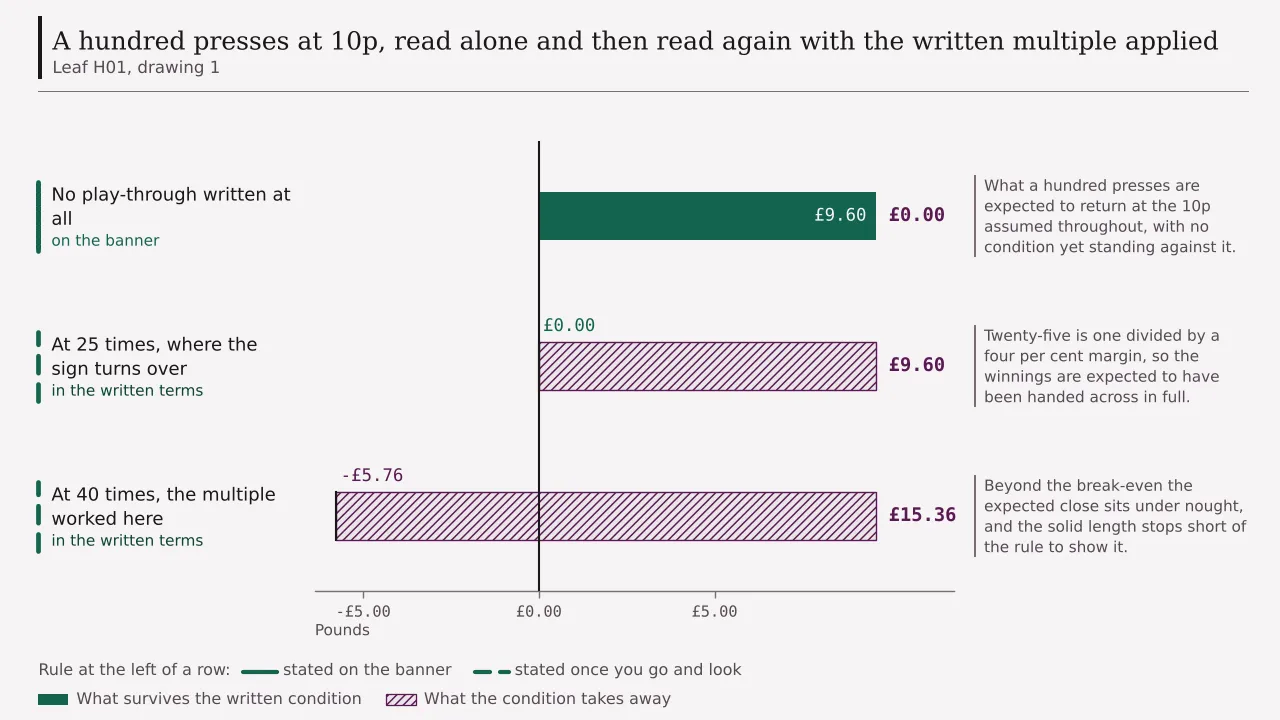
A multiple of forty is what this leaf works to, that being the band an offshore cashier prints when it prints one, and on an offer asking for no payment the multiple bites on the winnings, no credit having been issued for it to bite on instead. Forty lots of £9.60 come to £384.00 of staking before a balance turns into money. Cut that into ten penny pieces and 3,840 of them appear, stacked on top of the hundred the advertisement handed over.
One line of arithmetic closes it. Forty multiplied by four hundredths is 1.6, one less 1.6 is minus 0.6, and £9.60 taken six tenths in the unhelpful direction is minus £5.76. Weighting is held at one the whole way through, so nothing has been concealed inside it.
Read off the banner £9.60 Once the forty times clause applies minus £5.76 The price of the sentence nobody read £15.36
Fifteen pounds and thirty-six pence is £384.00 multiplied by the four pence in each pound that the reels keep, and it can be reached from either direction. Take the expected winnings and subtract the expected cost of satisfying the clause, and the close is minus £5.76. Take the two ends of the price block and subtract, and the gap is £15.36. The two agree exactly, which they must, since the clause does nothing except hand the staked money to the margin at a known rate.
So the first click into a bonus document is worth £15.36 on a hundred-press headline. That is not a figure about the operator or about the offer. It is a figure about the reader’s own time, and it is the highest-paid click in this entire family of headlines, because it converts a positive number into a negative one in a single step. Allow ninety seconds to find the clause and read it, which is this leaf’s own assumption and not a measurement anybody made, and the rate of pay for that minute and a half works out at £614.40 an hour.
£15.36 of difference turning on one sentence a reader has to open a second document to see
Where the sign flips is at twenty-five, and that figure is arithmetic rather than market practice: one divided by four hundredths. Under that multiple a balance is expected to survive the clause with something left on it. Exactly at it, the winnings are expected to have been handed across in full. Over it, the clause wants more margin than the winnings hold, and the excess has to be funded by the reader.
A second clause usually sits in the same document and gets read even less often. It caps what may be withdrawn out of a bonus balance, which is a different thing from capping a deposit balance and is not covered by the British rule that forbids the latter. Where a ceiling of that sort is set at, say, £50, it costs nothing in expectation on these figures, because the expected close is already below nought. It costs a great deal in the one outcome anybody actually hopes for, which is a run that goes well.
A third clause fixes a window. Where the staking has to be done inside seven days, 3,840 presses have to be fitted into a week, which is 549 presses a day. A fourth sets a ceiling on a single stake while credit is live, and its function is to stop a reader compressing the first three clauses by pressing bigger buttons. These sit in the general terms, two documents from the claim, and a reader who opened one document has not reached them.
4
A public record, and the one question it answers
Three registers are published by the British regulator and each can be searched or taken away in full: businesses, personal licences, premises. One row of the business register fixes a company name, the list of activities permitted to it, and whichever domains have been recorded under it. Nothing has to be paid, created or asked for to read that row, and the company described by it writes not a word of it.
What a row settles is therefore narrow and genuinely settled. Somebody either holds a licence or does not. The licence either permits remote casino activity or does not. A domain is either recorded against it or is absent. The British regulator tells players to click through to the entry and check that the activities and the domains match the public register, which is a check needing neither an account nor a payment.
What a row cannot settle is the harder half and every page in this site’s register section carries it. An entry proves who holds a licence and what that licence permits. It does not prove who operates a given website today. Ownership moves, arrangements between a licence holder and a front end change hands, and a domain entered some time ago may be answering to a different party now. The register comes with neither a date on it nor instructions for interpreting a domain entry, so an inference drawn past the face of a row belongs to whoever drew it.
Set against the headline, the register prices at nothing and decides everything. Not one of the figures above moves when a row is found or not found. The £9.60 is the same, the £384.00 is the same, the minus £5.76 is the same. What changes is whether the five other addresses have any compulsion behind them, and that is worth the whole of the rest of this leaf.
Put it as a conditional and the shape comes out. If a row exists and matches, then the placement rules in part nine apply, the multiple has a ceiling, an eight-week complaints clock runs, and a scheme that closes accounts across operators covers the site. If no row exists, none of that holds and the arithmetic above is the whole of the protection. The register is therefore the switch rather than a term, and the only address on the list whose value is binary.
One further asymmetry is worth printing. A reader can check the register before creating an account, which puts it at one unit of commitment, the same distance as a bonus document. It is the cheapest serious check available on a headline of this shape, and of the six addresses it is the only place whose wording the described party had no hand in. Everything inside a bonus document was written by somebody with an interest in how it reads.
Artwork a reader recognises is no substitute for the row. On 20 January 2025 a warning notice went out recording licensed suppliers’ titles found running where nobody held a licence at all. A payment of £4.75m was then agreed on 23 July 2026 by a supplier whose titles had surfaced on half a dozen sites of that kind, open to players in Britain. So a familiar lobby carries nothing whatever about who runs it, while one register search carries the whole of it.
5
Floors that appear no earlier than a payment screen
An offer asking for no payment seems to have no payment screen in it, and that intuition is where the fourth address gets missed. The payment screen is reached on the way out rather than on the way in. A reader who has met the clause and wants the balance sent somewhere meets, for the first time, whatever rules govern movement of money, and those rules were never on the route they travelled.
Two of them bite on a small balance. The first is a withdrawal floor, the smallest sum the cashier will move at all. The second is a route restriction: a balance that was never funded by a card or a wallet has no instrument on file to be sent back to, so the cashier asks for one at the moment of leaving. Neither of these is a bonus term and neither is in the bonus document. They are properties of a payment page and appear at the cashier.
Price the floor against the claim and the arithmetic is blunt. Assume a floor of £20.00, which is this leaf’s own assumption and is not a figure published in any rule this site can cite. Expected winnings off a hundred 10p presses are £9.60. Nine pounds sixty cannot cross a twenty pound floor, so a reader who ignored every clause in part three and simply tried to take the money would still be holding a balance that the exit refuses to move.
| Assumed exit floor | Where it first appears | Expected winnings | Shortfall to the floor | What has to happen to close it |
|---|---|---|---|---|
| £5.00 | Payment screen | £9.60 | None | Nothing; the sum already clears |
| £10.00 | Payment screen | £9.60 | £0.40 | A run forty pence better than expected |
| £20.00 | Payment screen | £9.60 | £10.40 | A run that more than doubles the expectation |
| £50.00 | Payment screen | £9.60 | £40.40 | A run better than five times the expectation |
Every floor in that table is an assumption of this leaf’s, printed to show the shape rather than to report a market. The shape is that a floor does not reduce the value of a small balance by a little. It either leaves the balance alone or takes the entire thing, because a sum below a floor is worth nought at the exit however close to the floor it got. A forty pence shortfall and a forty pound shortfall have the same consequence, and only one of them feels like one.
The route restriction prices differently and is easier to miss. Where the terms permit payment only to an instrument that has previously funded a deposit, a balance built entirely from a no-deposit offer has no qualifying instrument at all. Resolving that means sending money in, which is the one thing the headline promised would not be needed. The cost of the restriction is therefore not a fee. It is a deposit, and on a small balance the required deposit may exceed the balance.
What a British licence forbids is a cap on money leaving a deposit balance, and the regulator has printed a specimen of the forbidden wording, limited by the day and by the week. A bonus balance is a different object and the bar does not reach it. Both of the ceilings mentioned on this leaf can therefore stand at once without contradicting each other, which is why the balance a clause is written over has to be identified before the clause can be read at all.
6
Conditions met for the first time on the way out
The fifth address is reached only by somebody who has something to collect, which makes it the least-read part of any offer and the most expensive. A demand for documents, a source-of-funds question or a hold on an account arrives after the clause has been satisfied, after the balance exists, and after the reader has spent the 3,840 presses that part three priced. Nothing before that moment required it to be mentioned.
Sequence is the entire issue, and Britain legislates the sequence rather than the demand. Under licence condition 17.1.1 identity has to be established and checked at the front, ahead of any play whatever, and the same condition shuts the far end as well: information a licensee could sensibly have sought earlier may not be made the price of a withdrawal later. Put into this leaf’s own units, that pins the document check at nought units of commitment and forbids it at four.
Something worth dwelling on falls out of that pair. The British rule nowhere suggests that checking identity is optional, burdensome or unfair. It demands the check, and then fixes where in the order the check may stand. Position is the regulated quantity, and no clearer published instance exists anywhere in this subject of a regulator controlling where a condition sits instead of what it says.
Play funded by an incentive sits inside that rule, which matters a great deal on a headline where nothing changes hands. The announcement of the current regime put age checking ahead of any gambling at all, incentive-funded play included, and ahead of the demonstration versions of games besides. Before it, a licensee had three days from registration in which to finish an age check. Nought of that grace survives.
Pricing the fifth address honestly means admitting that it has no fixed figure. A document demand that is answered costs time and nothing else. A document demand that cannot be answered costs the entire balance, because an unpaid balance is worth nought regardless of what the arithmetic said. Its expected cost lies between the two and turns on facts about the reader rather than facts about the offer, and saying so is the accurate answer rather than an evasion.
What can be priced is the asymmetry. On the figures in part three the expected close after the clause is minus £5.76, so in expectation there is nothing at the exit for a demand to act on. The fifth address therefore costs nothing in expectation and costs everything in the single branch where the run went well. Every term at this address shares that profile, and it is the reason a condition met on the way out is worth more to the party that wrote it than the same condition written on the banner.
7
Three quantities that are written down nowhere
Three numbers decide the value of a spin count and none of them has an address. The cash value of one press is the first, the proportion of staking the reel contributes towards the clause is the second, and the shape of the distribution the presses are drawn from is the third. Each applies automatically whether or not anybody writes it down, which is what puts them nowhere in writing.
No primary source defines the cash value of a press, fixes who sets it, or requires anybody to disclose it separately. Two published duties brush against the area and neither one produces the figure. A licensed build owes a customer something about their chances before any commitment is made, and an incentive owes conditions that are transparent and within reach of whoever it was offered to. Nothing in either obliges anybody to state what a single press costs, so that stays a commercial decision, and the 10p used here is this leaf’s assumption and nothing firmer.
That single absence is the reason a count behaves so badly as a headline. A sum on a banner is one quantity with one unknown attached to it, the multiple. A count on a banner is one quantity with two unknowns attached, the press value and the multiple, and the two multiply. The reader is not short of one fact. They are short of a dimension.
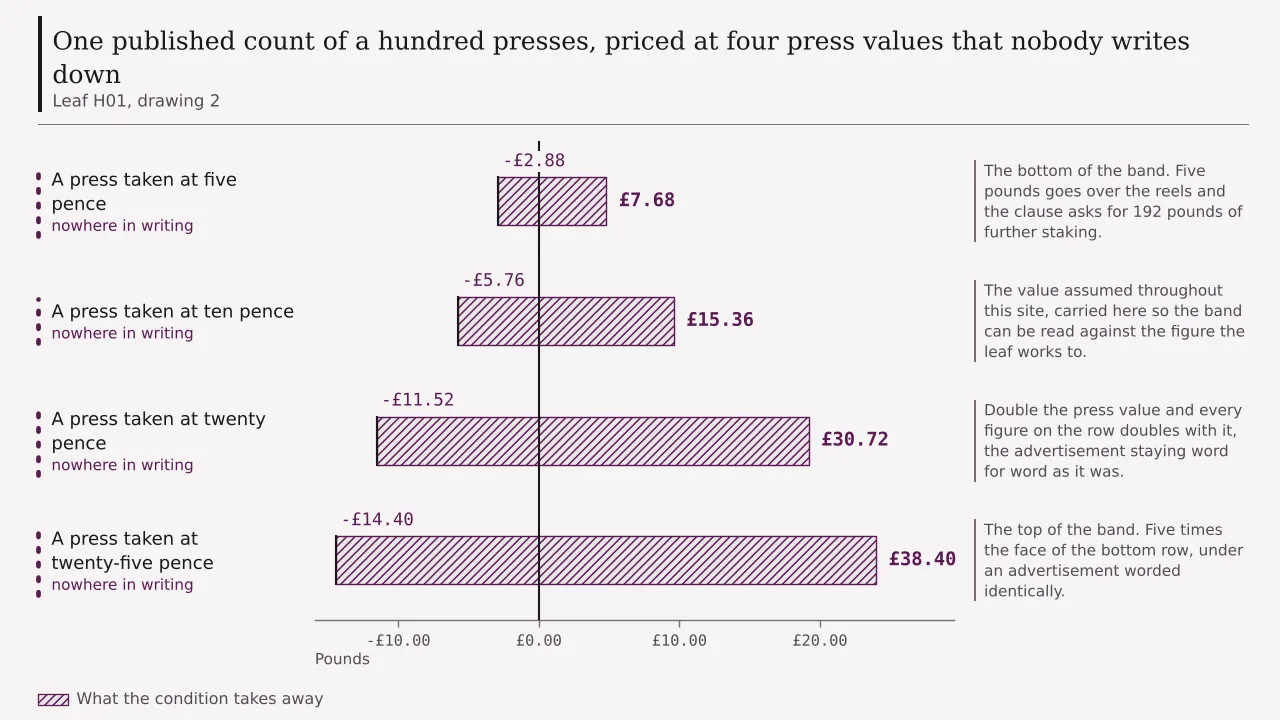
| Assumed press value | Turned over by the presses | Expected winnings | Staking the clause asks | Expected close at forty times |
|---|---|---|---|---|
| Five pence | £5.00 | £4.80 | £192.00 | minus £2.88 |
| Ten pence | £10.00 | £9.60 | £384.00 | minus £5.76 |
| Twenty pence | £20.00 | £19.20 | £768.00 | minus £11.52 |
| Twenty-five pence | £25.00 | £24.00 | £960.00 | minus £14.40 |
Five times separates the first row from the last, with an identical banner standing above every one of them. Whatever a hundred presses means, it means something between £4.80 and £24.00 of expected winnings, and a reader who assumed the middle of that band would be wrong by up to £14.40 in either direction. No clause has been broken to produce that spread. The advertisement is accurate at both ends.
The second unwritten quantity multiplies the first. Where a reel contributes less than a pound per pound staked towards the clause, the staking required rises in inverse proportion. The British regulator’s own published page records a respondent describing a thirty per cent contribution rate, and this leaf’s working from that figure is its own: thirty pence of credit per pound staked means £384.00 of required contribution needs £1,280.00 of staking, which is 12,800 presses instead of 3,840. The clause reads the same on the page either way.
Whether any of this is ever reached at all is decided by the third quantity. A distribution paying out rarely and heavily empties most small balances early, so the expected close is an average taken across outcomes in which the clause was mostly abandoned long before completion. That shape is published nowhere for an unnamed build, and no page on this site invents one.
Pace belongs here too, with a qualification. For a licensed build the minimum interval between game cycles on a reel-based game is a published standard, so it sits in a public record rather than nowhere. Worked against this leaf’s own figures, 3,840 presses cannot be completed in less than 9,600 seconds, which is two hours and forty minutes of pressing before anything else is counted. Outside a British licence that floor has no source, so the same quantity moves from the third address to the sixth.
8
The whole subtraction, assembled in one column
Everything above can be stacked into a single descending column, which is the format this site uses whenever a claim has to be taken apart. The column starts at the figure a reader would act on from the advertisement alone and ends at the figure the arithmetic actually supports, with each step labelled by the address its condition came from.
| Step | Address it came from | Running figure |
|---|---|---|
| A hundred presses, price nought | £10.00 of turnover | |
| Press value taken as 10p, this leaf’s assumption | nowhere in writing | £9.60 expected |
| Forty times the winnings turned over | in the bonus terms | minus £5.76 |
| A ceiling on a single stake, blocking compression | in the general terms | minus £5.76 |
| An exit floor the expected balance does not reach | at the cashier | £0.00 collectable |
| A document demand acting on whatever survived | on the way out | £0.00 collectable |
| A contribution rate below one pound in the pound | nowhere in writing | Worse again |
Two of the seven steps move the money and the rest decide whether the money can be collected at all, which is a distinction the column makes visible and prose tends to blur. The multiple does the arithmetical damage. The floor and the demand do something structurally different: they convert a positive balance into an uncollectable one without changing its size.
Reading the running column from the top, the honest summary of a hundred-press no-deposit headline is that it is worth an expected £9.60 if nothing else applies, nothing at all once the usual clause applies, and nothing at all again at the exit in the branch where the clause was somehow beaten. The claim remains true throughout. Not one line of the advertisement has been contradicted by any step.
That is the point this site exists to make. Nothing here turns on an operator lying. The entire difference between £9.60 and nought is produced by true statements kept at five different addresses, in an order that puts the cheapest statement first and the most expensive ones behind a decision the reader has already taken. A reader who wants the real figure must travel, and the travelling is what the advertisement is designed to make unnecessary.
One genuinely positive reading survives the column and it deserves printing. Somebody who wants a hundred turns of a reel for nothing, intends to stop when the presses run out, and never intends to attempt the clause has been handed exactly what was advertised at precisely the stated price. For that reader the entire apparatus above is irrelevant, because none of it is triggered until a withdrawal is attempted. The arithmetic on this leaf is written for everybody else.
3,840 presses asked for a balance an assumed £20.00 exit floor would refuse to move
9
What placement is worth when nothing compels it
Where a term sits is what parts two to seven measured. What that sitting is worth is this part, reached by naming the British duties that fix position and then taking them away. A spin count advertised at nought price sits outside the British licence, and what vanishes with the licence, on this subject, is the apparatus governing position rather than the apparatus governing substance. Losses of other kinds are genuine and get priced on other leaves. These are the ones the present subject turns on.
Two separate instruments regulate position in Britain and they approach it from opposite ends. Rule 8.17 of the advertising code bears on the promotion, requiring a significant condition to be put where it will actually be read and treating its omission as a fault where omitting it would mislead. Condition 7.1.1 bears on the contract instead, asking that terms be transparent in the statutory sense and be kept within easy reach. Advertisement and contract between them cover every address in part two except the sixth.
A published list settles what counts as significant inside a gambling promotion, and it maps nearly row for row onto part two: who is eligible, any payment or turnover asked for, the time allowed to claim or use the thing, and any qualifying odds or bet types. The same advice fixes where the full conditions belong, normally a single click from the advertisement, and rules out burying the route to them in tiny type at a page’s foot. In this leaf’s units that is a duty to hold the clause at distance one and a prohibition on distance two.
The provision governing incentives supplies the other half. Whoever hands a customer a reward or an arrangement carrying an advantage owes transparent and fair conditions for it, kept easy to reach by every person it was put in front of, which is what limb two of social responsibility code 5.1.1 demands. Easy reach is a statement about position. Limb two passes no judgement on how large a multiple may be, only on how much work finding the multiple takes.
What follows from getting position wrong fits in a line on the regulator’s advertising page: give a significant condition too little prominence and the advertisement counts as a misleading one. None of that turns on what the condition says. It turns on where the condition was put.
Three rulings published by the advertising regulator show the duty biting on position and on nothing else, each turning on a condition that genuinely existed and had simply been kept elsewhere. A ruling of 17 July 2024 concerned a ten pound offer conditional on answering a message before a cut-off the advertisement had left out. A ruling of 31 July 2024 concerned a payment route that disqualified an offer, set in small type inside the full conditions and judged not prominent enough there. A ruling of 27 August 2025 turned on a voucher that was dead for one March fixture without saying so on its face. Not a word of any of those three conditions was untrue. Where each one stood was the finding.
Take those duties away and the measurement in part two stops being a diagnosis and turns into a description of a free choice. Nothing then requires a multiple to be one click from the claim rather than three. Nothing requires an exclusion to stand beside the headline rather than inside a general document. Nothing requires an incentive’s conditions to be readable by somebody who has not yet opened an account. Distances in that table are not failures against a standard, since outside the licence no standard exists for them to fail against.
Pricing that loss on this leaf’s own figures is straightforward, because the duties govern exactly the sentence that part three costed. Where the one-click rule holds, the £15.36 clause is at distance one and a reader who clicks once has it. Where it does not hold, the same clause may sit at distance two or three, and each extra document is a further opportunity for a reader to stop. The duty does not change the £15.36. It changes who ends up paying it, which on a figure of that size is the whole question.
A related loss follows from the same absence and is worth stating on its own. Belonging to the national self-exclusion scheme follows from holding a British licence rather than from anything a site decides, so a registration that shuts accounts across licensed operators stops where that licence stops. Gamstop Online sets out the limit in its own terms of use rather than leaving a reader to find it by experiment. Somebody who has used that protection should treat an offer beyond its reach as beyond it, and the support routes in the block below are the better place to go than a sign-up form.
10
Running the same sort on any headline you meet
The procedure in parts one to eight is short enough to run on a phone in a few minutes and it does not need this leaf’s figures. Write the claim down exactly as published. List every quantity that would have to be known before the claim converts into a sum of money. Put an address beside each one. Then apply the ones with addresses and price the ones without.
Step one is harder than it sounds because an advertisement is designed to be remembered rather than transcribed. Copy the words, not the impression. A headline giving a count states a count. A headline giving a sum states a sum. A headline saying nothing about payment is saying nothing about payment, and a reader who assumes either way has added a term the publisher did not write.
Step two is the list of quantities, and on a spin-count headline it runs to four before any clause is read: how many presses, what each press is worth, what proportion of staking the reel returns, and what happens to the winnings. The claim supplies the first of those and withholds the other three. Any single one of them can move the answer by a multiple, which part seven showed for the press value on its own.
Step three is the address, and the discipline is to write down the one place a reader could genuinely settle each quantity rather than the place they would guess. A multiple is in a document. A licence is in a register. A floor is on a payment screen. A press value is in no document anybody can open. Writing unreachable against a line is a result, not a failure, and it is the line that most needs pricing.
Step four is the arithmetic and it is always the same subtraction. Compute what the claim is worth read entirely on its own. Compute it again with every reachable condition applied. Print both figures and rule off the difference. Worked on this leaf’s own headline that produces £9.60, then minus £5.76, then a gap of £15.36, of which the middle figure is the only reading anybody could honestly have acted on.
Two habits make the method hold up. Label every number that is an assumption in the same sentence that uses it, every time, because an assumption carried quietly into a later line becomes a fact nobody checked. And keep the address beside the figure permanently rather than dropping it once the arithmetic starts, since a result reached from three documents and a guess is a different kind of object from one reached from a banner.
Applied across this section, the method produces the same column with different contents each time. A sum on the banner instead of a count removes one unknown and leaves the rest standing. A larger count scales the staking and leaves the sign alone. A bare number with no unit attached moves the whole question into the sixth address. In every case the answer is a pair of figures and the gap between them, and the gap is what a reader is paying for not having travelled.
Questions
- What does a free spins no deposit headline actually state?
- A quantity, a price of nought, and nothing else. The count fixes how many times a reel turns and the words no deposit fix that nothing has to be sent from a bank first. The cash value of one press, the multiple the winnings must be turned over at, the window, the exit floor and the documents demanded on the way out are all settled somewhere other than the advertisement.
- What is a hundred free spins worth before any condition applies?
- At the 10p press value this site assumes throughout, a hundred presses push £10.00 across the reels and return an expected £9.60 on a 96 per cent return. Both figures rest on the press value, which no primary source publishes, so the opening line of the arithmetic is already an assumption rather than a reading.
- Where is the wagering requirement written, and how far from the claim is that?
- In a bonus document, one click from the advertisement where an advertising duty applies and further away where none does. Measured in commitment rather than distance, a bonus document sits one unit from the banner, a general terms document sits two, a payment screen sits behind an account, and a verification demand sits behind a balance.
- What does a forty times play-through cost on an offer like this?
- £15.36 on this leaf’s figures. Forty lots of £9.60 come to £384.00 of staking, of which four hundredths stays with the reels, giving £15.36 of expected cost. Take that off £9.60 and the close is an expected minus £5.76. The multiple at which the sign flips is twenty-five, one divided by a four per cent margin.
- Can the public register tell me whether a no-deposit offer is honest?
- No, and it is not built to. A register row establishes who holds a licence, which activities it permits and which domains are recorded against it. It does not prove who operates a given website today, and it says nothing whatever about the terms of an offer. What it does settle is whether any of the placement duties, ceilings and complaint clocks apply at all, which makes it a switch rather than a term.
- There is no deposit, so why does a payment screen matter?
- Because it is met on the way out rather than on the way in. A withdrawal floor and a rule restricting which instrument money may be sent to both live on a payment page and appear no earlier. Take an assumed floor of £20.00, which is this leaf’s own assumption and not a published figure, and expected winnings of £9.60 cannot cross it, so the balance is worth nought at the exit while remaining perfectly real on the screen.
- What turns up for the first time when I try to take the money out?
- A demand for documents, a source-of-funds question, or a hold. In Britain the moment of that demand is itself regulated. Licence condition 17.1.1 puts identity checking at the front, ahead of any play, and then shuts the far end: information obtainable earlier may not be made the price of a withdrawal later. Outside that licence nobody fixes the sequence at all.
- Which numbers behind a spin count are never written down anywhere?
- Three of them. The cash value of one press, the proportion of staking the reel contributes towards the clause, and the shape of the distribution the presses are drawn from. No primary source defines the first, and at the thirty per cent contribution rate recorded on the regulator’s own consultation page, this leaf’s working makes £384.00 of required contribution take £1,280.00 of staking rather than £384.00.
- Does a British licence change where a term has to be printed?
- It fixes it from two sides at once. The advertising code, at rule 8.17, puts a significant condition where it will actually be read, the full conditions normally a single click away, with no burying of the route in tiny type at a page’s foot. Limb two of code 5.1.1 on social responsibility demands transparent conditions kept in easy reach of whoever the incentive was put in front of. A headline of this build holds no Great Britain licence, so neither instrument reaches it, and how far the clause sits from the claim becomes a matter of taste.
- How do I run this sort on a headline myself?
- Copy the claim exactly, list every quantity that would have to be known before it converts into money, write one address beside each, then compute the claim alone and the claim with every reachable condition applied and rule off the difference. Writing unreachable against a line is a result rather than a failure, and it marks the quantity most worth pricing.