Terms read 19 October 2026 Leaf A02, revision 1
A check that has been moved, and the sum standing behind it when it lands
Seven minutes is what identity paperwork takes, an estimate this leaf makes and labels as its own wherever it is spent. Moved to the far end of an account it still takes seven minutes, so the saving is nil. What changes is the sum standing behind those seven minutes, which goes from £0.00 at the start to £240.00 on the worked balance below. Both readings get printed and the difference gets ruled off, twice over.
Stated on the banner 0 minutes The paperwork a phrase of this shape reads as promising, which is none of it at any point in the relationship. Stated, once you go and look 7 minutes The identical paperwork, fastened by an offshore rulebook to a milestone further along instead of being deleted. Not stated before the money goes in £240.00 What stands behind those seven minutes once they are asked for at the far end of an account instead of the near one, on the balance worked below.
Offers advertised with the paperwork postponed, with their written terms read
Every destination in this file is bought advertising. The site is paid a fee if a reader goes on to register, and no figure printed below moves because of it.
Bonus Spins UK Slip 01
Betportal
Ceiling as a multiple
The drop
€15.00
€1.00 in the euro
The claim reads €15.00. Once the terms beside it have applied, €0.00 of it can leave. The difference is the drop.
7 of the 15 terms on this slip could not be read before the money went in
Spins priced at this site's own 10p a spin, which the operator does not publish
Stated
€15.00
The claim as it is printed, before a single term has been applied to it.
Headline paid as spins
150 spins at 10c each, which is €15.00 of the figure above.
6 Nowhere
What one spin is worth
No unit is published for a spin, so the count is priced at this site's own 10p a spin. At half that price every figure below halves with it.
Match and other credit not priced
300% of three deposits, to a ceiling of €1,000. A share of a deposit nobody has made yet is not a sum, so no figure stands on this line and none is carried below.
Qualified
-€14.40
Written down somewhere, and taking part of the claim back. Each term carries the place it is written and the sum it takes.
2 Written terms at a distance this record does not establish
Play-through -€14.40
Carrying €14.40 through 35 times stakes €504.00 and costs €20.16 of it at 96 per cent return. That prices above the €14.40 there is to charge it against, so the whole of the credit goes and the line is held at that. The multiple sits on the bonus.
2 Written terms at a distance this record does not establish
Game weighting not priced
Slots only count towards the play-through. No contribution percentage is published, so the line above has been worked at full weight, which is the kindest reading there is.
2 Written terms at a distance this record does not establish
Ceiling on the winnings not priced
5x the bonus.
2 Written terms at a distance this record does not establish
Clock on the credit not priced
14 days.
2 Written terms at a distance this record does not establish
Largest stake while it runs not priced
€5.
3 Public record
Licence, and who holds it not priced
Licensed in Anjouan, Comoros, held by BetPortal Gaming Ltd, with Excite Ultra Media Ltd, reference ALSI-202601040-FI2. A register entry settles who holds a licence and what it permits. It does not settle who is running the site this morning.
4 Cashier
Smallest qualifying deposit your money
€20 a stage. That is €20.00 of your own money, and it is never netted into a drop.
5 On the way out
Checks before a withdrawal not priced
Documents before the first withdrawal.
Unstated
-€0.60
Applying without having been published anywhere, and costing money all the same.
6 Nowhere
What a spin hands back -€0.60
Staking a spin returns 96 per cent of it, so that share of the batch is the house's before a reel turns. This site works at that return and the operator publishes none where the claim is made.
6 Nowhere
Forfeited by rule cost unknown
Nothing is published under this heading, and it applies regardless.
6 Nowhere
Charge on the way out cost unknown
No charge on the way out is published as a figure, so nothing comes off this line. A charge that exists unpublished would come straight off whatever survives.
6 Nowhere
Smallest withdrawal allowed cost unknown
No smallest withdrawal is published as a figure. A floor nobody has published is still a floor, and it decides whether a small balance can move at all.
No Great Britain licence
Terms read 19 October 2026
Bonus Spins UK Slip 02
WinBeast
Ceiling as a sum
The drop
€50.00
€1.00 in the euro
The claim reads €50.00. Once the terms beside it have applied, €0.00 of it can leave. The difference is the drop.
8 of the 15 terms on this slip could not be read before the money went in
Spins priced at this site's own 10p a spin, which the operator does not publish
Stated
€50.00
The claim as it is printed, before a single term has been applied to it.
Headline paid as spins
500 spins at 10c each, which is €50.00 of the figure above.
6 Nowhere
What one spin is worth
No unit is published for a spin, so the count is priced at this site's own 10p a spin. At half that price every figure below halves with it.
Match and other credit not priced
50% to 100% of five deposits, each to a ceiling of €1,000, and a €650 free bet. A share of a deposit nobody has made yet is not a sum, so no figure stands on this line and none is carried below.
Qualified
-€48.00
Written down somewhere, and taking part of the claim back. Each term carries the place it is written and the sum it takes.
2 Written terms at a distance this record does not establish
Play-through -€48.00
Carrying €48.00 through 40 times stakes €1,920.00 and costs €76.80 of it at 96 per cent return. That prices above the €48.00 there is to charge it against, so the whole of the credit goes and the line is held at that. The multiple sits on the bonus and the winnings from the spins.
2 Written terms at a distance this record does not establish
Game weighting not priced
Slots, titles vary by country count towards the play-through. No contribution percentage is published, so the line above has been worked at full weight, which is the kindest reading there is.
2 Written terms at a distance this record does not establish
Ceiling on the winnings not priced
€100 a batch of spins.
2 Written terms at a distance this record does not establish
Clock on the credit not priced
7 days, spins 1 day.
3 Public record
Licence, and who holds it not priced
Licensed in Curaçao, holder not named on the site. A register entry settles who holds a licence and what it permits. It does not settle who is running the site this morning.
4 Cashier
Smallest qualifying deposit your money
€20 a stage. That is €20.00 of your own money, and it is never netted into a drop.
5 On the way out
Checks before a withdrawal not priced
Documents before the first withdrawal.
Unstated
-€2.00
Applying without having been published anywhere, and costing money all the same.
6 Nowhere
What a spin hands back -€2.00
Staking a spin returns 96 per cent of it, so that share of the batch is the house's before a reel turns. This site works at that return and the operator publishes none where the claim is made.
6 Nowhere
Largest stake while it runs cost unknown
Nothing is published under this heading, and it applies regardless.
6 Nowhere
Forfeited by rule cost unknown
Nothing is published under this heading, and it applies regardless.
6 Nowhere
Charge on the way out cost unknown
No charge on the way out is published as a figure, so nothing comes off this line. A charge that exists unpublished would come straight off whatever survives.
6 Nowhere
Smallest withdrawal allowed cost unknown
No smallest withdrawal is published as a figure. A floor nobody has published is still a floor, and it decides whether a small balance can move at all.
No Great Britain licence
Terms read 19 October 2026
Bonus Spins UK Slip 03
EliteSpin
Longest spin window
The drop
£50.00
£1.00 in the pound
The claim reads £50.00. Once the terms beside it have applied, £0.00 of it can leave. The difference is the drop.
8 of the 15 terms on this slip could not be read before the money went in
Spins priced at this site's own 10p a spin, which the operator does not publish
Stated
£50.00
The claim as it is printed, before a single term has been applied to it.
Headline paid as spins
500 spins at 10p each, which is £50.00 of the figure above.
6 Nowhere
What one spin is worth
No unit is published for a spin, so the count is priced at this site's own 10p a spin. At half that price every figure below halves with it.
Match and other credit not priced
50% to 100% of five deposits, each to a ceiling of £1,000. A share of a deposit nobody has made yet is not a sum, so no figure stands on this line and none is carried below.
Qualified
-£48.00
Written down somewhere, and taking part of the claim back. Each term carries the place it is written and the sum it takes.
2 Written terms at a distance this record does not establish
Play-through -£48.00
Carrying £48.00 through 40 times stakes £1,920.00 and costs £76.80 of it at 96 per cent return. That prices above the £48.00 there is to charge it against, so the whole of the credit goes and the line is held at that. The multiple sits on the bonus and the winnings from the spins.
2 Written terms at a distance this record does not establish
Game weighting not priced
Slots count towards the play-through. No contribution percentage is published, so the line above has been worked at full weight, which is the kindest reading there is.
2 Written terms at a distance this record does not establish
Ceiling on the winnings not priced
5x the bonus.
2 Written terms at a distance this record does not establish
Clock on the credit not priced
7 days, spins 3 days.
3 Public record
Licence, and who holds it not priced
Licensed in Costa Rica, held by PrimeTier Limited. A register entry settles who holds a licence and what it permits. It does not settle who is running the site this morning.
4 Cashier
Smallest qualifying deposit your money
£20 a stage. That is £20.00 of your own money, and it is never netted into a drop.
5 On the way out
Checks before a withdrawal not priced
Documents before the first withdrawal.
Unstated
-£2.00
Applying without having been published anywhere, and costing money all the same.
6 Nowhere
What a spin hands back -£2.00
Staking a spin returns 96 per cent of it, so that share of the batch is the house's before a reel turns. This site works at that return and the operator publishes none where the claim is made.
6 Nowhere
Largest stake while it runs cost unknown
Nothing is published under this heading, and it applies regardless.
6 Nowhere
Forfeited by rule cost unknown
Nothing is published under this heading, and it applies regardless.
6 Nowhere
Charge on the way out cost unknown
No charge on the way out is published as a figure, so nothing comes off this line. A charge that exists unpublished would come straight off whatever survives.
6 Nowhere
Smallest withdrawal allowed cost unknown
No smallest withdrawal is published as a figure. A floor nobody has published is still a floor, and it decides whether a small balance can move at all.
No Great Britain licence
Terms read 19 October 2026
Bonus Spins UK Slip 04
Crown Jewelz
Multiple unpublished
The drop
NOT WORKED
The multiple is not published in the operator's own terms. Since the sum cannot be worked around it, none is worked.
9 of the 14 terms on this slip could not be read before the money went in
No drop worked
Stated
£15.00
The claim as it is printed, before a single term has been applied to it.
Headline paid as spins
150 spins at 10p each, which is £15.00 of the figure above.
6 Nowhere
What one spin is worth
No unit is published for a spin, so the count is priced at this site's own 10p a spin. At half that price every figure below halves with it.
Match and other credit not priced
200% of the first deposit, then 150% twice, each to a ceiling of £1,000. A share of a deposit nobody has made yet is not a sum, so no figure stands on this line and none is carried below.
Qualified
NOT WORKED
Written down somewhere, and taking part of the claim back. Each term carries the place it is written and the sum it takes.
2 Written terms at a distance this record does not establish
Play-through not priced
40x the bonus, reported rather than published by the operator.
2 Written terms at a distance this record does not establish
Game weighting not priced
Slots count towards the play-through. No contribution percentage is published, so the line above has been worked at full weight, which is the kindest reading there is.
3 Public record
Licence, and who holds it not priced
Licensed in Curaçao, number not verified, holder not named on the site. A register entry settles who holds a licence and what it permits. It does not settle who is running the site this morning.
4 Cashier
Smallest qualifying deposit your money
£20. That is £20.00 of your own money, and it is never netted into a drop.
5 On the way out
Checks before a withdrawal not priced
Documents before the first withdrawal.
Unstated
NOT WORKED
Applying without having been published anywhere, and costing money all the same.
6 Nowhere
Ceiling on the winnings cost unknown
No ceiling is published. Nothing is assumed in its place.
6 Nowhere
Clock on the credit cost unknown
Nothing is published under this heading, and it applies regardless.
6 Nowhere
Largest stake while it runs cost unknown
Nothing is published under this heading, and it applies regardless.
6 Nowhere
Forfeited by rule cost unknown
Nothing is published under this heading, and it applies regardless.
6 Nowhere
Charge on the way out cost unknown
No charge on the way out is published as a figure, so nothing comes off this line. A charge that exists unpublished would come straight off whatever survives.
6 Nowhere
Smallest withdrawal allowed cost unknown
No smallest withdrawal is published as a figure. A floor nobody has published is still a floor, and it decides whether a small balance can move at all.
No Great Britain licence
Terms read 19 October 2026
Every figure in the second and third columns is this site's own working and nothing an operator has published. A claim is priced as printed, then the share a spin hands back at 96 per cent return comes off it, then what playing the multiple through costs at the same return, and then whatever a published ceiling, a charge on the way out or a floor on the smallest withdrawal takes from what has survived. The drop is the difference between the first figure and the last. The two columns add back up to it exactly, so no money leaves a slip without a term and a place beside it.
Which column a term falls in is settled by one question: has anybody written it down. A charge a reader meets at the payment screen is written down, and it stands in the second column with the cashier against it. A condition that binds without ever having been set down stands in the third, whatever it costs. Inside each column the terms run outwards from the banner, so the order itself says how far a reader would have had to go.
A count of spins has no unit until one is supplied. Where an operator publishes what one of its own spins is worth, that figure is used and the first column says it is theirs. Where none is published, this site's own 10p a spin stands in its place and every figure below moves in proportion with it. Where the multiple itself is unpublished, no drop is worked at all, because that is the one figure the sum cannot be done without.
Three words stand where a figure cannot. Not priced is a term that is written down and carries no number the arithmetic can take. Cost unknown is a term nobody has written down, costing something nobody has put a number on. Your money is money of the reader's own, which is never netted into a drop.
None of the operators in this file holds a Great Britain licence, so none of the duties that licence carries reaches them. Each of those duties is published in its own right, which is what makes its absence here something a reader can check rather than take on trust. Every gambling company licensed in Great Britain belongs to Gamstop Online, so a reader who has shut themselves out through the scheme is not shut out here. Social Responsibility Code 5.1.1 has held a play-through to a maximum of ten times the bonus funds since 19 January 2026, and it binds a licence holder and nobody else. Asked in a post of 21 October 2025 what is lost along with the licence, the Gambling Commission's Director of Enforcement and Intelligence answered: "unfair gaming practices, financial loss, and a lack of recourse if things go wrong". The same post puts blocked payouts, and withdrawal limits pitched high enough to be unreachable, among the behaviour the Commission has recorded. Nobody under 18 may hold an account at any of them.
Terms are reproduced in the wording their operator published, and each slip is dated with the day somebody sat down and read them. 19 October 2026 is the oldest of those dates. Anybody claiming an offer is bound by that operator's full terms, which are elsewhere, and never by a line standing here.
1
Three readings a phrase will carry, and one it will not
Seven minutes is the quantity this leaf keeps returning to: how long identity paperwork occupies somebody, estimated on this page and flagged as an estimate wherever it gets used. Three would serve the argument as well as seven, and so would twelve. The point is that the same seven minutes appear whichever end of an account they are placed at, while the sum standing behind them is £0.00 at one end and £240.00 at the other on the balance worked in part five.
Not everybody arriving at this phrase is shopping. Some readers put something in the way of their own gambling at some earlier point and are testing whether an absence of paperwork gets round it. For anybody in that position three routes answer better than a sign-up form, and none of them charges. Voice calls, live chat and written messages all reach the National Gambling Helpline, open under GamCare at every hour of every day, on 0808 8020 133. The same help sits in reading form at GamCare.org.uk and BeGambleAware.org. Device-level blocking comes to British users without charge through a route GamCare publishes combining the talking, the blocking and the registration; its one primary source carries 12 April 2021 and no period at all, which is why no period is claimed on this page.
Nothing below describes how to get past a check, an account restriction, a registration, or a gambling payment that a bank or a payment network declines to carry. Those are protections of one family, and a page that mapped a route around any of them would be doing the opposite of what the arithmetic recommends. Where an argument on this leaf would need such a map to complete it, the consequence is printed and the map is not.
Now the phrase itself. Taken strictly it carries three readings, and they are not equally honest. The first is that nothing is asked at the moment an account opens. The second is that nothing is asked below some level the operator sets and does not publish. The third is that the asking has been fastened to a later point in the relationship rather than removed from it. All three are consistent with the same four letters, and a reader cannot tell from the phrase which is meant.
The reading it will not carry is that no check exists anywhere in the relationship. Two things block it. Where an offshore regulator publishes a rulebook, that rulebook ties identity work to later milestones instead of deleting it, which part three quotes from the document that does the tying. And in the direction that matters, money leaving an account is the moment at which anybody wanting documents asks for them, because it is the first moment at which the asking is worth anything to the party doing it.
So the heading over this whole leaf is a subtraction with an answer of nought. Work postponed is not work cancelled. Seven minutes at the start is seven minutes at the end. The quantity that moves is not the paperwork. It is the balance standing behind the paperwork while it is being done, and that quantity moves from nothing to everything.
2
Moving work is not the same operation as deleting it
Put both readings into one unit and the subtraction does itself. Taken as a waiver, the phrase promises nought minutes of identity paperwork across the entire life of an account. Taken as a postponement, which is what part three shows it to be wherever anything is published at all, it promises those same seven minutes at a later hour. Subtract, and seven minutes separates the readings, with every one of them relocated rather than cancelled.
Paperwork read off the phrase alone 0 minutes Paperwork once the postponement is applied 7 minutes Minutes moved rather than saved 7 minutes
A reader might object that seven minutes avoided at the start is still seven minutes avoided at the start, and that the objection holds for anybody who never comes back. It does, and this leaf concedes it in terms. Somebody who opens an account, plays through whatever they put in, reaches nought and leaves has genuinely spent no time on paperwork, because they never reached the point at which it is asked for. The saving is real and it is available only to the reader for whom the account ended at nought. Every other reader pays the seven minutes in full.
That asymmetry deserves stating as a rule, since it recurs throughout this section. A condition first encountered at the exit charges nothing to whoever never arrives there, and charges its full value to whoever does. Averaged over everybody it looks trivial. Conditioned on reaching the exit holding something, it is the entire subject.
There is a second quantity that moving work does save, and being honest about it strengthens the rest. Postponement saves the operator the cost of checking people who never produce a balance worth checking. On a population that mostly ends at nought, deferring the work moves it off the many and onto the few. That is a saving, it is genuine, and not one penny of it accrues to the reader, who either does not reach the check at all or meets the whole of it.
Set against a licensed arrangement the ordering is reversed and the reason is published rather than commercial. Inside a British licence the identity work is placed before any gambling of any kind, which puts the seven minutes at the point where the sum standing behind them is £0.00. Part four takes that duty apart limb by limb, because the limbs are what this whole subject turns on and they are more specific than a summary of them suggests.
3
The milestone a postponed check is tied to, in the rulebook that ties it
No British regulator writes the most useful sentence on this subject. An offshore one does, in the responsible gaming policy the Curaçao Gaming Authority issues to operators it licenses, at version 1.0 and carrying the date 21 February 2025, which states in terms that identity work belongs to a later milestone rather than to nowhere.
At the opening of an account that policy asks for very little. Depositing and wagering are both barred until an operator has satisfied itself that the player is 18 at least, and the registration test for that is a birth date, with open-source checking, an over-18 declaration and payment-method confirmation listed as things an operator might add rather than things it must. Age verification proper is treated as a different exercise: it belongs under the policies that authority keeps on knowing a customer and on money laundering, its floor is an identity document a government issued, and it gets pulled forward only on a doubt about the player’s age arising ahead of those milestones.
Read as a timetable, that paragraph takes the phrase at the top of this leaf apart. An operator working under such a policy is not promising the absence of a check. It is placing the check at a milestone, and the milestones concerned are the ones money-laundering work attaches to, which are the ones sizeable movements of money attach to. Outward movement makes the milestone and the exit one event.
Which gives the timing its proper label, and this section exists to print exactly that label. Which identity material is wanted, and at which hour, is settled on the way out, both facts reaching a reader in one instant. Before that instant nothing obliged anybody to publish either, the duty that would have obliged it travelling with a licence these addresses do not have.
Fairness requires one more passage from the same offshore shelf. Its complaints policy, at version 1.1 and dated 18 June 2025, allows six months from the incident; receipt gets confirmed in writing inside seven days; a response falls due within four weeks, extendable one time by four more, capping the whole at eight. Saying no route exists anywhere would therefore be inaccurate. The sharper and narrower thing to say is that the route is there while the terms of the dispute resolution closing it, such as how far the outcome binds the player and whether low-value claims qualify for escalation, are contemplated as matters the operator settles.
4
A duty written about sequence rather than about documents
Britain regulates the position of the check rather than its contents, and that is the single most useful fact for anybody reading the phrase at the top of this leaf. The relevant instrument is licence condition 17.1.1, and it has four limbs worth taking one at a time, because a summary of them loses exactly the detail the subject needs.
Limb one dates the work. Verified identity has to exist before any gambling happens at all, and the condition names three items as a floor rather than a ceiling: identity, an address, a birth date. Position is the operative part of the sentence. Ahead of play, not ahead of payout.
Limb two is the limb this leaf prices. Ahead of the first payment inwards, a licensee owes its customer a statement of what may be wanted, at which point and in which form. That converts an unknown into a published fact before a penny has moved. Set it beside part three and the contrast is exact: with the duty in place, the answer to when does the check land costs £0.00 of exposure to obtain; without it, the answer costs £240.00 of exposure and arrives no earlier.
Limb three shuts the far end. Turning a request to withdraw into the occasion for a fresh demand is barred in every case where asking sooner had been a reasonable option. One carve-out survives, for material some other legal duty compels at that very moment, and the carve-out is what keeps the limb honest rather than what empties it.
Limb four is quiet and does genuine work: reasonable steps keeping whatever identity information sits on file accurate. A record that was correct three years ago and is wrong today produces precisely the stall this leaf prices, which makes maintenance a duty about the exit quite as much as about the entrance.
Scope runs narrower than people assume and is worth printing. Remote licences are covered, ancillary remote betting over telephone and email included. Left out are lottery licences confined to draws of low frequency or by subscription, plus the technical, software and host categories and the ancillary remote casino and bingo ones. The condition page prints no effective date, which is a fact about the page and not about the rule.
A guide written for players puts the same position in plainer words. Proving age and identity may not be the price of getting money out where the asking could have happened sooner, and money-laundering material belongs early, not at the hour a payout is being requested, with exceptions where a legal obligation says otherwise. That page also records two things worth carrying: a payout delayed for want of identity material may place the operator in breach, and no particular list of documents is prescribed by the regulator. Its dates matter, 23 September 2020 at publication and 13 April 2022 at the last revision, which puts it behind the condition text rather than in front of it.
5
What a balance is worth to whoever is not holding it
Here is the worked case the rest of the leaf leans on. A reader pays £25.00 of their own money into an account, plays, and arrives at the exit with £240.00 showing: their own £25.00 and £215.00 built on top of it. At that moment the postponed seven minutes arrive. Nothing about the paperwork has changed. Everything about the position has.
Price the position rather than the paperwork and the subtraction prints itself. Done at the front, the seven minutes are performed by somebody with £0.00 in the account, who can abandon the whole thing at no cost whatever and lose nothing by walking away. Done at the exit, the identical seven minutes are performed by somebody with £240.00 in the account, for whom walking away costs £240.00. The work is equal. The leverage is not.
Standing behind the paperwork, done at the front £0.00 Standing behind it, done at the exit instead £240.00 What the postponement carries across the line £240.00
Twice now the subtraction has been performed, and marking the second occurrence is part of the method here. Part two had both readings in minutes and seven of them between the two. This part has both readings in pounds and the whole balance between them. Subtraction one shows the postponement saving nothing. Subtraction two shows what the postponement is for.
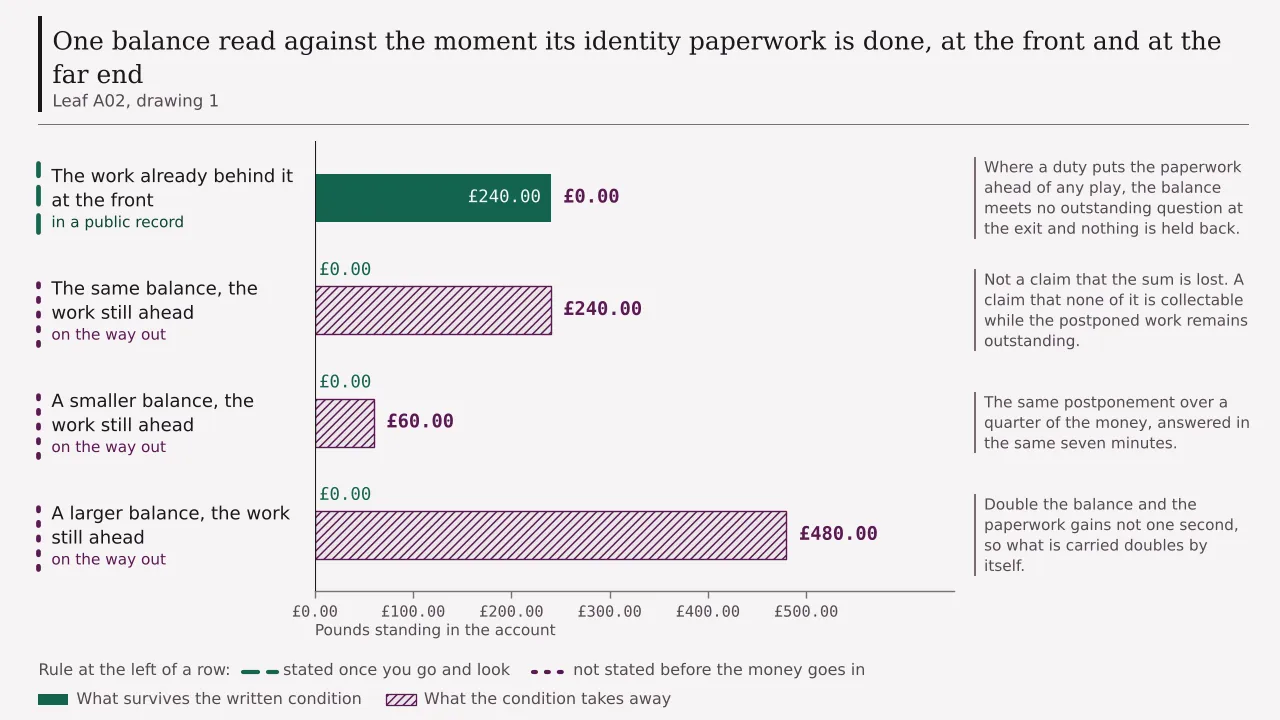
Nothing in that drawing asserts that a balance behind an outstanding check is lost. It asserts that it is not collectable while the check is outstanding, which is a different and smaller claim, and the one the arithmetic supports. A balance that cannot be collected today is worth its face only to somebody confident about the day it can. The confidence has a source where a complaint runs to a published clock and an approved adjudicator, and a much thinner one where the clock and the adjudicator are written by the party holding the money.
£240.00 standing behind seven minutes of paperwork that the postponement did not save
One figure from the regulator’s own writing belongs here rather than in a footnote, because it describes a failure mode rather than a worry about one. A post the Commission published on 21 October 2025 records two behaviours seen at unlicensed addresses: payouts stopped outright, and ceilings on withdrawal pitched at levels nobody reaches. Serious concerns about data protection appear in the same post, alongside the absence of any remedy once matters have gone wrong. Those are observations about conduct at the exit, from the body the complaints arrive at, and they are what the £240.00 row measures.
6
The branch in which any of this gets reached at all
Honesty requires the next sentence. On the house arithmetic this site works to, most accounts never produce a £240.00 balance, and the postponed check is therefore never met by most readers. Printing the £240.00 without printing that would be printing the tail and calling it the distribution.
Work it on a credit, credits being how balances of this kind usually begin. Put £25.00 of credit under the forty times this site works to throughout. The condition multiplies the credit by forty, demanding £1,000.00 of turnover, and at 10p that is 10,000 separate presses. Four pence in the pound of £1,000.00 comes to £40.00 kept, which overshoots the £25.00 credit by £15.00. An expected close of minus £15.00 follows, weighting sitting at one so that nothing is concealed inside it.
| Condition over the credit | Which place settles it | Turnover demanded | Kept by the margin | Expected close |
|---|---|---|---|---|
| None at all | £0.00 | £0.00 | £25.00 | |
| Ten times, the British ceiling | in a public record | £250.00 | £10.00 | £15.00 |
| Twenty-five times, the break-even point | in the bonus terms | £625.00 | £25.00 | £0.00 |
| Forty times, worked throughout here | in the bonus terms | £1,000.00 | £40.00 | minus £15.00 |
The sign changes at twenty-five, a property of four pence rather than of any market: £25.00 of credit at that multiple demands £625.00 of turnover and keeps £25.00, which is the credit exactly. Under twenty-five a remainder is left on the account. Over it the amount kept exceeds the credit and the surplus comes out of whatever else the account holds, which here is the reader’s own £25.00.
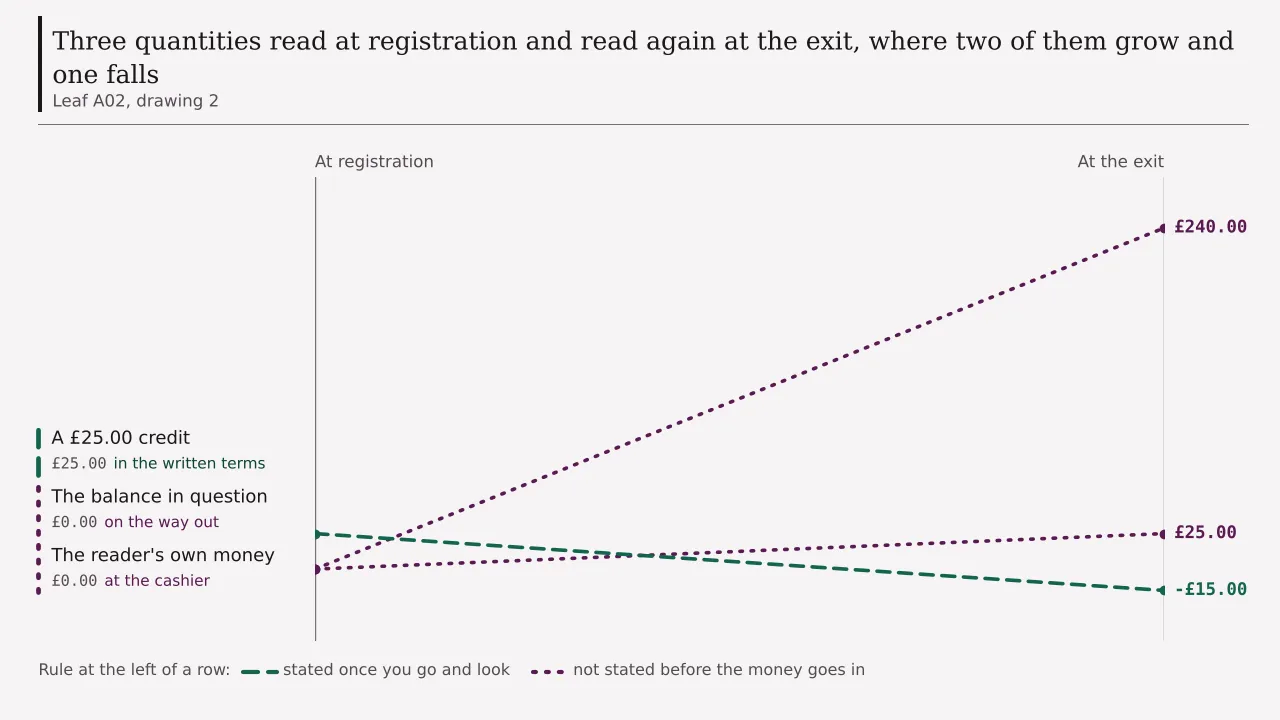
Read the three lines of that drawing together and the structure of the whole subject is visible without prose. One line rises because money has been paid in. One line rises faster because an outcome went well. One line falls because a condition was written over a credit. The postponed check is measured against the second of those and is indifferent to the third, which is why a leaf about paperwork has to carry the credit arithmetic as well: the paperwork only becomes expensive in the branch where the credit arithmetic was beaten.
So the proper statement of the risk is conditional rather than average. Expected across everybody, a postponed check costs almost nothing, because almost nobody reaches it. Conditioned on arriving at the exit with £240.00, it costs the whole £240.00 until it is satisfied. The two sentences are both true and only one of them is about the reader who is reading.
7
Sorting one question into the six places that could settle it
Every term on this site gets filed under whichever one place would settle it, and six candidates exist, running from the advertisement through a written document, a public record and a payment screen to an exit, and ending at no place whatsoever. Put the identity question through that filing and it does not stay whole, its parts landing in five different places, which is why no single phrase can answer it.
| The part being asked | Settled where | Prerequisite | Exposure at that moment |
|---|---|---|---|
| Whether paperwork is mentioned at all | Nothing | £0.00 | |
| Whether the account terms reserve the right to ask | in the account terms | A document, opened | £0.00 |
| Whether a duty fixes the moment of asking | in a public record | A licensee’s name | £0.00 |
| Whether an instrument has to be named to pay in | at the cashier | An account | £25.00 |
| Which material is actually wanted, and by when | on the way out | A balance to collect | £240.00 |
| How long the answer may be considered for | on the way out | A balance to collect | £240.00 |
| What happens to the balance while it is considered | nowhere in writing | Unreachable | £240.00 |
Read the exposure column downwards and it does the work of an argument. The three rows a reader could settle for nothing are the three that decide least. The three rows that decide most are settled at £240.00 of exposure, and the last of them is settled nowhere at all, since no document anybody can open states how long a balance sits while paperwork is under consideration.
The third row is the one that converts this leaf into a register question. Whether any duty fixes the moment of the asking is settled by looking up who holds a licence and for what, which costs nothing, needs no account, and can be done before a penny moves. It is the cheapest serious check in the whole table and the only one drafted by a party with nothing at stake in how it reads.
The last row deserves its own sentence because its absence is the expensive part. A period during which a balance is held pending paperwork is not a term anybody has drafted. It emerges from how long the work takes, how long the queue is, and how energetically either is pursued, and no document a reader can open before committing contains any of those three. Where a British licence applies, the outer limit on arguing about it is eight weeks from the day a complaint arrives, with an adjudicator the regulator has approved at the end of it. Where none applies, part three’s offshore timetable is the nearest published thing and its final parameters are set by the operator.
8
Four limbs about order, taken away one at a time
An address advertising an absence of paperwork holds no Great Britain licence. Showing what that costs, on a leaf about sequence, means removing the four limbs of part four one at a time and naming in pounds and minutes what each removal alters. Nothing in this part concerns whether documents are intrusive. All of it concerns when they arrive.
Remove limb one and the seven minutes lose their appointed position. The requirement fixing verified identity, a reachable address and a birth date ahead of all gambling is what puts the paperwork at £0.00 of exposure. Without it the paperwork floats, and a floating requirement settles wherever it is most useful to whoever wrote it, which on the evidence of part three is at the milestone money moves outward through.
Remove limb two and the timetable disappears. A licensee inside the licence must say, before a customer can pay anything in, what may be asked for, at what point and in what manner. That duty converts an unknown into a published fact at nought cost to the reader. Delete it and the first authoritative statement about which material is wanted arrives at the same instant as the demand for it, with £240.00 standing behind the answer.
Remove limb three and the exit becomes the natural place to start asking. The bar on a withdrawal request triggering a demand for information the licensee could reasonably have sought earlier is the single clause that makes postponement a breach rather than a policy. Without it, postponement is simply how the account is run, and the reader who notices has already paid in.
Remove limb four and the record decays unchecked. A duty to take reasonable steps to keep identity information accurate is what stops a stale record producing a stall at the worst moment. Where nobody owes that duty, the quality of the record is whatever it happens to be on the day the balance is asked for.
Add the four removals together and the arithmetic of this leaf does not shift by a penny: still seven minutes, still £240.00, still a credit closing at minus £15.00 under forty times. What shifts is the position of the seven minutes and the authority of every statement about them. Inside the licence the sequence is fixed by a published condition, whose player-facing version states plainly that identifying yourself is not something a payout may be made to wait on where the asking had its chance earlier. Outside, sequence becomes a commercial decision taken by the party gaining from it, and the nearest published thing to a timetable is a rulebook fastening the work to milestones the money itself sets off.
9
What this page declines to set out, and why that is not coyness
No part of this leaf describes a procedure, and the omission is deliberate rather than squeamish. It does not set out what material satisfies anybody, how to prepare it, in what order to supply it, or what to do when an answer is unwelcome. It names no address, no jurisdiction and no category of operator as asking for less than another. That is not an editorial manner. It is the only position consistent with the arithmetic above.
The reason is in the numbers rather than in a principle. The whole of this leaf is a demonstration that a check postponed costs seven minutes exactly as a check performed does, and that the postponement shifts £240.00 of exposure onto the reader. A page that then supplied a route would be arguing against its own measurement. Where an argument here would need a route to complete it, the consequence is printed and the route is left out, and part seven’s final row is an example: the useful thing to know about a hold is how long it may last and who decides, not how to pre-empt one.
What a reader may already have put in place belongs to the same reasoning. Enrolment in the national exclusion arrangement, a blocking application installed on a device, and a bank or card network declining to carry a gambling payment make up one family of three instruments. Every one of them interrupts something the person themselves arranged to have interrupted. Running into one is a result and not an obstruction, and the three routes in part one answer running into one better than any further reading could.
Where its own reach ends is something the arrangement states plainly, and the statement is worth carrying because it marks a limit rather than a failing. Its terms of use, carrying a revision date of 20 May 2026, say the exclusion covers gambling services offered by participating operators, while anything run by organisations outside it falls beyond what the arrangement can prevent. Reach follows the British licence, membership being something the licence requires rather than something a site elects, which is why a phrase promising an absence of paperwork and a phrase describing an address beyond the arrangement so often point in the same direction.
What this leaf will do, and has done, is price the thing in both directions. Seven minutes either way. Nought saved. £240.00 moved from one side of the relationship to the other. A credit of £25.00 closing at minus £15.00 under the usual condition. Those four figures are the whole of what the phrase is worth, and a reader who has them does not need anything further from this page.
10
Reading any phrase that promises an absence of paperwork
What follows is reusable and needs none of this leaf’s figures. Five questions, each with a written answer, and the fifth is the only one with pounds in it.
Question one: does anything say the check will never happen, or only that it is not happening now. Those are different promises and only the second is ever actually made. A phrase, a banner headline and a help article are all capable of saying the second while reading like the first.
Question two: which document fixes the moment. Inside a British licence the answer is a numbered condition with four limbs and it is readable without an account. Elsewhere the answer is whichever rulebook the regulator publishes, if any, and part three shows what one of them actually says. Where no rulebook can be found, the moment is fixed by nobody and the answer to question two is that there is no answer, which is itself a result worth writing down.
Question three: what is standing behind the paperwork at each candidate moment. Write two figures, one for the front and one for the exit. On any arrangement where money goes in before paperwork comes out, the first figure is £0.00 and the second is the whole balance, and the gap between them is what the postponement is worth to whoever chose it.
Question four: how long may the consideration take, and who may be complained to about it. Eight weeks and an approved adjudicator is one answer. Four weeks extendable once, with the final parameters set by the operator, is another. No published answer at all is a third, and a reader who finds the third should treat the hold as open-ended because nothing says otherwise.
Question five: price it. Minutes at the front against minutes at the exit, which subtract to nought. Exposure at the front against exposure at the exit, which subtract to the balance. Print both pairs, rule off both differences, and label every estimate inside the sentence spending it, because an estimate carried quietly forward turns into a fact that nobody has checked.
Questions
- Does a no KYC casino really never ask for identity documents?
- The phrase supports three readings and that is not one of them. It can mean nothing is asked when an account opens, that nothing is asked below a level the operator sets and does not publish, or that the asking has been fastened to a later point. Where an offshore regulator publishes a rulebook at all, the rulebook ties identity work to later milestones rather than deleting it, and money leaving an account is the moment at which anybody wanting material asks for it.
- What does postponing the check actually save a player?
- Nothing, unless the account ends at nought. Seven minutes is how long identity paperwork occupies somebody, estimated on this page and flagged as such, and the same seven minutes appear whichever end of the relationship they sit at, so the two readings subtract to nil. One saving is genuine and it belongs to a reader who opens an account, plays through whatever went in, arrives at nought and leaves, since that reader never reaches the point where the asking happens.
- When does a deferred identity check actually arrive?
- At the milestone, and for money going outward the milestone and the exit are the same event. The responsible gaming policy the Curaçao Gaming Authority publishes for its licensed operators, version 1.0 of 21 February 2025, requires a date of birth at registration to establish the player is not a minor, and puts full age verification under its know-your-customer and anti-money-laundering policies with a government-issued identity document as the floor, brought forward only where the operator doubts the player’s age before those milestones are reached.
- If the work is identical, why should its timing matter at all?
- Because the sum standing behind the work is not identical. Done at the front, the seven minutes are performed by somebody holding £0.00, who can abandon the account at no cost. Done at the exit, the same seven minutes are performed by somebody holding £240.00 on the balance worked here, for whom walking away costs £240.00. Equal work, unequal position, and the difference of £240.00 is what the postponement carries across the line.
- What does British licence condition 17.1.1 require, limb by limb?
- Four things, and the order of them is the point. Verified identity has to exist ahead of any gambling, with three items set as a floor rather than a ceiling: identity, an address, a birth date. Ahead of the first payment inwards, the licensee owes a statement of what may be wanted, at which point and in which form. Turning a request to withdraw into the occasion for a fresh demand is barred in every case where asking sooner had been a reasonable option, one carve-out surviving for material another legal duty compels at that moment. And reasonable steps have to keep whatever identity information sits on file accurate.
- Can a licensed operator hold a withdrawal until documents arrive?
- Not where the asking had its chance sooner. A guide written for players puts it plainly: proving age and identity may not be the price of getting money out where it could have been sought before, and money-laundering material belongs early rather than at the hour a payout is wanted. That page also records a payout delayed for want of identity material as something that may place the operator in breach, and notes that no particular list of documents is prescribed. Its dates are 23 September 2020 at publication and 13 April 2022 at the last revision.
- What survives of a £25 credit after a forty times condition?
- An expected minus £15.00. Forty times the credit demands £1,000.00 across the reels, which comes to 10,000 presses of 10p, of which four pence in each pound is kept, £40.00 in all. Keeping £40.00 overshoots a £25.00 credit by £15.00. At twenty-five the sign changes, since £625.00 of turnover keeps exactly £25.00. At ten, the ceiling a British licence sets, £250.00 of turnover keeps £10.00 and the close is a positive £15.00.
- Does a complaint go anywhere at an offshore address?
- Usually it does, and asserting otherwise would be inaccurate. The Curaçao complaints policy, at version 1.1 and dated 18 June 2025, allows six months from the incident, confirms receipt in writing within seven days, and puts a response due in four weeks, extendable one time by four more, so eight weeks caps it. What differs from the British arrangement is who writes the terms of the dispute resolution closing the process: that policy contemplates the operator settling such matters as how far the outcome binds the player and whether low-value claims qualify for escalation.
- How long can a balance be held while paperwork is considered?
- No document a reader can open before committing states it. The period emerges from how long the work takes, how long the queue is and how energetically either is pursued, so it is settled nowhere in writing. Inside a British licence the outer limit on arguing about it is eight weeks from the day a complaint arrives, with an adjudicator the regulator has approved at the end. Where no British licence applies, a reader finding no published answer should treat the hold as open-ended, because nothing says otherwise.
- Why will this page not explain how to satisfy a check quickly?
- Because the measurement on the page argues against it. Every figure here says the postponed check costs the same seven minutes as the performed one and shifts £240.00 of exposure onto the reader, so a route around it would contradict the arithmetic that produced those figures. The same reasoning covers a self-exclusion registration, a blocking application and a bank or card network declining to carry a gambling payment: three instruments of one family, each stopping something a person set out to do at the request of their earlier self.
- What is the shortest honest summary of a phrase like this one?
- Four figures. Seven minutes of paperwork either way, nought saved by moving it, £240.00 of exposure carried from one end of the relationship to the other, and a £25.00 credit closing at an expected minus £15.00 under the usual condition. A reader holding those four does not need anything further, and the first authoritative statement about which material is wanted arrives, where no British licence applies, at the same instant as the demand for it.