Terms read 19 October 2026 Leaf N11, revision 1
One name, several builds, and the quantities that move underneath it
A hundred and twenty presses at 10p carry £12.00 across the reels and are expected back as £11.52. Move the rate from 96 pence in the pound to 94 and that figure shifts by 24p. Move the share of the return sitting behind a feature from three tenths to more than half, which is a thing that differs between builds carrying one name, and the sum arriving in ordinary play falls to £5.18. The quantity readers argue about moves least, and no document gathers any of them in one place.
Stated on the banner A line’s name Which product line the presses belong to, settled for anybody without a click, and admitting every build the line contains. Stated, once you go and look One member A bonus document narrows the line to the build or two the presses may actually be spent on, which is a different set from the one advertised. Not stated before the money goes in £6.34 What separates two members of one line on a hundred and twenty presses, once the share of the return held behind a feature is allowed to differ between them.
Spin offers tied to a product line, with their terms read
Every destination in this file is bought advertising. The site is paid a fee if a reader goes on to register, and no figure printed below moves because of it.
Bonus Spins UK Slip 01
Betportal
Ceiling as a multiple
The drop
€15.00
€1.00 in the euro
The claim reads €15.00. Once the terms beside it have applied, €0.00 of it can leave. The difference is the drop.
7 of the 15 terms on this slip could not be read before the money went in
Spins priced at this site's own 10p a spin, which the operator does not publish
Stated
€15.00
The claim as it is printed, before a single term has been applied to it.
Headline paid as spins
150 spins at 10c each, which is €15.00 of the figure above.
6 Nowhere
What one spin is worth
No unit is published for a spin, so the count is priced at this site's own 10p a spin. At half that price every figure below halves with it.
Match and other credit not priced
300% of three deposits, to a ceiling of €1,000. A share of a deposit nobody has made yet is not a sum, so no figure stands on this line and none is carried below.
Qualified
-€14.40
Written down somewhere, and taking part of the claim back. Each term carries the place it is written and the sum it takes.
2 Written terms at a distance this record does not establish
Play-through -€14.40
Carrying €14.40 through 35 times stakes €504.00 and costs €20.16 of it at 96 per cent return. That prices above the €14.40 there is to charge it against, so the whole of the credit goes and the line is held at that. The multiple sits on the bonus.
2 Written terms at a distance this record does not establish
Game weighting not priced
Slots only count towards the play-through. No contribution percentage is published, so the line above has been worked at full weight, which is the kindest reading there is.
2 Written terms at a distance this record does not establish
Ceiling on the winnings not priced
5x the bonus.
2 Written terms at a distance this record does not establish
Clock on the credit not priced
14 days.
2 Written terms at a distance this record does not establish
Largest stake while it runs not priced
€5.
3 Public record
Licence, and who holds it not priced
Licensed in Anjouan, Comoros, held by BetPortal Gaming Ltd, with Excite Ultra Media Ltd, reference ALSI-202601040-FI2. A register entry settles who holds a licence and what it permits. It does not settle who is running the site this morning.
4 Cashier
Smallest qualifying deposit your money
€20 a stage. That is €20.00 of your own money, and it is never netted into a drop.
5 On the way out
Checks before a withdrawal not priced
Documents before the first withdrawal.
Unstated
-€0.60
Applying without having been published anywhere, and costing money all the same.
6 Nowhere
What a spin hands back -€0.60
Staking a spin returns 96 per cent of it, so that share of the batch is the house's before a reel turns. This site works at that return and the operator publishes none where the claim is made.
6 Nowhere
Forfeited by rule cost unknown
Nothing is published under this heading, and it applies regardless.
6 Nowhere
Charge on the way out cost unknown
No charge on the way out is published as a figure, so nothing comes off this line. A charge that exists unpublished would come straight off whatever survives.
6 Nowhere
Smallest withdrawal allowed cost unknown
No smallest withdrawal is published as a figure. A floor nobody has published is still a floor, and it decides whether a small balance can move at all.
No Great Britain licence
Terms read 19 October 2026
Bonus Spins UK Slip 02
WinBeast
Ceiling as a sum
The drop
€50.00
€1.00 in the euro
The claim reads €50.00. Once the terms beside it have applied, €0.00 of it can leave. The difference is the drop.
8 of the 15 terms on this slip could not be read before the money went in
Spins priced at this site's own 10p a spin, which the operator does not publish
Stated
€50.00
The claim as it is printed, before a single term has been applied to it.
Headline paid as spins
500 spins at 10c each, which is €50.00 of the figure above.
6 Nowhere
What one spin is worth
No unit is published for a spin, so the count is priced at this site's own 10p a spin. At half that price every figure below halves with it.
Match and other credit not priced
50% to 100% of five deposits, each to a ceiling of €1,000, and a €650 free bet. A share of a deposit nobody has made yet is not a sum, so no figure stands on this line and none is carried below.
Qualified
-€48.00
Written down somewhere, and taking part of the claim back. Each term carries the place it is written and the sum it takes.
2 Written terms at a distance this record does not establish
Play-through -€48.00
Carrying €48.00 through 40 times stakes €1,920.00 and costs €76.80 of it at 96 per cent return. That prices above the €48.00 there is to charge it against, so the whole of the credit goes and the line is held at that. The multiple sits on the bonus and the winnings from the spins.
2 Written terms at a distance this record does not establish
Game weighting not priced
Slots, titles vary by country count towards the play-through. No contribution percentage is published, so the line above has been worked at full weight, which is the kindest reading there is.
2 Written terms at a distance this record does not establish
Ceiling on the winnings not priced
€100 a batch of spins.
2 Written terms at a distance this record does not establish
Clock on the credit not priced
7 days, spins 1 day.
3 Public record
Licence, and who holds it not priced
Licensed in Curaçao, holder not named on the site. A register entry settles who holds a licence and what it permits. It does not settle who is running the site this morning.
4 Cashier
Smallest qualifying deposit your money
€20 a stage. That is €20.00 of your own money, and it is never netted into a drop.
5 On the way out
Checks before a withdrawal not priced
Documents before the first withdrawal.
Unstated
-€2.00
Applying without having been published anywhere, and costing money all the same.
6 Nowhere
What a spin hands back -€2.00
Staking a spin returns 96 per cent of it, so that share of the batch is the house's before a reel turns. This site works at that return and the operator publishes none where the claim is made.
6 Nowhere
Largest stake while it runs cost unknown
Nothing is published under this heading, and it applies regardless.
6 Nowhere
Forfeited by rule cost unknown
Nothing is published under this heading, and it applies regardless.
6 Nowhere
Charge on the way out cost unknown
No charge on the way out is published as a figure, so nothing comes off this line. A charge that exists unpublished would come straight off whatever survives.
6 Nowhere
Smallest withdrawal allowed cost unknown
No smallest withdrawal is published as a figure. A floor nobody has published is still a floor, and it decides whether a small balance can move at all.
No Great Britain licence
Terms read 19 October 2026
Bonus Spins UK Slip 03
EliteSpin
Longest spin window
The drop
£50.00
£1.00 in the pound
The claim reads £50.00. Once the terms beside it have applied, £0.00 of it can leave. The difference is the drop.
8 of the 15 terms on this slip could not be read before the money went in
Spins priced at this site's own 10p a spin, which the operator does not publish
Stated
£50.00
The claim as it is printed, before a single term has been applied to it.
Headline paid as spins
500 spins at 10p each, which is £50.00 of the figure above.
6 Nowhere
What one spin is worth
No unit is published for a spin, so the count is priced at this site's own 10p a spin. At half that price every figure below halves with it.
Match and other credit not priced
50% to 100% of five deposits, each to a ceiling of £1,000. A share of a deposit nobody has made yet is not a sum, so no figure stands on this line and none is carried below.
Qualified
-£48.00
Written down somewhere, and taking part of the claim back. Each term carries the place it is written and the sum it takes.
2 Written terms at a distance this record does not establish
Play-through -£48.00
Carrying £48.00 through 40 times stakes £1,920.00 and costs £76.80 of it at 96 per cent return. That prices above the £48.00 there is to charge it against, so the whole of the credit goes and the line is held at that. The multiple sits on the bonus and the winnings from the spins.
2 Written terms at a distance this record does not establish
Game weighting not priced
Slots count towards the play-through. No contribution percentage is published, so the line above has been worked at full weight, which is the kindest reading there is.
2 Written terms at a distance this record does not establish
Ceiling on the winnings not priced
5x the bonus.
2 Written terms at a distance this record does not establish
Clock on the credit not priced
7 days, spins 3 days.
3 Public record
Licence, and who holds it not priced
Licensed in Costa Rica, held by PrimeTier Limited. A register entry settles who holds a licence and what it permits. It does not settle who is running the site this morning.
4 Cashier
Smallest qualifying deposit your money
£20 a stage. That is £20.00 of your own money, and it is never netted into a drop.
5 On the way out
Checks before a withdrawal not priced
Documents before the first withdrawal.
Unstated
-£2.00
Applying without having been published anywhere, and costing money all the same.
6 Nowhere
What a spin hands back -£2.00
Staking a spin returns 96 per cent of it, so that share of the batch is the house's before a reel turns. This site works at that return and the operator publishes none where the claim is made.
6 Nowhere
Largest stake while it runs cost unknown
Nothing is published under this heading, and it applies regardless.
6 Nowhere
Forfeited by rule cost unknown
Nothing is published under this heading, and it applies regardless.
6 Nowhere
Charge on the way out cost unknown
No charge on the way out is published as a figure, so nothing comes off this line. A charge that exists unpublished would come straight off whatever survives.
6 Nowhere
Smallest withdrawal allowed cost unknown
No smallest withdrawal is published as a figure. A floor nobody has published is still a floor, and it decides whether a small balance can move at all.
No Great Britain licence
Terms read 19 October 2026
Bonus Spins UK Slip 04
Crown Jewelz
Multiple unpublished
The drop
NOT WORKED
The multiple is not published in the operator's own terms. Since the sum cannot be worked around it, none is worked.
9 of the 14 terms on this slip could not be read before the money went in
No drop worked
Stated
£15.00
The claim as it is printed, before a single term has been applied to it.
Headline paid as spins
150 spins at 10p each, which is £15.00 of the figure above.
6 Nowhere
What one spin is worth
No unit is published for a spin, so the count is priced at this site's own 10p a spin. At half that price every figure below halves with it.
Match and other credit not priced
200% of the first deposit, then 150% twice, each to a ceiling of £1,000. A share of a deposit nobody has made yet is not a sum, so no figure stands on this line and none is carried below.
Qualified
NOT WORKED
Written down somewhere, and taking part of the claim back. Each term carries the place it is written and the sum it takes.
2 Written terms at a distance this record does not establish
Play-through not priced
40x the bonus, reported rather than published by the operator.
2 Written terms at a distance this record does not establish
Game weighting not priced
Slots count towards the play-through. No contribution percentage is published, so the line above has been worked at full weight, which is the kindest reading there is.
3 Public record
Licence, and who holds it not priced
Licensed in Curaçao, number not verified, holder not named on the site. A register entry settles who holds a licence and what it permits. It does not settle who is running the site this morning.
4 Cashier
Smallest qualifying deposit your money
£20. That is £20.00 of your own money, and it is never netted into a drop.
5 On the way out
Checks before a withdrawal not priced
Documents before the first withdrawal.
Unstated
NOT WORKED
Applying without having been published anywhere, and costing money all the same.
6 Nowhere
Ceiling on the winnings cost unknown
No ceiling is published. Nothing is assumed in its place.
6 Nowhere
Clock on the credit cost unknown
Nothing is published under this heading, and it applies regardless.
6 Nowhere
Largest stake while it runs cost unknown
Nothing is published under this heading, and it applies regardless.
6 Nowhere
Forfeited by rule cost unknown
Nothing is published under this heading, and it applies regardless.
6 Nowhere
Charge on the way out cost unknown
No charge on the way out is published as a figure, so nothing comes off this line. A charge that exists unpublished would come straight off whatever survives.
6 Nowhere
Smallest withdrawal allowed cost unknown
No smallest withdrawal is published as a figure. A floor nobody has published is still a floor, and it decides whether a small balance can move at all.
No Great Britain licence
Terms read 19 October 2026
Every figure in the second and third columns is this site's own working and nothing an operator has published. A claim is priced as printed, then the share a spin hands back at 96 per cent return comes off it, then what playing the multiple through costs at the same return, and then whatever a published ceiling, a charge on the way out or a floor on the smallest withdrawal takes from what has survived. The drop is the difference between the first figure and the last. The two columns add back up to it exactly, so no money leaves a slip without a term and a place beside it.
Which column a term falls in is settled by one question: has anybody written it down. A charge a reader meets at the payment screen is written down, and it stands in the second column with the cashier against it. A condition that binds without ever having been set down stands in the third, whatever it costs. Inside each column the terms run outwards from the banner, so the order itself says how far a reader would have had to go.
A count of spins has no unit until one is supplied. Where an operator publishes what one of its own spins is worth, that figure is used and the first column says it is theirs. Where none is published, this site's own 10p a spin stands in its place and every figure below moves in proportion with it. Where the multiple itself is unpublished, no drop is worked at all, because that is the one figure the sum cannot be done without.
Three words stand where a figure cannot. Not priced is a term that is written down and carries no number the arithmetic can take. Cost unknown is a term nobody has written down, costing something nobody has put a number on. Your money is money of the reader's own, which is never netted into a drop.
None of the operators in this file holds a Great Britain licence, so none of the duties that licence carries reaches them. Each of those duties is published in its own right, which is what makes its absence here something a reader can check rather than take on trust. Every gambling company licensed in Great Britain belongs to Gamstop Online, so a reader who has shut themselves out through the scheme is not shut out here. Social Responsibility Code 5.1.1 has held a play-through to a maximum of ten times the bonus funds since 19 January 2026, and it binds a licence holder and nobody else. Asked in a post of 21 October 2025 what is lost along with the licence, the Gambling Commission's Director of Enforcement and Intelligence answered: "unfair gaming practices, financial loss, and a lack of recourse if things go wrong". The same post puts blocked payouts, and withdrawal limits pitched high enough to be unreachable, among the behaviour the Commission has recorded. Nobody under 18 may hold an account at any of them.
Terms are reproduced in the wording their operator published, and each slip is dated with the day somebody sat down and read them. 19 October 2026 is the oldest of those dates. Anybody claiming an offer is bound by that operator's full terms, which are elsewhere, and never by a line standing here.
1
What a line’s name is, and what it was ever meant to do
A product line is a marketing object. A producer makes a build, it does well, and the producer makes more builds that look like it, sound like it and borrow its name. That is an entirely ordinary commercial act and it happens in every industry that sells things people liked once. What it is not, and was never offered as, is a specification.
The distinction matters because a reader meeting a familiar line on a banner feels they have been told something precise, and the precision is real but is about the wrong thing. A line’s name fixes who made it, what it will look like, roughly what the feature will do and what the symbols will be. It fixes none of the quantities that decide money, and parts three to seven show that those quantities move between members of one line by amounts this leaf prices in pounds.
Start from the arithmetic so the rest has something to sit on. A hundred and twenty presses at 10p, which is this leaf’s assumed press value throughout, put £12.00 across the reels. With 96 pence returning against each pound staked, the rate held fixed throughout here, the expected return is £11.52. Both of those are the family-level reading: they are what a reader would compute knowing only the line’s name and a press value, and every figure after this one is a departure from them.
A separate question runs alongside and belongs to a different leaf. Whose permission stands behind the address showing the line is a question about licensing, and a producer’s name reaches it no better than a line’s name does. This leaf leaves that where it belongs and asks something narrower: taking the line’s name as accurate and the address as settled, what has a reader learned about the money. The answer is almost nothing, and the almost is worth setting out carefully.
One concession before the arithmetic. A reader choosing a line because they enjoy the way it plays has used the name for exactly what it is good at, since enjoyment is a property of the mechanics and the mechanics are what a line really does share. The criticism on this leaf attaches only to using a line’s name as a guide to what the presses are worth, which is a different use with a different answer.
2
What members of one line genuinely hold in common
Be concrete about the shared part, because it is substantial and a leaf that waved it away would be arguing dishonestly. Members of a line normally share a producer, an art style, a sound, a feature concept, a set of symbol names and a general grammar of how a round proceeds. Somebody who has played one member and opens another will recognise almost everything in front of them inside ten seconds.
That recognition is the whole commercial point of a line and it works. It is also the reason the substitution this leaf is about is so easy to make, because recognising nearly everything feels like knowing everything, and the handful of things not recognised are the ones with money attached.
Sort the shared list by whether a member of the line could differ on it. Art, sound and symbol names: shared by construction, since differing on them would stop it being a line. The feature concept: shared in outline and different in every parameter. The grammar of a round: usually shared. The count of reels and rows: often shared, and when it differs the difference is visible on the screen, which makes it the only variable quantity in the whole list a reader can settle by looking.
Everything else moves, and nothing moving is visible. A rate of return is a number computed off a paytable. How much of the return is reserved for a feature is a design decision. A frequency at which that feature arrives is another. A ceiling on a single payout is a third. None of the four figures announces itself on a screen, and a reader who has played one member of a line for an hour has learned the four values of that member and not the four values of the next one.
So the honest summary of what a line’s name buys is this: it buys an accurate forecast of the experience and no forecast at all of the arithmetic. Those two are normally assumed to travel together, and inside one line they do not, because the things that make a build feel like its siblings are precisely the things a producer can keep while changing everything underneath.
3
Quantities that move between builds, and where each is settled
Here is the inventory, with a price against each. Every figure in the final column is this leaf’s own arithmetic on a hundred and twenty presses at 10p, worked at settings chosen to show a range rather than to describe any build. Nothing this site can source publishes a value for any of them against any title, which is why four rows out of the five carry the identical answer in their third column.
| The quantity | What it decides | Where a reader would settle it | What a plausible spread is worth |
|---|---|---|---|
| The rate of return | Where the whole distribution is centred | nowhere in writing | 24p across 94 to 96 |
| The share of the return held behind a feature | How much of it arrives in ordinary play | nowhere in writing | £2.88 across three tenths to over a half |
| How often the feature arrives | Whether a short run meets it even once | nowhere in writing | 37 runs in 100 against 74 in 100 |
| The ceiling on one payout, counted in stakes | The top of the distribution and nothing else | nowhere in writing | £250.00 against £1,000.00 |
| Which member the presses may be spent on | Which set of the four above applies at all | in the bonus terms | Everything above |
Read the final column downwards and the ordering is the opposite of the ordering readers use. The rate of return is the quantity people ask about, compare, screenshot and argue over, and across a two-point spread it moves a hundred and twenty presses by twenty-four pence. The share of the return held behind a feature is a quantity almost nobody asks about, and across a plausible spread it moves the same presses by £2.88.
Both of those are expectations, and the third row is of a different kind again, being a probability rather than a sum. It decides whether a short run encounters the part of the build where the money was put, and on the settings modelled in part five the answer swings between 37 runs in a hundred and 74 in a hundred. No amount of care with the first row rescues a reader who is wrong about the third.
The last row is the one with an address, and it is the hinge of the whole leaf. A bonus document names the builds the presses may be spent on. The banner names a line. Until the first of those is opened, a reader does not know which column of values applies, so the four unaddressed rows above are not merely unpublished: they are unpublished for a build that has not yet been identified.
4
Where the return sits inside a build, priced on one count
Take the second row and work it properly. A build’s rate of return is a total: it counts everything the reels give back, from the smallest ordinary line to the largest outcome the feature can produce. How that total is divided between ordinary play and the feature is a separate decision, and two members of one line can carry the same rate with the division set very differently.
Put numbers on the division. A hundred and twenty presses at 10p turn over £12.00 and are expected back as £11.52 in total. Where three tenths of the return is held behind the feature, the sum expected to arrive in ordinary play is £11.52 multiplied by seven tenths, which is £8.06. Where the share is nearly a half it is £6.34. Where the share is more than half, at fifty-five hundredths, ordinary play is expected to return £5.18. Those three settings are modelled here to bracket a range and are not claimed of anything.
A hundred and twenty presses read at the line’s level £11.52 What ordinary play returns where more than half sits behind the feature £5.18 What one unpublished division is worth on this count £6.34
Six pounds thirty-four on twelve pounds of turnover, produced by a quantity no document anywhere carries, against twenty-four pence produced by the quantity everybody looks for. Put as one comparison, that proportion is what this leaf exists to show, and it works out at better than twenty-six to one.
Check the subtraction from the other end before trusting it. If £5.18 arrives in ordinary play and the total expected is £11.52, then £6.34 must be expected to arrive inside the feature, and £6.34 is 55 hundredths of £11.52 to the penny. The two routes are the same split read from opposite sides, which is what makes the figure safe to print rather than a coincidence.
Nothing in that arithmetic says the second build is worse. It says the money has been put somewhere else inside it. Over an unlimited number of presses the two builds return the identical 96 pence in the pound, and the difference is entirely about what a hundred and twenty presses are likely to see, which is the next part.
5
Whether a hundred and twenty presses reach the feature at all
A share of the return held behind a feature is only a problem if the feature is out of reach, so the third row has to be worked as well. Model a feature arriving once in every ninety presses on one member of a line and once in every two hundred and sixty on another, those being illustrations chosen to bracket a range rather than measurements of anything.
The arithmetic is the same shape as any question about whether an event lands inside a window. A feature fails to arrive on a single press with probability one less its rate, and fails across a hundred and twenty presses with that figure raised to the hundred and twentieth. One arrival in ninety presses leaves a 120-press run meeting the feature with probability 73.84 per cent. At one in a hundred and forty it is 57.69 per cent. At one in two hundred and sixty it is 37.02 per cent.
Set the two rows together and the worst pairing appears. A build holding more than half its return behind a feature that a hundred and twenty presses reach 37 times in a hundred is a build where most short runs collect the £5.18 of ordinary play and nothing else, while the rest of the money waits in a branch most readers never open. A build holding three tenths behind a feature reached 74 times in a hundred behaves almost exactly like its headline rate. Same line, same name, same art, and a different proposition entirely.
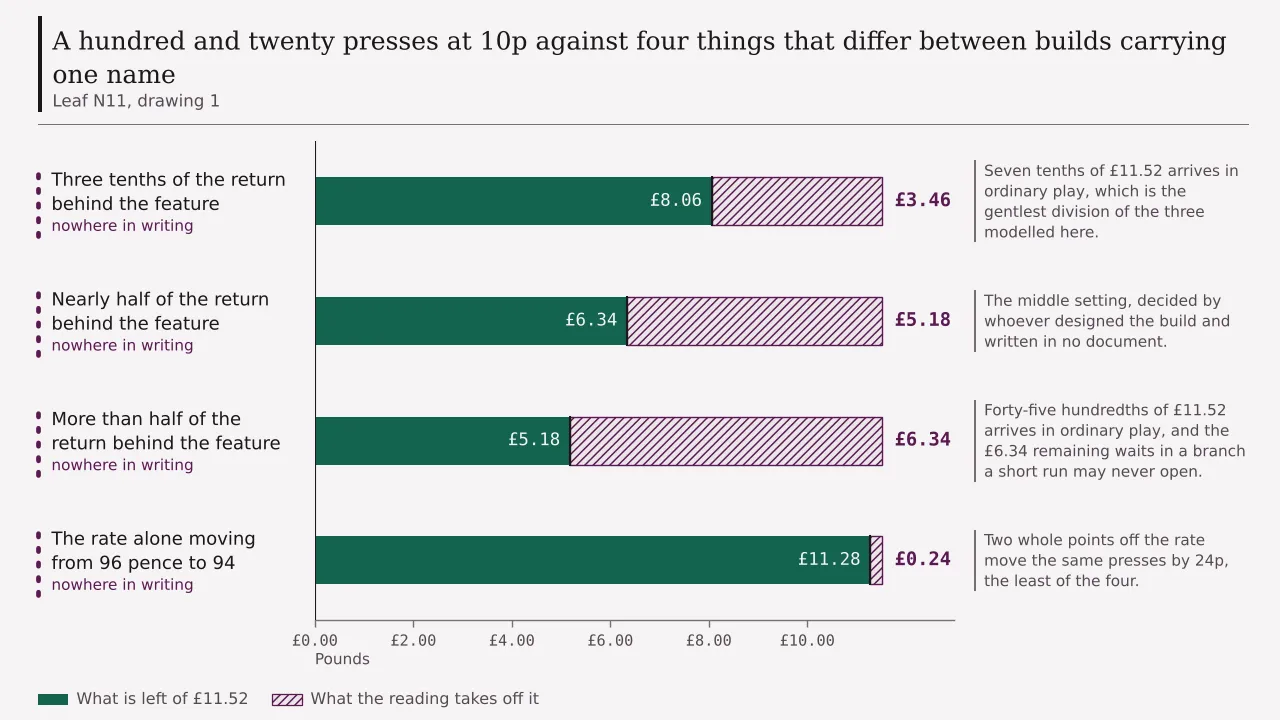
Point at the lowest bar in that drawing. It is the rate moving by two whole points, which is a larger move than most comparisons between builds ever involve, and it is barely distinguishable from the top of the ledger. The three bars above it are one design decision, unpublished, taking between a quarter and more than half of what a short run collects.
The question of how returns are spread around their average, as against where inside a build they are placed, is a separate property with its own leaf, and this one does not re-argue it. What belongs here is only the family point: two builds under one name can differ on placement by this much, and the name is silent on all of it.
6
A ceiling counted in stakes, which belongs to the build
The fourth varying quantity is a ceiling on what a single outcome may pay, expressed as a multiple of whatever the press cost. It is a build property rather than a line property, it is the one quantity on this leaf a reader may actually have seen on a screen, and it behaves differently from the other three because it touches only the extreme end of the distribution.
Model two members at 2,500 times the press and 10,000 times the press, figures chosen to show a spread rather than taken from anything. At the 10p this leaf assumes, those ceilings are £250.00 and £1,000.00. Four times separates them, and a reader who assumed the first member’s ceiling applied to the second would be wrong by £750.00 at the top of the range.
Now the honest part, which cuts against the drama. A ceiling at either of those settings changes the expected return by an amount too small to print on a hundred and twenty presses, because outcomes that large occur too rarely to move an average meaningfully over a run of that length. What a ceiling decides is not what a run is expected to produce. It decides the size of the best thing that can happen, which is the part of the proposition a reader is usually buying and the part no expectation describes.
£250.00 against £1,000.00 at the top of two builds carrying one name, decided by a multiple neither the banner nor the bonus document prints
Which gives a rule worth carrying. The four quantities in part three divide cleanly into two kinds. The rate and the feature share move the expectation, so they are priced in pounds and can be subtracted. The feature frequency and the payout ceiling move the shape of what a reader might get without moving the average, so they are priced in probabilities and in ceilings and cannot be subtracted at all. Folding the second kind into an expected close would put a figure on this leaf that nothing here can support.
There is also a second ceiling that has nothing to do with the build, and separating the two is worth a line. A bonus document commonly writes a ceiling over the sum a bonus balance will release, that being a condition drafted by whoever runs the address and applying whichever member of the line the presses ran on. The build’s ceiling is a design parameter settled nowhere. The document’s ceiling is a term settled in the bonus terms. They are commonly read as one thing and they have different owners, different addresses and different effects.
7
The set a banner describes against the set the terms allow
Everything so far has assumed a reader knows which member of the line their presses will run on, and ordinarily they do not. A banner naming a line describes a set with several builds in it. A bonus document names the build or two the presses may actually be spent on. Those are different sets, the second sits inside the first, and only the second decides anything.
The gap between the two sets is an ordinary feature of how these offers are drafted rather than anything underhand. A promotion is negotiated over particular builds, for particular reasons, and the terms record the result. The banner reaches for the widest accurate description available, and the widest accurate description of a particular build is the line it belongs to. Both documents are correct. They are simply about different things.
Price the gap using the parts above. Until the bonus document is opened, a reader holds a set of builds whose members may differ by £6.34 on the feature share, by 24p on the rate, by a factor of four on the payout ceiling, and by two to one on whether a hundred and twenty presses meet the feature at all. Opening the document collapses that set to one member and settles all four variables at once, which makes it the highest-value click in this entire family of offers, and it costs nothing but the opening.
What the document does not do is publish the four values. It identifies the build, and identification is where the trail stops, because the quantities belonging to that build sit nowhere in writing exactly as they did before. So the click is worth taking and it converts an unidentified unknown into an identified one rather than into a figure.
That is a genuinely awkward conclusion and this leaf is not going to dress it up. The one step a reader can take moves them from not knowing which build to knowing which build and still not knowing what it does. The honest value of the step is that it stops a reader applying remembered figures from one member of a line to another, which is the single commonest way the wrong number gets into a decision.
8
Duties that keep a specification still while it is played
Operators carrying no Great Britain licence are behind offers fastened to a product line at this end of things, and the obligations deserving a name on a leaf about specifications are those that stop a specification shifting. They publish nothing and they are not disclosure duties. What they do is make the four unpublished quantities in part three stable properties of a build rather than settings somebody can reach.
Four stand out. Rules, payouts and the probabilities under them hold steady for as long as a build is in play, and an alteration, where one happens, gets set before the customer rather than slipped through, with the build expected to be offline or suspended while it happens. One drafting is refused outright in the guidance: wording that keeps back a right to vary a game’s rules at will. For as long as a round runs, whatever allows somebody to follow where it has reached belongs on the screen. The outcome gets an accurate, clear showing, held there long enough to be read. And nothing may be provided that would let several games run together.
The last of those bites hardest on a line, because the obvious thing to do with a line is open three of its members side by side. Put this leaf’s own figures through it. Three builds going at once at 10p a press, each taking cycles as quickly as a licensed reel permits, would reach 4,320 presses in an hour against 1,440, which is £432.00 across the reels rather than £144.00, and an expected cost of £17.28 rather than £5.76. Outside the licence nothing forbids the arrangement, so a reader who likes a line can be spending three times the hourly figure they had in mind on three builds they believe to be the same build.
The first of the four is the one the whole leaf rests on. Every figure in parts three to six treats a build as having a rate, a split, a frequency and a ceiling, which are properties it holds. Remove the obligation to keep them still and they stop being properties and become settings, at which point a reader is not merely ignorant of four numbers but ignorant of four numbers that need not stay where they were when anybody last looked. Wording that keeps back a right to vary the rules at the operator’s convenience, refused inside Britain, binds whoever accepted it once the licence stops.
The concession is that none of the four would have published a single figure this leaf has been hunting. A build bound by all of them is still a build whose rate, split, frequency and ceiling appear in no document a reader can open. What the four buy is that the answer, whatever it is, is the same answer this week as last, and that a reader watching the screen can follow what is happening on it. That is worth naming accurately rather than overstating.
9
Totalling what the name on the banner actually bought
Add the leaf up. A reader meeting a line’s name on a banner has acquired, accurately: the producer, the art, the sound, the shape of the feature, the symbol set and the general grammar of a round. They have acquired, inaccurately if they think they have it: the rate, the split, the frequency, the ceiling and the identity of the build the presses attach to.
| What a reader takes from the name | Is it actually settled | What being wrong costs on 120 presses |
|---|---|---|
| The look, the sound and the symbols | Yes, by construction | Nothing |
| The shape of the feature | In outline only | Nothing on its own |
| The rate of return | No | 24p across two points |
| The share held behind the feature | No | £6.34 against the line-level reading |
| How often the feature arrives | No | 37 runs in 100 against 74 |
| The ceiling on one outcome | No | £750.00 at the top of the range |
| Which build the presses run on | Only once the terms are opened | All of the four above at once |
Two rows settle something and five do not, and the two that settle something are the two with no money attached to them. That is the shortest statement of what a family name is worth, and it is worth stating without exaggeration: the name is accurate about everything it covers, it covers everything a reader can see, and it covers none of what a reader is paying for.
The expected close under a written condition can be added for completeness, since offers of this sort carry one. Lay a multiple of forty over expected winnings of £11.52 and £460.80 has to cross the reels, which is 4,608 further presses at 10p, and a margin of four hundredths takes an expected £18.43 out of that. The close is £11.52 less £18.43, which is minus £6.91. Working it the other way, forty lots of four hundredths overshoot the winnings by six tenths of them, and six tenths of £11.52 is £6.91 to the penny.
That figure is the same whichever member of the line the presses ran on, which is the one quietly useful thing on this leaf. The clause does not care about the split, the frequency or the ceiling. It cares about the winnings, and it takes a fixed proportion of whatever the winnings turn out to be. So the four quantities decide what a reader collects, and the written condition then takes the same fraction of it regardless.
10
Reading any offer fastened to a product line
The method is four steps and it works on any offer that advertises a line rather than a build. It will not produce a figure, because the inputs are missing, and it will stop a reader producing a wrong one, which is the realistic goal.
Step one, treat the line’s name as a statement about appearance and nothing else, and write that down so it stops quietly becoming a statement about value. Step two, open the bonus document and find which member the presses attach to, which is the one step that settles anything and the one most often skipped. Step three, having identified the build, write the word unreachable against the rate, the split, the frequency and the ceiling, because that is where they are. Step four, compute at the line-level reading and treat the result as a ceiling on what ordinary play collects rather than as a forecast.
Worked on this leaf’s own count, step four gives £11.52 as the most ordinary play can be expected to return across a hundred and twenty presses, with the realistic figure anywhere from there down to £5.18 depending on a split nobody prints. Printing both ends and refusing to pick between them is the honest output, and it is more use than a single confident number resting on a remembered value from a different build.
Two habits keep it from drifting. Never carry a figure across from one member of a line to another, because that is precisely the move the line’s name invites and precisely the move the arithmetic above forbids. And never read a ceiling, whether it belongs to the build or to the bonus document, as a statement about the expected close, since the two live at opposite ends of the same distribution and neither tells you about the other.
The fair conclusion is narrow. A line’s name is accurate, useful for choosing something you will enjoy, and almost entirely uninformative about money. The quantity a reader can most easily establish, which is the rate, moves a hundred and twenty presses by twenty-four pence. The quantity nobody publishes and few readers consider moves the same presses by £6.34. A name that settles the first and is silent on the second has settled the cheaper half of the question.
Questions
- Do slots in the same series have the same RTP?
- Nothing requires it and nothing publishes it either way. A line is a marketing object: a producer makes a build, it does well, and more builds follow carrying its name, its art and its feature concept. The rate of return is computed off each build’s own paytable, so it belongs to the build rather than to the line. A reader carrying a figure across from one member to another is carrying a number nobody has checked between two things nobody said were the same.
- What actually varies between slots in one family?
- Four quantities, none of them visible and none of them published together. The rate of return, which centres the distribution. The share of the return held behind the feature, which decides how much arrives in ordinary play. How often the feature arrives, which decides whether a short run meets it at all. And the ceiling on a single payout counted in stakes, which decides the top of the range. A fifth thing varies as well: which member of the line an offer’s presses may actually be spent on, and that one is settled in the bonus document.
- Which matters more on a short run, the RTP or the bonus frequency?
- The frequency and the split, by better than twenty-six to one on this leaf’s arithmetic. A hundred and twenty presses at 10p turn over £12.00 and are expected back as £11.52 at 96 pence in the pound. Move the rate two whole points to 94 and the figure shifts by 24p. Move the share held behind the feature from three tenths to fifty-five hundredths and the sum expected to arrive in ordinary play falls from £8.06 to £5.18, which is £6.34 below the line-level reading. The quantity readers argue about moves least.
- What is the chance of hitting the bonus round in 120 spins?
- The answer rests on a frequency nobody publishes, so a range is the most that can be given. A feature fails on one press with probability one less its rate and fails across the whole run with that figure raised to the hundred and twentieth. Modelling one arrival in ninety presses gives a 73.84 per cent chance of meeting it at least once. One in a hundred and forty gives 57.69 per cent. One in two hundred and sixty gives 37.02 per cent. Those three settings bracket a range here and are not claimed of any build.
- Does a bigger max win mean a better slot?
- It means a different one, and the arithmetic separates the two claims. Model two members of a line at 2,500 times the press and 10,000 times the press, which at 10p is £250.00 and £1,000.00. Four times separates them. What it does not do is change what a hundred and twenty presses are expected to return by any amount worth printing, because outcomes that large occur far too rarely to move an average over a run of that length. A ceiling decides the size of the best thing that can happen, not the size of the likely thing.
- Does a free spins offer work on every game in the series?
- Rarely, and the two documents describe different sets. A banner naming a line describes the whole line. A bonus document names the build or two the presses may be spent on, and that smaller set sits inside the larger one. Opening the document is the highest-value click in this family of offers, because it settles which member applies and therefore which set of four unpublished quantities applies. It identifies the build and still publishes none of its figures.
- If the series name tells me so little, what does it tell me?
- The producer, the art, the sound, the shape of the feature, the symbol set and the grammar of a round, all of it accurate. Somebody opening a second member of a line recognises nearly everything inside ten seconds, and that recognition is the whole commercial point. The difficulty is that recognising nearly everything feels like knowing everything, while the handful of things not recognised are exactly the ones with money attached to them.
- How much does a forty times condition take out of 120 free spins?
- £18.43 of expected cost, closing at minus £6.91, and the figure is the same whichever member of the line the presses ran on. Expected winnings of £11.52 at a multiple of forty put £460.80 across the reels, which is 4,608 further presses at 10p, and a margin of four hundredths takes £18.43 out of that. The other route gives the same answer: forty lots of four hundredths overshoot the winnings by six tenths of them, and six tenths of £11.52 is £6.91 to the penny.
- What is lost on an offer tied to a series from an offshore address?
- Four obligations that keep a specification still rather than publish it. Rules, payouts and the probabilities under them hold steady for as long as a build is in play, with an alteration set before the customer and the build expected to be offline while it happens, and the guidance refusing outright any wording that keeps back a right to vary a game’s rules at will. Whatever allows somebody to follow where a round has reached belongs on the screen. The outcome gets an accurate, clear showing, held there long enough to be read. And nothing may be provided that would let several games run together, which bites hardest on a line, since three members going at once, each taking cycles as quickly as a licensed reel permits, reach 4,320 presses in an hour rather than 1,440, turning over £432.00 and costing an expected £17.28 rather than £5.76.
- How should I read an offer that names a series rather than a game?
- Four steps. Treat the line’s name as a statement about appearance and write that down. Open the bonus document and find which member the presses attach to. Write the word unreachable against that build’s rate, split, frequency and ceiling, because that is where all four figures sit. Then compute at the line-level reading and treat the answer as a ceiling rather than a forecast. On a hundred and twenty presses that gives £11.52 at the top and £5.18 at the bottom, and printing both ends while refusing to pick between them is the honest output.