Terms read 19 October 2026 Leaf H12, revision 1
Five free spins with no deposit, costed from both sides of the counter
Five presses at ten pence stake 50p and are expected to hand back 48p. That is the smallest quantity this section has to price, and the arithmetic finishes in a line. What takes the rest of the leaf is the question the figure raises, which is what a batch this small is for, since forty-eight pence of expectation cannot buy a prize, cannot clear an exit and cannot even be paid in a round coin.
Stated on the banner 48p Five presses at the ten pence assumed throughout, on reels that give back 96 pence in each pound, with no second figure beside them. Stated, once you go and look minus 28.8p A play-through of forty hung on those winnings, written in a conditions document the banner does not open, asking £19.20 of further staking. Not stated before the money goes in Price of a registration An identity, a reachable address and a standing permission to be contacted, none of which is priced on the banner and all of which moves in the opposite direction to the spins.
Small spin batches, with their terms read
Every destination in this file is bought advertising. The site is paid a fee if a reader goes on to register, and no figure printed below moves because of it.
Bonus Spins UK Slip 01
Betportal
Ceiling as a multiple
The drop
€15.00
€1.00 in the euro
The claim reads €15.00. Once the terms beside it have applied, €0.00 of it can leave. The difference is the drop.
7 of the 15 terms on this slip could not be read before the money went in
Spins priced at this site's own 10p a spin, which the operator does not publish
Stated
€15.00
The claim as it is printed, before a single term has been applied to it.
Headline paid as spins
150 spins at 10c each, which is €15.00 of the figure above.
6 Nowhere
What one spin is worth
No unit is published for a spin, so the count is priced at this site's own 10p a spin. At half that price every figure below halves with it.
Match and other credit not priced
300% of three deposits, to a ceiling of €1,000. A share of a deposit nobody has made yet is not a sum, so no figure stands on this line and none is carried below.
Qualified
-€14.40
Written down somewhere, and taking part of the claim back. Each term carries the place it is written and the sum it takes.
2 Written terms at a distance this record does not establish
Play-through -€14.40
Carrying €14.40 through 35 times stakes €504.00 and costs €20.16 of it at 96 per cent return. That prices above the €14.40 there is to charge it against, so the whole of the credit goes and the line is held at that. The multiple sits on the bonus.
2 Written terms at a distance this record does not establish
Game weighting not priced
Slots only count towards the play-through. No contribution percentage is published, so the line above has been worked at full weight, which is the kindest reading there is.
2 Written terms at a distance this record does not establish
Ceiling on the winnings not priced
5x the bonus.
2 Written terms at a distance this record does not establish
Clock on the credit not priced
14 days.
2 Written terms at a distance this record does not establish
Largest stake while it runs not priced
€5.
3 Public record
Licence, and who holds it not priced
Licensed in Anjouan, Comoros, held by BetPortal Gaming Ltd, with Excite Ultra Media Ltd, reference ALSI-202601040-FI2. A register entry settles who holds a licence and what it permits. It does not settle who is running the site this morning.
4 Cashier
Smallest qualifying deposit your money
€20 a stage. That is €20.00 of your own money, and it is never netted into a drop.
5 On the way out
Checks before a withdrawal not priced
Documents before the first withdrawal.
Unstated
-€0.60
Applying without having been published anywhere, and costing money all the same.
6 Nowhere
What a spin hands back -€0.60
Staking a spin returns 96 per cent of it, so that share of the batch is the house's before a reel turns. This site works at that return and the operator publishes none where the claim is made.
6 Nowhere
Forfeited by rule cost unknown
Nothing is published under this heading, and it applies regardless.
6 Nowhere
Charge on the way out cost unknown
No charge on the way out is published as a figure, so nothing comes off this line. A charge that exists unpublished would come straight off whatever survives.
6 Nowhere
Smallest withdrawal allowed cost unknown
No smallest withdrawal is published as a figure. A floor nobody has published is still a floor, and it decides whether a small balance can move at all.
No Great Britain licence
Terms read 19 October 2026
Bonus Spins UK Slip 02
WinBeast
Ceiling as a sum
The drop
€50.00
€1.00 in the euro
The claim reads €50.00. Once the terms beside it have applied, €0.00 of it can leave. The difference is the drop.
8 of the 15 terms on this slip could not be read before the money went in
Spins priced at this site's own 10p a spin, which the operator does not publish
Stated
€50.00
The claim as it is printed, before a single term has been applied to it.
Headline paid as spins
500 spins at 10c each, which is €50.00 of the figure above.
6 Nowhere
What one spin is worth
No unit is published for a spin, so the count is priced at this site's own 10p a spin. At half that price every figure below halves with it.
Match and other credit not priced
50% to 100% of five deposits, each to a ceiling of €1,000, and a €650 free bet. A share of a deposit nobody has made yet is not a sum, so no figure stands on this line and none is carried below.
Qualified
-€48.00
Written down somewhere, and taking part of the claim back. Each term carries the place it is written and the sum it takes.
2 Written terms at a distance this record does not establish
Play-through -€48.00
Carrying €48.00 through 40 times stakes €1,920.00 and costs €76.80 of it at 96 per cent return. That prices above the €48.00 there is to charge it against, so the whole of the credit goes and the line is held at that. The multiple sits on the bonus and the winnings from the spins.
2 Written terms at a distance this record does not establish
Game weighting not priced
Slots, titles vary by country count towards the play-through. No contribution percentage is published, so the line above has been worked at full weight, which is the kindest reading there is.
2 Written terms at a distance this record does not establish
Ceiling on the winnings not priced
€100 a batch of spins.
2 Written terms at a distance this record does not establish
Clock on the credit not priced
7 days, spins 1 day.
3 Public record
Licence, and who holds it not priced
Licensed in Curaçao, holder not named on the site. A register entry settles who holds a licence and what it permits. It does not settle who is running the site this morning.
4 Cashier
Smallest qualifying deposit your money
€20 a stage. That is €20.00 of your own money, and it is never netted into a drop.
5 On the way out
Checks before a withdrawal not priced
Documents before the first withdrawal.
Unstated
-€2.00
Applying without having been published anywhere, and costing money all the same.
6 Nowhere
What a spin hands back -€2.00
Staking a spin returns 96 per cent of it, so that share of the batch is the house's before a reel turns. This site works at that return and the operator publishes none where the claim is made.
6 Nowhere
Largest stake while it runs cost unknown
Nothing is published under this heading, and it applies regardless.
6 Nowhere
Forfeited by rule cost unknown
Nothing is published under this heading, and it applies regardless.
6 Nowhere
Charge on the way out cost unknown
No charge on the way out is published as a figure, so nothing comes off this line. A charge that exists unpublished would come straight off whatever survives.
6 Nowhere
Smallest withdrawal allowed cost unknown
No smallest withdrawal is published as a figure. A floor nobody has published is still a floor, and it decides whether a small balance can move at all.
No Great Britain licence
Terms read 19 October 2026
Bonus Spins UK Slip 03
EliteSpin
Longest spin window
The drop
£50.00
£1.00 in the pound
The claim reads £50.00. Once the terms beside it have applied, £0.00 of it can leave. The difference is the drop.
8 of the 15 terms on this slip could not be read before the money went in
Spins priced at this site's own 10p a spin, which the operator does not publish
Stated
£50.00
The claim as it is printed, before a single term has been applied to it.
Headline paid as spins
500 spins at 10p each, which is £50.00 of the figure above.
6 Nowhere
What one spin is worth
No unit is published for a spin, so the count is priced at this site's own 10p a spin. At half that price every figure below halves with it.
Match and other credit not priced
50% to 100% of five deposits, each to a ceiling of £1,000. A share of a deposit nobody has made yet is not a sum, so no figure stands on this line and none is carried below.
Qualified
-£48.00
Written down somewhere, and taking part of the claim back. Each term carries the place it is written and the sum it takes.
2 Written terms at a distance this record does not establish
Play-through -£48.00
Carrying £48.00 through 40 times stakes £1,920.00 and costs £76.80 of it at 96 per cent return. That prices above the £48.00 there is to charge it against, so the whole of the credit goes and the line is held at that. The multiple sits on the bonus and the winnings from the spins.
2 Written terms at a distance this record does not establish
Game weighting not priced
Slots count towards the play-through. No contribution percentage is published, so the line above has been worked at full weight, which is the kindest reading there is.
2 Written terms at a distance this record does not establish
Ceiling on the winnings not priced
5x the bonus.
2 Written terms at a distance this record does not establish
Clock on the credit not priced
7 days, spins 3 days.
3 Public record
Licence, and who holds it not priced
Licensed in Costa Rica, held by PrimeTier Limited. A register entry settles who holds a licence and what it permits. It does not settle who is running the site this morning.
4 Cashier
Smallest qualifying deposit your money
£20 a stage. That is £20.00 of your own money, and it is never netted into a drop.
5 On the way out
Checks before a withdrawal not priced
Documents before the first withdrawal.
Unstated
-£2.00
Applying without having been published anywhere, and costing money all the same.
6 Nowhere
What a spin hands back -£2.00
Staking a spin returns 96 per cent of it, so that share of the batch is the house's before a reel turns. This site works at that return and the operator publishes none where the claim is made.
6 Nowhere
Largest stake while it runs cost unknown
Nothing is published under this heading, and it applies regardless.
6 Nowhere
Forfeited by rule cost unknown
Nothing is published under this heading, and it applies regardless.
6 Nowhere
Charge on the way out cost unknown
No charge on the way out is published as a figure, so nothing comes off this line. A charge that exists unpublished would come straight off whatever survives.
6 Nowhere
Smallest withdrawal allowed cost unknown
No smallest withdrawal is published as a figure. A floor nobody has published is still a floor, and it decides whether a small balance can move at all.
No Great Britain licence
Terms read 19 October 2026
Bonus Spins UK Slip 04
Crown Jewelz
Multiple unpublished
The drop
NOT WORKED
The multiple is not published in the operator's own terms. Since the sum cannot be worked around it, none is worked.
9 of the 14 terms on this slip could not be read before the money went in
No drop worked
Stated
£15.00
The claim as it is printed, before a single term has been applied to it.
Headline paid as spins
150 spins at 10p each, which is £15.00 of the figure above.
6 Nowhere
What one spin is worth
No unit is published for a spin, so the count is priced at this site's own 10p a spin. At half that price every figure below halves with it.
Match and other credit not priced
200% of the first deposit, then 150% twice, each to a ceiling of £1,000. A share of a deposit nobody has made yet is not a sum, so no figure stands on this line and none is carried below.
Qualified
NOT WORKED
Written down somewhere, and taking part of the claim back. Each term carries the place it is written and the sum it takes.
2 Written terms at a distance this record does not establish
Play-through not priced
40x the bonus, reported rather than published by the operator.
2 Written terms at a distance this record does not establish
Game weighting not priced
Slots count towards the play-through. No contribution percentage is published, so the line above has been worked at full weight, which is the kindest reading there is.
3 Public record
Licence, and who holds it not priced
Licensed in Curaçao, number not verified, holder not named on the site. A register entry settles who holds a licence and what it permits. It does not settle who is running the site this morning.
4 Cashier
Smallest qualifying deposit your money
£20. That is £20.00 of your own money, and it is never netted into a drop.
5 On the way out
Checks before a withdrawal not priced
Documents before the first withdrawal.
Unstated
NOT WORKED
Applying without having been published anywhere, and costing money all the same.
6 Nowhere
Ceiling on the winnings cost unknown
No ceiling is published. Nothing is assumed in its place.
6 Nowhere
Clock on the credit cost unknown
Nothing is published under this heading, and it applies regardless.
6 Nowhere
Largest stake while it runs cost unknown
Nothing is published under this heading, and it applies regardless.
6 Nowhere
Forfeited by rule cost unknown
Nothing is published under this heading, and it applies regardless.
6 Nowhere
Charge on the way out cost unknown
No charge on the way out is published as a figure, so nothing comes off this line. A charge that exists unpublished would come straight off whatever survives.
6 Nowhere
Smallest withdrawal allowed cost unknown
No smallest withdrawal is published as a figure. A floor nobody has published is still a floor, and it decides whether a small balance can move at all.
No Great Britain licence
Terms read 19 October 2026
Every figure in the second and third columns is this site's own working and nothing an operator has published. A claim is priced as printed, then the share a spin hands back at 96 per cent return comes off it, then what playing the multiple through costs at the same return, and then whatever a published ceiling, a charge on the way out or a floor on the smallest withdrawal takes from what has survived. The drop is the difference between the first figure and the last. The two columns add back up to it exactly, so no money leaves a slip without a term and a place beside it.
Which column a term falls in is settled by one question: has anybody written it down. A charge a reader meets at the payment screen is written down, and it stands in the second column with the cashier against it. A condition that binds without ever having been set down stands in the third, whatever it costs. Inside each column the terms run outwards from the banner, so the order itself says how far a reader would have had to go.
A count of spins has no unit until one is supplied. Where an operator publishes what one of its own spins is worth, that figure is used and the first column says it is theirs. Where none is published, this site's own 10p a spin stands in its place and every figure below moves in proportion with it. Where the multiple itself is unpublished, no drop is worked at all, because that is the one figure the sum cannot be done without.
Three words stand where a figure cannot. Not priced is a term that is written down and carries no number the arithmetic can take. Cost unknown is a term nobody has written down, costing something nobody has put a number on. Your money is money of the reader's own, which is never netted into a drop.
None of the operators in this file holds a Great Britain licence, so none of the duties that licence carries reaches them. Each of those duties is published in its own right, which is what makes its absence here something a reader can check rather than take on trust. Every gambling company licensed in Great Britain belongs to Gamstop Online, so a reader who has shut themselves out through the scheme is not shut out here. Social Responsibility Code 5.1.1 has held a play-through to a maximum of ten times the bonus funds since 19 January 2026, and it binds a licence holder and nobody else. Asked in a post of 21 October 2025 what is lost along with the licence, the Gambling Commission's Director of Enforcement and Intelligence answered: "unfair gaming practices, financial loss, and a lack of recourse if things go wrong". The same post puts blocked payouts, and withdrawal limits pitched high enough to be unreachable, among the behaviour the Commission has recorded. Nobody under 18 may hold an account at any of them.
Terms are reproduced in the wording their operator published, and each slip is dated with the day somebody sat down and read them. 19 October 2026 is the oldest of those dates. Anybody claiming an offer is bound by that operator's full terms, which are elsewhere, and never by a line standing here.
1
Fifty pence of stake and the forty-eight expected back
Three tokens get published: a figure, an adjective and a two-word denial. Five says how often a reel moves. Free puts the price at nought. The denial rules out anything being sent from a bank beforehand. That exhausts what is settled , and at this size the exhausting takes about four words.
Turning the quantity into money wants a press value, which no advertisement carries. Ten pence is the figure this site works to throughout and it is a convention adopted for modelling rather than anything a rule fixes. Five presses at ten pence send 50p over the reels. At 96 pence returned in the pound they are expected to hand back 48p, the absent two pence being whatever share a very small transaction leaves behind.
Two pence. That is the whole of what the reels are expected to keep from an advertised batch of this size, and it is the number everything else on this leaf has to be set against. A sum that small cannot be the reason anybody publishes the offer, because nobody builds a payment system, a reel and a promotions page to collect two pence. Something else is being collected.
The expected figure is also an average rather than a forecast. Five presses is a very short run, and on a reel-based build the common outcome of a short run is nothing at all, with the average held up by rare large returns that five presses are unlikely to reach. The shape of that distribution is published nowhere in writing for an unnamed build, so this leaf states the expectation, states that the median is unknown, and does not invent one.
Four quantities are held steady below so that no second variable shifts underneath a comparison: ten pence to a press, 96 pence returned out of every pound, forty as the play-through wherever one applies, and a contribution rate of exactly one. All four are adopted here for modelling. Any line departing from one of them announces its departure alongside the figure it carries.
2
Twelve and a half seconds, which is the whole of it
Measure the advertised thing in time rather than in money and it shrinks again. Under the British pace standard a reel-based build must let 2.5 seconds elapse between one cycle beginning and the next being permitted to begin, so five presses occupy 12.5 seconds at the very least. A quarter of a minute is the entire duration of what somebody is being offered.
That figure earns its place by being the single quantity here that nobody can argue with. The press value is a convention. The multiple is a convention. The return is a convention. Twelve and a half seconds follows from a published floor applied to a published count, and the only thing it depends on is whether the floor applies at all, which depends on where the build is licensed.
12.5 seconds of advertised play against a registration that lasts until it is closed
Set the two durations beside each other and the asymmetry is the leaf in one line. The thing being given lasts a quarter of a minute. The thing being taken is a record that persists, carries a name and an address, and can be contacted again next month and the month after. Nothing about the banner suggests those two are being exchanged for one another, because the banner prices only one of them.
Outside the British licence the pace floor has no source, so the twelve and a half seconds becomes a floor with nothing under it and the five presses can be finished in whatever interval the build permits. That does not change the expected 48p by a penny. It changes only how fast the reader arrives at the moment where the next thing is asked of them.
3
The same batch costed from the side that pays
Run the arithmetic from the house’s end and a figure appears that the reader’s end never produces. Handing over five presses costs whoever hands them over the expected payout on those presses, which is the same 48p computed in part one, since no stake arrives to offset it. That is the gross outlay on one batch, and it is the largest number the house risks at this size.
Now apply the condition the batch ordinarily arrives with. Where the winnings must be turned over forty times before anything may leave, £19.20 has to cross the reels, and 96 pence in the pound comes back out of that, leaving 76.8p with the house. So the outlay of 48p is followed, wherever the reader attempts the clause, by an expected return of 76.8p in the other direction.
Read off the banner 48p With the written play-through applied minus 28.8p What the clause is expected to cost 76.8p
Net the two and the batch is expected to leave the house 28.8p ahead rather than 48p behind, on the branch where the clause is attempted. A five-press batch given away is therefore not a cost the publisher is bearing in order to be noticed. On these conventions it is a transaction with a positive expected return to the party advertising it, before anything at all is counted on the other side of the counter.
That conclusion depends on the reader attempting the clause, and the honest version says so. Somebody who takes five presses, watches them finish and never touches the account again leaves the publisher 48p out of pocket in expectation. The clause is what converts the outlay into a return, and the clause is the part that is never on the banner.
Scale it to see the shape. A thousand pounds of expected payout, which is what the outlay would amount to across a great many registrations, buys 2,083 batches of this size at 48p apiece. Where each of those attempts the clause, the expected 76.8p coming back on every one of them comes to £1,599.74, which is more than half as much again as went out. No part of that arithmetic requires anybody to behave badly or any clause to be concealed.
4
What crosses the counter, and in which direction
A transaction has two sides and a banner prices one. Towards the reader goes 48p of expectation. The other way goes a registration, which on a gambling site is not a formality. It is a name, a birth date, somewhere to post to, an electronic address or a telephone line, and in nearly every arrangement a standing permission to use whichever of those was handed across.
Not one of those items carries a price on the banner, and this leaf declines to supply one, since nothing published values a gambling registration and a figure made up here would be the worst sentence on a page about what can be checked. What can be stated exactly is the direction of travel and the mismatch. One way goes 48p of expectation lasting twelve and a half seconds. The other way goes a durable record with a correspondent fastened to it.
| What moves | Where it is settled | What it comes to |
|---|---|---|
| Presses credited to the account | 48p expected | |
| Staking owed before anything may leave | in the bonus terms | £19.20 |
| Identity handed over at registration | at the cashier | Not priced anywhere |
| Permission to be contacted again | in the bonus terms | Not priced anywhere |
| Documents demanded before any payout | on the way out | Not settled |
| The cash value of a single press | nowhere in writing | Unreachable |
Six rows and one of them carries a figure a reader could have computed before clicking. Two carry figures nobody publishes at all. The row holding the obligation, at £19.20, is forty times the size of the row holding the gift, and both of them are smaller than the thing in the middle rows, which has no number beside it because nothing published supplies one.
So the honest summary of a five-press offer is that it is a registration sold at a price of 48p, where the 48p is paid in expectation rather than in coin and the registration is paid in full on the spot. Nothing about that is hidden. It simply is not what the banner appears to be describing, because the banner describes the smaller half of the exchange.
5
Sums a forty-eight pence expectation will never reach
A figure is only worth what it can be turned into, and the useful test on a very small one is which thresholds it clears. There are three worth running, and the batch fails all of them on expectation, with the failures becoming worse rather than better as the thresholds rise.
| The threshold | Where it first appears | Expected winnings | Short by | What would have to happen |
|---|---|---|---|---|
| A £5.00 smallest payout | Payment screen | 48p | £4.52 | A run more than ten times the expectation |
| A £10.00 smallest payout | Payment screen | 48p | £9.52 | A run better than twenty times over |
| A £20.00 smallest payout | Payment screen | 48p | £19.52 | A run past forty times the expectation |
| The clause’s own staking | Bonus document | 48p | £18.72 | The winnings recycled forty times over |
Every payout threshold in that table is a working assumption of this leaf rather than a published figure, set down to exhibit a structure rather than to describe anybody’s payment screen. The structure is the part worth keeping. A threshold is not a discount applied to a small balance. Either the balance passes and arrives whole, or it fails and arrives as nothing, since being short by sixpence and being short by nineteen pounds finish in precisely the same place.
Invert the test and the statement gets sharper. Clearing a five pound payout threshold on 48p of expectation would need the presses to return better than ten times what they are expected to. Clearing a twenty pound one would need them to beat the expectation forty-one times over. Neither of those is impossible and no line here says otherwise. They are outcomes whose likelihood is published in no place at all, on a reel nobody has named.
A fourth threshold has nothing to do with sums at all and catches more readers than the three above. An account nobody has ever funded may carry no recorded instrument for money to travel back along, so a request for one arrives at the cashier on the way out. Satisfying it takes a payment inward, which is the exact thing the denial on the banner ruled out, and at this size the payment would dwarf the balance it was supposed to release.
6
Arithmetic that settles under the smallest coin
Something happens at this size that does not happen anywhere else in this family, and it is worth a part of its own. The important figures stop being payable. An expected close of minus 28.8p and an expected clause cost of 76.8p are both quantities with a tenth of a penny in them, and a tenth of a penny is not a sum any cashier, bank or coin can represent.
Follow where that leads. A balance is held to the penny, so every figure above has to be rounded before it can exist in an account. The expected close rounds to minus 29p. The expected cost of the clause rounds to 77p. The rounding is a hundredth of a penny here and a hundredth there, which matters not at all to the reader and matters considerably to the point being made, which is that the whole dispute on this headline is conducted below the resolution of the currency it is denominated in.
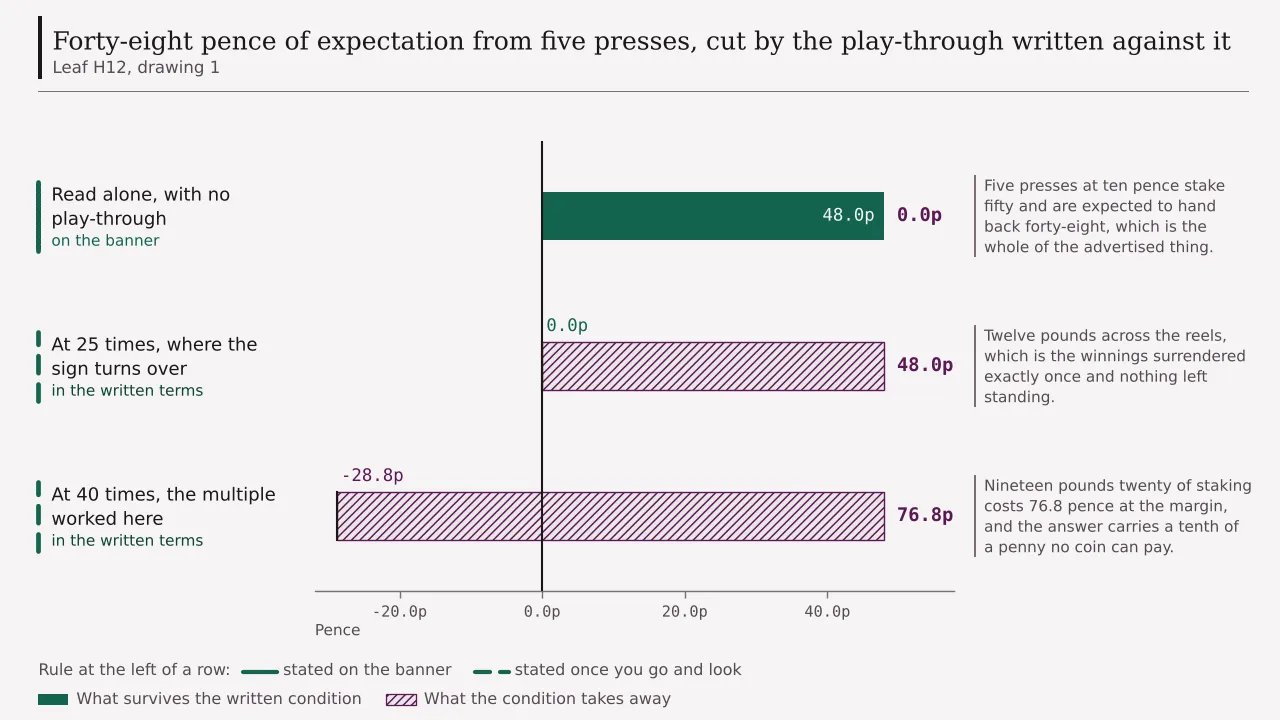
Compare that with the obligation, which is emphatically not below the resolution of anything. Nineteen pounds and twenty pence is a real sum, payable, countable, and about forty times the gift it is attached to. The gift is too small to be paid in coin. The obligation is large enough to need a bank. That mismatch is the single most telling fact about a batch of five, and it is produced by multiplying a number nobody publishes by a number nobody prints on a banner.
One consequence runs against the grain and deserves printing. Because the expected close is a fraction of a penny below nought rather than a large negative sum, a reader attempting the clause on a five-press batch is not expected to lose very much. They are expected to lose about twenty-nine pence. What they are expected to spend is 192 further presses of their attention, and attention is the quantity the arithmetic has no unit for.
7
A nineteen pound obligation on a fifty pence pile
Take the clause on its own terms. Forty lots of 48p is £19.20 of staking before a balance may be requested. At the ten pence a press this leaf assumes, that is 192 presses, stacked on top of the five the advertisement handed over. The ratio between the two piles is thirty-eight to one and it is not a figure a banner would print.
Where a pace floor applies, those 192 presses occupy 480 seconds at a minimum, which is eight minutes of continuous pressing with no pause counted anywhere. Eight minutes is not a hardship. The point is not the burden but the proportion: a quarter of a minute was advertised and eight minutes is what satisfying the condition takes, which is thirty-eight times as long as the thing anybody was offered.
The crossing point is twenty-five, a figure produced by the margin and by nothing else: four pence stays behind out of each pound, and twenty-five fours make a hundred. Forty-eight pence at twenty-five times wants £12.00 across the reels, which is the winnings surrendered exactly once, so a balance of nothing is what the condition is expected to leave. Beyond that, each unit added to the multiple removes about 1.9p, four hundredths of 48p being the rate.
That last figure is the one to keep. On a batch of five presses, each additional unit written into the clause costs the reader less than two pence in expectation. A clause at sixty rather than forty costs a further 38p. Across the whole band of multiples written out here the answer shifts by well under a pound, where the larger counts elsewhere in this section shift by tens of pounds against an identical band.
So the clause on a five-press batch is doing something other than extracting money. Its function is to make the balance unreachable rather than to make it negative, and the two are easy to confuse. Nineteen pounds and twenty pence of staking against an expected 48p balance means that in practice the balance is never withdrawn, not because it was taken but because reaching the exit costs more attention than the destination holds.
8
What a registration is worth where somebody answers for it
Batches this size are advertised from outside the British licence. Where the subject is a registration sold for 48p, the losses worth naming attach to that registration rather than to any payout or any register row. Each of the four duties below bears on it directly, and each is owed by a licence holder and owed by nobody at all here.
Whether anybody holds such a licence is the one item here a reader can settle without an account, in the public register, by a row giving a holder and the activities permitted to it. It is also the only document in this subject written by somebody with no interest in how it reads.
The first decides who is protected. The provision on incentives in the code on social responsibility bites wherever a licensee puts an incentive or an advantage-carrying arrangement in front of somebody holding an account or somebody who might open one. That second category is what a five-press batch is aimed at, since the whole purpose of the batch is to reach people who have not registered yet, and the provision owes them terms no weaker than it owes to anybody signed up already.
The second concerns proportion, and it runs against the way a small batch is usually defended. The advertising regulator’s guidance on casino promotions asks that rewards be held in proportion to what a player has actually laid out in money and in hours, and cautions against promotions climbing faster as spending climbs. Its worked instance carries a condition which has to travel with it: one reward after fifty pounds of staking might be acceptable, on the condition that rewards that size are ordinary for the sort of gambling involved. A batch arriving before a penny has been spent is at the far end of that scale.
The same guidance says a promotion ought not to encourage taking part over and over or at frequent intervals, and ought not to urge anybody towards spending more than losing it would allow. Where an incentive is worth forty-eight pence, everything the arrangement earns has to come from what follows the incentive, and what follows is precisely what those two sentences are addressed to.
The third is the marketing permission, and that is the item a registration is most plainly worth something for. Under the British regulator’s advertising page a licence holder may put no electronic marketing in front of anybody who has not consented in a way that is both informed and specific, save where the law expressly permits it. From 1 May 2025 onwards, on online gambling, that consent has to be taken separately for each type of product and separately for each channel. The date shifted while the rule was being made, and the earlier one should never be written against it.
The fourth is what somebody is told in advance of being asked for money. Licence condition 17.1.1 obliges a licensee, before funds can go in at all, to set out which papers or further particulars might be called for, the point at which that could happen, and the route by which they should arrive. That duty is about forewarning rather than about checking, and it is aimed squarely at the moment a five-press batch manufactures.
Taken together, the four absences change nothing whatever about the 48p and everything about the registration. Five presses are worth the same under any regime at all. What moves is whether whoever ends up holding the name, the address and the permission answers to anybody for what becomes of them, and a batch published in this shape holds no Great Britain licence, so the answer is that nobody does.
Two consequences follow and belong in plain words rather than in an implication. A site standing outside that licence stands outside the national self-exclusion scheme too, since what fixes the scheme’s reach is the licence rather than any choice the site makes. And somebody already registered with Gamstop Online should read a small no-deposit batch as sitting beyond what that registration can do, which makes the help numbers below a better address than a sign-up form.
9
How to read the smallest figure in the family
The method for a very small count is shorter than the method for a large one, because most of the usual questions stop mattering. Three moves do it, and none of them requires opening a document.
Move one is to convert the count into expectation immediately, before anything else is considered. Five presses at the assumed ten pence return an expected 48p. That number is the ceiling on everything the offer can be worth in expectation, and it is produced in a single multiplication. Where a reader’s own guess at the press value differs, the whole leaf scales with it: at five pence the expectation is 24p, and at twenty-five pence it is £1.20.
Move two is to set that expectation against the smallest sum the exit will move, which is the one threshold that decides whether the figure can ever become money. Nothing about the multiple matters if the balance cannot reach the door. On a batch of this size the comparison is between pence and pounds, so the answer arrives without arithmetic.
Move three is to ask what the other side of the transaction is, and this is the move the small batches exist to discourage. Where the thing offered is worth under a pound in expectation, the thing collected is the reason the offer exists, and it will be a registration. Naming it is most of the work, because once it is named a reader can decide whether they would hand it over for 48p if the batch were not attached to it.
What the method refuses to do is worth stating as well. It does not conclude that a batch of five is a trick, since nothing in it is untrue: five presses arrive, no bank is touched, and the printed words all hold. It does not price the registration, since nothing published prices one. And it predicts no single outcome, an expectation being an average taken over very many attempts, and five presses being the shortest run this section has to handle.
Applied across the rest of the family the same three moves keep their shape and change their contents. A larger count moves the expectation above the exit threshold and makes the multiple matter again. A sum on the banner skips the first move entirely. A count published with no mention of payment moves the whole question to the payment screen. At five presses, uniquely, the first move answers the question and the other two confirm it.
Questions
- What is a batch of 5 free spins actually worth?
- Forty-eight pence in expectation, taking a press at ten pence and the reels at 96 pence returned in each pound, both of which this site assumes. Five presses send 50p over the reels and the reels are expected to hand 48p back, which leaves two pence as the share the advertised batch does not return. Neither figure survives without the press value, nothing published supplies one, and so even that single multiplication begins from a convention rather than from a reading.
- Why would anybody advertise a batch this small?
- Because the batch is not the product. What moves towards the reader is 48p of expectation lasting twelve and a half seconds under a British pace floor. Travelling the other way is a registration: a name, a birth date, somewhere to post to, an electronic address or a telephone line, and nearly always a standing permission to use whichever was handed across. No primary source values a gambling registration, so this leaf prices the direction and the asymmetry rather than inventing a figure for it.
- What does five spins cost the house?
- An expected 48p of payout on the branch where the reader stops, and nothing at all on the branch where they do not. Where the winnings must be turned over forty times, £19.20 crosses the reels and 76.8p of that stays behind, so the expected 48p outlay is followed by an expected 76.8p coming back. Netted, a batch of five is expected to leave the publisher 28.8p ahead rather than out of pocket.
- Can I withdraw anything from five free spins?
- Not on expectation, and what blocks it is a threshold rather than a clause. Take a smallest payout of £20.00, a working assumption here and not a published figure: 48p falls short by £19.52, and being short by sixpence finishes in the same place as being short by nineteen pounds. A five pound threshold still wants a run better than ten times the expectation. There is a separate question about what the money would travel back along, since an account nobody has funded may carry no recorded instrument at all.
- What does a forty times play-through ask for on 48p?
- £19.20 of staking, which at ten pence a press is 192 presses stacked on top of the five that were advertised. The ratio between the two piles is thirty-eight to one. Where a pace floor applies, those presses occupy at least 480 seconds, so a quarter of a minute of advertised play turns into eight minutes of satisfying the condition.
- How much does the multiple actually change the answer?
- Under two pence a unit, four hundredths of 48p being the rate. Twenty-five is the crossing point, since four pence stays behind out of each pound and twenty-five fours make a hundred. Writing sixty into the clause rather than forty costs a further 38p. So the whole band of multiples written out here moves a five-press batch by well under a pound, while the same band moves a large count by tens of pounds.
- Why are the figures in tenths of a penny?
- Because at this size the arithmetic settles below the resolution of the currency. An expected close of minus 28.8p and an expected clause cost of 76.8p both carry a tenth of a penny, and no coin, cashier or bank can represent one. Rounded to what an account can hold, the close is minus 29p and the clause costs 77p. The obligation attached to them, at £19.20, is a perfectly ordinary payable sum, and that mismatch is the most telling thing about a batch of five.
- Is a five-spin offer worse than a larger one?
- Not in the sense of being less truthful, and arguably better in one narrow respect. Five presses arrive, no bank is touched, and the printed words all hold. Somebody attempting the clause is expected to lose about twenty-nine pence rather than tens of pounds, the expected loss scaling with the size of the gift. What they are expected to spend is 192 further presses of attention, and attention is the quantity this arithmetic has no unit for.
- What protections am I giving up on an offer this small?
- The ones attaching to the registration rather than to a payout. A batch published in this shape holds no Great Britain licence, so nothing binds whoever published it to the incentive provision reaching people who might open an account as well as people who hold one, to the advertising guidance holding rewards in proportion to what has actually been laid out, to the bar on electronic marketing without consent that is informed and specific, or to the duty in licence condition 17.1.1 to set out beforehand which papers could be called for and at what point.
- How should I read a tiny spin count before clicking?
- Convert the count into expectation first, since one multiplication gives the ceiling on everything the offer can be worth. Set that expectation against the smallest sum the exit will move, because nothing about the multiple matters if the balance cannot reach the door. Then name what is being collected on the other side, which at this size is the reason the offer exists at all.