Terms read 19 October 2026 Leaf H14, revision 1
Ten free spins, and the payment the line declines to mention
Ten presses at ten pence stake £1.00 and are expected to return 96p. Set beside whatever a reader has to pay to be given them, that is an irrelevance, and the payment is the one quantity the line omits. Solve for it backwards and the figures are sharp: at a qualifying payment of £24.00 the ten presses are expected to return precisely what a single turn of that payment is expected to cost.
Stated on the banner 96p Ten presses valued at the ten pence used throughout, on a reel handing back 96 in every hundred, and no second figure is printed. Stated, once you go and look minus 57.6p Forty times those winnings is £38.40 of further staking, set out in a conditions document a reader reaches only by opening it. Not stated before the money goes in An unnamed payment How much has to be sent before the presses are credited, which decides everything and appears no earlier than a payment screen.
Spin counts advertised without a price, terms read
Every destination in this file is bought advertising. The site is paid a fee if a reader goes on to register, and no figure printed below moves because of it.
Bonus Spins UK Slip 01
Betportal
Ceiling as a multiple
The drop
€15.00
€1.00 in the euro
The claim reads €15.00. Once the terms beside it have applied, €0.00 of it can leave. The difference is the drop.
7 of the 15 terms on this slip could not be read before the money went in
Spins priced at this site's own 10p a spin, which the operator does not publish
Stated
€15.00
The claim as it is printed, before a single term has been applied to it.
Headline paid as spins
150 spins at 10c each, which is €15.00 of the figure above.
6 Nowhere
What one spin is worth
No unit is published for a spin, so the count is priced at this site's own 10p a spin. At half that price every figure below halves with it.
Match and other credit not priced
300% of three deposits, to a ceiling of €1,000. A share of a deposit nobody has made yet is not a sum, so no figure stands on this line and none is carried below.
Qualified
-€14.40
Written down somewhere, and taking part of the claim back. Each term carries the place it is written and the sum it takes.
2 Written terms at a distance this record does not establish
Play-through -€14.40
Carrying €14.40 through 35 times stakes €504.00 and costs €20.16 of it at 96 per cent return. That prices above the €14.40 there is to charge it against, so the whole of the credit goes and the line is held at that. The multiple sits on the bonus.
2 Written terms at a distance this record does not establish
Game weighting not priced
Slots only count towards the play-through. No contribution percentage is published, so the line above has been worked at full weight, which is the kindest reading there is.
2 Written terms at a distance this record does not establish
Ceiling on the winnings not priced
5x the bonus.
2 Written terms at a distance this record does not establish
Clock on the credit not priced
14 days.
2 Written terms at a distance this record does not establish
Largest stake while it runs not priced
€5.
3 Public record
Licence, and who holds it not priced
Licensed in Anjouan, Comoros, held by BetPortal Gaming Ltd, with Excite Ultra Media Ltd, reference ALSI-202601040-FI2. A register entry settles who holds a licence and what it permits. It does not settle who is running the site this morning.
4 Cashier
Smallest qualifying deposit your money
€20 a stage. That is €20.00 of your own money, and it is never netted into a drop.
5 On the way out
Checks before a withdrawal not priced
Documents before the first withdrawal.
Unstated
-€0.60
Applying without having been published anywhere, and costing money all the same.
6 Nowhere
What a spin hands back -€0.60
Staking a spin returns 96 per cent of it, so that share of the batch is the house's before a reel turns. This site works at that return and the operator publishes none where the claim is made.
6 Nowhere
Forfeited by rule cost unknown
Nothing is published under this heading, and it applies regardless.
6 Nowhere
Charge on the way out cost unknown
No charge on the way out is published as a figure, so nothing comes off this line. A charge that exists unpublished would come straight off whatever survives.
6 Nowhere
Smallest withdrawal allowed cost unknown
No smallest withdrawal is published as a figure. A floor nobody has published is still a floor, and it decides whether a small balance can move at all.
No Great Britain licence
Terms read 19 October 2026
Bonus Spins UK Slip 02
WinBeast
Ceiling as a sum
The drop
€50.00
€1.00 in the euro
The claim reads €50.00. Once the terms beside it have applied, €0.00 of it can leave. The difference is the drop.
8 of the 15 terms on this slip could not be read before the money went in
Spins priced at this site's own 10p a spin, which the operator does not publish
Stated
€50.00
The claim as it is printed, before a single term has been applied to it.
Headline paid as spins
500 spins at 10c each, which is €50.00 of the figure above.
6 Nowhere
What one spin is worth
No unit is published for a spin, so the count is priced at this site's own 10p a spin. At half that price every figure below halves with it.
Match and other credit not priced
50% to 100% of five deposits, each to a ceiling of €1,000, and a €650 free bet. A share of a deposit nobody has made yet is not a sum, so no figure stands on this line and none is carried below.
Qualified
-€48.00
Written down somewhere, and taking part of the claim back. Each term carries the place it is written and the sum it takes.
2 Written terms at a distance this record does not establish
Play-through -€48.00
Carrying €48.00 through 40 times stakes €1,920.00 and costs €76.80 of it at 96 per cent return. That prices above the €48.00 there is to charge it against, so the whole of the credit goes and the line is held at that. The multiple sits on the bonus and the winnings from the spins.
2 Written terms at a distance this record does not establish
Game weighting not priced
Slots, titles vary by country count towards the play-through. No contribution percentage is published, so the line above has been worked at full weight, which is the kindest reading there is.
2 Written terms at a distance this record does not establish
Ceiling on the winnings not priced
€100 a batch of spins.
2 Written terms at a distance this record does not establish
Clock on the credit not priced
7 days, spins 1 day.
3 Public record
Licence, and who holds it not priced
Licensed in Curaçao, holder not named on the site. A register entry settles who holds a licence and what it permits. It does not settle who is running the site this morning.
4 Cashier
Smallest qualifying deposit your money
€20 a stage. That is €20.00 of your own money, and it is never netted into a drop.
5 On the way out
Checks before a withdrawal not priced
Documents before the first withdrawal.
Unstated
-€2.00
Applying without having been published anywhere, and costing money all the same.
6 Nowhere
What a spin hands back -€2.00
Staking a spin returns 96 per cent of it, so that share of the batch is the house's before a reel turns. This site works at that return and the operator publishes none where the claim is made.
6 Nowhere
Largest stake while it runs cost unknown
Nothing is published under this heading, and it applies regardless.
6 Nowhere
Forfeited by rule cost unknown
Nothing is published under this heading, and it applies regardless.
6 Nowhere
Charge on the way out cost unknown
No charge on the way out is published as a figure, so nothing comes off this line. A charge that exists unpublished would come straight off whatever survives.
6 Nowhere
Smallest withdrawal allowed cost unknown
No smallest withdrawal is published as a figure. A floor nobody has published is still a floor, and it decides whether a small balance can move at all.
No Great Britain licence
Terms read 19 October 2026
Bonus Spins UK Slip 03
EliteSpin
Longest spin window
The drop
£50.00
£1.00 in the pound
The claim reads £50.00. Once the terms beside it have applied, £0.00 of it can leave. The difference is the drop.
8 of the 15 terms on this slip could not be read before the money went in
Spins priced at this site's own 10p a spin, which the operator does not publish
Stated
£50.00
The claim as it is printed, before a single term has been applied to it.
Headline paid as spins
500 spins at 10p each, which is £50.00 of the figure above.
6 Nowhere
What one spin is worth
No unit is published for a spin, so the count is priced at this site's own 10p a spin. At half that price every figure below halves with it.
Match and other credit not priced
50% to 100% of five deposits, each to a ceiling of £1,000. A share of a deposit nobody has made yet is not a sum, so no figure stands on this line and none is carried below.
Qualified
-£48.00
Written down somewhere, and taking part of the claim back. Each term carries the place it is written and the sum it takes.
2 Written terms at a distance this record does not establish
Play-through -£48.00
Carrying £48.00 through 40 times stakes £1,920.00 and costs £76.80 of it at 96 per cent return. That prices above the £48.00 there is to charge it against, so the whole of the credit goes and the line is held at that. The multiple sits on the bonus and the winnings from the spins.
2 Written terms at a distance this record does not establish
Game weighting not priced
Slots count towards the play-through. No contribution percentage is published, so the line above has been worked at full weight, which is the kindest reading there is.
2 Written terms at a distance this record does not establish
Ceiling on the winnings not priced
5x the bonus.
2 Written terms at a distance this record does not establish
Clock on the credit not priced
7 days, spins 3 days.
3 Public record
Licence, and who holds it not priced
Licensed in Costa Rica, held by PrimeTier Limited. A register entry settles who holds a licence and what it permits. It does not settle who is running the site this morning.
4 Cashier
Smallest qualifying deposit your money
£20 a stage. That is £20.00 of your own money, and it is never netted into a drop.
5 On the way out
Checks before a withdrawal not priced
Documents before the first withdrawal.
Unstated
-£2.00
Applying without having been published anywhere, and costing money all the same.
6 Nowhere
What a spin hands back -£2.00
Staking a spin returns 96 per cent of it, so that share of the batch is the house's before a reel turns. This site works at that return and the operator publishes none where the claim is made.
6 Nowhere
Largest stake while it runs cost unknown
Nothing is published under this heading, and it applies regardless.
6 Nowhere
Forfeited by rule cost unknown
Nothing is published under this heading, and it applies regardless.
6 Nowhere
Charge on the way out cost unknown
No charge on the way out is published as a figure, so nothing comes off this line. A charge that exists unpublished would come straight off whatever survives.
6 Nowhere
Smallest withdrawal allowed cost unknown
No smallest withdrawal is published as a figure. A floor nobody has published is still a floor, and it decides whether a small balance can move at all.
No Great Britain licence
Terms read 19 October 2026
Bonus Spins UK Slip 04
Crown Jewelz
Multiple unpublished
The drop
NOT WORKED
The multiple is not published in the operator's own terms. Since the sum cannot be worked around it, none is worked.
9 of the 14 terms on this slip could not be read before the money went in
No drop worked
Stated
£15.00
The claim as it is printed, before a single term has been applied to it.
Headline paid as spins
150 spins at 10p each, which is £15.00 of the figure above.
6 Nowhere
What one spin is worth
No unit is published for a spin, so the count is priced at this site's own 10p a spin. At half that price every figure below halves with it.
Match and other credit not priced
200% of the first deposit, then 150% twice, each to a ceiling of £1,000. A share of a deposit nobody has made yet is not a sum, so no figure stands on this line and none is carried below.
Qualified
NOT WORKED
Written down somewhere, and taking part of the claim back. Each term carries the place it is written and the sum it takes.
2 Written terms at a distance this record does not establish
Play-through not priced
40x the bonus, reported rather than published by the operator.
2 Written terms at a distance this record does not establish
Game weighting not priced
Slots count towards the play-through. No contribution percentage is published, so the line above has been worked at full weight, which is the kindest reading there is.
3 Public record
Licence, and who holds it not priced
Licensed in Curaçao, number not verified, holder not named on the site. A register entry settles who holds a licence and what it permits. It does not settle who is running the site this morning.
4 Cashier
Smallest qualifying deposit your money
£20. That is £20.00 of your own money, and it is never netted into a drop.
5 On the way out
Checks before a withdrawal not priced
Documents before the first withdrawal.
Unstated
NOT WORKED
Applying without having been published anywhere, and costing money all the same.
6 Nowhere
Ceiling on the winnings cost unknown
No ceiling is published. Nothing is assumed in its place.
6 Nowhere
Clock on the credit cost unknown
Nothing is published under this heading, and it applies regardless.
6 Nowhere
Largest stake while it runs cost unknown
Nothing is published under this heading, and it applies regardless.
6 Nowhere
Forfeited by rule cost unknown
Nothing is published under this heading, and it applies regardless.
6 Nowhere
Charge on the way out cost unknown
No charge on the way out is published as a figure, so nothing comes off this line. A charge that exists unpublished would come straight off whatever survives.
6 Nowhere
Smallest withdrawal allowed cost unknown
No smallest withdrawal is published as a figure. A floor nobody has published is still a floor, and it decides whether a small balance can move at all.
No Great Britain licence
Terms read 19 October 2026
Every figure in the second and third columns is this site's own working and nothing an operator has published. A claim is priced as printed, then the share a spin hands back at 96 per cent return comes off it, then what playing the multiple through costs at the same return, and then whatever a published ceiling, a charge on the way out or a floor on the smallest withdrawal takes from what has survived. The drop is the difference between the first figure and the last. The two columns add back up to it exactly, so no money leaves a slip without a term and a place beside it.
Which column a term falls in is settled by one question: has anybody written it down. A charge a reader meets at the payment screen is written down, and it stands in the second column with the cashier against it. A condition that binds without ever having been set down stands in the third, whatever it costs. Inside each column the terms run outwards from the banner, so the order itself says how far a reader would have had to go.
A count of spins has no unit until one is supplied. Where an operator publishes what one of its own spins is worth, that figure is used and the first column says it is theirs. Where none is published, this site's own 10p a spin stands in its place and every figure below moves in proportion with it. Where the multiple itself is unpublished, no drop is worked at all, because that is the one figure the sum cannot be done without.
Three words stand where a figure cannot. Not priced is a term that is written down and carries no number the arithmetic can take. Cost unknown is a term nobody has written down, costing something nobody has put a number on. Your money is money of the reader's own, which is never netted into a drop.
None of the operators in this file holds a Great Britain licence, so none of the duties that licence carries reaches them. Each of those duties is published in its own right, which is what makes its absence here something a reader can check rather than take on trust. Every gambling company licensed in Great Britain belongs to Gamstop Online, so a reader who has shut themselves out through the scheme is not shut out here. Social Responsibility Code 5.1.1 has held a play-through to a maximum of ten times the bonus funds since 19 January 2026, and it binds a licence holder and nobody else. Asked in a post of 21 October 2025 what is lost along with the licence, the Gambling Commission's Director of Enforcement and Intelligence answered: "unfair gaming practices, financial loss, and a lack of recourse if things go wrong". The same post puts blocked payouts, and withdrawal limits pitched high enough to be unreachable, among the behaviour the Commission has recorded. Nobody under 18 may hold an account at any of them.
Terms are reproduced in the wording their operator published, and each slip is dated with the day somebody sat down and read them. 19 October 2026 is the oldest of those dates. Anybody claiming an offer is bound by that operator's full terms, which are elsewhere, and never by a line standing here.
1
The two words this line declines to carry
Two tokens are published: a quantity of ten and an adjective putting the price of the presses themselves at nought. What is absent is the phrase that would fix whether anything has to be sent in first, and its absence is the whole subject of this leaf. A count without that phrase beside it is a count whose entry price is unsettled .
Being unsettled is not the same as being concealed. A line that says nothing about payment has made no statement about payment, and a reader who supplies one has added a term nobody wrote. Assuming a payment is required is as unwarranted as assuming none is, and the honest position after reading the banner is that the entry price is unknown rather than that it is positive.
What makes the absence expensive rather than merely untidy is the relative size of the two quantities. The presses are worth under a pound in expectation. The payment that might be attached to them has no ceiling the banner can establish, and anything from a single pound to fifty would be unremarkable in this corner of the market. So the published figure is small, the missing figure may be many times larger, and the one printed is the smaller of the two.
That is a different fault from the one a wagering clause produces. A clause reduces something a reader already holds. An unstated payment decides whether the reader ever holds anything, and it decides it at a moment when they have already created an account, handed over an identity and reached a screen designed to take money. The sequence is doing as much work as the figure.
Four conventions are held still below, so that only the payment varies: a press valued at ten pence, a reel handing back 96 in every hundred, forty as the play-through wherever a clause bites, and a contribution rate of one. No rule fixes any of them. All four are adopted here for modelling, and a line that moves one says so beside whatever figure it produces.
2
Ten presses priced on their own, in one line
The published half of the arithmetic finishes quickly. Ten presses at ten pence put £1.00 through the reels, 96 in every hundred comes back, and the expectation is therefore 96p with four pence held behind. One pound across the reels, ninety-six pence expected in return, and the advertisement holds nothing beyond that once it has been turned into money.
Hang the usual condition on those winnings and the figure travels a long way for so small a base. Forty lots of 96p make £38.40 that has to cross the reels before anybody may ask to be paid, with four hundredths of the total retained along the way, coming to 153.6p. Subtract that from 96p and the expected close is minus 57.6p.
Read off the banner 96p With the written play-through applied minus 57.6p What the condition is expected to cost 153.6p
Hold that price block in view, because the rest of this leaf is an argument that it is the less important of two subtractions. A pound and a half of expected cost is a real figure and it is the one this site is built to print. It is also smaller than any plausible qualifying payment, and the qualifying payment is the figure nobody published.
In time the advertised part is briefer still. Where a British pace standard governs the build, ten presses cannot be finished inside 25 seconds, and the 384 presses that £38.40 of staking comes to cannot be finished inside 960 seconds, which is sixteen minutes. Twenty-five seconds of advertised play, sixteen minutes of condition, and an unstated sum at the door deciding whether either happens.
3
The same ten presses against every payment that might buy them
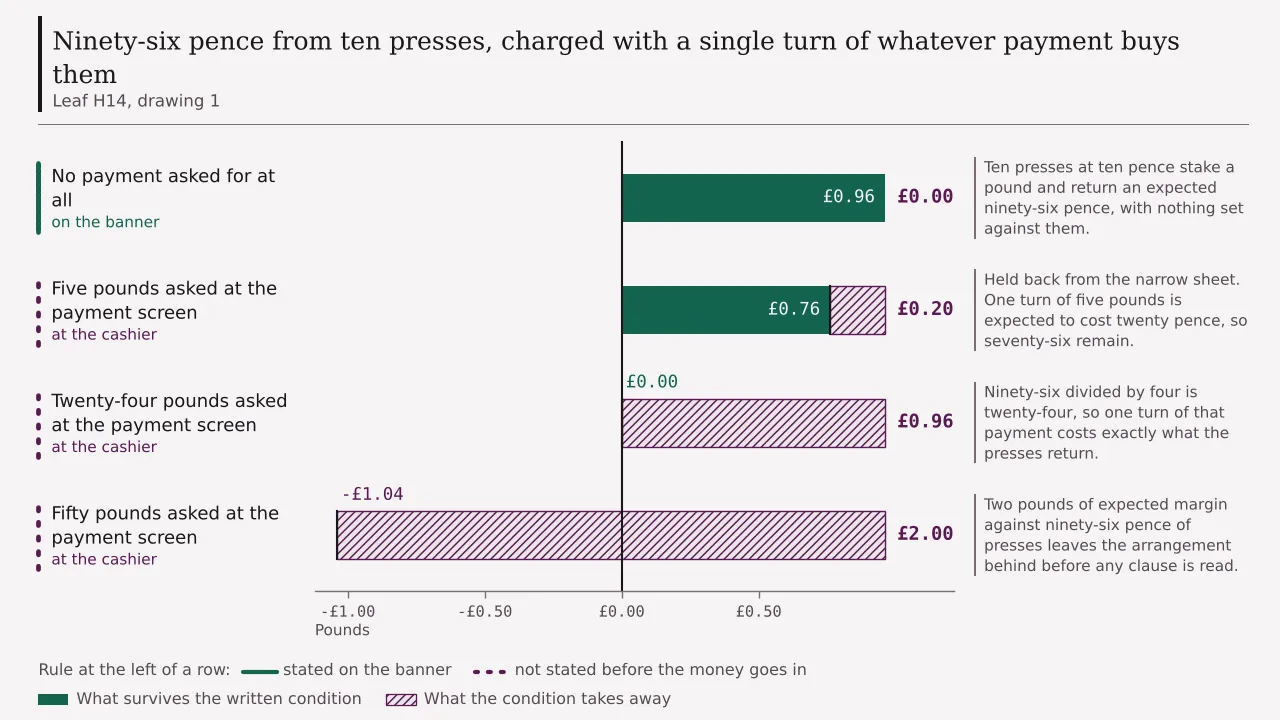
Since the payment is the free variable, the sensible move is to solve the offer for every value it might take rather than guess at one. Each row below holds the ten presses fixed at 96p of expectation and varies only what the reader sends in. Every payment figure in the table is a value this leaf tries out rather than a figure anybody publishes.
| Payment the screen asks for | Expected from ten presses | Gift as a share of the payment | Expected cost of turning that payment once | Net on a single pass |
|---|---|---|---|---|
| A single pound | 96p | 96.00 per cent | 4p | plus 92p |
| Five pounds | 96p | 19.20 per cent | 20p | plus 76p |
| Ten pounds | 96p | 9.60 per cent | 40p | plus 56p |
| Twenty pounds | 96p | 4.80 per cent | 80p | plus 16p |
| Twenty-four pounds | 96p | 4.00 per cent | 96p | nothing either way |
| Fifty pounds | 96p | 1.92 per cent | £2.00 | minus £1.04 |
Six rows, one advertisement, and a range running from ninety-six per cent down to under two. The third column is the one worth staring at. A quantity described in exactly the same four words is worth very nearly the whole of a small payment and about a fiftieth of a larger one, and the banner is identical in both cases because the banner describes the numerator.
The fourth column is working of this leaf’s own and the assumption inside it belongs in plain sight. It charges the payment as though it crossed the reels a single time at the house return, which is the kindest treatment any payment can be given. Playing a payment through twice incurs the same cost twice, so that column is a floor under the cost rather than an estimate of it.
4
Twenty-four pounds, where the gift stops covering its own entry
One row in that table is not a sample value. Twenty-four pounds is the solution to a small equation and it falls out of the house figures exactly. Ask what payment, turned over once at four pence kept in the pound, costs an expected 96p, and the answer is £24.00, since ninety-six divided by four is twenty-four.
£24.00 of unstated payment, at which ten presses stop covering their own entry
That figure deserves its own part because it converts a vague worry into a threshold a reader can carry about. Under twenty-four pounds, the ten presses are expected to return more than one pass of the payment is expected to cost, so the arrangement is ahead on that narrow reading. Over it, the payment is expected to cost more than the presses are expected to return, and the arrangement is behind before any clause has been read.
The threshold does not depend on the count being ten. Divide the expectation from any advertised count by four hundredths and the same kind of answer appears, which on these figures means the threshold is twenty-four times whatever the presses are expected to return. Ten presses give 96p and a threshold of twenty-four pounds. Twenty presses would give £1.92 and a threshold of forty-eight pounds.
There is a second and much sharper solution hiding behind the first, and it applies wherever a clause reaches the payment as well as the presses. A requirement of forty over the payment makes its expected cost forty times four hundredths of itself, which is 1.6 times the payment. Ask which payment then costs 96p and the answer is 60p. The threshold collapses from twenty-four pounds to sixty pence depending on a clause nobody printed.
No published source addresses whether a requirement written across a payment and a credit together is caught by anything, so the chain of published wording gets set out here and the leaf goes no further with it. The arithmetical consequence it will state is this: the unstated figure on the banner and the unstated figure in the conditions act on each other, and between them they shift the break point by a factor of forty.
5
Thirty-eight pounds of obligation on a ninety-six pence expectation
Return to the clause for a moment and put it in proportion. Forty times 96p gives £38.40, and at ten pence each that is 384 presses piled on the ten the line advertised. Measured against what it hangs from, the pile runs to thirty-eight times over, and both of those figures belong to an arrangement whose entry price nobody has named yet.
Compare the obligation with the payments in part three and something awkward falls out. At every row of that table except the last, the staking the clause demands is larger than the payment itself. A reader sending five pounds in has accepted a thirty-eight pound turnover obligation to unlock ninety-six pence of expectation, and the ratio between the three figures is the shape of the arrangement rather than an accident.
| The quantity | Where a reader settles it | What it comes to |
|---|---|---|
| The count of presses | Ten | |
| What a press is worth in cash | nowhere in writing | Unreachable |
| Turnover owed before a payout | in the bonus terms | £38.40 |
| Payment that qualifies for the presses | at the cashier | Not settled |
| Whether the payment is protected in insolvency | in the general conditions | Rated, where rated at all |
| Papers demanded before money moves out | on the way out | Not settled |
Six rows and a single figure a reader could have read before clicking. Whichever row decides whether the others are reached at all sits at the payment screen, three stages of commitment distant: by the time it appears an account exists, particulars have changed hands, and a way of paying is being requested.
So the clause and the payment are not competing explanations of where the value goes. They act in sequence on different things. The payment decides whether the reader is in the arrangement at all. The clause decides what the arrangement is worth once they are. Only the second of those is in a document, and the document is not where most readers stop.
6
The screen where the deciding figure is actually kept
Name the address and the leaf has done most of its job. On a count advertised without any phrase about payment, the figure that decides the arrangement lives at the cashier. Of the six places this site sorts claims into, that one stands fourth, and it is the earliest of them nobody reaches without first opening an account.
Two things make that address different in kind from the others. It is the only place where a figure is revealed by being acted on rather than by being read: the screen either accepts a sum or refuses it, and the refusal is the disclosure. And it is the only place a reader arrives at having already spent something, since an account, an identity and usually a marketing permission have changed hands by the time the screen appears.
In some arrangements the figure is written down earlier, in a promotion’s own conditions, at one document from the claim. In others it exists only as a rule inside a payment system and surfaces when a sum below it is attempted. The reader cannot tell which case they are in from the advertisement, which means the honest distance to this figure is not one document or three but unknown.
There is a second quantity at the same address and it bites from the other end. A smallest payout threshold decides whether anything can leave, and on an arrangement where the expected winnings are 96p that threshold decides the outcome on its own. Take an assumed smallest payout of £20.00, which is a value tried out here and not a published figure: 96p falls short of it by £19.04, so the presses alone cannot reach the door whatever the clause says.
Those two figures at one address are easy to confuse and pull in opposite directions. A payment floor is the smallest sum that may come in. A payout threshold is the smallest sum that may go out. They are set by different considerations, they are frequently different numbers, and a reader who has found one has not found the other.
7
Whose money it is while it waits in there
Where a payment goes unnamed and only the presses are advertised, the arrangement is published beyond the reach of a British licence. This leaf is about the reader’s own money going in, so the duties worth naming are those bearing on that money while it waits in somebody else’s account. They are not the duties about what a claim may say, and they bite at quite another moment.
The first is a duty to tell a customer what would happen to that money if the business failed. Licence condition 4.2.1 obliges a licensee holding customer funds to set out in its conditions whether they are protected on insolvency, at what level, and by what arrangement. The information has to follow a form the regulator specifies, be given in writing, and be acknowledged by the customer, who may not gamble with the funds until that acknowledgement has been made.
The second is the vocabulary that duty works in, published and exact. Four ratings exist, and their wording is fixed: “Not protected – No segregation”, “Not protected – Segregation of customer funds”, “Medium protection”, “High protection”. What the regulator has not at this stage settled is the precise language a licensee uses around whichever one applies, so the explanation beside a rating is drafted by whoever is holding the money while the rating is not.
Where the rating in use opens with the words “Not protected”, paragraph 3 of the same condition wants a reminder twice a year that the money would go unprotected should the business fail, together with a statement of the balance being held for that customer and a fresh acknowledgement before any of it is gambled with. Biting on that paragraph began on 31 October 2025. No commencement date attaches to the earlier paragraphs, and none at all is published for the ratings system itself.
The third attaches to the instrument a payment is made with rather than to the sum. Since 14 April 2020 a licence condition has put the credit card outside the set of instruments a licensee may be paid on, and a money service business standing in the middle of the chain does not put it back inside. Where a count is advertised with no price beside it, which instrument a reader reaches for at the screen is one more question the banner has left open.
The fourth attaches to how much goes in over time. Financial vulnerability checks of the lighter sort begin above a monthly figure for net deposits. From 30 August 2024 that figure stood at £500 in the month, and from 28 February 2025 it was brought down to £150. A second and heavier assessment remains at pilot stage with none of it running live, and the regulator says neither the lighter check nor the pilot touches anybody’s credit rating.
No Great Britain licence stands behind an arrangement of this kind, so not one of the duties above reaches it. What is lost is specific and not general: nobody owes the reader a statement of what becomes of a payment should the business fail, no published vocabulary describes the answer, no instrument is ruled out at the screen, and no figure triggers a look at whether the payments can be afforded. The money goes in on the reader’s own assessment and on nobody else’s.
Whether a single one of those duties applies is itself settled in the public register, by a row naming a holder and the activities that holder is permitted. That row costs nothing and needs no account, which makes it reachable earlier than any figure in part three, and it is the one document in this subject whose author had nothing to gain from the wording.
The self-exclusion position falls out of the same absence. Coverage by the national scheme is settled by whether a British licence is held and by nothing the site itself elects, so an arrangement published without the licence is published without the scheme as well. A bare count of this kind should be read, by anyone registered with Gamstop Online, as beyond what that registration can reach, and the numbers below are the address worth using.
8
What the silence does and does not entail
Nothing above establishes that a payment is required, and it is worth being exact about that, because the opposite error is just as costly. Two readings survive the banner and this part prices the one the leaf has so far set aside.
Under the first reading nothing has to be paid at all, and the count then behaves like any other batch given away: 96p of expectation, a clause wanting £38.40 across the reels, a close expected at minus 57.6p. The arrangement is small, honest and unremarkable on that reading, and the missing phrase has cost nobody more than the few seconds spent wondering about it.
Under the second a payment is required, and everything in parts three to six applies. The gap between the two readings is therefore the whole of the payment, whatever it turns out to be, plus the expected cost of turning it over, which at twenty-four pounds is another 96p. On the figures above the two readings are separated by somewhere between a single pound and fifty of the reader’s own money.
What tips the balance towards the second reading as a working assumption is not suspicion but drafting practice. A no-deposit arrangement says so, because saying so is the most attractive thing about it and nobody with that offer to make leaves the phrase out. A line that omits the phrase is therefore more likely to be one where the phrase would not have been true, and that inference is about how advertisements get written rather than about what any particular one means.
The inference is worth stating as what it is, which is a probability rather than a reading. It cannot be checked against anything published, it does not follow from the words, and a reader who treats it as settled has done the same thing this leaf objects to in the other direction. What it supports is a decision about where to look next, which is at the payment screen or at the promotion’s own conditions rather than at the banner.
So the silence is worth something even before it is resolved. It tells a reader which address to travel to, it fixes the order the two unknowns should be settled in, and it identifies which of the two is capable of costing fifty times what the other one does.
9
Reading a bare count before anything moves
Four moves exhaust a count advertised with no price beside it, and the first three cost nothing. The order matters more here than on any other headline in this family, because getting it wrong means arriving at a payment screen with the arithmetic still unfinished.
Move one converts the count into expectation. Ten presses at the assumed ten pence return 96p, which is the ceiling on everything the advertised part can be worth. That number is produced by one multiplication and it stays fixed through everything that follows, which is what makes it a useful anchor rather than an answer.
Move two computes the threshold. Divide the expectation by four hundredths and the result is the payment at which the gift stops covering a single turn of itself, which on these figures is twenty-four pounds. Carry that number rather than the 96p, because a threshold can be compared against a payment screen and an expectation cannot.
Move three hunts for the payment in the written material before any account exists. A promotion’s own conditions carry it in some arrangements, and a line about a minimum qualifying sum is the thing to look for. Where it is there, the arrangement is settled at one document from the claim and the threshold decides it. Where it is absent, the reading stays unsettled, and recording that is itself an outcome rather than a defeat.
Move four is the payment screen itself, and it is the expensive one, which is why it comes last. By the time a screen names a figure, an account exists and an identity has been handed over, so a reader who has not done the first three moves is doing arithmetic under pressure with something already committed. A reader who has done them is comparing one number against one number.
What the method will not do is supply the missing figure. No published source fixes a qualifying payment, no published source fixes what a press is worth, and this leaf invents neither. What it supplies instead is the shape of the answer: a threshold at twenty-four times the expected return, a clause worth 153.6p against that return, and a clear statement that the quantity deciding the whole arrangement is kept at the one address a reader cannot reach for free.
Questions
- Do 10 free spins require a deposit?
- The line says nothing either way, and that is the finding rather than an evasion. A count published without any phrase about payment has made no statement about payment, so assuming one is required is as unwarranted as assuming none is. What follows is that the entry price is unknown rather than positive, and that the figure deciding the arrangement sits at a payment screen rather than on the advertisement.
- What are ten free spins worth on their own?
- Ninety-six pence in expectation. Ten presses at the ten pence assumed throughout put £1.00 through the reels, 96 pence of every pound comes back, and four pence is the share that does not. Both figures depend on the press value, which no published source fixes, so even that single multiplication starts from a convention adopted here.
- How big a deposit makes ten spins not worth having?
- Twenty-four pounds, on one pass of the payment. Ask which payment, turned over once at four pence kept in the pound, is expected to cost 96p, and ninety-six divided by four gives £24.00. Below that the presses are expected to return more than a single pass of the payment is expected to cost. Above it the payment costs more than the presses return, before any clause has been read at all.
- Does the threshold change if the clause covers my deposit too?
- It collapses, by a factor of forty. A requirement of forty over the payment puts its expected cost at 1.6 times the payment itself, so the payment costing an expected 96p is 60p and not £24.00. No published source addresses whether a requirement drafted across a payment and a credit together is caught by anything, so the chain of published wording is set out here, the arithmetical consequence is priced, and the leaf goes no further.
- What does a forty times clause ask for on ten spins?
- £38.40 across the reels, which at ten pence each comes to 384 presses piled on the ten the line advertised. Four hundredths of the total is retained, an expected 153.6p set against expected winnings of 96p, leaving a close expected at minus 57.6p. Under a British pace standard the 384 presses cannot be got through inside 960 seconds, which is sixteen minutes of condition against twenty-five seconds of advertised play.
- Where is the qualifying payment written down?
- At a payment screen in some arrangements and in a promotion’s own conditions in others, and a reader cannot tell which case applies from the banner. That makes the honest distance to the figure unknown rather than one document or three. A payment screen is also the one address where a figure is revealed by being acted on rather than read, since the screen either takes a sum or refuses it and the refusal is the disclosure.
- Can I take the winnings out without paying anything in?
- Not on expectation, and a separate figure at the same address decides it. A smallest payout threshold governs what may leave, and on expected winnings of 96p it settles the matter by itself. Take an assumed threshold of £20.00, a value tried out here rather than a published one: 96p falls short by £19.04. A payment floor and a payout threshold are different numbers set for different reasons, and finding one is not finding the other.
- How much is ten spins worth as a share of what it costs?
- Anywhere from 96.00 per cent down to 1.92 per cent, on the payments this leaf tries out. Against a single pound the presses are worth very nearly the whole of it. Against fifty pounds they are worth about a fiftieth. The four published words are identical in both cases, because what they describe is the numerator and never the denominator.
- What happens to my money while it sits in the account?
- Beyond a British licence nothing whatever is owed to the reader about it. A licensee holding customer funds has to put in its conditions whether those funds are protected should it become insolvent, at what level, and by what arrangement, in a form the regulator specifies, in writing, and acknowledged before any of the money may be gambled with. Four ratings exist and their wording is fixed: “Not protected – No segregation”, “Not protected – Segregation of customer funds”, “Medium protection”, “High protection”. Where the rating opens with the words “Not protected”, a reminder twice a year has been required since 31 October 2025.
- What else does an unlicensed arrangement leave out at the payment screen?
- Two things carrying dates. Since 14 April 2020 a licence condition has put the credit card outside the set of instruments a licensee may be paid on, and a money service business standing in the middle of the chain does not put it back inside. And financial vulnerability checks of the lighter sort begin above a monthly figure for net deposits, which stood at £500 in the month from 30 August 2024 and was brought down to £150 from 28 February 2025. No Great Britain licence stands behind an arrangement of this kind, so no instrument is ruled out at the screen and no figure triggers a look at affordability.