Terms read 19 October 2026 Leaf C01, revision 1
Money that arrives in twelve seconds and leaves by an account you have not opened
Ten pounds billed to a mobile account buys 100 presses at 10p and is expected to leave £9.60 on the balance. Not a penny of that can travel back down the wire it came along. The return leg wants a second instrument, registered after the money is already gone, under terms written by somebody the payment screen never names. This leaf prices the direction.
Stated on the banner £10.00 The qualifying payment a reel promotion prints, and a sum a mobile account will carry without a card being fetched. Stated, once you go and look No return leg The written terms list the ways money may be sent out, and a mobile account appears on none of those lists. Not stated before the money goes in £9.60 detained What one payment is expected to leave sitting on an account with no instrument on file able to carry it anywhere.
Offers taking a mobile account as the qualifying payment
Every destination in this file is bought advertising. The site is paid a fee if a reader goes on to register, and no figure printed below moves because of it.
Bonus Spins UK Slip 01
Betportal
Ceiling as a multiple
The drop
€15.00
€1.00 in the euro
The claim reads €15.00. Once the terms beside it have applied, €0.00 of it can leave. The difference is the drop.
7 of the 15 terms on this slip could not be read before the money went in
Spins priced at this site's own 10p a spin, which the operator does not publish
Stated
€15.00
The claim as it is printed, before a single term has been applied to it.
Headline paid as spins
150 spins at 10c each, which is €15.00 of the figure above.
6 Nowhere
What one spin is worth
No unit is published for a spin, so the count is priced at this site's own 10p a spin. At half that price every figure below halves with it.
Match and other credit not priced
300% of three deposits, to a ceiling of €1,000. A share of a deposit nobody has made yet is not a sum, so no figure stands on this line and none is carried below.
Qualified
-€14.40
Written down somewhere, and taking part of the claim back. Each term carries the place it is written and the sum it takes.
2 Written terms at a distance this record does not establish
Play-through -€14.40
Carrying €14.40 through 35 times stakes €504.00 and costs €20.16 of it at 96 per cent return. That prices above the €14.40 there is to charge it against, so the whole of the credit goes and the line is held at that. The multiple sits on the bonus.
2 Written terms at a distance this record does not establish
Game weighting not priced
Slots only count towards the play-through. No contribution percentage is published, so the line above has been worked at full weight, which is the kindest reading there is.
2 Written terms at a distance this record does not establish
Ceiling on the winnings not priced
5x the bonus.
2 Written terms at a distance this record does not establish
Clock on the credit not priced
14 days.
2 Written terms at a distance this record does not establish
Largest stake while it runs not priced
€5.
3 Public record
Licence, and who holds it not priced
Licensed in Anjouan, Comoros, held by BetPortal Gaming Ltd, with Excite Ultra Media Ltd, reference ALSI-202601040-FI2. A register entry settles who holds a licence and what it permits. It does not settle who is running the site this morning.
4 Cashier
Smallest qualifying deposit your money
€20 a stage. That is €20.00 of your own money, and it is never netted into a drop.
5 On the way out
Checks before a withdrawal not priced
Documents before the first withdrawal.
Unstated
-€0.60
Applying without having been published anywhere, and costing money all the same.
6 Nowhere
What a spin hands back -€0.60
Staking a spin returns 96 per cent of it, so that share of the batch is the house's before a reel turns. This site works at that return and the operator publishes none where the claim is made.
6 Nowhere
Forfeited by rule cost unknown
Nothing is published under this heading, and it applies regardless.
6 Nowhere
Charge on the way out cost unknown
No charge on the way out is published as a figure, so nothing comes off this line. A charge that exists unpublished would come straight off whatever survives.
6 Nowhere
Smallest withdrawal allowed cost unknown
No smallest withdrawal is published as a figure. A floor nobody has published is still a floor, and it decides whether a small balance can move at all.
No Great Britain licence
Terms read 19 October 2026
Bonus Spins UK Slip 02
WinBeast
Ceiling as a sum
The drop
€50.00
€1.00 in the euro
The claim reads €50.00. Once the terms beside it have applied, €0.00 of it can leave. The difference is the drop.
8 of the 15 terms on this slip could not be read before the money went in
Spins priced at this site's own 10p a spin, which the operator does not publish
Stated
€50.00
The claim as it is printed, before a single term has been applied to it.
Headline paid as spins
500 spins at 10c each, which is €50.00 of the figure above.
6 Nowhere
What one spin is worth
No unit is published for a spin, so the count is priced at this site's own 10p a spin. At half that price every figure below halves with it.
Match and other credit not priced
50% to 100% of five deposits, each to a ceiling of €1,000, and a €650 free bet. A share of a deposit nobody has made yet is not a sum, so no figure stands on this line and none is carried below.
Qualified
-€48.00
Written down somewhere, and taking part of the claim back. Each term carries the place it is written and the sum it takes.
2 Written terms at a distance this record does not establish
Play-through -€48.00
Carrying €48.00 through 40 times stakes €1,920.00 and costs €76.80 of it at 96 per cent return. That prices above the €48.00 there is to charge it against, so the whole of the credit goes and the line is held at that. The multiple sits on the bonus and the winnings from the spins.
2 Written terms at a distance this record does not establish
Game weighting not priced
Slots, titles vary by country count towards the play-through. No contribution percentage is published, so the line above has been worked at full weight, which is the kindest reading there is.
2 Written terms at a distance this record does not establish
Ceiling on the winnings not priced
€100 a batch of spins.
2 Written terms at a distance this record does not establish
Clock on the credit not priced
7 days, spins 1 day.
3 Public record
Licence, and who holds it not priced
Licensed in Curaçao, holder not named on the site. A register entry settles who holds a licence and what it permits. It does not settle who is running the site this morning.
4 Cashier
Smallest qualifying deposit your money
€20 a stage. That is €20.00 of your own money, and it is never netted into a drop.
5 On the way out
Checks before a withdrawal not priced
Documents before the first withdrawal.
Unstated
-€2.00
Applying without having been published anywhere, and costing money all the same.
6 Nowhere
What a spin hands back -€2.00
Staking a spin returns 96 per cent of it, so that share of the batch is the house's before a reel turns. This site works at that return and the operator publishes none where the claim is made.
6 Nowhere
Largest stake while it runs cost unknown
Nothing is published under this heading, and it applies regardless.
6 Nowhere
Forfeited by rule cost unknown
Nothing is published under this heading, and it applies regardless.
6 Nowhere
Charge on the way out cost unknown
No charge on the way out is published as a figure, so nothing comes off this line. A charge that exists unpublished would come straight off whatever survives.
6 Nowhere
Smallest withdrawal allowed cost unknown
No smallest withdrawal is published as a figure. A floor nobody has published is still a floor, and it decides whether a small balance can move at all.
No Great Britain licence
Terms read 19 October 2026
Bonus Spins UK Slip 03
EliteSpin
Longest spin window
The drop
£50.00
£1.00 in the pound
The claim reads £50.00. Once the terms beside it have applied, £0.00 of it can leave. The difference is the drop.
8 of the 15 terms on this slip could not be read before the money went in
Spins priced at this site's own 10p a spin, which the operator does not publish
Stated
£50.00
The claim as it is printed, before a single term has been applied to it.
Headline paid as spins
500 spins at 10p each, which is £50.00 of the figure above.
6 Nowhere
What one spin is worth
No unit is published for a spin, so the count is priced at this site's own 10p a spin. At half that price every figure below halves with it.
Match and other credit not priced
50% to 100% of five deposits, each to a ceiling of £1,000. A share of a deposit nobody has made yet is not a sum, so no figure stands on this line and none is carried below.
Qualified
-£48.00
Written down somewhere, and taking part of the claim back. Each term carries the place it is written and the sum it takes.
2 Written terms at a distance this record does not establish
Play-through -£48.00
Carrying £48.00 through 40 times stakes £1,920.00 and costs £76.80 of it at 96 per cent return. That prices above the £48.00 there is to charge it against, so the whole of the credit goes and the line is held at that. The multiple sits on the bonus and the winnings from the spins.
2 Written terms at a distance this record does not establish
Game weighting not priced
Slots count towards the play-through. No contribution percentage is published, so the line above has been worked at full weight, which is the kindest reading there is.
2 Written terms at a distance this record does not establish
Ceiling on the winnings not priced
5x the bonus.
2 Written terms at a distance this record does not establish
Clock on the credit not priced
7 days, spins 3 days.
3 Public record
Licence, and who holds it not priced
Licensed in Costa Rica, held by PrimeTier Limited. A register entry settles who holds a licence and what it permits. It does not settle who is running the site this morning.
4 Cashier
Smallest qualifying deposit your money
£20 a stage. That is £20.00 of your own money, and it is never netted into a drop.
5 On the way out
Checks before a withdrawal not priced
Documents before the first withdrawal.
Unstated
-£2.00
Applying without having been published anywhere, and costing money all the same.
6 Nowhere
What a spin hands back -£2.00
Staking a spin returns 96 per cent of it, so that share of the batch is the house's before a reel turns. This site works at that return and the operator publishes none where the claim is made.
6 Nowhere
Largest stake while it runs cost unknown
Nothing is published under this heading, and it applies regardless.
6 Nowhere
Forfeited by rule cost unknown
Nothing is published under this heading, and it applies regardless.
6 Nowhere
Charge on the way out cost unknown
No charge on the way out is published as a figure, so nothing comes off this line. A charge that exists unpublished would come straight off whatever survives.
6 Nowhere
Smallest withdrawal allowed cost unknown
No smallest withdrawal is published as a figure. A floor nobody has published is still a floor, and it decides whether a small balance can move at all.
No Great Britain licence
Terms read 19 October 2026
Bonus Spins UK Slip 04
Crown Jewelz
Multiple unpublished
The drop
NOT WORKED
The multiple is not published in the operator's own terms. Since the sum cannot be worked around it, none is worked.
9 of the 14 terms on this slip could not be read before the money went in
No drop worked
Stated
£15.00
The claim as it is printed, before a single term has been applied to it.
Headline paid as spins
150 spins at 10p each, which is £15.00 of the figure above.
6 Nowhere
What one spin is worth
No unit is published for a spin, so the count is priced at this site's own 10p a spin. At half that price every figure below halves with it.
Match and other credit not priced
200% of the first deposit, then 150% twice, each to a ceiling of £1,000. A share of a deposit nobody has made yet is not a sum, so no figure stands on this line and none is carried below.
Qualified
NOT WORKED
Written down somewhere, and taking part of the claim back. Each term carries the place it is written and the sum it takes.
2 Written terms at a distance this record does not establish
Play-through not priced
40x the bonus, reported rather than published by the operator.
2 Written terms at a distance this record does not establish
Game weighting not priced
Slots count towards the play-through. No contribution percentage is published, so the line above has been worked at full weight, which is the kindest reading there is.
3 Public record
Licence, and who holds it not priced
Licensed in Curaçao, number not verified, holder not named on the site. A register entry settles who holds a licence and what it permits. It does not settle who is running the site this morning.
4 Cashier
Smallest qualifying deposit your money
£20. That is £20.00 of your own money, and it is never netted into a drop.
5 On the way out
Checks before a withdrawal not priced
Documents before the first withdrawal.
Unstated
NOT WORKED
Applying without having been published anywhere, and costing money all the same.
6 Nowhere
Ceiling on the winnings cost unknown
No ceiling is published. Nothing is assumed in its place.
6 Nowhere
Clock on the credit cost unknown
Nothing is published under this heading, and it applies regardless.
6 Nowhere
Largest stake while it runs cost unknown
Nothing is published under this heading, and it applies regardless.
6 Nowhere
Forfeited by rule cost unknown
Nothing is published under this heading, and it applies regardless.
6 Nowhere
Charge on the way out cost unknown
No charge on the way out is published as a figure, so nothing comes off this line. A charge that exists unpublished would come straight off whatever survives.
6 Nowhere
Smallest withdrawal allowed cost unknown
No smallest withdrawal is published as a figure. A floor nobody has published is still a floor, and it decides whether a small balance can move at all.
No Great Britain licence
Terms read 19 October 2026
Every figure in the second and third columns is this site's own working and nothing an operator has published. A claim is priced as printed, then the share a spin hands back at 96 per cent return comes off it, then what playing the multiple through costs at the same return, and then whatever a published ceiling, a charge on the way out or a floor on the smallest withdrawal takes from what has survived. The drop is the difference between the first figure and the last. The two columns add back up to it exactly, so no money leaves a slip without a term and a place beside it.
Which column a term falls in is settled by one question: has anybody written it down. A charge a reader meets at the payment screen is written down, and it stands in the second column with the cashier against it. A condition that binds without ever having been set down stands in the third, whatever it costs. Inside each column the terms run outwards from the banner, so the order itself says how far a reader would have had to go.
A count of spins has no unit until one is supplied. Where an operator publishes what one of its own spins is worth, that figure is used and the first column says it is theirs. Where none is published, this site's own 10p a spin stands in its place and every figure below moves in proportion with it. Where the multiple itself is unpublished, no drop is worked at all, because that is the one figure the sum cannot be done without.
Three words stand where a figure cannot. Not priced is a term that is written down and carries no number the arithmetic can take. Cost unknown is a term nobody has written down, costing something nobody has put a number on. Your money is money of the reader's own, which is never netted into a drop.
None of the operators in this file holds a Great Britain licence, so none of the duties that licence carries reaches them. Each of those duties is published in its own right, which is what makes its absence here something a reader can check rather than take on trust. Every gambling company licensed in Great Britain belongs to Gamstop Online, so a reader who has shut themselves out through the scheme is not shut out here. Social Responsibility Code 5.1.1 has held a play-through to a maximum of ten times the bonus funds since 19 January 2026, and it binds a licence holder and nobody else. Asked in a post of 21 October 2025 what is lost along with the licence, the Gambling Commission's Director of Enforcement and Intelligence answered: "unfair gaming practices, financial loss, and a lack of recourse if things go wrong". The same post puts blocked payouts, and withdrawal limits pitched high enough to be unreachable, among the behaviour the Commission has recorded. Nobody under 18 may hold an account at any of them.
Terms are reproduced in the wording their operator published, and each slip is dated with the day somebody sat down and read them. 19 October 2026 is the oldest of those dates. Anybody claiming an offer is bound by that operator's full terms, which are elsewhere, and never by a line standing here.
1
Twelve seconds, and everything that instant settles
A number typed, a code typed back, a confirmation tapped. Twelve seconds is this leaf’s own figure for that sequence, carried as an assumption rather than as anything a source publishes, and it is the fastest instant anywhere in this subject. Ten pounds appears on a gambling balance before a card has been found, before an account number has been looked up, and before a single digit of a long card number has been read off a plastic rectangle.
Convert it and the sum is unremarkable. Ten pounds divides into 100 presses where a press costs 10p, the value this site works to and labels as its own. Ninety-six pence in each pound is handed back off the reels, so those presses hand over an expected £9.60 and keep £0.40. That working is identical whichever route the ten pounds arrived by. A rail decides nothing about what money does once it has landed.
What the rail changes is the shape of the journey, and the whole of that change is on the way out. A payment billed to a mobile account is settled at the cashier, which means a reader meets the arrangement for the first time on the payment screen, at the moment of committing, with nothing about it on the advertisement that sent them there.
Three facts land together in that twelve seconds and only one of them is visible. The payment succeeds, which is visible. The money has entered a one-way channel, which is not. And the sum that eventually wants to come back will need an arrangement with a different company altogether, which is not visible either and will not become visible until a withdrawal is attempted.
Put the three in order of when a reader learns them and the gap is the subject of this leaf. The first is known at second twelve. The second is knowable at second twelve if the payment page happens to say so and is not knowable at all if it does not. The third waits for a balance to exist, which is days later and several hundred presses further on.
2
Measuring a rail by direction rather than by speed
Speed is what a payment method advertises and direction is what decides the money. Almost every rail in this subject runs both ways: a debit instrument takes a payment and receives one, a bank account sends and is sent to, a wallet does both and keeps a ledger. A mobile account does one of those two things and has no machinery at all for the other.
The reason is structural rather than discretionary, and saying so is fairer than implying somebody chose it. A charge on a mobile account is a debt added to a bill, and a bill is an invoice rather than a deposit account. Crediting an invoice with £9.60 from a gambling balance would be an unusual thing for an invoice to do, which is why no cashier anywhere offers it and why the absence is not a policy a reader could argue with.
So the measurement this leaf makes is not how long a payment takes. It is how many separate instruments a complete round trip needs. A debit route needs one. A bank route needs one. A mobile account needs two, and the second one is unnamed at the moment the first one is used.
| The leg | Where its rule is settled | Instruments needed |
|---|---|---|
| Money in, billed to a mobile account | at the cashier | One |
| Money out, by the route it arrived on | nowhere in writing | Not available |
| Money out, by a nominated bank account | in the written terms | Two |
| Money out, where paperwork is wanted first | on the way out | Two, and a document |
Row two is the one worth staring at. It is not a restriction written in a document, and no clause anywhere has to be read to discover it, because there is no clause. The second row is empty in the way a missing platform is empty, and an absence of that sort belongs nowhere in writing by construction, since nothing obliges anybody to write down a thing that was never offered.
That places this page’s central term in the sixth of the six addresses this site sorts by, while placing everything else about the rail in the fourth. The payment is a cashier fact. The impossibility of a return is a fact with no address whatever, and it is the one that decides where the money ends up.
3
Producing a second instrument, and what production costs
A reader with £9.60 expected on the balance and a mobile account on file has to supply an account number, a sort code or a card, and then wait while whoever runs the cashier decides it is acceptable. Call that production, because the instrument has to be produced in both senses: brought into existence as a record on the account, and presented as evidence.
Production costs three things and none of them is a fee. It costs the time of filling in the fields. It costs whatever identity work the cashier attaches to a new payout route, which is settled on the way out and nowhere earlier. And it costs the delay of the slower rail, since the one to three working days a bank leg is taken to need here is an assumption and not a timetable anybody prints.
Set that against the twelve seconds at the other end and the asymmetry has a number on it. Going in: one instrument, one screen, twelve seconds. Coming out: two instruments, a second screen, a document, and a wait measured in working days rather than in seconds. A ratio of a few seconds against a few days is not a difference of degree between two similar processes. It is two different processes sharing one balance.
The honest part of this is that none of it is concealed, and a reader who looks at the withdrawal page before paying anything will find the list of permitted payout routes sitting there, mentioning a bank account and not mentioning a mobile account. The page exists. What is true is that nothing puts it in front of a reader at second twelve, and the sorting this site performs is about which page a reader is standing on when a decision gets made.
Twelve seconds and one instrument in, against two instruments and a wait in working days out
4
Why a balance is detained rather than reduced
Most conditions this site prices shrink a figure. A multiple takes a bite out of a credit, a contribution rate lengthens the staking, a ceiling clips the top off a payout. A rail with no return leg does none of that. The balance stays exactly the size the arithmetic says it is and simply cannot go anywhere, which is a different harm and needs a different sum.
Work it on one payment. Ten pounds billed to a mobile account is expected to leave £9.60 after a single pass across the reels. With no instrument on file that the cashier will send to, the sum that reaches a bank account is £0.00, and the £9.60 is intact, visible on screen, and worth nothing until something else happens.
Expected on the balance after one pass £9.60 Reaching a bank with no second instrument £0.00 The price of a channel with one direction £9.60
Nine pounds sixty is the whole of it, which is the signature of this type of condition. A multiple of forty takes six tenths of a credit and leaves a remainder to argue about. A missing payout route takes the entire sum or none of it, depending on an action the reader has not yet taken, and there is no partial outcome anywhere on the scale between those two.
Now add the second half, which is the smallest sum a payout will carry. Take an exit floor of £20.00, an assumption of this leaf’s rather than a figure any rule this site can cite sets down. Two payments of £10.00 are expected to leave £19.20, which is eighty pence under that floor, so even a reader who has produced a bank account finds the exit refusing to move the money.
That eighty pence can be reached from the other direction, and the agreement is worth printing because the two calculations share no step. Forwards: two lots of £10.00 leave £19.20 once the reels have taken their four hundredths, and £20.00 less £19.20 is £0.80. Backwards: a balance of £20.00 wants £20.83 of billing to support it, two payments supply £20.00, and the £0.83 missing from the billing comes out at £0.80 on the balance. One figure, two routes, nothing shared between them.
| Payments billed | Paid from the mobile account | Expected after one pass | Against a £20.00 exit floor | What the exit does |
|---|---|---|---|---|
| One | £10.00 | £9.60 | £10.40 short | Refuses, and keeps refusing |
| Two | £20.00 | £19.20 | £0.80 short | Refuses by eighty pence |
| Three | £30.00 | £28.80 | £8.80 over | Carries it, once a bank is on file |
| Five | £50.00 | £48.00 | £28.00 over | Carries it, once a bank is on file |
Read the last column downwards and a property appears that no advertisement would choose to print. The smallest number of mobile payments whose expected balance can clear an assumed £20.00 floor is three, and three payments is £30.00 of billing on a promotion whose qualifying figure was £10.00. The floor at the far end quietly sets a minimum scale at the near end, and it does it without saying anything.
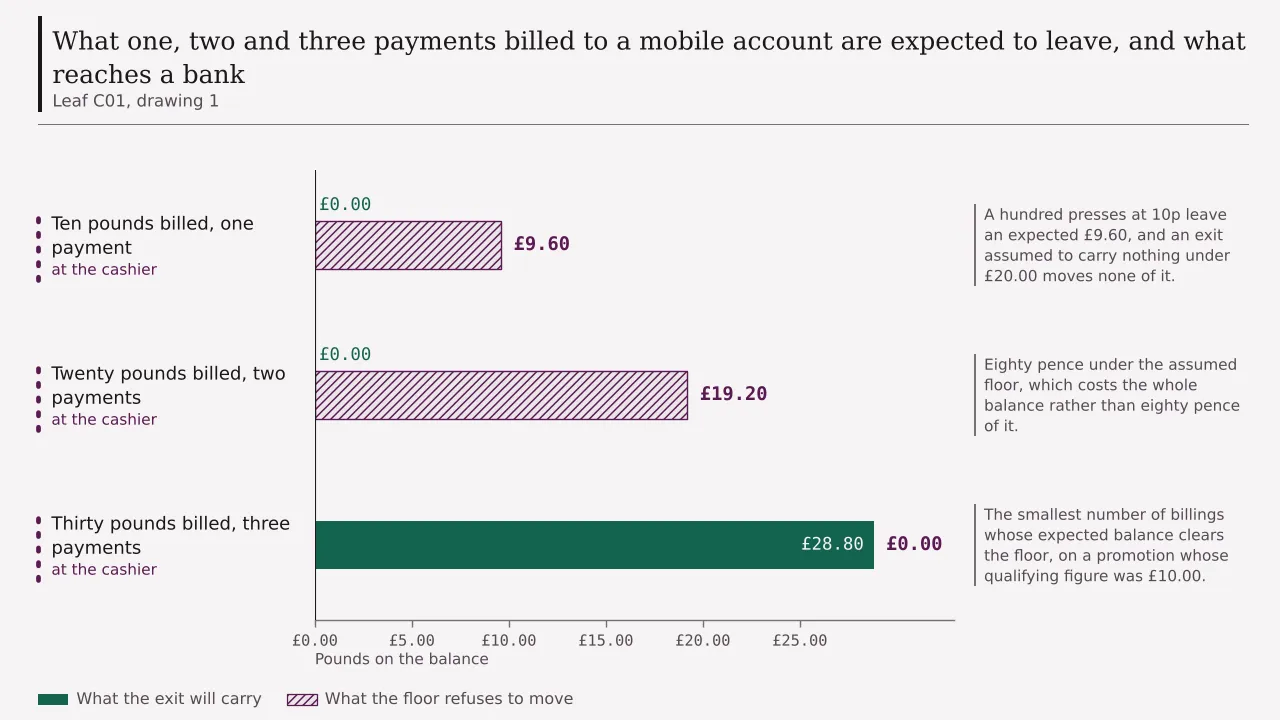
The middle bar is the one that teaches the lesson. Nineteen pounds twenty is a real balance, correctly calculated, perfectly visible, and worth precisely nought at the exit, because a floor does not scale its refusal to the size of the shortfall. Eighty pence short and ten pounds forty short produce the identical outcome, and only one of the two feels as though it should.
5
Terms belonging to somebody the screen never names
Everything so far has treated the second instrument as a form to fill in. It is also a contract, and it is the only contract in this subject that a reader signs with a party the gambling cashier has no relationship with. The bank that receives the £9.60 has its own rules about what it will carry, and those rules were written for reasons having nothing to do with reels.
Two of them matter here and both are properly out of this site’s reach. A receiving bank may decline a credit it does not wish to process, and a payment service may apply its own policy to gambling traffic in either direction. Where either of those things happens the refusal is a protection, it belongs to the party that made it, and nothing on this page offers a route round one.
What can be said precisely is where the governing document sits. The cashier’s own rules are in the written terms, one document away and readable before registering. The receiving bank’s rules are in a different document belonging to a different company, which the payment screen does not link to, does not name and has no obligation to mention.
So at the moment of commitment a reader has read nought of the two documents that will decide whether the money comes back. That is not a figure of speech and it is not an accusation. It is a count of documents opened at second twelve, and the count is nought because at second twelve only one of the two parties is on screen.
The useful consequence is that the reader can change the count before paying rather than afterwards. Both documents exist in advance. Both are readable by somebody who has not registered anything. The whole of the difficulty is that the payment screen is built to be completed in twelve seconds and reading two sets of terms is not a twelve-second activity.
6
Floors at either end, and the one that gets printed
Two smallest sums govern a round trip and they are not the same number. The entry floor is the least a mobile account will carry in one go, and it tends to be printed on the payment screen because it has to be: a reader typing an amount needs to know what will be accepted. The exit floor is the least the cashier will send, and nothing requires it to appear anywhere near the first one.
Treat them as a pair and the arithmetic is simple and unpleasant. Where the entry floor is £3.00 and the exit floor is £20.00, both this leaf’s assumptions rather than published figures, a reader may legitimately put in a sum that can never on its own come out. One payment of £3.00 is 30 presses, expected to leave £2.88, which is £17.12 under the sum the exit will move.
A gap of that shape is not a trick, since nothing in it is false. The entry floor is stated truthfully, the exit floor is stated truthfully wherever it is stated, and the relationship between them is stated nowhere, because no document on either side has a reason to perform a comparison across two screens.
| The quantity | Where it is settled | Assumed figure | Printed beside the other one |
|---|---|---|---|
| Least a mobile account will carry | at the cashier | £3.00 | Yes, on the amount field |
| Least the cashier will send out | at the cashier | £20.00 | On a different screen |
| Ratio between the two | nowhere in writing | Six to one | Never, by anybody |
| Payments needed to clear the exit | nowhere in writing | Seven at £3.00 | Never, by anybody |
Seven is worth checking rather than taking on trust. Seven payments of £3.00 is £21.00 billed, expected to leave £20.16 after a pass, which clears £20.00 with sixteen pence to spare; six payments give £18.00 and an expected £17.28, which does not. Every figure in that sentence rests on assumed floors, and the shape it demonstrates survives whatever the real floors turn out to be.
The shape is this. A rail whose entry floor is low is advertised as accessible, and a low entry floor combined with a higher exit floor produces a region in which money can go in and cannot come out. The size of that region is the exit floor divided by the return, and nobody publishes the division.
7
What a payment screen owes under a British licence
The instant a payment is made is a regulated instant in Great Britain, and the duties attaching to it are about furniture rather than about outcomes. Three of them bear directly on the screen this leaf has been describing, and each one is a requirement to put something in front of a person at exactly the moment this rail is designed to pass through quickly.
The first fixes the instant a spending ceiling has to be put on offer. Under the live standard on financial limits that prompt falls inside registration or at the first payment, and three lengths are compulsory: a day, a week, a month. Fold it into this leaf’s own figures: a ceiling of £3.00 a day turns the seven billings of part six into a week of them, which is a reader’s arithmetic rather than a discovery.
The second governs a refusal rather than a choice. Where the facility is offered, the offer stands as the default, so somebody wanting no ceiling has to act in order to have none, and that act must register before the payment proceeds. Twelve seconds with a default standing in them is no longer twelve seconds, which is exactly what putting one there accomplishes.
The third bears on the return leg and is the one this subject turns on. Licence condition 17.1.1 pins a disclosure ahead of the first payment: what evidence of identity may be sought, at which moment, and by what means of sending it. Set beside part three, that is an obligation to publish the cost of producing a payout route before anybody has incurred it.
Those three sit in the public register of rules in the sense this site means: published, dated, readable by anybody, and written by a party with no interest in how the payment screen converts. That is what makes them checkable, and checkability rather than strictness is the quality being measured here.
8
What the same screen owes nobody once that is gone
A payment screen billing a mobile account for a reel promotion holds no Great Britain licence. None of the three requirements in part seven reaches it, and the way to price that is to walk the same twelve seconds again with each one taken out in turn.
Remove the prompt and the limit facility and second twelve has nothing in it but an amount field. No ceiling is offered, no duration is offered, and the question of how much may be billed this week is answered by whatever a mobile account will carry rather than by a figure a reader chose in advance. Remove the default and declining a limit stops being an act, because there is nothing to decline.
Remove the pre-payment disclosure and the cost of producing a second instrument becomes knowable only by attempting it. A reader can still find the withdrawal page and read it, as part three said, and nobody is obliged to have put anything on it, so the page may be silent about documents and the silence breaks no rule.
One further loss belongs to a page about billing. A registration that shuts accounts across the licensed market is carried by the licence rather than by any cashier, and Gamstop Online puts the boundary in its own terms: it reaches the operators taking part in it and nobody else at all. Somebody who has used that protection should read a mobile-billed payment screen as standing beyond it, and the block below this leaf is the better address.
None of this makes the rail dishonest. It makes the rail unfurnished, which is a different criticism and the accurate one. The twelve seconds do what they say. What is missing is everything a licence would otherwise have required to be standing in those twelve seconds alongside the amount field.
9
Settling the return leg before a penny is sent
The procedure is short and it is entirely about sequence. Find the withdrawal page before the payment page. Read the list of routes money may leave by. Check whether the instrument that is about to be billed appears on that list, and where it does not, write down what will have to be produced instead.
Step two is the smallest sum the exit will carry, which this leaf has assumed at £20.00 throughout and which a reader can usually find printed on the same withdrawal page. Divide it by 0.96 to get the payments a single pass would need to support it, then divide that by the entry floor to get the number of billings. On this leaf’s assumed figures that chain gives £20.83, then seven payments of £3.00 or three of £10.00.
Step three is the document question, and it is the one worth asking in advance rather than at the exit. What identity evidence does a new payout route attract, and is the answer written down anywhere before a balance exists. Where the answer is not written down, that is a result rather than a dead end, and it is the line of the exercise most worth recording.
Step four is the arithmetic this site performs everywhere. Print what the payment is worth read on its own, print what it is worth once the return leg has been applied to it, and rule off the difference. For one £10.00 billing against an assumed £20.00 floor those two readings are £9.60 and £0.00, and the gap is the entire £9.60.
Two cautions keep the method honest. Every floor here is assumed, and each one carries its label in the sentence that spends it, since a figure travelling a single paragraph without its label arrives at the next one looking sourced. And the second instrument’s terms belong to a company that is party to none of this, so a reader who has checked the cashier alone has read one of the two documents deciding the outcome.
The honest summary is narrow and worth having. A mobile account is the quickest way money has ever been put onto a gambling balance, it is accurate about everything it states, and it has no second direction. For somebody who intends to spend the £10.00 and stop, none of the apparatus above is triggered. For everybody who expects the £9.60 back, the rail that made the first leg effortless has quietly made the second leg somebody else’s problem.
Questions
- Can a withdrawal be sent back to a mobile account?
- No, and the reason is structural rather than a policy anybody chose. A charge billed to a mobile account is a debt added to an invoice, and an invoice has no machinery for receiving £9.60 from a gambling balance. That makes the missing return leg an absence settled nowhere in writing, because nothing obliges anybody to document a thing that was never offered in the first place.
- What does a ten pound payment billed this way actually buy?
- Exactly 100 presses where a press costs 10p, the value this site works to and labels as its own, handing over an expected £9.60 once the reels have kept four hundredths. No rail alters that working, which comes out the same whichever route the ten pounds travelled. What a rail decides is whether the £9.60 can go anywhere afterwards, and a mobile account cannot take it back along the wire it arrived on.
- What has to be produced before any money can be withdrawn?
- A second instrument: a bank account or a card, supplied as a record on the account and accepted by whoever runs the cashier. It costs the time of the form, whatever identity work a new payout route attracts, and the delay of a slower rail, taken here as one to three working days, an assumption of this page rather than a timetable anybody prints. Going in needs one instrument and twelve seconds; coming out needs two instruments and a wait measured in working days.
- Why is nine pounds sixty described as detained rather than reduced?
- Because nothing has taken a bite out of it. A play-through shrinks a credit by a computable fraction and leaves a remainder. A missing payout route leaves the balance at exactly the size the arithmetic gives and moves nought of it, so the sum reaching a bank is £0.00 while the figure on screen stays £9.60. There is no partial outcome anywhere between those two readings.
- How many payments does it take to clear a withdrawal floor?
- Three of £10.00 on this leaf’s own assumptions, which put the exit floor at £20.00. Two payments are expected to leave £19.20, eighty pence under. That eighty pence turns up twice over: forwards, £20.00 less two lots of £9.60; backwards, a balance of £20.00 wants £20.83 of billing to support it, and the £0.83 missing from the billing comes out at £0.80 on the balance. Neither calculation uses a step the other one needs.
- Is there a sum that can go in and cannot come out?
- Yes, and it is a region rather than a single figure. Where the entry floor is £3.00 and the exit floor is £20.00, both assumed here, a payment of £3.00 buys 30 presses and is expected to leave £2.88, which is £17.12 under the sum the exit will move. Nothing in that is false: each floor is stated truthfully where it is stated, and the relationship between them is stated nowhere, because no document has a reason to compare two screens.
- Does the payment screen have to offer a spending limit?
- Under a British licence, yes. The live standard on financial limits puts that prompt inside registration or at the first payment, and makes three lengths compulsory: one day, one week, one month. The offer also stands as the default, so somebody wanting no ceiling has to act in order to have none, and the act must register before the payment proceeds. Twelve seconds with a default standing in them is no longer twelve seconds.
- What should be disclosed about identity documents before paying in?
- Licence condition 17.1.1 pins a disclosure ahead of the first payment: what evidence of identity may be sought, at which moment, and by what means of sending it. Read against the production of a second instrument, that is an obligation to publish the cost of the return leg before anybody has incurred it. Where no licence applies nobody owes the disclosure, and the price of producing a payout route becomes knowable only by attempting one.
- What is given up by using a cashier that bills a mobile account?
- A payment screen billing a mobile account for a reel promotion holds no Great Britain licence whatever, and what bites here is the furniture of the payment instant itself. No prompt towards a ceiling, no compulsory lengths, no default anybody has to decline, and no obligation to say in advance what paperwork a payout will attract. Gamstop Online puts its own boundary in its own terms: it reaches the operators taking part in it and nobody else, so a registration does not travel to a cashier beyond them.
- What is worth doing before a payment is confirmed?
- Read the withdrawal page before the payment page, list the routes money may leave by, and check whether the instrument about to be billed is on that list. Then take the smallest sum the exit will carry, divide it by 0.96 for the payments a single pass would support, and divide again by the entry floor for the number of billings: on the figures assumed here that is £20.83, then seven payments of £3.00 or three of £10.00. Print both readings of the payment and rule off the difference.