Terms read 19 October 2026 Leaf A01, revision 1
An offer with no payment leg, and the minutes it takes out of a decision
Opening an account at an address that wants nothing sent from a bank occupies about four minutes, an estimate this leaf makes and labels as its own wherever it is spent. The shortest protective period the national scheme sells runs 262,080 minutes. A £10.00 credit under a forty times condition wants £400.00 of turnover and closes at an expected minus £6.00. Each of those quantities is read here twice, once by itself and once with everything else switched on, and the gap is printed on both occasions.
Stated on the banner £0.00 The sum a reader is asked for, which is where an advertisement of this build stops. Stated, once you go and look minus £6.00 Where a bonus document lays forty times over £10.00 of credit, at the 96 pence returned in the pound that every figure here rests on. Not stated before the money goes in 262,080 minutes A protective period a reader may be partway through, which no advertisement mentions and which the form takes four minutes to act against.
Payment-free offers advertised from beyond the national scheme, with their written terms read
Every destination in this file is bought advertising. The site is paid a fee if a reader goes on to register, and no figure printed below moves because of it.
Bonus Spins UK Slip 01
Betportal
Ceiling as a multiple
The drop
€15.00
€1.00 in the euro
The claim reads €15.00. Once the terms beside it have applied, €0.00 of it can leave. The difference is the drop.
7 of the 15 terms on this slip could not be read before the money went in
Spins priced at this site's own 10p a spin, which the operator does not publish
Stated
€15.00
The claim as it is printed, before a single term has been applied to it.
Headline paid as spins
150 spins at 10c each, which is €15.00 of the figure above.
6 Nowhere
What one spin is worth
No unit is published for a spin, so the count is priced at this site's own 10p a spin. At half that price every figure below halves with it.
Match and other credit not priced
300% of three deposits, to a ceiling of €1,000. A share of a deposit nobody has made yet is not a sum, so no figure stands on this line and none is carried below.
Qualified
-€14.40
Written down somewhere, and taking part of the claim back. Each term carries the place it is written and the sum it takes.
2 Written terms at a distance this record does not establish
Play-through -€14.40
Carrying €14.40 through 35 times stakes €504.00 and costs €20.16 of it at 96 per cent return. That prices above the €14.40 there is to charge it against, so the whole of the credit goes and the line is held at that. The multiple sits on the bonus.
2 Written terms at a distance this record does not establish
Game weighting not priced
Slots only count towards the play-through. No contribution percentage is published, so the line above has been worked at full weight, which is the kindest reading there is.
2 Written terms at a distance this record does not establish
Ceiling on the winnings not priced
5x the bonus.
2 Written terms at a distance this record does not establish
Clock on the credit not priced
14 days.
2 Written terms at a distance this record does not establish
Largest stake while it runs not priced
€5.
3 Public record
Licence, and who holds it not priced
Licensed in Anjouan, Comoros, held by BetPortal Gaming Ltd, with Excite Ultra Media Ltd, reference ALSI-202601040-FI2. A register entry settles who holds a licence and what it permits. It does not settle who is running the site this morning.
4 Cashier
Smallest qualifying deposit your money
€20 a stage. That is €20.00 of your own money, and it is never netted into a drop.
5 On the way out
Checks before a withdrawal not priced
Documents before the first withdrawal.
Unstated
-€0.60
Applying without having been published anywhere, and costing money all the same.
6 Nowhere
What a spin hands back -€0.60
Staking a spin returns 96 per cent of it, so that share of the batch is the house's before a reel turns. This site works at that return and the operator publishes none where the claim is made.
6 Nowhere
Forfeited by rule cost unknown
Nothing is published under this heading, and it applies regardless.
6 Nowhere
Charge on the way out cost unknown
No charge on the way out is published as a figure, so nothing comes off this line. A charge that exists unpublished would come straight off whatever survives.
6 Nowhere
Smallest withdrawal allowed cost unknown
No smallest withdrawal is published as a figure. A floor nobody has published is still a floor, and it decides whether a small balance can move at all.
No Great Britain licence
Terms read 19 October 2026
Bonus Spins UK Slip 02
WinBeast
Ceiling as a sum
The drop
€50.00
€1.00 in the euro
The claim reads €50.00. Once the terms beside it have applied, €0.00 of it can leave. The difference is the drop.
8 of the 15 terms on this slip could not be read before the money went in
Spins priced at this site's own 10p a spin, which the operator does not publish
Stated
€50.00
The claim as it is printed, before a single term has been applied to it.
Headline paid as spins
500 spins at 10c each, which is €50.00 of the figure above.
6 Nowhere
What one spin is worth
No unit is published for a spin, so the count is priced at this site's own 10p a spin. At half that price every figure below halves with it.
Match and other credit not priced
50% to 100% of five deposits, each to a ceiling of €1,000, and a €650 free bet. A share of a deposit nobody has made yet is not a sum, so no figure stands on this line and none is carried below.
Qualified
-€48.00
Written down somewhere, and taking part of the claim back. Each term carries the place it is written and the sum it takes.
2 Written terms at a distance this record does not establish
Play-through -€48.00
Carrying €48.00 through 40 times stakes €1,920.00 and costs €76.80 of it at 96 per cent return. That prices above the €48.00 there is to charge it against, so the whole of the credit goes and the line is held at that. The multiple sits on the bonus and the winnings from the spins.
2 Written terms at a distance this record does not establish
Game weighting not priced
Slots, titles vary by country count towards the play-through. No contribution percentage is published, so the line above has been worked at full weight, which is the kindest reading there is.
2 Written terms at a distance this record does not establish
Ceiling on the winnings not priced
€100 a batch of spins.
2 Written terms at a distance this record does not establish
Clock on the credit not priced
7 days, spins 1 day.
3 Public record
Licence, and who holds it not priced
Licensed in Curaçao, holder not named on the site. A register entry settles who holds a licence and what it permits. It does not settle who is running the site this morning.
4 Cashier
Smallest qualifying deposit your money
€20 a stage. That is €20.00 of your own money, and it is never netted into a drop.
5 On the way out
Checks before a withdrawal not priced
Documents before the first withdrawal.
Unstated
-€2.00
Applying without having been published anywhere, and costing money all the same.
6 Nowhere
What a spin hands back -€2.00
Staking a spin returns 96 per cent of it, so that share of the batch is the house's before a reel turns. This site works at that return and the operator publishes none where the claim is made.
6 Nowhere
Largest stake while it runs cost unknown
Nothing is published under this heading, and it applies regardless.
6 Nowhere
Forfeited by rule cost unknown
Nothing is published under this heading, and it applies regardless.
6 Nowhere
Charge on the way out cost unknown
No charge on the way out is published as a figure, so nothing comes off this line. A charge that exists unpublished would come straight off whatever survives.
6 Nowhere
Smallest withdrawal allowed cost unknown
No smallest withdrawal is published as a figure. A floor nobody has published is still a floor, and it decides whether a small balance can move at all.
No Great Britain licence
Terms read 19 October 2026
Bonus Spins UK Slip 03
EliteSpin
Longest spin window
The drop
£50.00
£1.00 in the pound
The claim reads £50.00. Once the terms beside it have applied, £0.00 of it can leave. The difference is the drop.
8 of the 15 terms on this slip could not be read before the money went in
Spins priced at this site's own 10p a spin, which the operator does not publish
Stated
£50.00
The claim as it is printed, before a single term has been applied to it.
Headline paid as spins
500 spins at 10p each, which is £50.00 of the figure above.
6 Nowhere
What one spin is worth
No unit is published for a spin, so the count is priced at this site's own 10p a spin. At half that price every figure below halves with it.
Match and other credit not priced
50% to 100% of five deposits, each to a ceiling of £1,000. A share of a deposit nobody has made yet is not a sum, so no figure stands on this line and none is carried below.
Qualified
-£48.00
Written down somewhere, and taking part of the claim back. Each term carries the place it is written and the sum it takes.
2 Written terms at a distance this record does not establish
Play-through -£48.00
Carrying £48.00 through 40 times stakes £1,920.00 and costs £76.80 of it at 96 per cent return. That prices above the £48.00 there is to charge it against, so the whole of the credit goes and the line is held at that. The multiple sits on the bonus and the winnings from the spins.
2 Written terms at a distance this record does not establish
Game weighting not priced
Slots count towards the play-through. No contribution percentage is published, so the line above has been worked at full weight, which is the kindest reading there is.
2 Written terms at a distance this record does not establish
Ceiling on the winnings not priced
5x the bonus.
2 Written terms at a distance this record does not establish
Clock on the credit not priced
7 days, spins 3 days.
3 Public record
Licence, and who holds it not priced
Licensed in Costa Rica, held by PrimeTier Limited. A register entry settles who holds a licence and what it permits. It does not settle who is running the site this morning.
4 Cashier
Smallest qualifying deposit your money
£20 a stage. That is £20.00 of your own money, and it is never netted into a drop.
5 On the way out
Checks before a withdrawal not priced
Documents before the first withdrawal.
Unstated
-£2.00
Applying without having been published anywhere, and costing money all the same.
6 Nowhere
What a spin hands back -£2.00
Staking a spin returns 96 per cent of it, so that share of the batch is the house's before a reel turns. This site works at that return and the operator publishes none where the claim is made.
6 Nowhere
Largest stake while it runs cost unknown
Nothing is published under this heading, and it applies regardless.
6 Nowhere
Forfeited by rule cost unknown
Nothing is published under this heading, and it applies regardless.
6 Nowhere
Charge on the way out cost unknown
No charge on the way out is published as a figure, so nothing comes off this line. A charge that exists unpublished would come straight off whatever survives.
6 Nowhere
Smallest withdrawal allowed cost unknown
No smallest withdrawal is published as a figure. A floor nobody has published is still a floor, and it decides whether a small balance can move at all.
No Great Britain licence
Terms read 19 October 2026
Bonus Spins UK Slip 04
Crown Jewelz
Multiple unpublished
The drop
NOT WORKED
The multiple is not published in the operator's own terms. Since the sum cannot be worked around it, none is worked.
9 of the 14 terms on this slip could not be read before the money went in
No drop worked
Stated
£15.00
The claim as it is printed, before a single term has been applied to it.
Headline paid as spins
150 spins at 10p each, which is £15.00 of the figure above.
6 Nowhere
What one spin is worth
No unit is published for a spin, so the count is priced at this site's own 10p a spin. At half that price every figure below halves with it.
Match and other credit not priced
200% of the first deposit, then 150% twice, each to a ceiling of £1,000. A share of a deposit nobody has made yet is not a sum, so no figure stands on this line and none is carried below.
Qualified
NOT WORKED
Written down somewhere, and taking part of the claim back. Each term carries the place it is written and the sum it takes.
2 Written terms at a distance this record does not establish
Play-through not priced
40x the bonus, reported rather than published by the operator.
2 Written terms at a distance this record does not establish
Game weighting not priced
Slots count towards the play-through. No contribution percentage is published, so the line above has been worked at full weight, which is the kindest reading there is.
3 Public record
Licence, and who holds it not priced
Licensed in Curaçao, number not verified, holder not named on the site. A register entry settles who holds a licence and what it permits. It does not settle who is running the site this morning.
4 Cashier
Smallest qualifying deposit your money
£20. That is £20.00 of your own money, and it is never netted into a drop.
5 On the way out
Checks before a withdrawal not priced
Documents before the first withdrawal.
Unstated
NOT WORKED
Applying without having been published anywhere, and costing money all the same.
6 Nowhere
Ceiling on the winnings cost unknown
No ceiling is published. Nothing is assumed in its place.
6 Nowhere
Clock on the credit cost unknown
Nothing is published under this heading, and it applies regardless.
6 Nowhere
Largest stake while it runs cost unknown
Nothing is published under this heading, and it applies regardless.
6 Nowhere
Forfeited by rule cost unknown
Nothing is published under this heading, and it applies regardless.
6 Nowhere
Charge on the way out cost unknown
No charge on the way out is published as a figure, so nothing comes off this line. A charge that exists unpublished would come straight off whatever survives.
6 Nowhere
Smallest withdrawal allowed cost unknown
No smallest withdrawal is published as a figure. A floor nobody has published is still a floor, and it decides whether a small balance can move at all.
No Great Britain licence
Terms read 19 October 2026
Every figure in the second and third columns is this site's own working and nothing an operator has published. A claim is priced as printed, then the share a spin hands back at 96 per cent return comes off it, then what playing the multiple through costs at the same return, and then whatever a published ceiling, a charge on the way out or a floor on the smallest withdrawal takes from what has survived. The drop is the difference between the first figure and the last. The two columns add back up to it exactly, so no money leaves a slip without a term and a place beside it.
Which column a term falls in is settled by one question: has anybody written it down. A charge a reader meets at the payment screen is written down, and it stands in the second column with the cashier against it. A condition that binds without ever having been set down stands in the third, whatever it costs. Inside each column the terms run outwards from the banner, so the order itself says how far a reader would have had to go.
A count of spins has no unit until one is supplied. Where an operator publishes what one of its own spins is worth, that figure is used and the first column says it is theirs. Where none is published, this site's own 10p a spin stands in its place and every figure below moves in proportion with it. Where the multiple itself is unpublished, no drop is worked at all, because that is the one figure the sum cannot be done without.
Three words stand where a figure cannot. Not priced is a term that is written down and carries no number the arithmetic can take. Cost unknown is a term nobody has written down, costing something nobody has put a number on. Your money is money of the reader's own, which is never netted into a drop.
None of the operators in this file holds a Great Britain licence, so none of the duties that licence carries reaches them. Each of those duties is published in its own right, which is what makes its absence here something a reader can check rather than take on trust. Every gambling company licensed in Great Britain belongs to Gamstop Online, so a reader who has shut themselves out through the scheme is not shut out here. Social Responsibility Code 5.1.1 has held a play-through to a maximum of ten times the bonus funds since 19 January 2026, and it binds a licence holder and nobody else. Asked in a post of 21 October 2025 what is lost along with the licence, the Gambling Commission's Director of Enforcement and Intelligence answered: "unfair gaming practices, financial loss, and a lack of recourse if things go wrong". The same post puts blocked payouts, and withdrawal limits pitched high enough to be unreachable, among the behaviour the Commission has recorded. Nobody under 18 may hold an account at any of them.
Terms are reproduced in the wording their operator published, and each slip is dated with the day somebody sat down and read them. 19 October 2026 is the oldest of those dates. Anybody claiming an offer is bound by that operator's full terms, which are elsewhere, and never by a line standing here.
1
Four minutes, and three better places to spend them
Four minutes opens this leaf because four minutes is the whole transaction: an electronic mail address, a password, a date of birth, a tick, and a credit sitting on a screen with nothing sent from a bank to produce it. That duration is estimated here rather than measured anywhere, and every sentence below that spends it says so. Being exactly four rather than three or six changes none of the arithmetic. What the figure is for is comparison with the second one, and the second one is 262,080.
A proportion of the people typing a phrase of this shape into a search box did something deliberate about their own gambling a while ago and are, at this moment, in the middle of reconsidering it. Three routes stand open to anybody in that position and none of them charges a penny. A conversation is billed at nothing. Through every hour of all 365 days GamCare answers the National Gambling Helpline, by voice, by live chat or in writing, on 0808 8020 133. GamCare.org.uk and BeGambleAware.org carry the same help in reading form for anybody who would rather not speak to a person. Blocking software is available to British users at no charge through an arrangement GamCare publishes, which joins the conversation, the blocking and the registration together; it is published under a date of 12 April 2021, states no length for the free access, and leaves this page equally silent on that point.
Where its own cover stops is something the scheme prints rather than leaves to be discovered. Two statements in its terms of use, revised 20 May 2026, settle it: a registration reaches gambling services provided by the operators who have joined the arrangement, and gambling services from organisations standing outside that arrangement are not something the scheme is able to keep anybody away from. Printed on the protection itself, that is an edge rather than a failure. An advertisement for a payment-free credit from beyond the edge is describing a kind of address a registration was never purchased to reach, and four minutes given to the number in the paragraph above will do more for a reader in that position than four minutes given to a sign-up form.
So to the claim, copied exactly as published. An advertisement of this build states a sum of credit or a count of presses, states that nothing has to be paid, and finishes. Both halves are accurate. No card has to be found, no wallet topped up, no telephone bill involved. A quantity and a price of nought exhaust what is settled , and nothing below contradicts either, because neither was ever the difficulty.
The difficulty is structural rather than promotional. Every other arrangement in this market carries a payment leg. A payment leg occupies time, requires an instrument, and can be declined by whoever owns the instrument. Delete the payment leg and the three go together. An arrangement wanting nothing is accordingly the only one that can be accepted in full between an impulse and the second thought that would ordinarily have caught up with it, and stating that plainly is most of this leaf’s purpose.
2
What a payment leg does, taken apart and costed in seconds
Friction is a fault in the design of a payment screen and a virtue in the design of a protection, and the word points opposite ways depending on which of those is being built. Disassembled, a payment leg performs three jobs and only the first of them has anything to do with money.
Job one is duration. Locating an instrument, keying a long number, satisfying an authentication prompt and waiting for a confirmation take, on this leaf’s own estimate, some six minutes beyond the four a bare registration needs. Those six minutes earn their keep not by being tiresome but by their position: they stand between a decision and the execution of it, and an execution that takes six minutes can be abandoned while it is still running.
Job two is the instrument. Something physical or at least proprietary has to exist and be fetched: a card in a drawer, a wallet carrying a balance, a bill that will arrive at the end of the month. Fetching it is a second interruption, and the thing fetched belongs to somebody who may have put arrangements around it.
Job three is nobody’s design intention. A payment can be refused by a party who is neither the operator nor the customer. When a bank or a card network declines to carry a gambling transaction it performs, at that instant, the same office a registration with the national scheme performs: it stops something a person set out to do, on the instruction of that person’s earlier self or of a rule written for their benefit. A refusal of that kind is treated on this leaf as a protection. What meeting one costs and what it prevents are printed; no arrangement for defeating one is described anywhere, and where a point would require such a description, the consequence appears instead and the description does not.
| What has to happen | Which place settles it | Seconds, estimated here |
|---|---|---|
| An address, a password and a birth date | 240 | |
| Fetching an instrument belonging to somebody | at the cashier | 150 |
| Keying its details into a payment screen | at the cashier | 90 |
| Satisfying whatever its owner asks for | at the cashier | 120 |
| A refusal by whoever carries the money | at the cashier | Ends the attempt |
| Paperwork demanded ahead of any payout | on the way out | Not yet reached |
Totalling rows two, three and four produces 360 seconds: six minutes of somebody’s life, each second of it a chance to stop. Row six belongs to the subject of this part of the site and nobody without a balance ever arrives at it. Delete the payment leg and row one is the entire procedure: 240 seconds, no object to go and find, and nobody in the chain with standing to say no.
An honest description of a payment-free arrangement is therefore not that it is generous. It is that it is brief. Three hundred and sixty seconds of delay and one party’s power of refusal come out, and a credit goes in. Whether that trade is a good one turns entirely on what the 360 seconds had been doing, and for a reader who had arranged to be stopped they were doing the only work that counted.
3
A protective period measured against the length of a form
Minutes make the comparison concrete. Four lengths a registrant may pick from are published in the scheme’s terms of use: 182 days, 365 days, 1,826 days, and 1,826 days renewing themselves unless the renewal is stopped during the closing six months. Converted, 182 days is 262,080 minutes and 1,826 days is 2,629,440.
Four minutes into 262,080 is one part in 65,520. Four minutes into 2,629,440 is one part in 657,360. Neither ratio has been dressed up: one number is how long a form takes and the other is how long a decision was meant to last, and a reader who completes the form has acted against the decision without the decision being named anywhere on the page they were looking at.
262,080 minutes of chosen protection against the four a payment-free registration takes
Three further provisions in that document decide how solid the larger number is. Early release does not exist, the terms stating in capitals of their own that deactivation waits for the minimum term to run out. Expiry is not automatic either, since the scheme declines to lift a registration by itself at the end of a term, so somebody who does nothing stays excluded for as long as seven more years. A deliberate reversal is routed through the contact centre the scheme keeps and then held at least 24 hours, the exclusion running throughout, after which seven years of notifications tell operators about the former registration while obliging them to do nothing about it.
Taken together those provisions describe something built to be entered quickly and left slowly, which is precisely the asymmetry a payment leg creates by accident rather than by design. An arrangement asking for no payment is entered quickly and has nothing whatever to leave, so it reverses both ends at once.
Scale is published. A count of 614,738 registered people carries the date 16 July 2026; sixty months was the term over half of them took, six months the term a quarter took, and among people under 25 the six-month share reached 38 per cent. None of that describes any offer. All of it describes the chance that somebody reading a phrase like this one still has days left on a term.
4
Ten pounds of credit against four hundred pounds of turnover
To the money, which is the smaller quantity on this leaf and the easier one to settle. Take £10.00 of credit handed over for nothing under a forty times condition, forty being the band an offshore bonus document reaches for where it prints a band at all. Multiply and £400.00 of required turnover appears. Divide that by a 10p press and 4,000 individual presses appear behind a credit nobody paid a penny for.
Retention is the quickest route through the rest. Every pound crossing a reel at a 96 per cent return leaves 4p behind, so £400.00 of turnover retains £16.00 between its 4,000 presses. Put £16.00 of retention against £10.00 of credit and the credit falls £6.00 short, which is an expected close of minus £6.00. Weighting sits at one throughout, so no part of the shortfall is hiding inside it.
The credit read off the advertisement £10.00 That credit after a forty times condition bites minus £6.00 What the unread condition is worth £16.00
Both ends of that block reach the same £16.00, which is how the arithmetic checks itself. Approach from the top and £16.00 is the retention on £400.00 of turnover. Approach from the bottom and £16.00 is what separates a £10.00 reading from a minus £6.00 one. They agree because the condition performs exactly one operation, which is to pass turnover through a margin whose rate was fixed before any of it started.
Twenty-five is where the sign changes, and it is a property of 4p rather than of any market. At twenty-five times, £10.00 of credit wants £250.00 of turnover and retains £10.00, which is the credit exactly. Short of twenty-five a credit emerges with something still attached to it. Past twenty-five the retention outgrows the credit and the surplus is drawn from whatever else is in the account, and in an arrangement where nothing was paid in there is nothing there for it to be drawn from.
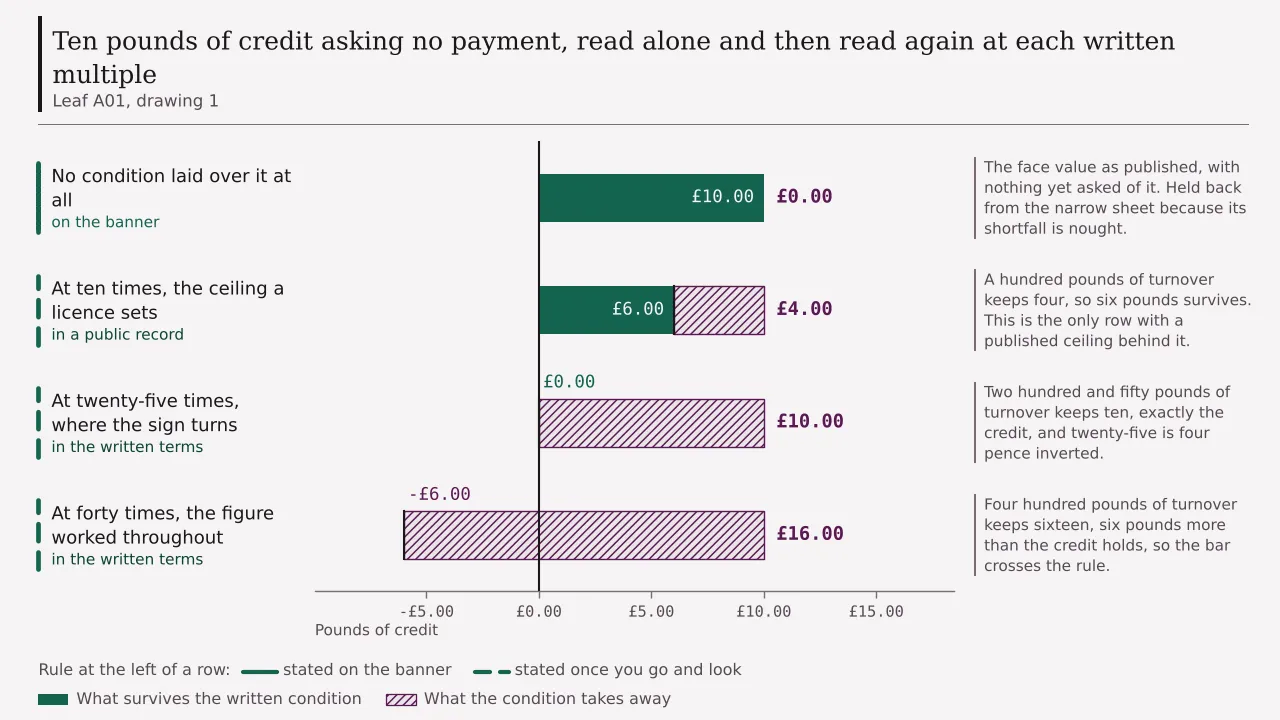
Row two of that drawing is the row with a published ceiling standing behind it. Inside a British licence a wagering condition over bonus funds stops at ten times, a limit dated 19 January 2026. At that ceiling £10.00 of credit wants £100.00 of turnover, retains £4.00, and leaves an expected £6.00 in place of minus £6.00. What the regulator describes itself as correcting sits in the same document: wagering at sixty times was being applied somewhere in the market. Between the capped row and the row worked here lies £12.00 of expected close on a credit of £10.00.
5
Ten thousand seconds of pressing, and what removes the floor beneath them
A condition has a duration as well as a size, and on a payment-free arrangement the duration is the stranger of the two. Four thousand presses is not a figure of speech. A licensed reel may not begin a cycle inside 2.5 seconds of starting the last one, so 4,000 of them occupy 10,000 seconds at minimum, which is two hours, 46 minutes and 40 seconds of uninterrupted pressing. That is a floor rather than a forecast, and it is arrived at here by multiplying a published minimum by this leaf’s own press count.
Hold it against the four minutes the registration occupied and the two numbers carry the argument by themselves. Three hundred and sixty seconds were taken out at the front and at least 10,000 were installed at the back. Nobody is compelled to serve the 10,000, and most will not, since on these figures the credit is expected to be exhausted long before the condition is. That is the design rather than a complaint about it. A condition of this size is not a task anybody completes; it is a standing reason to continue after the money has already done what the arithmetic predicted.
Past the reach of a British licence, nothing at all publishes that 2.5-second figure. It travels with a licence, and an address holding none is unbound by it, so the 10,000 seconds compress to whatever the software permits. Compression reads like an improvement, a shorter obligation sounding cheaper than a long one, and the arithmetic says otherwise. Fitting 4,000 presses into an evening leaves the £400.00 of turnover and the £16.00 of retention exactly where they were. What it removes is the last thing standing between a decision taken in four minutes and an obligation discharged in a single sitting.
Two companion rules hold the same ground from other directions. Each of the 4,000 cycles has to be committed to separately on a licensed build, the only carve-out the guidance records being the posting of blinds in player-against-player poker, so 4,000 presses means 4,000 decisions and a person has to make all of them. And the wait cannot be bought back, shortening the time until a result appears being unavailable on a licensed build, which is what keeps 10,000 seconds at 10,000.
One sentence condenses the pair. How long the obligation must take at minimum is settled in a public record wherever a British licence stands behind an address, and nowhere in writing wherever none does. Four thousand presses is 4,000 presses in both cases. Only the permitted speed has moved, from a published minimum to an unpublished one.
6
Something costing nothing can be taken repeatedly, and here is that arithmetic
Nothing priced at nought carries a budget, and this is where single-offer arithmetic stops describing the product. If a £10.00 credit costs £0.00, no feature of the arrangement makes once more natural than weekly, and the only brake on repetition is how many addresses exist and how fast a form can be filled. Four minutes apiece is not a brake.
Work it weekly across the shorter protective term from part three: 26 occasions inside 182 days, a frequency this leaf assumes rather than observes in anybody. Twenty-six credits of £10.00 each want £400.00 of turnover, so £10,400.00 crosses the reels and 4p in the pound of it is retained, giving £416.00. Across the same 26 weeks the sum demanded of the reader stays at £0.00.
What the arrangement asks a reader to pay £0.00 Retention on the turnover it wants, weekly for half a year £416.00 Cost beyond the price £416.00
That is the subtraction performed for a second time, and the brief of this site is to say so when it happens. In part four the two readings were a credit off an advertisement and the same credit under one written condition, separated by £16.00. Here the two readings are what an arrangement charges and what the activity it requires is expected to retain, separated by £416.00. The second figure is 26 times the first for the plainest of reasons, and it earns a block of its own because a price of nought is what makes the repetition behind it ordinary.
Duration accumulates on the same multiplier. Twenty-six obligations of 4,000 presses come to 104,000 presses, and at 2.5 seconds apiece those occupy 260,000 seconds, or 72 hours, 13 minutes and 20 seconds. Three days of pressing, inside a term somebody set aside for doing none of it, unlocked in total by 104 minutes of form-filling.
No part of that forecasts the behaviour of any particular reader. It is what a price of nought implies, and the honest way to take it is as a description of the product’s shape. A reader who accepts one credit, spends it and never goes back carries an expected cost of £16.00 and nothing more.
7
Where each condition is settled when no payment is asked for
This site files every term of an offer under the single place a reader could genuinely settle it: a banner, a written document, a public record, a payment screen, an exit, or no place whatsoever. A payment-free arrangement shuffles that filing in a way worth setting out at length, since the place that usually carries most of the weight is vacant and the place that usually carries least is carrying all of it.
| What it decides | Which place settles it | What has to exist first | Worth on a £10.00 credit |
|---|---|---|---|
| How large the credit is, and its price | Nothing | £10.00 at £0.00 | |
| Which multiple is laid over it | in the bonus terms | A document, opened | £400.00 of turnover |
| The most the credit is allowed to pay out | in the bonus terms | That same document | Nothing in expectation |
| Which company is permitted to do this | in the public register | A name to search on | Governs every row |
| The shortest permitted gap between presses | in a public record | A name to search on | 10,000 seconds, or none |
| How little the exit is willing to move | at the cashier | A balance to move | Unknown till reached |
| Which instrument the money may go to | at the cashier | A balance to move | A payment, belatedly |
| Paperwork demanded ahead of any payout | on the way out | Something to collect | All of it |
| A discretion to shut the account and keep it | on the way out | Something to collect | All of it |
| How much of a stake the build contributes | nowhere in writing | Unreachable | Multiplies £400.00 |
Row seven deserves a second reading. An arrangement with no payment leg at the entrance grows one at the exit, because money has to be directed somewhere and a balance assembled from a credit has nothing on record for it to be returned to. Friction was never abolished. It was relocated to the far end, where it operates on somebody who now holds something rather than on somebody holding nothing, and that relocation is the most consequential single fact about this product.
Rows eight and nine are what this part of the site takes its name from. Neither is a term in the usual sense, since neither can be read, priced or planned for while a balance is still hypothetical. Paperwork that gets answered costs time. Paperwork that cannot be answered costs the balance. A discretion to shut an account and retain what sits in it costs the balance as well. A penalty of £170,000 carrying the date 3 July 2025 was imposed on a licensee whose rules over new casino promotions held a term of that construction, and the condition recorded as breached was the one covering fairness and openness.
8
Duties written into a product rather than into a document
No Great Britain licence stands behind an address advertising a credit of this construction. On a leaf about friction the duties worth itemising are those written into how a product behaves rather than into what a document says, behaviour being what a four-minute registration delivers somebody into. Duties about wording, placement and complaints are genuine, bite in other places, and get priced on other leaves of this section.
Begin with the one published duty anywhere that names this exact product. Three things a licensed build may not do: push a customer towards recovering a loss, push them towards a bigger stake, or keep pushing once they have said they want to stop. Guidance printed beside that requirement adds two more. Topping up money that already sits inside a product takes a fresh choice from the customer on every occasion. And somebody who has gone is not to be pulled back in, the guidance reaching for a free game as its illustration of how not to do it. A credit costing nothing, handed to a person who stopped, is the thing described. No British licence, no description.
Two design duties hold adjoining ground. Commitment to each cycle separately is required of a licensed system, which is why automatic running is unavailable on licensed gaming and why the 4,000 presses of part five are 4,000 decisions. Shortening the wait for a result is equally unavailable, so the interval cannot be purchased back through a setting. Both duties do the work part two credited to the payment leg: they insert a deliberate human act between a person and the next thing that happens to their money.
A fourth duty governs the instant a result lands. A licensed build has no celebration available to it where what comes back is no bigger than what went in: no winning noise, no winning animation. Against this leaf’s figures that is a rule about several thousand separate instants. Of the £400.00 crossing the reels, £384.00 is expected back and £16.00 is not, and a great many of the returns inside that £384.00 arrive in amounts under the 10p that bought them. A build at liberty to dress those as wins is at liberty to report a losing evening as a run of small victories.
Remove the four of them together and not a penny of this leaf’s arithmetic moves. The credit remains £10.00, the turnover remains £400.00, the expected close remains minus £6.00 and the difference remains £16.00. Everything around those figures changes. Nothing then obliges the obligation to occupy 10,000 seconds, nothing obliges each of 4,000 cycles to be a separate act, nothing prevents a result being hurried, nothing prevents a return under its own stake being dressed as a win, and nothing whatever forbids offering a free game to a person who arranged to be kept clear of one. Identical money, a different product, and on this subject the product is what a reader actually encounters.
9
Two columns, one in money and one in something that is not money
The question this leaf was written to answer resolves into two columns that do not resemble one another. Under money: accepting a payment-free credit costs £0.00, an attempted condition carries an expected close of minus £6.00, and weekly acceptance across half a year reaches £416.00 of expected retention. By the standards of this market every one of those is a small number, and none of them is why the page exists.
Under protection the quantities are of a different kind altogether. Four minutes of form-filling against 262,080 minutes somebody chose on purpose, which cannot be ended early, does not expire of its own accord, and takes a telephone call plus a day of waiting to undo. A payment leg worth 360 seconds, together with a bank’s or a card network’s standing to decline, deleted. A minimum of 2.5 seconds between presses, unsourced. A requirement not to draw back somebody who has chosen to go, with nobody behind it.
The conclusion is therefore one sentence whose halves face opposite ways. An arrangement demanding no payment costs a reader nothing at all in money, and costs a great deal to a reader who had already arranged, at some length and some personal expense, not to be offered anything. Both halves hold simultaneously, which is why a page arguing only the first is wrong and a page arguing only the second is unpersuasive.
A concession belongs here, because it is genuine. Somebody carrying no registration, who wants presses at no cost, means to stop when they are used up and has no intention of attempting the condition, has received exactly the advertised thing at exactly the advertised price. For that reader nothing above is live, since none of it starts until a payout is asked for. The figures on this leaf are addressed to the other reader.
One comparison closes the two columns. On the money side half a year at weekly frequency totals £416.00 of expected retention. On the protection side sits a term that 614,738 people have registered for and that over half of them set to sixty months. Those two quantities have no exchange rate between them and this leaf invents none. The sayable thing is which one comes back: £416.00 can be earned again, while a protective term admits of no retrospective reinstatement, the days inside it having been the whole of what it was built out of.
10
Running the same subtraction on anything with a price of nought
What follows works on any arrangement priced at nought, needs no figure from this leaf, and is quicker than the registration it concerns. Four steps, and every one of them leaves a written line behind rather than an impression.
Step one: write down what changes hands and at what price, which is a count of presses or a sum of credit, against nought. Add nothing the advertisement omitted, because advertisements of this build are accurate and the inaccuracy is usually the reader’s own contribution.
Step two, locate the multiple and apply it ahead of anything else. Credit times multiple gives turnover; 4p in each pound of turnover gives retention at a 96 per cent return; credit less retention gives the close. Print the credit, print the close, rule off the gap. On £10.00 at forty times those three are £10.00, minus £6.00 and £16.00, and only the middle one was ever available to act on honestly.
Step three belongs to this part of the site rather than to the arithmetic: ask what the absent payment leg had been doing. Count the minutes it would have cost. Name the party who would have held a power of refusal. Then ask whether either of those was arranged by the reader on purpose, because where it was, the removal is not a feature of the offer. It is the offer.
Step four, multiply by the frequency a price of nought permits. One acceptance is a £16.00 proposition. Weekly acceptance across half a year is a £416.00 one, bought with 104 minutes of form-filling. No written term performs that multiplication and none has any reason to.
Two habits keep the method straight. Name every estimate as an estimate within the sentence that uses it, on each occasion, since a figure carried quietly forward becomes a fact that nobody has checked. And never drop the place from beside the figure, since a result assembled out of an advertisement, a bonus document and two estimates is a different animal from one assembled out of a public record.
Questions
- What does a no deposit offer at a site outside the national scheme actually give you?
- A count of presses or a sum of credit, priced at nought, and the banner settles nothing beyond those two. Which multiple is laid over the credit sits in a bonus document. How little the exit will move sits at the payment screen. Paperwork demanded ahead of a payout, and any discretion to shut the account and keep what is in it, are met for the first time at the exit. The price of nought stays accurate throughout and was never the thing in dispute.
- Why does an offer with no payment matter more than one with a deposit?
- Because deleting a payment leg deletes three jobs at once. It occupies time, roughly six minutes by the estimate this leaf makes and labels as its own. It needs an instrument that has to be fetched. And it hands a bank or a card network standing to decline the transaction outright. An arrangement wanting nothing can accordingly be completed end to end in about four minutes, again an estimate rather than a measurement, between an impulse and the second thought that would ordinarily have overtaken it.
- How much is a ten pound credit worth once a forty times condition is applied?
- An expected minus £6.00. The condition wants forty lots of the credit, so £400.00 has to cross the reels, which comes to 4,000 presses at 10p apiece. A 96 per cent return retains 4p out of each pound, making £16.00 of retention on that turnover against a credit holding only £10.00. Read the credit at £10.00, read it again at minus £6.00, and £16.00 is what the condition is worth to whoever drafted it.
- How long does four hundred pounds of turnover take to put through?
- Ten thousand seconds at minimum wherever a British licence stands behind the address, which comes to two hours, 46 minutes and 40 seconds. Four thousand presses, each held 2.5 seconds clear of the one before it, is a multiplication this page performs rather than a total anybody publishes. Where no such licence applies that interval has no source whatever, so the identical 4,000 presses compress as far as the software allows, and neither the £400.00 of turnover nor the £16.00 of retention shifts when they do.
- What is the comparison between four minutes and a self-exclusion period?
- A 182-day term is 262,080 minutes, so a four-minute registration is one part in 65,520 of it. Five years counted at 1,826 days is 2,629,440 minutes, putting the ratio at one part in 657,360. The scheme publishes four lengths: 182 days, 365 days, 1,826 days, and 1,826 days on automatic renewal, with no deactivation possible before the minimum term has finished.
- How far does a registration with the national scheme actually reach?
- As far as the operators who joined it, and the scheme prints that boundary itself instead of leaving anybody to find it by experiment. Its terms of use, revised 20 May 2026, carry two statements: a registration reaches gambling services provided by participating operators, and gambling services from organisations standing outside the arrangement are not something it can keep anybody away from. An edge printed on a protection is not a fault in one, and running into that edge is better answered by a support route than by a form.
- Why does repetition change the arithmetic on something that is free?
- Because nothing priced at nought carries a budget, so no feature of the arrangement limits how often it is accepted. Weekly across 182 days is 26 occasions, a frequency assumed here rather than observed in anybody, and 26 credits of £10.00 want £10,400.00 of turnover between them, retaining £416.00 against a price of £0.00. The same 26 obligations total 104,000 presses, or 260,000 seconds at the licensed minimum, which is 72 hours, 13 minutes and 20 seconds.
- Is there a rule against offering a free game to somebody who has stopped?
- Within a British licence, yes. A licensed build may not push a customer to win back a loss, may not push for a larger stake, and may not keep pushing once that customer has said they wish to stop. Guidance printed beside the requirement adds that somebody who has gone is not to be pulled back in, and it reaches for a free game as its illustration of how not to do it. The same guidance makes topping up money already inside a product take a fresh choice each time. No Great Britain licence sits behind addresses advertising credits of this construction, so none of it reaches them.
- Does a payment-free offer really avoid the payment screen altogether?
- Only going in. A balance has to be directed somewhere, and a balance assembled entirely from a credit has nothing on record for it to be returned to, so an instrument gets asked for at the exit instead. The friction was relocated rather than removed, and at the far end it acts on somebody who is holding something rather than on somebody holding nothing. How little the exit is willing to move turns up at the same moment and not one step earlier.
- What is the shortest honest summary of an offer that asks for nothing?
- It costs £0.00 and it is exactly what was advertised. A £10.00 credit closes at an expected minus £6.00 under forty times, a difference of £16.00, and weekly acceptance over half a year reaches £416.00 of expected retention against that same price of nought. Set against which: four minutes of form-filling, and a term of 262,080 minutes that somebody chose, that admits no early release and that will not expire on its own. Both halves hold at once, and a reader carrying no such term meets only the first.