Terms read 19 October 2026 Leaf W05, revision 1
A hundred presses for a tenner, and a condition whose size a run decides
A hundred presses at 10p commit £10.00 and are expected to give back £9.60. Forty times that return is £384.00 of staking and an expected close of minus £5.76. But the clause is not written over £9.60. It is written over whatever the presses happen to produce, so its size is settled by a run and cannot be printed in advance.
Stated on the banner £10.00 The payment, and a hundred presses beside it, with both halves fixed before a single click. Stated, once you go and look Forty times A multiplier rather than a sum, written over the winnings in a second document, with no figure attached because none can be. Not stated before the money goes in Every pound of it What the obligation will come to, since it is forty lots of a quantity that does not exist until the presses have been used.
Arrangements where the clause sits on the winnings, terms read
Every destination in this file is bought advertising. The site is paid a fee if a reader goes on to register, and no figure printed below moves because of it.
Bonus Spins UK Slip 01
Betportal
Ceiling as a multiple
The drop
€15.00
€1.00 in the euro
The claim reads €15.00. Once the terms beside it have applied, €0.00 of it can leave. The difference is the drop.
7 of the 15 terms on this slip could not be read before the money went in
Spins priced at this site's own 10p a spin, which the operator does not publish
Stated
€15.00
The claim as it is printed, before a single term has been applied to it.
Headline paid as spins
150 spins at 10c each, which is €15.00 of the figure above.
6 Nowhere
What one spin is worth
No unit is published for a spin, so the count is priced at this site's own 10p a spin. At half that price every figure below halves with it.
Match and other credit not priced
300% of three deposits, to a ceiling of €1,000. A share of a deposit nobody has made yet is not a sum, so no figure stands on this line and none is carried below.
Qualified
-€14.40
Written down somewhere, and taking part of the claim back. Each term carries the place it is written and the sum it takes.
2 Written terms at a distance this record does not establish
Play-through -€14.40
Carrying €14.40 through 35 times stakes €504.00 and costs €20.16 of it at 96 per cent return. That prices above the €14.40 there is to charge it against, so the whole of the credit goes and the line is held at that. The multiple sits on the bonus.
2 Written terms at a distance this record does not establish
Game weighting not priced
Slots only count towards the play-through. No contribution percentage is published, so the line above has been worked at full weight, which is the kindest reading there is.
2 Written terms at a distance this record does not establish
Ceiling on the winnings not priced
5x the bonus.
2 Written terms at a distance this record does not establish
Clock on the credit not priced
14 days.
2 Written terms at a distance this record does not establish
Largest stake while it runs not priced
€5.
3 Public record
Licence, and who holds it not priced
Licensed in Anjouan, Comoros, held by BetPortal Gaming Ltd, with Excite Ultra Media Ltd, reference ALSI-202601040-FI2. A register entry settles who holds a licence and what it permits. It does not settle who is running the site this morning.
4 Cashier
Smallest qualifying deposit your money
€20 a stage. That is €20.00 of your own money, and it is never netted into a drop.
5 On the way out
Checks before a withdrawal not priced
Documents before the first withdrawal.
Unstated
-€0.60
Applying without having been published anywhere, and costing money all the same.
6 Nowhere
What a spin hands back -€0.60
Staking a spin returns 96 per cent of it, so that share of the batch is the house's before a reel turns. This site works at that return and the operator publishes none where the claim is made.
6 Nowhere
Forfeited by rule cost unknown
Nothing is published under this heading, and it applies regardless.
6 Nowhere
Charge on the way out cost unknown
No charge on the way out is published as a figure, so nothing comes off this line. A charge that exists unpublished would come straight off whatever survives.
6 Nowhere
Smallest withdrawal allowed cost unknown
No smallest withdrawal is published as a figure. A floor nobody has published is still a floor, and it decides whether a small balance can move at all.
No Great Britain licence
Terms read 19 October 2026
Bonus Spins UK Slip 02
WinBeast
Ceiling as a sum
The drop
€50.00
€1.00 in the euro
The claim reads €50.00. Once the terms beside it have applied, €0.00 of it can leave. The difference is the drop.
8 of the 15 terms on this slip could not be read before the money went in
Spins priced at this site's own 10p a spin, which the operator does not publish
Stated
€50.00
The claim as it is printed, before a single term has been applied to it.
Headline paid as spins
500 spins at 10c each, which is €50.00 of the figure above.
6 Nowhere
What one spin is worth
No unit is published for a spin, so the count is priced at this site's own 10p a spin. At half that price every figure below halves with it.
Match and other credit not priced
50% to 100% of five deposits, each to a ceiling of €1,000, and a €650 free bet. A share of a deposit nobody has made yet is not a sum, so no figure stands on this line and none is carried below.
Qualified
-€48.00
Written down somewhere, and taking part of the claim back. Each term carries the place it is written and the sum it takes.
2 Written terms at a distance this record does not establish
Play-through -€48.00
Carrying €48.00 through 40 times stakes €1,920.00 and costs €76.80 of it at 96 per cent return. That prices above the €48.00 there is to charge it against, so the whole of the credit goes and the line is held at that. The multiple sits on the bonus and the winnings from the spins.
2 Written terms at a distance this record does not establish
Game weighting not priced
Slots, titles vary by country count towards the play-through. No contribution percentage is published, so the line above has been worked at full weight, which is the kindest reading there is.
2 Written terms at a distance this record does not establish
Ceiling on the winnings not priced
€100 a batch of spins.
2 Written terms at a distance this record does not establish
Clock on the credit not priced
7 days, spins 1 day.
3 Public record
Licence, and who holds it not priced
Licensed in Curaçao, holder not named on the site. A register entry settles who holds a licence and what it permits. It does not settle who is running the site this morning.
4 Cashier
Smallest qualifying deposit your money
€20 a stage. That is €20.00 of your own money, and it is never netted into a drop.
5 On the way out
Checks before a withdrawal not priced
Documents before the first withdrawal.
Unstated
-€2.00
Applying without having been published anywhere, and costing money all the same.
6 Nowhere
What a spin hands back -€2.00
Staking a spin returns 96 per cent of it, so that share of the batch is the house's before a reel turns. This site works at that return and the operator publishes none where the claim is made.
6 Nowhere
Largest stake while it runs cost unknown
Nothing is published under this heading, and it applies regardless.
6 Nowhere
Forfeited by rule cost unknown
Nothing is published under this heading, and it applies regardless.
6 Nowhere
Charge on the way out cost unknown
No charge on the way out is published as a figure, so nothing comes off this line. A charge that exists unpublished would come straight off whatever survives.
6 Nowhere
Smallest withdrawal allowed cost unknown
No smallest withdrawal is published as a figure. A floor nobody has published is still a floor, and it decides whether a small balance can move at all.
No Great Britain licence
Terms read 19 October 2026
Bonus Spins UK Slip 03
EliteSpin
Longest spin window
The drop
£50.00
£1.00 in the pound
The claim reads £50.00. Once the terms beside it have applied, £0.00 of it can leave. The difference is the drop.
8 of the 15 terms on this slip could not be read before the money went in
Spins priced at this site's own 10p a spin, which the operator does not publish
Stated
£50.00
The claim as it is printed, before a single term has been applied to it.
Headline paid as spins
500 spins at 10p each, which is £50.00 of the figure above.
6 Nowhere
What one spin is worth
No unit is published for a spin, so the count is priced at this site's own 10p a spin. At half that price every figure below halves with it.
Match and other credit not priced
50% to 100% of five deposits, each to a ceiling of £1,000. A share of a deposit nobody has made yet is not a sum, so no figure stands on this line and none is carried below.
Qualified
-£48.00
Written down somewhere, and taking part of the claim back. Each term carries the place it is written and the sum it takes.
2 Written terms at a distance this record does not establish
Play-through -£48.00
Carrying £48.00 through 40 times stakes £1,920.00 and costs £76.80 of it at 96 per cent return. That prices above the £48.00 there is to charge it against, so the whole of the credit goes and the line is held at that. The multiple sits on the bonus and the winnings from the spins.
2 Written terms at a distance this record does not establish
Game weighting not priced
Slots count towards the play-through. No contribution percentage is published, so the line above has been worked at full weight, which is the kindest reading there is.
2 Written terms at a distance this record does not establish
Ceiling on the winnings not priced
5x the bonus.
2 Written terms at a distance this record does not establish
Clock on the credit not priced
7 days, spins 3 days.
3 Public record
Licence, and who holds it not priced
Licensed in Costa Rica, held by PrimeTier Limited. A register entry settles who holds a licence and what it permits. It does not settle who is running the site this morning.
4 Cashier
Smallest qualifying deposit your money
£20 a stage. That is £20.00 of your own money, and it is never netted into a drop.
5 On the way out
Checks before a withdrawal not priced
Documents before the first withdrawal.
Unstated
-£2.00
Applying without having been published anywhere, and costing money all the same.
6 Nowhere
What a spin hands back -£2.00
Staking a spin returns 96 per cent of it, so that share of the batch is the house's before a reel turns. This site works at that return and the operator publishes none where the claim is made.
6 Nowhere
Largest stake while it runs cost unknown
Nothing is published under this heading, and it applies regardless.
6 Nowhere
Forfeited by rule cost unknown
Nothing is published under this heading, and it applies regardless.
6 Nowhere
Charge on the way out cost unknown
No charge on the way out is published as a figure, so nothing comes off this line. A charge that exists unpublished would come straight off whatever survives.
6 Nowhere
Smallest withdrawal allowed cost unknown
No smallest withdrawal is published as a figure. A floor nobody has published is still a floor, and it decides whether a small balance can move at all.
No Great Britain licence
Terms read 19 October 2026
Bonus Spins UK Slip 04
Crown Jewelz
Multiple unpublished
The drop
NOT WORKED
The multiple is not published in the operator's own terms. Since the sum cannot be worked around it, none is worked.
9 of the 14 terms on this slip could not be read before the money went in
No drop worked
Stated
£15.00
The claim as it is printed, before a single term has been applied to it.
Headline paid as spins
150 spins at 10p each, which is £15.00 of the figure above.
6 Nowhere
What one spin is worth
No unit is published for a spin, so the count is priced at this site's own 10p a spin. At half that price every figure below halves with it.
Match and other credit not priced
200% of the first deposit, then 150% twice, each to a ceiling of £1,000. A share of a deposit nobody has made yet is not a sum, so no figure stands on this line and none is carried below.
Qualified
NOT WORKED
Written down somewhere, and taking part of the claim back. Each term carries the place it is written and the sum it takes.
2 Written terms at a distance this record does not establish
Play-through not priced
40x the bonus, reported rather than published by the operator.
2 Written terms at a distance this record does not establish
Game weighting not priced
Slots count towards the play-through. No contribution percentage is published, so the line above has been worked at full weight, which is the kindest reading there is.
3 Public record
Licence, and who holds it not priced
Licensed in Curaçao, number not verified, holder not named on the site. A register entry settles who holds a licence and what it permits. It does not settle who is running the site this morning.
4 Cashier
Smallest qualifying deposit your money
£20. That is £20.00 of your own money, and it is never netted into a drop.
5 On the way out
Checks before a withdrawal not priced
Documents before the first withdrawal.
Unstated
NOT WORKED
Applying without having been published anywhere, and costing money all the same.
6 Nowhere
Ceiling on the winnings cost unknown
No ceiling is published. Nothing is assumed in its place.
6 Nowhere
Clock on the credit cost unknown
Nothing is published under this heading, and it applies regardless.
6 Nowhere
Largest stake while it runs cost unknown
Nothing is published under this heading, and it applies regardless.
6 Nowhere
Forfeited by rule cost unknown
Nothing is published under this heading, and it applies regardless.
6 Nowhere
Charge on the way out cost unknown
No charge on the way out is published as a figure, so nothing comes off this line. A charge that exists unpublished would come straight off whatever survives.
6 Nowhere
Smallest withdrawal allowed cost unknown
No smallest withdrawal is published as a figure. A floor nobody has published is still a floor, and it decides whether a small balance can move at all.
No Great Britain licence
Terms read 19 October 2026
Every figure in the second and third columns is this site's own working and nothing an operator has published. A claim is priced as printed, then the share a spin hands back at 96 per cent return comes off it, then what playing the multiple through costs at the same return, and then whatever a published ceiling, a charge on the way out or a floor on the smallest withdrawal takes from what has survived. The drop is the difference between the first figure and the last. The two columns add back up to it exactly, so no money leaves a slip without a term and a place beside it.
Which column a term falls in is settled by one question: has anybody written it down. A charge a reader meets at the payment screen is written down, and it stands in the second column with the cashier against it. A condition that binds without ever having been set down stands in the third, whatever it costs. Inside each column the terms run outwards from the banner, so the order itself says how far a reader would have had to go.
A count of spins has no unit until one is supplied. Where an operator publishes what one of its own spins is worth, that figure is used and the first column says it is theirs. Where none is published, this site's own 10p a spin stands in its place and every figure below moves in proportion with it. Where the multiple itself is unpublished, no drop is worked at all, because that is the one figure the sum cannot be done without.
Three words stand where a figure cannot. Not priced is a term that is written down and carries no number the arithmetic can take. Cost unknown is a term nobody has written down, costing something nobody has put a number on. Your money is money of the reader's own, which is never netted into a drop.
None of the operators in this file holds a Great Britain licence, so none of the duties that licence carries reaches them. Each of those duties is published in its own right, which is what makes its absence here something a reader can check rather than take on trust. Every gambling company licensed in Great Britain belongs to Gamstop Online, so a reader who has shut themselves out through the scheme is not shut out here. Social Responsibility Code 5.1.1 has held a play-through to a maximum of ten times the bonus funds since 19 January 2026, and it binds a licence holder and nobody else. Asked in a post of 21 October 2025 what is lost along with the licence, the Gambling Commission's Director of Enforcement and Intelligence answered: "unfair gaming practices, financial loss, and a lack of recourse if things go wrong". The same post puts blocked payouts, and withdrawal limits pitched high enough to be unreachable, among the behaviour the Commission has recorded. Nobody under 18 may hold an account at any of them.
Terms are reproduced in the wording their operator published, and each slip is dated with the day somebody sat down and read them. 19 October 2026 is the oldest of those dates. Anybody claiming an offer is bound by that operator's full terms, which are elsewhere, and never by a line standing here.
1
Which pile of money the condition is written over
Pay £10.00 and take a hundred presses and there are promptly two separate sums in the account. One is the tenner that came out of a bank, sitting where it was put. The other is whatever the presses produce, which does not exist yet and will not exist until the last of them has been used.
Those two sums are different objects, and almost everything on this page follows from keeping them apart. The payment is a known quantity settled . The winnings are an unknown quantity with a known average, and nothing fixes that average anywhere a reader could look, which leaves it nowhere in writing. The average is also not the thing the condition acts on.
Work the average first, because it is the figure everybody quotes. A hundred presses at the 10p this site supposes throughout commit £10.00 of stake. Ninety-six pounds come back for every hundred staked at the rate carried across this site, so the middle of the range is £9.60.
Now put the condition in. Forty times on £9.60 asks for £384.00 to cross the reels, which is thirty-eight and a half payments of the size the banner asked for. The expected cost of pushing £384.00 round, at four pence held back on each pound, is £15.36, and £9.60 minus £15.36 leaves an expected close of minus £5.76.
Everything in that paragraph is true of the average and of nothing else. Nobody plays the average. A hundred presses produce a number drawn from a spread, and the condition attaches to the number drawn rather than to the middle of the spread, which means the obligation a reader is agreeing to has as many values as the spread has.
That is the whole subject here. A term written over a deposit has a size the moment it is written, because a deposit is a sum somebody chose. A term written over winnings has no size until a run has happened, and the run happens after the agreement. The document is signed first and filled in afterwards, by chance.
2
A multiplier is not a quantity, and the difference costs money
Read the clause as it is actually drafted, in the bonus terms, and what stands there is a multiplier with no sum beside it. Forty times is an instruction to take whatever lands and multiply. It has the grammar of a figure and the behaviour of a slope, and the two get confused because both are printed as numbers.
Call the outcome X. The staking owed is forty X. The expected cost of pushing forty X round the reels, at four pence a pound, is 1.6 X. What is left of the winnings is X less 1.6 X, which is six tenths of X with the sign turned over. Three statements, all of them exact, and not one of them a sum of money.
Convert to money only by choosing an X, and the choice is what the clause declines to make. At X of £9.60 the staking is £384.00. At X of £96.00 it is £3,840.00. The sentence in the document is identical in both cases, the reader agreed to it once, and the thing agreed to differs by a factor of ten.
£40.00 of staking falls due for each £1.00 the presses happen to hand back
Forty pounds of staking for every pound returned is the clause expressed properly, and it is a rate rather than a bill. Nothing about it is hidden: a reader who opens the document reads exactly that and has understood it completely. Understanding it does not tell them what they owe, because what they owe has not been decided yet.
Compare that with the payment, which is settled in the other direction. £10.00 was chosen by the reader, before anything happened, with full knowledge of the figure. Every term written over the payment is therefore a term whose size the reader fixed. Every term written over the winnings is a term whose size the reels fix, and the reels are not party to the agreement.
3
The obligation laid out against the run that produces it
Here is the clause drawn as what it is, which is a straight line through the origin. Each row takes an outcome and carries it to the staking owed, the expected cost of working that staking off, and the close. The last column divides the staking by the £10.00 that was paid, since that is the figure a reader thought they were committing to.
| What the presses handed back | How a reader would describe that | Staking then owed | Multiplier written over it | Expected cost of working it off | Expected close | Staking for each pound paid |
|---|---|---|---|---|---|---|
| £0.00 | Nothing came back at all | £0.00 | Forty times | £0.00 | £0.00 | None |
| £2.40 | A quarter of the middle | £96.00 | Forty times | £3.84 | minus £1.44 | £9.60 |
| £9.60 | The middle of the spread | £384.00 | Forty times | £15.36 | minus £5.76 | £38.40 |
| £24.00 | Two and a half times the middle | £960.00 | Forty times | £38.40 | minus £14.40 | £96.00 |
| £30.00 | An hour worth telling somebody about | £1,200.00 | Forty times | £48.00 | minus £18.00 | £120.00 |
| £100.00 | Ten times the middle | £4,000.00 | Forty times | £160.00 | minus £60.00 | £400.00 |
The top row is the one nobody writes about and it is the kindest line in the table. Where the presses hand back nothing, the staking owed is nothing, the cost of working it off is nothing, and the close is nothing. A reader in that position has lost the £10.00 they chose to spend and has walked into no obligation whatever.
Run a finger down the final column and the shape becomes uncomfortable. A reader paid £10.00 and the staking the clause produces runs from nought to four hundred times that payment across rows nothing rules out. The better the hour, the heavier the condition, and the heaviness is exactly proportional.
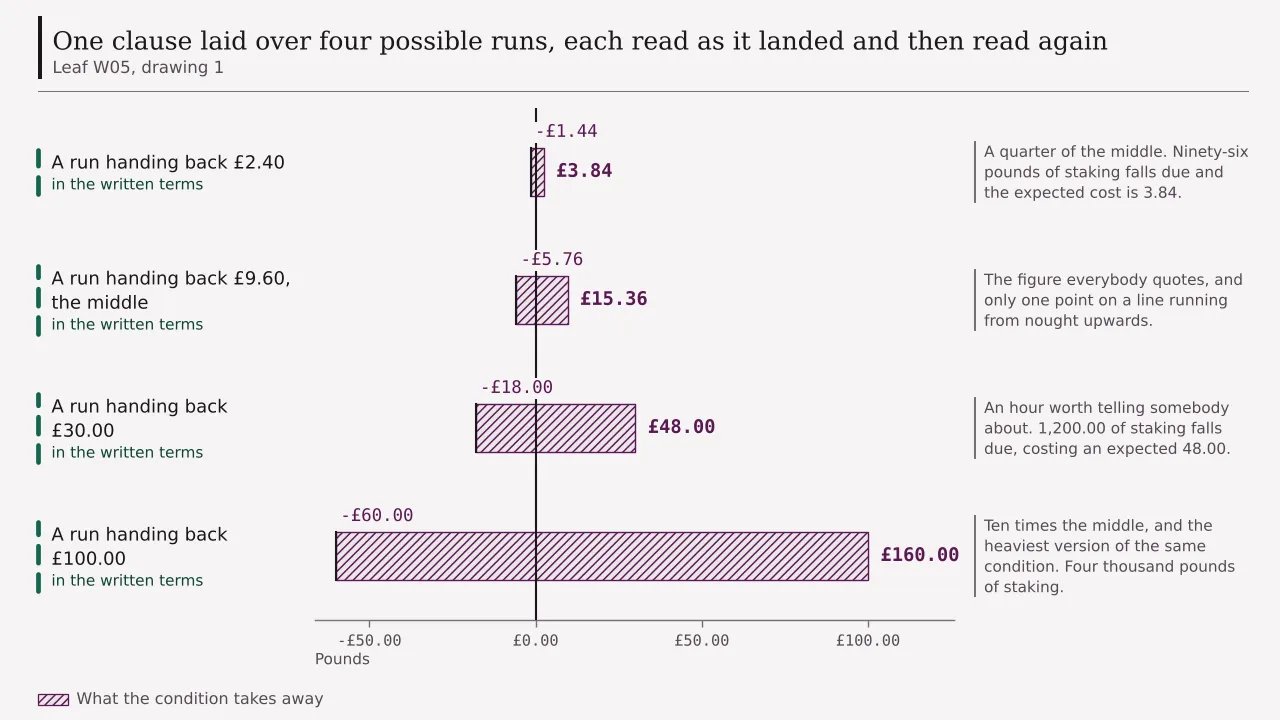
The bars widen as they go down the sheet and that widening is the whole finding. A condition with a fixed figure would draw the same cut on every row. This one draws a cut proportional to the bar, so the gap a reader is agreeing to grows with the only thing they were hoping for.
4
What an hour that goes well ends up owing
Take the row at £30.00, which is a good but unremarkable hour on a hundred presses. Three times the middle of the spread is not a story anybody tells, and on a build with any spread at all it happens often enough to be ordinary. Here is what it costs.
What a £30.00 run hands back £30.00 What the same clause leaves of it minus £18.00 What the good hour costs to collect £48.00
Forty-eight pounds arrives from either direction without sharing a step. Forty lots of £30.00 is £1,200.00 of staking, and four pence held back on each pound of that is £48.00. Or take the head of the block and remove the foot, £30.00 less minus £18.00, which produces £48.00 a second time. They agree because the condition has exactly one effect, and it works at a fixed rate.
Set that beside the £10.00 payment. A reader who sent a tenner and had a good hour is looking at £48.00 of expected cost to turn the result into money, which is nearly five payments. Nothing has gone wrong, nobody has broken a term, and the figure is entirely a consequence of the run having been good.
Push it once more. A hundred pounds off a hundred presses is the sort of result a reader would describe as the arrangement having worked. Four thousand pounds then has to cross the reels, the expected cost of which is £160.00, leaving an expected close of minus £60.00. The best outcome in the table produces the largest bill in the table.
A ceiling over what bonus money may pay out usually sits in the same document, and it bites only here, in the branch where the hour went well. Pricing one would take a figure, and nothing this site can cite sets a usual ceiling, so this page names the clause and refuses to invent a number for it.
5
What an hour that goes badly owes, which is next to nothing
The other end of the table deserves equal time, because it is where most readers land and it is genuinely mild. A run of £2.40 off a hundred presses owes £96.00 of staking, costs an expected £3.84 to work off, and closes at minus £1.44. A run of nothing owes nothing at all.
So the condition is not uniformly harsh. It is harsh in proportion, which is a different thing and produces a distribution of outcomes rather than a single verdict. Most readers meet a small version of it, some meet a middling one, and the few who have the hour they were hoping for meet the largest version there is.
That shape is worth naming plainly, because it explains why a clause of this build survives contact with readers. Almost nobody who meets it is badly hurt by it. The people it costs most are the people who had the best time, and they are in no mood to complain about a bill arriving on top of a win.
The middle of the spread, read alone £9.60 The middle after a forty times condition minus £5.76 The gap at one point on a sliding line £15.36
Fifteen pounds thirty-six is the figure that would be quoted if somebody insisted on one number for this arrangement, and the caption on the bottom row says why it should not be. It is a reading at a single point, and the line it sits on runs from nought to as far as a good run reaches. Quoting it as the answer discards the shape that this page exists to draw.
There is also a shortening of the bad branch worth knowing. Where the presses hand back very little, the balance is usually too small for a withdrawal floor met at the cashier, so the clause and the exit agree for once: nothing was ever going to come out. The condition costs that reader nothing because there was nothing for it to act on.
6
The single property of the clause readable beforehand
If the size cannot be read in advance, something must be, or the document would be pointless. One thing can, and it is the sign. Whether a reader expects to keep any of the winnings at all is fixed by the multiple, and the multiple is printed.
The arithmetic is one line. Each pound crossing the reels leaves four pence behind, so a multiple of W takes four hundredths of W of the winnings. That reaches a whole at W of twenty-five. Below twenty-five a positive share survives, at twenty-five none does, and above twenty-five the clause expects more than the winnings contain.
Forty is sixty per cent past that point, so the expected share is minus six tenths at every outcome. The sign never varies with the run. A £2.40 hour and a £100.00 hour both close at six tenths of themselves in the wrong direction, and the only thing the run changes is how many pounds six tenths amounts to.
That gives a reader exactly one thing to check before agreeing, and it takes a glance. Compare the multiple with twenty-five. Under it, the condition shrinks a win. At or over it, the condition is expected to consume the win and then keep going. Nothing else in the document can be converted into a figure before the presses have run.
Twenty-five is arithmetic rather than market practice, and it moves with the rate of return rather than with anything a business decides. At a lower rate of return it falls, at a higher one it rises, and at the ninety-six in the hundred carried here it sits exactly at twenty-five. Any page on this site that needs the turning point is reaching for the same division.
The honest instruction is narrow, and this page offers no second one. Find the multiple, which is a single click into a second document. Hold it against twenty-five. That single comparison settles the direction of everything else, and no amount of reading settles the amount.
7
Reading a condition before agreeing to it, and what that is worth here
Advice about bonus offers reduces, almost everywhere, to the instruction to read the terms first. The instruction is sound and this page does not argue with it. What this page argues is that on a condition of this build, reading is necessary and is not sufficient, and the gap between those two words is where the money sits.
A reader who opens the document and reads it carefully knows four things. They know the multiple is forty. They know it attaches to the winnings rather than to the payment. They know the window, if one is written. They know whether a ceiling sits over the bonus balance. Every one of those is a fact and none of them is a sum.
What they cannot know is the thing a person normally means by knowing what they have agreed to, which is how much. The quantity the clause will demand of them is forty times a figure that does not exist at the moment of agreement, and it will not exist until they have finished the hundred presses the agreement was about.
That is an unusual kind of term and it is worth being precise about why. A contract term whose amount depends on a future event is ordinary enough: an interest rate does that, and so does a usage charge. What is unusual here is the direction. The amount owed rises with the outcome the reader wanted, so the term is at its heaviest in precisely the branch the reader was aiming at.
It also puts a cost on a piece of standard advice. A reader told to compare the wagering requirements of two arrangements is being told to compare two multipliers, and multipliers only rank if the quantities they multiply are alike. Where one arrangement hands a reader a hundred presses and another hands them a credit of a stated size, the multipliers are acting on objects of different kinds and the comparison is not what it appears to be.
The practical upshot is a change of question. Instead of asking what the condition will cost, which has no answer before the presses run, ask what it will cost for each pound the presses return. That question does have an answer, it is the same answer for everybody, and on this arrangement the answer is forty pounds of staking and an expected sixteen pence of cost for each pound handed back.
8
Rules that hold two piles of money apart
Part one split the account into a payment and a set of winnings, and three published British duties act on exactly that split. Each is picked here because it bears on this page’s own two piles rather than on bonus offers at large, and beyond a British licence not one of them reaches anybody.
The first guards the tenner. A licensee is forbidden to impose any maximum whatever on what leaves a deposit balance. The regulator has gone on to publish a model of the wording it will not allow, which caps a day and then caps a week. Bonus winnings are a separate object, and that bar does not stretch across to them. The upshot is tidy and uncomfortable: of the two piles here, the £10.00 is covered and the £9.60 is not, which is the split part one made, reached a second time from a rulebook.
The second asks whether the tenner is still there to guard. Under licence condition 4.2.1, a licensee sitting on customer money has to set out in writing, ahead of any of it being gambled, how that money would fare if the business went under, placing itself on one of the regulator’s four levels and taking an acknowledgement for the answer. The lowest two levels both open with the words not protected. Pick either, and a paragraph that took effect on 31 October 2025 adds a reminder twice a year, carrying the sum then held and needing a fresh acknowledgement before play resumes.
That paragraph earns its place on this page through the length of the obligation. £384.00 worked off ten pence at a time is a great many presses, nobody completes it in an evening, and a reader working off a middling run therefore has money lodged elsewhere for weeks. Twice a year is the only published rhythm at which anybody is obliged to write down what is being held and on what footing, so the slower the staking, the more that rhythm is worth.
The third governs the moment of departure, which a reader reaches on the way out and never sooner. Where a withdrawal has already been requested, no licensed system may hand the customer a route to taking that request back, and the guidance beside the same requirement wants leaving made as smooth as it can be, with the money already requested kept out of reach as a stake. Where an obligation grows with the hour, that rule is worth more than it reads. The better the run, the larger the staking still outstanding, so a path from the exit straight back into play lands at precisely the moment the heaviest version of the condition exists.
A hundred presses sold alongside a tenner is advertised by businesses holding no Great Britain licence whatever, and where a condition is sized by an outcome the duties worth naming are whichever ones act on the two piles rather than on the advertisement. Lose the first and nothing stops a maximum being written over the pile the reader paid in, as well as over the pile the clause already governs. Lose the second and nobody must set down how money lodged for weeks would fare in a collapse, nor repeat it twice a year while the staking is worked off. Lose the third and a balance may be offered back as a stake at the single moment a good hour has produced the heaviest obligation available. Not one of them improves a run. Between them they settle what becomes of a run that went well.
A concession, as elsewhere here. An offshore rulebook consulted for this build does want bonus conditions put clearly and does forbid promotion aimed at excessive play, so the position is not a blank sheet. It holds nothing answering to the deposit-balance protection, nothing about declaring how lodged money would fare in a collapse, and nothing keeping a requested withdrawal from being offered back as a stake.
9
Turning any play-through condition into a rate card
The method here replaces a single figure with three, and the three are stable while the figure is not. Write down the multiple. Divide the rate of return into a margin per pound. Then produce the rate card: staking owed for each pound returned, expected cost for each pound returned, and the share of the return that survives.
On this arrangement that gives forty pounds of staking, sixteen pence of expected cost, and minus six tenths of whatever came back. Those three travel with the clause rather than with the run, so they are true before any press has been made and stay true afterwards. A reader who carries them has everything the document can honestly give them.
Then, and only then, pick outcomes and multiply. Choose the middle, choose a quarter of the middle, choose three times the middle, and print all three rather than one. Printing one is what turns a function into a figure, and a figure is what nobody is actually agreeing to when they accept a multiplier.
Two habits hold this together. Flag the press value as supposed rather than read, in whichever sentence spends it, since that quantity is what turns a tally of events into pounds and nothing published pins it down. And keep the payment and the winnings in separate columns from the first line, because the moment they are added the question of which pile a term sits over becomes unanswerable.
Run on this page’s own arrangement the method yields a short list and stops: £10.00 paid, £10.00 of stake committed, a middle outcome of £9.60, a rate of forty pounds of staking for each pound returned, and a surviving share of minus six tenths whatever happens. One of those is on the banner, one is in a second document, and the rest are consequences.
The conclusion that matters is the narrow one. A condition attached to winnings cannot be priced before the winnings exist, so a reader cannot know the size of what they are agreeing to however carefully they read. What they can establish in a glance is whether the condition expects to take more than the winnings hold, and on anything at or above twenty-five times it does.
Questions
- Deposit 10 get 100 free spins: what is it worth once the wagering applies?
- At the middle of the spread it is worth minus £5.76. A hundred presses at the 10p supposed here commit £10.00 of stake and hand back an expected £9.60 at the rate of return carried across this site. Forty times that is £384.00 of staking, which costs an expected £15.36 at four pence held back on each pound, leaving an expected close of minus £5.76 and a gap of £15.36 between the two readings.
- Why can the wagering requirement not be stated as a sum of money?
- Because it is written over the winnings rather than over the payment, and the winnings do not exist when the agreement is made. Call the outcome X and the staking owed is forty X, the expected cost of working it off is 1.6 X, and what survives is six tenths of X with the sign turned over. Those are exact statements and none of them is a sum. A figure appears only once somebody picks an X, and the clause declines to pick one.
- Does a better run mean owing more?
- Yes, and exactly in proportion. A run handing back £2.40 owes £96.00 of staking. The middle of the spread, £9.60, owes £384.00. A £30.00 hour owes £1,200.00 and a £100.00 hour owes £4,000.00. Against a payment of £10.00 that is staking running from nought to four hundred times what was paid, across outcomes nothing rules out, and the heaviest version of the condition arrives in the branch the reader was hoping for.
- What happens if the free spins return nothing?
- Nothing is owed. Where the presses hand back no winnings there is no balance for the multiplier to act on, so the staking owed is nothing, the cost of working it off is nothing, and the close is nothing. That reader has lost the £10.00 they chose to spend and walked into no obligation at all, which makes the top row of the table the kindest line in it.
- What does a thirty pound win on a hundred spins actually cost to collect?
- £48.00 in expectation. Forty lots of £30.00 is £1,200.00 of staking, and four pence held back on each pound of that comes to £48.00, so the expected close is minus £18.00. The same £48.00 appears by subtracting the two readings, £30.00 less minus £18.00, which is a check rather than a coincidence. Against a £10.00 payment that is nearly five payments of expected cost, produced entirely by the hour having gone well.
- Can anything about the clause be known before agreeing to it?
- One thing: the sign. Each pound crossing the reels leaves four pence behind, so a multiple of W takes four hundredths of W of the winnings, which reaches a whole at twenty-five. Under twenty-five a positive share survives. At it, none does. Over it, the condition expects more than the winnings hold. Forty sits sixty per cent beyond that point, so the expected share is minus six tenths at every outcome and the run changes only how many pounds that is.
- Is reading the terms enough on an offer like this?
- Reading is necessary and it is not sufficient, and the gap between those two words is where the money sits. A careful reader learns the multiple, which pile it attaches to, the window if one is written, and whether a ceiling sits over the bonus balance. Every one of those is a fact and none is a sum. How much they have agreed to is forty times a figure that does not exist until the hundred presses have been used.
- Which pile of money does a bonus condition usually attach to?
- Here, the winnings. The £10.00 that came out of a bank is a deposit balance and sits where it was put, chosen by the reader with full knowledge of the figure. Whatever the presses produce is a different object, unknown at the moment of agreement, and that is what the multiplier acts on. Every term written over the payment has a size the reader fixed, and every term written over the winnings has a size the reels fix.
- Does a British licence protect the deposit as well as the winnings?
- It guards them differently, which is the point. A licensee is forbidden to impose any maximum whatever on what leaves a deposit balance. The regulator has gone on to publish a model of the wording it will not allow, which caps a day and then caps a week. Bonus winnings are a separate object, and that bar does not stretch across to them. So the £10.00 is covered and the £9.60 is not, which is the split the account already makes, reached a second time from a rulebook.
- What is the six-monthly reminder about customer funds?
- Under licence condition 4.2.1 a licensee sitting on customer money has to set out in writing, ahead of any of it being gambled, how that money would fare if the business went under, placing itself on one of the regulator’s four levels and taking an acknowledgement for the answer. The lowest two levels both open with the words not protected. Pick either, and a paragraph that took effect on 31 October 2025 adds a reminder twice a year, carrying the sum then held and needing a fresh acknowledgement before play resumes. On a condition taking weeks to work off, that is the only published rhythm obliging anybody to write down what is being held.
- What protections disappear when the clause is sized by a run and nobody is licensed here?
- Three that act on the two piles. A hundred presses sold alongside a tenner is advertised by businesses holding no Great Britain licence whatever. Lose the first duty and nothing stops a maximum being written over the pile the reader paid in, as well as over the pile the clause already governs. Lose the second and nobody must set down how money lodged for weeks would fare in a collapse, nor repeat it twice a year while the staking is worked off. Lose the third and a balance may be offered back as a stake at the single moment a good hour has produced the heaviest obligation available. An offshore rulebook consulted for this build does want conditions put clearly and does forbid promotion aimed at excessive play, and holds nothing answering to those three.
- How should a wagering clause be written down if not as a single figure?
- As a rate card of three entries that travel with the clause instead of with the run. Staking owed for each pound returned, which here is forty pounds. Expected cost for each pound returned, which here is sixteen pence. And the share of the return that survives, which here is minus six tenths. Then pick several outcomes and multiply, printing the middle, a quarter of the middle and three times the middle rather than one of them. Printing one turns a function into a figure, and a figure is not what anybody agreed to.