Terms read 19 October 2026 Leaf T02, revision 1
What no wagering strikes out of the written terms, and what it leaves standing
Fifty presses at 10p turn over £5.00 and are expected to hand back £4.80. A forty-times line written over that £4.80 would ask for £192.00 across the reels and close at an expected minus £2.88, so two words on a banner are worth £7.68. Thirteen further lines sit in the identical document untouched by them, and between them they reach every penny of the £4.80.
Stated on the banner £4.80 A count of fifty, a price of nothing, and an absence asserted about a document the banner does not open. Stated, once you go and look £7.68 What the struck line was worth, worked at forty times where each staked pound hands back 96 pence. Not stated before the money goes in 6 settings The price of a press, the build it runs on, that build’s contribution rate, the smallest sum a till will release, the paperwork wanted at the exit, and when a discretion gets used.
Spin offers advertising no play-through, terms read
Every destination in this file is bought advertising. The site is paid a fee if a reader goes on to register, and no figure printed below moves because of it.
Bonus Spins UK Slip 01
Betportal
Ceiling as a multiple
The drop
€15.00
€1.00 in the euro
The claim reads €15.00. Once the terms beside it have applied, €0.00 of it can leave. The difference is the drop.
7 of the 15 terms on this slip could not be read before the money went in
Spins priced at this site's own 10p a spin, which the operator does not publish
Stated
€15.00
The claim as it is printed, before a single term has been applied to it.
Headline paid as spins
150 spins at 10c each, which is €15.00 of the figure above.
6 Nowhere
What one spin is worth
No unit is published for a spin, so the count is priced at this site's own 10p a spin. At half that price every figure below halves with it.
Match and other credit not priced
300% of three deposits, to a ceiling of €1,000. A share of a deposit nobody has made yet is not a sum, so no figure stands on this line and none is carried below.
Qualified
-€14.40
Written down somewhere, and taking part of the claim back. Each term carries the place it is written and the sum it takes.
2 Written terms at a distance this record does not establish
Play-through -€14.40
Carrying €14.40 through 35 times stakes €504.00 and costs €20.16 of it at 96 per cent return. That prices above the €14.40 there is to charge it against, so the whole of the credit goes and the line is held at that. The multiple sits on the bonus.
2 Written terms at a distance this record does not establish
Game weighting not priced
Slots only count towards the play-through. No contribution percentage is published, so the line above has been worked at full weight, which is the kindest reading there is.
2 Written terms at a distance this record does not establish
Ceiling on the winnings not priced
5x the bonus.
2 Written terms at a distance this record does not establish
Clock on the credit not priced
14 days.
2 Written terms at a distance this record does not establish
Largest stake while it runs not priced
€5.
3 Public record
Licence, and who holds it not priced
Licensed in Anjouan, Comoros, held by BetPortal Gaming Ltd, with Excite Ultra Media Ltd, reference ALSI-202601040-FI2. A register entry settles who holds a licence and what it permits. It does not settle who is running the site this morning.
4 Cashier
Smallest qualifying deposit your money
€20 a stage. That is €20.00 of your own money, and it is never netted into a drop.
5 On the way out
Checks before a withdrawal not priced
Documents before the first withdrawal.
Unstated
-€0.60
Applying without having been published anywhere, and costing money all the same.
6 Nowhere
What a spin hands back -€0.60
Staking a spin returns 96 per cent of it, so that share of the batch is the house's before a reel turns. This site works at that return and the operator publishes none where the claim is made.
6 Nowhere
Forfeited by rule cost unknown
Nothing is published under this heading, and it applies regardless.
6 Nowhere
Charge on the way out cost unknown
No charge on the way out is published as a figure, so nothing comes off this line. A charge that exists unpublished would come straight off whatever survives.
6 Nowhere
Smallest withdrawal allowed cost unknown
No smallest withdrawal is published as a figure. A floor nobody has published is still a floor, and it decides whether a small balance can move at all.
No Great Britain licence
Terms read 19 October 2026
Bonus Spins UK Slip 02
WinBeast
Ceiling as a sum
The drop
€50.00
€1.00 in the euro
The claim reads €50.00. Once the terms beside it have applied, €0.00 of it can leave. The difference is the drop.
8 of the 15 terms on this slip could not be read before the money went in
Spins priced at this site's own 10p a spin, which the operator does not publish
Stated
€50.00
The claim as it is printed, before a single term has been applied to it.
Headline paid as spins
500 spins at 10c each, which is €50.00 of the figure above.
6 Nowhere
What one spin is worth
No unit is published for a spin, so the count is priced at this site's own 10p a spin. At half that price every figure below halves with it.
Match and other credit not priced
50% to 100% of five deposits, each to a ceiling of €1,000, and a €650 free bet. A share of a deposit nobody has made yet is not a sum, so no figure stands on this line and none is carried below.
Qualified
-€48.00
Written down somewhere, and taking part of the claim back. Each term carries the place it is written and the sum it takes.
2 Written terms at a distance this record does not establish
Play-through -€48.00
Carrying €48.00 through 40 times stakes €1,920.00 and costs €76.80 of it at 96 per cent return. That prices above the €48.00 there is to charge it against, so the whole of the credit goes and the line is held at that. The multiple sits on the bonus and the winnings from the spins.
2 Written terms at a distance this record does not establish
Game weighting not priced
Slots, titles vary by country count towards the play-through. No contribution percentage is published, so the line above has been worked at full weight, which is the kindest reading there is.
2 Written terms at a distance this record does not establish
Ceiling on the winnings not priced
€100 a batch of spins.
2 Written terms at a distance this record does not establish
Clock on the credit not priced
7 days, spins 1 day.
3 Public record
Licence, and who holds it not priced
Licensed in Curaçao, holder not named on the site. A register entry settles who holds a licence and what it permits. It does not settle who is running the site this morning.
4 Cashier
Smallest qualifying deposit your money
€20 a stage. That is €20.00 of your own money, and it is never netted into a drop.
5 On the way out
Checks before a withdrawal not priced
Documents before the first withdrawal.
Unstated
-€2.00
Applying without having been published anywhere, and costing money all the same.
6 Nowhere
What a spin hands back -€2.00
Staking a spin returns 96 per cent of it, so that share of the batch is the house's before a reel turns. This site works at that return and the operator publishes none where the claim is made.
6 Nowhere
Largest stake while it runs cost unknown
Nothing is published under this heading, and it applies regardless.
6 Nowhere
Forfeited by rule cost unknown
Nothing is published under this heading, and it applies regardless.
6 Nowhere
Charge on the way out cost unknown
No charge on the way out is published as a figure, so nothing comes off this line. A charge that exists unpublished would come straight off whatever survives.
6 Nowhere
Smallest withdrawal allowed cost unknown
No smallest withdrawal is published as a figure. A floor nobody has published is still a floor, and it decides whether a small balance can move at all.
No Great Britain licence
Terms read 19 October 2026
Bonus Spins UK Slip 03
EliteSpin
Longest spin window
The drop
£50.00
£1.00 in the pound
The claim reads £50.00. Once the terms beside it have applied, £0.00 of it can leave. The difference is the drop.
8 of the 15 terms on this slip could not be read before the money went in
Spins priced at this site's own 10p a spin, which the operator does not publish
Stated
£50.00
The claim as it is printed, before a single term has been applied to it.
Headline paid as spins
500 spins at 10p each, which is £50.00 of the figure above.
6 Nowhere
What one spin is worth
No unit is published for a spin, so the count is priced at this site's own 10p a spin. At half that price every figure below halves with it.
Match and other credit not priced
50% to 100% of five deposits, each to a ceiling of £1,000. A share of a deposit nobody has made yet is not a sum, so no figure stands on this line and none is carried below.
Qualified
-£48.00
Written down somewhere, and taking part of the claim back. Each term carries the place it is written and the sum it takes.
2 Written terms at a distance this record does not establish
Play-through -£48.00
Carrying £48.00 through 40 times stakes £1,920.00 and costs £76.80 of it at 96 per cent return. That prices above the £48.00 there is to charge it against, so the whole of the credit goes and the line is held at that. The multiple sits on the bonus and the winnings from the spins.
2 Written terms at a distance this record does not establish
Game weighting not priced
Slots count towards the play-through. No contribution percentage is published, so the line above has been worked at full weight, which is the kindest reading there is.
2 Written terms at a distance this record does not establish
Ceiling on the winnings not priced
5x the bonus.
2 Written terms at a distance this record does not establish
Clock on the credit not priced
7 days, spins 3 days.
3 Public record
Licence, and who holds it not priced
Licensed in Costa Rica, held by PrimeTier Limited. A register entry settles who holds a licence and what it permits. It does not settle who is running the site this morning.
4 Cashier
Smallest qualifying deposit your money
£20 a stage. That is £20.00 of your own money, and it is never netted into a drop.
5 On the way out
Checks before a withdrawal not priced
Documents before the first withdrawal.
Unstated
-£2.00
Applying without having been published anywhere, and costing money all the same.
6 Nowhere
What a spin hands back -£2.00
Staking a spin returns 96 per cent of it, so that share of the batch is the house's before a reel turns. This site works at that return and the operator publishes none where the claim is made.
6 Nowhere
Largest stake while it runs cost unknown
Nothing is published under this heading, and it applies regardless.
6 Nowhere
Forfeited by rule cost unknown
Nothing is published under this heading, and it applies regardless.
6 Nowhere
Charge on the way out cost unknown
No charge on the way out is published as a figure, so nothing comes off this line. A charge that exists unpublished would come straight off whatever survives.
6 Nowhere
Smallest withdrawal allowed cost unknown
No smallest withdrawal is published as a figure. A floor nobody has published is still a floor, and it decides whether a small balance can move at all.
No Great Britain licence
Terms read 19 October 2026
Bonus Spins UK Slip 04
Crown Jewelz
Multiple unpublished
The drop
NOT WORKED
The multiple is not published in the operator's own terms. Since the sum cannot be worked around it, none is worked.
9 of the 14 terms on this slip could not be read before the money went in
No drop worked
Stated
£15.00
The claim as it is printed, before a single term has been applied to it.
Headline paid as spins
150 spins at 10p each, which is £15.00 of the figure above.
6 Nowhere
What one spin is worth
No unit is published for a spin, so the count is priced at this site's own 10p a spin. At half that price every figure below halves with it.
Match and other credit not priced
200% of the first deposit, then 150% twice, each to a ceiling of £1,000. A share of a deposit nobody has made yet is not a sum, so no figure stands on this line and none is carried below.
Qualified
NOT WORKED
Written down somewhere, and taking part of the claim back. Each term carries the place it is written and the sum it takes.
2 Written terms at a distance this record does not establish
Play-through not priced
40x the bonus, reported rather than published by the operator.
2 Written terms at a distance this record does not establish
Game weighting not priced
Slots count towards the play-through. No contribution percentage is published, so the line above has been worked at full weight, which is the kindest reading there is.
3 Public record
Licence, and who holds it not priced
Licensed in Curaçao, number not verified, holder not named on the site. A register entry settles who holds a licence and what it permits. It does not settle who is running the site this morning.
4 Cashier
Smallest qualifying deposit your money
£20. That is £20.00 of your own money, and it is never netted into a drop.
5 On the way out
Checks before a withdrawal not priced
Documents before the first withdrawal.
Unstated
NOT WORKED
Applying without having been published anywhere, and costing money all the same.
6 Nowhere
Ceiling on the winnings cost unknown
No ceiling is published. Nothing is assumed in its place.
6 Nowhere
Clock on the credit cost unknown
Nothing is published under this heading, and it applies regardless.
6 Nowhere
Largest stake while it runs cost unknown
Nothing is published under this heading, and it applies regardless.
6 Nowhere
Forfeited by rule cost unknown
Nothing is published under this heading, and it applies regardless.
6 Nowhere
Charge on the way out cost unknown
No charge on the way out is published as a figure, so nothing comes off this line. A charge that exists unpublished would come straight off whatever survives.
6 Nowhere
Smallest withdrawal allowed cost unknown
No smallest withdrawal is published as a figure. A floor nobody has published is still a floor, and it decides whether a small balance can move at all.
No Great Britain licence
Terms read 19 October 2026
Every figure in the second and third columns is this site's own working and nothing an operator has published. A claim is priced as printed, then the share a spin hands back at 96 per cent return comes off it, then what playing the multiple through costs at the same return, and then whatever a published ceiling, a charge on the way out or a floor on the smallest withdrawal takes from what has survived. The drop is the difference between the first figure and the last. The two columns add back up to it exactly, so no money leaves a slip without a term and a place beside it.
Which column a term falls in is settled by one question: has anybody written it down. A charge a reader meets at the payment screen is written down, and it stands in the second column with the cashier against it. A condition that binds without ever having been set down stands in the third, whatever it costs. Inside each column the terms run outwards from the banner, so the order itself says how far a reader would have had to go.
A count of spins has no unit until one is supplied. Where an operator publishes what one of its own spins is worth, that figure is used and the first column says it is theirs. Where none is published, this site's own 10p a spin stands in its place and every figure below moves in proportion with it. Where the multiple itself is unpublished, no drop is worked at all, because that is the one figure the sum cannot be done without.
Three words stand where a figure cannot. Not priced is a term that is written down and carries no number the arithmetic can take. Cost unknown is a term nobody has written down, costing something nobody has put a number on. Your money is money of the reader's own, which is never netted into a drop.
None of the operators in this file holds a Great Britain licence, so none of the duties that licence carries reaches them. Each of those duties is published in its own right, which is what makes its absence here something a reader can check rather than take on trust. Every gambling company licensed in Great Britain belongs to Gamstop Online, so a reader who has shut themselves out through the scheme is not shut out here. Social Responsibility Code 5.1.1 has held a play-through to a maximum of ten times the bonus funds since 19 January 2026, and it binds a licence holder and nobody else. Asked in a post of 21 October 2025 what is lost along with the licence, the Gambling Commission's Director of Enforcement and Intelligence answered: "unfair gaming practices, financial loss, and a lack of recourse if things go wrong". The same post puts blocked payouts, and withdrawal limits pitched high enough to be unreachable, among the behaviour the Commission has recorded. Nobody under 18 may hold an account at any of them.
Terms are reproduced in the wording their operator published, and each slip is dated with the day somebody sat down and read them. 19 October 2026 is the oldest of those dates. Anybody claiming an offer is bound by that operator's full terms, which are elsewhere, and never by a line standing here.
1
A claim about what a document does not say
Most things printed beside an offer are claims about the world. A count of fifty is a claim about how many presses arrive. A price of nothing is a claim about what leaves a bank account. Both can be checked by reading the thing that states them, which is why they get printed.
Two words set beside them are a claim of a completely different sort. They assert that a particular sentence is missing from a document the reader has not opened. Nothing on the banner can establish that, because an absence is settled by opening the document and failing to find something, and failing to find something takes longer than finding it. The claim is checkable, and it is checkable only at the far end of a document written for a different purpose.
So the sorting starts in an unusual place. The count of fifty is settled . The price of a single press is nowhere in writing on offers at this end of the market, and this leaf uses the 10p it assumes throughout rather than any figure anybody publishes. Whether a play-through line exists is settled in the written conditions, and the banner’s contribution is to state the answer in advance.
Run the two settled figures together and the offer at face is quickly done. Fifty presses at 10p push £5.00 over the reels. At the 96 per cent this leaf works to, £5.00 of turnover is expected to hand back £4.80, and £4.80 is therefore the sum any arithmetic on this offer has to start from. It is not a balance anybody is handed. It is what the presses are expected to leave behind once they have all been made.
Everything after this part concerns one question. The banner has told a reader that one sentence is gone. What else is in the document, where does each of those lines sit, and what can each of them do to £4.80. The answer, worked at the end, is that the deletion is real, the saving is real, and the saving is not protected by anything.
A last point of method before the sums. This leaf treats the promotional conditions as a single numbered document, because that is how a reader meets them, and numbers its lines one to fourteen for reference. Those numbers are the leaf’s own device for keeping track and no operator’s numbering is being described. Which document a given line sits in varies, and where it matters the sentence says so.
2
Pricing a sentence that is no longer in the document
Work out what the missing line would have cost and the two words acquire a price. The usual drafting puts a multiple on the winnings from promotional presses rather than on a credit, since no credit was handed over. Forty times is the figure this leaf applies, and it applies it because that is the multiple written where offers of this shape are written, not because any source publishes a market average.
Forty times £4.80 asks for £192.00 to cross the reels before the £4.80 may leave. Each pound staked is expected to leave four pence behind, so £192.00 of staking is expected to cost £7.68. Start with £4.80, subtract £7.68, and the arrangement closes at an expected minus £2.88. The house formula lands in the same place. Take the margin of four pence in the pound, multiply by forty, and subtract the product from one: the coefficient is minus 0.6, and minus 0.6 of £4.80 is minus £2.88.
Twenty-five is where that calculation changes sign, a margin of four pence in the pound inverting to exactly that. Any multiple below it leaves something. Any multiple above it has already consumed the winnings and is operating on funds the offer never supplied. Forty sits well past the turn, which is why the struck line is worth more than the winnings it was written over.
Expected from fifty presses, nothing applied £4.80 The same sum under a forty-times line minus £2.88 What two words on the banner are worth £7.68
Seven pounds sixty-eight is a real saving and this leaf is not about to argue otherwise. It is also larger than the £4.80 it protects, which is the first odd thing on this page. A condition can be worth more than the money it is attached to once it pushes a player beyond the place at which those winnings have notionally gone back, because each pound staked after that comes from somewhere else entirely.
The size of the obligation is easier to feel in presses than in pounds. Ten pence a press turns £192.00 into 1,920 separate presses. The British floor on how quickly one game cycle may follow another puts those 1,920 presses at no less than eighty minutes, and eighty minutes with no pause for anything is a long sitting. The struck line asked for roughly thirty-eight times as much pressing as the offer itself provides.
1,920 presses asked of an offer that hands over fifty
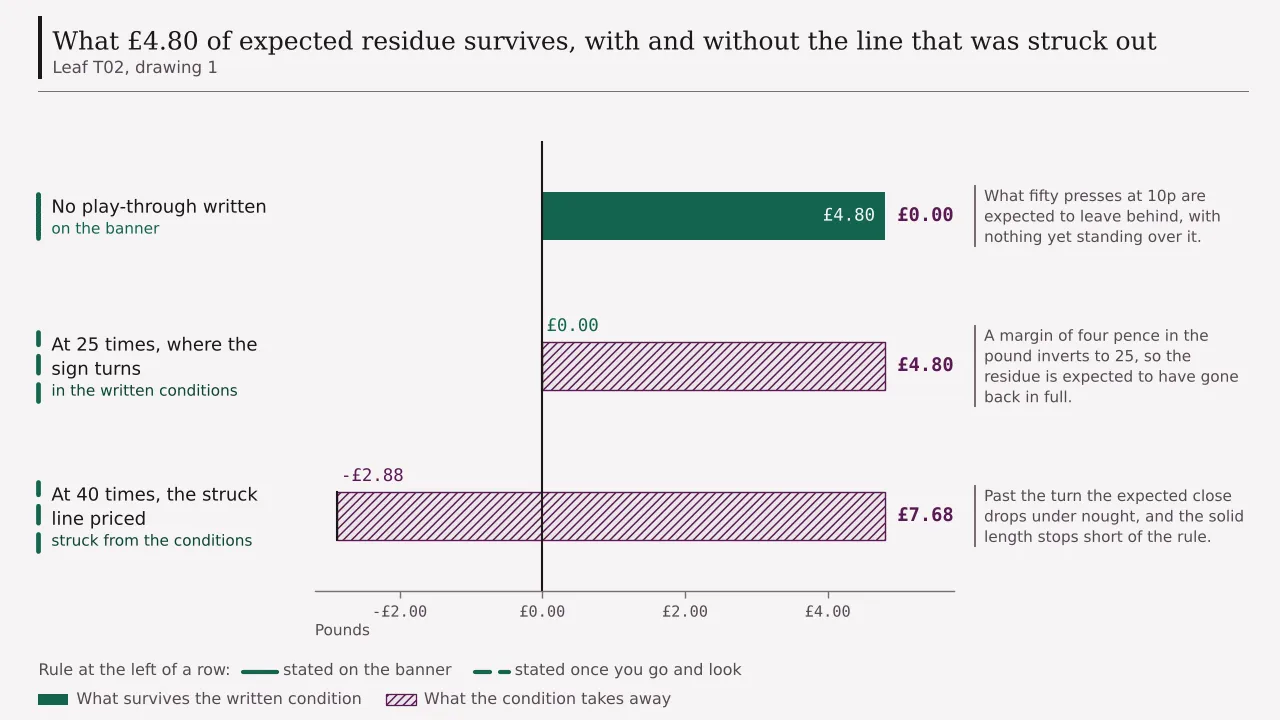
Read the three rows downward and the shape of the saving appears. The top row is the offer the banner describes. The middle row is the same offer at the multiple where a player has handed back exactly what they won. The bottom row is the multiple that recurs in drafting of this shape, and the bar crosses the rule because the expected close has dropped under it.
3
The lines a deletion never reached
Now open the thing and read what remains. A promotional document for presses of this kind runs to a dozen or more separate conditions, and the play-through line is one of them. Striking it does not shorten the others, reword them, or make any of them easier to meet. It removes a line and closes the gap.
Below is the document as this leaf models it, with line six struck out and the rest left exactly as drafted. The last column gives what each line can do to the £4.80 on the arithmetic worked in part two. Where a figure is this leaf’s own illustrative setting rather than anything published, the row says so.
| Line | What it asks | Settled by | Reach on £4.80 |
|---|---|---|---|
| 1 | One registration a person, a household and an instrument | in the written conditions | All of it |
| 2 | The presses claimed inside a stated period of opening an account | in the written conditions | All of it |
| 3 | Presses confined to one build the operator picks | in the written conditions | Decides the 96 per cent |
| 4 | Presses released together or in parts | in the written conditions | Splits the £4.80 |
| 5 | A window on the presses themselves, assumed here at seven days | in the written conditions | Whatever is unused |
| 6 | Struck out: a multiple on the winnings before they may leave | struck from the conditions | £7.68, now forgone |
| 7 | A separate window on the winnings once credited, assumed at 24 hours | in the written conditions | All of it |
| 8 | A ceiling over what those winnings may pay | in the written conditions | Only a large win |
| 9 | A ceiling on a single stake while promotional money is live | in the account agreement | All of it, on breach |
| 10 | Which lobby the winnings may be spent in before release | in the account agreement | Narrows the choice |
| 11 | A discretion to withhold a balance or shut an account | in the account agreement | All of it, at will |
| 12 | The smallest sum a till will send out | at the cashier | All of it, if unmet |
| 13 | Documents wanted before a payment is released | on the way out | Holds it, not takes it |
| 14 | What the chosen build contributes towards anything counted | nowhere in writing | Multiplies any obligation |
Count the rows whose last column reads that the whole £4.80 can go and the answer is seven. Count the rows the banner says anything about and the answer is one, and it is the struck one. That ratio is the finding of this leaf stated as plainly as it can be stated: the advertisement reports on 7.1 per cent of the document by line count, and reports its absence rather than its contents.
Three of those rows deserve pointing at rather than working here, since each is taken apart properly somewhere else in this section. Line four is a release pattern and belongs with the schedule worked at two hundred presses. Line eight is the ceiling, taken to the floor on a hundred presses for five pounds. Line twelve is a payment floor and is the whole subject of the seventy press version of this offer.
What matters here is the arithmetic of the set rather than any single member of it. Seven lines can each take the entire £4.80. They do not add up, because a sum of money can only be taken once, and they do not cancel either. They are seven separate ways for the same £4.80 to come to nothing, and the deletion in line six removed none of them.
4
Reading a deletion by the numbers on either side of it
There is a measurement hiding in that table and it is worth taking out and naming. A deletion has a reach, and that reach is countable in lines of one document. Line six goes. Lines one to five and seven to fourteen stay. The reach is one line, and one line is the whole of it.
That sounds obvious written down and it is not how the phrase is read. A reader meeting two words on a banner takes them as a statement about the document’s character rather than about one of its lines. The inference runs: a house that has given up its play-through has given up the posture that produces play-throughs, so whatever else is in there will be mild. The document does not work that way. It is a list, not an argument, and striking an item from a list leaves every neighbouring item at exactly the force it had.
Put the two readings side by side as quantities. Under the reading a banner invites, the deletion reaches the document: fourteen lines become mild, and £4.80 is as good as in a bank account. Under the reading the document supports, the deletion reaches one line: £7.68 of obligation goes, and seven separate lines can still take the lot. Between those two readings sits everything this leaf has to say.
| What is being measured | As the banner invites | As the document reads |
|---|---|---|
| Lines the phrase reaches | All fourteen | One |
| Obligation removed | Everything standing in the way | £7.68 |
| Lines that can still take £4.80 | None | Seven |
| What a reader may act on without opening anything | £4.80 | Nothing at all |
One property of this measure is worth keeping, because it carries over to every offer that advertises an absence. The reach of a deletion never grows with the prominence of the advertisement. A phrase set in forty-point type across a banner reaches the same single line as the same phrase set in a footnote. Prominence changes who reads the claim. It cannot change what the claim is about.
The second property is less comfortable. A deletion is the one kind of amendment a reader cannot verify without reading the whole document, since confirming that something is missing means passing over everything that is present. So the effort the claim demands is the maximum the document can impose, and the effort it appears to save is the entire reason anybody clicks.
5
The line that can take £4.80 before a reel moves
Of the seven lines that reach the whole sum, one is settled before a single press happens, which makes it different in kind from the other six. Line one restricts the offer to one registration a person, a household and a payment instrument, and it is tested against records the operator already holds.
Everything else in the document acts on money that exists. Line seven takes a balance that has been won. Line twelve stops a payment that has been requested. Line one acts earlier than any of them: it decides whether the fifty presses were ever owed, and where it is decided against a reader the £4.80 was never on the table. A reader has then spent the time registering, surrendered a name, an address for post and the day they were born, and collected an offer worth nothing.
Three things make that line harder to satisfy than it reads. A household is not a person, so a second adult at the same address can exhaust it without anybody doing anything unusual. A payment instrument is not a person either, and a shared card or wallet seen before is enough. And the test is applied when it suits, which is ordinarily at the point a payment is requested rather than at the point an account is opened, so the finding arrives at the end of the sequence rather than the start.
That last point is a timing fact rather than a fairness one and it prices cleanly. The line is written in the written conditions, so it is stated. It is applied on the way out, so it is met late. Written early, applied late: that pairing is what makes a condition expensive without making it hidden, and nothing in two words on a banner speaks to it.
None of this is a reason to treat the deletion as fictitious. The £7.68 is genuinely not being asked for. It is a reason to notice that the deletion sits in a document whose other lines are indifferent to it, and that the first of them is decided before the offer begins.
6
Two words, three readings, and the one the document supports
The phrase supports three readings and they are worth different sums. Separating them is most of the useful work on this subject, because a reader who has picked the wrong one is not making a small error of degree.
The narrow reading is that no multiple stands over the winnings. That is what the document says and it is worth exactly the £7.68 computed in part two. It is a statement about line six and about nothing else in the document.
The broad reading is that nothing stands between the winnings and a bank account. That is worth £4.80 unconditionally, which is to say it is worth the entire offer, and it is the reading the words invite because that is what the words would mean about any ordinary promise. Lines one, two, five, seven, nine, eleven and twelve each contradict it. So the broad reading is wrong by seven separate sentences, any one of which is sufficient.
The third reading is quieter and concerns what the winnings are. Money credited after a promotional press can be credited as cash or as promotional money subject to the rest of the document, and which of those happens decides whether anything else in the document applies to it at all. No published rule settles that question either way, so a document either answers it or leaves it open, and a reader who wants the answer has to find the sentence that gives it. Two words on a banner do not give it.
The broad reading, taken at face £4.80 What the narrow reading actually secures £0.00 Money the wrong reading puts at stake £4.80
The nought in the middle row is the finding and it is not a slip. Lifting an obligation and securing a sum are separate acts, and the document performs the first without performing any of the second: the £7.68 computed in part two is an obligation that has gone, which is worth having, and it leaves nothing at all standing between the winnings and the seven other lines that reach them. So a reader holding the broad reading has £4.80 riding on a promise the document declines to make, and the figure beneath is what that costs rather than what separates two alternatives.
7
Sentences a British licence would have put in the same document
Spin offers sold on a deleted play-through hold no Great Britain licence. On a leaf about what a document contains, the loss worth setting out is a loss of sentences: three of them would have been written into the same terms document, and each concerns the money rather than the presses.
First sentence. A licensee holding customer money has to set down in its terms whether an insolvency would leave that money protected, to what level, and by what means, on a rating scheme and in a form of words the regulator settles, with the customer acknowledging it in writing before gambling with the funds. Four names are fixed: not protected where there is no segregation; not protected but with segregation of customer funds; medium protection; and high protection. Where the rating is one of the two that start with the words not protected, a reminder goes out every six months stating the sum being held, and that paragraph has bound licensees since 31 October 2025.
Second sentence. A licensed build may not alter its rules, its payout table or its stated probabilities part way through play, and the regulator names the clause that fails the test: wording saying the rules may be changed at any time is not acceptable. Line three of the document hands the operator the choice of build. Under a licence that choice carries a promise about the build’s behaviour. Outside one it carries nothing.
Third sentence. Marketing by electronic means needs informed and specific consent before anything is sent, under the code provision on direct electronic marketing, and since 1 May 2025 that consent has had to be taken one channel and one product type at a time. A registration made for fifty presses is a registration, and what it is worth to whoever collected it is settled by whichever of those sentences is in the document.
A fourth absence belongs in this part although it is not a sentence in any promotional document. Whether a licence stands behind the address somebody has typed is settled in the public register, a record kept by the regulator rather than by the operator. Of everything priced here it is the single entry a reader can settle without the operator’s cooperation. It says nothing whatever about what the terms document contains.
Set those three against the fourteen lines in part three and the asymmetry is plain. The lines that survive the deletion are the operator’s. The sentences that would have been added are the customer’s, and they are the ones that do not appear. A document can be complete, accurate and perfectly legible while containing nothing a reader could ever hold anybody to, and completeness is the quality a deletion claim implicitly asserts.
8
What the deletion secures, worked down to nothing
Part two priced what the deletion removes. This part prices what it protects, which is a different sum and comes out at a surprising place. Take the £4.80 the presses are expected to return and ask what the document still permits to happen to it.
Line one can take it before the presses are made. Line two can take it if an account was opened a week too early. Line five can take whatever is left unused when a window closes. Line seven can take a credited balance that is not moved inside its own window. Line nine can take it on a single stake set too high. Line eleven can take it because somebody decided to. Line twelve can hold it indefinitely by setting a release floor the balance never reaches. Not one of those sentences mentions a play-through, and not one of them was touched.
So the smallest sum this document permits a reader to end with is nothing at all, and the deletion did not raise that floor by a penny. That is not a prediction and it is not the expected outcome. It is the worst case the document allows, and a worst case is exactly the quantity a reader thinks they have bought when they read a promise about what is missing.
Secured by two words, as the banner reads £4.80 Smallest sum the document still permits £0.00 What the deletion fails to protect £4.80
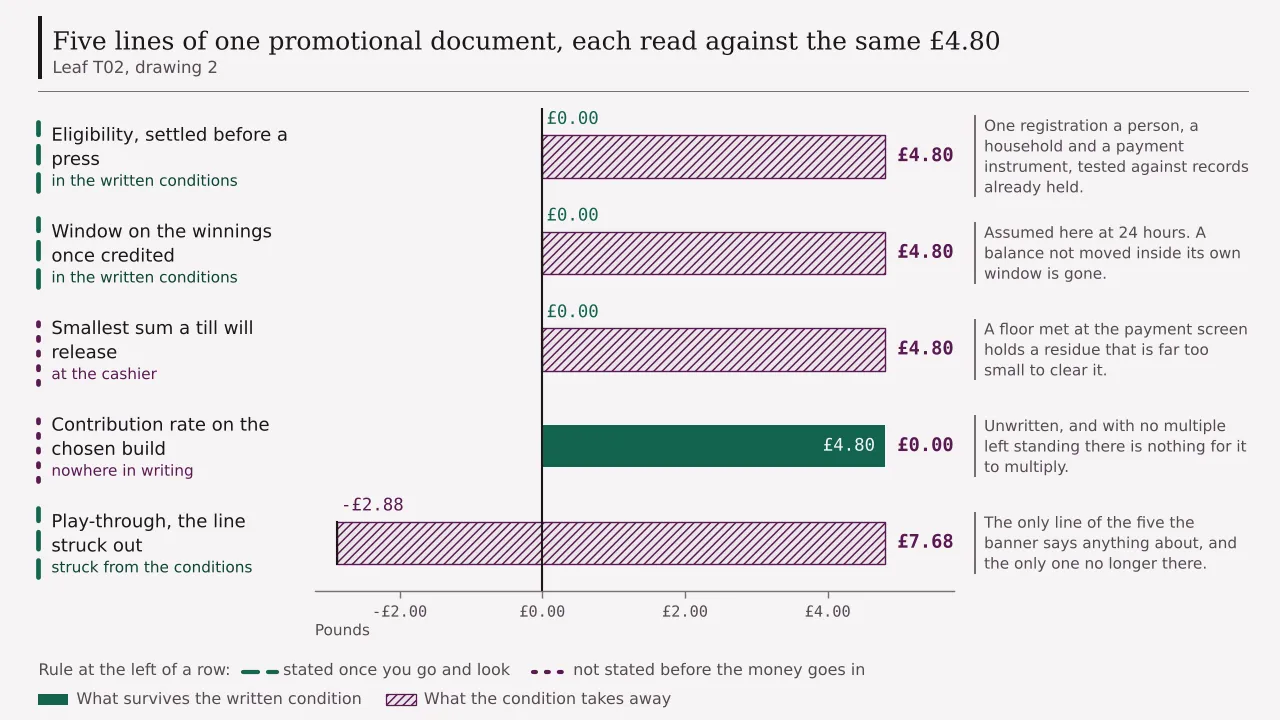
Every bar in that drawing opens at the identical £4.80, and that sameness is the whole of its argument. The faces are the same because the money is the same money. The remainders differ because the lines differ, and the one line with a figure beside it on the banner is the one that is not in the document any more.
Hold the two subtractions together. The first says that a forty-times line would have been worth £7.68 and is not being asked for. The second says that £4.80 is as exposed after the deletion as before it. Both are true, and a reader who takes only the first has paid attention to a genuine saving while missing that the saving is unprotected. That is the precise shape of the error this offer invites.
9
Handling any offer whose selling point is a missing clause
The procedure is short and it transfers to any offer sold on something it does not contain. Three questions, asked in order, each answered from the document rather than from the advertisement.
Which sentence is said to be missing. Write it out in full as it would have read, because a claim about an absence is only as precise as the sentence it denies. A multiple on winnings is one sentence. A multiple on a deposit is another. A requirement to turn over the whole balance once is a third, and a banner saying nothing has to be played through leaves all three of those readings open.
What would that sentence have cost. Here the arithmetic is fixed and takes a minute. Count the presses, multiply by whatever the press is worth, multiply by the return to get the expected winnings, then apply the multiple that offers of this shape usually write. On fifty presses at 10p the chain runs £5.00, £4.80, and minus £2.88 at forty times, for £7.68 of saving.
What else in the document reaches the same money. This is the question nobody asks and it is the one that decides the outcome. Read every line that mentions the winnings, the balance, the account or the payment, and ask of each whether a play-through deletion changes it. The answer is no every time, because a deletion reaches one line.
Applied to this offer the three answers give four figures and nothing else. The presses are worth £5.00 of turnover and an expected £4.80. The struck line was worth £7.68. The document still permits £0.00. And the gap between the £4.80 a reader acts on and the £0.00 the document allows is the whole £4.80, settled across seven sentences none of which is on the banner.
The honest close is narrow and it is not a warning. An offer that deletes a play-through is better than the same offer with one, by £7.68 on these numbers, and that is a real improvement in a market where improvements are rare. It is simply not what it sounds like. It is one sentence lighter, in a document that is otherwise unchanged.
Questions
- What are fifty free spins with no wagering actually worth?
- An expected £4.80. Fifty presses at the 10p this leaf assumes send £5.00 across the reels, and at a 96 per cent return £5.00 of turnover is expected to hand back £4.80. That figure is not a balance anybody is given at the start. It is what the presses are expected to leave behind once all fifty have been made, and it is the sum every other calculation on this leaf is performed against.
- How much does the missing play-through clause save?
- £7.68. A forty-times line written over £4.80 of winnings asks for £192.00 to cross the reels, each pound staked is expected to leave four pence behind, and £192.00 of staking is therefore expected to cost £7.68. The arrangement would close at an expected minus £2.88 rather than at £4.80. The saving is larger than the money it protects because forty sits past 25, the multiple at which a sum of winnings is expected to have gone back over the counter entirely.
- Does no wagering mean the winnings can be withdrawn straight away?
- No. It is a statement about one line of a promotional document and it says nothing about any other. Seven separate lines in the same document can still take the whole £4.80: an eligibility restriction, a claiming period, a window on the presses, a second window on the winnings, a ceiling on a single stake, a discretion to withhold, and a payment floor met at the till. A deletion reaches one line and closes the gap, and the neighbouring lines keep exactly the force they had.
- Where does the wagering clause sit on a spin offer of this shape?
- Inside the terms document rather than beside the headline, which is why a claim about its absence is a claim about writing the reader has not opened. This leaf numbers those conditions one to fourteen for reference and puts the play-through at line six. Lines one to five and seven to fourteen are the ones that survive the deletion. The numbering is this leaf’s own device for keeping track and does not describe anybody’s drafting.
- Which condition on a no wagering spin offer costs the most?
- The eligibility line, because it is the only one decided before a press is made. One registration a person, a household and a payment instrument is tested against records the operator already holds, and where it is decided against a reader the £4.80 was never owed. A household is not a person and a shared payment instrument is not a person either, so the line is harder to satisfy than it reads, and it is normally applied at the point a payment is requested rather than when an account is opened.
- Why is a deletion harder to check than an ordinary condition?
- Because confirming that something is missing means passing over everything that is present. A count or a sum is settled by reading the line that states it. An absence is settled only by reading the whole document and failing to find a sentence, so the effort the claim demands is the largest the document can impose while the effort it appears to save is the reason anybody clicks. Prominence changes who reads the claim and cannot change what the claim is about.
- Can the winnings from a no wagering offer still be promotional money?
- That depends on a sentence in the document and no published rule settles it either way. Money credited after a promotional press can arrive as cash or as promotional money subject to the rest of the document, and which of the two happens decides whether anything else in there applies to it. A document either answers the question or leaves it open. Two words on a banner do not answer it, and a reader who wants the answer has to find the line that gives it.
- What protections are missing on an offer of this kind?
- Three sentences that would have been in the same document. A licensee holding customer money must set down in its terms whether an insolvency would leave that money protected, to what level and by what means, on a rating scheme whose four names are fixed, acknowledged in writing before the funds are gambled, and wherever the rating begins not protected the customer is reminded twice a year of the sum held, a paragraph that began to bite on 31 October 2025. A licensed build may not have its rules, payouts or outcome probabilities changed mid-play, and wording saying the rules may be changed at any time is named as unacceptable. Electronic marketing needs informed and specific consent, taken one channel and one product type at a time since 1 May 2025. A spin offer sold on this phrasing holds no British licence, so not one of the three binds anybody.
- How long would a forty times requirement take to clear on fifty spins?
- At least eighty minutes of uninterrupted pressing. Nineteen hundred and twenty presses are what £192.00 buys at ten pence each, and a build obeying the British floor on how quickly one game cycle may follow another cannot get through that many any faster. The offer provides fifty presses, so the struck line asked for roughly thirty-eight times as much pressing as the offer itself hands over, paid for out of funds it never supplied.
- Is a no wagering offer better than one with a play-through?
- Yes, by £7.68 on these fifty presses, and that is a genuine improvement rather than a trick. It is simply not what the phrase sounds like. The deletion removes an obligation and secures nothing, so the smallest sum the document still permits is £0.00 both before and after it. Reading the saving correctly means holding two figures at once: £7.68 of obligation lifted, and £4.80 still reachable by seven sentences the banner does not mention.