Terms read 19 October 2026 Leaf N08, revision 1
A rate quoted to one decimal place, and the two years of pressing behind it
A published rate of return is a limit, not a measurement. Working at a swing this leaf models rather than reads anywhere, confirming such a figure to the decimal it is printed with takes about 25,000,000 presses, which at the fastest a licensed reel may be pressed is 17,361 hours, or close to two years without stopping. A session of 150 presses carries an uncertainty of roughly 41 percentage points. On the newest build the distance between the printed figure and anything observed is at its widest, and this site observes nothing whatever.
Stated on the banner A release date Whichever week a lobby decides to call a build new, which is a fact about a listing rather than about a build. Stated, once you go and look 96 per cent A theoretical average, derived from a paytable rather than counted from play, and describing a run nobody completes. Not stated before the money goes in £5.36 What an hour costs once pace is applied, against the 40p a reader takes from the rate alone. Pace, cadence and the stake ladder are never printed beside the rate.
Offers tied to recent reel releases, with their terms read
Every destination in this file is bought advertising. The site is paid a fee if a reader goes on to register, and no figure printed below moves because of it.
Bonus Spins UK Slip 01
Betportal
Ceiling as a multiple
The drop
€15.00
€1.00 in the euro
The claim reads €15.00. Once the terms beside it have applied, €0.00 of it can leave. The difference is the drop.
7 of the 15 terms on this slip could not be read before the money went in
Spins priced at this site's own 10p a spin, which the operator does not publish
Stated
€15.00
The claim as it is printed, before a single term has been applied to it.
Headline paid as spins
150 spins at 10c each, which is €15.00 of the figure above.
6 Nowhere
What one spin is worth
No unit is published for a spin, so the count is priced at this site's own 10p a spin. At half that price every figure below halves with it.
Match and other credit not priced
300% of three deposits, to a ceiling of €1,000. A share of a deposit nobody has made yet is not a sum, so no figure stands on this line and none is carried below.
Qualified
-€14.40
Written down somewhere, and taking part of the claim back. Each term carries the place it is written and the sum it takes.
2 Written terms at a distance this record does not establish
Play-through -€14.40
Carrying €14.40 through 35 times stakes €504.00 and costs €20.16 of it at 96 per cent return. That prices above the €14.40 there is to charge it against, so the whole of the credit goes and the line is held at that. The multiple sits on the bonus.
2 Written terms at a distance this record does not establish
Game weighting not priced
Slots only count towards the play-through. No contribution percentage is published, so the line above has been worked at full weight, which is the kindest reading there is.
2 Written terms at a distance this record does not establish
Ceiling on the winnings not priced
5x the bonus.
2 Written terms at a distance this record does not establish
Clock on the credit not priced
14 days.
2 Written terms at a distance this record does not establish
Largest stake while it runs not priced
€5.
3 Public record
Licence, and who holds it not priced
Licensed in Anjouan, Comoros, held by BetPortal Gaming Ltd, with Excite Ultra Media Ltd, reference ALSI-202601040-FI2. A register entry settles who holds a licence and what it permits. It does not settle who is running the site this morning.
4 Cashier
Smallest qualifying deposit your money
€20 a stage. That is €20.00 of your own money, and it is never netted into a drop.
5 On the way out
Checks before a withdrawal not priced
Documents before the first withdrawal.
Unstated
-€0.60
Applying without having been published anywhere, and costing money all the same.
6 Nowhere
What a spin hands back -€0.60
Staking a spin returns 96 per cent of it, so that share of the batch is the house's before a reel turns. This site works at that return and the operator publishes none where the claim is made.
6 Nowhere
Forfeited by rule cost unknown
Nothing is published under this heading, and it applies regardless.
6 Nowhere
Charge on the way out cost unknown
No charge on the way out is published as a figure, so nothing comes off this line. A charge that exists unpublished would come straight off whatever survives.
6 Nowhere
Smallest withdrawal allowed cost unknown
No smallest withdrawal is published as a figure. A floor nobody has published is still a floor, and it decides whether a small balance can move at all.
No Great Britain licence
Terms read 19 October 2026
Bonus Spins UK Slip 02
WinBeast
Ceiling as a sum
The drop
€50.00
€1.00 in the euro
The claim reads €50.00. Once the terms beside it have applied, €0.00 of it can leave. The difference is the drop.
8 of the 15 terms on this slip could not be read before the money went in
Spins priced at this site's own 10p a spin, which the operator does not publish
Stated
€50.00
The claim as it is printed, before a single term has been applied to it.
Headline paid as spins
500 spins at 10c each, which is €50.00 of the figure above.
6 Nowhere
What one spin is worth
No unit is published for a spin, so the count is priced at this site's own 10p a spin. At half that price every figure below halves with it.
Match and other credit not priced
50% to 100% of five deposits, each to a ceiling of €1,000, and a €650 free bet. A share of a deposit nobody has made yet is not a sum, so no figure stands on this line and none is carried below.
Qualified
-€48.00
Written down somewhere, and taking part of the claim back. Each term carries the place it is written and the sum it takes.
2 Written terms at a distance this record does not establish
Play-through -€48.00
Carrying €48.00 through 40 times stakes €1,920.00 and costs €76.80 of it at 96 per cent return. That prices above the €48.00 there is to charge it against, so the whole of the credit goes and the line is held at that. The multiple sits on the bonus and the winnings from the spins.
2 Written terms at a distance this record does not establish
Game weighting not priced
Slots, titles vary by country count towards the play-through. No contribution percentage is published, so the line above has been worked at full weight, which is the kindest reading there is.
2 Written terms at a distance this record does not establish
Ceiling on the winnings not priced
€100 a batch of spins.
2 Written terms at a distance this record does not establish
Clock on the credit not priced
7 days, spins 1 day.
3 Public record
Licence, and who holds it not priced
Licensed in Curaçao, holder not named on the site. A register entry settles who holds a licence and what it permits. It does not settle who is running the site this morning.
4 Cashier
Smallest qualifying deposit your money
€20 a stage. That is €20.00 of your own money, and it is never netted into a drop.
5 On the way out
Checks before a withdrawal not priced
Documents before the first withdrawal.
Unstated
-€2.00
Applying without having been published anywhere, and costing money all the same.
6 Nowhere
What a spin hands back -€2.00
Staking a spin returns 96 per cent of it, so that share of the batch is the house's before a reel turns. This site works at that return and the operator publishes none where the claim is made.
6 Nowhere
Largest stake while it runs cost unknown
Nothing is published under this heading, and it applies regardless.
6 Nowhere
Forfeited by rule cost unknown
Nothing is published under this heading, and it applies regardless.
6 Nowhere
Charge on the way out cost unknown
No charge on the way out is published as a figure, so nothing comes off this line. A charge that exists unpublished would come straight off whatever survives.
6 Nowhere
Smallest withdrawal allowed cost unknown
No smallest withdrawal is published as a figure. A floor nobody has published is still a floor, and it decides whether a small balance can move at all.
No Great Britain licence
Terms read 19 October 2026
Bonus Spins UK Slip 03
EliteSpin
Longest spin window
The drop
£50.00
£1.00 in the pound
The claim reads £50.00. Once the terms beside it have applied, £0.00 of it can leave. The difference is the drop.
8 of the 15 terms on this slip could not be read before the money went in
Spins priced at this site's own 10p a spin, which the operator does not publish
Stated
£50.00
The claim as it is printed, before a single term has been applied to it.
Headline paid as spins
500 spins at 10p each, which is £50.00 of the figure above.
6 Nowhere
What one spin is worth
No unit is published for a spin, so the count is priced at this site's own 10p a spin. At half that price every figure below halves with it.
Match and other credit not priced
50% to 100% of five deposits, each to a ceiling of £1,000. A share of a deposit nobody has made yet is not a sum, so no figure stands on this line and none is carried below.
Qualified
-£48.00
Written down somewhere, and taking part of the claim back. Each term carries the place it is written and the sum it takes.
2 Written terms at a distance this record does not establish
Play-through -£48.00
Carrying £48.00 through 40 times stakes £1,920.00 and costs £76.80 of it at 96 per cent return. That prices above the £48.00 there is to charge it against, so the whole of the credit goes and the line is held at that. The multiple sits on the bonus and the winnings from the spins.
2 Written terms at a distance this record does not establish
Game weighting not priced
Slots count towards the play-through. No contribution percentage is published, so the line above has been worked at full weight, which is the kindest reading there is.
2 Written terms at a distance this record does not establish
Ceiling on the winnings not priced
5x the bonus.
2 Written terms at a distance this record does not establish
Clock on the credit not priced
7 days, spins 3 days.
3 Public record
Licence, and who holds it not priced
Licensed in Costa Rica, held by PrimeTier Limited. A register entry settles who holds a licence and what it permits. It does not settle who is running the site this morning.
4 Cashier
Smallest qualifying deposit your money
£20 a stage. That is £20.00 of your own money, and it is never netted into a drop.
5 On the way out
Checks before a withdrawal not priced
Documents before the first withdrawal.
Unstated
-£2.00
Applying without having been published anywhere, and costing money all the same.
6 Nowhere
What a spin hands back -£2.00
Staking a spin returns 96 per cent of it, so that share of the batch is the house's before a reel turns. This site works at that return and the operator publishes none where the claim is made.
6 Nowhere
Largest stake while it runs cost unknown
Nothing is published under this heading, and it applies regardless.
6 Nowhere
Forfeited by rule cost unknown
Nothing is published under this heading, and it applies regardless.
6 Nowhere
Charge on the way out cost unknown
No charge on the way out is published as a figure, so nothing comes off this line. A charge that exists unpublished would come straight off whatever survives.
6 Nowhere
Smallest withdrawal allowed cost unknown
No smallest withdrawal is published as a figure. A floor nobody has published is still a floor, and it decides whether a small balance can move at all.
No Great Britain licence
Terms read 19 October 2026
Bonus Spins UK Slip 04
Crown Jewelz
Multiple unpublished
The drop
NOT WORKED
The multiple is not published in the operator's own terms. Since the sum cannot be worked around it, none is worked.
9 of the 14 terms on this slip could not be read before the money went in
No drop worked
Stated
£15.00
The claim as it is printed, before a single term has been applied to it.
Headline paid as spins
150 spins at 10p each, which is £15.00 of the figure above.
6 Nowhere
What one spin is worth
No unit is published for a spin, so the count is priced at this site's own 10p a spin. At half that price every figure below halves with it.
Match and other credit not priced
200% of the first deposit, then 150% twice, each to a ceiling of £1,000. A share of a deposit nobody has made yet is not a sum, so no figure stands on this line and none is carried below.
Qualified
NOT WORKED
Written down somewhere, and taking part of the claim back. Each term carries the place it is written and the sum it takes.
2 Written terms at a distance this record does not establish
Play-through not priced
40x the bonus, reported rather than published by the operator.
2 Written terms at a distance this record does not establish
Game weighting not priced
Slots count towards the play-through. No contribution percentage is published, so the line above has been worked at full weight, which is the kindest reading there is.
3 Public record
Licence, and who holds it not priced
Licensed in Curaçao, number not verified, holder not named on the site. A register entry settles who holds a licence and what it permits. It does not settle who is running the site this morning.
4 Cashier
Smallest qualifying deposit your money
£20. That is £20.00 of your own money, and it is never netted into a drop.
5 On the way out
Checks before a withdrawal not priced
Documents before the first withdrawal.
Unstated
NOT WORKED
Applying without having been published anywhere, and costing money all the same.
6 Nowhere
Ceiling on the winnings cost unknown
No ceiling is published. Nothing is assumed in its place.
6 Nowhere
Clock on the credit cost unknown
Nothing is published under this heading, and it applies regardless.
6 Nowhere
Largest stake while it runs cost unknown
Nothing is published under this heading, and it applies regardless.
6 Nowhere
Forfeited by rule cost unknown
Nothing is published under this heading, and it applies regardless.
6 Nowhere
Charge on the way out cost unknown
No charge on the way out is published as a figure, so nothing comes off this line. A charge that exists unpublished would come straight off whatever survives.
6 Nowhere
Smallest withdrawal allowed cost unknown
No smallest withdrawal is published as a figure. A floor nobody has published is still a floor, and it decides whether a small balance can move at all.
No Great Britain licence
Terms read 19 October 2026
Every figure in the second and third columns is this site's own working and nothing an operator has published. A claim is priced as printed, then the share a spin hands back at 96 per cent return comes off it, then what playing the multiple through costs at the same return, and then whatever a published ceiling, a charge on the way out or a floor on the smallest withdrawal takes from what has survived. The drop is the difference between the first figure and the last. The two columns add back up to it exactly, so no money leaves a slip without a term and a place beside it.
Which column a term falls in is settled by one question: has anybody written it down. A charge a reader meets at the payment screen is written down, and it stands in the second column with the cashier against it. A condition that binds without ever having been set down stands in the third, whatever it costs. Inside each column the terms run outwards from the banner, so the order itself says how far a reader would have had to go.
A count of spins has no unit until one is supplied. Where an operator publishes what one of its own spins is worth, that figure is used and the first column says it is theirs. Where none is published, this site's own 10p a spin stands in its place and every figure below moves in proportion with it. Where the multiple itself is unpublished, no drop is worked at all, because that is the one figure the sum cannot be done without.
Three words stand where a figure cannot. Not priced is a term that is written down and carries no number the arithmetic can take. Cost unknown is a term nobody has written down, costing something nobody has put a number on. Your money is money of the reader's own, which is never netted into a drop.
None of the operators in this file holds a Great Britain licence, so none of the duties that licence carries reaches them. Each of those duties is published in its own right, which is what makes its absence here something a reader can check rather than take on trust. Every gambling company licensed in Great Britain belongs to Gamstop Online, so a reader who has shut themselves out through the scheme is not shut out here. Social Responsibility Code 5.1.1 has held a play-through to a maximum of ten times the bonus funds since 19 January 2026, and it binds a licence holder and nobody else. Asked in a post of 21 October 2025 what is lost along with the licence, the Gambling Commission's Director of Enforcement and Intelligence answered: "unfair gaming practices, financial loss, and a lack of recourse if things go wrong". The same post puts blocked payouts, and withdrawal limits pitched high enough to be unreachable, among the behaviour the Commission has recorded. Nobody under 18 may hold an account at any of them.
Terms are reproduced in the wording their operator published, and each slip is dated with the day somebody sat down and read them. 19 October 2026 is the oldest of those dates. Anybody claiming an offer is bound by that operator's full terms, which are elsewhere, and never by a line standing here.
1
What a published rate is, and the run it describes
A rate of return is derived rather than counted. Whoever builds a reel knows the paytable and the frequency of every symbol, multiplies one by the other across every outcome the build can produce, and arrives at a figure. A theoretical average is what the guidance sitting behind Britain’s disclosure standard calls that quantity, and both words earn their place: theoretical because the sum is done on paper, average because it is the centre of a distribution rather than a promise about any session.
The figure is then printed as a percentage, usually to a decimal place, which is where the trouble starts. A decimal place is a claim about precision. Nothing is wrong with the claim, because the derivation really is exact to that precision and well beyond it. What goes wrong is in the reading: a figure carrying a decimal invites somebody to treat it as a measurement, and a measurement is the one thing it is not.
One question follows and nobody appears to have printed an answer to it. If a reader wanted to check a published rate against what a build actually does, how many presses would that take. The answer is computable from first principles, it is very large, and on a build released this month it is unreachable by anybody, because the build has not existed long enough for anyone at all to have pressed it that many times.
Say the honest thing about this publisher before any of the arithmetic. This site observes nothing and computes everything. No build was opened for this leaf, no presses were made, no session was recorded and no rate was measured. Every figure below follows by stated arithmetic from stated assumptions, and where an assumption carries a number the sentence spending it says so.
One further property of the published figure matters here and gets taken apart on a neighbouring leaf rather than this one. The rate is an average, and the spread around it is a second quantity that nothing requires anybody to publish. That spread is exactly what decides how many presses a check would take, so the sum this leaf is about to perform needs an input that is itself missing, and the honest response is to work it at three settings and label all three.
2
How many presses before an observed rate says anything
Here is the arithmetic, stated so that anybody can repeat it. Call the swing on one press its typical distance from the average, measured in stakes. Press a build many times and the uncertainty on the observed rate shrinks as the square root of the count, so the uncertainty equals the swing divided by the square root of the presses. That is the whole formula and it needs two inputs: a swing and a count.
The swing is unpublished, so this leaf models three: 5 stakes, 10 stakes and 20 stakes, standing for a build that pays small and often, one in the middle, and one that pays rarely and heavily. Those three are illustrations chosen to bracket a range, they are labelled as this leaf’s own, and nothing here claims any build carries one of them.
Invert the formula and it answers the question directly: to pin an observed rate inside a given margin, the presses needed are the swing divided by that margin, squared. Want the observation good to one percentage point at a swing of 5 stakes and the count is 500 squared, which is 250,000 presses. At a swing of 10 it is a million. At 20 it is four million. Halving the margin quadruples the count, every time, which is the property that makes precision so expensive.
Now ask for the decimal place the figure is actually printed with, which is a margin of one tenth of a percentage point. At a swing of 5 stakes the count is 5,000 squared, or 25,000,000 presses. Divide 3,600 seconds by the 2.5-second gap a licensed reel must leave between cycles and an hour comes to 1,440 presses, so twenty-five million of them is 17,361 hours. That is 723 days of pressing without pause, or very nearly two years.
Put money on the same count while it is in view. Twenty-five million presses at 10p is £2,500,000 of turnover, out of which a margin of four hundredths is an expected £100,000. So confirming the decimal place on a published rate, at the gentlest of the three swings modelled here, would cost a hundred thousand pounds in expectation and two years of continuous pressing, and those are the terms on which the figure describes anything observable.
25,000,000 presses, 17,361 hours and an expected £100,000 to confirm one decimal place at the gentlest swing modelled here
3
One session set against that number, in percentage points
Run the same formula downwards, from the enormous counts to the ones a reader actually performs, and the uncertainty rises as the square root falls. Twenty presses, which is what a small offer hands over. A hundred and fifty, which is what a larger one hands over. An hour of pressing, which is 1,440. Ten thousand, which is a determined fortnight. Then the two counts from part two.
| Presses behind the reader | Time at the fastest licensed pace | Uncertainty at a swing of 5 | At a swing of 10 | At a swing of 20 |
|---|---|---|---|---|
| 20 | 50 seconds | 111.8 points | 223.6 points | 447.2 points |
| 150 | 6.25 minutes | 40.8 points | 81.6 points | 163.3 points |
| 1,440 | 1 hour | 13.2 points | 26.4 points | 52.7 points |
| 10,000 | 6.94 hours | 5.0 points | 10.0 points | 20.0 points |
| 250,000 | 173.6 hours | 1.0 point | 2.0 points | 4.0 points |
| 25,000,000 | 17,361 hours | 0.1 point | 0.2 points | 0.4 points |
Sit with the second row for a moment. At the gentlest swing modelled here, a hundred and fifty presses leave an observed rate uncertain by about 41 percentage points either way. A reader finishing that session and concluding anything about the build has drawn a conclusion from a quantity whose uncertainty is ten times the whole margin the house keeps. At a swing of 20 the uncertainty passes 163 points, which is larger than the entire scale the rate is measured on.
Divide the fifth row by the second and the ratio comes out at about 1,667. A reader would need something near seventeen hundred sessions of a hundred and fifty presses before an observed rate was worth a single percentage point of confidence, and about a hundred and sixty-seven thousand of them before it was worth the decimal place the figure is printed with. Neither number is a criticism of anybody. They are what the square root does.
The practical consequence runs the other way from the way people use it. An impression formed in a session is not weak evidence about a build. It is evidence about that session and nothing else, and the arithmetic says so with a figure rather than with an adjective. Whatever a reader believes they have learned in six minutes of pressing, the uncertainty attached to it is wider than the quantity they think they have measured.
4
Why the newest build is the one least can be said about
Parts two and three apply to every build ever made. What makes a recent release the sharp case is that the enormous counts above are cumulative across everybody, not just across one reader, and a build that went live last month has had far fewer total presses behind it than one that went live four years ago. The published figure is identical in both cases, because it was derived rather than accumulated, and the distance between it and anything anyone could have observed is at its widest on the newest one.
There is a second and odder difficulty with the word new, which is that it has no published owner. A licence register records when a company’s permission began. Nothing anywhere records when a build was released. The date on a lobby’s recent section is a fact about that lobby’s merchandising, settled , and two addresses may legitimately call different builds new in the same week without either being wrong.
Which means a reader meeting a build described as new holds two quantities, both of them weaker than they look. The rate is exact and unobservable. The newness is a listing decision. Neither tells them what the next hour will cost, and the three quantities that would are the subject of parts six, seven and eight.
One point in favour of a recent release deserves stating, since this leaf has been unkind to it so far. A build released into a licensed market was tested against the standards in force when it was released, which on recent releases means the current ones rather than the ones that applied some years ago. That is a genuine difference between an old build and a new one, it concerns compliance rather than return, and nothing else about a build’s age carries information at all.
The symmetrical point is the honest one to put beside it. Outside a British licence that argument has nothing behind it, because no standard was in force to test anything against, so the age of a build at an address beyond the licence carries no information in either direction.
5
Where an observed rate would be published, and is not
Before pricing anything, establish the absence properly, because the claim being made is that no observed rate exists anywhere a reader can reach. Four places were opened and each holds something adjacent to it.
The disclosure standard comes first. Whatever bears on a customer’s prospects has to be within reach before commitment, by any of four routes, and a percentage return is one route among them. The guidance describing that percentage specifies the average theoretical figure, which settles the matter: the derived number is what the duty reaches. Counting is asked of nobody.
The public record is the second. A row fastens a company to its permitted activities and records domains against it. No field in any row describes a build, carries a release date, or reports play. The record was built to answer a question about permission and answers that question only.
Official statistics are the third, and they are the closest thing to an observation that exists. Across the year from April 2025 through March 2026, £8.3 billion was yielded by the one sector holding remote casino alongside remote betting and remote bingo, with online casino games standing at £5.7 billion inside that and reel-based ones at £4.8 billion, on a release dated 17 September 2026. Those are counts of real money from real play. They are also aggregates across every build and every licensee in a sector over a financial year, so nothing about one build can be recovered from them, and this leaf will not pretend otherwise.
The fourth place is the build’s own information screen, which carries whatever the producer puts there, which is the derived figure again. A screen showing 96.2 is showing a calculation, not a tally, and showing it after an account exists rather than before.
Two of the three inputs this leaf models are inputs nobody publishes: the swing on a single press, used in parts two and three, and the pace used from part six onwards wherever a build sits outside the licensed market. Both are named as modelled in the sentences spending them. The one sheet of regulatory fact behind every page here holds nothing on the behaviour of any particular title, and no figure on this leaf is offered as describing one.
So the position is this. The derived rate is published and is not an observation. The observed rate is nowhere, and is nowhere in writing for every build at every age. Parts two and three computed what it would take to produce one, and the answer was two years of pressing for a single decimal place. Those two facts together are the whole of the finding.
6
Pricing an hour, which the rate alone cannot do
A reader thinking about a session is not thinking in pounds staked. They are thinking in time and in the money they brought. The published rate answers neither, because it is a rate per pound across the reels and carries no clock in it. Converting it into the cost of an hour needs the pace, which is not printed beside it.
Do the conversion. An hour is 3,600 seconds. On a licensed build the gap from one cycle to the next cannot fall under 2.5 seconds, which puts 1,440 presses in an hour at the outside. Ten pence apiece makes that £144.00 across the reels, and four hundredths of it is an expected £5.76 of cost. The same hour on a build running at two seconds a press holds 1,800, which is £180.00 across the reels and £7.20 of cost.
Set that against what a reader takes from the rate on its own. Somebody holding 96 per cent and ten pounds of intended spend concludes that an evening costs about four pence in the pound of it, which is 40p. The conclusion is arithmetically correct about £10.00 and wildly wrong about an hour, because £10.00 does not survive an hour: it survives a hundred presses, which at the licensed floor is four minutes and ten seconds.
An hour read off the published rate and a £10.00 intention £0.40 The same hour once pace is applied at 10p a press £5.76 The price of reading a rate as though it were a cost £5.36
Five pounds thirty-six is what one unpublished quantity does to one hour, and the subtraction arrives twice. Along the first route, four hundredths of £144.00 is £5.76, from which the 40p a reader had in mind leaves £5.36. Along the second, an hour exceeds ten pounds by 1,340 presses, those 1,340 presses carry £134.00 across the reels, and four hundredths of £134.00 is £5.36 exactly. The two routes share the margin and nothing else.
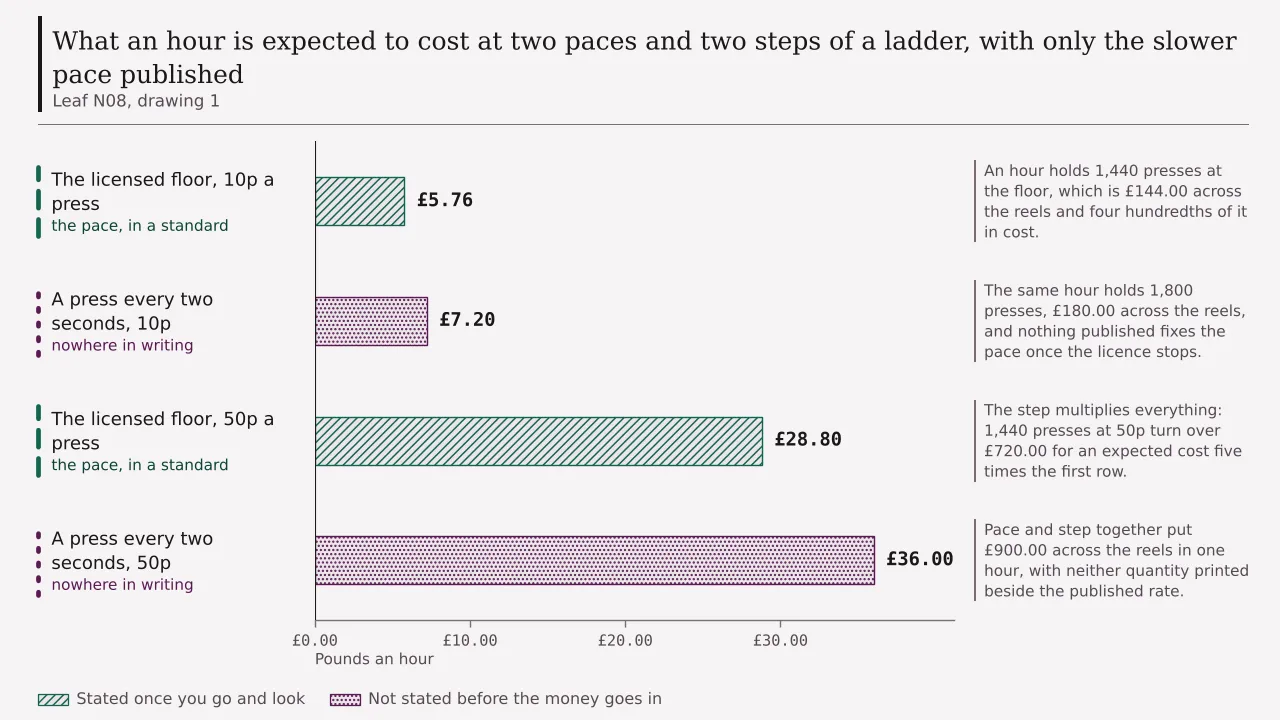
Three hours in that drawing are decided by quantities carrying no address. Only the first rests on anything published, and it rests on a floor that applies inside a British licence and nowhere else. Beyond that licence an hour holds as many presses as the build permits, and the figure deciding it appears in no document a reader can open.
7
The stake ladder, never printed beside the figure it multiplies
The second unpublished quantity is the ladder of stakes a build offers: where it starts, where it stops, and which steps sit in between. Of the three it has the largest effect, since it multiplies whatever the other two produce, and it is also the one least often thought of as a property of the build rather than of a reader’s own choosing.
The multiplication is direct. An hour at the licensed floor holds 1,440 presses whatever they cost, so the expected cost of the hour is 1,440 multiplied by the step multiplied by four hundredths. At 10p the hour costs £5.76. At 20p it costs £11.52. At 50p it costs £28.80. At £2.00 it costs £115.20. Nothing about the build has changed between those four lines except which rung the reader is standing on.
| Step on the ladder | Turned over in an hour | Expected cost of the hour | What ten pounds buys | Where the step is settled |
|---|---|---|---|---|
| 10p | £144.00 | £5.76 | 100 presses | nowhere in writing |
| 20p | £288.00 | £11.52 | 50 presses | nowhere in writing |
| 50p | £720.00 | £28.80 | 20 presses | nowhere in writing |
| £2.00 | £2,880.00 | £115.20 | 5 presses | nowhere in writing |
A factor of twenty stands between the first row and the last while the rate of return holds at 96 pence throughout. That is the clearest demonstration available that a rate is not a price. The rate tells a reader what share of each pound stays behind. How many pounds there are in an hour is settled by a ladder and a clock, and neither of those is published with the rate anywhere this site can reach.
Inside the British licence the top of the ladder has a ceiling, standing at £5 against one game cycle and falling to £2 for anybody younger than twenty-five. Those two figures were set by a statutory instrument carrying the date 25 February 2025, and the commencement dates the regulator gives run 9 April 2025 for the larger, 21 May 2025 for the smaller. The ceiling is a slots rule attached to remote casino permissions, it reaches no other casino game, and it is a ceiling rather than a disclosure: it caps the ladder and publishes nothing about where a given build’s ladder starts or which rungs it holds.
Put the ceiling through this leaf’s own arithmetic and it prices out cleanly. An hour at the £5 ceiling holds the same 1,440 presses, turns over £7,200.00, and costs an expected £288.00. At the £2 step it turns over £2,880.00 and costs £115.20. So the ceiling caps the expected cost of an hour at £288.00 inside the licence, and caps nothing at all outside it.
8
Feature cadence, and the cycles it takes out of an hour
The third unpublished quantity is the cadence of whatever feature the build carries: how often it arrives, and how long it occupies when it does. Of the three it hides best, since it does not present itself as a number at all. It presents itself as the part of the build somebody came for.
Cadence works on the clock rather than on the margin, and the arithmetic is worth doing because the result runs against intuition. Suppose a feature arrives once in every 160 presses and occupies 90 seconds when it does, both figures being this leaf’s own illustration and not a description of anything. Across 1,440 presses the feature arrives nine times, which is 810 seconds, so the hour holds 2,790 seconds of ordinary pressing rather than 3,600, and that is 1,116 presses rather than 1,440.
Run the money through it. 1,116 presses at 10p turn over £111.60 and cost an expected £4.46, against £5.76 for the hour with no feature in it. So a slower cadence makes an hour cheaper in expectation, by £1.30 on these figures, because time spent inside a feature is time not spent paying for new cycles. A reader who assumed that a build full of features costs more per hour has the sign the wrong way round.
The honest complication is that the feature is not free: its returns are part of the 96 pence, so a build routing a large share of the return through a rarely arriving feature has the same rate and a very different distribution, which is the subject of a neighbouring leaf rather than this one. What belongs here is only the clock. Cadence decides how many cycles an hour holds, and how many cycles an hour holds decides what an hour costs.
Which completes the set. Three quantities decide the cost of an hour on a recent release: the pace, the ladder and the cadence. Not one of them is published beside the rate, the rate cannot be converted into an hourly figure without all three, and a reader is therefore handed the one number that does not answer their question and none of the three that do.
9
Duties about speed and about staying at the screen
Addresses carrying no Great Britain licence are how recent releases reach most readers here, and on a leaf costing an hour the obligations worth naming are the ones governing speed and the ones governing what a build may do to keep somebody at it. They decide the two inputs parts six and eight turn on. Other protections matter and are costed elsewhere on this site.
Three stand out. There is a floor under how quickly one cycle may follow another, which this leaf has already spent: it is what made an hour hold 1,440 presses rather than whatever a build prefers, and it is the only published input in the whole of part six. A customer may not be handed any means of cutting short the wait for a result, which puts turbo, quick spin and a slammed stop out of bounds, across every remote game whatever pace it runs at. And a product may not actively push anybody towards clawing a loss back, towards a larger stake, towards spending past whatever sum was settled on, or towards staying once a wish to leave has been signalled, with funds topped up solely at the customer’s own election each time and no drawing back of anybody who has gone, a free game being the example named.
Price the first two through this leaf’s own figures. Remove the floor and an hour at a press every 1.8 seconds holds 2,000 presses, which at 10p turns over £200.00 and costs an expected £8.00 against £5.76. Lift the bar on cutting short a result and part eight’s cadence arithmetic runs backwards: the 810 seconds the feature occupied comes back, the hour returns to 1,440 presses, and the cost returns to £5.76 from £4.46. Between them the two removals move the expected cost of one hour from £4.46 to £8.00, which is a swing of £3.54 produced entirely by quantities nobody publishes.
The third has no figure and is the one worth reading twice. A duty about not encouraging somebody to stay past their own decision is not a duty about money, so no sum in this leaf moves when it goes. What it governs is whether the count of presses behind a reader at the end of an hour was chosen by them or produced by the build. Every figure in parts two, three, six and seven is a function of that count, which makes this the duty the whole arithmetic rests on while contributing nothing to it.
And the ceiling on the ladder from part seven goes with the rest, so outside the licence the £288.00 an hour it capped is not capped by anything. Set the three removals together and the position is that the cost of an hour at a recent release beyond the licensed market is decided by three unpublished quantities with no ceiling over any of them, which is a different and worse situation from not knowing what the rate is.
10
Reading a recent release for what it can support
What follows is short and it replaces the question most readers ask with the question the published figures can answer. It needs no sources beyond the screen in front of somebody.
Step one, take the published rate and write beside it the words derived, not counted, so that it stops being treated as a measurement. Step two, stop asking what the build pays and start asking what an hour costs, which is a question with a computable answer. Step three, collect the three inputs: the step you intend to press at, the seconds a cycle takes, and whether a feature interrupts. Two of those three can be read off the screen in a minute of watching, which is more than the rate can tell you. Step four, multiply: 3,600 divided by the seconds, times the step, times four hundredths.
Worked on this leaf’s own figures that produces £5.76 an hour at 10p and the licensed floor, £11.52 at 20p, £28.80 at 50p and £115.20 at £2.00. Those are the numbers a reader can act on, and not one of them appears anywhere near the published rate, which is the number they were given instead.
Two habits keep it honest. Never treat a session as evidence about a build, because part three put a figure on that and the figure was 41 percentage points of uncertainty on a hundred and fifty presses. And never treat the word new as information about a build, because nothing publishes a release date and the only thing it reliably describes is where a lobby has chosen to put a tile this week.
The fair conclusion is narrow rather than damning. A published rate is exact, honest and unobservable, and on a build released this month it is further from anything observed than it will ever be again. Nobody is hiding anything by printing it. What is missing is everything that would turn it into a cost, and that absence is not a drafting failure either, because no rule anywhere requires a pace, a ladder or a cadence to be printed beside a rate.
Questions
- Is a published RTP measured or calculated?
- Calculated. Whoever builds a reel takes the paytable and the frequency of every symbol, multiplies one by the other across every outcome the build can produce, and arrives at a figure, which the guidance sitting behind Britain’s own disclosure standard terms a theoretical average. Theoretical because the sum is done on paper, average because it is the centre of a distribution rather than a promise about a session. Printing it to a decimal place invites a reader to treat it as a measurement, and a measurement is the one thing it is not.
- How many spins does it take to confirm a slot’s published return?
- Far more than anybody performs, and the count follows from one formula: uncertainty is the swing on one press divided by the square root of whatever count stands behind the reader. Modelling a swing of 5 stakes, chosen here rather than read anywhere, an observation good to one percentage point wants 250,000 presses. Good to the decimal place the figure is printed with, it wants 25,000,000, and at 1,440 presses to the hour that is 17,361 hours, or 723 days with no pause in them. Halving the margin quadruples the count every time.
- What does my own session tell me about a slot’s return?
- Less than almost anybody assumes, and the arithmetic puts a figure on it. A hundred and fifty presses at a modelled swing of 5 stakes leaves an observed rate uncertain by about 41 percentage points either way, which is ten times the whole margin the house keeps. At a swing of 20 the uncertainty passes 163 points, wider than the scale the rate is measured on. A session is evidence about that session and about nothing else.
- Why is a brand new slot the hardest one to judge?
- Because the counts that would support an observation are cumulative across everybody, and a build that went live last month has had far fewer total presses behind it than one four years old. The published figure is identical in both cases, since it was derived rather than accumulated, so the distance between it and anything anybody could have observed is widest on the newest release. There is a second oddity too: nothing publishes a release date, so newness itself is a listing decision rather than a property of the build.
- Does anyone publish how a slot has actually performed?
- Not for a single build. The disclosure standard reaches the derived figure and asks counting of nobody. A register row fastens a company to permitted activities and carries no field describing a build. Official statistics come closest and are aggregates: £8.3 billion was yielded over the year to March 2026 by the one sector holding remote casino alongside remote betting and remote bingo, with online casino games standing at £5.7 billion inside that and reel-based ones at £4.8 billion, on a release dated 17 September 2026. Nothing about one build can be recovered from a sector total.
- What does an hour on a slot actually cost?
- At 10p a press on a licensed build, an expected £5.76, and the rate on its own cannot produce that figure. An hour is 3,600 seconds, and on a licensed build the gap from one cycle to the next cannot fall under 2.5 seconds, putting 1,440 presses in an hour at the outside. Ten pence apiece makes £144.00 of turnover, four hundredths of that being £5.76. A reader holding 96 per cent and ten pounds of intended spend concludes 40p instead, which is correct about £10.00 and wrong about an hour, because £10.00 lasts a hundred presses or four minutes and ten seconds.
- How much does the stake size change the cost of an hour?
- By the full multiple, since the hour holds its 1,440 presses whatever each one costs. At 10p the hour puts £144.00 over the reels for an expected cost of £5.76. At 20p it is £288.00 and £11.52. At 50p it is £720.00 and £28.80. At £2.00 it is £2,880.00 and £115.20. A factor of twenty stands between the first line and the last while the rate holds at 96 pence in all of them, which is the clearest demonstration that a rate is not a price.
- Do bonus features make a slot more expensive per hour?
- The opposite, on the clock at least, and the sign catches people out. Take a feature arriving once in 160 presses and occupying 90 seconds, with both figures illustrating a shape here rather than describing anything real. Across 1,440 presses it arrives nine times for 810 seconds, so the hour holds 2,790 seconds of ordinary pressing, which is 1,116 presses rather than 1,440. That turns over £111.60 and costs an expected £4.46 against £5.76. Time inside a feature is time not spent paying for new cycles.
- What protections are missing on slots at an unlicensed site?
- Three that bear directly on the cost of an hour. The floor under how quickly one cycle may follow another, which is what made an hour hold 1,440 presses rather than whatever a build prefers. The rule putting any means of cutting short a result out of bounds, which covers turbo, quick spin and a slammed stop. And the rule against a product pushing anybody towards clawing a loss back, towards a larger stake, towards spending past whatever sum was settled on, or towards staying once a wish to leave has been signalled, with funds topped up solely at the customer’s own election each time and nobody drawn back by a free game. Remove the first two and an hour moves from an expected £4.46 to £8.00.
- Is there a cap on what a single spin can cost?
- Inside the British licence, yes. One game cycle is capped at £5, falling to £2 for anybody younger than twenty-five. A statutory instrument carrying the date 25 February 2025 set those figures, and the commencement dates the regulator gives are 9 April 2025 for the larger and 21 May 2025 for the smaller. It is a slots rule attached to remote casino permissions and reaches no other casino game. Put through this leaf’s arithmetic it caps the expected cost of an hour at £288.00, and it caps nothing whatever beyond that licence.