Terms read 19 October 2026 Leaf W10, revision 1
One word, five questions, and a build that answers any of them badly answers another well
A balance of £20.00 is expected to push £500.00 over the reels before it is gone. Move a tenth of the return into a payout arriving once in 10,417 presses and the same balance pushes £147.06, a loss of £352.94 of play bought with one chance in roughly eight. That trade is what the word hides, and this leaf prices five of them rather than naming a single build.
Stated on the banner £3.60 What an hour of pressing is expected to cost on the published return, which is the one meaning with a figure behind it. Stated, once you go and look 9.6p a press Average return on a single press, fixed by the rules screen however often or seldom the build actually pays anything. Not stated before the money goes in Four criteria Event rate, reach, survival and the size of an ordinary return, none of which any document is obliged to carry.
Reel offers in this bracket, with their terms read
Every destination in this file is bought advertising. The site is paid a fee if a reader goes on to register, and no figure printed below moves because of it.
Bonus Spins UK Slip 01
Betportal
Ceiling as a multiple
The drop
€15.00
€1.00 in the euro
The claim reads €15.00. Once the terms beside it have applied, €0.00 of it can leave. The difference is the drop.
7 of the 15 terms on this slip could not be read before the money went in
Spins priced at this site's own 10p a spin, which the operator does not publish
Stated
€15.00
The claim as it is printed, before a single term has been applied to it.
Headline paid as spins
150 spins at 10c each, which is €15.00 of the figure above.
6 Nowhere
What one spin is worth
No unit is published for a spin, so the count is priced at this site's own 10p a spin. At half that price every figure below halves with it.
Match and other credit not priced
300% of three deposits, to a ceiling of €1,000. A share of a deposit nobody has made yet is not a sum, so no figure stands on this line and none is carried below.
Qualified
-€14.40
Written down somewhere, and taking part of the claim back. Each term carries the place it is written and the sum it takes.
2 Written terms at a distance this record does not establish
Play-through -€14.40
Carrying €14.40 through 35 times stakes €504.00 and costs €20.16 of it at 96 per cent return. That prices above the €14.40 there is to charge it against, so the whole of the credit goes and the line is held at that. The multiple sits on the bonus.
2 Written terms at a distance this record does not establish
Game weighting not priced
Slots only count towards the play-through. No contribution percentage is published, so the line above has been worked at full weight, which is the kindest reading there is.
2 Written terms at a distance this record does not establish
Ceiling on the winnings not priced
5x the bonus.
2 Written terms at a distance this record does not establish
Clock on the credit not priced
14 days.
2 Written terms at a distance this record does not establish
Largest stake while it runs not priced
€5.
3 Public record
Licence, and who holds it not priced
Licensed in Anjouan, Comoros, held by BetPortal Gaming Ltd, with Excite Ultra Media Ltd, reference ALSI-202601040-FI2. A register entry settles who holds a licence and what it permits. It does not settle who is running the site this morning.
4 Cashier
Smallest qualifying deposit your money
€20 a stage. That is €20.00 of your own money, and it is never netted into a drop.
5 On the way out
Checks before a withdrawal not priced
Documents before the first withdrawal.
Unstated
-€0.60
Applying without having been published anywhere, and costing money all the same.
6 Nowhere
What a spin hands back -€0.60
Staking a spin returns 96 per cent of it, so that share of the batch is the house's before a reel turns. This site works at that return and the operator publishes none where the claim is made.
6 Nowhere
Forfeited by rule cost unknown
Nothing is published under this heading, and it applies regardless.
6 Nowhere
Charge on the way out cost unknown
No charge on the way out is published as a figure, so nothing comes off this line. A charge that exists unpublished would come straight off whatever survives.
6 Nowhere
Smallest withdrawal allowed cost unknown
No smallest withdrawal is published as a figure. A floor nobody has published is still a floor, and it decides whether a small balance can move at all.
No Great Britain licence
Terms read 19 October 2026
Bonus Spins UK Slip 02
WinBeast
Ceiling as a sum
The drop
€50.00
€1.00 in the euro
The claim reads €50.00. Once the terms beside it have applied, €0.00 of it can leave. The difference is the drop.
8 of the 15 terms on this slip could not be read before the money went in
Spins priced at this site's own 10p a spin, which the operator does not publish
Stated
€50.00
The claim as it is printed, before a single term has been applied to it.
Headline paid as spins
500 spins at 10c each, which is €50.00 of the figure above.
6 Nowhere
What one spin is worth
No unit is published for a spin, so the count is priced at this site's own 10p a spin. At half that price every figure below halves with it.
Match and other credit not priced
50% to 100% of five deposits, each to a ceiling of €1,000, and a €650 free bet. A share of a deposit nobody has made yet is not a sum, so no figure stands on this line and none is carried below.
Qualified
-€48.00
Written down somewhere, and taking part of the claim back. Each term carries the place it is written and the sum it takes.
2 Written terms at a distance this record does not establish
Play-through -€48.00
Carrying €48.00 through 40 times stakes €1,920.00 and costs €76.80 of it at 96 per cent return. That prices above the €48.00 there is to charge it against, so the whole of the credit goes and the line is held at that. The multiple sits on the bonus and the winnings from the spins.
2 Written terms at a distance this record does not establish
Game weighting not priced
Slots, titles vary by country count towards the play-through. No contribution percentage is published, so the line above has been worked at full weight, which is the kindest reading there is.
2 Written terms at a distance this record does not establish
Ceiling on the winnings not priced
€100 a batch of spins.
2 Written terms at a distance this record does not establish
Clock on the credit not priced
7 days, spins 1 day.
3 Public record
Licence, and who holds it not priced
Licensed in Curaçao, holder not named on the site. A register entry settles who holds a licence and what it permits. It does not settle who is running the site this morning.
4 Cashier
Smallest qualifying deposit your money
€20 a stage. That is €20.00 of your own money, and it is never netted into a drop.
5 On the way out
Checks before a withdrawal not priced
Documents before the first withdrawal.
Unstated
-€2.00
Applying without having been published anywhere, and costing money all the same.
6 Nowhere
What a spin hands back -€2.00
Staking a spin returns 96 per cent of it, so that share of the batch is the house's before a reel turns. This site works at that return and the operator publishes none where the claim is made.
6 Nowhere
Largest stake while it runs cost unknown
Nothing is published under this heading, and it applies regardless.
6 Nowhere
Forfeited by rule cost unknown
Nothing is published under this heading, and it applies regardless.
6 Nowhere
Charge on the way out cost unknown
No charge on the way out is published as a figure, so nothing comes off this line. A charge that exists unpublished would come straight off whatever survives.
6 Nowhere
Smallest withdrawal allowed cost unknown
No smallest withdrawal is published as a figure. A floor nobody has published is still a floor, and it decides whether a small balance can move at all.
No Great Britain licence
Terms read 19 October 2026
Bonus Spins UK Slip 03
EliteSpin
Longest spin window
The drop
£50.00
£1.00 in the pound
The claim reads £50.00. Once the terms beside it have applied, £0.00 of it can leave. The difference is the drop.
8 of the 15 terms on this slip could not be read before the money went in
Spins priced at this site's own 10p a spin, which the operator does not publish
Stated
£50.00
The claim as it is printed, before a single term has been applied to it.
Headline paid as spins
500 spins at 10p each, which is £50.00 of the figure above.
6 Nowhere
What one spin is worth
No unit is published for a spin, so the count is priced at this site's own 10p a spin. At half that price every figure below halves with it.
Match and other credit not priced
50% to 100% of five deposits, each to a ceiling of £1,000. A share of a deposit nobody has made yet is not a sum, so no figure stands on this line and none is carried below.
Qualified
-£48.00
Written down somewhere, and taking part of the claim back. Each term carries the place it is written and the sum it takes.
2 Written terms at a distance this record does not establish
Play-through -£48.00
Carrying £48.00 through 40 times stakes £1,920.00 and costs £76.80 of it at 96 per cent return. That prices above the £48.00 there is to charge it against, so the whole of the credit goes and the line is held at that. The multiple sits on the bonus and the winnings from the spins.
2 Written terms at a distance this record does not establish
Game weighting not priced
Slots count towards the play-through. No contribution percentage is published, so the line above has been worked at full weight, which is the kindest reading there is.
2 Written terms at a distance this record does not establish
Ceiling on the winnings not priced
5x the bonus.
2 Written terms at a distance this record does not establish
Clock on the credit not priced
7 days, spins 3 days.
3 Public record
Licence, and who holds it not priced
Licensed in Costa Rica, held by PrimeTier Limited. A register entry settles who holds a licence and what it permits. It does not settle who is running the site this morning.
4 Cashier
Smallest qualifying deposit your money
£20 a stage. That is £20.00 of your own money, and it is never netted into a drop.
5 On the way out
Checks before a withdrawal not priced
Documents before the first withdrawal.
Unstated
-£2.00
Applying without having been published anywhere, and costing money all the same.
6 Nowhere
What a spin hands back -£2.00
Staking a spin returns 96 per cent of it, so that share of the batch is the house's before a reel turns. This site works at that return and the operator publishes none where the claim is made.
6 Nowhere
Largest stake while it runs cost unknown
Nothing is published under this heading, and it applies regardless.
6 Nowhere
Forfeited by rule cost unknown
Nothing is published under this heading, and it applies regardless.
6 Nowhere
Charge on the way out cost unknown
No charge on the way out is published as a figure, so nothing comes off this line. A charge that exists unpublished would come straight off whatever survives.
6 Nowhere
Smallest withdrawal allowed cost unknown
No smallest withdrawal is published as a figure. A floor nobody has published is still a floor, and it decides whether a small balance can move at all.
No Great Britain licence
Terms read 19 October 2026
Bonus Spins UK Slip 04
Crown Jewelz
Multiple unpublished
The drop
NOT WORKED
The multiple is not published in the operator's own terms. Since the sum cannot be worked around it, none is worked.
9 of the 14 terms on this slip could not be read before the money went in
No drop worked
Stated
£15.00
The claim as it is printed, before a single term has been applied to it.
Headline paid as spins
150 spins at 10p each, which is £15.00 of the figure above.
6 Nowhere
What one spin is worth
No unit is published for a spin, so the count is priced at this site's own 10p a spin. At half that price every figure below halves with it.
Match and other credit not priced
200% of the first deposit, then 150% twice, each to a ceiling of £1,000. A share of a deposit nobody has made yet is not a sum, so no figure stands on this line and none is carried below.
Qualified
NOT WORKED
Written down somewhere, and taking part of the claim back. Each term carries the place it is written and the sum it takes.
2 Written terms at a distance this record does not establish
Play-through not priced
40x the bonus, reported rather than published by the operator.
2 Written terms at a distance this record does not establish
Game weighting not priced
Slots count towards the play-through. No contribution percentage is published, so the line above has been worked at full weight, which is the kindest reading there is.
3 Public record
Licence, and who holds it not priced
Licensed in Curaçao, number not verified, holder not named on the site. A register entry settles who holds a licence and what it permits. It does not settle who is running the site this morning.
4 Cashier
Smallest qualifying deposit your money
£20. That is £20.00 of your own money, and it is never netted into a drop.
5 On the way out
Checks before a withdrawal not priced
Documents before the first withdrawal.
Unstated
NOT WORKED
Applying without having been published anywhere, and costing money all the same.
6 Nowhere
Ceiling on the winnings cost unknown
No ceiling is published. Nothing is assumed in its place.
6 Nowhere
Clock on the credit cost unknown
Nothing is published under this heading, and it applies regardless.
6 Nowhere
Largest stake while it runs cost unknown
Nothing is published under this heading, and it applies regardless.
6 Nowhere
Forfeited by rule cost unknown
Nothing is published under this heading, and it applies regardless.
6 Nowhere
Charge on the way out cost unknown
No charge on the way out is published as a figure, so nothing comes off this line. A charge that exists unpublished would come straight off whatever survives.
6 Nowhere
Smallest withdrawal allowed cost unknown
No smallest withdrawal is published as a figure. A floor nobody has published is still a floor, and it decides whether a small balance can move at all.
No Great Britain licence
Terms read 19 October 2026
Every figure in the second and third columns is this site's own working and nothing an operator has published. A claim is priced as printed, then the share a spin hands back at 96 per cent return comes off it, then what playing the multiple through costs at the same return, and then whatever a published ceiling, a charge on the way out or a floor on the smallest withdrawal takes from what has survived. The drop is the difference between the first figure and the last. The two columns add back up to it exactly, so no money leaves a slip without a term and a place beside it.
Which column a term falls in is settled by one question: has anybody written it down. A charge a reader meets at the payment screen is written down, and it stands in the second column with the cashier against it. A condition that binds without ever having been set down stands in the third, whatever it costs. Inside each column the terms run outwards from the banner, so the order itself says how far a reader would have had to go.
A count of spins has no unit until one is supplied. Where an operator publishes what one of its own spins is worth, that figure is used and the first column says it is theirs. Where none is published, this site's own 10p a spin stands in its place and every figure below moves in proportion with it. Where the multiple itself is unpublished, no drop is worked at all, because that is the one figure the sum cannot be done without.
Three words stand where a figure cannot. Not priced is a term that is written down and carries no number the arithmetic can take. Cost unknown is a term nobody has written down, costing something nobody has put a number on. Your money is money of the reader's own, which is never netted into a drop.
None of the operators in this file holds a Great Britain licence, so none of the duties that licence carries reaches them. Each of those duties is published in its own right, which is what makes its absence here something a reader can check rather than take on trust. Every gambling company licensed in Great Britain belongs to Gamstop Online, so a reader who has shut themselves out through the scheme is not shut out here. Social Responsibility Code 5.1.1 has held a play-through to a maximum of ten times the bonus funds since 19 January 2026, and it binds a licence holder and nobody else. Asked in a post of 21 October 2025 what is lost along with the licence, the Gambling Commission's Director of Enforcement and Intelligence answered: "unfair gaming practices, financial loss, and a lack of recourse if things go wrong". The same post puts blocked payouts, and withdrawal limits pitched high enough to be unreachable, among the behaviour the Commission has recorded. Nobody under 18 may hold an account at any of them.
Terms are reproduced in the wording their operator published, and each slip is dated with the day somebody sat down and read them. 19 October 2026 is the oldest of those dates. Anybody claiming an offer is bound by that operator's full terms, which are elsewhere, and never by a line standing here.
1
Five questions hiding inside a single adjective
Ask what makes a reel build better than another and five answers come back, each of them reasonable, each measurable in pounds, and no two of them pointing at the same build. The word carries all five at once and names none of them, which is why a page promising the best ten of anything is answering a question nobody asked in a form nobody can check.
Here are the five, stated as questions rather than as adjectives. Which build makes an hour cost least. Which build has the most happening in that hour. Which build gives the best chance of a payout large enough to change the evening. Which build keeps a fixed balance alive the longest. And which build hands back the most cash on an ordinary press that pays. Every one of those is a real thing somebody might want and every one of them has a number.
The trouble is not that the five are vague. It is that they are tied together by arithmetic, so improving one forces another down, and the forcing is exact rather than approximate. A build with four times as many paying presses pays a quarter as much on each of them. A build with a serious chance of a very large return takes the funding for it out of the ordinary line, and a fixed balance consequently lasts a third as long. Those are not editorial judgements. They are consequences of one published percentage and a fixed total.
No title appears on this leaf, here or anywhere below, for the reason this whole site exists: the fact sheet behind it carries no claim about any individual build, so a sequence of ten resting on figures nobody published would be an invented quantity sitting beside checkable ones. What follows instead is the criterion, taken apart and priced, which is the part of the question that keeps working after any particular build has been replaced.
Worth saying plainly before the arithmetic starts: none of the five criteria is the right one. Somebody who wants an evening to last has a different correct answer from somebody who wants a story to tell, and no arithmetic adjudicates between them. What it can do is say what each choice costs in the currency of the remaining four criteria, which is the business of this leaf.
One pair in the five does not fight, which is worth flagging early so that the page is not read as a counsel of despair. The cheapest hour and the longest-lasting balance pull in the same direction, both being helped by a smaller press. Everything else on the list trades, and part eight sets out every pairing in one table.
2
Settings everything below is priced against
Four quantities are fixed for the length of this leaf and each is labelled wherever it is spent, an assumption spent quietly in a later line having a way of hardening into a fact that nobody ever checked. Ninety-six per cent is the return and 10p the press, both of them standing assumptions across this site rather than readings taken off anything. The balance is £20.00. And the rate of pressing is one press every four seconds, which gives 900 presses in an hour and is this leaf’s own setting rather than a published floor.
From those four settings everything else follows by multiplication. Nine hundred presses at 10p put £90.00 over the reels in an hour, of which the margin keeps four hundredths, so an hour is expected to cost £3.60. The average return on one press is 9.6p, which is the published percentage applied to the stake and is the single figure every criterion below has to be reconciled with.
Nine point six pence a press is the constraint doing all the work on this leaf, so it is worth stating in the strongest form. Whatever a build does with its payouts, however often it pays, however large the largest payout is, the average across presses comes to 9.6p at this press value and this return. A build cannot put more into one part of its distribution without taking it out of another, and the whole of parts four to seven is that sentence worked through with figures attached.
The balance matters because two of the five criteria are about a fixed sum rather than about a fixed length of time. Twenty pounds at a margin of four hundredths is expected to put £500.00 over the reels before it has gone, or 5,000 presses, which at 900 an hour is five hours and thirty-three minutes. Those three figures describe the same quantity in three units and part six uses all of them.
One caution on the pressing rate. Four seconds a press is slower than a licensed build must allow and faster than most people keep up over a long sitting, so it sits somewhere sensible without being measured. Change it and every hourly figure moves in direct proportion while nothing priced against the balance moves at all, so the two families of criteria do not contaminate each other.
A fifth quantity is used from part five onward and is introduced here so that it does not arrive unlabelled. Where a build holds part of its return in a rare large payout, this leaf describes that part as a share of the 96 and converts it into a probability by dividing. Nothing anywhere publishes such a share for any build, so every figure drawn from it is an illustration of a mechanism rather than a reading of a market.
3
Cheapest hour, and the quantity it is tied to
Take the first meaning. Best is whichever build lets somebody spend an hour at the reels for the smallest expected outlay. That is the easiest of the five to compute and the only one with a published quantity on both of its inputs.
Expected cost of an hour is presses times stake times margin. On this leaf’s settings that is 900, 10p and four hundredths, giving £3.60. Halve the press to 5p and the hour costs £1.80. Double it to 20p and the hour costs £7.20. Leave the press at 10p and move the return instead: two points in either direction puts the hour at £1.80 or at £5.40, by the same arithmetic approached from the other input.
| What is being varied | Turnover in the hour | Expected cost | Where the input is settled |
|---|---|---|---|
| 5p a press, published return | £45.00 | £1.80 | |
| 10p a press, the setting held here | £90.00 | £3.60 | |
| 20p a press, published return | £180.00 | £7.20 | |
| 10p a press, two points better | £90.00 | £1.80 | in the written terms |
| 10p a press, two points worse | £90.00 | £5.40 | in the written terms |
Notice what is missing from that table and from this criterion generally. Nothing about how the build pays, how often it pays, or how large its largest payout is enters the calculation anywhere. Cost per hour depends on three numbers and all three are available before a penny moves. A reader whose only question is what an hour costs is done, and needs none of the rest of this leaf.
The trade appears the moment a second criterion is admitted. Cost per hour falls when pressing slows or the stake shrinks, and both also reduce what happens in the hour. Press every eight seconds rather than every four and the hour costs £1.80 and holds half the events. The cheapest hour available is the one in which nothing happens at all, which is a reductio rather than a recommendation and shows that cost per hour read alone has a degenerate answer. Part four puts the events back and fixes the relation between the two.
4
Most happening per hour, and the identity behind it
The second meaning is the one most people have in mind without saying so. Best is whichever build keeps something happening, where something means a press that gives money back rather than taking it. Call the proportion of presses that pay anything the event rate, and this is where the arithmetic becomes unforgiving.
The constraint is one line. Event rate times the average amount handed back on a paying press comes to the return rate. Where one press in four pays, the average paid press returns 3.84 stakes, which on a 10p press is 38.4p. One in three gives 28.8p. One in ten gives 96p. One in twenty gives £1.92. Four times the event rate buys exactly a quarter of the event.
So a reader asking for the busiest hour is asking for the smallest returns, and the two requests are the same request wearing different clothes. There is no build anywhere that pays often and pays well at a fixed return, because the product of the two is pinned by the only figure the rules screen publishes.
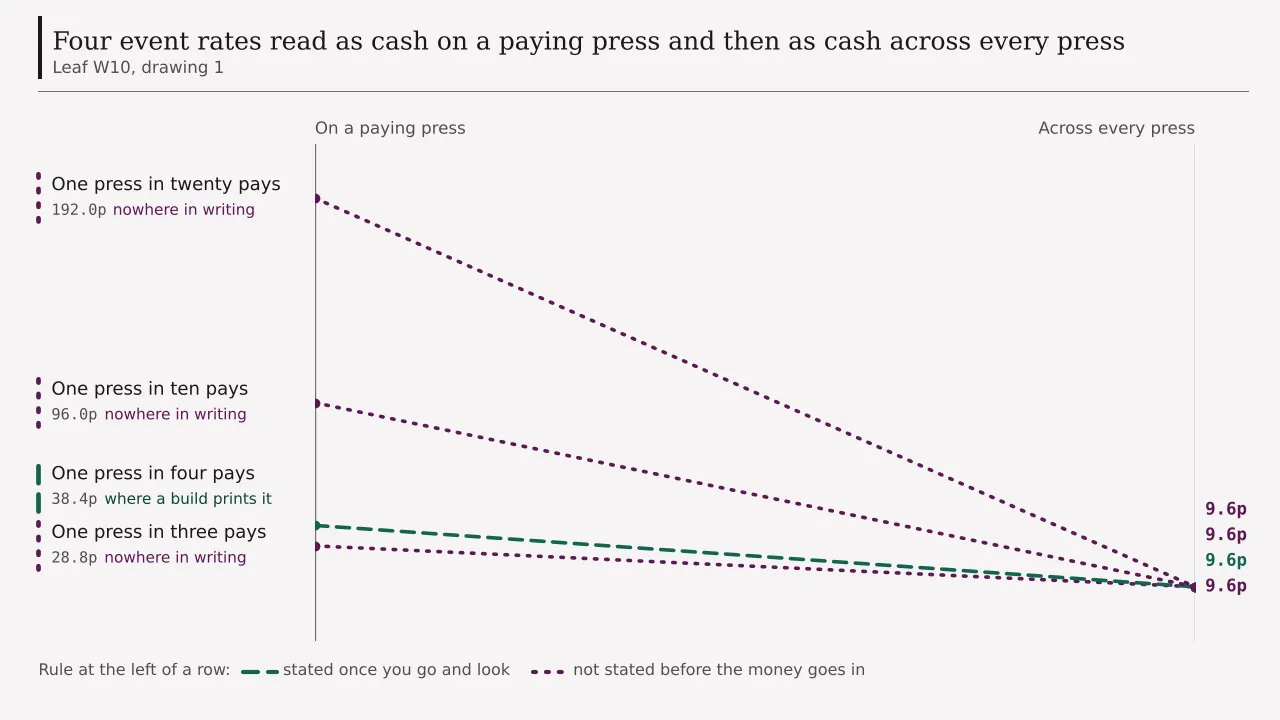
Convergence is the whole of that drawing. Four builds that feel entirely unlike each other arrive at one figure on the right, the right being the published percentage and the left being a way of distributing it. A reader picking between those four event rates is picking a texture rather than a price.
Put the event rate against the first criterion and a second fixed relation appears. Events in an hour are the press rate times the event rate, and the hour’s cost is the press rate times stake times margin, so both scale with the press rate and the ratio between them does not. At one press in four and the settings held here, an hour brings 225 paying presses for £3.60, which is 62.5 events for every pound of expected cost. At one in ten it is 90 events for the same £3.60, which is 25 to the pound.
62.5 paying presses for each pound of expected cost at one press in four, against 25 at one in ten
Events for each pound of cost is therefore the honest form of this criterion, and it depends on the event rate alone. Nothing a reader does to the stake or the pace changes it. What it buys is smaller events, in exact proportion, which is the sentence the first paragraph of this part was heading towards.
5
The chance of something large, and what pays for it
The third meaning is the one a lobby advertises hardest. Best is whichever build offers a real chance of a payout big enough to be worth describing afterwards, and the figure usually quoted is a multiple of the press. A build announcing a thousand times the stake is announcing £100.00 on a 10p press.
What nobody announces is the probability, and the probability follows from the share of the return the large payout is given. Let a tenth of the 96 per cent be delivered by that payout, which is 9.6 points of return. Dividing 9.6 points by the thousand-times multiple gives a probability of 0.0096 per cent a press, or roughly one press in 10,417. At this leaf’s pressing rate that is one expected occurrence every eleven hours and thirty-five minutes.
The ordinary line has to be funded out of what remains. With 9.6 points committed to the large payout, everything else shares 86.4 per cent rather than 96, so the margin on an ordinary press is thirteen point six hundredths instead of four. That single change is the engine behind parts six and seven, and it has not required a build to be worse in any sense a rules screen would record.
| Share of the return held in the large payout | Chance per press | Return left for everything else | Ordinary margin a press | How it feels at the reels |
|---|---|---|---|---|
| None of it | Nil | 96.0 per cent | 4.0 hundredths | Nothing ever very large, and a slow drain |
| A twentieth of it | 1 in 20,833 | 91.2 per cent | 8.8 hundredths | A faint prospect, and a drain twice as quick |
| A tenth of it | 1 in 10,417 | 86.4 per cent | 13.6 hundredths | A real prospect, and a drain three times as quick |
| A fifth of it | 1 in 5,208 | 76.8 per cent | 23.2 hundredths | A serious prospect, and most balances gone first |
Read the last two columns together and the trade is visible without any further working. Every point of return moved into the rare payout is a point taken off the ordinary line and added to the margin a press carries, and the margin a press carries is what decides how long anything lasts. The reach is not free and it is not paid for by the operator. It is paid for out of the same 96 pence.
One figure is worth computing because it is the one a reader actually wants. On the tenth-share row, a £20.00 balance buys about 1,471 presses before the ordinary line exhausts it, and the chance of meeting the large payout inside that many presses is roughly one in eight. That is this leaf’s own working from the rows above, approximate because it ignores what happens after the payout lands, and it is a far smaller number than the advertisement implies and a far larger one than nothing.
6
How long twenty pounds lasts, in pounds
The fourth meaning is survival. Best is whichever build keeps a fixed balance in play longest, which is the criterion somebody choosing an evening’s entertainment is really applying even when they describe it some other way.
Survival has a clean formula and it is the same compounding that governs any recycled balance. Any sum is expected to send itself divided by the margin over the reels before it has gone, each returned pound being staked a second time. At the published 96 per cent, £20.00 produces £500.00 of turnover, which is 5,000 presses, which is five hours and thirty-three minutes at this leaf’s pressing rate.
Now apply part five. Where a tenth of the return sits in a payout arriving once in 10,417 presses, the ordinary margin is 13.6 hundredths rather than four, so the same £20.00 produces £147.06 of turnover and 1,471 presses, which is an hour and thirty-eight minutes. The balance has not changed. The published return has not changed. Only the shape has, and the shape is settled nowhere in writing.
Turnover £20.00 buys with nothing in the tail £500.00 The same sum with a tenth of the return there £147.06 Play given up for one chance in eight £352.94
Three hundred and fifty-two pounds ninety-four comes out twice from workings with nothing in common. Subtract the two turnovers and £500.00 less £147.06 leaves £352.94. Or forget turnover and count presses: 5,000 against 1,471 is a shortfall of 3,529 presses, and 3,529 presses at 10p is £352.94 again, to the penny once the rounding is carried properly. The agreement matters because it fixes the difference on the shape of the distribution rather than on anything else that moved.
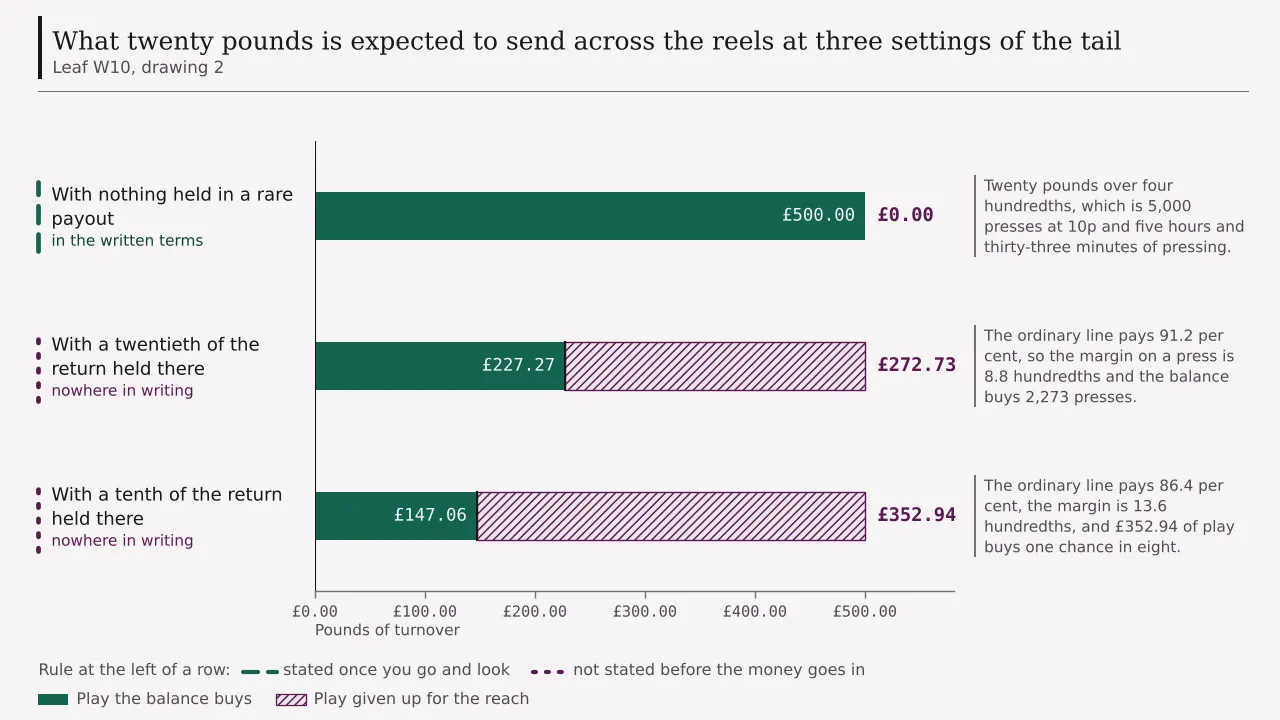
Survival also responds to the stake, and here it agrees with the first criterion rather than fighting it. At 5p a press the same £20.00 buys 10,000 presses instead of 5,000, and at 20p it buys 2,500. Turnover is unchanged at £500.00 in all three cases, because turnover is decided by the balance and the margin alone, which is a result worth holding on to: the stake moves the count of presses and leaves the money untouched.
Which gives the honest summary of this criterion. A reader who wants a balance to last should want a small press and a build with little in its tail, and the second of those two wishes cannot be checked anywhere. The first can be checked on the stake panel in seconds, which makes it the only part of the survival question a reader has any purchase on.
7
The size of an ordinary paying press
The fifth meaning is the quietest and it is the one that decides whether an hour feels worth sitting through. Best is whichever build hands back the most cash on a press that pays at all, leaving aside how often that happens and leaving aside the rare payout entirely.
Part four fixed the relation at a flat return: event rate times average paying press equals the return rate, so at one press in four the ordinary paying press returns 38.4p on a 10p stake. Part five then takes some of that away. With a tenth of the return committed to the large payout, 86.4 per cent is left for the ordinary line, and at the same one press in four the ordinary paying press returns 34.6p rather than 38.4p.
Three point eight pence a paying press sounds negligible and compounds into something that is not. At 900 presses an hour and one press in four paying, an hour holds 225 paying presses, so the difference is £8.64 of cash returned in an hour, against a build whose expected cost for that hour is the identical £3.60 either way. The reader whose build holds a tenth of its return in the tail receives less back per event, every event, for the whole of the sitting.
| Share of the return held in the large payout | One press in three | One press in four | One press in ten | What a sitting looks like |
|---|---|---|---|---|
| None of it | 28.8p | 38.4p | 96.0p | Steady, and nothing memorable in it |
| A twentieth of it | 27.4p | 36.5p | 91.2p | Slightly thinner, with a faint prospect behind it |
| A tenth of it | 25.9p | 34.6p | 86.4p | Noticeably thinner, with a real prospect behind it |
| A fifth of it | 23.0p | 30.7p | 76.8p | Thin throughout, and most balances end before the prospect arrives |
Every figure in that table is the same 96 per cent arranged differently, which is why no row is better than any other in any sense the arithmetic recognises. Reading left to right within a row shows the trade in part four. Reading top to bottom within a column shows the trade in part five. The two trades are independent and a build has to take a position on both.
One point of honesty about this criterion. A reader has more direct evidence on the size of an ordinary paying press than on anything else here, twenty minutes producing a rough sense of it, and a short sample says least about precisely this. A sitting holding two of the better ordinary returns reads as a generous build and is nothing of the sort.
8
All five set against one another in one table
Everything above produces one table and the table is the point of the leaf. Each row takes a criterion and asks what winning on it does to the other four, in the figures this leaf has been using. Where a cell is a cost it says so in pounds or in presses. Where a pair does not trade at all, the cell says that too, because a page claiming everything fights everything would be as unhelpful as one claiming nothing does.
| Winning on this | Does this to the cheapest hour | Does this to the busiest hour | Does this to the reach | Does this to survival | Does this to the ordinary return |
|---|---|---|---|---|---|
| Cheapest hour | The criterion itself, at £1.80 against £3.60 | Halves the events with the pressing | Cuts the cash payout with the stake, £50.00 not £100.00 | Helps it, 10,000 presses not 5,000 | Cuts it with the stake, 19.2p not 38.4p |
| Busiest hour | No effect at all on the hour’s cost | The criterion itself, 62.5 events a pound | No arithmetical effect either way | No effect, turnover being fixed by the margin | Cuts it to a quarter for four times the events |
| Best reach | No effect, the hour costing £3.60 regardless | No direct effect on how often presses pay | The criterion itself, 1 in 10,417 | Costs £352.94 of turnover on £20.00 | Cuts it to 34.6p from 38.4p |
| Longest survival | Helps it, both wanting a smaller press | No effect on events for each pound of cost | Costs the reach entirely at nothing in the tail | The criterion itself, £500.00 of turnover | Raises it, 38.4p rather than 34.6p |
| Largest ordinary return | Raises it with the stake, £7.20 not £3.60 | Costs three quarters of the events | Pushes against holding anything in the tail | Cuts presses to 2,500 at the larger stake | The criterion itself, 96p at one press in ten |
Read down the diagonal and each cell is the criterion stated in its own units, which makes the table self-describing. Read across a row and the costs of winning on that criterion appear in the units of the other four. Read down a column and the same quantity is seen from every other direction, which is where the cells saying no effect earn their place: three of the twenty cells record a genuine independence and the rest record a cost or a help.
Two findings fall out of the table that the parts above did not quite state. The first is that the busiest hour is almost orthogonal to everything except the size of a paying press, so a reader who wants plenty happening pays for it in one currency only and that currency is small returns. The second is that the reach is the most expensive criterion in the list: it costs £352.94 of play on a £20.00 balance and thins every ordinary return by a tenth, and it buys a probability of roughly one in eight within that balance.
The honest use of the table is not to pick a winning row. It is to pick a row knowing what the other four cells in it say, and then to check whichever of the five quantities can actually be checked, which part nine settles and which is a shorter list than the table implies.
9
Which of the five has a published figure behind it
Five criteria, and the count of them with a published quantity behind them is one. Setting that out plainly is the point at which this leaf stops being arithmetic and starts being about what a reader can establish.
The cheapest hour is checkable. It needs the return and the stake panel, both of them one movement from the lobby, plus a pressing rate the reader supplies themselves. The busiest hour needs an event rate, which a build may publish, since the disclosure duty can be satisfied with the odds on winning events in place of a return figure, and which in practice is published rarely. The reach needs a probability nobody prints. Survival needs the share of the return held in the tail, printed by nobody. The ordinary return needs the event rate and the tail share together.
So four of the five criteria rest on quantities settled nowhere in writing, and that is the plain answer to the question this leaf’s search phrase poses. Any ten builds put in an order by one of those four criteria would be ordered on figures nobody could have read, and a reader holds no instrument for telling that case apart from a sound one.
Three British rules bear directly on this leaf’s criteria and they are worth stating because of what they do to the measuring rather than to the outcome. Sound and animation of the celebratory sort are barred on any press whose return fails to exceed the stake laid on it, which means the count of events on the screen is obliged to match the count in part four’s arithmetic. A build may not set out to push anybody into chasing a loss, into a bigger stake, or into carrying on once they have indicated they would rather stop, and a fresh choice is needed each time funds go back in, which is what keeps part six’s balance a fixed quantity. And limit-setting has to be put to a customer as the default choice, at account level, over spans among which a day, a week and a calendar month must all appear, with any reduction landing at once and any rise waiting out a cooling-off period of a day and then a further positive act.
Builds reached through offers in this bracket run on sites holding no Great Britain licence, and on a leaf about criteria the losses worth printing are whichever ones decide whether a criterion can be measured at all. Lose the bar on dressing up a press whose return fails to exceed its stake, and 5p coming back against a 10p press can be presented as an event, so the event rate a reader perceives and the event rate part four computes come apart, and the busiest-hour criterion stops meaning one thing. Lose the bar on pushing somebody into a bigger stake or a longer sitting, and the rule making every top-up its own decision, and part six’s balance stops being a fixed sum while the survival figures describe nobody. Lose limit-setting put as the default choice, with reductions landing at once and rises waiting out a cooling-off day, and the £20.00 at the head of part six becomes whatever the evening makes of it. Not one of those three promises a better return. What they protect is the meaning of the quantities, and a criterion whose quantity has no fixed meaning cannot order anything.
One concession, stated as plainly as the rest. A rulebook published by one offshore regulator and read for this site does require cooling-off periods reachable in a single click and a deposit limit reducible with immediate effect, so on the third of those three the position is closer than a reader might expect. On celebrating a small return and on encouraging a continued sitting it carries nothing, and those two are the ones part four and part six lean on.
10
Settling on a criterion before settling on anything
The method is short because the hard work was done in parts three to eight. Name the criterion first, in a sentence, before looking at any build at all. Then check whichever of its inputs is published, price the ones that are not across a band, and accept that the answer is a range rather than a name.
Step one, write down which of the five questions is being asked. Cheapest hour, busiest hour, best reach, longest survival, largest ordinary return. A reader who cannot pick one has not got a question yet, and a page offering ten of something is offering an answer to whichever of the five the reader supplies silently.
Step two, take the inputs that exist. The return figure and the stake panel are both a movement from the lobby and between them settle the cheapest hour exactly. Where a build publishes the odds on winning events instead of a return, convert: the event rate and the average paying press multiply to the return, so either one plus the return gives the other.
Step three, band the rest. For the tail share, run the figures at nothing, at a twentieth and at a tenth, which gives survival at £500.00, £227.27 and £147.06 of turnover on a £20.00 balance. For the event rate, run one press in three, one in four and one in ten. Printing three answers is not weakness. It is the only honest output where the input is unpublished.
Step four, do the subtraction the site is built on. Print the figure the criterion gives at its best reading, print it at its worst, and rule off the gap. On the reach and survival pair that gives £500.00, £147.06 and £352.94, and the second of those figures is what a reader actually meets where the build they picked holds a tenth of its return in a rare payout.
Two habits keep this from collapsing back into a ranking. Never compare two builds on two different criteria, which is the commonest error on this subject and makes any build look better than any other depending on which cell of part eight’s table is quoted. And label the pressing rate and the tail share inside whichever sentence puts them to work, each time it does, neither having a source and each moving a whole family of figures.
What a reader is left holding is a criterion, one checkable figure, and a band on the rest. That is less than a list of ten and it is the part that survives contact with the arithmetic, because the thing a list of ten was promising was a single answer to a question that has five, and the five pull against each other by amounts this leaf has now printed to the penny.
Questions
- What does best actually mean when applied to an online slot?
- Five different things, each measurable and no two pointing at the same build. Which build makes an hour cost least. Which keeps the most happening in that hour. Which gives the best chance of a payout large enough to change the evening. Which keeps a fixed balance alive longest. And which hands back the most cash on an ordinary press that pays. The five are tied together by arithmetic, so winning on one forces another down by an amount that can be computed exactly.
- How much does an hour at the reels cost?
- £3.60 on this leaf’s settings, which are 900 presses to the hour, a press worth 10p and ninety-six pence coming back for each pound. Nine hundred presses at 10p put £90.00 over the reels in an hour, of which the margin keeps four hundredths. Halve the press to 5p and the hour costs £1.80; double it to 20p and it costs £7.20. The pressing rate of one press every four seconds is this leaf’s own assumption rather than a published floor, and every hourly figure moves in direct proportion to it.
- Can a slot pay often and pay well at the same time?
- No, and the constraint is one line of arithmetic. The proportion of presses that pay anything, multiplied by the average amount returned when one does, equals the return rate. On the settings here the average paid press returns 38.4p where one press in four pays, 28.8p at one in three, 96p at one in ten and £1.92 at one in twenty. Four times the event rate buys exactly a quarter of the event.
- What does a chance at a thousand times the stake cost me?
- £352.94 of play on a £20.00 balance, on this leaf’s working. Give a tenth of the 96 per cent return to a payout of a thousand times the press and its probability is 9.6 points divided by a thousand, which is about one press in 10,417. Everything else then shares 86.4 per cent, so the ordinary margin is 13.6 hundredths rather than four, and £20.00 buys £147.06 of turnover instead of £500.00. The chance of meeting the payout inside that balance is roughly one in eight.
- How long should twenty pounds last at a slot?
- £500.00 of turnover and 5,000 presses at the published 96 per cent, which is five hours and thirty-three minutes at 900 presses an hour. Any sum is expected to send itself divided by the margin over the reels before it has gone, each returned pound being staked a second time. Where a tenth of the return sits in a rare payout the ordinary margin is 13.6 hundredths and the same £20.00 produces 1,471 presses, which is an hour and thirty-eight minutes.
- Does playing at a smaller stake make my balance last longer?
- In presses yes, in money no, and the distinction is worth holding. At 5p a press £20.00 buys 10,000 presses, at 10p it buys 5,000 and at 20p it buys 2,500, while the turnover is £500.00 in all three cases because turnover is decided by the balance and the margin alone. So a smaller press buys more pressing for the same expected loss, and it also cuts what any single payout returns in cash, £50.00 rather than £100.00 on a thousand-times event.
- Which criteria agree with each other rather than fighting?
- One pair, and a few cells of genuine independence. The cheapest hour and the longest-lasting balance both want a smaller press, so they pull together. The busiest hour has no arithmetical effect on the hour’s cost, on survival, or on the reach, because events for each pound of cost depend on the event rate alone. Everything else on the list trades, and the full set of twenty pairings is set out in part eight’s table.
- Why is a thinner ordinary return the price of a big top prize?
- Because both come out of the same 96 pence. Commit a tenth of the return to a payout arriving once in 10,417 presses and 86.4 per cent is left for everything else, so at one press in four the ordinary paying press returns 34.6p rather than 38.4p. At 900 presses an hour with one in four paying, that is 225 paying presses and £8.64 less cash returned across the hour, while the hour’s expected cost stays at £3.60 either way.
- How many of these five can I actually check before playing?
- One. The cheapest hour needs the return and the stake panel, both a movement from the lobby, plus a pressing rate the reader supplies. The busiest hour needs an event rate, which a build may publish because the disclosure duty can be met with the odds on winning events instead of a return figure, and which is published rarely. The reach needs a probability nobody prints, survival needs the share held in the tail, and the ordinary return needs both of those together.
- What protections go missing where builds like these sit outside Great Britain?
- Three that decide whether a criterion can be measured at all. Lose the bar on dressing up a press whose return fails to exceed its stake, and 5p coming back against a 10p press can be presented as an event, so a reader’s count of events and the arithmetic’s count come apart. Lose the bar on pushing somebody into a bigger stake or a longer sitting, and the rule making every top-up its own decision, and a balance stops being a fixed sum. Lose limit-setting put as the default choice, at account level, with reductions landing at once and rises waiting out a cooling-off day, and the starting balance becomes whatever the evening makes of it.
- So how should I choose, if not from a list of ten?
- Name the criterion first, in a sentence, before looking at any build. Then take the inputs that exist: the return figure and the stake panel settle the cheapest hour exactly. Band the rest rather than guessing, running the tail share at nothing, a twentieth and a tenth, which gives survival at £500.00, £227.27 and £147.06 of turnover on £20.00. Print the best reading, print the worst, and rule off the gap. And never compare two builds on two different criteria, which makes any build look better than any other.