Terms read 19 October 2026 Leaf W08, revision 1
Twenty places, four points of spread, and thirty pence between one position and the next
An hour of pressing at 10p sends £144.00 over the reels. Across a four-point band of return rates that hour costs between £2.88 and £8.64, so the whole distance between the two ends of a plausible twenty is £5.76 an hour and one step along it is thirty pence. No titles appear below, and part one explains in arithmetic why putting any there would be the one thing this site exists to avoid.
Stated on the banner £144.00 What an hour of pressing at 10p puts across the reels, which is settled by a stake panel anybody can read. Stated, once you go and look £5.76 The whole span an ordering by published return could move in that hour, across a four-point band this leaf assumes rather than sources. Not stated before the money goes in The criterion Which quantity put twenty in that order, without which the positions carry no information and the span is worth nothing at all.
Reel offers at this end of the market, with their terms read
Every destination in this file is bought advertising. The site is paid a fee if a reader goes on to register, and no figure printed below moves because of it.
Bonus Spins UK Slip 01
Betportal
Ceiling as a multiple
The drop
€15.00
€1.00 in the euro
The claim reads €15.00. Once the terms beside it have applied, €0.00 of it can leave. The difference is the drop.
7 of the 15 terms on this slip could not be read before the money went in
Spins priced at this site's own 10p a spin, which the operator does not publish
Stated
€15.00
The claim as it is printed, before a single term has been applied to it.
Headline paid as spins
150 spins at 10c each, which is €15.00 of the figure above.
6 Nowhere
What one spin is worth
No unit is published for a spin, so the count is priced at this site's own 10p a spin. At half that price every figure below halves with it.
Match and other credit not priced
300% of three deposits, to a ceiling of €1,000. A share of a deposit nobody has made yet is not a sum, so no figure stands on this line and none is carried below.
Qualified
-€14.40
Written down somewhere, and taking part of the claim back. Each term carries the place it is written and the sum it takes.
2 Written terms at a distance this record does not establish
Play-through -€14.40
Carrying €14.40 through 35 times stakes €504.00 and costs €20.16 of it at 96 per cent return. That prices above the €14.40 there is to charge it against, so the whole of the credit goes and the line is held at that. The multiple sits on the bonus.
2 Written terms at a distance this record does not establish
Game weighting not priced
Slots only count towards the play-through. No contribution percentage is published, so the line above has been worked at full weight, which is the kindest reading there is.
2 Written terms at a distance this record does not establish
Ceiling on the winnings not priced
5x the bonus.
2 Written terms at a distance this record does not establish
Clock on the credit not priced
14 days.
2 Written terms at a distance this record does not establish
Largest stake while it runs not priced
€5.
3 Public record
Licence, and who holds it not priced
Licensed in Anjouan, Comoros, held by BetPortal Gaming Ltd, with Excite Ultra Media Ltd, reference ALSI-202601040-FI2. A register entry settles who holds a licence and what it permits. It does not settle who is running the site this morning.
4 Cashier
Smallest qualifying deposit your money
€20 a stage. That is €20.00 of your own money, and it is never netted into a drop.
5 On the way out
Checks before a withdrawal not priced
Documents before the first withdrawal.
Unstated
-€0.60
Applying without having been published anywhere, and costing money all the same.
6 Nowhere
What a spin hands back -€0.60
Staking a spin returns 96 per cent of it, so that share of the batch is the house's before a reel turns. This site works at that return and the operator publishes none where the claim is made.
6 Nowhere
Forfeited by rule cost unknown
Nothing is published under this heading, and it applies regardless.
6 Nowhere
Charge on the way out cost unknown
No charge on the way out is published as a figure, so nothing comes off this line. A charge that exists unpublished would come straight off whatever survives.
6 Nowhere
Smallest withdrawal allowed cost unknown
No smallest withdrawal is published as a figure. A floor nobody has published is still a floor, and it decides whether a small balance can move at all.
No Great Britain licence
Terms read 19 October 2026
Bonus Spins UK Slip 02
WinBeast
Ceiling as a sum
The drop
€50.00
€1.00 in the euro
The claim reads €50.00. Once the terms beside it have applied, €0.00 of it can leave. The difference is the drop.
8 of the 15 terms on this slip could not be read before the money went in
Spins priced at this site's own 10p a spin, which the operator does not publish
Stated
€50.00
The claim as it is printed, before a single term has been applied to it.
Headline paid as spins
500 spins at 10c each, which is €50.00 of the figure above.
6 Nowhere
What one spin is worth
No unit is published for a spin, so the count is priced at this site's own 10p a spin. At half that price every figure below halves with it.
Match and other credit not priced
50% to 100% of five deposits, each to a ceiling of €1,000, and a €650 free bet. A share of a deposit nobody has made yet is not a sum, so no figure stands on this line and none is carried below.
Qualified
-€48.00
Written down somewhere, and taking part of the claim back. Each term carries the place it is written and the sum it takes.
2 Written terms at a distance this record does not establish
Play-through -€48.00
Carrying €48.00 through 40 times stakes €1,920.00 and costs €76.80 of it at 96 per cent return. That prices above the €48.00 there is to charge it against, so the whole of the credit goes and the line is held at that. The multiple sits on the bonus and the winnings from the spins.
2 Written terms at a distance this record does not establish
Game weighting not priced
Slots, titles vary by country count towards the play-through. No contribution percentage is published, so the line above has been worked at full weight, which is the kindest reading there is.
2 Written terms at a distance this record does not establish
Ceiling on the winnings not priced
€100 a batch of spins.
2 Written terms at a distance this record does not establish
Clock on the credit not priced
7 days, spins 1 day.
3 Public record
Licence, and who holds it not priced
Licensed in Curaçao, holder not named on the site. A register entry settles who holds a licence and what it permits. It does not settle who is running the site this morning.
4 Cashier
Smallest qualifying deposit your money
€20 a stage. That is €20.00 of your own money, and it is never netted into a drop.
5 On the way out
Checks before a withdrawal not priced
Documents before the first withdrawal.
Unstated
-€2.00
Applying without having been published anywhere, and costing money all the same.
6 Nowhere
What a spin hands back -€2.00
Staking a spin returns 96 per cent of it, so that share of the batch is the house's before a reel turns. This site works at that return and the operator publishes none where the claim is made.
6 Nowhere
Largest stake while it runs cost unknown
Nothing is published under this heading, and it applies regardless.
6 Nowhere
Forfeited by rule cost unknown
Nothing is published under this heading, and it applies regardless.
6 Nowhere
Charge on the way out cost unknown
No charge on the way out is published as a figure, so nothing comes off this line. A charge that exists unpublished would come straight off whatever survives.
6 Nowhere
Smallest withdrawal allowed cost unknown
No smallest withdrawal is published as a figure. A floor nobody has published is still a floor, and it decides whether a small balance can move at all.
No Great Britain licence
Terms read 19 October 2026
Bonus Spins UK Slip 03
EliteSpin
Longest spin window
The drop
£50.00
£1.00 in the pound
The claim reads £50.00. Once the terms beside it have applied, £0.00 of it can leave. The difference is the drop.
8 of the 15 terms on this slip could not be read before the money went in
Spins priced at this site's own 10p a spin, which the operator does not publish
Stated
£50.00
The claim as it is printed, before a single term has been applied to it.
Headline paid as spins
500 spins at 10p each, which is £50.00 of the figure above.
6 Nowhere
What one spin is worth
No unit is published for a spin, so the count is priced at this site's own 10p a spin. At half that price every figure below halves with it.
Match and other credit not priced
50% to 100% of five deposits, each to a ceiling of £1,000. A share of a deposit nobody has made yet is not a sum, so no figure stands on this line and none is carried below.
Qualified
-£48.00
Written down somewhere, and taking part of the claim back. Each term carries the place it is written and the sum it takes.
2 Written terms at a distance this record does not establish
Play-through -£48.00
Carrying £48.00 through 40 times stakes £1,920.00 and costs £76.80 of it at 96 per cent return. That prices above the £48.00 there is to charge it against, so the whole of the credit goes and the line is held at that. The multiple sits on the bonus and the winnings from the spins.
2 Written terms at a distance this record does not establish
Game weighting not priced
Slots count towards the play-through. No contribution percentage is published, so the line above has been worked at full weight, which is the kindest reading there is.
2 Written terms at a distance this record does not establish
Ceiling on the winnings not priced
5x the bonus.
2 Written terms at a distance this record does not establish
Clock on the credit not priced
7 days, spins 3 days.
3 Public record
Licence, and who holds it not priced
Licensed in Costa Rica, held by PrimeTier Limited. A register entry settles who holds a licence and what it permits. It does not settle who is running the site this morning.
4 Cashier
Smallest qualifying deposit your money
£20 a stage. That is £20.00 of your own money, and it is never netted into a drop.
5 On the way out
Checks before a withdrawal not priced
Documents before the first withdrawal.
Unstated
-£2.00
Applying without having been published anywhere, and costing money all the same.
6 Nowhere
What a spin hands back -£2.00
Staking a spin returns 96 per cent of it, so that share of the batch is the house's before a reel turns. This site works at that return and the operator publishes none where the claim is made.
6 Nowhere
Largest stake while it runs cost unknown
Nothing is published under this heading, and it applies regardless.
6 Nowhere
Forfeited by rule cost unknown
Nothing is published under this heading, and it applies regardless.
6 Nowhere
Charge on the way out cost unknown
No charge on the way out is published as a figure, so nothing comes off this line. A charge that exists unpublished would come straight off whatever survives.
6 Nowhere
Smallest withdrawal allowed cost unknown
No smallest withdrawal is published as a figure. A floor nobody has published is still a floor, and it decides whether a small balance can move at all.
No Great Britain licence
Terms read 19 October 2026
Bonus Spins UK Slip 04
Crown Jewelz
Multiple unpublished
The drop
NOT WORKED
The multiple is not published in the operator's own terms. Since the sum cannot be worked around it, none is worked.
9 of the 14 terms on this slip could not be read before the money went in
No drop worked
Stated
£15.00
The claim as it is printed, before a single term has been applied to it.
Headline paid as spins
150 spins at 10p each, which is £15.00 of the figure above.
6 Nowhere
What one spin is worth
No unit is published for a spin, so the count is priced at this site's own 10p a spin. At half that price every figure below halves with it.
Match and other credit not priced
200% of the first deposit, then 150% twice, each to a ceiling of £1,000. A share of a deposit nobody has made yet is not a sum, so no figure stands on this line and none is carried below.
Qualified
NOT WORKED
Written down somewhere, and taking part of the claim back. Each term carries the place it is written and the sum it takes.
2 Written terms at a distance this record does not establish
Play-through not priced
40x the bonus, reported rather than published by the operator.
2 Written terms at a distance this record does not establish
Game weighting not priced
Slots count towards the play-through. No contribution percentage is published, so the line above has been worked at full weight, which is the kindest reading there is.
3 Public record
Licence, and who holds it not priced
Licensed in Curaçao, number not verified, holder not named on the site. A register entry settles who holds a licence and what it permits. It does not settle who is running the site this morning.
4 Cashier
Smallest qualifying deposit your money
£20. That is £20.00 of your own money, and it is never netted into a drop.
5 On the way out
Checks before a withdrawal not priced
Documents before the first withdrawal.
Unstated
NOT WORKED
Applying without having been published anywhere, and costing money all the same.
6 Nowhere
Ceiling on the winnings cost unknown
No ceiling is published. Nothing is assumed in its place.
6 Nowhere
Clock on the credit cost unknown
Nothing is published under this heading, and it applies regardless.
6 Nowhere
Largest stake while it runs cost unknown
Nothing is published under this heading, and it applies regardless.
6 Nowhere
Forfeited by rule cost unknown
Nothing is published under this heading, and it applies regardless.
6 Nowhere
Charge on the way out cost unknown
No charge on the way out is published as a figure, so nothing comes off this line. A charge that exists unpublished would come straight off whatever survives.
6 Nowhere
Smallest withdrawal allowed cost unknown
No smallest withdrawal is published as a figure. A floor nobody has published is still a floor, and it decides whether a small balance can move at all.
No Great Britain licence
Terms read 19 October 2026
Every figure in the second and third columns is this site's own working and nothing an operator has published. A claim is priced as printed, then the share a spin hands back at 96 per cent return comes off it, then what playing the multiple through costs at the same return, and then whatever a published ceiling, a charge on the way out or a floor on the smallest withdrawal takes from what has survived. The drop is the difference between the first figure and the last. The two columns add back up to it exactly, so no money leaves a slip without a term and a place beside it.
Which column a term falls in is settled by one question: has anybody written it down. A charge a reader meets at the payment screen is written down, and it stands in the second column with the cashier against it. A condition that binds without ever having been set down stands in the third, whatever it costs. Inside each column the terms run outwards from the banner, so the order itself says how far a reader would have had to go.
A count of spins has no unit until one is supplied. Where an operator publishes what one of its own spins is worth, that figure is used and the first column says it is theirs. Where none is published, this site's own 10p a spin stands in its place and every figure below moves in proportion with it. Where the multiple itself is unpublished, no drop is worked at all, because that is the one figure the sum cannot be done without.
Three words stand where a figure cannot. Not priced is a term that is written down and carries no number the arithmetic can take. Cost unknown is a term nobody has written down, costing something nobody has put a number on. Your money is money of the reader's own, which is never netted into a drop.
None of the operators in this file holds a Great Britain licence, so none of the duties that licence carries reaches them. Each of those duties is published in its own right, which is what makes its absence here something a reader can check rather than take on trust. Every gambling company licensed in Great Britain belongs to Gamstop Online, so a reader who has shut themselves out through the scheme is not shut out here. Social Responsibility Code 5.1.1 has held a play-through to a maximum of ten times the bonus funds since 19 January 2026, and it binds a licence holder and nobody else. Asked in a post of 21 October 2025 what is lost along with the licence, the Gambling Commission's Director of Enforcement and Intelligence answered: "unfair gaming practices, financial loss, and a lack of recourse if things go wrong". The same post puts blocked payouts, and withdrawal limits pitched high enough to be unreachable, among the behaviour the Commission has recorded. Nobody under 18 may hold an account at any of them.
Terms are reproduced in the wording their operator published, and each slip is dated with the day somebody sat down and read them. 19 October 2026 is the oldest of those dates. Anybody claiming an offer is bound by that operator's full terms, which are elsewhere, and never by a line standing here.
1
Why no title is printed anywhere on this leaf
A page under this search phrase is expected to carry twenty names in an order, and this one carries none, which is a decision rather than an omission and is worth setting out before any arithmetic. The fact sheet behind this site holds not a single claim about any individual build. What it holds is regulation, claim by claim, every one carrying the source it was read from and the day somebody read it, together with the arithmetic this site works in. About which reel-based build pays what, it is silent, and it is silent because no primary source was found that says so.
That matters because an order is a claim. Putting one name above another asserts that some quantity is larger for the first than for the second, and if the quantity is unnamed, or named and unsourced, the assertion is manufactured. A site whose entire premise is that every claim about an offer is checkable somewhere or is not checkable at all cannot then print twenty positions resting on nothing. The invented figure would sit on the page beside the checkable ones and a reader would have no way to tell them apart, which is the precise failure this site was built to replace.
The site this replaces printed five numbers beside its entries on every guide page it had, the identical five on all of them, and that is what an unsourced ordering looks like once it has been running for a while. Nobody reading those pages could have checked a single one of the five. The honest alternative is not a shorter list or a vaguer one. It is to work on the ordering itself: which published quantities could genuinely put twenty reel builds in a sequence, what each of those quantities does to a reader’s money, and how much distance the whole exercise is capable of producing.
That turns out to be a more useful page than a list would have been, because the answer is small and specific. Across a band this leaf assumes rather than sources, the entire distance between a first position and a twentieth is £5.76 an hour at 10p a press, and the distance between neighbouring positions is thirty pence. Those two figures are the subject of parts three and four, and they are what a reader would be buying if the ordering were sound.
One concession, and it is a real one. Lists of this shape are not useless. A twenty assembled by somebody with access to figures nobody publishes could be perfectly accurate, and a reader has no way to distinguish that list from one assembled by picking names out of a lobby. The complaint here is about what a reader can check, not about what an author might know, and the arithmetic below is the only part of the subject that survives the distinction.
So the structure of this leaf is the ordering stripped of its contents. Part two assembles the quantities a list could honestly be sorted by and says where each one is settled. Parts three to six price them. Part seven prices an order whose criterion is withheld, which is the ordinary case. Parts eight and nine deal with what a licence pins flat and what nobody publishes at all.
2
Seven published quantities that could put twenty in order
Begin with what is genuinely published about a reel build before anybody commits anything. Seven quantities qualify, in the sense that a reader could find them without an account and without a payment. Three of them are on the stake panel or the rules screen, two follow from a rule rather than from the build, and two are presentational figures the build itself carries.
The return percentage comes first and is the one most lists claim to use. It sits in the written terms of the build, by which this leaf means the rules screen reached from the lobby tile, and of the seven quantities it alone attaches directly to the house formula’s own arithmetic. The smallest permitted press comes second and sits on the stake panel, one movement away at most, frequently visible without leaving the lobby at all.
The largest permitted press comes third, and under a British licence it is set by rule rather than by the build, which puts it in a published standard and makes it identical everywhere the rule reaches. The minimum gap between one cycle and the next is fourth and has the same property: a published floor, identical across every licensed build, and therefore incapable of distinguishing one from another.
Fifth is the ceiling a build advertises on what a single press can return, usually written as a multiple of the stake. Sixth is the count of paying lines or ways. Seventh is whatever hit frequency or event probability the build chooses to publish, which is one of the ways the disclosure duty can be discharged and is published far less often than a return figure.
| Quantity a sequence could rest on | Where a reader settles it | What it moves in an hour | Why that figure is the figure |
|---|---|---|---|
| Published return percentage | in the written terms | £5.76 | Four points of an assumed band, on £144.00 of turnover |
| Smallest press the build accepts | £8.64 | Turnover scales straight with the stake, 5p against 20p | |
| Largest press permitted | in a published standard | £282.24 | Only where a reader presses at the ceiling rather than the floor |
| Minimum gap between cycles | in a published standard | £0.00 | One floor, every licensed build, so nothing is separated |
| Advertised ceiling on a single press | in the written terms | £0.00 | Rearranges the return, never adds to it or takes from it |
| Count of paying lines or ways | in the written terms | £0.00 | A division of one press, at an unchanged cost per press |
| Frequency of a paying event | nowhere in writing | £0.00 | Published rarely, and fixed by the return when it is |
Three rows there carry a nought, and those noughts are the result of the work rather than a hole left in it. Two quantities move money in expectation, one moves money only if a reader chooses to use it, and the remaining four change the shape of an hour without changing its price. Parts four to six take each group in turn and show the working, because a nought printed without a derivation is as unhelpful as a score.
3
One hour of pressing, as the unit everything converts into
Seven quantities measured in seven units cannot be compared, so this leaf converts all of them into the cost of an hour. An hour holds 1,440 presses at the quickest a licensed build permits, that count being what the published floor on the gap between cycles leaves room for, and the division is this leaf’s own rather than anything the regulator states. At the 10p press this site assumes throughout, those 1,440 presses send £144.00 across the reels.
Turnover is the quantity every ordering acts on, which is why the hour works as a unit. A return percentage multiplies turnover. A stake multiplies turnover. A ceiling on what one press returns acts on the distribution of the same turnover. Fix the hour and all seven quantities become comparable, in pounds, at the cost of nothing except admitting that the hour itself is an assumption about how somebody plays.
At the 96 per cent this site holds, £144.00 of turnover leaves four pence in each pound with the margin, so the hour is expected to cost £5.76. Move to 98 per cent and the hour costs £2.88. Move to 94 and it costs £8.64. Parts four to six do nothing but arithmetic on that trio, and no further quantity enters.
Two cautions belong with the hour before it is used. The first is that 1,440 presses is a ceiling rather than a description: somebody pausing between presses, reading the screen, or stopping for a minute does fewer, and the money figures fall in exact proportion. The second is that away from a British licence no floor on the gap applies at all, so the same hour can hold rather more presses and the costs rise with the count. Both cautions move every figure on this leaf by the same multiplier and change no comparison between them.
The hour also makes one relation visible that a percentage hides. Four points of return on £144.00 is £5.76, and that figure equals the entire expected cost of the hour at 96 per cent. A reader moving from the foot of an assumed band to its head does not save a fraction of what the hour costs. They save the whole of it, which sounds dramatic until part four puts the same quantity against the twenty positions it has to be shared between.
4
What the distance between the two ends is worth
Take a plausible band first, and label it as this leaf’s own. Nothing primary that this site can cite publishes a distribution of return rates across reel builds, and a figure of that sort invented here would be exactly the thing part one refused. So the band used below runs from 94.0 to 98.0 per cent, four points wide, chosen as a generous width rather than measured, and every figure drawn from it carries that label.
Four points of £144.00 is £5.76. That is the complete distance between a twenty’s first position and its twentieth, in the money a reader actually spends, for one hour of pressing. Over a hundred hours it is £576.00, which is a serious sum, and over an evening of three hundred presses it is £1.20.
An hour read at the top of the band £2.88 The same hour read at its foot £8.64 Everything an ordering by return could move £5.76
Five pounds seventy-six arrives from two directions that share no working, which is how every subtraction here gets its second opinion. Multiply £144.00 by the four points and the answer is £5.76. Or leave turnover out: 1,440 presses, each worth 10p, each carrying four hundredths of spread, and out comes £5.76 a second time. The two agree because the rate enters only once, which is also why the figure scales with pressing and with nothing else whatever.
Now divide it between the positions, which is the step a list never shows. Twenty positions have nineteen gaps between them. Spread four points evenly over nineteen gaps and each gap is 0.2105 of a point, worth 30p of the hour. A reader who correctly identifies the first position rather than the second has gained thirty pence an hour. A reader who gets the first rather than the fifth has gained £1.21.
30p an hour between neighbouring positions, where four points of spread are shared across twenty places
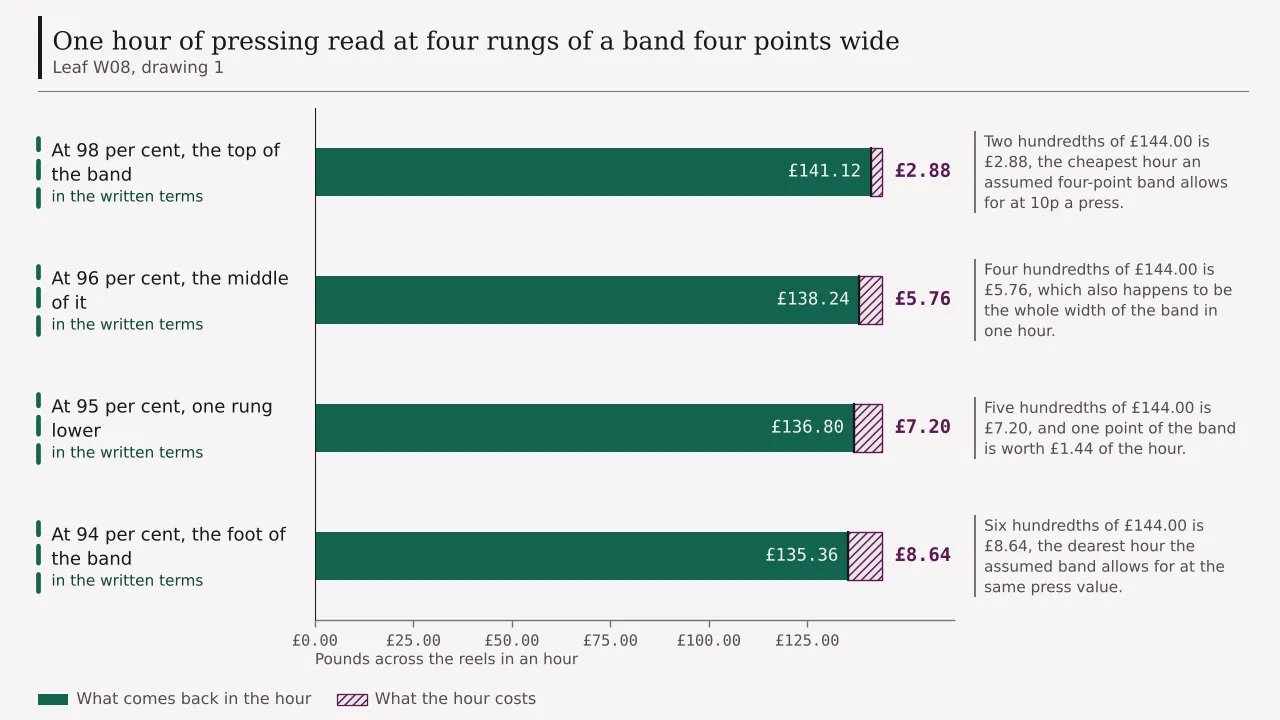
The sliver is the argument. On a bar a hundred and forty-four pounds long, the part any ordering can shift is between two and nine pounds, and a reader choosing a position in a twenty is choosing between slivers that differ from one another by thirty pence. Nothing in that paragraph says the ordering is worthless. It says the ordering is worth thirty pence a position an hour, which is a figure somebody can weigh against the effort of establishing it.
5
The quantity nobody sorts by, which moves more
Set the second published quantity beside the first and the ordering turns over. The smallest press a build will accept is printed on the stake panel, needs no account to read, and is almost never the quantity a list of twenty claims to be sorted by. At a fixed hour of 1,440 presses it moves more money than the whole return band does.
At 5p a press the hour sends £72.00 across the reels and costs £2.88 at 96 per cent. At 10p it sends £144.00 and costs £5.76. At 20p it sends £288.00 and costs £11.52. The distance from the bottom of that range to the top is £8.64 an hour, which is half as much again as the £5.76 the four-point band produced, and every figure in it is readable before a penny moves.
| What is being varied | Cheapest reading | Dearest reading | Distance |
|---|---|---|---|
| Return across four assumed points | £2.88 | £8.64 | £5.76 |
| Smallest press, 5p against 20p | £2.88 | £11.52 | £8.64 |
| Both together, at their kindest and harshest | £1.44 | £17.28 | £15.84 |
Dwell on the bottom row, which is the one honest summary available of what a sequence of twenty could do for a reader at the very top of its range. Pair the kindest return with the smallest press and the hour costs £1.44. Pair the harshest with a press four times the size and it costs £17.28. Twelve times separates the two, and nothing in that twelve comes from a quantity anybody has to withhold.
Why no list sorts on the stake floor is not a mystery and does not need a sinister reading. A press value is a choice the reader makes rather than a property the build advertises, and a sequence built on it would rank builds by how cheaply somebody could play them rather than by anything about the builds themselves. That is a perfectly reasonable editorial decision. It is also the decision that leaves the larger of the two quantities out of the ordering entirely.
One qualification keeps this straight. The stake floor moves the hour only because the hour is fixed at 1,440 presses. A reader who sets out to spend £144.00 rather than to press for an hour meets an identical expected cost whatever the press value, since turnover rather than stake is what the margin acts on. The two framings answer different questions, and the one this part uses is the one in which an hour of somebody’s evening is the fixed quantity.
6
Three figures that sort a list and move nothing
Four of the seven quantities in part two carry a nought in the money column, and three of them are the figures most often reached for when something has to be put in an order. Each nought has a derivation and each derivation is short.
Take the advertised ceiling on what one press can return first, because it is the showiest figure a reel build carries. A build announcing that a press can pay five thousand times the stake and one announcing five hundred may both be specified at 96 per cent, and where they are, the hour costs £5.76 on either. The ceiling decides how the ninety-six pence in the pound is distributed across outcomes, not how many pence there are. It moves a great deal about what an hour feels like and £0.00 about what the hour costs.
The count of paying lines is the second, and the derivation is shorter still. Ten lines at a penny and twenty lines at a halfpenny are the identical 10p press. The number is a statement about how one stake is divided internally, and dividing a stake differently neither adds to turnover nor subtracts from it. Two builds with a tenfold difference in the line count can cost precisely the same £5.76 an hour.
The published frequency of a paying event is the third and needs one extra step. At a fixed return, frequency and size are locked together: if a proportion h of presses returns something and the average return on those presses is m stakes, then h multiplied by m is the return rate. At 96 per cent, a build paying on a quarter of presses pays an average 3.84 stakes when it pays, and one paying on a tenth pays 9.60. A reader ordering twenty by frequency is ordering them by a quantity that has already been priced into the return figure.
The fourth nought belongs to the gap between cycles and is of a different kind. It moves nothing because, under a British licence, the floor is identical for every reel-based build, so no two of them can be separated by it. Where that floor does not apply the quantity comes loose and can differ, at which point it is the one quantity on the list that multiplies every other one, because it decides how many presses an hour actually holds. Part eight takes that up.
Those four noughts are the reason this leaf exists rather than a list. Of seven published quantities a sequence could rest on, two move money in expectation, one moves money only where a reader uses it, and four move none. A list claiming an order without naming the quantity is therefore as likely as not to have been ordered by something in the second group, and a reader has no way of telling which.
7
An order whose criterion is not given, priced
Everything so far assumed the criterion was stated. It usually is not, and the arithmetic of a withheld criterion is the sharpest part of this subject, because it produces an exact figure and the figure is nought.
Suppose a twenty is genuinely ordered by published return, across the four-point band this leaf assumes, and suppose a reader knows that. Taking the top position rather than drawing blind from the twenty gains the distance from the top to the average position, which on an evenly spread band is half the width: two points, worth £2.88 an hour. That is what a stated and sound ordering is worth per hour of pressing.
Now withhold the criterion. The positions are still in some sequence, the reader still sees twenty of them, and the expected gain from taking the top one is the gain from taking any one of them, because nothing distinguishes the sequence from any other sequence as far as the reader can establish. The expected value of the information is £0.00 an hour, and it is nought exactly rather than nought approximately.
So the difference between a list that names its quantity and a list that does not is £2.88 an hour at 10p a press, or £288.00 over a hundred hours. That is a price on a sentence rather than on a figure. One line naming the quantity the sequence rests on, and saying where a reader could check it, converts nought into £2.88 an hour without changing a single position.
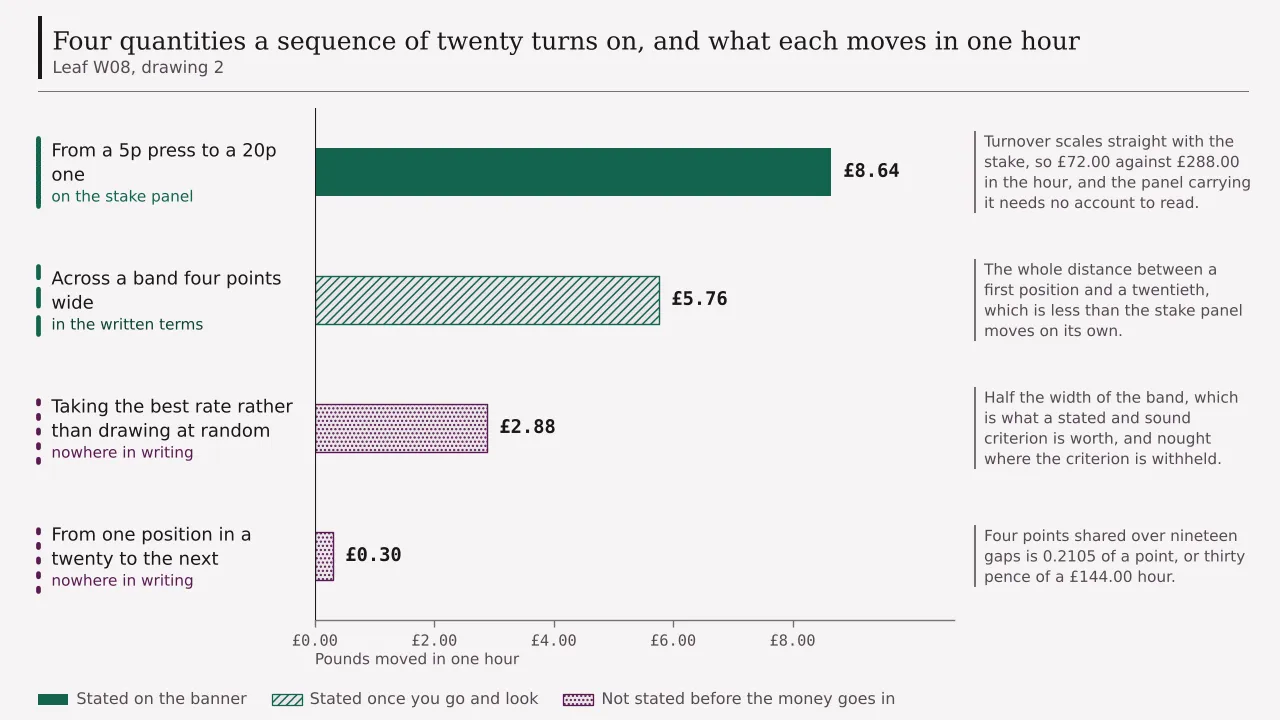
Two honest qualifications belong with the nought. The first is that a sequence may be sound and simply unexplained, in which case the reader is losing £2.88 an hour to a missing sentence rather than to a missing ordering. The second is that a reader who independently checks the return figure of the position they fancy has recovered the whole £2.88 without needing the sequence at all, which is the only action this part points towards.
There is a third case and it deserves naming plainly. Where the sequence rests on something other than a published quantity, the positions are a statement about a commercial arrangement rather than about the builds, and the expected value to the reader is still nought while the expected value to somebody else is not. This leaf cannot tell a reader which of the three cases they are looking at, and neither can the reader, which is the whole of the problem.
8
Quantities a licence holds flat, and what comes loose
Four of the quantities in part two are held in place by rule rather than left to a build, and holding them in place is precisely what stops them ordering anything. That is an unusual thing for a regulation to do and it is worth setting out before the losses, because the losses are the same sentences read backwards.
Start with the ceiling, which a statutory instrument rather than a build decides. No single cycle of a reel game accepts more than £5, and more than £2 where the player is short of twenty-five, and neither ceiling reaches a casino product built on something other than reels. The larger ceiling has applied since 9 April 2025, and six weeks of transition separated it from the smaller, which began on the 21st of the following month. Put the larger against this leaf’s hour and it bites hard: pressing 1,440 times at the ceiling turns over £7,200.00 and is expected to cost £288.00, where the £2 figure gives £115.20.
Three design rules hold the remaining quantities flat. Every cycle needs its own act of commitment from whoever is playing, so nothing presses on anybody’s behalf and automatic pressing stops being a variable at all. No build may hand a player a way of hurrying a result along, which takes turbo and its relatives off the list of things two builds can differ on. And functionality letting several games run together is barred, so an hour cannot be made to hold two hours of pressing.
Whoever advertises reel play in this bracket holds no Great Britain licence, and a leaf about ordering owes its reader the losses that bear on ordering rather than the usual roll-call. Come loose, and a ceiling on one cycle is whatever a build cares to set, so twenty entries may differ by a factor the £5 and £2 figures had removed. Come loose, and the act of commitment owed to every cycle goes with it, leaving a build free to press for somebody. Come loose, and hurrying a result along is permitted, so two builds holding the same return figure need not run at the same speed. Come loose, and several games may share a screen, at which point an hour is no longer a fixed count of presses. Not one of those rules promises anybody a return. Their work is to hold four of the seven quantities constant, and a constant sorts nothing. Take them away and sorting becomes possible and uncheckable in the same movement, no document anywhere carrying the values that would have to be compared.
That is the reversal this part exists to print. Inside the licence, four quantities are flat and a list of twenty can only be ordered by the two or three that remain, each of which is published and checkable. Outside it, all seven come loose, so the number of things a sequence could be ordered by goes up while the number a reader can check goes down, and the £2.88 an hour from part seven becomes harder to earn rather than easier.
One concession keeps the comparison fair. An offshore rulebook read for this site does require a build’s conditions to be put plainly and does bar promotion pitched aggressively, so the ground is not bare. On stake ceilings, on pressing speed, on automatic cycles and on running several games together it holds nothing at all, which is exactly the set this part has been measuring.
9
What would have to be published before twenty could be ordered
Three things have to be in print before an ordering is checkable, and the last of the three is the one routinely left out. Setting them out makes the condition concrete rather than rhetorical, and it also makes plain how close the subject is to being checkable.
The first is the quantity itself, for every entry, in the same unit. Return percentages across twenty builds would do, provided each is the figure for the version actually loaded. One build can carry several specified rates at once, whichever is loaded being a matter between whoever runs the site and whoever supplied the game, with no duty on a lobby to disclose the choice. The published figure then describes a version rather than a session, and any sequence resting on it inherits that.
The second is the date each figure was read. A return figure is stable and a stake panel is not, and a sequence assembled over weeks mixes readings taken at different times without saying so. Any ordering worth checking carries a reading date against each position, in the way this site carries one against every regulatory claim it makes.
The third is the method, stated in one sentence. Which quantity, taken from where, broken which way. Part seven priced the absence of that sentence at £2.88 an hour, and it is the cheapest of the three to supply and the one most often left out. A list that publishes its quantity and its dates and withholds its method has published two thirds of a checkable thing.
Against those three, consider what is never published and would be needed for a richer ordering. The shape of the distribution behind a return figure sits nowhere in writing, so nothing supports an ordering by how long a balance lasts. The share of the return carried by rare outcomes is equally absent, so nothing supports an ordering by the chance of something large. Both of those are what a reader usually means by a better build, and neither has a published quantity behind it anywhere this site can reach.
Which leaves the honest position. Twenty reel builds can be ordered checkably by return, by the smallest press they accept, and by the version-reading dates attached to those two. They cannot be ordered checkably by anything else, and the two that work are worth £5.76 and £8.64 an hour respectively at 10p a press. Everything else a sequence might claim to measure is either a nought from part six or a quantity with no address.
10
What to do with a list of twenty instead
A reader holding a sequence of twenty names has something, and the something is not an order. It is a shortlist, and a shortlist is useful in a way an order is not: it saves the work of finding candidates without making any claim about which is which.
Step one, ignore the positions entirely. Nothing in parts two to seven supports reading a sequence as a ranking of anything unless the quantity is named, and where it is not named the expected value of the sequence is nought. Treating twenty positions as twenty candidates costs nothing and discards no information, because there was none in the order.
Step two, open the rules screen on two or three of them and read the return figure and the stake panel. Both are one movement from the lobby and neither needs an account. That is a minute of work per candidate, and on this leaf’s arithmetic the better of two readings is worth up to £5.76 an hour on return and up to £8.64 on the press value.
Step three, convert what is found into the hour. Presses an hour times the stake gives turnover, turnover times the margin gives the cost. At 1,440 presses, 10p and a four-point margin, the hour is £5.76. The whole method is three multiplications and it answers the only question an ordering was ever going to answer.
Step four, do the subtraction and print both figures. The hour at the better reading, the hour at the worse, and the difference. On the band this leaf assumes that gives £2.88, £8.64 and £5.76, and the middle figure is the one a reader would have paid for the ordering to avoid.
Two habits keep the method from drifting back towards a ranking. Write the band down as an assumption whenever a span is quoted, a span with nothing behind it being a figure nobody can rebuild. And keep the hour and the deposit in separate columns, because a cost per hour and a cost per deposit answer different questions and the second is twenty-five times the first on a balance played through at this margin.
What a reader ends with is narrow and genuinely checkable. Two published quantities, both readable before any commitment, worth a combined £15.84 an hour at the extremes of the readings this leaf assumes. No position, no sequence, and no number anywhere that somebody else had to be trusted for.
Questions
- Why does this page carry no slot names at all?
- Because the fact sheet behind this site holds no claim about any individual build, and an order is a claim. Putting one name above another asserts that some quantity is larger for the first than for the second, and where the quantity is unnamed or unsourced the assertion has been manufactured. On a site whose premise is that every claim about an offer is checkable somewhere or is not checkable at all, an invented sequence would sit beside the checkable figures with nothing to tell them apart.
- What published quantities could put twenty reel builds in an order?
- Seven, and only two of them move money in expectation. The return percentage and the smallest press the build accepts are the two. The largest permitted press moves money only where a reader uses it. The minimum gap between cycles, the advertised ceiling on what one press can return, the count of paying lines and the published frequency of a paying event each move £0.00 an hour, for reasons worked out separately in part six.
- How much is the gap between the top and bottom of a list of twenty worth?
- £5.76 an hour at 10p a press, across a four-point band of return rates this leaf assumes rather than sources. An hour holds 1,440 presses at the quickest a licensed build permits, which is £144.00 of turnover, and four points of £144.00 is £5.76. The same figure appears with no turnover in it: 1,440 presses, each worth 10p, each carrying four hundredths of spread. Two lines sharing no step, one answer.
- What is one position in a list of twenty actually worth?
- Thirty pence an hour. Twenty positions have nineteen gaps between them, so a four-point band spread evenly gives 0.2105 of a point per gap, which is 30p of a £144.00 hour. Getting the first position rather than the fifth is worth £1.21 an hour on the same arithmetic. Those figures are what a reader would be buying if the ordering were sound, and they are small enough to be weighed against the work of checking it.
- Does the maximum win figure a slot advertises change what it costs me?
- Not by a penny in expectation. A build announcing that a press can pay five thousand times the stake and one announcing five hundred may both be specified at 96 per cent, and where they are, an hour costs £5.76 on either. The ceiling decides how the ninety-six pence in the pound is spread across outcomes rather than how many pence there are. It changes a great deal about how an hour feels and £0.00 about what the hour costs.
- Is a list worth anything when it does not say how it was ordered?
- Nought exactly, rather than nought approximately. A stated and sound ordering by return is worth the distance from the top to the average position, which on an evenly spread band is half its width: two points, or £2.88 an hour at 10p. Withhold the criterion and nothing distinguishes that sequence from any other as far as a reader can establish, so the expected gain from taking the top position equals the gain from taking any of them.
- Why is the minimum stake a bigger lever than the return rate?
- Because turnover scales straight with it while the return band is only four points wide. At a fixed 1,440 presses an hour, 5p sends £72.00 across the reels and costs £2.88 at 96 per cent, 10p sends £144.00 and costs £5.76, and 20p sends £288.00 and costs £11.52. The distance is £8.64 an hour against £5.76 for the whole band, and the stake panel carrying it is readable before any account exists.
- Does the number of paylines tell me anything useful?
- Nothing about cost. Ten lines at a penny and twenty lines at a halfpenny are the identical 10p press, so the count describes how one stake is divided internally and dividing a stake differently neither adds to turnover nor takes from it. Two builds with a tenfold difference in line count can cost precisely the same £5.76 an hour. The same holds for a published hit frequency, which at a fixed return is already locked to the average size of a paying press.
- Which rules hold these quantities still inside a British licence?
- Four, and holding them still is what stops them sorting anything. No single cycle of a reel game accepts more than £5, and more than £2 where the player is short of twenty-five, the larger ceiling applying since 9 April 2025 and the smaller from the 21st of the following month. Every cycle needs its own act of commitment from whoever is playing. No build may hand a player a way of hurrying a result along. And functionality letting several games run together is barred.
- What is lost where reel play of this kind sits outside that licence?
- The four quantities just named come loose, which makes ordering possible and uncheckable in the same movement. A ceiling on one cycle becomes whatever a build cares to set, so entries may differ by a factor the £5 and £2 figures had removed. A build is free to press for somebody. Two builds holding the same return figure need not run at the same speed. And an hour stops being a fixed count of presses once several games may share a screen. No document anywhere carries the values that would have to be compared.
- What should I do with a list of twenty slots then?
- Treat it as a shortlist and discard the order, which costs nothing because there was no information in it. Open the rules screen on two or three candidates, read the return figure and the stake panel, and convert what is found into an hour: presses an hour times the stake gives turnover, turnover times the margin gives the cost. At 1,440 presses, 10p and four points that is £5.76. Print the hour at the better reading and at the worse, and rule off the difference.