Terms read 19 October 2026 Leaf R09, revision 1
Live casino UK: two permissions behind one table, and the familiar one is the wrong one
A credit of £50.00 with forty times written over it asks £2,000.00 to pass across a table and settles at an expected minus £30.00. At the shortest round a British standard permits, that is two hours and forty-six minutes of dealing. A recognised name along the lobby moves none of those figures, and this leaf works out why rather than asserting it.
Stated on the banner £50.00 Printed beside a table, with a row of names down the lobby, each of them reading as assurance without being one. Stated, once you go and look £2,000.00 What a multiple of forty asks to pass across a table before the balance converts, closing at an expected minus £30.00 where ninety-six pounds come back for each hundred put across. Not stated before the money goes in One rate, one name What share of each staked pound a table hands to the condition, carried by no document, and which company answers for the address, fixed by no record.
Table offers of this build, with their written terms read
Every destination in this file is bought advertising. The site is paid a fee if a reader goes on to register, and no figure printed below moves because of it.
Bonus Spins UK Slip 01
Betportal
Ceiling as a multiple
The drop
€15.00
€1.00 in the euro
The claim reads €15.00. Once the terms beside it have applied, €0.00 of it can leave. The difference is the drop.
7 of the 15 terms on this slip could not be read before the money went in
Spins priced at this site's own 10p a spin, which the operator does not publish
Stated
€15.00
The claim as it is printed, before a single term has been applied to it.
Headline paid as spins
150 spins at 10c each, which is €15.00 of the figure above.
6 Nowhere
What one spin is worth
No unit is published for a spin, so the count is priced at this site's own 10p a spin. At half that price every figure below halves with it.
Match and other credit not priced
300% of three deposits, to a ceiling of €1,000. A share of a deposit nobody has made yet is not a sum, so no figure stands on this line and none is carried below.
Qualified
-€14.40
Written down somewhere, and taking part of the claim back. Each term carries the place it is written and the sum it takes.
2 Written terms at a distance this record does not establish
Play-through -€14.40
Carrying €14.40 through 35 times stakes €504.00 and costs €20.16 of it at 96 per cent return. That prices above the €14.40 there is to charge it against, so the whole of the credit goes and the line is held at that. The multiple sits on the bonus.
2 Written terms at a distance this record does not establish
Game weighting not priced
Slots only count towards the play-through. No contribution percentage is published, so the line above has been worked at full weight, which is the kindest reading there is.
2 Written terms at a distance this record does not establish
Ceiling on the winnings not priced
5x the bonus.
2 Written terms at a distance this record does not establish
Clock on the credit not priced
14 days.
2 Written terms at a distance this record does not establish
Largest stake while it runs not priced
€5.
3 Public record
Licence, and who holds it not priced
Licensed in Anjouan, Comoros, held by BetPortal Gaming Ltd, with Excite Ultra Media Ltd, reference ALSI-202601040-FI2. A register entry settles who holds a licence and what it permits. It does not settle who is running the site this morning.
4 Cashier
Smallest qualifying deposit your money
€20 a stage. That is €20.00 of your own money, and it is never netted into a drop.
5 On the way out
Checks before a withdrawal not priced
Documents before the first withdrawal.
Unstated
-€0.60
Applying without having been published anywhere, and costing money all the same.
6 Nowhere
What a spin hands back -€0.60
Staking a spin returns 96 per cent of it, so that share of the batch is the house's before a reel turns. This site works at that return and the operator publishes none where the claim is made.
6 Nowhere
Forfeited by rule cost unknown
Nothing is published under this heading, and it applies regardless.
6 Nowhere
Charge on the way out cost unknown
No charge on the way out is published as a figure, so nothing comes off this line. A charge that exists unpublished would come straight off whatever survives.
6 Nowhere
Smallest withdrawal allowed cost unknown
No smallest withdrawal is published as a figure. A floor nobody has published is still a floor, and it decides whether a small balance can move at all.
No Great Britain licence
Terms read 19 October 2026
Bonus Spins UK Slip 02
WinBeast
Ceiling as a sum
The drop
€50.00
€1.00 in the euro
The claim reads €50.00. Once the terms beside it have applied, €0.00 of it can leave. The difference is the drop.
8 of the 15 terms on this slip could not be read before the money went in
Spins priced at this site's own 10p a spin, which the operator does not publish
Stated
€50.00
The claim as it is printed, before a single term has been applied to it.
Headline paid as spins
500 spins at 10c each, which is €50.00 of the figure above.
6 Nowhere
What one spin is worth
No unit is published for a spin, so the count is priced at this site's own 10p a spin. At half that price every figure below halves with it.
Match and other credit not priced
50% to 100% of five deposits, each to a ceiling of €1,000, and a €650 free bet. A share of a deposit nobody has made yet is not a sum, so no figure stands on this line and none is carried below.
Qualified
-€48.00
Written down somewhere, and taking part of the claim back. Each term carries the place it is written and the sum it takes.
2 Written terms at a distance this record does not establish
Play-through -€48.00
Carrying €48.00 through 40 times stakes €1,920.00 and costs €76.80 of it at 96 per cent return. That prices above the €48.00 there is to charge it against, so the whole of the credit goes and the line is held at that. The multiple sits on the bonus and the winnings from the spins.
2 Written terms at a distance this record does not establish
Game weighting not priced
Slots, titles vary by country count towards the play-through. No contribution percentage is published, so the line above has been worked at full weight, which is the kindest reading there is.
2 Written terms at a distance this record does not establish
Ceiling on the winnings not priced
€100 a batch of spins.
2 Written terms at a distance this record does not establish
Clock on the credit not priced
7 days, spins 1 day.
3 Public record
Licence, and who holds it not priced
Licensed in Curaçao, holder not named on the site. A register entry settles who holds a licence and what it permits. It does not settle who is running the site this morning.
4 Cashier
Smallest qualifying deposit your money
€20 a stage. That is €20.00 of your own money, and it is never netted into a drop.
5 On the way out
Checks before a withdrawal not priced
Documents before the first withdrawal.
Unstated
-€2.00
Applying without having been published anywhere, and costing money all the same.
6 Nowhere
What a spin hands back -€2.00
Staking a spin returns 96 per cent of it, so that share of the batch is the house's before a reel turns. This site works at that return and the operator publishes none where the claim is made.
6 Nowhere
Largest stake while it runs cost unknown
Nothing is published under this heading, and it applies regardless.
6 Nowhere
Forfeited by rule cost unknown
Nothing is published under this heading, and it applies regardless.
6 Nowhere
Charge on the way out cost unknown
No charge on the way out is published as a figure, so nothing comes off this line. A charge that exists unpublished would come straight off whatever survives.
6 Nowhere
Smallest withdrawal allowed cost unknown
No smallest withdrawal is published as a figure. A floor nobody has published is still a floor, and it decides whether a small balance can move at all.
No Great Britain licence
Terms read 19 October 2026
Bonus Spins UK Slip 03
EliteSpin
Longest spin window
The drop
£50.00
£1.00 in the pound
The claim reads £50.00. Once the terms beside it have applied, £0.00 of it can leave. The difference is the drop.
8 of the 15 terms on this slip could not be read before the money went in
Spins priced at this site's own 10p a spin, which the operator does not publish
Stated
£50.00
The claim as it is printed, before a single term has been applied to it.
Headline paid as spins
500 spins at 10p each, which is £50.00 of the figure above.
6 Nowhere
What one spin is worth
No unit is published for a spin, so the count is priced at this site's own 10p a spin. At half that price every figure below halves with it.
Match and other credit not priced
50% to 100% of five deposits, each to a ceiling of £1,000. A share of a deposit nobody has made yet is not a sum, so no figure stands on this line and none is carried below.
Qualified
-£48.00
Written down somewhere, and taking part of the claim back. Each term carries the place it is written and the sum it takes.
2 Written terms at a distance this record does not establish
Play-through -£48.00
Carrying £48.00 through 40 times stakes £1,920.00 and costs £76.80 of it at 96 per cent return. That prices above the £48.00 there is to charge it against, so the whole of the credit goes and the line is held at that. The multiple sits on the bonus and the winnings from the spins.
2 Written terms at a distance this record does not establish
Game weighting not priced
Slots count towards the play-through. No contribution percentage is published, so the line above has been worked at full weight, which is the kindest reading there is.
2 Written terms at a distance this record does not establish
Ceiling on the winnings not priced
5x the bonus.
2 Written terms at a distance this record does not establish
Clock on the credit not priced
7 days, spins 3 days.
3 Public record
Licence, and who holds it not priced
Licensed in Costa Rica, held by PrimeTier Limited. A register entry settles who holds a licence and what it permits. It does not settle who is running the site this morning.
4 Cashier
Smallest qualifying deposit your money
£20 a stage. That is £20.00 of your own money, and it is never netted into a drop.
5 On the way out
Checks before a withdrawal not priced
Documents before the first withdrawal.
Unstated
-£2.00
Applying without having been published anywhere, and costing money all the same.
6 Nowhere
What a spin hands back -£2.00
Staking a spin returns 96 per cent of it, so that share of the batch is the house's before a reel turns. This site works at that return and the operator publishes none where the claim is made.
6 Nowhere
Largest stake while it runs cost unknown
Nothing is published under this heading, and it applies regardless.
6 Nowhere
Forfeited by rule cost unknown
Nothing is published under this heading, and it applies regardless.
6 Nowhere
Charge on the way out cost unknown
No charge on the way out is published as a figure, so nothing comes off this line. A charge that exists unpublished would come straight off whatever survives.
6 Nowhere
Smallest withdrawal allowed cost unknown
No smallest withdrawal is published as a figure. A floor nobody has published is still a floor, and it decides whether a small balance can move at all.
No Great Britain licence
Terms read 19 October 2026
Bonus Spins UK Slip 04
Crown Jewelz
Multiple unpublished
The drop
NOT WORKED
The multiple is not published in the operator's own terms. Since the sum cannot be worked around it, none is worked.
9 of the 14 terms on this slip could not be read before the money went in
No drop worked
Stated
£15.00
The claim as it is printed, before a single term has been applied to it.
Headline paid as spins
150 spins at 10p each, which is £15.00 of the figure above.
6 Nowhere
What one spin is worth
No unit is published for a spin, so the count is priced at this site's own 10p a spin. At half that price every figure below halves with it.
Match and other credit not priced
200% of the first deposit, then 150% twice, each to a ceiling of £1,000. A share of a deposit nobody has made yet is not a sum, so no figure stands on this line and none is carried below.
Qualified
NOT WORKED
Written down somewhere, and taking part of the claim back. Each term carries the place it is written and the sum it takes.
2 Written terms at a distance this record does not establish
Play-through not priced
40x the bonus, reported rather than published by the operator.
2 Written terms at a distance this record does not establish
Game weighting not priced
Slots count towards the play-through. No contribution percentage is published, so the line above has been worked at full weight, which is the kindest reading there is.
3 Public record
Licence, and who holds it not priced
Licensed in Curaçao, number not verified, holder not named on the site. A register entry settles who holds a licence and what it permits. It does not settle who is running the site this morning.
4 Cashier
Smallest qualifying deposit your money
£20. That is £20.00 of your own money, and it is never netted into a drop.
5 On the way out
Checks before a withdrawal not priced
Documents before the first withdrawal.
Unstated
NOT WORKED
Applying without having been published anywhere, and costing money all the same.
6 Nowhere
Ceiling on the winnings cost unknown
No ceiling is published. Nothing is assumed in its place.
6 Nowhere
Clock on the credit cost unknown
Nothing is published under this heading, and it applies regardless.
6 Nowhere
Largest stake while it runs cost unknown
Nothing is published under this heading, and it applies regardless.
6 Nowhere
Forfeited by rule cost unknown
Nothing is published under this heading, and it applies regardless.
6 Nowhere
Charge on the way out cost unknown
No charge on the way out is published as a figure, so nothing comes off this line. A charge that exists unpublished would come straight off whatever survives.
6 Nowhere
Smallest withdrawal allowed cost unknown
No smallest withdrawal is published as a figure. A floor nobody has published is still a floor, and it decides whether a small balance can move at all.
No Great Britain licence
Terms read 19 October 2026
Every figure in the second and third columns is this site's own working and nothing an operator has published. A claim is priced as printed, then the share a spin hands back at 96 per cent return comes off it, then what playing the multiple through costs at the same return, and then whatever a published ceiling, a charge on the way out or a floor on the smallest withdrawal takes from what has survived. The drop is the difference between the first figure and the last. The two columns add back up to it exactly, so no money leaves a slip without a term and a place beside it.
Which column a term falls in is settled by one question: has anybody written it down. A charge a reader meets at the payment screen is written down, and it stands in the second column with the cashier against it. A condition that binds without ever having been set down stands in the third, whatever it costs. Inside each column the terms run outwards from the banner, so the order itself says how far a reader would have had to go.
A count of spins has no unit until one is supplied. Where an operator publishes what one of its own spins is worth, that figure is used and the first column says it is theirs. Where none is published, this site's own 10p a spin stands in its place and every figure below moves in proportion with it. Where the multiple itself is unpublished, no drop is worked at all, because that is the one figure the sum cannot be done without.
Three words stand where a figure cannot. Not priced is a term that is written down and carries no number the arithmetic can take. Cost unknown is a term nobody has written down, costing something nobody has put a number on. Your money is money of the reader's own, which is never netted into a drop.
None of the operators in this file holds a Great Britain licence, so none of the duties that licence carries reaches them. Each of those duties is published in its own right, which is what makes its absence here something a reader can check rather than take on trust. Every gambling company licensed in Great Britain belongs to Gamstop Online, so a reader who has shut themselves out through the scheme is not shut out here. Social Responsibility Code 5.1.1 has held a play-through to a maximum of ten times the bonus funds since 19 January 2026, and it binds a licence holder and nobody else. Asked in a post of 21 October 2025 what is lost along with the licence, the Gambling Commission's Director of Enforcement and Intelligence answered: "unfair gaming practices, financial loss, and a lack of recourse if things go wrong". The same post puts blocked payouts, and withdrawal limits pitched high enough to be unreachable, among the behaviour the Commission has recorded. Nobody under 18 may hold an account at any of them.
Terms are reproduced in the wording their operator published, and each slip is dated with the day somebody sat down and read them. 19 October 2026 is the oldest of those dates. Anybody claiming an offer is bound by that operator's full terms, which are elsewhere, and never by a line standing here.
1
Two permissions behind one table, and the familiar one is the wrong one
Any dealt table reaching a screen has at least two parties behind it, and British licensing treats them as two separate things. One party produces the table: the studio, the camera, the shoe, the wheel, the software that settles the round. The other party collects the money, holds the balance, drafts the conditions and deals with a complaint when one arrives. Those two can be the same company and very often are not.
Both can hold a permission. Permissions for supplying gambling software exist alongside permissions for running remote casino, and the rulebook keeps them apart deliberately rather than by accident. Part three sets out five separate conditions whose own scope lines carve the software side out by name, and that carving is not an oversight. It reflects what the two parties actually do.
Which means the name a reader recognises on a lobby, in the overwhelming majority of cases, belongs to the party the player has no contractual relationship with and whose permission carries none of the duties the player is relying on. The money goes elsewhere. The terms are written elsewhere. The complaint is answered elsewhere. The familiar name is attached to the one half of the arrangement that is not holding anything of the reader’s.
Here is the sentence this whole part of the site is built to carry, said through this leaf’s own subject. A row in a public record fastens a permission to a company and enumerates what that permission covers. It does not establish which party is running an address on a given morning. A lobby full of recognisable artwork is silent on exactly the same question, with the difference that the record is honest about its silence and the lobby is not.
The arithmetic underneath all of this is a single worked arrangement, used from here to the end so that nothing gets smuggled in. A credit of £50.00 attached to table play. Forty times written over it where nothing caps the multiple. A round costing £1.00. A return pitched at ninety-six pounds for each hundred staked. A table counting a whole pound in the pound until part seven takes that apart. Everything in that list bar the credit itself is assumed by this site rather than observed, and no source consulted fixes any of them for a particular table.
What follows splits in two. Parts two to five establish what a recognised name can and cannot settle, including the part a reader finds hardest to give up, which is the visible human being. Parts six to nine do the money and the hours. Part ten compresses it into something usable against a lobby nobody has written about.
2
What a recognised mark on a lobby settles, line by line
Work through what a familiar name on a tile actually supports, and keep the list honest in both directions, because an over-stated criticism of a lobby is as useless as an over-stated trust in it.
It does support two things. The build running in that frame was produced by somebody whose output a reader has seen elsewhere, which is a genuine statement about the origin of the software and the look of the table. And where that producer holds a British permission to supply gambling software, a set of technical obligations attaches to the producer in respect of what it supplies.
It supports nothing at all about the address. Not who holds the balance. Not which company’s terms govern the credit. Not whether the multiple written over that credit is capped by anything. Not who answers if a payment stops. Not whether a complaint has an outside route at the end of it. Not whether the national self-exclusion scheme reaches the account.
| What a reader takes from the name | Where that is really settled | Does the name support it |
|---|---|---|
| The build came from a recognisable producer | Yes, and this is the whole of what it supports | |
| The producer holds some permission somewhere | in the public register | Only once a row has been found and read |
| The address holds a permission | in the public register | No, and the two questions are unrelated |
| The multiple over the credit is capped | in the published rules | No, since the cap follows the address |
| A withdrawal floor will let a balance out | at the cashier | No, and it appears no earlier than payment |
| Paperwork was asked for at the right moment | on the way out | No, and the sequence belongs to the address |
| The table counts fully towards the condition | nowhere in writing | No, and nothing anywhere settles this |
One row out of seven is supported outright, and it is the row about artwork. Two more become answerable after somebody opens a record, and the four beneath them are properties of an address, a payment screen, an exit or a silence. The familiar name answers the least consequential question on the list, which is why it works so well as reassurance.
None of that is an accusation against any producer. A producer licences its output to whoever contracts for it, and its name appearing in a lobby is the ordinary result of a commercial arrangement rather than a statement about the lobby. The failure, where there is one, is in the reading rather than in the tile.
3
Five conditions drafted to leave the supplier outside them
Here is the sharpest available demonstration that supply and operation are different things, and it needs no inference at all, because it is printed in the scope line of each condition. Five obligations a player would want all exclude a permission for supplying gambling software by name.
The condition on fair and transparent terms, which wants contract terms transparent and within easy reach, lifts the software permission out. The condition on verifying who a customer is before any play happens lifts it out. The bar on taking payment by credit card lifts it out. The code provision governing incentives, under which the terms of a reward have to be clear, transparent, fair and reachable, lifts it out. And the ceiling of ten times on a play-through, carried by that same code provision, lifts it out too.
Five scope lines, one consistent carve-out. The drafting is doing something coherent: obligations about a customer’s money, a customer’s identity and a customer’s contract are placed on whoever has the customer, and a party that supplies a build has no customer in that sense. A reader who takes the supplier’s permission as covering any of those five has read a permission for one thing as a permission for another.
Put a number against the shape of the record while this is fresh. At the end of March 2026 the regulator counted 3,097 permitted activities across 2,154 licensees, and subtracting one from the other leaves 943 activities beyond a single one apiece. Subtracting like that is a piece of arithmetic this leaf performs on two published totals, and what falls out of it is that permissions and companies do not pair off one for one. Reading a company name is not reading a permission, and reading one permission is not reading the others.
943 permitted activities beyond one each across 2,154 licensees, on figures published for 31 March 2026
The consequence for a live lobby is exact rather than rhetorical. Suppose every build in a lobby comes from producers holding British software permissions, and suppose each of those producers is in perfect compliance with everything that binds it. Not one of the five conditions above has thereby been satisfied for the reader, because not one of the five was ever pointed at a producer. All five follow the address, and the address is what part ten sends a reader to check.
4
A warning notice, a settlement, and six addresses nobody had licensed
Nothing about that separation is theoretical, and the published record settles it twice. A dated notice to the industry, issued 20 January 2025, put on record that games from licensed suppliers had been found running at addresses nobody had licensed. The same notice lists what an address of that sort can mean for whoever uses it: anti-money-laundering and social responsibility controls that may not be adequate, openings for fraud, difficulties over the privacy of data, practices that are unfair, and a habit of going after customers who have already shut themselves out through the national scheme.
Then the money, eighteen months later. 23 July 2026 carries an agreement by a supplier to pay £4.75m, the regulator having found that its games had surfaced at half a dozen addresses holding no licence and reachable by people in Great Britain. Visits came in large volumes over a stretch the release puts between December 2023 and November 2024. Three failings sat behind the sum: one on identifying and assessing how much risk of money laundering and terrorist financing it faced, one on keeping controls effective enough that its games did not reach British players by way of operators without licences, and one on due diligence towards customers. Weakness serious enough that suspending a licence was considered is how the regulator’s enforcement director put it.
Read the settlement for what it fixes about lobbies rather than for what it says about anybody’s conduct. Software made under a British permission was running at addresses carrying none, and it ran there long enough to gather visits in quantity over the best part of a year. Whoever arrived at an address of that kind saw a familiar table under a familiar name. The name was accurate. What got inferred from it was not.
The structural lesson is one line and it is worth carrying everywhere on this site. A permission travels with the party that holds it, and a product travels with whoever contracts for it, and the two travel along different routes. A reader standing at an address sees the product. The permission sits in a record somewhere else, and that record is the only place where one may be held up against the other.
Price what a reader who took the mark as assurance was actually relying on. They relied on a party carved out of the five conditions in part three, whose compliance obligations run towards the regulator rather than towards them, and whose output has been found at addresses the record knew nothing about. What they believed they were holding was a statement about the address. That distance is the subject of this entire leaf, and the three parts after the middle put pounds and hours against it.
5
A camera shows a person, and a person carries none of the fields
A dealt table is the one product in this subject where a reader can watch a human being do the thing. Cards leave a shoe. A wheel is spun by a hand. Someone says good evening. That is a genuinely different experience from a reel, and the question worth working out is what the difference establishes rather than how it feels.
Start from what a visible person does settle, because something is settled and pretending otherwise would be dishonest. A physical deal is happening somewhere. The outcome of this particular round was produced by a physical process in front of a camera rather than by a number generator. Continuity between rounds is observable. Those are real and they are not nothing.
Now set them against the fields a record carries, one at a time, and the mismatch is total. The person does not establish which company holds the balance. The person does not establish which permissions that company has. The person does not establish whether the address is recorded against any of them. The person does not establish what the terms say, what the exit floor is, or who answers a complaint. The studio the person stands in may be operating under a permission held on the other side of a contract from the address a reader is signed into.
Camera and record therefore answer two sets of questions that do not overlap, and the camera’s set holds nothing costing money. One test makes that concrete: name one figure on this leaf that would change if the dealer were replaced by a different dealer at a different table in a different studio. The credit stays £50.00. The staking asked stays £2,000.00. The expected close stays minus £30.00. The hours in part eight stay where they are. Not one figure moves.
Now run the test the other way. Name one figure that would change if the record showed a permission covering remote casino, recorded against the exact address. The multiple would be capped at ten times, minus £30.00 would turn into £30.00 as the expected close, putting £60.00 between the two readings of a face worth fifty pounds. The camera moves nothing and the row moves more than the credit is worth.
The intuition points the opposite way for a reason, and naming that reason is better than mocking it. Seeing a person is the ordinary human test for whether something is real, and it works almost everywhere else. It fails here because the thing in doubt was never whether the table was real. The thing in doubt is who is holding the money, and no camera has ever been pointed at that.
6
Fifty pounds across a table counting pound for pound
Take the arrangement from part one and run it. A credit of £50.00, a multiple of forty written over it in the bonus terms, a table giving up a whole pound for each pound staked, and ninety-six pounds coming back for every hundred. Those last two settings are this site’s own, no source consulted having fixed either figure for a dealt table.
Forty applied to £50.00 puts £2,000.00 across the table before the balance converts into money. The house margin, four in a hundred, lifts £80.00 out of £2,000.00 as it goes through. Hold that £80.00 up against a credit of fifty pounds and the expected close shows minus £30.00.
Reach the identical number along a route that never writes £2,000.00 down, one figure arriving twice being the only audit this arithmetic can be given. Forty multiplied by a margin of four in a hundred comes out at 1.6 credits demanded where a single credit is all there is. Six tenths of a credit therefore goes missing, six tenths of fifty pounds is £30.00, and that £30.00 comes from somewhere other than the offer. Both routes stop on one number, as they are bound to, a clause of this shape moving staked money to the margin at a steady rate and doing nothing besides.
Credit as the table offer prints it £50.00 Expected close once forty times has run minus £30.00 Taken out by one line in a second document £80.00
Eighty pounds is what the margin lifts out of £2,000.00, and it is equally the fall from £50.00 to minus £30.00. Both statements describe one quantity, and a leaf printing only one of them would be asking to be trusted rather than checked.
Now the register’s own contribution, which is the £60.00 from part five worked properly. Where a permission covering remote casino is recorded against the address, the multiple cannot exceed ten times the bonus money, a limit binding since 19 January 2026. Ten applied to £50.00 asks £500.00 across the table, the margin lifts £20.00 of that, and the expected close is £30.00 rather than minus £30.00.
Expected close where a published cap reaches it £30.00 Expected close where no cap reaches it minus £30.00 Decided by a row, and by no name on a tile £60.00
Verify the £60.00 along the second route before leaning on it. The two readings stand thirty multiples apart, which on a £50.00 credit puts a further £1,500.00 over the table, and four in every hundred of that comes to £60.00. Subtraction and multiplication stop together, so the figure can be printed.
7
The share a table hands over, which is published nowhere
Everything in part six assumed a table counts pound for pound towards the condition, and that assumption is the most generous one available. A table of contribution rates by product appears in no primary source this site consulted, and no rule found anywhere requires one to exist. So the quantity applies, decides a great deal, and is settled nowhere in writing.
Work the arithmetic at settings this leaf chooses itself, and label them as such every time one is spent. Where a table hands over half of each staked pound, the £2,000.00 becomes £4,000.00 before the condition is satisfied, the margin lifts £160.00, and the expected close falls to minus £110.00. Where it hands over a tenth, the requirement reaches £20,000.00, the margin lifts £800.00, and the expected close is minus £750.00 against a credit with a face of fifty pounds.
Check the half-rate line along the second route, as before. Divide the multiple by the share and an effective eighty appears; eighty against a margin of four in a hundred gives 3.2 credits demanded against one credit held, so 2.2 credits go missing, and 2.2 lots of fifty pounds is £110.00. The staking route and the scaling route agree, so the number stands.
| Share the table hands over | Where the figure comes from | Staking required | Margin taken | Expected close on £50.00 |
|---|---|---|---|---|
| A pound in the pound | This leaf’s most generous setting | £2,000.00 | £80.00 | minus £30.00 |
| Half a pound in the pound | This leaf’s own illustrative setting | £4,000.00 | £160.00 | minus £110.00 |
| A fifth of a pound | This leaf’s own illustrative setting | £10,000.00 | £400.00 | minus £350.00 |
| A tenth of a pound | This leaf’s own illustrative setting | £20,000.00 | £800.00 | minus £750.00 |
A factor of ten in an unpublished quantity moves the expected close from minus £30.00 to minus £750.00 on an unchanged credit of £50.00, which is a range of £720.00 sitting underneath a figure printed as though it were simple. Every row of that table describes the same advertisement. None of them contradicts it.
Direction is the thing to take from the table rather than any particular row. Each unpublished quantity on this site runs the same way: the reading a reader can see is the best one, and every setting the document does not state can only make it worse. That is a pattern rather than a coincidence, and it is the reason a figure computed at full contribution should always be labelled as a ceiling.
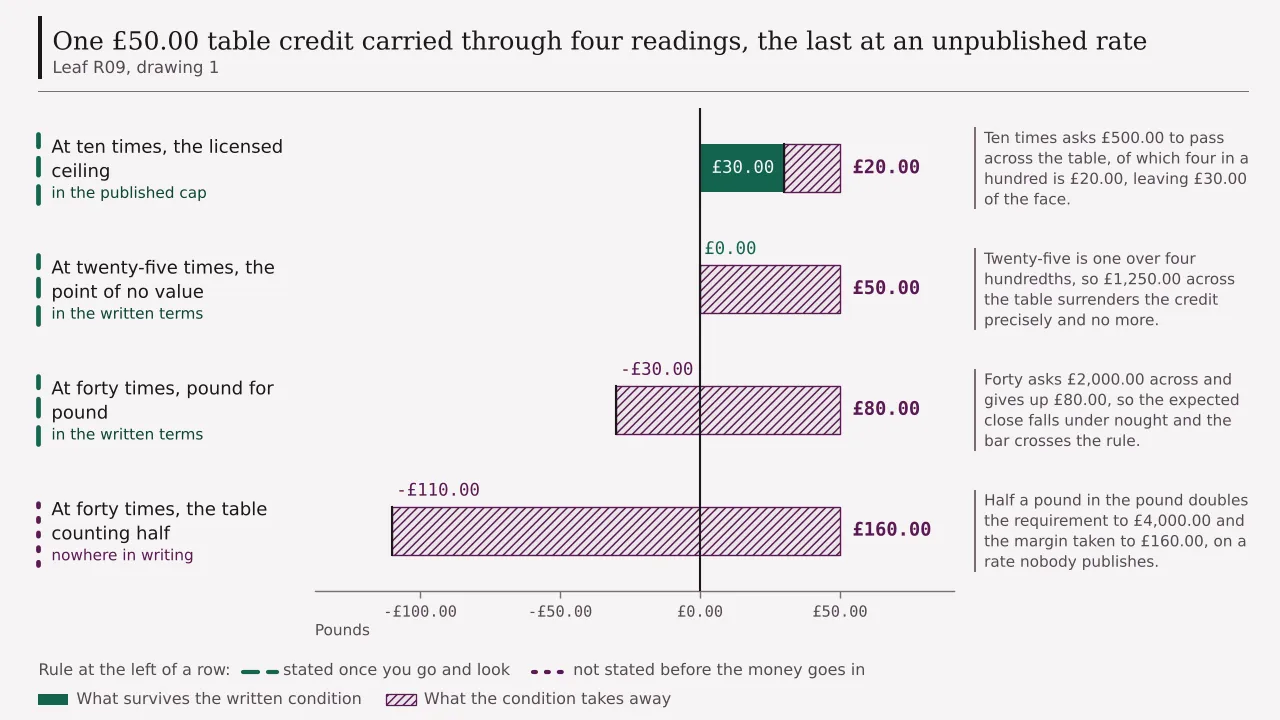
The bottom bar of that drawing is the only one whose cut comes from a quantity no document anywhere carries. Two of the bars above it are cut by a written multiple, and the top one is cut by a published ceiling. Three places, four bars, and the deepest cut belongs to the place with no address.
8
Five seconds a round, and the hours a condition really asks
A play-through is a quantity of money, but it is spent at a rate, and the rate turns it into a quantity of time. On a dealt table inside the British licence there is a floor under that rate, and it is the one place on this leaf where a technical standard does real arithmetical work rather than decorating a paragraph.
Five seconds is the shortest a dealt round may be, measured from the start of one game cycle until the next one is allowed to begin. The rule covers casino play that is not a slot and leaves peer-to-peer poker aside, and it started applying on 17 January 2025. That date comes off the regulator’s list of updates, since the standard holding the rule puts no commencement against anything in it at all.
Now fold it into the sum. At £1.00 a round, which is this leaf’s own stake assumption and not a published minimum for any table, satisfying £2,000.00 takes 2,000 rounds. Two thousand rounds held to five seconds apiece makes 10,000 seconds, and 10,000 seconds is two hours and forty-six minutes of dealing without a break before the balance converts into anything at all. Nobody is obliged to deal faster, and that floor is the only published bound on the whole exercise.
| Share the table hands over | Staking required | Rounds at £1.00 | Seconds at the five-second floor | Time that represents |
|---|---|---|---|---|
| A pound in the pound | £2,000.00 | 2,000 | 10,000 | 2 hours 46 minutes |
| Half a pound in the pound | £4,000.00 | 4,000 | 20,000 | 5 hours 33 minutes |
| A fifth of a pound | £10,000.00 | 10,000 | 50,000 | 13 hours 53 minutes |
| A tenth of a pound | £20,000.00 | 20,000 | 100,000 | 27 hours 46 minutes |
The bottom row is longer than a day. A condition written in one line over a credit of fifty pounds has, at an unpublished contribution rate this leaf chose for illustration, asked for more than twenty-four hours of uninterrupted dealing at a pound a round, and the expected close at the end of it is minus £750.00. The clause that produced that says nothing about hours anywhere in its wording.
Here is the twist that makes the floor interesting rather than merely restrictive. Outside the British licence no five-second floor exists at all, so a table there may deal as fast as the arrangement allows. Faster dealing does not improve the expected close by a penny, the margin being a rate per pound rather than per minute. It compresses the hours. So the protection the floor provides is not financial, and removing it does not cost the reader money. It costs them the pause.
Say the honest thing about what the floor is for, since this leaf has worked it out rather than borrowed it. A minimum interval is a brake on how quickly a decision can be repeated, and the sums above show that the brake and the arithmetic are independent quantities. A reader who wanted the brake has lost it beyond the licence. A reader who wanted the £80.00 back never had the brake as a remedy for that in the first place.
9
What a table beyond the licence stops being bound by
Table offers put together at this end of things come from companies carrying no Great Britain licence whatever, and the obligations worth naming on a leaf about dealt play are the ones written about the conduct of a game in progress. Other protections matter and get priced on neighbouring leaves. These are the ones a table is the natural home for.
The five-second floor from part eight is the first, and part eight has already costed it: it governs the hours rather than the pounds, and 10,000 seconds becomes whatever the dealing allows. Second comes the bar on a system handing a customer the means to run more than one game concurrently, which in a lobby of dealt tables means no seat at a second, third and fourth table while the first is live. Beyond the licence nothing forbids that, and a reader seated at four tables meets the 10,000 seconds in a quarter of the time while the arithmetic of each is untouched.
Third comes the requirement that a game holds still while it is being played. Its payouts, its rules and the probabilities underneath them are all fixed for the duration, and an alteration, where one is made, has to be set before the customer. Guidance behind that requirement refuses one drafting outright: a term reserving the right to alter a game’s rules whenever the operator likes. Past the licence, a term drafted precisely that way binds whoever accepted it.
Fourth and fifth are about what a player can read. Before anybody commits, an explanation of the rules in force has to be within easy reach, correct, and full enough to account for every one of them. And while a game runs, whatever lets a customer follow its present state has to be on the screen. On a dealt table those two are the difference between watching a game and watching a video.
One admission cuts against this leaf’s own case, and it belongs in the body rather than in small type. The stake caps of £5 and £2 and the two-and-a-half-second minimum are rules about slots and reach no other casino game, so they never applied to a dealt table even inside the licence. A page claiming those as losses on a page about tables would be inflating the bill, and the four obligations above are the honest list.
Price that set against the worked arrangement and the division comes out clean. Nothing on the list moves the £80.00, since none of it touches a multiple or a margin. What they govern is the conduct of play: how fast, how many at once, whether the rules can shift underneath a round, and how much a player can see while it runs. The £60.00 in part six is the figure that does turn on the licence, and it turns on it through the ceiling rather than through any obligation about conduct.
One further consequence follows from the same absence. The national scheme that closes accounts across operators rides on the British licence, so an address beyond that licence sits beyond the scheme too, a limit the scheme spells out in the terms governing its own use instead of letting anybody find it the hard way. The warning notice in part four recorded that addresses of that sort frequently seek out people who have already registered. Somebody in that position is better served by the helpline details printed at the foot of this leaf than by a lobby.
10
Reading a lobby for what it establishes, which is less than it looks
The procedure here is deliberately short, because the finding of this leaf is that most of what a lobby displays is not evidence and only one check produces any. It needs no account and no payment.
First, ignore the tiles. Every name along a lobby is a statement about who produced a build, which part two showed answers one question out of seven and the least expensive one. Second, take the company name and whatever account number is printed along the bottom of the page, and put that into a public record rather than the brand across the masthead. Third, run down the permissions on the row and settle whether remote casino is one of them, that line being worth £60.00 against a £50.00 credit. Fourth, set the address showing in the browser, as far as its first dot, beside the web addresses sitting under that company.
Write a conclusion with the day of looking fastened to it, then stop before the step everybody wants to take. A row names a permission holder and the reach of the permission. It cannot say who is operating an address this morning, and a lobby cannot say so either, which means the honest output of the whole exercise is a dated statement about permissions rather than a statement about a party.
Two habits keep this from going wrong in the way it usually goes wrong. Treat a recognised name as evidence about artwork and nothing else, because the settlement in part four is a published instance of that name being accurate at an address holding no permission at all. And treat the dealer as evidence that a deal is happening, which it is, rather than as evidence about money, which it never was.
Applied to the worked arrangement, the whole of this leaf produces six quantities. A face of £50.00. Two thousand pounds of staking at forty times. Eighty pounds of margin taken. An expected close of minus £30.00. Sixty pounds lying between a reading under a ceiling and a reading with none. And two hours forty-six minutes of dealing at the floor a British standard sets. Five of the six are arithmetic on published material, and the sixth, the multiple, varies by drafting alone.
A flat admission is owed to one sort of reader, whom most of this misses. Somebody playing a dealt table with their own money, taking no credit at all, never meets a multiple or a contribution rate, so the £80.00, the £60.00 and the £720.00 range in part seven are all beside the point for them. What remains in their case is the question nothing in a lobby answers and a record partly does, which is whose balance they are sitting on, and it is the one question this leaf would still have them ask.
Questions
- Does a recognised game provider on a live casino lobby mean the site is licensed?
- The two questions have nothing to do with each other. A familiar name carries one proposition only, which is that the build came out of a recognisable producer. Whether the address holds any permission, whether the multiple written over a credit is capped, what the exit floor is, who answers a complaint and whether the national self-exclusion scheme reaches the account are all properties of the party taking the money. That party can be, and frequently is, a different company from the one whose name appears on the tile.
- Why does a software permission not protect a player the way an operating one does?
- Because five obligations a player would want all lift a permission for supplying gambling software out by name in their own scope lines. The condition on fair and transparent terms lifts it out. The condition on verifying a customer’s identity before play lifts it out. The bar on taking payment by credit card lifts it out. The code provision on incentives lifts it out. So does the ceiling of ten times on a play-through, carried by that same provision. Those obligations are placed on whoever has the customer, and a party supplying a build has no customer in that sense.
- Has a supplier’s game ever turned up on a site with no licence at all?
- Yes, and the record carries it twice. A notice to the industry issued 20 January 2025 put on record that games from licensed suppliers had been found running at addresses nobody had licensed, and it lists what an address of that sort can mean for whoever uses it: anti-money-laundering and social responsibility controls that may not be adequate, openings for fraud, difficulties over the privacy of data, practices that are unfair, and a habit of going after customers who have already shut themselves out through the national scheme. Eighteen months later, 23 July 2026 carries an agreement by a supplier to pay £4.75m, its games having surfaced at half a dozen addresses holding no licence and reachable by people in Great Britain, with visits coming in large volumes over a stretch put between December 2023 and November 2024.
- What were the findings behind that £4.75m settlement?
- Three failings. One on identifying and assessing how much risk of money laundering and terrorist financing it faced. One on keeping controls effective enough that its games did not reach British players by way of operators without licences. And one on due diligence towards customers. Weakness serious enough that suspending a licence was considered is how the regulator’s enforcement director put it. What that establishes for a reader is structural rather than personal: software made under a British permission ran for the best part of a year at addresses the record knew nothing about, and whoever arrived there saw an accurate name and drew an inaccurate inference.
- Does seeing a real dealer prove anything about the site?
- It proves a physical deal is happening in front of a camera, that this round’s outcome came from that process rather than from a number generator, and that continuity between rounds is observable. It establishes nothing about which company holds the balance, which permissions that company has, whether the address is recorded against any of them, what the terms say, what the exit floor is, or who answers a complaint. The test is simple: replace the dealer with a different dealer at a different table and not a single figure drawn here moves. Show a permission covering remote casino recorded against the exact address and the expected close moves by £60.00.
- What is a fifty pound live table credit worth once forty times applies?
- Minus £30.00 expected, which makes the difference £80.00. Forty applied to £50.00 puts £2,000.00 across the table before the balance converts, the house margin of four in a hundred lifts £80.00 out of it, and holding that against the credit leaves minus £30.00. The second route never writes £2,000.00 down: forty multiplied by a margin of four in a hundred comes out at 1.6 credits demanded where a single credit is all there is, so six tenths of a credit goes missing, and six tenths of fifty pounds is £30.00 from somewhere other than the offer. A table giving up a whole pound for each pound staked, and ninety-six pounds coming back for every hundred, are settings of this site’s rather than figures any source fixes for a dealt table.
- How much does the register actually decide on a live casino credit?
- £60.00 on a face of £50.00. Where a permission covering remote casino is recorded against the address, the multiple cannot exceed ten times the bonus money, a limit binding since 19 January 2026, so ten applied to £50.00 asks £500.00 across the table, the margin lifts £20.00 and the expected close is £30.00. Where no such permission reaches the address, the close is minus £30.00. Checked the second way, thirty multiples of difference put a further £1,500.00 across the table and four in every hundred of that is £60.00.
- Does a live table count fully towards a wagering condition?
- Nobody publishes an answer. No primary source consulted for this site carries a table of contribution rates by product, nor any rule requiring one to exist, so the quantity applies and is settled nowhere in writing. Worked at settings this leaf chooses for itself: at half a pound in the pound the requirement becomes £4,000.00, the margin lifts £160.00 and the expected close falls to minus £110.00. At a tenth it reaches £20,000.00, the margin lifts £800.00 and the close is minus £750.00. A factor of ten in an unpublished quantity moves the answer across a range of £720.00 beneath an unchanged advertisement.
- At the shortest round a British standard permits, how many hours is a table play-through?
- Two hours and forty-six minutes on the worked arrangement. Five seconds is the shortest a dealt round may be, measured from the start of one game cycle until the next is allowed to begin, the rule covering casino play that is not a slot and leaving peer-to-peer poker aside. It started applying on 17 January 2025, a date off the regulator’s list of updates, since the standard holding the rule puts no commencement against anything in it. At £1.00 a round, which is this leaf’s own stake assumption, £2,000.00 of requirement is 2,000 rounds, and 2,000 rounds held to five seconds apiece makes 10,000 seconds. Where the table gives up only a tenth of each pound, the same sum reaches 100,000 seconds, which is longer than a day.
- What does a live table outside the British licence stop being bound by?
- Four obligations about the conduct of play. The five-second minimum between game cycles, which governs hours rather than pounds. The bar on a system handing a customer the means to run more than one game concurrently, which in a lobby of dealt tables means no seat at a second or a third table while the first is live. The requirement that a game holds still while it is being played, its payouts, its rules and the probabilities underneath them fixed for the duration, with any alteration set before the customer, and whose guidance refuses outright a term reserving the right to alter a game’s rules whenever the operator likes. And the pair about reading: an accurate and sufficient explanation of the rules easy to reach before committing, and information displayed while a game runs that lets a customer understand its current state.
- Do the five pound stake caps apply to a live dealer table?
- No, and saying so cuts against this page’s own argument, which is why it belongs here. The £5 and £2 caps and the two-and-a-half-second minimum are rules about slots and reach no other casino game, so they never applied to a dealt table even inside the British licence. Claiming them as losses on a page about tables would be inflating the bill. The honest list of what a table outside the licence drops is the four obligations about the conduct of play, plus the ceiling on the multiple that is worth £60.00 on a £50.00 credit.
- Is there anybody this page does not apply to?
- Largely yes, for one kind of reader. Somebody playing a dealt table with their own money and taking no credit at all never meets a multiple or a contribution rate, so the £80.00, the £60.00 and the £720.00 range are all beside the point for them. What survives in their case is the question a lobby does not answer and a record partly does, which is whose balance they are sitting on, and that is the one question this leaf would still have them put.