Terms read 19 October 2026 Leaf R07, revision 1
Five quantities a public record will order, and the one thing it will not
A published penalty list of twelve entries runs from £122,835.00 to £10,000,000.00, a spread of 81.41 to one, with an average sitting at 2.93 times the middle. That is the only quantity on a public record denominated in money, and it still refuses to put anybody in order. This leaf names the five things a reader can establish, gives each its unit and its source, and then prices what the missing inputs do.
Stated on the banner £120.00 The sum a reader is deciding where to put, treated for the moment as settled by a position and nothing else. Stated, once you go and look £105.00 What a position still settles once one unpublished input is allowed its whole range, at a ten point gap on the four that are published. Not stated before the money goes in Two inputs How long a payment takes to leave, and how often a complaint ends in the customer’s favour. Neither is published by anything this site may cite.
Offshore addresses, with the written terms read
Every destination in this file is bought advertising. The site is paid a fee if a reader goes on to register, and no figure printed below moves because of it.
Bonus Spins UK Slip 01
Betportal
Ceiling as a multiple
The drop
€15.00
€1.00 in the euro
The claim reads €15.00. Once the terms beside it have applied, €0.00 of it can leave. The difference is the drop.
7 of the 15 terms on this slip could not be read before the money went in
Spins priced at this site's own 10p a spin, which the operator does not publish
Stated
€15.00
The claim as it is printed, before a single term has been applied to it.
Headline paid as spins
150 spins at 10c each, which is €15.00 of the figure above.
6 Nowhere
What one spin is worth
No unit is published for a spin, so the count is priced at this site's own 10p a spin. At half that price every figure below halves with it.
Match and other credit not priced
300% of three deposits, to a ceiling of €1,000. A share of a deposit nobody has made yet is not a sum, so no figure stands on this line and none is carried below.
Qualified
-€14.40
Written down somewhere, and taking part of the claim back. Each term carries the place it is written and the sum it takes.
2 Written terms at a distance this record does not establish
Play-through -€14.40
Carrying €14.40 through 35 times stakes €504.00 and costs €20.16 of it at 96 per cent return. That prices above the €14.40 there is to charge it against, so the whole of the credit goes and the line is held at that. The multiple sits on the bonus.
2 Written terms at a distance this record does not establish
Game weighting not priced
Slots only count towards the play-through. No contribution percentage is published, so the line above has been worked at full weight, which is the kindest reading there is.
2 Written terms at a distance this record does not establish
Ceiling on the winnings not priced
5x the bonus.
2 Written terms at a distance this record does not establish
Clock on the credit not priced
14 days.
2 Written terms at a distance this record does not establish
Largest stake while it runs not priced
€5.
3 Public record
Licence, and who holds it not priced
Licensed in Anjouan, Comoros, held by BetPortal Gaming Ltd, with Excite Ultra Media Ltd, reference ALSI-202601040-FI2. A register entry settles who holds a licence and what it permits. It does not settle who is running the site this morning.
4 Cashier
Smallest qualifying deposit your money
€20 a stage. That is €20.00 of your own money, and it is never netted into a drop.
5 On the way out
Checks before a withdrawal not priced
Documents before the first withdrawal.
Unstated
-€0.60
Applying without having been published anywhere, and costing money all the same.
6 Nowhere
What a spin hands back -€0.60
Staking a spin returns 96 per cent of it, so that share of the batch is the house's before a reel turns. This site works at that return and the operator publishes none where the claim is made.
6 Nowhere
Forfeited by rule cost unknown
Nothing is published under this heading, and it applies regardless.
6 Nowhere
Charge on the way out cost unknown
No charge on the way out is published as a figure, so nothing comes off this line. A charge that exists unpublished would come straight off whatever survives.
6 Nowhere
Smallest withdrawal allowed cost unknown
No smallest withdrawal is published as a figure. A floor nobody has published is still a floor, and it decides whether a small balance can move at all.
No Great Britain licence
Terms read 19 October 2026
Bonus Spins UK Slip 02
WinBeast
Ceiling as a sum
The drop
€50.00
€1.00 in the euro
The claim reads €50.00. Once the terms beside it have applied, €0.00 of it can leave. The difference is the drop.
8 of the 15 terms on this slip could not be read before the money went in
Spins priced at this site's own 10p a spin, which the operator does not publish
Stated
€50.00
The claim as it is printed, before a single term has been applied to it.
Headline paid as spins
500 spins at 10c each, which is €50.00 of the figure above.
6 Nowhere
What one spin is worth
No unit is published for a spin, so the count is priced at this site's own 10p a spin. At half that price every figure below halves with it.
Match and other credit not priced
50% to 100% of five deposits, each to a ceiling of €1,000, and a €650 free bet. A share of a deposit nobody has made yet is not a sum, so no figure stands on this line and none is carried below.
Qualified
-€48.00
Written down somewhere, and taking part of the claim back. Each term carries the place it is written and the sum it takes.
2 Written terms at a distance this record does not establish
Play-through -€48.00
Carrying €48.00 through 40 times stakes €1,920.00 and costs €76.80 of it at 96 per cent return. That prices above the €48.00 there is to charge it against, so the whole of the credit goes and the line is held at that. The multiple sits on the bonus and the winnings from the spins.
2 Written terms at a distance this record does not establish
Game weighting not priced
Slots, titles vary by country count towards the play-through. No contribution percentage is published, so the line above has been worked at full weight, which is the kindest reading there is.
2 Written terms at a distance this record does not establish
Ceiling on the winnings not priced
€100 a batch of spins.
2 Written terms at a distance this record does not establish
Clock on the credit not priced
7 days, spins 1 day.
3 Public record
Licence, and who holds it not priced
Licensed in Curaçao, holder not named on the site. A register entry settles who holds a licence and what it permits. It does not settle who is running the site this morning.
4 Cashier
Smallest qualifying deposit your money
€20 a stage. That is €20.00 of your own money, and it is never netted into a drop.
5 On the way out
Checks before a withdrawal not priced
Documents before the first withdrawal.
Unstated
-€2.00
Applying without having been published anywhere, and costing money all the same.
6 Nowhere
What a spin hands back -€2.00
Staking a spin returns 96 per cent of it, so that share of the batch is the house's before a reel turns. This site works at that return and the operator publishes none where the claim is made.
6 Nowhere
Largest stake while it runs cost unknown
Nothing is published under this heading, and it applies regardless.
6 Nowhere
Forfeited by rule cost unknown
Nothing is published under this heading, and it applies regardless.
6 Nowhere
Charge on the way out cost unknown
No charge on the way out is published as a figure, so nothing comes off this line. A charge that exists unpublished would come straight off whatever survives.
6 Nowhere
Smallest withdrawal allowed cost unknown
No smallest withdrawal is published as a figure. A floor nobody has published is still a floor, and it decides whether a small balance can move at all.
No Great Britain licence
Terms read 19 October 2026
Bonus Spins UK Slip 03
EliteSpin
Longest spin window
The drop
£50.00
£1.00 in the pound
The claim reads £50.00. Once the terms beside it have applied, £0.00 of it can leave. The difference is the drop.
8 of the 15 terms on this slip could not be read before the money went in
Spins priced at this site's own 10p a spin, which the operator does not publish
Stated
£50.00
The claim as it is printed, before a single term has been applied to it.
Headline paid as spins
500 spins at 10p each, which is £50.00 of the figure above.
6 Nowhere
What one spin is worth
No unit is published for a spin, so the count is priced at this site's own 10p a spin. At half that price every figure below halves with it.
Match and other credit not priced
50% to 100% of five deposits, each to a ceiling of £1,000. A share of a deposit nobody has made yet is not a sum, so no figure stands on this line and none is carried below.
Qualified
-£48.00
Written down somewhere, and taking part of the claim back. Each term carries the place it is written and the sum it takes.
2 Written terms at a distance this record does not establish
Play-through -£48.00
Carrying £48.00 through 40 times stakes £1,920.00 and costs £76.80 of it at 96 per cent return. That prices above the £48.00 there is to charge it against, so the whole of the credit goes and the line is held at that. The multiple sits on the bonus and the winnings from the spins.
2 Written terms at a distance this record does not establish
Game weighting not priced
Slots count towards the play-through. No contribution percentage is published, so the line above has been worked at full weight, which is the kindest reading there is.
2 Written terms at a distance this record does not establish
Ceiling on the winnings not priced
5x the bonus.
2 Written terms at a distance this record does not establish
Clock on the credit not priced
7 days, spins 3 days.
3 Public record
Licence, and who holds it not priced
Licensed in Costa Rica, held by PrimeTier Limited. A register entry settles who holds a licence and what it permits. It does not settle who is running the site this morning.
4 Cashier
Smallest qualifying deposit your money
£20 a stage. That is £20.00 of your own money, and it is never netted into a drop.
5 On the way out
Checks before a withdrawal not priced
Documents before the first withdrawal.
Unstated
-£2.00
Applying without having been published anywhere, and costing money all the same.
6 Nowhere
What a spin hands back -£2.00
Staking a spin returns 96 per cent of it, so that share of the batch is the house's before a reel turns. This site works at that return and the operator publishes none where the claim is made.
6 Nowhere
Largest stake while it runs cost unknown
Nothing is published under this heading, and it applies regardless.
6 Nowhere
Forfeited by rule cost unknown
Nothing is published under this heading, and it applies regardless.
6 Nowhere
Charge on the way out cost unknown
No charge on the way out is published as a figure, so nothing comes off this line. A charge that exists unpublished would come straight off whatever survives.
6 Nowhere
Smallest withdrawal allowed cost unknown
No smallest withdrawal is published as a figure. A floor nobody has published is still a floor, and it decides whether a small balance can move at all.
No Great Britain licence
Terms read 19 October 2026
Bonus Spins UK Slip 04
Crown Jewelz
Multiple unpublished
The drop
NOT WORKED
The multiple is not published in the operator's own terms. Since the sum cannot be worked around it, none is worked.
9 of the 14 terms on this slip could not be read before the money went in
No drop worked
Stated
£15.00
The claim as it is printed, before a single term has been applied to it.
Headline paid as spins
150 spins at 10p each, which is £15.00 of the figure above.
6 Nowhere
What one spin is worth
No unit is published for a spin, so the count is priced at this site's own 10p a spin. At half that price every figure below halves with it.
Match and other credit not priced
200% of the first deposit, then 150% twice, each to a ceiling of £1,000. A share of a deposit nobody has made yet is not a sum, so no figure stands on this line and none is carried below.
Qualified
NOT WORKED
Written down somewhere, and taking part of the claim back. Each term carries the place it is written and the sum it takes.
2 Written terms at a distance this record does not establish
Play-through not priced
40x the bonus, reported rather than published by the operator.
2 Written terms at a distance this record does not establish
Game weighting not priced
Slots count towards the play-through. No contribution percentage is published, so the line above has been worked at full weight, which is the kindest reading there is.
3 Public record
Licence, and who holds it not priced
Licensed in Curaçao, number not verified, holder not named on the site. A register entry settles who holds a licence and what it permits. It does not settle who is running the site this morning.
4 Cashier
Smallest qualifying deposit your money
£20. That is £20.00 of your own money, and it is never netted into a drop.
5 On the way out
Checks before a withdrawal not priced
Documents before the first withdrawal.
Unstated
NOT WORKED
Applying without having been published anywhere, and costing money all the same.
6 Nowhere
Ceiling on the winnings cost unknown
No ceiling is published. Nothing is assumed in its place.
6 Nowhere
Clock on the credit cost unknown
Nothing is published under this heading, and it applies regardless.
6 Nowhere
Largest stake while it runs cost unknown
Nothing is published under this heading, and it applies regardless.
6 Nowhere
Forfeited by rule cost unknown
Nothing is published under this heading, and it applies regardless.
6 Nowhere
Charge on the way out cost unknown
No charge on the way out is published as a figure, so nothing comes off this line. A charge that exists unpublished would come straight off whatever survives.
6 Nowhere
Smallest withdrawal allowed cost unknown
No smallest withdrawal is published as a figure. A floor nobody has published is still a floor, and it decides whether a small balance can move at all.
No Great Britain licence
Terms read 19 October 2026
Every figure in the second and third columns is this site's own working and nothing an operator has published. A claim is priced as printed, then the share a spin hands back at 96 per cent return comes off it, then what playing the multiple through costs at the same return, and then whatever a published ceiling, a charge on the way out or a floor on the smallest withdrawal takes from what has survived. The drop is the difference between the first figure and the last. The two columns add back up to it exactly, so no money leaves a slip without a term and a place beside it.
Which column a term falls in is settled by one question: has anybody written it down. A charge a reader meets at the payment screen is written down, and it stands in the second column with the cashier against it. A condition that binds without ever having been set down stands in the third, whatever it costs. Inside each column the terms run outwards from the banner, so the order itself says how far a reader would have had to go.
A count of spins has no unit until one is supplied. Where an operator publishes what one of its own spins is worth, that figure is used and the first column says it is theirs. Where none is published, this site's own 10p a spin stands in its place and every figure below moves in proportion with it. Where the multiple itself is unpublished, no drop is worked at all, because that is the one figure the sum cannot be done without.
Three words stand where a figure cannot. Not priced is a term that is written down and carries no number the arithmetic can take. Cost unknown is a term nobody has written down, costing something nobody has put a number on. Your money is money of the reader's own, which is never netted into a drop.
None of the operators in this file holds a Great Britain licence, so none of the duties that licence carries reaches them. Each of those duties is published in its own right, which is what makes its absence here something a reader can check rather than take on trust. Every gambling company licensed in Great Britain belongs to Gamstop Online, so a reader who has shut themselves out through the scheme is not shut out here. Social Responsibility Code 5.1.1 has held a play-through to a maximum of ten times the bonus funds since 19 January 2026, and it binds a licence holder and nobody else. Asked in a post of 21 October 2025 what is lost along with the licence, the Gambling Commission's Director of Enforcement and Intelligence answered: "unfair gaming practices, financial loss, and a lack of recourse if things go wrong". The same post puts blocked payouts, and withdrawal limits pitched high enough to be unreachable, among the behaviour the Commission has recorded. Nobody under 18 may hold an account at any of them.
Terms are reproduced in the wording their operator published, and each slip is dated with the day somebody sat down and read them. 19 October 2026 is the oldest of those dates. Anybody claiming an offer is bound by that operator's full terms, which are elsewhere, and never by a line standing here.
1
What an ordering needs before it can exist at all
A search phrased as a request for the best gambling sites is a request for an ordering, and an ordering is a specific mathematical object with requirements attached to it. Three of them, and all three have to hold before any list can claim to be in order rather than merely in sequence.
The first requirement is a common unit. Two quantities can be compared when they measure the same thing in the same units, and cannot otherwise, which is why nobody asks whether four kilograms beats a Tuesday. The second is a scale with known intervals. Knowing that one thing sits above another is weaker than knowing by how much, and the difference matters the moment anybody wants to average, weight or trade one criterion against another. The third is a published set of weights. Where several quantities feed one answer, something has to say how much each counts for, and if nothing does then whoever builds the list has supplied the weights out of their own head.
Run those three against what a public record actually hands over and the answer is honest and limited. The record is excellent evidence about a narrow set of facts, it is free, it takes minutes, and the party described wrote none of it. What it is not is a measuring instrument, because it was built to publish permissions rather than to rate the people holding them.
This leaf therefore does the useful half of the job and refuses the other half. Parts two to five name five quantities a reader can genuinely establish, each with the unit it carries, the source it comes from and the method for getting it. Part six sets those five against the three requirements above and shows which requirement each one fails. Part seven then prices the failure, because on this site a limitation that cannot be priced is only an opinion.
One thing is settled before any of that starts. No number produced anywhere on this page is attached to a named business, and this site publishes no rating of its own against anybody. The arithmetic below is about what an ordering can and cannot carry, worked on constructions this page declares as it goes, and the constructions exist to be tested rather than believed.
The honest summary, printed at the front so nobody has to reach part six for it, is this: five quantities can be established, four of them have no unit in common with any other, the fifth has an order but no interval, no published weights exist, and the two inputs most readers would weight heaviest are published nowhere. An ordering built on that material is a statement about its builder.
2
Two counts off a single row, and what each counts
The first two quantities come off one row and cost nothing beyond the minutes spent looking. Both are counts, both are integers, and both are frequently misread as measures of quality when they are measures of shape.
Quantity one is the number of activities a permission runs to. Its unit is a count of named activities. Its source is the published list of licensed businesses. Its method is a search on a company name or a web address, followed by reading the inventory of activities on the entry that comes back. What it settles is whether a particular product may lawfully be offered by that holder, which is a yes or a no about each activity on the list rather than a mark out of anything.
What it does not settle is worth stating because the temptation runs the other way. A holder with several activities is not thereby better than a holder with one. The count measures the breadth of a permission, so it tracks the size of a business and nothing else, and a narrow permission held impeccably outranks a broad one held badly on every criterion a reader actually cares about. Breadth is a fact about an estate.
Quantity two is the number of web addresses recorded against the same entry. Its unit is a count of addresses. Its source is the same row. Its method is reading the field and setting it beside whatever the site in front of you shows. The useful operation is a match rather than a tally: a reader asks whether the address they are standing on appears in the field, and that question has a clean answer in a way that the count never does.
Two cautions belong with both counts and they come from the publisher’s own silence. The front page of the record explains neither how a recorded address should be interpreted nor what the status words on a row are supposed to mean, and the page a reader arrives at carries no date of its own. A count taken on a Tuesday is therefore a count about that Tuesday, with the date supplied by whoever took it because nobody else supplies one.
One limitation runs beneath both counts and beneath everything in parts three to five, so it goes here rather than in a footnote at the end. Each of these quantities measures a permission and the party holding it. Not one of them measures the website a reader has actually opened. What an entry establishes is the holder of a permission together with the activities that permission covers, and it halts there, making no claim about whose hands are on a given address today, since permissions change owners and a front end can be run under an arrangement no record sets out. Every figure computed later on inherits that boundary, and no quantity of arithmetic shifts it.
Against the three requirements in part one, the two counts fail at the first hurdle rather than the last. Each has a perfectly good unit of its own. Neither shares a unit with the other, since activities and addresses are different kinds of thing, and neither shares a unit with anything in the three parts that follow. Two integers that cannot be added to one another are two facts, and two facts are not a position.
3
The one quantity a public record prints in pounds
Quantity three is the published record of regulatory action, and nothing else in this part of the subject arrives already denominated in money. Its unit is pounds, with dates attached. Its source is the regulator’s published enforcement listing, read alongside the actions page hanging off the holder’s own entry. Its method is to search both and to notice that they are not the same document.
That last point needs stating before any arithmetic, because it has caught this network out before. The two places carry different date fields for the same penalty, and one worked instance puts the same £650,000 penalty at 20 November 2025 in one place and at 30 October 2025 in the other, which is 21 days apart. Neither is wrong. They are different fields. A page naming a business has to take the date from that business’s own entry, and may cite the listing only for the shape of the record as a whole, which is precisely what this part does.
Take the shape, then. Twelve penalties stand on the listing covering roughly a year of actions, and they total £25,896,939. Divide by twelve and the average is £2,158,078.25. Sort them instead and the middle of the twelve falls at £737,500, halfway between the sixth and seventh figures. The average therefore stands at 2.93 times the middle, which is what a long tail looks like when it is written out in money.
Two further divisions finish the picture. The largest single penalty, at £10,000,000, is 38.61 per cent of everything on the listing, so one entry carries better than three pounds in eight. The smallest six entries added together come to £2,421,939, which is 9.35 per cent, so half the entries carry under a tenth of the money. And the extremes stand 81.41 to one apart, the smallest being £122,835 against that ten million.
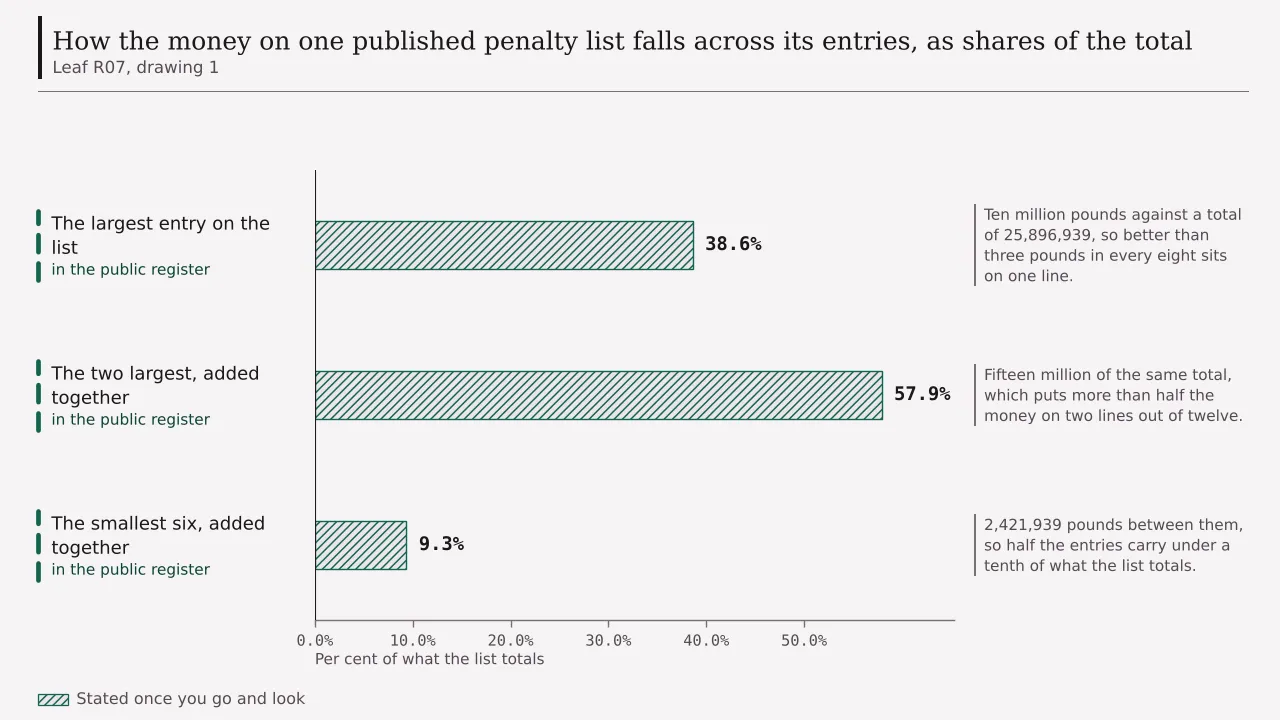
What that distribution does to an ordering is the point of computing it. A quantity whose average sits near three times its middle cannot be averaged into anything without the largest member deciding the result, so a composite containing this one as a term is a composite about that one entry. Anybody wanting to use enforcement money in a comparison has to use a rank, a logarithm or a threshold instead of a mean, and choosing between those three is a decision nobody has published a rule for.
A second published series travels with the penalties and behaves differently. Licence suspensions appear on the same listing as five entries over the same period, and a suspension has no money attached to it at all. It is a state rather than a sum, which makes it the cleanest thing on the whole record to read and the hardest to combine with anything, since a state and a quantity have no arithmetic in common.
The deepest limitation here is the one nobody computes. An entry with no published action against it is not thereby an entry with a clean history. It may be an entry nobody has examined, and the record does not publish how many examinations produced nothing, so an absence of actions carries the same ambiguity that an absence of a row carries. Zero pounds of penalty is not a measurement of anything.
4
A name that is not a scope, and how to read the difference
Quantity four is the route out of an argument, and it arrives looking like a name while behaving like a list. Its unit is a named body together with the sectors that body is shown against. Its source is the regulator’s published roll of approved dispute entities. Its method is to find which body a business names at the close of its own complaints process, then to read the row standing beside that body on the roll.
Eight bodies carry approval and their sector coverage is uneven, which is the fact a reader needs and the fact a bare name hides. Five carry remote right across the sectors. A further two are shown against all sectors in that table, although betting alone appears in one of their own entries, which is a contradiction sitting on the page rather than anything this leaf resolves. The eighth is shown against premises-based categories only, with arcades, halls, family centres and licensed houses among them, and remote casino is not one of those categories.
Turn that into the quantity it actually is. A reader told nothing but the name of an approved body has learnt that the body sits somewhere among eight, and the probability that the named one covers the product being played is 5 in 8 on the strict reading of the table and 7 in 8 on the generous one. Those are 62.5 per cent and 87.5 per cent. Neither is 100, and the gap between them is caused by the page contradicting itself rather than by anything a reader has done wrong.
So the correct use of quantity four is not to score the choice of adjudicator but to check a scope. Two businesses naming two different approved bodies are not thereby ranked against one another, because the roll publishes no quality ordering over the eight and the regulator’s own obligation is only that an approved one is used. What can be checked is narrower and more useful: whether the body named covers the sector the argument is going to be about.
One published change on the same page is worth carrying because it shows the roll moving. A body previously on it has been removed, which the page records in its own update note. A roll that changes is a roll that has to be read on the day rather than remembered, and the date of reading belongs beside the result, in exactly the way part two required it for the two counts.
Against the three requirements in part one, quantity four fails the first and the second together. Its unit is a name and a sector list, which cannot be added to a count of activities or to a sum in pounds, and there is no scale underneath it at all, since the roll is published as an approved set rather than as an ordered one.
5
Four steps with no interval published between them
Quantity five is the only genuinely ordered thing in this corner of the subject, and even it stops short of what an ordering needs. Its unit is a label drawn from a four-step scale the regulator fixes. Its source is the business’s own written terms, where a disclosure duty bites on any licensee holding money for customers: the terms have to set out what an insolvency would do to that money, how much of it would come through, and by what arrangement. Its method is to open the terms, locate the disclosure and copy the label.
Those labels are set strings and not descriptions anybody may rewrite. The lower pair both begin with the words not protected, separated by what follows: one continues to no segregation, the other to segregation of customer funds. Above that pair stand medium protection and then high protection. A holder selects the label and drafts its own prose around it, no exact form of words having been laid down for the explanation, so the rung is fixed while the paragraph beside it belongs to the holder.
Here is why it is the most useful item on the list and still not a measurement. Four rungs in a stated order is more than anything else here manages. What nobody has published is the height of a rung. Nothing says whether moving from the lower not protected label to the upper one is a larger or a smaller improvement than moving from medium to high, and nothing turns either move into pounds, into a probability, or into any quantity that could be averaged against a count of activities.
An ordinal scale with no spacing supports two operations and refuses the rest. It supports a comparison, in that one rung stands above another. It supports a threshold, in that a reader declines everything below a line they drew themselves. It supports no addition, no mean and no weighting, so a composite turning four rungs into one, two, three and four points has manufactured the spacing and then computed with it.
A clock travels with the lower pair and carries a date. Where the label in use starts with those two words, the holder owes the customer a reminder twice a year that an insolvency would not protect the money, a statement of the sum being held at that moment, and an acknowledgement taken before anything more is staked. 31 October 2025 is the day the paragraph imposing that started to bind, and the consultation answer standing behind it turned down every threshold put to it, so there is no balance too small for the reminder to reach.
Four ordered levels, nought published intervals between them, and one reminder every six months
6
Why five quantities refuse to become one
Now put the five together and watch the combination fail, item by item, against the three requirements part one set out. The failure is not a shortcoming of the record. It is a property of the quantities, and knowing which property fails is what tells a reader what each one is still good for.
| The quantity | Unit it carries | Where it is settled | Which requirement it fails |
|---|---|---|---|
| Activities a permission runs to | A count of named activities | in the public register | No unit shared with anything else |
| Web addresses recorded against it | A count of addresses | in the public register | No unit shared with anything else |
| Published regulatory action | Pounds, with dates | in the enforcement listing | A tail that makes a mean meaningless |
| Approved adjudicator and its sectors | A name plus a sector list | in the approved roll | No unit and no scale underneath |
| Customer funds level | A label from a four-step scale | in the written terms | An order with no published interval |
| Time a payment takes to leave | Hours, if anybody published them | nowhere in writing | Not published by any citable source |
| Share of complaints upheld | A proportion, if anybody published it | nowhere in writing | Not published by any citable source |
Seven rows, five of which can be filled in and two of which cannot. Read the last column downwards and the five failures sort into three kinds. Two quantities have units that exist but match nothing. One has a unit that matches money everywhere and a distribution that destroys any average taken over it. One has no scale at all. One has a scale with no spacing. The two rows at the foot have nothing, which is a different problem and gets its own part.
The requirement that breaks hardest is the third, and it breaks silently. Suppose somebody solves every difficulty above by normalising each quantity onto a common range. They still have to say how much each of the five counts for, and no source anywhere publishes a weighting. Whoever supplies it has put their own judgement into the answer, and because the five inputs all arrived from public records the result looks checkable while the step that decided it was not.
That is the honest statement this leaf exists to make, and it matters most on a site whose whole subject is what can be checked. Five things can be established. They do not combine. No score follows from them, and any score that appears to follow has had weights smuggled into it. This page therefore prints no ordering of its own against anybody, which is not modesty but the conclusion of the arithmetic above.
What survives is better than nothing and worth saying plainly. Each of the five supports a threshold, which is a decision a reader makes rather than a comparison a publisher makes. Is the product permitted at all. Does this address appear in the field. Is there a published action, and how large. Does the named body cover this sector. Is the funds level above the line I have drawn. Five thresholds applied in sequence remove candidates without ever claiming that what remains is in order.
7
What one unpublished input does to a position, in numbers
Suppose somebody ignores part six and builds the composite anyway. The damage can be computed, and computing it is more use than objecting to it. What follows is this page’s own construction, declared here so that every figure after it can be checked or rejected: five inputs, each weighted equally at twenty points, giving a hundred points in total, with four of the five taken from public records and the fifth unpublished and therefore free to be anything inside its twenty.
Two candidates are compared, and the composite on the four published inputs separates them by a gap of g points. The order comes out wrong whenever the unpublished contribution of the lower candidate exceeds that of the higher one by more than g. Each unpublished contribution runs anywhere from nought to twenty, so their difference runs from minus twenty to twenty, and it is most likely to land near nought and least likely near either end.
That gives a share for the reversal of (20 minus g) squared, divided by 800. At a gap of ten points the numerator is 100 and the share is 0.125, so the order is wrong one time in eight. At five points it is 225 over 800, or 28.125 per cent. At two points it is 324 over 800, or 40.5 per cent. At fifteen points it is 25 over 800, or 3.125 per cent. And at twenty points the numerator is nought, because a gap as wide as the whole unpublished input cannot be overturned by it.
| Gap on the four published inputs | Share of readings that reverse it | Confidence in the order | Settled, on £120.00 | Settled by nothing |
|---|---|---|---|---|
| Nought points, a dead heat | 400 over 800 | 50.0 per cent | £60.00 | £60.00 |
| Two points | 324 over 800 | 59.5 per cent | £71.40 | £48.60 |
| Five points | 225 over 800 | 71.9 per cent | £86.25 | £33.75 |
| Ten points | 100 over 800 | 87.5 per cent | £105.00 | £15.00 |
| Fifteen points | 25 over 800 | 96.9 per cent | £116.25 | £3.75 |
| Twenty points or wider | Nought over 800 | 100 per cent | £120.00 | £0.00 |
The two money columns need their own declaration, because they rest on a construction and not on an observation. Take £120.00 as the sum a reader is deciding where to put, and treat a correct order as worth the whole of it and a reversed one as worth nothing. That is this page’s own simplification, chosen because it converts a probability into pounds without hiding a step. Under it, the worth of a position is £120.00 multiplied by the confidence in the column beside it.
Read off a position alone £120.00 Once one unpublished input runs at a ten point gap £105.00 What the hole in the composite is worth £15.00
Fifteen pounds comes out of two calculations that share no machinery, and their agreement is the check rather than an ornament. The first treats each unpublished contribution as running smoothly across its twenty points: their difference is then a triangle over minus twenty to twenty, the portion of it past a ten point gap is 100 over 800, and an eighth of £120.00 is £15.00. The second abandons smoothness and counts. Restrict each contribution to the 21 whole-point values from nought to twenty and there are 441 equally likely pairs; the pairs in which the lower candidate beats the higher by 11 or more number ten plus nine and so on down to one, which is 55; and 55 of 441 applied to £120.00 gives £14.97.
Three pence separates the two answers, and the three pence is the step size rather than a disagreement. A counted version of a smooth quantity lands near it and not on it, and the direction of the miss is set by where the boundary falls between whole points. Printing both figures rather than the tidier one is the point: a construction that survives being computed two ways is a construction worth arguing with.
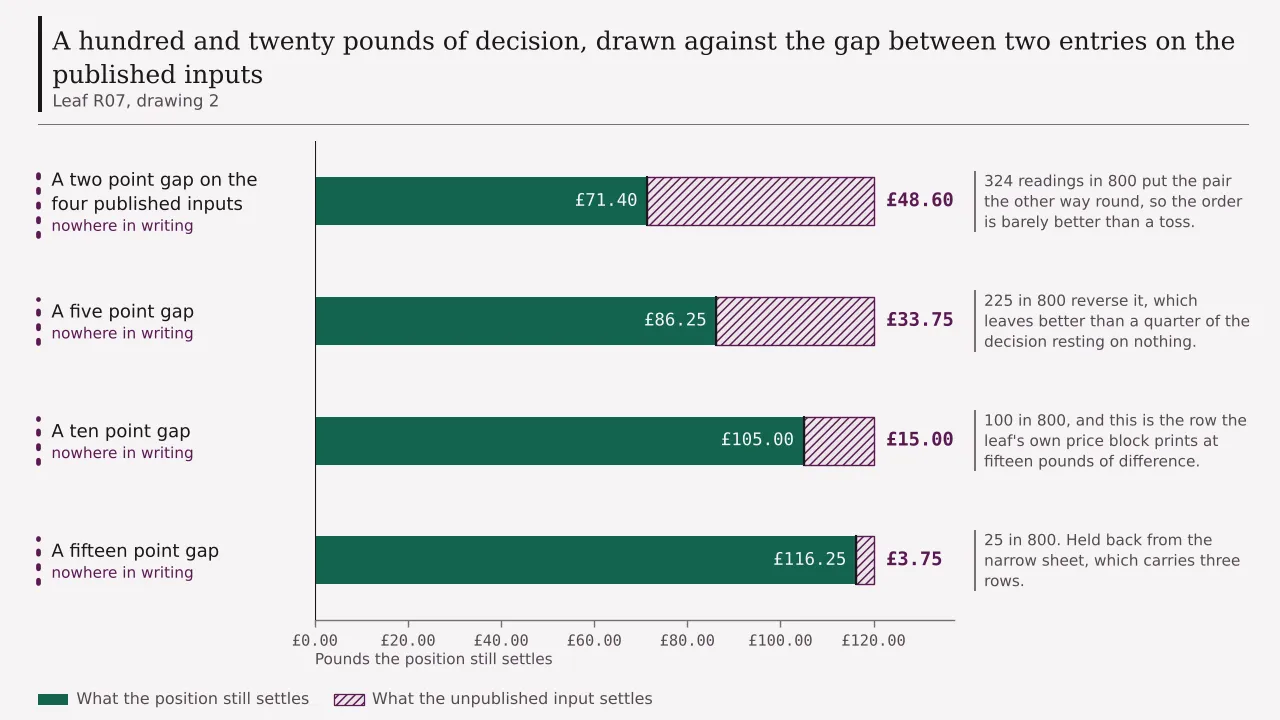
Taking the drawing from its top row downwards, a practical rule falls out without any further arithmetic. Positions separated by a narrow margin on the published inputs are not separated at all, because a single hole in the composite is wide enough to swap them. Positions separated by most of the width of one input are reasonably safe. Nothing in between is reliable, and nothing anywhere tells a reader which case they are looking at unless the builder published the gaps, which is a thing no list does.
8
The two inputs a reader wants most, and where they are not
Ask anybody what they would rank on and two answers come back before any of the five above. How long does it take to get money out, and what happens when something goes wrong. Both are the right questions. Neither is carried by any source this site may lean on, and the reason differs between them.
The first has simply never been published. A hold is met on the way out, and no regulator, standard or register carries a figure for the length of time a payment is held before it goes, with no duty obliging anybody to produce one. A neighbouring duty does exist and it is about something else: a licensee may not hand a customer a route for undoing a withdrawal already requested. That governs reversal, not duration, and it says nothing at all about hours.
Any speed figure in circulation therefore came from somewhere that is not a primary source, and this page carries none. The honest treatment of the first absence is to write down the unit it would have carried, which is hours, note that nothing citable supplies it, and leave the row empty. An empty row entered on purpose is a finding. A row filled out of marketing material is an invention wearing a figure.
The second absence is the more interesting of the two, because the raw material exists while the total does not. Complaint timing is regulated in some detail: an internal process is capped at eight weeks counted from the day it lands, a complaint may still be opened up to half a year after whatever it concerns, and the running of those weeks may be stopped where the customer goes silent on a reasonable request. One offshore regulator goes further still, obliging its operators to send it complaint figures twice a year, on 15 January and 15 June, split by total, by outcome, by what is still open, by category, by referral onward and by whether anybody has gone to law.
Sending figures to a regulator is not the same act as publishing them, and that gap is where this input disappears. No total assembled from those returns could be found, so neither a volume nor a proportion upheld can be cited for that jurisdiction by this site or by anybody else working from primary sources. The British regulator sets out its own position in three sentences: it is no ombudsman, it holds no power to settle one individual complaint or to recover anybody’s money, and nothing gives it sight of an account. Enforcement outcomes get published, which is quantity three. A ratio does not.
Price those two absences on the construction in part seven and the result is worse than one hole. Two unpublished inputs out of five leave forty of the hundred points free to move rather than twenty, which doubles the width a gap has to clear before an order can be trusted. Under that arrangement a ten point gap on the three published inputs is no longer worth 87.5 per cent, since the difference of two free contributions spreads twice as far, and the gap that buys certainty rises from twenty points to forty. An ordering of two things on three published inputs is close to a coin unless they are a long way apart.
9
What stops being recorded, and what stops along with it
Everything in parts two to five assumes a British grant exists, because four of the five quantities are published only as a consequence of one. Offers reached this way stand outside the British licence, which takes away those four quantities and the duties generating them in a single movement, so on a page about measurement the duties worth naming are the ones that would otherwise be producing numbers for a reader to read.
The first is a flat prohibition and therefore the easiest to check and the least use in any comparison: payment for gambling may not be accepted on a credit card, a rule running since 14 April 2020, and a card payment arriving through a money service business is caught by it too. Being identical for every holder it has nought variance and can order nobody, which demonstrates neatly that a duty and a criterion are different objects. The second runs in two directions at two speeds. Cutting a money limit takes effect at once on the customer’s say-so, while raising one sits out a day at the very least and then wants a further deliberate act at the close of that wait before anything happens. The third is a threshold measured in pounds a month: a lighter check reaches any online customer taking net deposits in a month past £150, a threshold opening at £500 from 30 August 2024 and coming down to the lower figure on 28 February 2025. The fourth closes the condition covering fairness and transparency in terms, and it is the broadest of the set: nothing amounting to an unfair commercial practice, as the 2024 statute on digital markets and consumers defines that term, may surface anywhere across a licensee’s dealings with its customers.
Take those away and the arithmetic in part seven does not get worse in the way a reader might expect. It stops applying altogether. The construction there assumed four published inputs and one hole. Outside the British grant the enforcement listing carries nothing, the approved roll carries nothing, the activity inventory and the recorded addresses do not exist, and the funds level is a disclosure nobody is obliged to make. Four of the five quantities go at once, which leaves one hole and four, not four and one.
Running the same construction on that arrangement gives the honest ending. With eighty of the hundred points unpublished, the difference between two candidates on the twenty points that remain is almost never large enough to matter, and the confidence in any position converges on the fifty per cent standing at the head of part seven’s table. That is not a rhetorical flourish. It is the same formula with the free range widened, and a coin is what it produces.
Which leaves one thing worth doing rather than none, and it is a threshold rather than an ordering. A reader can still establish whether a British grant exists at all, which is a yes or a no and needs none of the apparatus above. Everything in this leaf past that first answer is addressed to the case where the answer was yes, and where it is no, the five quantities are not hard to obtain so much as absent.
10
The five checks written out as a sheet anybody can fill
The procedure below is the usable residue of everything above, and it is written as a sheet with five rows because the result is a sheet and not a verdict. Each row carries what to look for, where to look, the unit the answer comes in, and a date. The whole thing takes a few minutes and produces no ordering whatsoever, which is the intended outcome rather than a shortfall.
Row one, the activity. Search the list of licensed businesses on a company name and again on the web address, write down the inventory of activities that comes back, and record whether the product being considered is among them. The mechanics of the lookup, field by field, live on the step-by-step page for this section, since performing it badly produces an answer that looks exactly like performing it well.
Row two, the address. Read the recorded web addresses off the same entry and record whether the one in front of you is among them. Write yes, no, or not checked, and never write a count on its own, since a count of addresses measures the size of an estate and the question being asked is about a match.
Row three, the money. Search the enforcement listing and the actions page attached to the entry, and copy both the figure and the date, taking the date from the holder’s own page where the two differ. Record nought pounds as nought pounds and not as a clean history, because an entry with no published action may be an entry nobody has looked at.
Row four, the route out. Find the body named at the end of the complaints process in the business’s own documents, then read its sector row on the approved roll and record whether the sector covers the product. The answer is a yes or a no about scope, not a mark against the body, and the roll changes, so the date belongs in the row beside it.
Row five, the level. Open the written terms, find the disclosure about what happens to customer money if the business fails, and copy the label exactly as it is given, since the labels are fixed strings and the explanation around them is the holder’s own prose. Decide in advance which levels you will accept and apply that as a threshold rather than converting the four levels into points.
Then stop, and stop deliberately. Two rows at the foot of the sheet stay empty, those being how long a payment takes to leave and what share of complaints end in the customer’s favour, and the right thing to write in them is the word unpublished and the date it was looked for. A sheet with five rows filled, two rows honestly blank and a date at the top is a better object than any list in order, because every line on it can be checked by somebody else, and because the construction in part seven shows what the two blanks would have done to the order if anybody had tried to supply them.
Questions
- What can actually be established about a gambling business from public records?
- Five things, each with its own unit. The inventory of activities a permission runs to, as a count. The web addresses recorded against the same entry, as a count. The published regulatory action against it, in pounds with dates. The approved dispute body it names and the sectors that body covers. And the customer funds level in its own written terms, as a label off a four-step scale. Two further things a reader would want, how long a payment takes and how often complaints are upheld, are published by nothing citable.
- Why does no ranking follow from those five quantities?
- Because an ordering needs a shared unit, a scale with known intervals and a published set of weights, and the five fail at least one apiece. Two are counts with units matching nothing else. One is money with a distribution that destroys any average over it. One is a name and a sector list with no scale underneath. One has an order but no published distance between its steps. Nothing anywhere publishes weights, so whoever supplies them has put their own judgement into an answer that looks checkable.
- What does the published penalty record look like as a distribution?
- Twelve entries covering roughly a year total £25,896,939, which averages £2,158,078.25. Sorted, the middle of the twelve falls at £737,500, so the average stands at 2.93 times the middle. The largest single penalty of £10,000,000 is 38.61 per cent of the whole, the smallest six added together come to £2,421,939 or 9.35 per cent, and the extremes stand 81.41 to one apart. A quantity shaped like that cannot be averaged without its largest member deciding the result.
- Does an operator with no published penalty have a clean record?
- Not established, and the distinction matters. An entry carrying no published action may be an entry nobody has examined, and the record does not publish how many examinations produced nothing. Zero pounds of penalty is therefore not a measurement of conduct, in the same way that an absent row is not a measurement of anything. The usable form of this quantity is a threshold applied to what is published, never an inference drawn from what is not.
- Is naming an approved dispute body enough to settle the complaints route?
- No, because a name is not a scope. Eight bodies carry approval and their sector coverage is uneven: five carry remote right across the sectors, two more are shown against every sector although betting alone appears in one of their own entries, and the eighth is shown against premises-based categories only, arcades, halls, family centres and licensed houses among them. So a name alone gives 5 in 8 on a strict reading and 7 in 8 on a generous one.
- What are the four customer funds levels and what can be done with them?
- They are set strings. The lower pair both begin with the words not protected, separated by what follows, one continuing to no segregation and the other to segregation of customer funds; above them stand medium protection and then high protection. Four rungs in a stated order is more than anything else here manages, but the height of a rung is published nowhere. That supports a comparison and a threshold and no arithmetic at all, so turning the four into four points manufactures the spacing.
- How much does one unpublished input change a position?
- Take five inputs weighted equally at twenty points each, four of them published and the fifth free to be anything inside its twenty, which is this page’s own construction. The share of readings that reverse two candidates is twenty minus the gap, squared, over 800. At a ten point gap that is 100 over 800, so the order is wrong one time in eight. At five points it is 28.125 per cent, at two points 40.5 per cent, and at twenty points or wider it is nothing at all.
- What is that worth in pounds?
- Fifteen pounds on a £120.00 decision at a ten point gap, where a correct order is treated as worth the whole sum and a reversed one as worth nothing, which is this page’s own simplification. Two calculations reach it. The smooth one takes an eighth of £120.00 and gives £15.00 exactly. The counting one restricts each free contribution to 21 whole-point values, finds 55 reversing pairs out of 441, and gives £14.97. Three pence separates them, and the three pence is the step size rather than a disagreement.
- Why are payout speed and complaint outcomes not on the list?
- Neither has a citable source, for different reasons. No regulator, standard or register carries the length of time a payment is held before it goes, and nothing obliges anybody to produce it; a neighbouring duty bars a licensee from handing a customer a route for undoing a withdrawal already requested, which governs reversal rather than duration. Complaint figures go to one offshore regulator twice a year, on 15 January and 15 June, but no total assembled from those returns could be found, and sending figures is not publishing them.
- Does the register prove who is running the site I am looking at?
- It does not, and every quantity on this leaf inherits that limit. All five are measurements of a permission and of whoever holds it. None is a measurement of the website a reader has actually opened, because an entry settles who holds a permission and which activities it covers and stops at that line. Permissions change hands and a front end can be operated under an arrangement no record describes, so the strongest available move is a comparison between an entry and what the site displays.
- What is lost where no British grant stands behind the business?
- Four duties, and with them the numbers they generate. A flat bar on accepting payment for gambling on a credit card, running since 14 April 2020 and catching a card payment arriving through a money service business. A money limit that falls at once on the customer’s say-so while rising only after a day at the very least and a further deliberate act. A lighter check reaching any customer taking net deposits in a month past £150, a threshold opening at £500 from 30 August 2024 and coming down on 28 February 2025. And nothing amounting to an unfair commercial practice anywhere across a licensee’s dealings with its customers.
- What should I write down instead of a ranking?
- A sheet of five rows and a date. Whether the product is among the activities on an entry. Whether the address in front of you appears in the recorded field, written as a yes or a no rather than a count. The published penalty figure and the date, taken from the holder’s own page where two sources differ. Whether the named dispute body covers the sector. And the funds label copied exactly. Two further rows stay empty, carrying the word unpublished and the date they were looked for.