Terms read 19 October 2026 Leaf A07, revision 1
Fast withdrawal casinos, and the one length that is published nowhere at all
A payout advertised at 10 minutes has five separate lengths inside it, and the advertisement describes the fourth. Added at the top of this leaf’s own assumed bands the five come to 8 days and 25 minutes. Settle the paperwork at sign-up instead of at the exit and 4 days come off for nothing. What remains is a queue, and the queue has no published figure anywhere.
Stated on the banner 10 minutes The length an advertisement of this shape prints, which belongs to one of the five lengths a payout is made of. Stated, once you go and look None of five A payments document names the stages and attaches a number to none of them, which is the position the written terms occupy here. Not stated before the money goes in 8 days 25 minutes The total at the top of this leaf’s assumed bands, of which the queue before anybody looks is the largest piece and the only one with no figure anywhere.
Offers advertising a quick exit, with their terms read
Every destination in this file is bought advertising. The site is paid a fee if a reader goes on to register, and no figure printed below moves because of it.
Bonus Spins UK Slip 01
Betportal
Ceiling as a multiple
The drop
€15.00
€1.00 in the euro
The claim reads €15.00. Once the terms beside it have applied, €0.00 of it can leave. The difference is the drop.
7 of the 15 terms on this slip could not be read before the money went in
Spins priced at this site's own 10p a spin, which the operator does not publish
Stated
€15.00
The claim as it is printed, before a single term has been applied to it.
Headline paid as spins
150 spins at 10c each, which is €15.00 of the figure above.
6 Nowhere
What one spin is worth
No unit is published for a spin, so the count is priced at this site's own 10p a spin. At half that price every figure below halves with it.
Match and other credit not priced
300% of three deposits, to a ceiling of €1,000. A share of a deposit nobody has made yet is not a sum, so no figure stands on this line and none is carried below.
Qualified
-€14.40
Written down somewhere, and taking part of the claim back. Each term carries the place it is written and the sum it takes.
2 Written terms at a distance this record does not establish
Play-through -€14.40
Carrying €14.40 through 35 times stakes €504.00 and costs €20.16 of it at 96 per cent return. That prices above the €14.40 there is to charge it against, so the whole of the credit goes and the line is held at that. The multiple sits on the bonus.
2 Written terms at a distance this record does not establish
Game weighting not priced
Slots only count towards the play-through. No contribution percentage is published, so the line above has been worked at full weight, which is the kindest reading there is.
2 Written terms at a distance this record does not establish
Ceiling on the winnings not priced
5x the bonus.
2 Written terms at a distance this record does not establish
Clock on the credit not priced
14 days.
2 Written terms at a distance this record does not establish
Largest stake while it runs not priced
€5.
3 Public record
Licence, and who holds it not priced
Licensed in Anjouan, Comoros, held by BetPortal Gaming Ltd, with Excite Ultra Media Ltd, reference ALSI-202601040-FI2. A register entry settles who holds a licence and what it permits. It does not settle who is running the site this morning.
4 Cashier
Smallest qualifying deposit your money
€20 a stage. That is €20.00 of your own money, and it is never netted into a drop.
5 On the way out
Checks before a withdrawal not priced
Documents before the first withdrawal.
Unstated
-€0.60
Applying without having been published anywhere, and costing money all the same.
6 Nowhere
What a spin hands back -€0.60
Staking a spin returns 96 per cent of it, so that share of the batch is the house's before a reel turns. This site works at that return and the operator publishes none where the claim is made.
6 Nowhere
Forfeited by rule cost unknown
Nothing is published under this heading, and it applies regardless.
6 Nowhere
Charge on the way out cost unknown
No charge on the way out is published as a figure, so nothing comes off this line. A charge that exists unpublished would come straight off whatever survives.
6 Nowhere
Smallest withdrawal allowed cost unknown
No smallest withdrawal is published as a figure. A floor nobody has published is still a floor, and it decides whether a small balance can move at all.
No Great Britain licence
Terms read 19 October 2026
Bonus Spins UK Slip 02
WinBeast
Ceiling as a sum
The drop
€50.00
€1.00 in the euro
The claim reads €50.00. Once the terms beside it have applied, €0.00 of it can leave. The difference is the drop.
8 of the 15 terms on this slip could not be read before the money went in
Spins priced at this site's own 10p a spin, which the operator does not publish
Stated
€50.00
The claim as it is printed, before a single term has been applied to it.
Headline paid as spins
500 spins at 10c each, which is €50.00 of the figure above.
6 Nowhere
What one spin is worth
No unit is published for a spin, so the count is priced at this site's own 10p a spin. At half that price every figure below halves with it.
Match and other credit not priced
50% to 100% of five deposits, each to a ceiling of €1,000, and a €650 free bet. A share of a deposit nobody has made yet is not a sum, so no figure stands on this line and none is carried below.
Qualified
-€48.00
Written down somewhere, and taking part of the claim back. Each term carries the place it is written and the sum it takes.
2 Written terms at a distance this record does not establish
Play-through -€48.00
Carrying €48.00 through 40 times stakes €1,920.00 and costs €76.80 of it at 96 per cent return. That prices above the €48.00 there is to charge it against, so the whole of the credit goes and the line is held at that. The multiple sits on the bonus and the winnings from the spins.
2 Written terms at a distance this record does not establish
Game weighting not priced
Slots, titles vary by country count towards the play-through. No contribution percentage is published, so the line above has been worked at full weight, which is the kindest reading there is.
2 Written terms at a distance this record does not establish
Ceiling on the winnings not priced
€100 a batch of spins.
2 Written terms at a distance this record does not establish
Clock on the credit not priced
7 days, spins 1 day.
3 Public record
Licence, and who holds it not priced
Licensed in Curaçao, holder not named on the site. A register entry settles who holds a licence and what it permits. It does not settle who is running the site this morning.
4 Cashier
Smallest qualifying deposit your money
€20 a stage. That is €20.00 of your own money, and it is never netted into a drop.
5 On the way out
Checks before a withdrawal not priced
Documents before the first withdrawal.
Unstated
-€2.00
Applying without having been published anywhere, and costing money all the same.
6 Nowhere
What a spin hands back -€2.00
Staking a spin returns 96 per cent of it, so that share of the batch is the house's before a reel turns. This site works at that return and the operator publishes none where the claim is made.
6 Nowhere
Largest stake while it runs cost unknown
Nothing is published under this heading, and it applies regardless.
6 Nowhere
Forfeited by rule cost unknown
Nothing is published under this heading, and it applies regardless.
6 Nowhere
Charge on the way out cost unknown
No charge on the way out is published as a figure, so nothing comes off this line. A charge that exists unpublished would come straight off whatever survives.
6 Nowhere
Smallest withdrawal allowed cost unknown
No smallest withdrawal is published as a figure. A floor nobody has published is still a floor, and it decides whether a small balance can move at all.
No Great Britain licence
Terms read 19 October 2026
Bonus Spins UK Slip 03
EliteSpin
Longest spin window
The drop
£50.00
£1.00 in the pound
The claim reads £50.00. Once the terms beside it have applied, £0.00 of it can leave. The difference is the drop.
8 of the 15 terms on this slip could not be read before the money went in
Spins priced at this site's own 10p a spin, which the operator does not publish
Stated
£50.00
The claim as it is printed, before a single term has been applied to it.
Headline paid as spins
500 spins at 10p each, which is £50.00 of the figure above.
6 Nowhere
What one spin is worth
No unit is published for a spin, so the count is priced at this site's own 10p a spin. At half that price every figure below halves with it.
Match and other credit not priced
50% to 100% of five deposits, each to a ceiling of £1,000. A share of a deposit nobody has made yet is not a sum, so no figure stands on this line and none is carried below.
Qualified
-£48.00
Written down somewhere, and taking part of the claim back. Each term carries the place it is written and the sum it takes.
2 Written terms at a distance this record does not establish
Play-through -£48.00
Carrying £48.00 through 40 times stakes £1,920.00 and costs £76.80 of it at 96 per cent return. That prices above the £48.00 there is to charge it against, so the whole of the credit goes and the line is held at that. The multiple sits on the bonus and the winnings from the spins.
2 Written terms at a distance this record does not establish
Game weighting not priced
Slots count towards the play-through. No contribution percentage is published, so the line above has been worked at full weight, which is the kindest reading there is.
2 Written terms at a distance this record does not establish
Ceiling on the winnings not priced
5x the bonus.
2 Written terms at a distance this record does not establish
Clock on the credit not priced
7 days, spins 3 days.
3 Public record
Licence, and who holds it not priced
Licensed in Costa Rica, held by PrimeTier Limited. A register entry settles who holds a licence and what it permits. It does not settle who is running the site this morning.
4 Cashier
Smallest qualifying deposit your money
£20 a stage. That is £20.00 of your own money, and it is never netted into a drop.
5 On the way out
Checks before a withdrawal not priced
Documents before the first withdrawal.
Unstated
-£2.00
Applying without having been published anywhere, and costing money all the same.
6 Nowhere
What a spin hands back -£2.00
Staking a spin returns 96 per cent of it, so that share of the batch is the house's before a reel turns. This site works at that return and the operator publishes none where the claim is made.
6 Nowhere
Largest stake while it runs cost unknown
Nothing is published under this heading, and it applies regardless.
6 Nowhere
Forfeited by rule cost unknown
Nothing is published under this heading, and it applies regardless.
6 Nowhere
Charge on the way out cost unknown
No charge on the way out is published as a figure, so nothing comes off this line. A charge that exists unpublished would come straight off whatever survives.
6 Nowhere
Smallest withdrawal allowed cost unknown
No smallest withdrawal is published as a figure. A floor nobody has published is still a floor, and it decides whether a small balance can move at all.
No Great Britain licence
Terms read 19 October 2026
Bonus Spins UK Slip 04
Crown Jewelz
Multiple unpublished
The drop
NOT WORKED
The multiple is not published in the operator's own terms. Since the sum cannot be worked around it, none is worked.
9 of the 14 terms on this slip could not be read before the money went in
No drop worked
Stated
£15.00
The claim as it is printed, before a single term has been applied to it.
Headline paid as spins
150 spins at 10p each, which is £15.00 of the figure above.
6 Nowhere
What one spin is worth
No unit is published for a spin, so the count is priced at this site's own 10p a spin. At half that price every figure below halves with it.
Match and other credit not priced
200% of the first deposit, then 150% twice, each to a ceiling of £1,000. A share of a deposit nobody has made yet is not a sum, so no figure stands on this line and none is carried below.
Qualified
NOT WORKED
Written down somewhere, and taking part of the claim back. Each term carries the place it is written and the sum it takes.
2 Written terms at a distance this record does not establish
Play-through not priced
40x the bonus, reported rather than published by the operator.
2 Written terms at a distance this record does not establish
Game weighting not priced
Slots count towards the play-through. No contribution percentage is published, so the line above has been worked at full weight, which is the kindest reading there is.
3 Public record
Licence, and who holds it not priced
Licensed in Curaçao, number not verified, holder not named on the site. A register entry settles who holds a licence and what it permits. It does not settle who is running the site this morning.
4 Cashier
Smallest qualifying deposit your money
£20. That is £20.00 of your own money, and it is never netted into a drop.
5 On the way out
Checks before a withdrawal not priced
Documents before the first withdrawal.
Unstated
NOT WORKED
Applying without having been published anywhere, and costing money all the same.
6 Nowhere
Ceiling on the winnings cost unknown
No ceiling is published. Nothing is assumed in its place.
6 Nowhere
Clock on the credit cost unknown
Nothing is published under this heading, and it applies regardless.
6 Nowhere
Largest stake while it runs cost unknown
Nothing is published under this heading, and it applies regardless.
6 Nowhere
Forfeited by rule cost unknown
Nothing is published under this heading, and it applies regardless.
6 Nowhere
Charge on the way out cost unknown
No charge on the way out is published as a figure, so nothing comes off this line. A charge that exists unpublished would come straight off whatever survives.
6 Nowhere
Smallest withdrawal allowed cost unknown
No smallest withdrawal is published as a figure. A floor nobody has published is still a floor, and it decides whether a small balance can move at all.
No Great Britain licence
Terms read 19 October 2026
Every figure in the second and third columns is this site's own working and nothing an operator has published. A claim is priced as printed, then the share a spin hands back at 96 per cent return comes off it, then what playing the multiple through costs at the same return, and then whatever a published ceiling, a charge on the way out or a floor on the smallest withdrawal takes from what has survived. The drop is the difference between the first figure and the last. The two columns add back up to it exactly, so no money leaves a slip without a term and a place beside it.
Which column a term falls in is settled by one question: has anybody written it down. A charge a reader meets at the payment screen is written down, and it stands in the second column with the cashier against it. A condition that binds without ever having been set down stands in the third, whatever it costs. Inside each column the terms run outwards from the banner, so the order itself says how far a reader would have had to go.
A count of spins has no unit until one is supplied. Where an operator publishes what one of its own spins is worth, that figure is used and the first column says it is theirs. Where none is published, this site's own 10p a spin stands in its place and every figure below moves in proportion with it. Where the multiple itself is unpublished, no drop is worked at all, because that is the one figure the sum cannot be done without.
Three words stand where a figure cannot. Not priced is a term that is written down and carries no number the arithmetic can take. Cost unknown is a term nobody has written down, costing something nobody has put a number on. Your money is money of the reader's own, which is never netted into a drop.
None of the operators in this file holds a Great Britain licence, so none of the duties that licence carries reaches them. Each of those duties is published in its own right, which is what makes its absence here something a reader can check rather than take on trust. Every gambling company licensed in Great Britain belongs to Gamstop Online, so a reader who has shut themselves out through the scheme is not shut out here. Social Responsibility Code 5.1.1 has held a play-through to a maximum of ten times the bonus funds since 19 January 2026, and it binds a licence holder and nobody else. Asked in a post of 21 October 2025 what is lost along with the licence, the Gambling Commission's Director of Enforcement and Intelligence answered: "unfair gaming practices, financial loss, and a lack of recourse if things go wrong". The same post puts blocked payouts, and withdrawal limits pitched high enough to be unreachable, among the behaviour the Commission has recorded. Nobody under 18 may hold an account at any of them.
Terms are reproduced in the wording their operator published, and each slip is dated with the day somebody sat down and read them. 19 October 2026 is the oldest of those dates. Anybody claiming an offer is bound by that operator's full terms, which are elsewhere, and never by a line standing here.
1
What a claim about speed is a claim about
Every number on a page about speed is a length of time, and a length of time needs two endpoints before it means anything. A claim of ten minutes is useless until somebody says ten minutes from what, to what. Pin down the endpoints and most claims of this shape turn out to describe a stretch the reader was never waiting on.
A payout has five stretches in it. Money sits in a queue before any human or system looks at the request. Paperwork gets demanded, or does not. Somebody or something releases the payment. The payment crosses whatever carries it. The far end posts it to an account. Five stages, five lengths, one of which is short and photogenic.
The fourth of those is the one an advertisement describes, because it is the one that can honestly be given a small number. The other four belong to the operator, to the paperwork, and to whoever receives the money, and between them they hold the overwhelming majority of the wait. That is the whole argument of this leaf and the rest is arithmetic.
Before any of the sums below, one thing belongs at the front. Anybody who has shut their own gambling accounts and is now reading about quicker exits should put this page down and use the help instead. Support that costs nothing and stays private sits at BeGambleAware.org, and GamCare.org.uk runs the National Gambling Helpline, reachable on 0808 8020 133 around the clock. Gamstop Online covers operators holding a British licence and says in its own written terms that it reaches nobody outside that group. The sentence is there to describe the edge of a protection. No part of this leaf explains how to go round it, and every figure here is worse, not better, for somebody in that position.
Each length below carries an assumed figure or an assumed band, and the sentence that uses one says so. Nothing on this leaf reports an observed duration, because this site reads, computes and cites rather than timing anything. What the assumptions are for is to show which stage dominates the total, and that result survives every one of them being replaced with different numbers.
Set out in the terms this site uses everywhere, the ten minutes is settled , two of the five lengths can be established in a public record, one appears on the way out, and the largest of them is nowhere in writing. Six places exist, and a claim of speed uses four of them at once.
2
A payout taken apart into five separate lengths
Here are the five, in the order a request meets them, with an assumed figure or an assumed band against each. Every band is this leaf’s own and no published source supplies any of them.
The queue. A request exists and nothing has happened to it. Assume this runs between 1 hour and 72 hours. The foot of the band assumes somebody is on duty when the request arrives; the top assumes somebody looks inside three days. Neither endpoint has a source and part eight returns to that.
The paperwork round. Assume nothing at all where identity was settled at sign-up, and assume between 24 and 96 hours where it is first demanded at the exit. The band covers a document being asked for, found, sent and read, and it assumes everything is accepted first time.
The release. Once a request has been approved, something has to act on it. Assume 15 minutes. This leaf treats the figure as small and bounded rather than precise, and part five shows it makes almost no difference what the figure is.
The transit. The stage an advertisement describes. Assume 10 minutes across a network that confirms transfers publicly, which is the fastest reading available and is deliberately generous to the claim being examined.
The posting. The receiving end has its own timetable. Assume between nothing and 24 hours, the foot assuming instant credit and the top assuming an overnight cycle.
| The stage | Where a reader would settle it | Foot of the band | Assumed middle | Top of the band |
|---|---|---|---|---|
| The queue before anybody looks | nowhere in writing | 1 hour | 36 hours 30 minutes | 72 hours |
| The paperwork round, met at the exit | on the way out | 24 hours | 60 hours | 96 hours |
| The release, once approved | nowhere in writing | 15 minutes | 15 minutes | 15 minutes |
| The transit, which the advertisement describes | in a public record | 10 minutes | 10 minutes | 10 minutes |
| The posting at the receiving end | in a published rule | None | 12 hours | 24 hours |
| All five added together | Not published as a total anywhere | 25 hours 25 minutes | 108 hours 55 minutes | 192 hours 25 minutes |
The bottom row is the only one a reader cares about and the only one nobody writes down. At the top of every band the five come to 192 hours and 25 minutes, which is 8 days and 25 minutes. At the foot they come to 25 hours and 25 minutes, just over a day. In the middle they come to 4 days, 12 hours and 55 minutes.
The length printed in the advertisement 10 minutes Every stage counted, at the top of each band 8 days 25 minutes The price of counting one stage out of five 8 days 15 minutes
Put the two ends of that block in the same unit and the proportion is stark. Ten minutes against 11,545 minutes is a ratio of 1,154.5 to one. Nothing in the advertisement is false. The transit really does take about ten minutes, and the other 11,535 minutes were never what it was describing.
3
Which of those lengths anybody can settle in advance
Sorting the five by whether they can be established before committing is the test this whole part of the site runs, and on this subject it splits them three ways rather than two.
Two of the five are genuinely settleable beforehand. The transit crosses a network whose confirmations are observable by anybody without an account, a name or a payment, which is why it is the number that gets advertised. The posting runs on the receiving institution’s own published timetable, which a reader already has a relationship with and can read without asking anybody’s permission.
One of the five is settleable in part. Where a British licence applies, the position of the paperwork round in the sequence is fixed by a written rule, which part seven sets out. Outside that licence, the position is a commercial choice and the length is a function of how quickly documents are produced, so half of it is knowable and half is not.
Two of the five cannot be settled at all. The release is small enough not to matter, and the queue is the subject of the next part. Neither has a number attached to it anywhere a reader could look, and the difference between them is that one of those absences is harmless.
| The stage | Settleable in advance | By what means |
|---|---|---|
| The transit | Yes | Public confirmations anybody may observe |
| The posting | Yes | The receiving institution’s own timetable |
| The paperwork round | Its position, under a licence | A written condition about sequence |
| The release | No, and it hardly matters | Nothing published, and the figure is tiny |
| The queue | No, and it decides the answer | Nothing published at either end |
Read that table downwards and the pattern is uncomfortable. Establishability falls as importance rises. The two stages anybody can check contribute 10 minutes and up to 24 hours. The stage nobody can check contributes up to 72 hours, and it does so after every other decision has been taken.
That ordering is not an accident of this leaf’s assumptions. It follows from who owns each stage. A public network publishes because publication is what it is for. A receiving institution publishes because it is regulated into doing so. An operator’s internal queue has neither pressure on it, so it publishes nothing, and the stage with no pressure on it is the stage with the most room to grow.
4
The queue with no number standing against it
The period between a request arriving and anybody attending to it is the heart of this subject, and it is alone among the five stages in having no figure that can be produced from any source this site is able to cite. Not a regulator’s figure, not a standard’s figure, not an industry one that would pass the test applied here.
What can be said about it is structural. It is the operator’s own period. Nothing obliges anybody to publish its length, to keep it constant between customers, or to explain why it was long on a given occasion. It is also the stage at which a withdrawal request is at its most reversible from the operator’s side, since nothing has yet left anywhere.
Its size relative to everything else is what makes the absence expensive. Take the free step in part six as already taken, so the paperwork round is nothing. What remains at the top of the bands is 96 hours and 25 minutes, of which the queue is 72 hours. That is 74.68 per cent of the whole remaining wait, held by one stage with no published figure at either end.
74.68 per cent of a payout’s remaining length held by one stage nobody anywhere publishes a number for
Three quarters is the finding this leaf exists to produce, and it is worth stating in the negative as well. Every improvement a reader can make for themselves acts on the other 25.32 per cent. Settling paperwork early acts on a stage already removed. Choosing a quick transit acts on 0.17 per cent of it. Nothing available to a reader acts on the queue, because the queue is not theirs.
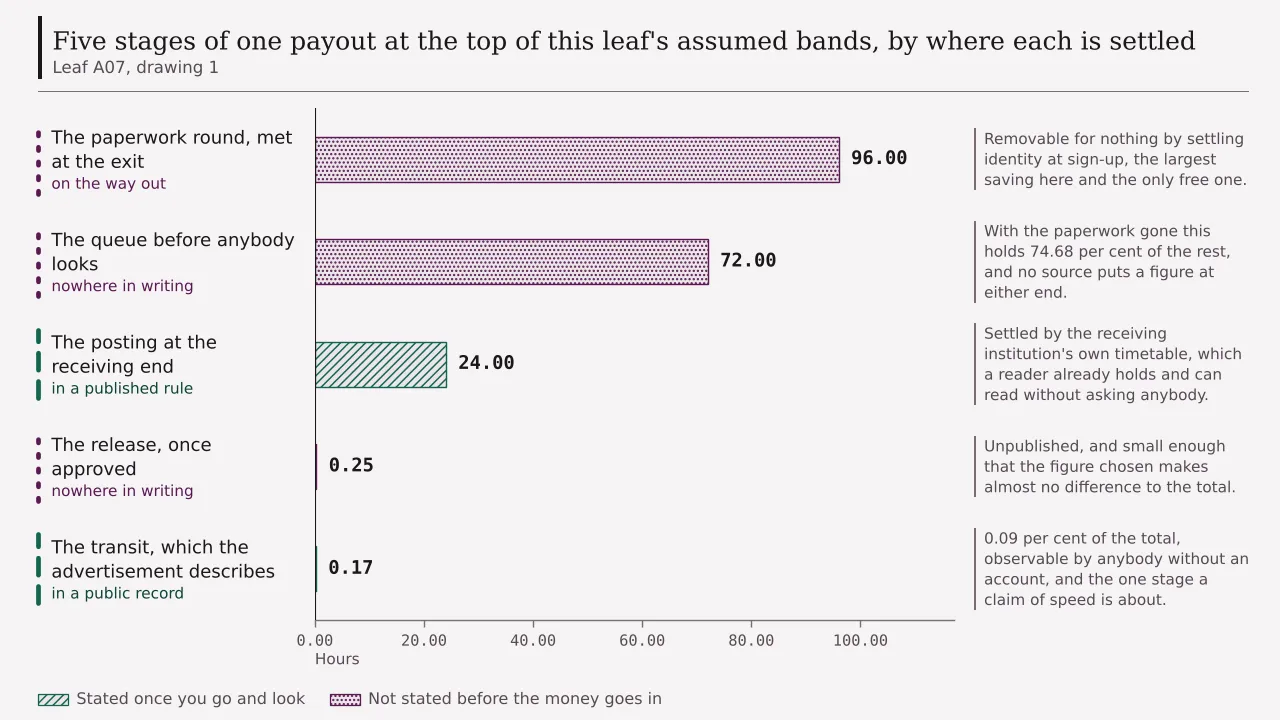
The two shortest bars on that drawing are the two anybody can check, and together they come to 25 minutes. The two longest are the two that are not checkable in advance, and together they come to 168 hours. A drawing is a blunt instrument and that particular bluntness is the point of drawing it.
5
What each length is worth as a share of the whole
Shares make the comparison portable, because a share survives the bands being replaced. Divide each stage by the total at the top of every band, which is 192 hours and 25 minutes, and five percentages fall out.
| The stage | Hours at the top | Share with paperwork at the exit | Share with paperwork settled early | Who owns the stage |
|---|---|---|---|---|
| The paperwork round | 96.00 | 49.89 per cent | Nothing | Shared between reader and operator |
| The queue | 72.00 | 37.42 per cent | 74.68 per cent | The operator alone |
| The posting | 24.00 | 12.47 per cent | 24.89 per cent | The receiving institution |
| The release | 0.25 | 0.13 per cent | 0.26 per cent | The operator alone |
| The transit | 0.17 | 0.09 per cent | 0.17 per cent | A public network |
The stage the advertisement is about holds nine hundredths of one per cent of the total. Double the speed of it and the whole payout improves by 0.045 per cent, which on 192 hours and 25 minutes is five minutes. Make it instantaneous and the saving is ten minutes exactly, which is the entire claim being examined.
Now run the same test on the queue. Halve it and 36 hours come off, which is 18.71 per cent of the total with the paperwork at the exit and 37.34 per cent of it without. One stage responds to improvement by hundreds of times more than the other, and the responsive one is the one nobody publishes and no reader controls.
Column four repays a longer look. Removing the paperwork round does not only shorten the payout. It concentrates what is left, pushing the queue from 37.42 per cent of the wait to 74.68 per cent of it. A reader who takes the free step in part six ends up with a shorter payout whose remaining length is more completely in somebody else’s hands than before.
That is an honest and slightly deflating result, and it is printed because the alternative would be to imply the free step solves the problem. It does not. It removes half the wait and leaves the unknowable part proportionally larger, which is an improvement in minutes and a worsening in what can be predicted.
6
One saving that costs nothing at all, priced in pounds
Of everything a reader can do about the length of a payout, exactly one thing is large and exactly one thing is free, and they are the same thing. Have the identity round done at sign-up rather than at the exit. On the figures above, that takes 96 hours off the top of the band, 60 hours off the middle and 24 hours off the foot.
Pricing a saving in time needs a rate, and this leaf assumes one rather than borrowing one. Suppose the only purchasable acceleration available anywhere is a priority charge of £5.00 that removes 12 hours. That is an assumption of this leaf’s and not an offer anybody makes. It gives a rate of 41.67 pence an hour.
At that rate the free step is worth £40.00 at the top of the band, £25.00 in the middle and £10.00 at the foot. It costs nothing, it is taken before any money has moved, and it is available to everybody at the same price, which is none.
Four days of waiting, bought at the assumed rate £40.00 The same four days, settled at sign-up instead £0.00 What the free step is worth on this leaf’s rate £40.00
Forty pounds is a large figure against the balances this site works with. A hundred presses at the 10p held constant here turn over £10.00 and return an expected £9.60, so the free step is worth four times the expected return on a hundred presses. Both numbers rest on assumptions, and they are assumptions of different kinds: the £9.60 comes from a return figure and a press value, and the £40.00 comes from a rate this leaf invented to have something to multiply by.
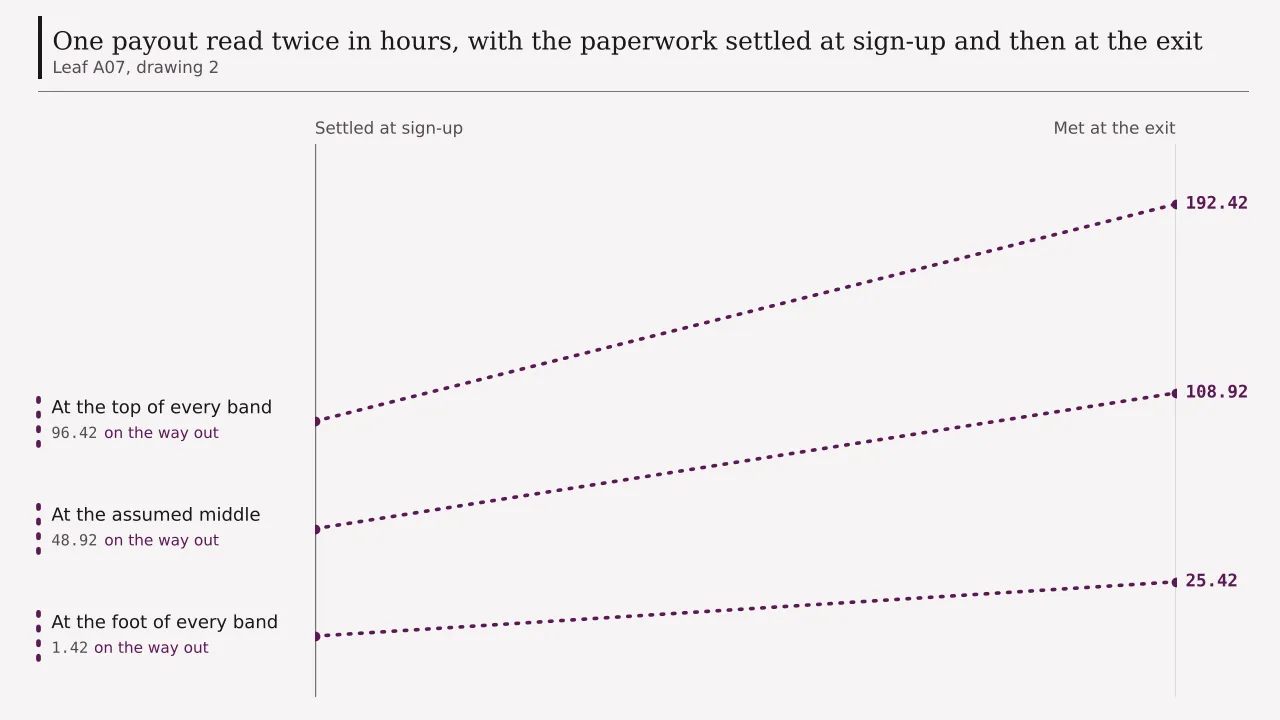
Each pair on that drawing is separated by exactly the paperwork band, so the gap is 24 hours at the foot, 60 in the middle and 96 at the top. Nothing else differs between the two readings, which is what makes the comparison fair: the queue, the release, the transit and the posting are held at identical figures on both sides.
One qualification belongs with the £40.00 and it is not small. The saving belongs only to a reader who has not opened an account yet, because the step happens at sign-up. For a reader who already has a balance waiting, the figure is retrospective, and the honest thing to say is that the cheapest moment to have acted has passed rather than that it can be recovered.
7
Where a paperwork round is permitted to stand
Britain regulates the position of the identity round rather than leaving it to whoever runs the exit, and the rule is worth reading as an instruction about sequence rather than as a rule about documents.
Under licence condition 17.1.1 the work of establishing who somebody is has to be finished ahead of any play whatever, and three items are named as its floor: what the customer goes by, the address they are at, and their date of birth. On this leaf’s arithmetic that single sentence puts the paperwork band at nothing in the only position where it can be nothing, which is in front of everything else.
The same condition shuts the other end. Asking for money back may not be turned into the occasion for a demand that could reasonably have gone out sooner, save where a separate legal duty forces the question at exactly that point. Rendered into the five stages above, that is a prohibition on shifting the paperwork band from the front of the order to the back of it.
A third limb deals with what a customer knows before any of it begins. Ahead of a first payment they have to be told which papers or other particulars could be called for, at what stage, and by what means these are to be handed over. That converts an unknown band into a described one, which is exactly the operation this site spends its time asking for.
Two further published points keep the account accurate. The rule reaches play funded by an incentive and reaches the demonstration versions of games, so no corner of a licensed site falls outside it, and licensees once had three days from the moment somebody registered in which to complete an age check, and nothing of that survives. Nor is any list prescribed from above, since the choice of documents is left to the business, so the 24 to 96 hours assumed here is a band about a process and not about a fixed set of papers.
None of this reaches the offers measured on this leaf, over which no Great Britain licence stands. Measured in this leaf’s own units the cost is 96 hours at the top of the band, and not because paperwork takes longer out there. It is because nothing fixes where in the order the round stands, and a round permitted to stand at the exit will sometimes stand there.
There is a second, quieter loss in the same place. Where the position of the round is fixed by a rule, a reader can plan around it before committing anything. Where it is a commercial choice, the planning cannot be done at all, and a band of 24 to 96 hours has to be carried through every sum as an unknown rather than discharged before the first payment.
8
The model set out in full, with its weakest term named
This part is the one this group of leaves asks for. Everything above rests on one small model and a set of assumed numbers, and a page that prints results without printing the model has asked to be believed rather than checked.
The model is a sum of five terms. Total equals queue, plus paperwork, plus release, plus transit, plus posting. There are no coefficients, no weights and no interactions, because nothing published supports any. Each term is held at a fixed assumed figure or an assumed band with a foot and a top, and the three totals in part two are the sums of the three corresponding readings.
The assumptions, each one this leaf’s own. The queue runs 1 to 72 hours. The paperwork round runs nothing where identity is settled at sign-up and 24 to 96 hours where it is first demanded at the exit. The release is 15 minutes. The transit is 10 minutes. The posting runs nothing to 24 hours. The priority rate used in part six is £5.00 for 12 hours, giving 41.67 pence an hour.
The weakest of them is the band on the queue, and it is weak at both ends. No source this site can cite puts a floor under it or a ceiling over it. The 1 hour assumes somebody is awake and the 72 hours assumes somebody looks within three days, and neither assumption has anything behind it beyond being a plausible-looking number. Since the queue is the largest term once the free step is taken, the error in the total is essentially the error in that one band.
How bad can that be. Suppose the queue ran to 14 days rather than 72 hours, which nothing this leaf can cite excludes. With every other term held exactly as it is and the paperwork settled at sign-up, the total goes from 96 hours and 25 minutes to 360 hours and 25 minutes, which is 15 days and 25 minutes. That is 3.74 times the figure printed above, produced by changing one assumption that nobody publishes.
What the model leaves out, listed rather than hinted at. It counts hours and keeps no calendar, so weekends and banking hours are absent. It prices slowness and not refusal, so a request that is declined rather than delayed is outside it entirely. It assumes documents are accepted first time, where a return and a resubmission restarts the paperwork band rather than extending it. It assumes one payment rather than a split into instalments. It assumes nothing is queued behind anything else. It carries no probability distribution across any band, because none is published, so the foot, the middle and the top are three readings rather than a likelihood. It excludes the charge taken at the exit, which is a cost rather than a length and is worked through on a neighbouring leaf. And it treats a first payout and a tenth as identical, which they may well not be.
One further caution about the middle column. It is the arithmetic mean of each band, which is not the same as the outcome a reader should expect, and on a quantity with a long tail a median would sit well below a mean. Printing the middle as an average and calling it typical would be the error this whole leaf is written against, so it is printed as the midpoint of a band and labelled as one.
What survives all of that is the ranking rather than the figures. Whatever numbers go into the five terms, the two stages a reader can check are small, the paperwork round is removable for nothing, and what is left over is dominated by a period with no published figure. Replace every assumption on this leaf and that sentence still holds.
9
Who is obliged to answer when an exit stops moving
A length nobody publishes becomes a different sort of problem when it runs long, and the question stops being how many hours and becomes who has to respond. On this subject the British position is specific, and the first thing it is specific about is its own limits.
The regulator says plainly that the office is not an ombudsman’s office. By its own account it can neither settle a complaint nor get anybody’s money back, cannot decide an argument about a payout or about a fault in some game, and cannot see into a customer’s account at all. Anybody expecting a regulator to chase a slow exit has misread what the office is for, and that is as true inside the British licence as outside it.
What the licence supplies instead is an obligation on the operator and a route past it. Complaints have to be acknowledged quickly. From the day one lands, eight weeks is the whole allowance, and anything escalated inside the business runs within that span. The letter ending it has to name the onward route to an independent body that the regulator has already approved, and approval is the load-bearing word, since only an entity on the published list may be used.
Set that against this leaf’s own arithmetic and the comparison is exact. A queue assumed at up to 72 hours is three days. Eight weeks is 1,344 hours. So the complaints machinery is not a faster route than waiting, and nobody should read it as one. What it is, is a point past which the wait stops being open-ended, and an open-ended wait is the thing a payout with an unpublished queue otherwise has.
What the unlicensed end of this market has produced is also on the public record in the regulator’s own words: payouts stopped outright, and withdrawal ceilings pitched at heights nobody reaches. Those are failure modes rather than frequencies, and neither gets converted into a rate here, because no rate exists to convert. As a failure mode it is worth naming with care, since it is not a slow queue at all. It is a queue that never ends.
Offers of the kind this leaf measures carry no Great Britain licence, so no eight-week outer limit runs against them, no approved independent body waits at the end of the process, and whatever the regulator has said about its own powerlessness applies while the half about its powers does not. The loss is not the speed of the exit. It is the absence of a moment at which somebody else becomes responsible for the exit still being shut.
10
Taking apart any claim about how quickly money arrives
The decomposition in parts two to five works on any claim of this shape and needs no figures from this leaf. Five steps, each producing something written down, and the fourth is the one that does the work.
First, find the endpoints. Write out what the advertised number is measured from and measured to, in the advertiser’s own terms, and if those two points are not stated then the number is not yet a length. Second, list the stages between the moment a reader asks for money and the moment it is in their hands, and keep listing until every gap is covered.
Third, put a figure or a band against each stage, and mark every one of them as assumed unless a source can be named. Fourth, divide each stage by the total and read the shares, because shares are what make one stage obviously the subject and the others obviously decoration. Fifth, ask of the largest share only: where would a reader go to settle this, and is there anywhere at all.
The fifth step is the one that produces a result rather than a number. A large share with a public source behind it is a planning problem. A large share with no source behind it is a different object altogether, because it cannot be planned around, only waited out. On this leaf the largest share after the free step is 74.68 per cent and it has no source, which is the entire finding.
Two habits keep the method honest. Print the model and the omissions every time, as part eight does, because a total without them invites more confidence than it has earned. And keep the assumed figures visibly assumed in the sentence that spends them, every time, since an assumption that travels three paragraphs without its label arrives as a fact.
Run end to end on this leaf’s own case, the method gives seven figures and one instruction. Ten minutes advertised, 8 days and 25 minutes at the top of the bands, 4 days removed for nothing by settling identity at sign-up, £40.00 as the value of that at an assumed rate, 74.68 per cent of what is left held by a queue, 0.09 per cent held by the stage the advertisement describes, and 3.74 times as the factor a single unsupported assumption can move the total by. The instruction is the free step, and it is the only one on the leaf.
Questions
- What is an advertised withdrawal time actually measuring?
- One stage out of five, and the shortest one. A payout contains a queue before anybody looks at the request, a paperwork round, a release, a transit across whatever carries the money, and a posting at the receiving end. The advertised figure describes the transit, which on this leaf’s assumption is 10 minutes and holds 0.09 per cent of a total that comes to 8 days and 25 minutes at the top of every band. Nothing in the claim is false. It is answering a different question from the one a reader is asking.
- Which stage of a payout decides how long it takes?
- The queue between a request arriving and anybody attending to it. Assume it runs up to 72 hours, settle the paperwork at sign-up so that band is nothing, and 96 hours and 25 minutes remain, of which the queue is 74.68 per cent. Alone among the five, it carries no published figure at either end from any source this site is able to cite, which is what makes a three-quarters share expensive rather than merely large.
- Can I work out any of the stages before I commit?
- Two of them fully, one in part, and two not at all. The transit crosses a network whose confirmations anybody can observe without an account or a payment. The posting runs on the receiving institution’s own published timetable. The position of the paperwork round is fixed by a written condition where a British licence applies and is a commercial choice where none does. The release and the queue have nothing published about them anywhere, and only the second of those two matters.
- What is the largest thing I can do about the wait?
- Have identity settled at sign-up rather than at the exit, which removes the whole paperwork band. On this leaf’s figures that is 96 hours off the top of the band, 60 off the middle and 24 off the foot, and it costs nothing at all. Assume, as this leaf does, that the only purchasable acceleration is £5.00 for 12 hours, a rate of 41.67 pence an hour, and four days bought at that rate would come to £40.00.
- Does taking that free step fix the problem?
- It halves the wait and makes what remains harder to predict, which is worth printing rather than glossing. Removing the paperwork band takes the queue from 37.42 per cent of the total to 74.68 per cent of it, so the payout is shorter and a larger proportion of it sits with one party and carries no published figure. An improvement in minutes and a worsening in what can be planned are both true at once here.
- How much difference does a faster transit make?
- Ten minutes at the very most, because that is the entire stage. The transit holds 0.09 per cent of a total of 192 hours and 25 minutes, so halving it saves five minutes and abolishing it saves ten. Halving the queue instead saves 36 hours, which is 18.71 per cent of the same total. One stage responds to improvement by hundreds of times more than the other, and it is the one no reader controls.
- What does a British licence fix about the paperwork round?
- Its position in the order, which is the quantity that matters. Licence condition 17.1.1 puts the work of establishing who somebody is ahead of any play whatever, naming three items as its floor: what the customer goes by, the address they are at, and their date of birth. It separately stops a request for money being turned into the occasion for a demand that could reasonably have gone out sooner. A third limb makes the customer be told, ahead of a first payment, which papers could be called for, at what stage and by what means. The rule reaches play funded by an incentive and demonstration games too, and the three days licensees once had in which to finish an age check are gone.
- What is the model behind the figures on this page?
- A sum of five terms with no weights and no interactions: queue, plus paperwork, plus release, plus transit, plus posting. The queue is assumed at 1 to 72 hours, the paperwork at nothing or 24 to 96 hours, the release at 15 minutes, the transit at 10 minutes, the posting at nothing to 24 hours, and the priority rate at £5.00 for 12 hours. Every one of those is this leaf’s own assumption and none is published anywhere.
- Which assumption is the weakest one?
- The band on the queue, and it is weak at both ends. Nothing citable puts a floor under it or a ceiling over it: one hour assumes somebody is awake and 72 hours assumes somebody looks inside three days. Because the queue is the largest term once the free step is taken, the error in the total is essentially the error in that one band. Push it to 14 days, which nothing here excludes, and the total runs from 96 hours and 25 minutes to 15 days and 25 minutes, a factor of 3.74 from one unsupported number.
- What does the model deliberately leave out?
- Weekends and banking hours, since it counts hours and keeps no calendar. Refusal rather than delay, so a declined request sits outside it. Documents returned and sent again, which restarts a band rather than extending it. Split payments, and anything queued behind anything else. Any probability across a band, because none is published, so a foot and a middle and a top are three readings rather than a likelihood. The charge taken at the exit, which is a cost and not a length. And any difference between a first payout and a later one.
- Will a regulator chase a slow payout for me?
- No, and it says so itself. The British regulator calls the office something other than an ombudsman’s office, with no power at all to settle a complaint or hand anybody their money back, unable to decide an argument about a payout or a fault in some game, and unable to see into a customer’s account. What a licence supplies instead is an obligation on the operator to finish its own process inside eight weeks and to name an approved independent body at the end of it. Eight weeks is 1,344 hours, so that machinery is not a faster route than waiting.
- What is lost when an exit sits outside the British licence?
- Not speed, which nothing here can measure, but the moment at which somebody else becomes answerable. These offers carry no Great Britain licence, so no eight-week outer limit runs against a complaint, no approved independent body waits at the end of the process, and the rule pinning identity to the front rather than to the exit does not apply. On the public record in the regulator’s own words are payouts stopped outright and withdrawal ceilings pitched at heights nobody reaches, which are failure modes rather than frequencies and are named here as such.