Terms read 19 October 2026 Leaf W02, revision 1
A handset moves two numbers, and both of them are recorded nowhere
Credit of £50.00 wants £2,000.00 across the reels at forty times and closes at an expected minus £30.00, a gap of £80.00, and every one of those is the same figure on a telephone as on a desk. What a smaller screen does change is how many sittings a month holds and how much of a document can stand in front of somebody at once. This leaf prices both.
Stated on the banner £50.00 A credit figure beside a payment figure, set at the same size in either rendering and settling exactly as little in both. Stated, once you go and look minus £30.00 Forty times over that credit with 96 pence coming back in the pound, out of a clause carrying identical figures in both renderings of one document. Not stated before the money goes in Two movers A tally of sittings in a day and a quantity of words one screen can hold, neither of them written down by anybody at all.
Arrangements claimed on a handset, with the conditions read
Every destination in this file is bought advertising. The site is paid a fee if a reader goes on to register, and no figure printed below moves because of it.
Bonus Spins UK Slip 01
Betportal
Ceiling as a multiple
The drop
€15.00
€1.00 in the euro
The claim reads €15.00. Once the terms beside it have applied, €0.00 of it can leave. The difference is the drop.
7 of the 15 terms on this slip could not be read before the money went in
Spins priced at this site's own 10p a spin, which the operator does not publish
Stated
€15.00
The claim as it is printed, before a single term has been applied to it.
Headline paid as spins
150 spins at 10c each, which is €15.00 of the figure above.
6 Nowhere
What one spin is worth
No unit is published for a spin, so the count is priced at this site's own 10p a spin. At half that price every figure below halves with it.
Match and other credit not priced
300% of three deposits, to a ceiling of €1,000. A share of a deposit nobody has made yet is not a sum, so no figure stands on this line and none is carried below.
Qualified
-€14.40
Written down somewhere, and taking part of the claim back. Each term carries the place it is written and the sum it takes.
2 Written terms at a distance this record does not establish
Play-through -€14.40
Carrying €14.40 through 35 times stakes €504.00 and costs €20.16 of it at 96 per cent return. That prices above the €14.40 there is to charge it against, so the whole of the credit goes and the line is held at that. The multiple sits on the bonus.
2 Written terms at a distance this record does not establish
Game weighting not priced
Slots only count towards the play-through. No contribution percentage is published, so the line above has been worked at full weight, which is the kindest reading there is.
2 Written terms at a distance this record does not establish
Ceiling on the winnings not priced
5x the bonus.
2 Written terms at a distance this record does not establish
Clock on the credit not priced
14 days.
2 Written terms at a distance this record does not establish
Largest stake while it runs not priced
€5.
3 Public record
Licence, and who holds it not priced
Licensed in Anjouan, Comoros, held by BetPortal Gaming Ltd, with Excite Ultra Media Ltd, reference ALSI-202601040-FI2. A register entry settles who holds a licence and what it permits. It does not settle who is running the site this morning.
4 Cashier
Smallest qualifying deposit your money
€20 a stage. That is €20.00 of your own money, and it is never netted into a drop.
5 On the way out
Checks before a withdrawal not priced
Documents before the first withdrawal.
Unstated
-€0.60
Applying without having been published anywhere, and costing money all the same.
6 Nowhere
What a spin hands back -€0.60
Staking a spin returns 96 per cent of it, so that share of the batch is the house's before a reel turns. This site works at that return and the operator publishes none where the claim is made.
6 Nowhere
Forfeited by rule cost unknown
Nothing is published under this heading, and it applies regardless.
6 Nowhere
Charge on the way out cost unknown
No charge on the way out is published as a figure, so nothing comes off this line. A charge that exists unpublished would come straight off whatever survives.
6 Nowhere
Smallest withdrawal allowed cost unknown
No smallest withdrawal is published as a figure. A floor nobody has published is still a floor, and it decides whether a small balance can move at all.
No Great Britain licence
Terms read 19 October 2026
Bonus Spins UK Slip 02
WinBeast
Ceiling as a sum
The drop
€50.00
€1.00 in the euro
The claim reads €50.00. Once the terms beside it have applied, €0.00 of it can leave. The difference is the drop.
8 of the 15 terms on this slip could not be read before the money went in
Spins priced at this site's own 10p a spin, which the operator does not publish
Stated
€50.00
The claim as it is printed, before a single term has been applied to it.
Headline paid as spins
500 spins at 10c each, which is €50.00 of the figure above.
6 Nowhere
What one spin is worth
No unit is published for a spin, so the count is priced at this site's own 10p a spin. At half that price every figure below halves with it.
Match and other credit not priced
50% to 100% of five deposits, each to a ceiling of €1,000, and a €650 free bet. A share of a deposit nobody has made yet is not a sum, so no figure stands on this line and none is carried below.
Qualified
-€48.00
Written down somewhere, and taking part of the claim back. Each term carries the place it is written and the sum it takes.
2 Written terms at a distance this record does not establish
Play-through -€48.00
Carrying €48.00 through 40 times stakes €1,920.00 and costs €76.80 of it at 96 per cent return. That prices above the €48.00 there is to charge it against, so the whole of the credit goes and the line is held at that. The multiple sits on the bonus and the winnings from the spins.
2 Written terms at a distance this record does not establish
Game weighting not priced
Slots, titles vary by country count towards the play-through. No contribution percentage is published, so the line above has been worked at full weight, which is the kindest reading there is.
2 Written terms at a distance this record does not establish
Ceiling on the winnings not priced
€100 a batch of spins.
2 Written terms at a distance this record does not establish
Clock on the credit not priced
7 days, spins 1 day.
3 Public record
Licence, and who holds it not priced
Licensed in Curaçao, holder not named on the site. A register entry settles who holds a licence and what it permits. It does not settle who is running the site this morning.
4 Cashier
Smallest qualifying deposit your money
€20 a stage. That is €20.00 of your own money, and it is never netted into a drop.
5 On the way out
Checks before a withdrawal not priced
Documents before the first withdrawal.
Unstated
-€2.00
Applying without having been published anywhere, and costing money all the same.
6 Nowhere
What a spin hands back -€2.00
Staking a spin returns 96 per cent of it, so that share of the batch is the house's before a reel turns. This site works at that return and the operator publishes none where the claim is made.
6 Nowhere
Largest stake while it runs cost unknown
Nothing is published under this heading, and it applies regardless.
6 Nowhere
Forfeited by rule cost unknown
Nothing is published under this heading, and it applies regardless.
6 Nowhere
Charge on the way out cost unknown
No charge on the way out is published as a figure, so nothing comes off this line. A charge that exists unpublished would come straight off whatever survives.
6 Nowhere
Smallest withdrawal allowed cost unknown
No smallest withdrawal is published as a figure. A floor nobody has published is still a floor, and it decides whether a small balance can move at all.
No Great Britain licence
Terms read 19 October 2026
Bonus Spins UK Slip 03
EliteSpin
Longest spin window
The drop
£50.00
£1.00 in the pound
The claim reads £50.00. Once the terms beside it have applied, £0.00 of it can leave. The difference is the drop.
8 of the 15 terms on this slip could not be read before the money went in
Spins priced at this site's own 10p a spin, which the operator does not publish
Stated
£50.00
The claim as it is printed, before a single term has been applied to it.
Headline paid as spins
500 spins at 10p each, which is £50.00 of the figure above.
6 Nowhere
What one spin is worth
No unit is published for a spin, so the count is priced at this site's own 10p a spin. At half that price every figure below halves with it.
Match and other credit not priced
50% to 100% of five deposits, each to a ceiling of £1,000. A share of a deposit nobody has made yet is not a sum, so no figure stands on this line and none is carried below.
Qualified
-£48.00
Written down somewhere, and taking part of the claim back. Each term carries the place it is written and the sum it takes.
2 Written terms at a distance this record does not establish
Play-through -£48.00
Carrying £48.00 through 40 times stakes £1,920.00 and costs £76.80 of it at 96 per cent return. That prices above the £48.00 there is to charge it against, so the whole of the credit goes and the line is held at that. The multiple sits on the bonus and the winnings from the spins.
2 Written terms at a distance this record does not establish
Game weighting not priced
Slots count towards the play-through. No contribution percentage is published, so the line above has been worked at full weight, which is the kindest reading there is.
2 Written terms at a distance this record does not establish
Ceiling on the winnings not priced
5x the bonus.
2 Written terms at a distance this record does not establish
Clock on the credit not priced
7 days, spins 3 days.
3 Public record
Licence, and who holds it not priced
Licensed in Costa Rica, held by PrimeTier Limited. A register entry settles who holds a licence and what it permits. It does not settle who is running the site this morning.
4 Cashier
Smallest qualifying deposit your money
£20 a stage. That is £20.00 of your own money, and it is never netted into a drop.
5 On the way out
Checks before a withdrawal not priced
Documents before the first withdrawal.
Unstated
-£2.00
Applying without having been published anywhere, and costing money all the same.
6 Nowhere
What a spin hands back -£2.00
Staking a spin returns 96 per cent of it, so that share of the batch is the house's before a reel turns. This site works at that return and the operator publishes none where the claim is made.
6 Nowhere
Largest stake while it runs cost unknown
Nothing is published under this heading, and it applies regardless.
6 Nowhere
Forfeited by rule cost unknown
Nothing is published under this heading, and it applies regardless.
6 Nowhere
Charge on the way out cost unknown
No charge on the way out is published as a figure, so nothing comes off this line. A charge that exists unpublished would come straight off whatever survives.
6 Nowhere
Smallest withdrawal allowed cost unknown
No smallest withdrawal is published as a figure. A floor nobody has published is still a floor, and it decides whether a small balance can move at all.
No Great Britain licence
Terms read 19 October 2026
Bonus Spins UK Slip 04
Crown Jewelz
Multiple unpublished
The drop
NOT WORKED
The multiple is not published in the operator's own terms. Since the sum cannot be worked around it, none is worked.
9 of the 14 terms on this slip could not be read before the money went in
No drop worked
Stated
£15.00
The claim as it is printed, before a single term has been applied to it.
Headline paid as spins
150 spins at 10p each, which is £15.00 of the figure above.
6 Nowhere
What one spin is worth
No unit is published for a spin, so the count is priced at this site's own 10p a spin. At half that price every figure below halves with it.
Match and other credit not priced
200% of the first deposit, then 150% twice, each to a ceiling of £1,000. A share of a deposit nobody has made yet is not a sum, so no figure stands on this line and none is carried below.
Qualified
NOT WORKED
Written down somewhere, and taking part of the claim back. Each term carries the place it is written and the sum it takes.
2 Written terms at a distance this record does not establish
Play-through not priced
40x the bonus, reported rather than published by the operator.
2 Written terms at a distance this record does not establish
Game weighting not priced
Slots count towards the play-through. No contribution percentage is published, so the line above has been worked at full weight, which is the kindest reading there is.
3 Public record
Licence, and who holds it not priced
Licensed in Curaçao, number not verified, holder not named on the site. A register entry settles who holds a licence and what it permits. It does not settle who is running the site this morning.
4 Cashier
Smallest qualifying deposit your money
£20. That is £20.00 of your own money, and it is never netted into a drop.
5 On the way out
Checks before a withdrawal not priced
Documents before the first withdrawal.
Unstated
NOT WORKED
Applying without having been published anywhere, and costing money all the same.
6 Nowhere
Ceiling on the winnings cost unknown
No ceiling is published. Nothing is assumed in its place.
6 Nowhere
Clock on the credit cost unknown
Nothing is published under this heading, and it applies regardless.
6 Nowhere
Largest stake while it runs cost unknown
Nothing is published under this heading, and it applies regardless.
6 Nowhere
Forfeited by rule cost unknown
Nothing is published under this heading, and it applies regardless.
6 Nowhere
Charge on the way out cost unknown
No charge on the way out is published as a figure, so nothing comes off this line. A charge that exists unpublished would come straight off whatever survives.
6 Nowhere
Smallest withdrawal allowed cost unknown
No smallest withdrawal is published as a figure. A floor nobody has published is still a floor, and it decides whether a small balance can move at all.
No Great Britain licence
Terms read 19 October 2026
Every figure in the second and third columns is this site's own working and nothing an operator has published. A claim is priced as printed, then the share a spin hands back at 96 per cent return comes off it, then what playing the multiple through costs at the same return, and then whatever a published ceiling, a charge on the way out or a floor on the smallest withdrawal takes from what has survived. The drop is the difference between the first figure and the last. The two columns add back up to it exactly, so no money leaves a slip without a term and a place beside it.
Which column a term falls in is settled by one question: has anybody written it down. A charge a reader meets at the payment screen is written down, and it stands in the second column with the cashier against it. A condition that binds without ever having been set down stands in the third, whatever it costs. Inside each column the terms run outwards from the banner, so the order itself says how far a reader would have had to go.
A count of spins has no unit until one is supplied. Where an operator publishes what one of its own spins is worth, that figure is used and the first column says it is theirs. Where none is published, this site's own 10p a spin stands in its place and every figure below moves in proportion with it. Where the multiple itself is unpublished, no drop is worked at all, because that is the one figure the sum cannot be done without.
Three words stand where a figure cannot. Not priced is a term that is written down and carries no number the arithmetic can take. Cost unknown is a term nobody has written down, costing something nobody has put a number on. Your money is money of the reader's own, which is never netted into a drop.
None of the operators in this file holds a Great Britain licence, so none of the duties that licence carries reaches them. Each of those duties is published in its own right, which is what makes its absence here something a reader can check rather than take on trust. Every gambling company licensed in Great Britain belongs to Gamstop Online, so a reader who has shut themselves out through the scheme is not shut out here. Social Responsibility Code 5.1.1 has held a play-through to a maximum of ten times the bonus funds since 19 January 2026, and it binds a licence holder and nobody else. Asked in a post of 21 October 2025 what is lost along with the licence, the Gambling Commission's Director of Enforcement and Intelligence answered: "unfair gaming practices, financial loss, and a lack of recourse if things go wrong". The same post puts blocked payouts, and withdrawal limits pitched high enough to be unreachable, among the behaviour the Commission has recorded. Nobody under 18 may hold an account at any of them.
Terms are reproduced in the wording their operator published, and each slip is dated with the day somebody sat down and read them. 19 October 2026 is the oldest of those dates. Anybody claiming an offer is bound by that operator's full terms, which are elsewhere, and never by a line standing here.
1
The arithmetic a smaller screen leaves exactly where it was
Start with the sum, because the sum settles most of the question before any argument begins. A credit of £50.00 under a forty times clause carries £2,000.00 of staking. At a return of 96 per cent the margin keeps four pence in each pound, so £2,000.00 is expected to leave £80.00 behind. Deduct that from the credit and what remains is minus £30.00.
Check it by a route sharing none of those steps. Forty multiplied by four hundredths comes to 1.6, a credit keeps one less that, and what a credit keeps is therefore six tenths of itself pointing downwards. Six tenths of £50.00 downwards is minus £30.00, and the climb back from there to the £50.00 on the advertisement is £80.00. Two calculations, no shared working, one answer.
Credit as the advertisement gives it, at either width £50.00 Expected close under the written multiple, at either width minus £30.00 A gap no screen size has moved by a penny £80.00
Nothing in those two paragraphs mentions a device, and that is not an oversight. The multiple comes out of a clause. The return comes out of a build. The break-even of twenty-five is what you get by asking how many times four pence goes into a pound. None of the three has any way of knowing what a reader is holding, and none of them is drafted with a field for it.
So the useful question is not whether a handset version is worse, which the arithmetic answers in a line, but which quantities on the whole offer are capable of differing by device at all. Working through them gives a long list that cannot and a short list that can, and the short list turns out to hold exactly two entries, neither of which anybody publishes.
The first is how many separate sittings a month contains, which rises when the thing is carried about and falls when it sits on a desk. The second is how many words a screen holds at one time, which falls with the width. Everything else a reader might suspect of moving is either derived from those two or is not moving.
Both of the movers share a property worth naming before either is priced. Neither appears in a bonus document, a general term, a public record, a payment screen or a demand made on the way out. They apply regardless, they decide real money, and they are settled nowhere in writing, which puts the whole of the device question in the sixth place and nowhere else.
2
Fourteen quantities, two widths and no difference at all
Here is the long list, set out so that it can be disagreed with line by line. Each row is a quantity that decides money on an arrangement of this kind, naming the place that settles it and printing what the quantity reads as at each width. The fourth and fifth columns are the point: they are the same column twice.
| Quantity | Where it is settled | On a desk | In a hand |
|---|---|---|---|
| Credit arriving on a qualifying payment | £50.00 | £50.00 | |
| Play-through multiple fastened to the credit | in the bonus terms | 40 times | 40 times |
| Staking the clause asks for | in the bonus terms | £2,000.00 | £2,000.00 |
| Return the reels are expected to hand back | nowhere in writing | 96 per cent | 96 per cent |
| Expected close on the credit | in the bonus terms | minus £30.00 | minus £30.00 |
| Multiple where a credit’s value reaches nought | nowhere in writing | 25 times | 25 times |
| Contribution a build makes towards the clause | nowhere in writing | Held at one | Held at one |
| Largest sum one game cycle may take | in a published rule | £5.00 | £5.00 |
| Interval before another cycle may begin | in a published rule | 2.5 seconds | 2.5 seconds |
| Smallest sum the exit will move, assumed here | at the cashier | £20.00 | £20.00 |
| Smallest payment that qualifies, assumed here | at the cashier | £10.00 | £10.00 |
| Days the clause allows, assumed here | in the bonus terms | 30 days | 30 days |
| Identity items wanted before any play | on the way out | Name, address, birth date | Name, address, birth date |
| Outer limit on a complaint inside the business | in a published rule | 8 weeks | 8 weeks |
Fourteen rows and not a single disagreement between the last two columns. Four of the fourteen carry figures this leaf has assumed rather than sourced, and they are marked in the row that uses them; the assumption changes the figure and does not change the equality, because an assumed quantity is assumed identically at both widths.
A sceptical reader will want to know what was deliberately kept off that table, and the answer is anything that could not be stated as a number. Whether a thumb strikes the wrong control more often than a cursor is a real question and has no published figure attached to it. Whether an interface lays out a limit-setting page differently is real too, and the same applies. This leaf prices quantities and leaves what it cannot count alone.
What the table establishes is narrow and worth having. Any sentence claiming that a handset arrangement runs at a worse multiple, a worse return, a tighter floor or a lower ceiling is a sentence about a column that does not exist. The figures were written once, in one document, and both renderings are renderings of that document.
Fourteen money quantities read at two widths, with the two readings identical in every row
3
Sittings, the first of the two numbers that genuinely moves
A thing carried in a pocket is reachable at a bus stop, in a queue and between two other tasks, and a thing on a desk is not. That difference does not touch the terms. It touches how often the terms get exercised, which is a separate quantity and the first of the two this leaf can put a figure on.
Give a sitting a length so it can be counted. Twenty minutes is this leaf’s assumption and nobody publishes a typical one. A licensed reel build will not open a second cycle inside 2.5 seconds, so twenty minutes holds at most 480 presses. At 10p a press that is £48.00 of staking, out of which the margin is expected to keep £1.92.
That is the unit. Everything in this part and the next is that unit repeated, because the quantity under examination is a count of repetitions and nothing else. The press value, the return and the interval are all held where the rest of this leaf holds them, so no figure below depends on anything a device could alter.
Now the count itself. Nobody records it. A bonus document has no reason to state how often its holder will sit down, a public register records nothing of the kind, a payment screen does not ask, and an exit does not care. The quantity applies to everybody and is written nowhere in writing, which is precisely the profile of the three unwritten quantities this site keeps finding.
Its absence is more awkward than the usual one, because unlike a press value or a contribution rate it is not a figure anybody else could publish. The operator does not choose it, the regulator cannot set it, and the only person able to count it is the one doing it, who is also the least likely to keep a tally. That makes it an unwritten quantity of a different kind: not withheld, simply never gathered.
It also behaves differently from every other unwritten quantity on this site. A press value multiplies a credit once. A contribution rate multiplies a staking requirement once. A count of sittings multiplies the whole arrangement every month for as long as the habit runs, which makes it the only quantity here that compounds with the calendar rather than with the clause.
4
Thirty days of pressing, priced at four rates of sitting
Take the twenty-minute unit from part three and lay it over thirty days at four rates. One sitting a day gives thirty of them. Two gives sixty, four gives a hundred and twenty, six gives a hundred and eighty. Multiply by £48.00 of staking apiece and the month’s turnover appears; take four pence in the pound of that and the month’s expected cost appears beside it.
| Sittings a day | Sittings in thirty days | Presses across the month | Staking across the month | Expected cost of the month |
|---|---|---|---|---|
| One | 30 | 14,400 | £1,440.00 | £57.60 |
| Two | 60 | 28,800 | £2,880.00 | £115.20 |
| Four | 120 | 57,600 | £5,760.00 | £230.40 |
| Six | 180 | 86,400 | £8,640.00 | £345.60 |
The ladder is linear because it has to be. Nothing in the arrangement notices that a month has gone by rather than a day, so doubling the sittings doubles both the turnover and the cost expected out of it, every proportion left alone. That is the same scaling result a larger stake produces, arriving by a different door.
Thirty days at two sittings a day £115.20 The identical thirty days at six sittings a day £345.60 What a tally nobody keeps decides in one month £230.40
Two hundred and thirty pounds and forty pence is the figure this part exists to print, and it deserves its qualifications. Both ends of it rest on a twenty-minute sitting, a 10p press and a 96 per cent return, all three of which this leaf assumes. What the subtraction does not rest on is any claim that a handset produces six sittings and a desk produces two. It rests only on the claim that the rate can differ and that nothing anywhere states it.
Set the month against the credit for a sense of scale. A £50.00 credit carries an £80.00 gap, once. A rate of six sittings a day rather than two carries £230.40, every month it continues. The condition everybody reads is worth a third of the quantity nobody counts, and the quantity nobody counts is the one that renews.
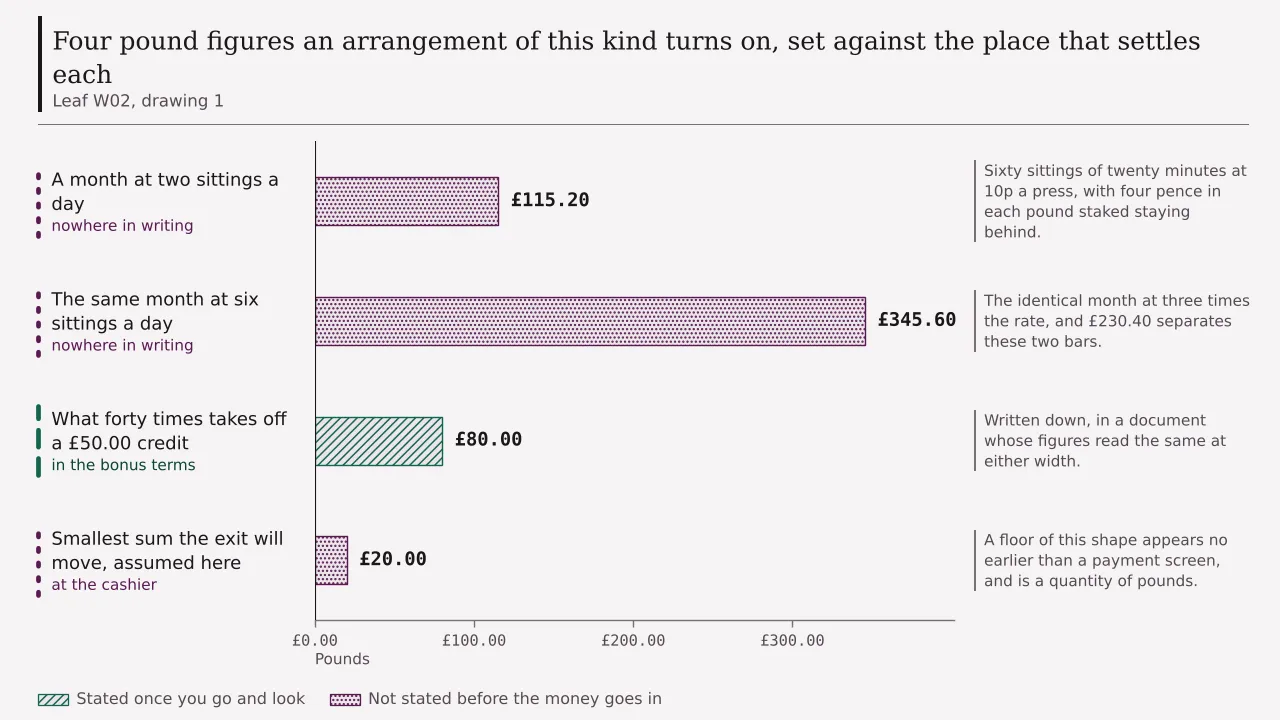
The drawing makes the ordering visible and the ordering is the uncomfortable part. The two tallest bars are the two nobody writes down. The bar a reader is most likely to go looking for, the one the written multiple produces, is the third of four. Attention and money are sorted in opposite directions, which is the same shape this site keeps turning up and is sharper here than anywhere.
5
Measuring the walk to a clause in screenfuls instead of documents
Distance from a claim to the condition qualifying it is this site’s central measurement, and it is ordinarily counted in deliberate actions: open the promotional document, open the account agreement, open the schedule the second defers to. Counted that way the two widths agree exactly. Whatever a reader must open on a desk, they must open on a telephone, in the same order.
That agreement is where the usual measurement stops being sensitive enough. A document opened is not a document read, and the quantity deciding whether it gets read is how much of it stands in front of somebody at any moment. So this part adds a finer unit underneath the action: the screenful, meaning the quantity of a document a reader can see without moving anything.
Give the unit a size. This leaf assumes a desktop column holds about 320 words at a time and a handset screen about 80, a ratio of four to one, and no source publishes either figure. Assume a conditions document of 4,000 words, which is this leaf’s assumption as well. Divide and the document is 12.5 screenfuls on the desk and 50 in the hand.
| What is measured | On a desk | In a hand |
|---|---|---|
| Words standing in view at once, assumed here | 320 | 80 |
| Screenfuls in a 4,000 word document | 12.5 | 50.0 |
| Deliberate actions to open that document | 1 | 1 |
| Words in the document | 4,000 | 4,000 |
| Minutes to read it at 230 words a minute, assumed here | 17 minutes 23 seconds | 17 minutes 23 seconds |
Three of those five rows refuse to move and two of them multiply by four. Note especially the last row, because it is the one most people expect to move and it does not. Reading 4,000 words takes the same seventeen minutes and twenty-three seconds either way, since the eye reads words rather than screens and the word count is a property of the drafting.
So the honest statement of what a small screen does to a document is precise and limited. It does not lengthen the document. It does not slow the reading. It multiplies by four the number of separate acts required to get through the identical text in the identical time, and it cuts to a quarter how much of that text can be held in view while any part of it is being considered.
Both halves of that are measurements about rendering rather than about drafting, which is what makes this the clearest case anywhere on this site of a condition changing its position without one word of it being rewritten. The sentence that costs £80.00 is the same sentence. Where it sits relative to a reader is not.
6
One document, two renderings, and a clause that travelled
Put a clause inside the document and the measurement becomes concrete. Conditions documents of this kind tend to open with eligibility and the qualifying payment, then come to the multiple, then to the ceilings. Assume the wagering clause begins 2,600 words in and the ceiling over a single press 3,400 words in, both of which are this leaf’s placements and neither of which any source fixes.
Divide by the two screenful sizes. The wagering clause sits 8.1 screenfuls down on a desk and 32.5 in a hand. The press ceiling sits 10.6 down on a desk and 42.5 in a hand. Nothing about either clause has been edited. The reader has not been asked to open anything further. The clause deciding £80.00 has moved 24.4 screenfuls away from where it was.
24.4 screenfuls of further travel to one unchanged clause, produced by a narrower column and nothing else
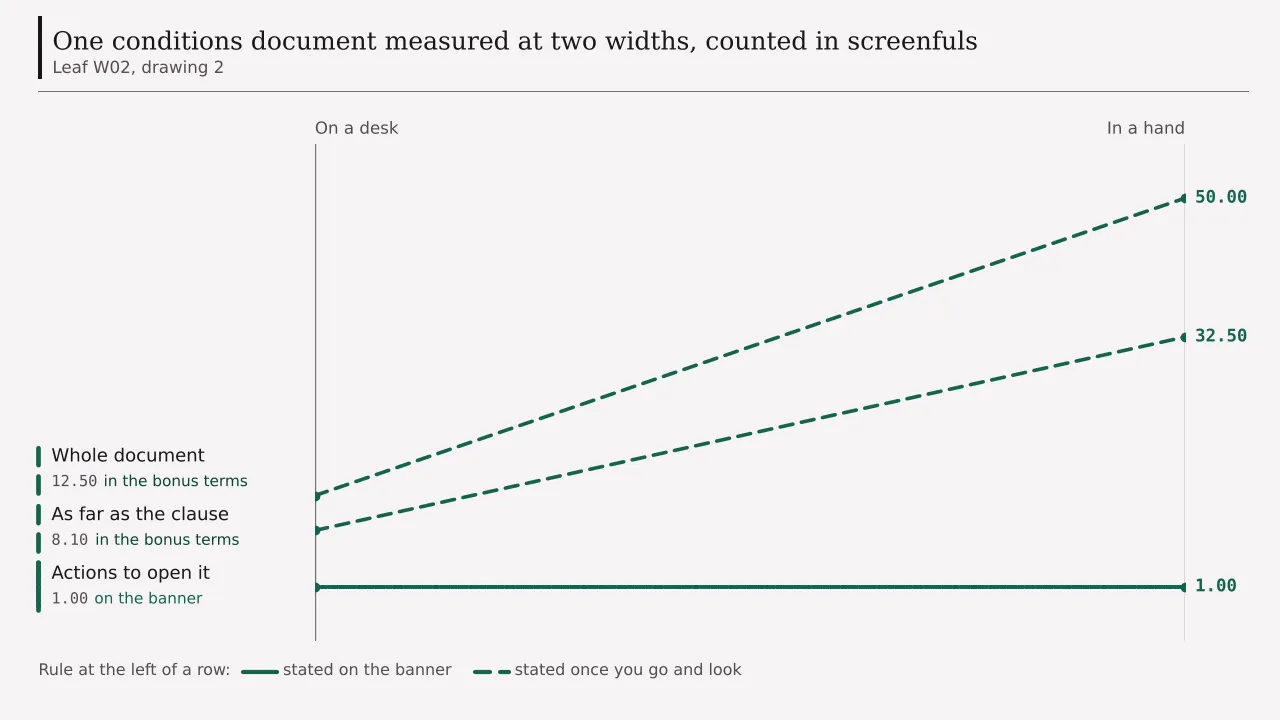
The flat line at the foot of that drawing is the one worth staring at. Measured in actions, which is the measurement this site normally makes, the two renderings are identical and there is no finding to report. Measured in screenfuls, they differ by a factor of four. The same document can therefore be described as equally reachable and four times further away, and both descriptions are accurate.
Price the travel. On the worked arrangement the whole of the £80.00 gap is settled by one clause, so the price of the walk is £80.00 whichever rendering it is read in. Divided over the walk, that is £9.88 a screenful on a desk and £2.46 a screenful in a hand. The money at the end has not changed. It has been spread over four times as many separate acts, each of which is a place somebody can stop.
Nothing in that is a claim about how often anybody does stop, and this leaf has no figure for it. What can be said without inventing anything is the shape: the number of opportunities to abandon a reading rises by a factor of four while the value of finishing it stays at £80.00. A condition reached at the fiftieth act is binding in exactly the way a condition reached at the twelfth is binding, which is the whole point.
One fair objection deserves answering. A document can be searched rather than read, and a reader who looks for the word wagering reaches the clause in one act at either width. That is true, it collapses the measurement entirely, and it requires knowing which word to look for. The screenful count is a measurement about reading through, which is what somebody does when they do not yet know what the document contains.
7
What stands in view at the instant of agreeing
Agreement happens at one moment and in one view, and that view can be measured. Of a 4,000 word document, a desktop column showing 320 words puts 8 per cent of it in front of somebody at the instant they agree. A handset showing 80 words puts 2 per cent. Those two percentages are the sharpest numbers on this leaf.
Work out what is inside that view. The clauses deciding money sit at 2,600 and 3,400 words in, which is 65 and 85 per cent of the way through. A view holding the last 8 per cent or the last 2 per cent of the document contains neither of them, so the money decided by what a reader can actually see while agreeing is £0.00 at both widths.
That nought is the most useful figure in this part and it cuts against the argument a reader might expect from a page of this kind. A smaller screen does not hide the expensive clause, because the larger screen was not showing it either. What a smaller screen reduces is the quantity of surrounding context in view, from a twelfth of the document to a fiftieth.
| What the view holds | On a desk | In a hand |
|---|---|---|
| Words of the document | 320 | 80 |
| Share of the document | 8 per cent | 2 per cent |
| Money the visible words decide | £0.00 | £0.00 |
| Money the whole document decides | £80.00 | £80.00 |
Read the third row against the fourth and the structure of every arrangement in this family appears in two lines. All of the money is in the document. None of it is in the view. The gap between those two rows is the whole of what this site measures, and the width of the screen changes how large the surrounding silence is without changing either figure.
There is a second quantity in view at that instant and it is the one doing the persuading. A headline figure is set large, which means it occupies a larger share of a small screen than of a big one. This leaf will not put a number on that, because measuring it needs a layout rather than an assumption, and a layout is the one thing a page like this cannot honestly stipulate.
What can be stated plainly is the asymmetry of the two measurements. The clause is measured in words and multiplies its distance by four on a narrow screen. The claim is measured in pixels of type and does not. One of the two was drafted to be read and the other was drafted to be seen, and only one of them is affected by how much a reader can hold in front of them.
8
Ceilings, floors and the pace beneath them, tested at both widths
Run the same test over the conditions that bound the arithmetic, because the result is not obvious until it is checked. A ceiling of £5.00 over a single game cycle is a figure about money and takes no account of what the money was committed from. On the worked arrangement, £2,000.00 of staking at that ceiling needs at least 400 presses either way.
The interval between cycles behaves identically. At 2.5 seconds, 400 presses occupy at least 1,000 seconds, which is sixteen minutes and forty seconds. At the 10p this leaf assumes, the same £2,000.00 is 20,000 presses and 50,000 seconds, or thirteen hours and fifty-three minutes. Both figures are properties of a build and a clause, and neither has a device in it.
An exit floor assumed at £20.00 and a qualifying payment assumed at £10.00 are both quantities of pounds, and pounds do not vary with a screen. A thirty-day window on the clause is a quantity of days. The identity items wanted before any play come to three, a name, somewhere post would reach, and when the holder was born, and no screen size touches any of them.
What the width does reach is the one place in part two’s table where a reader’s own behaviour meets a figure. A thirty-day window on £2,000.00 of staking needs £66.67 across the reels a day. At the twenty-minute sitting from part three that is £48.00, so one sitting a day leaves the window unmet and two comfortably meets it. The window is identical at both widths and the thing that satisfies it is the mover.
That is worth stating carefully, because it is the one genuine interaction on the leaf. Device does not change the clause. Device plausibly changes the count of sittings. The count of sittings decides whether a window written in days can be met at all, so a quantity nobody records decides whether a quantity everybody can read is reachable. The clause has not moved and its feasibility has.
£66.67 a day of staking needed to meet a thirty-day window, against £48.00 in one assumed sitting
Follow it one step further and the subtraction returns. A reader who cannot meet the window leaves the credit unconverted, so the expected close is not minus £30.00 but whatever their own money did on the way, and the £50.00 on the advertisement was worth nothing at all. The two readings the price block printed are the two endpoints; failing the window drops a reader off the bottom of both.
9
Duties about where a thing sits and what a screen must show
Britain writes rules about position and about display, which is the family of duty this leaf’s subject actually sits in. The regulator’s own advertising page makes prominence inside the advertisement the test, with the significant terms kept near the headline figure on an arrival page and on a registration page alike. An advertisement falling short of that counts as a misleading one.
Read that against part seven and it is a duty about exactly the quantity measured there. Prominence is a statement about what stands in a view, not about what exists in a document, and a view is the thing a narrower screen shrinks. The duty does not mention screen widths and it does not need to, because it is written about the result rather than the cause.
The financial limits standard goes further and counts the actions. Its access limb asks for the route to limit-setting to be reachable straight off a homepage, plainly visible on a deposit screen or linked from one, and above all short: the system has to hold down the count of pages and presses lying between a customer and a limit. That is a British rule written in this leaf’s own unit, and no other rule on the subject is.
The same standard carries a prominence requirement of its own: a gross deposit limit, the kind that caps what goes in over a period, must be offered with at least equal prominence to the other limit types. Equal prominence on a screen holding 320 words and equal prominence on a screen holding 80 are different engineering problems and the same duty.
Two further rules bear on a screen while a sitting is running. From 17 January 2025 a licensed operator must keep a live count of net spend and of time spent in front of the customer, and nothing the operator provides may set several products running together. The first of that pair is the only duty here whose worth climbs with the tally of sittings, since somebody at six a day has six separate chances to lose the running total.
Put the five duties above beside the figures and each one answers a specific line of this leaf, which is why the losses are worth itemising this way rather than as a list. Prominence answers part seven’s 2 per cent. Equal prominence for a deposit cap answers the same view from the other side. Minimising clicks answers part five’s unit directly. A running total shown live answers part four’s £345.60, which is the figure a reader at six sittings a day has no other way of seeing assembled. The ban on simultaneous products answers the rate at which a small screen can be made to carry more than one thing. Then note where the arrangement sits, which is outside the British licence, and the five withdraw together, leaving a document still accurate, still complete, and under no obligation to put any part of itself where a reader is looking.
Say what the duties do not reach, because the limit matters as much as the reach. None of them touches the multiple, the return, the break-even or the weighting, so none of them moves the minus £30.00. They govern where a figure stands and what a screen displays while money is moving, which is to say they govern the two quantities this leaf found to be device-sensitive and nothing else at all.
10
Running the width test on any claim met on a handset
The test is three questions and the first one disposes of most of the suspicion a reader brings to this subject. Ask of every figure on the arrangement whether it is a quantity of money, a ratio, a count of days or a count of identity items. If it is any of those, it is identical at both widths and the enquiry ends there.
The second question is the one worth time. Ask what the arrangement needs from the reader that is measured in occasions rather than in pounds. A window in days needs a rate of staking a day. A limited-period release needs a visit inside the period. A daily credit needs a daily visit. Every one of those turns on the count from part three, and the count is the quantity a device plausibly moves.
The third question is about the reading rather than the arrangement. Before agreeing, work out roughly how long the conditions document is and divide by what the screen in hand holds. Twelve and a half acts of scrolling is a reading somebody finishes. Fifty is a reading most people abandon, and the clause at the thirty-second of those fifty is as binding as it would have been at the eighth.
Applied to the worked arrangement the three questions give a short answer. The credit, the multiple, the staking, the return, the close, the ceilings, the floors and the clocks are all identical, so none of them is a reason to prefer one width. The thirty-day window needs £66.67 a day and one assumed sitting supplies £48.00, so the window is the line where the device enters. And the document is fifty screenfuls rather than twelve and a half, so the place to read it is wherever a reader will actually finish.
There is a version of this subject that would have been easier to write and is not true. It says that a handset arrangement is a worse arrangement, with tighter clauses and meaner figures, dressed up for a screen that cannot show the catch. Fourteen rows at two widths say otherwise, and this leaf prints them rather than the easier story because the easier story would collapse the moment anybody opened the same document twice.
The accurate summary is narrower and more useful. One document, two renderings, identical figures, four times the acts of reading, a quarter of the context in view, and a count of sittings that nobody has ever written down deciding £230.40 a month. The arithmetic is not device-dependent. The reading of it is, and the reading is what the £80.00 was always hanging on.
Questions
- Are bonus terms different on a phone than on a desktop?
- Not in the figures. A £50.00 credit under a forty times clause asks £2,000.00 across the reels, leaves £80.00 with the margin at a 96 per cent return, with an expected close of minus £30.00, and every one of those is the same number at both widths. Fourteen money quantities on an arrangement of this kind were read at two widths for this leaf, covering the credit, the multiple, the staking, the return, the close, the break-even, the contribution, the ceilings, the floors, the window, the identity items and the complaint clock, and the two readings agreed in every row.
- What does a handset genuinely change about an offer?
- Two quantities, and no document records either. The first is how many separate sittings a month holds, which rises when the thing is carried about. The second is how many words one screen can hold, which falls with the width. Everything else that might be suspected of moving is either derived from those two or is not moving at all, and both of them apply regardless of anything written, which puts the whole device question in the sixth place and nowhere else.
- How much is the number of sittings worth in money?
- On this leaf’s assumptions, £230.40 across a month. A twenty-minute sitting holds at most 480 presses where no second cycle may open inside 2.5 seconds, which is £48.00 of staking at 10p and an expected £1.92 to the margin. Two sittings a day for thirty days is £2,880.00 of turnover and £115.20 of expected cost; six a day is £8,640.00 and £345.60. The subtraction does not claim that a handset produces six and a desk produces two, only that the rate can differ and nothing anywhere states it.
- What is a screenful and why count in them?
- A screenful is the quantity of a document standing in view without anything being moved, and this leaf assumes 320 words of it on a desktop column and 80 on a handset, with no source publishing either. Counting deliberate actions, the usual measurement on this site, makes the two widths identical: whatever must be opened on a desk must be opened in a hand, in the same order. Counting screenfuls makes a 4,000 word document 12.5 on the desk and 50 in the hand, which is where the difference actually lives.
- Does a small screen make the terms longer or slower to read?
- Neither. The word count is a property of the drafting, so a 4,000 word document stays 4,000 words, and at the 230 words a minute this leaf assumes it takes seventeen minutes and twenty-three seconds at both widths. What multiplies by four is the number of separate acts needed to get through that identical text in that identical time, and what falls to a quarter is how much of the text can be held in view while any part of it is being weighed.
- How far from the claim does the wagering clause actually sit on a phone?
- Assume the clause begins 2,600 words into a 4,000 word document, which is this leaf’s placement and not anything a source fixes. That puts it 8.1 screenfuls down on a desktop column and 32.5 in a hand, a difference of 24.4 screenfuls produced by a narrower column and by nothing else. Not one word of the clause has been edited and the reader has not been asked to open anything further, which makes this the clearest case anywhere of a condition changing position without being rewritten.
- How much of the terms can I see at the moment I agree?
- Eight per cent of a 4,000 word document on a desktop column and 2 per cent in a hand, on this leaf’s assumed screenful sizes. The clauses deciding money sit at roughly 65 and 85 per cent of the way through, so a view holding the last 8 per cent or the last 2 per cent contains neither of them, and the money decided by the words actually visible at that instant is £0.00 at both widths. A smaller screen does not hide the expensive clause. The larger one was not showing it either.
- Do the stake ceiling and the pace rules work the same way on a handset?
- Identically, because both are properties of a build and a clause. A ceiling of £5.00 over one game cycle means £2,000.00 of staking needs at least 400 presses at either width, and at a 2.5 second interval those 400 occupy at least sixteen minutes and forty seconds. At the 10p this leaf assumes the same £2,000.00 is 20,000 presses and at least thirteen hours fifty-three minutes. Neither figure has a device anywhere in it.
- Where does the device actually touch the arithmetic, if anywhere?
- At a window written in days. Thirty days against £2,000.00 of staking needs £66.67 across the reels a day, and one assumed twenty-minute sitting supplies £48.00, so a single daily sitting leaves the window unmet and two comfortably meet it. The window is identical at both widths; the thing that satisfies it is the count of sittings, which is the quantity nobody records. A reader who misses the window leaves the credit unconverted, and the £50.00 on the advertisement was then worth nothing at all.
- What rules does Britain write about how an offer is displayed?
- Five that bear on this subject. Prominence inside the advertisement is the test, with significant terms kept near the headline figure on an arrival page and on a registration page alike, and an advertisement falling short of that counts as misleading. The financial limits standard wants limit-setting reachable straight off a homepage, plainly visible on a deposit screen, and short to get to, with the count of pages and presses between customer and limit held down. It also wants a gross deposit limit, the sort capping what goes in across a period, carried no less visibly than the other sorts. And from 17 January 2025 an operator must keep a live count of net spend and of time spent in front of the customer, with nothing it provides allowed to set several products running together.
- What is lost on a handset at a site outside the British licence?
- The five answers above, withdrawn together. Nothing then obliges a significant term to stand where a reader is looking, nothing obliges a deposit cap to be put forward as prominently as any other kind, nothing obliges the route to limit-setting to be short, nothing obliges a running total of spend and of time to be visible while a sitting is under way, and nothing bars an interface from carrying several products together. Arrangements reached this way hold no Great Britain licence. The document left behind is still accurate, still complete, and under no obligation to put any part of itself in front of anybody.