Terms read 19 October 2026 Leaf W01, revision 1
A bigger balance buys a shorter clock and not one better term
Credit of £500.00 under a forty times clause wants £20,000.00 pushed across the reels and closes at an expected minus £300.00, a gap of £800.00. Divide every one of those by twenty-five and the figures for a £20.00 credit appear, with the proportions untouched. This leaf works the arithmetic up a ladder of sizes and finds the only thing the size decides.
Stated on the banner £500.00 A percentage against a payment, which between them fix how much credit arrives and settle nothing whatever about what it converts into. Stated, once you go and look minus £300.00 Forty times laid across that credit at a return of 96 per cent, from a clause whose wording does not vary with the sum standing under it. Not stated before the money goes in Four switches Conditions drafted in pounds rather than in ratios, which change state at a particular size of stake, and no writing anywhere names the size.
Arrangements built for larger balances, with the conditions read
Every destination in this file is bought advertising. The site is paid a fee if a reader goes on to register, and no figure printed below moves because of it.
Bonus Spins UK Slip 01
Betportal
Ceiling as a multiple
The drop
€15.00
€1.00 in the euro
The claim reads €15.00. Once the terms beside it have applied, €0.00 of it can leave. The difference is the drop.
7 of the 15 terms on this slip could not be read before the money went in
Spins priced at this site's own 10p a spin, which the operator does not publish
Stated
€15.00
The claim as it is printed, before a single term has been applied to it.
Headline paid as spins
150 spins at 10c each, which is €15.00 of the figure above.
6 Nowhere
What one spin is worth
No unit is published for a spin, so the count is priced at this site's own 10p a spin. At half that price every figure below halves with it.
Match and other credit not priced
300% of three deposits, to a ceiling of €1,000. A share of a deposit nobody has made yet is not a sum, so no figure stands on this line and none is carried below.
Qualified
-€14.40
Written down somewhere, and taking part of the claim back. Each term carries the place it is written and the sum it takes.
2 Written terms at a distance this record does not establish
Play-through -€14.40
Carrying €14.40 through 35 times stakes €504.00 and costs €20.16 of it at 96 per cent return. That prices above the €14.40 there is to charge it against, so the whole of the credit goes and the line is held at that. The multiple sits on the bonus.
2 Written terms at a distance this record does not establish
Game weighting not priced
Slots only count towards the play-through. No contribution percentage is published, so the line above has been worked at full weight, which is the kindest reading there is.
2 Written terms at a distance this record does not establish
Ceiling on the winnings not priced
5x the bonus.
2 Written terms at a distance this record does not establish
Clock on the credit not priced
14 days.
2 Written terms at a distance this record does not establish
Largest stake while it runs not priced
€5.
3 Public record
Licence, and who holds it not priced
Licensed in Anjouan, Comoros, held by BetPortal Gaming Ltd, with Excite Ultra Media Ltd, reference ALSI-202601040-FI2. A register entry settles who holds a licence and what it permits. It does not settle who is running the site this morning.
4 Cashier
Smallest qualifying deposit your money
€20 a stage. That is €20.00 of your own money, and it is never netted into a drop.
5 On the way out
Checks before a withdrawal not priced
Documents before the first withdrawal.
Unstated
-€0.60
Applying without having been published anywhere, and costing money all the same.
6 Nowhere
What a spin hands back -€0.60
Staking a spin returns 96 per cent of it, so that share of the batch is the house's before a reel turns. This site works at that return and the operator publishes none where the claim is made.
6 Nowhere
Forfeited by rule cost unknown
Nothing is published under this heading, and it applies regardless.
6 Nowhere
Charge on the way out cost unknown
No charge on the way out is published as a figure, so nothing comes off this line. A charge that exists unpublished would come straight off whatever survives.
6 Nowhere
Smallest withdrawal allowed cost unknown
No smallest withdrawal is published as a figure. A floor nobody has published is still a floor, and it decides whether a small balance can move at all.
No Great Britain licence
Terms read 19 October 2026
Bonus Spins UK Slip 02
WinBeast
Ceiling as a sum
The drop
€50.00
€1.00 in the euro
The claim reads €50.00. Once the terms beside it have applied, €0.00 of it can leave. The difference is the drop.
8 of the 15 terms on this slip could not be read before the money went in
Spins priced at this site's own 10p a spin, which the operator does not publish
Stated
€50.00
The claim as it is printed, before a single term has been applied to it.
Headline paid as spins
500 spins at 10c each, which is €50.00 of the figure above.
6 Nowhere
What one spin is worth
No unit is published for a spin, so the count is priced at this site's own 10p a spin. At half that price every figure below halves with it.
Match and other credit not priced
50% to 100% of five deposits, each to a ceiling of €1,000, and a €650 free bet. A share of a deposit nobody has made yet is not a sum, so no figure stands on this line and none is carried below.
Qualified
-€48.00
Written down somewhere, and taking part of the claim back. Each term carries the place it is written and the sum it takes.
2 Written terms at a distance this record does not establish
Play-through -€48.00
Carrying €48.00 through 40 times stakes €1,920.00 and costs €76.80 of it at 96 per cent return. That prices above the €48.00 there is to charge it against, so the whole of the credit goes and the line is held at that. The multiple sits on the bonus and the winnings from the spins.
2 Written terms at a distance this record does not establish
Game weighting not priced
Slots, titles vary by country count towards the play-through. No contribution percentage is published, so the line above has been worked at full weight, which is the kindest reading there is.
2 Written terms at a distance this record does not establish
Ceiling on the winnings not priced
€100 a batch of spins.
2 Written terms at a distance this record does not establish
Clock on the credit not priced
7 days, spins 1 day.
3 Public record
Licence, and who holds it not priced
Licensed in Curaçao, holder not named on the site. A register entry settles who holds a licence and what it permits. It does not settle who is running the site this morning.
4 Cashier
Smallest qualifying deposit your money
€20 a stage. That is €20.00 of your own money, and it is never netted into a drop.
5 On the way out
Checks before a withdrawal not priced
Documents before the first withdrawal.
Unstated
-€2.00
Applying without having been published anywhere, and costing money all the same.
6 Nowhere
What a spin hands back -€2.00
Staking a spin returns 96 per cent of it, so that share of the batch is the house's before a reel turns. This site works at that return and the operator publishes none where the claim is made.
6 Nowhere
Largest stake while it runs cost unknown
Nothing is published under this heading, and it applies regardless.
6 Nowhere
Forfeited by rule cost unknown
Nothing is published under this heading, and it applies regardless.
6 Nowhere
Charge on the way out cost unknown
No charge on the way out is published as a figure, so nothing comes off this line. A charge that exists unpublished would come straight off whatever survives.
6 Nowhere
Smallest withdrawal allowed cost unknown
No smallest withdrawal is published as a figure. A floor nobody has published is still a floor, and it decides whether a small balance can move at all.
No Great Britain licence
Terms read 19 October 2026
Bonus Spins UK Slip 03
EliteSpin
Longest spin window
The drop
£50.00
£1.00 in the pound
The claim reads £50.00. Once the terms beside it have applied, £0.00 of it can leave. The difference is the drop.
8 of the 15 terms on this slip could not be read before the money went in
Spins priced at this site's own 10p a spin, which the operator does not publish
Stated
£50.00
The claim as it is printed, before a single term has been applied to it.
Headline paid as spins
500 spins at 10p each, which is £50.00 of the figure above.
6 Nowhere
What one spin is worth
No unit is published for a spin, so the count is priced at this site's own 10p a spin. At half that price every figure below halves with it.
Match and other credit not priced
50% to 100% of five deposits, each to a ceiling of £1,000. A share of a deposit nobody has made yet is not a sum, so no figure stands on this line and none is carried below.
Qualified
-£48.00
Written down somewhere, and taking part of the claim back. Each term carries the place it is written and the sum it takes.
2 Written terms at a distance this record does not establish
Play-through -£48.00
Carrying £48.00 through 40 times stakes £1,920.00 and costs £76.80 of it at 96 per cent return. That prices above the £48.00 there is to charge it against, so the whole of the credit goes and the line is held at that. The multiple sits on the bonus and the winnings from the spins.
2 Written terms at a distance this record does not establish
Game weighting not priced
Slots count towards the play-through. No contribution percentage is published, so the line above has been worked at full weight, which is the kindest reading there is.
2 Written terms at a distance this record does not establish
Ceiling on the winnings not priced
5x the bonus.
2 Written terms at a distance this record does not establish
Clock on the credit not priced
7 days, spins 3 days.
3 Public record
Licence, and who holds it not priced
Licensed in Costa Rica, held by PrimeTier Limited. A register entry settles who holds a licence and what it permits. It does not settle who is running the site this morning.
4 Cashier
Smallest qualifying deposit your money
£20 a stage. That is £20.00 of your own money, and it is never netted into a drop.
5 On the way out
Checks before a withdrawal not priced
Documents before the first withdrawal.
Unstated
-£2.00
Applying without having been published anywhere, and costing money all the same.
6 Nowhere
What a spin hands back -£2.00
Staking a spin returns 96 per cent of it, so that share of the batch is the house's before a reel turns. This site works at that return and the operator publishes none where the claim is made.
6 Nowhere
Largest stake while it runs cost unknown
Nothing is published under this heading, and it applies regardless.
6 Nowhere
Forfeited by rule cost unknown
Nothing is published under this heading, and it applies regardless.
6 Nowhere
Charge on the way out cost unknown
No charge on the way out is published as a figure, so nothing comes off this line. A charge that exists unpublished would come straight off whatever survives.
6 Nowhere
Smallest withdrawal allowed cost unknown
No smallest withdrawal is published as a figure. A floor nobody has published is still a floor, and it decides whether a small balance can move at all.
No Great Britain licence
Terms read 19 October 2026
Bonus Spins UK Slip 04
Crown Jewelz
Multiple unpublished
The drop
NOT WORKED
The multiple is not published in the operator's own terms. Since the sum cannot be worked around it, none is worked.
9 of the 14 terms on this slip could not be read before the money went in
No drop worked
Stated
£15.00
The claim as it is printed, before a single term has been applied to it.
Headline paid as spins
150 spins at 10p each, which is £15.00 of the figure above.
6 Nowhere
What one spin is worth
No unit is published for a spin, so the count is priced at this site's own 10p a spin. At half that price every figure below halves with it.
Match and other credit not priced
200% of the first deposit, then 150% twice, each to a ceiling of £1,000. A share of a deposit nobody has made yet is not a sum, so no figure stands on this line and none is carried below.
Qualified
NOT WORKED
Written down somewhere, and taking part of the claim back. Each term carries the place it is written and the sum it takes.
2 Written terms at a distance this record does not establish
Play-through not priced
40x the bonus, reported rather than published by the operator.
2 Written terms at a distance this record does not establish
Game weighting not priced
Slots count towards the play-through. No contribution percentage is published, so the line above has been worked at full weight, which is the kindest reading there is.
3 Public record
Licence, and who holds it not priced
Licensed in Curaçao, number not verified, holder not named on the site. A register entry settles who holds a licence and what it permits. It does not settle who is running the site this morning.
4 Cashier
Smallest qualifying deposit your money
£20. That is £20.00 of your own money, and it is never netted into a drop.
5 On the way out
Checks before a withdrawal not priced
Documents before the first withdrawal.
Unstated
NOT WORKED
Applying without having been published anywhere, and costing money all the same.
6 Nowhere
Ceiling on the winnings cost unknown
No ceiling is published. Nothing is assumed in its place.
6 Nowhere
Clock on the credit cost unknown
Nothing is published under this heading, and it applies regardless.
6 Nowhere
Largest stake while it runs cost unknown
Nothing is published under this heading, and it applies regardless.
6 Nowhere
Forfeited by rule cost unknown
Nothing is published under this heading, and it applies regardless.
6 Nowhere
Charge on the way out cost unknown
No charge on the way out is published as a figure, so nothing comes off this line. A charge that exists unpublished would come straight off whatever survives.
6 Nowhere
Smallest withdrawal allowed cost unknown
No smallest withdrawal is published as a figure. A floor nobody has published is still a floor, and it decides whether a small balance can move at all.
No Great Britain licence
Terms read 19 October 2026
Every figure in the second and third columns is this site's own working and nothing an operator has published. A claim is priced as printed, then the share a spin hands back at 96 per cent return comes off it, then what playing the multiple through costs at the same return, and then whatever a published ceiling, a charge on the way out or a floor on the smallest withdrawal takes from what has survived. The drop is the difference between the first figure and the last. The two columns add back up to it exactly, so no money leaves a slip without a term and a place beside it.
Which column a term falls in is settled by one question: has anybody written it down. A charge a reader meets at the payment screen is written down, and it stands in the second column with the cashier against it. A condition that binds without ever having been set down stands in the third, whatever it costs. Inside each column the terms run outwards from the banner, so the order itself says how far a reader would have had to go.
A count of spins has no unit until one is supplied. Where an operator publishes what one of its own spins is worth, that figure is used and the first column says it is theirs. Where none is published, this site's own 10p a spin stands in its place and every figure below moves in proportion with it. Where the multiple itself is unpublished, no drop is worked at all, because that is the one figure the sum cannot be done without.
Three words stand where a figure cannot. Not priced is a term that is written down and carries no number the arithmetic can take. Cost unknown is a term nobody has written down, costing something nobody has put a number on. Your money is money of the reader's own, which is never netted into a drop.
None of the operators in this file holds a Great Britain licence, so none of the duties that licence carries reaches them. Each of those duties is published in its own right, which is what makes its absence here something a reader can check rather than take on trust. Every gambling company licensed in Great Britain belongs to Gamstop Online, so a reader who has shut themselves out through the scheme is not shut out here. Social Responsibility Code 5.1.1 has held a play-through to a maximum of ten times the bonus funds since 19 January 2026, and it binds a licence holder and nobody else. Asked in a post of 21 October 2025 what is lost along with the licence, the Gambling Commission's Director of Enforcement and Intelligence answered: "unfair gaming practices, financial loss, and a lack of recourse if things go wrong". The same post puts blocked payouts, and withdrawal limits pitched high enough to be unreachable, among the behaviour the Commission has recorded. Nobody under 18 may hold an account at any of them.
Terms are reproduced in the wording their operator published, and each slip is dated with the day somebody sat down and read them. 19 October 2026 is the oldest of those dates. Anybody claiming an offer is bound by that operator's full terms, which are elsewhere, and never by a line standing here.
1
What a larger balance actually purchases, in figures
Take a credit of £500.00 and lay the house arithmetic over it. Forty times that credit is £20,000.00 of staking before a penny of it becomes money. Four pence in every pound staked stays with the reels at a 96 per cent return, so £20,000.00 is expected to shed £800.00. Subtract that from the £500.00 and the expected close is minus £300.00.
The same answer arrives by a second route touching none of the first one’s steps. Multiply forty by four hundredths and the product is 1.6. A credit retains one less that, so what it retains is negative six tenths of itself, and negative six tenths of £500.00 is minus £300.00. The distance from £500.00 down to minus £300.00 is £800.00, which is exactly the shedding computed from the staking. Two calculations sharing no step and landing on one pair of figures is the test applied at every rung below, and it holds at all of them.
Credit, taken from the percentage alone £500.00 Expected close with the forty times clause in force minus £300.00 The subtraction, which this page then repeats at four other sizes £800.00
Now shrink the whole thing by twenty-five. A credit of £20.00 at forty times wants £800.00 of staking, sheds £32.00 and closes at an expected minus £12.00. Set the two side by side and every figure has moved by the same factor of twenty-five: the credit, the staking, the shedding and the close. Not one of the relationships between them has shifted by so much as a hundredth.
That is a stronger statement than it sounds, because it is the opposite of what the vocabulary around larger balances implies. Arrangements pitched at bigger payments are described with words borrowed from banking, where a larger sum genuinely does buy a better rate. Here the rate is a property of the reels and of the clause, and neither of them can see how much money is behind a press. Forty times is forty times at £20.00 and forty times at £12,500.00, and the reels hand back the identical 96 pence per pound at either end.
So the question worth asking is not whether a large balance is treated better, which the arithmetic settles in a line, but what it is treated differently about at all. The answer this leaf reaches is that the size of a stake changes exactly one thing in the expectation, which is how long the expectation takes to arrive, and changes one thing about the document, which is which of its conditions are capable of binding. Both of those are real and neither is printed anywhere.
The figure this leaf is built to produce already stands above: £800.00 against £500.00, which is £1.60 of gap for every pound of credit and exactly what a £20.00 arrangement produces.
2
Five credits an order apart, and the ratio that will not move
A ladder makes the invariance visible in a way prose cannot. Below are five credits, each rung five times the one above it, carried from £20.00 to £12,500.00. The staking column is forty times the credit. The shedding column is four hundredths of the staking. The close is the credit less the shedding. The final column is the close divided by the credit, and it is the column worth reading.
| Credit arriving | Staking the clause wants | Expected shedding at four pence | Expected close | Close divided by credit |
|---|---|---|---|---|
| £20.00 | £800.00 | £32.00 to the margin | minus £12.00 | minus 0.6 |
| £100.00 | £4,000.00 | £160.00 to the margin | minus £60.00 | minus 0.6 |
| £500.00 | £20,000.00 | £800.00 to the margin | minus £300.00 | minus 0.6 |
| £2,500.00 | £100,000.00 | £4,000.00 to the margin | minus £1,500.00 | minus 0.6 |
| £12,500.00 | £500,000.00 | £20,000.00 to the margin | minus £7,500.00 | minus 0.6 |
The right-hand column is a flat line and that flatness is the finding. A factor of six hundred and twenty-five divides the uppermost rung from the lowest, and the ratio of close to credit matches to the last decimal place at either end. A reader at £12,500.00 is buying what a reader at £20.00 is buying, enlarged, and the enlargement runs uniformly in every direction at once.
Say what has been assumed, because most of what feeds that table is this leaf’s rather than anybody’s rule. A press worth 10p is assumed throughout this site and no source publishes one. A return of 96 pence per pound staked is assumed as well, and no licensee is obliged to print that particular figure. Forty times is the band an offshore cashier tends to write, assumed here rather than quoted. Weighting is pinned at one, which is the kindest setting the arithmetic allows and the one no drafter has a duty to put right.
Credit ceases to carry value once the multiple reaches twenty-five, and twenty-five is simply how many times four pence fits inside a pound. Under twenty-five, something is expected to remain once the staking is done. At twenty-five, the whole credit is expected to have crossed the reels. Over twenty-five the clause asks the margin for more than the credit contains, and whatever it cannot find there is drawn from a balance the arrangement never promised to supply.
That break-even is a ratio as well, so it also refuses to move with size. Twenty-five is twenty-five at £20.00 and twenty-five at £12,500.00, and a clause written at forty sits sixty per cent beyond it on every rung. Anybody looking for the point where a large balance becomes a different proposition will not find it in this column, because the column is made of ratios and ratios do not have sizes.
£20,000.00 of staking asked against £500.00 of credit, which is the identical forty to one at every rung of the ladder
One honest qualification belongs with the ladder. An expectation is an average over outcomes, and the spread around it is wider in pounds at the bottom of the table than at the top, because the number of presses is larger and the law of averages has more to work with. That is a statement about variance rather than about the terms, it works in the reader’s favour on precisely as many occasions as it works against, and nothing in any document mentions it.
3
The one quantity a bigger press changes, measured in hours
Hold the credit at £500.00 and therefore hold the staking at £20,000.00, then vary nothing but the size of a single press. At 10p the obligation is 200,000 presses. At £1 it is 20,000. At £5 it is 4,000. At £25 it is 800. The expected close after every one of those is minus £300.00, because the shedding is four pence in each pound staked and the number of pounds staked has not changed.
Presses convert into time through a floor rather than a ceiling. A reel build inside the British licence has to leave an interval of 2.5 seconds standing between the opening of one game cycle and the opening of the next, which puts a hard minimum under any quantity of presses and no maximum over it. Multiplying the counts just given by that interval gives each one a shortest possible sitting, and a shortest possible sitting is the only duration here anybody can compute with.
| Size of one press | Presses the £20,000.00 wants | Shortest sitting at the pace floor | Expected close | Whether a £5.00 press ceiling reaches it |
|---|---|---|---|---|
| 10p | 200,000 | 5 days 18 hours 53 minutes | minus £300.00 | Idle, by a factor of fifty |
| £1.00 | 20,000 | 13 hours 53 minutes | minus £300.00 | Idle, by a factor of five |
| £5.00 | 4,000 | 2 hours 46 minutes | minus £300.00 | Exactly binding |
| £25.00 | 800 | 33 minutes | minus £300.00 | Forbids it, and multiplies the sitting by five |
Two hundred and fifty times separates the top press from the bottom one and the fourth column does not move at all. Five days and eighteen hours of uninterrupted pressing against thirty-three minutes is a difference anybody would feel, and it buys an identical expected close. Whatever a larger press is for, it is not for improving the number at the end.
Turn the same arithmetic into a rate and it becomes easier to hold in the head. That interval allows at most 1,440 presses inside an hour. Ten pence a press fills the hour with £144.00 of staking, of which an expected £5.76 stays behind. Five pounds a press fills it with £7,200.00 and leaves an expected £288.00 behind. The press is fifty times larger, the hourly expectation is fifty times larger, and the proportion between them has not stirred from four pence in the pound.
Sixty minutes of pressing at the 10p this leaf assumes £5.76 The same sixty minutes at the largest press a British slot build may take £288.00 What fifty times the press costs inside one hour £282.24
Both figures in that block are expected costs rather than losses anybody is billed for, and both lean on the 10p press and the 96 per cent return this leaf has assumed. What the block prices is no condition in any document. It is a decision a reader makes with a dial, and it is the single most consequential decision available to somebody with a large balance, because it sets the rate at which everything else happens.
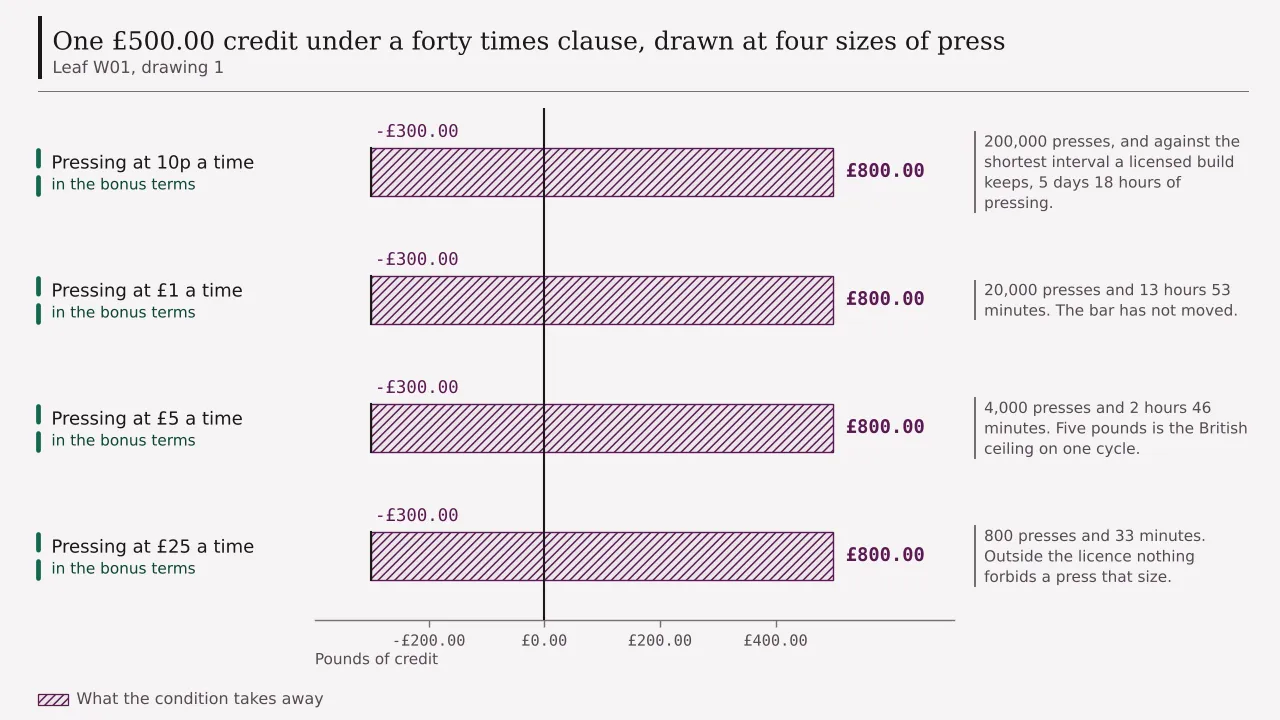
Four identical bars is the correct picture rather than a fault in the drawing. The rows differ in a quantity the ledger has no column for, which is how long each one takes, and that quantity is where the whole of the difference between a small stake and a large one has gone. A reader who wanted the difference drawn would need a second measured axis, and the point of printing the figures in the margin is that there is no second axis to have.
4
A ceiling over one press, and the size at which it wakes
Now the document. A condition capping what may be committed to one game cycle for as long as a credit is outstanding goes into general account terms far more often than into a promotional one, and it is drafted in pounds. Take £5.00 as the illustration, that being both a common shape and the figure Britain legislates, and read it against the press ladder from part three.
At 10p intended, the cap sits fifty times above the press and does nothing at all. A reader there could read the clause, understand it perfectly and act on it in no way, because there is no behaviour it forbids them. At £1 intended it sits five times above and still does nothing. At £5 it is exactly met. At £25 intended it forbids the press outright and forces the sitting from thirty-three minutes to two hours and forty-six minutes.
So one clause, one wording, and three completely different relationships to three readers depending on a number the clause never mentions. The condition sits in the general terms, two documents from any advertisement, and a reader who intends 10p a press has no reason to go and get it while a reader who intends £25 has every reason, and nothing in the advertisement distinguishes the two.
Price what the cap does. It changes the expected close by nothing whatever, since minus £300.00 is minus £300.00 at every press size, and it multiplies the shortest sitting by five. Expressed as a rate, the cap takes the expected cost of an hour down from £1,440.00 at £25 a press to £288.00 at £5. The arrangement has not got better. It has got slower, and at a fixed obligation of £20,000.00 slower means the same money leaves over a longer stretch.
A second condition in the same family is worth separating from it, because the pair get read as one. A cap over the press is a cap on turnover per cycle. A ceiling over what a bonus balance may release is a cap on an outcome. They are drafted in identical units and they bite at opposite ends, and somebody pressing £25 is within reach of the second on any run that goes at all well while somebody pressing 10p is not.
Assume the second ceiling at £100.00, which is this leaf’s illustration and not a figure any rule sets. Against a £20.00 credit it is five times the credit and bites only on a run that quintuples. Against a £500.00 credit it is one fifth of the credit and bites on almost any run where anything survives. The ceiling has not changed. The credit has, and the ceiling’s share of it has collapsed from five hundred per cent to twenty.
That collapse is the mechanism this whole leaf turns on and it runs in both directions. A fixed number of pounds set beside a growing credit becomes a smaller and smaller fraction of it. Where the fixed number is a ceiling, the ceiling tightens as the credit grows. Where it is a floor, the floor loosens. Either way the clause stays still and the stake moves past it, and the stake at which the crossing happens is the figure no document supplies.
5
An exit floor that decides everything, then decides nothing
The least a payment screen will consent to move is the clearest instance of a condition whose entire significance is a function of stake size. Set that floor at £20.00, an illustration chosen by this leaf, with no rule reachable from here publishing a standard one. It turns up at the cashier, meaning after registration and after identity work has begun, and never once before.
Read it against the ladder in part two and it changes character four times over. On a £20.00 credit the floor equals the entire credit, so a reader has to finish with every penny of it intact before the exit will acknowledge a balance at all. On a £100.00 credit it is a fifth. On a £500.00 credit it is a twenty-fifth. On a £12,500.00 credit it is roughly one part in six hundred, which is to say it has ceased to exist.
| Credit arriving | The £20.00 floor as a share of it | What a reader has to establish |
|---|---|---|
| £20.00 | 100 per cent | That nothing at all was lost on the way |
| £100.00 | 20 per cent | That a fifth of the credit survived |
| £500.00 | 4 per cent | That a twenty-fifth survived |
| £2,500.00 | 0.8 per cent | Effectively nothing |
| £12,500.00 | 0.16 per cent | Nothing the arithmetic can see |
A reader at the top of that table should not spend a second on the floor and a reader at the bottom of it should read nothing else, and the two of them are looking at an identical sentence in an identical document. Any page that lists an exit floor among the conditions worth checking, without saying for whom, has given half its readers advice that wastes their time and the other half advice that saves them the whole balance.
The route restriction travelling with the floor behaves the same way. Where a payment may only be sent back to an instrument that previously funded one, a balance built without a payment has no qualifying instrument and the reader has to make one. The cost of resolving that is a deposit, and a deposit is a fixed sum set against a balance of any size, so once more a condition that is decisive at £20.00 is trivia at £12,500.00.
There is an asymmetry inside the floor that is worth printing on its own. Money falling short of a floor releases nothing whatever, and how narrowly it fell short changes none of that, so a floor does not reduce value by degrees. It takes the lot or it takes none. A shortfall of forty pence and a shortfall of forty pounds finish identically, and only one of the pair reads like a disaster.
Set that beside the expected close and the picture completes. In expectation a £20.00 credit finishes at minus £12.00 and a £12,500.00 credit at minus £7,500.00, so in neither case is there anything for a floor to refuse. The floor decides the lucky branch and nothing besides, and which reader meets it there is settled by stake size rather than by anything the exit says.
6
Conditions drafted in pounds against conditions drafted as ratios
Everything in parts two to five sorts into two heaps and the sorting is the leaf’s main result. A condition written as a ratio applies identically at every size, because a ratio has no size. A condition written as a quantity of pounds changes state at one particular size, because a quantity of pounds does, and the size at which it changes is never stated beside the condition.
The ratio heap is short and holds everything a reader usually worries about. The multiple is forty whatever the credit. The return is 96 in the hundred whatever the press. The break-even is twenty-five at every size. A game weighting, where one applies, multiplies the staking by the same factor for everybody. Not one of these distinguishes a reader at £20.00 from a reader at £12,500.00 in any way at all.
The pounds heap is longer and is where the whole of the difference lives. A ceiling over the credit. A ceiling over the sum a credit is permitted to release. A ceiling over one press. A floor under what the exit will move. A floor under what a payment screen will accept. A threshold above which somebody starts asking where money came from. Each is a fixed quantity standing still while a stake walks past it.
| Condition | Drafted as | Where a reader settles it | What changes as the stake grows |
|---|---|---|---|
| The play-through multiple | A ratio | in the bonus terms | Nothing whatever |
| The return the reels pay back | A ratio | nowhere in writing | Nothing whatever |
| The contribution a build makes to the clause | A ratio | nowhere in writing | Nothing whatever |
| A ceiling over the credit itself | Pounds | in the bonus terms | Goes from idle to governing |
| A ceiling over what a credit may pay | Pounds | in the bonus terms | Tightens as a share of the credit |
| A ceiling over one press | Pounds | in the general terms | Goes from idle to binding |
| A floor under what the exit will move | Pounds | at the cashier | Goes from decisive to invisible |
| The point at which money is queried | Pounds | on the way out | Goes from unreachable to routine |
Three ratios and five quantities of pounds, and the three ratios are the ones every advertisement and every guide concentrates on. That is an understandable allocation of attention, since a ratio is easier to compare between arrangements, and it is exactly the wrong allocation for somebody at the far end of the table. The ratios are identical for them and for everybody else. The pounds are not.
The asymmetry has a second edge. A ratio can be compared between two arrangements without knowing anything about the reader. A pound figure cannot be compared at all until the reader’s own size is supplied, which means a published comparison of pound figures is meaningless on its own face. A ceiling of £100.00 is neither better nor worse than one of £500.00 until somebody says what is going to be put under it.
None of this is concealment, and the leaf gains nothing by pretending otherwise. The clauses are written down, in plain figures, in documents anybody may open. What is absent is the one sentence that would make them usable, which is the sentence saying at what stake each one starts to matter. No rule requires that sentence, no drafter has a reason to supply it, and so it sits nowhere in writing on every arrangement of this shape.
7
Which written conditions to open, sorted by the size of the stake
The practical form of part six is a reading list that changes with the reader. Below is this leaf’s own, built by taking each pounds-denominated condition and asking at what stake it crosses from idle to active. The thresholds are illustrations rather than market figures, and the shape of the list survives whatever numbers replace them.
| Intended size | Worth opening first | Safe to leave unread | Expected close per pound of credit |
|---|---|---|---|
| £20.00 of credit, 10p a press | The exit floor and the smallest payment the till takes | Press ceilings, payout ceilings, money queries | minus 0.6 |
| £100.00 of credit, 20p a press | The exit floor, then the payout ceiling | Press ceilings and money queries | minus 0.6 |
| £500.00 of credit, £1 a press | The payout ceiling and the ceiling over the credit | The exit floor | minus 0.6 |
| £2,500.00 of credit, £5 a press | The press ceiling and the discretionary clauses | The exit floor and the till minimum | minus 0.6 |
| £12,500.00 of credit, £25 a press | The press ceiling, then whatever governs a held payment | Every floor in the document | minus 0.6 |
That final column stands there to keep the rest of the table honest. None of the first three columns improves anybody’s expectation. A reading list is a way of spending a quarter of an hour where the quarter hour does most good, and the most it can do is stop somebody meeting a condition after the money has already moved.
The last two rows carry something the rows above them do not, which is the discretion an account agreement commonly keeps to shut an account down or withhold what has been won. Drafted in neither pounds nor ratios, it never switches, and its expected cost switches anyway, because what it can remove is the balance and the balance is the thing that grew. A discretion worth £50.00 at the head of the table is worth thousands at the foot.
A penalty has landed on drafting of that shape exactly once, and on a question where published evidence is otherwise thin, a single instance carries weight. A bill of £170,000 went out on 3 July 2025 against bonus rules holding back a power of precisely that kind, the regulator recording a breach of the condition on fairness and openness and the opacity such drafting carries. One licensee, one bill, and no ruling striking the wording out everywhere.
What the reading list cannot do is tell anybody where the thresholds actually sit on a given arrangement, and the leaf will not invent them. The method is to open the document, find each figure denominated in pounds, write it beside the stake the reader actually intends, and see which way the comparison falls. Four comparisons takes about ten minutes and replaces every general rule anybody could publish about what a large balance should check.
8
What Britain legislates about the size of one press
Britain regulates the size of a press directly, which is unusual, and the figures are exact. A statutory instrument of February 2025 puts a ceiling of £5 over everything one individual commits to a single game cycle, and £2 where that individual is under 25. The Commission’s own guidance attaches the calendar dates: the larger ceiling took effect on 9 April 2025, the smaller one on 21 May 2025, and the guidance records that neither reaches a casino product outside the reel-based family.
Folded into this leaf’s arithmetic those figures do real work. A £20,000.00 obligation at the £5 ceiling cannot be completed in fewer than 4,000 presses, and the pace floor on a reel-based build then puts two hours and forty-six minutes underneath it. Under the £2 ceiling the same obligation needs 10,000 presses and six hours fifty-six minutes. Those are the shortest sittings the British pair of rules permits, and no licensed build can go faster.
The same standard carries a requirement aimed at the dial rather than at the balance. A product may not push anybody towards a larger stake, towards recovering what has already gone, or towards committing more than they had settled on, and funds already committed get no automatic top-up, each refill needing its own deliberate choice. Those are rules about which way a dial gets nudged, and part three priced that dial at £282.24 an hour.
Two further duties attach to the size of money rather than the size of a press. Social responsibility code 5.1.1 asks that an incentive put in front of somebody designated high value or equivalent sit consistently with the licensing objectives, and that whatever the regulator has published about incentives of that sort be weighed first. And light-touch financial checks begin where net deposits pass a monthly threshold. That threshold began at £500 on 30 August 2024. A second step on 28 February 2025 took it down to £150.
One more runs in a single direction on purpose. The financial limits standard lets a customer cut a limit at once, while a raised limit has to sit through 24 hours and then be confirmed by a further deliberate act once the wait is over. Down quickly, up slowly. None of that promises anything about how a sitting turns out, and of everything named here it touches most directly on a decision taken while one is under way.
Nothing in the eight parts above assumes a British licence, and arrangements built for payments of this magnitude hold no Great Britain licence. Read the five rules just cited as a ledger of bounds and the absence prices itself, line by line. The statutory ceiling bounds one press at £5 or at £2; without it, £1,440.00 of expected cost in an hour stops being hypothetical. The interval between cycles bounds how quickly 4,000 presses can be got through; without it they have no shortest duration whatever. The rule against nudging bounds the direction a dial is pushed. The high-value limb of the incentives code bounds what may be built for a large payment. The asymmetry on limits bounds how fast one can be raised mid-sitting. Every bound on that ledger is a reason some figure above has a ceiling over it rather than an open end, and every one of them is absent here.
Note what the British rules do not do, because overstating them would be as inaccurate as ignoring them. None of them improves the expected close. Four pence in the pound stays four pence in the pound under every one of them, and minus 0.6 of a credit at forty times is minus 0.6 of a credit in Britain and elsewhere. What the rules bound is the rate, the pace and the direction of travel, which is to say they bound the clock rather than the arithmetic.
9
Running the switch test on any arrangement, at any size
The test is four questions and it takes less time than reading the promotional document it is applied to. Write down the stake actually intended, in pounds of credit and in pounds of press. Go through every condition and mark each one as a ratio or as a quantity of pounds. Ignore the ratios, since they treat everybody alike. Compare each pound figure against the two numbers written down first, and read only the conditions the comparison has woken up.
The first of those is harder than it looks, because intention drifts. Anybody writing £1 a press and then presses £5 has invalidated their own reading list without noticing, and the ceiling they skipped is the one now binding. The honest version of step one is to write the largest press seriously contemplated rather than the usual one, since a reading list built on the usual press fails at exactly the moment anybody would want it.
Step two produces the sort, and the sort is mechanical. Forty times, 96 in the hundred, twenty-five, thirty per cent contribution, half weighting: ratios, all of them, and all of them scale-free. Twenty pounds, a hundred pounds, five pounds, five hundred pounds a month: quantities, every one of which has a stake at which it switches. There is no third category and nothing in a bonus document falls outside the pair.
Step three is the one readers resist, because ignoring the ratios feels like ignoring the important part. The ratios are the important part of the arithmetic and the unimportant part of the reading, and that distinction repays keeping. Forty times has already been priced in part one at £1.60 of gap for every pound of credit, and that figure needs nothing from the reader except the credit it applies to.
Step four is the comparison, and its output is a short list rather than an opinion. For a £500.00 credit at £1 a press against the illustrations used here, the press ceiling is idle, the exit floor is idle, the payout ceiling is live and the credit ceiling is live. Two conditions to read instead of eleven, and the two chosen by arithmetic rather than by somebody else’s idea of what matters.
Applied across every size this leaf has worked, the test produces the same shape with different contents. At the small end the floors are everything and the ceilings are decoration. At the large end the ceilings are everything and the floors are decoration. In the middle both are live and the reading takes longest. The expected close is minus 0.6 of the credit at every point along that range, which is the figure the test cannot improve and is not trying to.
The honest summary of a large stake is therefore narrow and it is the thing the leaf was written to say. A larger balance buys no better multiple, no better return, no better break-even and no better weighting, because not one of that quartet has a size at which it could be better. It buys a shorter route to an identical expected close, and it walks a reader across several thresholds written in pounds and discussed nowhere.
Questions
- Do larger balances get better bonus terms than small ones?
- Not on the arithmetic. A credit of £500.00 under a forty times clause wants £20,000.00 of staking, gives up £800.00 to the margin and closes at an expected minus £300.00. Divide that trio by twenty-five and a £20.00 credit appears with its proportions untouched: £800.00 of staking, £32.00 gone to the margin, minus £12.00 at the close. The close sits at minus 0.6 of the credit at either end of the ladder and at every rung between them, because a multiple and a return are both ratios and a ratio has no size.
- What does a bigger stake per press actually change?
- The clock, and nothing else in the expectation. Hold a £20,000.00 obligation fixed and vary only the press: 200,000 presses at 10p, 20,000 at £1, 4,000 at £5, 800 at £25. Set against the 2.5 seconds that has to elapse before a licensed reel build will begin another cycle, those come to five days eighteen hours, thirteen hours fifty-three minutes, two hours forty-six minutes and thirty-three minutes. The expected close is minus £300.00 at the end of every one of them.
- How much does an hour of pressing cost at the largest stake Britain allows?
- An expected £288.00, against £5.76 at the 10p this leaf assumes, a difference of £282.24. The interval between cycles permits at most 1,440 presses inside an hour, so £7,200.00 crosses the reels at £5 a press against £144.00 at 10p, and whichever press is chosen, four pence out of every pound crossing them is expected not to come back. The press is fifty times larger, the hourly expectation is fifty times larger, and the proportion between them has not stirred.
- Which conditions start mattering only once the stake gets large?
- The ones drafted in pounds rather than as ratios. A ceiling over a single press is idle at 10p, idle at £1, exactly met at £5 and forbidding at £25. A ceiling over what a credit may pay out is five times a £20.00 credit and one fifth of a £500.00 credit, so it bites on almost any surviving run at the larger size. A threshold above which money gets queried is unreachable at the small end and routine at the large one.
- Which conditions stop mattering once the stake gets large?
- Floors, for the same reason in reverse. Put the exit floor at £20.00, a quantity this page supplies rather than quotes, and it stands at 100 per cent of a £20.00 credit, 20 per cent of £100.00, 4 per cent of £500.00 and 0.16 per cent of £12,500.00. At the far end of that range it has effectively ceased to exist. The floor never altered; the stake walked past it, and the size at which the crossing happens appears in no writing anywhere.
- Does the break-even multiple move for a larger balance?
- No. The break-even stands at twenty-five because four pence fits into a pound twenty-five times, making it a fact about the return and not about the money standing behind the press. A clause written at forty times is sixty per cent past that point on a £20.00 credit and sixty per cent past it on a £12,500.00 credit. Over twenty-five, the shortfall between what the margin is asked for and what a credit contains falls on the reader, and that is as true at the top of the ladder as at the bottom.
- What are the British stake limits on slots, exactly?
- A statutory instrument of February 2025 puts a ceiling of £5 over everything one individual commits to a single game cycle, and £2 where that individual is under 25. Both calendar dates come from the Commission’s own guidance, which puts £5 into force on 9 April 2025 and £2 six weeks later on 21 May 2025, confining each to online slots. Worked against this page’s figures, £5 a press means a £20,000.00 obligation takes at least 4,000 presses, and the interval between cycles then puts two hours and forty-six minutes under it.
- What does a reader with a large balance lose outside the British licence?
- Five bounds on the size and the speed of money going in. No statutory ceiling of £5 or £2 over a single press, so the £1,440.00 hourly expected cost at £25 a press stops being hypothetical. No minimum interval between game cycles, so a press count has no shortest duration. No rule against a product nudging a stake upwards or topping funds up unasked. No requirement that an incentive aimed at a high value customer answer to the licensing objectives. And no asymmetry making a limit easy to cut and slow to raise. None of the five improves the expected close, and all five bound the clock.
- How do I work out which conditions to read before I commit anything?
- Write down the largest press seriously contemplated and the credit expected to arrive. Go through the document marking each condition as a ratio or as a quantity of pounds. Skip the ratios, which treat everybody identically. Compare every pound figure against the two numbers first written down, and read only the conditions the comparison wakes up. On a £500.00 credit at £1 a press, against the illustrations used here, that leaves two conditions to read rather than eleven, and the expected close is minus £300.00 either way.