Terms read 19 October 2026 Leaf C08, revision 1
Thirty-four minutes of setting up, and the payment where it finally pays back
Taking up a rail nobody already holds costs an assumed 34 minutes before a penny moves: an account that does not exist, a check run on that account as well as on the gambling one, and conditions written by a party nobody has read. Valued at an assumed £12.00 an hour that is £6.80, and this leaf solves for the payment number at which it comes back.
Stated on the banner £15.00 The credit a matched payment of that size draws, with the rail used to make it never mentioned beside the figure. Stated, once you go and look £9.00 the wrong way What forty times leaves of that credit, written a document away, on 96p coming back per pound pushed over the reels. Not stated before the money goes in 34 minutes of setting up Nine minutes opening an account, eleven on a check that belongs to somebody else, fourteen on conditions nobody links to. All three are assumed here rather than measured.
Offers taking wallet payments, with the written terms read
Every destination in this file is bought advertising. The site is paid a fee if a reader goes on to register, and no figure printed below moves because of it.
Bonus Spins UK Slip 01
Betportal
Ceiling as a multiple
The drop
€15.00
€1.00 in the euro
The claim reads €15.00. Once the terms beside it have applied, €0.00 of it can leave. The difference is the drop.
7 of the 15 terms on this slip could not be read before the money went in
Spins priced at this site's own 10p a spin, which the operator does not publish
Stated
€15.00
The claim as it is printed, before a single term has been applied to it.
Headline paid as spins
150 spins at 10c each, which is €15.00 of the figure above.
6 Nowhere
What one spin is worth
No unit is published for a spin, so the count is priced at this site's own 10p a spin. At half that price every figure below halves with it.
Match and other credit not priced
300% of three deposits, to a ceiling of €1,000. A share of a deposit nobody has made yet is not a sum, so no figure stands on this line and none is carried below.
Qualified
-€14.40
Written down somewhere, and taking part of the claim back. Each term carries the place it is written and the sum it takes.
2 Written terms at a distance this record does not establish
Play-through -€14.40
Carrying €14.40 through 35 times stakes €504.00 and costs €20.16 of it at 96 per cent return. That prices above the €14.40 there is to charge it against, so the whole of the credit goes and the line is held at that. The multiple sits on the bonus.
2 Written terms at a distance this record does not establish
Game weighting not priced
Slots only count towards the play-through. No contribution percentage is published, so the line above has been worked at full weight, which is the kindest reading there is.
2 Written terms at a distance this record does not establish
Ceiling on the winnings not priced
5x the bonus.
2 Written terms at a distance this record does not establish
Clock on the credit not priced
14 days.
2 Written terms at a distance this record does not establish
Largest stake while it runs not priced
€5.
3 Public record
Licence, and who holds it not priced
Licensed in Anjouan, Comoros, held by BetPortal Gaming Ltd, with Excite Ultra Media Ltd, reference ALSI-202601040-FI2. A register entry settles who holds a licence and what it permits. It does not settle who is running the site this morning.
4 Cashier
Smallest qualifying deposit your money
€20 a stage. That is €20.00 of your own money, and it is never netted into a drop.
5 On the way out
Checks before a withdrawal not priced
Documents before the first withdrawal.
Unstated
-€0.60
Applying without having been published anywhere, and costing money all the same.
6 Nowhere
What a spin hands back -€0.60
Staking a spin returns 96 per cent of it, so that share of the batch is the house's before a reel turns. This site works at that return and the operator publishes none where the claim is made.
6 Nowhere
Forfeited by rule cost unknown
Nothing is published under this heading, and it applies regardless.
6 Nowhere
Charge on the way out cost unknown
No charge on the way out is published as a figure, so nothing comes off this line. A charge that exists unpublished would come straight off whatever survives.
6 Nowhere
Smallest withdrawal allowed cost unknown
No smallest withdrawal is published as a figure. A floor nobody has published is still a floor, and it decides whether a small balance can move at all.
No Great Britain licence
Terms read 19 October 2026
Bonus Spins UK Slip 02
WinBeast
Ceiling as a sum
The drop
€50.00
€1.00 in the euro
The claim reads €50.00. Once the terms beside it have applied, €0.00 of it can leave. The difference is the drop.
8 of the 15 terms on this slip could not be read before the money went in
Spins priced at this site's own 10p a spin, which the operator does not publish
Stated
€50.00
The claim as it is printed, before a single term has been applied to it.
Headline paid as spins
500 spins at 10c each, which is €50.00 of the figure above.
6 Nowhere
What one spin is worth
No unit is published for a spin, so the count is priced at this site's own 10p a spin. At half that price every figure below halves with it.
Match and other credit not priced
50% to 100% of five deposits, each to a ceiling of €1,000, and a €650 free bet. A share of a deposit nobody has made yet is not a sum, so no figure stands on this line and none is carried below.
Qualified
-€48.00
Written down somewhere, and taking part of the claim back. Each term carries the place it is written and the sum it takes.
2 Written terms at a distance this record does not establish
Play-through -€48.00
Carrying €48.00 through 40 times stakes €1,920.00 and costs €76.80 of it at 96 per cent return. That prices above the €48.00 there is to charge it against, so the whole of the credit goes and the line is held at that. The multiple sits on the bonus and the winnings from the spins.
2 Written terms at a distance this record does not establish
Game weighting not priced
Slots, titles vary by country count towards the play-through. No contribution percentage is published, so the line above has been worked at full weight, which is the kindest reading there is.
2 Written terms at a distance this record does not establish
Ceiling on the winnings not priced
€100 a batch of spins.
2 Written terms at a distance this record does not establish
Clock on the credit not priced
7 days, spins 1 day.
3 Public record
Licence, and who holds it not priced
Licensed in Curaçao, holder not named on the site. A register entry settles who holds a licence and what it permits. It does not settle who is running the site this morning.
4 Cashier
Smallest qualifying deposit your money
€20 a stage. That is €20.00 of your own money, and it is never netted into a drop.
5 On the way out
Checks before a withdrawal not priced
Documents before the first withdrawal.
Unstated
-€2.00
Applying without having been published anywhere, and costing money all the same.
6 Nowhere
What a spin hands back -€2.00
Staking a spin returns 96 per cent of it, so that share of the batch is the house's before a reel turns. This site works at that return and the operator publishes none where the claim is made.
6 Nowhere
Largest stake while it runs cost unknown
Nothing is published under this heading, and it applies regardless.
6 Nowhere
Forfeited by rule cost unknown
Nothing is published under this heading, and it applies regardless.
6 Nowhere
Charge on the way out cost unknown
No charge on the way out is published as a figure, so nothing comes off this line. A charge that exists unpublished would come straight off whatever survives.
6 Nowhere
Smallest withdrawal allowed cost unknown
No smallest withdrawal is published as a figure. A floor nobody has published is still a floor, and it decides whether a small balance can move at all.
No Great Britain licence
Terms read 19 October 2026
Bonus Spins UK Slip 03
EliteSpin
Longest spin window
The drop
£50.00
£1.00 in the pound
The claim reads £50.00. Once the terms beside it have applied, £0.00 of it can leave. The difference is the drop.
8 of the 15 terms on this slip could not be read before the money went in
Spins priced at this site's own 10p a spin, which the operator does not publish
Stated
£50.00
The claim as it is printed, before a single term has been applied to it.
Headline paid as spins
500 spins at 10p each, which is £50.00 of the figure above.
6 Nowhere
What one spin is worth
No unit is published for a spin, so the count is priced at this site's own 10p a spin. At half that price every figure below halves with it.
Match and other credit not priced
50% to 100% of five deposits, each to a ceiling of £1,000. A share of a deposit nobody has made yet is not a sum, so no figure stands on this line and none is carried below.
Qualified
-£48.00
Written down somewhere, and taking part of the claim back. Each term carries the place it is written and the sum it takes.
2 Written terms at a distance this record does not establish
Play-through -£48.00
Carrying £48.00 through 40 times stakes £1,920.00 and costs £76.80 of it at 96 per cent return. That prices above the £48.00 there is to charge it against, so the whole of the credit goes and the line is held at that. The multiple sits on the bonus and the winnings from the spins.
2 Written terms at a distance this record does not establish
Game weighting not priced
Slots count towards the play-through. No contribution percentage is published, so the line above has been worked at full weight, which is the kindest reading there is.
2 Written terms at a distance this record does not establish
Ceiling on the winnings not priced
5x the bonus.
2 Written terms at a distance this record does not establish
Clock on the credit not priced
7 days, spins 3 days.
3 Public record
Licence, and who holds it not priced
Licensed in Costa Rica, held by PrimeTier Limited. A register entry settles who holds a licence and what it permits. It does not settle who is running the site this morning.
4 Cashier
Smallest qualifying deposit your money
£20 a stage. That is £20.00 of your own money, and it is never netted into a drop.
5 On the way out
Checks before a withdrawal not priced
Documents before the first withdrawal.
Unstated
-£2.00
Applying without having been published anywhere, and costing money all the same.
6 Nowhere
What a spin hands back -£2.00
Staking a spin returns 96 per cent of it, so that share of the batch is the house's before a reel turns. This site works at that return and the operator publishes none where the claim is made.
6 Nowhere
Largest stake while it runs cost unknown
Nothing is published under this heading, and it applies regardless.
6 Nowhere
Forfeited by rule cost unknown
Nothing is published under this heading, and it applies regardless.
6 Nowhere
Charge on the way out cost unknown
No charge on the way out is published as a figure, so nothing comes off this line. A charge that exists unpublished would come straight off whatever survives.
6 Nowhere
Smallest withdrawal allowed cost unknown
No smallest withdrawal is published as a figure. A floor nobody has published is still a floor, and it decides whether a small balance can move at all.
No Great Britain licence
Terms read 19 October 2026
Bonus Spins UK Slip 04
Crown Jewelz
Multiple unpublished
The drop
NOT WORKED
The multiple is not published in the operator's own terms. Since the sum cannot be worked around it, none is worked.
9 of the 14 terms on this slip could not be read before the money went in
No drop worked
Stated
£15.00
The claim as it is printed, before a single term has been applied to it.
Headline paid as spins
150 spins at 10p each, which is £15.00 of the figure above.
6 Nowhere
What one spin is worth
No unit is published for a spin, so the count is priced at this site's own 10p a spin. At half that price every figure below halves with it.
Match and other credit not priced
200% of the first deposit, then 150% twice, each to a ceiling of £1,000. A share of a deposit nobody has made yet is not a sum, so no figure stands on this line and none is carried below.
Qualified
NOT WORKED
Written down somewhere, and taking part of the claim back. Each term carries the place it is written and the sum it takes.
2 Written terms at a distance this record does not establish
Play-through not priced
40x the bonus, reported rather than published by the operator.
2 Written terms at a distance this record does not establish
Game weighting not priced
Slots count towards the play-through. No contribution percentage is published, so the line above has been worked at full weight, which is the kindest reading there is.
3 Public record
Licence, and who holds it not priced
Licensed in Curaçao, number not verified, holder not named on the site. A register entry settles who holds a licence and what it permits. It does not settle who is running the site this morning.
4 Cashier
Smallest qualifying deposit your money
£20. That is £20.00 of your own money, and it is never netted into a drop.
5 On the way out
Checks before a withdrawal not priced
Documents before the first withdrawal.
Unstated
NOT WORKED
Applying without having been published anywhere, and costing money all the same.
6 Nowhere
Ceiling on the winnings cost unknown
No ceiling is published. Nothing is assumed in its place.
6 Nowhere
Clock on the credit cost unknown
Nothing is published under this heading, and it applies regardless.
6 Nowhere
Largest stake while it runs cost unknown
Nothing is published under this heading, and it applies regardless.
6 Nowhere
Forfeited by rule cost unknown
Nothing is published under this heading, and it applies regardless.
6 Nowhere
Charge on the way out cost unknown
No charge on the way out is published as a figure, so nothing comes off this line. A charge that exists unpublished would come straight off whatever survives.
6 Nowhere
Smallest withdrawal allowed cost unknown
No smallest withdrawal is published as a figure. A floor nobody has published is still a floor, and it decides whether a small balance can move at all.
No Great Britain licence
Terms read 19 October 2026
Every figure in the second and third columns is this site's own working and nothing an operator has published. A claim is priced as printed, then the share a spin hands back at 96 per cent return comes off it, then what playing the multiple through costs at the same return, and then whatever a published ceiling, a charge on the way out or a floor on the smallest withdrawal takes from what has survived. The drop is the difference between the first figure and the last. The two columns add back up to it exactly, so no money leaves a slip without a term and a place beside it.
Which column a term falls in is settled by one question: has anybody written it down. A charge a reader meets at the payment screen is written down, and it stands in the second column with the cashier against it. A condition that binds without ever having been set down stands in the third, whatever it costs. Inside each column the terms run outwards from the banner, so the order itself says how far a reader would have had to go.
A count of spins has no unit until one is supplied. Where an operator publishes what one of its own spins is worth, that figure is used and the first column says it is theirs. Where none is published, this site's own 10p a spin stands in its place and every figure below moves in proportion with it. Where the multiple itself is unpublished, no drop is worked at all, because that is the one figure the sum cannot be done without.
Three words stand where a figure cannot. Not priced is a term that is written down and carries no number the arithmetic can take. Cost unknown is a term nobody has written down, costing something nobody has put a number on. Your money is money of the reader's own, which is never netted into a drop.
None of the operators in this file holds a Great Britain licence, so none of the duties that licence carries reaches them. Each of those duties is published in its own right, which is what makes its absence here something a reader can check rather than take on trust. Every gambling company licensed in Great Britain belongs to Gamstop Online, so a reader who has shut themselves out through the scheme is not shut out here. Social Responsibility Code 5.1.1 has held a play-through to a maximum of ten times the bonus funds since 19 January 2026, and it binds a licence holder and nobody else. Asked in a post of 21 October 2025 what is lost along with the licence, the Gambling Commission's Director of Enforcement and Intelligence answered: "unfair gaming practices, financial loss, and a lack of recourse if things go wrong". The same post puts blocked payouts, and withdrawal limits pitched high enough to be unreachable, among the behaviour the Commission has recorded. Nobody under 18 may hold an account at any of them.
Terms are reproduced in the wording their operator published, and each slip is dated with the day somebody sat down and read them. 19 October 2026 is the oldest of those dates. Anybody claiming an offer is bound by that operator's full terms, which are elsewhere, and never by a line standing here.
1
Thirty-four minutes, and the three places they go
A payment screen listing a rail the reader has never used is offering two things at once, and only one of them looks like an offer. The first is a way of moving money. The second is a project: register somewhere new, satisfy whoever runs it, and take on a contract that was drafted by a party with no connection to the arrangement being advertised. The project is the subject here, and it is priced in minutes before it is priced in pounds.
Three stages, with a figure beside each. Opening an account that does not yet exist is put at 9 minutes, which is this leaf’s assumption and not a measurement anybody made. Satisfying whatever check that account runs is put at 11 minutes of a reader’s actual attention, which is also assumed, and deliberately counts only the attention rather than any waiting. Reading the conditions the new account comes with is put at 14 minutes, assumed on the same basis.
Thirty-four minutes in total. Converting that into money takes one more assumption, and this leaf puts £12.00 on an hour of a reader’s own time, declared once here so that the figures underneath can rest on it without arguing the point again. Nine minutes is £1.80, eleven minutes is £2.20, fourteen minutes is £2.80, and the three together come to £6.80.
Two properties of that £6.80 decide how the rest of this leaf is organised. It is paid once, whatever happens afterwards, which makes it a fixed cost in the ordinary sense. And it is paid before any payment is made, so no arrangement, no credit and no multiple has yet had a chance to apply to anything. A fixed cost paid at the front is recovered by repetition or it is not recovered at all.
Against the 10p press value assumed across this site, £6.80 is sixty-eight presses, and sixty-eight presses are expected to give back £6.53. That conversion is not a claim that setting up an account is like gambling. It is a way of putting a quantity of somebody’s evening into the same unit as everything else on the page, so that it can be compared rather than merely mentioned.
34 assumed minutes spent before any payment screen has been asked to move a penny
2
The identical payment made on something already held
The comparison that makes the £6.80 mean anything is the same payment made on something the reader already has. That path has an adoption cost of nought minutes and nought pounds, because every stage in part one has already been completed at some earlier date and for some unrelated reason. Whatever the payment itself costs, the project around it costs nothing at all.
So the two paths differ by exactly £6.80 at the first payment and by nothing thereafter, in the adoption column. Everything else about them may differ too, and nothing here is sourced on any of it: no tariff, no settlement interval, no floor and no ceiling appears on a page this site may cite. What follows therefore holds the per-payment advantage as an unknown and solves for it, that being the sole honest way of handling a quantity nobody publishes.
Call that unknown the edge, meaning whatever the unfamiliar rail is worth per payment compared with the familiar one, in pence. Where the edge is nought the £6.80 never comes back and the project has no financial case whatever. Where the edge is positive the project recovers at a payment number falling as that edge climbs. Both of those are statements about arithmetic rather than about any particular rail.
One thing is worth saying before the solving starts, because it cuts against the whole framing. A reader who would have opened the new account anyway, for reasons having nothing to do with a gambling payment, has an adoption cost of nought as well. The £6.80 belongs only to somebody opening it for this purpose, and attributing a cost to a decision that was already taken would be the same error as netting a shop’s leftover into a bonus.
The honest statement of the comparison is therefore narrow. For a reader who takes up a rail solely because a payment screen listed it, the first payment carries £6.80 that the familiar path does not, and each payment after it carries nothing but the edge, at whatever size that proves to have.
3
When each cost in the chain becomes visible
This site sorts figures by where they could have been settled, and the chain in part one sorts unusually badly. Not one of its three stages is visible from the advertisement, and two of them are not visible until after an account somewhere else has been created.
The credit a matched payment draws is settled . Forty times lives in the promotional terms. That the unfamiliar rail is offered at all is settled at the cashier, since a row of pictures is a property of a payment screen. What that rail asks of a new customer is settled at a second cashier altogether, and how long the reading takes is settled nowhere in writing.
| Stage of taking it up | Assumed minutes | At £12.00 an hour | First visible |
|---|---|---|---|
| Opening an account that does not exist | 9 | £1.80 | Once the payment screen lists it |
| Satisfying the check that account runs | 11 | £2.20 | After the new account is opened |
| Reading the conditions it comes with | 14 | £2.80 | Whenever the reader chooses |
| The three taken together | 34 | £6.80 | Never, as one figure |
No home exists for the bottom row, which is exactly the row a reader would want. No party in the chain has any reason to add the three stages together, because the three stages belong to three different parties. The advertisement owns none of them. The payment screen owns one. The new account owns two, and would describe neither as a cost.
Observe also that the second stage has an odd status. A check run by the new account is separate from any check run by the gambling account, and the reader meets both. Neither party is doing anything improper by running one, and neither has any obligation to tell the reader in advance that the other one exists. The duplication is a consequence of two accounts, not of anybody’s drafting.
A first payment read as a payment £15.00 The same payment with the chain counted in £8.20 Carried by the first payment alone £6.80
4
Solving for the payment where the two lines cross
Here is the arithmetic the leaf was built for. A fixed outlay of £6.80 is recovered when the accumulated edge reaches it, so the payment number at which the two paths cross is £6.80 divided by the edge, rounded up to a whole payment. Nothing about that depends on any rail in particular, and every figure in it is either assumed here or solved for.
At an edge of 25p a payment the crossing is 27.2, so the twenty-eighth payment is the first one in profit. At 50p it is 13.6, so the fourteenth. At £1.00 it is 6.8, so the seventh. At 10p it is 68, which is a different kind of answer: sixty-eight payments is not a habit, it is a lifestyle, and a reader who does not expect to make that many has their answer without needing the rest of the table.
| Assumed edge per payment | Crossing, exactly | First payment in profit | At two payments a month | What the reader is really deciding |
|---|---|---|---|---|
| Nothing at all | No crossing | None | Never | Whether convenience alone is worth 34 minutes |
| 10p | 68.0 | The 68th | 34 months | Whether the habit lasts the better part of three years |
| 25p | 27.2 | The 28th | 14 months | Whether the habit lasts a year and a bit |
| 50p | 13.6 | The 14th | 7 months | Whether the habit lasts most of a year |
| £1.00 | 6.8 | The 7th | Under 4 months | Whether the habit lasts a season |
The fourth column is where the table stops being arithmetic and starts being useful. Converting a payment count into calendar time turns an abstract break-even into a question anybody can answer about themselves, which is whether they expect to still be doing this in fourteen months. A reader who cannot say yes to that has no financial case for the project at a 25p edge, however much that edge proves to be worth.
Running the same sum in time rather than in money gives a cross-check that needs no hourly rate at all. If the unfamiliar rail saves twenty seconds at each payment, which is assumed here, then 34 minutes is 2,040 seconds and the crossing is at 102 payments. That answer is worse than every money answer above, which says something about how expensive 34 minutes is when the thing it buys is measured in seconds.
The honest concession on this leaf belongs here, because the table is not a verdict. Somebody who makes payments steadily over several years genuinely does recover the chain, and at a £1.00 edge recovers it inside a season. A fixed cost is not an argument against a thing. It is an argument for knowing the number of repetitions it needs, and the number is the only part a payment screen will never show.
5
A second check is a second place a demand lands
Eleven minutes was put against the second stage and it is the stage that deserves unpacking, because the minutes are the least of it. Taking up a new account means a second party forms a view about the reader, holds whatever documents that view rested on, and may come back later with a further question. None of that is improper and all of it is additional.
Count the places a demand for documents can now arrive from and the figure doubles. One party is the gambling account, which has its own reasons and its own timing. The other is the newly opened one, whose grounds are its own and unconnected with gambling altogether. A reader who passed one check has established nothing whatever about the other, because the two parties share no process and reach no joint conclusion.
The asymmetry worth noticing is about when. A check at the front of a relationship costs minutes and delays nothing much, because nothing is waiting behind it. A check that arrives later costs whatever is waiting, and on a payment chain with two accounts in it the later check can sit on either of them. Two accounts therefore produce two independent chances of a demand arriving at the moment money is trying to move.
Pricing that honestly means admitting it has no fixed figure, which is the accurate answer rather than a dodge. A demand that is answered costs attention. A demand that cannot be answered costs whatever was behind it. The expected cost sits between the two, decided by facts about the reader rather than by anything either party published.
What can be priced is the structure. Before adoption there was one party capable of asking. Afterwards there are two, and both of them sit on the path the money takes. Nothing in the advertisement, the promotional terms or the payment screen mentions that the count has changed, and nothing obliges any of them to.
6
Conditions written by somebody nobody has read
Fourteen minutes was put against reading the new account’s conditions, and that figure is generous in one direction and meaningless in another. Generous, because very few readers spend fourteen minutes on a document nobody required them to open. Meaningless, because the thing being bought with those minutes is not comprehension but the ability to predict one’s own position later.
Set out what has actually changed. Before adoption a reader was party to the gambling account’s conditions and to nothing else relevant. Afterwards they are party to a second contract, written by a party they had not previously dealt with, covering a balance that is not the gambling balance, with its own account closure provisions, its own dormancy provisions and its own rules about where money may be sent.
The practical consequence turns up only at the exit and it is easy to state. Where money comes back along the path it went out on, the conditions deciding what happens to it at the far end are the new account’s, not the gambling account’s. A reader who read one document carefully and the other not at all has read the wrong one for that question, and nothing told them which was which.
Counting writings rather than parties is why this leaf is laid out as it is. Before adoption, one writing matters for the exit. Afterwards, two do, by two authors, with neither referring to the other. Not a penny of the arrangement’s arithmetic has moved, while the documents a reader needs in order to predict their own position have gone from one to two.
There is a cheerful reading of the same fact and it should be printed. The second document is published, open, and readable today by anybody, with no account anywhere and no payment made. It is the only item in the whole chain that can be settled in advance at no cost whatsoever, which makes fourteen assumed minutes spent before adoption worth considerably more than fourteen spent after.
7
Fifteen pounds credited, six hundred staked
Now put the chain beside the thing it is a chain to. A payment of £15.00 matched in full draws a credit of the same size. Forty multiples of it want £600.00 over the reels, which at the 10p press value assumed here is six thousand presses.
The margin keeps four pence of every staked pound, so £600.00 of turnover is expected to shed £24.00. Take that from the credit and the expected close is minus £9.00. The formula agrees: a leakage of four hundredths repeated forty times totals 1.6, which leaves a credit standing at minus six tenths once it is subtracted from one, and six tenths of fifteen pounds is nine pounds facing backwards. Weighting is held at one, so nothing is concealed inside it.
Credit read off the match £15.00 Expected close at forty times minus £9.00 Distance between the readings £24.00
So the single unread clause is worth £24.00 and the entire adoption chain is worth £6.80. The chain is 28.3 per cent of the clause, which is the proportion this leaf exists to establish and it runs against the impression a payment screen gives. A screen presents the rail as the decision and says nothing about the multiple. The arithmetic puts the multiple at roughly three and a half times the weight.
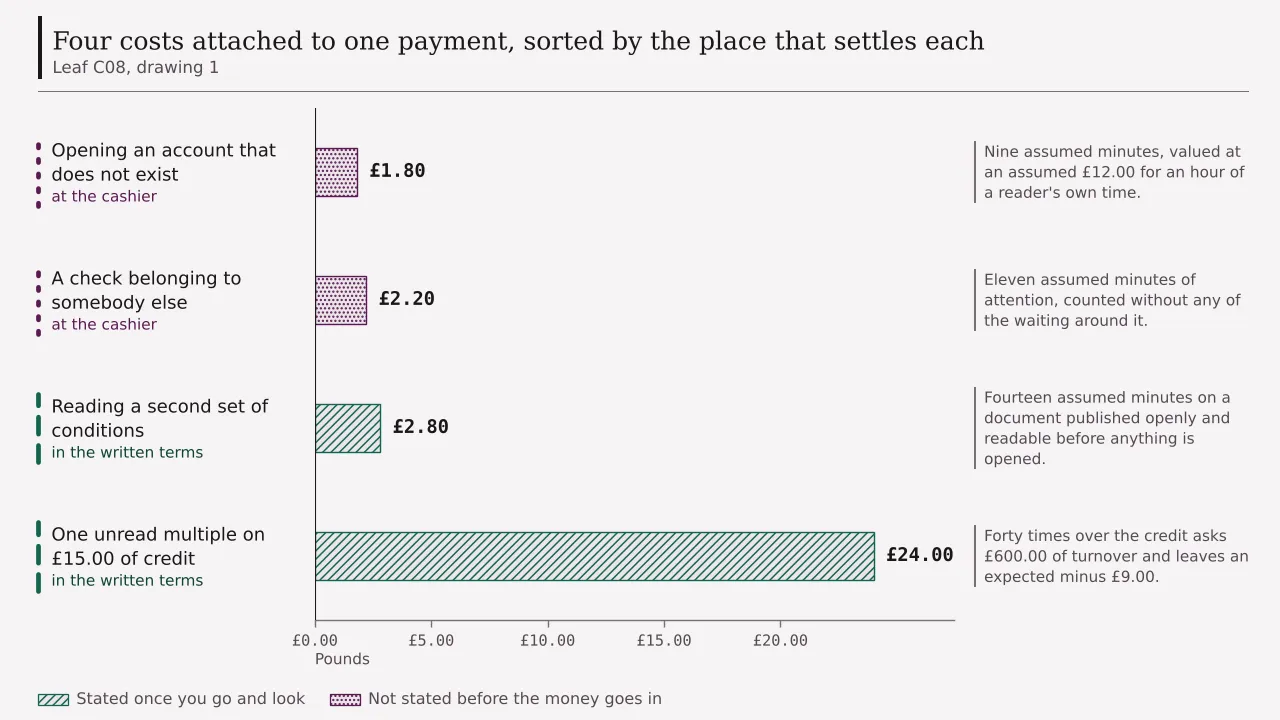
Two further differences between the bars matter more than their heights. The three small ones are paid once and then never again, while the large one is paid on every credit taken up. And the three small ones are the reader’s own time, which they can decline to spend by not adopting anything, while the large one is a property of a clause they did not write.
Add the two together and the first payment on a new rail carries £30.80 of combined weight against a £15.00 credit, with £6.80 of it spent before the screen was reached and £24.00 of it waiting in a document. Printing that sum is not the same as adding the figures, which part two warned against: it is a statement about one payment on one occasion, and the two components part company immediately afterwards.
8
What stands behind a balance, and in which of the two
Adoption leaves a reader with money in two places rather than one, and the British rule worth naming on that subject is about what each place has to tell them. It is a disclosure duty rather than a guarantee, and the distinction is the point.
Any licensee sitting on customer money owes its terms a statement of whether that money is protected should the business fail, at what level, and by what means. That statement follows a rating system the regulator specifies, goes to the customer in writing, and needs their acknowledgement before the money may be gambled with, arriving with a first payment in and once again with whichever payment first follows a change in the protection arrangements. Where the rating used is one of the two that say the money is not protected, a reminder is owed every six months, naming what is held to that customer’s credit and taking a fresh acknowledgement, under a paragraph in force since 31 October 2025.
Promotions reached through an unfamiliar rail hold no Great Britain licence, which on this subject removes the only duty that would have made the second balance legible. Nobody then owes a rating, so a reader cannot tell protected money from unprotected. Nobody owes a written statement on the first payment, so the acknowledgement that normally has to be given before the money is played with never arises. Nobody owes a reminder twice a year naming the sum held. A reader who spent 34 assumed minutes opening an account elsewhere has therefore taken on a second balance, and neither of the two places now holding their money owes them a sentence about what stands behind it.
Fold that into the chain and a fourth cost appears that has no minutes against it. Before adoption the reader had one balance to reason about. Afterwards they have two, and the arithmetic in part four made no allowance for the second one, because nobody publishes a figure that could be put there. It is recorded here as an unpriced item rather than estimated, which is the rule this site follows wherever a quantity has no source.
One point of fairness is owed to the rail. Whatever the party running the new account does or does not disclose, the duty above was written for gambling licensees and not for them, so its absence is not a failing on their part. The honest statement is structural: the duty attaches to one kind of business, the reader now deals with two kinds, and outside the British licence it attaches to neither of them.
The reader’s cheapest response costs nothing and is the same one part six pointed at. The newer account’s published conditions say what they say about a balance, and they can be read today without opening anything. That is not equivalent to a rating under a specified system, and it is what is actually available.
9
The whole sum, written out for anything unfamiliar
The method carries over to any payment route a reader does not already hold, and none of the assumed figures above is needed to run it. Write down the stages of taking it up. Put minutes against each, from your own experience rather than from anybody’s claim. Add them. Multiply by whatever an hour of your own time is worth to you. That is the fixed outlay.
Then estimate the per-payment edge, and where no figure can honestly be put there, write nought and read the opening row of part four’s table. Divide the fixed outlay by the edge and round upwards to a whole payment. Convert the result into calendar time at your own rate of payments, because a count is abstract and a number of months is not.
Three cautions keep the answer honest. Count only the attention, never the waiting, or the figure inflates on a quantity nobody controls. Attribute nothing to a decision that was already taken for other reasons, since an account somebody wanted anyway has an adoption cost of nought. And keep the fixed outlay in its own column, never folded into what a clause does to a credit, because one of them is paid once and the other is paid every time.
Applied to this leaf’s own figures the method prints four numbers and stops. Thirty-four assumed minutes, £6.80 at an assumed £12.00 an hour, a crossing at the twenty-eighth payment on an assumed 25p edge, and fourteen months of a two-payment habit to reach it. Beside them sits £24.00, which is what one unread clause does to £15.00 of credit and is paid again on every credit after.
The single action this leaf points at is free and takes less time than the chain it prices. Before taking up anything new, work out the crossing. If the number of payments is larger than the number you expect to make, the arithmetic has answered the question, and no figure on a payment screen was ever going to answer it for you.
The 28th payment, where an assumed 25p edge finally repays an assumed £6.80 of setting up
Questions
- What does it cost to start using a payment rail I do not already have?
- Thirty-four minutes on this leaf’s assumptions, split nine for opening an account that does not exist, eleven of actual attention on the check that account runs, and fourteen on the conditions it comes with. Valued at an assumed £12.00 for an hour of a reader’s own time, that is £1.80, £2.20 and £2.80, or £6.80 in total. Every one of those figures is assumed here rather than measured, and none is published anywhere.
- How many payments does it take before that is worth it?
- Divide £6.80 by whatever the new rail is worth per payment and round upwards. At an assumed 25p the crossing is 27.2, so the twenty-eighth payment is the first in profit, which at two payments a month is fourteen months away. At 50p it is the fourteenth payment and seven months. At £1.00 it is the seventh and under four months. At nothing per payment there is no crossing at all.
- Does the setting-up cost count against the bonus?
- No, and keeping them apart is the discipline this leaf asks for. The setting-up cost is a reader’s own time, paid once, and it would be identical on a payment with no promotion attached to it. What a clause does to a credit is paid again on every credit and moves when the terms move. One of them is a fixed outlay and the other is a recurring difference, so adding them produces a figure that describes nothing.
- What is £15.00 of credit worth at forty times?
- An expected minus £9.00. Forty times over the credit asks £600.00 across the reels, which is six thousand presses at the 10p assumed here, and the margin keeps four pence of every staked pound, so £24.00 is expected to go. The formula agrees: a leakage of four hundredths repeated forty times totals 1.6, which leaves a credit standing at minus six tenths once it is subtracted from one, and six tenths of fifteen pounds is nine pounds facing backwards.
- How big is the setting-up cost compared with the terms?
- About 28.3 per cent of it. The whole chain comes to £6.80 on this leaf’s assumptions, while one unread multiple takes £24.00 off £15.00 of credit. A payment screen presents the rail as the decision and is silent about the multiple, and the arithmetic puts the multiple at roughly three and a half times the weight of everything the screen is drawing attention to.
- Why does an account elsewhere mean a second check?
- Because two parties are now involved and they share no process. The gambling account forms its own view on its own timing. The newer one forms a separate view, on grounds unconnected with gambling altogether. Passing one establishes nothing about the other, so the number of places a demand for documents can arrive from has gone from one to two, and both of them sit on the path the money takes.
- Whose conditions decide what happens to money coming back?
- At the far end of the path, the new account’s rather than the gambling account’s. That is the practical reason the fourteen assumed minutes are worth spending: the second document covers a balance that is not the gambling balance, with its own provisions on closure, dormancy and where money may be sent. A reader who read one document carefully and the other not at all has read the wrong one for that question.
- Is there anything I can settle before opening anything?
- One item in the chain, and it is the cheapest. The new account’s conditions are published and readable today, with no account anywhere and no payment made, which makes fourteen minutes spent before adoption worth considerably more than fourteen spent afterwards. The other two stages cannot be reached until the account exists, and the fact that the rail is offered at all cannot be seen until the payment screen is.
- Does anyone have to tell me whether my balance is protected?
- A British licensee does. It must state in its terms whether customer money is protected if the business fails, at what level and by what means, following a rating system the regulator specifies, in writing, acknowledged by the customer before the money is gambled with, on the first deposit and again on the first deposit after the arrangements change; where a not-protected rating is used a reminder naming the sum held is owed every six months, a paragraph in force from 31 October 2025. Promotions reached through an unfamiliar rail hold no Great Britain licence, so none of that is owed, and the duty never reached the newer account in the first place.
- What is the shortest version of this sum?
- Four numbers and one caution. Thirty-four assumed minutes, £6.80 at an assumed £12.00 an hour, a crossing at the twenty-eighth payment on an assumed 25p edge, and fourteen months of a two-payment habit to get there. The caution is that an account somebody wanted anyway costs nought to adopt, so the whole calculation belongs only to a reader taking one up because a payment screen listed it.